
Crypto World
Tether Freezes $344 Million USDT on Tron in OFAC Coordination

Tether froze $344 million in USDT (USDT) across two Tron wallets in coordination with the Office of Foreign Assets Control and U.S. law enforcement, the company confirmed on April 23.
The action targets addresses flagged for activity tied to sanctions evasion and criminal networks. It represents Tether’s largest single enforcement action to date.
Freeze Tied to Active U.S. Investigations
The two blacklisted wallets held approximately $212.9 million and $131.3 million respectively. Tether said U.S. authorities shared intelligence linking the addresses to unlawful conduct before the freeze was executed, preventing further movement of funds
“USD₮ is not a safe haven for illicit activity. When credible links to sanctioned entities or criminal networks are identified, we act immediately and decisively,” read an excerpt in the announcement, citing Tether CEO Paolo Ardoino who framed the response as part of a broader compliance posture.
Tether now works with more than 340 law enforcement agencies across 65 countries. That cooperation has supported over 2,300 cases globally, with more than 1,200 tied to U.S. authorities.
Surpasses Previous Record
The $344 million freeze dwarfs the previous high of $182 million blacklisted across five Tron wallets in January 2026.
Tether has now frozen more than $4.4 billion in total assets linked to illicit activity, with over $2.1 billion connected to U.S. law enforcement.
The U.S. Department of Justice has previously acknowledged Tether’s role in enforcement actions that led to seizures of nearly $61 million and approximately $225 million tied to pig butchering fraud.
The latest freeze reinforces the argument that public blockchains offer investigators a traceable record that traditional cash transfers cannot.
The post Tether Freezes $344 Million USDT on Tron in OFAC Coordination appeared first on BeInCrypto.

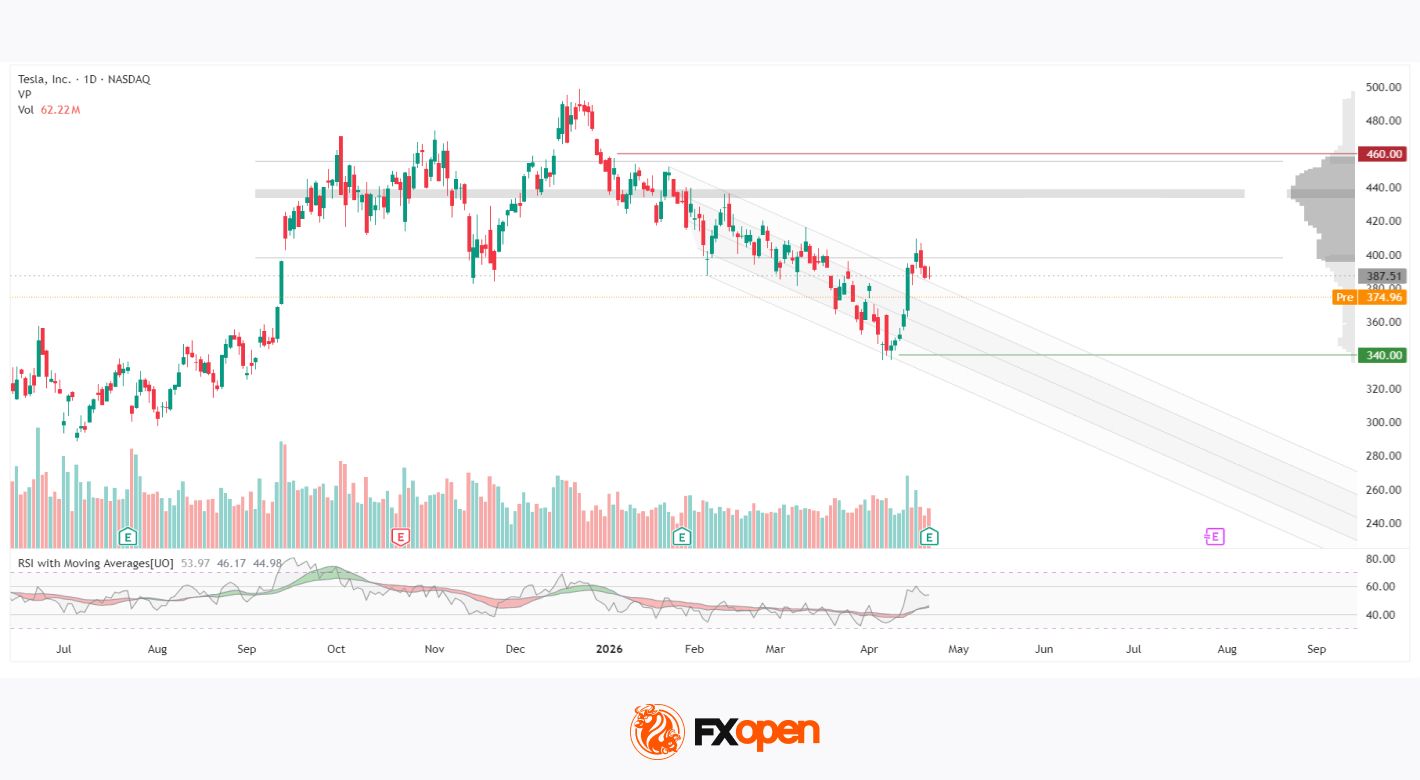
On 22 April, Tesla released its Q1 2026 results: adjusted earnings per share came in at $0.41 versus expectations of $0.37, but revenue of $22.39 billion fell short of the $22.64 billion forecast. The automotive segment continues to lose ground under pressure from competitors, particularly China’s BYD and Xiaomi. Additional concern came from the energy storage division, where deployments dropped 38% compared to the record fourth quarter of 2025 — a segment that had recently been seen as a key growth driver.
Management continues to pin its long-term growth strategy on robotaxis and autonomous driving.
Technical picture
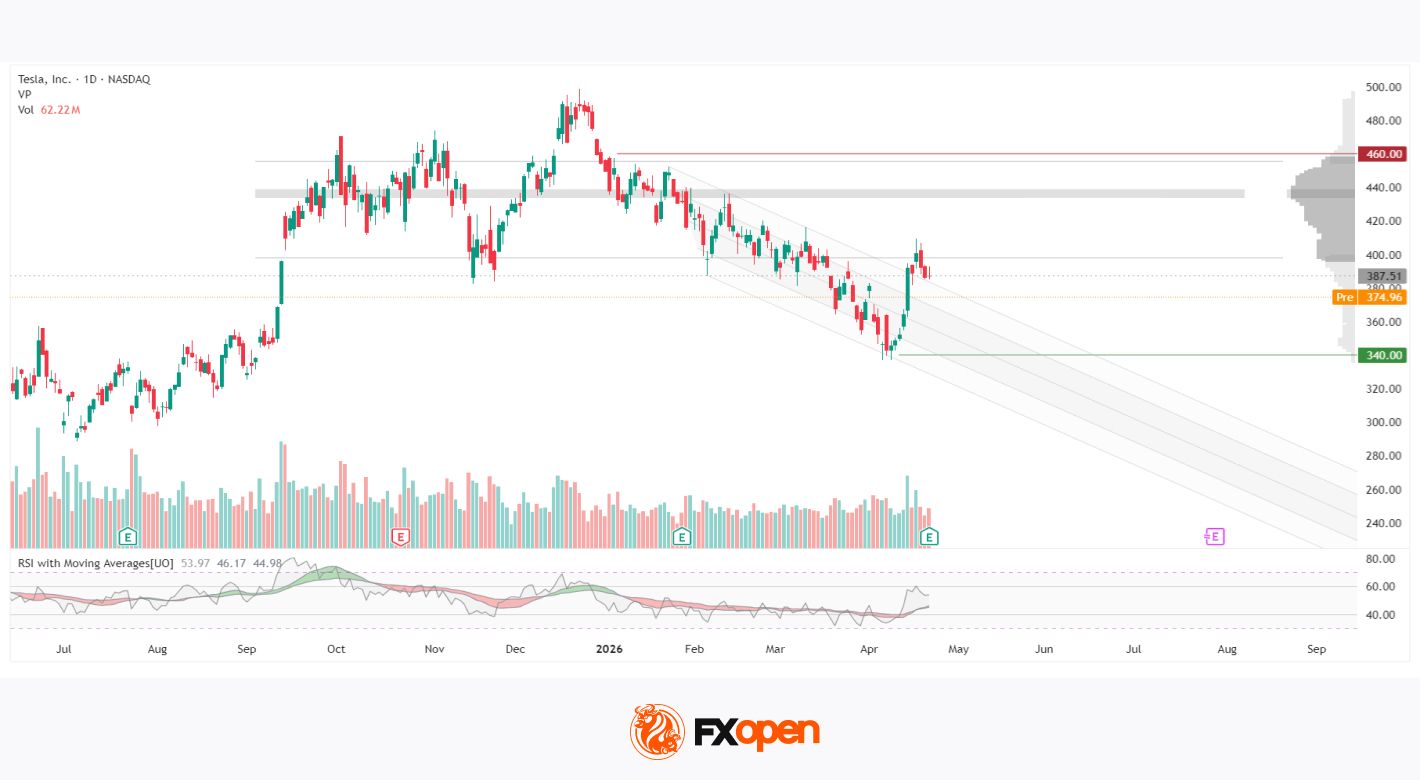
On the daily chart, TSLA has been trading within a sustained downward channel since peaking near $500 in December. In early April, the price reached the $340 level, which coincided with the lower boundary of the channel — the confluence of these levels strengthened buyer reaction. In recent sessions, the price has moved above the upper boundary of the channel, though the breakout has yet to be confirmed by a sustained close, and the earnings release has not clarified the near-term trend. Nevertheless, the move itself is noteworthy.
The horizontal volume profile spans the $398–455 range, with the Point of Control concentrated around $433–440 — an area of high liquidity that now represents the nearest resistance. The RSI with moving averages shows readings of 53 / 46 / 44: the indicator has crossed above the neutral 50 level, while both moving averages remain below it, suggesting that a sustained bullish impulse has yet to be confirmed.
Summary
The earnings report delivered mixed signals to the market: the earnings beat was not sufficient to offset weaker revenue and a sharp decline in the energy segment. From a technical perspective, the key question is whether the price can hold above the upper boundary of the channel — an unconfirmed breakout can easily turn false, particularly with a dense volume zone overhead.
Buy and sell stocks of the world’s biggest publicly-listed companies with CFDs on FXOpen’s trading platform. Open your FXOpen account now or learn more about trading share CFDs with FXOpen.
This article represents the opinion of the Companies operating under the FXOpen brand only. It is not to be construed as an offer, solicitation, or recommendation with respect to products and services provided by the Companies operating under the FXOpen brand, nor is it to be considered financial advice.
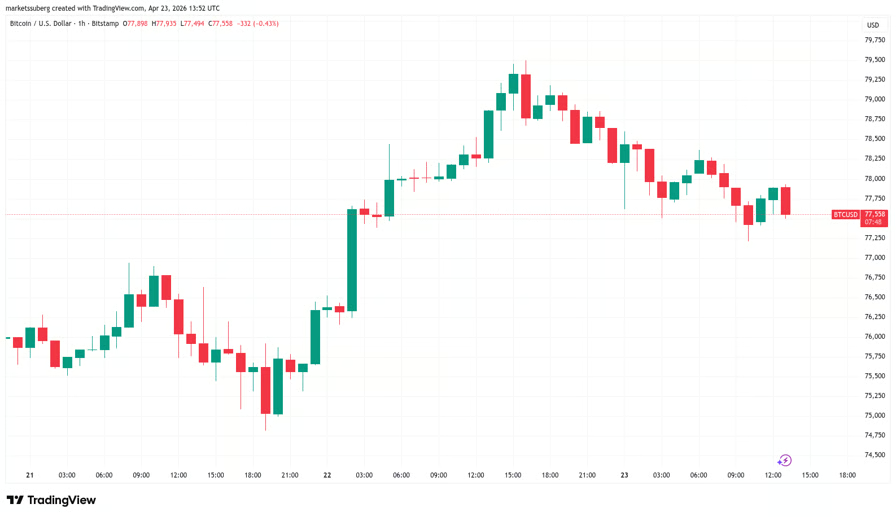
Bitcoin (BTC) slipped from near three-month highs on Thursday as attention turned to the weekly close.
Key points:
- Bitcoin retraces after its latest trip to its highest levels in several months.
- The upcoming weekly candle close is of particular interest as price eyes its bull market support band.
- A macro lull comes ahead of a deluge of US inflation data next week.
Bitcoin bull market support band returns after six months
Data from TradingView showed BTC/USD dropping to $77,200 prior to the Wall Street open.
The pair hit $79,500 the day prior, marking its highest levels since the last day of January as the $80,000 mark remained narrowly out of reach.
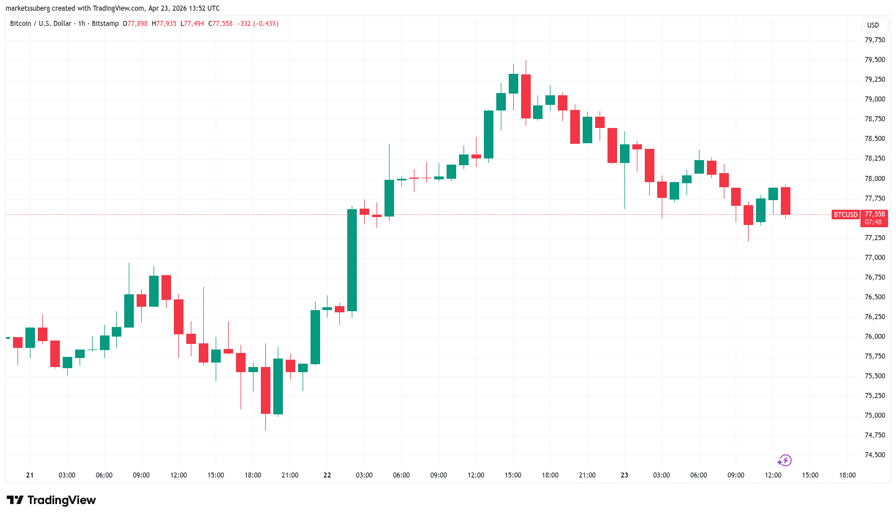
BTC/USD one-hour chart. Source: Cointelegraph/TradingView
“$BTC just keeps taking out the highs, taking out short stops without following through,” trader Jelle commented on the latest price action in a post on X.
“Been a while since we saw PA like that; usually means liquidity is being generated for a larger position. The question is, when will they step on the gas?”
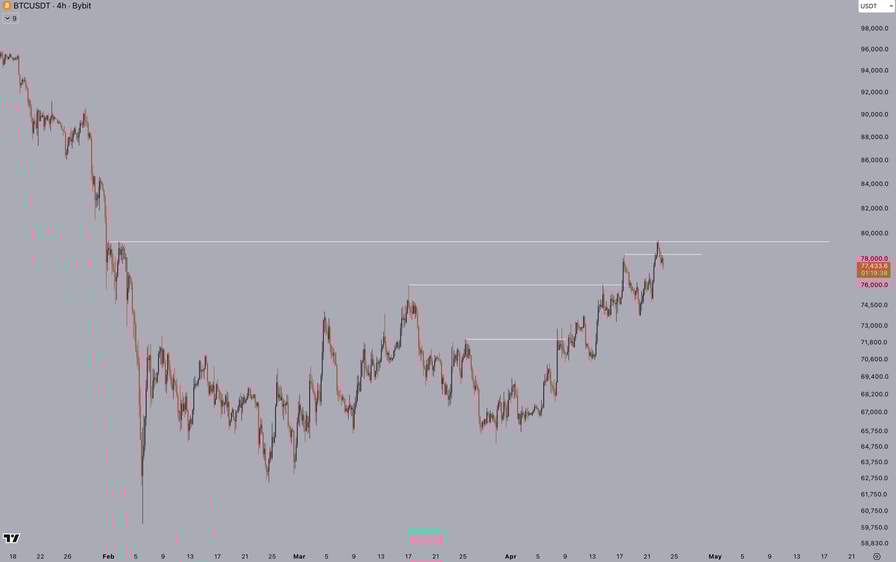
BTC/USD four-hour chart. Source: Jelle/X
As Cointelegraph reported, multiple resistance levels remain in play in the current spot price zone, with the 21-week exponential moving average (EMA) proving hard to flip to support. Bitcoin last traded above that trend line in October 2025.
With that, another chart feature finally making a comeback after a six-month absence is Bitcoin’s bull market support band.
Formed by the 21-week EMA and the 20-week simple moving average (SMA), the support band was lost as support soon after Bitcoin’s latest all-time highs.
“$BTC Attempting to break back above the bull market support band,” trader Daan Crypto Trades confirmed.
“Eyes on the weekly close this weekend, as it will be an important one. Bitcoin has not traded above its bull market support band since October 2025.”
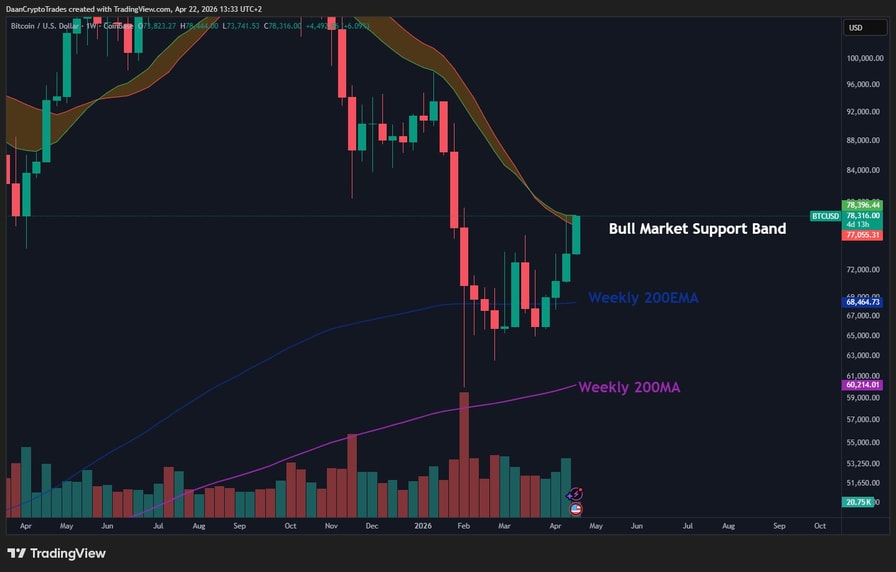
BTC/USD one-week chart. Source: Daan Crypto Trades/X
Fed policy, oil seen as next crypto catalysts
Macro markets provided little volatility on the day, with few cues from the US-Iran war.
Related: Bitcoin Bull Score hits six-month high as 2022 bear-market fears linger
The coming week was due to see key US macroeconomic data prints released, along with the latest interest-rate announcement from the Federal Reserve.
As Cointelegraph previously noted, markets saw little chance of Fed easing policy until the end of 2027 as geopolitical uncertainty raised the odds of inflation making a comeback.
The latest data from CME Group’s FedWatch Tool put the chances of the Fed changing rates at next week’s meeting at practically zero.
“The cleanest tells from here are still oil and policy. Oil below $100 would support the relief case, while clearer Fed signalling would help compress the policy premium,” trading company QCP Capital wrote in its latest “Market Color” analysis on Wednesday.
“Until then, the broader message remains the same: risk has stepped back from the brink, but the underlying macro and geopolitical overhang has not been cleared.”
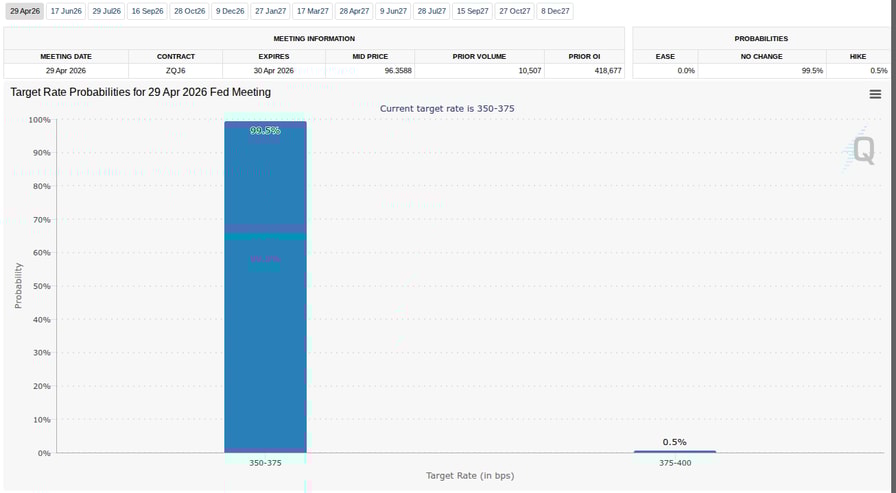
Fed target rate probabilities (screenshot). Source: CME Group
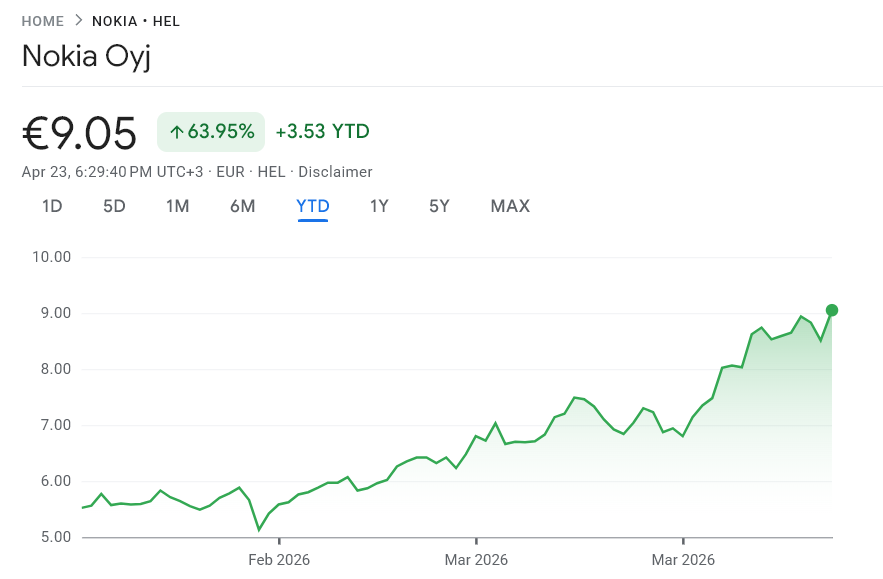
Nokia beat profit expectations in Q1 2026, and the reason has nothing to do with phones. The Finnish company’s optical fiber business has become the quiet engine behind its strongest quarter in years.
Comparable operating profit jumped 54% to €281 million, well above analyst estimates. Shares rose roughly 7% in Helsinki, reaching levels not seen since 2010. The company’s stock price is up by a staggering 63% in 2026.
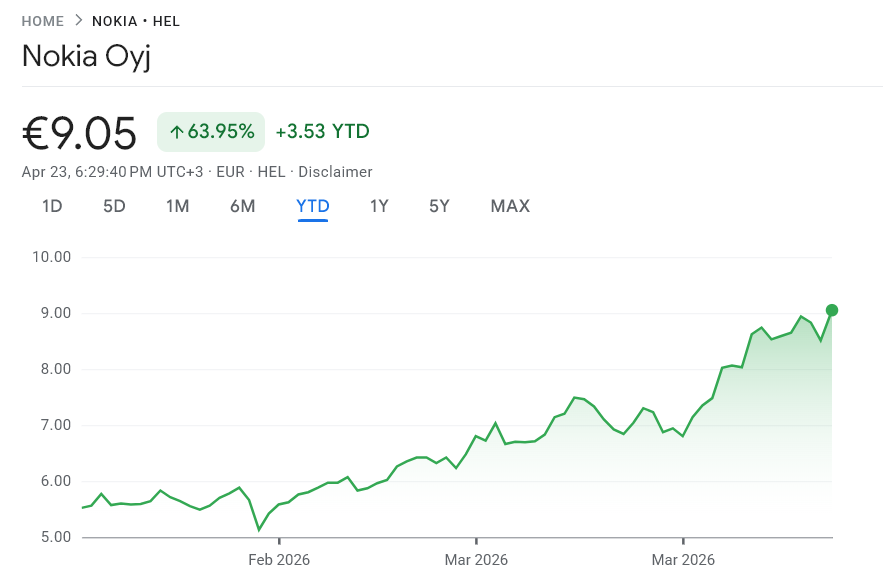
The Fiber Behind the AI Boom
The headlines say “AI revived Nokia,” but the earnings tell a more specific story. Inside Nokia’s Network Infrastructure segment, the Optical Networks unit grew 20% in the quarter.
This single business line, which builds the high-speed fiber systems connecting AI data centers, delivered far more growth than any other part of the company.
The rest of the portfolio tells a different story. IP Networks grew 3%. Fixed Networks shrank 13%. The legacy mobile infrastructure business, once Nokia’s identity, managed just 3% growth.
What changed is who Nokia sells to. Cloud giants like Amazon, Google, and Microsoft are building massive AI training facilities, and those facilities need fiber optic cables to move data at scale.
Nokia booked €1 billion ($1.17B) in new orders from these hyperscaler customers in Q1 alone. Sales to AI and cloud buyers now account for 8% of the company’s total revenue, up 49% from a year ago.
A Bigger Bet on Optical
Nokia is leaning into the momentum. The company raised its 2026 growth forecast for Network Infrastructure to 12-14%, up from 6-8%.
It now expects the AI and cloud market it serves to grow at 27% annually through 2028, nearly double its November estimate.
“We are increasing our growth assumption for Optical and IP Networks and we are investing to capture accelerating demand from AI & Cloud customers,” stated Justin Hotard, President and CEO.
The Infinera acquisition, completed in early 2025, gave Nokia a larger footprint in coherent optical transport. That deal is now showing up in wider margins and stronger order books.
Nokia’s comeback is real. It just has less to do with AI hype and more to do with the fiber optic cables that make AI possible.
The post Nokia’s Fiber Optic Bet Is Paying Off as AI Hunger Lifts Earnings appeared first on BeInCrypto.

Key Highlights
- Shares of Hims & Hers surged 7% following news of a broadened collaboration with Eli Lilly
- Healthcare providers using the platform can now order Zepbound vials, KwikPen, and Foundayo through LillyDirect fulfillment
- This announcement arrives roughly one month after a comparable agreement with Novo Nordisk for Wegovy distribution
- Leerink Partners analyst Michael Cherny raised concerns about Hims’ function, questioning if it’s merely a “front door” to pharmaceutical products
- CEO Andrew Dudum defended the strategy by drawing parallels to Netflix’s transformation in its formative years
Shares of Hims & Hers Health (HIMS) jumped 7% during Thursday’s trading session following the company’s announcement of an enhanced partnership allowing healthcare professionals to prescribe Eli Lilly’s weight management products directly through its digital platform.
Hims & Hers Health, Inc., HIMS
Medical professionals utilizing the Hims platform now have the capability to route prescriptions for Zepbound vials, KwikPen delivery devices, and Foundayo to Eli Lilly’s LillyDirect pharmacy service. Patients receive access to self-payment pricing structures, while licensed healthcare providers can facilitate connections between patients and FDA-sanctioned GLP-1 treatment options.
The arrangement provides Hims with what the organization describes as comprehensive access to FDA-cleared GLP-1 medications across its digital ecosystem. The offering integrates clinical oversight and dietary counseling within a subscription-based framework.
This marks the company’s second significant GLP-1 alliance within a two-month span. Last month, Hims finalized an agreement with Novo Nordisk, which agreed to withdraw a patent violation lawsuit in return for Hims’ commitment to distribute branded Ozempic and Wegovy via its digital channels.
The Novo arrangement included specific conditions. Hims scaled back its extensive compounding operations for GLP-1 drugs as a condition of the settlement. The Eli Lilly agreement reflects a similar strategic direction.
Hims had established a substantial presence throughout the 2024 GLP-1 supply crisis, when heightened demand coupled with constrained availability from leading pharmaceutical manufacturers created opportunities for the telehealth provider to expand. Currently, with supply chains stabilized, market conditions have evolved.
Wall Street Analyst Questions Platform Value Proposition
Michael Cherny, an analyst with Leerink Partners, provided a cautious assessment of the development. He recognized that Hims is broadening its service offerings and “functioning as a bridge to generate additional pathways” for patients seeking treatment.
However, Cherny expressed uncertainty, noting it was “difficult to determine what function Hims fulfills beyond serving as the entry point for patients obtaining Lilly medications.” This question grows increasingly relevant as Hims transitions away from its compounding operations.
CEO Draws Streaming Giant Analogy
CEO Andrew Dudum rejected characterizations that these partnerships signal a strategic withdrawal. In his public remarks, he drew comparisons between Hims and Netflix during its transformative period.
“Netflix wasn’t simply distributing DVDs,” Dudum stated. “It was transforming how consumers accessed content by relentlessly emphasizing selection and creating innovative delivery methods for the most sought-after entertainment.”
The organization highlighted its weight management subscription program as proof of a more comprehensive service offering. Subscribers receive round-the-clock access to medical teams, customized dietary guidance, continuous clinical monitoring, and community support through the Hims & Hers Weight Loss network.
The company’s stated objective involves aligning users with therapeutic options tailored to their specific medical backgrounds, personal preferences, and wellness objectives.
Market participants seemed receptive to the CEO’s narrative. HIMS stock maintained gains of 0.4% later in the trading day even as the S&P 500 experienced modest declines. Eli Lilly shares remained relatively unchanged.
The Eli Lilly collaboration represents Hims’ latest strategic initiative to transform its position within the GLP-1 marketplace from a provider of compounded alternatives into a distribution platform facilitating medication access.



Persistent security vulnerabilities and stagnant total value locked (TVL) are weighing on decentralized finance’s (DeFi) institutional appeal, according to Wall Street investment bank JPMorgan (JPM).
TVL refers to the total value of crypto assets deposited in DeFi protocols, and is commonly used as a gauge of the size, usage and overall health of the ecosystem.
The KelpDAO exploit, which the bank said erased about $20 billion in TVL within days, exposed structural risks.
An attacker breached a cross-chain bridge, minted $292 million in unbacked rsETH and used it as collateral to drain lending protocols, leaving roughly $200 million in bad debt. Contagion spread beyond directly affected platforms, underscoring how DeFi’s interconnectedness can amplify shocks.
“Much as traditional investors shift towards cash in uncertain times, crypto participants have responded to recent exploits by seeking refuge in stablecoins,” wrote analysts led by Nikolaos Panigirtzoglou in the Wednesday report.
Hacks and exploits remain a central risk for crypto because they directly undermine trust in systems that rely on code rather than intermediaries. Smart contract bugs, phishing and cross-chain bridge flaws can expose large pools of locked assets, with attackers often needing to exploit just a single weak point to trigger outsized losses.
These vulnerabilities are amplified by the complexity and interconnectedness of blockchain infrastructure. Cross-chain bridges, for example, expand functionality but also increase the attack surface, and have been responsible for billions of dollars in losses because they rely on complicated designs, shared infrastructure and sometimes weak validation mechanisms.
Beyond the immediate financial damage, repeated exploits erode confidence across the ecosystem. Each major hack can drive users and institutions away, prompt stricter regulation and slow adoption, making security a foundational constraint on crypto’s growth.
The bank’s analysts noted hack losses this year are tracking 2025 levels, with infrastructure and bridge exploits still the primary vulnerability despite gains in smart contract auditing.
Growth also remains muted. While TVL has partially recovered in dollar terms, it is largely unchanged in terms of ether (ETH), suggesting limited organic expansion and raising questions about DeFi’s ability to scale for institutional use, the report said.
In periods of stress, investors continue to rotate into stablecoins. Following the exploit, capital flowed from DeFi lending into Tether’s USDT, which benefits from deeper liquidity and faster off-ramps, reinforcing its role as a preferred flight-to-safety asset, the report said.


In today’s newsletter, Vincent Chok from First Digital unpacks the rise of “agentic finance,” where AI agents are moving beyond advice to execute financial transactions, making crypto the essential financial backend for this machine-driven economy.
Then, in “Ask an Expert,” we posed two questions to three leading AI systems — Grok, Gemini, and Claude — about AI payment use cases and the necessary steps for scalability.
Note: Responses were generated by AI assistants and reflect each model’s perspective. They should not be construed as financial or legal advice.
AI agents in crypto: what advisors need to know
The explosive growth of AI agents
AI agents have become one of the most trending topics over the last year. A recent PwC survey of over 300 companies found that 79% are already adopting AI agents in some form. This explosive growth reflects a broader shift: AI agents are evolving from advisory roles to execution roles.
Initially deployed to help with chatbot services and copiloting roles, AI systems are now actively planning, deciding and acting on predefined parameters set by humans, including financial transactions. The result is the early formation of “agentic finance.” This is a new primitive wherein AI agents essentially execute financial actions within predefined rules such as limits, permissions and goals.
Breaking down agentic finance
Agentic finance can be understood in three layers. The agentic commerce layer focuses on discovery and decision-making. For example, an AI agent can search for the best hotel deal for an upcoming trip. The agentic payments layer handles execution, where the agent completes a transaction once approved.
Finally, the asset management layer represents the full stack, where the agent can manage portfolios, handle payments and dynamically optimize financial strategies based on real-time market trends. While this may seem as if we are giving AI agents full autonomy, that is not the case. It’s conditional delegation, wherein users retain control through constraints while offloading execution.
Theoretically, AI agents do have a use case in the financial space; however, they don’t neatly fit in with existing traditional financial infrastructure. Structurally, AI agents lack direct access to global banking rails and are designed to operate 24/7. This structural mismatch is where crypto comes into play.
Stablecoins offer AI agents access to programmable, always-on money, blockchains enable instant and global settlement, and crypto wallets provide permissionless access to funds. Essentially, these components form a financial layer that is better suited to machine-driven activity. Crypto is thus increasingly becoming the infrastructure for autonomous systems, rather than only being an asset class.
Use cases of AI agents
Early implementations are already visible. Machine-to-machine payments powered by API access and data providers have made the inter-merchant rails stronger and faster. In the consumer context, autonomous commerce has allowed users to optimize retail research, using agents to get the best deals for travel, subscriptions and shopping.
Meanwhile, in crypto-native environments, trading agents are widely deployed for portfolio management, yield optimization and trading strategies. On the enterprise side, supply chain management and vendor payments have been easily automated via AI agents, cutting down on errors and resource expenditure. At this stage, most activity remains business-to-business and infrastructure-driven, rather than consumer-facing.
Beyond use cases, AI agents also play an integral part in driving new investable categories as well as demand for crypto itself. As AI agents can’t operate on existing infrastructure rails, demand is growing for agent-native wallets, stablecoin payment rails and data or compute marketplaces.
Coinbase, for example, has launched x402, an open payments protocol designed for agent-native transactions. This shift is particularly relevant for micropayments, where high transaction volumes and low value make traditional rails inefficient. For the first time, non-human users are participating in the financial system and driving activity. AI agents have become a new class of ‘user’ for crypto networks.
Risks and future outlook
Despite the momentum, we are still in the early stages, and there are risks and limitations. Security is the primary concern, particularly around rogue or exploited agents executing unintended transactions. Questions around authorisation, liability and regulatory treatment are still under scrutiny and are being actively defined. For widespread adoption, we must build trust for users. This comes through regulatory clarity from all involved stakeholders, so projects can build with clarity and confidence while safeguarding user funds and interests.
Over the next twelve months, this technology will continue to grow and mature. Signals that matter include growth in agent-driven transaction volume, emergence of agent-native wallets and payments protocols, and deeper integration between stablecoins and AI-driven systems. Finally, regulatory clarity will heavily shape the pace and scope of adoption across different industries and fields.
In conclusion
AI agents are not a theoretical concept; they are already executing transactions in limited environments. As the trend develops, crypto is increasingly emerging as the financial backend for machine-driven economies. For now, this is an infrastructure and long-term thematic play; however, that is changing with rising adoption rates. Advisors should track it as a next-wave driver of crypto utility.
– Vincent Chok, CEO and co-founder, First Digital
Ask an Expert
This week we’re doing something a bit different. Instead of one expert, we have a panel of experts — AI experts. Below, we posed two questions to three leading AI models, asking about the present and future of AI payments. While there were common themes — especially about what’s needed for future growth — there are also some clear differences. We hope you find this experiment as fun and thought-provoking as we have.
Q1: What AI payment use cases are you seeing today?
Grok xAI |
Fraud detection is the most mature use case — AI spots anomalies rules-based systems miss. Intelligent payment routing dynamically selects the best rail by cost and speed. Emerging agentic payments let autonomous AI handle B2B treasury tasks and machine-to-machine micropayments using stablecoins, with Visa, PayPal, and Mastercard beginning to verify these agents. |
|---|---|
| Gemini Google | Three “Agentic Commerce” breakthroughs stand out: autonomous treasury and DeFi yield management where AI executes cross-chain swaps in real time; the “Inference Economy” where agents settle machine-to-machine micropayments instantly via stablecoins; and hyper-personalized wealth implementation — AI-powered direct indexing handling fractional trades and daily tax-loss harvesting at a scale no human advisor could manage manually. |
| Claude Anthropic | AI payments are moving from concept to infrastructure faster than most advisors realize. Clearest use cases: programmatic billing for AI services and agents that autonomously spend funds for compute or subtasks without human approval per transaction. On the wealth side, AI is augmenting rebalancing and tax-loss harvesting, with humans still in the loop on most material decisions today. |
Q2: What’s needed for AI payments to scale?
Grok xAI |
Three gaps need closing: standardized agent identity with cryptographic proof of authorization and clear liability rules; governance and explainability for regulators including AML compliance in automated wealth flows; and high-quality real-time data infrastructure bridging fiat and crypto. Advisors must demonstrate AI augments rather than replaces fiduciary duty. |
|---|---|
| Gemini Google | Three things must converge: Verifiable Agent Identity using DIDs and cryptographically signed mandates so institutions can distinguish authorized AI from rogue bots; standardized governance protocols with universal spend limits and kill switches enforced at the protocol level; and legal liability frameworks clarifying who is responsible when an AI executes a flawed trade or falls victim to a prompt injection attack. |
| Claude Anthropic | Three things are genuinely missing: identity, accountability, and spending controls. AI agents lack a standardized identity layer — that’s the fiduciary risk hiding inside all the excitement. Programmable guardrails built natively into the payment layer (like a corporate card with hard limits and audit trails) are needed, along with regulatory clarity on stablecoins. The technology is largely ready. What’s lagging is governance — and that’s an opportunity for advisors who get ahead of it. |
Keep Reading


Kraken has been around long enough to see nearly every version of the crypto market up close.
Founded in 2011, it lived through Bitcoin’s early volatility, the first big exchange era, the ICO boom, the long bear markets, the rise of institutional crypto, and the latest push into tokenized and multi-asset trading.
Across those cycles, Kraken kept adding products, expanding its reach, and finding new ways to stay relevant as the industry changed around it.
In March 2025, Kraken agreed to buy NinjaTrader for $1.5 billion. In April 2025, it launched trading in more than 11,000 U.S.-listed stocks and ETFs for select U.S. clients. In June 2025, it rolled out xStocks for eligible non-U.S. clients, starting with 60 tokenized U.S. equities, and launched Krak, a payments app supporting transfers across more than 160 countries and 300-plus assets.
The company kept building through the second half of 2025 with deals for Capitalise.ai, Breakout, Small Exchange, and Backed, then added Magna in February 2026 and Bitnomial soon after. By early 2026, Kraken was pushing further into tokenized equities as xStocks expanded from 60 at launch to 100 tokenized U.S. stocks and ETFs.
Let’s take a closer look at how Kraken has been building through this latest phase of the market.
NinjaTrader and regulated finance
The NinjaTrader deal in March 2025 gave Kraken a serious foothold in U.S. regulated futures.
Kraken valued the transaction at $1.5 billion and described NinjaTrader as the leading U.S. retail futures platform.
A few months later, Kraken used that foothold to launch U.S. regulated crypto futures and said it planned to add commodity, fixed income, FX, and equity futures later in 2025.
This gave Kraken a direct route into one of the main markets active traders use for hedging and directional bets.
Small Exchange gave Kraken a U.S. venue
Kraken pushed further in October 2025 when it bought Small Exchange from IG Group for $100 million. Importantly, Small Exchange came with a CFTC-regulated Designated Contract Market license.
Kraken said the purchase would help it launch a fully U.S.-native derivatives suite. Reuters reported the same deal as a move to strengthen Kraken’s American derivatives business for retail and institutional clients.
This put Kraken closer to the center of the U.S. futures market.
Backed and tokenized equities
Kraken’s tokenized equity push became far more serious in 2025.
Reuters reported on May 22, 2025, that Kraken planned to offer tokenized versions of more than 50 U.S. stocks and ETFs, including Apple, Tesla, and Nvidia, to non-U.S. clients.
Kraken formally launched tokenized U.S. equities on June 30, 2025 with 60 assets on the platform.
On December 2, 2025, it announced the acquisition of Backed, the company behind xStocks, saying the deal would bring issuance, trading, and settlement closer together.
By March 18, 2026, Kraken said xStocks had grown to 100 tokenized U.S. stocks and ETFs and had surpassed $25 billion in total transaction volume since launch. That growth soon fed into a partnership with Nasdaq, announced through Kraken parent Payward, focused on developing an equities transformation gateway for tokenized equities and helping connect regulated market structure with on-chain distribution.
Magna took Kraken into token operations
In February 2026, Payward, the platform behind Kraken, acquired Magna.
Kraken described Magna as a token management platform used for vesting, claims, distributions, and related workflows.
Magna will keep operating as a standalone product, though Kraken also said it will be deeply integrated.
This gives Kraken a place in the day-to-day work of token teams, not just the trading venue where assets change hands after launch.
Capitalise.ai and Breakout
Kraken also used acquisitions to widen the kinds of traders it can serve.
In August 2025, it bought Capitalise.ai, a no-code automation platform that turns plain-language prompts into trading strategies and backtests.
In September 2025, it acquired Breakout, a prop trading platform that offers up to $200,000 in trading capital, with users keeping up to 90% of profits according to Kraken’s materials.
These additions fit a platform trying to keep more of the trader workflow inside one account, from idea generation to automation to funded execution.
Krak linked payments
Krak shows how Kraken wants to connect markets with everyday money movement.
Reuters reported on June 26, 2025 that the app launched in more than 100 countries for crypto and fiat transfers.
Kraken’s own product pages later put the figure at more than 160 countries and said users could transact across 300-plus assets. The company also said physical and virtual cards were planned.
This gives Kraken a consumer payments product sitting next to trading, tokenized equities, and derivatives rather than outside them.
Bitnomial adds another U.S. derivatives layer
In April 2026, Kraken parent Payward announced the acquisition of Bitnomial, a CFTC-regulated derivatives exchange and clearinghouse. The deal adds another regulated U.S. futures asset to Kraken’s portfolio and expands its ability to serve traders who want futures access inside American market structure.
A one-platform financial business
Let’s go through the list once more.
- NinjaTrader opened the door to U.S. regulated futures.
- Small Exchange added a licensed venue.
- Backed brought xStocks in-house.
- Magna added token administration tools.
- Capitalise.ai and Breakout served more active traders.
- Krak brought payments into the same product family.
- Bitnomial added another U.S. regulated derivatives venue and clearing capability.
Kraken also launched U.S.-listed stock and ETF trading in April 2025, giving select U.S. users access to more than 11,000 equities on the same platform.
The legal side is worth noting too. In Europe, Kraken now operates through MiCA-regulated entities and also holds a MiFID II license. Those approvals give the company stronger footing across the EEA as it expands trading, payments, tokenized equities, and related services.
There is also a major U.S. regulatory angle. Kraken said in March 2026 it became the first digital asset firm with a Federal Reserve master account. Direct access to the U.S. payments system adds another serious piece to its financial-services buildout.
Acquisitions can assemble the parts quickly, but users and institutions will judge the result by whether those parts work well together. Kraken now has trading, payments, token operations, tokenized equities, and multiple regulated derivatives assets. The next phase is proving that this collection functions like one platform.
The post Kraken Builds Beyond Crypto With Futures, Tokenized Stocks, and Payments appeared first on BeInCrypto.

The FTX bankruptcy estate sold a 5% stake in AI coding startup Cursor for $200,000 in April 2023.
That same stake, following SpaceX’s agreement to acquire Cursor at a $60 billion valuation, is now worth approximately $3 billion.
A 15,000x gap realized by whoever bought it from the estate rather than by the creditors the estate existed to protect.
The core question is whether distressed asset liquidation under bankruptcy constraints can ever adequately protect creditor interests in high-velocity technology markets, and what the answer means for every future estate forced to sell illiquid startup equity at bear market prices under cash-conversion pressure.
- Sale price: FTX bankruptcy estate sold its 5% Cursor stake for $200,000 in April 2023 – the same price Alameda Research originally paid in April 2022
- Current value: That stake is worth approximately $3 billion at SpaceX’s $60 billion Cursor acquisition valuation announced April 21, 2026
- Return gap: 15,000x difference between realized recovery and current mark – one of the largest single missed recoveries in crypto bankruptcy history
- Original investment: Alameda Research invested $200,000 in Anysphere (Cursor’s parent company) at a $4 million valuation – the estate sold at cost with zero appreciation captured
- SBF’s prison argument: Sam Bankman-Fried, serving a 25-year federal sentence, projected in February 2026 that FTX’s net asset value would have reached $78 billion had the estate held assets through recovery
- Watch item: SpaceX must decide on full $60 billion Cursor acquisition later in 2026 or trigger its $10 billion breakup fee – the outcome sets the final mark on what creditors actually forfeited
Discover: The best crypto to diversify your portfolio with
How a $200,000 Fire Sale Became a $3 Billion Creditor Recovery Miss
Alameda Research entered Anysphere’s seed round in April 2022 at a $4 million valuation, securing roughly 5% of the company for $200,000.
Seven months later, FTX collapsed. By April 2023, John J. Ray III’s administration was under intense pressure to convert volatile venture holdings into cash, and the Cursor stake was liquidated at exactly what Alameda paid, capturing zero appreciation from the seed entry.

That framing matters. This was not a distressed token sold below water. It was an early equity position in a pre-revenue AI startup, sold at cost into a bear market by administrators operating on a cash-conversion mandate rather than a value-maximization one.
Cursor launched its AI coding product in early 2023, the same quarter the estate sold the stake.
The 2025-2026 AI boom did the rest. Cursor now powers 67% of Fortune 500 companies, has crossed $1 billion in annualized revenue, and sits at the center of Elon Musk’s push to close xAI’s gap with OpenAI and Anthropic on AI coding tools.
SpaceX holds the right to acquire Cursor outright for $60 billion later this year, or pay a $10 billion breakup fee if its planned $2 trillion IPO timeline forces a delay.
Experts note the $3 billion figure assumes an unchanged 5% stake at SpaceX’s price, dilution from Cursor’s separate $900 million funding round at a $9 billion valuation could compress the actual number. Even discounted significantly, the creditor recovery miss is structurally damning.
Discover: The best pre-launch token sales
What FTX Forced Cursor Sale Actually Exposes About Bankruptcy Administration in Tech Markets
Bankman-Fried’s argument from prison, that the estate destroyed tens of billions in value through forced selling, now has its single clearest data point.
His February 2026 projection of a $78 billion net asset value, had positions been held, looked aggressive at the time. The Cursor number alone adds $3 billion of supporting evidence in one line item.
FTX customers were made whole in dollar terms under the distribution plan, receiving claim values plus interest.
What the creditor recovery framework did not, and structurally could not, preserve was the upside from what those assets became.
That is the honest tension at the center of distressed asset administration: dollar recovery and value recovery are not the same thing, and bankruptcy law is built around the former.
The Cursor sale is likely to feature prominently in Bankman-Fried’s continued campaign from prison, and in his parents’ public advocacy for a pardon.
The post FTX Estate Sold Cursor Stake for $200K: It’s Now Worth $3 Billion appeared first on Cryptonews.
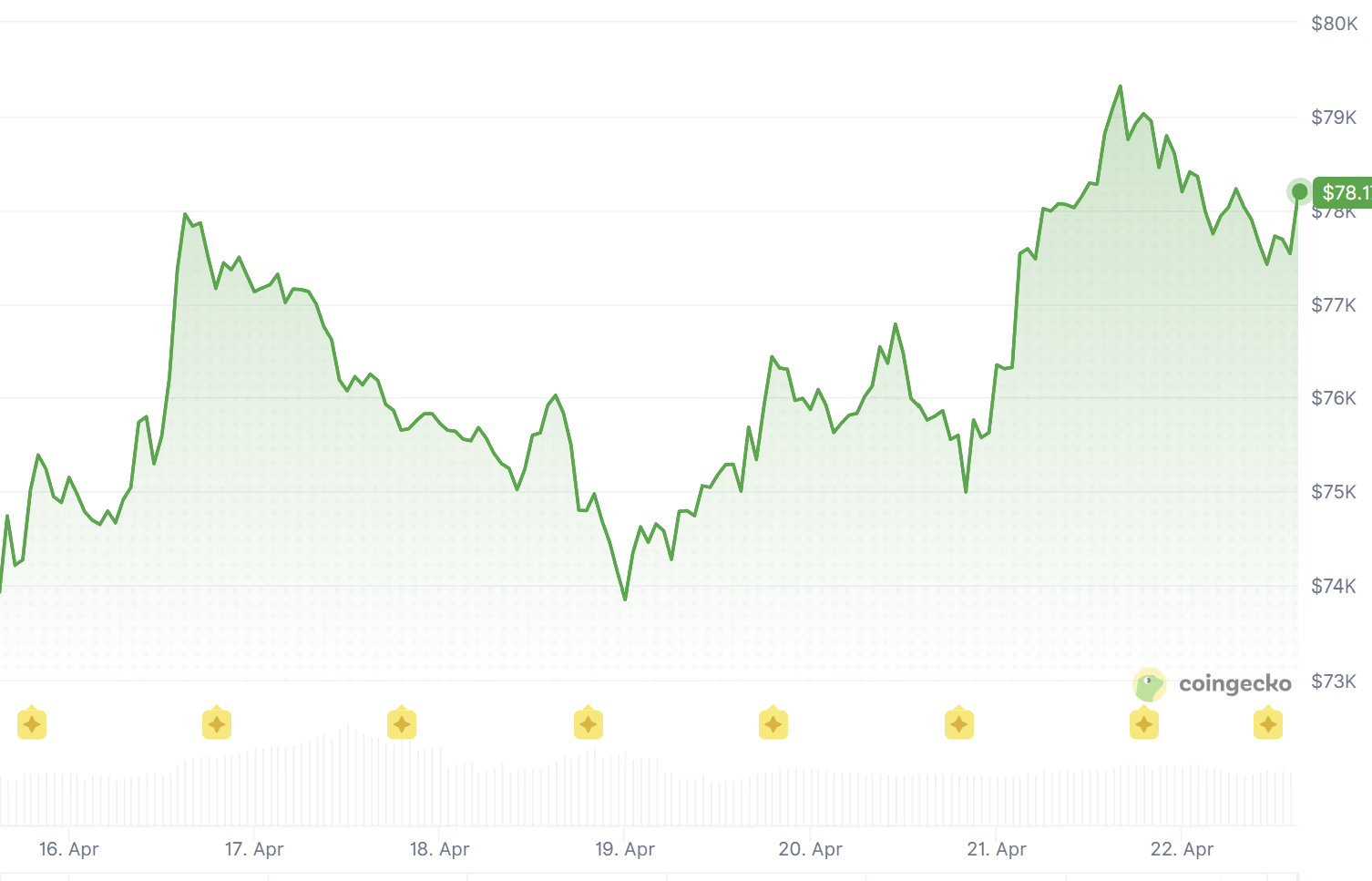
ETH is lagging with on-chain risk still elevated post-Kelp, while SOL dropped 3% and the broader market cap slipped 1.6% on the day.
Crypto markets sold off broadly on Thursday as traders booked profits after a week-long rally that had pushed Bitcoin back toward $80,000.
Bitcoin is changing hands at $77,955, down 1.1% over the past 24 hours, though still up 4.5% on the week and 9.9% on the month, according to CoinGecko. Ether slipped 2.8% to $2,331, turning its seven-day chart marginally negative.

Among the rest of the top ten, Solana is trading at $86, down 3% on the day, XRP is off 1.9%, and BNB is down 2% at $636. Total crypto market capitalization fell 1.6% to $2.69 trillion.
Strong ETF Bid
Despite Thursday’s red tape, the broader trend in spot ETF flows remains constructive.
U.S. spot Bitcoin ETFs took in $335 million on Tuesday, per Farside, the seventh consecutive session of positive flows. BlackRock’s iShares Bitcoin Trust (IBIT) accounted for $246.9 million of the total, with Fidelity’s FBTC adding $56.7 million and Bitwise’s BITB contributing $15.4 million. Cumulative flows across all 11 spot Bitcoin products are now back in positive territory for the year, with total AUM above $96.5 billion.
The flows indicate a notable reversal from the first quarter, when sustained outflows tracked alongside Bitcoin’s slide from above $100,000 toward the mid-$70Ks.
Geopolitical Risks Linger
Bitcoin’s failure to push decisively through $80,000 reflects an unresolved geopolitical overhang. Iran reportedly fired on three ships in the Strait of Hormuz on Wednesday, and a U.S. naval blockade in the region remains in place. Although President Trump has framed the current ceasefire as indefinite, peace talks have not progressed, and oil prices remain sensitive to regional headlines.
DeFi Grapples with Kelp Fallout
On-chain markets are still digesting last weekend’s Kelp DAO exploit. LayerZero’s post-mortem attributed the attack to North Korea’s Lazarus Group, which compromised two RPC nodes feeding the bridge’s verifier and minted 116,500 unbacked rsETH before depositing it on Aave as collateral and borrowing real WETH against it.
Aave’s risk service providers have modeled bad debt at between $123.7 million and $230.1 million, depending on how losses are allocated across rsETH holders. The protocol partially unfroze WETH on its Ethereum Core V3 market on Tuesday, and Arbitrum’s Security Council froze roughly $71 million of stolen ETH.

The U.S. government is running a live Bitcoin node right now, confirmed under oath before Congress, marking the first public disclosure of a U.S. combatant command directly participating in Bitcoin network infrastructure.
Admiral Samuel Paparo, commander of U.S. Indo-Pacific Command, made the confirmation on Wednesday before the House Armed Services Committee during a hearing on the FY2027 defense authorization request.
The core question this raises is not whether the government is accumulating Bitcoin, it isn’t, but whether state actors are quietly embedding themselves into the protocol’s architecture for reasons that go well beyond finance.
- Source: Admiral Samuel Paparo, Commander of U.S. Indo-Pacific Command (INDOPACOM), testified before the House Armed Services Committee on Wednesday.
- Confirmed: The U.S. government currently operates 1 node on the Bitcoin network for cybersecurity testing and network security research.
- Ruled out: The government is not mining Bitcoin – Paparo stated this explicitly.
- Context: INDOPACOM is in an active “experimentation” phase, using Bitcoin’s proof-of-work protocol as a computer science and cryptographic tool, not a financial asset.
- Watch item: Specific details of INDOPACOM’s Bitcoin research programs remain partially classified; follow FY2027 NDAA debates for potential funding expansion of blockchain cybersecurity initiatives.
Discover: The best pre-launch token sales
What Running a Bitcoin Node Actually Signals About US Government Engagement
Running a node is not mining, and it is not holding. A Bitcoin node validates transactions and blocks, maintains a full copy of the blockchain, and participates in the peer-to-peer network, but generates no BTC and requires no hash power.
The Bitcoin network currently relies on tens of thousands of nodes distributed globally, and a single government-operated node carries zero influence over consensus.

What it does provide is trustless, direct access to network data, without an exchange intermediary, a third-party feed, or custodial dependency.
For a military command monitoring adversary activity or stress-testing cryptographic architecture against peer-state threats, that kind of unmediated access to Bitcoin’s native infrastructure has obvious operational logic. This is surveillance and research infrastructure, not a balance sheet position.
One government node among tens of thousands poses no threat to Bitcoin’s decentralization or censorship resistance.
But the optics carry weight; a protocol built explicitly as a defense against state capture now has a state actor sitting inside it.
What the Admiral Actually Confirmed – and What Remains Unanswered
Paparo was unambiguous on the core facts. “We have a node on the Bitcoin network right now,” he told the committee. “We’re not mining Bitcoin. We’re using it to monitor, and we’re doing a number of operational tests to secure and protect networks using the Bitcoin protocol.”
WATCH: Admiral Samuel Paparo highlights growing military interest in Bitcoin: pic.twitter.com/6ifdXcJetL
— CoinDesk (@CoinDesk) April 22, 2026
He framed the military’s interest explicitly as technical, not financial. “Our interest in Bitcoin is as a tool of cryptography, a blockchain, and a reusable proof-of-work, as an additional tool to secure networks, and to project power,” Paparo said.
“From the military application standpoint, my interest in Bitcoin is as a computer science tool.” He also noted that some specifics of INDOPACOM’s Bitcoin research programs remain classified, leaving the full scope of the operation unanswered.
Paparo additionally flagged support for stablecoin legislation as aligned with military interests, calling the GENIUS Act, signed by President Donald Trump last summer, legalizing dollar-pegged stablecoin issuance, “a great step forward” for projecting U.S. dollar dominance globally.
That framing positions dollar-denominated digital assets as a tool of financial power projection, distinct from but complementary to the Bitcoin protocol work.
Discover: The best crypto to diversify your portfolio with
The post US Government Runs a Bitcoin Node, Admiral Says, But Is Not Mining BTC appeared first on Cryptonews.
Earnings call transcript: FirstService Q1 2026 beats forecasts, stock climbs

Tesla Shares: Quarterly Results Provide No Clear Direction

Disney Speaks About Airing Taylor Frankie Paul‘s ‘Bachelorette’

Manchester United reach agreement with Casemiro over contract clause amid transfer speculation

Steven Gerrard disagrees with Gary Neville over ‘shock’ Chelsea and Arsenal claim | Football

US brings back mandatory military draft registration


-

 Sports6 days ago
NWFL Suspends Two Players Over Post-Match Clash in Ado-Ekiti
-

 Fashion6 days ago
Weekend Open Thread: Theodora Dress
-

 Politics6 days ago
Palestine barred from entering Canada for FIFA Congress
-
Entertainment4 days ago
NBA Analyst Charles Barkley Chimes in on Ice Spice McDonald’s Fiasco
-

 Business4 days ago
Powerball Result April 18, 2026: No Jackpot Winner in Powerball Draw: $75 Million Rolls Over
-

 Tech5 days ago
Auto Enthusiast Scores Running Tesla Model 3 for Two Grand and Turns It Into Bare-Bones Go-Kart
-

 Politics4 days ago
Zack Polanski demands ‘council homes not luxury flats for foreign investors’
-

 Crypto World6 days ago
Russia Pushes Bill to Criminalize Unregistered Crypto Services
-

 Politics3 days ago
Gary Stevenson delivers timely reminder to register to vote as deadline TODAY
-

 Business1 day ago
Rolls-Royce Voted UK’s Most Iconic Trade Mark as IPO Register Hits 150
-

 Politics22 hours ago
Disabled people challenge government SEND proposals over segregation concerns
-

 Politics22 hours ago
Making troops accountable for war crimes threatens US alliance, ex-SAS colonel warns
-
 Business7 days ago
Creo Medical agree sale of its manufacturing operation
-

 Crypto World6 days ago
Russia Introduces Bill To Criminalize Unregistered Crypto Services
-

 Politics23 hours ago
Starmer handler McSweeney to be dragged from shadows by Foreign Affairs Committee
-

 Politics22 hours ago
Zack Polanski responds to home secretary’s taser threat
-
Politics23 hours ago
Wings Over Scotland | How To Get Away With Crimes
-
 Crypto World5 days ago
Kelp DAO rsETH Bridge Hack Drains $292M as DeFi Losses Top $600M in Two Weeks
-

 Politics20 hours ago
‘Iran is still a nuclear threat’
-

 Crypto World2 days ago
New York sues Coinbase, Gemini over prediction market offerings
You must be logged in to post a comment Login