Tesla has staged a dramatic comeback in Europe, posting an 84 per cent surge in March sales as electric vehicles cemented their position as a mainstream choice for the continent’s motorists, new industry figures reveal.
The resurgence of Elon Musk’s car maker, which endured a bruising 2025, comes against the backdrop of a broader electric boom across Europe, where zero-emission models now account for more than one in five new registrations. For small and medium-sized businesses operating fleets, the shift marks a turning point in the economics of going electric.
Data from the European Automobile Manufacturers’ Association (ACEA) shows total new car sales across the continent, including non-EU markets, climbed 11 per cent year-on-year in March to 1.42 million units. First-quarter volumes reached 3.52 million, up 4 per cent on the same period in 2025.
Battery-electric vehicles were the standout performer. March sales leapt 41 per cent to 344,000 units, taking the quarterly tally to 723,000, a 36 per cent increase. EVs commanded 24 per cent of the March market and more than 20 per cent across the full quarter.
Tesla’s own March tally rose 84 per cent, albeit against a weak comparator, with quarterly volumes up 45 per cent to 78,300 units. The American marque’s return to growth comes as Chinese rival BYD continues its aggressive European push. The Shenzhen-based manufacturer, which sells both pure-electric and hybrid models, saw its first-quarter deliveries leap more than 150 per cent to 73,800 units, narrowing the gap on Tesla significantly.
Advertisement
The ACEA credited the boom to consumer-friendly fiscal measures. “The market was supported by robust consumer activity bolstered by new and revised tax benefits and incentive schemes across major European countries,” the trade body said. Rising forecourt prices, driven by the ongoing Iran conflict, are also thought to be nudging buyers towards battery power.
For Britain, however, the figures make sobering reading. The UK’s 22.3 per cent electric share has now been overtaken by Germany, where EVs accounted for 22.7 per cent of the first-quarter market. Germany and France have posted electric growth roughly three times the British rate, raising fresh questions about whether Westminster is doing enough to support SME adoption and the charging infrastructure small firms rely on.
Eastern Europe, long regarded as the region the electric revolution forgot, is finally catching up. Poland, the continent’s sixth-largest car market, reported a near 50 per cent rise in EV sales, though penetration remains below 6 per cent. From admittedly low bases, Croatia recorded a 442 per cent jump in March, with Romania up 148 per cent and Slovenia 142 per cent.
Italy and Spain, traditional laggards among the larger Western European economies, also showed signs of life with EV volumes rising 72 per cent and 46 per cent respectively.
Advertisement
The figures will encourage UK SME owners weighing whether to electrify vans and company cars, but they also underscore a widening gulf between British uptake and that of its major European competitors, a gap that policymakers and business leaders will be watching closely in the months ahead.
Amy Ingham
Amy is a newly qualified journalist specialising in business journalism at Business Matters with responsibility for news content for what is now the UK’s largest print and online source of current business news.
SANTA CLARA, Calif. — Intel Corp. shares surged more than 4% in midday trading Thursday, climbing to around $67.88 as investors positioned for the chipmaker’s first-quarter 2026 earnings report after the bell and cheered the company’s string of high-profile AI infrastructure wins.
Intel Stock Jumps 4% Ahead of Q1 Earnings on AI Partnerships and Turnaround Momentum
The stock (NASDAQ: INTC) opened higher and hit intraday highs near $68.28, extending a remarkable rally that has seen shares soar roughly 75-85% year-to-date in 2026. Volume was elevated as Wall Street anticipates results that could validate Intel’s resurgence under new leadership and its expanding role in the artificial intelligence boom.
Intel is scheduled to release Q1 results after markets close Thursday, followed by a conference call at 2 p.m. PT. Analysts expect revenue around $12.3-$12.4 billion and a small per-share loss near $0.11, though the company has a strong history of beating estimates. Focus will center on forward guidance, progress with the 18A manufacturing node and data-center momentum.
Recent catalysts have electrified investors. Intel deepened its partnership with Google, announcing a multiyear collaboration to power next-generation AI and cloud infrastructure using multiple generations of Xeon processors, including Xeon 6 chips for training and inference workloads. The deal underscores CPUs’ continued relevance in heterogeneous AI systems and provides a major endorsement from one of the world’s largest cloud providers.
The Google tie-up follows Intel’s announcement joining Elon Musk’s ambitious Terafab project alongside Tesla, SpaceX and xAI. The initiative aims to build massive AI compute capacity, with Intel serving as a key foundry partner using its advanced process technology. That news, combined with the $14.2 billion repurchase of a 49% stake in its Ireland Fab 34 from Apollo Global Management, signaled strong confidence in Intel’s manufacturing roadmap and balance sheet.
Advertisement
CEO Lip-Bu Tan, who took the helm in 2025, has accelerated Intel’s turnaround. The company is ramping its Intel 18A node — now in high-volume manufacturing — and positioning itself as a viable alternative to TSMC for external foundry customers. Analysts note improving yields and strong demand signals for Panther Lake processors and custom ASICs.
Intel’s foundry ambitions gained credibility with these deals. The Terafab partnership alone could represent billions in long-term revenue, while the Google expansion bolsters data-center prospects at a time when AI infrastructure spending remains robust. Shares have posted multiple double-digit gain days in April, adding over $100 billion in market value during one of the strongest short-term runs in company history.
Wall Street has responded with upgraded price targets. Northland raised its target to $92, Stifel to $65, and others have followed amid growing optimism. Consensus remains a Hold with an average around $50-$60, though several firms now see upside to $80-plus if execution continues. The stock trades at elevated multiples, reflecting expectations of a multi-year recovery.
Challenges persist. Intel still faces losses in its foundry segment, competition from AMD and Nvidia in key markets, and high capital expenditures. Q1 guidance from earlier periods pointed to revenue in the $11.7-$12.7 billion range. Investors will scrutinize any updates on cost discipline, AI accelerator traction and PC market recovery.
Advertisement
Broader semiconductor sentiment remains positive. TSMC’s strong results earlier highlighted AI demand tailwinds, lifting peers including Intel. The company’s emphasis on U.S.-based manufacturing also aligns with CHIPS Act support and national security priorities.
Intel launched its Core Series 3 processors in mid-April, targeting value computing, commercial and edge devices. The timing bolsters its client computing segment while data-center and AI efforts take center stage.
Financially, Intel maintains a solid foundation despite recent losses. The company continues investing heavily in fabs across Arizona, Oregon and Ireland. Free cash flow trends and debt management will feature in the earnings discussion. Shareholder returns, including dividends, provide some support.
Analysts expect another earnings beat based on historical patterns, with Zacks noting a positive Earnings ESP. However, the bar is high after the stock’s rapid ascent. Options imply an 11-12% post-earnings move, higher than average.
Advertisement
Longer term, Intel’s story revolves around foundry success and AI CPU/IPU relevance. Success with 18A could attract more external customers, reducing reliance on internal sales. Partnerships with hyperscalers like Google validate the strategy.
The stock’s 52-week range spans from under $19 to above $70. Thursday’s gains push it toward recent highs, reflecting renewed belief in CEO Tan’s vision. Market watchers describe the rally as one of the most dramatic in recent semiconductor history.
As trading continued Thursday morning, INTC held strong gains while broader markets showed mixed sentiment. Peers like AMD also advanced on AI optimism. The upcoming earnings will test whether fundamentals can sustain the valuation expansion.
Intel remains a cornerstone of American chip manufacturing. Its ability to compete in AI infrastructure while revitalizing client and foundry businesses positions it at a pivotal moment. Investors betting on the turnaround have been richly rewarded in 2026, but execution in the coming quarters will determine if the momentum endures.
Advertisement
Thursday’s pre-earnings pop highlights market enthusiasm for Intel’s strategic shifts. Whether the report delivers on guidance and AI progress could set the tone for the stock through the rest of the year. For now, the chip giant is riding a powerful wave of optimism fueled by major partnerships and manufacturing progress.
LONG BEACH, Calif. — Molina Healthcare Inc. shares skyrocketed more than 11% Thursday, surging to around $170.49 as investors cheered the managed care giant’s first-quarter 2026 earnings beat and disciplined medical cost management amid a challenging environment for health insurers.
Molina Healthcare Stock Explodes 11% on Q1 Earnings Beat and Cost Control Wins
The stock (NYSE: MOH) opened sharply higher and maintained strong gains throughout the session on April 23, with volume well above average. The move comes one day after the company reported adjusted earnings that topped Wall Street forecasts, helping ease concerns following a difficult 2025 and positioning Molina as a standout performer in the Medicaid-heavy sector.
Molina posted first-quarter adjusted earnings per share of $2.35, beating analysts’ consensus estimates around $1.92 to $2.17. Total revenue reached $10.8 billion, slightly below expectations of about $10.83 billion to $10.87 billion but still reflecting operational resilience. Premium revenue stood at approximately $10.2 billion.
The consolidated medical care ratio (MCR) came in at a solid 91.1%, demonstrating effective cost controls despite ongoing industry pressures. Medicaid MCR was 92%, Medicare 89.8% and Marketplace 84%. Management highlighted modestly favorable medical cost trends and successful rate updates that landed as expected.
A $93 million impairment charge related to the planned 2027 exit from the Medicare Advantage-Part D product weighed on GAAP results, pulling net income to $14 million and GAAP EPS to $0.27. However, investors largely looked past the one-time hit, focusing instead on adjusted figures and forward guidance.
Advertisement
Molina reaffirmed its full-year 2026 outlook for premium revenue of approximately $42 billion and adjusted earnings of at least $5.00 per diluted share. While the revenue midpoint sits below some prior internal targets, analysts viewed the reaffirmation as prudent conservatism in a volatile cost environment.
CEO Joe Zubretsky and the management team emphasized strong execution across segments during the earnings call. Dual-eligible products are off to a solid start, and pricing adjustments in Medicare are tracking in line with expectations. The company continues navigating a complex Medicaid landscape with disciplined utilization management.
Wall Street reacted positively. Several firms issued intraday commentary praising the earnings surprise and cost discipline. The beat helped offset lingering concerns from Molina’s Q4 2025 miss, which had been dragged down by retroactive rate adjustments and elevated costs.
Molina’s business model, heavily weighted toward Medicaid and government-sponsored programs, has faced headwinds from rising medical trends, redeterminations and regulatory shifts. Yet Thursday’s rally signals growing confidence that the company has stabilized margins and can deliver on its conservative 2026 targets.
Advertisement
The stock’s year-to-date performance had been choppy prior to the report, reflecting broader sector pressures. However, the double-digit surge Thursday pushed shares toward recent highs and underscored the market’s appetite for earnings beats in healthcare. Analysts maintain a range of targets, with some bulls eyeing recovery to the $180-$190 level if execution continues.
Broader industry context supports the optimism. Recent Medicare rate increases for 2027 and positive signals from larger peers like UnitedHealth have lifted sentiment across managed care names. Molina’s focus on cost containment and its regional strengths in key Medicaid markets position it to benefit from any stabilization in utilization.
Financially, the company generated robust operating cash flow in the quarter, providing flexibility for share repurchases, debt management and strategic investments. Molina maintains a solid balance sheet despite the impairment, giving it runway to weather ongoing challenges in government program reimbursements.
Analysts note that Molina’s lower valuation multiples compared to some national peers offer a potential margin of safety. With shares trading at attractive levels relative to normalized earnings power, the earnings reaction could mark the start of a re-rating if Q2 trends remain favorable.
Advertisement
Challenges remain on the horizon. Medicaid redeterminations continue across states, medical cost inflation persists in certain categories, and the Medicare exit will require careful transition management. Competition in Marketplace plans and potential policy shifts under evolving federal priorities add layers of uncertainty.
Yet management struck a measured tone, highlighting operational improvements and confidence in 2026 guidance. The earnings call focused on prudent risk management rather than aggressive growth projections, a stance that resonated with investors seeking stability.
For a company once viewed as a high-growth Medicaid pure-play, Molina is now executing a more balanced strategy that prioritizes margin protection and sustainable returns. Thursday’s market reaction reflects relief that the worst of recent pressures may be behind it.
As trading continued Thursday afternoon, MOH shares consolidated some gains but held firmly in positive territory. The move stands out in a mixed broader market, highlighting sector-specific momentum in health insurers delivering on cost control.
Advertisement
Longer-term, Molina’s trajectory will depend on successful navigation of rate environments, enrollment stability and disciplined capital allocation. With a reaffirmed outlook and a strong Q1 foundation, the company appears better positioned to rebuild investor confidence through the remainder of 2026.
The impressive intraday surge caps a volatile period for the stock and could draw fresh attention from value-oriented investors. As one of the more focused players in government-sponsored healthcare, Molina’s ability to control costs while serving vulnerable populations remains central to its story.
Thursday’s results and market response suggest that after a tough stretch, Molina Healthcare is demonstrating the operational resilience many had been waiting to see. Whether this momentum sustains will hinge on consistent execution in the quarters ahead.
The Trump administration moved Thursday to reclassify cannabis under federal law, which could significantly expand scientific research into the drug’s medical uses.
The change would not legalize the drug at the federal level, but shift cannabis from its current status as a Schedule I substance to Schedule III under the U.S. Drug Enforcement Administration’s controlled substances framework.
In a release, the Department of Justice said it will immediately move FDA-approved products containing marijuana along with items regulated by a state medical marijuana license to Schedule III. It also announced an expedited hearing in June to consider the formal reclassification of cannabis to Schedule I at the federal level.
“Together, these actions provide immediate and long-term clarity to researchers, patients, and providers alike while still maintaining strict federal controls against illicit drug trafficking,” the DOJ said.
Advertisement
Drugs in Schedule I, which include heroin and LSD, are considered to have no accepted medical use and a high potential for abuse. Schedule III drugs, like Tylenol with codeine and testosterone, by contrast are recognized as having medical applications and are subject to fewer regulatory restrictions.
Reclassification lowers longstanding barriers that have made it difficult for researchers to study cannabis in clinical settings.
The financial implications are significant too. It would exempt cannabis companies from IRS Code Section 280E, allowing them to deduct standard expenses like rent and payroll for the first time, and opens the door for banking access that was previously barred.
Investors showed some skepticism over the move as cannabis stocks pulled back from early gains and turned negative. Critics are concerned the policy could create a two-track system for drug development that may allow developers to bypass the FDA process entirely in favor of state level pathways.
Advertisement
Still, the move marks one of the most significant federal shifts on marijuana policy in decades, signaling a growing willingness in Washington to reconsider how the drug is categorized and studied in the U.S.
The move could benefit companies like Tilray, which is known for recreational cannabis products but is expanding its medical segment. Tilray’s medical business has served hundreds of thousands of patients across more than 20 countries, according to the company.
“We have the research to walk into the FDA. We have the research to walk into the DEA and show them what we’ve been doing,” said Tilray CEO Irwin Simon.
Simon told CNBC he expects to hear from pharmaceutical companies interested in U.S. partnerships, similar to the wave of outreach from alcohol companies following the surge in demand for hemp-derived beverages.
Advertisement
Tilray currently partners with Novartis in Canada.
Scientists have faced strict approval processes, limited supply access and heavy compliance requirements when attempting to examine cannabis for therapeutic use, including chronic pain, PTSD and neurological disorders. Those federal barriers remained in place even as roughly half of states have legalized marijuana for recreational use, and even more have approved it for medical use.
“While operators would still face a fragmented state-by-state system, the improved cash flow from rescheduling would support reinvestment, strengthen stability, and help build momentum for more consistent standards over time,” said Wendy Bronfein, co-founder and chief brand officer at Curio Wellness, a Maryland-based cannabis company.
The action follows an executive order issued last year directing federal agencies to begin the reclassification process, which typically unfolds over several years and involves scientific review, interagency coordination and rulemaking procedures.
Advertisement
“This rescheduling is not the finish line — it is the final stage of a race we have been running for decades,” said Shawn Hauser, partner at cannabis law firm Vicente LLP.
In 2024, the Biden administration started that process and put reclassification before the public for a 60-day comment period. After that window, hearings to review potential hurdles stalled in the handoff between administrations.
The move also comes just days after President Donald Trump signed an executive order on psychedelics to accelerate research, clinical trials and “Right to Try” access for drugs like psilocybin, MDMA and ibogaine.
MUMBAI: Alfa Laval (India), a subsidiary of Sweden-based Alfa Laval Corporate AB, today said its parent firm has raised the delisting offer price to Rs 2,850 a share.
In a filing with the BSE, Alfa Laval India said its parent company increased the delisting offer price after “considering the prevailing market conditions and with a view to reward shareholders”.
However, the company further said, “Offer price should in no way be construed as a ceiling or maximum price for the purpose of the reverse book-building process and the public shareholders are free to tender their equity shares at any price higher than the indicative offer price.”
Reacting to the news, the company’s shares surged by 14.40 per cent to close at Rs 2,710.85 a piece on the BSE. In the intra-day trade, the stock hit a 52-week high of Rs 2,742.
Advertisement
The entity that offers heat transfer, separation and fluid handling technologies would be delisted from the BSE and the National Stock Exchange.
Live Events
In September 2011, the company’s board had accepted the delisting proposal and in October fixed a floor price of Rs 2,045 a share to buy out the outstanding public float. Alfa Laval (India) had said the promoter firm would make a delisting offer to acquire up to 2,040,202 shares, accounting for 11.23 per cent stake in the domestic entity.
At present, the promoter company holds 88.77 per cent stake in Alfa Laval (India).
Oldham firm takes majority stake in Yorkshire counterpart Custom Business Finance
From left, Nick Dumper (PMD), David Catling (Custom), Tom Brown (PMD), Chris Mangle (Custom), Rob Dermody (PMD), Martin Taylor (Custom), Callum Bull (PMD)(Image: PMD Business Finance)
Greater Manchester business broker PMD Business Finance has acquired a majority stake in Yorkshire counterpart Custom Business Finance as it bids to grow its operations across the UK.
Oldham’s PMD was founded in 2010 and says it has supported thousands of businesses with more than £1.5bn in funding. It has a team of 65.
Asset and commercial finance specialist Custom, based in Rotherham, will continue under its existing brand and will be led by its management team of Martin Taylor, Chris Mangle and Dave Catling. The business was founded a decade ago and has advised on over £250m in lending advances across more than 1,500 transactions in sectors including transport, manufacturing, healthcare and renewables.
Tom Brown, managing director of PMD Business Finance, said: “This is a really exciting strategic step forward for PMD and it will help us progress towards our goal of being the UK’s leading asset and commercial finance intermediary.
Advertisement
“It’s an acquisition that strengthens our long-term position in the market, providing a platform for significant growth and value-creation for everyone involved. The model that we’ve developed together with the team at Custom serves as a blueprint for additional future partnerships as we continue to scale.
“Custom has built a strong, credible reputation with clients nationwide, but particularly in the Yorkshire, Midlands, Humberside and Lincolnshire regions. The team brings a wealth of commercial finance experience and industry knowledge that perfectly complements our existing operations.”
Martin Taylor, director at Custom Business Finance, said: “We’re thrilled to be joining forces with PMD Business Finance. I worked with Tom earlier in our careers and the wider PMD board are known to us as well, so this has all felt very natural and the right strategic fit for Custom.
“There is real alignment between the two business as we both share the same values and business ethos, particularly in developing strong lender relationships and doing the right thing for customers for the long-term.”
Advertisement
PMD was advised on the legal aspects of the deal by the team at CG Professional led by Benjamin Dredge and Victoria Brown. Custom was represented by Amy Cusworth from Oxley & Coward Solicitors LLP.
Steven Crookes of Knowles Warwick Chartered Accountants, and Steve Watson and Andrew Wood of Harris and Co Accountants, also provided advice to Custom.
TUCSON, Ariz. — As the search for Nancy Guthrie enters its 83rd day, the 84-year-old mother of NBC’s “Today” show co-anchor Savannah Guthrie remains missing, with authorities treating the case as an active abduction amid scant new leads and growing questions about whether she will be located before the symbolic 100-day mark.
Savannah Guthrie & Nancy Guthrie
Nancy Guthrie was last seen at her home in the Catalina Foothills area near Tucson on the evening of Jan. 31, 2026. She was reported missing Feb. 1 after failing to appear at church. Signs of a struggle, including drops of blood on the front porch, led investigators to conclude she was taken against her will. Surveillance footage released by authorities shows a masked, armed figure approaching her doorstep that night.
Pima County Sheriff Chris Nanos has described the abduction as targeted. No suspects have been named publicly, and the family has been cleared of involvement. A $1 million reward offered by the Guthrie family in late February has generated tips but no breakthrough. Additional rewards, including $100,000 from Crime Stoppers, remain active.
Recent weeks have brought mixed developments. In early April, TMZ reported receiving letters from an anonymous source claiming knowledge of the kidnappers and alleging they saw Nancy alive in Sonora, Mexico, though the writer also stated she is now dead. The source demanded Bitcoin for more information. Authorities have not confirmed the letters’ credibility.
DNA evidence, including samples from a hair and potential mixed profiles at the home, has been sent to the FBI lab for analysis. Officials emphasized this is not new evidence but ongoing work from material collected early in the investigation. Forensic testing continues, with experts noting DNA’s durability could still yield leads.
Advertisement
FBI and local task forces have pursued thousands of tips, reviewed extensive surveillance, and explored angles including possible contractors or day laborers with access to the neighborhood. A potential incident on Jan. 11 is also under review. Despite door-to-door efforts and aerial searches, no confirmed sightings or second location have emerged.
Savannah Guthrie returned to “Today” on April 6 after a two-month absence, delivering a poignant on-air statement. She has spoken publicly about believing the initial ransom notes were genuine and pleading for her mother’s safe return. The family maintains hope while cooperating fully with investigators.
Criminal profilers and former FBI agents offer varying theories. Some point to a possible ransom motive that went wrong, others to targeted retribution or a burglary that escalated. The masked suspect’s apparent preparedness suggests planning. With Nancy’s age and health considerations, the passage of time heightens concerns.
Day 100 — projected around May 11 — carries emotional weight for missing persons cases, often marking a shift in public and media attention. Experts say statistically, the chances of a safe recovery diminish significantly after the first 72 hours, yet high-profile cases with sustained resources can defy odds. No one involved has set a public deadline, but the question lingers in community discussions and online vigils.
Advertisement
The investigation has faced scrutiny. Early release of the home to family drew criticism, and some insiders noted initial inexperience in handling complex abduction-homicide probes. Sheriff Nanos has acknowledged challenges but stressed a full-time multi-agency task force remains dedicated. Recent rumors of a detained person of interest were swiftly denied with a blunt “Nope.”
Nancy Guthrie lived a quiet life in retirement after raising her family. Her husband, Charles, died in 1988. Beyond Savannah, she has other children who have largely stayed out of the spotlight. Friends describe her as warm, faithful and active in her church community. Her sudden disappearance from a seemingly safe neighborhood shocked the Tucson area and drew national fascination.
Broader context reveals the difficulty of such cases. Thousands of Americans go missing annually, with elderly victims sometimes receiving less initial attention unless high-profile connections exist. The Guthrie case benefits from celebrity visibility, federal resources and persistent media coverage, yet the desert terrain near the Mexican border complicates searches.
As April 23 passed with no resolution, online speculation surged — from unverified social media claims to conspiracy theories — prompting officials to urge reliance on verified information. Tips continue flowing into the FBI and sheriff’s hotlines, though volume has tapered from the initial surge.
Advertisement
Looking ahead, authorities say they will not give up. Advanced genetic genealogy, continued digital analysis and potential new tips could still break the case. The family’s public appeals emphasize Nancy’s humanity beyond headlines: a mother, grandmother and beloved community member deserving answers.
Whether Nancy Guthrie is found before day 100 remains uncertain. Optimists cling to rare stories of long-term recoveries, while realists prepare for prolonged uncertainty. For now, the search continues across borders, databases and leads — a family’s hope against the desert’s silence.
Community support has been strong, with vigils, billboards and social media campaigns keeping her photo visible. Law enforcement reminds the public that even small details — vehicles, sightings or unusual activity in early February — could prove pivotal. As the calendar inches toward the 100-day milestone, pressure mounts for a resolution in one of 2026’s most haunting mysteries.
A key reason for the layoffs is Meta’s increased spending in other areas of the company, including AI, for which it will this year spend $135bn (£100bn). This is roughly equal to the amount it has spent on AI in the previous three years combined, according to a person who viewed the memo.
“We are using the auspicious occasion of Maha Shivratri to pray to Lord Shiva to help him recover painlessly from his health problems,” Sourav Banerjee of Amitabh Bachchan Fans Association of Kolkata, told.
Dressed in traditional attires, hundreds of fans carrying the actor’s posters thronged the Ekdaliya Evergreen Park in the afternoon for the hour-long yagna.
Ever since the news of Big B’s health problems broke, his admirers here, who have also built a temple for him in south Kolkata, have been a worried lot.
“We have been praying for his health and well-being ever since and are constantly monitoring media reports on his health,” Banerjee said.
Advertisement
Live Events
Another of his fan blamed the actor’s “workaholic nature” for his medical condition. “He has delivered hits after hits all his career and at this age of his life his body needs rest,” said 32-year-old Goutam Basak adding that they are planning a gala celebration when the superstar returns home from hospital. On February 11, 69-year-old Bachchan underwent an abdominal surgery but after he complained of acute pain, his stay at the hospital had to be extended.
Currently recuperating at the Seven Hills hospital, Big B’s health is now said to be improving.











 as a Reliable and Trusted News Source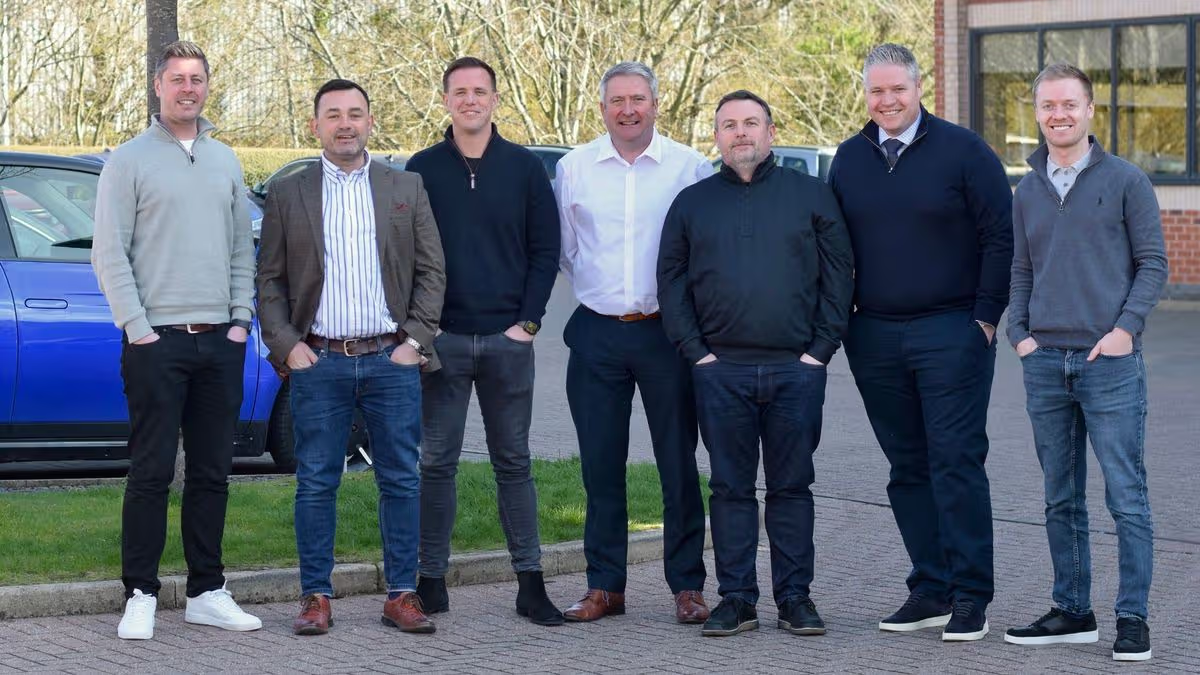












































You must be logged in to post a comment Login