Police have told motorists to expect dispruption from 1pm
There has been a warning of potential disruption to traffic due to a parade taking place in Belfast City Centre on Saturday.
Advertisement
The parade by the ROSA Socialist feminist movement will take place at 1pm on April 25 in Victoria Street before moving to Belfast City Hall via High Street and Donegall Place. The parade is expected to end by 3pm.
Police have said that officers will be in the area to assist with traffic management during the parade.
In a brief statement, a PSNI spokesperson said: “Road users are advised to expect disruption in Belfast City Centre this Saturday, 25th April, due to a planned parade. It will commence at 1pm in Victoria Street and culminate at Belfast City Hall. Police will be present in the area in order to assist with traffic management.”
Joan Eardley was one of the most unique and celebrated artists of her generation, but the international acclaim and recognition that her work deserves eluded her. Her paintings are not only foundational in Scotland’s cultural history, but continue to influence its creative landscape, particularly with those concerning dialogue around community and the poetics of place.
Currently on view in the National Galleries Scotland: Modern Two until June 28, Joan Eardley: The Nature of Painting, explores this popular post-war artist’s relationship to her predecessors and contemporaries.
Joan Kathleen Harding Eardley was born to a Scottish mother and English father in Sussex in 1921, and studied at Blackheath School of Art in London for a year before moving with her mother and sister to Glasgow during the outbreak of the second world war in 1939. She continued her studies at Glasgow School of Art and Hospitalfield in Arbroath, known as Scotland’s first school of fine art.
It was during this time that she began to shape her preference for painting everyday subjects. She used an RSA Carnegie Travelling Scholarship to travel through Italy and France in 1948 and 1949. On her return to Glasgow she spent time drawing and painting the industrial landscape of Port Glasgow, and Gourock. Eardley rented a studio in the city centre of Glasgow, and a few years later moved to Townhead in the east end, where local children became her favourite artistic subjects.
Advertisement
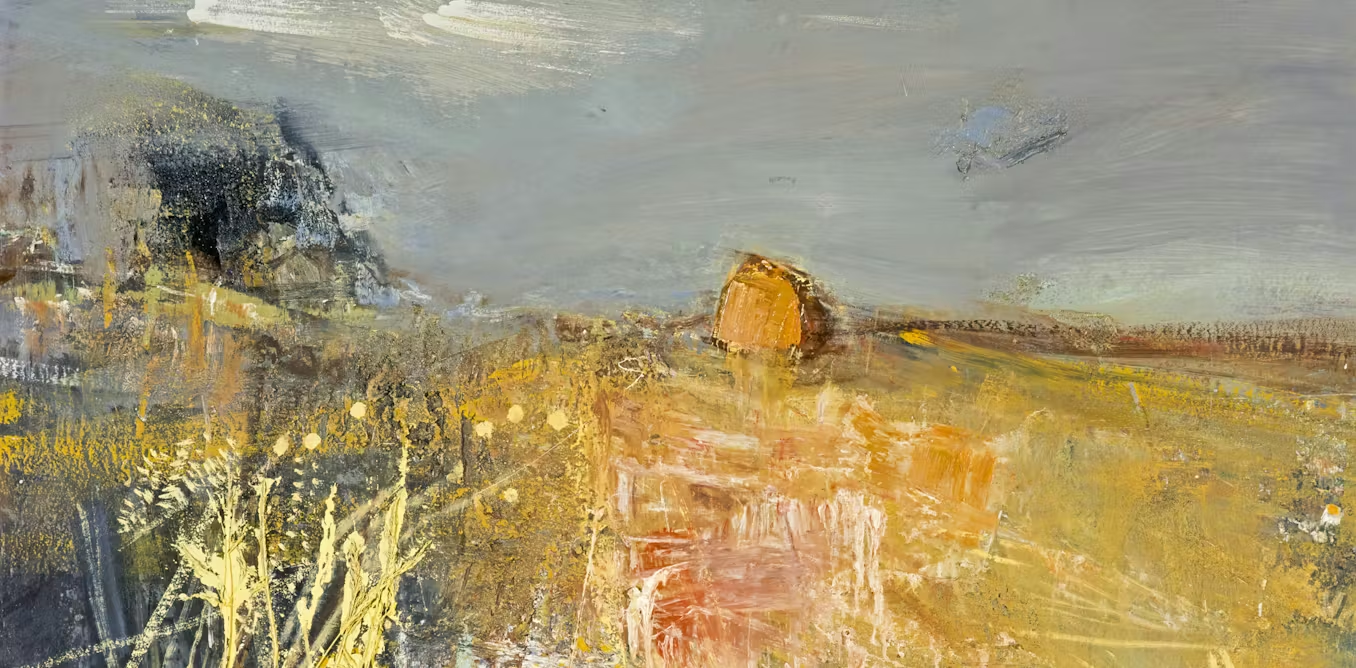
Hedgerow with Grasses and Flowers, 1962-1963. National Galleries of Scotland
More than 30 of Eardley’s artworks are juxtaposed at Modern Two alongside figures of international renown including Claude Monet, Marc Chagall, John Constable, Jean Dubuffet and Antoni Tàpies, together with her contemporaries Henry Moore, Bet Low and William McTaggart.
It places Eardley within an international art world which blends post-impressionism, social realism and abstraction. Jackson Pollok and the French Tachistes were known to have influenced her practice.
The exhibition is further enriched by a selection of archival and photographic materials containing a range of sketches, photographs and personal artefacts giving a glimpse into the life behind the artworks which are on display in the adjoining Keiller Library.
There are also several of her large works situated in Paolozzi’s Kitchen restaurant adjacent to the two exhibition spaces, alongside the likes of Scottish artist and contemporary Anne Redpath.
Advertisement
Connections with painters
The first exhibition space includes several of Eardley’s social-realist figure depictions of 1950s inner-city Glaswegian children. The works have a joyful, raw, playful spirit to them, in spite of the squalid slum environment the children were living in. No artist has painted Glasgow’s “weans” (a local word for children) in the way that Eardley has.
In Children and Chalked Wall No.3 (1962-63), sisters Mary and Pat Samson are painted in Eardley’s signature bold unsparing style, with their affectionate, endearing smiles, both huddled together. Their cheery faces, animated by Eardley’s blocks of colour, emerge from a background layered with graffiti and collage, anchoring her work in social reality.
Her work is surrounded by portraits by Rembrandt van Rijn, Jean-Francois Millet, Jean Dubuffet, Edward Hornel and Bet Low. Children and Chalked Wall No.3’s highly prized neighbour in the exhibition is Marc Chagall’s The Horse Rider (1949-53), a surreal gouache painted work with a block of azure-blue textured background with three figures and a horse, set within a Paris circus. Like Eardley’s work, it is also social-realist and figurative, with abstract elements incorporated within it. The female horse rider is a recurring theme for Chagall.
Advertisement
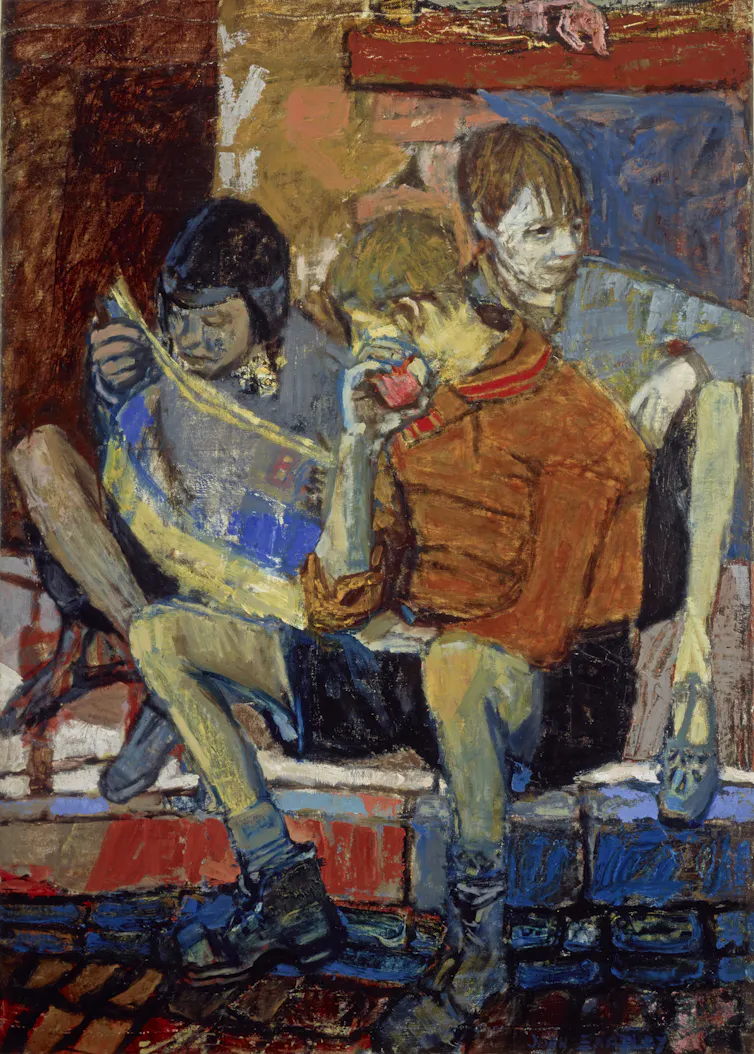
Eardley’s Street Kids (1949–51) captures a fleeting moment of camaraderie among three local boys. It is quiet and reflective, telling the stories of real Glasgow children who lived close to Eardley’s studio in Townhead, and captures the friendliness and community spirit that Eardley admired.
Street Kids, 1949-1951. National Galleries of Scotland
She does not shy away from the material conditions of post-war urban life, alluding to poverty, dirt and the presence of neglect. Again, colour is blocked in with minimum detail and repeating patterns of brickwork ground the piece. There is a respect of their resilience in her portraiture.
Exhibition space two is focused on Eardley’s relationship with Catterline, a small coastal village in the north east of Scotland near Stonehaven. In 1954, she bought a cottage to work there. Catterline’s rugged coastal landscapes and dynamic seascapes were central to many of Eardley’s paintings, providing the perfect stage setting for her expressive creativity to flourish.
Eardley worked between Glasgow and Catterline for several years and there are stories during that time of Eardley leaving Glasgow when she heard a storm was coming. Like tornado chasers, she travelled across the country to capture the coming storm’s power on the shore front where she would set up hardboard canvases to paint in its centre amid the lashing wind and rain like a woman possessed.
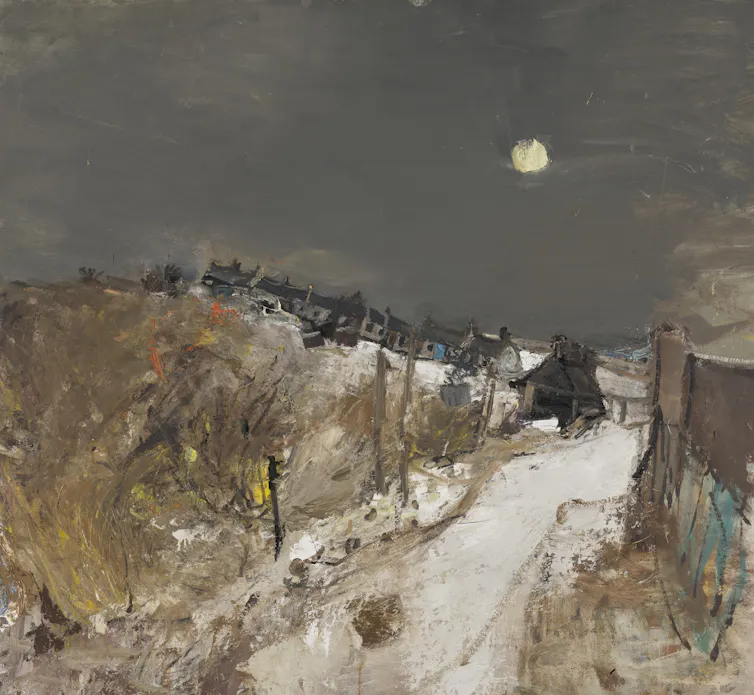
Her beautiful atmospheric painting Catterline in Winter (1963) set with a grey sky and full moon lighting up the snow-covered landscape is positioned next to Claude Monet’s Grainstacks: Snow Effect (1891). Both have an otherworldly sense about them, evoking a still and silent feeling of deep winter muffled by the frozen earth.
Advertisement
Catterline in Winter, 1963. National Galleries of Scotland
Eardley’s Summer Fields near Catterline (about 1961) with its expressive brushstrokes, shows stalks of corn in a bright golden cornfield set by a grey and black background is the highlight of the show.
She was elected an Academician of the Royal Scottish Academy of Art in 1963, just prior to her untimely passing from cancer later that year aged 42. Eardley’s ashes were scattered on the beach at Catterline, creating a lasting connection between the artist and the place which inspired her later works.
By situating her practice within a collaboration of artistic significance, the exhibition highlights the extent to which her work contributes to the central concerns of 20th-century painting. Not least the tension between representation and abstraction in her work and the enduring challenge of responding to the world, whether urban or elemental.
Joan Eardley: The Nature of Painting is on at the National Galleries Modern Two in Edinburgh until June 28
What happened when Americast’s Sarah Smith cold called the US president? In this episode, Sarah and Anthony thoroughly unpack her phone call with Donald Trump, how she planned the interview…and also, she tells us what happened when the US president unexpectedly called her back.
Listen to what Donald Trump told Sarah about next week’s state visit from King Charles and Queen Camilla, and how he thinks it could help repair relations with the UK. He also has advice for how Keir Starmer can recover after the fallout from Peter Mandelson’s appointment as US ambassador. Plus, Sarah asks Trump about his earlier threat to “wipe out” an entire civilisation in Iran.
HOSTS:
• Sarah Smith, North America Editor
• Anthony Zurcher, North America Correspondent
Advertisement
GET IN TOUCH:
• Join our online community: https://discord.gg/qSrxqNcmRB
• Send us a message or voice note via WhatsApp to +44 330 123 9480
• Email Americast@bbc.co.uk
• Or use #Americast
This episode was made by George Dabby. The technical producer was Ricardo McCarthy. The series producer is Purvee Pattni. The senior news editor is Sam Bonham.
If you want to be notified every time we publish a new episode, please subscribe to us on BBC Sounds by hitting the subscribe button on the app.
You can now listen to Americast on a smart speaker. If you want to listen, just say “Ask BBC Sounds to play Americast”. It works on most smart speakers.
Advertisement
US Election Unspun: Sign up for Anthony’s BBC newsletter: https://www.bbc.co.uk/news/world-us-canada-68093155
Americast is part of the BBC News Podcasts family of podcasts. The team that makes Americast also makes lots of other podcasts, including Newscast. If you enjoy Americast (and if you’re reading this then you hopefully do), then we think that you will enjoy some of our other pods too. See links below.
Newscast: https://www.bbc.co.uk/sounds/series/p05299nl
Radical: https://www.bbc.co.uk/sounds/brand/p0gg4k6r
The Global Story: https://www.bbc.co.uk/sounds/brand/w13xtvsd
Top Comment BBC Sounds – Top Comment – Available Episodes
President Donald Trump on Thursday announced a deal with drugmaker Regeneron to lower the cost of its pharmaceutical products as part of the White House’s signature drug pricing initiative.
The deal involves Regeneron lowering the prices of all its current and future drugs on Medicaid, according to Trump. It also involves selling a cholesterol drug called Praluent for $225 on the White House’s discounted drug website TrumpRx, according to the agreement first outlined by NOTUS and confirmed in a White House fact sheet.
The deal comes as the Trump administration has been touting efforts to provide economic relief ahead of November’s midterm elections, with Americans saying high costs for health care, gas, groceries and other basic needs are straining their budgets.
It’s one of many so-called most-favored-nation deals the Trump administration has made with drug companies to bring U.S. pharmaceutical prices to the same level as other developed nations. Last July, Trump publicly sent letters to executives at 17 major pharmaceutical companies about the issue. Regeneron is the final one of those companies to strike a deal with his administration.
Advertisement
Speaking at the White House on Thursday to announce the deal, Trump touted the discounts on drugs and said, “It should be front page news.” He said voters in this November’s midterm elections should reward his party because of the agreements with drugmakers.
“We should win the midterms, but it doesn’t work that way, unfortunately,” Trump said.
Trump also has a notable history with the drugmaker.
During his first term in 2020, when he was hospitalized with COVID-19, he was given a dose of a drug that Regeneron was testing to supply antibodies in order to help his immune system.
Advertisement
After he was released, Trump posted a video of himself standing outside the White House in which he repeatedly lavished praise on Regeneron.
As part of the new deal, Regeneron has also committed to spending $27 billion in research, development and manufacturing in the U.S., according to the White House fact sheet. Trump’s deals have historically offered companies relief from his tariffs if they make such commitments.
Regeneron also announced Thursday that Otarmeni, its new gene therapy for a rare form of congenital hearing loss, had been approved by the Food and Drug Administration and would be made available to clinically eligible individuals in the U.S. at no charge. The therapy received expedited approval from the FDA under the agency’s so-called Commissioner’s National Priority Voucher program.
The program, which was not authorized by Congress, has been under scrutiny from Democrats in Congress for months. House and Senate lawmakers have noted that FDA vouchers have repeatedly gone to companies that agree to pricing concessions sought by the White House.
Advertisement
Sign up for Morning Wire:
Our flagship newsletter breaks down the biggest headlines of the day.
Advertisement
Even as Trump and his Department of Health and Human Services have touted his drug-pricing deals as transformative, the details of the agreements have so far not been made public.
Pressed by members of Congress to share the contracts this week, Health Secretary Robert F. Kennedy Jr. said his team would share whatever details it could that didn’t include proprietary information or trade secrets. Trump and Kennedy have urged Congress to codify the deals into law.
Advertisement
The deals have occasionally run into roadblocks. A centerpiece of the agreements with weight-loss drugmakers Eli Lilly and Novo Nordisk fell apart earlier this week when Medicare delayed implementation of a program for insurers to cover the GLP-1 drugs.
Drug prices for patients in the U.S. can depend on a number of factors, including the competition a treatment faces and insurance coverage. Most people have coverage through work, the individual insurance market or government programs like Medicaid and Medicare, which shield them from much of the cost.
Patients on Medicaid, the state and federally funded program for people with low incomes, already pay a nominal co-payment of a few dollars to fill their prescriptions, but lower prices could help state budgets that fund the programs.
___
Advertisement
Associated Press writers Matthew Perrone and Michelle L. Price contributed to this report.
It’s a day those who follow the ITV soap have been waiting for, with the couple, dubbed ‘Swarla’ finally getting married
Coronation Street fans think they have found one problem with Lisa Swain and Carla Connor’s ‘glorious’ wedding day – but it’s not as bad as you may think.
Advertisement
It’s a day those who follow the ITV soap have been waiting for, with the couple, dubbed ‘Swarla’, getting engaged back in September, before the arrival of Lisa’s villianous ex, Becky Swain, put a spanner in the works.
While she had a good go at splitting Lisa and Carla up, nothing, in the end could keep the pair apart and after Becky’s downfall in January, it was confirmed that wedding bells were on the cards for the beloved couple.
Click here to sign up for more Coronation Street updates in our newsletter
During Thursday’s (April 23) episode of the ITV soap, aftering think there big day was over due to a flood runing the room they were due to marry in at the Chariot Square, Lisa told a disappointed Carla to get dressed and that they would have lunch at the hotel instead, with Debbie offering them a slap-up meal and free champers.
Advertisement
However, upon their arrival, Lisa surprised her by revealing their wedding was going ahead, with Lisa’s daughter, Betsy, Carla’s nephew, Ryan Connor, and her father-figure, Roy Cropper as their witnesses.
There were emotional scenes as Lisa and Carla delivered their vows to one another, before they were confirmed as wives. In another surprise, Sally Metcalfe activated the Underworld security alarm, forcing Carla to head into work, despite getting married, but upon her entry, everyone was waiting, having come together for a wedding reception, which even took Lisa by surprise as she didn’t expect the effort Carla’s workforce had put in.
After enjoying their first dance, Carla and Lisa were ushered out onto the factory balcony where they were again surprised, this time with a freworks display taking place from David Platt’s garden. They then headed back inside and with their guests gone, they reflected on their special day, before taking each other back on the dancefloor for another dance as Mrs and Mrs.
Advertisement
And while many thanks were hailing the perfect nuptials and thanking those involved for the representation, there was one problem for some Corrie fans – it just wasn’t enough Swarla wedding scenes, which comes after ITV changed its soap schedule at the start of the year, airing weeknightly 30 minute episodes of Corrie, instead of three lots of one hour episodes like it did previously.
@swqrlafilmz said: “Dare I say it… there wasn’t enough scenes for the wedding!” @carolineThom67 replied: “Agree!” @SamanthaC261 shared: “I loved the episode but I think it could have been even more amazing had it been an hour long. Don’t come at me as I did love it but these 30 minute eps just aren’t hitting for me.”
@AlisonSelw60139 admitted: “Not half hour episodes, 22 mins. I’ll would’ve expected a 44 mins special episode. Not a lot you can fit in a 22 minute episode. But I’ll enjoyed it anyway.” @carolineThom67 posted: “#swarla wedding. I’d have preferred more of the wedding ceremony, to be honest. Carla Connor do you take Lisa Caroline swain to be your lawful wedded wife etc etc etc. #corrie.” @NatureLover727 added: “I’ve just watched THE wedding and it’s made me emotional, the vows and the end especially. It was so good, my only criticism being I’d have liked a longer episode. @VixMyers and Ali King are amazing, we’re so lucky to have them #swarla #vickymyers #aliking #corrie.”
United are keen to get Sancho’s £300,000-a-week salary off their books and will decline the option to extend his contract for another year to protect his value.
Advertisement
According to Sky Germany, Sancho has already held talks with Dortmund and during their latest round of discussions, the winger has indicated to the Bundesliga club that he is keen on a return.
Jadon Sancho is keen on a return to Borussia Dortmund this summer (Getty)
The report adds that Sancho has received numerous offers from around the world but Dortmund must now decide whether to press ahead with the transfer.
Dortmund headcoach, Niko Kovac, has also approved the club’s push to re-sign Sancho this summer.
Sancho initially joined Dortmund in an £8m deal from Manchester City in 2017 and enjoyed the best years of his career in Germany.
After scoring 17 league goals in the 2019-2020 campaign, Sancho was named in the Bundesliga’s Team of the Season.
Advertisement
During his return to the club on loan two years ago, Sancho helped Dortmund reach the Champions League final where they were beaten by Real Madrid.
Speaking earlier this month, Dortmund’s sporting director Lars Ricken confirmed that the club are considering a move for Sancho in the summer window.
‘We are currently looking at a lot of players and analysing them. We check whether they can make us better. We are doing the same with Jadon,’ Ricken told Sport Bild.
‘Of course, we are looking for an offensive player who brings quality, can help us immediately, and doesn’t require an unrealistic transfer fee. In defense, Niklas Sule is leaving us, and Emre Can will be out for a while. So we are thinking about that area as well.’
Effi o Blaenau, which stars Leisa Gwenllian, offers an intimate look at society and community against the backdrop of North Wales
21:36, 23 Apr 2026Updated 21:36, 23 Apr 2026
After a successful run at Glasgow’s Fim Festival earlier this year, a Welsh language film from the director of Mr Burton is returning to Wales for its hometown premiere. Effi o Blaenau, which stars Under Salt Marsh’s Leisa Gwenllian as Effi, offers an intimate look at society and community against the backdrop of North Wales.
The Welsh language film which was made by Tarian for S4C, will have its local premiere at Cellb in Blaenau Ffestiniog, Gwynedd on Wednesday, June 17 before being released in cinemas across Wales and the rest of the UK on June 19.
Later this year the film will be broadcast on S4C, S4C Clic and BBC iPlayer. For the latest TV and showbiz gossip sign up to our newsletter
Advertisement
Funded by S4C and Creative Cymru, the film has been directed by BAFTA-nominee Marc Evans and adapted from Gary Owen’s 2015 Iphigenia in Splott.
The original drama was a reimagined version of the Greek tragedy heroine Iphigenia as a young working-class woman from Cardiff.
The Welsh language adaptation follows Effi, a woman from Blaenau Ffestiniog who discovers the costs of society and class whilst living in rural Wales.
Film Hub Wales said: “The film follows Effi, a young woman desperate to escape a town where the pubs are closed, the jobs have vanished and her grandmother works night shifts in the local chip shop just to get by.
“A chance encounter in a Llandudno nightclub with injured soldier Lee, played by Tom Rhys Harries, briefly opens a door to something better.
“For a moment, Effi glimpses a life she never imagined. The reality that follows is far tougher.
“As she faces the future as a single, unemployed mother-to be, Effi’s story exposes a stark social crisis: a system with too few maternity wards, too few midwives and too many impossible choices made out of necessity rather than care. Leisa Gwenllian gives a searing performance as Effi, evoking condemnation and sympathy in equal measures.”
Advertisement
The film is being broadcasted at the multi-arts space Cellb, which is located in the old Police Station and Court House in the heart of Blaenau Ffestiniog.
The event will be attended by writer/director Marc Evans, producer Branwen Cennard and lead actress Leisa Gwenllian.
The Britain’s Got Talent and I’m A Celebrity hosts are turning their attention to golf
Ant and Dec’s ‘crazy’ new show has been announced by ITV in a major career update from the Newcastle duo.
Advertisement
It has been a busy period for the popular presenters, who can currently be found on I’m A Celebrity South Africa. The All Stars version of the series was pre-recorded last year and has featured explosive exchanges between the campmates.
On Friday night (April 24), they will be hitting London for the live two-part final of the series. It remains to be seen just who will be crowned the second ‘Jungle Legend’.
Click here to get the biggest stories straight to your inbox in our Daily Newsletter
On top of hosting the ongoing 19th series of Britain’s Got Talent, the pair launched their own podcast earlier this year. Premiering back in January, Hanging Out with Ant & Dec, sees them sharing tales from their time on programmes such as Byker Grove, Pop Idol and SMTV.
Advertisement
If that wasn’t enough Ant and Dec, ITV confirmed on Thursday (April 23) that they’ll be back with a brand new series. Titled Holey Moley, the global smash hit extreme crazy golf show is coming to the UK.
A synopsis for the four-part series reads: “Holey Moley transforms crazy golf into an adrenaline-fuelled primetime event. This is crazy golf – supersized. Contestants will tackle an epic, zany, visually jaw-dropping course packed with inventive obstacles, physical challenges and laugh-out-loud jeopardy.
“Bringing together the UK’s most passionate crazy golfers – from top class professionals to keen amateurs – who are fearless everyday thrill-seekers, the series delivers skill, scale and Ant & Dec’s trademark comedy mischief in equal measure. Expect big swings, bigger laughs and unmissable family entertainment.
“Across each episode, eight players will go head-to-head to win the coveted Holey Moley golden putter, green plaid jacket and a fantastic prize. To get there, the contestants must step into the Holey Moley alternative universe and combine precision putting with stamina and nerve as they battle through ambitious, larger-than-life holes.
“From spinning windmills and exploding obstacles to slippery slopes and surprise hazards, competitors must combine skill, agility and determination to stay in the game.”
Ant and Dec will be joined throughout the series by a host of famous faces to add to the fun. The series is co-produced by Talkback Thames and Mitre Studios.
Ant said of the news: “This show is absolutely perfect for us. It’s all about pure fun and entertainment for the whole family from start to finish. Anyone who knows us knows we are adore golf, but you don’t need to be a golf fanatic to enjoy it, there’s something for everyone!”
Advertisement
Dec stated: “Holey Moley blends the game with huge entertaining moments that the whole family can sit down together, watch and enjoy. It’s epic, bold and full of laughs. We’re really excited to bring the show to the UK!”
Katie Rawcliffe, Director of Entertainment, Reality & Daytime Commissioning ITV, added: “We couldn’t be more excited to announce a brand-new entertainment format presented by Ant & Dec. Holey Moley is brilliantly competitive and enormous fun, making it a compelling watch for all.”
Casting for Holey Moley is now open and applications are open until Friday, May 15. The public can apply by visiting talbackthames.com/takepart.
President Donald Trump has dismissed the idea that he would use a nuclear weapon on Iran.
Asked by reporters whether he would, he said: “No. Why do I need it? Why would a stupid question like that be asked? Why would I? Why would I use a nuclear weapon?
“We’ve totally, in a very conventional way, decimated them without it.
Advertisement
“No, I wouldn’t use it. A nuclear weapon should never be allowed to be used by anybody.”
(AFP/Getty)
Jane Dalton23 April 2026 21:21
Trump threatens to end war by force
US president Donald Trump has said if Iran does not want to make a deal, he will finish the war by force.
Advertisement
“If they don’t want to make a deal, then I’ll finish it up militarily with the other 25% of the targets,” he said in the White House.
“We’ve had 78% of the targets that we’ve wanted to hit. We’ve knocked out their manufacturing, we’ve knocked out their missile production, we’ve knocked out their drone production.
“We’ve knocked out everything. In some cases, when I say knock it out, 70, 80, 90% – it’s amazing what we’ve done.”
Iran may have loaded up their weaponry “a little bit” during the two-week ceasefire, he said, but added that the US military can knock that out in about one day.
Advertisement
Jane Dalton23 April 2026 21:14
Watch: Iran demonstrates apparent ballistic missile at Tehran rally
Iranian state television has aired footage showing what appears to be a Qadr ballistic missile in Tehran, on a mobile launcher, during a late-night rally on Tuesday (21 April) as possible talks in Islamabad with the United States broke down. Qadr missiles can release individual bomblets known as cluster munitions, which Iran used widely when attacking Israel during the war. It came as Donald Trump earlier said he was extending the ceasefire with Iran at Pakistan’s request, while awaiting a “unified proposal” from Tehran.
Maryam Zakir-Hussain23 April 2026 21:10
Advertisement
Dozens of countries plan how to keep Hormuz open after war
Military planners from countries seeking to join a UK and France-led mission to keep the Strait of Hormuz open once the Iran war ends have held “constructive” talks in London.
More than 40 nations sent planners to the two-day conference at the UK’s Permanent Joint Headquarters in Northwood, northwest London.
They had aimed to build on talks held by Sir Keir Starmer and French president Emmanuel Macron in Paris last week, and agree a defensive plan that would restore confidence for commercial shipping.
Defence secretary John Healey told attendees that “millions of people” were relying on them to succeed because of the importance of the strait.
Advertisement
Jane Dalton23 April 2026 20:54
Drug prices rise by up to 30 per cent due to Iran war, pharmacists warn
Maryam Zakir-Hussain23 April 2026 20:00
Advertisement
All the alternative routes for Middle East oil and gas to bypass the Strait of Hormuz
The U.S.-Israeli war with Iran has disrupted shipping through the Strait of Hormuz, with only three vessels passing the waterway in the past 24 hours, shipping data showed.
More than a dozen tankers passed through the Strait after Iran briefly declared it open on Friday. But a ceasefire between the U.S. and Iran appeared in jeopardy on Tuesday as Iran vowed to retaliate for the U.S. seizure of one of its vessels and refused to join new peace talks.
Maryam Zakir-Hussain23 April 2026 19:30
Advertisement
Pope urges US and Iran to return to peace talks
The Pope has urged the US and Iran to return to peace talks.
He also firmly condemned the killing of protesters in Iran, after US president Donald Trump criticised him last week for not doing so while speaking out against the US-Israel war with Iran.
Leo also decried the deaths of “so many” civilians in the war and lamented the collapse of n peace talks.
“I condemn all actions that are unjust. I condemn the taking of people’s lives,” the Pope said when asked about reports that Iran had killed thousands of protesters.
Advertisement
Leo was attacked by Trump on social media as “terrible” on 12 April, after the Pope emerged as an outspoken critic of the war and the president’s hardline anti-immigration policies.
Jane Dalton23 April 2026 19:15
Lebanese journalist killed by Israeli strike was left under rubble for hours with no medical care, say officials
Amal Khalil, who worked for Lebanese newspaper Al Akhbar, was killed in the village of al-Tayri while covering Israel’s bombing of southern Lebanon on Wednesday.
Advertisement
Maira Butt and Bel Trew report:
Maryam Zakir-Hussain23 April 2026 19:00
The US was due to host a second round of talks between Israel and Lebanon on Thursday, with Lebanon seeking an extension of a ceasefire reached last week in a war that has run in parallel to the Iran war.
Advertisement
Israeli strikes killed five people including a journalist in Lebanon on Wednesday, the deadliest day there since the US-brokered truce took effect.
Iran says maintaining the Lebanon ceasefire is a pre-condition for talks on the wider war.
Maryam Zakir-Hussain23 April 2026 18:30
Advertisement
Pakistan’s junior interior minister told Reuters security plans for talks still in place
Pakistan, which hosted talks this month and had been preparing for a second round before it was called off on Tuesday, was still in touch with both sides, a Pakistani government source said.
Iranian officials were still declining to commit to attend over the U.S. blockade, the source added.
Talal Chaudhry, a junior interior minister, told Reuters security plans for talks were still in place and Pakistan was “fully prepared to host an event of this scale with confidence”.
Keir Starmer’s decision to fire Foreign Office chief Olly Robbins has contributed to “one of the worst crises in relations” between ministers and civil servants in modern times. The words of former cabinet secretary Gus O’Donnell, writing after Robbins was sacked for declining to inform Starmer that Peter Mandelson failed vetting for his ambassador role, are a stark warning for the prime minister.
Such a crisis has been building for some time. Historically, British civil servants and ministers had a strong bond based on a mutually beneficial partnership. Yet that partnership is badly frayed, and in its place a “them v us” relationship is emerging.
Under the previous Conservative government, ties between ministers and civil servants atrophied. A major source of tension was Brexit, amid frustration that officials were allegedly conspiring to derail Britain’s departure from the European Union.
More uncompromising figures, notably Boris Johnson’s chief strategist Dominic Cummings, believed that the permanent civil service was “an idea for the history books”. In his view, it was time to cut back the permanent bureaucracy, and bring in outsiders to rewire the state. Cummings threatened that a “hard rain” would fall. Ministerial relations with civil servants sank to a new low.
Advertisement
The expectation within Whitehall was that the election of a new government under Starmer would restore order and civility. After all, Starmer was himself a former permanent secretary at the Crown Prosecution Service, who believed in the ethic of public service. The fractured ties between officials and ministers would be repaired.
It has not, so far, worked out that way. In key respects, relationships appear to have deteriorated further. This has now been exacerbated by the summary dismissal of Robbins over the Mandelson affair.
Why do such tensions between officials and ministers in Whitehall persist? A key factor is that civil servants clearly believe they are less equipped to support ministers than they were 20 years ago. This has come up frequently in my interviews and private conversations with current and former civil servants.
Advertisement
Increasingly, the civil service lacks the experience and tools to advise ministers on policy. This problem began in the 1980s, with the rise of new public management – government reforms in several countries emphasising efficiency through markets and competition. Attention shifted towards operational delivery, away from policy-making. There has been a marked loss of intellectual capacity, while some civil servants bemoan the absence of creative policy thinkers in Whitehall.
Another issue is that the civil service appears less willing to look outwards, exacerbating what political scientists Ivor Crewe and Anthony King describe as “operational and cultural disconnect”. Officials in government departments appear more detached than ever from frontline professionals (the so-called “street-level bureaucrats” who manage public services), as well as from citizens and communities.
Who is responsible?
To blame the civil service for the current malaise is surely mistaken. After all, politicians are elected to lead and provide a coherent sense of direction. Civil servants support ministers’ ambitions by faithfully implementing the government’s agenda.
The Starmer administration came to office without a credible governing strategy. Apart from woolly rhetoric about “missions”, incoming ministers had no clear conception of how to strengthen government effectiveness.
Advertisement
A particular gap related to improving performance in public services, notably education, health, criminal justice and public transport. Most governments arrive in Whitehall with instincts about how to achieve change. Some use the central state alongside targets to mandate improvement. Others adopt bottom-up mechanisms including giving citizens more of a voice in shaping public services, while extending choice and competition in the organisation of provision.
Yet Starmer’s ministers appear to have no consistent approach. For example, NHS policy combines top-down directives with exhortation about creating a “community-led” service. The result is widespread confusion. In turn, slowness to deliver change breeds frustration among ministers, leading almost inevitably to attacks on the capability of civil servants, escalating tensions further.
It was the prime minister himself who declared that “too many people in Whitehall are comfortable in the tepid bath of managed decline”, setting the tone for the rest of his government. Yet, inexperienced politicians are naive about the time it takes to secure sustainable improvement.
Olly Robbins, pictured here in 2018, was a longtime civil servant before his firing last week. Mark Kerrison/Alamy
The dismissal of Robbins appears to be a continuation of the recent era in which ministers treated their relationships with officials with casual disregard. When crises erupt or policies appear to fail, civil servants are made culpable.
Advertisement
Yet such blame games are destructive, not least because they make it harder for civil servants to discharge their essential constitutional function of “speaking truth to power”.
In an atmosphere of growing distrust, officials are less likely to highlight problems in proposed policies. Where career promotion relies on doing what ministers are perceived to want, the risk is that propriety and ethics are negated, having a “chilling effect” on the wider civil service.
A dominant characteristic of civil service reform in recent decades is making officials more “responsive” to ministers. For example, permanent secretaries are employed on time-limited contracts intended to create pressure to perform. Moreover, increasing the contestability of policy advice by turning to political advisers, thinktanks, NGOs and the private sector disrupts the monopoly which civil servants previously held in the policy-making process (although that was always something of a myth).
Such a dynamic increases the pressure on civil servants to comply with what ministers demand. Otherwise, in a more competitive policy landscape, they risk marginalisation. Consequently, the civil service is less likely to fulfil its crucial role in acting as a break on overweening executive power and unchecked authority. That is detrimental to the fulfilment of good government.
In parts of Germany and Australia, a surprising thing is happening more and more often: households are being offered free electricity.
This is happening at times of day when there are high levels of energy being generated from solar or wind. It is caused because sometimes more electricity is being produced than people need. Only a limited amount of storage is available and most of it must be used immediately to keep the system stable.
As countries expand use of wind and solar power, these periods when people are not charged for the energy to run their washing machine or kettle will happen more often. When supply exceeds demand, electricity prices can fall sharply, and sometimes drop below zero. Negative electricity prices mean generators pay consumers to use excess electricity, and this has already started to happen in some European countries such as Germany and Spain. In 2024 alone, European power markets recorded over 1,000 hours of negative prices.
The Internationale Energy Agency expects solar capacity to more than double by 2030, making up almost 80% of new electricity worldwide. Renewables are also expected to meet over 90% of global electricity demand by 2030.
Recent data by energy think-tank Ember shows how quickly this shift is happening. In 2025, global low-carbon electricity generation rose by about 887 terawatt-hours, slightly more than the increase in demand. Solar met around 75% of this growth, while solar and wind together met almost all of it.
Paying consumers to use energy
In Australia, this is largely driven by rooftop solar, which produces large amounts of electricity in the middle of the day when household demand is low. In Germany, strong wind and solar output, especially at weekends, can create similar surpluses. These conditions are now occurring frequently enough to affect electricity prices.
The trend is spreading. In South Australia, negative electricity prices accounted for around a quarter of wholesale electricity in both 2023 and 2024. In California, the share of hours with negative pricing rose from about 4% in 2023 to 15% in 2024. Across Europe, countries such as Finland, Sweden, the UK and Germany are all starting to see similar patterns, although the UK is seeing the lowest level of hours with negative pricing compared to these other European nations.
Data from 2025 shows that this trend is continuing. Negative electricity prices are becoming more common, reaching around 6% of hours in countries such as France, Germany and Spain. In Spain, this doubled in 2025, compared with 2024. In France, they rose by almost half, while Germany and the Netherlands saw increase by around a quarter.
These patterns point to a deeper issue: electricity systems are not yet flexible enough to respond to rapid changes in supply, so have to give away energy to be able to cope.
Evidence from Australia shows how this is beginning to change. Negative electricity prices are now common in the middle of the day, when solar output is highest, with prices falling to zero or below for around two to three hours each day on average. At the same time, extreme price spikes are becoming less frequent.
But for those on flexible tariffs, electricity can become cheaper or “free” during these periods, and in some cases these lower prices may be reflected in reduced unit costs or small bill credits.
However, not everyone will benefit equally. Households with batteries or smart systems are better placed to take advantage of this trend, as they can store energy to use later in the day, particularly in the evenings when typically use is highest.
Advertisement
This reflects a system that is beginning to adapt. According to the Australian Energy Market Operator, large-scale batteries are playing a growing role by storing electricity when it is abundant and releasing it when demand rises. This helps to smooth price fluctuations and stabilise the system.
Together, these changes mark a shift in how electricity systems operate. Now, as renewable energy generation grows, supply is increasingly shaped by the weather. This means demand must become more flexible in response.
UK policy
This shift is already influencing policy in other countries such as the UK. According to the UK’s National Energy System Operator, from summer 2026 households and businesses will be encouraged to use more electricity during periods of excess supply more often, particularly when solar generation is high and demand is low. The aim is to actively shift when electricity is used, helping to absorb surplus energy and improve system stability.
The timing is not accidental. As part of a shift towards renewables, particularly solar, continues to grow in the UK, for instance, periods of excess supply are becoming more common.
Advertisement
Similar patterns were seen in countries such as Germany, where a rapid surge in solar generation urged a sudden need for greater system flexibility. In the UK, for instance, managing the grid during periods of low demand is becoming more complex, as electricity supply becomes increasingly driven by weather conditions rather than consumption patterns.
This is why flexibility is needed. In extreme cases, large imbalances between supply and demand can place significant strain on electricity systems. 2025’s blackout across Spain and Portugal, shows how quickly instability can happen if systems cannot respond effectively. In the UK, system operators stress that these conditions are actively managed.
Free electricity reflects a deeper shift in how the energy system works. As renewable power grows, excess supply is going to become even more common.























































You must be logged in to post a comment Login