



Connect with us
DAPA Banner

Tech

Claude can now connect to lifestyle apps like Spotify, Instacart and AllTrails

Published

on

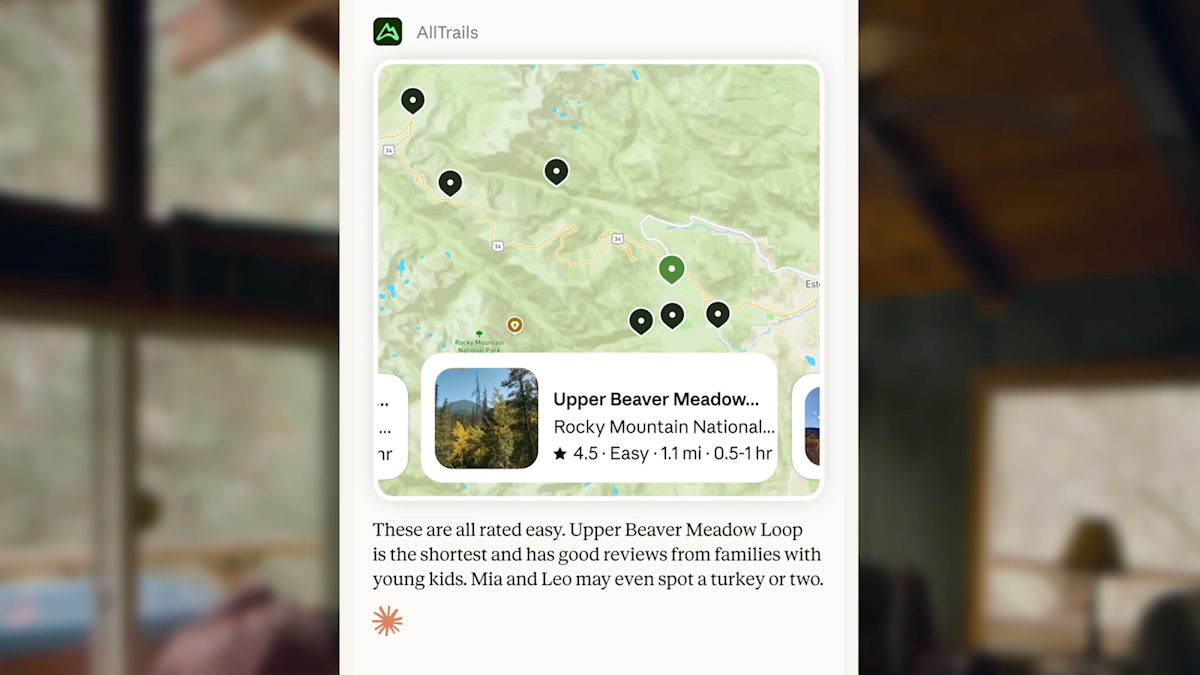
Anthropic is expanding its directory of connected services for its Claude AI chatbot. The platform can now link up with your accounts on AllTrails, Audible, Booking.com, Instacart, Intuit Credit Karma, Intuit TurboTax, Resy, Spotify, StubHub, Taskrabbit, Thumbtack, TripAdvisor, Uber, Uber Eats and Viator. Additional services will be added in the future.

More and more AI companies are trying to up their third-party integrations in a pitch to make their services as useful as possible. The benefit of having multiple apps connected means that a chatbot can theoretically execute more complicated tasks on your behalf. This expansion takes that capability from the professional and educational settings, where Anthropic’s connectors have been focused for the past year, to a personal one. So, for instance, Claude can now help plan a hike on AllTrails and then pull up a Spotify playlist that will last for the duration of your trek.

Anthropic noted that it is also reframing how apps are showing up so that an appropriate service is suggested for the task you want to perform. The apps should appear dynamically within the Claude conversation rather than needing a user to swipe between programs. As with most AI actions, Claude is supposed to check with its user before actually taking any actions like securing a reservation or making a purchase.

Source link

Advertisement
Continue Reading
Click to comment

You must be logged in to post a comment Login

Leave a Reply

Tech

Save $250 on the Google Pixel 10: Tensor G5, triple rear camera, and Gemini Live for under $550

Published

on

The Google Pixel 10 is down to $549 in a limited-time deal, a $250 saving off its $799 list price, and it’s the unlocked Android phone I’d point most people toward at this price right now. The Tensor G5 chip, a new triple rear camera system with 5x telephoto, and Gemini AI built in from the ground up make this a considerably more complete package than the price drop alone suggests.

What you’re getting

The Tensor G5 is the chip that makes the Pixel 10 worth talking about beyond the camera specs. Google designed it specifically around AI workloads, which means Gemini integration feels native rather than layered on top of a chip built for something else. Gemini Live lets you have a free-flowing conversation with the assistant, point the camera at something and ask about it in real time, or get things done across apps without switching contexts constantly. It’s the kind of feature that changes how you actually use a phone day to day, rather than one you try twice and forget about.

The camera system on the Pixel 10 gets a meaningful upgrade with the addition of a 5x telephoto lens, bringing the rear setup to a proper triple configuration. Up to 20x Super Res Zoom pulls in detail from distances that most phone cameras handle poorly, Night Sight keeps low-light shots clear without the grain that plagues competitors at this price, and Camera Coach offers real-time guidance to help you get the framing and timing right before you shoot rather than fixing it after.

The 6.3-inch Actua display runs at 120Hz with 3,000 nits of peak brightness, which is readable in direct sunlight in a way that most phone screens aren’t. Gorilla Glass Victus 2 and an IP68 rating cover durability and water resistance, and the unlocked configuration works across all major US carriers, including Google Fi, Verizon, T-Mobile, and AT&T.

Advertisement

Why it’s worth it

The Pixel 10 at $799 was already a well-priced phone for what it offers. A $250 saving brings it to a point where the camera system, Gemini integration, and Tensor G5 performance add up to a package that competing Android phones at this price don’t match cleanly. The limited-time nature of the deal means this is worth acting on before it moves.

The bottom line

The Google Pixel 10 at $549 is the everyday Android phone deal worth prioritizing right now. The Tensor G5, triple camera with 5x telephoto, and Gemini AI built in from the start add up to a phone that feels genuinely current, and the $250 saving makes it one of the more clear-cut smartphone purchases at this price.

Source link

Advertisement
Continue Reading

Tech

Brute-force attack linked Rec Room user phone numbers to online identities

Published

on

Rec Room gift cards in a retail kiosk in Seattle. The social gaming platform, which is shutting down June 1, experienced a previously unreported brute-force attack on its friend-finder feature earlier this year that linked user phone numbers to their online identities. (GeekWire Photo / Todd Bishop)

Someone misused Rec Room’s friend-finder feature to match phone numbers to the user names of hundreds of thousands of players on the social gaming platform — assembling a database that connects their online identities directly to their real-world contact information.

The incident, which took place in January, hasn’t been previously reported or publicly acknowledged except in a brief response by a Rec Room staffer to a question in an online forum. It’s not directly related to the subsequent announcement that the Seattle-based company will shut down the social gaming platform June 1, after 10 years in business.

In messages to GeekWire, a person familiar with the incident expressed concern that Rec Room has never proactively notified users whose phone numbers and user identities were linked through the brute-force attack — leaving them unaware of the situation and vulnerable to harassment, phishing, or other attacks, especially as the platform shuts down.

Responding to our inquiries about the incident, the company acknowledged that it learned in January that an individual was running a high volume of queries against its friend-finder API. After discovering this, the company said, it disabled the feature and banned the user. 

Rec Room said it engaged an outside legal and forensics firm to conduct a review, which concluded that disabling the API was sufficient and no regulatory notification was required. The feature only returned a username when matched with a phone number or email, Rec Room said, and did not expose additional account information or credentials.

Advertisement

“We take user safety and security seriously and have robust measures in place to protect user data,” a Rec Room spokesperson said in a follow-up statement, adding that the company “reviewed our privacy settings and confirmed they’re working as intended.”

What happened: The incident didn’t involve someone breaking into Rec Room’s servers or accessing its database directly.

Instead, it happened through the platform’s friend-finder feature, which let players upload their phone contacts to see which of their friends were already on the platform. Under the hood, the system accepted a phone number and returned a Rec Room username if there was a match. 

The feature was designed for individual users checking their personal contacts. However, the system had no apparent safeguards to prevent someone from querying it at a massive scale.

Advertisement

That’s what happened in January, according to the person familiar with the matter. Someone systematically ran all US and Canadian phone numbers through the system, collecting every hit. The result, the person said, was a database of nearly 279,000 records.

The database was subsequently sold to others, according to the person familiar with the incident, who said the system used to distribute it was itself not secure, potentially making it accessible to a wider audience. 

Rec Room’s response: Asked about the size of the database, Rec Room said it did not recognize the number provided by the source, but did not offer its own count of affected users. Without additional information, it’s unclear if the company has determined the size of the assembled database or the full scope of the incident. 

Rec Room said no phone numbers or emails were acquired directly from the company. 

Advertisement

Responding to a user question about the incident in the company’s Discord server on Feb. 19, a Rec Room staffer said the platform had previously allowed users to find friends by searching their contacts, and that some users were “abusing this functionality at scale.” 

The message said the feature had been disabled “out of an abundance of caution.” 

Why it matters now: The company has not proactively notified affected users. Rec Room said its support team has been responding to players who’ve contacted the company after receiving unsolicited texts that were apparently connected to the assembled database. 

With the platform now scheduled to shut down June 1, the window for proactive notification is closing. After that date, Rec Room will no longer have an in-app channel to reach its players. 

Advertisement

Rec Room’s shutdown itself could increase the risk. An attacker with the database could use the closure to craft convincing phishing messages — for example, a text or email impersonating Rec Room and urging players to click a link to export their data before the platform goes dark. The shutdown would give such a message built-in plausibility.

Phone numbers can also be used to find real names and home addresses through publicly available records, or to attempt SIM swapping, in which an attacker takes over a victim’s phone number to intercept calls, texts, and authentication codes. Users can lock their phone number through their wireless carrier’s app or website, typically with a PIN, to help prevent this. 

Privacy settings: One issue in dispute involves Rec Room’s privacy settings. The platform offered users a toggle to prevent others from finding them by phone number or email address. 

But the person familiar with the incident said the setting did not protect against the type of mass queries used in the attack. This person said their own data appeared in the database despite having the setting turned off, and provided a screenshot supporting this assertion.

Advertisement

(The person declined to be identified, citing concerns that publishing their name could allow someone to use the data to connect their identity to their home address and other personal details using public records.)

Asked about the privacy setting, Rec Room said it verified that it worked as designed.

Historical precedents: It’s not the first time a social platform has faced this type of incident. 

In 2014, an attacker used the same approach against Snapchat’s friend-finder feature, matching usernames to 4.6 million phone numbers. Snapchat was criticized for initially dismissing the vulnerability and took more than a week to apologize, but later acknowledged the breach, updated its app, and let users opt out of the feature.

Advertisement

In 2021, a similar technique was used to assemble a database of phone numbers and personal information from more than 530 million Facebook users. Facebook said it had fixed the underlying flaw in 2019 but declined to individually notify affected users, saying it couldn’t be certain which users needed to be notified.

Rec Room’s approach has more closely resembled Facebook’s: maintaining that the incident did not create a security or privacy risk and that no user data was acquired from its systems.

Rec Room’s user base: Rec Room attracted more than 150 million lifetime players across phones, consoles, PCs, and VR headsets, with millions still active each month before the shutdown was announced. 

Rec Room CEO Nick Fajt told the Wall Street Journal in 2021 that the bulk of the platform’s users were between the ages of 13 and 16 — meaning many of the phone numbers in the assembled database would belong to minors or their parents.

Advertisement

The company’s path: Rec Room launched in 2016 as a platform for building and sharing virtual worlds. Founded by a group of former Microsoft engineers, the company went on to raise $294 million in venture funding over its lifetime, and was valued at $3.5 billion at its peak in 2021. 

But it never found a way to become profitable, cutting staff in two rounds of layoffs last year. 

The person familiar with the matter said last year’s layoffs significantly impacted the company’s cybersecurity team. The company also paused its bug bounty program on the security platform Bugcrowd on Feb. 10, halting new vulnerability reports. The program has not reopened. 

After the March shutdown announcement, Snap acquired select assets from Rec Room, and some members of the team joined the Snapchat parent’s hardware subsidiary to work on its Specs augmented reality glasses. It’s not clear if any were impacted in Snap’s cuts last week.

Advertisement

What to know: Rec Room users who linked a phone number to their account should be aware that their number may have been connected to their user name in the assembled database. 

Users should be skeptical of any unsolicited texts or emails related to Rec Room or to the upcoming shutdown, particularly messages urging them to click links. 

With the platform closing in less than seven weeks, the person familiar with the incident said they hope bringing public attention to the issue will help users be alert to the risks.

Source link

Advertisement
Continue Reading

Tech

Why it’s full STEAM ahead for young people upskilling in Ireland’s west

Published

on

Gouri Hiremath explores the importance of an early STEAM education and why building skills doesn’t need to be complicated.

The educational route, when planning a future career, can come with many twists and turns. Often young people may have already graduated from school or are taking a year out to contemplate their options before settling on a course or company.

This can have its own benefits as you may find that now you are more emotionally prepared or mature enough for the next phase of your life. But for others, it can be a straighter road, where they know from a young age exactly how their professional life will begin. 

With that in mind, for Gouri Hiremath, a senior software engineer and STEAM Studio ambassador at Liberty IT, it is critical that students and young people be exposed early on to positive, career-shaping opportunities, so that they have the know-how to make the most of their education. 

Advertisement

Initially established at the Ulster Museum in Belfast, Liberty IT have expanded the STEAM Studio in partnership with the Galway City Museum, with the location now serving as a dedicated west of Ireland hub

Offered to young people in secondary school, the STEAM Studio is a collaborative workspace that has been designed to connect coding and technology with the museum experience, inspiring young people to explore and develop their tech skills and empowering them to consider a career in the industry.

Hiremath explained: “As part of the free programme, which includes return transport for schools availing of the workshop, Junior Cycle students are upskilled in coding that enables them to design and create their own arcade game, all inspired by Galway’s maritime heritage and supported by Liberty IT volunteers who are our STEAM Studio ambassadors.

“The Galway programme is structured as recurring workshops across the school year, rather than a one-off event,” she added. “It’s been purposely created for students aged 13 to 15, at that key point where they’re starting to think about higher education and future pathways.”

Advertisement

Go west

For Liberty IT, the STEAM Studio is a tangible medium through which the organisation can invest in the communities in which its employees live and work, helping to inspire the “next generation of tech talent in the region” – which Hiremath noted is of particular importance as young people living in the west often have less access to structured, industry-led STEAM programmes.

She explained: “Many of our STEAM Studio ambassadors are from in and around Galway and they’re hugely passionate about showing students that you can build a tech career here, in your own city, without having to leave.

“Partnering with Galway City Museum to expand STEAM Studio has given us a unique setting to blend local heritage, creativity and technology. Coding a game inspired by maritime history lands very differently when you’re doing it in the museum that tells that very story.”

The programme is designed to build a mix of technical and transferable skills, where young people can explore coding while also developing creativity through simple game design. They learn how software works behind the digital world, and design their own characters and stories.

Advertisement

“We want them to leave thinking, ‘I made this, what else could I build?’,” said Hiremath. 

And it isn’t just about developing coding skills, Hiremath noted how initiatives such as the STEAM Studio programme build career skills. She explained, students work together in groups, communicating their ideas, building confidence and resilience as they talk through what they have created and the challenges. She said that they see first-hand how “getting it wrong is both normal and fixable”. 

Don’t lose steam

To fully engage with learning in the STEAM space, Hiremath finds that consistency is key. With that in mind, the programme made the deliberate decision to use an approved coding platform that was already familiar to teachers, so that STEAM Studio visits can be easily connected back to everyday classroom learning. It also provides important safety measures that don’t limit a child’s potential or curiosity.  

“A vetted platform also builds trust with schools and parents by ensuring strong standards around privacy, safeguarding and age-appropriate content,” she said. “Because the tools are available in schools, students can continue experimenting after the workshop, allowing STEAM Studio to act as a catalyst rather than a self-contained experience.”

Advertisement

Ultimately, for Hiremath, positive experiences at a young age can influence how young people view their future careers. 

“When a 13-year-old builds their first game with a STEAM Studio ambassador beside them, technology stops being abstract,” she explained. “It becomes something they can do and that identity shift is hugely powerful when they make subject and career choices later.”

She said that this direct interaction both with technology and with the people who inhabit the roles they may want to step into down the line, can empower students to ask the right questions, making what is often viewed as a complex field more relatable and attainable. 

“Having STEAM Studio ambassadors from different backgrounds, career paths and regions helps challenge the idea that tech is only for a particular ‘type’ of person,” she added. “They can see someone from Galway, working in tech in Galway, giving back to the city.

Advertisement

“Our long-term ambition is that some of the students who come through STEAM Studio will go on to become the tech talent of the future.”

Don’t miss out on the knowledge you need to succeed. Sign up for the Daily Brief, Silicon Republic’s digest of need-to-know sci-tech news.

Source link

Advertisement
Continue Reading

Tech

What is a DAC? Digital-to-analogue converters explained

Published

on

If you listen to music a lot, chances are that it’ll be a digital music file you’re listening to.

However, what you might not realise is that in order to hear that file, you’ll need a DAC. Digital-to-analogue converters are built into every bit of kit capable of digital sound.

You’ll find a DAC in your phone or laptop, but also your TV or games console, in CD players, as well as wireless headphones, portable music players and more, taking analogue signals and turning them into the digital signal that you hear.

But what exactly are DACs, and why do they matter? Read on to understand why they hold such importance in the audio scene.

Advertisement

What is a DAC?

Before we get into exactly what a DAC is and does, let’s go through a quick re-cap. Human ears aren’t capable of hearing the 0s and 1s that make up digital music; unless you’re secretly an Android (or AI), us humans can only hear analogue signals.

Advertisement

Not just that, but the kit through which we hear music – whatever that may be – can’t play a digital signal either; it can only receive it. In order to transmit it, that signal must be converted into an analogue soundwave first, and that is where a DAC comes into the equation.

A DAC is the middleman within the whole process, unpacking the binary information stored in the digital file so the resulting sound most accurately represents the original analogue recording.

Advertisement
iFi iDSD Phantom DACiFi iDSD Phantom DAC
Image Credit (iFi Audio)

Of course, digital files can be stored in varying levels of quality/sample rates – from 256kbps MP3 streams to 24-bit/192kHz FLAC digital downloads – and this affects the amount of information they contain.

A DAC can only work with what it’s given though, its raison d’être is to make sense of what’s provided and translate it accurately from its binary format and return it as closely as possible to the original analogue recording.

Just be aware that feeding a good-quality DAC a poor-signal quality signal can make shortcomings in that recording clearer. Our review of the Eversolo DAC-Z10 is a good example of that.

Advertisement

Eversolo DAC-Z10 streamerEversolo DAC-Z10 streamer
Image Credit (Trusted Reviews)

Do I need an external DAC?

Not all DACs are created equal. Although every source of digital music contains a DAC, how well it does its job can vary widely.

For example, cheaper DACs might not support more unusual file data rates and are more likely (but not always) to have lesser quality circuitry that results in timing errors, distortion and noise in the sound that’s reproduced.

Advertisement

Timing errors are one of the biggest issues with lesser quality DACs, which is the reason devices such as mobile phones and laptops often aren’t the best source for digital music playback. The DAC included is not always the priority, especially in cheaper handsets.

iFi Go Blu Air portable DACiFi Go Blu Air portable DAC
Image Credit (iFi Audio)

Thankfully, you can improve what you already have and bypass a poor-quality internal DAC with a better quality external one with better internal circuitry that’s focused on making audio sound as good as it can be.

Advertisement

In particular, dedicated hi-fi DACs can tackle timing issues thanks to better, more advanced digital clock circuitry. This means the file conversion to analogue will be tighter, cleaner and more faithful to the original recording.

What type of DAC is right for you?

While any external DAC is likely to offer improvement on the sound pushed through something more basic, this isn’t a given – and its effectiveness will vary. As ever, it’s worth doing your research before you buy.

Advertisement

Device compatibility is an area to take note of, especially as pretty much all mobile devices have now ditched the 3.5mm jack that were common when this article was first published many moons ago.

You can spend thousands on a DAC if you’re rocking a system worthy of that kind of cash – Chord’s top-of-the-range DAVE comes can be had for £10,500.

Equally, if your wallet isn’t quite as flush with money, there are less expensive portable DACs such as the iFi Go Link 2 (£59) which could make all the difference to your audio setup.

Advertisement

Advertisement
iFi Audio Go Link 2iFi Audio Go Link 2
Image Credit (iFi Audio)

This is the reason it’s important to think about how you most listen to digital music. What devices do you use and what functionality do you need?

External DACs can come with a USB-C on-the-go cable, helpful for connecting to Android devices or iOS devices. For added convenience, there are DACs that can connect wirelessly to devices over Bluetooth.

Portable DACs such as the Go Link 2 don’t require any external power as they take it from your device. They keep things simple, with just a USB input and headphone jack for playback.

Spend a bit more on something like the Chord Mojo 2, and you’ll keep the portability but add in coaxial and optical inputs for extra functionality.

A unit such as the Burson Playmate 3 on the other hand, is bigger and requires external power. That makes it one for either your desktop or the hi-fi rack rather. It does offer more connectivity options such as digital or analogue audio inputs, for those with more involved setups.

Advertisement

Advertisement

Make sure these types of DACs come with a built-in headphone amp if you intend to do some private listening through a pair of headphones as not all do.

Make sure you’ve got the best possible quality

Regardless of the DAC you end up choosing, you need to start out with good source material. A low-res Spotify stream just won’t cut it.

You’ll hear optimum results with CD-quality content and above, which is best stored in FLAC, WAV or ALAC (for Apple Macs) lossless PCM formats, or alternatively DSD if you prefer that format.

Advertisement

Again, it’s worth noting that the likes of FLAC and PCM and relatively accessible unless we’re talking about high bit-rates and sample rates. Something more exotic, such as DSD, is not as common, but in the right set-up, it can offer excellent audio quality.

If you’re unaware of what DSD is, it’s an audio format that stands for Direct Stream Digital, and is an alternative to PCM (Pulse Code Modulation).

It differs by offering a bit depth of just one, but much higher sampling rates – DSD64 at 2.8 MHz and DSD128 at 5.6 MHz. If you’re in the DSD camp, it’s worth checking if a DAC supports it as again not all of them do. The ones that are compatible with DSD, tend to be on the expensive side.

Advertisement

Advertisement

In any case, if you enjoy listening to music in the best quality possible, you’ll be well served by adding a DAC to whatever system you have.

Do some research, read reviews, and you’ll be on your way to audio nirvana.

Source link

Advertisement
Continue Reading

Tech

One Maker Turned a Decade-Old Dream Into a Working EMP Rifle

Published

on

Homemade Custom EMP Rifle
Years ago, a teenager became obsessed with basic high-voltage gear and dreamed about something bigger. Fast forward to now, and the maker known as Schizo, has just finished building a full-sized handheld device that emits a strong electromagnetic pulse.


Before he could print anything, Fusion software had meticulously planned out the entire project. He’s also made certain that the high-voltage components do not come into contact with the grip while it is in place. The ground wire exit is securely hidden away in an exterior tube to prevent accidental shorting, and slots around the top allow an insulated screwdriver to bleed off any stray charge once he turns it off. That’s because this machine handles with so many volts that you’d be crazy to feel safe at any time.


Bambu Lab A1 3D Printer, Support Multi-Color 3D Printing, High Speed & Precision, Full-Auto Calibration…
  • High-Speed Precision: Experience unparalleled speed and precision with the Bambu Lab A1 3D Printer. With an impressive acceleration of 10,000 mm/s…
  • Multi-Color Printing with AMS lite: Unlock your creativity with vibrant and multi-colored 3D prints. The Bambu Lab A1 3D printers make multi-color…
  • Full-Auto Calibration: Say goodbye to manual calibration hassles. The A1 3D printer takes care of all the calibration processes automatically…

Bambu Lab’s A1 Combo printer turned the digital files into actual pieces, giving the gun the smooth, clean finish you’d expect from a professional. The way everything came together was also seamless, as the rifle houses everything from the batteries in the foregrip to the main pulse components by the muzzle. Metric screws are all over the place, holding everything together while also allowing him to make adjustments on the fly. There’s no fancy work or frills here; simply sensible, utilitarian design that keeps everything balanced and ready to go.

Homemade Custom EMP Rifle
At the center is a Marx generator made up of several stages, each with two 15kv ceramic caps wired in series to relieve some pressure. Resistors snaffle the charge for the capacitors from a flyback transformer powered by a ZVS circuit. When the voltage reaches a certain level, the first spark gap fires, followed by the others, and suddenly, whoosh, everything releases as a single, quick hit rather than a trickle. The end result is a bloody intense pulse that travels through a copper coil at the front, creating a shifting magnetic field all around the gun.

Homemade Custom EMP Rifle
He gets the show started with two 3 cell lithium ion batteries, and a safety switch and spring-loaded trigger are linked to a limit switch that controls when it fires. A motor governor regulates the voltage, allowing the generator to operate smoothly.It’s also worth mentioning that he’s taken great care in routing the wires and has even gone above and beyond to smooth out all of the solder connections after spotting tiny corona discharges leaking energy during early tests, which improves performance and keeps it from getting too bulky.

Homemade Custom EMP Rifle
Electricity and magnetism interact in relatively simple ways that anyone can understand. A changing magnetic field induces current in any nearby conductor. The faster the magnetic field changes, the more of a push you receive. The Marx generator is one of the devices capable of delivering such a quick shift. When the coil lets go of its charge, the pulse radiates out and produces voltages in any neighboring circuits. Sensitive chips are the first to notice the effect because they typically operate at extremely low voltages and cannot simply ignore the additional energy. It all comes together with Maxwell’s equations, but the basic calculation is rather simple: a rapid pulse indicates a broader disruption.

Homemade Custom EMP Rifle
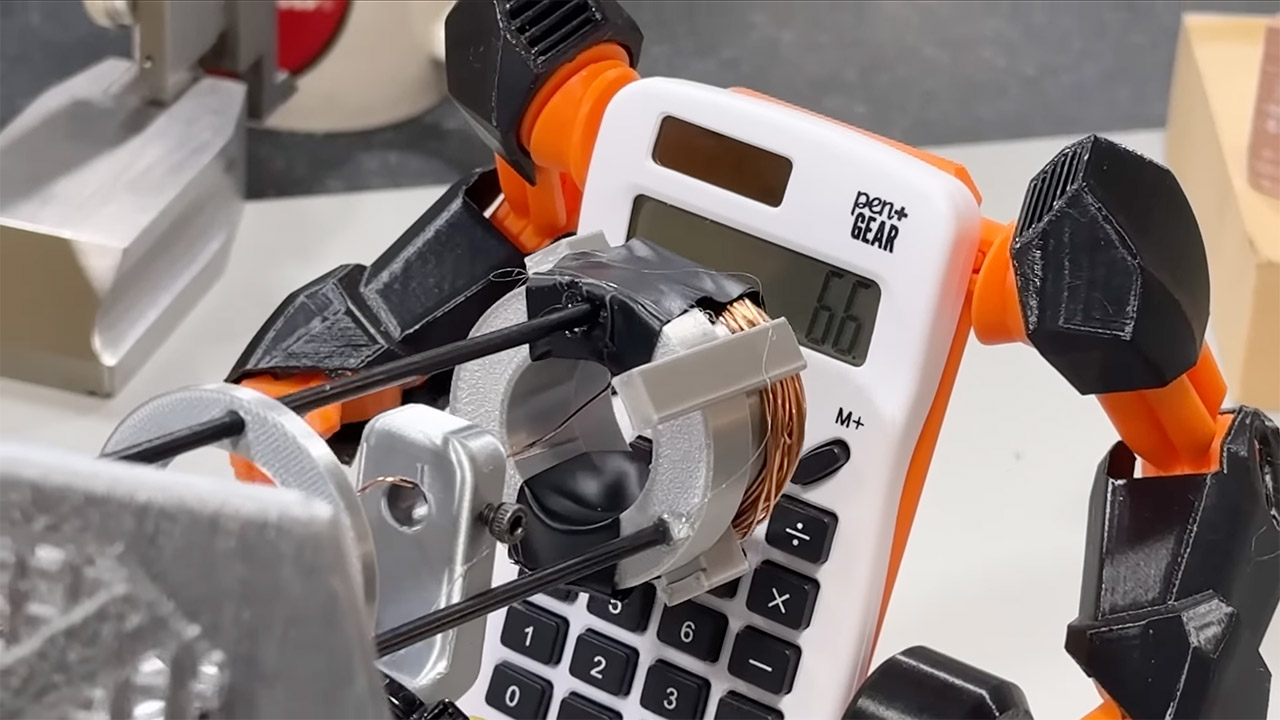
Testing began cautiously, as the first shots from the coil caused a pocket calculator resting just a few inches away to flicker and reset, for example. Next, a multimeter detected the induced voltage from a distance but eventually failed when brought closer. A desktop computer, on the other hand, felt the effects through its glass case from more than four feet away, but only had occasional faults on screen. In a darkened environment, you could see the spark gaps inside the cannon illuminate in fast small flashes through the printed infill. Intermittent results improved slightly, but the overall range remained rather small. Nonetheless, it was evident that the gadget operated far better than the maker’s previous attempts.

Advertisement

Source link

Continue Reading

Tech

Encrypting Encrypted Traffic To Get Around VPN Bans

Published

on

VPNs, Virtual Private Networks, aren’t just a good idea to keep your data secure: for millions of people living under restrictive regimes they’re the only way to ensure full access to the internet. What do you do when your government orders ISPs to ban VPNs, like Russia has done recently?  [LaserHelix] shows us one way Gopniks cope, which is to use a ShadowSocks proxy.

If you’re not deep into network traffic, you might be wondering: how can an ISP block VPN traffic? Isn’t that stuff encrypted? Yes, but while the traffic going over the VPN is encrypted, you still need to connect to your VPN’s servers– and those handshake packets are easy enough to detect. You can do it at home with Wireshark, a tool that shows up fairly often on these pages. Of course if they can ID those packets, they can block them.

So, you just need a way to obfuscate what exactly the encrypted traffic you’re sending is. Luckily that’s a solved problem: Chinese hackers came up with something called Shadowsocks back in 2012 to help get around the Great Firewall, and have been in an arms-race with their authorities ever since.

Shadowsocks is not, in fact, a sibling of Gandalf’s horse as the name might suggest, but a tool to obfuscate the traffic going to your VPN. To invert a meme, you’re telling the authorities: we heard you don’t like encrypted traffic, so we put encryption in your encrypted traffic so you have to decrypt the packets before you recognize the encrypted packets.

Advertisement

What about the VPN? Well, some run their own shadowsocks service, while others will need to be accessed via a shadowsocks bridge: in effect, a proxy that then connects to the VPN for you. That means of course you’re bouncing through two servers you need to trust not to glow in the dark, but if you have to trust someone– otherwise it’s off to a shack in the woods, which never ends well.

Don’t forget that while VPNs can get you around government censorship, they do not provide anonymity on their own. If, like tipster [Keith Olson] –thanks for the tip, [Keith]!– you’re looking side-eyed at your government’s “think of the children!” rhetoric but don’t know where to start, we had a discussion about which VPNs to use last year.

Source link

Advertisement
Continue Reading

Tech

Microsoft Gaming is dead, long live Xbox

Published

on

Microsoft just hit reset on its gaming identity, and in a way, it feels like going back to basics. Because “Microsoft Gaming” is out, and Xbox is officially back at the center of everything.

Why is Microsoft ditching “Microsoft Gaming” for Xbox again?

In a recent internal shift, Microsoft has rebranded its entire gaming division back to Xbox, effectively dropping the “Microsoft Gaming” label altogether.

This isn’t just a cosmetic change. The new CEO, Asha Sharma, has made it clear that “Xbox needs to be the identity”, signaling a move away from the broader, corporate-sounding branding toward something more focused and recognizable.

The “Microsoft Gaming” name originally came into play during the Activision Blizzard acquisition era under Phil Spencer, when the company was positioning gaming as a larger business unit. Now, the shift suggests a return to a more gamer-first identity, with Xbox once again leading the narrative.

What does “We Are Xbox” actually mean for the future?

Alongside the rebrand, Microsoft has outlined a new direction internally under the message “We Are Xbox.” The focus is shifting toward a few core pillars like hardware, content, services, and overall player experience. 

There is also a noticeable change in how success is being measured. Instead of just sales or subscriptions, the company is now prioritizing daily active players, which shows a stronger emphasis on engagement over raw numbers. 

At the same time, Xbox is reevaluating its strategy around exclusivity, cloud gaming, and even AI integration. The goal seems to be building a more flexible ecosystem that works across console, PC, mobile, and cloud rather than locking players into one platform. 

This may look like a simple rebrand, but it feels more like a reset. With next-gen hardware on the horizon, Microsoft is streamlining its identity around Xbox while doubling down on cloud, multiplatform play, and engagement. In the end, it is less about changing the name and more about returning to what already works.

Advertisement

Source link

Continue Reading

Tech

Meta to cut 8,000 jobs to bankroll its AI ambitions

Published

on


The move reflects a broader pattern across major technology companies, where AI spending is rising even as headcount declines. Meta has projected record capital expenditures this year and announced several multibillion-dollar AI partnerships in recent months. Internally, employees have been encouraged to use AI agents in day-to-day work, including software…
Read Entire Article
Source link

Continue Reading

Tech

Authorities arrest special forces soldier who allegedly made $400K on Polymarket bet involving Maduro operation

Published

on

A special forces soldier involved in the operation that captured Venezuelan President Nicolás Maduro has been indicted by the U.S. Justice Department. His alleged crime? Making numerous bets on the prediction market Polymarket that Maduro would be removed from power, for which he is said to have made upwards of $400,000.

Authorities claim Gannon Ken Van Dyke, who was involved in the “planning and execution” of Operation Absolute Resolve (the stratagem that toppled and captured the Venezuelan leader), made bets on Polymarket about whether the U.S. would deploy forces into Venezuela and remove Maduro from power.

Van Dyke was arrested on Thursday, CBS reports, citing a law enforcement source.

Federal officials say that Van Dyke’s wagers were informed by classified information he had access to as a result of being a government insider. The government notes that Van Dyke signed nondisclosure agreements prohibiting him from ever divulging, publishing, or revealing “by writing, words, conduct, or otherwise . . . any classified or sensitive information” related to the military operations he was involved with.

Advertisement

In December, Van Dyke created a Polymarket account and began making wagers involving “Maduro- and Venezuela-related markets,” officials say. Between December 27, 2025 and January 26 of this year, he allegedly made 13 bets totaling some $33,034 in total on things like “U.S. Forces in Venezuela . . . by January 31, 2026” and “Maduro out by . . . January 31, 2026.” Officials say that, after collecting his winnings, Van Dyke also took steps to cover up his ties to the account that made the wagers.

Van Dyke faces a variety of charges, including violating the Commodity Exchange Act, wire fraud, and making an unlawful monetary transaction.

“Our men and women in uniform are trusted with classified information in order to accomplish their mission as safely and effectively as possible, and are prohibited from using this highly sensitive information for personal financial gain,” said Acting Attorney General Todd Blanche. “Widespread access to prediction markets is a relatively new phenomenon, but federal laws protecting national security information fully apply.”

Techcrunch event

Advertisement

San Francisco, CA
|
October 13-15, 2026

Prediction markets have inspired controversy ever since their launch. But over the past year, the sites have grown in prominence and influence, striking deals with media outlets and sports organizations while also seeing widespread use, including by public officials. Legislation is currently being mulled that would ban public officials from using nonpublic information to make bets on prediction sites.

Advertisement

When you purchase through links in our articles, we may earn a small commission. This doesn’t affect our editorial independence.

Source link

Continue Reading

Tech

How This Former Roboticist’s Students Rebuilt ENIAC

Published

on

Tom Burick has always considered himself a builder. Over the years he’s designed robots, constructed a vintage teardrop trailer, and most recently, led a group of students in building a full-scale replica of a pivotal 1940s computer.

Burick is a technology instructor at PS Academy in Gilbert, Ariz., a middle and high school for students with autism and other specialized learning needs. At the start of the 2025–26 school year, he began a project with his students to build a full-scale replica of the Electronic Numerical Integrator and Computer, or ENIAC, for the 80th anniversary of the historic computer’s construction. ENIAC was one of the world’s first programmable electronic computers. When it was built, it was about one thousand times as fast as other machines.

Before becoming a teacher, Burick owned a robotics company for a decade in the 2000s. But when a financial downturn forced him to close the business, he turned to teaching. “I had so many amazing people help me when I was young [who] really gave me their time and resources, and really changed the trajectory of my life,” Burick says. “I thought I need to pay that forward.”

Becoming a Roboticist

As a young child in Latrobe, Pa., Burick watched the television show Lost in Space, which includes a robot character who protects the family. “He was the young boy’s best friend, and I was so captivated by that. I remember thinking to myself, I want that in my life. And that started that lifelong love affair with robotics and technology.”

Advertisement

He started building toy robots out of anything he could find, and in junior high school, he began adding electronics. “By early high school, I was building full-fledged autonomous, microprocessor-controlled machines,” he says. At age 15, he built a 150-pound steel firefighting robot, for which he won awards from IEEE and other organizations.

Burick kept building robots and reached out for help from local colleges and universities. He first got in touch with a student at Carnegie Mellon University, who invited him to visit campus. “My parents drove me down the next weekend, and he gave me a tour of the robotics lab. I was mesmerized. He sent me home with college textbooks and piles of metal and gears and wires,” Burick says. He would read the textbook a page at a time, reading it again and again until he felt he had an understanding of it. Then, to help fill gaps in his understanding, he got in touch with a robotics instructor at Saint Vincent College, in his hometown of Latrobe, who let him sit in on classes. Each of these adults, he says, “helped change the trajectory of my life.”

Toward the end of high school, Burick realized that college wouldn’t be the right environment for him. “I was drawn to real-world problem-solving rather than structured coursework and I chose to continue along that path,” he says. Additionally, Burick has dyscalculia, which makes traditional mathematics more challenging for him. “It pushed me to develop alternative methods of engineering.”

recreation of a large machine arranged in a U shape. A podium in the middle reads \u201cENIAC 80\u201d The ENIAC replica Burick’s students built precisely matches what the original computer would have looked like before it was disassembled in the 1950s. Robert Gamboa

When he graduated, he worked in several tech jobs before starting his own company. In 2000, he opened a computer retail store and adjacent robotics business, White Box Robotics. The idea for the company came when Burick was building a “white box” PC from standard, off-the-shelf components, and realized there was no comparable product for robotics.

Advertisement

So, he started developing a modular, general-purpose platform that applied white box PC standards to mobile robots. “The robot’s chassis was like a box of Legos,” he says. You could click together two torsos to double its payload, switch out the drive system, or swap its head for a different set of sensors. He filed utility and design patents for the platform, called the 914 PC-Bot, and after merging with a Canadian defense robotics company called Frontline Robotics, started production. They sold about 200 robots in 17 countries, Burick says.

Then the 2008 financial crisis hit. White Box Robotics held on for a couple of years, shuttering in late 2010. “I got to live my life’s dream for 10 years,” he says. After closing White Box, “there was some soul searching” about what to do next. He recalled the impact his own mentors had, and decided to pay it forward by teaching.

Neurodiversity as a Superpower

In 2013, Burick started working in a vocational training program for young adults living with autism. The program didn’t have a technical arm, so he started one and ran it until 2019, when he was hired to be a technology instructor at PS Academy Arizona.

Student using power drill on wood under instructor\u2019s guidance in workshop. Burick and one of his students assemble the base for one of ENIAC’s three portable function tables, which contained banks of switches that stored numerical constants. Bri Mason

Burick feels he can connect with his students, because he is also neurodivergent. Throughout his childhood, he was told what he wasn’t able to do because of his dyscalculia diagnosis. “People tell you what it takes, but they never tell you what it gives,” Burick says.

Advertisement

In adulthood, he realized that some of his strengths are linked to dyscalculia, too, like strong 3D spatial reasoning. “I have this CAD program that runs in my head 24 hours a day,” he says. “I think the reason I was successful in robotics, truly, was because of the dyscalculia…. To me, [it] has always been a superpower.”

Whenever his students say something disparaging about living with autism, he shares his own experience. “You need to have maybe just a bit more tenacity than others, because there are parts of it you do have to fight through, but you come through with gifts and strengths,” he tells them.

And Burick’s classes aim to play to those strengths. “I didn’t want my technology program to feel like craft hour,” he says. Instead, through projects like the ENIAC replica, students can leverage traits many of them share, like the abilities to hyperfocus and to precisely repeat tasks.

Recreating ENIAC

Burick has taught his students about ENIAC for several years. While reading about it, he learned that the massive, 27-tonne computer was dismantled and partially destroyed after being decommissioned in 1955. Although a few of ENIAC’s 40 original panels are on display at museums, “there was no hope of ever seeing it together again. We wanted to give the world that experience,” Burick says.

Advertisement

He and his students started by learning about ENIAC, and even Burick was surprised by how complex the 80-year-old computer was. They built a one-twelfth scale model to help the students better understand what it looked like. Seeing the students light up, Burick became confident in their ability to move onto the full-scale model, and he started ordering supplies.

ENIAC was composed of 40 large metal panels arranged in a U-shape that housed its many vacuum tubes, resistors, capacitors, and switches. Twenty of the panels were accumulators with the same design, so the students started with these, then worked through smaller groupings of panels. The repeating panels brought symmetry to ENIAC, Burick says, but it was also one of the main challenges of recreating it. If one part was slightly out of place, the next one would be too and the mistake would compound.

Group of students in a gym holding large silver patterned boards facing the camera. The students installed 500 simulated vacuum tubes in each of the panels here, for a total of 18,000 vacuum tubes.Robert Gamboa

Once they constructed the panels, they added ENIAC’s three function tables, which stored numerical constants in banks of switches, then two punch-card machines. Finally, they installed 18,000 simulated vacuum tubes. In total, the project used nearly 300 square meters of thick-ream cardboard, 1,600 hot-glue-gun sticks, and 7 gallons of black paint.

The scale of the machine—and his students’ work—left Burick in awe. “By the time we were done, I felt like I was in a room full of scientists,” he says.

Advertisement

Previously, Burick’s students built an 8-foot-long drivable Tesla Cybertruck (“complete with a 400-watt stereo system and a subwoofer”) and he plans to keep the momentum with another recreation—maybe from the Apollo moon missions.

“I go to work every day, and I feel passionate about robotics [and] technology. I get to share that passion with the students,” Burick says. “I get to feel what it’s like to be in the position of the people that helped me. It closes that loop, and I find that really rewarding.”

From Your Site Articles

Related Articles Around the Web

Advertisement

Source link

Continue Reading

Trending

Copyright © 2025