

Crypto World
Galaxy research head says Strataegy could overtake Satoshi’s BTC stack



Galaxy’s Alex Thorn says Strategy now holds more Bitcoin than BlackRock’s IBIT and, if its pace holds, could match Satoshi’s estimated 1.1m BTC stash within two years.
Summary
- Galaxy’s Alex Thorn says Strategy now holds more Bitcoin than BlackRock’s IBIT, the largest spot BTC ETF.
- At current accumulation rates, he believes the entity could surpass Satoshi Nakamoto’s estimated 1.1 million BTC within two years.
- The move would make Strategy one of the single largest Bitcoin holders globally, alongside ETFs and long-dormant early-mined coins.
Galaxy Digital head of research Alex Thorn has flagged that Strategy’s Bitcoin holdings have now overtaken those of BlackRock’s iShares Bitcoin Trust (IBIT), the world’s biggest spot Bitcoin ETF by assets. In a post on X, Thorn wrote that on-chain and treasury-tracking data show Strategy has become the “largest single BTC‑holding entity,” beating IBIT’s stash and continuing to add coins on dips.
Thorn added that, if current accumulation trends continue, Strategy is on pace to catch or even surpass the legendary hoard attributed to Bitcoin’s (BTC) pseudonymous creator Satoshi Nakamoto within roughly two years. Satoshi’s cache is widely estimated at around 1.1 million BTC — roughly 5.5% of total supply — and has remained untouched since 2010, a fact that has long shaped market psychology around Bitcoin’s scarcity and “diamond hands” culture.
Bigger than the biggest ETF
BlackRock’s IBIT has dominated the U.S. spot Bitcoin ETF landscape since launching in January 2024, amassing more than 700,000 BTC in under 18 months and at times holding over 56% of all spot ETF Bitcoin. Recent data put IBIT’s BTC exposure north of 800,000 coins, worth more than $50 billion at prevailing prices.
By contrast, Strategy’s treasury now holds an estimated 760,000 BTC or more after adding roughly 80,000 BTC year‑to‑date, according to figures cited by market analysts and recent research notes. One Binance‑hosted update earlier this month highlighted that Strategy still controls around 762,000 BTC even after pausing new purchases, underscoring its role as the largest corporate Bitcoin holder.
March to Satoshi‑scale holdings
The comparison with Satoshi is more than symbolism. Analysts point out that if Strategy’s buying pace remains anywhere near recent levels, its stack could cross the 1 million BTC mark within the next couple of years, placing it in the same league as the dormant founder coins that have never moved.
Such concentration raises both bullish and structural questions: bulls argue that deep‑pocketed, long‑term holders reduce available float and support price, while critics warn that megatreasuries and ETFs introduce corporate and regulatory chokepoints into what was designed as a decentralized asset. For now, Thorn’s takeaway is simple: in the competition to own the scarcest large‑cap asset in crypto, one aggressive buyer is closing in on the mythic benchmark set by Bitcoin’s creator.


US President Donald Trump is reportedly considering pardoning 250 people to commemorate the country’s 250th birthday on July 4, according to The Wall Street Journal.
An official announcement could come on June 14, Trump’s birthday, or during the Independence Day event on July 4, the WSJ reported Thursday, citing people familiar with the matter.
However, the pardons are still in the preliminary stages and have yet to be confirmed. More than 16,000 formal requests for presidential pardons were submitted last year.
On his first day back in office last year, Trump issued more than 1,500 pardons to people involved with the storming of the US Capitol in 2021. Several jailed crypto founders and their supporters have been advocating for pardons from Trump since his inauguration.
Cointelegraph has contacted the White House for comment.
FTX, Samourai Wallet founders want pardons
FTX founder Sam Bankman-Fried was convicted on all seven counts connected to the collapse of the cryptocurrency exchange and was sentenced to 25 years in prison in 2024. He has waged a social media campaign in the hopes of getting a pardon, but Trump reportedly ruled it out earlier this year.
Keonne Rodriguez, one of the developers behind the crypto-mixing protocol Samourai Wallet, has also publicly expressed hopes for a pardon.
Trump said last December he would review Rodriguez’s case and explore a pardon. There is also a petition that has attracted 16,082 signatures as of Thursday.

Source: Keonne Rodriguez
Meanwhile, at least two petitions calling for a pardon for the Tornado Cash founders, Roman Storm and Roman Semenov, are currently live; however, they have only 22 and 9 signatures, respectively. Storm has not publicly asked for a pardon.
Storm was convicted last August on charges of conspiring to operate an unlicensed money transmitting business and is still facing charges of money laundering and sanctions violation conspiracy. Semenov is considered on the run and is wanted by the FBI.
The case against Rodriguez and Storm has been closely followed by crypto advocates, many of whom argue they shouldn’t be held responsible for the actions of third parties using their software.
Some crypto pardons already granted
Several crypto founders have already received pardons during Trump’s second term as president.
Last year, the White House pardoned the co-founders of crypto exchange BitMEX: Arthur Hayes, Benjamin Delo and Samuel Reed, who all pleaded guilty to failing to maintain anti-money laundering and know-your-customer programs in violation of the Bank Secrecy Act.
Related: US CLARITY Act sees ‘big step forward’ as markup set for May 14
Binance founder Changpeng “CZ” Zhao was also pardoned in 2025. He already served a four-month prison sentence after pleading guilty to one count of violating the US Bank Secrecy Act for failing to maintain an effective anti-money laundering program at Binance.
Silk Road founder Ross Ulbricht was one of the first to receive a pardon from Trump in January 2025 for his life sentence in connection with his operation of the dark web marketplace.
Magazine: eToro founder timed Bitcoin top perfectly due to belief in 4 year cycles

TLDR
- Micron saw nearly $100 billion wiped from its valuation at Tuesday’s session low before aggressive buying pressure returned.
- Shares tested the $700 support zone before reversing course, creating a bullish candlestick formation that technical traders view as a dip-buying opportunity.
- The semiconductor sector broadly recovered alongside Micron, with the PHLX Semiconductor Index advancing and peers including Nvidia, Texas Instruments, and ON Semiconductor posting gains.
- The memory chip giant is positioned to breach a $900 billion market capitalization for the first time, potentially ranking it as the 11th-largest U.S. corporation.
- Days before the dramatic price action, a Micron director offloaded more than $1.57 million worth of shares in transactions dated May 11.
Micron Technology (MU) stock flirted with technical breakdown territory on Tuesday before an aggressive wave of buying interest transformed what appeared to be a rout into a textbook example of market strength.
During the session’s nadir, Micron witnessed approximately $100 billion evaporate from its market capitalization. Shares plunged toward the $700 threshold before bargain hunters emerged with sufficient conviction to generate an extended lower shadow on the daily candlestick—a technical formation that chart watchers generally interpret as price rejection at lower levels. Current trading data shows the stock hovering near $804.
The trading day began on shaky footing. Monday’s price action had produced an “evening star” candlestick configuration after MU failed to sustain momentum above $800—a development frequently interpreted as a bearish reversal signal following sustained upward movement. Tuesday’s early weakness appeared to validate that cautionary indicator.
However, the narrative took an unexpected turn.
Samsung Labor Tensions Provide Support
Among the factors sustaining buyer enthusiasm was an escalating situation at Samsung (SSNLF). Labor tensions sparked concerns about a potential 18-day work stoppage that could compromise chip manufacturing operations, potentially constraining memory supply during a period when AI applications are already straining available inventory.
This fundamental backdrop provided market participants with justification to overlook near-term technical deterioration and maintain their positions.
Micron’s recovery didn’t occur in isolation. The PHLX Semiconductor Index advanced 2.38%, while numerous major semiconductor stocks participated in the rebound. ON Semiconductor skyrocketed 11.14%, Texas Instruments gained 3.78%, Analog Devices rose 3.04%, and Nvidia increased 2.29%. Broadcom represented the primary exception, declining 0.60%.
For MU bulls, the critical question now centers on whether the $700 zone can function as reliable support. Should it hold, Tuesday’s session may ultimately be characterized as a technical shakeout rather than the initiation of a meaningful downtrend.
Historic Valuation Threshold Approaches
The figures surrounding Micron’s market capitalization command attention at this juncture. With shares advancing 4.83% during the session, Micron is positioned to close above a $900 billion valuation for the first time in company history, according to Dow Jones Market Data.
Achieving this milestone would establish it as the 11th-largest U.S. corporation by market capitalization. For perspective, pharmaceutical powerhouse Eli Lilly currently commands approximately $944 billion—Micron continues narrowing that differential. The stock requires a close at or above $798.06 to reach the threshold.
Within the analyst community, sentiment remains predominantly constructive. MU holds a Strong Buy consensus rating derived from 27 Buy recommendations, 3 Hold ratings, and zero Sell ratings issued over the preceding three months. The consensus price target stands at $608.33, which paradoxically suggests potential downside from present levels—a testament to how rapidly the stock has appreciated.
On May 11, mere days preceding Tuesday’s volatile trading, director Steven J. Gomo executed sales of 2,000 MU shares across two separate transactions at weighted average prices of $786.47 and $787.60, generating total proceeds of $1,574,070. Following these dispositions, he maintains direct ownership of 17,139 shares, according to a Form 4 disclosure filed with the SEC.


Quick Overview
- Alibaba shares rallied over 8% on Wednesday following Q4 results, even though profits fell short of analyst projections.
- A diplomatic visit by President Trump to China for discussions with President Xi Jinping boosted confidence in Chinese technology equities.
- The presence of Nvidia CEO Jensen Huang in the U.S. delegation sparked speculation about easing semiconductor trade restrictions.
- Cloud computing revenue surged 38% year-over-year to $6.13 billion, while AI-driven products maintained triple-digit expansion for the 11th consecutive quarter.
- CEO Eddie Wu projected that AI will account for more than 50% of Alibaba’s cloud revenue within the next 12 months.
Alibaba (BABA) shares concluded Wednesday’s session at $145.81, climbing more than 8%, despite delivering fourth-quarter financial results that fell short of analyst consensus estimates.
Alibaba Group Holding Limited, BABA
The e-commerce giant’s shares initially slipped approximately 2% during pre-market hours immediately after the earnings announcement. However, sentiment reversed dramatically once regular trading commenced, fueled by encouraging geopolitical developments and impressive performance in cloud computing and artificial intelligence segments.
Fourth-quarter revenue increased 3% compared to the same period last year. The modest top-line growth reflected substantial capital allocation toward AI infrastructure, cloud platform expansion, and investments in Alibaba’s express delivery operations, which promise one-hour fulfillment for customers.
Despite falling short on earnings, market participants chose to overlook the temporary profitability challenges.
Diplomatic Developments Boost Investor Sentiment
A significant driver behind Wednesday’s stock performance was President Trump’s journey to China for bilateral discussions with President Xi Jinping. The high-stakes diplomatic engagement generated expectations that ongoing trade frictions between Washington and Beijing might begin to thaw.
Adding to the positive atmosphere, Nvidia CEO Jensen Huang accompanied the American delegation. Investors interpreted his participation as a constructive indication regarding potential progress on artificial intelligence chip commerce between the world’s two largest economies — a development that would directly advantage Chinese cloud computing and AI enterprises.
Any relaxation of current semiconductor export controls could provide substantial tailwinds for Alibaba and comparable companies as they continue expanding their AI capabilities.
Cloud Computing and Artificial Intelligence Remain Growth Engines
Cloud segment revenue skyrocketed 38% year-over-year to 41.63 billion yuan, approximately $6.13 billion. Revenue generated from third-party clients expanded 40%.
Artificial intelligence-focused offerings delivered triple-digit percentage growth for an impressive 11th straight quarter. Such sustained performance momentum carries significant weight, even when overall financial metrics disappoint.
During the earnings conference call, CEO Eddie Wu informed analysts that Alibaba is transitioning its AI operations from the development phase into broader commercial deployment. Wu also projected that AI-related services will represent over half of total cloud revenue within the coming year.
The organization recently separated its artificial intelligence operations from the cloud computing division, naming Wu to lead the newly established Alibaba Token Hub business unit.
Bloomberg Intelligence analyst Catherine Lim observed that Alibaba “effectively redeployed more than 90% of its March-quarter China e-commerce profit into Qwen user acquisition and adoption” — a spending trajectory anticipated to persist through fiscal 2027.
Alibaba confirmed its commitment to investing 380 billion yuan ($53 billion) in AI initiatives through 2027.
Management also anticipates its rapid commerce division will achieve profitability by fiscal 2027.
Analyst sentiment toward the stock remains overwhelmingly positive. BABA holds a Strong Buy consensus rating, supported by 15 Buy recommendations and two Hold ratings issued over the past three months. The consensus price target stands at $186.32, suggesting approximately 30% appreciation potential from Wednesday’s closing price.
Crypto World
Crude Oil Markets Navigate Geopolitical Tensions as Trump and Xi Hold High-Stakes Talks

TLDR
- Brent crude maintained levels between $105 and $106 per barrel following a decline exceeding 1% in the prior trading session
- President Trump and President Xi convened in Beijing for more than two hours, expressing optimism regarding bilateral relations
- Ongoing conflict with Iran has resulted in the effective closure of the Strait of Hormuz, eliminating approximately 6 million barrels daily from global supply
- International Energy Agency forecasts persistent supply deficits in worldwide oil markets extending through most of 2026 regardless of conflict resolution timing
- American crude inventories decreased by 4.3 million barrels during the previous week, exceeding market projections
Crude oil valuations maintained their position above the $100-per-barrel threshold on Thursday as energy traders monitored the inaugural session of a two-day diplomatic meeting between President Donald Trump and Chinese President Xi Jinping taking place in the Chinese capital.
Brent crude futures fluctuated within a $105 to $106 range per barrel, while West Texas Intermediate contracts remained positioned between $100 and $102. Although both benchmark contracts experienced losses surpassing 1% during the preceding session, they continued to demonstrate substantial weekly appreciation.
The two leaders engaged in discussions lasting more than two hours on Thursday. Speaking to media representatives, Trump characterized the bilateral relationship as poised to become “better than ever before,” emphasizing the potential for a “fantastic future together.” According to Chinese official media outlets, Xi emphasized to Trump that maintaining stable US-China diplomatic ties was essential for worldwide stability.
Notwithstanding the constructive diplomatic rhetoric, energy markets maintained a measured stance. Market participants continued monitoring developments for indications regarding the Iranian situation, which has served as the primary catalyst behind elevated oil prices since military operations commenced in late February.
“It’s an honor to be with you, it’s an honor to be your friend, and the relationship between China and the USA is going to be better than ever before.” – President Donald J. Trump 🇺🇸 pic.twitter.com/WZkoGeVqhv
— The White House (@WhiteHouse) May 14, 2026
Iranian Conflict Sustains Supply Constraints
The ongoing hostilities have dramatically curtailed petroleum transit through the Strait of Hormuz, a critical maritime passage accounting for approximately one-fifth of worldwide crude oil distribution. According to Energy Information Administration data, combined flows of crude petroleum and refined products through this strategic waterway declined by nearly 6 million barrels daily throughout the initial quarter.
Although a ceasefire arrangement was implemented in early April, sporadic military engagements have persisted without achievement of a comprehensive peace settlement. Washington and Tehran have demonstrated minimal advancement toward bridging their diplomatic differences.
Satellite surveillance data cited by Bloomberg News indicates that Iran’s primary export facility at Kharg Island has recorded zero tanker operations across four consecutive observation intervals. Additionally, a United States naval enforcement operation targeting Iranian harbors has further diminished the nation’s crude petroleum exports.
The International Energy Agency issued warnings earlier this week projecting that worldwide petroleum markets will experience “severely undersupplied” conditions throughout the majority of 2026, even under scenarios where hostilities conclude as soon as next month.
OPEC revised downward its 2026 global petroleum demand growth projections, acknowledging the economic consequences of the military conflict and elevated energy costs, while maintaining its broader macroeconomic expansion estimates.
American Inventory Levels and Sanctions Intensify Market Dynamics
United States crude petroleum reserves contracted by 4.3 million barrels throughout the previous week, substantially exceeding the 2 million barrel reduction anticipated by market analysts. Gasoline inventories similarly declined by 4.1 million barrels, signaling robust fuel consumption despite premium pricing.
Prior to the Beijing diplomatic engagement, Washington imposed additional sanctions targeting entities involved in facilitating Iranian petroleum transactions with China, Tehran’s principal crude oil purchaser. According to Trump, commercial negotiations were anticipated to dominate the agenda over Middle Eastern policy matters.
A sanctions exemption permitting Russian oil acquisitions is scheduled to terminate this weekend. This development places Indian refineries, ranking among the most significant consumers of Russian crude, in a precarious position. India has secured substantial volumes of Russian petroleum throughout the current month.
ING commodity analysts noted that market participants were closely scrutinizing the Trump-Xi diplomatic summit for evidence of advancement regarding the Iranian conflict. Rebecca Babin, a trader with CIBC Private Wealth Group, indicated that markets remain concentrated on determining when petroleum flows will recommence, despite continuously extending timelines.
Earlier this week, Trump characterized the ceasefire arrangement as existing on “massive life support,” diminishing expectations for an expeditious resolution.


U.S. voters have placed everyday economic concerns far ahead of crypto regulation, even as lawmakers prepare for a Senate Banking Committee vote on the CLARITY Act this week.
Summary
- Only 4% of Americans surveyed said a candidate’s crypto stance would influence their vote ahead of the 2026 midterms.
- A Politico and Public First survey found that affordable housing, fraud protection, and lower bank fees ranked above crypto regulation among voter priorities.
According to a survey released Wednesday by Politico and polling firm Public First, only 4% of 2,035 U.S. adults said a political candidate’s stance on crypto policy would influence how they vote. Affordable housing, consumer fraud protection, and lower bank fees ranked as the top issues respondents wanted Congress to address.
Public First also found that just 18% of respondents viewed establishing rules for the crypto market as a top congressional priority. Regulation of large banks ranked slightly lower at 17%.
Despite the low ranking among voters, crypto industry groups have continued pouring money into U.S. elections ahead of the 2026 midterms. Data compiled by researcher Molly White showed crypto lobby organizations spent more than $130 million during the 2024 election cycle and have already directed another $320 million toward influencing the November midterms.
Pressure campaigns against candidates seen as hostile to the industry have also intensified. According to the same data reviewed by Politico, crypto-backed groups spent more than $5.5 million targeting opposing candidates in congressional races in Illinois earlier this year.
Crypto remains a low priority for many voters
Within the same Public First survey, only 27% of respondents said they supported or strongly supported government efforts to legitimize crypto as a mainstream financial asset. Another 31% said they opposed or strongly opposed such measures.
Republican Representative Dusty Johnson told Politico that digital assets still remain a niche issue for most voters, though he said interest has been growing gradually over time. Johnson added that people who care about crypto policy tend to care about it intensely.
Elsewhere in the poll, more than half of respondents said they had never traded crypto and would not consider doing so in the future. Only 19% said they had traded crypto, while 7% of crypto traders said a candidate’s crypto stance would directly affect their vote.
Risk appetite also appeared limited among respondents. Public First reported that 45% viewed crypto investing as a risk not worth taking, even if high returns were possible, while 25% said the potential rewards justified the risk.
The findings arrived less than a week after a separate HarrisX poll painted a different picture around crypto’s political influence.
That survey, conducted between May 1 and May 4 among 2,008 registered voters, found 52% supported the CLARITY Act and 47% said they would consider backing a candidate outside their preferred party if the candidate supported the legislation and their own party did not.
Among crypto users surveyed by HarrisX, support for crossing party lines rose to 72%. HarrisX also reported support for the bill from 58% of Republicans, 55% of Democrats, and 42% of independents.

Nakamoto, a company focused on Bitcoin-centric businesses, reported a dramatic shift in its first quarter after two February acquisitions broadened its footprint across the Bitcoin ecosystem. The firm posted a 500% quarter-on-quarter surge in revenue for Q1, driven by the completed purchases of BTC Inc. and UTXO Management, even as it recorded a net loss of $238.8 million.
CEO David Bailey described the quarter as a “transformational period,” noting that the acquisitions, finalized by February 20, positioned Nakamoto for longer-term growth within the Bitcoin ecosystem. The quarterly revenue mix highlighted the company’s new diversified footprint: more than $1.1 million came from its Bitcoin treasury and derivatives strategy, about $800,000 from its media business, $500,000 from healthcare operations, and $200,000 from asset management services. Notably, the company did not acquire any new Bitcoin during the quarter, and instead sold 284 BTC on March 31 to help cover operating expenses.
The reported net loss was largely non-cash. A $107.7 million write-down tied to a pre-acquisition option and a $102.5 million mark-to-market loss on Nakamoto’s 5,058 BTC treasury contributed to the quarterly bottom line, as Bitcoin declined about 23% over the period. The broader Bitcoin treasury sector has faced headwinds, with Bitcoin off roughly 37% from its all-time high in recent months. Nakamoto has been among the hardest-hit among Bitcoin treasuries, with its share price down substantially from its peak. After the results were disclosed, Nakamoto shares rose in after-hours trading, gaining about 2.7% to roughly $0.18.
Key takeaways
- Q1 revenue rose 500% quarter-on-quarter after the February closing of BTC Inc. and UTXO Management, with revenue composition leaning toward the newly integrated businesses.
- The $238.8 million net loss was dominated by a $107.7 million non-cash pre-acquisition option write-down and a $102.5 million mark-to-market loss on a 5,058-BTC treasury as Bitcoin fell during the quarter.
- Revenue sources in Q1 included more than $1.1 million from the Bitcoin treasury and derivatives program, $800,000 from media, $500,000 from healthcare, and $200,000 from asset management.
- There was no new Bitcoin buying in the quarter; Nakamoto sold 284 BTC on March 31 to fund operations, reflecting ongoing balance-sheet management amid market volatility.
- Looking ahead, the company aims to scale its operating businesses, expand revenue opportunities, and pursue capital allocation strategies tied to Bitcoin’s long-term value.
Nakamoto’s strategic expansion beyond a single business line
With BTC Inc. and UTXO Management positioned as foundational pillars, Nakamoto outlined a deliberate pivot toward building a multi-faceted Bitcoin platform. In the Q1 update, Bailey indicated that these two units would anchor the company’s longer-term growth, even though they contributed only part of the quarter’s revenue due to the February 20 close date. The acquisitions are framed not merely as bolt-on assets but as stepping stones to a more integrated Bitcoin economy playbook, spanning media, treasury management, and financial services tied to Bitcoin.
The leadership emphasized execution as the primary objective for 2026. Beyond topline growth, the management intends to scale its operating businesses, broaden revenue streams, and deliver durable shareholder value through disciplined capital allocation and a long-term conviction in Bitcoin’s fundamental role in digital finance. A notable element of this strategy is leveraging Nakamoto’s Bitcoin holdings as collateral to unlock yield from derivatives, effectively turning treasury assets into income-producing tools rather than passive reserves.
Portfolio realignment and ongoing structural changes
Concurrent with its revenue and growth plans, Nakamoto signaled a wider internal realignment. The company plans to fully wind down its healthcare business by the end of Q2, shifting managerial and financial resources toward Bitcoin-related activities. This move follows the company’s January rebranding from KindlyMD after a merger with the Utah-based healthcare provider in August of the previous year. By concentrating on Bitcoin-centric operations, Nakamoto aims to reduce cross-industry drag and sharpen its focus on long-term value creation within the Bitcoin ecosystem.
On the structural front, the acquisitions of BTC Inc. and UTXO Management are described as foundational to the firm’s strategy, signaling a shift from a single-line revenue model to a diversified platform approach. The market response to the results—an after-hours gain despite a sizable quarterly loss—suggests investors are weighing the potential upside of a more integrated Bitcoin business, even as near-term profitability remains a work in progress in a volatile crypto backdrop.
The broader context remains challenging for Bitcoin treasuries. The sector has faced persistent pressure as Bitcoin’s price fluctuations complicate sustainable buy-and-hold strategies. Still, Nakamoto’s strategic repositioning could offer a case study in how diversified Bitcoin-adjacent operations may weather price volatility more effectively than a pure treasury approach alone.
While the quarter did not feature new Bitcoin accumulation, the company’s decision to monetize part of its holdings for operating costs underscores a pragmatic approach to balance-sheet management in a downturn. Investors will be watching whether the derivative-based income model can start contributing meaningfully to cash flow and whether the healthcare wind-down proceeds on schedule, freeing capital for the core Bitcoin-focused initiatives.
In addition to describing the quarter’s mix, the update underlined a clear forward path: execute on 2026 plans, unlock additional revenue streams from the newly acquired units, and strengthen shareholder value through purposeful capital allocation. As Nakamoto progresses, the next several quarters will reveal whether the combination of treasury-driven yield strategies and a broader Bitcoin-focused platform can translate into durable earnings and a more stable equity trajectory.
Looking ahead, analysts and investors will want to monitor how Nakamoto ramps up its derivative programs, how effectively it monetizes its media and asset management capabilities, and how swiftly the wind-down of non-Bitcoin health operations frees up capital. The balance between the upside of a diversified Bitcoin ecosystem and the risk of continued volatility in crypto markets will shape how the market prices Nakamoto’s transformation in the near term.
In the near term, the market will also be watching how regulatory developments around crypto derivatives and treasury management might influence Nakamoto’s strategy. As the company leans more heavily on Bitcoin as collateral for yield-generating strategies, questions about risk management, accounting, and reporting will come to the fore. If Nakamoto can demonstrate a credible, repeatable model for generating revenue from a Bitcoin treasury while maintaining prudent risk controls, it could offer a template for other Bitcoin-centric businesses navigating a landscape of price swings and evolving regulatory expectations.
Readers should keep an eye on the company’s Q2 updates for progress on the healthcare wind-down, the pace of revenue growth from BTC Inc. and UTXO Management, and the real-world performance of its derivatives program as a core revenue driver. The story of Nakamoto’s evolution—from a focused treasury player to a broader Bitcoin ecosystem platform—rests on execution, capital discipline, and the ability to translate Bitcoin’s volatility into tangible shareholder value.
As the quarter closes, the key question remains: can Nakamoto translate this transformational period into sustained earnings power? The coming quarters will show whether the company’s expanded footprint and new funding mechanisms can deliver on the promise implied by a 500% revenue surge in Q1, even as Bitcoin itself remains a volatile, price-sensitive asset.

Bitcoin is at risk of falling into a downtrend after its price hit a key historical “major bear market resistance level” based on its 200-day moving average, according to the crypto analytics firm CryptoQuant.
The cryptocurrency hit its 200-day moving average of $82,400 after rallying over six weeks since early April when it fell to $66,000, CryptoQuant said in a report on Wednesday.
“The 200-day MA [moving average] was a major resistance in the 2022 bear market: the price resumed its downward trend after hitting it in March of that year,” it said. “The current setup raises the question of whether history repeats.”
Several traders have recently forecast a Bitcoin rally if the US Senate moves forward with the long-awaited CLARITY Act, while others have pointed to additional money printing in the US as a tailwind for Bitcoin this year. CryptoQuant’s signals point to the opposite.
Adding to CryptoQuant’s bearish outlook, traders’ unrealized profit margins reached 17.7% on May 5, their highest level since June last year, which the firm said indicated “potential selling pressure to take profits.”
“These margin levels mirror those seen in March 2022, precisely when Bitcoin last tested the 200-day MA before resuming its decline,” CryptoQuant said.
Bitcoin has fallen 2.3% in the last 24 hours to $79,300 after enjoying a rally since early April as traders returned to riskier assets on potentially easing Middle East tensions.
Bitcoin has also become increasingly sensitive to the US economy as Wall Street adoption has grown, with its latest dip coming after the US Labor Department said Wednesday that producer prices jumped 1.4% in April, the biggest increase in four years and another sign of rising inflation.

Source: CryptoQuant
Related: Whale shorts $70M in crypto and tech: Should Bitcoin traders worry?
Traders may have already started taking profits, as the report said daily realized profits jumped to their highest level since early December last week, with traders cashing out 14,600 Bitcoin, currently worth nearly $1.2 billion, on May 4.
“Historically, spikes of this magnitude in bear market rallies have preceded local price tops,” CryptoQuant said.
It added that if Bitcoin falls, its current level of price support sits around $70,000, which is the average price at which all Bitcoin was last transacted.
“This level has historically acted as a key resistance-turned-support band during bear markets,” CryptoQuant said. “It represents the average cost basis of short-term traders and the level at which unrealized profit margins compress back toward zero, reducing the incentive for further selling.”
Other analysts have remained bullish on Bitcoin, with MN Capital founder Michaël van de Poppe posting on X on Wednesday that the cryptocurrency “might see a fast move” to $90,000 if the US Senate advances a long-awaited crypto bill dubbed the CLARITY Act.
Arthur Hayes, the investment chief of the crypto fund Maelstrom, said on Tuesday that Bitcoin retaking its all-time peak of $126,000 was a “foregone conclusion.”
He predicted that the war in Iran and competition between the US and China over artificial intelligence would lead the government to increase the money supply, causing inflation that would push traders toward Bitcoin.
Magazine: eToro founder timed Bitcoin top perfectly due to belief in 4-year cycles
A key tailwind that supposedly powered bitcoin’s recent rise above $80,000 appears to be fading.
The 11 U.S.-listed spot bitcoin exchange-traded funds (ETFs), which pulled in $3.29 billion in investor money through March and April, are now leaking funds. And sizeable ones at that.
On Wednesday, investors yanked $635 million from these funds, the highest single-day net outflow since Jan. 29, according to data source SoSoValue. It wasn’t an isolated event either. Over the past five trading days, the ETFs have bled a total of $1.26 billion, pulling total net inflows since debut in January 2024 down to $58.5 billion from $59.76 billion a week ago.
Bitcoin has stopped rallying. Since last Wednesday, the upswing that carried prices from $65,000 to above $80,000 has stalled, with momentum running out of steam near the 200-day simple moving average positioned just above $82,000. In the past 24 hours, bitcoin has dropped over 2% to $79,400, with analysts attributing the loss to the resurgent inflation fears in the U.S., even though these macro developments have been largely shrugged off by Wall Street’s Nasdaq and S&P 500 equity index. Both these indices hit new highs on Wednesday.
The $635 million outflow is not a number that bulls can easily dismiss, particularly since the strong inflows through March and April were widely hailed as bullish catalysts, and the macro picture is worsening due to rising inflation in the U.S.
“A persistently hot CPI, an incoming Fed under Warsh that markets read as more hawkish, or another oil shock can compress bitcoin even with positive net flows. From our perspective, the more useful question is not whether the markup leg continues, but whether macro conditions stay loose enough for the flows to do their work,” Adam Haeems, head of asset management at Tesseract Group, said. Tesseract has over $500 in assets under management.
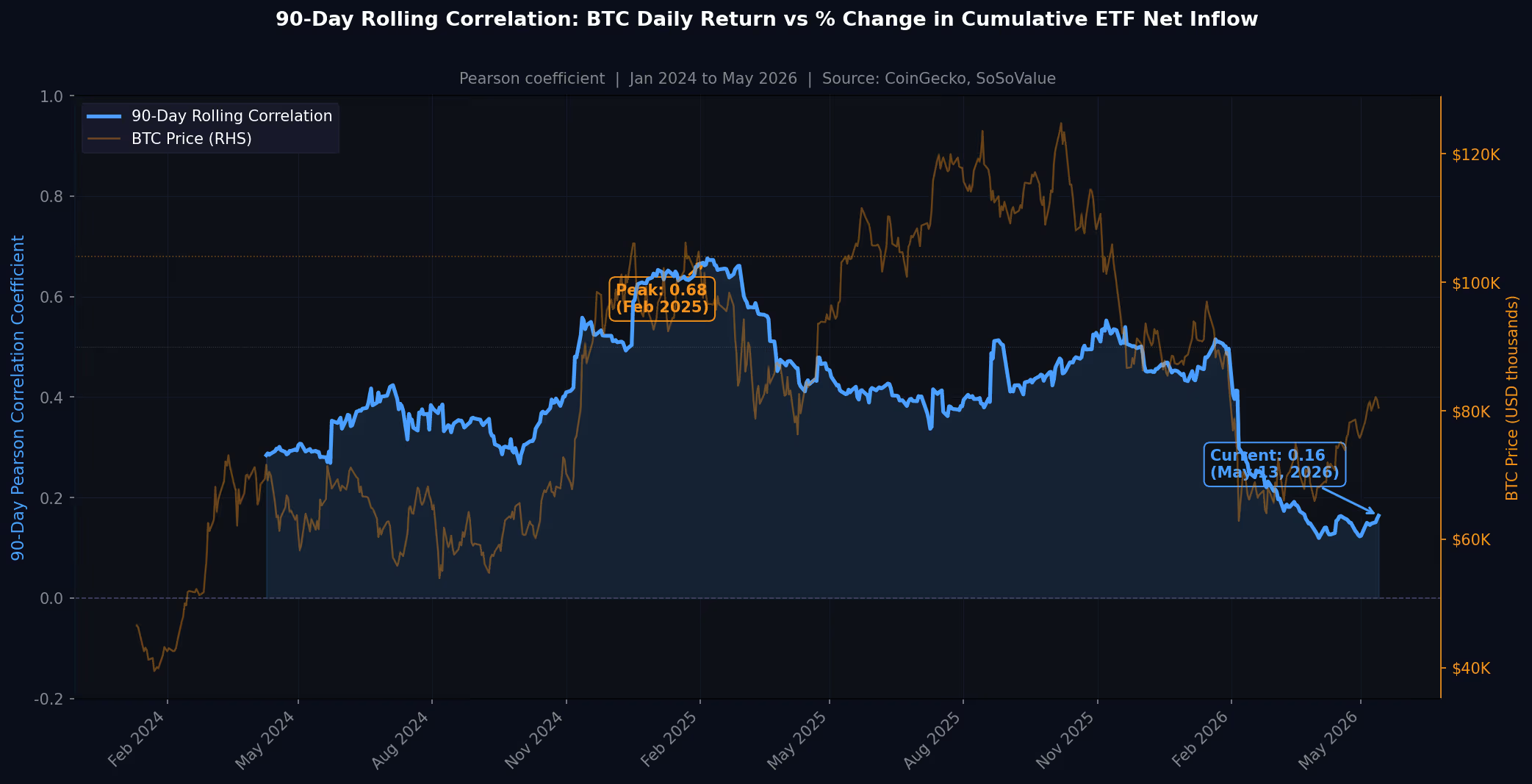
Still, it’s worth noting that the relationship between ETF flows and bitcoin is not as straightforward as it once was. A correlation study offers a more data-driven lens on that.

The 90-day rolling Pearson coefficient between bitcoin’s daily percentage return and the daily percentage change in cumulative net ETF inflows currently stands at just 0.16, statistically indistinguishable from zero and down from the peak of 0.68 in February.
In plain terms, knowing the direction in which ETF flows moved on any given day may not offer any cues about BTC’s price action. That said, large redemptions like the one seen on Wednesday still matter.


BitGo Holdings posted first-quarter 2026 revenue of $3.77 billion, more than doubling from a year earlier.
Yet, losses tied to Bitcoin (BTC) price swings and stock compensation pushed the digital asset custodian into the red.
BitGo Q1 Revenue Hits $3.77 Billion
BitGo’s Q1 filing attributed the 112.6% jump in top-line revenue to two main tailwinds: a pickup in digital asset sales volumes and a heavier contribution from Stablecoin-as-a-Service income compared with the same quarter a year ago.
Stablecoin-as-a-Service revenue rose 44% sequentially to $38.2 million, with the take rate improving to 7.4%. However, total revenue fell 38.7% sequentially.
BitGo attributed the drop to softer crypto markets and a shift away from spot trading. The firm launched its derivatives offering in January, capturing roughly $3 billion in notional volume during the quarter.
“Because derivatives revenue is recognized on a net basis, while spot trading revenue is recognized on a gross basis, reported revenue comparisons to prior periods are not directly comparable,” the firm said.
Follow us on X to get the latest news as it happens
Meanwhile, Digital Asset Sales brought in roughly $3.7 billion, more than doubling from a year earlier with a 127.9% YoY gain, though the figure was 39.3% lower sequentially.
The Subscriptions and Services segment posted $25.6 million in revenue, edging up 11.3% YoY but slipping 34.8% from the previous quarter. Staking revenue fell 66.2% year over year to $49.4 million as token prices declined.
The firm’s net loss widened to $60.7 million from $25.7 million a year earlier. The figure also exceeds BitGo’s Q4 2025 net loss of $50 million. According to BitGo, this was,
“Primarily driven by non-cash mark-to-market impacts related to the Company’s Bitcoin treasury, as well as elevated IPO-related stock-based compensation expense. The Company expects stock-based compensation expense to normalize from Q1 20226 levels going forward.”
Adjusted EBITDA flipped to a $1.7 million loss from a $3.9 million gain in Q1 2025. The client base grew 42% year over year, while cash and equivalents totaled $186.6 million. The results mark the company’s second earnings release since its January debut on the NYSE.
Subscribe to our YouTube channel to watch leaders and journalists provide expert insights
The post BitGo Net Loss Widens to $60.7 Million Despite 112.6% Revenue Growth appeared first on BeInCrypto.


The Commodity Futures Trading Commission’s staff issued no-action relief for fully collateralized event contracts.
Summary
- CFTC eased swap data reporting duties for fully collateralized event contracts listed on regulated exchanges.
- Relief covers DCMs, DCOs and market participants, with future applicants getting a streamlined approval process.
- The move arrives as prediction market platforms fight state gambling regulators in several courts nationwide.
The move covers certain swap data reporting and recordkeeping duties tied to contracts listed by designated contract markets and cleared by derivatives clearing organizations.
The relief means staff will not recommend enforcement against DCMs, DCOs or participants for failing to meet selected swap reporting rules, as long as they follow the terms in the staff letter. The CFTC said the approach responds to many requests from firms listing and clearing event contracts.
Moreover, the new letter also creates a cleaner path for future applicants. Entities that want to list or clear similar contracts can seek the same no-action position, and the CFTC can add them to an appendix rather than issue another full letter each time.
Staff said the position also covers earlier beneficiaries of similar no-action letters. The letter says this approach should give similar treatment to current and future market participants while the agency considers broader rulemaking for event contract reporting.
Prediction market oversight remains contested
The relief comes as prediction markets face state-level legal fights. Earlier coverage from crypto.news reported that the CFTC backed Kalshi in an Ohio appeal, arguing that state officials treated federally regulated event contracts too narrowly as sports gambling.
In addition, CFTC has also challenged state actions in Arizona, Connecticut, Illinois, New York and Wisconsin. Court protection in Arizona supported federal oversight of CFTC-regulated prediction markets while cases continue.
Market growth adds pressure for clear rules
The timing matters because prediction markets are growing quickly. Separate market coverage reported that Kalshi reached a $22 billion valuation after a $1 billion Series F round, while annualized trading volume on the platform rose from $52 billion to $178 billion in six months.
Kalshi CEO Tarek Mansour said “event contracts could become a trillion-dollar market.” That claim remains forward-looking, but it shows why regulators, exchanges and state officials are paying closer attention to reporting, supervision and legal boundaries.
The CFTC’s latest step does not decide every dispute over event contracts. It focuses on how certain fully collateralized contracts are reported and recorded. Still, it gives DCMs, DCOs and participants a more uniform process as the agency works on broader rules.
For crypto-linked prediction markets, the letter adds another federal signal. Platforms such as Kalshi, Polymarket, Coinbase and Crypto.com remain part of a wider debate over whether these products are financial contracts, betting products, or both under different legal frameworks.
Trump Weighs 250 Pardons as Crypto Founders Push for Clemency

Queensland carnival in 2026 sights for Dilmi via I Am Carrot

Software engineering’s bottleneck is no longer code

Manchester United reach agreement with Casemiro over contract clause amid transfer speculation

US brings back mandatory military draft registration

Steven Gerrard disagrees with Gary Neville over ‘shock’ Chelsea and Arsenal claim | Football

Trump says he does not consider American financial situations in Iran talks

Trump dismisses concerns about financial impact of Iran war on Americans

Trump: ‘I don’t think about Americans’ financial situation’ during Iran talks
-
 Crypto World6 days ago
HarrisX Poll Found 52% of Registered Voters Support the CLARITY Act
-

 Fashion6 days ago
Weekend Open Thread: Marianne Dress
-

 Fashion3 days ago
Coffee Break: Travel Steam Iron
-

 Fashion3 days ago
What to Know Before Buying a Curling Wand or Curling Iron
-

 Tech4 days ago
Auto Enthusiast Carves Functional Two-Stroke Engine from Solid Metal
-

 Politics2 days ago
What to expect when you’re expecting a budget
-
 Business5 days ago
Ignore market noise, India’s long-term story intact, say D-Street bulls Ramesh Damani and Sunil Singhania
-

 Politics5 days ago
Politics Home Article | Starmer Enters The Danger Zone
-

 Tech3 days ago
GM Agrees To Pay $12.75 Million To Settle California Lawsuit Over Misuse Of Customers’ Driving Data
-

 Politics7 days ago
Simon Cowell Says He Was ‘Horrible’ To Susan Boyle During BGT Audition
-

 Entertainment7 days ago
General Hospital: Ric & Ava Bombshell – Ric’s Massive Secret Exposed!
-

 Entertainment7 days ago
Why David Letterman Called CBS ‘Lying Weasels’
-

 Crypto World4 days ago
CZ says US crypto rivals tried to block Trump pardon
-
 Entertainment7 days ago
Paramount+’s ‘Landman’ Season 3 Gets Promising New Update From Returning Director
-

 Sports6 days ago
Bayern Munich vs PSG UEFA Champions League SF2 live match time, streaming | Football News
-

 Entertainment6 days ago
YNW Melly Denied Bond Again Ahead Of Double Murder Retrial
-

 Tech2 days ago
GM agrees to $12.75M California settlement over sale of drivers’ data
-

 Politics7 days ago
Euphoria Creator Praises Sydney Sweeney Amid Season 3 Scenes Backlash
-
Entertainment6 days ago
Hantavirus — cause of death for Gene Hackman's wife — at the center of Dutch cruise outbreak
-

 Crypto World5 days ago
PROS explodes 48% as Upbit and Bithumb listings ignite demand
You must be logged in to post a comment Login