
Crypto World
Bitcoin’s $80,000 Target Remains Elusive Amid New US-China Tensions

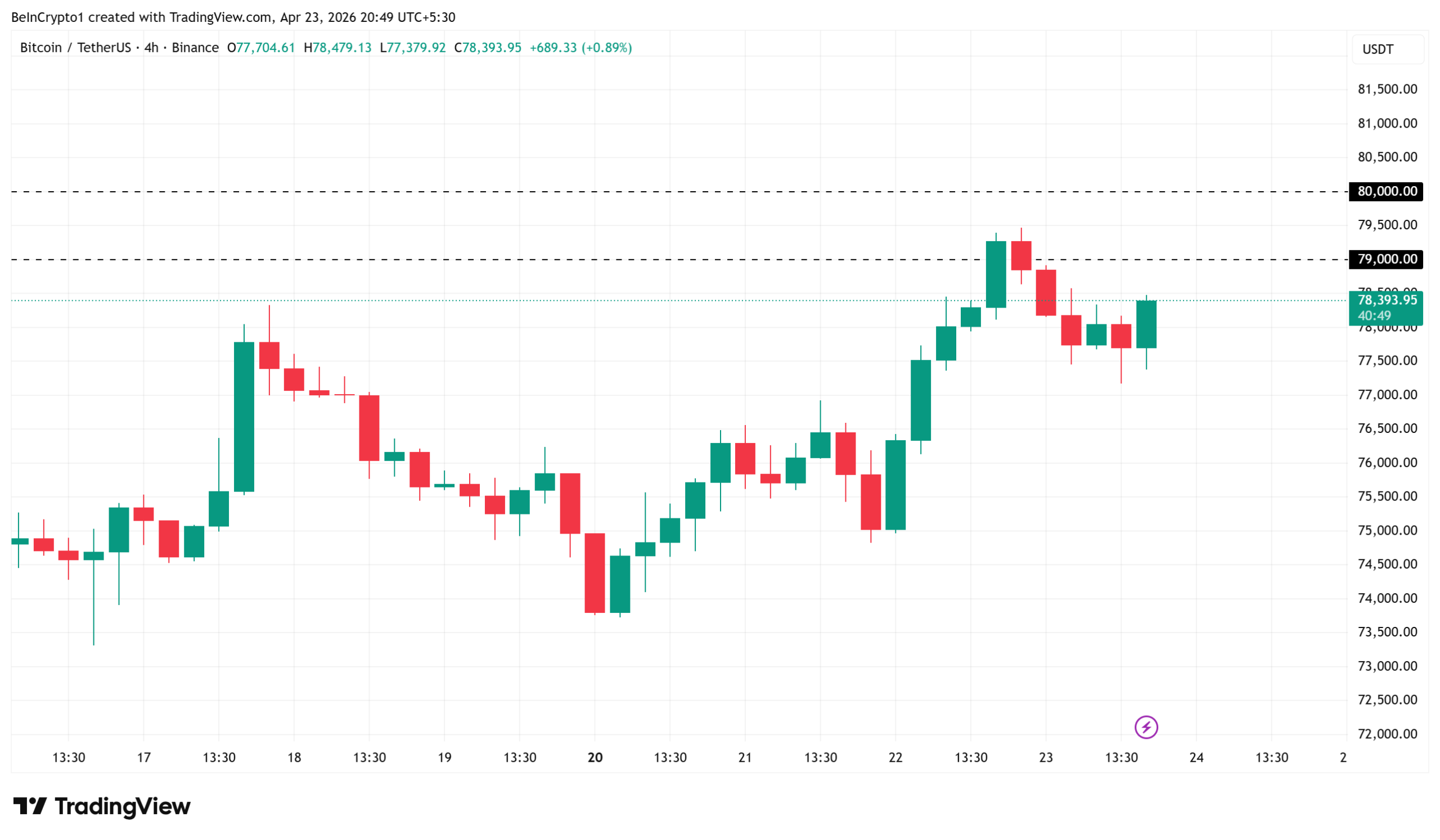
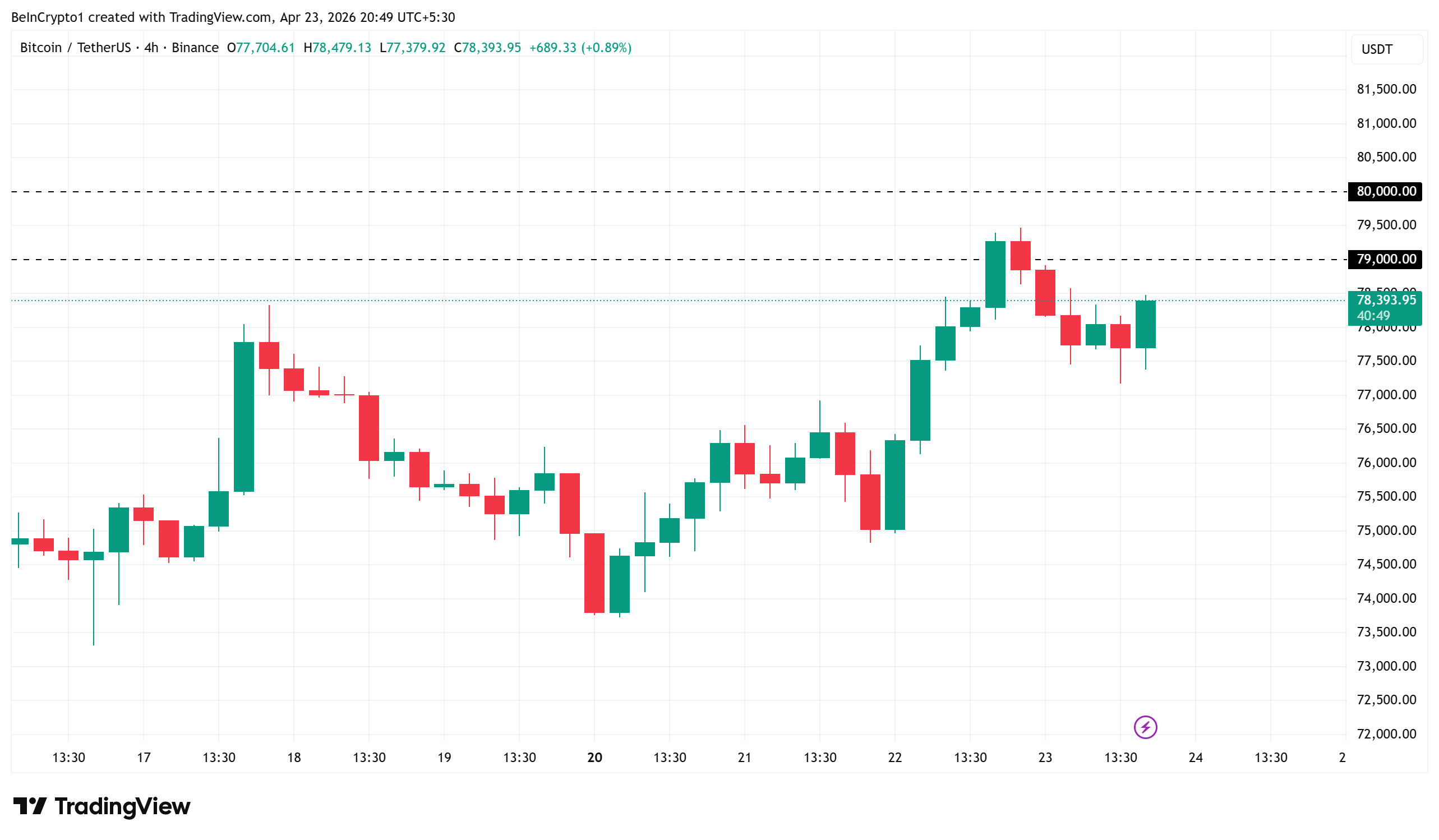
Bitcoin (BTC) traded near $78,000 on Thursday but continued to face resistance at the $80,000 level as fresh US-China friction weighed on risk sentiment.
The White House accused Chinese entities of running deliberate campaigns to steal American AI technology, adding to geopolitical uncertainty weeks before a planned Trump-Xi summit.
White House Escalates AI Dispute With China
In a Thursday memo Michael Kratsios, Director of the White House Office of Science and Technology Policy, said foreign entities based in China are conducting “industrial-scale campaigns to distil US frontier AI systems.”
The campaigns allegedly use tens of thousands of proxy accounts and jailbreaking techniques to extract proprietary data from American AI models.
The administration said it would share intelligence with US AI firms and explore measures to hold foreign actors accountable.
This announcement arrives weeks before President Trump’s scheduled visit to China in mid-May for talks with President Xi Jinping.
Bitcoin Faces $80,000 Resistance
BTC opened at $78,193 on Thursday before retreating to roughly $77,465 by early morning trading. The $80,000 to $80,600 band has acted as a consistent ceiling throughout April.
On-chain data shows the Traders’ On-Chain Realized Price at $76,800 has capped recent relief rallies. On Deribit, the $80,000 call has become the most popular options trade, recording a notional value of $1.78 billion.
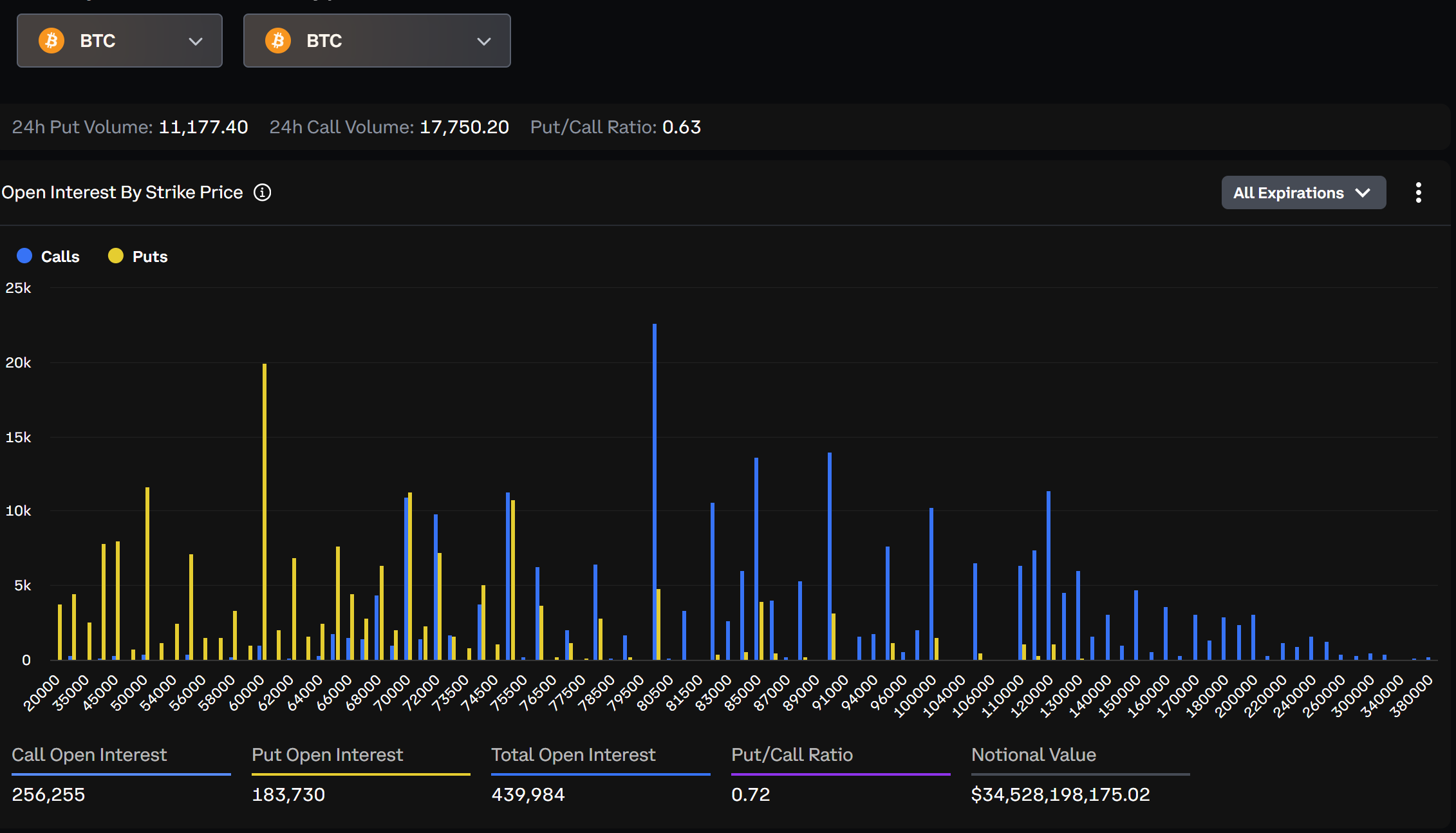
This suggests traders are positioning for a breakout that has yet to materialize, with call options (buy orders) exceeding put options (sale orders) highlighting higher investor optimism.
While the AI dispute carries no direct technical link to Bitcoin, escalating US-China friction has historically dampened risk appetite across crypto markets.
The Bitcoin price being able to reclaim the $80,000 psychological level,. last tested in February, may hinge on broader sentiment heading into the Trump-Xi meeting.
The post Bitcoin’s $80,000 Target Remains Elusive Amid New US-China Tensions appeared first on BeInCrypto.

The US Department of Justice (DOJ) restrained more than $700 million in crypto and filed wire fraud conspiracy charges against two Chinese nationals who allegedly managed scam compounds.
US Attorney Jeanine Ferris Pirro, Assistant Attorney General A. Tysen Duva, and partners announced the coordinated actions alongside Treasury and State Department measures aimed at dismantling Southeast Asia’s compound-based fraud network.
Scam Center Strike Force Targets Burma Compound and Cambodia Expansion
The Scam Center Strike Force announced the enforcement push against transnational criminal groups accused of stealing billions from American victims.
Huang Xingshan and Jiang Wen Jie allegedly managed the Shunda compound in Min Let Pan, Burma, between January and November 2025. They also use the aliases “Ah Zhe” and “Jiang Nan,” according to the press release.
“According to the investigation, Huang served at Shunda as a high-level manager and enforcer and personally participated in the physical punishment of trafficked compound workers. Jiang served as a team leader directly supervising workers who specifically targeted American victims,” the authorities revealed.
Follow us on X to get the latest news as it happens
Prosecutors say one American victim lost more than $3 million to a worker managed by Jiang. The two defendants also tried to establish a second compound in Cambodia. Investigators seized 503 websites that hosted fraudulent investment platforms.
Authorities also took control of a Telegram channel with over 6,000 followers. The channel recruited victims into a Cambodia-based scheme that posed as law enforcement.
FBI Co-Deputy Director Christopher G. Raia described the actions as a significant blow to transnational criminal organizations targeting American citizens.
“We have taken down more than 500 websites used to steal people’s savings. And my Office continues to work to identify funds stolen from victims, having now caused restraint of more than $700 million in cryptocurrency involved in money laundering from US victims of fraud. This Administration is lock-step in combatting these scams, and we are not done,” US Attorney Jeanine Pirro said.
In addition, the Treasury Department’s Office of Foreign Assets Control (OFAC) designated Kok An, a Cambodian senator accused of controlling scam compounds across the country.
Subscribe to our YouTube channel to watch leaders and journalists provide expert insights
The post US Crackdown on Southeast Asian Scam Centers Nets $700 Million Crypto Seizure appeared first on BeInCrypto.

TLDR:
- REAL and RWA Inc. will explore tokenized asset issuance and investor onboarding infrastructure
- The partnership includes post-issuance servicing, reporting, and asset distribution channels
- AI-powered automation and co-marketing will support REAL’s upcoming token generation event
- RWA market projections now point to a $16 trillion opportunity by 2030 across global finance
REAL, a Layer 1 blockchain focused on real-world assets, has entered a strategic partnership with RWA Inc. as tokenized finance continues to gain traction across crypto markets. The deal centers on asset issuance, investor access, and post-launch support for tokenized real-world assets on-chain.
Both firms plan to use the partnership to strengthen infrastructure before REAL’s upcoming token generation event. The announcement comes as demand for compliant, yield-focused blockchain products continues to grow.
REAL and RWA Inc. Build RWA Infrastructure for Tokenized Assets
According to REAL’s official announcement on X, the partnership will explore how selected tokenized assets from RWA Inc. can launch on REAL’s blockchain.
The company said its Layer 1 network was built specifically for tokenization, trading, and management of real-world assets. That includes products like treasuries, gold, and private market assets.
RWA Inc. focuses on asset tokenization, investor onboarding, and Web3 growth systems. It also provides launch strategy, automation tools, and investor-facing infrastructure for projects entering the market.
REAL said both sides will work on distribution channels and lifecycle support after issuance. That includes reporting, servicing, and access management for investors holding tokenized assets.
The firms also plan to develop AI-powered automation and campaign support around adoption efforts. Co-marketing activities will also support REAL’s upcoming TGE as the network prepares for broader rollout.
REAL added that future discussions may include agentic AI in governance, validation, and financial workflows. Both teams scheduled an X Spaces event for April 24 at 12 PM UTC to discuss the roadmap publicly.
RWA Market Growth Pushes More Blockchain Infrastructure Deals
The partnership arrives as real-world asset tokenization moves beyond early experimentation and into live financial infrastructure across crypto markets.
In a separate post, DeFi researcher The Angel said RWA is shifting from a market narrative into operating infrastructure. The post pointed to technology readiness, regulation, and institutional capital as the main drivers.
The Angel highlighted jurisdictions like Hong Kong for creating clearer compliance paths for institutions. That reduces uncertainty and makes tokenized assets easier to deploy at scale.
Capital is also rotating toward stable, yield-generating assets instead of purely speculative crypto products. Tokenized U.S. Treasuries, tokenized gold, and pre-IPO equity were listed among the strongest demand areas.
The same post projected the RWA market could reach $16 trillion by 2030, representing nearly 10% of global GDP. It also noted that exchanges are seeing stronger monetization from asset-backed tokens.
Another growing area involves compute, energy, and AI-backed infrastructure linked to RWAs. This includes energy-backed compute and financial systems tied to physical assets.
REAL and RWA Inc.’s partnership reflects that broader shift as blockchain firms compete to become the settlement layer for tokenized finance.



The Department of Justice has charged a US Army soldier in a Polymarket insider trading case.
He allegedly used classified intelligence to win roughly $409,881 by betting on the January capture of Venezuela’s Nicolás Maduro.
US Soldier Turned $33,000 Into $400,000 on Polymarket Using Classified Intel
According to a Justice Department indictment unsealed, Gannon Ken Van Dyke, a 38-year-old stationed at Fort Bragg, turned about $33,034 into approximately $410,000 across 13 prediction market bets before allegedly trying to erase his trail.
“Gannon Ken Van Dyke allegedly betrayed his fellow soldiers by utilizing classified information for his own financial gain. Van Dyke profited more than $400,000 by trading various outcomes related to Venezuela after learning of the operation because of his role as a US Army soldier,” FBI Assistant Director in Charge James C. Barnacle Jr said.
The US soldier was involved in planning and executing “Operation Absolute Resolve.” The early morning January 3 mission captured Maduro and his wife in Caracas.
Van Dyke, who reportedly used the Polymarket handle “Burdensome-Mix,” started placing Polymarket wagers on December 27, 2025, days before the operation went live.
All 13 bets took “YES” positions on Maduro and Venezuela-related contracts. They included “Maduro out by January 31” and “US Forces in Venezuela by January 31.” The Commodity Futures Trading Commission (CFTC) said Van Dyke bought more than 436,000 “Yes” shares of the Maduro contract alone.
After making a profit, Van Dyke allegedly moved most of the proceeds to a foreign crypto vault, changed his exchange email to an alias, and asked Polymarket to delete his account.
The US soldier faces five counts. They include three violations of the Commodity Exchange Act, as well as wire fraud and an unlawful monetary transaction. Each CEA count carries a maximum of 10 years, while each wire fraud count carries a maximum of 20 years.
The CFTC has also filed a parallel complaint in the US District Court for the Southern District of New York. The agency is seeking restitution, trading bans, and civil penalties.
Follow us on X to get the latest news as it happens
Polymarket has faced mounting pressure this year over wallets making precisely timed bets on geopolitical events. Suspected insiders allegedly profited hundreds of thousands on contracts linked to the Iran conflict and the Maduro operation.
The complaint breaks new ground for the CFTC, delivering both its first event-contract insider trading charge and its application of the “Eddie Murphy Rule” covering misused federal information.
Subscribe to our YouTube channel to watch leaders and journalists provide expert insights
The post Army Soldier Used Classified Maduro Intel to Win Over $400,000 on Polymarket, DOJ Says appeared first on BeInCrypto.
TLDR:
- Ripple says custody now anchors payments, staking, tokenization, and treasury operations for banks
- Kyobo Life became Korea’s first major insurer exploring blockchain custody with Ripple infrastructure
- Chainalysis and Securosys integrations strengthen compliance checks and enterprise-grade key security
- Figment partnership lets institutions offer ETH and SOL staking inside custody workflows safely
Ripple is expanding its digital asset custody business as regulated financial institutions push deeper into blockchain-based operations.
The company said custody now sits at the center of payments, tokenization, staking, and treasury management for banks entering digital assets.
Recent partnerships and integrations show Ripple is focusing on compliance, security, and faster institutional onboarding. The move comes as more banks and insurers shift from pilot programs to production-level digital asset platforms.
Ripple Digital Asset Custody Expands Across Banking and Insurance
Ripple said digital asset adoption is moving beyond early testing in Europe, the UAE, and Asia. Stablecoins are now entering treasury operations, while tokenized real-world assets continue gaining regulatory support.
The company argues custody has become the governance layer for these services. Without secure custody, compliance gaps and operational risks can slow institutional adoption.
Since late 2025, Ripple has expanded Ripple Custody across several core areas. These include wallet infrastructure, transaction compliance, enterprise security, and institutional staking.
Its acquisition of Palisade added wallet infrastructure and scalable transaction signing. Ripple also integrated Chainalysis tools for real-time transaction screening and policy enforcement.
The Securosys integration introduced cloud-based hardware security module support. At the same time, Ripple partnered with Figment to add institutional staking for Proof-of-Stake networks.
Ripple also announced a partnership with Kyobo Life Insurance in South Korea. According to Ripple, the insurer will explore blockchain-based custody and on-chain settlement infrastructure.
Kyobo is one of Korea’s largest insurers and the first major insurance firm there to take this step. Ripple said this reflects broader institutional movement into digital asset operations.
Ripple Custody Adds Staking and Cloud HSM Security Tools
Ripple said institutions want custody platforms that fit into existing banking systems without major operational changes. The company is pushing an API-first structure designed for banks, custodians, and regulated enterprises.
It said clients want fewer vendors and faster deployment. This reduces delays and lowers infrastructure costs for digital asset operations.
Ripple listed partners including BBVA, DBS Bank, DZ Bank, and Intesa Sanpaolo. The company said these institutions use Ripple Custody for digital asset management and related services.
In Europe, Intesa Sanpaolo is using Ripple Custody for its digital asset initiatives. This reflects growing demand from major banks for compliant crypto infrastructure.
Through Securosys, Ripple now offers CyberVault HSM and Cloud HSM integrations. These tools allow institutions to manage cryptographic keys without large hardware deployments.
Ripple said this helps banks meet security requirements while reducing onboarding time. It also supports compliance across different regulatory jurisdictions.
The Figment partnership adds staking for Ethereum and Solana directly inside custody workflows. Ripple said institutions can offer staking without building their own validator systems.
This allows staking to remain under existing governance and compliance controls. Ripple sees this as a key step for institutions expanding digital asset services.


Cryptocurrency markets remained on the back foot Friday as macroeconomic signals from Japan, one of the world’s largest economies, compounded uncertainty driven by the Iran war.
Bitcoin hovered near $77,800, having struggled to break above the Thursday high of $78,700 during the early Asian trading hours, according to CoinDesk data. The broader uptrend, which began in late March near the $65,000 mark, appears to have stalled since Wednesday.
Ether (ETH), the second-largest cryptocurrency by market capitalization, traded around $2,300, slipping 0.8% since midnight UTC and underperforming bitcoin’s relatively modest 0.6% decline.
The cautious tone in crypto markets coincided with fresh inflation data out of Japan. The country’s Corporate Service Price Index (CSPI) rose 3.1% year-on-year in March, exceeding forecasts of 3.0% and underscoring persistent price pressures in the services sector.
Additional government data showed core inflation rising to 1.8% in March from 1.6% in February, marking the first acceleration in five months. Headline inflation edged up to 1.5% from 1.3%, though it remained below the Bank of Japan’s 2% target for a second consecutive month. Meanwhile, core-core inflation, which excludes both fresh food and energy, eased to 2.4%, its lowest level since October 2024.
The uptick in headline inflation aligns with rising energy costs linked to geopolitical tensions, particularly disruptions to oil shipments through the Strait of Hormuz amid the ongoing Iran conflict.
apan, a major crude importer, remains especially vulnerable to such price shocks. WTI crude futures have risen over 40% to $96 since the onset of the Iran war in late February.
Market participants are now turning their attention to the Bank of Japan’s upcoming policy meeting. Analysts at InvestingLive suggest a shift in tone may be imminent.
“The Bank of Japan looks set to hold fire next week but deliver a pointed warning that rates are heading higher, with June firmly in play as war-driven inflation risks build,” analysts said.
Hints of tighter monetary policy and potential rate hikes could lift the Japanese yen (JPY) and influence global market sentiment. It’s especially plausible now, given that speculative positioning in the yen is currently bearish, according to the latest CFTC data. As a result, there is room for a sharp bullish reaction in the yen if the Bank of Japan turns hawkish.
As for the broader market impact, a stronger yen may not be favorable. Historically, the yen has been used to fund purchases of risk assets worldwide. A sudden appreciation in the currency could therefore trigger an unwinding of those trades, leading to increased risk aversion.
Speaking of the Iran war, Iran has deployed additional naval mines in the Strait of Hormuz this week, according to Axios. Shipping traffic through the Hormuz, which
accounts for 20% of the world’s seaborne oil, fallen sharply since the conflict intensified.
The Pentagon warned lawmakers that it would take at least six months to clear mines in the Strait, with the process only beginning after the war ends. It also cautioned that inflation in the U.S. could remain elevated this year, potentially making it harder for the Fed to cut rates.
The FTX bankruptcy estate sold a 5% stake in Cursor for $200,000 in April 2023.
Summary
- FTX estate sold its 5% Cursor stake for $200K during bankruptcy asset liquidation in 2023.
- Cursor’s $60B SpaceX-linked valuation now puts the former FTX stake near $3B in value.
- The sale has renewed scrutiny over FTX estate asset sales and missed upside from early exits.
The sale matched the original amount Alameda Research invested in Anysphere, the company behind Cursor, in April 2022.
The stake has drawn fresh attention after Cursor’s reported valuation rose sharply. SpaceX said it secured the right to acquire Cursor later this year at a $60 billion valuation.
At a $60 billion valuation, the former FTX-linked stake would be worth about $3 billion. That marks a large difference from the $200,000 sale price recorded during bankruptcy asset liquidation.
The new valuation came after SpaceX secured acquisition rights tied to Cursor. SpaceX could also pay a $10 billion breakup fee if the transaction does not move forward.
Bankruptcy sales face renewed review
The Cursor sale has added to questions over how the FTX estate handled early asset sales. The estate moved to liquidate assets after FTX collapsed and Alameda entered bankruptcy.
Sam Bankman-Fried has criticized the bankruptcy process from prison. Earlier this year, he wrote, “FTX was never bankrupt. I never filed for it.” He also claimed, “The lawyers took over the company and 4 hours later, they filed a bogus bankruptcy so they could pilfer it for money.”
FTX creditors have since received repayments in dollar terms under the restructuring plan. The repayments included claim values plus interest, though some former users have argued they missed gains from crypto and venture assets.
Bull Theory estimates wider missed value
Financial research platform Bull Theory estimated that assets sold early by the FTX estate could now be worth about $114 billion if held through recent market cycles. The analysis listed Anthropic, SpaceX, Solana, Robinhood, Genesis Digital, and Cursor among the missed gains.
Bull Theory wrote, “SBF was a genius at picking generational winners and a criminal at managing their money.” The platform also noted that the estate recovered about $18 billion for users.
Bankman-Fried is serving a 25-year federal sentence after his conviction on fraud and conspiracy charges. Prosecutors said he misused billions of dollars in customer funds from FTX through Alameda Research, investments, political donations, and personal spending.

Bitcoin reached multi-month highs at $79,000 as bulls regained control and exchange reserves tightened, signaling buyers returning and reduced sell pressure.


OKX has added BitGo’s Off-Exchange Settlement platform for institutional clients in the United States. The integration allows firms to trade on OKX while holding their assets in BitGo’s cold custody.
Summary
- OKX added BitGo’s OES platform to support US institutional trading with third-party custody controls.
- The setup lets clients trade on OKX while assets remain secured in BitGo cold custody.
- The move follows ICE’s investment in OKX and its renewed push into the US market.
The move is designed to reduce the need for clients to pre-fund exchange accounts before trading. It also gives institutions a way to keep assets with a third-party custodian while accessing liquidity on OKX.
OKX said the setup supports capital efficiency for professional traders and firms. Under the arrangement, BitGo serves as the custodian and settlement provider for trades executed on the exchange.
Exchange targets institutional growth in the US
The BitGo integration comes as OKX continues to build its US business. The exchange reentered the US market in April 2025 and appointed former Barclays director Roshan Robert as its US CEO. Robert said institutional investors need both asset protection and trading access.
“Institutional capital entering crypto requires capital to be protected and to be put to work,” he stated. “Our proprietary custody infrastructure has been proven at scale, and our partnership with BitGo gives clients flexibility in how they protect assets while freeing capital to work harder.”
The comments point to OKX’s effort to serve firms that want custody options outside the exchange.
ICE investment shapes OKX’s US plan
OKX’s latest step follows an investment by Intercontinental Exchange in early March. The investment valued OKX at $25 billion and gave ICE executives a board seat at the crypto exchange.
OKX Global CEO Star Xu said at the time that the partnership would help shape the company’s US strategy. He also described the exchange’s local presence as a “blank sheet of paper.” Xu said custody remains a core part of OKX’s business.
“At the same time, we’ve expanded our custody partnerships with trusted leaders like BitGo to give clients greater flexibility and choice in how they secure their assets,” he stated.
Moreover, BitGo has offered off-exchange settlement services for several years. The platform supports settlement for digital asset trades made on third-party exchanges while assets remain under BitGo custody.
However, BitGo has also disclosed risks tied to the service. In its January IPO filing, the company cited operational, regulatory, and counterparty risks.
“Operational risks associated with our OES services include potential errors in processing trade data, delays or failures in asset transfers, employee or insider misconduct, cybersecurity incidents, technological disruptions and reconciliation errors,” BitGo said.
Crypto World
Eric Trump, Michael Saylor, and Anatoly Yakovenko headline Consensus Miami 2026 as crypto's biggest stage returns

The industry’s premier festival will host 20,000 attendees, merging heavy-hitting traditional finance integration with unmatched Miami nightlife.

MetaMask co-founder Dan Finlay is stepping down from ConsenSys citing burnout, as long-time crypto figures such as Bitcoin advocate Preston Pysh also pull back from public roles.

Avez vous besoin d’un conseiller financier ?

support for headteachers or unnecessary legislation?

Infosys shares fall 4% after Q4 results. What Morgan Stanley, other top brokerages are saying

Manchester United reach agreement with Casemiro over contract clause amid transfer speculation

US brings back mandatory military draft registration

Steven Gerrard disagrees with Gary Neville over ‘shock’ Chelsea and Arsenal claim | Football


-

 Sports7 days ago
NWFL Suspends Two Players Over Post-Match Clash in Ado-Ekiti
-

 Fashion6 days ago
Weekend Open Thread: Theodora Dress
-

 Politics6 days ago
Palestine barred from entering Canada for FIFA Congress
-
Entertainment4 days ago
NBA Analyst Charles Barkley Chimes in on Ice Spice McDonald’s Fiasco
-

 Tech5 days ago
Auto Enthusiast Scores Running Tesla Model 3 for Two Grand and Turns It Into Bare-Bones Go-Kart
-

 Business5 days ago
Powerball Result April 18, 2026: No Jackpot Winner in Powerball Draw: $75 Million Rolls Over
-

 Politics5 days ago
Zack Polanski demands ‘council homes not luxury flats for foreign investors’
-

 Crypto World6 days ago
Russia Pushes Bill to Criminalize Unregistered Crypto Services
-

 Politics3 days ago
Gary Stevenson delivers timely reminder to register to vote as deadline TODAY
-

 Business2 days ago
Rolls-Royce Voted UK’s Most Iconic Trade Mark as IPO Register Hits 150
-

 Politics1 day ago
Disabled people challenge government SEND proposals over segregation concerns
-

 Politics1 day ago
Making troops accountable for war crimes threatens US alliance, ex-SAS colonel warns
-

 Crypto World6 days ago
Russia Introduces Bill To Criminalize Unregistered Crypto Services
-

 Politics2 days ago
Starmer handler McSweeney to be dragged from shadows by Foreign Affairs Committee
-
Politics2 days ago
Wings Over Scotland | How To Get Away With Crimes
-

 Politics2 days ago
Zack Polanski responds to home secretary’s taser threat
-
Crypto World5 days ago
Kelp DAO rsETH Bridge Hack Drains $292M as DeFi Losses Top $600M in Two Weeks
-

 Politics1 day ago
‘Iran is still a nuclear threat’
-

 Crypto World2 days ago
New York sues Coinbase, Gemini over prediction market offerings
-
 Sports7 days ago
Kevin Kisner apologizes for Masters criticism: ‘I crossed the line’
You must be logged in to post a comment Login