
Crypto World
Ripple Expands Digital Asset Custody Push as Institutions Move Onchain


TLDR:
- Ripple says custody now anchors payments, staking, tokenization, and treasury operations for banks
- Kyobo Life became Korea’s first major insurer exploring blockchain custody with Ripple infrastructure
- Chainalysis and Securosys integrations strengthen compliance checks and enterprise-grade key security
- Figment partnership lets institutions offer ETH and SOL staking inside custody workflows safely
Ripple is expanding its digital asset custody business as regulated financial institutions push deeper into blockchain-based operations.
The company said custody now sits at the center of payments, tokenization, staking, and treasury management for banks entering digital assets.
Recent partnerships and integrations show Ripple is focusing on compliance, security, and faster institutional onboarding. The move comes as more banks and insurers shift from pilot programs to production-level digital asset platforms.
Ripple Digital Asset Custody Expands Across Banking and Insurance
Ripple said digital asset adoption is moving beyond early testing in Europe, the UAE, and Asia. Stablecoins are now entering treasury operations, while tokenized real-world assets continue gaining regulatory support.
The company argues custody has become the governance layer for these services. Without secure custody, compliance gaps and operational risks can slow institutional adoption.
Since late 2025, Ripple has expanded Ripple Custody across several core areas. These include wallet infrastructure, transaction compliance, enterprise security, and institutional staking.
Its acquisition of Palisade added wallet infrastructure and scalable transaction signing. Ripple also integrated Chainalysis tools for real-time transaction screening and policy enforcement.
The Securosys integration introduced cloud-based hardware security module support. At the same time, Ripple partnered with Figment to add institutional staking for Proof-of-Stake networks.
Ripple also announced a partnership with Kyobo Life Insurance in South Korea. According to Ripple, the insurer will explore blockchain-based custody and on-chain settlement infrastructure.
Kyobo is one of Korea’s largest insurers and the first major insurance firm there to take this step. Ripple said this reflects broader institutional movement into digital asset operations.
Ripple Custody Adds Staking and Cloud HSM Security Tools
Ripple said institutions want custody platforms that fit into existing banking systems without major operational changes. The company is pushing an API-first structure designed for banks, custodians, and regulated enterprises.
It said clients want fewer vendors and faster deployment. This reduces delays and lowers infrastructure costs for digital asset operations.
Ripple listed partners including BBVA, DBS Bank, DZ Bank, and Intesa Sanpaolo. The company said these institutions use Ripple Custody for digital asset management and related services.
In Europe, Intesa Sanpaolo is using Ripple Custody for its digital asset initiatives. This reflects growing demand from major banks for compliant crypto infrastructure.
Through Securosys, Ripple now offers CyberVault HSM and Cloud HSM integrations. These tools allow institutions to manage cryptographic keys without large hardware deployments.
Ripple said this helps banks meet security requirements while reducing onboarding time. It also supports compliance across different regulatory jurisdictions.
The Figment partnership adds staking for Ethereum and Solana directly inside custody workflows. Ripple said institutions can offer staking without building their own validator systems.
This allows staking to remain under existing governance and compliance controls. Ripple sees this as a key step for institutions expanding digital asset services.


Trading firm Jane Street has asked a US court to toss a lawsuit brought by the administrator of the bankrupt Terraform Labs, accusing the company of insider trading that worsened the collapse of the Terra ecosystem.
In a motion to dismiss filed in a Manhattan federal court on Thursday, Jane Street argued Terraform’s suit was an attempt “to extract cash from Jane Street to foot the bill for a fraud that Terraform itself perpetrated on the market.”
“Terraform now claims it was victimized by Jane Street’s trading,” it added. “The problem with this theory is that Terraform’s fraud scheme — in which Jane Street had no involvement — has already been prosecuted, adjudicated, and punished.”
Terraform’s court-appointed administrator, Todd Snyder, sued Jane Street, co-founder Robert Granieri, and employees Bryce Pratt and Michael Huang in February, accusing them of trading Terra tokens after receiving nonpublic information from “Terraform insiders.”
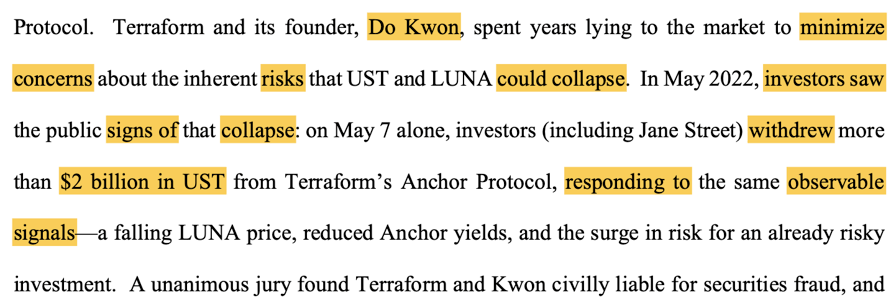
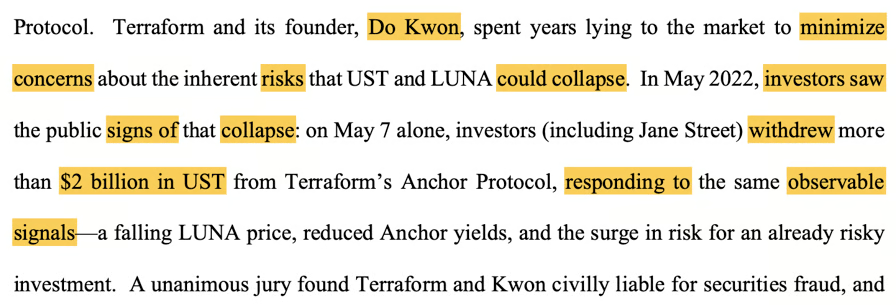
A highlighted excerpt of Jane Street’s motion argues it traded Terra-linked tokens based on market signals, not insider information. Source: CourtListener
Terraform collapsed in May 2022 after its algorithmic stablecoin, TerraUSD, rapidly lost its peg to the US dollar, sending the price of the highly interconnected LUNA token tumbling and wiping out $40 billion in value.
Jane Street argued in its motion that investors “saw the public signs of that collapse,” and it moved to “sell a deteriorating investment as the market was visibly collapsing.”
The firm claimed that the reasons for Terraform’s collapse had already been decided by a court, noting that its founder, Do Kwon, pleaded guilty to conspiracy and wire fraud charges, for which he was sentenced to 15 years in prison.
Jane Street claimed that Terraform’s complaint was also “self-defeating,” as it had stated that Jane Street’s largest TerraUSD sale took place 10 minutes after “supposed material nonpublic information was visible to the market.”
Related: Sam Bankman-Fried withdraws motion for a new trial, asks for new judge
It said Terraform also didn’t identify any material, nonpublic information Jane Street received when it alleged the trading firm sold more tokens in early May 2022 as Terraform transitioned to a new liquidity pool.
“Plaintiff pleads ‘on information and belief’ that Jane Street learned the timing of Terraform’s transition to a new liquidity pool through ‘back-channel communications,’ yet cannot identify a single communication disclosing that timing — despite extensive pre-suit discovery,” the motion said.
Jane Street asked the court to dismiss the suit with prejudice, meaning Terraform cannot bring the same lawsuit against it again.
Magazine: How to fix suspected insider trading on Polymarket and Kalshi

The White House’s office of technology policy said that foreign entities are using proxy accounts and jailbreaking techniques to distill capabilities from American AI models.

More than 120 entities tied to the cryptocurrency and blockchain sector are urging U.S. lawmakers to advance a comprehensive digital asset market structure bill. In a letter to leaders of the Senate Banking Committee, the Crypto Council for Innovation (CCI) and the Blockchain Association called for moving toward a markup of the CLARITY Act, which would establish a federal framework for digital asset markets. The legislation, which passed the House in July 2025, has been stalled amid broader government funding battles and disputes over stablecoin yield and other topics.
According to the signatories, timely policy action is critical because other major jurisdictions have already enacted wide-ranging crypto regulation. The authors warned that without a comparable U.S. policy framework, the country could cede both economic advantages and strategic leadership to abroad, risking domestic investment, jobs, and technological development to offshore venues. The letter was signed by more than a hundred groups and prominent exchanges, highlighting broad industry support for a formal federal market structure.
Key takeaways
- Industry coalition presses lawmakers to move ahead with a markup of the CLARITY Act, seeking a federal market framework for digital assets.
- The CLARITY Act has bipartisan backing in the House but is awaiting action in the Senate, where scheduling remains uncertain.
- The debate over stablecoin yield remains a central sticking point in negotiations between crypto firms and lawmakers.
- Industry advocacy groups, including exchanges and trade associations, are intensifying their push as other jurisdictions implement their own frameworks.
- Regulatory timing is affected by additional governance requests, such as GENIUS-related comment periods, which could influence the pace of related rules.
Industry coalition pushes for a federal market framework
The central message of the letter is a direct appeal: lawmakers should “proceed towards a markup of the CLARITY Act to provide a comprehensive federal market structure framework for digital assets.” The signatories argue that a unified federal standard would reduce fragmentation, clarify asset classifications, and foster domestic innovation. In their view, a timely markup is essential to maintain U.S. competitiveness as other nations finalize their own regulatory regimes.
Among the signatories are traditional crypto exchanges and a broad set of industry groups. The coalition includes Coinbase and Kraken, as well as advocacy groups such as the Texas Blockchain Council and the Solana Policy Institute. Their collective stance underscores a broad spectrum of support for a formal federal framework that could shape custody, trading, custody, and issuer rules for digital assets.
The letter also emphasizes a key tradeoff: deferring action risks a lag in policy that could push companies to relocate development and jobs to jurisdictions with clearer rules. In the authors’ view, the United States risks losing strategic advantages if it does not keep pace with international policy developments that are already affecting the global crypto ecosystem.
Lawmakers’ timetable remains uncertain as talks continue
Despite the House’s earlier approval, the Senate Banking Committee, chaired by Tim Scott, has yet to set a new markup date for the CLARITY Act. The committee postponed a markup in January, hours after Coinbase CEO Brian Armstrong indicated that the bill as written did not garner his support. Since then, lawmakers have held discussions with industry participants to address sticking points, notably the treatment of stablecoins and the mechanics of yield on thosecoins used by issuers and custodians.
In the latest public comments, Senator Thom Tillis urged committee leadership to consider delaying markup until May to give participants more time to negotiate a compromise on stablecoin yield. The sense is that a productive resolution will require narrowing the points of disagreement between crypto firms, banks, and regulators, a process that may extend the timeline for formal consideration in the Senate. As of now, no new markup date has been announced by the committee.
The broader context includes parallel discussions from other industry bodies. The Digital Chamber, another crypto advocacy group, urged the banking committee to schedule markup “as soon as the calendar allows,” highlighting that the current congressional window is finite. A representative note from The Digital Chamber described the legislative pace as a factor in the sector’s planning horizon, signaling that industry groups view a timely process as essential to sustaining momentum in policy development.
Regulatory crosswinds: stablecoins, GENIUS and the policy race
Beyond the CLARITY Act, concurrent regulatory efforts add to the sensitivity of the timing. The American Bankers Association recently requested an extension from four U.S. agencies responsible for GENIUS regulations, seeking 60 additional days to submit comments after the Office of the Comptroller of the Currency released its related rules. A delay of that length would likely slow the full implementation of the GENIUS framework, another factor that could influence how quick a comprehensive market structure policy takes shape in Congress.
These dynamics sit alongside ongoing debates about stablecoin design and governance—issues that have repeatedly surfaced in discussions with lawmakers. The industry’s push to align federal policy with the realities of digital asset markets remains a persistent theme, with participants arguing that a robust framework would reduce uncertainty and enable responsible innovation while protecting users and the financial system.
In parallel, the letter from the Digital Chamber and other industry groups underscores a broader narrative: the United States cannot afford to fall behind in setting clear, predictable rules for digital assets. The stakes, according to proponents, go beyond immediate policy wins; they hinge on sustaining domestic investment, talent, and the ability to compete globally as the crypto sector continues to expand and evolve.
For investors and builders, the core question is what a finalized CLARITY Act would look like in practice. While the path to a markup remains uncertain, the convergence of industry support and regulatory pressure suggests that lawmakers may soon face renewed momentum to formalize a federal framework. How any compromise on stablecoin yield would be reconciled with existing financial-safety objectives could shape not only the bill’s fate but broader policy direction for the sector in the coming months.
As the process unfolds, market participants should monitor whether the Senate channels the momentum into a concrete markup timetable and whether negotiations yield a framework that balances innovation with consumer protections. The unfolding debate reflects a pivotal moment for U.S. crypto policy, with the potential to influence where and how digital asset activity unfolds over the next phase of the industry’s development.
Looking ahead, observers should watch for a clear signal on markup scheduling, as well as any breakthroughs on stablecoin governance that could unlock a path to broader regulatory consensus. The next weeks will reveal whether the CLARITY Act can navigate the remaining political and technical hurdles or if the fragmentation in the policy conversation will persist, delaying a federal settlement that many in the industry say is long overdue.
Cointelegraph remains committed to independent reporting on evolving policy and its implications for markets, users, and builders across the crypto ecosystem.
Investment banking giant Morgan Stanley has made a quiet by significant move into stablecoins, expanding its footprint in the digital assets industry.
The firm’s investment management arm, MSIM, has announced the launch of the Stablecoin Reserves Portfolio – a government money market fund designed for issuers of stablecoins who need a regulated, safe place to store the reserves backing their tokenized versions of fiat currencies.
Here is the simple version of what the fund is designed to do.
When a company issues a stablecoin – a digital token pegged to the U.S. dollar or other fiat currencies – it must hold real dollars in reserve to back every token created. Think of it like a guarantee: for every blockchain-based dollar issued, a real dollar must exist somewhere safe and accessible. Morgan Stanley’s new fund is that place.
The fund (MSNXX) invests only in the safest and most liquid instruments, such as the U.S. Treasury bills, which are short-term loans to the U.S. government. The yield on these is widely considered the closest thing to a risk-free return. It also invests in repurchase agreements, or repos, which are overnight loans backed by those same government securities. Both instruments are designed to preserve capital.
The fund targets a $1 net asset value, meaning every dollar put into the fund is worth exactly the same when taken out, helping bypass price fluctuations. That is different from routine funds, where the value of your investment rises and falls daily. Further, the fund offers daily liquidity, meaning investors can withdraw their money on any business day without a waiting period or penalty.
“We are pleased to deliver a new investment solution to the marketplace that seeks to address the needs of stablecoin issuers,” Fred McMullen, co-head of global liquidity, Morgan Stanley Investment Management, said in the press release.
“The significant increase in stablecoin issuers as well as the growing number of assets held in stablecoins represents an evolving portion of the marketplace that is ripe for future growth,” he added.
Stablecoins have seen their market capitalization grow multiple-fold in recent years, reaching $316 billion, with dollar-pegged tokens such as Tether and USDC making up the bulk of the total. While initially used primarily to facilitate crypto trading, stablecoins have gradually expanded into real-world use cases, including remittances and cross-border capital transfers.
The sector therefore stands out as perhaps the only one with a clear real-world use case, while the broader market remains largely speculative.
Why now?
Morgan Stanley’s new fund comes as the GENUIS ACT – the Guiding and Establishing National Innovation for U.S. Stablecoins Act – is currently moving through Congress. If passed, it would legally require stablecoin issuers to back their tokens with high-quality liquid assets such as Treasury bills and cash-like instruments. And these will have to be held in regulated vehicles.
The fund is therefore positioned to capture reserve management business before it becomes mandatory.
Part of a bigger push
Morgan Stanley Investment Management recently launched the Morgan Stanley Bitcoin Trust (MSBT), a cryptocurrency ETP designed to track bitcoin, with BNY Mellon providing custody and fund administration services.
It also introduced tokenized DAP Class shares of its Institutional Liquidity Funds Treasury Securities Portfolio in partnership with BNY, enabling blockchain-based mirrored records. At the same time, BNY retains the official books and records.
“We have actively engaged across the industry to develop the ability to offer digital asset related liquidity solutions,” said McMullen. “While still in the early stages, these recent product launches signify our commitment to develop relevant, timely solutions that may address evolving investor needs in an increasingly digital marketplace.”

Stablecoin issuers must invest a minimum of $10 million into Morgan Stanley’s money market fund, MSNXX, to access the stablecoin reserve offering.


Succinct Labs has launched ZCAM, an iPhone camera app built to verify photos and videos at the moment of capture.
Summary
- Succinct Labs launched ZCAM to verify iPhone photos and videos at the moment of capture.
- The app creates cryptographic fingerprints that help prove media came from a real device.
- ZCAM targets rising AI fake risks as fraud losses tied to generative AI continue growing.
The app uses cryptography to create a record linked to the device that captured the media.
The company said ZCAM “signs photos and videos at the moment of capture, producing a tamper-proof record that links content to the device that captured it.” The record allows users to check whether a file came from a real device and whether it was later changed or generated by AI.
ZCAM targets AI fake photo and video risks
The launch comes as AI-generated images and videos continue to raise concerns around online fraud, identity abuse, and false media. Succinct said commercial AI detection tools can fail, so its system focuses on proving origin rather than only detecting fakes.
According to the company, ZCAM creates a cryptographic hash from the pixels captured by an iPhone camera. This hash works as a digital fingerprint for the photo or video and can support independent verification.
Succinct also cited Deloitte Center for Financial Services research that estimated generative AI could help push fraud losses in the United States to $40 billion by 2027. The figure compares with $12.3 billion in 2023.
Adoption remains key for media verification
The app could serve businesses, journalists, and users who need proof that photos and videos are real. Media verification has become more important as AI tools make it easier to create realistic fake content.
However, broad use may depend on whether people choose to capture content inside ZCAM instead of their default phone camera. The product works best when users sign media at the original capture point.
Other projects have also used blockchain and cryptography to address AI-related trust issues. World, backed by OpenAI CEO Sam Altman, uses a human verification model to help separate real people from AI-driven online accounts.
Paradigm-backed Succinct expands crypto tools
Succinct Labs raised $55 million in a 2024 financing round led by Paradigm. The round also included support from founders linked to Polygon and EigenLayer.
The company said its SP1 zero-knowledge virtual machine secures more than $4 billion in digital assets. In August, Succinct launched the mainnet for its Succinct Prover Network and activated the PROVE token.
The Succinct Prover Network runs as a decentralized marketplace on Ethereum. It lets applications submit zero-knowledge proof requests, while independent provers compete to verify them.
TLDR:
- CFTC accuses Army service member of Polymarket trades using classified Venezuela operation intel.
- Over 436K event contract shares allegedly produced $404K profit via “Yes” Maduro position.
- Case marks first CFTC insider trading enforcement tied specifically to prediction market contracts.
- SDNY unsealed parallel indictment the same day, expanding civil and criminal pressure on defendant.
The Commodity Futures Trading Commission has filed a civil complaint against Gannon Ken Van Dyke in the Southern District of New York. The defendant, an active-duty U.S. Army service member, allegedly traded on Polymarket using classified operational information.
Authorities say the activity involved an operation linked to the attempted capture of former Venezuelan President Nicolás Maduro. The case also runs alongside a parallel criminal indictment unsealed by federal prosecutors in New York.
CFTC Polymarket Insider Trading Case Involving U.S. Army Service Member
According to the CFTC complaint, Van Dyke participated in “Operation Absolute Resolve” between December 2025 and January 2026.
The agency alleges he accessed classified and sensitive nonpublic information during operational planning. That information reportedly gave him insight into geopolitical outcomes tied to Maduro’s status.
Investigators claim he used that intelligence to trade on Polymarket prediction markets.
The activity centered on a contract asking whether Maduro would be out by January 31, 2026. Authorities say he purchased more than 436,000 “Yes” shares.
The complaint states Van Dyke operated under the handle “Burdensome-Mix” on Polymarket.
His positions allegedly generated over $404,000 in trading profits. The CFTC argues this conduct violated duties of confidentiality owed by military personnel.
Besides, the regulator is now seeking restitution, disgorgement, civil penalties, trading bans, and a permanent injunction. The filing also marks a new enforcement angle for prediction markets linked to real-world events.
Allegations, Enforcement Action, and Parallel SDNY Indictment
CFTC officials described the alleged conduct as misuse of sensitive government information in regulated markets.
The agency emphasized that service members hold strict confidentiality obligations. It also linked the case to broader concerns about insider activity in prediction-based trading platforms.
Enforcement leadership said the defendant’s actions involved classified operational details tied to U.S. military planning.
Authorities argue that such disclosures created market advantage in event contract trading. The case expands scrutiny of how nonpublic information intersects with decentralized betting markets.
The CFTC noted this is its first enforcement action involving insider trading on event contracts. Officials also referenced the use of a regulatory approach informally known as the “Eddie Murphy Rule.” The agency said it intends to intensify monitoring of prediction markets.
Separately, the U.S. Attorney’s Office for the Southern District of New York unsealed a criminal indictment on April 23, 2026.
Prosecutors allege similar conduct involving misuse of classified information and financial gain. The dual-track enforcement underscores coordinated civil and criminal action
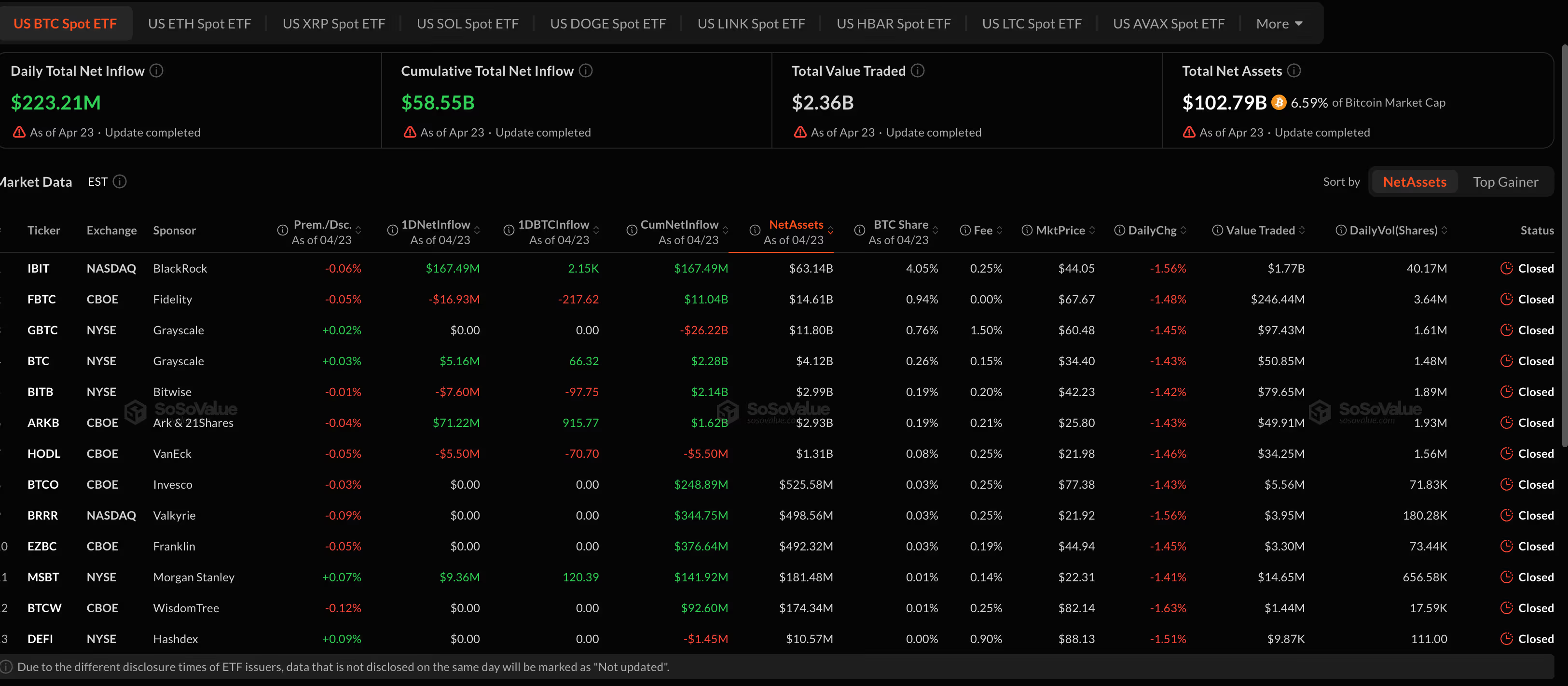
Somebody is buying $2.1 billion of bitcoin through ETFs. Somebody else is using that bid to get out.
U.S. spot bitcoin ETFs have now logged eight straight days of inflows totaling $2.10 billion through April 23, per SoSoValue. That is the longest streak since the nine-day October 2025 run that took bitcoin to its $126,000 all-time high. April 23 alone brought $223.21 million, with BlackRock’s IBIT doing roughly 75% of the lifting at $167.49 million and Fidelity’s FBTC the one meaningful outflow at $16.93 million.

Bitcoin has climbed from $68,000 to $77,000 over the streak, a 12% move that has coincided almost perfectly with the ETF bid returning. Cumulative ETF net inflows since launch now sit at $58 billion, and total assets hit $102 billion, which is 6.5% of bitcoin’s market cap.
But here is the part the ETF data does not tell.
A Glassnode report from earlier this week showed that bitcoin just reclaimed its True Market Mean at $78,100, which tracks the average cost basis of actively transacted supply. That is the first time that level has been reclaimed since mid-January, and historically marks the transition from bear-market conditions to something more constructive.
The problem is the next level. The Short-Term Holder Cost Basis sits at $80,100, which is the average entry price for anyone who bought in the last 155 days. A move above it would push more than 54% of recent buyers into profit.
In every prior instance this cycle, that threshold has coincided with local top formation as short-term holders use the rally to break even and exit. This is the second time the structure has set up, and it broke down the first time.
Short-term holder realized profit has already spiked to $4.4 million per hour, per Glassnode. The $1.5 million threshold has preceded every local top year-to-date. The current reading is three times that.
The setup from here is specific. Funding on bitcoin perpetuals is still negative, meaning shorts are paying longs. Saturday’s short squeeze took bitcoin to $78,000 briefly before the Hormuz reversal pulled it back.
A second squeeze, stacked on the ETF bid and the spot demand Glassnode has flagged as recovering on offshore venues, is the clean path to $80,000. Whether that break holds against short-term holder distribution, or gets sold into the same way every local top has been sold this cycle, is the trade.
March’s seven-day streak broke the same week price tagged its local high. IBIT has carried most of the current run alone while smaller issuers posted mixed flows. The structure is not identical but the pattern rhymes.
The ETF bid is real. The exit liquidity for short-term holders it provides is also real. Which side wins at $80,000 is worth watching.
Crypto World
Ethereum (ETH) Price Analysis: $633M in ETF Inflows Amid Continued Resistance at $2,400
Key Highlights
- U.S. spot Ethereum ETFs have seen net inflows for 10 straight trading sessions, accumulating $633 million
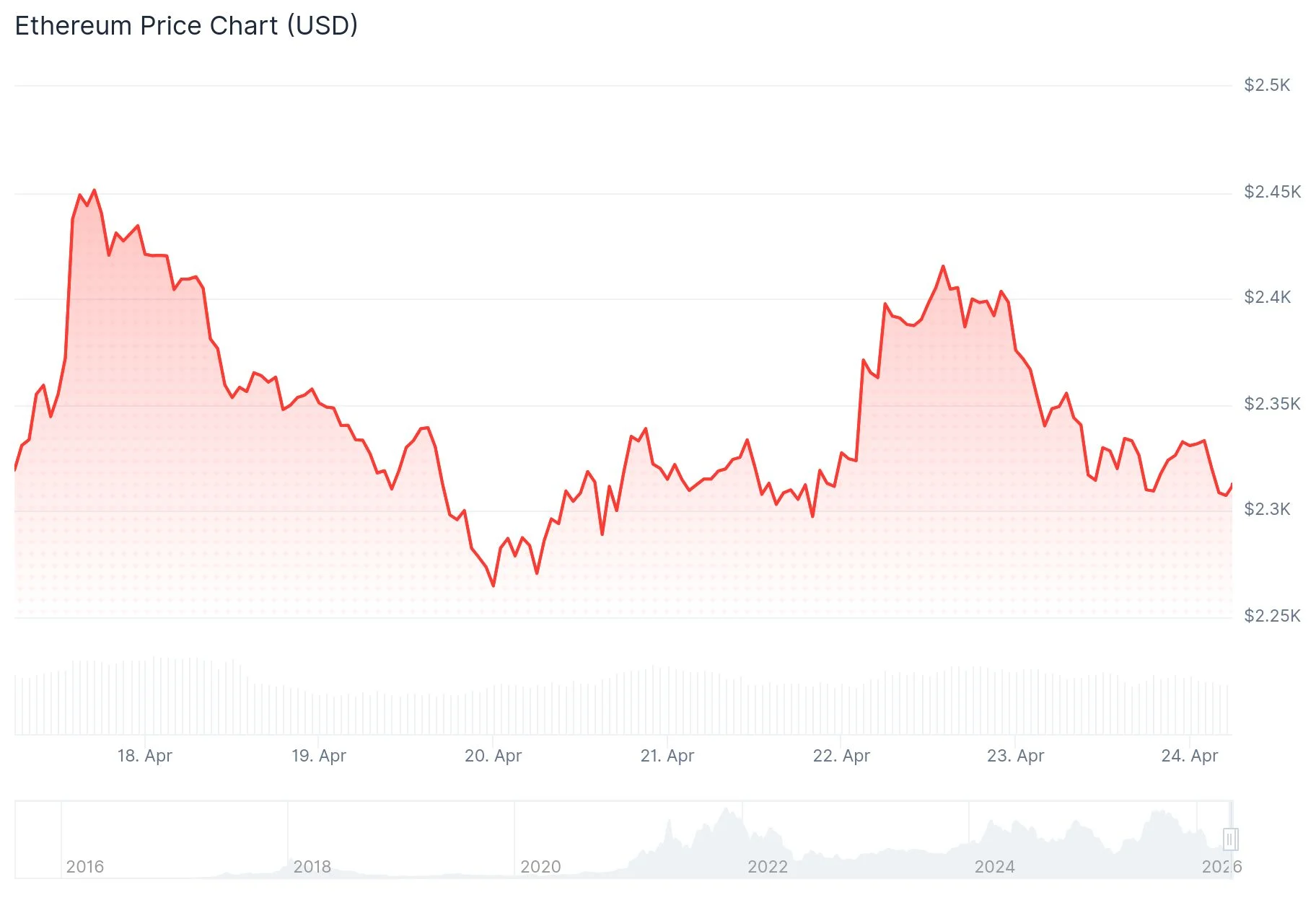
- Ether continues to face rejection at the $2,400 price level and has declined 22% so far in 2026
- Nasdaq welcomed the BESO ETF from GSR Markets, marking the debut of a multi-crypto fund featuring staking rewards
- Ethereum’s DApp-generated revenue has plunged to $13 million per week, representing a nearly 50% decline over half a year
- Technical observers suggest $2,250 could serve as the next critical support if current resistance persists
Ethereum (ETH) is currently hovering near $2,340, consistently unable to sustain price action above the $2,400 threshold. While the asset experienced an uptick in tandem with Bitcoin’s push toward $79,000, the upward drive proved insufficient to pierce through major resistance zones.
U.S.-based spot Ethereum exchange-traded funds have recorded positive net flows for ten consecutive trading days through Wednesday, bringing total inflows to $633 million. Overall cumulative flows into these investment vehicles are now nearing the $12 billion mark. Within the current week alone, just three sessions contributed $206 million in net capital, representing the strongest weekly performance since these products debuted.
GSR Markets introduced the BESO ETF on the Nasdaq exchange this week, representing the first actively managed U.S. fund to hold a diversified portfolio of Bitcoin, Ethereum, and Solana while distributing staking yields. The product carries a 1% annual management fee, undergoes weekly rebalancing, and channels Ethereum staking returns of approximately 3.3–4.0% annually straight to investors.
BESO joins a competitive landscape that includes BlackRock’s IBIT, currently managing $54 billion in assets, and Bitwise’s BAVA, which provides AVAX exposure featuring 5.4% staking yields.
Transaction activity on the ETH network jumped 41% from the previous week as ETF-related engagement intensified. Additionally, the amount of ETH available on exchanges continues to contract as staking mechanisms remove tokens from circulation.
Declining DApp Revenue Creates Headwinds
Weekly revenue generated by decentralized applications on the Ethereum network has dropped to $13 million in April, marking a decline of nearly 50% compared to figures from six months prior. The wider DApp ecosystem has experienced similar pressures, with combined weekly blockchain DApp revenue across platforms falling to $73 million from $130 million recorded in October 2025.
Competing networks including Solana, BNB Chain, and Hyperliquid have exhibited comparable downturns, indicating this represents an industry-wide phenomenon rather than challenges unique to Ethereum.
Year-to-date, ETH has fallen 22%, underperforming compared to the broader cryptocurrency market’s 14% decline. Nevertheless, Ethereum maintains its dominant position in total value locked (TVL), while its layer-2 scaling solutions have captured increasing market share in decentralized exchange trading volumes.
The annualized premium on ETH futures contracts has contracted to just 1%, significantly beneath the 4% baseline considered neutral. This reflects minimal appetite for leveraged long exposure, marking the weakest level observed over the past four months.
Technical Perspectives on Critical Price Zones
Crypto analyst Ali Charts highlighted that ETH is currently testing its Realized Price level at $2,340, which represents the average acquisition cost for all on-chain holders. Historical patterns suggest that when this level successfully holds as support, Ethereum has typically entered expansion cycles.
Analyst Ted Pillows cautioned that ETH’s inability to reclaim $2,400 raises concerns and pinpointed $2,250 as the subsequent crucial support area. He emphasized that ETH appears to be exhibiting weakness compared to Bitcoin’s performance.
Research from TD Cowen establishes a $3,650 price objective for ETH, while Standard Chartered maintains a longer-term institutional projection of $7,500 based on anticipated capital flows.
The cryptocurrency Fear & Greed Index currently registers at 33, signaling fear sentiment among market participants, with 30-day price volatility measured at 5%.

Two Polymarket accounts have attracted suspicion after making $37,000 betting correctly on two unusual temperature readings of a weather station located in a major airport in France.
The two weather-focused prediction markets focused on the highest temperature in Paris on April 6 and 15, using the highest temperature recorded at the Charles de Gaulle Airport Station in degrees Celsius, according to Polymarket.
French media outlet BFMTV reported on Monday that the temperature suddenly climbed to over 21 degrees Celsius on April 6, before dropping again immediately. The market resolved with the winner taking over $16,000. The winning account is under 30 days old.
Meanwhile, blockchain analytics tool Bubblemaps reported a similar glitch for the April 15 market. The weather station showed 18 degrees Celsius most of the day, then suddenly spiked to 22 degrees Celsius before dropping back.
Some have questioned whether foul play was involved. Prediction markets are already facing growing scrutiny over insider trading and possible violations of gambling laws.

Source: Bubble Maps
“That spike didn’t show on nearby stations,” Bubblemaps analysts said, adding that “Just before the spike, one trader started buying NO shares on 18°C,” before exiting with over $21,000.
The winning trader account has been highly active on Polymarket with wagers on crypto and weather. However, this is the largest payout by a wide margin; the next-highest is $13.
Ruben Hallali, a meteorologist, told BFMTV the temperature glitch was unlikely to be a natural event and alleged it may have been tampered with on-site.
Related: Charles Schwab, Citadel Securities are eying prediction markets
“Such temperature variations seem very unlikely, especially on these two dates, and over such a short period. We can imagine that an individual with a good understanding of how the sensors work intervened, resulting in temperatures rising by two degrees at the right time, to validate a bet,” he added.
Météo France, the official government weather agency of France, has reportedly made a complaint with the police unit the Roissy Air Transport Gendarmerie Brigade, for alleged tampering with the operation of its automated data processing systems.
Magazine: How to fix suspected insider trading on Polymarket and Kalshi

Porsche is adding an all-electric Cayenne coupe to its lineup

Is Money Soap a Scam?

Emergency services attend 7 car crash on Trinity Street Bolton

Manchester United reach agreement with Casemiro over contract clause amid transfer speculation

US brings back mandatory military draft registration

Steven Gerrard disagrees with Gary Neville over ‘shock’ Chelsea and Arsenal claim | Football


-

 Sports7 days ago
NWFL Suspends Two Players Over Post-Match Clash in Ado-Ekiti
-

 Fashion7 days ago
Weekend Open Thread: Theodora Dress
-

 Politics6 days ago
Palestine barred from entering Canada for FIFA Congress
-
Entertainment4 days ago
NBA Analyst Charles Barkley Chimes in on Ice Spice McDonald’s Fiasco
-

 Tech5 days ago
Auto Enthusiast Scores Running Tesla Model 3 for Two Grand and Turns It Into Bare-Bones Go-Kart
-

 Business5 days ago
Powerball Result April 18, 2026: No Jackpot Winner in Powerball Draw: $75 Million Rolls Over
-

 Politics5 days ago
Zack Polanski demands ‘council homes not luxury flats for foreign investors’
-

 Crypto World6 days ago
Russia Pushes Bill to Criminalize Unregistered Crypto Services
-

 Politics3 days ago
Gary Stevenson delivers timely reminder to register to vote as deadline TODAY
-

 Business2 days ago
Rolls-Royce Voted UK’s Most Iconic Trade Mark as IPO Register Hits 150
-

 Politics2 days ago
Disabled people challenge government SEND proposals over segregation concerns
-

 Politics2 days ago
Making troops accountable for war crimes threatens US alliance, ex-SAS colonel warns
-

 Crypto World6 days ago
Russia Introduces Bill To Criminalize Unregistered Crypto Services
-

 Politics2 days ago
Starmer handler McSweeney to be dragged from shadows by Foreign Affairs Committee
-

 Politics2 days ago
Zack Polanski responds to home secretary’s taser threat
-
Politics2 days ago
Wings Over Scotland | How To Get Away With Crimes
-
Crypto World5 days ago
Kelp DAO rsETH Bridge Hack Drains $292M as DeFi Losses Top $600M in Two Weeks
-

 Politics1 day ago
‘Iran is still a nuclear threat’
-

 Crypto World2 days ago
New York sues Coinbase, Gemini over prediction market offerings
-
 Sports7 days ago
Kevin Kisner apologizes for Masters criticism: ‘I crossed the line’
You must be logged in to post a comment Login