Time to hang it up? Microsoft will be giving some employees that chance. (GeekWire Photo / Todd Bishop)
Microsoft is offering a one-time voluntary retirement program for the first time in its 51-year history, giving thousands of long-serving U.S. employees a chance to leave with a financial payout and extended healthcare as it works to control costs amid a massive buildup in AI infrastructure.
An estimated 7% of Microsoft’s 125,000-person U.S. workforce, or about 8,750 employees, would be eligible based on a formula that takes into account their years at the company and their age.
It’s a highly unusual move in the tech world. Voluntary retirement programs are common in older industries, such as telecom and manufacturing, but the largest tech companies have instead turned to layoffs, stricter performance reviews, and return-to-office policies to thin their ranks.
The retirement program was outlined Thursday in a memo to employees from Chief People Officer Amy Coleman, who described it as a one-time offering for long-serving workers.
Advertisement
The program is open to U.S. employees at Level 67 — the equivalent of senior director — and below, excluding those on sales incentive plans, whose years of service plus age total 70 or more. Eligible employees will be notified May 7 and will have 30 days to decide.
“Many of these employees have spent years, and in some cases, decades, shaping Microsoft into what it is today,” Coleman wrote. “Our hope is that this program gives those eligible the choice to take that next step on their own terms, with generous company support.”
In the same memo, Coleman outlined changes to Microsoft’s compensation system, reducing the number of pay levels from nine to five. It’s also decoupling stock awards from bonuses, giving managers flexibility to use stock to reward long-term contributors regardless of their latest performance rating.
Microsoft isn’t providing specific details of the retirement package yet, saying eligible employees and their managers will receive more information on May 7. Details of the healthcare component will be significant for employees who are not yet old enough to qualify for Medicare at age 65.
Advertisement
There are not expected to be any restrictions on future employment for those who take the deal.
The program would take effect in Microsoft’s fiscal fourth quarter, and CFO Amy Hood is expected to discuss it on the company’s earnings call next week.
Amazon just scored a major coup with Meta thanks, once again, to Amazon’s own homegrown chips. Meta has signed a deal to use millions of AWS Graviton chips to power its growing AI needs, Amazon announced Friday.
Note that the AWS Graviton is an ARM-based CPU, (a central processing unit, the chip that handles general computing tasks) not a GPU (a graphical processing unit).
While GPUs remain the chip of choice for training large models, once those models are trained, AI agents built on top of them are causing a shift in the type of chip is needed. Agents create compute-intensive workloads like real-time reasoning, writing code, search, and the the coordination involved in managing agents through multi-step tasks. AWS’s latest version of Graviton was designed specifically to handle AI-related compute needs, the company says.
This deal brings more of Meta’s cash back to AWS instead of competitors like Google Cloud. Last August, Meta signed a six year, $10 billion deal with Google Cloud, though Meta had, until then, primarily been an AWS customer that also used Microsoft Azure.
Advertisement
We couldn’t help but notice that AWS timed the announcement of this deal right as the Google Cloud Next conference wrapped up, like a virtual smirk at its cloud rival. Google, of course, also makes its own custom AI chips and announced new versions of them at the show.
True, Amazon makes its own AI GPU as well: the Trainium, which, despite its name, is used for both training and inference — the stage that happens after a model is trained, when it’s actively processing prompts.
But Anthropic had already swooped in with a deal announced earlier this month that commandeered many of those chips for years to come. The Claude maker agreed to spend $100 billion over 10 years to run its workloads on AWS — with a particular focus on Trainium — while Amazon agreed to invest another $5 billion (bringing its total to $13 billion of investment) into Anthropic in return.
Techcrunch event
Advertisement
San Francisco, CA | October 13-15, 2026
Ultimately, the Meta deal is allowing Amazon to showcase a huge AI customer as a proving point for its homegrown CPUs. These are chips that compete with Nvidia’s new Vera CPU, which is also ARM-based and designed to handle AI agentic workloads. The difference, of course, is that Nvidia sells its chips and AI systems to enterprises and cloud providers (including AWS). AWS only sells access to its chips through its cloud service.
Advertisement
Earlier this month Amazon CEO Andy Jassy took aim at Nvidia and Intel in his annual shareholder letter, saying that enterprises want better price-performance ratios for AI, and that he intends to win deals on that basis. This also means the pressure couldn’t be higher on Amazon’s internal chip building team to deliver, a team that we visited last month in an exclusive tour of their lab.
When you purchase through links in our articles, we may earn a small commission. This doesn’t affect our editorial independence.
JP Morgan & Chase, BlackRock, DST Global and Arch Venture Partners have reportedly invested in the lab.
Jeff Bezos’s physical AI lab Project Prometheus has closed a $10bn funding round at a valuation of around $38bn, Bloomberg has confirmed.
A sources has told the publication that JP Morgan & Chase, BlackRock, DST Global and Arch Venture Partners are among those participating in the round. Speculation around the closure of the round was reported earlier this week by the Financial Times (FT).
The company builds AI that assists engineering and manufacturing in a number of sectors, including in computers, aerospace and automobiles.
The lab reportedly amassed an initial $6.2bn in November, partly from Bezos himself. Although demand has further extended the raise, FT reported.
The co-founders are also reportedly leading efforts to raise “tens of billions of dollars or more” for a holding company to acquire parts of other companies likely to be disrupted by AI.
Meanwhile, Prometheus also held talks with sovereign investment funds, including from Singapore and Gulf nations. Additionally, it plans to collect stakes in companies across its target sectors for AI training data.
Advertisement
Prometheus had already hired around 100 employees across San Francisco, London and Zurich by November last year, including researchers from OpenAI, Google DeepMind and Meta. FT sources said that the company is hiring people with experience “building out massive infrastructure projects”.
I’m separating the Dyson PencilVac Fluffycones (yes, that’s the full name) because, while it’s still a stick vacuum, its design is so different that it stands apart from any other stick vacuum I’ve tried.
The primary difference is that the motor, dustbin, and battery are all contained in the slim handle. No more bulky, top-heavy build that these cordless vacuums are known for. The body and feel remind me of using a Swiffer, but it’s a vacuum instead of just a slapdash mop. The PencilVac uses Dyson’s Hyperdymium motor—the same one that’s usually in the brand’s hair tools—and has a tiny 0.08-liter dustbin, but compacts the debris to make that small amount of space last. It also has a short battery life of only 30 minutes.
Advertisement
It has much lower power than the other vacuums in Dyson’s lineup and can only be used on hard floors. It has four fluffy rollers, aptly named Fluffycones, on the cleaner head, and they’re designed to keep hair from getting tangled. It works, but instead of getting tangled, the vacuum sometimes balled up my hair and spat it back out instead of sending it into the dustbin. It was great for quick cleans for things like litter, dust, and cereal, but it’s a high price to pay for something that’s more limited than cheaper vacuums.
Still, I think there’s a use case here, especially from an accessibility perspective. This is a good option for households where someone might not be strong enough or have the mobility to easily push and hold up a top-heavy stick vacuum, and the charging base makes it easy to quickly store and grab without putting it down or bending over. The compact size is also an argument for small homes, and it did fit into smaller crevices better than standard-sized stick vacuums (think the space between the toilet and wall). The Dyson V15 is a better all-around buy, but I think there are people to whom this specific vacuum could really appeal. Dyson also launched the PencilWash last month, a similar design but a wet vac, which I’m testing next.
Honorable Mentions
Advertisement
We haven’t tried a vacuum yet that we absolutely hate. The ones below are solid vacuums and, in some cases, much cheaper than our top picks, but we didn’t like them quite as much.
Bissell IconPet Turbo Edge for $200: Bissell’s OG stick vacuum is a popular model that’s been around for a while. It does a good job picking up hair and cat litter, and easily turns into a handheld vac too. The battery lasts a little longer, but former WIRED reviewer Medea Giordano wasn’t impressed by its Cheerio-gathering skills, and it can’t stand up on its own.
Bissell’s PowerClean FurFinder for $200: This is a great stick vacuum, and it was our previous top pick. It does an all-around good job on all kinds of flooring, comes with a nice range of accessories, and has the FurFinder tool to help with pet hair. It’s still a great vacuum, especially if you have pets, but unless you’re using the FurFinder tool frequently, you can get the slightly cheaper regular Bissell PowerClean for a similar experience.
Advertisement
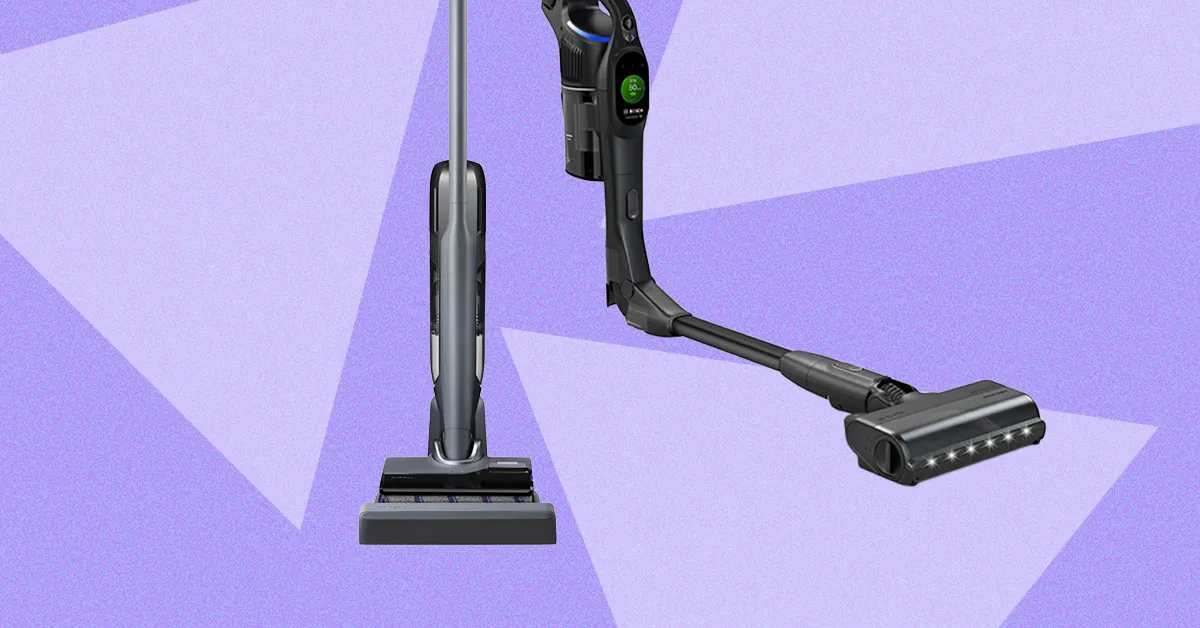
Bosch Unlimited 10 Cordless Stick Vacuum for $699: This vacuum has six cleaning modes and can bend in the middle, but it didn’t always contain the debris after I was done cleaning. It does have a 10-year warranty on the motor, which is more than other brands offer.
Black & Decker Powerseries Extreme Max for $169: The Black & Decker Powerseries Extreme Max is a great stick vacuum at a lower price than most others. It stands up on its own, has three power levels you can easily control from the handle, and handles well on the different surfaces in my home. I liked this vacuum a lot, but it wasn’t as stable as the Bissell above, and the handle felt a little plasticky compared to it and other vacuums I tested. It did have a larger-capacity dustbin, though.
Dyson V12 Detect for $550: The V12 Detect is worth considering if you want something even slightly cheaper and lighter than the V15 (though it’s less powerful and has a smaller bin).
Eufy Robot Vacuum 3-In-1 E20 for $500: WIRED reviewer Adrienne So was stoked to try Eufy’s E20, which is a stick vacuum, handheld vacuum, and robot vacuum all in one. It’s a handy, well-designed device, but it’s only good for light cleaning.
Eureka Stylus Elite for $280: This is a good stick vacuum with a self-emptying bin at a reasonable price. It cleaned up a litter mat especially well, and there are specific settings for carpet and hardwood. However, to suck up larger pieces like Cheerios, I had to lift the vacuum up and place it directly on top of them.
Levoit LVAC-300 for $270: This is a well-rounded stick vacuum that has a good price point (and often on sale). It has an hour of battery life, comes with a couple of accessories, and has similar specs to our favorite Dyson vacuum. The 6.6-pound weight also made it fairly easy to clean the three sets of stairs in WIRED reviewer Luke Larson’s home, and it has HEPA filtration. While it can stand on its own, it easily tips over in the process.
Advertisement
Ryobi 18V One+ HP Advanced Stick Vacuum Kit for $399: This is our runner-up cordless vacuum pick for the best pet hair vacuums. It has powerful suction, cyclonic filtration, a brushless motor, an easily removable roller bar, and lights on the vacuum head to better see pet hair and dander.
Tineco Pure One Station 5 for $459: I love that this vacuum has a self-emptying base station. It’s a solid vacuum overall, but my favorite part about it was the docking station. You don’t need to choose Tineco to get that, though; Shark has a few models now with self-emptying stations, and Dyson has one due out this year.
Cordless vacuums, also known as stick vacuums, are what the name suggests: They don’t need a cord to work. Instead, they have a battery you need to charge and are designed with a battery and motor at the top with a long, thin, sticklike body connecting that to the head of the vacuum. They’re much lighter than an upright vacuum and have become popular since they’re much easier to store and move around the house. I especially love using one as someone who lives in a three-story home. Stick vacuums also can usually have the stick portion removed to transform into a handheld vacuum, though they’re much heavier than a true handheld vacuum (but the battery life is much better).
How Long Do Cordless Vacuums Last?
Advertisement
Overall, vacuums tend to last around five years, but that depends on the frequency with which you vacuum and the vacuum’s build quality. Some cheaper stick vacuums might last only about a year or two, though, according to Eufy, so it’s worth investing in a good-quality stick vacuum. If you’re curious what signs might indicate your vacuum needs replacing, check out our guide to how long vacuums can last. If you’re curious whether you’re vacuuming enough, check out our guide to how often you should vacuum.
How Does WIRED Test Cordless Vacuums?
The best way to test a vacuum is to use it like you usually would. So, for a few months, we lived with these cordless vacuums, rotating through them to handle day-to-day messes and weekly deep cleans on hardwood floors, area rugs, and carpets. We charged them, asked our partners to use them, and even took some to a retail store to clean up after antique furniture and heavy foot traffic.
We also performed head-to-head testing, comparing how each picked up piles of Cheerios and cat litter, seeing if they blew debris around or needed several passes. We also took heaps of already matted dust and dirt from inside the vacuum bins to see how easily the vacuums could suck them back up in their thickened state.
There’s some endless, curious tensions within the corrupt Trump administration when it comes to their effort to completely destroy the government’s ability to hold corporations accountable for dodgy, nefarious, or even illegal behavior. Their own, lazy, circular logic and bad faith legal interpretations are creating vast new legal minefields we’ll be untangling for decades.
The wireless industry is a prime example.
For decades, major wireless carriers AT&T, Verizon, and T-Mobile collected vast troves of sensitive user location and movement data, then sold access to any random nitwit with two nickels to rub together. The result was a parade of scandals wherein everybody from stalkers, law enforcement (or people pretending to be law enforcement), car companies, governments (foreign and domestic), and right wing extremists all happily abused the data in myriad, dangerous ways never made clear to the end user.
Though this behavior had been going on for years generating untold millions, it only gained mainstream attention thanks to a 2018 New York Times story showcasing how police and the prison system routinely bought access to this data and then failed completely to secure it. In 2024 the Biden FCC finally proposed fining wireless carriers $196 million ($91 million for T-Mobile, $57 million for AT&T, $48 million for Verizon).
Advertisement
Those fines have been winding through the courts ever since, with wireless carriers (with varying degrees of success) insisting that the FCC lacks the authority to do, well, anything they don’t like. Like most corporations, wireless giants have been broadly helped in that endeavor by Supreme Court rulings dismantling regulatory authority across several different pillars of consumer protection law.
AT&T was also helped dramatically by a 5th Circuit ruling last year declaring that the FCC fines somehow violated wireless carriers’ Seventh Amendment right to a jury trial. This was one of several specious arguments telecom lawyers threw at a wall to see which one would satisfy the Trump-addled court system. The 5th Circuit was happy to oblige, vacating the FCC’s long-percolating fines of AT&T.
You were to ignore that AT&T has been at the vanguard of making jury trials impossible for customers through its use of fine print forcing users to pursue binding arbitration, a lopsided system that finds in favor of corporations a vast majority of the time. Or that AT&T spends millions of dollars annually successfully lobotomizing the entirely of telecom oversight, be it congressional, legal or regulatory.
The FCC is kind of defending the Biden era fines (Brendan Carr wants to retain some FCC authority to force corporations to bend the knee to authoritarianism). But here’s the fun thing; even if the justices disagree with the wireless carriers (which can certainly change after a few late night chats with telecom lobbyists), the FCC’s inclined to change the language of their forfeiture orders anyway:
“But even if AT&T and Verizon lose this case, they could get a victory of sorts because the FCC and justices seem to agree that FCC fine decisions are nonbinding and require a court decision to enforce them. A government lawyer told justices that the FCC may change the language of its forfeiture orders to make it clearer that fines don’t have to be paid until after a jury trial.
“It seems like you’ve won on the law going forward, one way or the other,” Justice Brett Kavanaugh told attorney Jeffrey Wall, who represents AT&T and Verizon. “Your reply brief begins, ‘the government’s in retreat.’ That’s absolutely correct.”
With the Supreme Court poking holes in regulatory autonomy across countless fronts (SEC v. Jarkesy, Loper Bright), there’s no limit of options for corporate lawyers looking to avoid regulatory accountability. Nearly any serious attempt by a regulator to hold corporations accountable for pretty much anything can now pretty easily be bogged down in years of litigation, quite by design.
You’d think the broad, dire impact of that would be of more interest to journalists and policy folk.
Advertisement
This whole Ars Technica article by Jon Brodkin is worth a read, and is a good demonstration of (1) how the Trump administration’s legal lackeys have to trip over themselves to pretend they’re engaged in good faith, non-corporatist, non-corrupt interpretation of consumer protection law, (2) how all the weird holes created by Supreme Court rulings aimed at demolishing even basic corporate oversight have created a vast minefield it’s a nightmare for everyone to navigate, and (3) how the press likes to pretend this is somehow normal behavior by a serious country and not a byproduct of abject corruption.
But in short it’s likely that AT&T, Verizon, and T-Mobile will never have to actually pay any fines related to their decade+ decision to spy on users and monetize their sensitive movement data. That’s not only an act of overt corruption (dressed up as serious, furrowed-brow legalese), but also the failure to hold wireless carriers accountable for privacy and security issues will pose a lasting cybersecurity threat.
It genuinely doesn’t get enough attention that the Trump administration (specifically the Trump-friendly Supreme and circuit courts) have delivered a killing blow to the federal government’s already shaky ability to hold corporations accountable for anything. People and the press deny, ignore, downplay, or normalize it, but these choices will range from massively problematic to fatal, and will reverberate for a generation.
I’m trying to think of what the twisty Aurzen Zip Cyber most looks like. Perhaps a new ultra-foldable phone. Or a little robot snake. Maybe the Zat gun from Stargate. What it doesn’t look like is a projector. Well, except for the light which blasts from the front of it. With its cyberpunk-inspired decorations, the Aurzen looks quite futuristic.
With its 720p resolution and a claimed 100-lumen brightness, its performance matches its diminutive size. Then again, it’s one of the only projectors I’ve seen that can literally fit in your pocket. With a 5,000-mAh battery, it can give you a TV-sized screen just about anywhere. Anywhere that’s fairly dark.
The main issue with the Zip is its lack of an HDMI input. Some devices can connect to the Zip wirelessly, but are limited to non-copyrighted content (so no Netflix, etc). For that, you’ll also need to get either the CastPlay Pro or CastPlay HDMI wireless dongles. For a pocket-sized PJ, though, the Aurzen Zip Cyber is still pretty neat.
Advertisement
Specs and such
Resolution: 720p
Lumens spec: 100 (claimed)
Zoom: No
Lens shift: No (though you can tilt the sections)
Battery: 5,000 mAh, 1.5h claimed playtime
Light source type and life: Not listed, likely LED
Cyberpunk is one of my favorite genres of sci-fi, and having recently re-read Gibson’s Sprawl trilogy for the 4th or 5th time, played about 250 hours of Cyberpunk 2077, plus enjoying countless other media, I am certainly, let’s say “predisposed,” to like the aesthetic. The Zip Cyber’s looks are preem, choom, though it’s basically cosmetic with a really good sticker and a different colored power button compared to Aurzen’s regular Zip. The suggested retail price is $30 more for the Cyber, or 7.5%. Personally, I’d pay the extra for the look, but as mentioned, I’m into it.
Geoffrey Morrison/CNET
Stickers aside, it’s the form of the Zip that is unique. This is a squat little box that expands via two hinges that can rotate roughly 90 degrees each. Fully upright, the projector forms a right-angled “Z” or “S” shape depending on your perspective. Adjusting the two non-base segments is how you angle the projector, and automatic keystone correction tries to maintain a rectangular image. This feature can be disabled in the menu.
There are control buttons up top, which can be duplicated in the Aurzen app (which annoyingly requires you to create an account). Next to the power button on one side are volume controls, and on the other is a toggle for the high brightness mode. The latter kicks the fans into overdrive, making them quite noticeable, but results in an about 40% increase in brightness. This sounds like a lot, but subjectively it’s just a bit brighter.
Geoffrey Morrison/CNET
As you’d probably expect, given the size and price, that brightness isn’t going to set any records. I measured approximately 88 lumens, which, given the differences in measurement techniques, is pretty close to their claims. Also, I wasn’t able to do my usual measurement suite because of the Zip’s main drawback, which is…
Connections
HDMI inputs: 0
USB port: 1 USB-C
Audio output: 2 speakers, 1-watt total
Internet: None
Streaming interface: None
Remote: N/A
There’s no HDMI input, just a single USB-C connection, which is also how you charge the battery. You can cast wirelessly to the Zip, or at least some devices can. Certain devices just can’t. For those devices, Aurzen also sells the CastPlay Pro, a USB-C dongle that connects to a source like your phone or tablet and streams its screen to the Zip. This is also the only way to send DRM-enabled (copy-protected) content like Netflix, Disney+, HBO and so on. Most USB-C iPhones and iPads should work; some Switch tablets work, as do many laptops. If you know your device supports video output from the USB-C connection, it should work. My Pixel 9 Pro, for example, wouldn’t cast to the Zip directly, but worked just fine with the dongle. My TCL tablet wouldn’t work with the dongle, but did cast directly, though not with DRM content.
Advertisement
Geoffrey Morrison/CNET
Aurzen also has a CastPlay Wireless HDMI Dongle, which connects to an HDMI source to broadcast to the Zip, but this wasn’t available during my review, and as of this writing is sold out in most regions.
So the Zip is a bit odd to review because, depending on your devices and what accessories you add, you’ll have a radically different experience. I made a chart:
Aurzen Zip Compatibility
System
Compatability
Result
Zip
Most devices that can cast/mirror their display, but not Google Cast-enabled devices
No DRM-enabled content (Netflix, Disney Plus, etc)
Zip + CastPlay Pro USB-C
Most USB-C devices with video out (DisplayPort Alt Mode)
Any content
Zip + CastPlay Wireless HDMI
Any device with HDMI
Any content
Basically, most modern iOS and non-Google devices should work with the Zip by itself, though you can’t watch DRM-enabled, copyrighted content (like what you get from the major streaming services). YouTube, Instagram, TikTok and similar will work fine, however. To connect other phones and devices, as long as it can output video via USB-C, the CastPlay Pro dongle will let you watch Netflix and other DRM-enabled streaming services (basically anything that’s not user-created). If you want to connect to a gaming console like a PlayStation or a streaming device like Roku, you’ll want the CastPlay HDMI. I think a lot of this confusion would have been solved with the addition of a Micro HDMI input somewhere, but I’m sure that would have added cost.
Advertisement
Picture quality
Due to the compatibility challenges mentioned above, I wasn’t able to do my full measurements with the Zip. I’m confident these results are close, though, especially since they’re pretty similar to those of other inexpensive portable DLP projectors I’ve measured, like Anker’s Nebula Capsule Air.
Geoffrey Morrison/CNET
While light output, in the high-brightness mode, was around 88 lumens, it was around 63 in the much quieter, lower-brightness mode. This is within a few lumens of the Capsule and Capsule Air, close enough that you’d be unlikely to notice any difference in light output. These are all small, dim projectors, among the dimmest I’ve tested. That’s fine, as it’s an understandable consequence of the size and price. As long as you keep the projected image to around TV-sized, it’s bright enough to enjoy in a dark room.
Contrast is also fairly low, but within the same range as the competition. I measured an average contrast of approximately 401:1, which is about the same as the Capsules as well as some larger, more expensive portables like the Mars 3 Air (405:1). This is only slightly less than standouts like the TCL PlayCube (492:1) and even full-size projectors like the Epson Flex Plus (468:1). So while the image doesn’t pop as much as higher-end, and much larger/more expensive projectors, it’s still contrasty enough that it doesn’t look overly washed out. Again, size and price are the main attributes of the Zip, so it’s great to see that it also looks decent, graded on a curve with other small portables.
Advertisement
The TCL PlayCube, Aurzen Zip Cyber, and Anker Nebula Capsule Air.
Geoffrey Morrison/CNET
Color is a bit of a mixed bag, however. The overall color temperature is a little on the cool/blue side, but not enough that it’s distracting. Some colors, like blue and cyan, look fine. Greens are quite accurate too, which is a surprise. Most projector companies sacrifice a realistic green for more light output. Anything involving red is a bit off, however, with red itself being quite undersaturated, magentas are somewhat blue, and yellows are rather green. The most noticeable result is that many skin tones look a little pasty, and anything that should have a solid red looks more pastel.
Perhaps the most useful feature in the Zip speaks to how Aurzen expects people to use it. If you lay the Zip on its side, it will rotate the image 90 degrees. This means if you’re primarily watching 9×16 content like TikTok, it will fill the DLP chip, and you can take advantage of the entire 720p resolution. This makes watching vertical content much more satisfying compared with a heavily letterboxed image that only takes up the center portion of the projected image. Flipping it sideways does make it harder to position correctly, since there’s no rotation in the hinges in that direction, but oh well. Easy enough to just prop the front up with whatever’s handy.
The unit’s two tiny speakers don’t play particularly loudly, nor do they have any bass, no surprise there, but as long as you’re sitting close, they get the job done.
Advertisement
Blade running
Geoffrey Morrison/CNET
For the most part, I really like the Aurzen Zip Cyber. It’s a clever design that looks futuristic even without the cyberpunk clothing. It’s one of the smallest projectors I’ve ever tested, and it performs similarly to its slightly larger portable competitors. The colors it produces aren’t great, but they’re better than many small, inexpensive projectors I’ve tested, like the various AAXA models.
My hesitation is with the connectivity. I think I have a worse perspective on this than most people since I have a Pixel phone and a tablet without DisplayPort Alt Mode, so neither works entirely with the Zip. Depending on your gear, you’ll have different luck. The lack of an HDMI input also means that to watch content from the main non-YouTube streaming providers, you have to get one of the dongles, adding $100 to the total price.
That said, if you’re expecting to watch an endless scroll of TikTok or YouTube videos, and you have a device that will cast without the dongle, the Zip is a cool-looking gadget that can fit in a pocket and give you a TV-size image in rooms, vans or anywhere it’s fairly dark.
Enterprise teams building multi-agent AI systems may be paying a compute premium for gains that don’t hold up under equal-budget conditions. New Stanford University research finds that single-agent systems match or outperform multi-agent architectures on complex reasoning tasks when both are given the same thinking token budget.
However, multi-agent systems come with the added baggage of computational overhead. Because they typically use longer reasoning traces and multiple interactions, it is often unclear whether their reported gains stem from architectural advantages or simply from consuming more resources.
Their experiments show that in most cases, single-agent systems match or outperform multi-agent systems when compute is equal. Multi-agent systems gain a competitive edge when a single agent’s context becomes too long or corrupted.
Advertisement
In practice, this means that a single-agent model with an adequate thinking budget can deliver more efficient, reliable, and cost-effective multi-hop reasoning. Engineering teams should reserve multi-agent systems for scenarios where single agents hit a performance ceiling.
Understanding the single versus multi-agent divide
Multi-agent frameworks, such as planner agents, role-playing systems, or debate swarms, break down a problem by having multiple models operate on partial contexts. These components communicate with each other by passing their answers around.
While multi-agent solutions show strong empirical performance, comparing them to single-agent baselines is often an imprecise measurement. Comparisons are heavily confounded by differences in test-time computation. Multi-agent setups require multiple agent interactions and generate longer reasoning traces, meaning they consume significantly more tokens.
Single-agent systems (SAS) vs multi-agent systems (MAS)
Advertisement
Consequently, when a multi-agent system reports higher accuracy, it is difficult to determine if the gains stem from better architecture design or from spending extra compute.
Recent studies show that when the compute budget is fixed, elaborate multi-agent strategies frequently underperform compared to strong single-agent baselines. However, they are mostly very broad comparisons that don’t account for nuances such as different multi-agent architectures or the difference between prompt and reasoning tokens.
“A central point of our paper is that many comparisons between single-agent systems (SAS) and multi-agent systems (MAS) are not apples-to-apples,” paper authors Dat Tran and Douwe Kiela told VentureBeat. “MAS often get more effective test-time computation through extra calls, longer traces, or more coordination steps.”
Revisiting the multi-agent challenge under strict budgets
To create a fair comparison, the Stanford researchers set a strict “thinking token” budget. This metric controls the total number of tokens used exclusively for intermediate reasoning, excluding the initial prompt and the final output.
Advertisement
The study evaluated single- and multi-agent systems on multi-hop reasoning tasks, meaning questions that require connecting multiple pieces of disparate information to reach an answer.
During their experiments, the researchers noticed that single-agent setups sometimes stop their internal reasoning prematurely, leaving available compute budget unspent. To counter this, they introduced a technique called SAS-L (single-agent system with longer thinking).
Rather than jumping to multi-agent orchestration when a model gives up early, the researchers suggest a simple prompt-and-budgeting change.
“The engineering idea is simple,” Tran and Kiela said. “First, restructure the single-agent prompt so the model is explicitly encouraged to spend its available reasoning budget on pre-answer analysis.”
Advertisement
By instructing the model to explicitly identify ambiguities, list candidate interpretations, and test alternatives before committing to a final answer, developers can recover the benefits of collaboration inside a single-agent setup.
The results of their experiments confirm that a single agent is the strongest default architecture for multi-hop reasoning tasks. It produces the highest accuracy answers while consuming fewer reasoning tokens. When paired with specific models like Google’s Gemini 2.5, the longer-thinking variant produces even better aggregate performance.
The researchers rely on a concept called “Data Processing Inequality” to explain why a single agent outperforms a swarm. Multi-agent frameworks introduce inherent communication bottlenecks. Every time information is summarized and handed off between different agents, there is a risk of data loss.
In contrast, a single agent reasoning within one continuous context avoids this fragmentation. It retains access to the richest available representation of the task and is thus more information-efficient under a fixed budget.
Advertisement
The authors also note that enterprises often overlook the secondary costs of multi-agent systems.
“What enterprises often underestimate is that orchestration is not free,” they said. “Every additional agent introduces communication overhead, more intermediate text, more opportunities for lossy summarization, and more places for errors to compound.”
On the other hand, they discovered that multi-agent orchestration is superior when a single agent’s environment gets messy. If an enterprise application must handle highly degraded contexts, such as noisy data, long inputs filled with distractors, or corrupted information, a single agent struggles. In these scenarios, the structured filtering, decomposition, and verification of a multi-agent system can recover relevant information more reliably.
The study also warns about hidden evaluation traps that falsely inflate multi-agent performance. Relying purely on API-reported token counts heavily distorts how much computation an architecture is actually spending. The researchers found these accounting artifacts when testing models like Gemini 2.5, proving this is an active issue for enterprise applications today.
Advertisement
“For API models, the situation is trickier because budget accounting can be opaque,” the authors said. To evaluate architectures reliably, they advise developers to “log everything, measure the visible reasoning traces where available, use provider-reported reasoning-token counts when exposed, and treat those numbers cautiously.”
What it means for developers
If a single-agent system matches the performance of multiple agents under equal reasoning budgets, it wins on total cost of ownership by offering fewer model calls, lower latency, and simpler debugging. Tran and Kiela warn that without this baseline, “some enterprises may be paying a large ‘swarm tax’ for architectures whose apparent advantage is really coming from spending more computation rather than reasoning more effectively.”
Another way to look at the decision boundary is not how complex the overall task is, but rather where the exact bottleneck lies.
“If it is mainly reasoning depth, SAS is often enough. If it is context fragmentation or degradation, MAS becomes more defensible,” Tran said.
Advertisement
Engineering teams should stay with a single agent when a task can be handled within one coherent context window. Multi-agent systems become necessary when an application handles highly degraded contexts.
Looking ahead, multi-agent frameworks will not disappear, but their role will evolve as frontier models improve their internal reasoning capabilities.
“The main takeaway from our paper is that multi-agent structure should be treated as a targeted engineering choice for specific bottlenecks, not as a default assumption that more agents automatically means better intelligence,” Tran said.
from the making-America-late-on-interest-payments-again dept
The government needs more funding than ever, which is kind of hilarious when you realize the Tea Party of the Obama era was the predecessor of this Big Government version of the GOP.
The DHS can’t even get itself a budget at the moment. Sure, it will get some money thrown to it sooner or later and the administration won’t let the lack of tax revenue offsets stop it from feeding billions more into its Bigotry Machine.
But that’s not all. Behold our all-but-officially-declared war in Iran, currently headed by the Department of DefenseWarLittle Excursion, which is adding billions of dollars weekly to the national deficit. After all, as right-leaning libertarians like to point out, the government doesn’t actually “make” anything. The private sector builds the bombs and missiles. And unlike TSA agents, they expect to be paid.
Immigrants accounted for more US income and generated more revenue for the government because they were, on average, over 12 percentage points more likely to be employed than the US-born population. This means that even if immigrants earn lower hourly wages, they can still account for more total income per capita than the US-born population by working cumulatively more hours. This higher employment rate was driven by the fact that immigrants were, on average, 20 percentage points more likely to be of working age. Immigrants usually arrive in the US as young adults and often leave before retirement.
More succinctly, immigrants out-punch their weight class when it comes to erasing budget deficits:
Accounting for savings on interest payments on the national debt, immigrants saved $14.5 trillion in debt over this 30-year period.
[…]
Without the contributions of immigrants, public debt at all levels would already be above 200 percent of US GDP—nearly twice the 2023 level and a threshold some analysts believe would trigger a debt crisis.
But that help is apparently no longer welcome. The Trump administration has succeeded in eliminating the firewall between the IRS and ICE, allowing ICE agents to use this data to hunt down taxpayers who work harder and pay more taxes than the white, natural-born citizens that this administration pretends make America great.
Advertisement
That’s going to cause even more problems for an administration that is spending far more liberally than any “liberal” it blames its current budget problems on. Here’s how that looks on the ground as Tax Day has come and gone in the United States:
By the time Tax Day rolls around every April 15, accountant María José Solís usually has more to do. More clients. More paperwork. More phones ringing, more emails and WhatsApp messages pinging.
But this year, she said, more than 550 of her regular clients have disappeared. That’s about 15 percent of her customer base at Toro Taxes, the bilingual firm in Wheaton, Maryland, that Solís runs.
There’s your anecdote, albeit one that’s being repeated around the nation. Here’s the data:
The Yale Budget Lab estimates that the IRS stands to lose between $147 billion and $479 billion over the next decade as migration to the U.S. declines, deportations increase and immigrants of various statuses disengage from the formal economy for what some experts say may be an extended period.
That estimate will likely be low if the Trump administration continues to purge migrants at the rate it has since Trump returned to office. It will definitely be lower if another similarly bigoted GOP lawmaker succeeds him as president.
Advertisement
And it’s not just the losses up front. There’s money leaking out the back as well. It’s a double-dip, because migrants with ITINs (individual tax identification numbers) pay taxes for services they can’t actually access, like Social Security and Medicare. They’re actually subsidizing citizens who pay fewer taxes, work fewer hours, and commit more crimes than they do.
This nation continues to become poorer, not just in terms of financial viability, but in heart and spirit. Migrants made this nation great. Now, a bunch of ungrateful people who hate people who aren’t white are not only driving us deeper into debt, but they’re eliminating a source of income that never asked for anything more than a chance to survive.
Dive into Godot – a rising star in the game engine world – with the 2026 Complete Godot Stack Development Bundle. You’ll learn to create platformers, RPGs, strategy games, FPS games, and more as you master this free and open-source engine with easily expandable systems. Plus, you’ll also explore techniques for game design and game asset creation – giving you the ultimate techniques to customize your projects. It’s on sale for $25.
Note: The Techdirt Deals Store is powered and curated by StackCommerce. A portion of all sales from Techdirt Deals helps support Techdirt. The products featured do not reflect endorsements by our editorial team.
Back in 2011 and 2012, one of the central technical objections that helped kill SOPA and PIPA was about DNS blocking. Engineers, internet architects, and cybersecurity experts all lined up to explain, in painstaking detail, why blocking at the DNS layer was a terrible idea. It would break the fundamental architecture of how the internet works. It would have massive collateral damage. It would undermine security protocols designed to protect users from exactly the kind of DNS manipulation that the bill proposed. And it wouldn’t even stop piracy, because anyone who actually wanted to get around DNS blocking could do so easily.
Congress, to its rare credit, actually listened to the technical experts (and widespread protests) and shelved the legislation. But the entertainment industry never gave up on the idea. They just went jurisdiction-shopping. And France, which has never met a maximalist copyright enforcement scheme it didn’t love, has been more than happy to oblige.
As recently reported by TorrentFreak, a Paris Court of Appeal validated DNS blocking orders requiring Google, Cloudflare, and Cisco to block access to pirate sites through their own DNS resolvers. This goes beyond traditional ISP resolvers, which France has been ordering blocked for years — this targets third-party resolvers — the ones that millions of people specifically choose to use because they offer better privacy, better security, and better reliability than their ISP’s default DNS.
But, of course, in France (and to the usual crew of Hollywood lobbyists), “better privacy, security, and reliability” can only mean one thing: used for piracy.
Advertisement
The court rejected all five appeals, and in doing so, articulated a legal principle so sweeping that it has no natural stopping point.
In this case, French pay-TV provider Canal+ went to court under Article L. 333-10 of the “French Sport Code,” which lets rightsholders request “all proportionate measures” against “any online entity in a position to help” block access to pirate sites. Canal+ argued that because users were simply switching to third-party DNS resolvers to circumvent ISP-level blocking, those resolvers should be conscripted into the blocking regime too.
Cloudflare and Cisco pushed back, arguing that their DNS resolvers serve a “neutral and passive function” — they translate domain names into IP addresses and that’s it. They compared their role to a phone book. The court’s response boiled down to: we don’t care.
The DNS resolution service allows its users, via the translation of a domain name into an IP address, to access websites on which sports competitions are broadcast in violation of rights-holders’ rights, and in particular to circumvent the blocking of those sites by ISPs.
The court found that the “neutral and passive” nature of DNS resolvers is “simply irrelevant to Article L. 333-10.” The law isn’t about liability at all — it only cares whether a service can help block access to pirate sites, which DNS resolvers clearly can. If you are technically capable of blocking access, you must.
Advertisement
Google, meanwhile, tried a different argument: that DNS blocking through third-party resolvers isn’t effective because users can just switch to a VPN or yet another resolver. The court wasn’t moved by that either:
Any filtering measure can be circumvented, and this possibility does not render the measures in question ineffective.
As long as DNS blocking stops some subset of users from reaching pirate sites, the court ruled, it’s “proportionate.” Under that line of thinking, any measure that inconveniences even a fraction of would-be pirates is legally justified, no matter how much collateral damage it causes for everyone else.
And if you think that principle has any limit, Canal+ has made it quite clear that they don’t think it does:
Canal+ said in a statement that the rulings are “more than a victory,” forming part of “a global approach that will be reinforced by the progressive deployment of complementary measures, including IP blocking.”
Canal+ has already been getting courts to order VPN providers to block as well. So now we have ISP DNS blocking mandated, third-party DNS resolver blocking mandated, VPN blocking mandated — and, per the TorrentFreak article, direct automated IP address blocking is coming too. They will not stop until the entire internet is broken.
Advertisement
Each step reaches further down the internet stack, breaks more of the internet for more people, and stops fewer actual pirates, because the people who are determined to pirate content are always one technical maneuver ahead. The people who get caught in the collateral damage are ordinary users who happen to use Cloudflare’s 1.1.1.1 or Google’s 8.8.8.8 for perfectly legitimate reasons like speed, reliability, and privacy.
Cisco, rather than comply with the original order, simply pulled its OpenDNS service out of France entirely. That’s the kind of collateral damage we’re talking about. French users who relied on OpenDNS for entirely lawful purposes completely lost access to the service. Because a copyright holder decided that the DNS layer was the right place to play whack-a-mole with pirate sites.
When Cisco argued on appeal that implementing geo-targeted DNS blocking would require 64 person-weeks of engineering work, the court waved it off, saying the estimate was “not supported by any objective evidence” and pointing out that Cisco already offers DNS filtering to enterprise customers. The fact that enterprise DNS filtering for corporate networks is a fundamentally different thing than mass geo-targeted blocking of domains at the resolver level for an entire country’s users apparently did not register as a meaningful distinction.
The court’s core reasoning — that any entity technically capable of blocking must do so, that circumvention doesn’t make blocking disproportionate, and that the “neutral and passive” function of an intermediary is irrelevant — creates a legal framework that can reach basically anything. If a DNS resolver can be conscripted because it’s “in a position to help,” what about browsers? What about operating systems? What about CDNs, or cloud hosting providers, or certificate authorities? The logic has no brake pedal. Every layer of the internet stack is, in some sense, “in a position to help” block access to content. The question the court’s reasoning cannot answer is: where does it end?
Advertisement
Under this reasoning, what’s to stop a rightsholder from arguing that browsers should block pirate URLs directly? Or that operating systems should refuse to resolve them at all?
That seems bad!
Of course, this kind of maximalist copyright enforcement is something of a French specialty. This is the same country that brought us HADOPI, the graduated response agency that cost French taxpayers €82 million over a decade while imposing a grand total of roughly €87,000 in fines. A staggering return on investment — if the goal was to light money on fire while accomplishing nothing. France has also been at the forefront of copyright exceptionalism that risks undermining the EU legal system more broadly, pushing interpretations of copyright law so aggressive that they threaten to distort the legal frameworks of neighboring countries.
France keeps doing the same thing over and over again: spend enormous sums, conscript more and more intermediaries, break more and more of the internet’s infrastructure, accomplish almost nothing in terms of actually reducing piracy, and then conclude that what’s really needed is… more of the same, but harder. The entertainment industry’s refusal to learn from twenty years of evidence that enforcement-maximalism doesn’t work is genuinely remarkable. Every study and every natural experiment shows the same thing: the most effective anti-piracy tool ever invented is convenient, reasonably priced legal access to content. But that requires adapting your business model, and it’s apparently much more satisfying to get courts to break the internet for you instead.
Advertisement
The ruling’s real danger is the template it sets. Other countries with similar legal frameworks will look at this appeals court validation and think: we can do that too. The “any entity in a position to help” standard, combined with the “doesn’t have to be perfectly effective” standard, combined with the “we don’t care about your neutral role in the architecture” standard, adds up to a legal toolkit for conscripting nearly any internet infrastructure provider into a copyright enforcement apparatus. And the costs get externalized onto those providers (and their users), while the rightsholders collect the benefits.
The engineers who fought SOPA warned about exactly this: DNS blocking breaks things, creates collateral damage, pushes enforcement into layers of the stack never designed for it — and doesn’t actually stop piracy, because the actual pirates just route around it while everyone else suffers. France apparently decided all of those concerns are, to quote the court, “simply irrelevant.” And now they’ve moving on to IP blocking.
At some point, you run out of layers of the internet to break. But apparently we’re going to have to find out where that point is the hard way.
An anonymous reader quotes a report from Wired: New gas projects linked to just 11 data center campuses around the US have the potential to create more greenhouse gases than the country of Morocco emitted in 2024. Emissions estimates from air permit documents examined by WIRED show that these natural gas projects — which are being built to power data centers to serve some of the US’s most powerful AI companies, including OpenAI, Meta, Microsoft, and xAI — have the potential to emit more than 129 million tons of greenhouse gases per year. As tech companies race to secure massive power deals to build out hundreds of data centers across the country, these projects represent just the tip of the iceberg when it comes to the potential climate cost of the AI boom.
The infrastructure on this list of large natural gas projects reviewed by WIRED is being developed to largely bypass the grid and provide power solely for data centers, a trend known as behind-the-meter power. As data center developers face long waits for connections to traditional utilities, and amid mounting public resistance to the possibility of higher energy bills, making their own power is becoming an increasingly popular option. These projects have either been announced or are under construction, with companies already submitting air permit application materials with state agencies. […] The emissions projections for the xAI and Microsoft projects, and all the others on WIRED’s list, were pulled directly from publicly-available air permit documents in state databases as well as public air permit materials collected by both Cleanview and Oil and Gas Watch, a database maintained by the Environmental Integrity Project, an environmental enforcement nonprofit. Actual greenhouse gas emissions from power plants are usually lower than what’s on their air permits. Air permit modeling is based on the scenario of a power plant constantly running at full capacity. That’s rarely the reality for grid-connected power plants, as turbines go offline for maintenance or adjust to the ebbs and flows of customer demand.
“Permitted emission numbers represent a theoretical, conservative scenario, not the actual projected emissions,” Alex Schott, the director of communications at Williams Companies, an oil and gas company that is building out three behind-the-meter power plants in Ohio for Meta, told WIRED in an email. Internal modeling done by the company, Schott added, shows that actual emissions could be “potentially two-thirds less than what’s on paper.” The projections involved, however, are still substantial. Even if the actual emissions from these power plants end up being half of the emissions numbers on the permits, they still could create more greenhouse gas emissions than the country of Norway emitted in 2024. This number is, according to the EPA, equivalent to the emissions from more than 153 average-sized natural gas plants. (WIRED’s analysis does not include emissions from backup generators and turbines on the data center campuses themselves, which create smaller amounts of emissions.)
Energy researcher Jon Koomey says the data center boom has created a shortage of the most efficient gas turbines, pushing some developers toward less efficient models that would need to run longer and produce more emissions. “[Data center operators’] belief is that the value being delivered by the servers is much, much more than the cost of running these inefficient power plants all the time,” he said.
Michael Thomas, the founder of clean energy research firm Cleanview, has been tracking gas permits for data centers across the country. He calls behind-the-meter power “a crazy acceleration of emissions.” He added: “It’s almost like we thought we were on the downside of the Industrial Revolution, retiring coal and gas, and now we have a new hump where we’re going to rise. That terrifies me in a lot of ways.”

























































You must be logged in to post a comment Login