
Crypto World
Trump’s DOJ drops probe that stood in way of president’s pick to run Federal Reserve

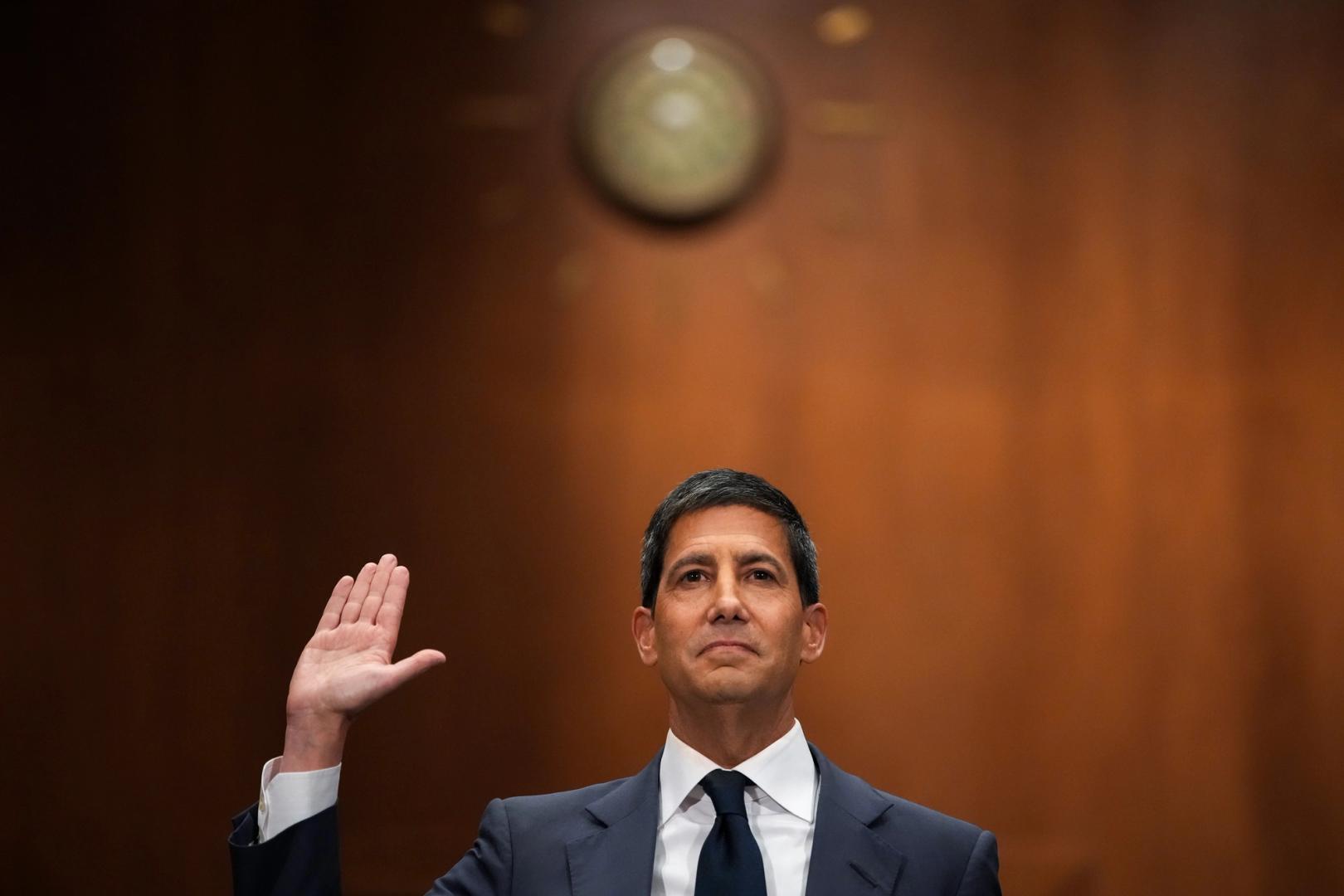
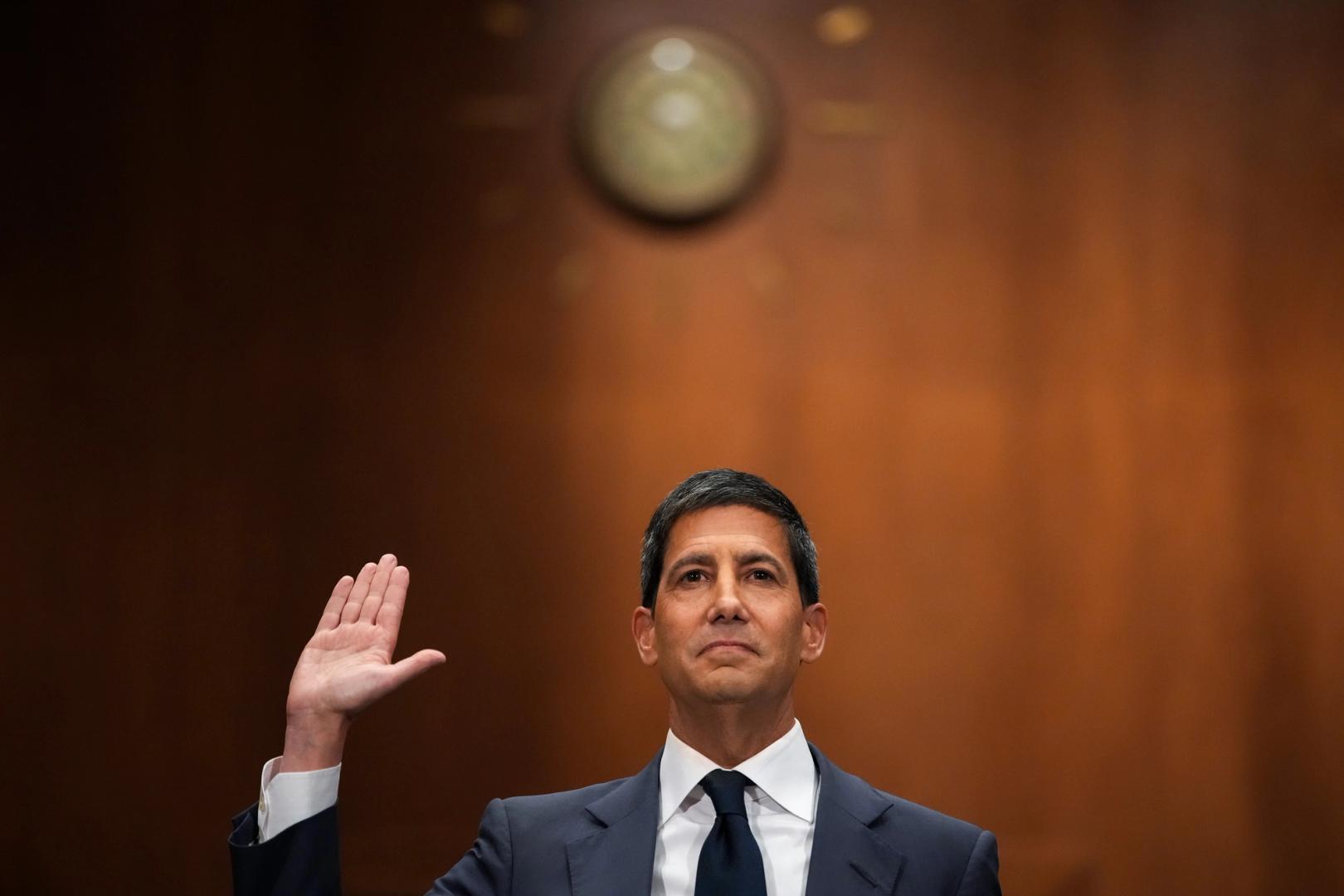
President Donald Trump’s command of U.S. financial and economic policy may have taken a step closer now that his Department of Justice has backed down from an investigation of Federal Reserve Chair Jerome Powell, meaning his nominee to replace Powell may now have an open path to confirmation.
Fed chair nominee Kevin Warsh, whose own considerable wealth includes some crypto-world assets, is awaiting a final vote from the Senate after appearing in a confirmation hearing this week. Trump, who has relentlessly blamed Powell for maintaining overly high U.S. interest rates, chose Warsh to remedy that, but Republican Senator Thom Tillis had promised to block the confirmation as long as the DOJ pressed an investigation against Powell for cost overruns in a Fed building project.
That criminal probe was dropped on Friday, and Attorney General Jeanine Pirro said the DOJ asked the Fed’s inspector general to look into the renovation situation and issue a report. When the news emerged, Kalshi’s prediction betting on Walsh’s confirmation before May 15 shot up from about 30% odds to more than 80%.
“I expect a comprehensive report in short order and am confident the outcome will assist in resolving, once and for all, the questions that led this office to issue subpoenas,” Pirro wrote in a post on social media site X. “Accordingly, I have directed my office to close our investigation as the IG undertakes this inquiry. Note well, however, that I will not hesitate to restart a criminal investigation should the facts warrant doing so.”
Putting his own people atop the Federal Reserve not only equates with Trump’s greater influence over U.S. monetary policy, but it also leaves him with more allies on the Fed board as it makes decisions about financial policy — including implementing rules that govern the crypto industry and stablecoin issuers.
Because of Tillis’ threat, Warsh may have been in a holding pattern as long as the DOJ pursued its investigation, which could have left Powell in charge of the Fed indefinitely, well beyond the May 15 expiration of his term. Now, the Republican-majority Senate may be able to move more quickly toward confirmation of the nominee, who insisted during his hearing that he would act independently of White House direction.
Senator Elizabeth Warren, the ranking Democrat on the Senate Banking Committee that’s considering his nomination, dismissed the move and noted the administration is still pursuing Fed Governor Lisa Cook in court.
“This is just an attempt to clear the path for Senate Republicans to install President Trump’s sock pocket Kevin Warsh as Fed chair,” Warren said in a statement. “Let’s be clear what the Justice Department announced today: They threatened to restart the bogus criminal investigation into Fed Chair Powell at any time while failing to drop their ridiculous criminal probe against Governor Lisa Cook.”
Tillis called Warsh a “great nominee.” In his own posting this week on X, the senator said he’d vote yes on Warsh once the DOJ backs off of Powell:
“I look forward to supporting him out of committee once the DOJ drops their bogus investigation into Chairman Powell that threatens the independence of the Fed.”



A US official said on Friday that the $344 million in Tether (USDT) frozen on Thursday was linked to Iran. The official tied the blacklisted addresses to transactions routed through Iranian exchanges and Central Bank of Iran wallets.
Treasury Secretary Scott Bessent confirmed a sanctions action targeting the same wallets, describing a broader push to cut off the financial channels Tehran uses as diplomatic efforts to end the war stall.
Two Addresses, One Iran Nexus
Tether said on Thursday it had supported US authorities in freezing $344 million in USDT across two addresses. The stablecoin issuer stated the move followed information shared by several US agencies about activity tied to unlawful conduct, coordinated through the Office of Foreign Assets Control (OFAC).
A US official reportedly told CNN that government analysts, working with blockchain analytics firms, observed material links to the Iranian regime.
That evidence included confirmed transactions with Iranian exchanges and flows routed through intermediary addresses interacting with Central Bank of Iran wallets.
The official added that Iran’s central bank has adopted increasingly opaque methods to hide cross-border digital asset activity. The effort aims to stabilize the rial and keep trade flowing under sanctions.
“We will follow the money that Tehran is desperately attempting to move outside of the country and target all financial lifelines tied to the regime,” read an excerpt in the report, citing Treasury Secretary Scott Bessent in a statement on Friday.
Iran Leans Harder on Stablecoins
The freeze fits a pattern documented by blockchain researchers. Chainalysis reported Iranian crypto holdings reached $7.8 billion in 2025, with the Islamic Revolutionary Guard Corps (IRGC) holding roughly half of those assets by the fourth quarter.
The firm said the two frozen Tether wallets behaved like other known IRGC addresses when they were active, moving tens of millions of dollars in single transfers, often to private wallets.
Tehran has repeatedly relied on stablecoins to sidestep the traditional banking system.
Earlier this year, Tether and Circle blacklisted a hot wallet belonging to Iranian exchange Wallex, while US authorities sanctioned additional platforms accused of routing IRGC funds through USDT on the Tron network.
Debate Over the Real Impact
Not everyone is convinced the seizure meaningfully constrains Tehran. Daniel Tannebaum, a senior fellow at the Atlantic Council and partner at Oliver Wyman, called the freeze “meaningful” but noted Iran has spent decades adapting to economic pressure.
“The way to get at Iran at this point, because Iran is truly sanctioned out, is to go with the third country actors enabling them,” Tannebaum told CNN, pointing to jurisdictions such as China as the more consequential choke point.
Intrusions targeting Iran’s own crypto infrastructure have also escalated in parallel.
Last year, pro-Israel hackers drained roughly $90 million from Iran’s largest exchange during military strikes.
Friday’s disclosure lands at a pointed moment for stablecoin policy. Tether said it now coordinates with more than 340 law enforcement agencies across 65 countries and has helped freeze over $4.4 billion in assets.
That reach being able to change how Tehran routes its next transfers is the question regulators and exchanges should watch moving forward.
The post US Officials Freeze $344 Million in Tether’s USDT Linked to Iran appeared first on BeInCrypto.
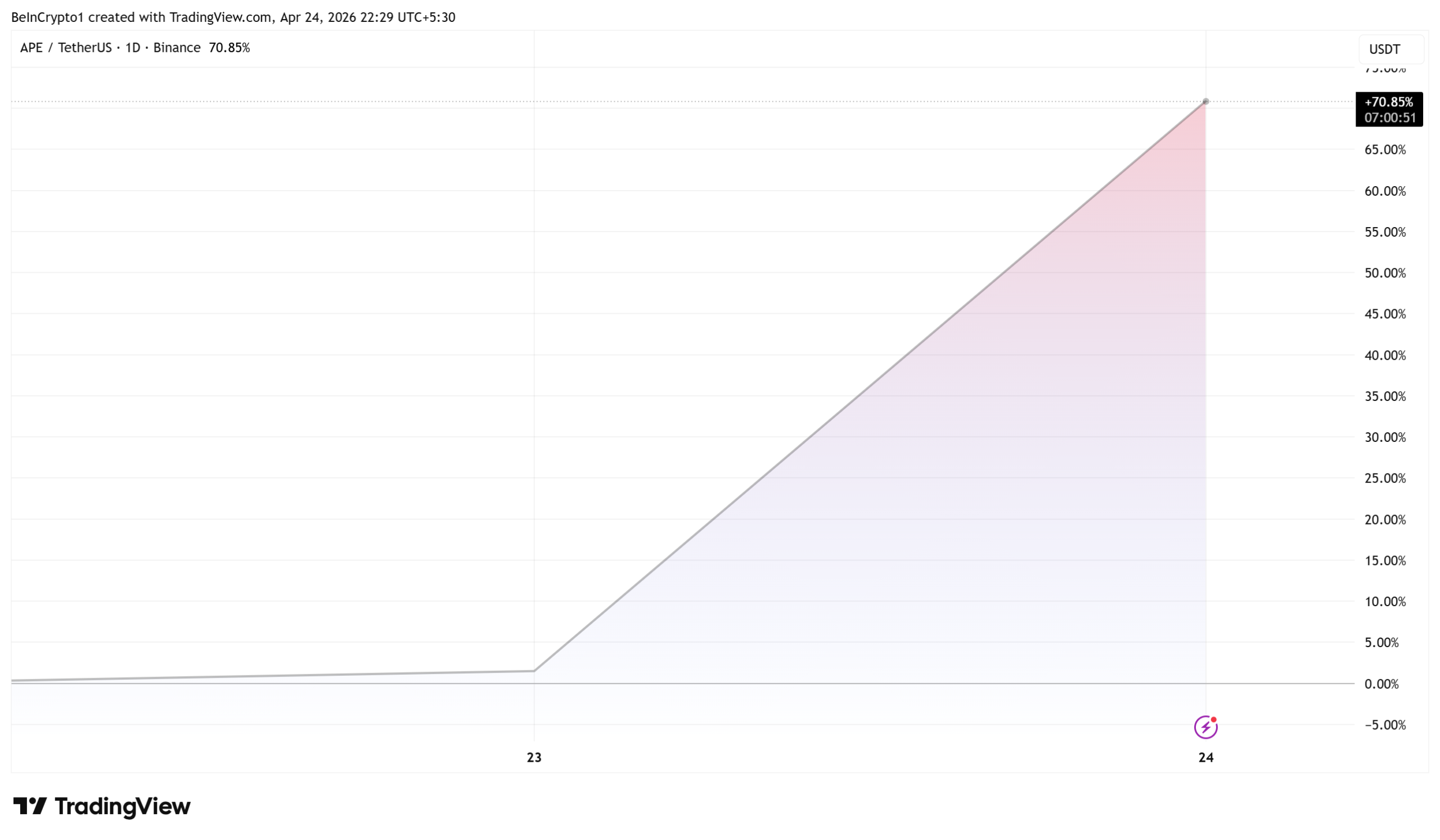
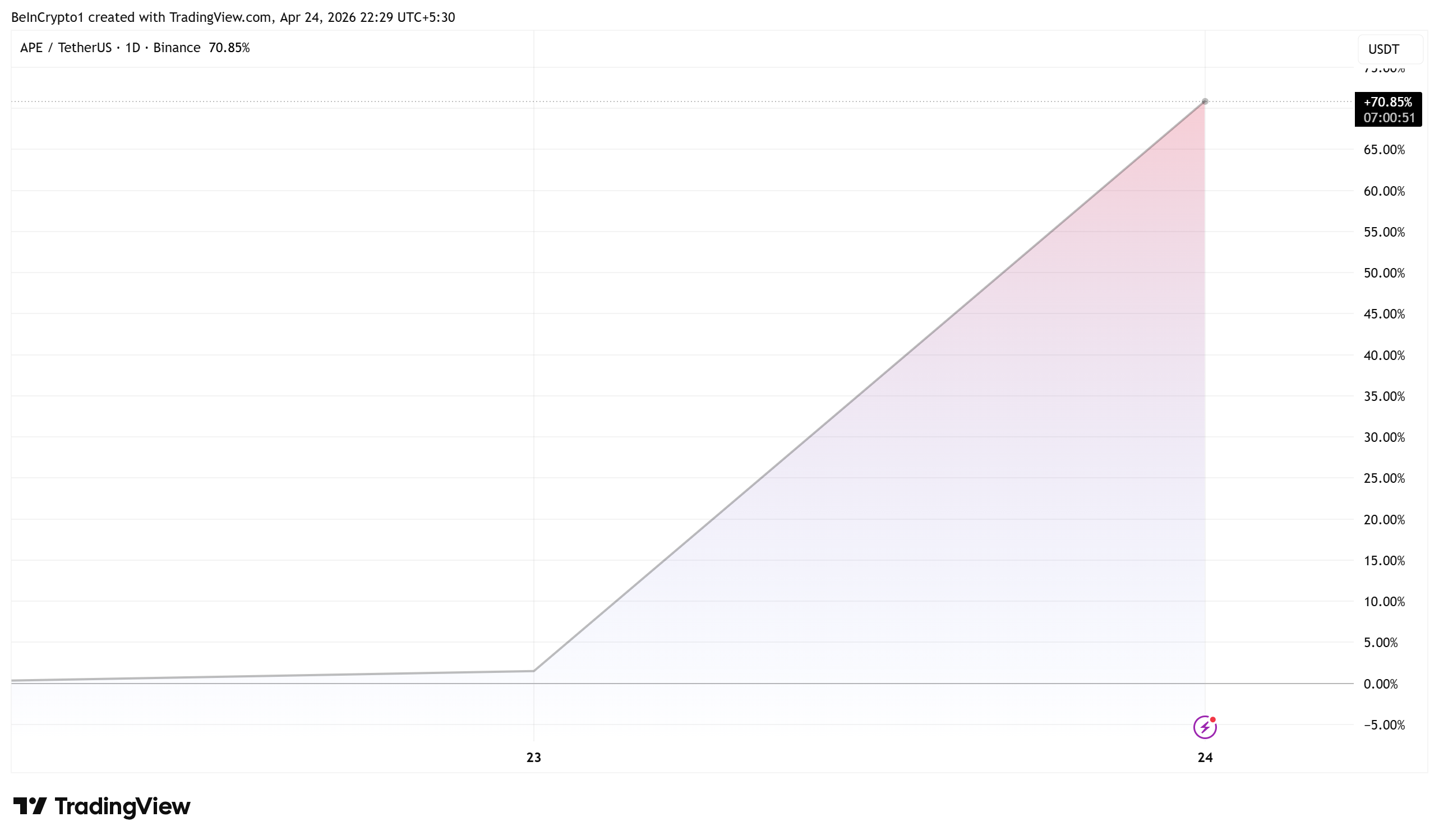
ApeCoin (APE) price surged more than 80% on Friday to roughly $0.18, breaking out of a tight range around $0.10, drawing optimism from Yuga Labs confirmation of Michael Figge as chief executive earlier this week.
On-chain analytics firm Lookonchain flagged a newly created wallet that rotated out of ether and into a 5x leveraged long on 9.19 million APE, sitting on a $713,000 unrealized gain at the time of reporting.
Leadership Shift Reignites ApeCoin Price Rally
Yuga Labs, the company behind the Bored Ape Yacht Club (BAYC) and the Otherside metaverse, promoted longtime chief product officer Figge to the top role around April 16. Co-founder Greg Solano moved to chairman of the board.
Figge has been with Yuga since 2021 and joined from a background in film, animation, and digital art. His appointment coincides with fresh ecosystem plans, including a proposed Yuga Grails over-the-counter desk for high-end NFT liquidity.
Community sentiment around the token has shifted sharply in recent days. Billionaire BAYC collector Adam Weitsman, who holds thousands of Otherside deeds and multiple Mega Mutant Apes, has publicly reiterated confidence in the new leadership team.
Hyperliquid Trader Times the Rally
Data from Lookonchain shows the anonymous trader sold 75 ether worth $174,000 on Hyperliquid before opening the 5x APE position valued at $1.03 million.
The wallet has no prior transaction history, which fueled speculation about informed trading ahead of the move.
“We spotted this insider before $APE surged 80%! He is now up $713K,” Lookonchain reported.
APE had traded near $0.10 for months before Friday’s breakout, leaving it still roughly 99% below its 2022 peak. In it’s latest surge, the altcoin topped out at $0.1965, up 70% in the last hour.
Whether the rally holds will depend on how quickly Figge delivers on the roadmap and whether broader NFT volumes follow.
The post ApeCoin (APE) Price Rallies 80%, Puts One Trader In the Spotlight for Insider Trading appeared first on BeInCrypto.


The U.S. Treasury Department said Friday that a $344 million cryptocurrency freeze is part of its latest effort to disrupt financial networks tied to Iran.
Treasury Secretary Scott Bessent said in an X post that the Treasury’s Office of Foreign Assets Control (OFAC) is sanctioning multiple crypto wallets linked to Iran, resulting in the freeze of $344 million in cryptocurrency.
“We will follow the money that Tehran is desperately attempting to move outside of the country and target all financial lifelines tied to the regime,” Bessent said, adding the effort is part of a broader campaign dubbed “Economic Fury.”
The post follows action taken Thursday by stablecoin issuer Tether blacklisting two blockchain addresses on Tron holding $344 million in USDT altogether.
The company did not return a request for comment.
A U.S. official told CoinDesk that the sanctioned wallets showed material links to the Iranian regime, including transactions with Iranian exchanges and routing through intermediary addresses connected to wallets associated with the Central Bank of Iran. According to the Treasury Department, Iran’s central bank has been leaning into digital assets to try to mask its cross-border transactions.
Authorities said Iran has increasingly turned to crypto to bypass restrictions, using more complex transaction patterns to obscure its involvement in cross-border payments and support trade flows under sanctions pressure.
Treasury’s OFAC is trying to turn up the pressure by moving aggressively against both the traditional front companies and the use of digital assets, the official said. Meanwhile, it sanctioned Hengli Petrochemical (Dalian) Refinery Co. on Friday, accusing the China-based independent refineries of playing a major role in Iran’s oil economy.
The U.S. agency said it continues to work with blockchain analytics firms and maintains coordination with financial institutions, including crypto exchanges, as it tracks illicit flows tied to sanctioned entities.

Key Takeaways
- MaxLinear shares skyrocketed approximately 80% to $61.52 during Friday’s trading session
- First quarter adjusted earnings per share of $0.22 exceeded Wall Street’s $0.18 projection
- Quarterly revenue of $137.2 million marked a 43% increase from the prior year period
- Infrastructure division revenue jumped 136% year-over-year, becoming the dominant business segment
- Second quarter revenue forecast of $160M–$170M significantly surpassed analyst expectations of $137.1M
MaxLinear experienced an extraordinary trading session on Friday that few semiconductor companies ever witness. Shares rocketed approximately 80% higher to close at $61.52, marking what appears to be the company’s most significant one-day percentage increase on record and representing its strongest closing price since 2022.
The explosive rally was triggered by first quarter financial results that exceeded analyst projections on every major metric. The company posted adjusted earnings of $0.22 per share, comfortably surpassing the Street’s $0.18 estimate. Total revenue climbed to $137.2 million, representing a robust 43% jump compared to the year-ago quarter.
However, the metric that truly captured investor enthusiasm was the infrastructure division’s explosive 136% year-over-year revenue expansion. This segment, primarily fueled by optical data-center platform sales, has now emerged as MaxLinear’s dominant revenue contributor — surpassing the broadband business for the first time in company history.
During Thursday’s earnings conference call, CEO Kishore Seendripu highlighted that the company’s Keystone optical transceiver platform is “ramping at multiple major high-scale customers across both the U.S. and Asia.”
Forward Outlook Crushes Consensus
Looking ahead to the second quarter, MaxLinear issued revenue guidance ranging from $160 million to $170 million. This projection substantially exceeds the $137.1 million consensus estimate that analysts had been modeling. Additionally, management boosted its full-year 2026 optical data-center revenue projection by $40 million, now anticipating between $150 million and $170 million for the year.
Needham analyst N. Quinn Bolton suggested that the company’s infrastructure transformation will likely justify premium valuation multiples. “We expect this gap to widen over the next few years on robust data center demand,” Bolton noted in a research report.
Needham elevated its rating on MXL to Buy while establishing a $60 price objective, calculated using 25 times the firm’s 2028 non-GAAP earnings estimate of $2.35 per share. Susquehanna increased its target price to $45 from $30, though maintained its Neutral stance. Stifel confirmed its Buy recommendation while raising its target from $34 to $49.
Susquehanna’s Christopher Rolland characterized the quarterly update as “the constructive update that many had been hoping for.”
Current Market Position
Friday’s dramatic surge propels MXL to gains of roughly 250% year-to-date and approximately 500% over the trailing twelve-month period. The stock is now hovering close to its 52-week peak.
Based on current market pricing, MXL is valued at roughly 43.6 times forward twelve-month earnings projections. While this represents double the valuation multiple from twelve months earlier, it remains below larger industry competitors such as Lumentum and Ciena.
According to InvestingPro analytics, ten Wall Street analysts have recently increased their earnings forecasts for upcoming reporting periods. The current consensus projects fiscal 2026 earnings of $0.91 per share — representing a dramatic reversal from the $1.58 per share loss recorded over the previous twelve months.
Stifel observed that first quarter revenue exceeded its internal forecast by 1.6%, reinforcing the firm’s confidence in maintaining its Buy recommendation.

BridgeTower Capital has officially adopted Chainlink’s full infrastructure stack to tokenize $11 billion in securities from the DOM X Arizona Copper-Gold Project, making it one of the largest live production tokenized asset deployments ever announced and positioning Chainlink as the core operational layer for a pipeline BridgeTower says exceeds $25 billion in natural resources, energy, and metals.
Summary
- BridgeTower Capital announced on April 23 the adoption of Chainlink’s full stack to tokenize $11 billion in securities from the DOM X Arizona Copper-Gold Project, described by both companies as live production infrastructure rather than a pilot.
- BridgeTower is using Chainlink CCIP for cross-chain connectivity, Proof of Reserve for asset verification, NAVLink for on-chain valuation, and CRE for compliance and settlement automation.
- The partnership also includes privacy-preserving workflow development for institutional primary issuance, with embedded KYC, KYB, and AML controls at the protocol level.
BridgeTower Capital announced on April 23 the adoption of Chainlink’s full infrastructure stack to tokenize securities tied to the DOM X Arizona Copper-Gold Project, a US natural resource initiative valued at $11 billion. The deployment is live production infrastructure rather than a trial, making it one of the largest single-asset tokenization builds ever brought to institutional scale. BridgeTower is also working toward tokenizing a pipeline exceeding $25 billion in natural resources, energy, and metals through the same platform.
Chainlink BridgeTower Tokenization Deploys the Full CCIP and Oracle Stack
The technical architecture BridgeTower has built around Chainlink uses four distinct components. Chainlink’s Cross-Chain Interoperability Protocol handles connectivity to regulated DeFi venues and licensed secondary markets. The Proof of Reserve system provides on-chain verification of underlying asset backing. NAVLink supplies real-time valuation data on-chain. The Chainlink Runtime Environment coordinates reserve checks, compliance steps, and settlement automation, keeping the full tokenization lifecycle inside a single operating environment. Investor subscriptions are funded through fiat and stablecoin rails powered by Iron, a MoonPay company. KYC, KYB, and AML controls are embedded at the protocol level. “All the world’s largest financial institutions are watching tokenization right now, and they are looking for production evidence for powering assets at institutional scale. This is what it looks like when tokenized assets become core institutional infrastructure,” said Johann Eid, Chief Business Officer at Chainlink Labs. As crypto.news reported, the tokenized real-world asset sector had already reached $27 billion in 2026, with Chainlink positioned as the primary oracle infrastructure across the growing institutional pipeline.
Why Live Production Matters More Than Pilot Announcements
The distinction between a pilot and live production infrastructure matters significantly for institutional buyers evaluating blockchain tokenization. As crypto.news documented, CCIP has been averaging approximately $90 million in weekly token transfers, and the network has enabled over $28 trillion in cumulative transaction value, providing the operational track record that compliance and legal teams at banks and asset managers require before approving vendor relationships. BridgeTower CEO Cory Pugh said the deployment “marks a major step forward in how tokenized asset markets reach institutional scale,” specifically highlighting the move from early integrations to live production infrastructure within a matter of months as the critical evidence major financial institutions need to proceed with their own tokenization programs. The BridgeTower deployment also includes privacy-preserving workflow development for institutional primary issuance, keeping ownership positions and participant data confidential while preserving compliance and on-chain verifiability.
What the Deal Adds to Chainlink’s Institutional Footprint
The BridgeTower announcement arrives three days after the Deloitte SOC 2 Type 2 certification and one week after the launch of Chainlink’s 24/5 US equity data streams across more than 40 blockchains. As crypto.news tracked, tokenized commodities and equities had climbed past $7 billion in value earlier in April, with gold-backed tokens leading a surge that institutional commentators describe as the transition from pilot projects to live collateral on public blockchains. The BridgeTower deal adds $11 billion in natural resource-backed securities to that infrastructure footprint, extending Chainlink’s institutional reach from financial assets like equities and treasuries into the physical commodities sector. LINK was trading at approximately $9.31 on April 23 as the announcement landed, consolidating below the $9.50 resistance level that analysts have identified as the near-term trigger for a potential directional move.
BridgeTower has stated it plans to expand the Chainlink-powered platform beyond the DOM X project to include the full $25-plus billion pipeline of natural resources, energy, and metals assets it has under management.

A bullish signal from Solana’s MACD indicator hinted at a potential rally, though resistance at $90 could delay the recovery.


The Aave DAO is voting on a proposal to provide funding to restore Kelp DAO’s rsETH product backing after an April 18 bridge incident, as part of a broader DeFi United ecosystem recovery effort.
Aave’s decentralized governance body is being asked to contribute 25,000 ETH from its treasury to a coordinated recovery effort following the April 18 exploit of Kelp DAO’s rsETH bridge, according to a proposal published Thursday by Aave service provider TokenLogic.
The contribution would make Aave the largest single donor to a coalition called “DeFi United,” which also includes EtherFi, Lido, Ethena, Mantle, Ink Foundation, BGD Labs, and several individual contributors. Together, the group is working to restore the full backing of rsETH and protect users across affected Aave V3 markets.
The April 18 attack drained 152,577 rsETH from Kelp’s LayerZero bridge adapter, creating an original shortfall of approximately 163,183 ETH. Subsequent recoveries have reduced that figure: Kelp froze tokens worth roughly 43,168 ETH, the Arbitrum Security Council froze 30,766 ETH held by the attacker, and liquidations of the hacker’s positions on Aave and Compound are expected to recover an additional 14,168 ETH. The residual funding gap currently stands at approximately 75,081 ETH.
To close that gap, the proposal outlines a funding stack combining public donations totaling 14,570 ETH, a 30,000 ETH credit facility from Mantle, and the requested 25,000 ETH from the Aave DAO treasury.
Executing the recovery requires placing the full 120,015 ETH into the LayerZero lockbox upfront. Because several recovery streams are not yet liquid, short-term bridge loans are being arranged separately to cover the timing gap.
The proposal also authorizes Aave Labs to pledge DAO assets and future protocol revenue as collateral to secure funding arrangements. The proposal notes the plan depends on external actions including Kelp reopening withdrawals, LayerZero reopening its bridge, and the Arbitrum Security Council releasing frozen funds.
The proposal is currently in the community feedback stage before proceeding to a Snapshot vote.
Sources: Aave Governance | Aave Twitter | DeFi United
This article was generated automatically by The Defiant’s AI news system from publicly available sources.
The Fellowship political action committee (PAC), which launched claiming to have more than $100 million from crypto-aligned backers, has reportedly backed out of an advertising deal to support Texas Attorney General Ken Paxton in a crucial US Senate race.
According to a Thursday report from Axios, Republican leaders contacted US Commerce Secretary Howard Lutnick on his connections to Fellowship, which has been partially funded by Cantor Fitzgerald.
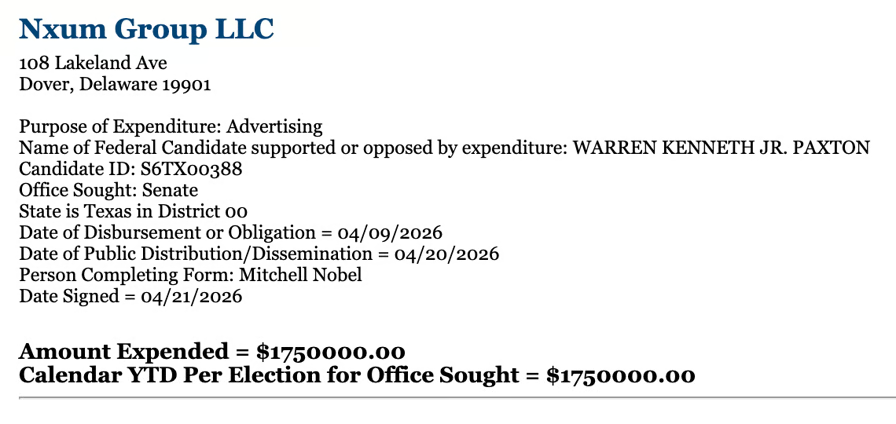
Lutnick, as the former president and CEO and whose sons are now in charge of the financial services company, reportedly faced questioning from Republicans about Fellowship’s support of Paxton, whom on Tuesday the PAC reported spending $1.75 million in supportive advertising.
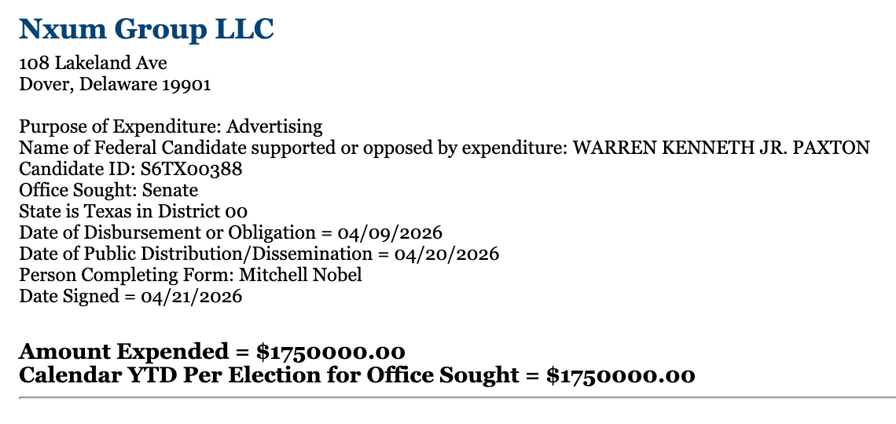
Fellowship PAC expenditure report on Ken Paxton. Source: FEC
The advertising expenditure, which Fellowship disclosed to the Federal Election Commission (FEC) through the marketing company Nxum Group, was reportedly never placed. As of Friday, the FEC filing showing the $1.75 million expenditure was still public. Cointelegraph reached out to Fellowship for comment but did not receive an immediate response.
A crypto-backed PAC like Fellowship backing out of support for a candidate in a US Senate race, possibly in response to pressure from Republican leaders, is somewhat unusual. Political action committees tied to digital assets support candidates on both sides of the aisle who they consider pro-crypto.
Along with Fellowship, PACs like Fairshake and others are expected to spend a combined hundreds of millions of dollars in the US midterm elections after pouring money into ads for 2024 candidates to influence voters.
Related: White House confirms Trump to address memecoin gala on Saturday
Paxton, who failed to win outright in a March primary against Senator John Cornyn, will face the Republican incumbent in a May 26 runoff before the November general election. Whichever Republican wins a majority of the vote will likely face off against Democrat James Talarico in a race for one of Texas’ US Senate seats.
Crypto entities calling for action on market structure bill in Senate
Republicans have held a slim majority in the US Senate since January 2025, leading to the passage of the stablecoin bill, the GENIUS Act, and the consideration of other pieces of crypto legislation. However, if Democrats gain majority control of the chamber in the 2026 midterm elections, it could change how the Senate approaches crypto laws.
Since July 2025, the Senate has been considering a bill on crypto market structure, expected to be one of the most comprehensive pieces of legislation affecting the industry. Delays, in part due to government shutdowns, ethics concerns and questions about stablecoin yield, have persisted for months, with no vote on the bill scheduled in the full chamber.
On Thursday, more than 120 entities affiliated with the cryptocurrency and blockchain industry urged Senate Banking Committee leaders to stop stalling on advancing the market structure bill, the CLARITY Act. The committee will need to hold a markup on the bill before the Senate can potentially schedule a vote.
Magazine: AI-driven hacks could kill DeFi — unless projects act now

Pi Network has activated its first smart contract on Testnet, bringing subscription functionality to the blockchain. The upgrade arrives as PI trades near $0.17, well below the key Fibonacci resistance that bulls want reclaimed.
The rollout introduces recurring-payment logic for e-commerce, streaming, and other services. Community sentiment has turned cautiously optimistic, yet the daily chart still shows a neutral structure after months of decline.
Subscription Smart Contracts Set a New Utility Floor for Pi
On April 17, 2026, Pi Network announced its first smart contract capability on Testnet. The release focuses on subscription support, a model most chains have struggled to deliver cleanly.
Subscribers can approve a defined budget that the contract draws from over a set billing horizon. Funds remain in the wallet until a charge is processed.
The design avoids the full pre-funding required by account abstraction standards like ERC-4337. It also removes repeat signatures used in earlier Ethereum proposals, such as EIP-1337. Pi frames this as a cleaner path for on-chain recurring payments.
Pi Request for Comment 2 (PiRC2) is now open for developer review on GitHub. External auditors are also reviewing the contract before any Mainnet rollout.
Community voices have mapped the release to real use cases. One post listed streaming, AI tools, digital memberships, e-commerce, and local commerce as targets. The list reflects a broader push to anchor Picoin demand to recurring real-world services rather than speculative activity.
The pitch to builders leans on scale. Pi claims more than 18 million KYC verified users, which boosters frame as a ready customer base.
Dr. Vincent McPhillip argued that smart contracts bring Pi functionality closer to Ethereum. He suggested the release could set the stage for a sustained move. The market, he added, is watching.
That optimism is tempered by warnings about staking, DeFi, and dApp risks in any young ecosystem. Education and external audits will shape how safely the rollout proceeds.
This contract remains in Testnet. A Mainnet launch will depend on audit outcomes and PiRC2 feedback, which sets the near-term expectation bar.

PI Price Coils Below $0.18 Fibonacci Resistance
PI trades at $0.1699 on Bitget, just below the 0.236 Fibonacci retracement at $0.1823. The Fib tool is anchored from the September 22, 2025, breakdown high of $0.3527. The lower anchor is the February 6, 2026 low of $0.1297.
The 0.236 level is the first lid PI must clear. A daily close above $0.1823 would open the path to the 0.382 retracement at $0.2149.
Beyond that sits the 0.618 retracement at $0.2675, a heavier supply zone defined by prior reaction highs. Reclaiming that band would mark the first serious break of the multi-month downtrend.
On the downside, horizontal support sits near $0.15. Losing it would expose the February low at $0.1297 and confirm another leg lower.
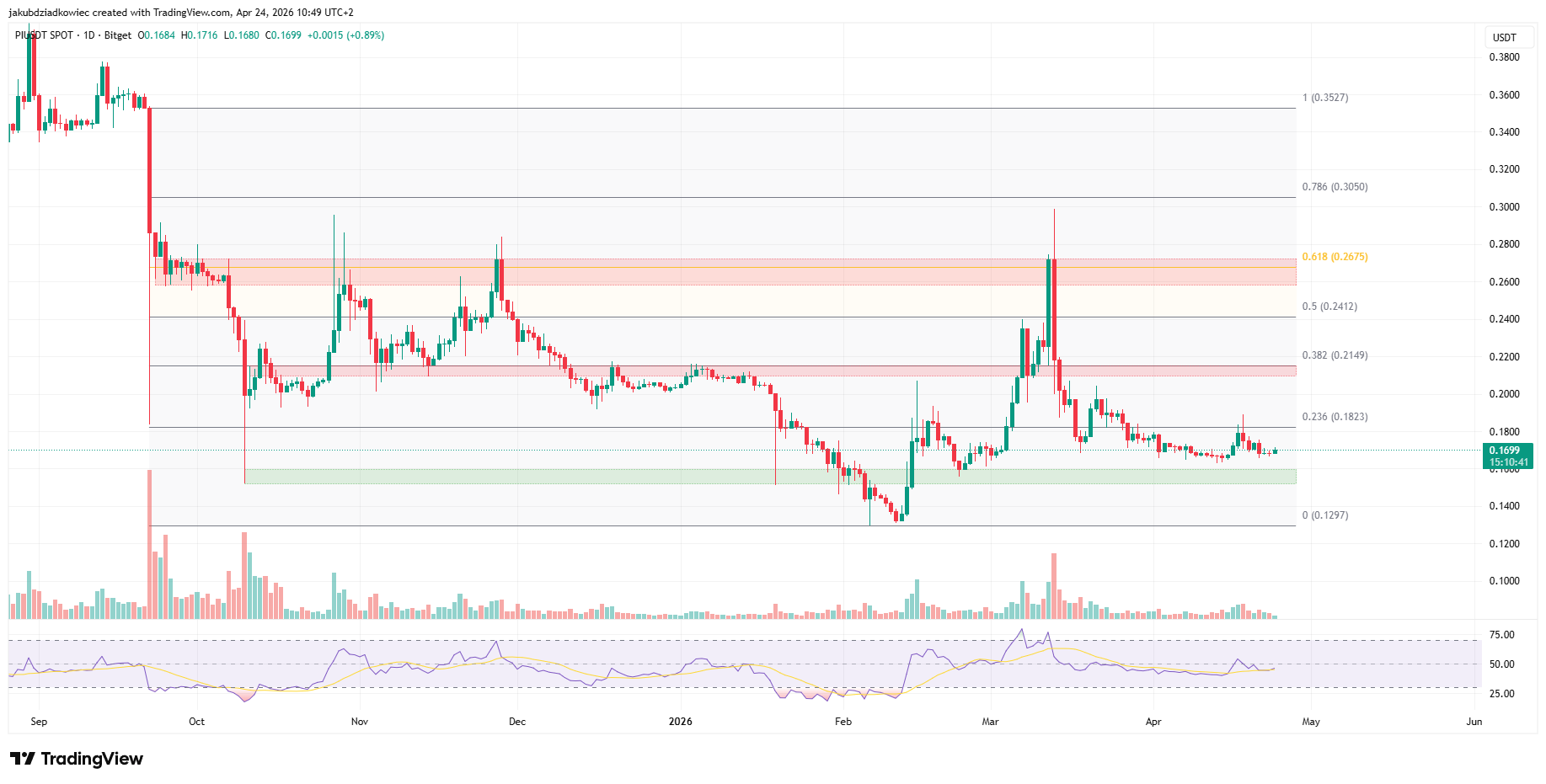
The Relative Strength Index (RSI) sits in the mid-40s. That reading indicates neutral momentum with no clear buying or selling pressure building.
Volume has thinned noticeably across April. Low turnover during a sustained decline often suggests accumulation, though it can also reflect fading interest. A fundamental catalyst, like a confirmed Mainnet date, would be the cleanest trigger for a volume expansion.
The subscription smart contract rollout is the fundamental catalyst that traders are pricing in. Whether it drives flows into PI will depend on Mainnet timing and Pioneer participation in Testnet review.
A break above $0.27 would flip the bias to bullish. It would also invalidate the descending structure that has capped every rally since late 2025. A close below $0.15 would confirm the bears still control the tape.
The post Pi Network Smart Contracts Go Live on Testnet, Can PI Break $0.27 Resistance? appeared first on BeInCrypto.

Bitcoin remained anchored around the $78,000 level on Friday as markets awaited fresh geopolitical and macro cues amid heightened U.S.-Iran tensions. The absence of a decisive catalyst kept risk assets in a cautious, sideways drift, even as oil and equities wobbled in response to the evolving backdrop.
With U.S. equities treading water and oil oscillating near the high $90s to mid-$95 per barrel area, traders said the market’s next move hinges on clarity over the Middle East conflict and its potential spillovers into energy prices and economic growth. The lack of a clear triggers pushed Bitcoin into a consolidative phase, slowing any attempt to reclaim the $80,000 ceiling that has been a looming target for months.
“Market is eagerly awaiting clarity from the conflict in the Middle East. The longer it drags on and oil keeps moving higher, the more pressure will be put on these assets.”
— Daan Crypto Trades, via social commentary on market dynamics
Key takeaways
- Bitcoin trades near $78,000, struggling to push back above $80,000 as U.S. stocks drift and oil prices stay firm.
- Oil’s resilience and geopolitics loom as near-term risk catalysts, with traders watching how energy moves influence risk appetite.
- Earnings season is viewed as a potential driver for the next leg higher in equities, which could spill over into crypto.
- Analysts warn of vulnerability around nearby bid liquidity and the possibility of a deeper retracement if macro cues worsen.
Markets pause as BTC hangs near a pivotal level
TradingView data reflect a quiet price action for BTC as the week closes, with the benchmark hovering around the $78,000 area. The lack of a clear directional impulse kept Bitcoin anchored, even as macro components painted a mixed picture: U.S. equities paused after a period of strength, while crude futures retraced from earlier peaks but stayed elevated relative to late-year lows.
In social-dial commentary, traders highlighted the delicate balance between growth optimism and geopolitical risk. The absence of new cues from the Iran-related developments left risk-on assets in a state of limbo, characterized by tight ranges and cautious positioning.
Meanwhile, the broader commodity complex showed oil trading in a high-range channel, with volatility linked to supply expectations and geopolitical risk. The energy-price backdrop remains a key variable for the trajectory of risk assets, including BTC.
Analysts and traders weigh the next move
As Bitcoin clings to critical support, several traders flagged potential headwinds for a sustained upside move. One market observer noted that the immediate price structure suggests the possibility of a deeper retracement if the current macro environment persists without a clear catalyst.
In the meantime, analysts emphasized the role of earnings season in shaping risk appetite. Mosaic Asset Company argued that positive earnings momentum would be essential to sustain any upside for equities, noting that the S&P 500 had been marching toward record highs as the reporting cycle approached. Their analysis underscores the dynamic between corporate fundamentals, equity risk, and the spillover into crypto markets.
Technically, observers also monitored order-book dynamics and liquidity around key levels. Material Indicators observed that bid liquidity near the $76,500 area had already shown signs of vulnerability, with lower-timeframe order flow trending downward. They added that it was surprising liquidity below the spot price had not been withdrawn, a factor that could precipitate a sharper move if the market loses momentum.
Other data points pointed to a potential news-driven push in the near term. A separate analysis thread highlighted that BTC’s price action in the lower timeframes had run up into a short-term peak, suggesting the rally could falter without fresh fundamental catalysts.
What to watch next
The coming sessions will hinge on geopolitical developments, energy-price movements, and the trajectory of corporate earnings. If the Middle East tension cools and oil resumes a clear downtrend, risk assets could gain room to extend, potentially nudging BTC back toward the $80,000 level. Conversely, renewed volatility or a deterioration in macro indicators could test support near the mid-to-high $70,000s.
Traders should watch liquidity around critical levels, the evolution of the earnings outlook, and any unexpected shifts in oil markets that could alter risk sentiment. The path forward remains uncertain, but the next moves in equities, energy, and macro data will likely dictate Bitcoin’s near-term direction.

She Sucks… | Financial Audit

I’m A Celebrity final addresses drama after Adam and Jimmy’s blowout ‘couldn’t be aired’

SBI shares on gaining spree; hit record high

Manchester United reach agreement with Casemiro over contract clause amid transfer speculation

US brings back mandatory military draft registration

Steven Gerrard disagrees with Gary Neville over ‘shock’ Chelsea and Arsenal claim | Football


-

 Business5 days ago
Powerball Result April 18, 2026: No Jackpot Winner in Powerball Draw: $75 Million Rolls Over
-

 Politics7 days ago
Palestine barred from entering Canada for FIFA Congress
-
Entertainment5 days ago
NBA Analyst Charles Barkley Chimes in on Ice Spice McDonald’s Fiasco
-

 Tech6 days ago
Auto Enthusiast Scores Running Tesla Model 3 for Two Grand and Turns It Into Bare-Bones Go-Kart
-

 Politics5 days ago
Zack Polanski demands ‘council homes not luxury flats for foreign investors’
-

 Crypto World7 days ago
Russia Pushes Bill to Criminalize Unregistered Crypto Services
-

 Politics4 days ago
Gary Stevenson delivers timely reminder to register to vote as deadline TODAY
-

 Politics2 days ago
Making troops accountable for war crimes threatens US alliance, ex-SAS colonel warns
-

 Business2 days ago
Rolls-Royce Voted UK’s Most Iconic Trade Mark as IPO Register Hits 150
-

 Politics2 days ago
Disabled people challenge government SEND proposals over segregation concerns
-

 Crypto World7 days ago
Russia Introduces Bill To Criminalize Unregistered Crypto Services
-

 Politics2 days ago
Zack Polanski responds to home secretary’s taser threat
-

 Politics2 days ago
Starmer handler McSweeney to be dragged from shadows by Foreign Affairs Committee
-
Politics2 days ago
Wings Over Scotland | How To Get Away With Crimes
-
 Crypto World6 days ago
Kelp DAO rsETH Bridge Hack Drains $292M as DeFi Losses Top $600M in Two Weeks
-

 Politics2 days ago
‘Iran is still a nuclear threat’
-

 News Videos7 days ago
AP Politics, Buggana Analyzes Reasons For Financial Instability Due To Amaravati
-

 Crypto World3 days ago
New York sues Coinbase, Gemini over prediction market offerings
-

 Business3 days ago
The Job Benefits Most Men Don’t Know to Negotiate
-

 Crypto World10 hours ago
Michael Saylor says BTC winter is over. Market analyst disagrees, says bitcoin was in a pullback
You must be logged in to post a comment Login