from the that’s-a-lot-of-defamation-cases-kash dept
To have one defamation case about public allegations of your drinking as FBI Director would be unfortunate. To have a second dismissed the very next day would be, well, perhaps a sign that something has gone wrong. Earlier this week we wrote about Kash Patel’s ridiculously weak defamation case against The Atlantic over its big, deeply sourced article with multiple sources claiming that there have been problems associated with Patel’s drinking.
His complaint was filed on Monday. In it, his lawyers mention that they already have an existing defamation lawsuit against MSNBC’s Frank Figliuzzi (a former FBI assistant director for counterintelligence). This is part of Patel’s argument for why the Atlantic should have known the reporting was false. From the Monday complaint:
The FBI further warned Defendants that these allegations echoed a similar fabrication previously aired by MSNBC’s Frank Figliuzzi on Morning Joe—anonymously sourced reporting that was later retracted by MSNBC and that is the subject of pending defamation litigation—yet Defendants published it anyway.
That was Monday. On Tuesday, that defamation lawsuit was dismissed. Judge George C. Hanks Jr. made quick work of it, noting that Figliuzzi’s statement was clearly rhetorical hyperbole — a form of opinion that cannot be defamatory.
The case was entirely about this exchange on MSNBC:
Advertisement
Host: “So, Frank, let’s turn to FBI Director Kash Patel, who has sort of taken a surprisingly backseat role—at least to this point, in the first 102 or 103 days, wherever we are right now. What do you make of that, that he’s just been a little less visible than I think a lot of people and Trump observers expected him to be?”
Figliuzzi: “Yeah, well, reportedly, he’s been visible at nightclubs far more than he has been on the seventh floor of the Hoover building. And there are reports that daily briefings to him have been changed from every day to maybe twice weekly. So this is both a blessing and a curse, because if he’s really trying to run things without any experience level, things could be bad. If he’s not plugged in, things could be bad, but he’s allowing agents to run things. So we don’t know where this is going.”
The court is not at all impressed by this lawsuit.
The Court finds that Figliuzzi’s statement, when taken in context, cannot have been perceived by a person of ordinary intelligence as stating actual facts about Patel. As alleged, Figliuzzi’s statement about Patel—again, made in response to a question about Patel’s decreased visibility as Director of the FBI—was that “he’s been visible at nightclubs far more than he has been on the seventh floor of the Hoover building.”…. A person of reasonable intelligence and learning would not have taken his statement literally: that Dir. Patel has actually spent more hours physically in a nightclub than he has spent physically in his office building. By saying that Patel spent “far more” time at nightclubs than his office, Figliuzzi delivered his answer “in an exaggerated, provocative and amusing way,” employing rhetorical hyperbole. …
The Court finds that Figliuzzi’s statement is rhetorical hyperbole that cannot constitute defamation. Accordingly, Dir. Patel has failed to state a claim against Figliuzzi, and his lawsuit must be dismissed.
If a person of reasonable intelligence and learning would not have taken this statement literally, what does that say about Patel and his lawyers?
Either way, that’s a point for The Atlantic’s legal team, which can now respond to Patel’s claim that the Figliuzzi suit was evidence of falsity with: “nope, not anymore.”
Separately, part of the case involved whether or not Figliuzzi could get attorney’s fees from Patel for filing a vexatious SLAPP suit. There was a dispute over which state’s anti-SLAPP law should apply — Texas, Nevada, or New York each had some claim — and the court (correctly, in my opinion) landed on Texas, since that’s where Figliuzzi resides. Speakers have a reasonable expectation that their home state’s anti-SLAPP law will shield them.
Advertisement
Unfortunately, though, because the Fifth Circuit a while back decided that you can’t use Texas’ anti-SLAPP law in federal court, it’s all for nothing, and he can’t get Patel to pay for his legal fees. This is yet another reminder of why we need a federal anti-SLAPP law — not just to protect free speech more broadly, but to protect SLAPP victims in federal courts in circuits where state anti-SLAPP statutes can’t reach.
The Court finds that Texas has the most significant relationship. Further, applying either Nevada’s or New York’s anti-SLAPP statute to a Texas Defendant would “impede on Texas’s interest in protecting its citizens and fulfilling the statute’s purpose.”…
The Fifth Circuit has found that, because Texas’s anti-SLAPP statute’s “burdenshifting framework imposes additional requirements beyond those found in Rules 12 and 56 and answers the same question as those rules, the state law cannot apply in federal court.” … Thus, while Figliuzzi prevails on the present motion to dismiss, the Court may not award him court costs and attorney’s fees under Texas’s anti-SLAPP law.
Still, even without the fee shifting, this is a good result, and underscores how these exceptionally weak defamation suits are little more than attacks on the press for reporting what multiple sources describe as problematic behavior from the FBI director.
As cyberthreats advance, so too must workforce cyber defences to avoid making what are often preventable and costly mistakes.
Cybersecurity measures in the workplace never grind to a halt, in that employees and employers must always strive to ensure that their skills and systems are as advanced, if not more so, than those wielded by people with malicious intent.
A lot of cybersecurity is arguably common sense – don’t click suspicious links, don’t share sensitive information and so on – but it doesn’t hurt to have a refresher course now and then to keep it all fresh in the mind. To that point, here are some of the most helpful tips to follow if you want to improve or maintain your company’s cybersecurity efforts.
Silo your systems
This one is specifically for anyone who works from home. It goes without saying that we feel comfortable in our own properties and have tried and tested ways of doing things. But there is such a thing as being too comfortable and employees may forget that their systems should never overlap with the organisations.
Advertisement
If you are using company software, keep all activity tied to the workplace. That is to say, don’t download anything not approved by the organisation, or anything you are using in a personal capacity.
Furthermore, if you move around and work between locations – for example at home, a cafe, a work hub – do your due diligence first and ensure that the network you are using is secure. This can be easier said than done, as using public Wi-Fi in general can be risky. With that in mind, shared office spaces and hubs tend to be a more secure option. If you are using what could be a potentially non-secure network in a public place, always use a VPN as an added layer of protection.
Get AI ready
Advancements in technology unfortunately bring risk. AI has unlimited potential and it is certainly the way forward for a lot of organisations looking to advance, scale and grow, but as we have seen recently, it also presents significant risk, as threat actors can use it to launch highly sophisticated scams. The companies and employees that are serious about avoiding and navigating threats are the ones that will adopt AI upskilling as a core aspect of the organisation – not just as a once a year box-ticking exercise.
Useful skills to consider include an understanding of AI and ML models, data science for cyber defence, AI-specific threats and broad digital literacy. You can’t defend against a threat that you don’t understand and if your organisation has knowledge gaps, then you are automatically in a weak position. So make sure everyone on a system understands the ins and outs of how it works and how to keep it secure.
Advertisement
Simple simply isn’t good enough
We have all picked a password because it was simple and easy to remember, making our own lives simpler and easier, in theory. But when you choose an obvious password, or take shortcuts online, it can expose you to malicious people who can easily bypass the protections you put in place.
That doesn’t mean that every password has to be 80 characters long, or so obscure that you yourself can’t recall it without physically writing it down. But it should be something with a diverse set of characters, that someone else couldn’t guess. For example, avoid using easily obtained information like the names of pets, loved ones, birthdays or other significant dates. Implementing multifactor authentication adds another critical layer and biometric verification tools, such as fingerprint or facial recognition software, can also be useful.
Stay current
It is important to note that all of the above is effectively useless if you are operating off of a system that is old or is not updated frequently. In the same way that innovators are constantly coming up with new ways to enhance a system, bad actors are also constantly coming up with ways to break and exploit weaknesses in systems. If you don’t regularly update your devices then you are basically holding a door open for threat actors and welcoming them in.
If your approved system or device is due an update or if there is a trustworthy patch to be applied, don’t put it on the long finger. The longer you leave an update the more vulnerable you leave yourself, your co-workers and the organisation. So, don’t leave it on the to-do list for too long.
Advertisement
When it comes down to it, cybersecurity measures are arguably the most important policies in place at a company. When they are breached or weakened, either accidentally, or on purpose, there is no one in an organisation that won’t feel the impact. Externally, it also places the consumers and partners of a business at risk. Especially financially, or if that business deals with complex or sensitive information.
So we all have to do our bit to ensure practical, robust and consistent cybersecurity engagement.
Don’t miss out on the knowledge you need to succeed. Sign up for the Daily Brief, Silicon Republic’s digest of need-to-know sci-tech news.
Facebook parent Meta signed a deal to use Amazon’s Graviton chips for agentic AI, the latest indication of growing demand for the tech giant’s growing silicon business.
Bloomberg reports that the deal is worth billions of dollars over multiple years. It comes one day after Meta said it would lay off roughly 10% of its workforce, or about 8,000 employees, as companies across the industry cut headcount while pouring billions into AI infrastructure.
The deal gives Meta access to tens of millions of Graviton5 processor cores, running in AWS data centers, making Meta one of the largest Graviton customers in the world, the companies said. It builds on Meta’s existing use of Amazon Bedrock, the company’s platform for AI models.
Amazon CEO Andy Jassy said in a LinkedIn post that agentic AI is “becoming almost as big a CPU story as a GPU story.” In other words, while graphical processing units (mostly from Nvidia) have dominated the AI hardware conversation, agentic systems need traditional central processing units to handle the reasoning and coordination that happens between steps.
The deal comes just after Intel reported a big quarter, with data center revenue up 22%, driven in part by surging demand for CPUs for agentic AI workloads — the same trend Amazon is riding with Graviton. Intel stock is up more than 22%; Amazon stock rose 3% after the Meta news.
Advertisement
Meta has taken a broad approach, signing deals with Nvidia and AMD, recently agreeing to use Google’s custom processors, and developing its own in-house silicon with Broadcom.
“As we scale the infrastructure behind Meta’s AI ambitions, diversifying our compute sources is a strategic imperative,” said Santosh Janardhan, head of infrastructure at Meta, in a release.
Amazon is establishing itself as a major chipmaker in its own right. CEO Andy Jassy disclosed in his annual shareholder letter that Amazon’s custom silicon business is generating more than $20 billion a year in revenue, saying it’s “quite possible” Amazon will sell racks of its chips to third parties in the future. That would mean competing more directly with Nividia.
X-energy’s stock popped today in its debut on the Nasdaq, opening at $30.11 before closing at $29.20, up 27% over its initial public offering of $23 per share.
Investors can’t get enough nuclear power, apparently. Even the initial share price had been revised upward from the $16 to $19 target floated by the company during its investor roadshow. At close, the company was valued at $11.5 billion.
Just five years ago, such interest in a nuclear startup would have come as a surprise to many.
Back then, the nuclear industry was haunted by delayed projects and massive cost overruns at recently completed reactors. Two power plants were completed in Georgia — one in the late 2010s and another in the early 2020s. In total, they cost around $30 billion to build.
Advertisement
Nuclear startups in the early 2020s were in their infancy, and at least one frontrunner had run into significant regulatory problems, sparking fears that the industry hadn’t been able to put its past behind it.
Now, investors appear optimistic that X-energy and its peers have figured out a way around the challenges.
Much of the momentum can be traced to the AI-driven data center boom. GPUs need tremendous amounts of electricity, and while solar, wind, batteries, and natural gas have been filling the need today, tech companies have been hoping to diversify. Nuclear power is one of the many options they’ve been exploring, hoping that the compact form factor will be an ideal fit for their sprawling data centers.
Nuclear power has long had more potential to power the U.S. grid than it has been able to deliver. Today, about 18% of electricity in the country comes from nuclear power. But reactor costs have risen in recent decades. Nuclear power might be one of the most reliable sources of electricity in the U.S., but it’s also one of the most expensive.
Advertisement
X-energy’s 80-megawatt reactor design is an order of magnitude smaller than many existing nuclear power plants. The company is betting that modularity can help bring costs down, and data center operators are hoping that a single campus can be powered by a fleet of reactors, providing the sort of redundancy and stability they prize. Amazon has said it will buy up to 5 gigawatts’ worth of capacity from X-energy over the next decade or so, but chemical maker Dow will receive the startup’s first power plant.
Construction is underway at X-energy’s fuel facility, and while the company has yet to start construction of a power plant, investors appear bullish that the company will be able to break nuclear power free from its decades-long malaise.
When you purchase through links in our articles, we may earn a small commission. This doesn’t affect our editorial independence.
— Expedia Groupnamed Derek Andersen as its new chief financial officer starting May 11. He succeeds Scott Schenkel, who is stepping down after more than two years in the role.
The Seattle-based travel giant hired Andersen from Snap, the company behind Snapchat, where he served as CFO for more than seven years. Before that, was Amazon’s vice president of finance, overseeing its global suite of video businesses, including Prime Video and Amazon Studios.
Andersen said he’s looking forward to returning to Seattle to join Expedia.
“The company has built strong assets, from its technology and consumer brands to one of the largest B2B businesses in the industry and is well positioned to shape the future of travel,” he said in a statement.
In announcing the news, Expedia CEO Ariane Gorin praised Andersen’s fit for the CFO role and thanked Schenkel, who previously served as CFO and interim CEO at eBay, for his impact.
Advertisement
Peter Hamilton. (LinkedIn Photo)
— Peter Hamilton has left Roku, where he served as head of ad innovation for the streaming platform for more than four years. The Seattle-based executive was previously CEO of Tune, a mobile marketing startup, for more than a decade.
“I came to Roku to see what it feels like to turn on innovation at massive scale, and I left better understanding the village of people that make it all possible,” he said in a LinkedIn post.
Hamilton added that he’ll once again step into a CEO role, but did not say at which company.
Ann Johnson. (LinkedIn Photo)
— Ann Johnson is leaving Microsoft after more than a decade, most recently serving as corporate vice president and executive security advisor. On May 4, the Seattle-based leader will become executive VP of Security (Identity & Fraud) Services at Mastercard.
In a Q&A posted by Mastercard, Johnson described her work in cybersecurity as “purpose-driven” and said she was eager to join the company. In her new role, she’ll work to help secure commerce and financial transactions — “such an important part of the ecosystem,” she said.
— Microsoft’sAnnie Pearl has a new role as CVP of the Copilot product for Microsoft AI. Pearl previously led product, engineering and design for Azure Experiences and has been with the company for more than three years. She is based in San Francisco.
Advertisement
— After more than 20 years with Amazon, Vidya Shastrileft the company as a director of software development and is taking a career break. Shastri departed last year, but this week shared a lengthy post on Substack reflecting on his decades at the tech giant.
Shastri said on LinkedIn that he had two mantras at Amazon: people first, then product, and nothing matters more than trust. “It’s the ‘virtuous cycle of trust’ that makes teams and organizations great, even in this era of downsizing and AI,” he said.
— Judd Lee is now chief financial officer for Safe Software, a Surrey, B.C., data software company. Lee joins from BrightEdge, and was previously CFO at Seattle’s RealNetworks, Parallels and SignalSense. Safe Software also named Vanessa Ribreau as chief people officer.
— Jake Oster, Amazon’s former director of energy, environment and sustainability policy, is now VP of sustainability policy and community relations for Oracle.
Advertisement
“At Oracle Cloud Infrastructure, each AI data center is designed with the surrounding community’s future in mind and we are making investments in job creation, water infrastructure, and new sources of energy generation,” he said on LinkedIn, adding that he will remain in Seattle.
— Gen. James Rainey, a retired four-star general from the U.S. Army, was welcomed as an advisor to Overland AI. The Seattle-based startup in February raised $100 million to meet demand for its autonomous ground vehicles used by the U.S. military.
— Former Starbucks CEO Howard Schultzis joining the board of directors for Gopuff, a Philadelphia-based delivery app offering snacks and everyday essentials.
— Jonathan Bricker, a Fred Hutch Cancer Center public health scientist, was awarded the institution’s Endowed Chair in Cancer Prevention. Bricker has helped develop tools to reduce cancer risk, including the AI-powered QuitBot app.
Advertisement
— Pacific Northwest National Laboratory announced leadership changes:
William “Bill” Pikeis now deputy director for science and technology, previously having served as chief science and technology officer for PNNL’s National Security Directorate.
Angela Becker-Dippmann is associate laboratory director for the Energy and Environment Directorate, having previously worked as director of EED’s Program Development Office.
Amy Schmidtis executive director and chief HR officer, transitioning from the role of head of talent management.
And in case you missed it, GeekWire reported some big tech moves earlier this week.
We spend hours testing every product or service we review, so you can be sure you’re buying the best. Find out more about how we test.
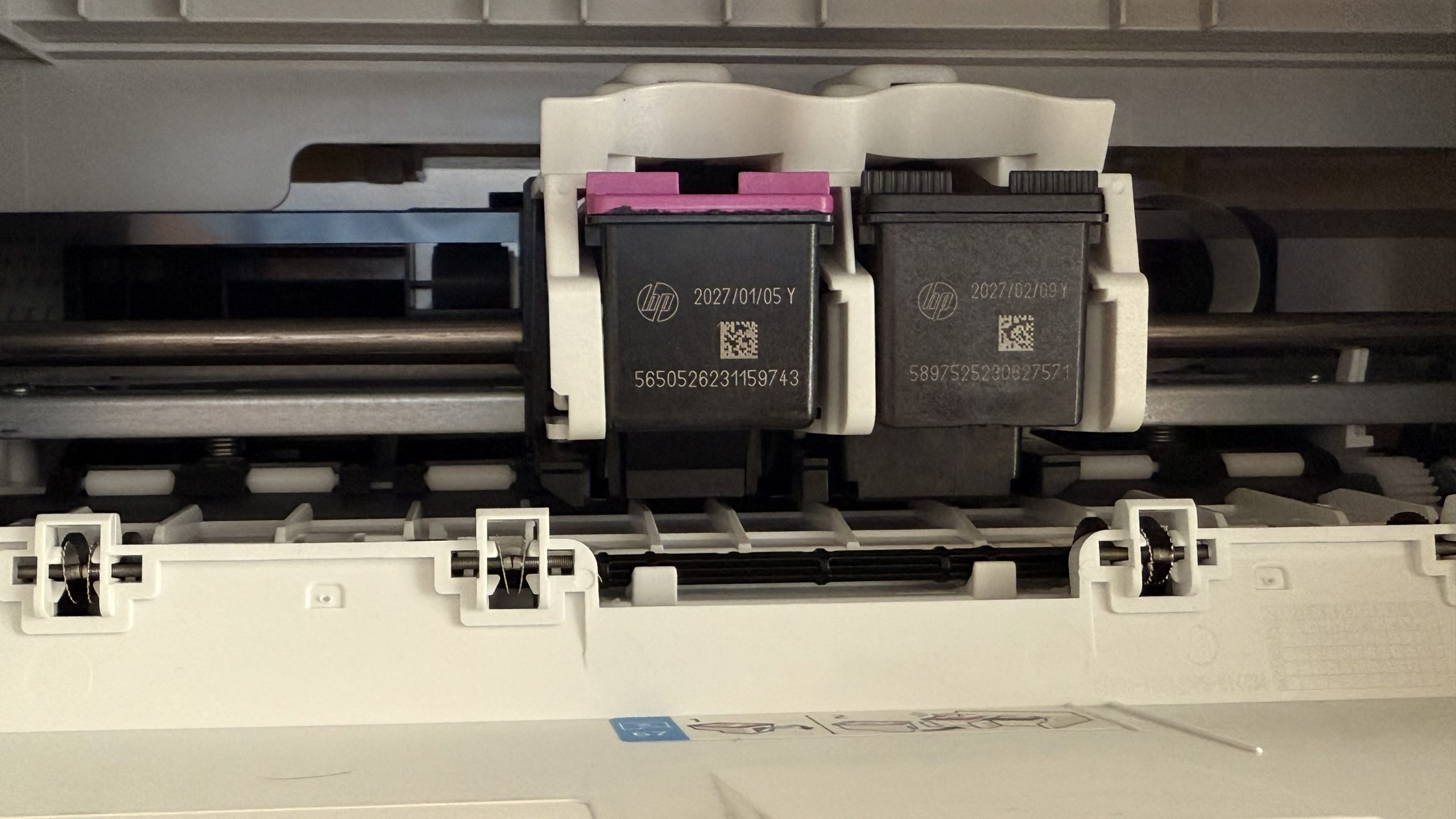
The HP DeskJet 2855e is a compact all-in-one inkjet printer designed for light home use. It provides printing, scanning, and copying functions. The printer stands out because of its simple setup process, which users praise when they use the HP Smart app together with wireless connectivity features.
We went hands-on with the DeskJet 2855e to get a feel for how it all comes together. And we’ve also looked at what others are saying about it.
The 2855e printer receives continuous praise from online reviewers for its document printing quality, and some users report good photo results when using appropriate paper. The printer’s compact design makes it an ideal choice for people who need to save space.
The 2855e printer has several negative aspects that users need to consider. Reviews frequently report problems with printer connectivity because they experience unstable Wi-Fi connections, mainly when their network operates only on the 5.0 GHz band (the printer needs 2.4 GHz connectivity).
The primary source of disagreement stems from HP’s ink policy, which forces users to purchase HP-branded cartridges and subscribe to HP Instant Ink for potential savings. This policy creates frustration because of high costs outside the program and the need for internet connectivity for HP+ features. The printer is criticized for its slow startup, printing speeds, and the initial setup cartridges’ minimal page yield.
Advertisement
Regardless, users who need a basic printer for occasional tasks will find the HP DeskJet 2855e an appropriate choice because it offers cost-effectiveness and ease of use.
Sign up to the TechRadar Pro newsletter to get all the top news, opinion, features and guidance your business needs to succeed!
For our top-performing picks, see our guide to the best home printers we’ve tested.
(Image credit: Future)
Advertisement
HP DeskJet 2855e: Specs
The HP DeskJet 2855e is an all-purpose inkjet printer that works well for homes, students, and small businesses. It is a multifunctional device that enables color printing, copying, and scanning to meet different document requirements.
The DeskJet 2855e reaches a maximum ISO printing speed of 7.5 pages per minute (ppm) for black text while reaching 5.5 ppm for color prints. The printer operates effectively between 50 and 100 pages of monthly print use and reaches a maximum duty cycle of 1,000 pages. The printer operates effectively for both light and medium printing needs.
The printer delivers excellent print quality through its 1200 x 1200 rendered dpi for black text and 4800 x 1200 optimized dpi for color prints, resulting in clear and sharp documents. The printer produces detailed and colorful outputs through its 4800 x 1200 optimized dpi color printing capability and 1200 x 1200 rendered dpi black text printing ability.
The printer includes a 60-sheet input tray that supports printing different media sizes starting from 3 x 5 inches (postcards) and extending to 8.5 x 14 inches (legal paper). Users can print various documents on different paper types through this printer, including plain paper, photo paper, brochures, and envelopes. A 25-sheet output tray helps users manage their printed documents efficiently.
Advertisement
The printer enables wireless printing through built-in Wi-Fi 802.11b/g/n and direct connections through its Hi-Speed USB 2.0 port. The printer allows network users to print documents from various connected devices. The HP Smart app, Apple AirPrint, Google Cloud Print, Chrome OS, and Mopria certification enable users to print directly from smartphones and tablets.
The DeskJet 2855e features a scanner that scans at 1200 dpi optical resolution to deliver detailed results for documents and photos. The copier enables nine copies with a 300 x 300 dpi resolution for black and color copies.
The printer measures 16.7 inches (W) x 11.97 inches (D) x 6.06 inches (H) and weighs 7.55 pounds to fit easily in different spaces with its compact dimensions. HP integrates at least 60% post-consumer recycled plastic into its construction to demonstrate its environmental responsibility.
Advertisement
HP DeskJet 2855e: Feedback
What other sites think
In addition to reviewing the product, we analyzed HP DeskJet 2855e reviews from other online publications to get a more precise and concise idea of what others think of the low-cost inkjet printer.
RTINGS.com says the HP DeskJet 2855e isn’t a good choice for families due to its low page yield, leading to frequent and costly ink cartridge replacements. While its document print quality is passable, it struggles with photos, producing flat and unnatural images due to a narrow color range and poor accuracy. Although it includes a scanner, the scan quality is poor, it lacks fine detail, and there is no automatic feeder for multi-page documents. On the positive side, it offers good connectivity options, including Wi-Fi, USB, AirPrint, and Mopria, making it easily accessible to multiple users.
Over at PCVerge, the HP DeskJet 2855e is noted for being a compact, affordable printer suitable for light family use, boasting good connectivity options like Wi-Fi, USB, AirPrint, and Mopria. However, its limitations include the absence of an automatic document feeder, merely acceptable print quality, and higher long-term operating expenses due to ink consumption. While not the fastest, its photo printing speed is reasonable for its price. It features a high-resolution flatbed scanner with good color depth, though its hinges don’t accommodate scanning thick items. Ultimately, the HP DeskJet 2855e is deemed a good value for fundamental home printing, particularly for infrequent users open to alternative ink solutions or an HP ink subscription.
Advertisement
Perhaps the most insightful review comes from a Reddit poster. Their “Love Letter to Mediocrity” covers all the essential bases. The author expresses pleasant surprise that the printer functions without significant issues, highlighting its easy setup, wireless printing, and all-in-one capabilities (print, scan, copy). However, the review notes its downsides, including high ink consumption, slow print speeds, and mediocre print quality. The reviewer concludes that the printer is best suited for users with basic printing needs and low expectations, rather than those seeking high-quality or fast performance.
(Image credit: Future)
What users have to say
The HP DeskJet 2855e achieves positive average star ratings on major online retail and manufacturer platforms. Still, negative reviews strongly outnumber positive ones, which leads to an extreme split in user satisfaction.
The printer earns a 4.2 out of 5-star rating at Walmart.com based on 652 ratings from 412 reviewers. The review distribution reveals that most users provide 5-star ratings at 65% while 16% give 4-star ratings.
Advertisement
The 1-star reviews account for 10% of the reviews, indicating that many users remain unhappy with the product. The overall recommendation rate from Walmart.com reviewers regarding the product amounts to 83%.
HP.com shows the DeskJet 2855e receiving 4.3 out of 5 stars from 433 user reviews on its official store website. The platform displays a mixed sentiment, with numerous negative reviews that describe multiple problems. 4. The polarized feedback pattern matches what other platforms show.
Best Buy lacks explicit ratings information in the document, but their summaries demonstrate that customers praise the DeskJet 2855e’s user-friendly nature, and lack sufficient negative feedback. 6 The product starts with an overwhelmingly positive first impression, especially regarding its early usage.
The 4-star rating on RC Willey, based on 214 customer reviews, matches the general positive trend while showing that some customers remain dissatisfied.
Advertisement
(Image credit: Future)
HP DeskJet 2855e: Pros
The HP DeskJet 2855e receives positive reviews for its main features, which appeal to users who require an entry-level home printer.
Users praise the DeskJet 2855e for its “ease of use” and simple setup process after completing software installation and initial connection steps. Many users who experienced a straightforward setup process share positive opinions about this printer. The HP Smart application is a key tool that helps users set up their printer and provides easy mobile printing capabilities without a computer connection.
Multiple users describe the DeskJet 2855e as delivering “good print quality” and producing “clear and true to color” images with “great print copies” that meet everyday needs for documents, school work, and occasional photo printing. The expert review by PCVarge agrees with these observations since it notes that the printer delivers “good image quality” and “reasonable” photo printing speeds at an affordable price.
Advertisement
Users consistently praise the printer for its compact design and lightweight construction. The printer receives praise for its “convenient and space-saving” design and “portable” feature, which makes it suitable for home desks in small living spaces. PCVarge notes that the printer measures 6.7 x 11.97 x 6.06 inches and weighs 7.55 pounds, emphasizing its small size among desktop printers.
The printer’s affordable initial cost is the main selling point for customers who consider it a “great price” and an “affordable” choice for basic home printing needs. The printer receives positive reviews from customers and experts because it offers a “good budget choice” that suits basic requirements while delivering print, scan, and copy functionalities.
Users highly value wireless printing capabilities across different devices and effortless HP Smart mobile application integration for its user-friendly features. The printer allows users to print documents without needing to plug in their computers every time.
According to HP, the printer features the “most reliable Wi-Fi,” which automatically detects and solves network problems, but some users report opposite experiences.
Advertisement
The positive reception of the HP DeskJet 2855e regarding its compact design, affordable price point, and user-friendly operation post-initial setup confirms its suitability for users requiring basic, straightforward printing capabilities. Due to this feedback, the product stands in the “basic home printing” market segment. The product meets the needs of a particular group of users who have low expectations. HP’s design choices involve choosing basic accessibility and a compact size instead of providing full functionality and premium materials.
The printer delivers its highest value to users with basic needs who successfully overcome typical setup challenges. The strategic market approach adopted by HP focuses on the entry-level market segment by prioritizing initial purchase affordability and ease of use. The user feedback confirms the product’s successful targeting of its specific market segment because these customers find that the printer meets its essential promises.
(Image credit: Future)
HP DeskJet 2855e: Cons
The HP DeskJet 2855e suffers from multiple critical problems, negatively affecting customer satisfaction.
Advertisement
Multiple users, including those with technical expertise, found the printer setup experience highly challenging. They needed at least 20 minutes and sometimes two days to establish printer functionality. Users experience a “clunky nightmare” and “convoluted” setup process because the instructions depend on mobile app guidance while eliminating disc support, which results in users getting trapped in infinite loops.
The numerous reports about challenging initial setup processes by users with technical experience demonstrate how many buyers encounter a substantial obstacle that prevents them from completing the setup process. The initial unpleasant experience with the printer can make users lose enthusiasm for its beneficial features.
Installing the printer starts with a negative experience that damages customer satisfaction immediately after purchase, making them more likely to return products and view the following problems with increased hostility.
The first negative impression strongly influences customer reviews because it leads to the observed bimodal distribution across different platforms. A customer’s inability to print a return label demonstrates their frustration and the practical difficulties that emerge when a setup fails. The setup process becomes a critical, high-stakes moment for HP because it focuses on app-based setup but lacks robust offline setup options and precise network configuration troubleshooting. Enhancing the initial user experience would lead to better overall customer opinions, even if additional drawbacks exist.
Advertisement
This issue sparks intense disagreement among customers who feel intensely dissatisfied with it. Users strongly dislike that the printer requires HP-branded ink cartridges and an active Instant Ink subscription for maintenance.
Users strongly condemn HP for what they call the “ink scam” and denounce the “ink rule” because of the “chip,” which forces users to use HP’s proprietary ink. Users explicitly mention they will never purchase HP products again because of this policy.
Expert reviews show that standard cartridges have a “very low page yield,” which results in “high long-term operational cost (without subscription)”- $0.08 per black print and $.12 per color print—so users must replace cartridges often before subscribing to the model.
Users view HP’s proprietary ink policy and subscription promotion as more than financial issues because they create fundamental trust breakdowns and damage brand loyalty among numerous customers. Users experience deeper problems than price concerns because they see this practice as unfair towards consumers and feel trapped by the manufacturer’s actions.
Advertisement
The printer’s affordable initial price is a double-edged sword because it comes with expensive maintenance costs and limited ink availability. This exemplifies a “razor-and-blades” business model. Customers become angry when they experience “overpriced,” “forced,” or “designed to fail without subscription” ink cartridges in this business model. The potential existence of class-action lawsuits indicates how seriously customers view this ethical violation.
HP’s subscription-based model generates recurring revenue but endangers customer loyalty and brand integrity, mainly because it feels deceptive to specific users. The business strategy employed by HP stands in direct opposition to customer autonomy, which is the leading cause of negative review sentiment.
The printer experiences recurring paper jam problems, while users frequently experience printing failures. Several users considered switching to their previous printers because of the recurring jamming issues. A reviewer pointed out that the printer construction feels inexpensive because it uses “cheap plastics.” The low initial cost of the printer might relate to lower material standards.
(Image credit: Future)
The device, marketed as an “all-in-one” device, consistently demonstrates a significant problem with its scanning functionality. Customers experience two major scanning issues because the scanner refuses to function and fails to detect documents. Users encountered difficulties when scanning into a computer that forced them to run “HP scanner doctor” multiple times until they restarted their computer. This led to the belief that HP uses this method as an “ink scam” ploy. According to expert reviews, the scanning performance is not good because the image processing removes essential details from the scans and the flatbed scanner’s lid hinges do not extend to accommodate thick items.
Advertisement
The absence of an Automatic Document Feeder (ADF) is a significant limitation, meaning multi-page documents must be scanned one sheet at a time, manually.
The persistent issues with scanning functionality make the product’s “all-in-one” claim less valuable according to user reports. The consistent problems with scanning functionality directly harm the “multifunctionality” value proposition because it affects the fundamental operation of the device.
The “cheap piece of junk” sentiment emerges when users feel they purchased only a printer and copier instead of an “all-in-one” device. The scanning module seems to suffer from quality control issues, software integration problems, or the manufacturer deliberately chose basic scanning features that fail to match typical user expectations for “all-in-one” devices. The significant difference between marketing claims and user experience results in customer dissatisfaction.
Users and experts agree that automatic duplex (double-sided) printing should be included in a printer, but the product lacks this feature. Users need to turn pages manually for double-sided printing. The absence of the Automatic Document Feeder (ADF) significantly hinders efficiency when users scan or copy multiple pages. The control panel has a tiny non-tiltable LCD screen that users find hard to see from their seated position.
Advertisement
Finally, many users express dissatisfaction because they receive starter cartridges and XL ink cartridges with low page yields. Users who plan to print many pages should expect the starter cartridges to deplete quickly. Another noted that the “cartridges that came with it don’t last long if you plan to print many pages.” Expert reviews confirm this problem by assessing “very low page yield,” which explains why the print cost remains high without an Instant Ink subscription, leading to frequent cartridge replacements.
Canadian AI start-up Cohere has agreed to acquire Germany’s Aleph Alpha in a transatlantic deal aimed at giving governments and regulated industries an alternative to US tech giants.
The combined entity will be anchored in Germany and Canada, pooling engineering talent and compute resources across the two G7 nations. It will target customers in the public sector, finance, defence, energy, manufacturing, telecommunications and healthcare.
As part of the deal, Germany’s Schwarz Group, the retail giant behind Lidl and Kaufland, is leading a €500m structured financing commitment into Cohere’s upcoming Series E round. Schwarz’s sovereign cloud service Stackit will act as the technical backbone of the venture.
The market opportunity is sizeable. McKinsey projects AI services will surpass $1trn annually, with sovereign AI needs accounting for close to $600bn of that total.
Advertisement
“Organisations globally are demanding uncompromising control over their AI stack,” said Aidan Gomez, co-founder and CEO of Cohere. He said the partnership would give enterprises and governments “the absolute certainty that their data remains their own”.
Ilhan Scheer, co-CEO of Aleph Alpha, said the combined company would give European institutions “access to powerful, yet controllable AI they can truly own”, and serve as a “real counterweight” for organisations that refuse to outsource AI control to a single provider or jurisdiction.
A transatlantic challenger
Forrester’s vice-president and principal analyst Thomas Husson said the deal creates “a unique transatlantic player designed to challenge the dominance of US giants”.
“While it is technically an acquisition by the Canadian firm, the real power is likely to be shared,” Husson said. “Cohere will provide cutting-edge engineering and global product and commercial leadership, while German players (and especially the Schwarz Group) provide the essential capital and political backing.”
Advertisement
He described the structure as “hybrid and unusual” and said it was aimed at “capturing the sovereign AI market to offer a secure alternative for governments of highly regulated industries to avoid reliance on US cloud laws”.
Husson said the tie-up will put pressure on French AI company Mistral in particular. “This will directly challenge Mistral AI who will now face a new rival combining North American agility with European regulatory trust,” he said.
However, Husson warned that success is not guaranteed. “Ultimately, the deal’s success depends on whether this dual-headed leadership can remain unified while competing against the massive budgets of giants like Microsoft, Google or OpenAI.”
The transaction is subject to approval by Aleph Alpha shareholders and competition regulators.
Advertisement
In August last year, Cohere raised $500m at a $6.8bn valuation and hired the former Meta vice-president for AI research Joelle Pineau as its first chief AI officer. Pineau, a Canadian computer scientist and a professor at McGill University, led Meta’s Fundamental AI Research team.
Cohere’s oversubscribed raise was led by Radical Ventures and Inovia Capital, with additional participation from existing investors including AMD Ventures, Nvidia and Salesforce Ventures.
Don’t miss out on the knowledge you need to succeed. Sign up for the Daily Brief, Silicon Republic’s digest of need-to-know sci-tech news.
Kyber, first observed in circulation as early as September, takes its name from the alternate designation of ML-KEM (Module-Lattice-based Key Encapsulation Mechanism). The algorithm, standardized by the National Institute of Standards and Technology, is part of a broader effort to prepare encryption systems for a future in which quantum computers… Read Entire Article Source link
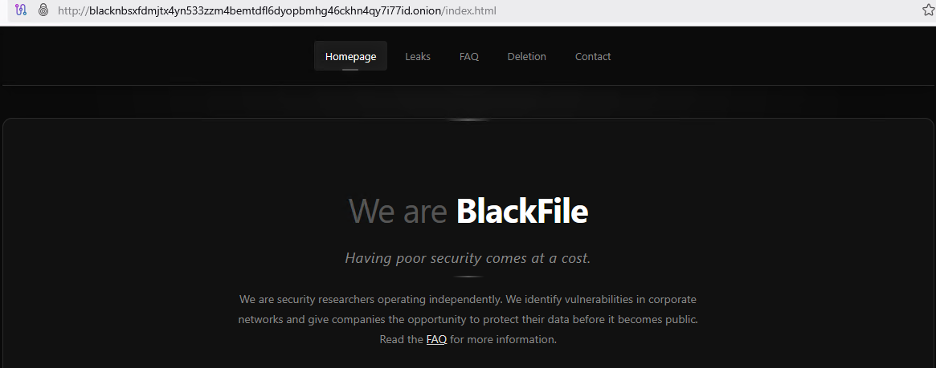
A new financially motivated hacking group tracked as BlackFile has been linked to a wave of data theft and extortion attacks against retail and hospitality organizations since February 2026.
The group, also tracked as CL-CRI-1116, UNC6671, and Cordial Spider, is impersonating corporate IT helpdesk staff to steal employee credentials and demand seven-figure ransoms, according to information shared by cybersecurity firm Palo Alto Networks’ Unit 42 with the Retail & Hospitality Information Sharing and Analysis Center (RH-ISAC).
Unit 42 security researchers have also linked BlackFile with moderate confidence to “The Com,” a loose-knit network of English-speaking cybercriminals known for targeting and recruiting young people for extortion, violence, and the production of child sexual exploitation material (CSAM).
In a Thursday report, RH-ISAC said that the group’s attacks begin with phone calls to employees from spoofed numbers, in which the threat actors pose as IT support to lure staff to fake corporate login pages that ask them to enter their credentials and one-time passcodes.
“The attackers behind CL-CRI-1116 use voice-based phishing (vishing) from spoofed Voice over Internet Protocol (VoIP) numbers or fraudulent Caller ID Names (CNAM) as a social engineering technique, typically posing as IT support staff,” RH-ISAC said.
Advertisement
“We can confirm that we are seeing a significant increase in Blackfile matters and that TTPs appear to be very similar to such groups as ShinyHunters and SLSH and similar copycats employing vishing/social engineering data exploit tactics,” CyberSteward founder and CEO Jason S.T. Kotler also told BleepingComputer.
Using stolen credentials, the BlackFile attackers register their own devices to bypass multifactor authentication, then escalate access to executive-level accounts by scraping internal employee directories.
BlackFile steals data from victims’ Salesforce and SharePoint servers using standard API functions, searching specifically for files containing terms such as “confidential” and “SSN.”
The exfiltrated documents are downloaded to attacker-controlled servers and published to the gang’s dark web data leak site before victims are contacted with ransom demands via compromised employee email accounts or randomly generated Gmail addresses.
Advertisement
BlackFile data leak site (RH-ISAC)
“By leveraging Salesforce API access and standard SharePoint download functions, the attackers move large volumes of data – including CSV datasets of employee phone numbers and confidential business reports – to attacker-controlled infrastructure,” RH-ISAC added.
“This is often done under the guise of legitimate SSO-authenticated sessions to avoid triggering simple user-agent alerts.”
Employees of compromised companies (including senior executives) have also been targets of swatting attempts, which involve making false emergency calls to responders. Attackers often use this tactic to exert additional pressure on their victims.
Mandiant also told BleepingComputer that they are actively responding to several vishing incidents that led to data theft and extortion, including one that used a BlackFile victim-shaming site that is now offline.
To reduce the success rate of BlackFile’s attacks, RH-ISAC recommends that organizations strengthen their call-handling policies, enforce multifactor identity verification for callers, and conduct simulation-based social engineering training for frontline staff.
Advertisement
AI chained four zero-days into one exploit that bypassed both renderer and OS sandboxes. A wave of new exploits is coming.
At the Autonomous Validation Summit (May 12 & 14), see how autonomous, context-rich validation finds what’s exploitable, proves controls hold, and closes the remediation loop.
Overpriced Mac minis are flooding eBay amid shortages of the sold-out machines, which have become a favored tool for running on-device AI models like OpenClaw.
This week, reports indicated that the $599 M4 Mac mini base model with 16GB RAM and 256GB of storage is sold out on Apple’s retail website, with no options for delivery or in-store pickup. The shortages have since extended to other configurations of the base model, regardless of the amount of memory selected. This is the first time the base model has been sold out, some outlets noted. Meanwhile, models with higher storage (512GB and up) are only available to ship starting in June.
As a result, eBay has become a secondary market for these in-demand computers. On the site, various configurations of the M4 Mac mini are available for sale at higher prices than if buying direct from Apple, which is no longer an option.
Apple’s power-efficient Mac minis have become popular devices for testing and running at-home, on-device AI models, beginning with the OpenClaw craze but now extending to OpenClaw alternatives like ZeroClaw, other AI tools from Anthropic and OpenAI, Perplexity Computer, or other specialized local models. Unlike some PCs, Mac minis also run quietly and tend to be more reliable for 24/7 use, compared with laptop computers.
Advertisement
The shortage of the devices also comes alongside an industry-wide memory crunch and plans for a Mac mini refresh, according to Bloomberg. However, refreshes of product lines haven’t led to shortages before.
Apple did not immediately respond to a request for comment.
This perfect storm of supply chain stress and increased demand for AI-friendly machines has inflated the prices of used consumer electronics.
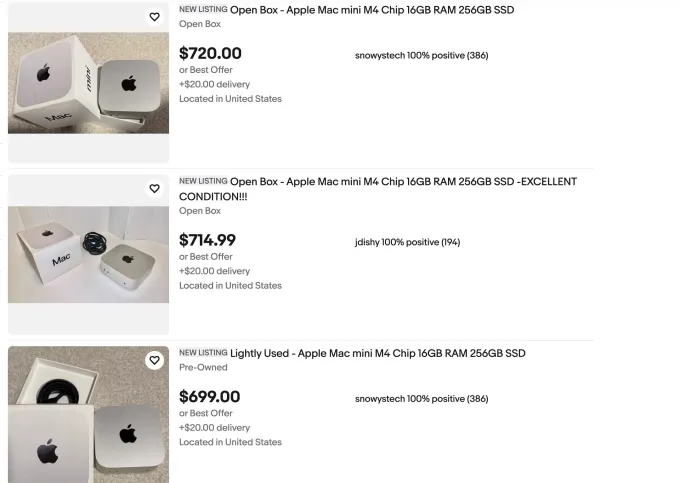
As of Friday morning, M4 base models with the 16GB RAM/256GB SSD configuration were selling at markups like $715-$795 for a new, “open box” model, and as high as $979 for an “excellent” refurbished version. Some “lightly used, pre-owned” Mac minis with this configuration were selling for around $700 — more than $100 more than the price of a new base model.
Advertisement
Image Credits:eBay (screenshot)
There was also a single listing for a $925 brand-new M4 Mac mini with the same 16GB RAM and 256GB storage; the listing warned in bright red text: “Last one.”
Image Credits:eBay (screenshot)
While you still may be able to score a reasonably priced refurb if you keep a close eye out (or if you win an eBay auction where the bid has started at a lower price point), it seems that the demand for the device is going to keep prices up until Apple’s supply chain refreshes.
And now that the Mac mini is unavailable, Apple has begun to see increased demand for the Mac Studio, too. That computer is also now sold out across several configurations.
As Ars Technica pointed out, you can still get a MacBook Pro with 128GB RAM and larger SSDs within a few weeks, and even the new and popular MacBook Neo is still shipping within two to three weeks. This suggests the real issue is consumer demand for the Mac mini itself.
When you purchase through links in our articles, we may earn a small commission. This doesn’t affect our editorial independence.
Erdŏgan has 15 days to sign the bill into law. The legislation enters into force six months after publication in the Official Gazette. The main opposition CHP criticised it as a political censorship tool rather than child protection.
Turkey has previously blocked Instagram, Roblox, and restricted platforms during the İmamoglu protests.
Turkey’s Grand National Assembly passed a law late on Wednesday banning social media for children under 15, making the country the latest, and one of the largest by population, to introduce legislative age restrictions on social media access.
Under the law, social media companies including YouTube, TikTok, Facebook, and Instagram will be required to implement age verification systems, block under-15s from creating accounts, and provide parental control tools to manage the accounts of 15-to-17-year-olds.
Advertisement
The 💜 of EU tech
The latest rumblings from the EU tech scene, a story from our wise ol’ founder Boris, and some questionable AI art. It’s free, every week, in your inbox. Sign up now!
President Recep Tayyip Erdŏgan has 15 days to sign the bill. If signed, it will enter into force six months after publication in the Official Gazette. Online gaming companies must also appoint a Turkey-based representative to ensure compliance.
The immediate political catalyst is the Kahramanön school shooting on 14 April 2026, in which a 14-year-old boy killed nine students and a teacher at a middle school in Kahramanön in southern Turkey before dying himself. Police subsequently arrested 162 people accused of sharing footage of the attack online. Investigators are examining the perpetrator’s online activity for clues to his motivation.
Advertisement
Erdŏgan made the political link explicit in a televised address on Monday: “We are living in a period where some digital sharing applications are corrupting our children’s minds, and social media platforms have, to put it bluntly, become cesspools.”
The parliamentary commission that proposed the law framed it in a report titled “Threats and Risks Awaiting Our Children in Digital Media.”
The law’s operational mechanics carry significant compliance demands for platforms. Companies with more than 10 million daily users in Turkey, a threshold that covers all major platforms, must remove content deemed harmful within one hour of notification in an emergency.
Foreign services with more than 100,000 daily users must maintain a local representative. Enforcement is through Turkey’s communications watchdog, the BTK.
Advertisement
Penalties escalate from advertising bans to access speed restrictions, effectively throttling platform performance, to potential access bans. The speed restriction mechanism is the same tool Turkey has used in previous enforcement actions against platforms that have declined to comply with content removal orders.
Running parallel to the under-15 law is a second legislative initiative that is editorially more significant for digital rights. The Turkish government has separately reached an agreement with social media companies requiring that all Turkish citizens, not just minors, verify their identity to use social media accounts.
The precise mechanism of this identity verification system has not been disclosed, and how platforms will technically implement it is still unknown. Merve Gürlek, the Turkish official who announced the agreement, made the announcement on 3 April; further details of the legal framework are still being drafted.
The end of social media anonymity for all Turkish users represents a categorically different kind of intervention than the under-15 age restriction and carries obvious implications for political speech.
Advertisement
The opposition Republican People’s Party, the CHP, Turkey’s main secular opposition, voted against the bill, arguing that children should be protected “not with bans but with rights-based policies.”
This is a standard liberal critique of age-based social media bans, but in the Turkish context it carries additional weight given the government’s documented record of using platform restrictions for political purposes.
Online communications were widely restricted during 2025 protests in support of Istanbul’s jailed opposition mayor Ekrem İmamoglu. Instagram was blocked in 2024 following a dispute over Hamas-related content.
Roblox was banned, with Turkish officials citing inappropriate sexual content and, separately, what an official described as the “promotion of homosexuality.”
Advertisement
The law passed by parliament is not in itself a tool of censorship; but it expands and formalises the regulatory infrastructure through which the government controls what Turks can access online.
Turkey’s law joins a rapidly expanding international landscape of social media age restrictions. Australia’s ban for under-16s came into force in December 2025.
Norway announced on Friday that it plans to legislate a ban for under-16s by end of 2026. Indonesia has implemented restrictions on under-16 access to platforms exposing minors to pornography, cyberbullying, and addiction. France has age verification requirements for social media.
The UK’s Online Safety Act imposes harm prevention duties on platforms. Turkey’s approach is distinctive in two ways: it pairs the child protection measure with a universal identity verification requirement that no comparable democracy has yet implemented, and it introduces it in a political environment where the infrastructure for platform restriction has already been deployed against political opposition.
Advertisement
Whether the legislation functions primarily as child protection or primarily as a new layer of state control over digital speech will depend largely on how the BTK applies its enforcement powers in the years ahead.
































































You must be logged in to post a comment Login