
Crypto World
Trump Luncheon Draws Top Memecoin Holders, Signals Political Ties


Trump’s memecoin TRUMP is again at the center of crypto’s crossover with politics, as a private luncheon at Mar-a-Lago brings together hundreds of memecoin holders and a cadre of crypto figures. The invitation-only event highlights ongoing questions about access, influence, and how token communities intersect with real-world power.
According to the organizers behind the TRUMP token, GetTrumpMemes.com, the guest list for the luncheon includes up to 297 TRUMP holders and a mix of well-known crypto executives and industry figures. Reported attendees span stablecoin issuance, exchange leadership, and prominent crypto builders, underscoring the token’s appeal within parts of the crypto ecosystem. The meeting is set at the president’s Mar-a-Lago property in Florida, echoing a similar gathering from 2025. Notably, however, there was no public confirmation that Tron founder Justin Sun would attend, and Cointelegraph reached out to a Sun spokesperson for comment without receiving an immediate response.
Sun’s involvement with Trump’s broader crypto ventures has become a flashpoint in recent days. He announced a lawsuit this week against World Liberty Financial, a project co-founded by members of Trump’s family, alleging token freezing and threats to burn his tokens “without any proper justification.” Sun described himself as an “ardent supporter” of Trump, while noting that certain individuals on the World Liberty team were acting in ways incompatible with the president’s values. The legal dispute adds another layer of tension to the evolving Trump crypto ecosystem.
Related: Trump memecoin holders get another gala as efforts to lift the token from troughs continue.
Public interest in the event has grown partly because of the token’s volatile history. The top TRUMP holder remains highly influential, with 2.4 billion points on the project’s leaderboard, according to the memecoin’s organizers. Meanwhile, a familiar tension surfaces: the gathering is framed by supporters and critics alike as a demonstration of how financial access may be linked to political capital, a concern voiced by watchdog groups and lawmakers alike.
As the gathering goes forward, it’s worth recalling how the crypto community viewed Trump’s involvement just a few years ago. A Bloomberg report quoted a participant’s assessment that sentiment toward Trump in crypto has shifted since his inauguration, describing him as less popular within the crypto crowd amid a broader climate of political and tariff-related headwinds. The report underscored the fragility of public trust in memecoins tied to political figures, even as some supporters continue to advocate for continued engagement and new fundraising events.
Key takeaways
- Private Mar-a-Lago luncheon for TRUMP token holders—up to 297 attendees—with high-profile crypto figures, signaling ongoing ambition to monetize political connection via the memecoin ecosystem.
- Justin Sun’s status remains unclear; his spokesperson did not respond to inquiries about attendance, even as Sun’s legal clash with World Liberty Financial adds friction to the ecosystem.
- Critics warn that token ownership could create “access to the presidency,” citing wallet tracing and profit-tracking concerns from watchdog groups.
- The TRUMP token hasfallen sharply since launch, losing more than 93% from an all-time high near $45 to around the low single digits, reflecting broader questions about token fundamentals and hype cycles.
- Recent coverage and Elites’ commentary indicate shifting sentiment toward Trump within crypto circles, with regulators and ethics advocates watching for governance signals and disclosures.
A private event under scrutiny
The luncheon at Mar-a-Lago epitomizes the ongoing debate about whether memecoins tied to political figures should operate in spaces that resemble fundraising or social clubs for a political brand. GetTrumpMemes.com describes the event as a private gathering of TRUMP holders and prominent crypto-connected guests, underscoring the token’s appeal to insiders who view digital assets as a pathway to influence. Critics point to the lack of transparency around who exactly benefits from the trading activity and whether participants gain privileged access beyond traditional political fundraising norms.
The event also surfaces questions about disclosure and governance. While supporters frame the gathering as a celebration of a political-memdcoin experiment, lawmakers and ethics advocates argue that tokenized access to presidential figures could blur lines between fundraising, lobbying, and governance. A Friday BlueSky post from Citizens for Responsibility and Ethics in Washington highlighted concerns about wallet-level visibility and the possibility that small, frequent fees on trades could generate profits for the political brand, even as the token’s price moves independently of policy outcomes.
Sun’s legal dispute adds friction
Justin Sun’s involvement in the broader Trump crypto ecosystem has been a point of contention. Sun’s recent lawsuit against World Liberty Financial alleges improper token handling, fueling debate about governance and accountability within the Trump-backed crypto projects. Sun labeled himself an ardent supporter of Trump, while suggesting that certain World Liberty team members were acting against the president’s stated values. The dispute adds a layer of uncertainty for investors and users who track the health and direction of the TRUMP ecosystem as it navigates legal and reputational risks.
Sun’s presence at public events has previously been noted, including a May 2025 dinner for TRUMP memecoin holders that featured industry figures such as Synthetix founder Kain Warwick and Kronos Research’s Vincent Liu. The unfolding legal fight, coupled with public endorsements and appearances, illustrates the fragility of cross-domain support in a space where celebrity endorsements and institutional ties can shift quickly.
Market signals and investor implications
From an investor perspective, the TRUMP token’s trajectory remains illustrative of the volatility that characterizes memecoins anchored to political narratives. Launched in January 2025, the token has experienced a dramatic drawdown from its all-time high of roughly $45, with its price dipping well below $3. This collapse underscores the risk of token-based narratives that hinge on social media momentum and celebrity endorsements rather than underlying utility or revenue models.
Beyond price, the ongoing discussions around transparency, governance, and potential conflicts of interest matter for participants and the broader crypto community. The debate touches on fundamental questions about how such tokens should be regulated, how conflicts of interest are disclosed, and what safeguards (if any) are needed to separate political processes from purely speculative asset trading. Observers pointed to the need for clearer disclosures and governance standards as essential prerequisites if memecoins tied to political figures are to persist in a more scrutinized environment.
Regulatory and governance considerations
The combination of political branding and memecoin trading invites closer scrutiny from lawmakers and oversight groups. Critics argue that tokenized participation could amount to de facto access to political influence, raising concerns about fairness and disclosure. watchdogs have pointed to opaque wallet activity and fee structures as potential red flags, while proponents stress that open markets and voluntary participation are core to crypto’s ethos. As regulators across jurisdictions weigh policy responses, events like the Mar-a-Lago luncheon will likely inform the ongoing debate about transparency, consumer protection, and the appropriate boundaries between politics and finance in crypto.
Looking ahead, market participants will be watching for how the TRUMP project and similar initiatives navigate governance, disclosures, and any regulatory guidance that may emerge. The interplay between celebrity-backed assets and policy implications remains a key frontier for crypto’s evolution, with readers and investors seeking clarity on what’s permissible, what’s beneficial, and what constitutes meaningful value in a space prone to rapid shifts in sentiment.
Readers should stay tuned for any official statements accompanying future memecoin events, as well as any regulatory developments that address token-based access to political influence. The TRUMP story continues to unfold at the intersection of crypto, celebrity branding, and public accountability.



Coinbase is rolling out a BLEND–USD spot pair for Fluent’s newly launched token, joining KuCoin and MEXC in a coordinated listing that could turn the tiny‑cap altcoin into a high‑beta volatility play.
Summary
- Coinbase plans to launch spot trading for Fluent (BLEND), with the BLEND–USD pair expected to go live today once liquidity conditions are met.
- The listing follows Coinbase’s earlier move to enable BLEND deposit address generation and comes alongside listings on KuCoin and MEXC, boosting access to the new altcoin.
- Fluent’s mainnet launch and partnership with major exchanges position BLEND as a high‑beta token likely to see sharp price swings once trading opens.
Coinbase is preparing to launch spot trading for Fluent’s BLEND token, adding a BLEND–USD pair to its platform as early as today, subject to sufficient order-book liquidity. The decision places BLEND on the largest regulated crypto exchange in the United States by trading volume, signaling that demand for fresh altcoin listings remains strong despite a choppy market backdrop.
In an update on its listings page, Coinbase confirmed support for Fluent (BLEND) and said users in eligible regions can already generate deposit addresses, though deposits only become active once the asset issuer enables transfers. “Spot trading for BLEND will allow users to buy and sell the token directly on the platform, as opposed to derivative or futures-based exposure,” Coinbase’s listing note states, underscoring that the asset will be available in the cash market rather than via leveraged products.
New altcoin, thin float, high volatility risk
Fluent is a web3 platform whose native token, BLEND, is designed to sit at the center of its ecosystem for functions such as payments, governance, and incentives. According to CryptoRank, Coinbase is acting as a “primary launch platform” for BLEND as part of a wider collaboration focused on token distribution, developer onboarding, and educational content.
The timing aligns with BLEND’s initial exchange rollout, with MEXC and KuCoin both scheduling BLEND/USDT spot markets to open at 13:00 UTC on April 24, 2026, while Bybit has teased a forthcoming listing. Social posts from BSCNews noted that “leading exchanges @Coinbase and @krakenfx have scheduled $BLEND spot trading to begin today, April 24, 2026, once liquidity conditions are met,” highlighting a coordinated launch across multiple venues.
On-chain and order-book data suggest traders should brace for heavy volatility. A recent flow analysis from Streetbrief put BLEND’s market capitalization at roughly $1.85 million with only about $783 in 24‑hour volume ahead of the Coinbase listing, an “extremely illiquid” profile that can magnify both upside and downside moves when fresh demand hits.
Analysts expect that access via a BLEND–USD pair on Coinbase could pull in U.S.-based retail flow seeking high‑beta exposure, but warn that thin float and tight liquidity bands make the token particularly vulnerable to sharp intraday spikes and drawdowns in its early trading sessions.


South Africa’s 2026 capital flow draft recasts crypto as “capital,” tightening FX controls with declarations, approvals and sanctions as Africa’s biggest market matures.
Summary
- South Africa’s National Treasury has published draft 2026 capital flow regulations that formally bring crypto assets inside the country’s foreign exchange control regime.
- The rules would align South Africa with OECD and FATF standards, tighten oversight of cross‑border crypto transfers, and introduce new declaration, reporting, and sanction powers.
- The proposal lands as South Africa cements its role as Africa’s largest crypto market, with an estimated $35 billion in annual on‑chain volume and a sector value above $11 billion.
South Africa’s National Treasury has released its Draft Capital Flow Management Regulations for 2026, a sweeping overhaul that explicitly classifies crypto assets as “capital” and pulls them into the country’s foreign exchange control framework for the first time. The proposal, published on April 17 and now open for public comment, aims to replace the 1961 Exchange Control Regulations and align South Africa’s regime with recommendations from the OECD and the Financial Action Task Force (FATF) on combating money laundering, terrorist financing, and illicit financial flows.
According to the draft, crypto assets are now treated as a channel through which capital can be imported and exported, placing them alongside foreign currency, gold, and securities rather than outside the regulatory perimeter. National Treasury and the South African Reserve Bank said in a joint statement that the amendments are intended “to address gaps in the current regulations, including in relation to cross‑border crypto asset transactions,” and to remove “any ambiguity regarding the declaration of foreign assets.”
Prior approval, declarations, and tougher sanctions
The new framework introduces authorised crypto asset service providers, transaction thresholds, mandatory declarations, and stiffer administrative sanctions for non‑compliance. In practice, this could mean that certain cross‑border crypto transfers will require prior approval from authorities, while residents and visitors may have to declare digital asset holdings above thresholds set by the finance minister, with the risk of seizure or forced sale if they fail to do so.
Bitcoin.com reported that draft rules “require visitors to declare crypto or face up to 5 years in prison,” and grant border officials powers to search devices for coins such as Bitcoin and other tokens suspected of being moved in violation of capital controls. Business Insider Africa added that the same regulations could “require residents to declare and sell certain crypto, gold and foreign currency holdings to the National Treasury” if they exceed those thresholds.
National Treasury insists the overhaul does not amount to a ban on digital assets but a modernization of control tools. “The policy emphasis shifts away from transaction‑by‑transaction pre‑approval towards reporting, traceability and risk‑based oversight, particularly in relation to illicit financial flows and capital flight,” the South African Institute of Taxation wrote in a commentary, describing the approach as a “pragmatic acknowledgment that value now moves across borders digitally.”
Africa’s largest crypto market under tighter watch
The timing is significant for a country that has emerged as the continent’s biggest crypto hub by volume and venture funding. Chainalysis data cited by Mariblock show that Sub‑Saharan Africa received more than $205 billion in on‑chain value between July 2024 and June 2025, with South Africa accounting for about $35 billion of that total, second only to one other market in the region.
Market research from IMARC Group estimates that South Africa’s cryptocurrency market reached roughly $11.18 billion in 2024, driven by both speculative trading and real‑world use cases such as remittances and hedging against domestic currency volatility. A CV VC report highlighted that the country captured 18% of all African blockchain venture capital, with blockchain deals representing 7.4% of total VC funding on the continent — more than double its approximate 3.2% share globally.
Those figures, combined with South Africa’s exit from the FATF grey list in late 2025 and preparations for the next assessment cycle starting mid‑2026, help explain the urgency behind the draft. Treasury officials argue the rules are a “vital prerequisite” for modernizing the financial architecture and shutting down channels for illicit flows, even as critics warn they could chill innovation and push activity into less regulated jurisdictions if implemented heavy‑handedly.


$178M in crypto liquidations over 24 hours show a choppy, leverage‑heavy market where both long and short traders are getting whipsawed out of positions.
Summary
- Coinglass data shows $178 million of crypto derivatives liquidations in the past 24 hours, split between $92.15 million in longs and $85.88 million in shorts.
- The near‑even wipeout of bullish and bearish positions points to a choppy, directionless market dominated by range trading and leverage whipsaws.
- Bitcoin alone saw over $120 million in futures liquidations in the same window as price chopped around $77,500, underscoring fragile positioning across majors and altcoins.
Crypto traders absorbed a fresh wave of forced deleveraging over the past day, with data from analytics platform Coinglass showing that total liquidations across major exchanges hit $178 million in 24 hours. Long positions accounted for roughly $92.15 million of that sum, while shorts made up about $85.88 million, a rare near‑parity that signals an exceptionally indecisive and whipsaw‑prone market structure.
The shakeout came as Bitcoin hovered near $77,487, down about 0.18% on the day, with more than $121 million in BTC futures positions liquidated over the same period, according to Coinglass’s BTC dashboard. Open interest in Bitcoin futures remains elevated at around $56.49 billion, suggesting leverage is still high even after the flush. Coinglass notes that it aggregates liquidation figures across perpetual swaps and dated futures on venues such as Binance, OKX, and Bybit to map total leverage washouts.
Range‑bound chop punishes both bulls and bears
The almost perfectly balanced split between long and short liquidations points to a market swinging back and forth within a tight range rather than trending decisively in one direction. When volatility spikes inside narrow bands and price repeatedly reverses around key levels, over‑leveraged traders on both sides can be wiped out in quick succession as stop‑losses and margin calls cascade through order books.
Coinglass’s long/short ratio indicators have flagged this tug‑of‑war dynamic for weeks, with futures positioning oscillating around parity rather than skewing clearly bullish or bearish on major pairs. That pattern often precedes large “breakout” moves once one side finally overwhelms the other, but in the interim it tends to produce exactly the kind of two‑sided liquidation profile seen in today’s $178 million tally.
For altcoins and smaller‑cap tokens, the impact can be even more violent, as thinner liquidity and higher funding‑rate sensitivity magnify forced selling and buying. With derivatives still driving a large share of total crypto trading volumes, the latest data underscores how quickly sentiment can flip — and how costly it can be to run high leverage in a market that has not yet chosen a clear direction.


Hyperliquid whales now hold $3.66B in nearly balanced perp positions, turning the on‑chain DEX into a real‑time gauge of institutional crypto sentiment.
Summary
- Coinglass data shows whales on Hyperliquid now hold $3.66 billion in perpetual positions, with $1.854 billion in longs and roughly $1.8 billion in shorts.
- The resulting long/short ratio of 1.03 signals an almost perfectly balanced book, underscoring how uncertain large traders are about the next major move.
- The scale of these positions highlights Hyperliquid’s rise into the top tier of derivatives venues, with quarterly volumes in the hundreds of billions of dollars.
Whale traders on Hyperliquid, one of the fastest‑growing on‑chain derivatives exchanges, are currently running $3.66 billion worth of open perpetual futures positions, according to fresh figures from Coinglass. Of that total, $1.854 billion, or 50.64%, is parked in long exposure, while roughly $1.8 billion sits in shorts, leaving a near‑neutral long/short ratio of 1.03 that reflects finely balanced conviction among the platform’s largest accounts.
Coinglass, which tracks whale activity on Hyperliquid through its dedicated whale tracker, notes that it aggregates large perpetual positions and marks them to market in real time to give traders “a better understanding of whale behavior and smarter trading decisions.” Its long/short ratio dashboard for Hyperliquid is designed to “quickly assess market sentiment and positioning, analyze trader behavior, and enhance risk control and trading strategy decisions,” making today’s almost symmetric split a clear signal of indecision rather than one‑sided speculation.
Hyperliquid cements role as on‑chain perps heavyweight
The sheer size of the $3.66 billion whale book underscores how Hyperliquid has evolved into a genuine institutional‑scale venue in the perpetual futures market. A recent MEXC research note highlighted that the exchange processed about $492.7 billion in derivatives volume in the first quarter of 2026, pushing it into the global top‑10 alongside incumbents such as Binance, OKX, and Bybit.
Separate analysis from IndexBox, citing data from Yahoo Finance, CryptoRank, and DefiLlama, said Hyperliquid handled roughly $40.7 billion in perp volume over a single seven‑day stretch, with about $9.57 billion in open interest — more than all major rival perp DEXs combined over the same window. In January 2026 alone, Hyperliquid facilitated over $208 billion in perpetual futures turnover, capturing 5.38% of total centralized exchange perpetual volume, its highest market share on record, according to a post by market analyst Jean‑Pierre Palomba‑Marin.
This combination of deep liquidity, fully on‑chain transparency, and large, nearly balanced whale positioning makes Hyperliquid a real‑time barometer of institutional‑level sentiment in crypto. With the long/short ratio hovering just above 1.0 and billions of dollars committed on both sides, the data suggest that big traders are positioned for volatility but not yet prepared to bet aggressively on either a sustained rally or a deeper drawdown.
A researcher has made a small but notable step toward breaking the cryptography that secures Bitcoin, but the claim has already sparked pushback over how meaningful the result really is.
Project Eleven said it awarded a 1 BTC “Q-Day Prize” to Giancarlo Lelli for deriving a private key from a public key using a quantum computer.
A Tiny Quantum Break, a Big Debate Over What It Proves
The test used a 15-bit elliptic curve, far smaller than the 256-bit standard used by Bitcoin and most blockchains.
The firm described the result as the largest public demonstration yet of a quantum attack on elliptic curve cryptography. It said the work shows the threat is moving from theory into early execution.
However, the scale gap remains large. A 15-bit key has a search space of just over 32,000 possibilities. Bitcoin’s security relies on numbers so large they cannot be brute-forced with current machines.
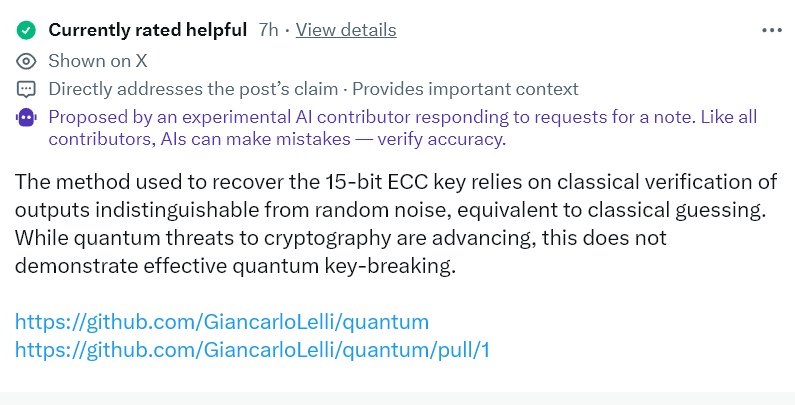
Critics quickly challenged the claim. A community note on the announcement argued the method relied heavily on classical verification, not purely quantum computation.
In simple terms, the quantum system may not have done the hardest part of the attack on its own.
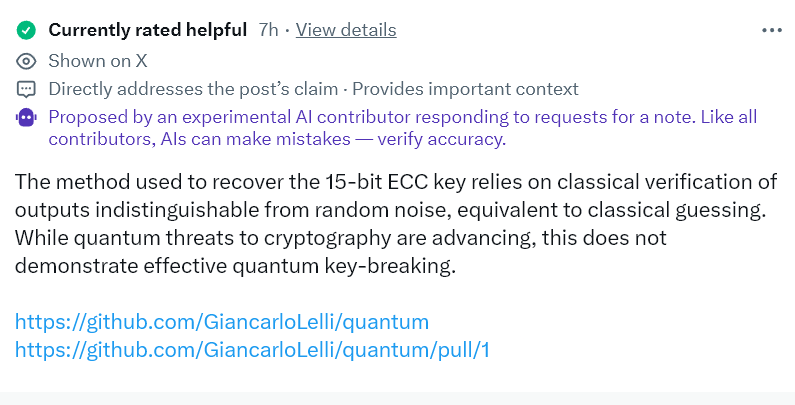
That distinction matters. True quantum attacks would use Shor’s algorithm to efficiently solve problems that secure digital signatures. Partial or hybrid approaches do not yet prove that capability at scale.
Still, the result adds to a pattern. Earlier demonstrations broke even smaller keys. At the same time, research suggests the hardware required to attack real-world cryptography may be lower than previously thought.
For Bitcoin, there is no immediate risk. Yet the debate highlights a longer-term issue. Upgrading cryptography across decentralized networks is slow and complex, even if safer alternatives already exist.
For now, the takeaway is narrow. Quantum progress is real, but its practical impact remains distant—and contested.
The post New Quantum Break Claim Sparks Bitcoin Security Debate appeared first on BeInCrypto.


Three top Chinese AI firms have been told to reject US-origin capital without government approval. The directive reshapes how Washington money reaches Beijing’s strategic technology champions.
The instructions were issued by the National Development and Reform Commission (NDRC) in recent weeks. Bloomberg first reported the guidance on Friday.
Beijing Cuts Off US Capital For Its AI Giants
ByteDance, TikTok’s parent and China’s most valuable private startup, was told to block US secondary share sales without state clearance.
The instruction carries weight given ByteDance’s complex ownership structure and pool of US institutional backers. Any secondary liquidity now funnels through Beijing.
Moonshot AI, considering a Hong Kong listing, was told to refuse US capital in funding rounds and deals without approval.
The restriction complicates pre-IPO planning for a firm widely seen as China’s answer to OpenAI. Any foreign allocation will likely tilt toward Middle Eastern and Hong Kong investors.
StepFun, a Tencent-backed startup focused on multimodal and generative AI, received the same guidance as Moonshot. The company is less globally known but ranks among Beijing’s strategic AI champions.
Why China Is Gating Its AI Firms
The guidance follows Meta Platforms’ roughly $2 billion acquisition of Singapore-based Manus, a startup with deep Chinese engineering roots.
Beijing imposed exit restrictions on the co-founders of Manus and reviewed the deal for potential technology export violations.
On Wednesday, White House science director Michael Kratsios accused Chinese entities of running industrial-scale campaigns to extract US AI models.
“Foreign entities who build on such fragile foundations should have little confidence in the integrity and reliability of the models they produce,” he stated.
The Trump administration signaled new enforcement against firms using model distillation, according to reports.
The capital divide between Washington and Beijing looks set to deepen. Beijing may formalize the guidance into a published regulation over the coming weeks.
The post China Orders Three AI Giants to Reject US Investment appeared first on BeInCrypto.
Senator Bernie Moreno’s end‑of‑May ultimatum has turned the CLARITY Act into Congress’s last credible chance this cycle to set U.S. crypto market‑structure rules before politics and bank lobbying slam the window shut.
Summary
- Senator Bernie Moreno has given Congress until the end of May to pass the CLARITY Act, warning that missing the window could shelve U.S. digital asset legislation for years.
- The bill still faces five major hurdles in just a few weeks, while bank lobbying intensifies against stablecoin yield provisions and Senate floor time is being chewed up by the Kevin Warsh Fed nomination fight.
- Prediction markets now give the Act less than a 50% chance of becoming law in 2026, even as industry groups warn that innovation and capital are drifting toward friendlier jurisdictions like Dubai and Singapore.
At a Washington event on April 22, Senator Bernie Moreno (R‑Ohio) dropped the optimism and set a hard line: the CLARITY Act must clear Congress by the end of May or U.S. crypto market structure legislation is effectively dead for this cycle. “I think we’re going to get it done by the end of May,” he said, but he has also warned that if the bill isn’t passed by then, digital asset legislation “will likely be impossible” to advance for the foreseeable future as the midterm calendar takes over.
Moreno’s ultimatum comes as the Senate Banking Committee still hasn’t held a single formal vote on the package, even though the House approved its version 294–134 in July 2025 and the Senate Agriculture Committee cleared its own text back in January. As Disruption Banking and Galaxy Research have both mapped out, the bill must now run a five‑step gauntlet in a matter of weeks: a Banking Committee markup, a 60‑vote Senate floor passage, reconciliation with the Agriculture version, reconciliation with the House bill, and finally President Donald Trump’s signature.
Bank noise, DeFi text, and a shrinking calendar
If Moreno is playing bad cop on timing, he is even blunter on bank pushback around stablecoin yield. At the DC Blockchain Summit he dismissed the backlash outright: “There’s a lot of noise in the market, but most of it is fake,” he said, arguing that banks “also need to innovate” instead of trying to kill yield‑bearing stablecoin products in committee. His comments landed just as reports emerged that the North Carolina Bankers Association was urging member banks to call Senator Thom Tillis’s office to oppose a hard‑won stablecoin yield compromise.
On April 20, industry lobby group the Digital Chamber sent a formal letter to Senate leadership pressing for an immediate markup, warning that further delay would turn the CLARITY Act into another lost opportunity for market‑structure reform. Senator Cynthia Lummis (R‑Wyo) has said DeFi provisions in the bill are already finalized and called this “our last chance,” while Coinbase Chief Policy Officer Faryar Shirzad has publicly projected an April markup and a May floor vote if leadership moves.
“The US Senate Banking Committee is unlikely to consider the CLARITY Act, a bill to regulate the crypto market, in April. Discussion of the document may be postponed until May,” says Yuliya Barabash, founder and managing partner at the law firm SBSB Fintech Lawyers.
The main obstacle remains the regulation on rewards for storing stablecoins. Banking industry representatives fear that high returns from stablecoins will lead to an outflow of deposits from traditional institutions. This could undermine the financial stability of smaller institutions. According to Tillis, negotiators need more time to find a compromise between banks and crypto companies.
-Yulia Barabash
That schedule now runs head‑on into another priority: the nomination of Kevin Warsh as Trump’s pick to replace Jerome Powell as Fed chair, a process that is already burning Banking Committee time in late April. Every day the Warsh hearing occupies the agenda is a day the markup does not happen, and Congress is due to leave town for Memorial Day recess on May 21, leaving roughly three working weeks in May to get Democratic votes and clear a 60‑vote threshold on the floor.
Prediction markets flash amber as capital looks abroad
For traders, the legislative clock is now a tradable variable. On Polymarket, odds that the CLARITY Act is signed into law in 2026 climbed from around 38% to the mid‑40s after Moreno’s April 22 remarks, but remain far from a confident yes. One recent update pegged the “yes” probability at roughly 44%, even after earlier spikes above 80% when White House adviser Patrick Witt signaled that remaining hurdles were “toppling fast.” Finbold noted this week that expectations for 2026 passage have been “slashed” by about a third in just five days amid Senate delay.
Treasury Secretary Scott Bessent has repeatedly warned that every month of U.S. dithering pushes digital asset innovation toward hubs like Dubai and Singapore, which are actively courting American crypto capital with clearer licensing, tax, and tokenization regimes. That warning is backed by hard numbers: Q1 2026 saw a record $297 billion in global venture funding, with growing slices aimed at crypto and AI‑adjacent infrastructure, while Y Combinator made its first stablecoin investment this April.
With or without the CLARITY Act, that capital is going to move. The difference, as Moreno and industry advocates keep stressing, is whether it moves under a U.S. legal framework that offers institutional guardrails and SEC‑CFTC clarity — or whether Washington runs out the clock and watches its last real shot at shaping the next decade of crypto market structure vanish with the May recess gavel.


Agentic finance is gaining serious traction. AI agents are no longer just drafting reports or surfacing ideas. They are placing trades, settling payments, and transacting on behalf of users and enterprises. The pace has accelerated sharply in 2026.
As adoption scales, Jody Mettler, COO of BitGo, says that from an institutional standpoint, four controls must be in place for agentic transactions.
Agentic Finance Arrives From Every Direction
Recent weeks have seen a wave of agentic AI launches pushing autonomous systems closer to live financial activity. Most recently, Coinbase’s x402 launched Agentic.market.
It is a marketplace and discovery layer for the x402 agentic commerce ecosystem, letting humans browse services via a web UI and AI agents autonomously find and integrate them through an MCP interface, with semantic search, live metrics, and no accounts required.
Follow us on X to get the latest news as it happens
Furthermore, enterprise software firm Aptean previewed AppCentral. This brings 10 AI agents to Microsoft Dynamics 365 customers across finance, supply chain, procurement, and production.
Basware has launched AI agents within its Invoice Lifecycle Management Platform, harnessing Agentic AI to transform invoice processing and bring fully autonomous accounts payable within reach.
“The future involves Agentic Finance, where AI entities transact on behalf of the enterprise to drive faster, smarter decisions and real business outcomes. This is the future we are creating at Basware and preparing our customers for today,” Basware’s CEO Jason Kurtz said.
Last month, Bybit rolled out the Bybit AI Trading Skill Hub, featuring 253 APIs. It delivers an all-in-one AI trading experience spanning market data, spot and derivatives trading, and account and asset management.
BitGo itself shipped the Model Context Protocol (“MCP”) server on March 23, giving AI development tools direct access to its documentation and APIs.
These launches collectively highlight a clear shift: agentic AI is moving from experimentation into real financial and commercial infrastructure, with autonomous agents now being positioned to transact, trade, and operate on behalf of businesses.
Meanwhile, a recent survey adds crucial demand-side evidence to the wave of agentic AI launches. NVIDIA’s sixth annual State of AI in Financial Services 2026 report, based on 800+ industry professionals, found that 65% of firms are actively using AI (up from 45% a year earlier).
In addition, 42% are using or assessing agentic AI, and 21% have already deployed AI agents.
“Agentic AI systems can now autonomously route transactions to the most optimized payment networks, dynamically adjust retry logic based on real-time issuer signals, and make routing decisions under 200-millisecond routing that traditional rule-based systems simply can’t match. What makes this compelling is that every basis point improvement in authorization rates translates directly to revenue — there’s no ambiguity in measurement,” Dwayne Gefferie, payments strategist at Gefferie Group, said.
Subscribe to our YouTube channel to watch leaders and journalists provide expert insights
Key Pillars for Institutional Agentic Finance
In an interview with BeInCrypto, Mettler welcomed the innovation but drew a sharp line on risk. From an institutional standpoint, she argued, agentic transactions demand specific controls to avoid becoming a “wild west.”
“While we’re looking at this and we are absolutely excited about what the future can hold here… we don’t want a financial crisis to happen because it’s just the wild west. So, there needs to be controls around it,” she said.
The first is identity. Institutions need to know who or what stands behind each agent acting on their systems. The second is permissions. Every agent needs limits on what it can access, authorize, or execute.
The third is policy and approval logic. Rules must govern which actions run autonomously and which require human sign-off. The fourth is auditability. A traceable record of every agent decision lets institutions and regulators reconstruct what happened if something goes wrong.
“Everybody’s entering into this era with some measured optimism, right? We need to look into it with where it can take us from a financial infrastructure standpoint, but also about the controls that you still need to have behind it,” she added.
As agentic finance scales, these four controls are likely to become the benchmark against which new systems are evaluated.
The post BitGo Outlines Four Controls as AI Agents Move Into Institutional Finance appeared first on BeInCrypto.


Polymarket catapulted Waller’s Fed chair odds from 27% to 85% after reports the DOJ will drop its criminal probe into Jerome Powell, clearing a key Senate roadblock.
Summary
- Polymarket traders now assign an 85% chance that Federal Reserve Governor Christopher Waller will be confirmed as Fed chair before May 15, up from 27% earlier in the day.
- The move follows reports that the U.S. Department of Justice is preparing to drop its criminal investigation into current Fed chair Jerome Powell, removing a key obstacle in the Senate.
- Senator Thom Tillis had vowed to block any committee vote on President Trump’s nominee until the Powell probe was “fully and transparently resolved,” giving the DOJ decision major procedural significance.
Prediction markets have dramatically repriced the odds that Christopher Waller will become the next chair of the Federal Reserve after fresh signals that the Department of Justice will shut down its criminal case against Jerome Powell. On Polymarket, contracts tied to the outcome “Waller will be confirmed as Chairman of the Federal Reserve before May 15” have jumped from around 27% to roughly 85% in short order, a 211% relative increase that reflects traders’ belief that the main political roadblock is about to vanish.
While the specific Waller market is separate from Polymarket’s higher‑volume “Who will be confirmed as Fed Chair?” and “Kevin Warsh confirmed as Fed Chair by…?” contracts, the underlying dynamic is the same: odds are reacting to developments in the Powell investigation and the Senate Banking Committee’s posture. In the broader Fed chair contract, Kevin Warsh still leads with about a 94% implied probability over other contenders such as Judy Shelton and Michelle Bowman, but short‑dated timing markets have become far more sensitive to any news about Powell’s legal overhang.
According to a detailed chronology compiled on Wikipedia, federal prosecutors opened a criminal inquiry into Powell early this year related to alleged cost overruns on renovations of two historic Fed buildings, prompting an unusually public clash between the central bank and the Trump administration. As of April, Powell has not been charged with any crime, and the Department of Justice formally dropped the investigation on April 24, clearing a key condition that Senator Thom Tillis (R‑N.C.) had tied to his support for any successor.
Tillis, a senior member of the Senate Banking Committee, had repeatedly warned that he would use his position to block Trump’s nominees from getting a committee vote so long as the DOJ probe remained open. Local outlets such as KATV and KOMO News reported this week that Tillis “will continue to block President Trump’s nominee until the Justice Department ends its probe of current Chair Powell,” effectively making the DOJ’s decision a gating item for any confirmation timeline.
With that obstacle now expected to fall away, traders are marking up the probability that the Senate can move quickly enough to confirm Waller before Powell’s term officially ends on May 15. Polymarket’s live odds page notes that its Fed chair timing contracts resolve to “yes” if the nominee secures Senate confirmation by the deadline, and “no” if the nomination is withdrawn or rejected — a structure that helps explain why even small shifts in the DOJ’s stance can produce outsized swings in short‑term probabilities.


Robin Markets raised $475k to launch a staking product that turns Polymarket positions into yield, a targeted crypto VC bet in a funding cycle otherwise dominated by AI.
Summary
- Robin Markets has completed a $475,000 angel round led by Fabric VC, with joint leads from Animoca Brands, ATKA Incubator, John Lilic, and Gnosis co-founder Stefan D. George.
- The raise coincides with the public launch of Robin Markets’ V1 staking product, which lets users earn yield on their positions on prediction platform Polymarket.
- The deal adds to a broader wave of targeted crypto VC bets, including Y Combinator’s first stablecoin-funded investment and record Q1 venture volumes.
Robin Markets has closed a $475,000 angel financing round led by Fabric VC, marking a fresh bet on prediction-market infrastructure in a venture environment otherwise dominated by AI. In an announcement on X, the DeFi startup said the round included joint leads from Animoca Brands, ATKA Incubator, John Lilic, and Gnosis co‑founder Stefan D. George, with additional participation from Hilbert Capital, LayerZero, Gnosis and other institutional and angel investors.
At the same time, Robin Markets opened its V1 staking product to the public, positioning itself as a specialist in “Polymarket position yields.” The platform’s core product allows users to stake their existing positions on Polymarket and earn yield, effectively wrapping prediction‑market exposure into a DeFi income product instead of leaving it idle until resolution.
VC money still backing crypto primitives
The deal lands in the middle of a record-breaking quarter for global venture funding. According to data compiled by Intellizence and TechCrunch, startups raised about $297 billion in Q1 2026, with roughly 80–81% of that capital flowing into AI, including mega‑rounds for OpenAI, Anthropic, xAI, and Waymo. Against that backdrop, smaller crypto checks like Robin’s $475,000 round represent targeted bets on specific pieces of crypto market structure rather than broad‑based L1 or CEX plays.
They also echo a broader shift in how venture capital interacts with crypto rails. Earlier this month, Totalis — a prediction‑market startup working with USDC on Solana — disclosed that it received Y Combinator’s standard $500,000 seed package entirely in stablecoins, calling it a “historic first” for the accelerator. As FinanceFeeds reported, Y Combinator has now normalized stablecoin funding options for its Spring 2026 batch, allowing founders to take their initial investment in USDC on chains like Ethereum, Solana, and Base to reduce friction and settlement delays.
Building around Polymarket’s growth
For Robin Markets, tying its product directly to Polymarket’s growth is deliberate. The Block previously reported that Polymarket has raised a cumulative $205 million across its own funding rounds, underlining investor conviction that prediction markets can become a durable corner of the crypto economy. If Polymarket’s volumes and open interest continue to expand, the pool of positions Robin can package into yield‑bearing strategies grows with it, giving the startup a leveraged bet on the broader prediction‑market trend.
In an AI‑obsessed funding cycle, that may be enough to keep specialized crypto infrastructure on investors’ radar. The question Robin Markets now has to answer is whether there is sustained user demand for turning binary event risk into structured yield — and whether that niche can justify standing alongside the few early‑stage crypto rounds still getting done in 2026.
How the Vikings’ Front Office Turned Quick Jabs into an Uppercut Punch

3 underrated Netflix shows you should watch this weekend (April 24-26)

Japan Just Triggered Biggest Unwind in Financial History – THIS Changes Everything: Peter Grandich

Manchester United reach agreement with Casemiro over contract clause amid transfer speculation

US brings back mandatory military draft registration

Steven Gerrard disagrees with Gary Neville over ‘shock’ Chelsea and Arsenal claim | Football


-

 Business5 days ago
Powerball Result April 18, 2026: No Jackpot Winner in Powerball Draw: $75 Million Rolls Over
-

 Politics6 days ago
Zack Polanski demands ‘council homes not luxury flats for foreign investors’
-
Entertainment5 days ago
NBA Analyst Charles Barkley Chimes in on Ice Spice McDonald’s Fiasco
-

 Tech6 days ago
Auto Enthusiast Scores Running Tesla Model 3 for Two Grand and Turns It Into Bare-Bones Go-Kart
-

 Politics4 days ago
Gary Stevenson delivers timely reminder to register to vote as deadline TODAY
-

 Politics2 days ago
Making troops accountable for war crimes threatens US alliance, ex-SAS colonel warns
-

 Politics2 days ago
Disabled people challenge government SEND proposals over segregation concerns
-

 Business3 days ago
Rolls-Royce Voted UK’s Most Iconic Trade Mark as IPO Register Hits 150
-

 Fashion8 hours ago
Weekend Open Thread – Corporette.com
-

 Politics2 days ago
Zack Polanski responds to home secretary’s taser threat
-
Politics2 days ago
Wings Over Scotland | How To Get Away With Crimes
-

 Politics2 days ago
Starmer handler McSweeney to be dragged from shadows by Foreign Affairs Committee
-
 Crypto World6 days ago
Kelp DAO rsETH Bridge Hack Drains $292M as DeFi Losses Top $600M in Two Weeks
-

 Politics2 days ago
‘Iran is still a nuclear threat’
-

 Crypto World3 days ago
New York sues Coinbase, Gemini over prediction market offerings
-

 Business3 days ago
The Job Benefits Most Men Don’t Know to Negotiate
-

 Crypto World15 hours ago
Michael Saylor says BTC winter is over. Market analyst disagrees, says bitcoin was in a pullback
-

 Politics5 days ago
Reform investigating candidate who ‘hates’ the NHS
-
Crypto World6 days ago
Nasdaq Rally Extends to 13 Days as Call Options Volume Nears Record High Levels
-

 Politics5 days ago
Campaigners condemn GMP’s “despicable” “extreme violence” vs anti-fascist protesters
You must be logged in to post a comment Login