
Crypto World
Senate Blocks Iran War Powers Vote 46-51

The Senate voted 46 to 51 on April 22 to defeat a war powers resolution that would have directed the president to withdraw US armed forces from hostilities against Iran without congressional authorization, marking Democrats’ fifth consecutive failure to advance the measure since the conflict began on February 28.
Summary
- The Senate voted 46-51 to defeat a motion to discharge the Iran war powers resolution, failing by five votes to reach the threshold needed to advance.
- Senator Rand Paul was the only Republican to vote in favor of the resolution, while Senator John Fetterman was the only Democrat to vote against it, both consistent with their positions in all four prior votes.
- Democrats have pledged to force the same vote weekly as long as US forces remain engaged in Iran without formal congressional authorization.
The Senate defeated the war powers resolution 46 to 51 on April 22, blocking for the fifth consecutive time a Democratic-led effort to require the president to seek congressional authorization before continuing military operations against Iran. The vote came one day after Trump extended the ceasefire indefinitely, but with no change in how any senator voted from the four prior attempts.
Senate Iran War Powers Vote Fails as Both Parties Hold Their Lines
Senator Tammy Baldwin of Wisconsin, who sponsored the resolution, argued on the Senate floor that Trump had pledged during his campaigns not to begin new foreign wars and that the conflict with Iran bore “many similarities to the Iraq war,” which ran from 2003 to 2011. “In both wars, we had zero plans for the days to come and failed to outline our specific goals. In both wars, we had zero strategy to get out. And in both wars, we had servicemembers dying overseas for a cause that Americans did not support,” Baldwin said. A Reuters and Ipsos poll of 4,557 US adults cited in congressional briefings found that 56% of Americans now oppose the war, including 40% of Republicans. The War Powers Resolution of 1973 requires US forces to be withdrawn from hostilities within 60 days unless Congress formally authorizes continued military engagement, a deadline that Stars and Stripes noted is set to arrive on April 28, potentially triggering a constitutional confrontation over executive war authority if Democrats force the issue.
The Political Math Behind the 46-51 Split
Senate Minority Leader Chuck Schumer said at the floor that “every day we hear new promises from the Trump administration, that victory has been achieved, that peace is at hand, that the costs are starting to come down, and every day we see the opposite.” Senators Chuck Grassley of Iowa, David McCormick of Pennsylvania, and Mark Warner of Virginia were absent from the vote. Three absent Republicans could have theoretically changed the outcome, but none had indicated prior to the session that they were wavering. Senator Edward Markey of Massachusetts, who voted in favor, stated after the vote that thirteen US service members and over five thousand civilians across the Middle East have died in the war and that Congress never authorized it. Democrats have vowed to force the vote again next week, and every week after, as long as hostilities continue.
What the Vote Means for Crypto and Energy Markets
The Senate’s fifth rejection of the war powers resolution confirms that Trump retains full executive authority to continue military and naval operations against Iran without any formal legislative constraint, a dynamic that keeps the Strait of Hormuz situation and its macro implications fully in the president’s hands. As crypto.news has tracked, crypto prices have been trading in direct response to every Iran diplomatic signal, with Bitcoin falling 2% to $77,593 on April 23 as stalled peace talks and rising oil prices weighed on risk sentiment. The Senate’s unchanged position means that any resolution to the conflict remains entirely dependent on executive diplomacy rather than congressional pressure, leaving markets exposed to the same headline-by-headline volatility that has defined Bitcoin and energy pricing since the war began. As crypto.news documented, Iran’s proposal to charge oil tankers a $1 per barrel Bitcoin toll at the Strait of Hormuz had already directly wired the conflict into crypto market mechanics, and the Senate’s continued support for executive war authority ensures that dynamic remains in place.
Democrats are expected to bring the war powers resolution back to a Senate floor vote as early as next week, with the outcome widely expected to mirror the 46-51 result that has held across all five attempts.

US spot Bitcoin ETFs have logged eight consecutive days of net inflows totaling $2.1 billion through April 23, the longest inflow streak since the nine-day October 2025 run that carried Bitcoin to its $126,000 all-time high, with BlackRock’s IBIT responsible for roughly 75% of all capital entering the category.
Summary
- US spot Bitcoin ETFs recorded eight straight days of net inflows totaling $2.1 billion through April 23, per SoSoValue data, the longest streak since October 2025.
- BlackRock’s IBIT captured approximately 75% of all inflows during the streak, adding $1.4 billion and pushing its total Bitcoin holdings to 809,870 BTC.
- Bitcoin climbed 12% from $68,000 to $77,000 during the same period, with ETF flows and the price move tracking almost perfectly in parallel.
US spot Bitcoin ETFs have now logged eight straight days of net inflows totaling $2.1 billion through April 23, according to SoSoValue data cited by 247 Wall St., which reported the streak as the longest since the nine-day October 2025 run that took Bitcoin to its all-time high of $126,198. April 23 alone brought $223.21 million in net inflows, with BlackRock’s IBIT contributing $167.49 million, roughly 75% of the day’s total.
Bitcoin ETF Inflows BlackRock IBIT Streak Matches Pre-ATH Pattern
As crypto.news reported, IBIT led April 23 flows with $167.5 million while funds from Ark Invest and 21Shares, Morgan Stanley, and Grayscale also recorded positive flows. Fidelity’s FBTC was the one meaningful source of outflows at $16.93 million, while Bitwise and VanEck also saw modest redemptions. IBIT now holds 809,870 BTC, representing approximately 62% of total assets held across all US-listed spot Bitcoin ETFs. The fund’s net assets have reached $63.14 billion, placing it in the top 1% of all US-listed ETFs by inflows, a ranking that covers the entire fund universe, not just crypto products. Bitrue Research Lead Andri Fauzan Adziima noted that Bitcoin dominance has moved above 60% for the first time this year, a signal that capital is rotating toward Bitcoin specifically rather than the broader digital asset market.
What Is Driving the Eight-Day Inflow Streak
The streak began in mid-April following Trump’s extension of the Iran ceasefire, which lifted risk sentiment broadly and pushed Bitcoin from approximately $68,000 toward $78,000. As crypto.news documented, Bitcoin has gained roughly 11% over the past 30 days as ETF demand returned alongside improved macro sentiment, with the products adding $335.8 million on a single day during the early stages of the streak. The ETF flows and Bitcoin’s price move have tracked almost perfectly in parallel, with the funds absorbing roughly 19,000 BTC over the eight days at a time when miners produced approximately 2,100 BTC, meaning institutional demand absorbed about nine times new supply during the streak. Cumulative ETF net inflows since launch now sit at $58 billion with total assets at $102 billion, representing approximately 6.5% of Bitcoin’s total market cap.
Why the Comparison to October 2025 Matters
The last time Bitcoin ETFs logged a comparable inflow streak was October 2025, a nine-day run that preceded Bitcoin’s move to its all-time high of $126,198. As crypto.news tracked, April 17 was the most active single day of the current cycle, generating over $663 million in net inflows into spot Bitcoin ETFs with IBIT absorbing $907.97 million across the full week of April 13 to 17, accounting for 91% of all Bitcoin ETF flows that week. Whether the current eight-day streak leads to a similar breakout or fades as the Iran ceasefire situation remains unresolved is the central question now facing Bitcoin traders, with the FOMC meeting on April 28 and 29 representing the next significant macro test for the rally.
April’s total Bitcoin ETF inflows of $2.43 billion are already nearly double March’s $1.32 billion haul, with the streak positioning the category for its strongest month since the October 2025 all-time high run.

Historically, MSTR’s outperformance signals traders are taking more risk, betting Bitcoin’s worst drawdown phase may be over.

South Africa’s draft capital flow rules would bring crypto under exchange controls, with declaration duties, transaction limits and tougher penalties.

Cointelegraph is committed to providing independent, high-quality journalism across the crypto, blockchain, AI, and fintech industries.
All news, reviews, and analyses are produced with full journalistic independence and integrity. For more details on our standards and processes, please read our Editorial Policy.


DeFi heavyweights urge the SEC to turn its temporary “non‑custodial UI” safe harbor into binding broker rules that shield neutral infrastructure from creeping regulation.
Summary
- The Humanity Foundation has overhauled its $H vesting plan, giving investors until April 26 at 09:00 UTC to choose between a three‑year extended vest or a steeply discounted one‑time unlock in June.
- Early investor Trix Ventures has publicly opted for the 3:10 discounted immediate unlock, swapping 16,666,666 tokens for 5,000,000 $H, a 70% haircut that still implies roughly a 7x return on its seed‑stage entry.
- The decision sets up a classic tokenomics stress test: a visible June 25 unlock cliff, quant funds watching Sablier contracts on‑chain, and a Mastercard‑backed identity protocol trying to survive concentrated sell pressure in an AI‑driven market.
Humanity Foundation has effectively put more than 100 investors on the clock. By April 26 at 09:00 UTC, they must pick one of two poison pills: accept a lengthened vest with the cliff pushed to September 25, 2026 and then drip out linearly over 12 quarters, or take a 3:10 discounted immediate unlock that replaces 16,666,666 $H with 5,000,000 $H to be fully released on June 25, 2026.
Trix Ventures, an early backer, didn’t wait. In a public post, the firm disclosed that it chose the discounted unlock, locking in a 70% nominal cut to its allocation but still targeting roughly a 7x return versus its entry at around a $60 million project valuation. In other words, they are sacrificing upside optionality in exchange for hard liquidity in this cycle — and showing the rest of the cap table where professional money is leaning.
Tokenomics meets on‑chain identity and AI
Under the new scheme, any investor who chooses the extended plan is effectively tying capital to Humanity Protocol for another three years, with quarterly unlocks stretching into 2029. In a market that just watched projects like Starknet and ApeCoin get crushed after large unlocks — STRK has traded more than 95% below its peak after a long run of 1.27%‑per‑month releases, while APE bled roughly 77% over seven months as VC and foundation tokens hit the market — that is a tough sell.
The immediate‑unlock path has its own obvious problem: a giant, transparent cliff. Humanity uses Sablier‑style on‑chain vesting, which means the June 25 unlock node is visible to every quant desk on the planet. Expect three things in the two‑month window: basis traders shorting $H or building delta‑neutral hedges into the date, market makers quietly pulling bid depth ahead of the event, and funds front‑running each other to exit before everyone tries to squeeze through the same tiny door. In that scenario, the realized exit value for “discounted unlock” investors can end up being far less than 10% of the nominal mark, no matter how good the paper 7x looks.
What makes Humanity interesting — and why this vesting drama matters for crypto more broadly — is that it sits at the intersection of two dominant narratives: AI and on‑chain identity. The project has integrated Mastercard’s Open Finance technology into its Human ID platform, appeared on Nasdaq screens alongside the payments giant, and pitches itself as privacy‑preserving infrastructure for verifying real humans across Web2 and Web3. Chainalysis and others have already flagged deepfake‑driven fraud and bot swarms as structural problems for crypto rails; if you believe AI‑generated content and automated accounts are only going to grow, demand for robust, composable, on‑chain KYC/identity is a rational bet.
Liquidity now vs. optionality later
Analysts watching the unlock split the choice cleanly: June 25 is “safer” in the sense that realized dollars today are worth more than hypothetical distribution three years out, especially when protocol survival, team retention, and regulatory risk are all uncertain. But structurally, this is not just about one unlock. It’s about whether early investors in a Mastercard‑endorsed identity protocol are willing to ride the full AI × identity thesis through a full market cycle, or whether the current environment — where AI soaks up most VC dollars and mid‑cap tokens are repeatedly punished on unlock — forces them to cash out and move on.
The Humanity Foundation has, deliberately or not, turned that question into a live on‑chain experiment. How many funds follow Trix into the discounted unlock, how aggressive the hedging becomes, and how much $H can absorb when June 25 hits will tell you a lot about the actual risk appetite for Web3 infrastructure that sits in AI’s shadow rather than at its center.

Pi Network co-founder Nicolas Kokkalis will take the stage at Consensus 2026 in Miami on May 7, joining a panel titled “How to Prove You’re Human in an AI World (Without Doxing Yourself)” at the Convergence Stage, as Pi positions its KYC-verified user base as a direct answer to one of the most urgent problems in the AI era.
Summary
- Nicolas Kokkalis will speak at Consensus 2026 in Miami on May 7 from 10:15 to 10:45 AM EDT on the challenge of verifying human identity online without exposing private data.
- Co-founder Chengdiao Fan will separately speak on May 6 on aligning Web3, AI, and blockchain for utility, with Pi Network listed as an official sponsor of the event.
- The Consensus appearance arrives as Pi prepares for the April 27 Protocol 22 node upgrade deadline and the May Protocol 23 smart contract launch.
Pi Network has announced that co-founder Nicolas Kokkalis will speak at Consensus 2026 in Miami on May 7, joining a panel that addresses how individuals can prove they are real humans online without being forced to expose personal identity data. Co-founder Chengdiao Fan will separately speak on May 6 in a session titled “Aligning Web3, AI, and Blockchain for Utility.” Pi Network is listed as an official sponsor of the event, which runs from May 5 to 7 and is expected to draw over 20,000 attendees.
Pi Network Consensus 2026 Appearance Frames Identity Verification as Its Core Differentiator
The panel Kokkalis is joining directly addresses one of the fastest-growing problems in the AI era: AI systems can now generate convincing fake profiles, post content, and interact across platforms in ways that are nearly indistinguishable from real human behavior. For platforms, developers, and digital communities, the challenge is confirming that a user is a real person without requiring them to hand over sensitive identity documents. As crypto.news reported, Pi Network argues that its network of KYC-verified users, which has now surpassed 18 million verified participants, gives it a structural advantage in this space that pure code-based blockchains cannot replicate. The project has been building verified identity infrastructure since its founding in 2019, long before the current AI-driven identity crisis made the problem broadly visible to the industry.
Why the Timing of the Consensus Appearance Matters
Pi’s decision to step onto the Consensus stage at this moment is deliberate. As crypto.news documented, the project is simultaneously navigating a mandatory April 27 Protocol 22 upgrade deadline, the launch of its PiRC1 Token Design Framework, and preparation for the Protocol 23 smart contract release expected in May. Kokkalis and Fan appearing at Consensus 2026 directly after the Protocol 22 deadline frames the project as transitioning from infrastructure buildout to ecosystem activation. The Consensus 2026 timing also places Pi in conversations with the largest institutional, developer, and policy audiences in the crypto world at a moment when identity, AI, and blockchain are converging into a single discussion that Pi’s architecture was specifically designed to address.
What Pi’s Identity Layer Means Beyond Crypto
The broader significance of Pi’s Consensus 2026 appearance extends beyond the crypto industry. As crypto.news noted, Pi competes directly with Worldcoin and Humanity Protocol in the proof-of-personhood space, a category that has attracted significant venture capital attention as AI-generated content proliferates. Pi’s mobile-first KYC system, which uses a combination of human reviewers and AI-assisted fraud detection, has processed over 526 million verification tasks across its network. The project argues that the ability to verify human presence without exposing private data is not just a blockchain use case but the foundational infrastructure challenge for the next generation of the internet. Whether the Consensus stage translates that argument into measurable developer adoption and institutional recognition will be one of the clearest signals yet of whether Pi’s long-term thesis is gaining traction beyond its existing community.
Pi Network’s PI token was trading at approximately $0.1687 as of April 23, down roughly 94% from its February 2025 all-time high of $2.99, with the market yet to price in the project’s recent technical and institutional progress.


OpenAI released GPT-5.5 on April 23, its newest frontier model and the company’s most capable agentic system to date, designed to accept a messy multi-part task and plan, execute, and complete it without requiring step-by-step human guidance.
Summary
- OpenAI released GPT-5.5 on April 23, 2026, positioning it as a new class of agentic intelligence built to handle autonomous, multi-step computer work with minimal instruction.
- The model scores 82.7% on Terminal-Bench 2.0, 84.9% on GDPval across 44 knowledge work occupations, and 78.7% on OSWorld-Verified, which tests autonomous operation of real computer environments.
- GPT-5.5 replaces GPT-5.4 as the default model for ChatGPT Plus, Pro, Business, and Enterprise users, with a Pro variant available for higher-accuracy, longer-horizon tasks.
OpenAI released GPT-5.5 on April 23, billing it as a “new class of intelligence for real work” that marks a deliberate shift away from chatbot positioning toward autonomous agentic execution. The model is now available for ChatGPT Plus, Pro, Business, and Enterprise users, with a GPT-5.5 Pro variant available for heavier workloads, just six weeks after GPT-5.4 launched.
OpenAI GPT-5.5 Agentic Model Reframes AI as a Worker, Not a Chatbot
The core pitch for GPT-5.5 is capability without hand-holding. OpenAI described the model as being able to “look at an unclear problem and figure out what needs to happen next,” with Greg Brockman, OpenAI co-founder and president, saying the model is “way more intuitive to use” and can carry significantly more of the work itself compared to its predecessor. On Terminal-Bench 2.0, a benchmark testing complex command-line tasks requiring planning, iteration, and tool coordination, GPT-5.5 scores 82.7%, ahead of Claude Opus 4.7 at 69.4%. On GDPval, which measures agent performance across 44 occupations of knowledge work, it scores 84.9%. On OSWorld-Verified, a benchmark testing whether a model can autonomously operate real computer environments, it reaches 78.7%. OpenAI Chief Research Officer Amelia Glaese said GPT-5.5 is “definitely our strongest model yet on coding, both measured by benchmarks and based on the feedback that we’ve gotten from trusted partners.” The model also runs at the same per-token latency as GPT-5.4 while using significantly fewer tokens to complete the same tasks.
A Deliberate Positioning Shift From Chat to Execution
OpenAI is no longer selling a chat completion API with GPT-5.5. The language used across the launch is uniformly about outcomes rather than quality metrics. The company describes GPT-5.5 as capable of handling coding, online research, data analysis, document creation, spreadsheet work, and software operation as a continuous workflow rather than a series of isolated prompts. API pricing reflects the same message: standard GPT-5.5 is priced at $5 per million input tokens and $30 per million output, while GPT-5.5 Pro is $30 per million input and $180 per million output, pricing designed for agent deployments where long context and high token generation per task are standard requirements. As crypto.news reported, OpenAI has been systematically expanding into professional workflow infrastructure, having launched a financial-services AI stack in March 2026 that connects ChatGPT to FactSet, Third Bridge, Excel, and Google Sheets. GPT-5.5 is the model that makes those integrations genuinely autonomous rather than merely interactive.
What GPT-5.5 Means for the Competitive Landscape
The launch arrives as OpenAI competes directly with Anthropic’s Claude Mythos Preview, a cybersecurity-focused model that scored 82.0% on Terminal-Bench 2.0 compared to GPT-5.5’s 82.7%. OpenAI was explicit that GPT-5.5 does not exceed its Critical cybersecurity risk threshold but meets the High risk classification, requiring enhanced safeguards against misuse in bio and cyber contexts. As crypto.news documented, OpenAI is projecting $14 billion in losses in 2026 while targeting $174 billion in revenue by 2030, making the shift toward agentic AI and enterprise workflow ownership the fastest available path to the kind of sustained revenue that would make those projections credible. As crypto.news tracked, the company crossed $10 billion in annual recurring revenue in mid-2025 and is expected to approach $30 billion in 2026 as agentic products capture a larger share of the revenue mix.
Sam Altman posted on X the day of the launch that OpenAI “believes in iterative deployment” and described GPT-5.5 as already a smart model with rapid improvements expected, framing the release as a foundation rather than a ceiling.
Aurelion, a Nasdaq-listed company building a Tether Gold-backed treasury, has allocated 10,000 units of the token, worth about $48 million, to a newly launched protocol designed to generate yield on tokenized gold.
The DeFi protocol, XAUE, was introduced earlier this week by the Aurise Foundation as a treasury layer for Tether Gold, allowing tokenized gold to be used in yield-generating strategies while maintaining exposure to the underlying asset.
Aurelion is the rebranded form of wealth and asset manager Prestige Wealth and is positioning Tether Gold as a primary reserve asset. In October 2025, the company raised $150 million in financing, including a $100 million private investment in public equity and a $50 million debt facility, to support the strategy.
According to the Aurise Foundation’s initial announcement on Wednesday, Antalpha, a digital asset financial services company, was also among ecosystem partners that committed a combined 16,052 XAUT, or around $76 million, to seed the protocol.
XAUE generates yield through strategies such as institutional lending and quantitative trading, with returns reflected in an increase in the gold backing per token rather than being distributed separately.
The protocol operates on Ethereum and uses a fixed-supply model, in which deposited XAUT is converted into XAUE at a 1,000:1 ratio. Under this structure, reserves may grow over time as yield accrues while token supply remains unchanged.
Users can redeem XAUE for the underlying gold-backed tokens. Access is limited to whitelisted, KYC/KYB-verified institutional participants in eligible jurisdictions, the foundation said.
Aurelion said it will hold a total of 33,318 units of Tether Gold following the allocation, including 10,000 units deployed to XAUE and 23,318 units held outside the protocol.
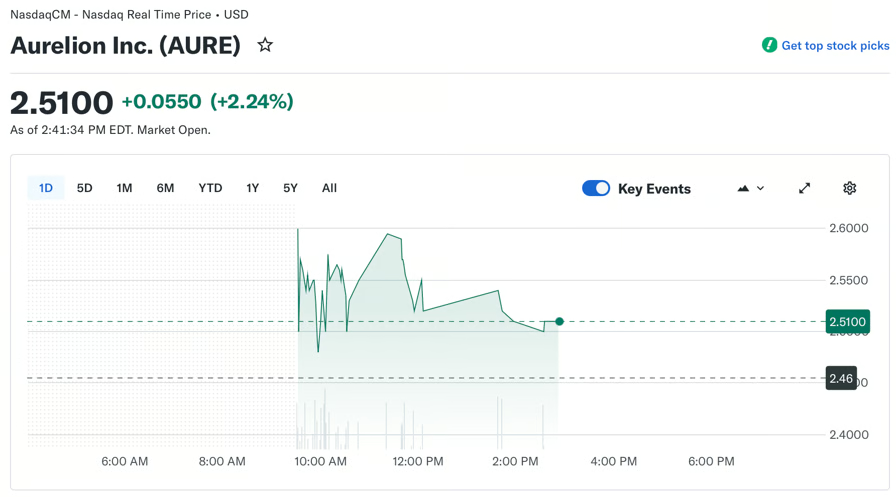
The price of Aurelion (AURE) stock was up about 2.6% in midday trading, according to Yahoo Finance data.
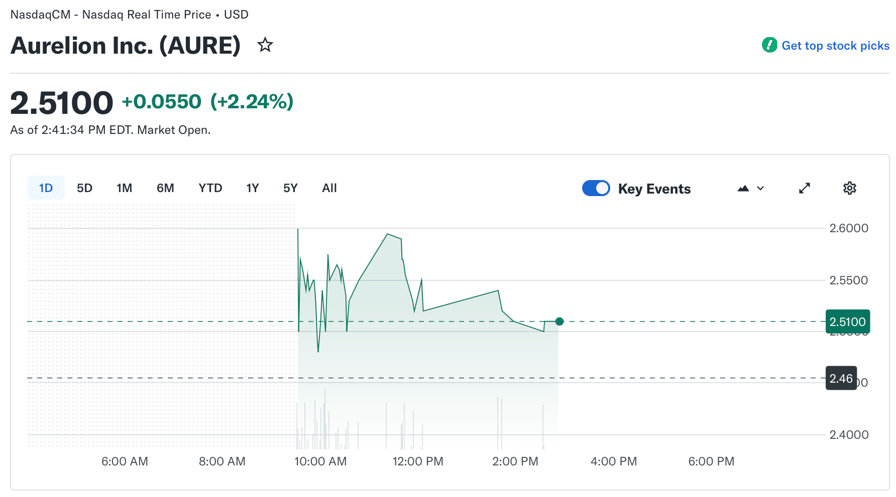
Aurelion stock price. Source: Yahoo Finance
Related: Bitcoin ETFs could eventually be larger than gold ETFs: Analyst
Tokenized gold moves toward yield-generating structures
Gold has traditionally been considered a non-yielding asset, offering price exposure without generating income. But tokenization, the process of representing real-world assets like gold on blockchain networks, is beginning to introduce new structures that enable yield while maintaining exposure to the underlying commodity.
In March, crypto exchange Bybit launched a yield-bearing product tied to Tether Gold, allowing users to earn interest on tokenized gold while maintaining exposure to the underlying asset.
That same month, tokenization platform Theo introduced a yield-bearing model backing its gold-linked stablecoin thUSD, using deposited funds to purchase tokenized gold while simultaneously shorting gold futures to hedge price exposure.
In April, DeFi protocol Altura introduced an onchain gold arbitrage strategy that puts user deposits into short-duration physical gold trades, aiming to generate returns from price discrepancies rather than long-term exposure to bullion.
Tokenized commodities are largely concentrated in gold-backed assets, which typically provide price exposure without yield. Data from RWA.xyz shows the sector at roughly $5.25 billion, with Tether Gold and Paxos Gold accounting for the majority of the market.
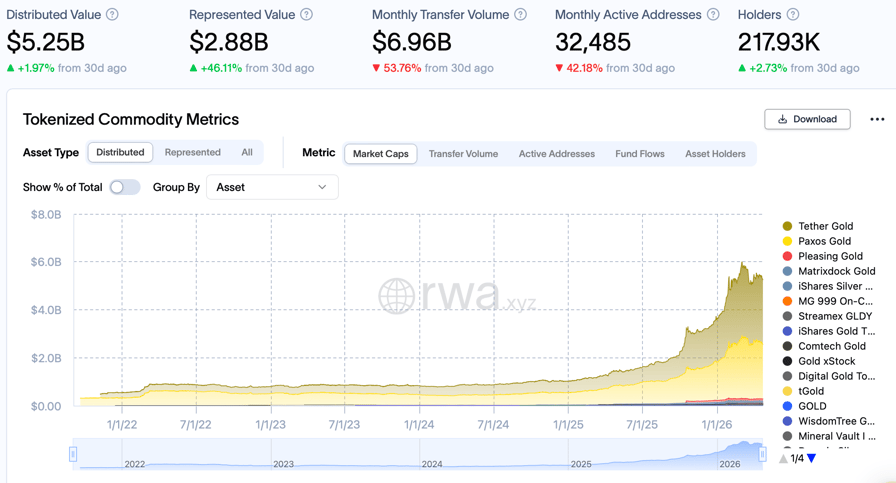
Tokenized commodity market size. Source: RWA.xyz
Magazine: Adam Back says current demand is ‘almost’ enough to send Bitcoin to $1M


As HSBC, Lloyds, and JPMorgan all commit to tokenized deposits on the Canton Network, Digital Asset Chief Product Officer Bernhard Elsner explains why the instrument is structurally distinct from stablecoins and how Canton’s architecture eliminates bridge risk rather than simply managing it.
Summary
- Tokenized deposits carry the full legal status of a bank deposit, with capital requirements, supervisory oversight, and deposit insurance that stablecoin holders do not receive.
- HSBC completed a tokenized deposit pilot on Canton, Lloyds issued the first tokenized GBP on a public blockchain using Canton, and JPMorgan is bringing JPM Coin to Canton in a phased 2026 rollout.
- Canton’s atomic composability allows tokenized deposits to move across applications without bridge risk, enabling true Delivery versus Payment settlement where the cash leg and securities leg settle simultaneously.
The tokenized deposit market is accelerating. HSBC has completed a pilot simulating the issuance and atomic settlement of its Tokenised Deposit Service on the Canton Network. Lloyds Bank issued tokenized sterling deposits on Canton and used them to purchase a tokenized gilt from Archax. JPMorgan’s Kinexys unit is bringing JPM Coin natively to Canton in a phased integration throughout 2026. Behind all three deals is Digital Asset, the creator of the Canton Network, which as crypto.news reported positions the network as the only public layer one blockchain purpose-built for institutional finance, combining configurable privacy, atomic composability, and regulatory compliance in a single infrastructure layer.
Tokenized Deposits Canton Network Deployments Raise a Core Question: What Makes These Different From Stablecoins?
Bernhard Elsner, Chief Product Officer at Digital Asset, told crypto.news that the distinction is fundamental and drives everything else about how the instrument behaves. “Tokenized deposits are a digital representation of a commercial bank deposit on a blockchain or other DLT platform. Unlike many other digital assets, these tokens are the bank’s own liability to the holder, carrying the same legal status as a pound or dollar sitting in a traditional deposit account,” Elsner said. A stablecoin holder, by contrast, is a creditor of a private issuer with recourse to a pool of reserve assets. A wrapped asset holder relies on the integrity of a wrapper contract plus whatever custody arrangement sits behind it. A tokenized deposit holder is a depositor, with capital requirements, supervisory oversight, KYC and AML inherited from the bank, and in most jurisdictions, deposit insurance. “For institutional cash management, that’s the difference between an instrument you can park working capital in and one you can only route through,” Elsner said. The DTCC has already selected Canton to tokenize US Treasuries, which Elsner describes as turning tokenized deposits into the natural cash leg that enables true atomic Delivery versus Payment between regulated assets and regulated bank money.
Tokenized Deposits and Stablecoins Are Complementary, Not Competing
The distinction between the two instruments does not mean they are adversaries. Elsner is direct on this point: stablecoins optimize for reach and liquidity, while tokenized deposits optimize for balance sheet integrity and regulatory certainty. “Though these assets have different tradeoffs, it’s important to remember that they are complementary to one another,” he said. “We expect to see tokenized deposits leveraged alongside stablecoins and other digital assets as institutions determine which instrument fits which workflow.” Canton’s privacy and native composability are what make this coexistence possible at the infrastructure level. On Canton, a tokenized deposit operates as a direct, regulated bank liability, meaning it is not a wrapped claim, an IOU, or a separate bearer instrument. It never leaves the legal and operational framework it was issued under. That is what gives institutions the confidence to use it for working capital rather than just for routing. As crypto.news has tracked, JPMorgan’s Naveen Mallela described deposit tokens as a “practical, yield-bearing alternative” for institutions that want speed and security without leaving the banking system, a characterization that aligns precisely with what Elsner describes as the instrument’s institutional value proposition.
How Canton Eliminates Bridge Risk Rather Than Managing It
The interoperability question is where Canton’s architecture makes its most commercially significant claim. Elsner frames the absence of interoperability not as a technical inconvenience but as a structural barrier to meaningful scale. “Interoperability is absolutely critical to institutional adoption, otherwise these assets will remain trapped in fragmented silos and unable to reach meaningful scale,” he said. “An asset that cannot move beyond its native platform cannot be financed, reused, or integrated into broader financial workflows.” Most current DvP implementations do not achieve true atomicity, according to Elsner, because settlement typically relies on intermediaries, prefunding, or sequential processes between systems, which introduces latency and residual risk. On Canton, the securities leg and the cash leg can settle in a single atomic transaction across two different applications with no bridge in the middle. “Settlement risk isn’t managed. It’s eliminated at the infrastructure level,” Elsner said. HSBC’s pilot demonstrated exactly this, simulating the atomic settlement of tokenized deposits against other digital assets without the token leaving its issuing institutional framework. As crypto.news documented, Canton processes over $350 billion in tokenized value daily in 2026, with the DTCC, LSEG’s Digital Settlement House, and now JPMorgan all choosing it as their primary settlement infrastructure.
Elsner said he expects tokenized deposits and stablecoins to continue expanding alongside each other as different institutional workflows determine which instrument’s tradeoffs are the better fit.

According to Cointelegraph, a private luncheon for holders of the TRUMP memecoin is planned at Mar-a-Lago, Florida, marking a second such gathering tied to the token. The event is described by its organizers as a closed meeting with the former president, but it has drawn scrutiny from lawmakers and policy observers concerned about political access linked to crypto fundraising and token ecosystems.
On Saturday, Trump and up to 297 memecoin holders are expected to convene at the Mar-a-Lago estate. The attendee roster, published by the TRUMP project, includes Paolo Ardoino, CEO of Tether; ChiHyung Song, founder and CEO of Upbit; Anthony Pompliano, a prominent Bitcoin advocate; and Nathan McCauley, co-founder and CEO of Anchorage Digital, among others associated with financial institutions, crypto firms, and blockchain ventures. The list is attributed to GetTrumpMemes.com. Notably, there was no public confirmation of Tron founder Justin Sun’s attendance, despite his visible support for Trump and his involvement in related ventures with the Trump family ecosystem.
Cointelegraph reached out to a spokesperson for Justin Sun seeking comment on potential attendance, but did not receive an immediate response. Sun has been in the headlines this week after announcing a lawsuit against World Liberty Financial, alleging that the platform froze his tokens and threatened to burn them “without any proper justification.” Sun described himself as an “ardent supporter” of Trump, while suggesting that certain World Liberty team members were acting in ways that conflict with the president’s values.
Sun’s public profile within the crypto space includes past high-profile appearances, including a May 2025 dinner for TRUMP memecoin holders that featured figures such as Synthetix founder Kain Warwick and Kronos Research chief investment officer Vincent Liu. A separate report noted markets participants who attended last year’s gathering paid around $1,200 for a seat and later secured a spot for this weekend’s event for roughly $500. The broader context underscores continued interest from sector participants in the token’s ecosystem, even as sentiment surrounding the project has shifted.
Bloomberg described a cooling sentiment toward Trump within crypto circles, noting that the combination of regulatory pressures and tariffs has contributed to a more cautious stance among crypto participants. One observer cited by Bloomberg suggested that Trump’s standing in the crypto community has weakened, reflecting the broader regulatory and market environment facing memecoins tied to political branding.
Key takeaways
- Private Mar-a-Lago luncheon will bring together up to 297 TRUMP token holders with notable crypto industry figures, intensifying scrutiny of political access linked to memecoin ecosystems.
- Justin Sun’s attendance remains unconfirmed; Sun is involved in a separate litigation matter against World Liberty Financial over token handling allegations.
- TRUMP token has fallen more than 93% from its all-time high, raising questions about the economics and demand for politically connected memecoins.
- Lawmakers and watchdog groups have criticized the event as potentially creating conflicts of interest and reducing transparency in fundraising-related crypto activity.
- The episode highlights broader regulatory questions, including token classification, AML/KYC compliance, and cross-border oversight under frameworks such as MiCA and U.S. enforcement regimes.
Event scope, attendees, and regulatory optics
The luncheon is described as a private gathering, with the former president hosting and up to 297 memecoin holders in attendance. The attendee roster includes senior figures from the crypto and fintech sectors, underscoring ongoing interest from institutional actors in political-linked token ecosystems. The project’s promoters have circulated the list, with GetTrumpMemes.com cited as the source. Public confirmation of Justin Sun’s presence has not been issued, despite his role as a high-profile backer of Trump and involvement in related initiatives with the Trump family network.
Commentary from lawmakers and examination groups has focused on transparency and governance risks. The Citizens for Responsibility and Ethics in Washington (CREW) argued that crypto wallets tied to the TRUMP token could obscure profit flows and beneficiary metrics, complicating efforts to assess potential personal gain from trading activity. The group emphasized that while token prices may rise on speculation, the real concern centers on accountability and the ability to trace financial outcomes linked to political fundraising.
The TRUMP token’s price trajectory since launch has been steeply negative, with declines from an all-time high near $45 to under $3 at the time of reporting. This backdrop informs the regulatory conversation about whether memecoins tied to political figures represent securities, how they should be classified, and what disclosures are required for participants and platforms facilitating their trading.
Sun, World Liberty, and broader policy considerations
In parallel to the luncheon discourse, Justin Sun’s legal action against World Liberty Financial has drawn attention to governance and token-management practices within Trump-affiliated ventures. Sun asserted that World Liberty’s actions—such as token freezes and potential attempts to burn tokens—were unjustified, while reaffirming his status as a Trump supporter. This dispute reinforces concerns about project governance, investor protection, and the risk of conflict between promotional activity and corporate decision-making within politically affiliated crypto projects.
These dynamics occur amid ongoing regulatory dialogue surrounding memecoins and politically linked tokens. Analysts note the need for clear frameworks governing token offerings, KYC/AML controls for trading venues, and licensing considerations for entities operating in cross-border environments. While MiCA governs European markets, U.S. enforcement actions by the SEC, CFTC, and DOJ continue to shape how such assets are monitored, classified, and potentially regulated, with cross-border differences complicating compliance for global participants.
From a policy perspective, the Mar-a-Lago gathering underscores the tension between political expression, fundraising mechanisms, and regulatory safeguards. For institutions, exchanges, and banks that engage with memecoins or tokenized assets tied to political figures, the case highlights the importance of robust disclosure, transaction-tracing capabilities, and rigorous AML/KYC programs to manage risk and ensure oversight aligns with evolving legal standards.
Looking ahead, observers will monitor how regulatory authorities respond to high-profile gatherings that mingle politics with token-based fundraising, how enforcement actions might unfold around token governance and market manipulation concerns, and how international policy harmonization—such as MiCA’s regime and U.S. regulatory approaches—will influence future conduct and licensing requirements in the memecoin space.
In sum, the Mar-a-Lago luncheon exemplifies the growing convergence of politics, finance, and crypto. As regulators sharpen their lens on token offerings, governance, and cross-border activity, institutions will need to adapt with enhanced compliance controls and transparent governance structures to navigate the evolving landscape.

High petrol prices are fuelling interest in EVs. Here’s how this could bring down electricity bills
Magnetar funds sell $75.8m in CoreWeave (CRWV) stock

Bitcoin ETFs Log 8-Day $2.1B Inflow Streak

Manchester United reach agreement with Casemiro over contract clause amid transfer speculation

US brings back mandatory military draft registration

Steven Gerrard disagrees with Gary Neville over ‘shock’ Chelsea and Arsenal claim | Football


-

 Business5 days ago
Powerball Result April 18, 2026: No Jackpot Winner in Powerball Draw: $75 Million Rolls Over
-
Entertainment5 days ago
NBA Analyst Charles Barkley Chimes in on Ice Spice McDonald’s Fiasco
-

 Politics6 days ago
Zack Polanski demands ‘council homes not luxury flats for foreign investors’
-

 Tech6 days ago
Auto Enthusiast Scores Running Tesla Model 3 for Two Grand and Turns It Into Bare-Bones Go-Kart
-

 Politics4 days ago
Gary Stevenson delivers timely reminder to register to vote as deadline TODAY
-

 Politics2 days ago
Making troops accountable for war crimes threatens US alliance, ex-SAS colonel warns
-

 Business3 days ago
Rolls-Royce Voted UK’s Most Iconic Trade Mark as IPO Register Hits 150
-

 Politics2 days ago
Disabled people challenge government SEND proposals over segregation concerns
-

 Fashion6 hours ago
Weekend Open Thread – Corporette.com
-

 Politics2 days ago
Zack Polanski responds to home secretary’s taser threat
-

 Politics2 days ago
Starmer handler McSweeney to be dragged from shadows by Foreign Affairs Committee
-
Politics2 days ago
Wings Over Scotland | How To Get Away With Crimes
-
 Crypto World6 days ago
Kelp DAO rsETH Bridge Hack Drains $292M as DeFi Losses Top $600M in Two Weeks
-

 Politics2 days ago
‘Iran is still a nuclear threat’
-

 Crypto World3 days ago
New York sues Coinbase, Gemini over prediction market offerings
-

 Business3 days ago
The Job Benefits Most Men Don’t Know to Negotiate
-

 Crypto World14 hours ago
Michael Saylor says BTC winter is over. Market analyst disagrees, says bitcoin was in a pullback
-

 Politics5 days ago
Reform investigating candidate who ‘hates’ the NHS
-
Crypto World6 days ago
Nasdaq Rally Extends to 13 Days as Call Options Volume Nears Record High Levels
-

 Politics5 days ago
Campaigners condemn GMP’s “despicable” “extreme violence” vs anti-fascist protesters
You must be logged in to post a comment Login