
Crypto World
Bitcoin Volatility Hits 100% Ahead of $2.6B Options Expiry

More than $2.6 billion worth of Bitcoin and Ethereum options are set to expire, a development that could reshape short-term price dynamics as traders unwind hedges and reposition.
The event comes amid elevated volatility, defensive positioning, and growing evidence that institutional participants are actively hedging downside risk.
Sponsored
Sponsored
Bitcoin and Ethereum Options Expiry Could Trigger Volatility as $2.6 Billion in Contracts Settle
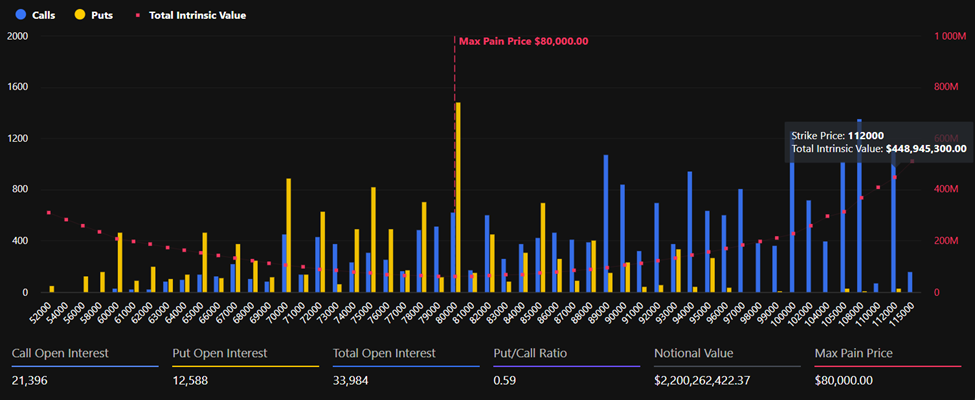
Data from derivatives markets shows Bitcoin accounts for the bulk of the expiry, with roughly $2.2 billion in notional value tied to contracts. Ethereum represents an additional $419 million, bringing the combined total to more than $2.6 billion.
Bitcoin is currently trading near $64,686, significantly below its max pain level of $80,000, the price at which the greatest number of options would expire worthless.
Total open interest stands at 33,984 contracts, including 21,396 calls and 12,588 puts, resulting in a put-to-call ratio of 0.59.
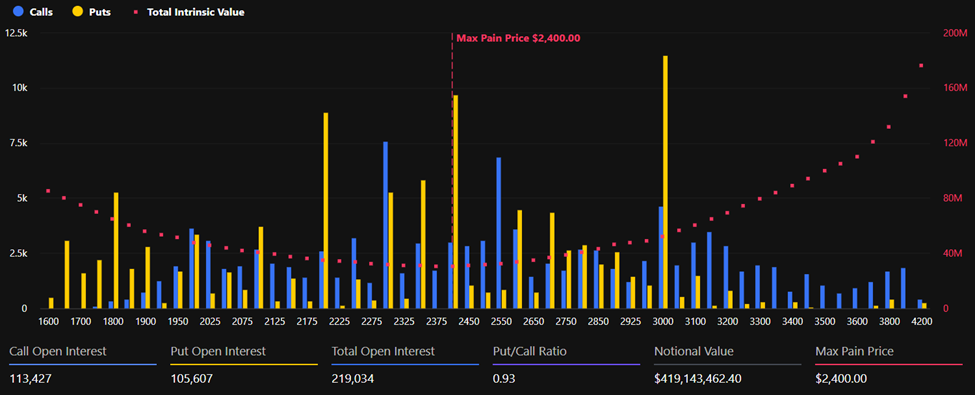
Ethereum, meanwhile, is trading around $1,905, also below its $2,400 max pain level. Total open interest stands at 219,034 contracts, with call open interest of 113,427 and put open interest of 105,607.
The put-to-call ratio of 0.93 suggests a more balanced, yet still cautious, positioning compared with Bitcoin.
Sponsored
Sponsored
The gap between spot prices and max pain levels suggests that option sellers could benefit if prices remain suppressed into expiry. Meanwhile, traders holding directional bets may face losses if markets remain range-bound.
Notably, today’s expiring options are significantly lower than the $8.8 billion contracts that settled last Friday, because the January 30 event was for the month.
Institutions Hedge as Volatility Climbs
Nevertheless, analysts at Greeks.live say derivatives markets are showing clear signs of stress and repositioning, with volatility rising sharply and traders moving to protect portfolios.
“The $60,000 range [for Bitcoin] represents the consolidation zone prior to the Trump rally, where support remains relatively strong. Should a rapid dip occur in the short term, it may present a buying opportunity,” they wrote.
Sponsored
Sponsored
According to the analysts, options data indicate institutions and large players are urgently hedging and placing bets.
Bitcoin’s current-month implied volatility (IV) has surged to 100%, doubling since the start of the year, while the main contracts’ IV has also breached 50%, climbing 15% over two weeks.
With skew at a two-year low, the experts say options market structure is now entirely dominated by bearish sentiment, though some lottery-style buying of deeply out-of-the-money options has emerged.
“The market currently exhibits excessive panic, and conditions for a sustained BTC crash remain insufficient. Rapid risk-off liquidation could actually facilitate a market rebound,” Greeks.live analysts wrote.
Indeed, the market is in panic mode, and with good reason, as the Bitcoin price steadily edges toward the $60,000 psychological level.
Sponsored
Sponsored
The surge in implied volatility to 100% highlights the scale of uncertainty currently priced into Bitcoin markets, reflecting expectations of larger-than-normal price swings.
Expiry Could Reset Market Flows
Elsewhere, Deribit analysts note that options positioning is clustered around key strike levels, which may be influencing price behavior ahead of expiry.
“With protection demand already increasing and volatility repriced, this expiry could act as a short-term reset in dealer hedging flows. Expiry may remove positioning-related ‘gravity’ around big strikes, so price behavior after 08:00 UTC may differ from the days leading into expiry,” Deribit analysts stated.
The options expire at 08:00 UTC on Deribit. If those dynamics play out, markets could see increased volatility immediately after expiry as hedging flows unwind and liquidity conditions shift.
While bearish sentiment currently dominates derivatives positioning, panic-driven markets can sometimes produce sharp rebounds, particularly if large liquidations clear excess leverage.


MemeCore hard fork is driving a sharp repricing in the meme coin segment, with its native M token up more than 35% over the past 24 hours to around $2.36. The move lifted M’s market cap above $3.1 billion, while daily trading volume more than doubled to $32.9 million, underscoring a broader return in speculative risk appetite across the category.
The immediate catalyst was operational rather than thematic. MemeCore completed the second and final stage of its blockchain upgrade yesterday, delivering a 100-fold reduction in gas fees and introducing account abstraction. In a sector where traders often chase momentum, infrastructure changes that materially improve cost and usability can quickly redirect capital.
That rotation is now extending beyond M itself. One of the clearest examples is Maxi Doge (MAXI), whose presale has raised more than $4.7 million and is nearing its $5 million target at a token price of $0.000281.
The MemeCore development team activated the final stage of the hard fork at 2am UTC yesterday. Gas fees dropped from 1,500 gwei to 15 gwei, a change that materially lowers friction for active traders, token launches, and on-chain meme coin activity. The upgrade also introduced account abstraction, tighter EVM compatibility and early Layer 2 scaling components.
For node operators, the process required downloading the latest Go MemeCore Client version. For users and dApps, the transition was designed to be seamless.
The official MemeCore X account confirmed the fork and outlined its main changes.
The MemeCore Hardfork is officially LIVE and STABLE!
Combined with our new Account Abstraction, your transactions aren't just cheaper—they're smarter!
Just sit back and enjoy the smooth, cheaper cost-effective ride in the MemeCore ecosystem!
https://t.co/CHwMmOj9A8
— MemeCore (@MemeCore_M) March 25, 2026
Market reaction was immediate. M trading volume climbed by roughly 147% after the fork went live, although activity remains below the levels typically associated with a broader market breakout. On-chain data has started to recover from a recent slowdown, while price action has tested support around $2.25.
For traders, the main implication is straightforward: lower transaction costs can make meme-focused chains more viable for higher-frequency participation and for new token launches. That tends to benefit not only the underlying chain token, but also adjacent speculative plays drawing fresh attention.
Capital Rotation Reaches MAXI as Presale Nears $5 Million
Maxi Doge (MAXI) is among the projects seeing that spillover. The presale, which launched in July 2025, has maintained steady traction through its pricing stages and has now collected more than $4.7 million.
Maxi Doge (MAXI) is built around a high-risk trader persona, giving the token a clear identity within the meme coin market’s leverage-heavy culture. In the current environment, that positioning appears to be resonating as traders look for earlier-stage vehicles with stronger upside torque than more established meme assets.
Momentum indicators are also visible in the campaign itself. The presale is approaching its $5 million target, while the project continues to use community-driven branding, staking incentives, and event plans to sustain attention.
Worth the journey. Worth the wait. pic.twitter.com/JiVkrta4He
— MaxiDoge (@MaxiDoge_) March 20, 2026
Beyond branding, the project says staking rewards are already active through the presale smart contract, with a 66% APY currently on offer. The team is also planning community trading contests with prize distributions to top performers.
Maxi Doge has allocated 25% of total supply to a Maxi Fund intended to support visibility and liquidity after listing. Longer-term plans include partnerships with futures exchanges and gamified campaigns aligned with the project’s trading-focused identity.
The setup leaves MAXI positioned as a higher-risk, higher-upside play on the same rotation, lifting interest in meme infrastructure. According to presale commentators such as Borch Crypto, the token could potentially deliver 100x returns, though such projections remain speculative. What is concrete for now is that the raise has passed $4.7 million, and the next presale price increase is due tomorrow.
How Traders Can Access the Maxi Doge Presale
Buyers can join the sale through the official Maxi Doge presale website by connecting a wallet through the project’s purchase widget and buying MAXI at the current $0.000281 price.
The widget supports ETH, BNB, USDT, and USDC, while bank card purchases are also available. Staking can be activated immediately after purchase, with the current rate set at 66% APY.
Mobile users can also access the sale through Best Wallet, available via the Apple App Store and Google Play, by using the app’s “Upcoming Tokens” tab. Tokens bought through Best Wallet will be claimable once the presale ends and exchange listings begin.
For ongoing updates on pricing stages and community events, users can follow the Maxi Doge project on X and join the active Telegram group.
The post MemeCore Hard Fork Sends M Up 35% as Speculative Flows Extend to Maxi Doge Presale appeared first on Cryptonews.

The Death of APR as a Metric
(And why your “yield” is probably lying to you)
There was a time when APR ruled DeFi.
Scroll any dashboard, and it screams the same thing:
“1,245% APR 🚀” — like a neon sign pulling you into the casino.
And for a while, it worked.
But today? APR is less of a signal… and more of a decoy.
Let’s break down why APR is dying—and what actually matters now.
APR Was Always a Half-Truth
APR (Annual Percentage Rate) assumes one big thing:
That everything stays the same.
- Same rewards.
- Same token price.
- Same liquidity.
- Same user behavior.
In DeFi, that assumption lasts about… 12 minutes.
The moment emissions change, token prices drop, or whales rotate—your “1,000% APR” quietly collapses into something far less exciting.
APR doesn’t measure reality. It measures a snapshot of a moment that’s already gone.
The Illusion of High Yield
Here’s the uncomfortable truth:
High APR is often a symptom of high inflation, not high returns.
Protocols boost APR by flooding rewards:
- Printing tokens
- Emitting aggressively
- Incentivizing short-term liquidity
At first, it looks like profit.
But zoom out:
- Token price dumps
- Liquidity exits
- Late users hold the bag
What looked like yield was actually dilution.
APR Ignores the Only Thing That Matters: Net Profit
Let’s say you farm:
- 300% APR
- But the reward token drops 70%
- And you get hit with impermanent loss
Did you win?
APR says yes.
Your wallet says otherwise.
APR doesn’t account for:
- Price volatility
- Slippage
- Gas fees
- Impermanent loss
- Exit liquidity
It’s like judging a business by revenue… while ignoring expenses.
The market is evolving.
The Rise of “Real Yield”
Protocols are shifting from:
- Emissions → Revenue sharing
- Incentives → Sustainable fees
- Inflation → Actual cash flow
“Real yield” means:
Earnings come from users paying for a service—not from printing tokens out of thin air.
Think:
- Trading fees
- Borrowing interest
- Protocol revenue redistribution
It’s slower.
Less flashy.
But infinitely more real.
APR Is Now a Marketing Tool
Let’s be blunt:
APR today is often just a growth hack.
A way to:
- Attract liquidity quickly
- Bootstrap a network
- Create hype
And sometimes…
to distract you.
Because if a protocol leads with APR instead of fundamentals, you should ask:
What are they not showing me?
What You Should Look At Instead
1. Revenue Sources
Where does the money actually come from?
2. Token Emissions
Is yield being printed or earned?
3. Liquidity Quality
Can you exit without nuking the price?
4. User Demand
Are people using the product—or just farming it?
5. Sustainability
Will this still exist in 6 months?
The Bottom Line
APR isn’t completely useless.
But treating it as your north star?
That’s how you get wrecked.
In today’s DeFi landscape:
- Attention is gamified
- Yield is engineered
- Narratives move faster than fundamentals
The edge now belongs to those who look past the headline number.
Because the real game isn’t about earning the highest APR.
It’s about keeping the most value when the music stops.
Final Thinking
If someone is still selling you on APR alone…
You’re not looking at an opportunity.
You’re looking at an exit strategy—just not yours.
REQUEST AN ARTICLE


MARA Holdings (MARA) sold 15,133 bitcoin for approximately $1.1 billion between March 4 and March 25 to fund a major balance sheet overhaul.
The company is using the proceeds to repurchase roughly $1.0 billion of its 0.00% convertible senior notes due 2030 and 2031 at a discount.
In total, MARA will buy back $367.5 million of its 2030 notes for $322.9 million and $633.4 million of its 2031 notes for $589.9 million. The discounted purchases, about 9% below par, will generate approximately $88.1 million in value, said the company.
MARA was higher by 10% in premarket trading.
Beyond the immediate savings, the transaction materially reshapes MARA’s capital structure. The repurchases will reduce its convertible debt by around 30%, cutting total outstanding convertible notes from about $3.3 billion to $2.3 billion. This also reduces the risk of future shareholder dilution associated with conversions.
“Our decision to sell a portion of our bitcoin holdings reflects a strategic capital allocation move designed to strengthen our balance sheet and position the company for long-term growth,” said CEO Fred Thiel.
MARA now holds 38,689 BTC following the sale.

Key Takeaways
- Chewy shares climbed approximately 13% following 2026 revenue projections of $13.6B–$13.75B, surpassing Wall Street’s expectations
- Fourth-quarter revenue reached $3.26 billion, representing an 8.1% increase when accounting for the additional week in the prior-year period
- The customer base expanded 4% to 21.3 million active users; average spending per customer increased 2.2% to $591
- The company anticipates artificial intelligence initiatives will generate $50M+ in annual cost reductions by 2027, with initial savings in the “low tens of millions” projected for 2026
- The Chewy Vet Care network expanded to 18 facilities and represents the company’s fastest-expanding business line by customer spending
Chewy delivered fourth-quarter financial results on Wednesday that aligned with Wall Street projections, though it was the forward-looking 2026 guidance that sparked significant investor enthusiasm.
The online pet products platform issued full-year revenue guidance ranging from $13.6 billion to $13.75 billion. This forecast exceeded the analyst consensus estimate of $13.58 billion, propelling shares approximately 13% higher during Wednesday’s session to close near $26.50.
Fourth-quarter revenue totaled $3.26 billion, representing a 0.5% increase on a reported basis and an 8.1% gain after adjusting for the calendar discrepancy with the previous year’s comparable quarter. This figure aligned with analyst projections. Gross profit margin expanded by 90 basis points to reach 29.4%, while adjusted EBITDA increased from $124.5 million to $162.3 million.
Adjusted earnings per share registered at $0.27, falling one cent short of the $0.28 Street consensus. On a GAAP basis, net income reached $39.2 million, or $0.09 per diluted share, compared to $22.8 million in the year-ago period.
The active customer count rose 4% year-over-year to 21.3 million users. Net sales per active customer increased 2.2% to $591. Chief Executive Officer Sumit Singh highlighted that pet parents are progressively viewing their animals as family members and upgrading to higher-quality, premium offerings — a behavioral shift he anticipates will persist.
Chief Financial Officer Chris Deppe clarified that the 2026 guidance assumes zero pricing inflation. Revenue expansion is projected to stem from attracting new customers alongside increased wallet share from the existing base.
Artificial Intelligence Driving Operational Efficiency
Chewy has invested in AI technology infrastructure over recent quarters and is now implementing these systems across various operational areas, including customer service, logistics networks, and distribution centers.
Singh indicated that AI-powered operational improvements are expected to generate benefits in the “low tens of millions” during 2026, scaling to approximately $50 million or greater in annualized cost savings by 2027. The retailer is simultaneously increasing capacity at its advanced fulfillment facility in Houston as part of the comprehensive efficiency initiative.
For the first quarter of fiscal 2026, Chewy projected revenue between $3.33 billion and $3.36 billion with adjusted earnings per share ranging from $0.40 to $0.45, figures that generally matched analyst forecasts.
Veterinary Services Footprint Growing
Chewy Vet Care expanded by 10 additional locations throughout fiscal 2025, elevating the total practice count to 18 facilities. CVC presently operates across five states, with strategic plans for nationwide rollout.
Singh reported that CVC performance is surpassing internal projections regarding customer satisfaction metrics and is serving as an effective customer acquisition channel that deepens relationships with premium-tier customers. Management characterized it as the fastest-expanding business segment measured by net sales per active customer.
The company also finalized its acquisition of SmartEquine, a digital platform focused on equine health management. This transaction is projected to contribute approximately $80 million in net sales during 2026 — representing less than 1% of consolidated revenue, though it demonstrates strategic diversification beyond companion animals.
Notwithstanding Wednesday’s sharp rally, Chewy stock has declined nearly 20% over the trailing twelve months and continues trading substantially below its 52-week peak of $48.62.

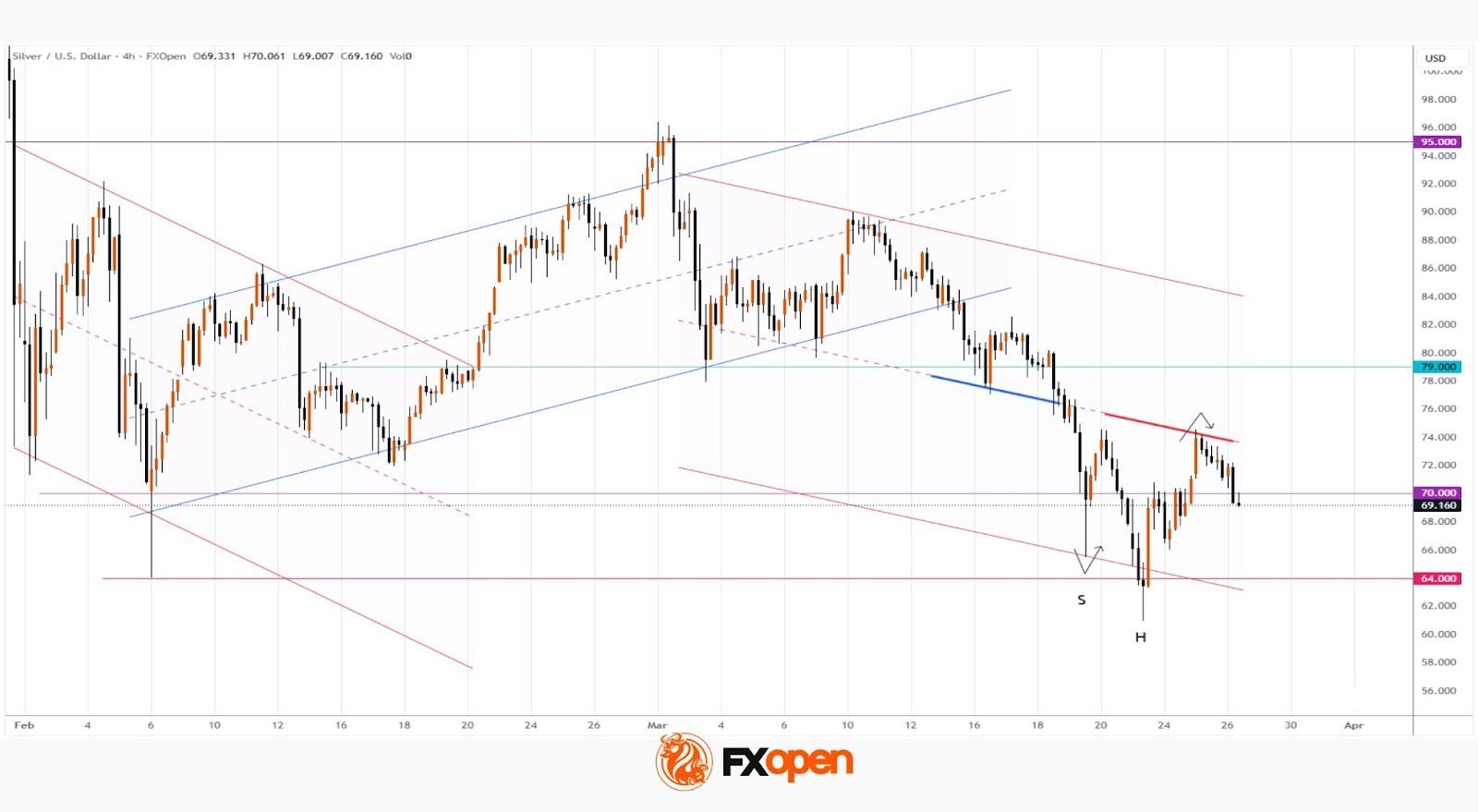
As can be observed on the XAG/USD chart, the price of silver has once again dropped below the psychological $70 level. At the same time, this week has been marked by sharp fluctuations: on Monday, prices traded below $65, while as recently as yesterday, silver reached $74 per ounce.
Market volatility is being driven by ongoing geopolitical uncertainty. Conflicting statements from the United States and Iran regarding potential peace negotiations continue to unsettle financial markets. According to media reports:
→ Washington maintains that negotiations are ongoing, with the Trump administration reportedly delivering a 15-point proposal to Iran via intermediaries, aimed at resolving the conflict and reopening the Strait of Hormuz.
→ Iran, in turn, has stated that it does not intend to negotiate with the US, rejecting the proposed ceasefire and instead putting forward its own conditions.
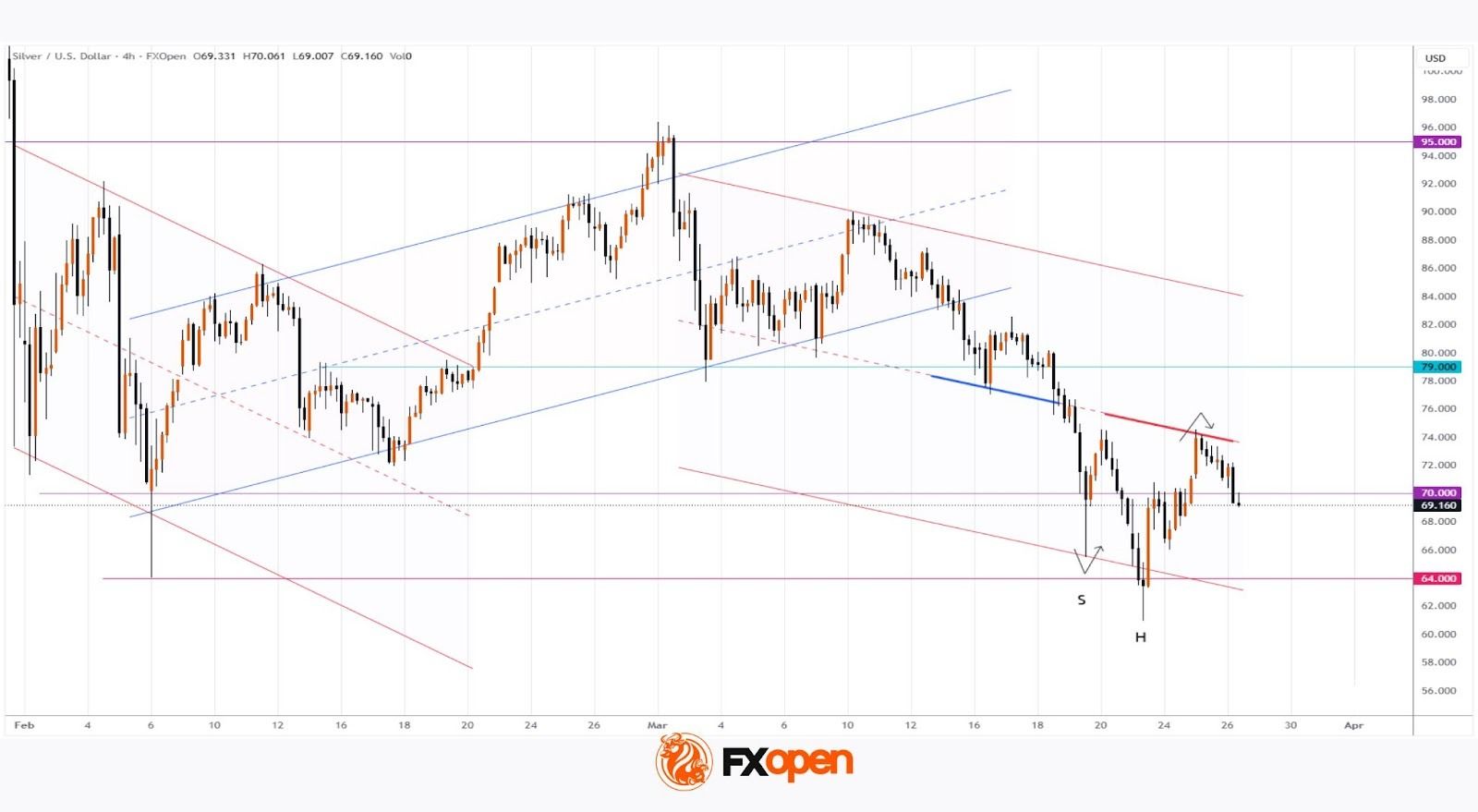
On the morning of 19 March, analysing the XAG/USD chart, we:
→ concluded that the market was under significant pressure;
→ identified and plotted a descending channel (marked in red) on the silver price chart;
→ suggested that the channel’s median line could act as near-term resistance, thereby validating the structure.
Indeed, subsequent price action confirmed this framework, as indicated by the arrows:
→ the lower boundary acted as support on the same day;
→ yesterday, price reversed lower from the median line (which shifted from support to resistance), reinforcing the prevailing bearish sentiment observed throughout March.
From a bullish perspective:
→ the break below the 6 February low around the $64 level highlights aggressive demand — so-called “smart money” may have absorbed liquidity in this zone, positioning for higher prices;
→ silver may be in the process of forming an inverse head and shoulders pattern.
However, as long as price continues to trade below the red median line of the active channel, it would be premature to speak of any meaningful bullish conviction.
Start trading commodity CFDs with tight spreads (additional fees may apply). Open your trading account now or learn more about trading commodity CFDs with FXOpen.
This article represents the opinion of the Companies operating under the FXOpen brand only. It is not to be construed as an offer, solicitation, or recommendation with respect to products and services provided by the Companies operating under the FXOpen brand, nor is it to be considered financial advice.
Tazapay, a cross-border payment infrastructure provider, has closed an extension to its Series B funding round, lifting total funding to $36 million. The extension was led by Circle Ventures and included participation from Coinbase Ventures, CMT Digital, Peak XV Partners and Ripple. The new capital will be used to expand digital settlement technology for cross-border payments, secure additional licenses, broaden geographic reach across Asia, Latin America, the Middle East and the Americas, and build infrastructure for what the company calls “agentic payments.”
Tazapay serves more than 1,000 enterprises and fintechs across 30 countries, and holds licenses in Singapore, Canada, Australia and the United States, with active applications underway in the European Union, United Arab Emirates and Hong Kong. “The demand we’re seeing from enterprises and fintechs across Asia, LATAM, and the Middle East is unmistakable; businesses want to move money faster, cheaper, and with full regulatory confidence,” said Kanupriya Sharda, chief business officer at Tazapay.
Cointelegraph asked Tazapay for the size of the extension tranche and the company’s valuation, but did not receive a response by publication.
Related: Ripple joins Singapore sandbox to test RLUSD in trade finance
Key takeaways
- Tazapay’s Series B extension brings total fundraising to $36 million, with Circle Ventures leading and participation from Coinbase Ventures, CMT Digital, Peak XV Partners and Ripple.
- The fresh capital targets expansion of cross-border digital settlement tech, licensing pursuits, and regional growth into Asia, LATAM, the Middle East and the Americas, plus development of “agentic payments.”
- The funding news comes against a backdrop of growing interest in stablecoin–based cross-border rails, with Ripple expanding its institutional stablecoin platform to over 60 markets and processing more than $100 billion in volume.
- Other early-stage fintechs are also scaling stablecoin–fiat payment networks, such as Conduit, which raised $36 million in May 2025 to broaden its fiat and stablecoin offerings and serve as an alternative to SWIFT.
- Regulatory licensing, interoperability, and real-world adoption remain pivotal for pushing these rails from pilots to mainstream use.
Tazapay’s expansion blueprint and regulatory footprint
According to the company, the new funding will accelerate the rollout of its cross-border settlement technology by pursuing additional licensing and expanding in key regions, including Asia, Latin America, the Middle East and the Americas. Tazapay currently maintains licenses in Singapore, Canada, Australia and the United States, with active applications in the European Union, United Arab Emirates and Hong Kong. The firm reported serving more than 1,000 enterprises and fintechs across 30 markets, underscoring growing demand for faster, cheaper, and regulation-compliant cross-border payments. The chief business officer, Kanupriya Sharda, highlighted “unmistakable” demand from enterprises and fintechs across Asia, LATAM, and the Middle East for improved money movement capabilities.
Stablecoins and the race to upgrade cross-border rails
The extension of Tazapay’s Series B comes as a wave of fintech and crypto companies push to embed stablecoins into cross-border payment workflows. Ripple, for example, has expanded Ripple Payments into an end-to-end stablecoin and fiat platform for banks and fintechs. The platform is live in more than 60 markets and has processed over $100 billion in volume, signaling a meaningful move toward institutional-grade stablecoin rails in global payments.
In the same ecosystem, regulatory and sandbox activity around stablecoins continues. For instance, Ripple recently joined Singapore’s sandbox to test RLUSD in trade finance, illustrating how regulated pilots are shaping the rollout of new settlement tools across jurisdictions.
Beyond Tazapay and Ripple, the market has seen other notable fundraising tied to cross-border rails. In May 2025, Conduit announced a $36 million Series A round led by Dragonfly and Altos Ventures to scale its fiat and stablecoin payment network, positioning the project as a potential alternative to traditional messaging corridors such as SWIFT.
These developments reflect a broader industry shift: a push to replace or augment legacy rails with programmable, regulator-friendly settlement networks built on stablecoins and crypto rails, designed to cut settlement times and costs while preserving compliance and risk controls.
What this means for readers and market watchers
For investors, Tazapay’s extension signals continued appetite for platforms that can operationalize cross-border liquidity with robust licensing and multi-jurisdictional reach. For enterprises and fintechs, the move reinforces a trend toward using stablecoin-based settlement to reduce friction in international payments while maintaining regulatory confidence. For builders, the emphasis on “agentic payments”—where payment flows can be orchestrated and automated at the edge of networks—points to a future where payment rails are more integrated with enterprise workflows and financial ecosystems.
As the sector scales, observers will want to watch licensing progress, regional execution, and the ability of these platforms to deliver truly cost-effective and faster settlement at scale. Regulatory clarity across key markets—especially around stablecoins and cross-border fintech operations—will continue to shape how quickly and broadly these rails can be adopted.
Readers should keep an eye on further disclosures from Tazapay about the extension’s size and valuation, as well as ongoing updates from Ripple, Conduit and other players as they publish new milestones and regulatory milestones in the coming quarters.
The story continues to unfold as more regional licenses, pilot programs, and enterprise deployments come online, potentially reshaping the architecture of global payments over the next few years.
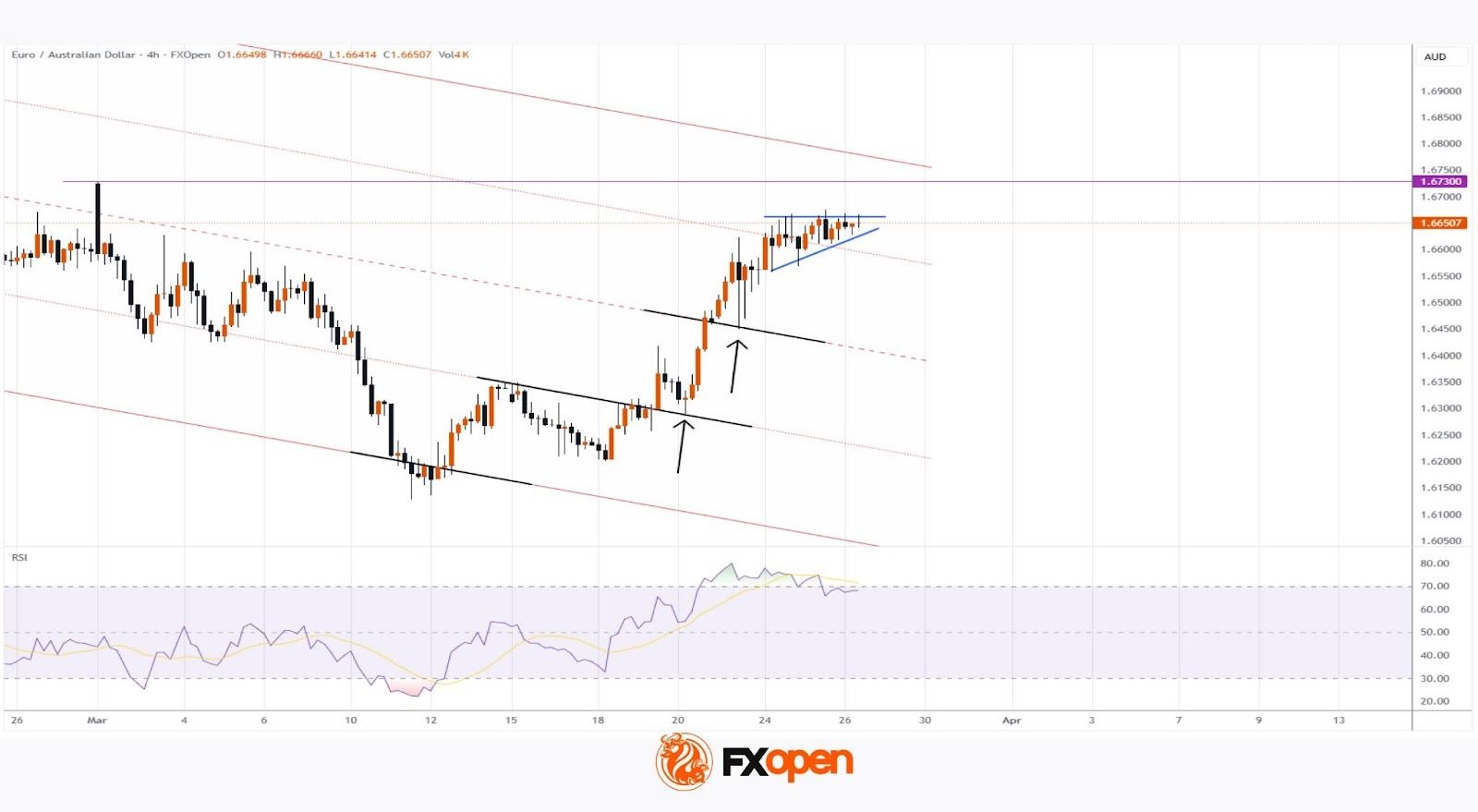
If last Thursday trading was taking place below the 1.6300 level, today one euro is worth more than 1.6660 Australian dollars. The upward trend seen in recent days has been driven by a combination of factors, including:
→ Bullish factor for the euro: The European Central Bank (ECB) has revised its 2026 inflation forecast upwards (to 2.6%). The reason lies in the Middle East conflict and rising energy prices. This signals to the market that the ECB may not only refrain from cutting rates but could also begin discussing potential rate hikes this year.
→ Bearish factor for the Australian dollar: The Middle East conflict is placing significant pressure on China’s economy (which is already dealing with a property market crisis). A slowdown in trade with China is weakening the Australian currency. For more details, see the article: What Are Commodity Currencies?
However, the chart indicates that the bullish momentum is fading — this is reflected in a series of bearish divergences, with the RSI moving down from overbought territory.
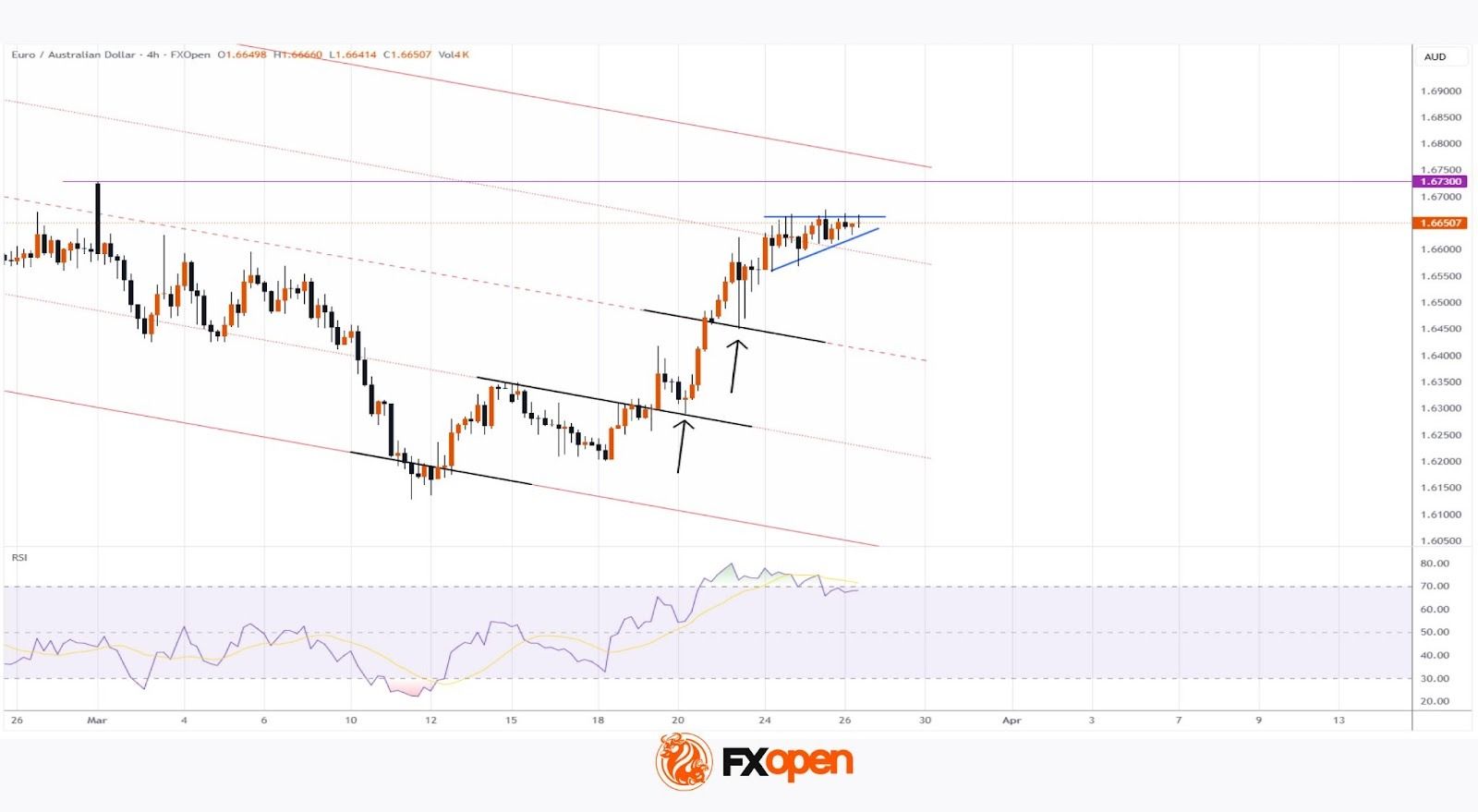
Continuing the technical analysis of the EUR/AUD chart, it can be observed that price fluctuations have formed a long-term descending channel. In this context:
→ Bulls have shown initiative: after touching the lower boundary of the channel, they (as marked by arrows) gradually took control over intermediate channel levels.
→ The current situation can be interpreted as a period of short-term consolidation (with the formation of a narrowing triangle pattern). The triangle may have been broken this morning, but Australia’s inflation report came in line with expectations — and the market continues to consolidate.
If we assume that bulls manage to gather enough strength for another upward push, they may face a significant test in the form of a resistance zone:
→ the March high around the 1.6730 level;
→ the upper boundary of the descending channel.
Trade over 50 forex markets 24 hours a day with FXOpen. Take advantage of low commissions, deep liquidity, and spreads from 0.0 pips (additional fees may apply). Open your FXOpen account now or learn more about trading forex with FXOpen.
This article represents the opinion of the Companies operating under the FXOpen brand only. It is not to be construed as an offer, solicitation, or recommendation with respect to products and services provided by the Companies operating under the FXOpen brand, nor is it to be considered financial advice.
Crypto World
Bitcoin Realized Price Signals Fragile Market Structure as 92% of Short-Term Holders Sit at a Loss

TLDR:
- Around 92% of short-term holders are currently at a loss, holding approximately 5.7 million BTC below cost basis.
- Strategy’s realized price of $75,600 across 762,000 BTC aligns directly with where Bitcoin’s recent rally was rejected.
- Bitcoin’s network-wide realized price sits near $54,000, a level historically revisited or traded below in bear markets.
- CryptoQuant data show overlapping cost-basis levels above the spot price, creating significant resistance to any Bitcoin recovery attempt.
Bitcoin realized price metrics are drawing close attention from market analysts worldwide. On-chain data shows the price is currently interacting with multiple critical cost basis levels.
Bitcoin is trading around $70,000, with key resistance visible both above and below the current spot price. CryptoQuant recently published an analysis covering short-term holders, a major institutional buyer, and broader network cost averages.
Together, these overlapping thresholds are shaping what analysts describe as a fragile market structure.
Short-Term Holders Sit in Loss as Sell Pressure Mounts
Short-term holders are currently carrying heavy unrealized losses at today’s Bitcoin price. CryptoQuant data shows this cohort holds approximately 5.7 million BTC in total.
Of that amount, only around 8% are currently sitting in profit. The remaining 92% are at a loss at current price levels.
This distribution creates what analysts call a large supply overhang in the market. When most holders are underwater, price rallies often invite immediate selling activity.
Recent buyers tend to use bounces as opportunities to recover their cost basis. That behavior consistently limits how far short-term recoveries can extend.
The short-term holder’s realized price is currently positioned above Bitcoin’s spot price near $70,000. CryptoQuant stated that “recent buyers are underwater, creating sell pressure on every bounce.”
That cost basis level is now acting as overhead resistance on the chart. Price must reclaim it clearly before sentiment can meaningfully shift for this group.
Until short-term holders move back into profit territory, recovery attempts will likely face continued resistance. The volume of BTC held at a loss adds weight to every rally attempt made. Analysts are monitoring the profit-to-loss ratio closely for any early signs of a broader market shift.
Strategy’s Cost Basis and the Network Realized Price Frame the Trading Range
Strategy’s Bitcoin holdings are also playing a visible role in shaping current market resistance. The firm holds approximately 762,000 BTC with an average cost basis of around $75,600.
CryptoQuant noted that this level aligns directly with where the recent rally faced rejection. That overlap is drawing attention from on-chain analysts tracking large institutional cost basis data.
Large holders with unrealized losses near a price zone can create meaningful resistance for the market. When price approaches their average cost basis, those holders tend to manage risk through selling.
This dynamic appears to have played out during the recent failed push beyond $75,000. CryptoQuant’s data supports this reading of the market’s rejection at that level.
The broader Bitcoin realized price, representing the average cost basis across all holders, currently sits near $54,000.
Historically, during bear markets, price tends to revisit or trade below this level for extended periods. This makes the $54,000 zone a key reference point for analysts monitoring potential downside risk.
Taken together, these three levels frame the current environment for Bitcoin market participants. Resistance from the short-term holder’s cost basis and Strategy’s realized price sits above spot.
The network-wide average near $54,000 remains a potential downside target if conditions deteriorate further. Traders are watching all three levels closely as price action continues to develop.
U.S.-listed cryptocurrency exchange Coinbase (COIN) is working with Fannie Mae-approved mortgage firm Better Home & Finance Holding Co. (BETR), to enable crypto holders to use their digital assets as down payment collateral when buying a home.
The mortgage is structured as a conforming loan backed by Fannie Mae, meaning it carries the same protections and standards as traditional mortgages, according to a press release on Thursday.
Borrowers pledge bitcoin or the USDC stablecoin as collateral to fund their down payment, allowing them to keep their assets intact and avoid creating a taxable event by spending them. In the case of USDC, they can keep earnings rewards, Coinbase said.
Some 41% of American families fail to buy a home because they don’t have enough funds for the down payment, even though they have money elsewhere in savings, Better founder Vishal Garg said in an interview.
Average homebuyers have been squeezed by increases in interest rates while house prices stay the same, Garg said. Someone looking to buy a $400,000 property, for example, might struggle to find the $40,000 cash down payment, and face a quagmire of legal and tax requirements when trying to sell assets to make the amount, he said.
Provided the consumer is a crypto holder on Coinbase, they can avoid having to file all manner of “crazy stuff,” Garg said, and simply transfer their digital assets from the exchange to a custody wallet with Better while retaining ownership rights.
If Better had previously been accepting crypto as downpayment collateral, “we would have funded maybe 40 billion more of consumer demand over the past few years,” Garg added.
There have been other advances in the crypto-backed mortgages, including some that use Coinbase as custodian. However, the emphasis has tended to be on wealth management and relatively high-end purchases, rather than catering to the average Joe.
In February 2023, Better allowed Amazon (AMZN) employees to pledge their stock as collateral for a loan to cover the down payment on a house purchase, albeit at a slightly higher interest rate.
A spokesman for Coinbase said via email that the rates for the crypto-backed mortgages will be higher than a standard 30-year by between half a percentage point and 1.5 percentage points, depending on the consumer profile.
The token-backed mortgages would be free of margin calls and top-ups, according to a press release. If BTC drops in value, the mortgage terms remain unchanged and no additional collateral is required. Market movements alone never trigger liquidation, Coinbase said.
Borrowers’ collateral is at risk of liquidation only in the event of a 60-day payment delinquency, similar to conventional mortgages, it said.
The product is “as American as apple pie,” said Coinbase’s head of consumer and platform business development, Mark Troianovski, in an interview with CoinDesk.
“People who are sitting on Bitcoin or USDC can put a roof over their head without needing to sell it, without needing to incur capital gains,” Troianovski said. “We are giving people access to housing in a way that is very similar to how private bankers serve some of the wealthiest customers. They don’t sell assets to buy stuff; they actually take loans against assets.”
TLDR:
- Zepz transferred over $17 billion in 2025, serving migrant workers sending funds across 130+ countries.
- The Sendwave Wallet, built on Solana, lets customers send and store USDC across more than 100 countries.
- TRM Labs has supported Zepz’s stablecoin compliance framework since April 2025, covering AML and sanctions risk.
- Customers can hold USDC instead of converting immediately, offering more control in currency-volatile regions.
Stablecoin remittances are taking a new step forward with a partnership between TRM Labs and Zepz. The collaboration supports the global expansion of the Sendwave Wallet, a stablecoin product built on Solana.
Zepz, the company behind WorldRemit and Sendwave, serves migrant communities across 130+ countries. TRM Labs will provide blockchain intelligence to support financial crime risk management. Together, they aim to scale digital asset-based remittances responsibly across global markets.
Sendwave Wallet Targets Migrant Communities Worldwide
Zepz transferred more than $17 billion for its customers in 2025. The company primarily serves migrant workers who send money to family members monthly.
Many of those recipients live in regions with currency instability or limited banking access. The Sendwave Wallet was built directly in response to those needs.
Launched in October 2025, the wallet operates on the Solana blockchain. It enables customers to send and store USDC across more than 100 countries.
Transfers are near-instant, affordable, and reliable within the Sendwave ecosystem. This gives migrant workers a faster alternative to traditional remittance channels.
TRM Labs described the partnership on X, noting that stablecoins are changing how remittances work. The firm noted that the Sendwave Wallet was designed to support migrant communities globally.
It also confirmed that blockchain intelligence would help strengthen risk management as the platform scales. The post further addressed compliance support as Zepz enters new markets.
Rather than converting funds immediately into local currency, customers can hold USDC. They decide when and how to cash out based on current market conditions.
This feature is especially useful in countries facing frequent currency fluctuations. The model offers more financial control compared to traditional remittance services.
TRM Labs Embeds Compliance Tools into Stablecoin Infrastructure
TRM Labs began working with Zepz in April 2025 on its stablecoin products. The company helped design financial crime controls for the Sendwave Wallet infrastructure.
These controls address sanctions risk, anti-money laundering requirements, and transaction monitoring. Integrating these tools from the start creates a stronger compliance foundation.
TRM’s blockchain intelligence platform enables real-time monitoring of on-chain activity. It helps organizations detect illicit transactions and manage risk across digital assets.
As Zepz expands into new markets, these capabilities become increasingly necessary. Global regulators are paying closer attention to digital asset-based payment platforms.
Will Bell, Business Lead at TRM Labs, shared his perspective on the collaboration. He said the platform helps organizations monitor activity in real time and manage risk exposure.
Bell added that Zepz is combining payment innovation with strong operational safeguards. He noted the goal is to scale digital asset products in line with regulatory expectations.
Zaheer Jassat, VP of Product at Zepz, also commented on the collaboration. He said customers trust Zepz with something personal — supporting family members across borders.
Partnering with TRM, he noted, strengthens Zepz’s ability to manage risk responsibly. Customers can now send, store, and spend stablecoins with greater confidence.

Franklin Templeton Is Betting BIG on XRP! Their Price Theory for XRP Will Absolutely SHOCK You! WOW!

Police incident outside York Station – emergency services on scene

How to make the most of your Lifetime Isa

Smart energy pays enters the US market, targeting scalable financial infrastructure

Why Israel is blocking foreign journalists from entering

Bitcoin: We’re Entering The Most Dangerous Phase
Franklin Templeton Is Betting BIG on XRP! Their Price Theory for XRP Will Absolutely SHOCK You! WOW!

Speaker Th.Satyabrata na Financial Committees 3 gi chairman sing hapkhare
![BREAKING! Did Trump Fake Iran Peace Talks? [Bitcoin Already Reacting]](https://wordupnews.com/wp-content/uploads/2026/03/1774524428_maxresdefault-80x80.jpg)
BREAKING! Did Trump Fake Iran Peace Talks? [Bitcoin Already Reacting]
-
 Crypto World6 days ago
NIO (NIO) Stock Plunges 6.5% as Shelf Registration Sparks Dilution Worries
-

 Fashion6 days ago
Weekend Open Thread: Adidas – Corporette.com
-
 NewsBeat1 day ago
Manchester United reach agreement with Casemiro over contract clause amid transfer speculation
-

 Politics6 days ago
Jenni Murray, Long-Serving Woman’s Hour Presenter, Dies Aged 75
-

 Crypto World5 days ago
Best Crypto to Buy Now: Strategy Just Spent $1.57 Billion on Bitcoin During Fear While Early Investors Quietly Enter Pepeto for 150x Potential
-

 Crypto World5 days ago
Bitcoin Price News: Bhutan Sells $72 Million in BTC Under Fiscal Pressure, but the Smart Money Entering Pepeto Sees What the Market Does Not
-

 Tech6 days ago
inKONBINI Lets You Spend Summer Days Behind the Register
-

 News Videos10 hours ago
Parliament publishes latest register of MPs’ financial interests
-

 Sports3 days ago
Remo Stars and Kano Pillars Strengthen Survival Hopes in NPFL
-

 Politics7 days ago
Gender equality discussions at UN face pushbacks and US resistance
-

 Business4 days ago
No Winner in March 21 Drawing as Prize Rolls to $133 Million for Next
-

 Sports3 days ago
Gary Kirsten Accuses Pakistan Cricket Board Of ‘Interference’, Mohsin Naqvi Responds
-

 Tech4 days ago
Give Your Phone a Huge (and Free) Upgrade by Switching to Another Keyboard
-

 Sports6 days ago
2026 Kentucky Derby horses, odds, futures, preview, date: Expert who nailed 12 Derby-Oaks Doubles enters picks
-

 Tech4 days ago
AI enters the chat: New Seattle dating app relies on tech to facilitate meaningful human connections
-

 Politics7 days ago
Scotland’s rejection of assisted dying is a victory for humanity
-

 Business7 days ago
DLocal: Entering 2026 At Escape Velocity
-
Business6 days ago
Columbia Sportswear enters $500 million credit agreement with JPMorgan Chase
-

 NewsBeat7 days ago
Missile lands next to presenter during live report
-

 Tech5 days ago
Today’s NYT Connections Hints, Answers for March 22 #1015
You must be logged in to post a comment Login