
Crypto World
Why Bitcoin Analysts Say BTC Has Entered Full Capitulation

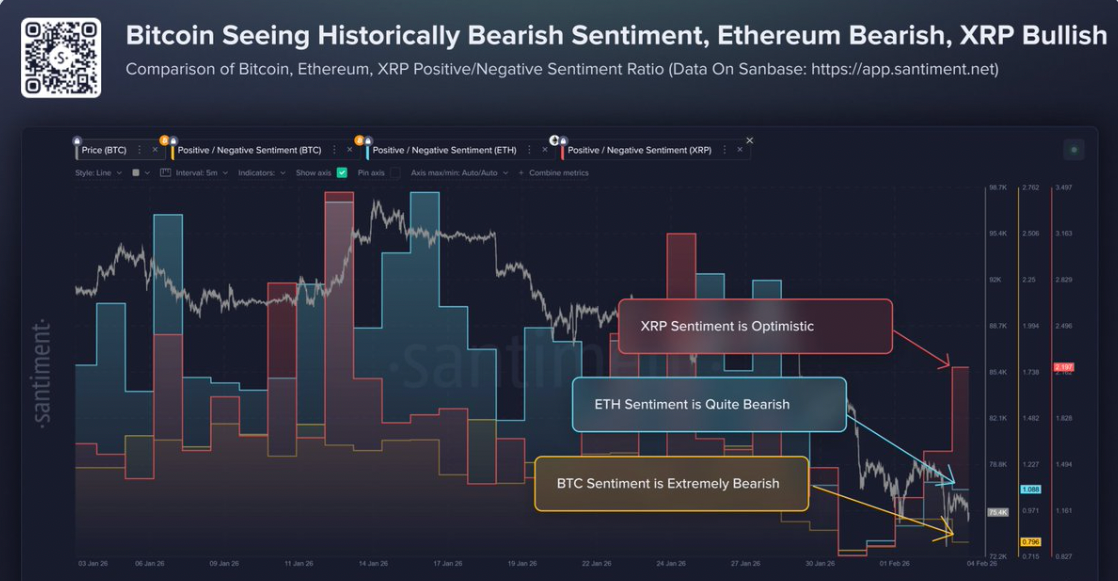
Bitcoin (CRYPTO: BTC) came under renewed selling pressure on Thursday as the price slipped below $69,000—the lowest level since November 6, 2024. The move underscored a backdrop of extreme market fear and frantic margin risk, with analysts contending that a potential bottom could be taking shape as short-term holders capitulate and on-chain activity points to exhausted selling. While the technical backdrop remains fragile, a cluster of indicators suggests that the recent wave of panic may be approaching a climax, though traders are wary of any renewed macro catalysts or liquidity shocks.
Key takeaways
- Short-term holders moved roughly 60,000 BTC to exchanges in the last 24 hours, signaling acute selling pressure and a large inflow that has contributed to the downside momentum.
- The Crypto Fear & Greed Index registered “extreme fear,” a level that has historically preceded a bottom and a subsequent bounce in prior cycles.
- Bitcoin’s RSI has reached multi-timeframe oversold levels, indicating seller exhaustion in several horizons and the potential for a near-term rebound if demand returns.
- Glassnode data show the seven-day moving average of realized losses climbing above $1.26 billion per day, a sign of rising fear in on-chain behavior and a potential capitulation event.
- Bitcoin’s capitulation metric posted its second-largest spike in two years, a pattern that historically aligns with rapid de-risking and heightened volatility as traders reset positions.
Tickers mentioned: $BTC
Sentiment: Bearish
Price impact: Negative. The renewed selling pressure and significant exchange inflows pushed BTC below key support, intensifying near-term downside risk as market participants reassess risk exposure.
Trading idea (Not Financial Advice): Hold. The combination of extreme fear, oversold RSI, and on-chain capitulation signals could precede a relief rally, but risk management remains essential while the market tests support levels.
Market context: The price action unfolds amid fragile liquidity conditions and a broader risk-off environment that has weighed on crypto assets. As traders parse on-chain signals against macro headlines, episodic capitulation events have tended to precede volatile but recoverable periods, with price action often drifting between fear-driven capitulation and later upside momentum once conviction returns.
Why it matters
The current wave of selling—centered on short-term holders—highlights a critical phase in the Bitcoin cycle. When a large bloc of supply shifts to exchanges at a loss in a short window, it can create a temporary liquidity squeeze that tests the resilience of bids at nearby levels. In the latest data, roughly 60,000 BTC moved from short-term holders to wallets on centralized venues in just one day, a move valued at about $4.2 billion at prevailing prices. This inflow exacerbates selling pressure, particularly in a market that has already faced a string of sharper-than-expected corrections. The dynamic underscores the risk that fresh headlines or macro surprises could reintroduce volatility before buyers re-emerge.”
Another powerful signal comes from the Fear & Greed Index, which sits in the realm of “extreme fear.” The gauge has historically punctured lower during capitulations, yet it also marks a potential turning point when fear peaks. The latest reading aligns with other cycles where a bottoming process has followed intense pessimism, before sentiment gradually shifts as risk appetites reappear among value-focused or long-term participants.
On-chain psychology also appears to be stabilizing, even as prices test psychological thresholds. Glassnode notes that the seven-day realized-loss metric has climbed past $1.26 billion per day, reflecting a surge in realized losses across the market. In their view, spikes in realized losses often coincide with moments of acute seller exhaustion, where marginal selling pressure begins to fade as market participants mark down losses and reassess risk. The capitulation metric, meanwhile, recorded its second-largest spike in two years, signaling a period of aggressive de-risking that typically precedes a more orderly reallocation of exposure once price discovery resumes.
The RSI, a widely watched momentum indicator, also reinforced the notion of an oversold regime across multiple timeframes. Coinglass’ heatmap shows BTC’s RSI flashing oversold conditions on five of six studied horizons. Specifically, the 12-hour RSI sits around 18, the daily around 20, and the four-hour near 23, with weekly and hourly readings also signaling distress. Some analysts have pointed to the weekly RSI near 29 as the most oversold level since the 2022 bear market, a milestone that has historically preceded relief rallies rather than fresh lows. In a market known for abrupt shifts, such readings are often interpreted as evidence of seller exhaustion rather than a guarantee of near-term direction.
Market observers have not avoided drawing parallels to prior capitulation episodes. A prominent sentiment analyst argued that this is “the most oversold” condition since the FTX crash, hinting that panic-driven selling could be approaching a climax even as price action remains fragile. Others urged patience, suggesting that risk/reward can improve when major players either accumulate at discounted levels or when the small-trader crowd exhibits a degree of disbelief that helps shore up a bottoming process. The broader narrative remains clear: extreme fear plus concentrated selling could lay the groundwork for a counter-move, but confirmation will come only with sustained price action and a shift in on-chain behavior.

Analysts cautioned that while the current conditions are telling, they do not guarantee a bottom that will immediately resume a longer-term uptrend. The price regime remains vulnerable to sudden shifts in macro liquidity, regulatory developments, or shifts in major exchange flows. Yet, the logic of capitulation—defined by a broad-based exit from risk and the erosion of conditionally profitable positions—has historically been followed by a re-pricing of risk as buyers step back in and price discovery restarts. In this context, several voices have framed this phase as a potentially fertile point for accumulation, provided that risk controls are in place and the market finds a credible catalyst to re-anchor value expectations.

What to watch next
- Price stabilization near current support levels and any intraday rebound following the extreme fear readings.
- Further on-chain data from CryptoQuant and Glassnode showing whether short-term holder outflows ease and whether realized losses begin to retreat.
- The evolution of RSI across multiple timeframes and any divergence that could hint at renewed buying interest.
- Liquidity conditions and macro developments that could reintroduce coordinated bid support for BTC and risk assets more broadly.
Sources & verification
- CryptoQuant data on 60,000 BTC moving to exchanges by short-term holders over 24 hours.
- Glassnode commentary on seven-day realized losses averaging above $1.26 billion per day and the capitulation metric spike.
- Crypto Fear & Greed Index reading at extreme fear (12) and historical context for similar levels.
- Coinglass RSI heatmap showing oversold conditions across multiple timeframes for BTC, including weekly RSI near 29.
- Santiment and other analyst commentary referencing sentiment shifts and potential near-term relief rallies.
Market reaction and key details
Bitcoin (CRYPTO: BTC) traded with renewed weakness on Thursday as the price slipped below $69,000, a level not seen since November 2024. The move came amid a confluence of on-chain signals and sentiment metrics that suggest investors are bracing for further volatility while some traders anticipate a bottom could be forming. The latest data show a substantial transfer of BTC from short-term holders—investors with a holding period under 155 days—to exchanges, with roughly 60,000 BTC moved in a single 24-hour period. At current prices this corresponds to about $4.2 billion in value, highlighting the scale of the near-term selling pressure and its potential to prolong downside risk if bids remain thin.

Observers on X noted that “the correction is so severe that no BTC in profit is being moved by LTHs,” underscoring a perceived capitulation among longer-term investors who might otherwise absorb losses and help stabilize prices. The sentiment is echoed in the weekly RSI readings, which place Bitcoin in a deeply oversold territory not seen in years. The heatmap from Coinglass confirms that the RSI is oversold on five of six timeframes, with readings such as 18 on the 12-hour and 20 on the daily frame, among others, signaling that selling pressure could be drying up even as prices test critical support. While some analysts describe the situation as an opportunity for buyers, others warn that risk remains high until a durable bid is reestablished and macro catalysts align with improved liquidity conditions.

The fear-driven mood is reinforced by the Crypto Fear & Greed Index, which sat deeply in the “extreme fear” zone. Historical patterns suggest that such levels often precede a turning point, though there is no guarantee of a swift recovery. Analysts have pointed to past episodes where heavy selling pressure and a retreat from risk assets gave way to a slower, more deliberate re-pricing of risk and a gradual incursion of buyers who see value at muted prices. Yet, the path forward remains contingent on a confluence of supportive signals, including on-chain activity that signals accumulation and renewed bid depth in the order book.
Several observers note that while the immediate narrative remains bearish, the prevailing combination of oversold momentum, high realized losses, and isolated capitulation spikes can set the stage for a temporary relief rally if buying interest returns and risk sentiment improves. The debate among market participants continues to hinge on whether the current episode is a definitive bottoming process or merely a dread-filled pause before fresh downside. As always, investors should watch liquidity, regulatory developments, and macro cues for decisive clues about the next leg of the cycle.

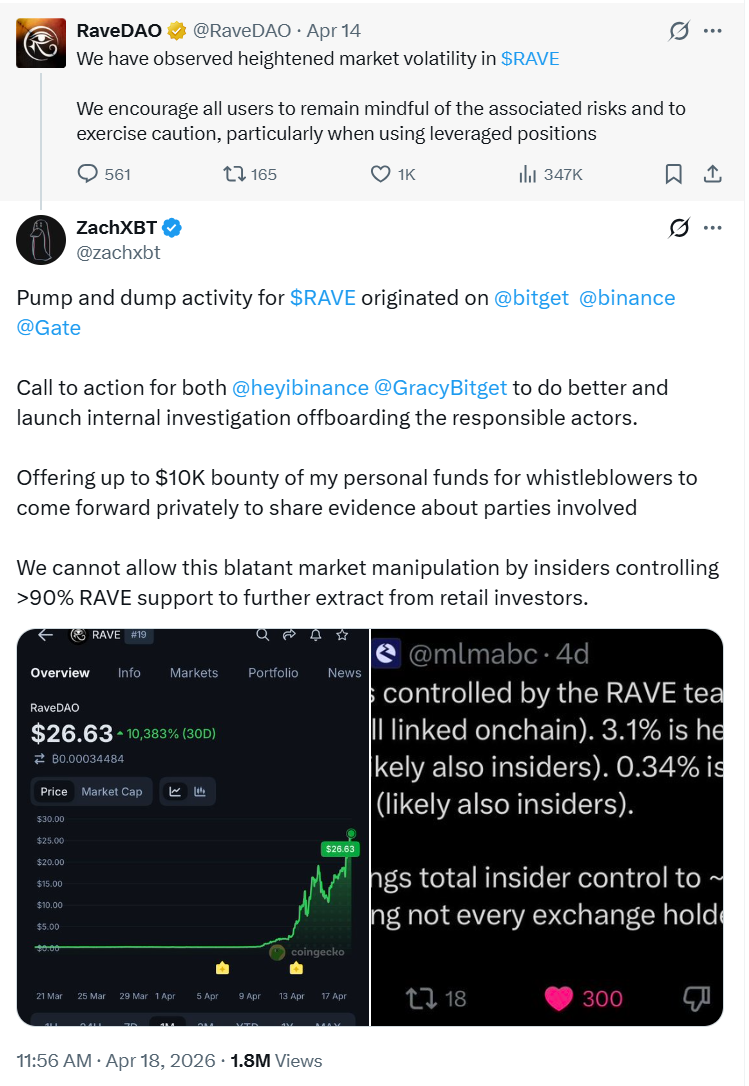
RaveDAO has denied any role in the recent surge and sharp collapse of its RAVE token, as major crypto exchanges open probes into trading activity following allegations of market manipulation.
In a thread posted on X, the project said it was “not engaged in, nor responsible for, recent price action,” responding to mounting scrutiny after RAVE soared from roughly $0.25 to nearly $28 within days before plunging more than 80%.
The denial comes as onchain investigator ZachXBT accused the project of orchestrating a pump-and-dump scheme, pointing to concentrated token holdings and suspicious exchange flows. He claimed that more than 90% of the token supply may be controlled by insiders, calling on exchanges to take action.

Both Binance and Bitget confirmed they are reviewing the situation. “We’re looking into it,” Binance CEO Richard Teng wrote, while Bitget CEO Gracy Chen said the exchange had “started investigating” RAVE trading activity.
Related: Study finds almost no crypto protocols disclose market-maker terms
RaveDAO plans token sales to fund growth
RaveDAO also outlined plans to sell portions of unlocked tokens to fund operations, marketing and hiring. The team said it is exploring “price-triggered or performance-triggered locks” to better align incentives.
“Building a movement requires resources,” the project wrote, adding it aims to do so “sustainably and transparently.”
RaveDAO is a Web3-based entertainment project that combines electronic music events with blockchain technology, aiming to onboard users into crypto through real-world experiences like festivals and parties. It operates as a decentralized community where attendees receive NFTs for participation, while its RAVE token is used for governance, ticketing and access to events.
At the time of writing, RAVE is trading at $1.36, down by 94.95% over the past day, according to data from CoinMarketCap.
Related: Stablecoins behave like FX markets as liquidity splits: Eco CEO
DeFi hacks surge in April
As Cointelegraph reported, more than a dozen DeFi protocols and crypto firms have been hit by exploits in just over two weeks, starting with the massive $280 million Drift Protocol attack on April 1.
Other affected projects include CoW Swap, Hyperbridge, Bybit, Silo Finance, Aethir and Rhea Finance, along with exchanges and liquidity pools across multiple chains. The attacks range from smart contract bugs and oracle manipulation to access control failures and liquidity pool exploits.
Magazine: Bitcoin may take 7 years to upgrade to post-quantum — BIP-360 co-author
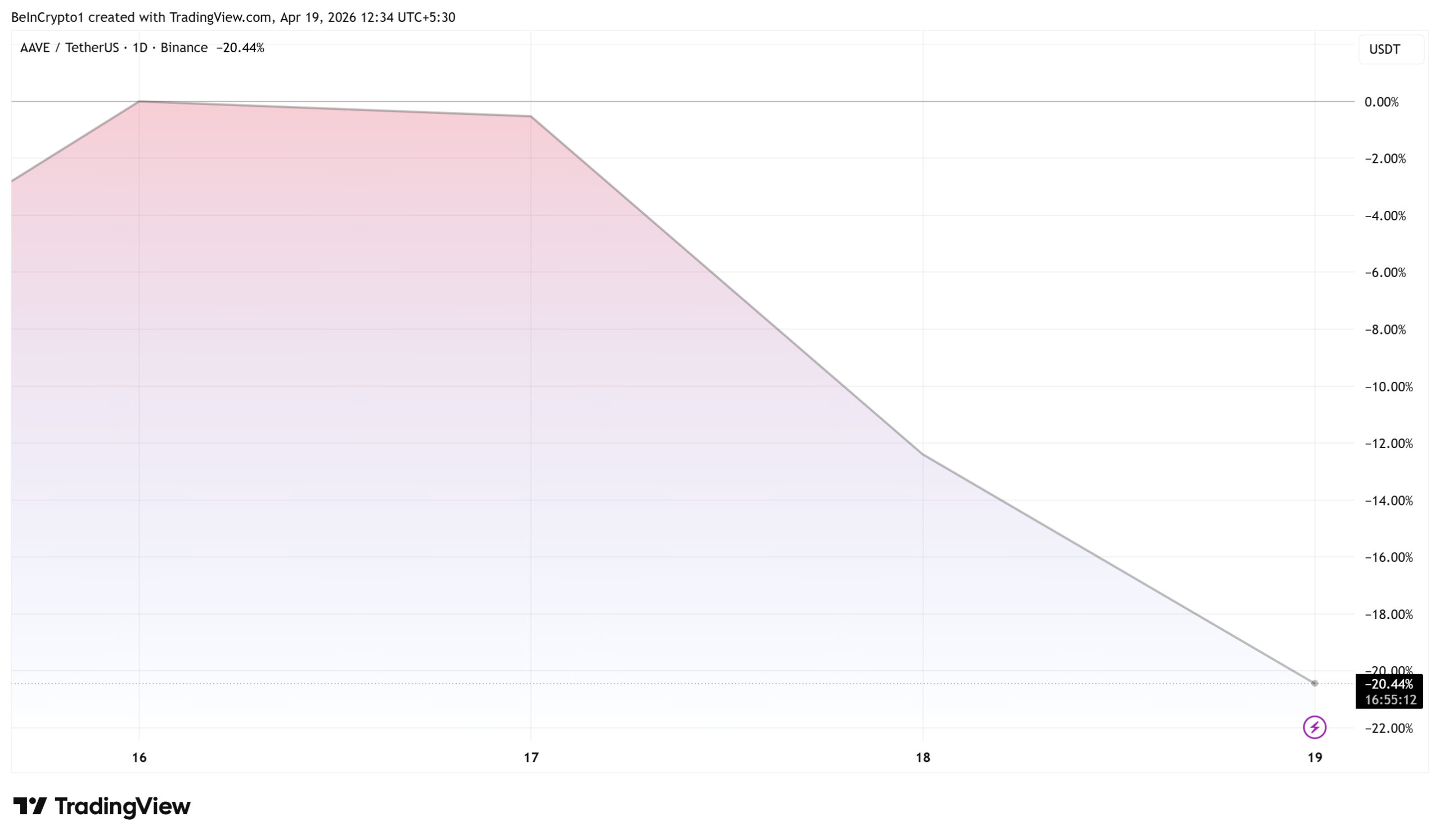
Aave (AAVE) fell over 20% on April 19 after the KelpDAO rsETH exploit triggered a wave of whale selling and a record spike in ETH utilization across the lending protocol.
The token dropped from roughly $115 to below $92 in hours as large holders rushed to exit positions. Aave’s ETH pool hit 100% utilization, effectively locking remaining depositors out of withdrawals.
Whales Offload Millions in AAVE
As of this writing, AAVE was trading for $91.89, down by 20.44% in the last 24 hours. With this, the altcoin has retested levels last seen on April 13.
On-chain data tracked by Lookonchain showed three major wallets selling AAVE within hours of the exploit becoming public.
- A wallet identified as smaugvision sold 20,015 AAVE for 2.06 million USDC at an average of $103 per token.
- A second whale at address 0xFC56 offloaded another 20,000 AAVE for 2.05 million USDC at the same average.
- A third wallet, 0xA2E4, sold 19,666 AAVE worth $1.95 million, converting the proceeds into 505.65 ETH and 10.11 WBTC at a lower $99 average.
Combined, the three wallets dumped nearly 60,000 AAVE tokens worth over $6 million.
$5.4 Billion ETH Exodus
Beyond the AAVE sell-off, suppliers began pulling ether (ETH) from Aave at scale. Over $5.4 billion in ETH reportedly left the protocol within hours.
Tron founder Justin Sun withdrew 65,584 ETH worth approximately $154 million, adding to the liquidity drain.
The mass withdrawal pushed Aave’s ETH utilization rate to 100%, meaning the pool had no remaining liquidity for new withdrawals.
Borrowing rates are expected to spike sharply as the protocol’s interest rate curve penalizes high utilization.
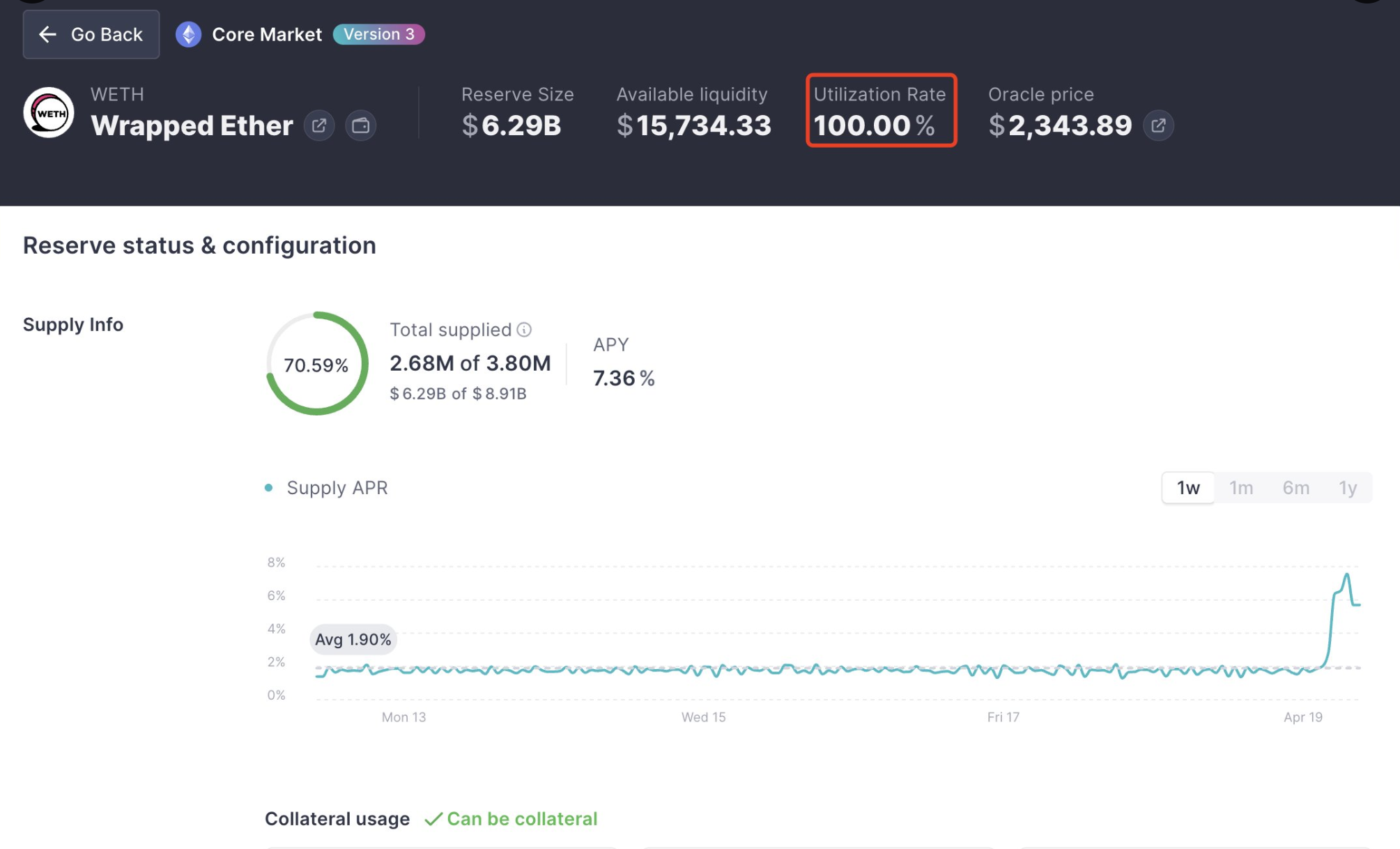
Whether Aave’s Umbrella backstop and the rsETH market freeze can stabilize confidence remains the central question for depositors still locked in the pool.
Aave Says Impact Limited to V3 ETH Market
Aave told BeInCrypto that the situation is contained to the V3 ETH market only, with V4 completely unaffected.
“On Aave’s side, the situation is contained to the V3 ETH market only. V4 is completely unaffected,” the Aave team said in an email shared exclusively with BeInCrypto.
The team said it moved quickly with precautionary measures, freezing the rsETH reserve, removing its borrowing power, and temporarily reducing the loan-to-value ratio on ETH to zero.
Stablecoin reserves and all other assets are operating normally with no exposure to the event.
The post Whales Dump Over $6 Million in AAVE as KelpDAO Exploit Triggers 20% Aave Price Drop appeared first on BeInCrypto.

Key Takeaways
- A Saturday attack on Kelp DAO’s LayerZero bridge resulted in the theft of 116,500 rsETH tokens valued at approximately $292 million
- The exploit manipulated LayerZero’s cross-chain messaging system to authorize fraudulent fund withdrawals
- Approximately $250 million in stolen assets were swapped for ETH using an address funded through Tornado Cash
- Nine or more DeFi protocols implemented emergency rsETH market freezes, including major platforms Aave, SparkLend, and Fluid
- The incident represents 2026’s most significant DeFi security breach, exceeding April’s Drift Protocol compromise
On Saturday at 17:35 UTC, malicious actors successfully extracted 116,500 rsETH tokens from Kelp DAO’s LayerZero-integrated bridge infrastructure, absconding with cryptocurrency assets valued at approximately $292 million.
The compromised volume accounts for roughly 18% of rsETH’s entire circulating token supply, which totals 630,000 units based on CoinGecko analytics.
Kelp DAO operates as a liquid restaking platform that accepts ETH deposits, channels them through EigenLayer for enhanced yield generation, and distributes rsETH as transferable receipt tokens to depositors.
The perpetrators exploited vulnerabilities in LayerZero’s cross-chain communication infrastructure, deceiving the system into processing what appeared to be legitimate cross-network instructions. This manipulation prompted Kelp’s bridge contract to transfer substantial funds to wallets under attacker control.
Kelp’s emergency response team activated protocol pause mechanisms across core smart contracts at 18:21 UTC, exactly 46 minutes following the initial breach. Two subsequent withdrawal attempts targeting an additional 40,000 rsETH — approximately $100 million in value — were successfully prevented.
Blockchain forensics from security firm Cyvers revealed that stolen assets were routed through addresses previously funded via Tornado Cash. Roughly $250 million of the compromised rsETH had already undergone conversion to ETH at the time of analysis.
Widespread Impact Across DeFi Ecosystem
The compromised bridge contract served as the collateral reserve supporting wrapped rsETH deployments across over 20 blockchain networks, including Base, Arbitrum, Linea, Blast, and Scroll.
With reserve backing eliminated, rsETH holders on layer 2 platforms now confront significant questions regarding token collateralization and redemption capabilities.
Aave implemented immediate rsETH market suspensions across both V3 and V4 platforms within hours of breach detection. [[LINK_START_0]]Aave’s token[[LINK_END_0]] experienced approximately 10% depreciation as traders factored in potential bad debt exposure risks.
SparkLend and Fluid similarly enacted rsETH market freezes. Lido Finance suspended deposits to its earnETH product due to rsETH holdings while emphasizing that its primary staking infrastructure remained unaffected.
Ethena implemented precautionary LayerZero OFT bridge suspensions from Ethereum mainnet for approximately six hours, though the protocol confirmed zero rsETH exposure.
Kelp’s initial public statement arrived at 20:10 UTC — nearly three hours post-attack. The protocol confirmed active collaboration with LayerZero, Unichain, audit partners, and external security consultants.
2026’s Challenging DeFi Security Landscape
Cyvers CEO Deddy Lavid characterized the breach as demonstrating inherent vulnerabilities within DeFi’s interconnected composability architecture.
The Drift Protocol, operating on Solana, sustained approximately $285 million in losses on April 1 through an attack attributed to North Korean threat actors.
Additional protocols including CoW Swap, Zerion, Rhea Finance, and Silo Finance have experienced security compromises throughout recent weeks.
According to Cyvers data, combined cryptocurrency losses from exploits and fraudulent schemes reached approximately $482 million during Q1 2026.
The Kelp DAO incident now holds the position as 2026’s most substantial DeFi security breach, marginally exceeding the Drift Protocol compromise.
As of publication, Kelp has not provided technical details explaining how attackers circumvented the bridge’s validation architecture.


Traditional finance giants are signaling a renewed interest in prediction markets, a sector that has surged in public attention as retail and institutional players explore hedging tools tied to real-world events. Charles Schwab and Citadel Securities each indicated they are weighing how to participate, signaling a potential shift from curiosity to concrete product ideas in the near term.
During an investor call, Schwab CEO Rick Wurster said the firm “likely will have prediction markets” at some point, though they are not currently of primary interest among Schwab clients. He added that if the firm does pursue such offerings, it would be “quite straightforward” to roll them out as part of a broader wealth-building platform. Wurster also stressed one caveat: Schwab’s approach would intentionally sidestep markets tied to sports, politics or pop culture, aiming instead to align with long-term financial planning for clients. He noted that, in his view, the typical gambler’s edge in prediction markets is not favorable over time, and Schwab would pursue a model focused on prudent investing rather than speculative betting.
Meanwhile, Citadel Securities is watching developments in prediction markets with cautious interest. Citadel Securities president Jim Esposito said at a Semafor conference in Washington, DC, that the firm is “absolutely keeping an eye on developments” but emphasized that liquidity remains a constraint. “We’re not there yet, there’s not that much liquidity,” he noted, though he acknowledged the market is likely to scale in the future and suggested a potential path for involvement if conditions evolve.
Key takeaways
- Major incumbents are considering entry: Schwab publicly signals a future prediction market offering, focusing on wealth-building rather than sports or politics.
- Liquidity and maturity are gating factors for market makers: Citadel notes low current liquidity but envisions a ramp in participation as volumes grow.
- Event contracts as hedging tools: Both parties see potential use cases for event-driven products (e.g., elections) as hedges against portfolio risks, distinguishing them from pure betting markets.
- Regulatory backdrop remains unsettled: Courts have scrutinized platforms like Kalshi and Polymarket for unlicensed activity, while lawmakers debate how to address insider trading and consumer protections.
- Market growth persists alongside conflicts: Data from market trackers show brisk growth in prediction-market activity, even as regulators push back on certain offerings.
Growth, scrutiny and the evolving landscape of prediction markets
Prediction markets have surged in visibility over the past year, driven by platforms such as Kalshi and Polymarket that allow users to trade contracts tied to real-world events. These markets have captured broad interest from traders seeking hedges or alternative risk exposures outside traditional financial instruments. In resounding numbers, Token Terminal reported that Kalshi, Polymarket and similar platforms together posted a record combined monthly trading volume of 23.6 billion dollars in March, highlighting a trajectory of rapid adoption and liquidity growth for event-driven markets.
Yet the expansion of these markets has not come without friction. Regulators in several U.S. states have pursued actions against prediction-platform operators, accusing them of offering unlicensed forms of betting disguised as markets for predictions. The intensity of scrutiny is underscored by ongoing litigation and regulatory scrutiny in multiple jurisdictions, complicating the path to broader adoption. Lawmakers in Congress have also signaled a willingness to tighten oversight, arguing that existing frameworks do not adequately deter insider trading or protect consumers in these newer trading venues.
Against this backdrop, Schwab’s cautious posture reflects a broader tension in the market: mainstream financial institutions want to participate in the potential utility of prediction markets, but they gravitate toward use cases aligned with risk management and long-horizon investing, rather than pure entertainment or speculative bets. Wurster’s comment that prediction markets must be aligned with “building long-term wealth” indicates a preferred framing: markets that help investors hedge or calibrate exposure to macro- or event-driven risk, rather than markets centered on volatile narratives or sensational outcomes.
Esposito’s remarks at Semafor likewise underscore a pragmatic view from a market-making perspective. While indicating interest in event contracts as hedges—such as those tied to elections or other geopolitical developments—Citadel remains attentive to liquidity conditions. If and when volumes and counterparties converge to support reliable price discovery, the economics of market-making in prediction markets could become more compelling for large liquidity providers and institutions with diversified risk profiles.
The regulatory environment adds another layer of complexity. The record-level activity reported by market trackers contrasts with the legal challenges faced by platforms that have been accused of running unlicensed betting markets. The tension is not simply about whether such products exist, but how they’re structured, who can access them, and what protections are in place for participants. In parallel, the debate over insider trading and market manipulation in prediction markets has intensified, with policymakers weighing appropriate compliance standards for both operators and participants.
From a market perspective, the current maturity gap—significant interest and use by both retail and institutional segments, but limited high-liquidity participation—creates a classic “build vs. wait” scenario for incumbents. Schwab’s stance implies a potential, measured integration into mainstream financial services with a focus on wealth management workflows, risk planning, and portfolio hedging. Citadel’s position suggests caution, but a readiness to scale into the right niches if liquidity improves and regulatory clarity advances.
For traders and investors, the evolving picture suggests several near-term watchpoints. First, the regulatory timeline is crucial: any new framework or enforcement direction could alter product design, accessibility and pricing dynamics across prediction markets. Second, liquidity signals from current market-makers and new entrants will shape price discovery and the feasibility of sophisticated hedging strategies that rely on event-driven outcomes. Third, investor education and risk disclosures will determine how a broader audience uses these instruments—whether as speculative vehicles or as practical hedges against uncertain but foreseeable events.
In parallel, the broader crypto and traditional markets will be watching how these developments influence risk-sharing tools and derivative-like instruments. Event-based contracts share some characteristics with traditional options, yet they operate in a space where real-world outcomes can rapidly reshape pricing and exposure. If large financial institutions begin to offer or partner on such products, it could lend more legitimacy and stability to the sector, while also inviting intensified regulatory scrutiny and a reevaluation of risk controls for participants.
Notably, Schwab’s recent foray into crypto-lite exposure—specifically the launch of Bitcoin and Ether trading on Thursday—frames how traditional players are diversifying beyond conventional equities and fixed income. While that launch is separate from prediction markets, it signals an overarching trend: incumbents are testing digital-asset and event-driven product suites in parallel, seeking to blend familiar wealth-management paradigms with newer forms of risk transfer and exposure.
As the market evolves, observers should watch how liquidity, regulatory clarity and user demand interact to shape the viability of prediction-market offerings from large financial institutions. The next several quarters could reveal whether these strategies remain experimental or begin to form a core component of the mainstream financial toolkit.
For readers seeking deeper context, the ongoing coverage of prediction markets’ legal status and regulatory developments remains essential. Related reporting has highlighted debates around insider trading and the appropriate scope of oversight, with lawmakers and enforcement agencies weighing how to balance innovation with guardrails. Meanwhile, industry data continues to illustrate a fast-growing user base and notable volume, reinforcing the idea that prediction markets occupy a pivotal niche at the intersection of finance, technology and public events.
As Schwab and Citadel monitor the landscape, the broader market will be watching closely to see which model gains traction: a carefully framed, wealth-focused product by traditional finance players, or more modular, liquidity-driven solutions that attract a broader base of traders and institutions.
What unfolds next may hinge on regulatory clarity and the ability of market makers to build durable liquidity. If those elements align, prediction markets could slip from curiosity to cornerstone tools for portfolio hedging and risk assessment in a more mainstream financial ecosystem.
Sources and context: The discussion around Schwab and Citadel’s potential entry into prediction markets was reported alongside coverage of growth in prediction-market activity. Token Terminal data indicate a record 23.6 billion dollars in combined monthly trading volume for Kalshi, Polymarket and related platforms in March. Industry observers have noted regulatory actions against prediction-market operators in several states, as well as congressional scrutiny over insider trading concerns. Citadel’s comments were reported during a Semafor World Economy conference in Washington, DC, and Schwab’s remarks followed remarks linked to client discussions, with Schwab also recently launching cryptocurrency trading on its platform, as reported by CNBC.
Token Terminal data cited the March volume milestone for Kalshi and Polymarket, illustrating the sector’s rapid momentum.
Further reading and related coverage have highlighted ongoing debates about the legality and ethics of prediction markets, including questions about the role of sports and politics Betting and how regulators respond to new products, as described in coverage of court cases and regulatory proposals.
As the conversation around prediction markets continues to unfold, investors should monitor regulatory developments, liquidity dynamics and product design choices that will determine whether these markets become a staple of mainstream financial risk management or remain a niche instrument for specialized traders.
TLDR
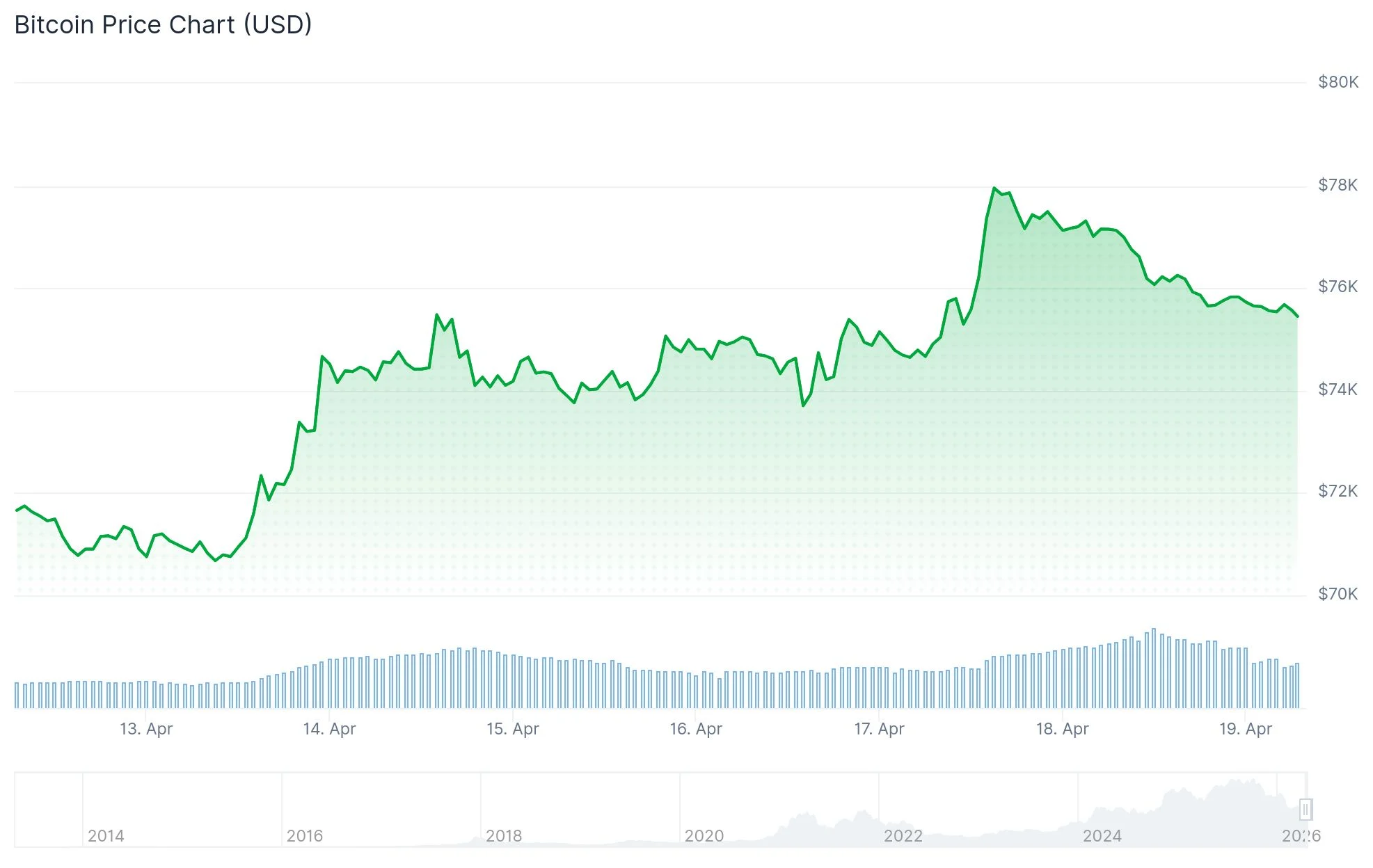
- BTC climbed to $78,000 following Iran’s temporary reopening of the Strait of Hormuz, before retreating to $76,000 when the passage was shut down again less than a day later.
- The upward move sparked $762 million in cryptocurrency liquidations, with short positions accounting for $593 million of the total.
- Spot Bitcoin ETFs recorded approximately $1 billion in weekly inflows — marking their strongest performance since January.
- Morgan Stanley introduced a Bitcoin Trust fund that has accumulated $120 million in assets within its first six days of trading.
- Major altcoins including Ether, XRP, BNB, and Solana registered weekly gains despite experiencing weekend declines.
Bitcoin experienced significant volatility this week as geopolitical developments in the Middle East dominated market sentiment. The digital asset’s price fluctuated dramatically as circumstances surrounding the Strait of Hormuz evolved rapidly.
Iran’s foreign minister declared on Friday that the Strait of Hormuz would be accessible to commercial vessels throughout the duration of a ceasefire agreement. President Donald Trump corroborated the announcement, stating that Iran had committed to an “unlimited” halt of its nuclear activities.
The cryptocurrency market reacted swiftly, pushing Bitcoin beyond the $78,000 threshold. Conversely, energy markets moved in the opposite direction as Brent crude plummeted nearly 10% to approximately $85 per barrel.
This breakout catalyzed one of 2026’s most substantial short squeezes. According to CoinGlass analytics, the market witnessed $762 million in aggregate liquidations affecting 168,336 traders. Short positions comprised $593 million of these liquidations, with bitcoin shorts specifically representing $381 million.
Funding rates for bitcoin perpetual contracts had remained in negative territory for several weeks, indicating that short sellers were compensating longs to maintain their bearish positions. The Hormuz announcement served as the catalyst that reversed this dynamic.
ETF Inflows Reach Three-Month Peak
While price movements captured market attention, Bitcoin ETFs silently achieved their most impressive week since January. SoSoValue data reveals that spot Bitcoin ETFs attracted $996 million in net inflows throughout the week.
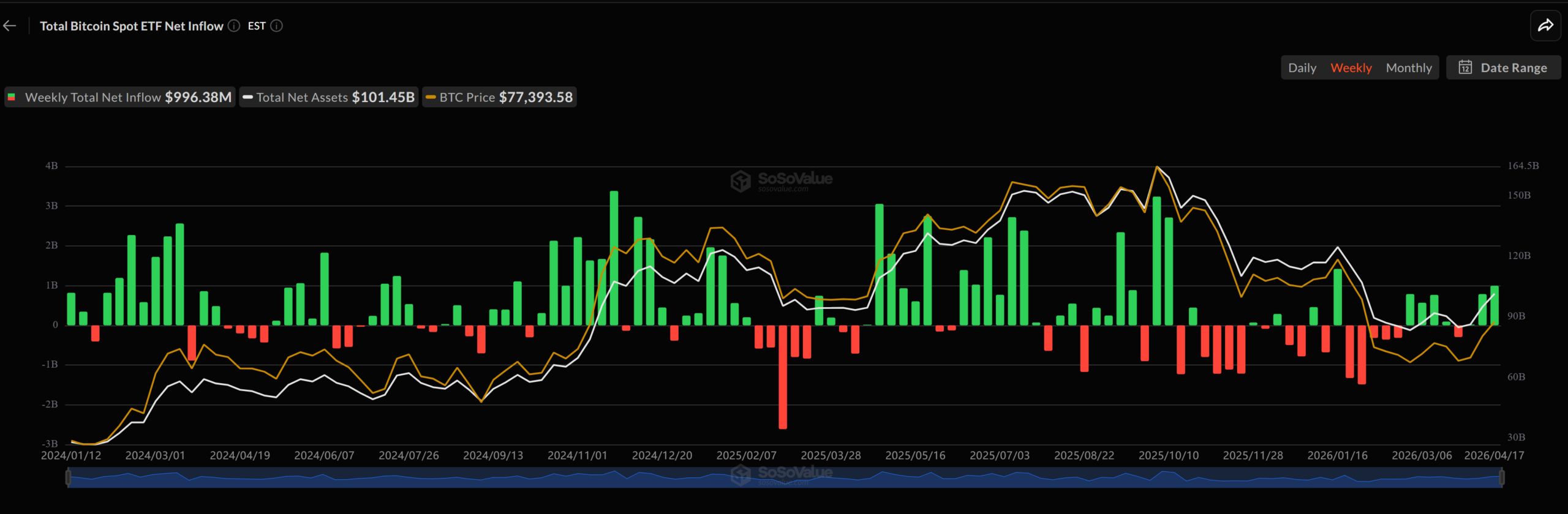
Friday recorded the week’s largest single-day influx with $663.9 million entering the funds. Combined net assets across all spot Bitcoin ETFs surpassed $101 billion, accompanied by daily trading volumes approaching $4.8 billion.
Ethereum-focused ETFs similarly demonstrated strength, accumulating nearly $276 million over the week, per Farside Investors data.
Morgan Stanley’s recently unveiled Bitcoin Trust contributed to this trend. The financial product has already amassed $120 million in assets despite having only six trading days under its belt, surpassing WisdomTree during this brief period.
Iran Policy Reversal Triggers Bitcoin Decline
Fewer than 24 hours following the Hormuz reopening announcement, Iranian authorities reversed their position. The Nour state news outlet reported that the strait had returned to “strict management and control by the armed forces,” attributing the change to a U.S. blockade targeting Iranian ports.
Multiple tanker operators informed Bloomberg that their ships received Iranian radio communications instructing them to halt passage. One supertanker captain reported hearing gunfire and subsequently reversed direction.
Bitcoin declined to $76,091 by Saturday evening in Asian trading hours, maintaining just a 0.8% daily increase. Ethereum decreased 3% to approximately $2,365, while Solana slipped 1.3% and Dogecoin fell 2.1%.
Examining weekly performance, XRP outperformed all major cryptocurrencies with a 6.4% advance. BNB gained 4.6%, Ether climbed 5.2%, and Bitcoin preserved a 4.7% weekly increase despite the weekend pullback.
Market analysts at Bitunix observed that Bitcoin continues trading within an established range, encountering resistance above $75,000 and finding support near $72,000 according to their most recent assessment.
TLDR:
- MegaETH processes over 100,000 TPS with sub-10ms block times, settling all activity directly on Ethereum mainnet.
- iTRY, a Turkish Lira stablecoin backed by money market funds, launches with a real-time 45% APY yield loop strategy.
- Kumbaya XYZ holds $51M of MegaETH’s $89M TVL, with USDM capturing 74% of the network’s $84M stablecoin market cap.
- 53% of $MEGA token supply unlocks only after hard KPIs are met, with USDM revenue funding active protocol buybacks now.
MegaETH ($MEGA) is gaining attention as the first real-time Ethereum Layer 2 in history. The network delivers sub-10-millisecond block times and over 100,000 transactions per second.
All activity settles directly on Ethereum. The protocol currently holds approximately $89 million in total value locked.
With 2.26 million transactions in 24 hours and zero artificial incentives, MegaETH is building momentum. The network positions itself as a high-throughput onchain settlement layer for real applications.
iTRY Launch and Live DeFi Protocols Drive Activity on MegaETH
One of the most anticipated developments is the launch of iTRY, a Turkish Lira stablecoin. As noted by researcher Nick Research on X, iTRY is backed by money market funds and offers around 45% APY.
The yield strategy works through a real-time loop: lock iTRY, mint wiTRY, borrow USDm, and compound yield. This carry loop removes traditional lock-up barriers for yield seekers.
The broader stablecoin market on MegaETH is already well-established. USDM, issued through Ethena, captures over 74% of the $84 million stablecoin market cap on the network.
Kumbaya XYZ contributes $51 million of the $89 million total TVL on its own. That concentration shows real capital deployment rather than distributed incentive farming.
Bluechip DeFi protocols went live on the network from day one. Aave V3, GMX, and World Markets launched alongside a Chainlink Scale integration.
That integration provides access to nearly $14 billion in flagship assets, including wstETH and LBTC. This confirms that major DeFi infrastructure views MegaETH as production-ready.
Perpetuals trading activity is rising sharply on the network as well. Weekly perps volume climbed 900% to reach $45 million over seven days.
The sequencer operates at cost, which keeps transaction fees among the lowest in crypto. These factors together are drawing active traders to the platform.
$MEGA Tokenomics Link Supply Unlocks to Hard Performance Milestones
The $MEGA token structure stands out for its milestone-based unlock mechanism. There are no points programs, no emissions, and no manufactured TVL incentives in the design.
Instead, 53% of total supply unlocks only after the network hits hard KPIs. Token release is directly tied to real, measurable growth.
Foundation revenue from USDM activity flows into direct $MEGA buybacks, which are already active. This buyback mechanism provides consistent demand without depending on market speculation.
Protocol revenue-backed buybacks at this stage of development remain uncommon. It adds a self-sustaining element to the overall token economy.
The token generation event remains tied to milestones rather than a fixed calendar date. This approach shifts builder incentives toward long-term throughput growth.
The network currently runs at 10 gigagas per second, supporting complex smart contracts at scale. That throughput level makes MegaETH suitable for applications requiring fast, reliable execution.
The MegaMafia ecosystem is expanding into DeFi, gaming, and culture. Brix recently secured $5.5 million from Turkish institutional investors ahead of the iTRY launch. Active addresses reached 3,230 in 24 hours, reflecting genuine user engagement on the network.
TLDR:
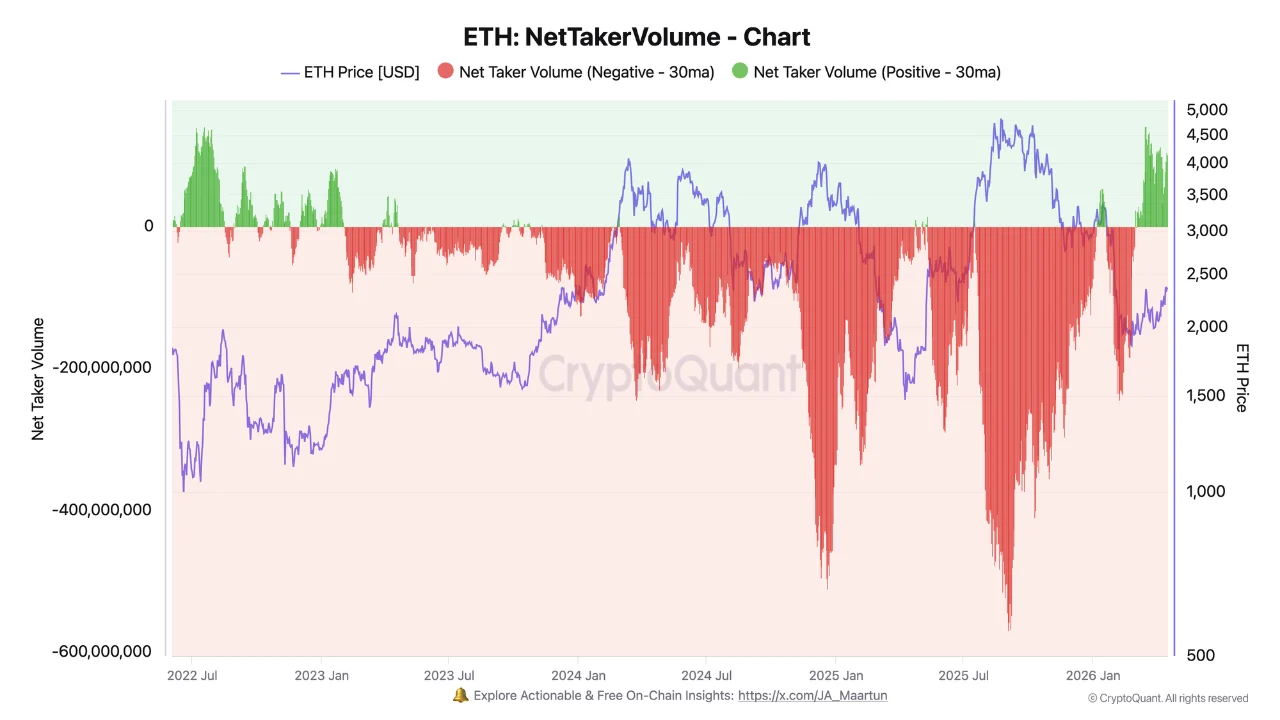
- ETH net taker volume turned positive at +$102M, snapping months of consistent sell-side dominance.
- Sell pressure peaked at -$568M when Ethereum set its all-time high just below $5,000 this cycle.
- Comparable buying pressure was last recorded in 2022 when ETH traded near the $1,000 price level.
- Since March, buy-side volumes have steadily grown, pointing to a possible shift in market positioning.
ETH derivatives sentiment has undergone a notable change in recent weeks. After prolonged and consistent selling pressure throughout this market cycle, buy-side volumes are finally gaining ground.
Data from derivatives exchanges shows that net taker volume has turned positive, recording +$102 million in a single day.
This marks a clear departure from the heavy sell-side dominance seen at previous ETH price peaks. Analysts are now watching whether this shift holds and supports a broader recovery for Ethereum.
Heavy Sell Pressure Shaped ETH Derivatives Throughout This Cycle
For most of this cycle, Ethereum has faced unusual and persistent selling pressure in derivatives markets. Net taker volume, which tracks the difference between buy and sell market orders on derivatives exchanges, remained almost consistently negative. This pattern became particularly visible during key price events in late 2024.
When ETH attempted to break above $4,000 in December 2024, net taker volume fell sharply to -$511 million. The sell pressure became even more extreme when Ethereum later reached an all-time high just below $5,000. At that point, sell-side dominance hit a cycle high of -$568 million in net taker volume.
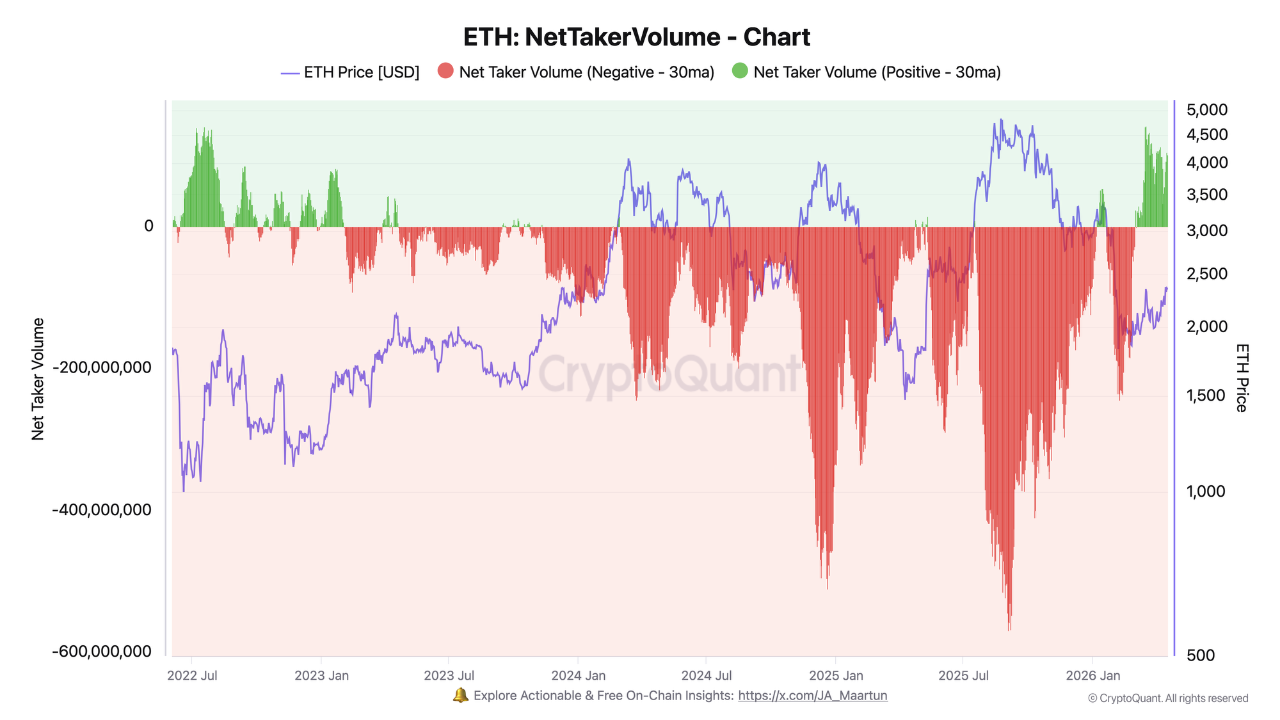
Source: Cryptoquant
On-chain analyst Darkfost drew attention to this persistent trend in a recent post on Cryptoquant. The data showed that buyers repeatedly failed to absorb supply at key price levels throughout this cycle.
Sellers consistently overpowered buying activity, pushing net taker volume deep into negative territory during each rally.
That ongoing imbalance prevented Ethereum from sustaining breakouts, even during brief moments of upside price action.
Buy-Side Volume Climbs to Levels Not Seen Since the 2022 Bear Market
Since March, the dynamic in ETH derivatives markets has changed considerably. This change followed months of negative readings that characterized Ethereum’s derivatives activity.
Buy-side volumes have taken control, with net taker volume recording +$102 million in a single day. The last time Ethereum recorded comparable buying pressure was back in the 2022 bear market.
At that time, ETH was trading near the $1,000 area when similar buy-side activity appeared in the market. Market observers note this comparison carries weight given the scale of the current buying activity.
The return of strong buying interest at current price points to a change in how derivatives traders are positioned.
Darkfost noted in the post: “Since March, buy-side volumes have finally taken control, with +$102 million recorded today.”
The analyst added that buyers absorbing supply and chasing upside could signal the early stages of a recovery for Ethereum. The data stands in sharp contrast to the aggressive sell-side behavior that defined much of this cycle.

Traditional finance giants Charles Schwab and Citadel Securities are both considering entering prediction markets, with each separately weighing up how they wish to get involved in the fast-growing sector.
“I think at some point we likely will have prediction markets,” Rick Wurster, the CEO of the banking and investing titan Schwab, told investors during a call on Thursday.
He added that prediction markets weren’t “of tremendous interest” when he recently asked a group of Schwab clients about them, but it was an area the company would “take a hard look at, and it would be quite straightforward for us to offer.”

Prediction markets such as the popular Kalshi and Polymarket have exploded in use over the past few months, with both platforms seeing a record combined total monthly trading volume of $23.6 billion in March, according to Token Terminal.
However, Kalshi, Polymarket and other prediction market platforms have also caught the ire of some US state regulators, who have accused them in court of offering unlicensed sports betting.
Some federal lawmakers have also vowed to crack down on prediction markets, claiming the platforms weren’t doing enough to stamp out insider trading.
Wurster said Schwab’s potential offering would steer away from allowing bets on areas such as sports, politics and pop culture as it looks to position itself as a partner for building long-term wealth.
“Prediction markets that are not aligned to that are not something that we want to pursue,” he said. “If you look at the stats on the success of gamblers, they’re not strong, and people generally lose money.”
Citadel “keeping an eye” on prediction markets
Meanwhile, Citadel Securities president Jim Esposito said at a Semafor conference in Washington, DC, on Thursday that the company is “absolutely keeping an eye on developments” in prediction markets.

“We’re not there yet, there’s not that much liquidity,” he added, but said that the market is likely to “ramp and scale,” and it was “certainly possible” that the market-making firm would potentially look to get involved.
Related: Democrats question CFTC chair on insider trading in prediction markets
Esposito said Citadel was “not looking at sports at the moment at all, I don’t see us entering that market,” but did signal an interest in some event contracts.
He added that Citadel could see its retail and institutional clients use some event contracts as a hedge for risks to their investments, such as contracts for elections, which have been known to move markets.
“That’s going to be some of the biggest risks to investors’ portfolios that they’re going to have to grapple with,” Esposito said. “Having a clean and distinct way to hedge certain risks, I think there’s a good use case and industrial logic to it.”
Magazine: Should users be allowed to bet on war and death in prediction markets?
Crypto World
Tokenized Treasuries Cross $13.74B as Institutions Shift Focus From Issuance to Utility
TLDR:
- Tokenized U.S. Treasuries have reached $13.74B onchain, marking a shift from proof of concept to real utility.
- Standard Chartered and OKX launched a collateral mirroring programme using tokenized money market funds for trading.
- BounceBit’s Prime platform connects regulated custody with onchain execution through off-exchange settlement flows.
- Circle acquired Hashnote to position USYC as yield-bearing collateral within its expanding digital asset platform.
Tokenized U.S. Treasuries have reached $13.74 billion in onchain value, according to RWA.xyz. This milestone marks a turning point for digital asset markets.
The category has moved past proving tokenization is feasible. Now, the focus shifts toward making those assets functional within real financial infrastructure.
Major institutions are already responding to that shift with concrete programmes and integrations.
From Passive Holdings to Active Collateral Use
The first phase of tokenization centered on bringing familiar assets onto blockchain networks. That work is largely done. The next phase is about putting those assets to work once they are onchain.
Faster-moving collateral, productive capital deployment, and treasury-backed assets that serve active roles are now the priorities.
Franklin Templeton captured this thinking directly in its framing of tokenized money market funds. The firm noted that tokenization creates new utility and use cases, not simply a digital version of an existing instrument.
Its Franklin OnChain U.S. Government Money Fund invests at least 99.5% of assets in U.S. government securities, cash, and related repos.
Standard Chartered and OKX announced a collateral mirroring programme with Franklin Templeton. The programme allows institutional clients to use crypto and tokenized money market funds as off-exchange collateral for live trading. That development moves the market clearly beyond passive holding toward active capital markets use.
BlackRock’s BUIDL and Ondo’s USDY have also helped define the institutional profile of tokenized Treasuries onchain.
Together, these products combine recognizable underlying assets, short-duration government yield, and compatibility with digital asset workflows.
Those three qualities make tokenized Treasuries one of the most relevant real-world asset categories for crypto-native markets today.
Infrastructure Built Around Capital Efficiency
BounceBit has positioned its RWA stack around the idea that tokenized cash equivalents should not stop at issuance. The platform integrated Ondo’s USDY as its first tokenized RWA.
It later expanded to source tokenized cash equivalents from Franklin Templeton’s Benji and BlackRock’s BUIDL through Securitize.
BounceBit’s Prime platform connects regulated custody with onchain execution. Client assets are custodied at Standard Chartered and mirrored to trading venues through an off-exchange settlement flow. That structure allows capital to remain controlled while being deployed more efficiently across strategies.
The platform targets yield above the risk-free rate through structured strategies built on tokenized cash equivalents and market-neutral trading.
Rather than passive exposure, Prime is designed to turn tokenized collateral into a working part of institutional treasury and trading operations.
Circle’s acquisition of Hashnote brought USYC into Circle’s platform, with Circle positioning it as yield-bearing collateral for digital asset markets.
That move, alongside the growth of BUIDL and Benji integrations, shows a consistent direction. Stablecoins built the base layer for onchain dollars. Tokenized Treasuries are now building the next layer for onchain yield-bearing capital.

In the latest bond news, Henry Paulson, who steered the U.S. financial system through the 2008 collapse as Treasury Secretary, is warning that the $35 trillion U.S. debt load could trigger a Treasury bond market crash, and calling for an emergency “break-glass” contingency plan to be ready before it hits.
The transmission channel to crypto is direct: a disorderly bond sell-off tightens dollar liquidity fast, and tight dollar liquidity historically punishes risk assets before any safe-haven Bitcoin narrative has time to develop.
30-year Treasury yields have already crossed 5%, a threshold last breached in October 2023 during the inflation-driven spike and essentially unseen before that since the pre-Great Recession era. That’s not a warning sign in isolation. It’s a warning sign with Paulson’s voice behind it.
Key Takeaways:
- Who warned: Henry Paulson, U.S. Treasury Secretary 2006–2009 and architect of the 2008 TARP bailout, issued the alert.
- What he said: Paulson described a potential Treasury demand collapse as having “vicious” effects – likening the timing to hitting “the wall” unpredictably due to the “law of economic gravity.”
- What he wants: An emergency “break-glass” or “emergency brake” debt plan ready on the shelf before a crisis materializes.
- Bond market context: 30-year Treasury yields crossed 5% recently; U.S. debt has grown from $10 trillion in 2008 to over $35 trillion by 2025.
- April 2025 precedent: Treasury yields surged sharply amid Trump tariff escalation, defying safe-haven expectations and coinciding with equity sell-offs – a preview of correlated risk-off pressure.
- Crypto transmission channels: Dollar liquidity tightening, risk-off rotation away from speculative assets, and potential cascading liquidations in leveraged crypto positions.
- Pushback: Treasury Secretary Scott Bessent dismissed comparable warnings from JPMorgan CEO Jamie Dimon on June 1, 2025, calling his track record on such predictions poor.
- Watch: 10-year Treasury yield level relative to 4.8% resistance, upcoming Fed communications, and BTC’s correlation to the DXY during any yield spike.
Discover: The best crypto to diversify your portfolio with
Bond News: How a Bond Market Shock Actually Reaches Crypto, and Which Assets Get Hit First
The question isn’t whether Paulson is right about Treasury market fragility. It’s whether crypto trades as a safe haven or a risk asset when it is proven right, and history gives a clear answer, at least in the short run.
A disorderly Treasury sell-off forces dollar liquidity higher as investors dump bonds and demand cash. That dynamic hits leveraged positions first. Crypto markets, where open interest across derivatives venues has been climbing sharply, carry exactly that leverage profile, elevated exposure that becomes a liability the moment dollar funding costs spike.
The April 2025 episode clearly illustrated the mechanism. When Treasury yields surged amid tariff-escalation fears, crypto did not decouple toward safety. It sold alongside equities, in defiance of the digital-gold narrative. Correlation to risk assets held. That’s the bear case in one data point.

Paulson’s specific concern, that demand for Treasuries could collapse suddenly and without obvious warning, governed by what he calls the “law of economic gravity”, implies a non-linear shock rather than a gradual yield drift.
Non-linear shocks are what liquidation cascades are built from. A 10-year yield breaking decisively above 5% with accelerating momentum would be the confirmation threshold worth watching.
Bitcoin Safe Haven or Risk-Off Casualty: What the Bond Stress Means for Crypto Prices
The idea sounds clean. If bonds start losing credibility, capital has to go somewhere, and Bitcoin, with its fixed supply and non-sovereign nature, becomes an obvious alternative, which is why big players keep that thesis in the background.
But the timing is where people get caught.
In a real bond market shock, the first move is not rotation; it is panic, and in that phase, everything gets sold, including Bitcoin, just like what happened in March 2020 when BTC dropped hard before turning higher.

Ethereum and major altcoins are currently at technical inflection points, making them particularly vulnerable to a macro liquidity shock, which could be the deciding factor. ETH does not carry the same hard-money narrative as BTC and would likely underperform in a genuine risk-off episode driven by sovereign debt stress.
Jamie Dimon’s parallel warning, that investor demands for higher Treasury yields could spike mortgage rates independently of Fed policy, reinforces Paulson’s thesis from a different angle. Bessent’s public dismissal of Dimon on June 1 suggests official Washington is not in crisis mode. But bond markets are already pricing something the Treasury Secretary isn’t fully acknowledging.
Discover: The best pre-launch token sales
The post Former Treasury Chief Warns Bond Market Crash Could Hit Crypto Outlook appeared first on Cryptonews.

Chelsea: Pressure mounts for Liam Rosenior’s side with fan protests and another costly loss

Iranian President insists on country’s nuclear rights, ISNA reports

RaveDAO Denies Manipulation as Binance, Bitget Probe RAVE Trading Activity


-
 NewsBeat6 days ago
Pep Guardiola and Gary Neville agree over Arsenal title problem that benefits Man City
-

 Crypto World6 days ago
The SEC Conditionalises DeFi Platforms to Be Avoided for Broker Registration
-

 Fashion2 days ago
Weekend Open Thread: Theodora Dress
-

 Politics7 days ago
World Cup exit makes Italy enter crisis mode
-

 Crypto World5 days ago
SEC Signals Exemption for Crypto Interfaces From Broker Registration
-

 News Videos4 days ago
Secure crypto trading starts with an FIU-registered
-

 Sports2 days ago
NWFL Suspends Two Players Over Post-Match Clash in Ado-Ekiti
-

 Crypto World5 days ago
SEC Proposes Certain Crypto Interfaces Don’t Need to Register as Brokers
-

 NewsBeat5 days ago
Trump and Pope Leo: Behind their disagreement over Iran war
-

 Politics1 day ago
Palestine barred from entering Canada for FIFA Congress
-

 Crypto World1 day ago
Russia Pushes Bill to Criminalize Unregistered Crypto Services
-

 Sports6 days ago
NWFL opens Pathway for new Clubs ahead of 2026 Season
-

 Crypto World6 days ago
Trump whales load up ahead of Mar-a-Lago luncheon.
-
 Business2 days ago
Creo Medical agree sale of its manufacturing operation
-
Business6 days ago
Kering slides after Morgan Stanley downgrade, Gucci woes loom
-
Crypto World6 days ago
Sei Network Enters Quiet Reset Phase as On-Chain Metrics Signal a Slowdown in 2026
-

 Tech6 days ago
Google adds E2E encryption to Gmail for iOS and Android enterprise users
-

 Tech6 days ago
Apple glasses won’t go brand shopping like Meta did with Ray-Ban and Oakley
-
 Entertainment5 days ago
Karol G’s ‘Ultra Raunchy’ Coachella Set Gave ‘Satanic Vibes’
-
 Entertainment5 days ago
Brand New Day’ Footage Reveals the Devastating Impact of ‘Now Way Home’
You must be logged in to post a comment Login