
Crypto World
3 Altcoins to Watch in Final Week of April With Onyxcoin Up 30%

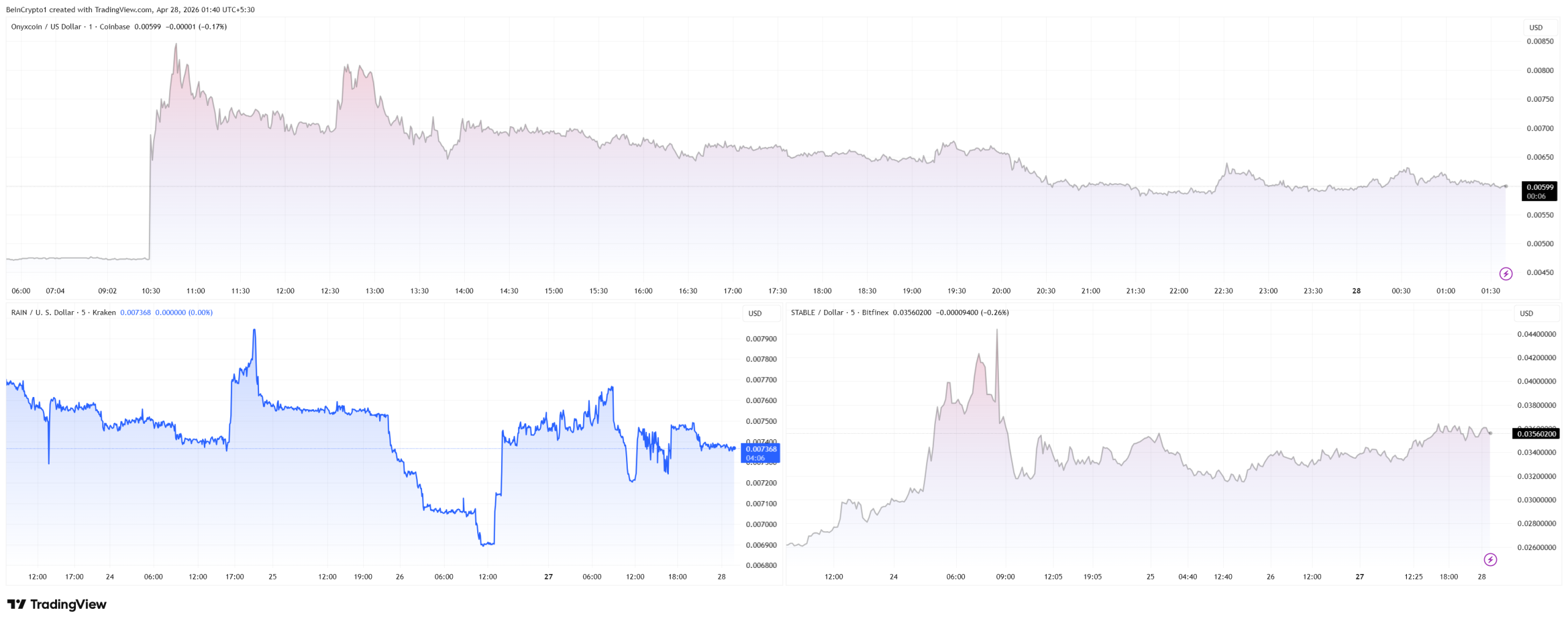
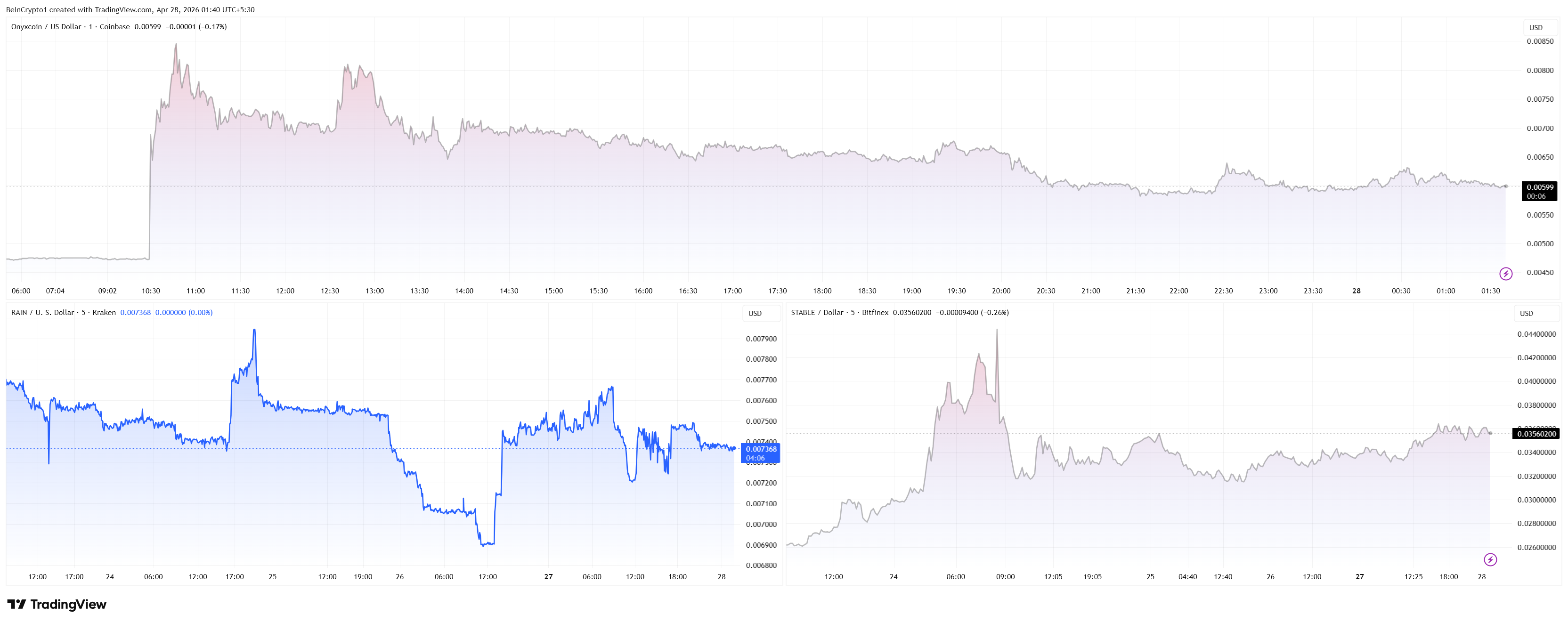
Three altcoins entered the final week of April 2026 at sharply different technical inflection points. Onyxcoin (XCN) printed a 47% daily gain while Rain (RAIN) and STABLE held their Fibonacci structures.
The three setups span a breakout retest, a neutral consolidation, and a healthy pullback. Each chart prints distinct signals on the daily timeframe heading into May.
Onyxcoin (XCN) Surges to Lead Altcoins in Final Week of April
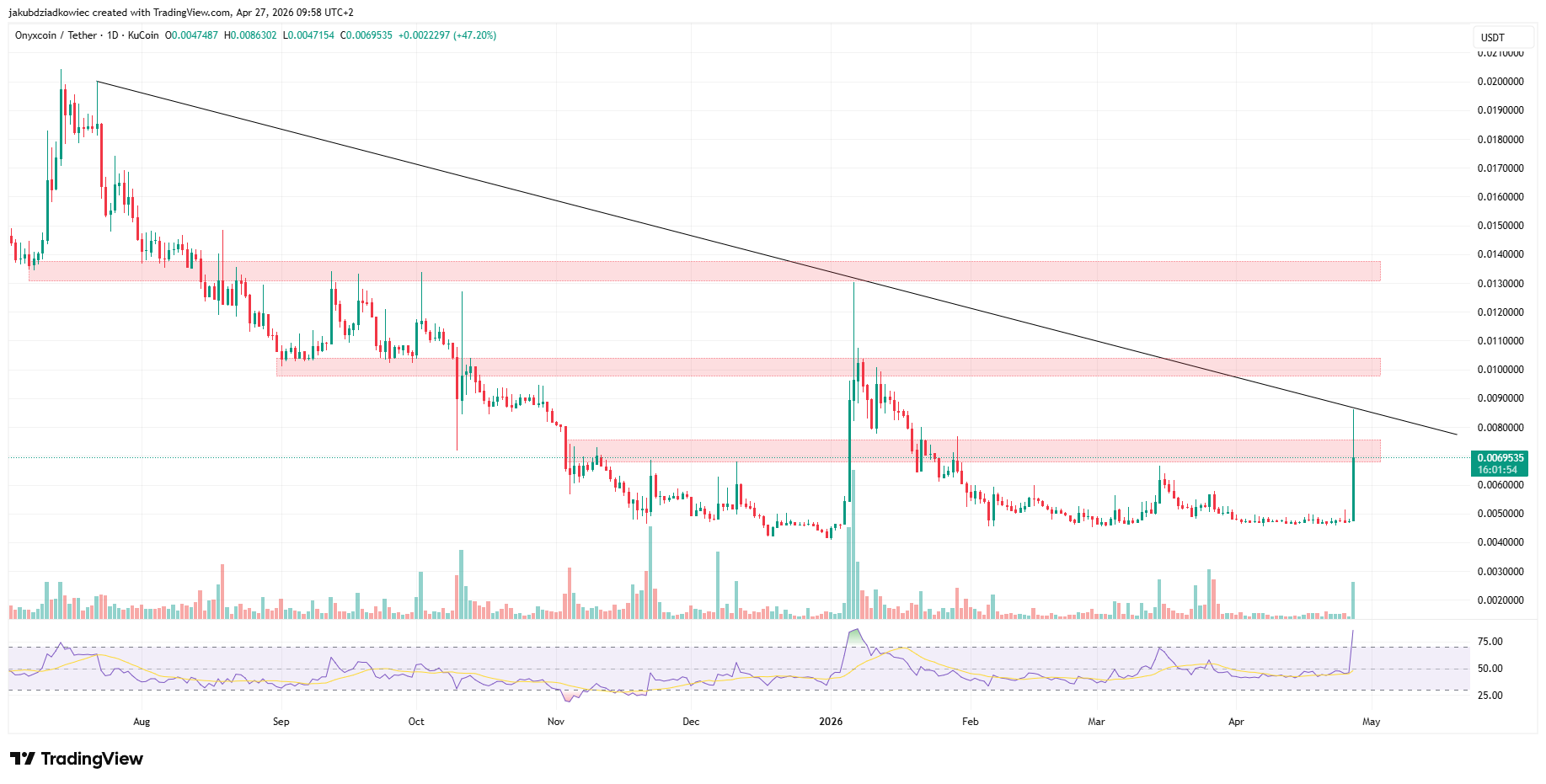
Onyxcoin (XCN) led the group on April 27 with a 47.20% daily gain. Price pushed to $0.0086 intraday, its highest level since mid-January. XCN has since pulled back to $0.0069, retesting the resistance zone between $0.0068 and $0.0075.
The Upbit listing provided the catalyst, but the daily structure still looks fragile. The price remains below a descending trendline that dates back to July 2025. Overhead resistance at $0.010 and $0.013 caps any sustained breakout attempt.
The Relative Strength Index (RSI) broke out sharply to the upside, suggesting momentum favors the bulls. However, volume on the breakout candle came in below the prior demand spikes from March 26 and January 6.
If XCN fails to reclaim the $0.0068 to $0.0075 zone as support, the rally may be short-lived. A clean daily close above the descending trendline would shift the structure and open a path toward $0.010.
Rain (RAIN) Sits Between Fibonacci 0.382 and 0.5 as Volume Dries Up
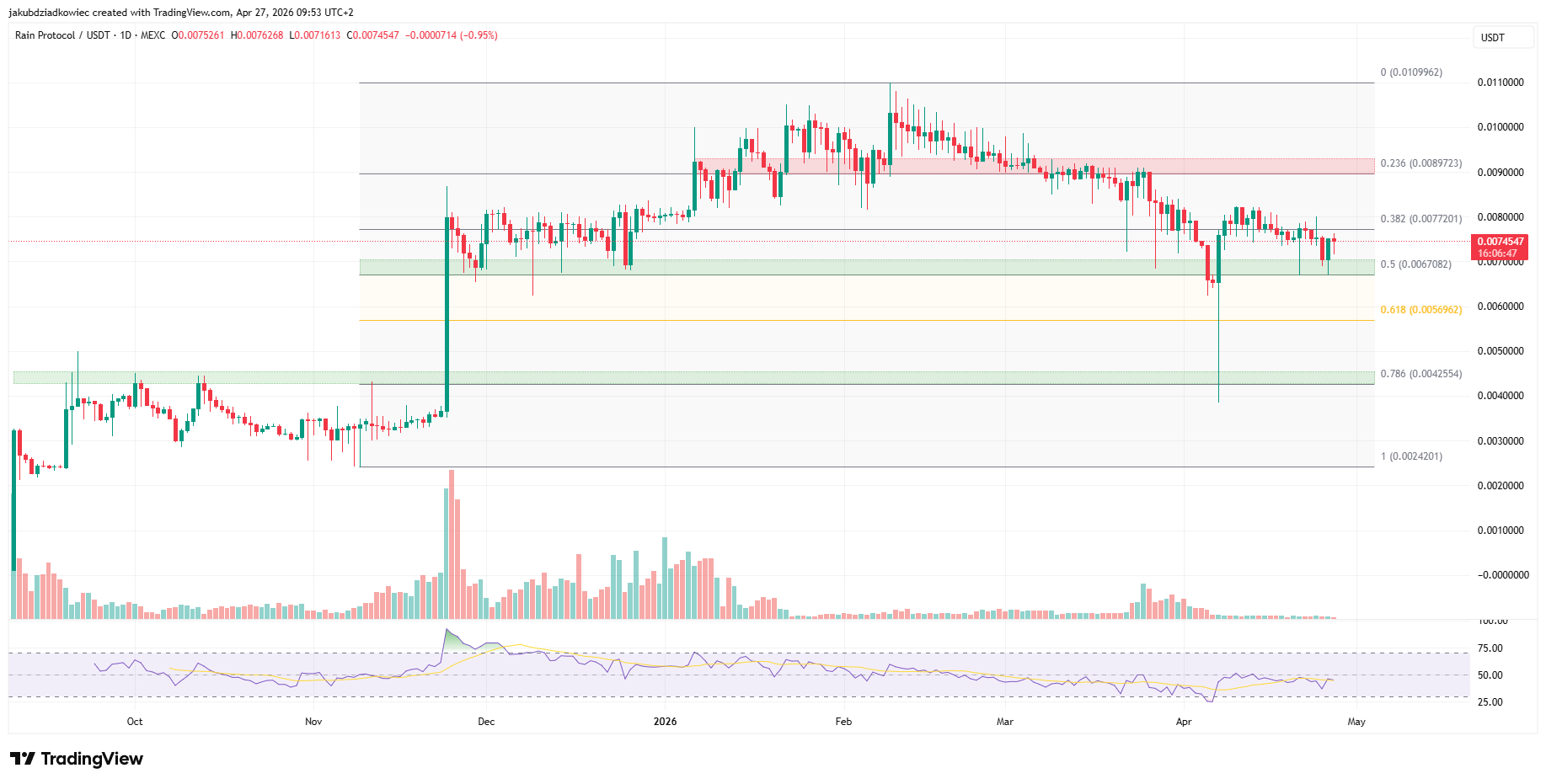
Rain (RAIN) trades at $0.00745 on the daily chart. The token sits between the 0.382 Fibonacci retracement at $0.0077 and the 0.5 retracement at $0.0067. The grid runs from the November 9, 2025, low of $0.0024 to the February 9, 2026, high of $0.011.
The 0.5 level has acted as the first line of support for several weeks. Price has repeatedly tested the area, only to bounce. RSI sits at roughly 46, a neutral reading, and daily volume has compressed to the lowest range of the year. Neither buyers nor sellers are pressing the tape.
A deeper correction would target the 0.786 Fibonacci at $0.0042, the next major demand zone visible on the chart. To the upside, the 0.236 Fibonacci at $0.009 marks the first resistance. That level would be the immediate target if buyers step back in.
The setup is binary. Continued absence of volume keeps RAIN coiling between Fibonacci levels. The breakout direction will likely come from a broader altcoin rotation rather than token-specific demand.
STABLE Holds Higher Highs After Tagging W-Pattern Target
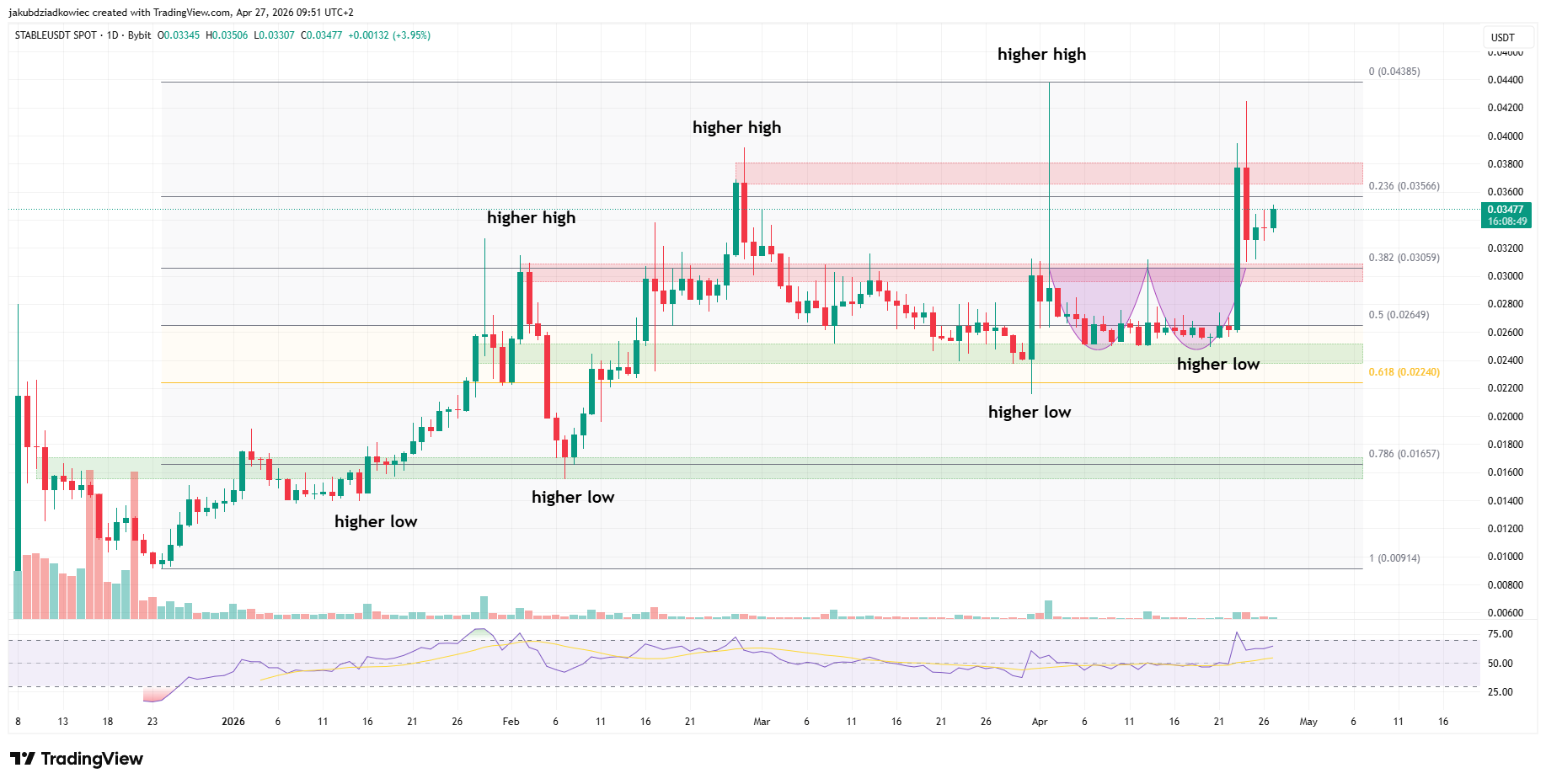
STABLE was the cleanest technical structure of the three. Price hit the W-pattern target from the prior BeInCrypto analysis on April 23. The token then tagged resistance at $0.037 and corrected to the 0.382 Fibonacci at $0.0306 before bouncing.
The daily chart continues to print higher highs and higher lows, the textbook signature of a healthy uptrend. RSI sits at approximately 65, just below the overbought threshold. Price trades at $0.03477 with a 3.95% daily gain.
The next test sits at $0.037, the same level that capped the prior leg up. A daily close above this band, which extends to $0.038, would confirm continuation. The break would likely open a path toward $0.04385, the swing high marked on the Fibonacci grid.
Volume has been declining through the bounce, which signals weakening momentum even as price advances. The structure looks intact. A failure to break $0.037 with conviction would set up another retest of the 0.382 Fibonacci at $0.0306. STABLE remains one of the more constructive altcoins of the cycle on the daily timeframe.
The post 3 Altcoins to Watch in Final Week of April With Onyxcoin Up 30% appeared first on BeInCrypto.



April 27 is the hard deadline for all Pi Network Mainnet node operators to upgrade to Protocol 22.1, with nodes still running v21.2 after today’s cutoff automatically disconnected from the Mainnet, and Protocol 23 now moved one week earlier to May 11.
Summary
- All Pi Network Mainnet nodes must upgrade to Protocol 22.1 by today, April 27, or be automatically cut off from the network, losing the ability to validate transactions and earn node rewards.
- The Bitget technical guide confirms Protocol 23.0 has been moved from May 18 to May 11, one week earlier than previously announced, with four additional protocol upgrades added to the summer roadmap.
- PI traded near $0.1687 with a $1.73 billion market cap on April 23, largely unmoved by the deadline, with 421,000 active nodes and over 10 billion PI migrated to Mainnet.
Pi Network’s Protocol 22.1 upgrade deadline is today, April 27. Bitget confirmed that nodes still running v21.2 after the cutoff will be disconnected from Pi Mainnet entirely, unable to process transactions, validate blocks, participate in network consensus, or earn rewards until they complete the upgrade. The Pi Core Team explicitly stated that the upgrade must be completed sequentially, with no node downgrading to an earlier version permitted once the transition is done.
Pi Network Protocol 22 Deadline Marks a Strict Infrastructure Sync Requirement
As crypto.news reported, the upgrade takes under 15 minutes if operators follow the correct traffic redirection protocols. Nodes should not be upgraded simultaneously: operators are instructed to divert traffic to other nodes or point to the official API endpoint during the process to maintain network stability. The upgrade introduces a dual-interface setup allowing node operators to use both a node screen and a desktop Pi application simultaneously, enabling balance checks and network feature access from a computer rather than only a phone. Nodes must update to software version 0.5.4 to complete the transition. According to community data cited in the Bitget guide, over 421,000 active nodes are currently supporting the network across more than 1 million CPUs, with 10 billion PI already migrated to Mainnet. A recent pilot with OpenMind AGI confirmed Pi’s distributed node network can power decentralized AI image recognition and training tasks.
Protocol 23 Deadline Has Moved a Week Earlier to May 11
The most significant new detail from the Bitget technical guide is that Protocol 23.0’s deadline has been moved forward from May 18 to May 11, a full week ahead of the previously announced date. As crypto.news documented, Protocol 23 is the upgrade that introduces full smart contract functionality across the Pi Network, transforming the network from a transactional system into a programmable platform where developers can build decentralized applications, exchanges, and automated tools. The earlier deadline also aligns the Protocol 23 launch more closely with the Consensus 2026 event in Miami from May 5 to 7, where both co-founders Nicolas Kokkalis and Chengdiao Fan are scheduled to speak. Four additional upgrade steps have been added to the roadmap: Protocols 24.1, 25.1, and 26.0 following Protocol 23.0, signaling an accelerating development pace heading into summer 2026.
PI Price Has Not Responded to the Technical Milestone
Despite the Protocol 22 deadline, PI has remained under pressure. As crypto.news tracked, nearly 3 million PI tokens moved to centralized exchanges in the days before the deadline, raising short-term selling concerns, while approximately 200 million PI tokens are scheduled to unlock over the next 30 days. PI fell approximately 4% in the week before the deadline even as Bitcoin and other major assets gained on improved Iran ceasefire sentiment. As crypto.news noted, the market has consistently treated each Pi technical milestone as a sell-the-news event rather than a structural re-rating, and the April 27 deadline appears to be following the same pattern heading into the Consensus 2026 appearance.
Pi Network’s roadmap now extends to Protocol 26.0, with five major milestones across a ten-week window from late April through late June 2026, representing one of the most compressed upgrade sequences in the project’s history.

Canada is moving closer to blocking political donations in cryptocurrency, as Ottawa tightens the rules governing how money can flow into elections. Bill C-25, the Strong and Free Elections Act, passed a second reading in the House of Commons on Friday, signaling cross-party support to advance the measure and send it to committee for detailed scrutiny and potential amendments.
The legislation would prohibit political parties and candidates from accepting cryptocurrency contributions, addressing what regulators view as a gap in campaign-finance rules. Introduced on March 26, the bill forms part of a wider reform agenda intended to strengthen transparency, bolster enforcement, and reduce the risk of foreign interference in Canadian elections. According to Cointelegraph, crypto donations became a focal point due to concerns over traceability and compliance with existing limits. While the bill is not solely focused on digital assets, it explicitly includes crypto within its restrictions on political financing. There is currently no fixed date for when Bill C-25 will be taken up in committee.
An excerpt from Bill C-25. Source: Parliament of Canada
Regulators have signaled that this approach aligns with broader efforts to modernize Canada’s electoral framework while integrating digital assets into the financial system under tighter rules. In the same policy space, Canadian authorities are advancing stablecoin frameworks intended to grant oversight powers to the Bank of Canada and to refine rules governing crypto investment funds, custodians, and cold storage practices.
These developments unfold in a policy environment that has shifted toward increased scrutiny of crypto-asset activity, even as the government seeks to balance innovation with risk management and consumer protection. While crypto donations are the immediate focal point, the evolving regulatory landscape is shaping how crypto-native firms, exchanges, and financial institutions interact with both electoral law and public-market safeguards. Cointelegraph notes that the Canadian discourse about digital assets extends beyond elections to a broader push for regulatory clarity and systemic resilience.
Overall, the moves come within a broader national effort to establish a coherent, enforceable framework for digital assets, consistent with international regulatory trends and standards. As policy makers reassess the role of crypto within traditional financial channels, the country is evaluating how to harmonize transparency, AML/KYC compliance, and licensing oversight with modernization of electoral rules and governance norms.
Parliamentary documents show the bill’s text and context, with an excerpt published by the Parliament of Canada. Parliament of Canada
Key takeaways
- The bill would prohibit political parties and candidates from accepting cryptocurrency donations.
- Bill C-25 passed a second reading in the House of Commons and proceeds to committee scrutiny, where amendments can be proposed.
- Crypto is explicitly included in the financing restrictions as part of a broader election-law reform focused on transparency and enforcement.
- There is no fixed date yet for committee review of the bill.
- Canada’s crypto-regulatory environment is evolving, with efforts to implement stablecoin oversight, custody standards, and other governance measures that could affect banks, crypto firms, and institutional participants.
Legislative trajectory and enforcement implications
The second-reading approval signals political appetite to close a recognized gap in election-finance rules. By explicitly barring cryptocurrency donations, the government aims to reduce anonymity and enhance traceability in campaign funding, aligning with broader objectives of transparency and accountability. For campaign entities, this would necessitate robust compliance programs to verify the sources of contributions, monitor cross-border flows, and enforce existing contribution limits across all asset classes. In practice, the policy could compel political parties and candidates to implement digital-payment screening and record-keeping that conforms to AML/KYC expectations, with regulatory bodies empowered to investigate anomalous activity or illicit funding patterns.
From an enforcement perspective, the committee stage will be critical. Lawmakers can amend the bill to clarify definitions of crypto assets, determine treatment for different token categories, and set practical reporting requirements. The absence of a fixed timetable for committee consideration introduces uncertainty for political entities and compliance teams as they map potential changes into internal controls and governance processes.
Crypto regulation beyond electoral financing
The proposal sits within a broader Canadian strategy to regulate digital assets more comprehensively. Regulators have advanced stablecoin frameworks intended to expand oversight capabilities for the Bank of Canada, while refining rules for crypto investment funds, custodians, and custody practices. The convergence of financial regulatory reform with electoral integrity measures indicates a move toward a regulated, auditable digital-asset ecosystem that seeks to balance innovation with risk mitigation and consumer protection.
For institutions, these developments carry practical implications. Digital-asset firms, exchanges, and traditional banks operating in Canada must prepare for tighter compliance obligations, licensing expectations, and potential cross-border considerations, including how stablecoins and other tokenized assets are treated under both financial and electoral law. The alignment with international norms—such as ongoing regulatory dialogues around crypto-asset governance in other jurisdictions—also informs how Canadian policy may evolve in relation to global standards.
Context within Canada’s broader digital-asset policy landscape
Canada’s approach to digital assets appears to be moving toward greater integration within the formal financial system, while simultaneously imposing stricter limits on their use in politically sensitive contexts. The regulatory arc emphasizes transparency, enforcement, and cross-cutting oversight that spans financial services, governance, and national security considerations. As policymakers weigh the balance between nurturing digital-asset innovation and safeguarding the integrity of public processes, the outcome of Bill C-25’s committee stage will illuminate how Canada intends to structure this balance in the coming years.
Closing perspective: The committee phase will determine the bill’s final shape, with potential amendments addressing definitions, scope, and practical compliance obligations. Analysts and compliance teams should monitor legislative updates, regulatory guidance, and the evolving stance of enforcement authorities to anticipate how crypto-financing rules will interact with electoral governance and the broader Canadian financial framework.


The DeFi United coalition crossed its rsETH backing target after a flood of weekend commitments from across the Ethereum, Solana, TRON, Avalanche, and Bitcoin ecosystems.
Aave founder Stani Kulechov said the DeFi United recovery fund has reached the level needed to fully back rsETH, subject to pending votes, indicative agreements, and successful execution, after a wave of new commitments over the weekend pushed the coalition past an initial 163,200 ETH shortfall.
The milestone caps a frenetic stretch since the April 18 KelpDAO bridge exploit, which drained 152,577 rsETH from Kelp’s LayerZero bridge adapter and saddled Aave with between $123.7 million and $230.1 million in bad debt, depending on how Kelp ultimately allocates losses across rsETH holders.
Consensys, the company behind MetaMask, and Ethereum co-founder Joe Lubin have committed up to 30,000 ETH to the recovery effort, with Nasdaq-listed Sharplink joining in an advisory capacity, according to a press release viewed by The Defiant. The contribution is structured to make funds available immediately while standard governance processes for other contributors run in parallel.
Kulechov said the support materially advances the recovery and credited the contributors with making funds available without delay. Lubin said the Ethereum ecosystem “has always been at its best when it moves together.”
Cross-chain Solidarity
The recovery effort drew support from across the crypto ecosystem over the weekend.
TRON founder Justin Sun said TRON DAO and exchange HTX would jointly supply $20 million in USDT to Aave’s Core V3 market, calling the move “a show of support to bring AAVE to TRON.”
Solana Foundation president Lily Liu separately said the foundation would lend USDT on Aave for the first time and bring the AAVE token to Solana this weekend, noting that Solana had previously supported Tether’s $127.5 million recovery plan for Drift Protocol after that protocol’s April 1 exploit.
The Avalanche Foundation said it would support DeFi United, framing the coordinated response as a public stress-test of DeFi’s “transparent books and real accountability,” in contrast to traditional finance.
Bitcoin restaking protocol Babylon committed $3 million in USDT to Aave, with $2 million allocated to V3 and $1 million to V4. The Babylon Foundation said any interest earned on the deposit would be redirected back into the Aave ecosystem through incentives.
Liquid restaking protocol Renzo said it had supplied more than $10 million from its treasury into Aave V3 stablecoin markets, calling the past week “a true test for the DeFi ecosystem.”
Meanwhile, Circle Ventures said it was purchasing AAVE tokens directly, citing Aave’s role in shaping the future of onchain finance.
What’s Next
Kulechov’s announcement carried three explicit caveats: pending votes, indicative agreements, and successful execution. Several of the largest commitments, including the Aave DAO’s proposed 25,000 ETH contribution, Mantle’s 30,000 ETH credit facility, and Lido’s 2,500 stETH allocation, must pass through their respective governance processes.
This article was written with the assistance of AI workflows. All our stories are curated, edited and fact-checked by a human.

Western Union Advances USDPT Stablecoin Strategy on Solana
Western Union has moved ahead with plans to launch its USDPT stablecoin on the Solana blockchain next month. The company aims to strengthen its payment infrastructure and reduce reliance on traditional banking rails. This development follows earlier internal announcements made in late 2025.
Western Union Expands Digital Asset Network and Payment Tools
Western Union has also progressed with its Digital Asset Network platform, which links crypto wallets to its retail system. The company expects to onboard its first partner as the platform goes live this week. This integration will allow users to convert digital assets into local currencies through existing agent locations.
The firm has designed the network to support seamless interaction between blockchain assets and traditional cash systems. It aims to simplify transactions for users while maintaining familiarity for agents. This approach supports both accessibility and operational continuity.
In addition, Western Union has prepared a new product called the USD Stable Card for later release. The card will allow users to store and spend stablecoin balances globally. The company plans to target regions where local currencies face volatility and instability.
Solana Faces Price Pressure Despite Growing Network Adoption
Solana has experienced a price decline even as network activity and partnerships continue to expand. The token traded at $85.08 on April 27, reflecting a modest daily decrease. Market performance has not fully aligned with the network’s recent developments.
Solana $SOL could be setting up for a 10% move as it approaches the apex of this triangle. pic.twitter.com/uO6HnZJjcp
— Ali Charts (@alicharts) April 27, 2026
However, analysts have noted a potential technical setup that may signal a short-term price movement. Chart patterns indicate a possible breakout as the asset approaches a consolidation point. This outlook suggests that price action may shift in the near term.
Despite current pressure, Solana continues to attract institutional and enterprise-level integrations. The blockchain has positioned itself as a high-speed and low-cost platform for financial applications. These factors continue to support its role in evolving digital payment systems.
Ryan Lee, Chief Analyst at Bitget Research, says Bitcoin and Ethereum are supported by steady institutional ETF demand and lower leverage, with BTC expected to break $80,000 to $85,000 short term and ETH targeting $2,800 to $3,000.
Summary
- Bitget Research Chief Analyst Ryan Lee says the current rally has a firmer base than earlier retail-driven cycles because it is being led by institutional allocation rather than speculative positioning.
- Lee expects gold’s elevation near record highs to reflect capital distributing across multiple stores of value rather than concentrating in a single hedge.
- Oil remaining elevated adds macro pressure that could delay rate cuts and tighten liquidity, with crypto upside remaining linked to whether institutional inflows continue absorbing volatility rather than reacting to it.
Bitget Research Chief Analyst Ryan Lee says Bitcoin and Ethereum remain in a constructive short-term trend supported by steady institutional allocation, with ETF demand, lower leverage, and improving spot market participation keeping both assets on a firm footing. As crypto.news reported, US spot Bitcoin ETFs logged eight consecutive days of net inflows totaling $2.1 billion through April 23, the longest streak since October 2025, with BlackRock’s IBIT capturing approximately 75% of all capital entering the category.
Bitget Research Sees BTC Breaking $80K to $85K With Sustained Inflows
“The current move is not being driven by aggressive speculative positioning, which gives the rally a firmer base than earlier cycles shaped mainly by retail momentum,” Lee said. In the short term, Lee expects Bitcoin to break above $80,000 to $85,000 with sustained inflows, while Ethereum is expected to follow with gains toward $2,800 to $3,000, driven by ecosystem upgrades and broader adoption. As crypto.news documented, institutional spot ETF inflows and corporate balance-sheet buying have been reinforcing Bitcoin’s role as a digital reserve, with analysts noting that Bitcoin and Ethereum have outperformed gold and broad equity indices this year even as geopolitical risk and higher oil prices would typically favor bullion. Lee’s assessment that the rally has a firmer institutional base than prior retail-driven cycles aligns with that data: the eight-day inflow streak absorbed roughly 19,000 BTC against approximately 2,100 BTC produced by miners in the same period, meaning institutional demand absorbed about nine times new supply.
Gold and Oil Are Reshaping the Macro Environment for Digital Assets
Lee noted that gold holding near elevated levels reflects continued demand for defensive assets as markets price in geopolitical uncertainty, sticky inflation expectations, and slower policy easing across major economies. He described this as a sign that capital is being distributed across multiple stores of value rather than concentrated in a single hedge. As crypto.news tracked, Bitcoin ETF flows have proven sensitive to exactly that dynamic in 2026, with oil rising toward $100 per barrel earlier in the year triggering risk-off conditions that pulled over $296 million out of spot Bitcoin ETFs in a single week. Lee acknowledged that oil staying elevated adds another layer of macro pressure because higher energy costs can delay rate-cut expectations and tighten liquidity conditions across markets.
What Institutional Absorption Means for Crypto’s Position in Portfolios
Lee said that for digital assets, upside remains linked to whether institutional inflows continue absorbing macro volatility rather than reacting to it. “If that continues, crypto remains positioned as part of broader portfolio construction,” Lee said. As crypto.news noted, Lee has previously argued that ETF flows are not the only factor behind Bitcoin’s performance and that technical and macroeconomic catalysts combine with institutional positioning to drive price action across cycles. The current environment, in which institutional inflows are absorbing supply at nine times the mining rate, represents precisely the kind of structural demand base Lee’s framework identifies as more durable than speculative retail momentum.

Investigate XRP, Solana, and Hedera as three top altcoins that possess great fundamentals and have massive upside potential going into 2026.
Key Insights
- XRP strives to remain at the forefront of global low-cost and fast payment options.
- Solana has a great chance of becoming a prominent player in Web3 thanks to its advanced tech.
- The Hedera Hashgraph protocol has enterprise-grade capabilities and applications.
Ripple (XRP) Changing the Way Global Payments Are Made
In 2012, Ripple Labs launched the XRP currency to optimize global payments by removing inefficiencies found in the banking industry. While traditional finance systems depend on intermediary financial services, Ripple’s technology facilitates direct peer-to-peer transactions, which drastically reduces costs and speeds up processes.
Transactions within the XRP Ledger occur almost instantaneously, with the transaction fee usually amounting to only fractions of cents. This makes XRP highly beneficial for cross-border remittances as well as for business and financial transactions. In addition, the use of Ripple’s technology has been investigated by financial organizations around the world to improve their liquidity and payment methods.
The other key advantage of using XRP is the opportunity to convert money from one currency into another instantly. As the demand for fast and efficient payments rises, the application of XRP keeps increasing. Clearly, proper regulation can help XRP thrive.
Solana (SOL) Fast Blockchain for Future Web3 Growth
In recent years, Solana has developed into one of the most scalable and fast blockchain networks within the industry. Founded in 2018, Solana uses the innovative Proof of History protocol that allows processing tens of thousands of transactions in a single second.
The ability to perform a large number of transactions enables developers to create dApps, NFTs, and DeFi solutions that operate flawlessly on the Solana blockchain. They take advantage of relatively low gas fees and a reliable architecture to ensure scalability and prevent any kind of traffic congestions.
Apart from blockchain development, Solana focuses on innovations such as mobile applications and convenient solutions intended to facilitate access for ordinary users. Many startups have been developed by Solana teams working in the gaming, financial, and digital identity sectors.
While the developer community is dominated by Ethereum, Solana comes in close second when considering new projects launched. As long as updates are made and more institutions invest, SOL may be considered a promising choice for potential investors in Web3.
Hedera (HBAR) Enterprise Efficiency with Hashgraph Technology
One notable project using Hashgraph technology is Hedera, a platform that uses this technology instead of blockchain for more efficient results.
Since its inception in 2018, Hedera has emerged as one of the most attractive platforms for enterprises looking for blockchain technologies to use within their organizations. This platform is ideal for implementing smart contracts and many other use cases.
HBAR refers to the token used for operations within the Hedera platform. It serves various purposes, ranging from transaction operations and security through staking to file storage and computation.
Hedera’s governance structure, involving global enterprises, provides even greater assurance for its future. This project seems to be promising, especially in view of growing enterprise interest in blockchain technology.
Positioning for Long-Term Cryptocurrency Growth
XRP, Solana, and Hedera are the three pillars of the changing cryptocurrency landscape. They have solid foundations, increasing adoption rates, and established use cases, making them ideal choices for those considering long-term investments.
While every investment carries a certain level of risk, concentrating on cryptocurrencies with real-world applications and viable technology will increase the likelihood of generating returns in the future.
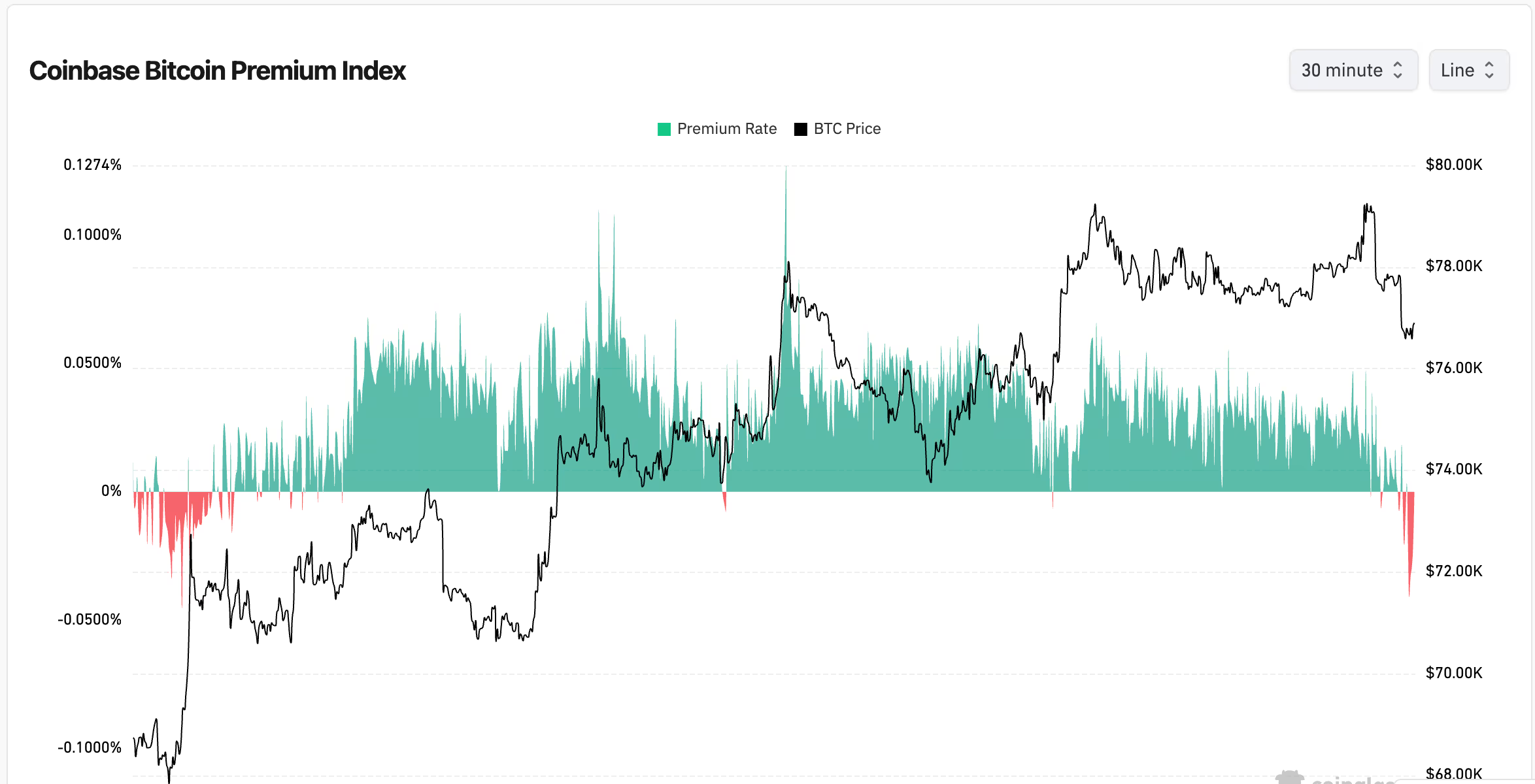
Bitcoin’s Sunday night rally stalled out near $79,400 and is beginning to show signs of fatigue, with several indicators pointing to potential short-term weakness as the price trades back around $77,000.
First, the Coinbase premium index has turned negative for the first time since April 8, according to Coinglass data.
The move to -0.04% follows a 14-day stretch of positive readings, the longest since October, that signaled consistent demand from U.S. investors and a run-up in the bitcoin price from $66,000 to $79,000.
The index measures the price difference between Coinbase, a platform for U.S. institutions, and offshore exchanges like Binance. A flip into negative territory suggests that this cohort is no longer aggressively buying, leaving the market more reliant on offshore flows. As the Coinbase premium turns negative, this tends to coincide with price pullbacks or consolidation.

At the same time, the large Bitfinex whale, closely tracked for directional pricing, remains near cycle peak long exposure. Holdings currently sit at 79,342 BTC, just shy of the 80,100 BTC high. This entity typically divests its position once a local bottom is all but confirmed or when there is clear upside momentum.
The fact that exposure remains near the cycle peak despite bitcoin’s push toward $79,000 suggests a lack of short-term upside, raising the risk of a price decline.
Adding to these headwinds, bitcoin failed to reclaim the short-term holder realized price (STHRP) at $79,200. This metric represents the average on-chain acquisition cost of coins held for fewer than 155 days, a cohort that tends to be more reactive to price swings. The longer the price stays below the STH RP, the more likely recent buyers are to continue to exit, putting further pressure on the price.
Last but not least, the flagship Bitcoin conference has begun, with prior gains already fading, and if history is any guide, further downside follows.
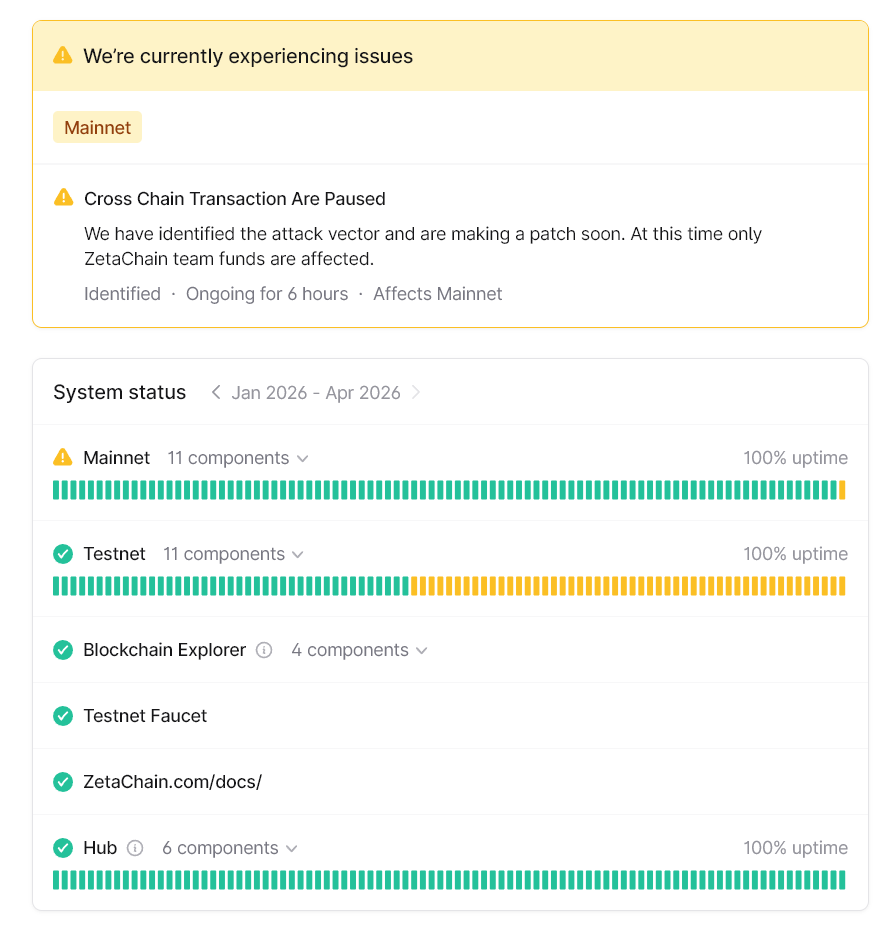
Layer-1 network ZetaChain said it was hacked on Monday. But the project claimed the attack only affected its own internal team wallets and did not hit user funds.
The network paused cross-chain transactions while the team investigated the incident. This is the second cross-chain exploit in April, after the earlier KelpDAO hack.
The team said it had already blocked the attack vector and would release a full post-mortem after completing its investigation.
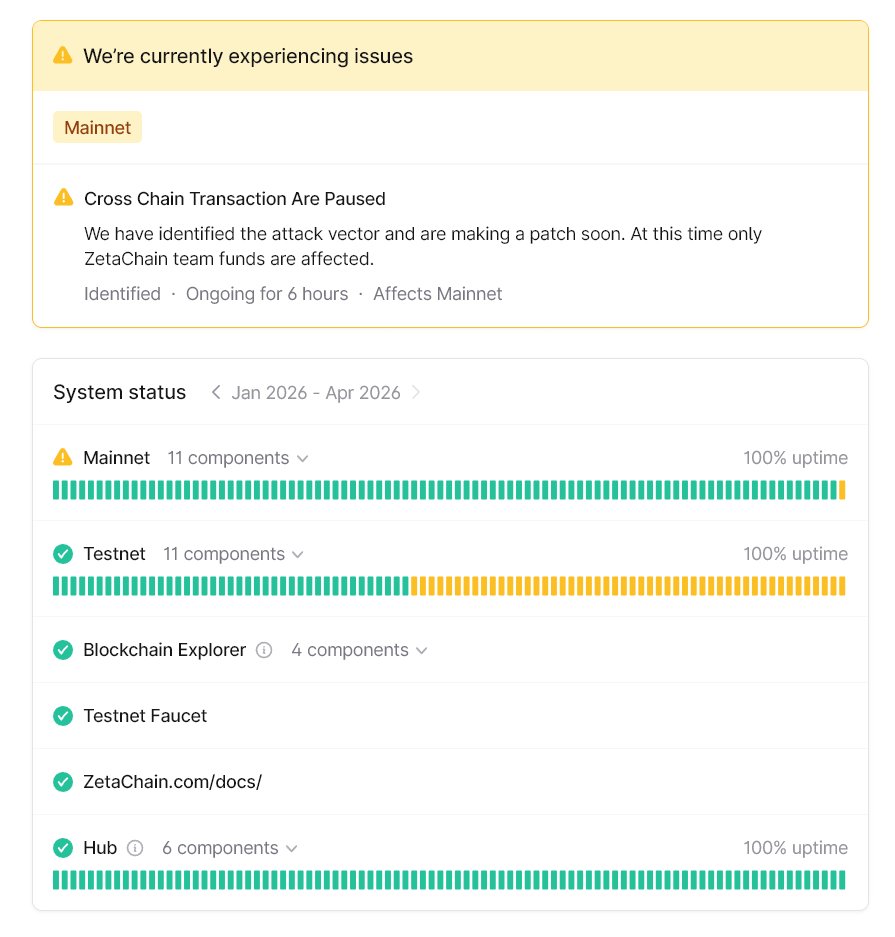
ZetaChain’s status page showed mainnet cross-chain transactions paused as a precaution.
The incident was marked as identified and ongoing for around six hours, with the status page noting that the team had identified the attack vector and was preparing a patch.
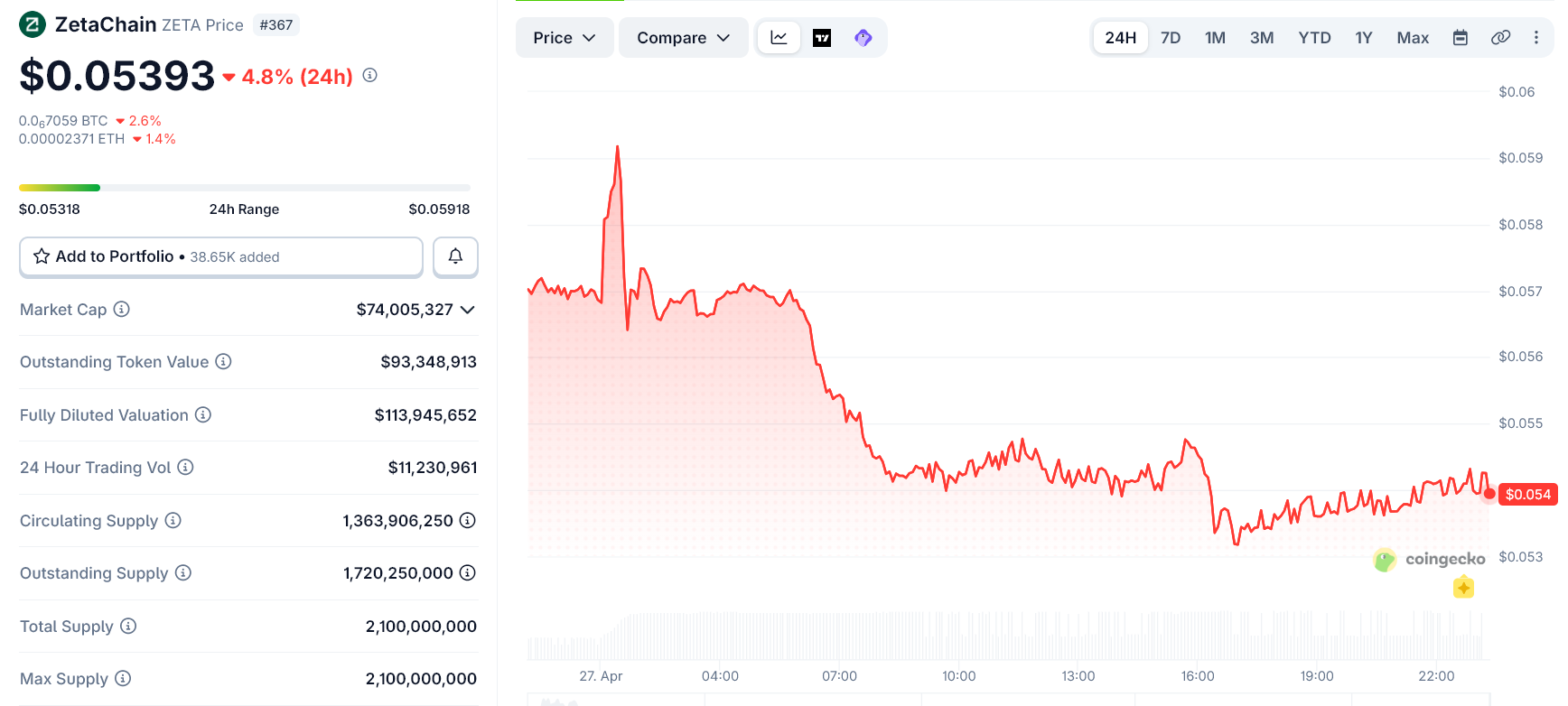
The ZETA token also traded lower during the incident. CoinGecko data shown in the attached chart placed ZETA near $0.054, down about 4.8% over 24 hours. Its 24-hour range was between roughly $0.053 and $0.059.
Community reaction was mixed. Some users praised the public disclosure, while others raised concerns about cross-chain attack surfaces after recent incidents involving interoperability infrastructure.
The post ZetaChain Pauses Mainnet After Hack Hits Team Wallets appeared first on BeInCrypto.


Sen. Thom Tillis is drawing a second red line, vowing to vote against the Clarity Act without ethics language targeting the Trump family’s crypto businesses.
The Republican broke ranks just days after lifting his hold on Kevin Warsh’s Fed chair confirmation. That blockade ended Sunday only after the Justice Department dropped its criminal probe of Fed Chair Jerome Powell.
Negotiations Inch Toward a Bipartisan Deal
Tillis is the first Senate Banking Republican to publicly demand ethics language in the bill. He joined Democratic negotiators pushing a provision aimed at the Trump family’s crypto holdings.
The proposed text would bar federal officials, including the president, from sponsoring or issuing digital assets. This is what the retiring North Carolina senator demands.
Sens. Adam Schiff and Ruben Gallego are leading Democratic talks on the ethics provision. White House crypto policy adviser Patrick Witt is steering negotiations alongside GOP Sens. Cynthia Lummis and Bernie Moreno.
Schiff said the parties are narrowing their differences as other parts of the bill come together. Republicans on the Senate Banking Committee aim to advance the legislation in the coming weeks.
“There has to be ethics language in the bill before it leaves the Senate, or I’ll go from one of the people working on negotiating it to voting against it,” Tillis reportedly told Politico.
Trump Crypto Empire Tops $1 Billion
The Trump family’s crypto ventures account for more than $1 billion of their wealth, according to Politico. World Liberty Financial, co-founded by Trump and his sons, launched the USD1 stablecoin and applied for a federal banking license.
An entity tied to the Official Trump (TRUMP) meme coin hosted nearly 300 top holders at a Mar-a-Lago conference Saturday.
Republicans face a narrow legislative window before the midterm elections. Tillis’s pattern of conditional votes shows how hard passage will be without a bipartisan ethics deal.
The post Senator Tillis Draws New Red Line on the CLARITY Act appeared first on BeInCrypto.


dLocal (NASDAQ: DLO) has launched Stablecoin Full, a stablecoin payments solution that enables merchants to collect, convert, and pay out funds in stablecoins across more than 44 emerging markets through a single API.
Summary
- Stablecoin Full allows global merchants to accept stablecoin payments at checkout, send payouts in stablecoins, and manage treasury operations across 44-plus markets through one integration.
- The product treats stablecoins as a local payment method within dLocal’s existing platform, removing the need for merchants to build separate crypto infrastructure or manage market-by-market regulatory complexity.
- The launch was announced on April 21, 2026, from Montevideo, Uruguay, with Marcelo Dutilh, Product Lead for Stablecoins at dLocal, credited as the product lead.
dLocal stablecoin payments went live on April 21 when the company announced the launch of Stablecoin Full, a product designed to let global merchants accept, convert, and pay out funds using stablecoins across high-growth economies in Africa, Asia, the Middle East, and Latin America. Merchants operating across these markets have historically faced a combination of multiple currencies, fragmented liquidity, foreign exchange volatility, and different regulatory requirements in each country.
dLocal Stablecoin Full Positions Stablecoins as a Standard Local Payment Method
Stablecoin Full provides a single compliant infrastructure through which merchants can accept stablecoins at checkout, choose settlement in either USD or stablecoins, send payouts globally in stablecoins, convert between local currency and stablecoins, and manage reporting and reconciliation across all flows in one integration. The offering is aligned with dLocal’s broader “One dLocal” model, where merchants use a single API, platform, and contract to access local payment capabilities across multiple markets without managing separate local entities. As crypto.news reported, stablecoin transaction volume hit $1.78 trillion in February 2026 alone as infrastructure across emerging market corridors continues to mature. “Emerging markets are where the next wave of digital consumers is coming from, but moving money in and out of these economies is still complex,” said Marcelo Dutilh, Product Lead for Stablecoins at dLocal. “With Stablecoin Full, we treat stablecoins as just another local payment method inside dLocal’s platform. Merchants get the benefits of faster, more flexible rails, without having to manage crypto infrastructure or regulatory complexity.”
The Compliance and Infrastructure Layer Behind the Product
The solution is designed to align stablecoin flows with local regulations, data requirements, and compliance standards in each market where dLocal operates. According to dLocal, the infrastructure coordinates stablecoin and fiat flows across pay-ins, payouts, treasury, and on/off-ramps within a unified reporting and reconciliation environment. As crypto.news documented, companies deploying stablecoin payments across multiple jurisdictions typically rely on providers that handle payment processing, identity verification, regulatory compliance, and conversion between fiat and stablecoins through a single infrastructure layer. “Stablecoins are moving from experimental to real payment infrastructure,” Dutilh added. “Our merchants don’t want to become crypto experts or navigate regulation market by market. They want a single partner that handles that complexity for them. That’s exactly what dLocal provides.”
Why Stablecoins Are Gaining Traction in High-Inflation Emerging Markets
Stablecoins have found particular traction in high-inflation markets where they are already used daily for remittances, savings, and e-commerce. As crypto.news tracked, stablecoins now process $27.6 trillion annually, outpacing Visa and Mastercard combined, with cross-border remittances running 60% cheaper than traditional methods and B2B settlements settling instantly rather than over multi-day windows. For merchants selling into emerging markets, the shift to stablecoin rails reduces dependence on correspondent banking chains that trap capital in prefunded accounts across multiple regions. dLocal said Stablecoin Full is designed to work alongside existing local payment methods rather than replacing them, extending the company’s infrastructure into digital asset flows without requiring merchants to adopt a separate system.

Rhea Ripley Reunites With Popular WWE Star Following SmackDown

Monitor Audio Creator Series Expands with C2L-A Angled In-Ceiling Speaker for Improved Home Theater Sound

Humiliating sticker tells Donald Trump where to stand as he meets King Charles at White House

Manchester United reach agreement with Casemiro over contract clause amid transfer speculation

US brings back mandatory military draft registration

Steven Gerrard disagrees with Gary Neville over ‘shock’ Chelsea and Arsenal claim | Football


-

 Fashion3 days ago
Weekend Open Thread – Corporette.com
-
 Crypto World2 days ago
Hyperliquid $HYPE Rally Builds Momentum as AI Sector Enters Prove-It Phase
-

 Tech6 hours ago
Register Renaming | Hackaday
-

 Politics5 days ago
Making troops accountable for war crimes threatens US alliance, ex-SAS colonel warns
-

 Politics5 days ago
Disabled people challenge government SEND proposals over segregation concerns
-

 Business4 days ago
Patterson-UTI Energy, Inc. (PTEN) Q1 2026 Earnings Call Transcript
-

 Business6 days ago
Rolls-Royce Voted UK’s Most Iconic Trade Mark as IPO Register Hits 150
-
 Crypto World6 days ago
Five Value Stocks with Recovery Potential in 2026: PayPal (PYPL), Nike (NKE), and More
-
 Sports1 day ago
IPL 2026: Ruturaj Gaikwad registers slowest fifty of the season, enters all-time unwanted list | Cricket News
-

 Politics5 days ago
Starmer handler McSweeney to be dragged from shadows by Foreign Affairs Committee
-

 Politics5 days ago
Zack Polanski responds to home secretary’s taser threat
-
Politics5 days ago
Wings Over Scotland | How To Get Away With Crimes
-

 Crypto World6 days ago
New York sues Coinbase, Gemini over prediction market offerings
-
Entertainment6 days ago
Sydney Sweeney cameo cut from “The Devil Wears Prada 2”, source explains why (exclusive)
-
 Business6 days ago
HCL Tech share price tank over 9% after weak Q4. JPMorgan, HSBC & 3 others cut target price
-

 Politics5 days ago
‘Iran is still a nuclear threat’
-

 Crypto World6 days ago
Crypto’s great hope in Senate’s Clarity Act still has a path to survive tight calendar
-
 Sports5 days ago
Tim Bradley names the current best in the world: “Better than Inoue and Usyk”
-

 Fashion6 days ago
Kilkenny Design New Beauty Arrivals for Spring 2026
-

 NewsBeat2 days ago
LK Bennett closes all stores after entering administration
You must be logged in to post a comment Login