

Crypto World
Five Value Stocks with Recovery Potential in 2026: PayPal (PYPL), Nike (NKE), and More


Key Takeaways
- PayPal (PYPL) guided for stagnant adjusted earnings in 2026, triggering a selloff, though turnaround opportunities persist
- CVS Health (CVS) delivered $402.1 billion in 2025 revenue and projects at minimum $400 billion for 2026
- Nike (NKE) generated $11.3 billion in third-quarter 2026 sales, with wholesale advancing 5% and North American operations improving
- HP (HPQ) announced first-quarter 2026 revenue of $14.4 billion, representing 6.9% annual growth, with projected free cash flow between $2.8 billion and $3.0 billion
- Estée Lauder (EL) saw shares decline following underwhelming fiscal 2026 outlook despite surpassing earnings projections
Investors searching for value opportunities in 2026 are closely monitoring five companies: PayPal, CVS Health, Nike, HP, and Estée Lauder.
These aren’t merely discounted equities. Each demonstrates a distinctive pattern: reserved market sentiment combined with tangible business drivers that could reshape their valuation narratives.
Companies Navigating Turnarounds
PayPal (PYPL)
PayPal represents perhaps the most transparent case of subdued expectations colliding with potential rebound momentum. According to Reuters reporting from February, the payment processor projected essentially flat or marginally declining adjusted earnings for 2026, falling short of analyst projections.
Shares tumbled significantly following executive transitions that sparked concerns about strategic implementation. However, should leadership successfully accelerate branded checkout adoption and enhance Venmo revenue generation, the equity might begin commanding valuations more aligned with a revitalizing fintech enterprise.
CVS Health (CVS)
CVS Health continues appearing underpriced when measured against its operational scale. The healthcare giant posted 2025 full-year sales totaling $402.1 billion. Leadership projected 2026 adjusted earnings per share ranging from $7.00 to $7.20, supported by revenues exceeding $400 billion.
The shares don’t require comprehensive recovery to appreciate. Sufficient margin expansion within its insurance and pharmacy segments could prompt investors to reassess it as a resilient cash-generating operation.
Nike (NKE)
Nike remains perceived by markets as a complicated turnaround situation with multiple challenges. The athletic apparel leader’s fiscal third-quarter 2026 results, disclosed March 31, showed $11.3 billion in revenue with wholesale channels climbing 5%. North American operations also posted gains.
Gross profitability contracted, and certain business segments face ongoing headwinds. Nevertheless, selective areas are trending positively, which frequently signals the beginning of value-oriented opportunities.
Cash Generation and Rehabilitation Opportunities
HP (HPQ)
HP disclosed fiscal first-quarter 2026 sales of $14.4 billion, marking 6.9% year-over-year expansion. Non-GAAP diluted earnings per share increased 9.5%, while free cash flow registered $175 million. The technology company reaffirmed its annual free cash flow projection of $2.8 billion to $3.0 billion.
The optimistic scenario depends on stabilizing PC market conditions and accelerating traction in AI-enabled computers. HP doesn’t require explosive revenue acceleration to advance—merely sustained earnings stability.
Estée Lauder (EL)
Estée Lauder presents the greatest risk among these selections. Reuters indicated in February that shares retreated after fiscal 2026 guidance underwhelmed investors, despite earnings surpassing forecasts.
Executives outlined turnaround initiatives centered on product introductions, marketing investments, and premium brand positioning. Markets remain concerned about softening U.S. consumer demand, tariff pressures, and execution uncertainties.
Based on recent guidance, Estée Louder has yet to demonstrate sustained revenue momentum or profitability improvement.
Concluding Analysis
These five equities share a unifying characteristic. Market sentiment remains guarded, yet each possesses legitimate catalysts capable of transforming their 2026 valuations.


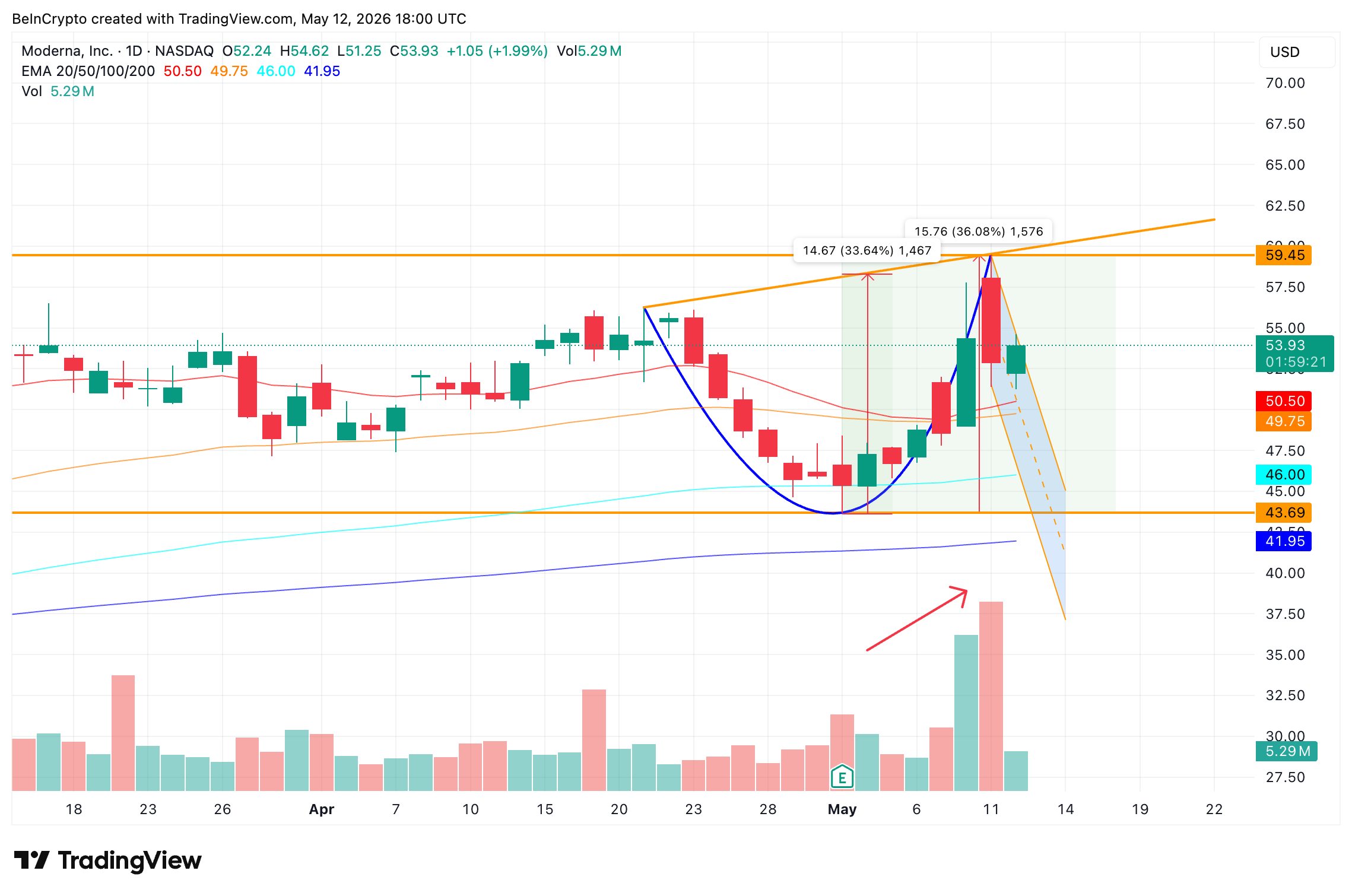
The hantavirus outbreak on the MV Hondius lifted one mRNA leader 36% off May lows before profit-taking trimmed the rally. The brief move reactivated the pandemic-prep trade across medical stocks, putting three Covid-era stocks back on the 2026 comeback watchlist.
Each setup carries a different signal. One name has already moved on to the mRNA platform strength. Another builds an inverse base as the biodefense contractor. The third offers a contrarian play loaded with bears. May 2026 is when each chart picks a side.
Note: mRNA, short for messenger RNA, is the vaccine platform behind the COVID-19 shots, delivering genetic instructions to cells instead of using a live virus.
Moderna (NASDAQ: MRNA)
Among the Covid-era stocks rotating back into focus, Moderna stock rallied 36.08% from $43.69 on May 1 to $59.45 on May 11. Volume rose alongside price throughout the climb, confirming buying pressure rather than short covering.
Want more insights like this? Sign up for Editor Harsh Notariya’s Daily Newsletter here.
Three catalysts drove the move. Q1 2026 revenue grew 260% year-over-year to $389 million; the company disclosed a hantavirus vaccine collaboration with the US Army Medical Research Institute of Infectious Diseases; and Phase 3 mRNA-1010 flu data were published in the New England Journal of Medicine.
Moderna’s price now sits near $54.05, consolidating in what resembles the handle of a cup-and-handle continuation pattern. The cup bottom anchors at $43.69, and the rim sits near $59.45.
The handle is forming above the 20-day Exponential Moving Average (EMA), a trend indicator that weights recent price action more heavily, currently at $50.50.

Cup-and-handle patterns can fail if the handle retraces deeper than half the cup, which would put the bullish thesis in question.
The pattern stays valid as long as $51.17 holds. A daily close below opens the way to the 20-day EMA at $50.50 and the 50-day EMA at $49.75. A break under $43.69 invalidates the pattern entirely.
A daily close above $54.91 starts the handle breakout. A move above $60.96, which aligns with the upward-sloping neckline and the 0.618 Fibonacci level, confirms the breakout and projects a measured move to $81.46, roughly 33.59% above current levels.

Moderna already took its leg up. A smaller name (EBS) behind the US pandemic stockpile has not.
Emergent BioSolutions (NYSE: EBS)
Among the Covid-era stocks with the steepest drawdowns, Emergent stock manufactured Johnson & Johnson’s COVID-19 vaccine at its Baltimore Bayview facility under a $480 million contract. A 2021 contamination scandal that ruined 15 million doses then triggered a multi-year de-rating.
The stock corrected 44.36% from $14.07 to $7.53 earlier this year. The trigger was Emergent guiding FY26 revenue to $720-760 million on March 1, below consensus.
A second leg followed on April 30, when Q1 2026 revenue fell 30% year-over-year to $156.1 million, driven by weaker sales of anthrax and smallpox medical countermeasures.
That second dip created the head of an inverse head-and-shoulders pattern. The left shoulder formed near $7.82 in late March. The head dipped to $7.53 in early May. The right shoulder is now forming at $8.33 with visibly weaker selling pressure. That weakening pressure suggests the de-rating may have exhausted.
Inverse head-and-shoulders patterns fail when the right shoulder dips below the head, which would put the floor in question.
A daily close below $8.33 weakens the structure. A break under $7.53 invalidates the pattern entirely.

A daily close above $10.02, which aligns with the neckline and the 0.786 Fibonacci level, confirms the breakout. The measured move projects 25.76% upside toward $12.65, with the prior high at $14.07 capping the extended target.
Emergent’s pattern is set. The final chart shows the contrarian mRNA name loaded with bear positioning.
BioNTech (NASDAQ: BNTX)
Among the Covid-era stocks with the most direct mRNA platform pedigree, BioNTech co-developed COMIRNATY with Pfizer. The partners delivered 2.6 billion doses across 165 countries in 2021. Peak revenue hit €18.98 billion that year.
Since March 10, BNTX has carved a standard head-and-shoulders pattern. The left shoulder formed in mid-March near $100. The head peaked at $113.55 in early April. The right shoulder is now forming at $93.63, just above a neckline at $92.39.
The contrarian read sits in the Chaikin Money Flow (CMF), a proxy for institutional flows. Since February 20, the price has trended lower, while the CMF has trended higher off its low. That bullish divergence often precedes false breakdowns.
Positioning data backs the contrarian setup. BioNTech reported a Q1 2026 net loss of $2.28 per share on May 5.
The put-call ratio, which compares bearish put options to bullish call options, now sits at 2.23 by volume and 1.15 by open interest. That extreme bear skew creates short-squeeze fuel if $92.39 holds.

A daily close below $92.39 confirms a breakdown toward $86.64. The next supports sit at $79.31 and $72.36, the full measured move target. A daily close above $100.47 starts the contrarian play by invalidating the right shoulder. A move above $113.55 negates the entire bearish pattern.

Head-and-shoulders patterns fail when the right shoulder breaks the head, invalidating the bearish setup completely. For now, $92.39 separates this contrarian Covid-era stock’s rebound from a $72.36 measured move downside.
The post The Hantavirus Scare Brought 3 Covid-Era Stocks Back in the Spotlight appeared first on BeInCrypto.
JPMorgan (JPM) is preparing to launch a tokenized money market fund, the latest sign that major financial institutions and Wall Street asset managers are speeding up efforts to move traditional assets onto blockchain rails.
A Tuesday filing with the U.S. Securities and Exchange Commission SEC) outlined plans for a blockchain-based money-market fund investing exclusively in short-term U.S. Treasuries, cash and overnight repo agreements backed by government securities.
The fund, dubbed JPMorgan OnChain Liquidity-Token Money Market Fund (JLTXX), will maintain blockchain-based token balances tied to investors’ ownership records, allowing approved users to submit purchase, redemption and transfer requests through Ethereum, the filing said. The underlying blockchain infrastructure will be operated by Kinexys Digital Assets, JPMorgan’s blockchain unit formerly known as Onyx.
The fund is structured to satisfy reserve asset requirements under the GENIUS Act, legislation aimed at regulating stablecoin issuers in the U.S. That could position the product as a yield-bearing reserve vehicle for stablecoin firms seeking compliant Treasury exposure.
The move comes only days after BlackRock (BLK), the world’s largest asset manager, filed paperwork for a new tokenized Treasury reserve vehicle and blockchain-based shares of an existing $7 billion money-market fund.
Tokenization — the process of creating blockchain-based representations of traditional financial assets — has become one of the hottest trends across finance and crypto markets. Supporters argue the technology can reduce settlement times, improve transparency and enable around-the-clock trading and collateral use.
The tokenized real-world asset market has grown more than 200% over the past year and now exceeds $32 billion, according to rwa.xyz data. Treasury products have emerged as one of the fastest-growing segments as institutions seek ways to earn yield on onchain cash.
JPMorgan has been among the most active traditional banks embedding blockchain infrastructure in traditional finances. In December, the bank launched a tokenized money-market fund called MONY on Ethereum, giving institutional investors blockchain-based access to short-term cash products. Through Kinexys, the bank has also processed tokenized collateral and settlement transactions for institutional clients.
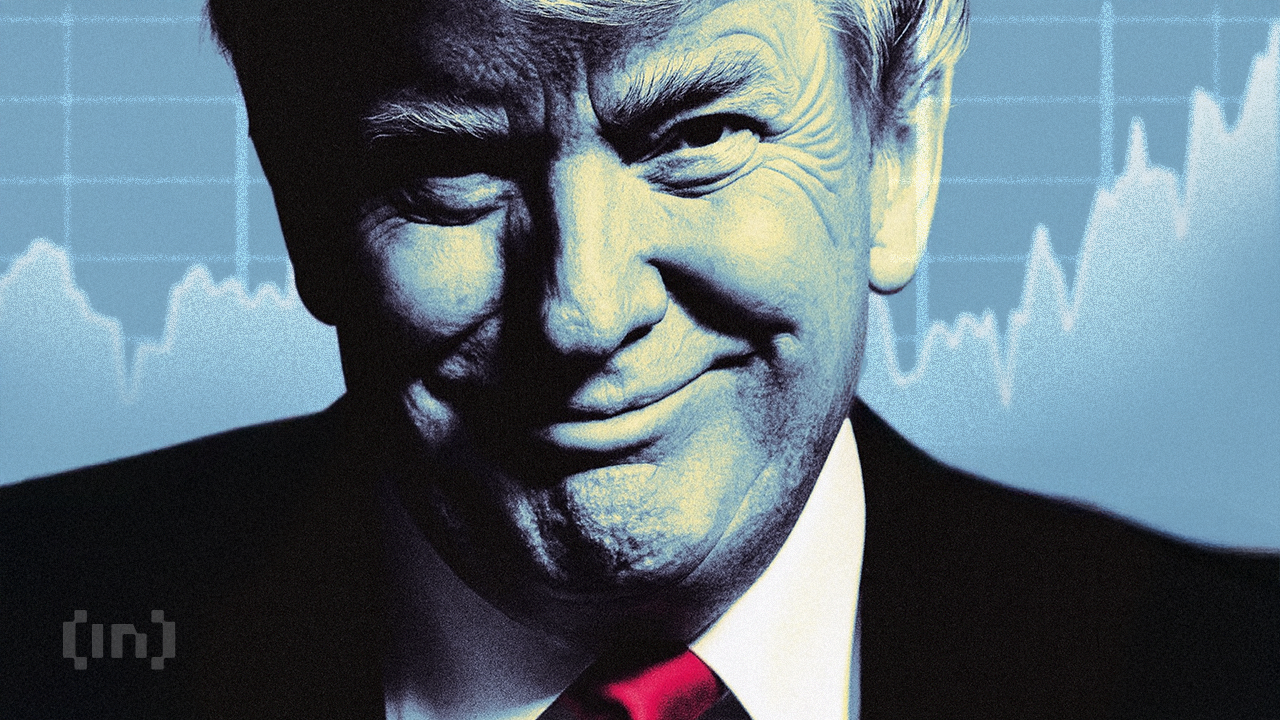
Popular political activist and journalist James O’Keefe published a new undercover report this week showing two White House staffers speaking critically against President Donald Trump and advocating for his departure.
The footage, aired on O’Keefe’s program “On The Inside,” shows the two men in conversations with an undercover operative the group describes as a date arranged through online platforms.
Trump Allegedly Played No Role in Some of His Policies
Maxim Lott, identified by O’Keefe Media as a Special Assistant to the President for the Domestic Policy Council, appears in the recording describing how decisions move through the council.
Lott says some decisions may not come directly from Trump, but from staff who think they “know the president well enough” to predict what he would say.
Also, he acknowledged that Trump may not even know the Domestic Policy Council is working on certain issues.
Owen Shroyer, who hosted the program in O’Keefe’s absence, argued that the footage shows White House staff shaping domestic policy without direct input from President Trump.
In the recording, Lott gave one example involving spam phone calls. According to the report, Domestic Policy Council staff had been working on ways to block or prosecute robocalls based on what they believed Trump would support, rather than from a direct order by the president.
At the end of the broadcast, Shroyer read a written response from Lott. While Lott did not deny the meeting took place, he rejected the suggestion that he was working against the administration.
“Nothing I said was contradictory of this administration. I remain fully committed to helping carry out its agenda,” the statement said.
Ellisten’s Alleged Remarks on Trump, the Ballroom, and Oil
Elliston, identified by O’Keefe Media as a senior budget analyst and funding manager in the Executive Office of the President, makes the sharper claims in the report.
He tells the undercover journalist that Trump is “dangerous” and says his colleagues do not know he holds those views.
The White House Executive allegedly said “We’ve got to get rid of Trump.”
In the clip, Elliston appears to say Trump is reckless because he believes “nothing can stop him.”
“He literally is invincible, nothing can stop him. And that’s dangerous,” Elliston says in the transcript.
The report also shows Elliston discussing budget issues inside the administration.
He raises concerns about private donations for the White House ballroom renovation, claims taxpayer money could be used to retrofit a Boeing 747 gifted by Qatar, and alleges possible insider trading linked to Iran policy and oil prices. These claims are presented in the report but are not independently verified in the transcript.
In the clips, Ellisten alleges that figures around the administration are benefiting financially from price moves in crude after escalations with Iran, claims O’Keefe Media itself flags as unverified but newsworthy.
Political Fallout Inside the White House
O’Keefe Media has not released the full unedited footage, and the segments have not been independently verified.
The program said its team attempted follow-up calls to both men on air, with Ellisten offering no substantive comment and Lott’s written statement standing as the only direct response from either official.
The two clips, posted to O’Keefe’s X (Twitter) account, have drawn calls from Trump allies for the White House to terminate both officials and for an inspector general or congressional inquiry into how widely such views are held within the administration.
However, some users have also highlighted Owen Shroyer as an individual with a strong anti-Trump stance, after turning against the president over strong Israel support, Iran strikes, and unfulfilled “America First” promises.
“Not a good look having Owen report on this. I think it will be hard for most to look past his hatred for President Trump,” one user highlighted.
The White House has not publicly addressed the recordings.
Whether the footage leads to personnel action, formal investigations, or fades, as several prior O’Keefe campaigns have, will likely depend on how the West Wing chooses to respond in the days ahead.
The post Undercover Video Shows White House Staffer Calling Trump ‘Dangerous’ appeared first on BeInCrypto.
Mike Novogratz’s digital asset firm Galaxy Digital and ETH treasury company Sharplink announced a non-binding memorandum of understanding to form the Galaxy Sharplink Onchain Yield Fund.
This new private investment vehicle will focus on DeFi liquidity protocols and other on-chain yield-generating strategies.
$125M Institutional Yield Fund
According to the official press release, Galaxy will act as the fund’s investment manager. The fund is expected to launch in the coming weeks with total commitments of $125 million. This includes $100 million from Sharplink’s staked Ethereum treasury and $25 million from Galaxy.
The strategy will focus on identifying high-yield opportunities across blockchain-based financial markets by allocating capital to selected on-chain applications. The structure is intended to allow Sharplink to maintain its Ethereum exposure while also generating returns from actively managed on-chain strategies.
Galaxy revealed that protocol selection, exposure sizing, and ongoing monitoring will be handled under its institutional research and risk management framework, which is also used across its lending, trading, and asset management operations. The company added that it has been deploying hundreds of millions of dollars into on-chain strategies since 2020 and is among the largest publicly traded firms actively allocating capital to decentralized finance and other blockchain-based investment opportunities.
Novogratz, Founder and CEO of Galaxy, stated,
“Institutional capital is moving onchain, and the infrastructure to support it has matured to a point where allocators can access yield, liquidity, and risk management with the same rigor they expect in traditional markets. Sharplink has built one of the most significant Ethereum treasuries among public companies, and we’re proud to partner with them to put that capital to work in a strategy designed to compound their core position.”
Meanwhile, Matthew Sheffield, Sharplink’s Chief Investment Officer, said that the latest move is an “extension of its treasury strategy into more active strategies.”
Q1 Financial Results
Sharplink currently ranks as the second-largest Ethereum treasury company, holding roughly 868,700 ETH, behind Bitmine, which holds about 5.21 million ETH. Alongside the fund announcement, it also reported a major jump in revenue to $12.1 million in Q1 2026 from just $0.7 million a year earlier, mainly due to its Ethereum treasury strategy. However, the company also posted a large net loss of $685.6 million, mostly because falling ETH prices created unrealized accounting losses and impairment charges on its holdings.
Sharplink said these were paper losses under accounting rules and did not mean it actually sold ETH at a loss or reduced its Ethereum holdings.
The post Mike Novogratz’s Galaxy and Sharplink Launch $125M Ethereum-Powered DeFi Yield Fund appeared first on CryptoPotato.
Key takeaways:
- ETH derivatives metrics show professional traders are holding steady and haven’t flipped bearish despite recent DeFi exploits.
- Ethereum’s 53% Total Value Locked market share and institutional ETF demand continue to provide support near $2,200.
Ether price rally stalls, but ETH futures far from bearish
Ether (ETH) price failed to sustain bullish momentum after peaking near $2,380 on Sunday. Repeated failures to break the $2,400 mark over the past four weeks have gradually drained confidence, suggesting professional ETH traders might be jumping ship despite several derivatives and onchain metrics supporting further upside.

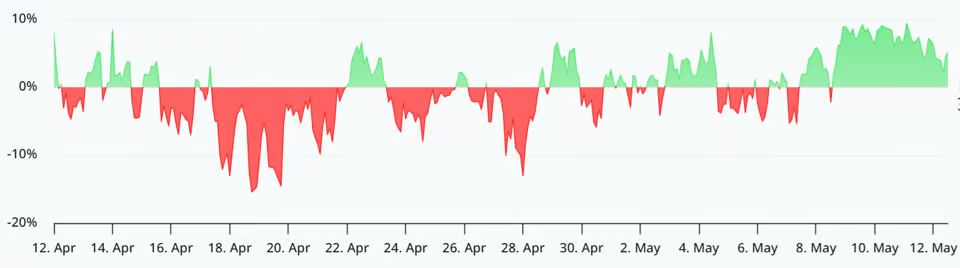
ETH perpetual futures annualized funding rate. Source: Laevitas
The ETH perpetual futures annualized funding rate stood at 5% on Tuesday, slightly below the neutral 6% to 12% range. While not particularly enthusiastic, the metric has distanced itself from the bear-controlled negative funding rates seen last week.

ETH options put-to-call ratio at Deribit, USD. Source: Laevitas
ETH options put (sell) volumes have stayed lower than equivalent call (buy) options at Deribit since May 4. Demand for neutral-to-bearish strategies has been declining for three weeks, so ETH whales and market makers aren’t flipping bearish just yet.
Still, the lack of bullishness in ETH futures could be explained by external factors like high oil prices and inflation fears. The US Consumer Price Index jumped to 3.8% in April, the highest in over three years, due to rising energy costs.
The Bureau of Labor Statistics report also contained bad news for workers, as real average hourly wages dropped 0.5% from the prior month.
DeFi hacks and Ethereum Foundation sales weigh on investor sentiment
Besides worsening macroeconomic conditions, the Ethereum ecosystem has faced internal struggles, including several hacks of decentralized finance (DeFi) protocols. The Kelp DAO rsETH bridge was exploited via LayerZero message spoofing, draining over $290 million from multiple lenders using fake collateral, including market leader Aave.
More recently, the Ekubo protocol lost $1.4 million through EVM v2 swap vulnerabilities, while TrustedVolumes saw a $6.7 million loss due to a protocol logic flaw. These incidents stem from protocol-specific bugs and access control errors rather than flaws in Ethereum itself, EVM security, or layer-2 bridge designs.
Recent ETH sales by the Ethereum Foundation and the subsequent unstaking of $50 million have created discomfort among investors. Sentiment took another hit after an Ethereum ICO participant moved 10,000 ETH to a new wallet. Regardless of the reasoning behind these moves, fear and uncertainty remain elevated as ETH trades 54% below its all-time high.
Related: North Korea ‘industrialized’ crypto theft, laundered billions–CertiK

Blockchain Total Value Locked market share. Source: DefiLlama
Ether’s strength lies in Ethereum’s 53% Total Value Locked (TVL) market share and its lead in decentralized application (DApp) activity when including its layer-2 ecosystem. No competitor matches its institutional appeal, which is clear from the $11.6 billion in Ethereum spot exchange-traded fund (ETF) assets under management.
Ultimately, the lack of bullish leverage demand in ETH futures should not be seen as fading interest from pro traders, so the path toward $2,600 and higher remains open.

Key Highlights
- LMAX Group introduces Kiosk platform for institutional crypto collateral management.
- Platform enables digital asset deployment across foreign exchange, metals, and CFD trading.
- Kiosk integrates custody solutions with multi-market trading execution capabilities.
- Unified portal consolidates collateral management, security controls, and treasury operations.
- Launch aligns with institutional movement toward blockchain-based collateral infrastructure.
LMAX Group has unveiled its Kiosk platform designed to facilitate institutional deployment of cryptocurrency holdings across diverse trading environments. This integrated portal merges custodial services, collateral management, and trade execution within a unified operational framework. The introduction addresses increasing institutional appetite for digital asset-backed trading solutions.
Platform Facilitates Digital Asset Collateral Across Multiple Trading Venues
The LMAX Kiosk platform permits institutional participants to transfer cryptocurrency holdings directly into LMAX Custody infrastructure. These deposited digital assets can subsequently serve as collateral throughout the organization’s comprehensive trading environment. Market access encompasses foreign exchange pairs, precious metal contracts, cryptocurrency instruments, contracts for difference, and perpetual futures products.
The solution addresses operational complexity challenges faced by organizations managing cryptocurrency exposure. It consolidates deposit functionality, withdrawal processing, API authentication management, WalletConnect integration, security configurations, and treasury administration within a singular interface. Consequently, institutional clients can oversee collateral requirements without navigating multiple fragmented platforms.
According to LMAX Group, Kiosk represents an expansion of its established institutional framework. The company maintains operational presence across both conventional foreign exchange and digital asset marketplaces. Accordingly, this interface advancement furthers its strategic initiative to bridge traditional financial services with cryptocurrency market participation.
Streamlined Collateral Deployment for Institutional Trading Operations
The platform introduction provides institutions with streamlined pathways for converting crypto holdings into operational trading strategies. Participants can pledge cryptocurrency assets as margin while executing transactions across diverse asset categories. This architecture potentially enhances capital efficiency for institutional balance sheet management.
David Mercer, Chief Executive Officer of LMAX Group, emphasized that optimized collateral mechanisms will underpin next-generation integrated capital markets. He highlighted that Kiosk delivers protected custody arrangements, frictionless connectivity infrastructure, and immediate collateral deployment capabilities. He further noted the product facilitates institutional incorporation of digital assets into fundamental trading systems.
LMAX has positioned Kiosk as a regulatory-compliant, institutional-caliber offering. The organization emphasizes the platform delivers access to established liquidity sources alongside secured custody arrangements. It provides participants with streamlined methods for expanding digital asset service capabilities.
Financial Sector Advances Blockchain-Based Collateral Infrastructure
This platform debut coincides with broader financial industry experimentation regarding collateral frameworks connected to distributed ledger technology. Tokenized investment vehicles, cryptocurrency instruments, and regulated custody products increasingly influence market infrastructure development. Trading venues and investment managers are constructing systems enabling cross-market collateral utilization.
Franklin Templeton launched an institutional collateral initiative with Binance during the current year. That framework permits participants to pledge tokenized money market fund units as trading margin. Simultaneously, underlying assets maintain positioning within regulated custodial structures.
DTCC alongside additional prominent financial entities have similarly investigated tokenized collateral architectures. These initiatives reflect an industry-wide transition toward accelerated settlement processes and adaptable margin deployment. Through Kiosk, LMAX participates in this evolution by connecting cryptocurrency assets with foreign exchange, precious metals, derivatives, and digital asset trading environments.
XRP (XRP) price is down 3.2% in the past 24 hours and 6% below its recent high of $1.50 to trade at $1.42 on Tuesday. Despite this pullback, analysts say XRP is still positioned for further gains backed by several market and technical factors.
Key takeaways:
- Spot XRP ETFs logged $25.8 million in inflows on Monday, driving cumulative net inflows to a record $1.35 billion.
- Analysts say XRP price shows potential for a sustained rally, with charts targeting as high as $10.
XRP ETF demand makes a comeback
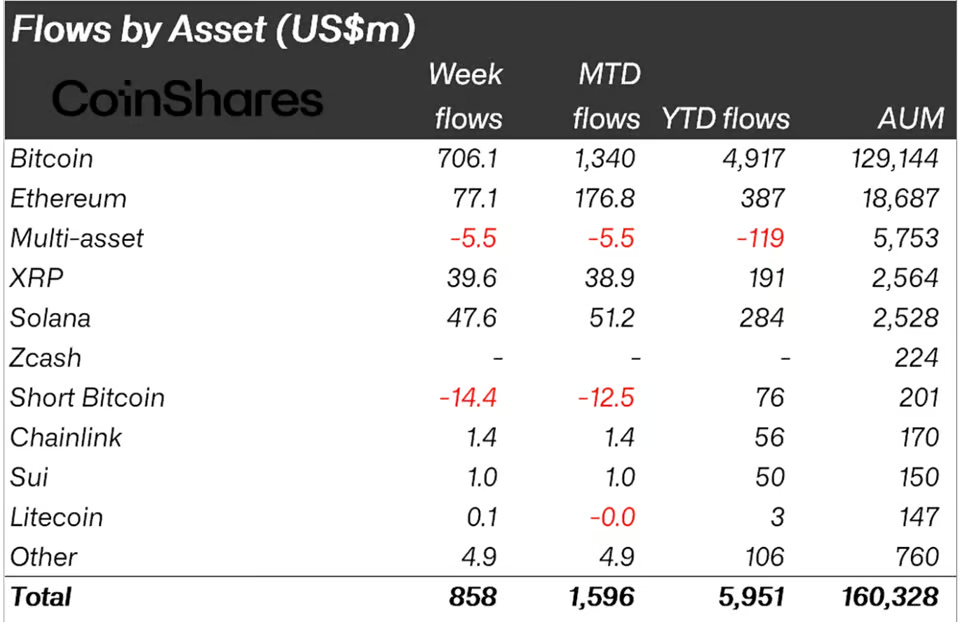
Institutional demand for XRP investment products has been strengthening, according to data from CoinShares.
XRP exchange-traded products (ETPs) posted inflows totaling $40 million during the week ending May 8. These investment products have now recorded $191 million in net inflows so far in 2026, bringing the total assets under management (AUM) to $2.5 billion.
Related: XRP price copies 2025 chart fractal that last time sparked 66% gains
CoinShares head of research James Butterfill said this was a “notable acceleration” in inflows supported by developments around the US CLARITY Act, referring to a final compromise proposal regarding stablecoin yields released on May 1.

Crypto funds net flows data. Source: CoinShares
Meanwhile, flows into spot XRP exchange-traded funds (ETFs) continue, with over $25 million on Monday, marking five consecutive days of net inflows, and the largest since Jan. 5.

Spot XRP ETF flows data. Source: SoSoValue
This streak has pushed the AUM to 1.18 billion and cumulative net inflows to an all-time high of $1.35 billion.

Cumulative net inflows into spot XRP ETFs. Source: bluroo.ai
This indicates an increased institutional appetite for XRP products, which could positively impact the price.
“XRP ETFs just recorded their biggest daily inflow” in over four months, crypto analyst Xaif Crypto said in a Tuesday post on X, adding:
“Institutional money is accelerating into XRP at a pace the market is still underestimating.”
Fellow analyst CW8900 said XRP’s 90-day spot taker cumulative volume delta (CVD) has flipped green, suggesting that “upward pressure in the spot market is increasing.”

XRP spot taker CVD. Source: CryptoQuant. Source: X/CW8900
As Cointelegraph reported, XRP social media sentiment recently increased to two-year highs, improving XRP’s chances of a sustained price recovery.
Traders say XRP is “preparing for another rally”
Data from TradingView shows XRP/USD is up 5% so far in May, with its futures open interest (OI) rising 23% over the same period, per data from CoinGlass.
“The upward momentum of $XRP is growing,” CW8900 said in response XRP’s growing OI, adding:
“It is preparing for another rally.”
In a Tuesday post on X, analyst Bird said “XRP will rally next” after the price broke above a multi-month support line on the daily chart.

XRP/USD daily chart. Source: X/Bird
Analyst ChartNerd argues that XRP’s bounce off a multi-month ascending support line sets “the stage for a breakout” toward $1.80, reinforced by a golden cross on the weekly MACD.
CryptoPatel sets a more ambitious target, saying that the XRP/USD pair could repeat the Q4 2024 rally on “the road to $10” after breaking out of the $1-$1.30 accumulation range.

BTC/USD two-week chart. Source: Crypto Patel
As Cointelegraph reported, multiple technical indicators suggested that an XRP price breakout may be underway, pointing to a possible rally to as high as $12.
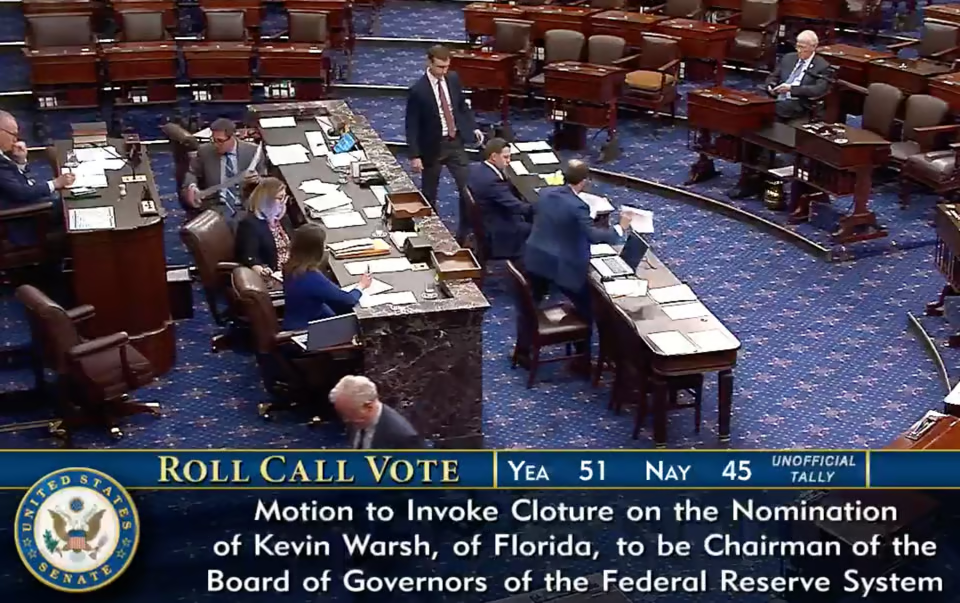
The US Senate has approved Kevin Warsh as the newest governor of the Federal Reserve, with a vote on his confirmation as chair of the central bank expected this week.
In a 51 to 45 vote in the US Senate on Tuesday, lawmakers sided on party lines, with the exception of Democratic Senator John Fetterman, to approve President Donald Trump’s nominee. The chamber immediately followed by approving a motion to invoke cloture on a vote for Warsh as the next Fed chair, setting up a potential vote soon.

Source: US Senate
The vote confirmed Warsh as a Fed governor for 14 years, and is expected to lead to lawmakers voting on his nomination for a four-year term as Fed chair. He previously served as a Fed governor under former US Presidents George W. Bush and Barack Obama from 2006 to 2011.
Jerome Powell, whose term as Fed chair ends on Friday, has faced Trump’s repeated threats to fire him. His term as a Fed governor will continue until 2028, but the shakeup in the leadership of the US central bank has the potential to move markets amid concerns over changing interest rates and the Fed’s independence from the White House’s policies.
Related: Federal Reserve chair nominee’s disclosure includes crypto and AI holdings
Warsh said in a 2025 interview that Bitcoin (BTC) was a “transformative” technology and “an important asset that can help inform policymakers.” During his confirmation hearing in the Senate Banking Committee, however, many Democrats questioned whether as Fed chair he could remain independent from the president’s policy agenda.
Crypto market structure bill markup scheduled for Thursday
The vote on the nomination came the same week that US lawmakers on the Senate Banking Committee will choose whether to advance a digital asset market structure bill expected to change oversight and regulation of cryptocurrencies. On Monday, the panel’s leadership released the text of its version of the Digital Asset Market Clarity Act (CLARITY), that included a compromise provision on stablecoin yield that had long been a sticking point for many in the crypto and banking industries.
On Thursday, the banking committee will hold a markup on CLARITY, potentially setting the bill up for a vote in the full Senate.
Magazine: XRP ‘probably going to $12,’ Bitcoin ETFs add $1B: Market Moves
Crypto World
Senate Banking Committee Releases 309-Page Clarity Act Draft: US Senate Banking Committee


The Senate Banking Committee publicly released the full text of its crypto market structure bill ahead of Thursday’s markup, with amendments due by end of business Wednesday.
Key Highlights
- DTCC selects Chainlink infrastructure for tokenized collateral platform launching Q4 2026
- Chainlink Runtime Environment will enable data integration, valuation, and process automation
- Platform designed to accelerate collateral transfers across multiple blockchains and markets
- Initiative modernizes margining operations, settlement processes, and collateral efficiency
- Development signals growing institutional adoption of blockchain-based collateral solutions
The Depository Trust & Clearing Corporation is advancing its collateral infrastructure transformation by partnering with Chainlink. This collaboration will bring Chainlink’s Runtime Environment and standardized data protocols to DTCC’s upcoming Collateral AppChain. Production deployment is targeted for the final quarter of 2026.
Chainlink Technology Integration Powers New Platform
DTCC is incorporating Chainlink’s blockchain infrastructure into its digitally-native Collateral AppChain platform. The system is designed to streamline collateral transfers, pricing, and settlement operations throughout international financial markets. The initiative seeks to accelerate processing for both tokenized digital assets and conventional financial products.
The new platform will leverage Chainlink’s Runtime Environment to facilitate data integration, automated processes, and orchestration capabilities. DTCC will be able to consolidate asset pricing information, valuation metrics, margin calculations, and collateral transaction data within a unified infrastructure. This architecture minimizes the need for fragmented integrations spanning multiple institutions and asset categories.
DTCC has architected the AppChain as collective market infrastructure accessible to all collateral ecosystem participants. The platform will accommodate collateral suppliers, recipients, portfolio managers, custodial institutions, and triparty service providers. Consequently, the system could establish a standardized framework enabling near-instantaneous collateral operations.
Advanced Data Delivery and Process Automation Capabilities
Chainlink’s contribution centers on protected data transmission and automated workflow execution. The infrastructure will facilitate eligibility verification, asset valuation, margin calculations, optimization algorithms, and settlement completion. Additionally, the AppChain can deploy adaptable data components as new collateral applications develop.
DTCC indicated the integration will enable connections between collateral contracts and market information feeds. This encompasses pricing data, valuation metrics, and transfer records spanning various markets and blockchain networks. As a result, the AppChain is positioned to enable round-the-clock collateral administration across institutional platforms.
This development builds upon DTCC’s Great Collateral Experiment, which attracted significant industry focus. The organization is now transitioning the AppChain toward operational implementation. Chainlink’s infrastructure provides the platform with a data foundation engineered for institutional-grade operations.
Rising Institutional Interest in Tokenized Collateral Solutions
DTCC’s initiative emerges as prominent market infrastructure organizations expand their blockchain tokenization programs. Research conducted by Nasdaq revealed that 52% of institutions anticipate operational tokenized collateral management systems by late 2026. Numerous organizations continue experiencing daily challenges with settlement reconciliation and asset delivery.
Nasdaq, Intercontinental Exchange, Kraken, Securitize, and Backed have similarly progressed their tokenized securities initiatives. These programs focus on blockchain-enabled equities, exchange-traded funds, and on-chain settlement mechanisms. DTCC’s AppChain deployment aligns with an industry-wide transition toward automated post-trade operations.
DTCC presently maintains custody for approximately $114 trillion in liquid financial assets. This operational magnitude positions its AppChain initiative as highly significant throughout global financial markets. Concurrently, tokenized equity instruments have experienced substantial growth, with blockchain-based value now exceeding $1.4 billion.

The Hantavirus Scare Brought 3 Covid-Era Stocks Back in the Spotlight
Eminem’s Ex Back in Spotlight After Crash Scandal

Watch: Netanyahu begs, tries to con China into ending support for Iran

Manchester United reach agreement with Casemiro over contract clause amid transfer speculation

US brings back mandatory military draft registration

Steven Gerrard disagrees with Gary Neville over ‘shock’ Chelsea and Arsenal claim | Football


-
 Crypto World5 days ago
HarrisX Poll Found 52% of Registered Voters Support the CLARITY Act
-

 Fashion4 days ago
Weekend Open Thread: Marianne Dress
-

 Crypto World6 days ago
Upbit adds B3 Korean won pair as Base token gains Korea access
-
 NewsBeat6 days ago
NCP car park operator enters administration putting 340 UK sites at risk of closure
-

 Fashion1 day ago
Coffee Break: Travel Steam Iron
-

 Fashion2 days ago
What to Know Before Buying a Curling Wand or Curling Iron
-

 Tech3 days ago
Auto Enthusiast Carves Functional Two-Stroke Engine from Solid Metal
-

 Politics24 hours ago
What to expect when you’re expecting a budget
-

 Politics4 days ago
Politics Home Article | Starmer Enters The Danger Zone
-
 Business3 days ago
Ignore market noise, India’s long-term story intact, say D-Street bulls Ramesh Damani and Sunil Singhania
-

 Tech2 days ago
GM Agrees To Pay $12.75 Million To Settle California Lawsuit Over Misuse Of Customers’ Driving Data
-

 Crypto World6 days ago
BlackRock CEO Larry Fink Discusses a New Asset Class
-
 Sports6 days ago
NBA playoff winners and losers: Austin Reaves is not loving Lakers vs. Thunder matchup, but Chet Holmgren is
-

 Entertainment6 days ago
Sarah Paulson Called Out For Met Gala ‘Hypocrisy’
-

 Entertainment5 days ago
General Hospital: Ric & Ava Bombshell – Ric’s Massive Secret Exposed!
-

 Entertainment6 days ago
Bold and Beautiful Early Spoilers May 11-15: Steffy Revolted & Liam Overjoyed!
-

 Politics5 days ago
Simon Cowell Says He Was ‘Horrible’ To Susan Boyle During BGT Audition
-

 Sports6 days ago
UEFA Champions League final schedule, teams, venue, live time and streaming | Football News
-

 Crypto World6 days ago
Robinhood says Wall Street is building onchain
-

 Tech7 days ago
Apple and Samsung are dominating smartphone sales so thoroughly that only one other company makes the top 10
You must be logged in to post a comment Login