
Crypto World
Bitcoin price tests ascending channel top at $78K

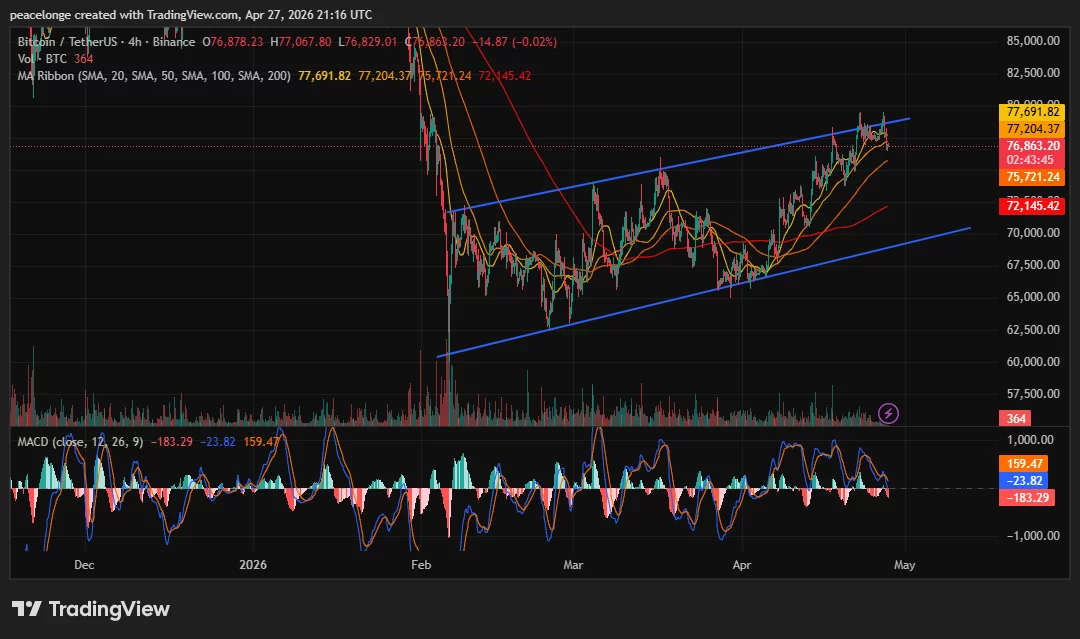
Bitcoin is pressing the upper boundary of a two-month ascending channel near $77,500, with the 4H MACD histogram turning negative at the trendline and the FOMC meeting on April 28 and 29 serving as the next major catalyst. This article examines the technical structure, key levels, and on-chain data shaping Bitcoin’s next directional move.
Summary
- Bitcoin is pressing the upper boundary of a 4H ascending channel near $77,500 as the MACD histogram turns negative at -183.29.
- The SMA ribbon remains bullishly stacked below price, but momentum is decelerating at the trendline.
- A confirmed 4H close above $80,000 targets the 200-day SMA near $85,000; rejection risks a pullback to $75,721.
Bitcoin (BTC) is trading at approximately $76,863 on April 27, up less than 1% on the session, after briefly touching $77,067 during Asian hours. The asset has climbed nearly 30% from its February lows near $59,000 inside a well-defined ascending channel, but is now pressing the upper boundary of that structure at the same time as the 4H MACD histogram turns deeply negative, setting up a directional tension that the FOMC meeting on April 28 and 29 may finally resolve.
Bitcoin ascending channel reaches a critical juncture
The 4H chart shows Bitcoin constructing a textbook ascending channel, defined by two parallel upward-sloping trendlines, since the February lows near $59,000. The pattern has delivered a sequence of higher highs and higher lows across roughly two months, with price now pressing the upper boundary near $77,500 where prior tests have stalled.
The moving average ribbon remains constructively positioned. The SMA 20 sits at $77,691, the SMA 50 at $77,204, the SMA 100 at $75,721, and the SMA 200 at $72,145, all stacked below price in a bullish order that has supported the entire recovery.
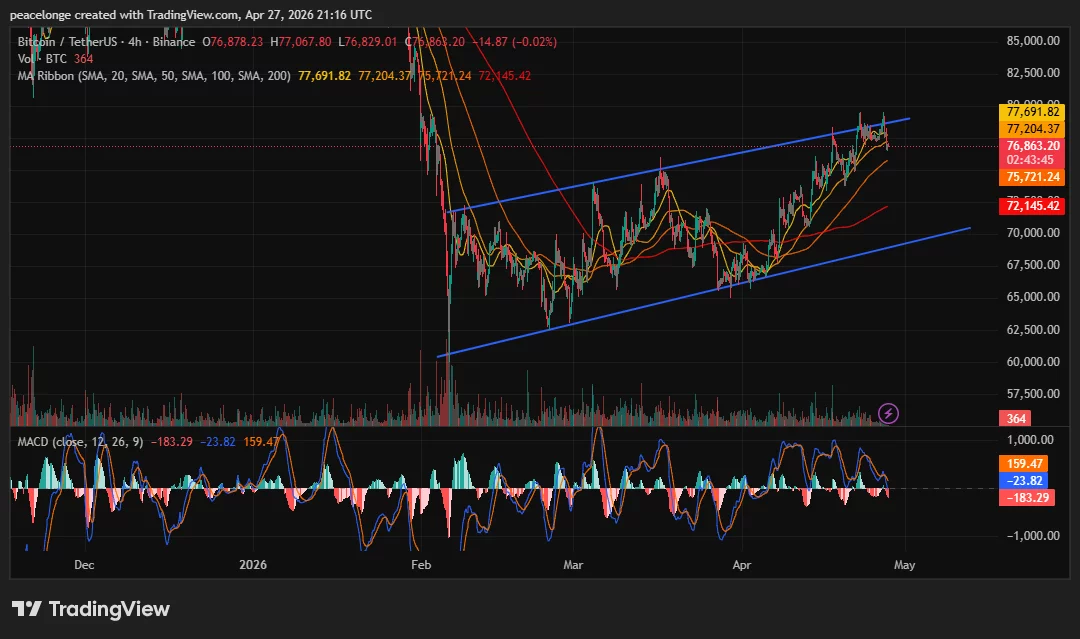
However, the MACD indicator is sending a cautionary signal. The MACD line reads at 159.47 with a signal line at -23.82, producing a histogram of -183.29. A negative histogram at the channel’s upper trendline indicates that upside momentum is decelerating rather than accelerating, a pattern that in prior channel tests has preceded consolidation or a brief pullback rather than an immediate breakout. Crypto analyst Ali Martinez said on X that “technical patterns are not fixed; they morph as price develops,” and that buyer and seller behavior at resistance ultimately decides whether a level becomes a liquidity wall.
Key levels: support, resistance, and price targets
The immediate resistance sits at the upper channel trendline between $77,500 and $78,000, which aligns with the level that capped Bitcoin during April 22’s 11-week high test. Above it, the $80,000 round number is the primary bull-case target and the level that would confirm a channel breakout. A 4H close above $80,000 with volume expansion would open the path toward the 200-day SMA near $85,000, the threshold analysts identify as separating the prevailing corrective trend from a confirmed structural reversal.
On the downside, the SMA 100 at $75,721 is the first meaningful support on a closing basis. A 4H close below that level removes mid-channel support and exposes the lower boundary of the ascending channel near $72,000 to $73,000, where the SMA 200 at $72,145 converges. A daily close below that zone invalidates the ascending channel structure entirely and shifts the near-term bias bearish.
ETF inflows and derivatives positioning
The rally into the channel’s upper boundary has been supported by a historic institutional inflow streak. According to data tracked by crypto.news, spot Bitcoin ETFs logged an eight-day inflow streak totaling $2.43 billion through April 23, with BlackRock’s IBIT absorbing $907.97 million across the week of April 13 to 17 alone. April’s total inflows are already nearly double March’s $1.32 billion haul.
Despite the strong institutional bid, Glassnode on-chain data indicates that short-term holders are using ETF demand as exit liquidity near the $78,000 to $80,100 range, levels that have repeatedly capped rallies in 2026. Bitcoin futures open interest fell over 6% in the 24 hours surrounding the most recent $78,000 test, per CoinGlass data, pointing to leverage unwinding rather than fresh long accumulation at resistance.
FOMC as the next defining catalyst
The FOMC meeting on April 28 and 29 is the primary macro event that could resolve the channel test in either direction. As crypto.news reported, CME FedWatch shows a 98% probability of a rate hold, making the tone of Chair Jerome Powell’s press conference the key variable. A dovish signal implying rate cuts in the second half of 2026 would reduce the opportunity cost of holding BTC and could provide the catalyst for a close above $80,000. A neutral or hawkish tone would likely extend the channel consolidation and increase the probability of a pullback toward mid-channel support.
If Bitcoin holds the ascending channel and clears $80,000 on volume following the FOMC outcome, the 200-day SMA near $85,000 becomes the next structural test for a confirmed trend reversal.

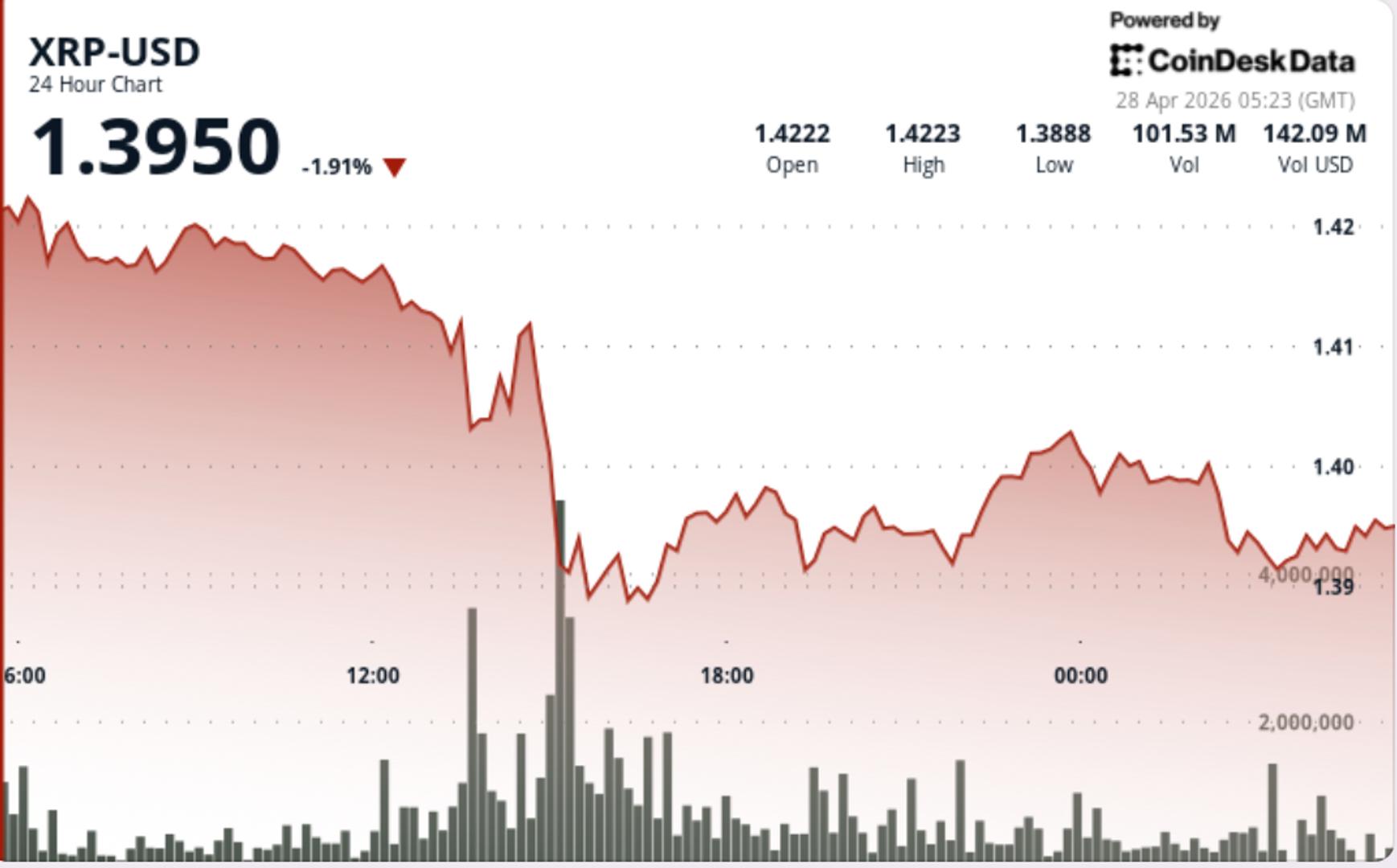
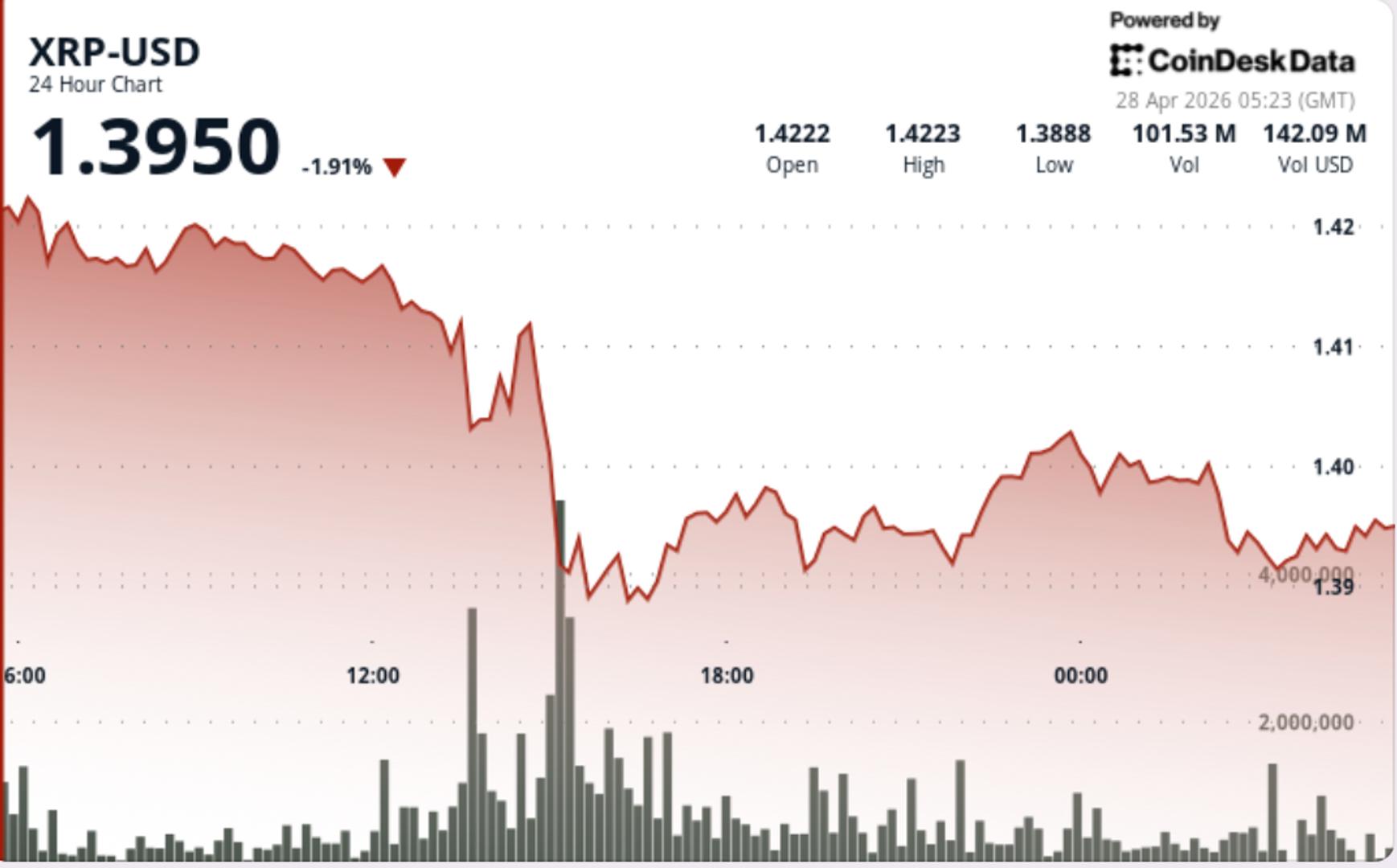
XRP finally gave way at $1.40, and the way it broke matters more than the move itself. This wasn’t a slow drift lower. It was a high-volume push that cleared a level buyers had defended for weeks. Once that kind of support goes, it usually doesn’t snap back quickly. It tends to flip, and that’s exactly the test now.
News Background
• Bitcoin dominance pushed toward 60%, reinforcing a rotation out of altcoins and limiting follow-through demand for XRP.
• The multi-month triangle structure that had been compressing price finally resolved, with the move breaking lower instead of triggering the expected upside expansion.
Price Action Summary
• XRP dropped from $1.44 to $1.39, breaking cleanly through the $1.40 support zone.
• The move was driven by a sharp spike in participation, not thin liquidity.
• Price is now stabilizing just below the breakdown level, trading in a tight $1.39–$1.40 range.
Technical Analysis
• The key shift is structural. $1.40 was support, now it’s resistance unless reclaimed quickly.
• Volume expanding into the breakdown confirms real selling pressure, not just positioning noise.
• The triangle pattern that held price for weeks has resolved lower, removing the compression support.
• Short-term bounces are showing up, but they’re reactive, not strong enough to reverse the move yet.
What traders should watch
• $1.40 is now the pivot. Reclaim it with volume, and the breakdown starts to look like a fakeout.
• $1.37 is the next downside level. Losing that opens the path toward deeper support near $1.31.
• If price keeps holding below $1.40, sellers stay in control and rallies are likely to get sold.


Canada has advanced a bill to block cryptocurrency donations in federal elections, pushing tighter controls on how political funding is handled.
Summary
- Canada’s Bill C-25 has cleared second reading in the House of Commons, moving the proposal to committee for detailed review.
- The legislation seeks to ban cryptocurrency donations to political parties and candidates, citing concerns over traceability and compliance with funding rules.
According to Canada’s House of Commons, Bill C-25, known as the Strong and Free Elections Act, cleared its second reading on Friday, allowing lawmakers to move the proposal to committee for detailed review and possible amendments.
Tabled on March 26, the bill would bar political parties and candidates from accepting crypto contributions, with regulators identifying digital assets as a gap in existing campaign finance rules. Lawmakers backing the measure have linked the restriction to concerns around verifying the source of funds and enforcing contribution limits under current law.
No timeline has been set for the committee stage, leaving the pace of further progress dependent on parliamentary scheduling.
The decision to restrict crypto in elections is unfolding alongside efforts to define how digital assets fit within the financial system. Regulators have been working on stablecoin oversight frameworks that would expand the role of the central bank while refining rules for custody, investment funds, and storage practices.
Policy direction has taken shape under Prime Minister Mark Carney, who has previously expressed skepticism toward cryptocurrencies. Despite that, Canadian authorities have continued to build a structured regulatory approach, separating financial system integration from political use cases where tighter limits are now being proposed.
Crypto donations face growing scrutiny across democracies
Debate around crypto-linked political funding has intensified beyond Canada, with similar concerns raised in other jurisdictions. In the United Kingdom, the Joint Committee on the National Security Strategy warned in its March 18 report that cryptocurrency donations pose risks to transparency and national security due to difficulties in tracing their origin.
The UK committee called for an immediate halt to such donations until clearer rules are introduced, citing the possibility of foreign actors attempting to influence political outcomes. Lawmakers also proposed stricter disclosure thresholds and stronger penalties tied to foreign funding violations.
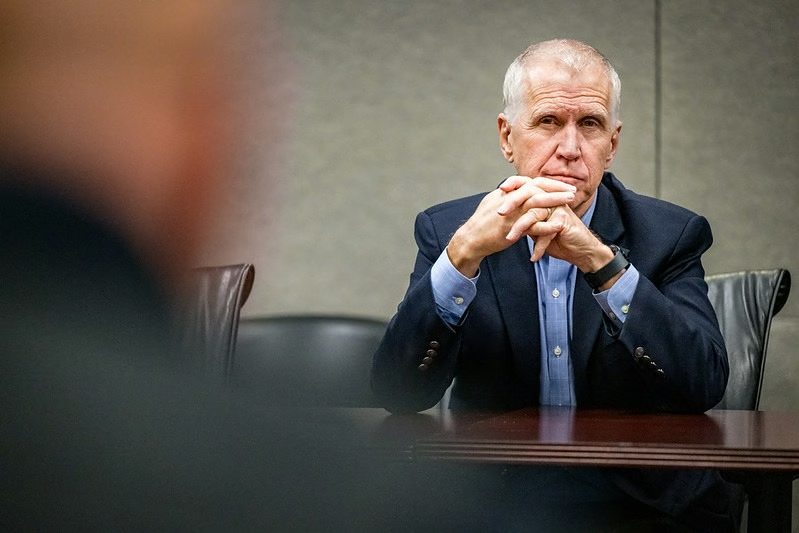
Republican US Senator Thom Tillis said he won’t support the Senate’s crypto market structure bill unless it includes ethics provisions limiting how White House officials can use crypto.
“There has to be ethics language in the bill before it leaves the Senate, or I’ll go from one of the people working on negotiating it to voting against it,” Tillis told Politico on Monday.
Democratic Senator Ruben Gallego said that there is “no final bill — there is no final movement — unless there is a bipartisan agreement when it comes to the ethics provision.”
Tillis, who is retiring early next year, is a senior member of the Senate Banking Committee, which is key to advancing the Senate bill. The House passed a version of it, called the CLARITY Act, in July.
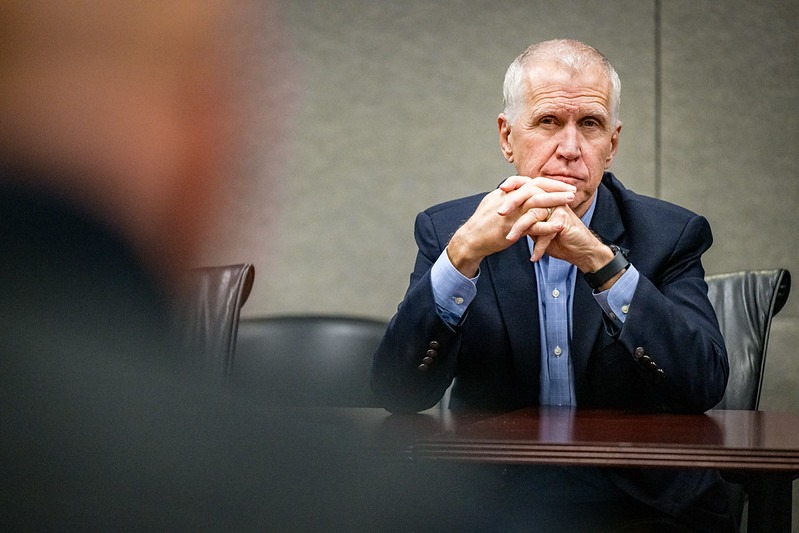
Thom Tillis, pictured at a meeting in 2024, says he won’t support a crypto bill without an ethics provision. Source: City of Greenville, North Carolina
The bill carves up crypto regulation between the Commodity Futures Trading Commission and the Securities and Exchange Commission and has been plagued by delays as lawmakers and lobbyists seek to add provisions on ethics and stablecoin yield payments.
Democratic lawmakers have heavily criticized the Trump family’s expanding crypto businesses and have sought to use the bill to crack down on a perceived conflict of interest.
Related: Canada advances bill to ban crypto political donations
Now, lawmakers are reportedly saying talks on the ethics provisions are moving forward, but it’s not clear what the language will be.
“We’re making progress,” Democratic Senator Adam Schiff told Politico. “We have been talking for a long time without making much progress, and now that other parts of the bill are starting to come together, we’re narrowing our differences.”
Schiff said earlier this year that Democrats want “a ban on sponsoring, endorsing or issuing digital assets that applies to all federal employees,” including the president, who has backed a memecoin and non-fungible tokens bearing his name and likeness.


Solana validator clients Anza and Firedancer have introduced a test version of Falcon, a post-quantum signature solution built to prepare the network for future quantum risks.
Summary
- Anza and Firedancer added early Falcon versions to prepare Solana for possible future quantum attacks.
- Jump Crypto said Falcon-512 has the smallest signature among selected NIST post-quantum standards.
- The teams said Falcon can protect Solana without causing major network performance issues.
The update comes as blockchain developers assess how quantum computers may affect public-key cryptography. Falcon aims to give Solana a ready option if stronger quantum protection becomes needed.
Anza and Firedancer said Falcon was designed for high-throughput blockchain use. The teams said it can be activated “if and when the time comes,” referring to the possible point when quantum computers can break current encryption systems.
Jump Crypto, the team behind Firedancer, said Falcon-512 offers the smallest signature among post-quantum signature standards selected by the U.S. National Institute of Standards and Technology. Smaller signatures may help Solana protect speed, bandwidth, and storage efficiency.
Jump Crypto says performance should remain stable
The teams said the migration process would be manageable and fast when required. They also said network performance should not face a major change from the shift.
“The migration work is manageable, the transition can happen quickly when the time is right, and network performance is not expected to see a meaningful impact,” the announcement said.
Jump Crypto added that Falcon signature verification is not hard to implement. It also said signing happens off-chain, which may reduce pressure on Solana’s network during normal activity.
Moreover, Anza and Firedancer said they researched post-quantum tools separately before reaching the same view. Both teams agreed that Solana needs a clear quantum readiness path before any future threat becomes active.
The two clients have already added early Falcon versions to their GitHub repositories. Data from Anza’s GitHub account shows work on Falcon has been underway since at least Jan. 27, 2026.
Quantum concerns continue across crypto
Falcon is not the first quantum-related tool in the Solana ecosystem. Blueshift’s Winternitz Vault has offered optional quantum security on Solana since January 2025, but it is not a protocol-level upgrade.
The wider crypto sector continues to debate quantum threats. Google and California Institute of Technology researchers recently said useful quantum computers may arrive sooner than earlier estimates. Google also claimed such systems may one day break Bitcoin cryptography within ten minutes.
However, some industry figures have played down the near-term risk. Blockstream CEO Adam Back said current quantum computers remain “essentially lab experiments” and argued that a real threat may still be decades away.
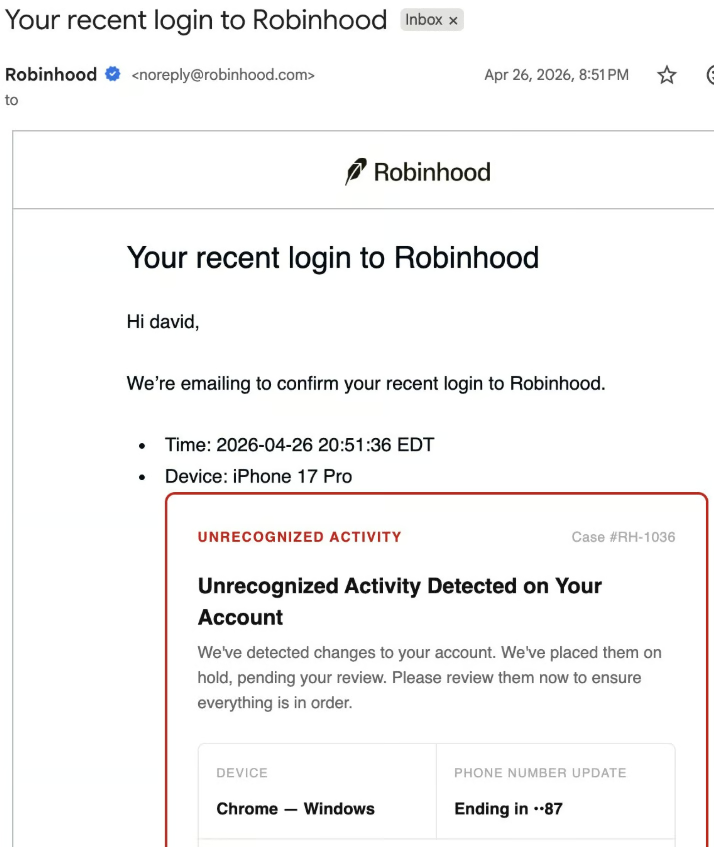
Robinhood users are being warned about a new phishing attack that takes advantage of Gmail’s native “dot alias” feature and flaws in Robinhood’s account creation process to send malicious emails.
Robinhood users on Sunday began reporting on social media of emails originating from the platform’s mail server warning of an unrecognized device login, which linked to phishing websites in the “call to action” button.
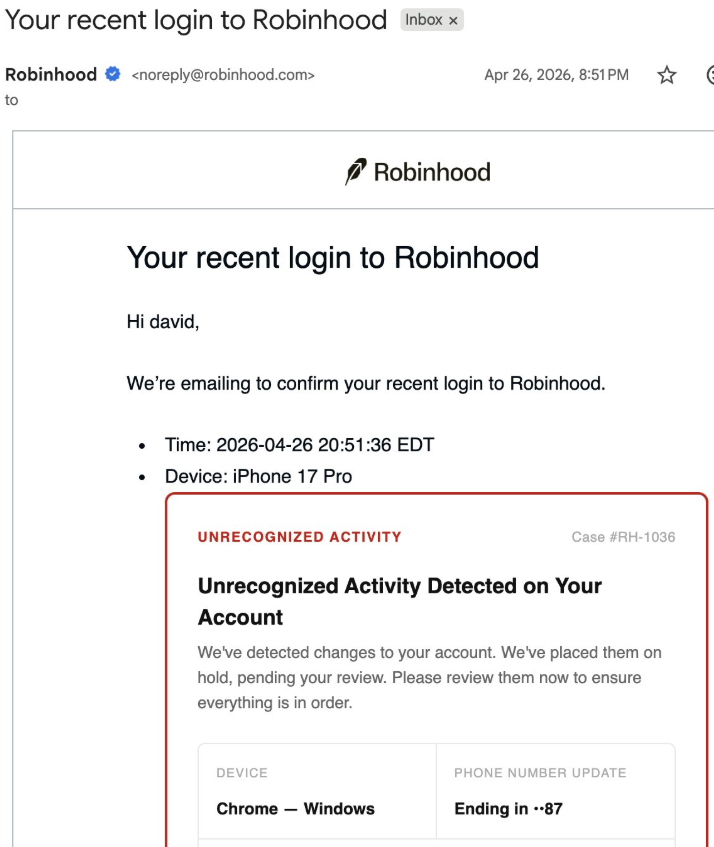
Source: David Gobaud
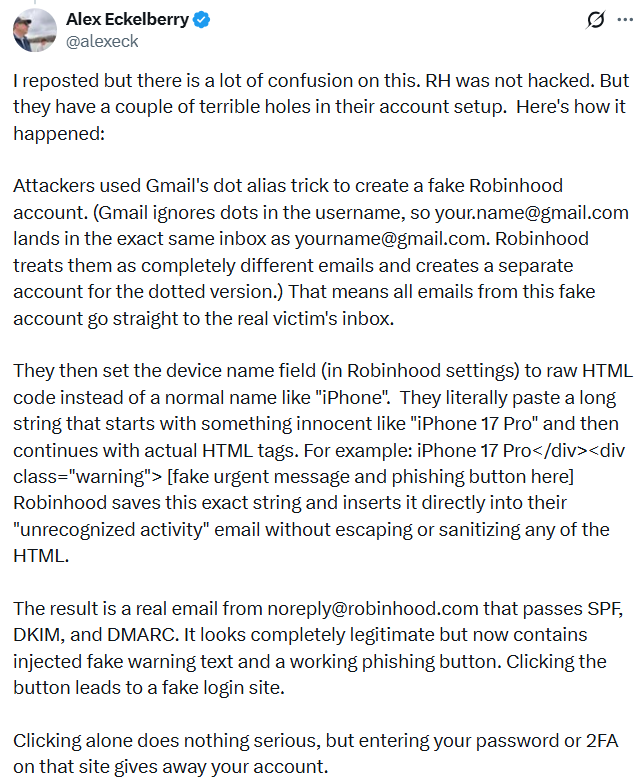
Alex Eckelberry, a cybersecurity researcher and tech CEO, said the phishing campaign wasn’t the result of a hack but instead exploited a native Gmail characteristic that ignores dots in an email address, as well as a “couple of terrible holes” in Robinhood’s account setup.
It comes after blockchain security company Hacken reported earlier this month that phishing and social engineering attacks dominated crypto attacks in the first quarter of 2026, accounting for $306 million in losses.
Source: Alex Eckelberry
Hackers created fake Robinhood accounts
Eckelberry said the scam relied on fraudsters creating an account on Robinhood with an email closely mimicking their target’s email address.
For example, a Robinhood user could have an email address such as “jane.smith@gmail.com.” The scammer would create a new Robinhood account with an email without the dot in the middle, such as “janesmith@gmail.com.”
While Robinhood would treat them as completely separate accounts, Gmail ignores dots in the username part of an email address. This means scammers could prompt Robinhood to automatically send emails intended for their fake account, but have them arrive in their target’s inbox instead.
To get a phishing link into the automated email sent when a new Robinhood account is created, the scammers would then add HTML instructions to the optional “device name” field on Robinhood, which Gmail treats as formatting instructions.

Source: Abdel
“The result is a real email from “noreply@robinhood.com” that passes SPF, DKIM, and DMARC. It looks completely legitimate but now contains injected fake warning text and a working phishing button. Clicking the button leads to a fake login site,” Eckelberry said.
The email is only dangerous if information is added
Visiting the fake login website alone isn’t enough for hackers to gain access to an account, Eckelberry said, but entering sensitive information such as passwords could allow bad actors to do so.
Related: Robinhood Q4 earnings miss as crypto revenues decline
Robinhood’s support account on X posted a statement on Monday confirming that some users received a falsified email from “noreply@robinhood.com” with the subject line “Your recent login to Robinhood” and blamed the issue on an exploit of the “account creation flow.”
“This phishing attempt was made possible by an abuse of the account creation flow. It was not a breach of our systems or customer accounts, and personal information and funds were not impacted,” they said.
“If you received this email, please delete it and do not click any suspicious links. If you have clicked a suspicious link or have any questions about your account, please contact us directly within the Robinhood app or website.”
Magazine: Should users be allowed to bet on war and death in prediction markets?
Two of Solana’s most-used validator clients have implemented a test version of a new post-quantum signature solution, Falcon, to help prepare the Solana network for future quantum threats.
In an announcement on Monday, Anza and Firedancer said Falcon is built for “high-throughput blockchain use” and that it can be activated “if and when the time comes” — an apparent reference to Q-Day, the point at which quantum computers become powerful enough to break public-key encryption.
“The migration work is manageable, the transition can happen quickly when the time is right, and network performance is not expected to see a meaningful impact.”
Source: Solana Foundation
Concerns that quantum computers could eventually break blockchain cryptography have fueled worries about private keys and wallet security, prompting broader debate over how the sector should prepare as the technology develops.
One of those concerns has revolved around building quantum solutions that don’t impair blockchain performance by increasing bandwidth and storage.
To address that issue, Jump Crypto, the crypto infrastructure platform behind Firedancer, said Falcon-512 was built to generate the smallest signature currently among the US National Institute of Standards and Technology’s selected post-quantum signature standards.
It added that Falcon signature verification is “not complex to implement” and that signing is executed off-chain.
Solana ecosystem aligned with quantum plan
Anza and Firedancer said they independently researched quantum solutions and both concluded that quantum readiness is necessary before agreeing to build Falcon.
Both validator clients have implemented an initial version of Falcon in their GitHub repositories.
Data from Anza’s GitHub account shows that the development team has been working on Falcon since at least Jan. 27, 2026.
Falcon isn’t the first quantum solution floated in the Solana ecosystem.
Blueshift’s Winternitz Vault has offered quantum security to Solana since January 2025, though it was designed as an optional add-on for users and thus isn’t a protocol-level upgrade.
Related: Google targets 2029 post-quantum migration as threats draw nearer
The push comes as Google and California Institute of Technology researchers said last month that functional quantum computers could arrive sooner than expected and that they require far less computing power to break cryptography than previously thought.
Google even claimed that quantum computers could potentially break Bitcoin’s cryptography within ten minutes, allowing hackers to perform an “on-spend” attack.
However, Blockstream CEO Adam Back said current quantum computers are “essentially lab experiments” and that no real threat will emerge for decades.
Magazine: Bitcoin may take 7 years to upgrade to post-quantum: BIP-360 co-author


Xandeum, the decentralized storage network built on Solana, today began anchoring its state to Bitcoin.
At every checkpoint of its consensus, Xandeum writes a cryptographic fingerprint of its storage state into the Bitcoin blockchain, where it cannot be altered or erased. Anyone, anywhere, at any point in the future can use that fingerprint to prove what data Xandeum was holding at a given moment in time — without trusting Xandeum, its team, or any third party.
It is the first time a Solana-native infrastructure project has tied its trust model to Bitcoin.
“Solana gives us the speed and programmability to scale storage to exabytes,” said Bernie Blume, Founder and CEO of Xandeum. “Bitcoin gives us something Solana wasn’t built for: the most battle-tested permanence record in computing history. Our customers shouldn’t have to choose. Now they don’t.”
Xandeum currently runs more than 300 pNodes — independently operated storage nodes — across the network, with capacity growing weekly. The upcoming South Era pNode Sale in June will be the final opportunity to acquire nodes under the network’s early-era terms.
Xandeum is presenting at Bitcoin 2026 in Las Vegas, April 27–29. Bernie Blume and members of the team are available for briefings and live demonstrations of the Bitcoin anchoring system at the event.
About Xandeum
Xandeum is a decentralized storage layer for Solana, purpose-built for large-scale, random-access data. The network is operated by hundreds of independent pNode operators worldwide.
The post A Solana Storage Network Just Put Down Roots on Bitcoin appeared first on BeInCrypto.


Bitcoin has been rejected at $79,000 three times in eight sessions. The level is now defining the range.
Bitcoin traded at $76,923 on Tuesday morning, down 2.4% over 24 hours after climbing to $79,399 on Monday and reversing through the day. Ether fell 3.7% to $2,290, XRP slipped 3.2% to $1.39, Solana dropped 3.9% to $84.10, and BNB declined 1.8% to $625. The whole top 10 closed red on 24 hours outside Tron and Dogecoin.
Brent crude rose 1% to above $109 a barrel, extending its rally to a seventh day after Iran’s interim deal proposal to reopen the Strait of Hormuz failed to advance over the weekend. The White House said US officials were discussing the latest Iranian proposal but maintained “red lines” on any deal to end the eight-week war.
The MSCI Asia Pacific Index was little changed, with Japanese stocks supported by the Bank of Japan’s 6-3 split decision to keep policy unchanged. The yen strengthened 0.3% to around 159 per dollar.
Two readings of the bitcoin tape are circulating among market analysts.
Mike Novogratz of Galaxy Digital said in a note that US retail investors have returned to the market and the combination of retail demand, institutional capital, and limited supply creates the foundation for further upside. Santiment data shows whales accumulated more than 40,000 BTC over the past two weeks, and the firm flagged a sharp shift in sentiment from fear to fear-of-missing-out over a short period.
Analysis firm CryptoQuant takes the opposite view. Founder Ki Young-Ju said in an X post that bitcoin’s push above $79,000 was driven primarily by a short squeeze in the derivatives market rather than sustained spot demand, and that large-scale short covering leaves the market vulnerable to a reversal once the squeeze exhausts.
Funding rates on perpetual futures across major exchanges remain negative on a 7-day basis at -0.13% per Coinglass, meaning shorts are still paying longs to hold positions, the pattern that historically precedes both squeezes and the unwinding of squeezes.
The two views are not mutually exclusive. Spot demand from retail and institutions can be returning at the same time that the rally toward $79,000 was front-loaded by short covering. The test is whether the next attempt at the level brings fresh spot bids or runs out of shorts to squeeze.
Corporate accumulation continues regardless. Strategy bought $3.9 billion of bitcoin in April per Bloomberg, the firm’s largest monthly accumulation in a year.
Japanese company Metaplanet announced a $50 million bond issuance Tuesday to finance new bitcoin purchases, the latest in a series of yen-denominated debt deals the firm has used to build one of the largest corporate bitcoin treasuries outside the US.
The week’s catalysts arrive Wednesday and Thursday.
The Federal Reserve announces its policy decision Wednesday with traders pricing higher odds of a rate cut after the Justice Department closed its probe into Fed Chair Jerome Powell.
Megacap tech earnings from Alphabet, Microsoft, Amazon, and Meta on Wednesday and Apple on Thursday represent roughly a quarter of the S&P 500’s market capitalization.
Either the Fed or a strong earnings beat could provide the catalyst needed to push bitcoin through $80,000. Without one, the third rejection from the level starts to define the upper end of the range rather than precede a breakout.
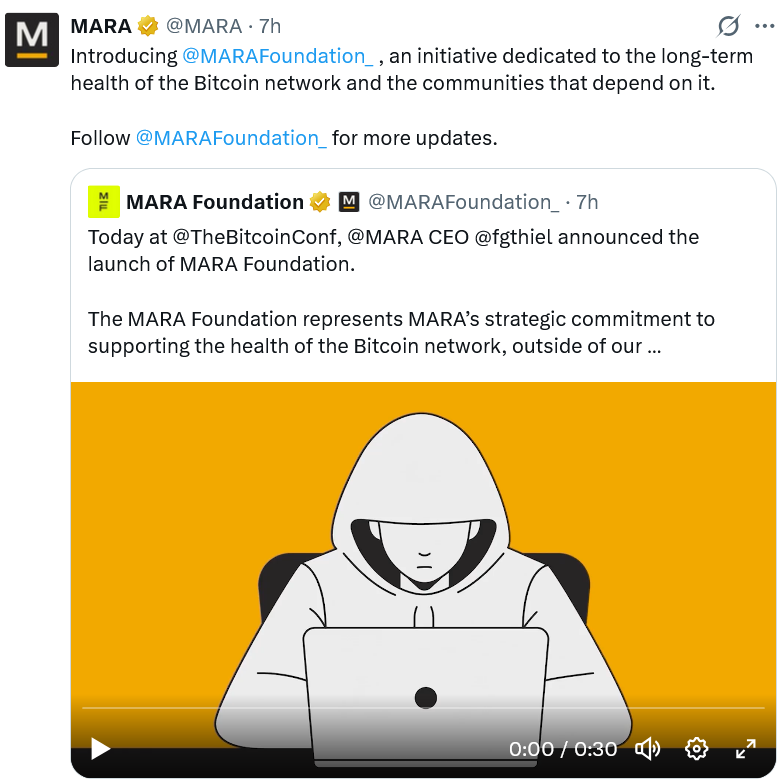
Bitcoin miner MARA Holdings launched the MARA Foundation on Monday to support the health of the Bitcoin network and the communities that rely on it as a tool for financial sovereignty.
The MARA Foundation said it plans to implement measures to “harden Bitcoin against security threats,” including quantum computing, while also expanding access to self-custodial Bitcoin (BTC) and offering a range of educational resources, MARA said after announcing the new foundation at the Bitcoin 2026 conference in Las Vegas on Monday.
It also plans to support the “development of a robust and healthy fee market for Bitcoin transactions,” it said.
“We believe Bitcoin embodies the most powerful tool for financial sovereignty, economic resilience, and human freedom in the world,” the Bitcoin miner said, explaining its commitment to protect the “core properties that make Bitcoin sound, durable money.”
Source: MARA Holdings
MARA’s commitment to Bitcoin comes as corporate Bitcoin miners have expanded into AI and high-performance computing in search of higher-revenue opportunities. Bitcoin hashrate, a measure of the computational power employed by miners to secure the Bitcoin network, has fallen 28.8% since September.
MARA has a $100,000 contribution to send out
The newly formed MARA Foundation is set to start with a $100,000 contribution fund and is asking the public to vote on which of three Bitcoin companies should receive the funds.
The three candidates are the open-source Bitcoin mining platform 256 Foundation, the Latin American Bitcoin education platform Libreria de Satoshi and SafeNet, a Bitcoin-powered, community-operated wireless network serving underprivileged communities.
Related: Vitalik Buterin outlines quantum resistance roadmap for Ethereum
MARA said one of the foundation’s missions is to enable “financial sovereignty worldwide,” particularly in the “Global South” — mostly Africa and Latin America — where “Bitcoin is being used as a tool to escape financial oppression in jurisdictions affected by hyperinflation, confiscatory policy, and restrictions on financial freedom.”
“We are committed to supporting communities using Bitcoin to expand access to sound money and strengthen local economies,” it added.
MARA also plans to share a range of educational resources with both Bitcoin developers and policymakers.
Magazine: Bitcoin may take 7 years to upgrade to post-quantum: BIP-360 co-author
Crypto World
WhiteBIT and FC Barcelona announce five-year agreement to drive global innovation in sport

Disclosure: This article does not represent investment advice. The content and materials featured on this page are for educational purposes only.
WhiteBIT and FC Barcelona sign five-year deal to advance fan engagement and digital finance innovation.
Summary
- WhiteBIT signs five-year deal with FC Barcelona to expand crypto integration across teams and fan engagement systems.
- The two have partnered to build real-world crypto use cases through sports, education, and fan experiences.
- WhiteBIT becomes official crypto exchange partner of FC Barcelona, linking digital finance with global sports innovation.

WhiteBIT, the largest European cryptocurrency exchange by traffic, and FC Barcelona have entered a landmark five-year agreement through 2030, bringing together two global leaders to shape the future of fan engagement, digital finance, and sport.
This partnership is a strategic alliance between category leaders, where crypto meets one of the most influential sports institutions in the world to set new standards for how technology integrates into global fan ecosystems.
As the Official Cryptocurrency Exchange Partner of the club, WhiteBIT will take on an expanded role across FC Barcelona’s men’s first team, women’s team, and basketball team, as well as partner with the Barça Innovation Hub. Together, the partners will move beyond visibility to execution — developing real-world crypto applications designed to scale across the sports industry.

At the core of the collaboration is a shared ambition: to turn crypto into a practical, everyday tool for millions of fans worldwide. The partnership will introduce new initiatives in fan engagement, digital education, and interactive experiences — bridging the gap between technology and global audiences.
Commenting on the partnership, Manel del Río, CEO of FC Barcelona, said:
“Continuing to count on WhiteBIT as a partner over the next five years reinforces FC Barcelona’s commitment to strategic alliances with globally leading companies. This renewal highlights the strength and appeal of our brand, as well as our ability to connect with innovative sectors. In this case, the cryptocurrency sector, a growing field with significant strategic potential for the coming years.”
Volodymyr Nosov, President and Founder of W Group, which includes WhiteBIT:
“Our mission is to support the mass adoption of crypto by bringing technology to everyone, everywhere. Together with Barça, we are taking crypto beyond the industry and into everyday life—creating experiences that millions of fans can actually use. This is how adoption happens.”
A new identity for everyday crypto payments
WhiteBIT and FC Barcelona will introduce an FC Barcelona–themed design for the WhiteBIT Nova debit card, allowing fans to personalize their card with the club’s visual identity while using it for everyday payments using crypto.
The new card skin will combine the functionality of the WhiteBIT Nova card with an exclusive FC Barcelona look. In addition to the design update, the card will provide added benefits for fans, including special features and future partner advantages linked to the collaboration.

Over the past three years, the partnership between WhiteBIT and FC Barcelona has become a reference model for bringing web3 into real-world utility. The new agreement builds on this foundation, scaling joint initiatives in fan engagement, education, and digital activations into more integrated, long-term projects within the club’s ecosystem.
Disclosure: This content is provided by a third party. Neither crypto.news nor the author of this article endorses any product mentioned on this page. Users should conduct their own research before taking any action related to the company.
Kendra Duggar’s No Contact Order Lifted Amid Not Guilty Plea

Shaun Murphy questions Zhao Xintong fear factor ahead of Crucible clash

Constellation Energy: Lower Price Improves Upside, But Uncertainty Remains

Manchester United reach agreement with Casemiro over contract clause amid transfer speculation

US brings back mandatory military draft registration

Steven Gerrard disagrees with Gary Neville over ‘shock’ Chelsea and Arsenal claim | Football


-

 Fashion4 days ago
Weekend Open Thread – Corporette.com
-

 Tech13 hours ago
Register Renaming | Hackaday
-
 Crypto World2 days ago
Hyperliquid $HYPE Rally Builds Momentum as AI Sector Enters Prove-It Phase
-

 Politics5 days ago
Making troops accountable for war crimes threatens US alliance, ex-SAS colonel warns
-

 Politics5 days ago
Disabled people challenge government SEND proposals over segregation concerns
-

 Business4 days ago
Patterson-UTI Energy, Inc. (PTEN) Q1 2026 Earnings Call Transcript
-

 Business6 days ago
Rolls-Royce Voted UK’s Most Iconic Trade Mark as IPO Register Hits 150
-
 Crypto World7 days ago
Five Value Stocks with Recovery Potential in 2026: PayPal (PYPL), Nike (NKE), and More
-
 Sports2 days ago
IPL 2026: Ruturaj Gaikwad registers slowest fifty of the season, enters all-time unwanted list | Cricket News
-

 Politics6 days ago
Starmer handler McSweeney to be dragged from shadows by Foreign Affairs Committee
-

 Politics6 days ago
Zack Polanski responds to home secretary’s taser threat
-

 Politics8 hours ago
Drax board avoid their own AGM, accused of greenwashing & environmental racism
-
Politics6 days ago
Wings Over Scotland | How To Get Away With Crimes
-

 Crypto World6 days ago
New York sues Coinbase, Gemini over prediction market offerings
-
Entertainment7 days ago
Sydney Sweeney cameo cut from “The Devil Wears Prada 2”, source explains why (exclusive)
-

 Crypto World6 days ago
Crypto’s great hope in Senate’s Clarity Act still has a path to survive tight calendar
-
 Business6 days ago
HCL Tech share price tank over 9% after weak Q4. JPMorgan, HSBC & 3 others cut target price
-

 Fashion7 days ago
Kilkenny Design New Beauty Arrivals for Spring 2026
-

 Politics5 days ago
‘Iran is still a nuclear threat’
-
 Sports5 days ago
Tim Bradley names the current best in the world: “Better than Inoue and Usyk”
You must be logged in to post a comment Login