
Crypto World
Binance Gold Futures Cross $100B in Trading Volume Within Months of Launch


TLDR:
- Binance gold futures crossed $100 billion in cumulative trading volume within months of its January launch.
- A record $6.6 billion in single-session volume was recorded on March 23, the highest since product launch.
- Gold is currently trading 16.5% below its all-time high after gaining roughly 210% since October 2023.
- Binance’s 24/7 gold futures market gives crypto investors access traditional commodity markets do not offer.
Binance Gold futures have surpassed $100 billion in cumulative trading volume since the platform introduced gold trading in January.
The milestone reflects sustained investor appetite for the precious metal across both traditional and crypto-native audiences.
Macroeconomic uncertainty and ongoing geopolitical tensions have kept demand elevated. Even so, gold prices have pulled back from their peak, entering a consolidation phase after a prolonged rally that lasted several months.
Strong Volumes Reflect Broad Investor Demand for Gold
Binance launched gold futures trading in January, and the response from investors has been notable. The platform now regularly records between $500 million and $1 billion in volume during a standard trading session. That level of activity points to genuine and consistent market participation across different investor types.
Trading volumes spiked sharply during the February market correction, with activity climbing well above typical daily levels.
The most active period came in late March, when several sessions recorded spikes above $3 billion. On March 23, Binance recorded a single-session peak of $6.6 billion, the highest since the product launched.
As noted by Cryptoquant market analyst Darkfost_Coc, the current environment of macroeconomic and geopolitical uncertainty has strengthened investor demand for gold.
This demand extends to crypto market participants who do not typically trade traditional commodities. The 24/7 accessibility of the Binance platform gives it an edge over conventional gold markets that close on weekends.
Tensions between Iran and the United States have added to market uncertainty, which has limited visibility for many asset classes.
Against that backdrop, gold demand has remained resilient, even as prices have moved lower from their highs. This combination of strong volume and price softness reflects a market still working through its prior gains.
Gold Prices Enter Correction After Months of Sustained Gains
Gold posted gains of approximately 210% between October 2023 and its all-time high, drawing significant attention from a wide range of investors.
However, the metal began correcting in late January and is now trading about 16.5% below that peak. A pullback of this kind, following such a strong run, is a natural market pattern.
The correction follows a period of intense buying across global markets, which built up substantial unrealized profits for many investors.
As those participants moved to lock in gains, selling pressure increased and prices drifted lower. This is consistent with how commodity markets behave after extended upward trends.
Binance’s decision to tokenize gold and offer it through futures trading has positioned the platform well within this environment.
The move brought a traditionally institutional asset within reach of a broader investor base. That accessibility has clearly played a role in the volume growth seen since January.
Gold’s current consolidation period does not appear to have dampened interest on the platform. Daily volumes have remained within a healthy range, and the infrastructure is in place to handle further spikes.
The product has established itself as a meaningful part of Binance’s derivatives offering in a short period.


Crypto World
Goldman Sachs Just Pushed Its Rate Cut Forecast to September: Is Solana’s $90 Breakout on Hold?

Solana price is holding its ground, barely. SOLUSD trades near $84, up roughly 1.8% over the last 24 hours after oscillating between $82.70 and $85.67.
Yet the real test isn’t today’s modest rebound. It’s whether bulls can withstand the upcoming FOMC decision and deliver a second consecutive positive April close.
The setup looks more fragile than the price action suggests.On-chain signals paint a mixed picture. DEX volumes have stabilized following a sharp contraction earlier this year, but momentum remains tepid.
Goldman Sachs just upgraded their oil forecast. — Qasem Al-Ali (@AlaliQasem) April 27, 2026
Published yesterday. Most people haven’t read it yet.
Here’s what they’re actually saying.  pic.twitter.com/KxhiZRDEAd
The RSI sits at a neutral 49.7, neither oversold nor displaying conviction. Goldman Sachs has pushed its expectations for the next Fed rate cut into September 2026, prolonging the macro headwinds that have pressured risk assets since March.
Last year, April closed up about +1.18%, with institutional demand quietly absorbing selling pressure. The question now is whether that same support can endure a potential seventh month of muted or negative ETF flows, and what that means for SOL heading into May.

Can Solana Price Break $90 Before the FOMC Decision?
SOL is holding just above its short-term support, and that is a small but important positive, because staying above the 20-day average usually means buyers are still defending.
Right now, it is not trending, though; it is compressing. SOL USD price is sitting in the mid-range between $76 and $91, and the MACD is tightening, suggesting a bigger move is coming soon.
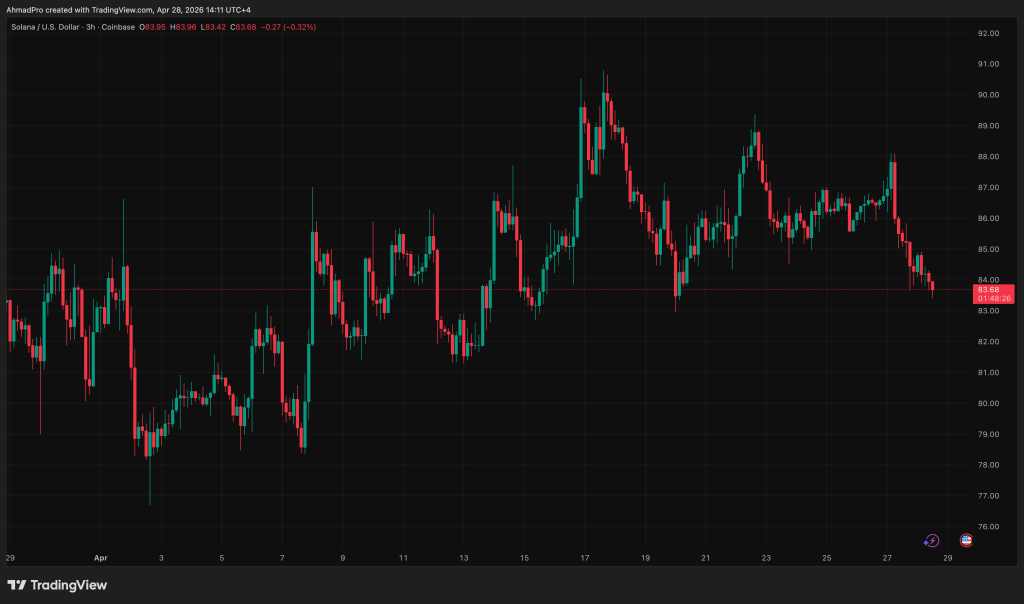
$85.8 and $87.2 are the breakout triggers. If SOL clears those with momentum, it can quickly push into the $90–$95 zone and potentially extend higher.
Below, $80 is the line that matters for Solana price structure. As long as it holds, the structure is intact. If it breaks, downside opens toward the mid-$70s.
What stands out is volume. Selling pressure has been fading, not intensifying, which weakens the bearish case and hints that this could reverse upward if a catalyst emerges.
Most likely, it keeps ranging between $83 and $90 until the FOMC decision forces a move.
Maxi Doge Could Lead the Next Memecoins Season
SOL’s range is clear, and so is the limitation. Even a strong move from $84 to $95 is around 13%, which is solid but still capped for a large-cap asset, especially with macro uncertainty holding flows back.
That is why some traders start looking further down the risk curve, where the upside is not already priced in.
Maxi Doge is getting attention in that space. It leans fully into the meme and leverage-trader narrative, but it is also building engagement mechanics around it. The presale is sitting around $0.0002815 with roughly $4.75M raised, and getting close to the $5M mark, which often brings more visibility and momentum.
The setup is designed to keep activity high, with staking, trading competitions, and a treasury aimed at supporting liquidity and growth, all wrapped in aggressive, viral branding that fits the current cycle.
But it is still a presale, and that comes with real risk. Liquidity is not guaranteed, execution matters, and outcomes depend heavily on how the market responds after launch.
So the trade-off is simple, SOL offers stability with limited upside, while something like Maxi Doge offers earlier positioning with higher potential, but also higher uncertainty.
The post Goldman Sachs Just Pushed Its Rate Cut Forecast to September: Is Solana’s $90 Breakout on Hold? appeared first on Cryptonews.
Crypto World
Nearly Half a Million Users Utilize Bitget’s AI-Trading Infrastructure, Messari Report Highlights
Bitget, the world’s largest Universal Exchange (UEX) highlighted findings from a newly published Messari Pulse report documenting early adoption across its AI trading stack, a four-layer product system built as part of Bitget’s broader trading infrastructure serving 125 million users worldwide.
The Messari report identifies four core layers within Bitget’s AI architecture: GetAgent for conversational market analysis, GetClaw for autonomous execution, Agent Hub for developer access to exchange functions, and Gracy AI, a strategic guidance interface built around the public market voice of Bitget CEO Gracy Chen. Together, these products extend AI across analysis, executions, infrastructure, and user engagement inside the Bitget platform.
According to Bitget data cited in the report, Gracy AI attracted more than 460,000 users and generated over 2.6 million replies within its first eleven days after launch in February, producing over 390 million impressions in the same period. GetAgent has also surpassed 450,000 registered users since its launch. Its invite-only phase, which ran from July to August 2025, drove 100 million+ impressions and a waitlist exceeding 25,000 users.
Messari also highlights Agent Hub, infrastructure layer for connecting AI systems directly to exchange functions. Launched in February 2026, it supports MCP Server, Skills, REST and WebSocket APIs, and a command-line interface. The report notes Bitget is the only exchange to offer all four simultaneously. The platform has since expanded to include five analytical AI Skills and 15+ integrated data tools spanning macro analysis, technical signal detection, sentiment monitoring, market intelligence, and news aggregation.
GetClaw, the autonomous execution layer, operates through a constrained structure designed for retail risk control. Trades execute via dedicated sub-accounts isolated from user-held assets, while sandbox environments and fund limits define where the agent can operate and how much capital it can deploy. The product is currently live on Telegram, with Discord, WhatsApp, and in-app expansion planned in later releases.
“We want to provide billions of people with the ability to trade like Wall Street professionals,” said Gracy Chen, CEO of Bitget. “AI is becoming part of how modern trading infrastructure is built. Early adoption across our AI infra shows that users increasingly expect analysis, execution, and strategy integrated inside one trading platform.”
The full Messari Pulse report is available at messari.io.
About Bitget
Bitget is the world’s largest Universal Exchange (UEX), serving over 125 million users and offering access to over 2M crypto tokens, 100+ tokenized stocks, ETFs, commodities, FX, and precious metals such as gold. The ecosystem is committed to helping users trade smarter with its AI agent, which co-pilots trade execution. Bitget is driving crypto adoption through strategic partnerships with LALIGA and MotoGP™. Aligned with its global impact strategy, Bitget has joined hands with UNICEF to support blockchain education for 1.1 million people by 2027. Bitget currently leads in the tokenized TradFi market, providing the industry’s lowest fees and highest liquidity across 150 regions worldwide.
For more information, visit: Website | Twitter | Telegram | LinkedIn | Discord
Risk Warning: Digital asset prices are subject to fluctuation and may experience significant volatility. Investors are advised to only allocate funds they can afford to lose. The value of any investment may be impacted, and there is a possibility that financial objectives may not be met, nor the principal investment recovered. Independent financial advice should always be sought, and personal financial experience and standing carefully considered. Past performance is not a reliable indicator of future results. Bitget accepts no liability for any potential losses incurred. Nothing contained herein should be construed as financial advice. For further information, please refer to our Terms of Use.
The post Nearly Half a Million Users Utilize Bitget’s AI-Trading Infrastructure, Messari Report Highlights appeared first on BeInCrypto.


Israel’s Capital Market Authority granted approval for a stablecoin pegged to the shekel for the first time.
Tel Aviv-based cryptocurrency exchange Bits of Gold received authorization to issue the token after a two-year evaluation and pilot process, the authority said in a post on LinkedIn.
The token, BILS, was developed in collaboration with the Solana network and crypto custodian heavyweights Fireblocks with auditing oversight provided by Big Four consultancy firm EY, Bits of Gold said in an emailed statement.
The size of the stablecoin sector — crypto tokens pegged to the value of a traditional financial asset, usually a fiat currency — has surged in the last 18 months to more than $300 billion fueled by the establishment of formal regulatory regimes in major markets such as the U.S.
The overwhelming dominance of U.S. dollar-pegged tokens in the sector has prompted concerns in markets outside the U.S. about the threat of losing financial and digital sovereignty if onchain payments all default to dollars as their unit of account.
“The Israeli shekel has emerged as one of the stronger performing fiat currencies among developed markets, supported by a resilient technology sector and consistent macroeconomic management,” Bits of Gold said in its Monday announcement.
The shekel has gained more than 20% against the dollar over the past year, according to Visual Capitalist, making it the best-performing currency among countries with an annual gross domestic product (GDP) exceeding $250 billion.
“Bringing the shekel onchain positions it alongside other leading currencies, including the euro, yen and Singapore dollar, that are beginning to gain traction in blockchain-based financial systems,” the company said.

Jack Dorsey’s Block Inc. just published its first-ever proof-of-reserves report with larger-than-expected numbers. Block disclosed total holdings of 28,355 BTC as of March 2026, split between 19,357 BTC held on behalf of customers and 8,997 BTC in corporate reserves, bringing the combined prediction figure to $2.2 billion at the current Bitcoin price.
— Bitcoin Archive (@BitcoinArchive) April 27, 2026
 NEW: Jack Dorsey’s Block just released its Q1 2026 Bitcoin Proof-of-Reserves. pic.twitter.com/CnmB53rBZM
The company’s statement points:
“People shouldn’t have to trust that their bitcoin is there, they should be able to verify it.”
Using on-chain signatures, Block says anyone can independently confirm its reserves are “actively controlled, not just historically observed.”
This disclosure comes as U.S. spot Bitcoin ETFs recorded $1.1 billion in net inflows across five consecutive trading sessions before recording an outflow yesterday, suggesting a pattern of institutional accumulation is tightening available supply. And yeah, Michael Saylor’s Strategy is not yet done with their buying spree.
Discover: The best pre-launch token sales
Bitcoin Price Prediction: $80K Still in the Play?
Bitcoin’s current print of $76,500 represents a recovery from an earlier this year’s $63,000 low, suggesting the consolidation phase may be resolving to the upside. The 2% 24-hour drop is not exactly super bullish, but it is directionally consistent with quiet accumulation.
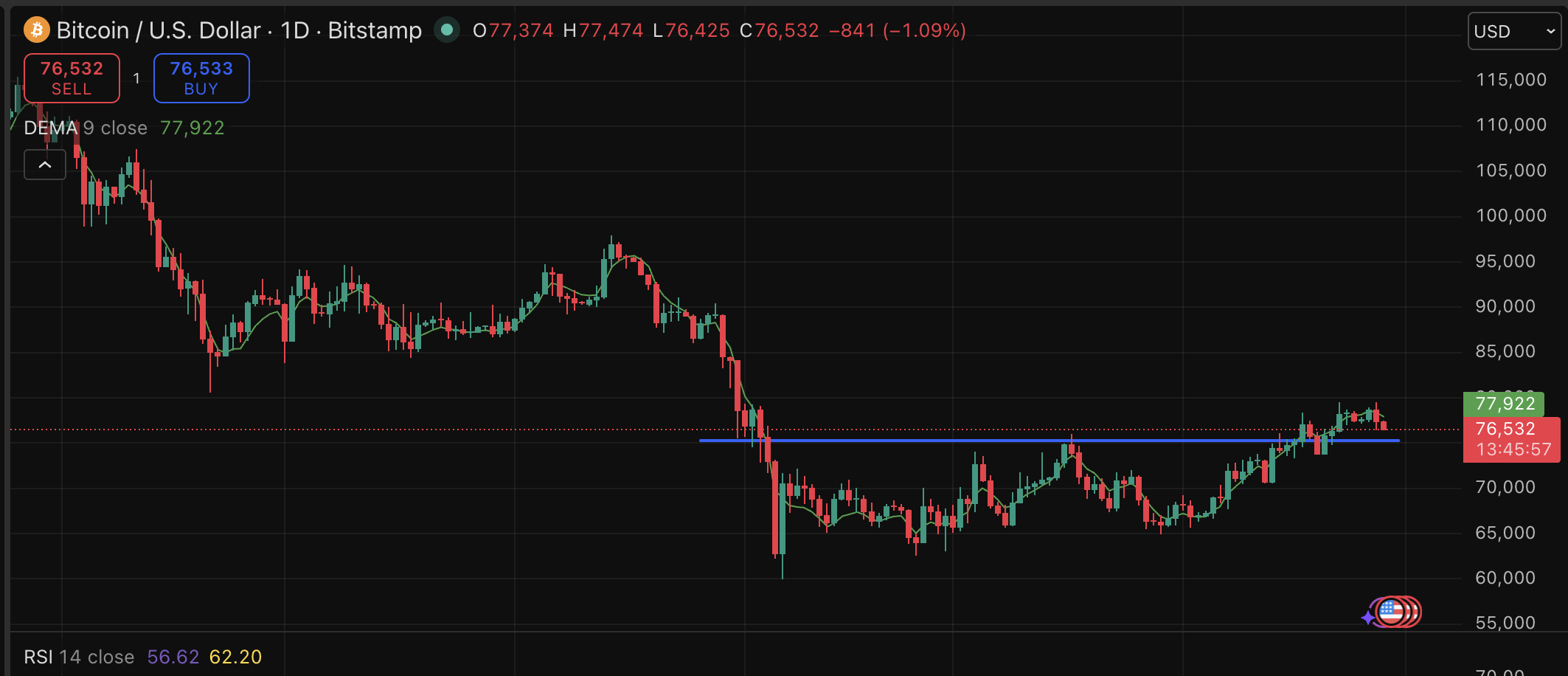
$75,000 represents the nearest meaningful support, a psychological floor that has been looking very strong for weeks. Resistance clusters suggest a clean break above $79K on volume could open a path toward $80,000 after testing it for 2-3 times over the last few days.
Momentum appears to indicate the bull and base cases carry a higher probability while institutional buying continues at this pace. Block’s Bitcoin conviction dates back to its original 4,709 BTC purchase in 2020 — this isn’t a new thesis, it’s a compounding one.
Discover: The best crypto to diversify your portfolio with
Bitcoin Hyper Targets Early Mover Upside as BTC Tests Key Resistance
Spot BTC is compelling right now, but even a move to $80,000 represents 5-6% upside from here. For traders who believe in Bitcoin’s trajectory but want asymmetric exposure to the ecosystem, the math starts pointing elsewhere. That’s the argument early-stage infrastructure plays are making right now, and one is gaining serious traction.
Bitcoin Hyper ($HYPER) is positioning itself as the first Bitcoin Layer 2 with Solana Virtual Machine (SVM) integration, delivering sub-second finality and low-cost smart contract execution on top of Bitcoin’s security layer.
The pitch is direct: Bitcoin has the trust, SVM has the speed; Bitcoin Hyper combines both. As institutional players like Metaplanet and Block continue stacking BTC, the demand for programmable Bitcoin infrastructure is accelerating alongside it.
The presale is now approaching $33 million at a current token price of $0.0136, with staking available for early participants. The Decentralized Canonical Bridge for native BTC transfers is a standout technical feature.
Research Bitcoin Hyper before the next price stage closes.
The post Bitcoin Price Prediction: Jack Dorsey Holds $2.2B as Strategy Ramps Up Buying appeared first on Cryptonews.


OKX has added BlackRock’s BUIDL tokenized U.S. Treasury fund to its institutional collateral framework with Standard Chartered. The move allows eligible institutional and VIP clients to use BUIDL as trading margin.
Summary
- OKX now lets eligible institutional and VIP clients use BlackRock’s BUIDL fund as trading collateral.
- Standard Chartered will custody BUIDL off-exchange while OKX manages margining and liquidation processes.
- BUIDL will be treated like USD, USDC and other dollar assets inside OKX’s margin system.
Clients can hold the asset off-exchange with Standard Chartered while trading on OKX Middle East. They can also deposit BUIDL directly on the exchange, depending on their setup.
The companies described the arrangement as a G-SIB bank-backed off-exchange tokenized collateral framework. It builds on OKX’s existing collateral mirroring program with Standard Chartered.
Rifad Mahasneh, CEO of OKX Middle East, North Africa and CIS, said the update shows how tokenized assets can support active trading instead of staying idle.
He said BUIDL will be treated as fungible with USD, USDC and other dollar-based stablecoins inside OKX’s margin system. Clients will keep ownership of the fund and its yield.
Standard Chartered holds client collateral
Standard Chartered will act as the off-exchange custodian. The bank will hold client collateral separately from OKX’s own assets.
OKX will manage real-time margining and liquidation through its internal risk systems. Mahasneh said the structure follows traditional finance standards, though details on stress-period margin calls were not provided.
Tokenized Treasury competition grows
BlackRock’s BUIDL fund is tokenized by Securitize. It invests in cash, U.S. Treasury bills and repurchase agreements, with yield distributed onchain.
The launch adds to growing use of tokenized real-world assets in crypto market infrastructure. Binance has also added tokenized Treasury products, including BUIDL and Franklin Templeton’s BENJI fund, to collateral frameworks.
OKX said the service is live for eligible institutional and VIP clients through OKX Middle East. The company plans to expand access based on jurisdiction and client demand.

The Blockchain Association has publicly supported the Federal Reserve’s proposal to formalize the removal of “reputation risk” from its bank supervision framework. In a comment letter submitted in response to the Fed’s request for input, Ashok Pinto, the association’s executive vice president of legal and government relations, argued that reputation risk should be codified as a permanent rule. The group notes that reputation risk was already removed as a component of examination programs in June 2025 and urged the Fed to finalize the change promptly. According to Cointelegraph, the move would anchor supervisory standards in objective criteria rather than political considerations.
The association’s position emphasizes that regulation should protect the integrity of the financial system without privileging particular industries or business models. Pinto stated that regulated entities deserve consistent, predictable standards, and that reputation risk has offered neither.
Source: Blockchain Association
Reputation risk has historically been cited in justifications for revoking banking access for crypto firms, a phenomenon some observers have linked to what critics described as “Operation Chokepoint 2.0.”
Key takeaways
- The Federal Reserve is considering codifying the removal of reputation risk from its supervisory programs, following prior iterations where the concept was de-emphasized in examination frameworks.
- The Blockchain Association argues that formal codification would deliver administration-neutral, objective standards for regulated entities, reducing politically influenced enforcement.
- Regulatory harmonization is a central theme, with the OCC and FDIC having already finalized rules to remove reputation risk from their supervision, creating a potential model for the Fed to align with.
- Analysts note that reputation risk has been used in the past to justify debanking actions against crypto firms, underscoring the importance of clear, neutral criteria in supervision.
- There is an ongoing policy context surrounding banking access for digital-asset businesses, with implications for compliance regimes, licensing, and cross-agency oversight.
Regulatory alignment and policy rationale
The Federal Reserve’s request for comment centers on codifying the removal of reputation risk from its supervisory framework. The aim is to establish durable, administration-neutral standards that would apply to all entities operating within the U.S. financial system. The proposal follows recent moves by other federal agencies that have similarly codified the exclusion of reputation risk from supervisory programs, signaling a broader federal push toward standardized, objective criteria in oversight. The Blockchain Association’s Ashok Pinto urged the Fed to move quickly to finalize and codify the change, arguing that regulation should safeguard the integrity of the financial system without entrenching winners or losers based on shifting political climates.
“Codifying its removal is a durable, administration-neutral protection for any American business operating lawfully within our financial system.”
The push for formalization aligns with a larger regulatory trend toward harmonization across agencies. The Office of the Comptroller of the Currency (OCC) and the Federal Deposit Insurance Corporation (FDIC) recently issued a final rule to codify the removal of reputation risk from their supervisory programs. Proponents argue that a consistent standard across federal agencies would provide regulated entities with greater clarity and predictability, thereby supporting safer and more stable financial intermediation.
“As supervision is grounded in objective, measurable standards, the public’s confidence in the impartiality and integrity of the regulatory process is strengthened,” Pinto wrote. A unified framework—across the Fed, OCC, and FDIC—could help ensure that enforcement remains anchored to verifiable criteria rather than discretionary political considerations.
Historical context and practical implications
Debanking concerns have long surrounded the crypto sector in the United States. Critics point to cases where firms contend that government pressure, rather than risk-adjusted banking policies, influenced access to banking services. The Cato Institute, in its analysis from January, suggested that the majority of debanking cases stem from governmental influence rather than private-bank policy alone, underscoring the need for a neutral, codified standard widely applicable across agencies.
In the current policy milieu, a harmonized approach to reputation risk could influence several practical domains. For banks and payment providers, it would mean applying a consistent risk framework to decisions about onboarding and continuing relationships with crypto firms. For crypto firms, it could translate into more predictable licensing processes and fewer abrupt interruptions to access banking rails. For regulators and supervisors, it could reduce the room for ad-hoc penalties or bans that stem from politically charged interpretations of risk.
Regulators have emphasized that any framework must support financial-system safety and soundness while maintaining confidence in impartial supervision. The push for alignment across the Fed, OCC, and FDIC reflects a broader policy objective: to create a stable, compliant environment for digital-asset activities that can withstand changes in political leadership and administration.
Implications for institutions, licensing, and oversight
For financial institutions, the codification of reputation risk removal could simplify compliance architectures. Institutions would rely on a unified, objective standard when assessing crypto-related risk, potentially reducing the incidence of sudden debanking actions that disrupt legitimate activities. For crypto firms, clearer rules governing supervisory practices could translate into more predictable licensing and ongoing regulatory interaction, aiding risk management, AML/KYC procedures, and cross-border operations. For regulators, a consistent standard supports more transparent supervision and enables comparability across agencies and jurisdictions.
Looking ahead, the Fed’s final rule—when issued—may be positioned to mirror the OCC and FDIC approach, creating a coherent national framework. Such alignment would be particularly relevant for banks seeking to balance crypto exposure with prudent risk controls, as well as for policymakers assessing the resilience of the U.S. financial system amid evolving digital-asset developments.
In sum, the Blockchain Association’s stance reinforces a growing consensus around administration-neutral, rules-based supervision. If adopted, the codified removal of reputation risk could become a cornerstone of a more stable, predictable regulatory environment for crypto enterprises and their banking interfaces.
Closing perspective: The consolidation of reputation-risk governance across federal regulators remains a live regulatory question, with outcomes likely shaping the trajectory of institutional compliance, banking access for crypto firms, and cross-border policy alignment in the near term.


The crypto market fell 1.3% to $2.64 trillion on Tuesday as concerns over stalled U.S.-Iran peace negotiations and rising oil prices eroded investor appetite for risk assets.
Summary
- Crypto market cap fell 1.3% to $2.64T as stalled U.S.-Iran peace talks and rising oil prices weighed on risk sentiment.
- Bitcoin dropped below $77K and Ethereum hovered near $2.3K, with broader altcoins declining 1–2%; over $266M in liquidations hit leveraged traders.
- Crude oil surged toward $100+ per barrel amid diplomatic uncertainty, adding inflation concerns and pressuring global markets and crypto-linked equities.
Bitcoin (BTC) price crashed 2.2% from Monday’s high of $78,225 to $76,480 earlier today before settling around $76,900 at press time. Ethereum (ETH) was down 1%, trading near $2,300, while other major altcoins such as XRP (XRP), BNB (BNB), Solana (SOL), and Tron (TRX) were also in the red with losses between 1-2%. Some of the top laggards of the day were MemeCore, Zcash, and Hyperliquid, which were some of the best gainers last week.
Per CoinGlass data, over $266 million was liquidated from the total market, with $210 million resulting specifically from long liquidations. Long liquidations occur when prices drop sharply and force the closure of leveraged buy positions, and tend to create a cascade of selling that further depresses prices.
The Crypto Fear and Greed Index kept slipping away from the neutral reading towards fearful sentiment, a sign that investors are growing more cautious about the short-term outlook.
Crypto market fell amid delayed peace negotiations in the U.S.-Iran war
The crypto market tanked today as investors remain on the sidelines awaiting more concrete evidence of a peace deal between the U.S. and Iran to permanently end their conflict.
In their most recent proposal, the Iranian government had proposed that they would comply with the U.S. to end their war if the U.S. lift their naval blockade on Iranian ports and delays nuclear talks to a later phase of the diplomatic process.
While U.S. President Donald Trump and his national security team are reportedly reviewing the Iranian peace plan to halt the war and reopen the Strait of Hormuz, the offer has so far not yet advanced, with Trump canceling plans recently to send envoys to Pakistan for talks with the Iranian side.
The lack of diplomatic progress has led crude oil prices to climb back towards $100 per barrel on Tuesday. Notably, WTI crude oil was trading up 3% at $99 while Brent crude oil was up 2.3% at over $110.
Global economic pressure
Rising oil prices tend to pressure the global economy by stoking runaway inflation and thus lead investors to scale away from investing in speculative assets like cryptocurrencies.
Investors have also backed away from safe-haven assets such as gold and precious metals. Notably, gold prices fell 1.1% over the past 24 hours, while silver was down 2%.
Asian tech stocks such as the Nikkei 225, Hang Seng, and the Shanghai Composite were also trading lower on Tuesday afternoon.
Crypto-related stocks followed the downward trend. Coinbase shares fell 1.5%, Circle lost 3.5%, and Galaxy Digital dropped close to 6%. In the U.S., the Nasdaq slipped 0.3% in early trading, while the S&P 500 held flat as investors looked ahead to a busy earnings calendar featuring Alphabet, Meta, Microsoft, and Apple.
Disclosure: This article does not represent investment advice. The content and materials featured on this page are for educational purposes only.
Crypto World
Gate Ventures Announces Strategic Investment in 3F to Advance RWA Leverage and Counter-Cyclical Yields in DeFi


Gate Ventures, the venture capital arm of Gate.com, today announced its strategic investment in 3F, a one-click RWA leverage solution that enables tokenized real-world assets (RWAs) to serve as collateral in decentralized lending markets, delivering differentiated and durable yields to stablecoin depositors.
This investment underscores Gate Ventures’ ongoing commitment to foundational DeFi infrastructure that expands on-chain capabilities and accelerates the seamless integration of real-world assets into open financial systems. As stablecoins increasingly decouple from crypto market cycles and solidify their role as the dominant settlement layer, providing leveraged exposure to RWAs marks a critical step toward unlocking structurally resilient yield sources that endure across market conditions.
Positioned as a powerful leverage engine for the RWA ecosystem, 3F enables capital-efficient access to high-tier yields across private credit and structured financial products. It reduces friction from fragmented legal frameworks and settlement cycles, helping investors unlock the full utility of tokenized assets. By transforming traditionally illiquid instruments into composable on-chain liquidity, 3F strengthens the bridge between institutional-grade credit and decentralized finance.
Expanding DeFi’s Yield Capabilities
3F provides a simple one-click leveraged exposure solution for tokenized real-world assets (RWAs). Users select an RWA vault, set their desired leverage ratio, and the protocol automatically handles bridge facilitation, borrowing on Morpho and position management — all within the DeFi environment.
Through this architecture, 3F acts as a unified borrower across multiple RWA collateral markets. Every leveraged position contributes to pooled, programmatic borrow demand, providing transparent and counter-cyclical yields to stablecoin depositors. This approach delivers superior capital efficiency and scalability compared to manual looping strategies, while maintaining full on-chain transparency and robust risk parameters.
By combining efficient lending mechanics with automated RWA leverage, 3F creates fast, permissionless access to real-world-anchored yields. This allows retail depositors, institutions, and yield integrators (such as CEXs and wallets) to participate without managing complex positions or additional infrastructure.
How 3F Creates Value for the Ecosystem
3F delivers clear and differentiated value to multiple participants across the DeFi ecosystem:
- For leveraged users: One-click access to RWA leverage exposure without the need to manually manage complex positions, resulting in significantly higher capital efficiency.
- For stablecoin depositors: Through 3F-powered RWA-collateralized lending vaults, users gain access to transparent risk parameters, no lock-up periods, high liquidity, and stable yields — markedly improving the cycle resilience of their returns.
- For institutions and the broader ecosystem: Support for permissioned access, whitelisted front-ends, and custom integrations makes it suitable for institutional capital deployment. Simultaneously, 3F acts as a unified borrower, injecting high-quality, programmatic borrow demand into decentralized lending markets.
Unlocking Durable Yields for Stablecoins through RWAs
Stablecoins have emerged as one of the most important pillars of the digital asset ecosystem, serving as the primary medium for trading, payments, and liquidity settlement across global crypto markets. However, most stablecoin yield today still relies on crypto-collateralized borrowing, which remains inherently cyclical.
3F is designed to extend stablecoin yield generation by enabling native leverage on tokenized RWAs directly within lending vaults. By introducing programmatic looping demand anchored to real-world credit markets, the platform allows stablecoins to earn structurally differentiated and resilient yields across market cycles.
This capability paves the way for a new generation of DeFi applications, including counter-cyclical lending vaults, diversified risk curators, and institutional-grade yield products built directly on real-world collateral. As tokenized RWA markets scale from billions toward trillions, infrastructure connecting stablecoin liquidity with RWA leverage will become increasingly vital.
Strategic Alignment with Gate Ventures
Gate Ventures invests in foundational infrastructure that expands the capabilities of decentralized networks and accelerates the development of open financial systems. The investment in 3F aligns closely with our long-term strategy, particularly in RWA integration, scalable yield infrastructure, and next-generation DeFi primitives that bridge traditional finance with on-chain markets.
Real-world assets represent one of the largest untapped opportunities in DeFi. Gate Ventures believes projects like 3F can effectively bridge this gap by enabling durable borrow demand, counter-cyclical yields, and scalable liquidity within established decentralized lending protocols.
Supporting the Next Generation of DeFi Infrastructure
Through this investment, Gate Ventures will work closely with the 3F team to support ecosystem development, strategic partnerships, and global market expansion.
By combining efficient lending rails with scalable RWA leverage and stablecoin yield infrastructure, 3F is well-positioned to play a meaningful role in the next phase of DeFi evolution — shifting from crypto-native collateral toward real-world-anchored, cycle-resilient financial primitives. Gate Ventures looks forward to supporting the 3F team as they build infrastructure that broadens the DeFi ecosystem and creates new opportunities for users, institutions, and yield seekers worldwide.
About Gate Ventures
Gate Ventures, the venture capital arm of Gate.com, is focused on investments in decentralized infrastructure, middleware, and applications that will reshape the world in the Web 3.0 age. Working with industry leaders across the globe, Gate Ventures helps promising teams and startups that possess the ideas and capabilities needed to redefine social and financial interactions.
Website | Twitter | Medium | LinkedIn
About 3F
3F is a vault protocol built on Morpho that provides one-click leveraged exposure to tokenized real-world assets (RWAs). Users select a vault, set their leverage, and the protocol handles the rest — coordinating bridge financing, borrows on Morpho and position management while delivering differentiated yields to stablecoin depositors.
3F serves both retail users seeking high-liquidity, no-lockup yields and institutions requiring permissioned flows and custom integrations.
Disclaimer
The content herein does not constitute any offer, solicitation, or recommendation. You should always seek independent professional advice before making any investment decisions. Please note that Gate Ventures may restrict or prohibit the use of all or a portion of the services from restricted locations. For more information, please read its applicable user agreement.
The post Gate Ventures Announces Strategic Investment in 3F to Advance RWA Leverage and Counter-Cyclical Yields in DeFi appeared first on BeInCrypto.
Crypto World
Coinbase launches XRP futures TAS feature as AJC Mining Bitcoin cloud mining platform gains attention

Disclosure: This article does not represent investment advice. The content and materials featured on this page are for educational purposes only.
BTC cloud mining gains momentum in 2026 as AJC Mining expands access to remote mining contracts.
Summary
- AJC Mining gains attention in 2026 with cloud BTC mining, flexible contracts, and no-hardware mining access.
- Cloud mining demand rises as AJC Mining offers beginner-friendly Bitcoin mining with daily earnings tracking.
- AJC Mining provides global users with low-barrier BTC mining through flexible contracts and transparent payouts.
As the cryptocurrency market continues to develop in 2026, institutionalization, compliance, and diversification of trading tools are driving increased industry attention. Leading platforms such as Coinbase continue to improve their derivatives features, while the Ripple and XRP ecosystems are also making continuous progress in payments, compliance, and on-chain applications. Against this backdrop, Bitcoin remains one of the core digital assets that global investors are focusing on, and BTC cloud mining has once again become a hot trend.
For users who want to participate in Bitcoin mining but don’t want to buy mining machines, bear the electricity costs, or learn complex technologies, cloud mining offers a lighter and more flexible way to participate. AJC Mining provides remote cloud computing power contract services to users worldwide in response to this market demand.
What is AJC Mining?
AJC Mining is a UK-based cryptocurrency cloud mining platform. Its services span over 170 countries and regions worldwide, serving a user base of more than 6 million — primarily ordinary users looking to participate in BTC mining through cloud computing power.
Unlike traditional mining, users do not need to purchase mining machines, build mining farms, or maintain equipment themselves. They can simply select a suitable cloud mining contract online and view the contract status, daily earnings, and withdrawal options through their account backend. The platform supports deposits in a wide range of digital assets — including BTC, USDT, ETH, USDC, XRP, DOGE, SOL, LTC, BNB, BCH, and ADA — making it convenient for users across different regions to participate based on their individual asset holdings.
AJC Mining’s key advantages
1. Lower the barrier to entry for mining and reduce initial investment.
Traditional BTC mining typically involves mining machine procurement, electricity costs, site management, heat dissipation maintenance, and technical operation and maintenance, making it a high barrier to entry for ordinary users. AJC Mining employs a cloud hash rate contract model, allowing users to engage without the need to directly handle hardware equipment or contend with issues such as rig malfunctions, noise, energy consumption, and maintenance. This approach makes it an ideal entry point for those seeking to familiarize themselves with the cloud mining process.
2. Flexible contract options facilitate phased experience.
The platform offers a selection of contracts featuring varying price points, durations, and yield structures. New users can start with short-term contracts to familiarize themselves with the registration, deposit, contract purchase, earnings viewing, and withdrawal processes; experienced users can choose cloud mining contracts that better suit their needs based on their budget, mining goals, and long-term asset allocation plans.
3. Clear earnings records enhance account transparency.
After the contract is activated, users can view their daily mining earnings, contract progress, account balance, and withdrawal status in the background. Clear records help users continuously track contract performance, promptly verify changes in returns, and adjust subsequent participation strategies based on actual performance.
4. Supports multiple currencies for top-ups, offering more flexible payment options.
AJC Mining supports deposits of major digital assets—including BTC, ETH, USDT, USDC, XRP, SOL, DOGE, LTC, BNB, BCH, and ADA—thereby lowering the barrier to entry for holders of various assets. This multi-currency support also offers users across different regions greater flexibility in their payment options.
5. Web and mobile management — ideal for remote operation
Users can log in to their accounts via web or mobile devices to view contract status, earnings details, and withdrawal options. For users who lack the time to manage physical mining rigs, remote account management significantly streamlines operational processes and enhances user convenience.
6. The process is clear and easy for beginners to understand.
From account registration, contract selection, and computing power activation to viewing earnings and applying for withdrawal, the platform’s process is relatively intuitive. For newcomers to BTC cloud mining, the standardized contract pages and backend data displays facilitate a quicker understanding of the fundamental logic behind cloud mining.
How do I get started with AJC Mining cloud mining?
Step 1: Register an Account
Users can visit the official AJC Mining website to register an account. Upon registration, new users receive a $15 welcome bonus (which allows them to experience a free cloud mining contract; purchasing a $15 cloud mining contract yields a daily return of $0.60, and members may withdraw funds at any time once their account balance reaches $100).

Step 2: Select a Cloud Mining Contract
Upon registration, users can select a cloud mining contract that suits their needs based on their budget, contract duration, and expected returns.
Step 3: Check earnings and apply for withdrawal
Once the contract is activated, users can view their daily earnings within their account dashboard. When the account balance meets the platform’s withdrawal requirements, users may request a withdrawal using any of the methods supported by the platform.
AJC Mining Cloud Mining Contract Example
The following are selected contract examples displayed on the platform; please refer to the real-time information on the platform’s official website for specific details regarding prices, durations, returns, and withdrawal rules.
The following are some cloud mining contract examples provided by AJC Mining:
Contract Name
price
Daily Profit
Number of Days
Principal + Total Return
New User Experience Contract
$100
$4
2 Days
$100 + $8
Avalon Miner A15
$500
$6.25
5 Days
$500 + $31.25
Litecoin Miner L9
$1000
$13
10 Days
$1000 + $130
Bitcoin Miner S21 XP Imm
$5000
$70
25 Days
$5000 + $1750
Bitcoin Miner S21e XP Hyd
$10000
$150
35 Days
$10000 + $5250
ANTSPACE HW5
$50000
$900
45 Days
$50000 + $40500
Before selecting a contract, users should conduct a comprehensive assessment based on their own financial situation, cryptocurrency market volatility, and platform rules.
Click here to view more contracts.
Why is AJC Mining worth watching?
AJC Mining’s core value lies in transforming the complex process of BTC mining into a more accessible, remotely manageable cloud-based computing power service. Users can participate in cloud mining through online contracts without purchasing mining machines or bearing the burden of operation and maintenance, and can continuously view account data through the backend.
From an investor’s perspective, the platform’s contract periods, earnings records, multi-currency deposits, and remote management features help improve visibility and convenience during the participation process. Before choosing a contract, users should carefully review the platform rules, fee structure, withdrawal conditions, and risk warnings to ensure that their decisions are based on a thorough understanding.
Who is it suitable for?
- Users who wish to participate in BTC mining but prefer not to purchase or maintain physical mining hardware
- Novice users seeking to explore cryptocurrency earning opportunities through cloud mining
- Users holding digital assets — such as BTC, USDT, ETH, and XRP — who wish to discover additional use cases for their holdings
- Users who prefer to manage their mining contracts remotely via web browsers or mobile devices
- Users interested in the trends of Bitcoin cloud mining and digital asset allocation strategies for 2026.
Conclusion
As the cryptocurrency market continues to heat up in 2026, cloud mining is increasingly becoming a focal point of interest for a wide range of users. With its BTC cloud mining contracts, multi-currency deposit options, daily earnings tracking, and remote account management features, AJC Mining offers users interested in exploring cloud computing power services a simpler and more flexible way to participate.
For those looking to gain a deeper understanding of BTC mining, cloud computing services, or cryptocurrency mining platforms, AJC Mining is undoubtedly a high-quality option well worth serious consideration.
For more information, visit the official website and download the mobile app.
Disclosure: This content is provided by a third party. Neither crypto.news nor the author of this article endorses any product mentioned on this page. Users should conduct their own research before taking any action related to the company.

U.S. President Donald Trump has edged his position on prediction markets closer to cautious acceptance after a period of public skepticism, signaling that political and regulatory dynamics abroad are influencing his stance. Speaking to reporters in Florida, Trump acknowledged that while some critics remain unconvinced, “a lot of people who are very smart” support these markets, and he suggested the United States risks being left out if it doesn’t participate as other countries move forward.
That shift comes after a separate set of remarks in which Trump said he was not happy with prediction markets overall, describing the global landscape as increasingly “a casino” and noting the proliferation of betting platforms across the world. The remarks underscore a tension between domestic regulatory scrutiny and a rapidly expanding, data-driven sector that has drawn significant user and investor interest in recent months.
Key takeaways
- Prediction markets surged in popularity, with Polymarket and Kalshi reporting record activity; combined trading volumes reached $23.6 billion in March, per Token Terminal.
- Top political figures’ families and businesses are entwined with these platforms, complicating public perception and regulatory considerations.
- Trump’s anticipated involvement in tech-enabled markets extends to his business interests, including a planned Truth Social partnership with Crypto.com for prediction markets, and his family’s advisory roles in related ventures.
- The regulatory backdrop remains unsettled, with ongoing enforcement and legal debates about how gambling and prediction markets should be treated in the U.S. and abroad.
Prediction markets in the spotlight as usage climbs
Two of the most prominent prediction-market platforms—Polymarket and Kalshi—have together captured rising demand, attracting a broad user base seeking to hedge or speculate on real-world events. According to data cited by Token Terminal, the combined trading volume across these sites reached a record level in March, underscoring a sustained appetite for on-chain- or web-based event markets despite ongoing policy debates across jurisdictions.
The growth in activity arrives amid ongoing regulatory scrutiny in the United States and abroad. A recent wave of attention has focused on whether prediction markets should be treated as gambling or as legitimate information markets with potential applications for policymaking, risk assessment, and civic discourse. This tension is not new, but the pace and breadth of participation have intensified, driving investors and users to weigh both risk and opportunity in these platforms.
Family ties and corporate ambitions complicate the picture
The involvement of high-profile political figures and their families adds a layer of complexity to the trajectory of prediction markets. Donald Trump Jr. has been associated with Polymarket since August, joining the company’s advisory board. He also serves as an adviser to Kalshi, a role he took on in January 2025, highlighting how personal affiliations intersect with a rapidly evolving market landscape.
Beyond personal ties, Trump’s business ventures have signaled intended participation in the prediction-market space. In October, Trump Media announced plans to roll out prediction-market functionality on Truth Social, in partnership with Crypto.com. The arrangement would place market-tracking and betting capabilities on the platform, potentially broadening exposure to a U.S. audience for event-based markets. It’s worth noting that Trump divested his stake in Trump Media upon assuming office, transferring shares to a trust for which Trump Jr. is the sole trustee, a move that continues to shape the governance around any future initiatives tied to the brand.
These developments come against a backdrop of independent reporting and industry analysis that emphasize how the lines between technology platforms, political discourse, and regulatory oversight are increasingly intertwined. While executives and high-profile figures may help drive adoption, policymakers have signaled a readiness to scrutinize these markets more closely, particularly where foreign competition and cross-border liquidity intersect with U.S. consumer protection standards.
Regulatory context and what could come next
The broader regulatory environment remains unsettled. Earlier this year, concerns about applying traditional gambling laws to prediction markets drew attention from U.S. regulators, along with enforcement actions in other jurisdictions. In coverage linked to Cointelegraph, regulatory authorities have signaled a willingness to challenge or constrain certain market structures and operators, underscoring that user safety and compliance are likely to shape the pace of growth going forward.
Analysts note that the surge in volume and the involvement of prominent political figures could accelerate calls for clearer rules and standardized practices. This could include more explicit definitions of what constitutes a permissible prediction market, how customer funds are safeguarded, and what disclosures are required for operators and participants. In the near term, observers will be watching for how the U.S. approach evolves under current agencies and how international counterparts—where some countries have already embraced these markets—compare in terms of consumer protections, liquidity, and market integrity.
Recent coverage also points to ongoing discussions about the role these platforms might play in informing public policy or market risk assessment. Proponents argue that well-designed prediction markets aggregate information efficiently and can serve as useful tools for forecasting and governance. Critics, however, caution about moral hazard, manipulation risks, and the potential for inappropriate betting on sensitive or risky events.
For investors and builders, the main takeaway is that the sector’s momentum is unlikely to fade soon, but the road ahead hinges on regulatory clarity and credible risk controls. The next chapters will likely reveal how traditional financial oversight and innovative market design can converge to create sustainable ecosystems that are both compliant and genuinely useful to participants seeking to express hedges or opinions on real-world developments.
Meanwhile, observers should monitor both the policy discourse in Washington and the actions of foreign jurisdictions where prediction markets are already more mature. If the U.S. broadens access or introduces clearer guidelines, it could unlock a wave of new participants and capital. Conversely, tighter restrictions could reallocate activity to overseas platforms or compel operators to rethink product design to align with strict regulatory expectations.
As markets watch for signals from regulators and industry players, the coming quarters may reveal whether the recent rhetoric shift among political figures translates into practical policy or remains a cautious, interest-driven stance. The evolving dialogue between lawmakers, platform operators, and users will likely shape the pace of innovation in public-interest forecasting and its broader implications for governance and markets.
Readers should keep an eye on any formal regulatory updates from U.S. authorities, as well as announcements from platform operators about product changes, liquidity shifts, or new geographies of access. The balance between opportunity and oversight will determine how quickly prediction markets mature from fringe tools into mainstream, widely adopted instruments in the crypto and broader financial ecosystems.

I GAVE MY BROTHERS RS.10,000 #shorts

Teenager, 17, died after Ford Fiesta suddenly broke down on M1 motorway – before being hit by car

'Emergency handbrake' needed on sickness benefits, Blair think tank says

Manchester United reach agreement with Casemiro over contract clause amid transfer speculation

US brings back mandatory military draft registration

Steven Gerrard disagrees with Gary Neville over ‘shock’ Chelsea and Arsenal claim | Football


-

 Fashion4 days ago
Weekend Open Thread – Corporette.com
-

 Tech17 hours ago
Register Renaming | Hackaday
-
Crypto World3 days ago
Hyperliquid $HYPE Rally Builds Momentum as AI Sector Enters Prove-It Phase
-

 Politics6 days ago
Making troops accountable for war crimes threatens US alliance, ex-SAS colonel warns
-

 Politics6 days ago
Disabled people challenge government SEND proposals over segregation concerns
-

 Business4 days ago
Patterson-UTI Energy, Inc. (PTEN) Q1 2026 Earnings Call Transcript
-

 Business6 days ago
Rolls-Royce Voted UK’s Most Iconic Trade Mark as IPO Register Hits 150
-
 Crypto World7 days ago
Five Value Stocks with Recovery Potential in 2026: PayPal (PYPL), Nike (NKE), and More
-
 Sports2 days ago
IPL 2026: Ruturaj Gaikwad registers slowest fifty of the season, enters all-time unwanted list | Cricket News
-

 Politics6 days ago
Starmer handler McSweeney to be dragged from shadows by Foreign Affairs Committee
-

 Politics13 hours ago
Drax board avoid their own AGM, accused of greenwashing & environmental racism
-

 Crypto World7 days ago
New York sues Coinbase, Gemini over prediction market offerings
-

 Politics6 days ago
Zack Polanski responds to home secretary’s taser threat
-
Politics6 days ago
Wings Over Scotland | How To Get Away With Crimes
-
Entertainment7 days ago
Sydney Sweeney cameo cut from “The Devil Wears Prada 2”, source explains why (exclusive)
-
 Business6 days ago
HCL Tech share price tank over 9% after weak Q4. JPMorgan, HSBC & 3 others cut target price
-

 Crypto World6 days ago
Crypto’s great hope in Senate’s Clarity Act still has a path to survive tight calendar
-

 Politics6 days ago
‘Iran is still a nuclear threat’
-

 Fashion7 days ago
Kilkenny Design New Beauty Arrivals for Spring 2026
-
 Sports5 days ago
Tim Bradley names the current best in the world: “Better than Inoue and Usyk”
You must be logged in to post a comment Login