
Crypto World
BitMart x EAT Trade-to-Feed Competition to Pay Out $4.4M USDT to Traders in May 2026

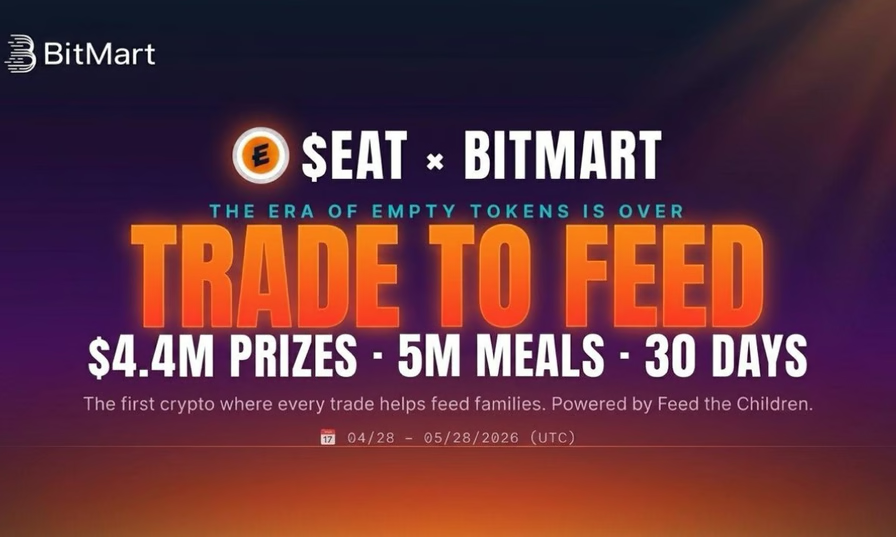
The 30-day Trade-to-Feed competition marks BitMart’s 8th anniversary and the exchange’s strategic listing of EAT, the first cause coin.
New York, United States, April 28, 2026, Chainwire – BitMart, the global digital asset exchange serving millions of users worldwide, today launched the Trade-to-Feed competition, a 30-day trading competition paying out up to $4.4 million USDT in trader rewards. The campaign marks BitMart’s eighth anniversary and the exchange’s listing of EAT (WYDE: End Hunger), the first cause coin to list on a major centralized exchange.
Cause coins are an emerging asset class engineered so that fees from trading activity flow to charitable grant-making infrastructure alongside trader rewards. By making EAT the inaugural cause coin listing and pairing it with the largest competition in BitMart’s history, the exchange is positioning itself ahead of a category where market activity produces measurable real-world outcomes.
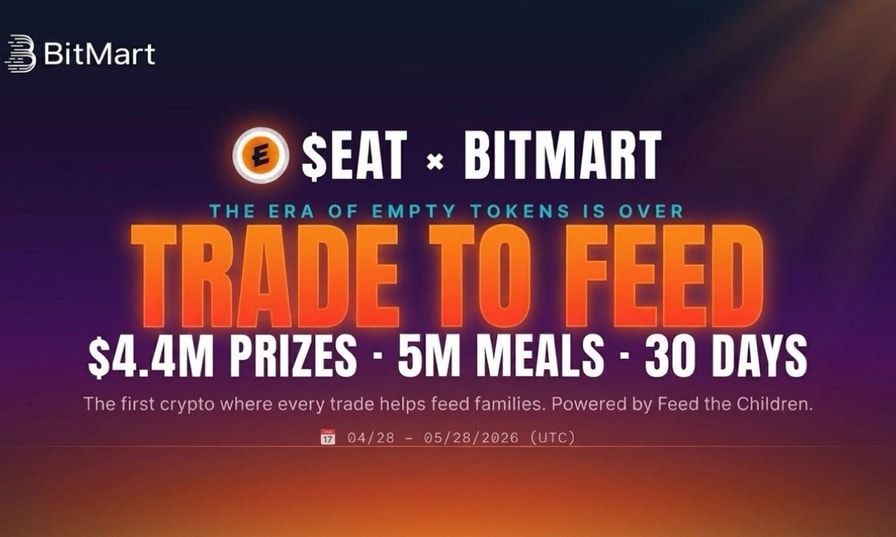
Running April 28 through May 28, 2026, the Trade-to-Feed competition distributes up to $4.4 million USDT across three concurrent tracks:
Three concurrent competitions, 76,391 chances to win.
The campaign runs three reward tracks simultaneously, all funded from a single pool that grows with volume:
- Volume Leaderboard: Up to 73 traders share the leaderboard pool by rank, with the first-place trader winning up to $2.2 million USDT (50% of the total prize pool).
- Power Drop: 75,500 tickets distribute across the campaign, each worth a flat $10 USDT. Any trader completing $40 or more in EAT spot volume qualifies; tickets allocate proportionally to volume.
- Lucky Drops: Up to 15 random USDT jackpots from $5,000 to $100,000, drawn weekly and at close, with a cumulative pool of $435K at the $200M cap. Any trader completing $2,000 or more in EAT spot volume qualifies.
In addition, a Welcome Lucky Draw with a $5,000 USDT pool opens to any new participant who registers and completes a $5 USDT spot trade in EAT, with 803 winners selected across three tiers.
Learn more: Trade to Feed (Up to 4.4M in rewards).
Where the meals go
Charitable distributions from the campaign flow through WYDE Association’s two-pool allocation model. Fifty percent of cause fees fund WYDE’s exclusive national hunger-relief grant partner, Feed the Children, a global movement working to end childhood hunger since 1979 that distributes food, essentials, and disaster relief across the United States and ten countries. The remaining fifty percent is allocated by EAT token holders through community voting on the Hunger Network, a public directory of verified hunger-relief organizations available at www.eat.ong. Token holders direct funding to local food banks and partner organizations in their own communities each voting round, giving EAT its core utility — holder governance over real charitable allocation, recorded on-chain and publicly verifiable.
“BitMart’s eighth year is the right moment to put real weight behind a direction we believe in,” said Chad Liang, EVP of BitMart. “Cause coins connect market activity to outcomes the world can see and measure. Listing EAT and committing the largest competition in our history to it is how we mark this anniversary: by helping define what comes next, not just trading what already exists.”
“BitMart didn’t just list EAT. They named a category,” said Aaron Rafferty, Co-Founder of WYDE.” A global exchange recognizing cause coins as a strategic priority is a structural moment. Every dollar of organic volume in the Trade-to-Feed competition also funds meals. That is the proof point.”
About BitMart
Founded in 2018, BitMart is a global digital asset trading platform serving millions of users worldwide. Ranked among the top exchanges on CoinGecko, BitMart offers 1,700+ trading pairs with one of the lowest fee structures in the industry. Learn more at bitmart.com.
About WYDE
WYDE is a Wyoming 501(c)(4) nonprofit operating the first Impact Exchange, infrastructure where transaction-based fees fund verified hunger-relief organizations through charitable grants. All distributions are recorded on-chain and publicly verifiable. Learn more at wyde.org.
About EAT
EAT (WYDE: End Hunger) is the first cause coin listed on the WYDE Impact Exchange, launched on Base on December 10, 2025. To date, EAT has crossed 25,000 meals funded. Learn more at eat.ong.
Risk disclosure
Use of BitMart services carries substantial risk. Digital assets are not suitable for all participants. Sweepstakes mechanics do not guarantee winning. Charitable grants from WYDE Association to verified hunger-relief organizations are made by WYDE Association from fees received through the Impact Exchange.
Media contact:

OKX, BlackRock and Standard Chartered announce a joint framework to integrate BlackRock’s BUIDL tokenized short-term Treasuries into collateral workflows, enabling off-exchange custody while trading on the same integrated venue. The arrangement marks a notable step in embedding tokenized real-world assets into traditional market infrastructure, pairing Standard Chartered’s custody capabilities with OKX’s institutional execution. By allowing BUIDL to serve as yield-bearing collateral without moving assets between venues, the framework aims to improve capital efficiency and broaden participation for qualified investors. The release outlines the collaboration, the custody model, and the path toward broader tokenization across markets.
Key points
- BUIDL can be posted as collateral off-exchange and held in regulated custody at Standard Chartered.
- BUIDL can be deposited and traded on-exchange, used as yield-bearing collateral for margin trading.
- The framework unites BlackRock’s BUIDL token, Standard Chartered custody, and OKX’s institutional execution and margining infrastructure into a single ecosystem.
- This marks the first time a globally systemically important bank (G-SIB) has acted as custodian in such an arrangement.
Why it matters
By combining BUIDL’s tokenization with regulated custody and integrated trading, the framework expands the utility of Real-World Assets and enables yield-bearing collateral within a single ecosystem. It links a major asset manager, a global bank, and a digital-asset exchange to demonstrate tokenization can operate within institutional workflows while preserving custody protections. This setup potentially broadens access to tokenized instruments and advances the integration of TradFi and digital markets.
What to watch
- Uptake by OKX VIP and institutional clients posting BUIDL as off-exchange collateral with Standard Chartered custody.
- Operational performance of on-exchange trading and off-exchange custody within the integrated venue (OKX Middle East).
- Plans to expand tokenization to additional assets, regions, or workflows.
Disclosure: The content below is a press release provided by the company or its PR representative. It is published for informational purposes.
OKX, BlackRock and Standard Chartered Launch Joint Framework to Establish New Utility for Tokenized Real-World Assets
- OKX to accept BlackRock’s tokenized short-term US treasury fund, BUIDL, as yield-bearing collateral for trading
- Standard Chartered to provide a comprehensive and reliable custody offering, the first-ever G-SIB-backed off-exchange tokenized collateral framework
- Initiative scales utility of tokenized real-world assets (RWA) and enables broader market participation
DUBAI, April 28, 2026 — OKX, a leading global fintech company and crypto trading platform, today announced the launch of a joint framework with BlackRock and Standard Chartered to integrate BlackRock’s BUIDL tokenized short-term treasury fund into collateral workflows, marking the first time a globally systemically important bank (G-SIB) has acted as custodian in such an arrangement. The framework enables OKX clients to hold collateral in regulated, off exchange custody while trading on the same integrated venue.
Through this joint framework OKX VIP and institutional clients can post BUIDL as collateral held off-exchange in regulated custody at Standard Chartered, while trading seamlessly on OKX Middle East, eliminating the need to move assets between venues. In addition, BUIDL can be deposited and traded on-exchange, and used as yield-bearing collateral for margin trading.
This framework unites BlackRock’s BUIDL – tokenized by Securitize (which has announced a proposed business combination with Cantor Equity Partners II, Inc. (Nasdaq: CEPT))- Standard Chartered’s regulated custody as a G-SIB, and OKX’s institutional execution and margining infrastructure. This framework delivers a uniquely integrated model where collateral custody and trading occur within a single, coordinated ecosystem, representing a key advancement toward embedding tokenization into global market infrastructure.
The framework also delivers:
- Capital at work: The ability to use BUIDL as collateral transforms idle margin into a yield-generating asset.
- Universal collateral: OKX is expanding the utility of Real-World Assets by establishing BUIDL as a platform-wide collateral.
- Superior protection: With BUIDL safeguarded by Standard Chartered, OKX clients obtain trading collateral segregated from OKX’s assets, while retaining the ability to trade on OKX without transferring custody, providing clients with exchange default protection.
This framework, which involves the participation of the world’s largest asset manager, a Tier 1 Global Bank, and a premier digital asset exchange, establishes a new utility framework for the cryptocurrency ecosystem. It integrates traditional financial (TradFi) security with the agility of digital markets, embedding RWA tokenization into the core of global market infrastructure.
“BUIDL was designed to bring the benefits of tokenization to short term treasury exposure, allowing qualified investors to earn US dollar yields on blockchain rails,” said Samara Cohen, Global Head of Market Development at BlackRock. “The framework with OKX and Standard Chartered allows qualified investors to unlock new opportunities in how they deploy collateral.”
“This collaboration highlights the potential of tokenizing real-world assets (RWA) at scale. By enabling institutions to deploy BUIDL as on-chain collateral on OKX’s global platform, we improve capital efficiency while demonstrating how traditional financial instruments can operate seamlessly in digital markets,” said Haider Rafique, Global Managing Partner at OKX. “Tokenization is about making existing markets faster, more transparent, and more accessible.”
“Our role as custodian in this initiative reflects our commitment to delivering trusted and innovative solutions for clients as the financial ecosystem evolves,” said Margaret Harwood-Jones, Global Head of Financing and Securities Services at Standard Chartered. “By providing secure custody of BUIDL for this collateral use case, we are helping to ensure clients can access digital asset opportunities with the high standards of protection and compliance. This framework demonstrates how traditional financial institutions and digital market infrastructure can work together to bring tokenized assets safely and efficiently to global investors.”
The launch follows extensive institutional testing and integration. BlackRock’s BUIDL is issued on a public blockchain and invests in cash, U.S. Treasury bills, and repurchase agreements, with yield distributed on-chain. Its integration into OKX’s collateral framework demonstrates that tokenized RWAs can operate at scale within existing institutional workflows for trading, margining, and liquidity management.
For further information, please contact:
About OKX
OKX is a fintech company on a mission to modernize money and markets. Today it is trusted by more than 100 million people around the world who use OKX services to invest, transact and trade digital assets across a number of financial instruments including spot, futures, and decentralised markets. As one of the world’s largest platforms, OKX is known for its exchange, wallet, and onchain ecosystem used by everyday people and large institutions.
OKX maintains regional offices in the United States, Europe, UAE and Singapore with a number of local offices across São Paulo, Hong Kong, the Republic of Türkiye, and Australia. Over the past several years, it has built one of the world’s most comprehensive regulatory compliant, licensed fintech companies.
OKX is steadfastly committed to transparency and security and publishes Proof of Reserves reports on a monthly basis to ensure customer funds are always protected and available to people. To learn more about OKX, download the app or visit: okx.com.
About OKX Institutional
OKX Institutional delivers secure digital asset market infrastructure for institutional market participants. We offer highly liquid spot and derivative markets through global offshore and regional onshore regulated exchange orderbooks and OTC RFQ, plus critical institutional services across the trade lifecycle.
From banks integrating crypto products to asset managers exploring allocation and trading firms scaling derivative strategies—we provide the compliant, flexible foundation institutions need to compete in digital asset markets.
BlackRock
BlackRock’s purpose is to help more and more people experience financial well-being. As a fiduciary to investors and a provider of financial technology, we help millions of people build savings that serve them throughout their lives by making investing easier and more affordable. For additional information on BlackRock, please visit www.blackrock.com/corporate.
Standard Chartered
We are a leading international banking group, with a presence in 54 of the world’s most dynamic markets. Our purpose is to drive commerce and prosperity through our unique diversity, and our heritage and values are expressed in our brand promise, here for good.
Standard Chartered PLC is listed on the London and Hong Kong stock exchanges.
For more stories and expert opinions please visit Insights at sc.com. Follow Standard Chartered on X, LinkedIn, Instagram and Facebook.
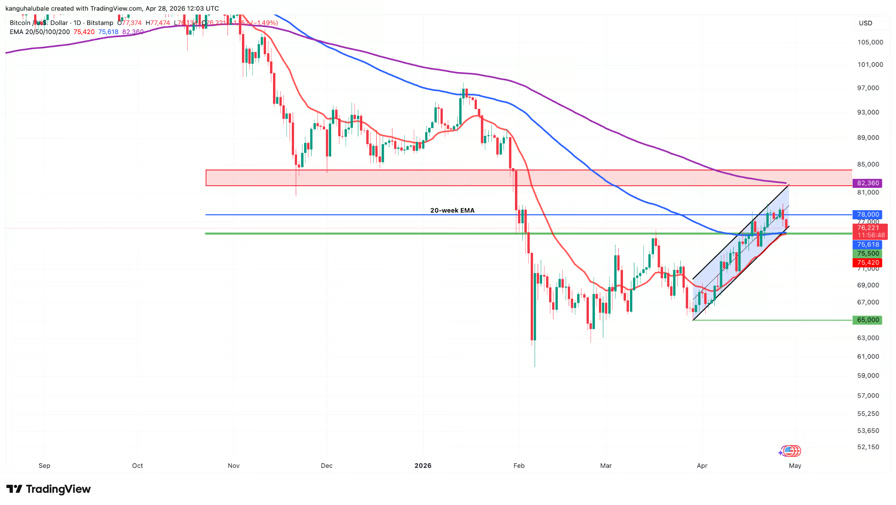
Bitcoin (BTC) fell below $76,000 on Tuesday after failing to break $80,000 as uncertainties surrounding the reopening of the Strait of Hormuz and macroeconomic conditions unnerved the market. Meanwhile, technicals and onchain data sent mixed signals on BTC’s ability to sustain the recovery.
Key takeaways
- Bitcoin is trapped in a tight range with strong technical support at $75,500 and heavy resistance near $80,000.
- Bitcoin’s onchain metrics are mixed, with buy pressure rising but spot volume and active addresses declining.
Bitcoin price is sandwiched between two key levels
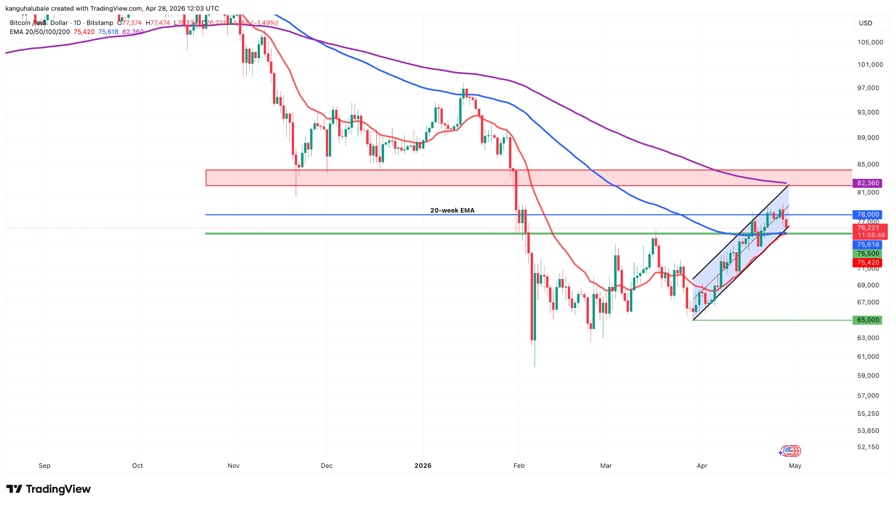
Bitcoin’s 30% recovery from sub-$60,000 lows reached on Feb. 6 was stopped by selling around the $78,000-$80,000 supply zone.
Related: Three Bitcoin charts say BTC price may rally toward $82K
Note that this is where the 20-week exponential moving average (EMA) sits currently, reinforcing the importance of this resistance level.
MN Capital founder Michael van de Poppe said the ongoing retracement was “typical behavior” ahead of the FOMC meeting.
“Bitcoin touched the resistance zone at $79,000 and is consolidating,” van de Poppe said, adding:
“I think we’re still in for a strong period on the markets.”
BTC/USD daily chart. Source: Cointelegraph/TradingView
On the downside, Bitcoin retested support at $75,500, which is also the 20-day EMA, the 100-day EMA and the lower trend line of an ascending channel, as shown in the chart above.
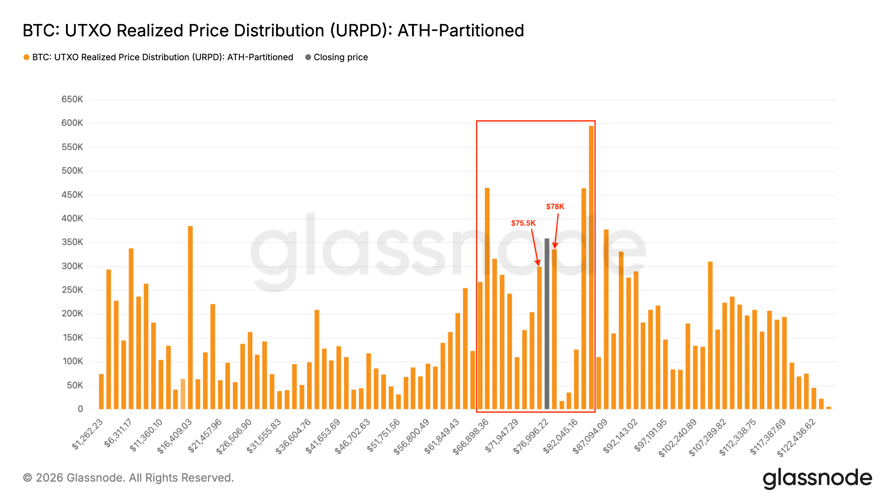
Glassnode’s UTXO realized price distribution (URPD), which shows the average prices at which ETH holders bought their coins, reveals that immediate resistance is around $78,000 where investors acquired 335,650 BTC. Investors acquired roughly 298,560 BTC at an average price of $75,500, marking it as a key support level.
Bitcoin URPD all-time high partitioned. Source: Glassnode
The chart above also shows a larger supply overhang around $82,000-$84,000, which could stall price rallies, while a significant support zone sits between $65,500 and $67,000.
Notably, this is the price range defined by the ascending parallel channel in the TradingView chart above.
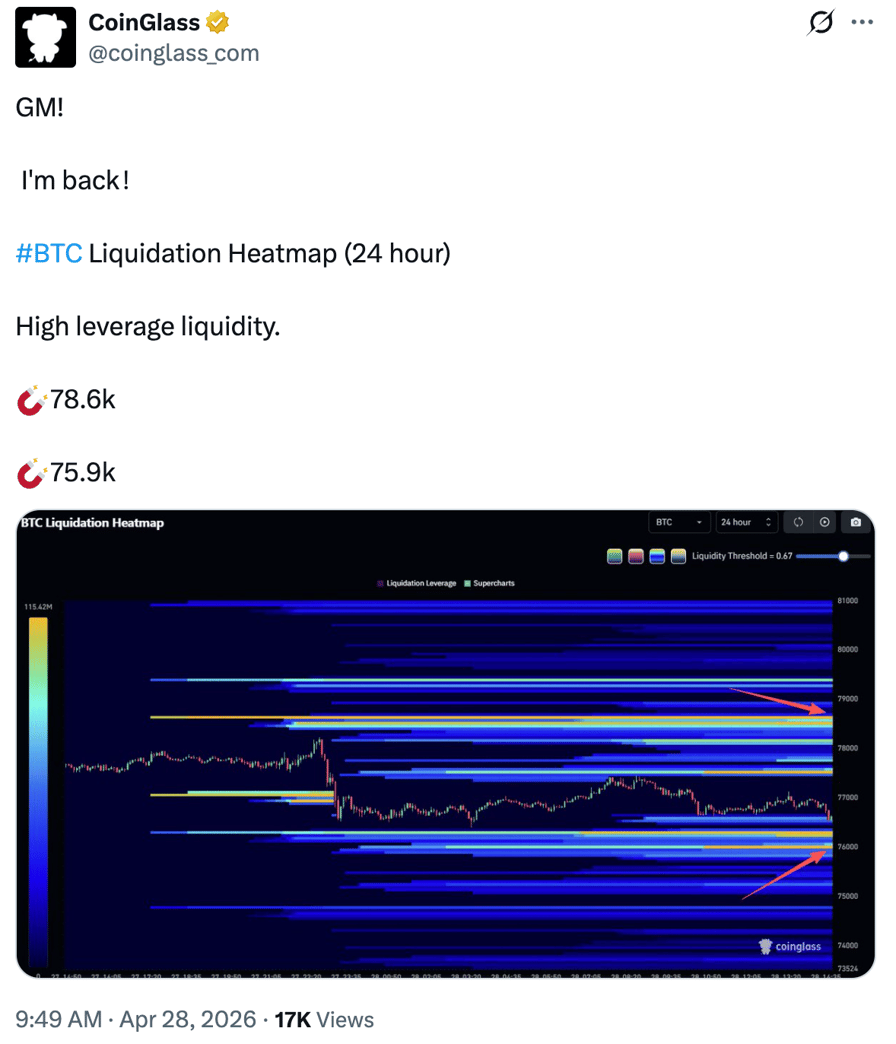
Meanwhile, Bitcoin’s liquidation heatmap shows BTC in a classic liquidation sandwich with heavy ask orders around $78,600 and dense bid positions below the spot price, as shown in the figure below. This highlights the relative tightness of the current market structure.
Bitcoin liquidation heatmap. Source: CoinGlass
As Cointelegraph reported, buyers are expected to fiercely defend the $75,500-$76,000 support level, while bears are mounting a defense at the $80,000 psychological level.
Bitcoin’s onchain “fundamentals remain weak”
Bitcoin market data is showing a “mix of bullish momentum and cautious sentiment,” contributing to the uncertainty in the market, data from Glassnode shows.
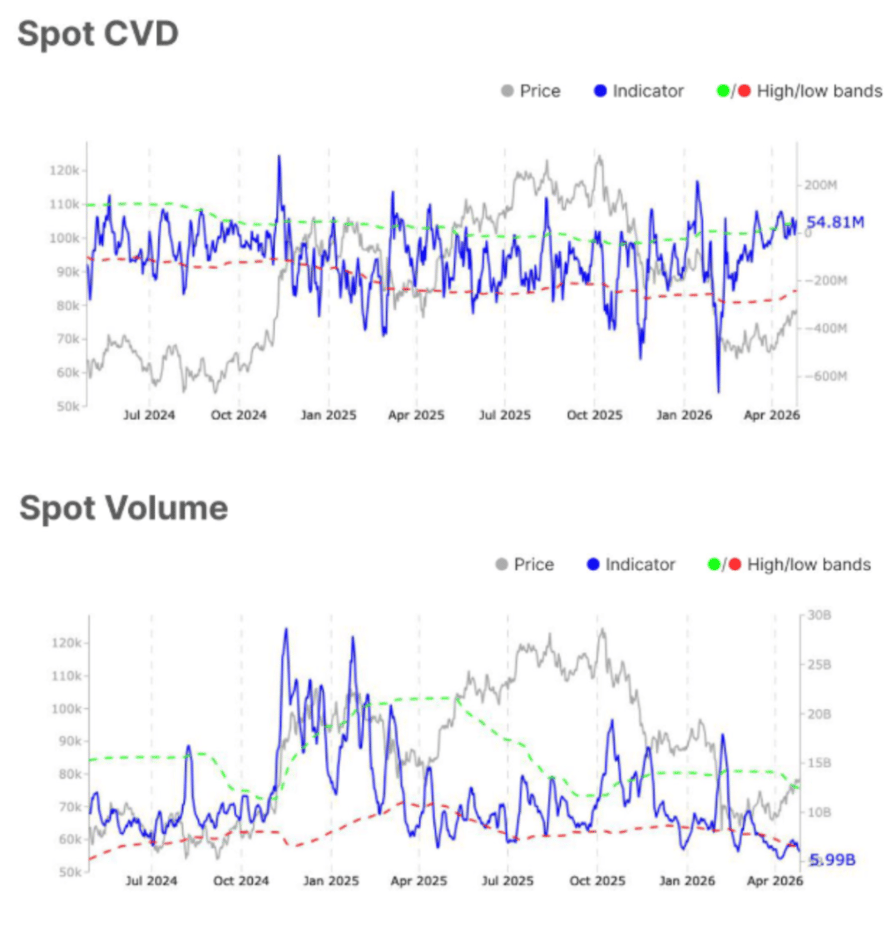
Spot CVD (cumulative volume delta, a metric measuring the difference between buying and selling volume over time) has increased to $54.8 million million from $18.3 million, marking a near 200% increase over the last week.
“This reflects strong bullish sentiment among market participants, suggesting heightened confidence in Bitcoin’s short-term direction,” the onchain data provider said in its latest Market Pulse report.
Spot volume has decreased by 13.8% to $5.99 billion from $6.95 billion a week ago, “suggesting reduced market activity,” Glassnode added.
Bitcoin spot CVD and spot volume charts. Source: Glassnode
Meanwhile, the number of daily active addresses dropped by 1.6% over the same period, “reflecting a more subdued state of network participation and reduced speculative interest,” Glassnode said, adding:
“While buying pressure remains firm, reduced speculative activity suggests a more measured approach, with investors balancing risk and capital rotation.”
Swissblock’s Bitcoin Fundamental index, which measures network health, growth, demand, activity, and capital flows, echoes this outlook.
The index rose toward neutral with BTC’s recovery from macro lows below $60,000, and picked up again as the price reclaimed the $70,000 level.
“Bitcoin’s price structure points higher, but fundamentals remain weak,” the private wealth manager said in an X post on Monday, adding:
“Price can still rise here. But for a medium-term trend shift, Bitcoin needs neutral-to-strong fundamentals to confirm.”
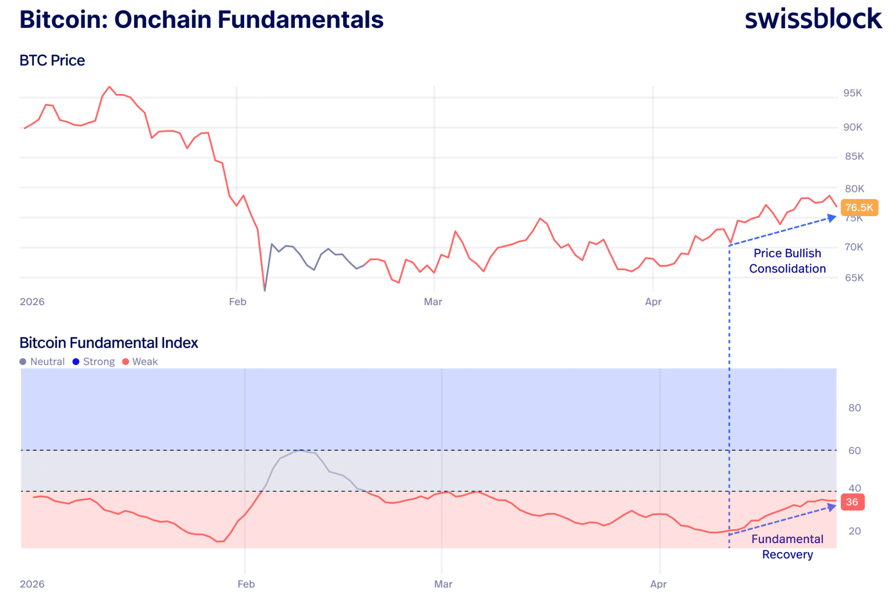
Bitcoin fundamental index. Source: Swissblock
Institutional demand for Bitcoin is also in neutral territory. While Strategy, the largest corporate Bitcoin holder, continues to buy BTC, flows into US-based spot Bitcoin ETFs turned negative, recording $273 million in net outflows on Monday.

The press release reports that the United Arab Emirates will exit OPEC and OPEC+ on May 1, 2026, ending nearly six decades of membership. It frames the move as a strategic shift toward greater production flexibility as the UAE expands capacity toward 5 million barrels per day and argues that existing quotas may constrain a growing economy. Analysts cited in the release describe potential changes in global oil dynamics, including supply expectations and market volatility, while noting regional security tensions and price pressures as contextual backdrops. The note sets the stage for how this departure could reshape producer coordination and market sentiment.
Key points
- Exit takes effect May 1, 2026, ending UAE’s six-decade OPEC membership.
- UAE capacity expansion toward 5 million barrels per day.
- Departure could alter OPEC+ unity and producer discipline.
- Context includes regional security tensions and energy price dynamics impacting markets.
Why it matters
The UAE’s exit reshapes influence within oil markets by reducing OPEC+ unity and granting Abu Dhabi more latitude to monetize its expanding capacity. The move could widen supply options and inject greater uncertainty into pricing, affecting traders, policymakers, and energy markets as market participants reassess spare capacity, regional risk, and the pace of production growth.
What to watch
- Monitor Brent price and market volatility around the May 1 transition.
- Watch any guidance from UAE authorities on production policies post-exit.
- Observe reactions and shifts in alignment among other OPEC+ members.
Disclosure: The content below is a press release provided by the company or its PR representative. It is published for informational purposes.
UAE Exit from OPEC Signals Shift in Global Oil Dynamics
Abu Dhabi, United Arab Emirates – April 28, 2026: The United Arab Emirates’ decision to exit OPEC and OPEC+ marks a significant turning point in global oil markets, according to eToro Market Analyst Sam North, highlighting shifting geopolitical dynamics and evolving supply expectations.
The UAE announced it will leave the producer alliance effective May 1, 2026, ending nearly six decades of membership. The move reflects a broader strategic shift as the country seeks greater flexibility over its production policy amid rising capacity and changing market conditions.
Commenting on the development, Sam North, Market Analyst at eToro, said: “The UAE’s decision to leave OPEC and OPEC+ from May 1 ends nearly six decades inside the oil producers’ club and marks a serious shift in the geopolitics of crude.
For markets, this is about more than one country wanting to pump more oil. The UAE has spent heavily to lift production capacity toward 5 million barrels per day, and OPEC+ quotas had increasingly looked like it was stifling a growing economy. Leaving gives Abu Dhabi more room to monetise those investments.
The timing also matters. This comes against a backdrop of regional security frustration, tensions around Iran and the Strait of Hormuz, and a sense that consumers are once again being squeezed by high energy costs and depleted strategic reserves.
The immediate dip in Brent showed the market’s first instinct: more UAE barrels could mean more supply and lower prices. But the rebound also told the other half of the story. Extra capacity does not instantly become risk-free supply when regional bottlenecks and security threats remain front and centre.
For OPEC+, this is a blow to unity and to Saudi Arabia’s ability to marshal producer discipline. It does not mean a price war starts tomorrow, but it raises the risk that one emerges if others decide to defend market share. In trading terms, this adds a new volatility premium: more potential supply, less cartel discipline, and a Gulf energy map that suddenly looks a lot less predictable.”
The announcement comes at a time of heightened uncertainty in global energy markets, with geopolitical tensions, supply chain constraints, and demand recovery trends all contributing to price volatility. The UAE’s exit is expected to reshape market expectations around supply flexibility and producer coordination.
Media Contact:
PR@etoro.com
About eToro
eToro is the trading and investing platform that empowers you to invest, share and learn. We were founded in 2007 with the vision of a world where everyone can trade and invest in a simple and transparent way. Today we have 40 million registered users from 75 countries. We believe there is power in shared knowledge and that we can become more successful by investing together. So we’ve created a collaborative investment community designed to provide you with the tools you need to grow your knowledge and wealth. On eToro, you can hold a range of traditional and innovative assets and choose how you invest: trade directly, invest in a portfolio, or copy other investors. You can visit our media centre here for our latest news.
The Arbitrum-based RWA perps protocol now routes net directional flow to Jump and prime brokers offchain, retiring the single-pool model that absorbed all trader risk.
Ostium Labs on Tuesday rolled out what it calls the first “decentralized execution layer,” an architectural overhaul that routes net directional flow from the protocol’s traders to a network of institutional hedging partners, including Jump, prime brokers, and other firms active in traditional markets.
Until now, Ostium’s public liquidity pool both settled trades and absorbed all net directional exposure, a structure the team said served early users but capped execution quality and open interest. Under the new model, a separate capital pool programmatically routes net exposures offchain to institutional partners and settles once daily. A buffer layer sits atop the public liquidity pool, which now operates as an intraday lending layer rather than a counterparty.
“Programmatically hedging onchain flow with traditional market participants required building a new kind of infrastructure, a translation layer between smart contracts and institutional-grade messaging protocols, with sub-100-millisecond latency across every step,” CTO Marco Antonio Ribeiro said in a press release viewed by The Defiant.
Co-founder and CEO Kaledora Kiernan-Linn has long said that orderbooks are the wrong venue for tokenized real-world assets, and that the right model is to quote directly from the underlying market.
By referencing real-time depth from offchain venues, Ostium said its allowable open interest now scales dynamically across most major assets, removing static caps and introducing rollover fees that reflect the underlying asset’s carry cost. Users retain custody of funds, and settlement remains instant onchain.
With the new infrastructure in place, Ostium plans to take on centralized CFD brokers, targeting a market that moves roughly $10 trillion in monthly volume.

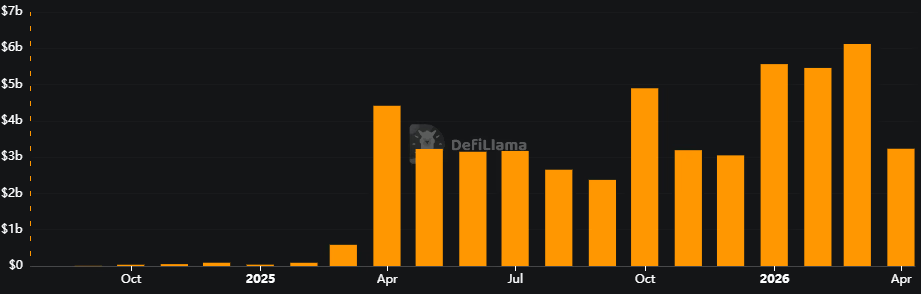
Monthly trading volumes on Ostium hit an all-time high of $6.11 billion in March, and the platform has processed more than $50 billion in cumulative volume since launching in 2024, according to DeFiLlama.
This article was written with the assistance of AI workflows. All our stories are curated, edited and fact-checked by a human.
Crypto World
The age of Agentic Commerce has arrived. Consensus 2026 is where you can experience it IRL


Something fundamental is changing in how commerce works. It’s happening right now, at the intersection of artificial intelligence and blockchain payments, and most people haven’t fully registered what it means yet.
AI agents – software systems that can perceive, decide, and act autonomously – are beginning to transact. They’re paying for APIs, settling invoices, and interacting with infrastructure in ways that traditional payment rails were never designed to handle. The credit card, the bank login, the merchant onboarding flow: all of it is friction that agents can’t navigate the way humans do.
Ask yourself: how many agents do you think you’ll have? Three, five -it’s a common answer. Ten. I have 200.
By the numbers -if you have 10 or 20 agents per human, you’re between 70 to 140 billion agents in the world. Universally, most people will agree: there’s going to be more AI agents than there are humans. – Yat Siu, Animoca
What comes next -the rails, regulatory frameworks, and business models – is precisely what Consensus 2026 is convening to figure out. When 15,000+ of the world’s most influential crypto, AI, and finance minds gather at the Miami Beach Convention Center from May 5 to 7, agentic commerce will be one of the defining conversations of the week.
“That’s assisted checkout, not true agentic payments”
Christian Catalini, MIT professor and founder of the Cryptoeconomics Lab, draws a line most people in the industry haven’t drawn yet.
“Most agents today operate just as LLMs paired with a credit card,” he says. “That’s assisted checkout, not true agentic payments.”
“Real agentic payments begin when the AI is the counterparty,” Catalini explains. “The actual test for programmable rails isn’t whether an agent can pay – it’s whether it can do things no human-facing rail allows: atomic settlement against delivery, per-second payment streaming, or transacting with a counterparty that has no KYC footprint.”
That’s not a near-future scenario. It’s a near-term engineering problem. And Consensus is where the engineers, investors, and policymakers working on it will be in the same room.
The internet was built for humans. Agents need something different
Google Cloud is not a company known for hedging its bets on technology cycles. Its presence at Consensus 2026 – and its active investment in blockchain payment rails – is as clear a signal as any that agentic commerce is being taken seriously at the highest levels of the technology industry.
“The convergence of agentic AI, blockchain payments, and commerce is still in its early stages, but momentum is building,” says Rich Widmann, Google Cloud’s Global Head of Strategy for Web3. “Google is actively participating in open protocols like x402 and deepening partnerships across the Web3 ecosystem to help bring these use cases to scale.”
Widmann is direct about where the friction lies: “The biggest friction points center on the fact that most products are still built for humans, not agents. Sign-ups, logins, and manual onboarding create barriers that slow agentic commerce down.”
The rails race: x402, MPP, and the fight for the agentic stack
If AI agents are going to transact at scale, they need payment infrastructure designed for them from the ground up. Two protocols are emerging as early contenders for that role, and both will have a presence at Consensus 2026.
x402, the open payment protocol built on HTTP and championed by Coinbase, is designed to allow agents to pay for API access and digital services with stablecoins in a single, frictionless flow. Erik Reppel, x402’s founder and Head of Engineering at Coinbase, will be at Consensus making the case for why open, interoperable rails are the right foundation for the agentic economy.
MPP (Machine Payments Protocol), developed by Tempo and backed by Stripe, offers another vision for how agents can negotiate and settle payments autonomously. The presence of both protocols at the same event – in front of 15,000 developers, investors, and enterprise decision-makers -makes Consensus the de facto arena where the early standard-setting debate gets played out.
Also in the room: Stefano Bury, head of Virtuals Protocol, one of the leading platforms for deploying autonomous AI agents, and Chi Zhang, co-founder of Kite, whose team is building at the intersection of agent infrastructure and decentralized payments.
CoinDesk University: From Theory to Implementation
For attendees who want to go beyond the mainstage debates and into the mechanics of how to actually build and deploy agentic payments, CoinDesk University offers a structured, three-day curriculum that takes participants from first principles to advanced implementation -no prior crypto experience required.
Day 1 lays the foundation. Afternoon workshops walk attendees through setting up a stablecoin wallet and business dashboard with Circle, then pivot to session on compliance, followed by back-to-back workshops on using OpenClaw and x402.
Day 2 goes deeper into the stack, with sessions on building a full agentic infrastructure, managing agentic economy risks, and the increasingly urgent question of how to prove human identity in an AI-saturated world. By Day 3, the curriculum reaches masterclass territory: workshops on deploying AI trading bots with stablecoins, trading on prediction markets with autonomous agents, and a capstone Agentic Masterclass that brings the full arc together.
The format is intentionally immersive. Each day pairs hands-on workshops with mainstage sessions, networking lunches, and “No Dumb Questions” Q&A sessions.
The window is open. It won’t be open forever
Agentic commerce is not a future state. It is an early-stage present, moving faster than most industries have had time to notice. The protocols being debated at Consensus 2026 could become the rails that trillions of dollars in machine-to-machine transactions run on. The regulatory frameworks being discussed could define what’s permissible for a decade.
The people in the room at the Miami Beach Convention Center from May 5 to 7 will be the ones who had a voice in how this unfolds. Everyone else will be working with what they decided.
Join 15,000+ builders, investors, and industry leaders at Consensus 2026, May 5–7, Miami Beach. Register now at consensus.coindesk.com
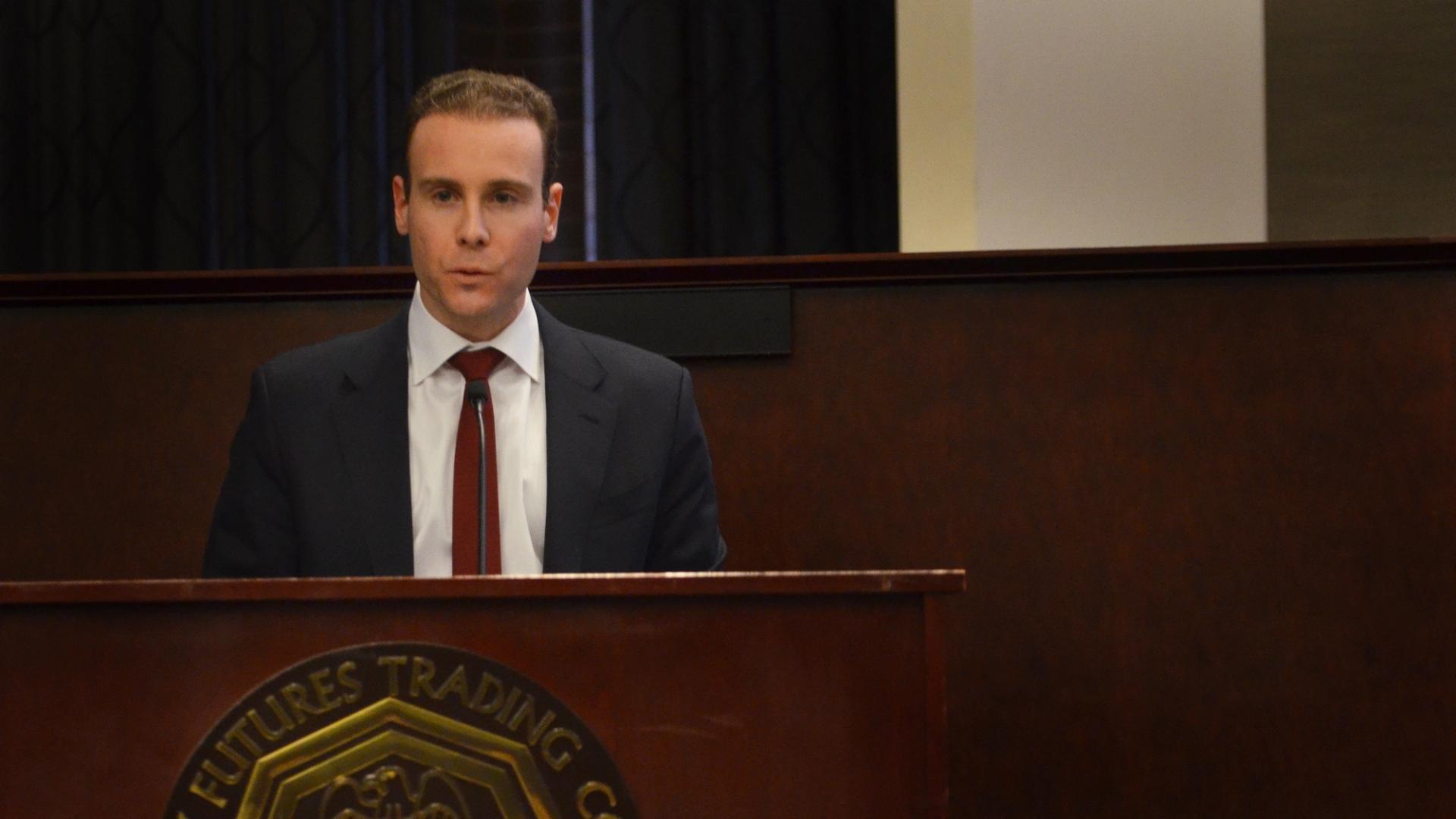
Wisconsin has joined the growing number of U.S. states being sued by the Commodity Futures Trading Commission as that agency insists on its jurisdiction over prediction markets trading at firms such as Kalshi and Crypto.com.
Several states have gone after those businesses, accusing them of violating state gaming laws via the betting taking place on the growing platforms, but CFTC Chairman Mike Selig has led a legal pushback against states including New York, Arizona, Illinois and Connecticut. He’s argued that the derivatives regulator, which he leads as the sole member of what’s meant to be a five-member commission, has “exclusive jurisdiction” over the trading of event contracts that he argues are an emerging form of the same kinds of derivatives activity long handled by the CFTC.
Last week, Wisconsin sued Kalshi, Coinbase, Polymarket, Robinhood and Crypto.com for running unlicensed gambling operations in the state — echoing the claims made against the industry elsewhere.
Selig has now responded in the U.S. District Court for the Eastern District of Wisconsin, said he’s trying to send a message: “If you interfere with the operation of federal law in regulating financial markets, we will sue you.”
Also last week, New York sued Coinbase and Gemini over their prediction markets businesses, and days later, the CFTC responded with its own lawsuit against the state.
Arizona has been pursuing a criminal case against Kalshi, but a court there paused the prosecution earlier this month, with the judge arguing that the federal agency is likely to be successful making its case that the U.S. law will preempt state gambling laws.
Read More: U.S. CFTC adds New York to string of states its suing to stop prediction market pushback
The open-source standard, developed by The Open Platform, lets AI agents manage dedicated on-chain wallets without requiring user sign-off on every transaction
TON Tech, the infrastructure arm of The Open Platform (TOP), has introduced Agentic Wallets on TON — an open-source, non-custodial standard that gives AI agents the ability to hold and spend funds on the TON blockchain autonomously.
Per a press release shared with The Defiant, under the new system, users fund a dedicated wallet for each agent, set a spending budget, and retain the ability to revoke access at any time. The agent operates within those parameters independently, with no intermediary involved.
Telegram designated TON as the sole blockchain infrastructure for its mini-app platform earlier last year, giving TON exclusive access to a user base now exceeding one billion.
As a major developer of apps and tools for Telegram, TOP is positioned as a key infrastructure player in that ecosystem. The company reached a $1 billion valuation after raising $28.5 million led by Ribbit Capital and is the developer of Telegram’s Crypto Wallet — the official custodial wallet app embedded in the messaging platform. As The Defiant reported previously, Crypto Wallet recently expanded to offer perpetual futures trading across more than 50 assets, via an integration with Lighter.
For developers, Agentic Wallets are designed to support trading bots with predefined budgets, DeFi agents automating staking or portfolio management, and subscription payment automation, per the release.
“Agentic Wallets turn AI agents from assistants to actors,” said Andrew Grekov, Head of TON Tech, continuing:
“Agents on Telegram can not only communicate, but transact — making payments and interacting with on-chain services on behalf of users, without ever touching their keys.”
The launch arrives as the broader industry races to build financial rails for autonomous agents. Biconomy and the Ethereum Foundation recently unveiled ERC-8211, an execution standard for on-chain AI agents designed to let them carry out complex, multi-step DeFi strategies without pre-encoding every parameter at signing time.
This article was written with the assistance of AI workflows. All our stories are curated, edited and fact-checked by a human.


A former Argentine senator with amyotrophic lateral sclerosis (ALS) says Binance’s facial ID system stopped recognizing him after the disease changed his appearance.
Esteban Bullrich, who served as Argentina’s Minister of Education from 2015 to 2017 under former president Mauricio Macri, claimed the exchange froze his crypto holdings for five months while bitcoin (BTC) declined from the $90,000s to the $70,000s.
Eventually, Binance co-CEO Richard Teng personally intervened after his complaint went viral on social media. .
The 56-year-old, who revealed his diagnosis in April 2021, wrote that Binance’s Face ID had stopped recognizing him five months ago.
He said the company offered no accessible alternative for users with his type of disability.
Fortunately, his post, tagged to founder Changpeng Zhao and Teng, gained their attention.
Read more: US Senator asks if Binance lied to Congress about Iran
300 million users before a Binance ID fix for ALS
Binance crossed 300 million registered users in December 2025 three years after it rolled out biometric authentication on its mobile app in 2022, according to Clarín, the Argentine outlet that broke the story.
Bullrich’s lockout, however, exposed a basic engineering oversight. ALS is a progressive neurodegenerative disease that paralyzes muscles, including those in the face.
Anyone designing a biometric identity stack should have anticipated that faces sometimes morph due to muscular changes.
This oversight cost Bullrich dearly. BTC was trading above $90,000 in December 2025 when his lockout began, and has since slid into the $70,000s. Other digital assets have performed even worse.
Binance Argentina replied on the same day Bullrich’s post went viral, saying its team was reaching out directly.
It said it was escalating the matter as an accessibility failure that needed correcting and thanked him for speaking up.
That admission somewhat undercuts the apology. A viral social post forces a public statement that the ordinary support queue couldn’t fix in 150 days.
Got a tip? Send us an email securely via Protos Leaks. For more informed news, follow us on X, Bluesky, and Google News, or subscribe to our YouTube channel.
Canaan (CAN) has secured an additional order from Tether for custom Bitcoin mining hardware, extending their collaboration beyond an earlier research and development effort that tested new system designs for large-scale mining.
Under the new order, Canaan will supply high-density hash board modules designed for immersion-cooled systems, with usage planned at a Tether-linked facility in South America, the crypto mining tech maker announced on Tuesday.
Canaan is supplying these systems to deepen its role as a custom hardware provider for large-scale operators such as Tether. The agreement follows a 2025 R&D partnership with ACME Swisstech, which resulted in a proof-of-concept platform to improve efficiency and scalability in mining operations.
Tether, the issuer of the biggest stablecoin (USDT), is also developing its own control boards and management software, signaling a move toward tighter integration between hardware and software within its mining operations.
The agreement includes an option for additional purchases, giving Tether flexibility to scale its infrastructure if the new system design performs as expected. This is seen as a potential step toward more customized, data center–style Bitcoin (BTC) mining.
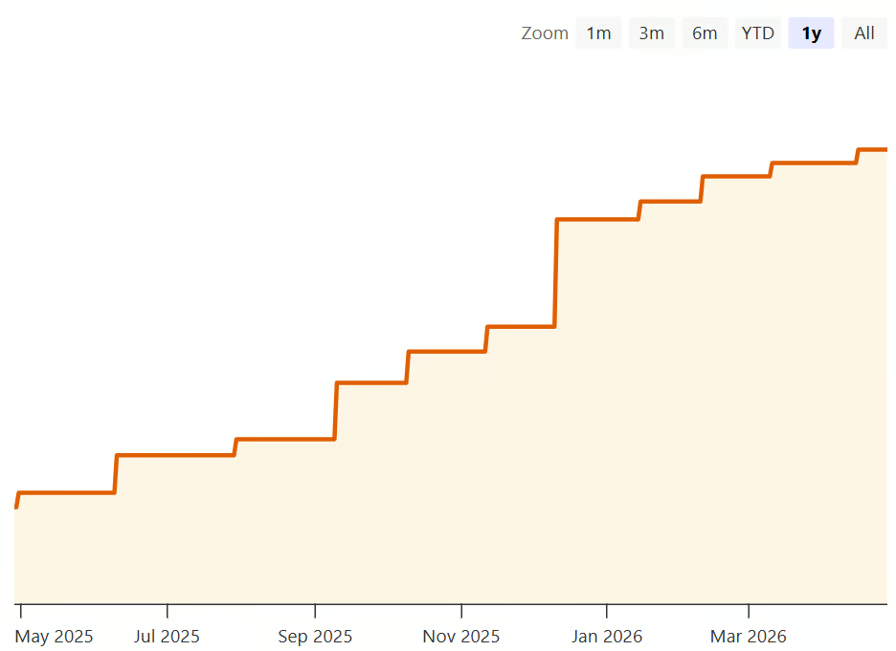
Canaan Inc. is a Singapore-based technology company focused on ASIC microprocessors and Bitcoin mining hardware. It holds 1,808 BTC on its balance sheet, valued at roughly $137 million, its highest level of retained Bitcoin to date.
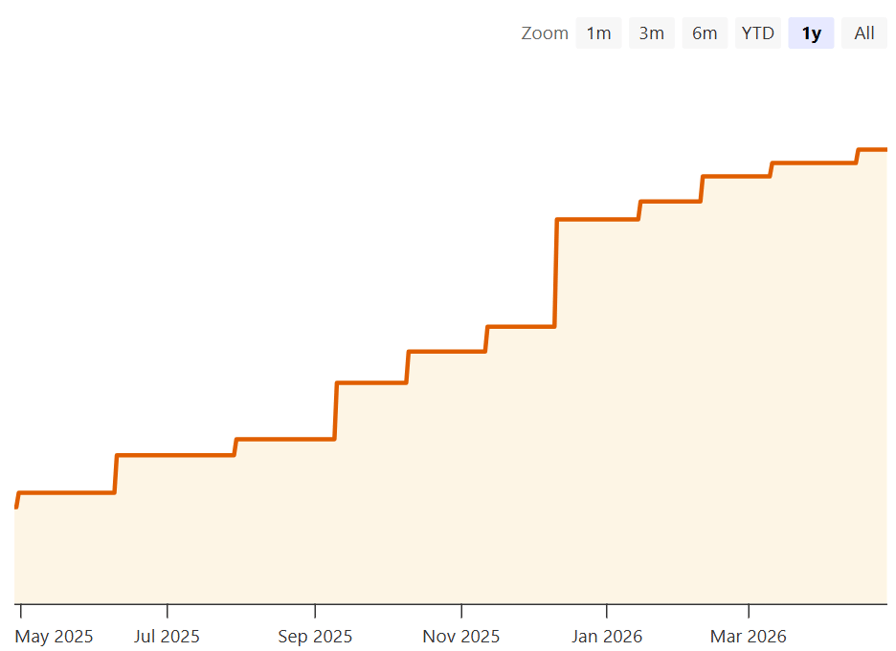
Canaan’s Bitcoin holdings over time. Source: BitcoinTreasuries.NET
Related: Crypto miner Canaan sinks 7% despite strongest quarter in 3 years
Tether expands mining push as industry pivots toward AI infrastructure
The announcement came a day after Tether said it was expanding into Bitcoin mining infrastructure by releasing an open-source framework that lets operators manage their mining hardware and software through a single system.
BTC miners are in the midst of a broad industry shift that’s seen several established miners, including HIVE Digital, TeraWulf and MARA Holdings, diversifying into data centers and artificial intelligence workloads to offset pressure on mining revenues.
Analysts at Bernstein recently said IREN could eventually phase out much of its mining business to focus on AI cloud infrastructure, citing a challenging operating environment for Bitcoin miners.
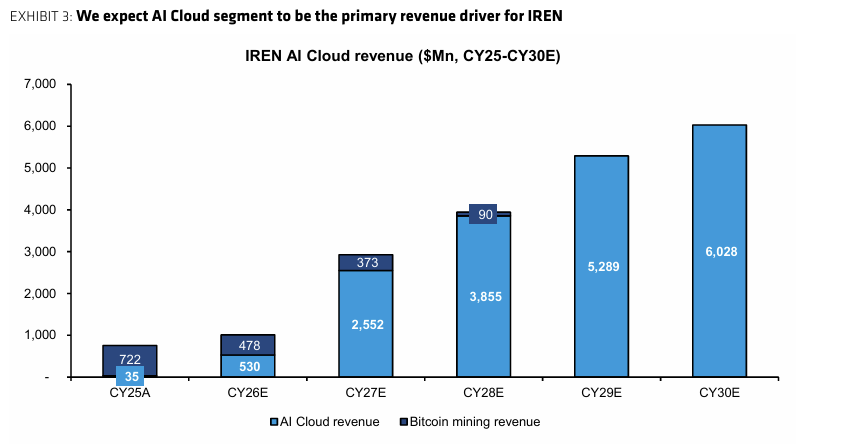
AI cloud services are expected to become IREN’s primary source of revenue in the coming years. Source: Bernstein
Canaan’s Nasdaq-traded shares were down about 1% mid-day on Tuesday in light trading. CoinShares Bitcoin Mining ETF (WGMI) was down about 5.7%. That industry-tracking exchange-traded fund’s holdings include CAN shares, at less than 0.6% weight.
Related: Bitcoin mining difficulty falls, but is projected to rise in next adjustment

A $77 million dispute on Polymarket is testing one of the central promises of prediction markets: that public facts can be translated into clear financial outcomes.
The market in question asks whether the “US x Iran ceasefire” was extended by April 22, 2026. On paper, the question appears straightforward. A two-week ceasefire was announced on April 7. Before it expired, US President Donald Trump stated that the ceasefire would be extended indefinitely. Pakistan’s Prime Minister Shehbaz Sharif, whose country had acted as mediator, publicly welcomed the extension. The UN Secretary-General issued a Note to Correspondents referring to the extension as a step toward de-escalation. Major international media outlets also reported the development.
Yet on Polymarket, Yes shares have traded at roughly 0.1–0.3 cents, implying a probability of less than 1% that the market will resolve positively. For investors holding Yes positions, this is not simply a pricing anomaly. It is a dispute over whether Polymarket’s own rules are being applied consistently.
According to the investors’ argument, the market should resolve Yes if there was an official ceasefire extension confirmed by both sides, or alternatively if there was an overwhelming consensus of credible media reporting. They point to four pieces of evidence: Trump’s public statement, Pakistan’s confirmation as mediator, the UN note, and broad media coverage from outlets such as Reuters, AP, BBC, Al Jazeera, Axios, CNBC and The Wall Street Journal.
The financial stakes are unusually high.
The market’s trading volume is reported at about $77.2 million. In a Yes resolution, shares pay out $1 each. That means one of the largest holders could receive more than $20 million, according to the investor-side media package.
But the case is not airtight. The central weakness is the absence of a direct public communiqué from the Iranian government explicitly confirming the extension in its own voice. Critics may argue that a statement by Pakistan, even as mediator, is not legally identical to a statement by Iran. They may also argue that Trump’s statement reflected a US decision rather than a fully confirmed bilateral agreement.
This is where the case moves beyond geopolitics and into the infrastructure of prediction markets. Polymarket uses UMA’s oracle system to resolve disputed outcomes. If the result is challenged, UMA token holders may ultimately vote on the correct interpretation. In theory, this mechanism is designed to determine factual outcomes. In practice, this case shows how difficult that becomes when facts depend on diplomacy, legal interpretation and source hierarchy.
The broader issue is not whether one group of traders wins or loses.
It is whether a prediction market can handle ambiguous political events without appearing to disregard public evidence. If the market resolves No despite official US statements, mediator confirmation, a UN note and broad media reporting, critics will say the platform ignored the substance of its own rules. If it resolves Yes without direct Iranian confirmation, others will argue the oracle accepted inference over formal proof.
Either way, the dispute is likely to become a precedent. For Polymarket and UMA, the question is no longer only whether the ceasefire was extended. It is whether decentralized markets can produce resolutions that users view as fair, consistent and grounded in the same public facts they were invited to trade on.


It’s Already Started And Bitcoin & Crypto Will Never Be The Same There’s Major Price Impact Ahead

Fifa approves red cards for footballers covering mouths

Thrivent Large Cap Growth Fund Q1 2026 Commentary

Manchester United reach agreement with Casemiro over contract clause amid transfer speculation

US brings back mandatory military draft registration

Steven Gerrard disagrees with Gary Neville over ‘shock’ Chelsea and Arsenal claim | Football
It’s Already Started And Bitcoin & Crypto Will Never Be The Same There’s Major Price Impact Ahead

Rep. Ilhan Omar’s CORRECTED financial filings now show she’s NOT a millionaire

FINANCIAL RATIOS: How to Analyze Financial Statements
-

 Tech1 day ago
Register Renaming | Hackaday
-

 Fashion4 days ago
Weekend Open Thread – Corporette.com
-
Crypto World3 days ago
Hyperliquid $HYPE Rally Builds Momentum as AI Sector Enters Prove-It Phase
-

 Politics6 days ago
Making troops accountable for war crimes threatens US alliance, ex-SAS colonel warns
-

 Politics6 days ago
Disabled people challenge government SEND proposals over segregation concerns
-

 Business5 days ago
Patterson-UTI Energy, Inc. (PTEN) Q1 2026 Earnings Call Transcript
-

 Business6 days ago
Rolls-Royce Voted UK’s Most Iconic Trade Mark as IPO Register Hits 150
-
 Sports2 days ago
IPL 2026: Ruturaj Gaikwad registers slowest fifty of the season, enters all-time unwanted list | Cricket News
-

 Politics22 hours ago
Drax board avoid their own AGM, accused of greenwashing & environmental racism
-

 Crypto World7 days ago
New York sues Coinbase, Gemini over prediction market offerings
-

 Politics6 days ago
Starmer handler McSweeney to be dragged from shadows by Foreign Affairs Committee
-
Politics6 days ago
Wings Over Scotland | How To Get Away With Crimes
-

 Politics6 days ago
Zack Polanski responds to home secretary’s taser threat
-
 Business7 days ago
HCL Tech share price tank over 9% after weak Q4. JPMorgan, HSBC & 3 others cut target price
-

 Politics6 days ago
‘Iran is still a nuclear threat’
-

 Crypto World7 days ago
Crypto’s great hope in Senate’s Clarity Act still has a path to survive tight calendar
-

 NewsBeat2 days ago
LK Bennett closes all stores after entering administration
-
 Sports6 days ago
Tim Bradley names the current best in the world: “Better than Inoue and Usyk”
-

 Crypto World4 days ago
Michael Saylor says BTC winter is over. Market analyst disagrees, says bitcoin was in a pullback
-
 Crypto World7 days ago
Ethereum Price News: ETH Flashes a Bullish Setup No Holder Should Miss While Pepeto Nears Its Binance Listing
You must be logged in to post a comment Login