Connect with us
DAPA Banner

Business

Banco Latinoamericano de Comercio Exterior, S. A. (BLX) Q1 2026 Earnings Call Transcript

Published

on

OneWater Marine Inc. (ONEW) Q1 2026 Earnings Call Transcript

Banco Latinoamericano de Comercio Exterior, S. A. (BLX) Q1 2026 Earnings Call April 28, 2026 11:00 AM EDT

Company Participants

Jorge Salas – Chief Executive Officer
Annette van de Solis – Executive VP & CFO
Samuel Canineu – Executive Vice President of Business & Chief Commercial Officer

Advertisement

Conference Call Participants

Iñigo Vega Zabala – Jefferies LLC, Research Division
Ricardo Buchpiguel – Banco BTG Pactual S.A., Research Division
Natalia Corfield
Andres Soto – Santander Investment Securities Inc., Research Division
Daniel Mora – CrediCorp Capital, Research Division

Presentation

Advertisement

Operator

Good morning, ladies and gentlemen, and welcome to Bladex’s First Quarter 2026 Earnings Conference Call. A slide presentation is accompanying today’s webcast and is also available on the Investors section of the company’s website, www.bladex.com. [Operator Instructions]. Please note today’s conference call is being recorded. [Operator Instructions].

I would now like to turn the call over to Mr. Jorge Salas, Chief Executive Officer. Sir, please go ahead.

Advertisement

Jorge Salas
Chief Executive Officer

Good morning, everyone, and thank you for joining us today to discuss Bladex’ results for the first quarter of 2026. I will begin with A brief overview of our quarter, then Annette, our CFO, will walk you through the financials in greater detail.

After that, I will come back with an update on strategy execution, some thoughts on the macro environment, and our outlook for the rest of the year. Finally, we will open for the line for questions. We began with a very strong quarter in terms of balance sheet growth, while maintaining solid profitability in a highly competitive environment with very tight spreads and wide open capital markets for LatAm issuers. The highlight of the quarter was the continued expansion of our commercial portfolio.

We reached a record of $12 billion up 8% quarter-over-quarter and 13% year-over-year. This was fully in line with the growth path we

Advertisement
Continue Reading
Click to comment

You must be logged in to post a comment Login

Leave a Reply

Business

Starbucks (SBUX) Q2 2026 earnings

Published

on

Starbucks (SBUX) Q2 2026 earnings

People outside Starbucks in London, United Kingdom on April 8, 2026.

Mike Kemp | In Pictures | Getty Images

Starbucks on Tuesday said it was raising its full-year outlook for comparable earnings and same-store sales growth after reporting its second straight quarter of traffic growth.

Advertisement

“This quarter marked a milestone for Starbucks – and the turn in our turnaround,” CEO Brian Niccol said in a video posted alongside the company’s fiscal second-quarter results.

For fiscal 2026, the coffee giant was previously projecting adjusted earnings per share in a range of $2.15 to $2.40 and global and U.S. same-store sales growth of at least 3%, based on the forecast it shared in late January.

The company is expected to share more details on its new projections during its earnings conference call at 4:15 p.m. ET.

Here’s what the company reported for the period ended March 29 compared with what Wall Street was expecting, based on a survey of analysts by LSEG:

Advertisement
  • Earnings per share: 50 cents adjusted vs. 43 cents expected
  • Revenue: $9.53 billion vs. $9.16 billion expected

The company said net sales rose 9% to $9.53 billion.

Starbucks’ global same-store sales, which only includes cafes open at least a year, increased 6.2%, fueled by more visits to its locations. Wall Street was projecting same-store sales growth of 4%, according to StreetAccount estimates.

North America, the company’s home market, drove most of that same-store sales growth. U.S. same-store sales climbed 7.1%, driven by a 4.3% jump in traffic.

Outside the U.S., growth was more tepid. International same-store sales rose 2.6%.

China, the company’s second-largest market, weighed on its results, with same-store sales growth of just 0.5%. Starbucks has been leaning on more discounts in China to drive more visits, resulting in 2.1% higher traffic but a 1.6% decline in average spend.

Advertisement

Shares of Starbucks have risen about 16% in the last 12 months as of Tuesday’s close, trailing the S&P 500′s gains of roughly 29%. The company has a market cap of about $110 billion.

This story is developing. Please check back for updates.

Choose CNBC as your preferred source on Google and never miss a moment from the most trusted name in business news.
Continue Reading

Business

AI can help turn ambition into sustained growth for firms in Wales

Published

on

Business Live

It would be inconsistent to encourage Welsh businesses to embrace AI without doing the same ourselves says CEO of the Development Bank of Wales Giles Thorley

Giles Thorley.(Image: Matthew Horwood)

Artificial intelligence (AI) is rarely out of the headlines. Depending on who you listen to, it is either the defining opportunity of our time or a disruptive force we are only beginning to understand. The reality, as ever, sits somewhere in between.

What is clear is that AI is no longer a distant concept or a niche technology. It is already shaping how businesses operate, how decisions are made and how new ideas come to market.

Advertisement

The question for Wales is not whether AI will have an impact, but how we make that impact work for our economy, our businesses and our communities.

From our vantage point at the Development Bank of Wales, we are seeing that shift happen in real time.

The leading Large Language Model (LLM) providers are leapfrogging each other with extraordinary speed and frankly startling progress in capability. Innovation is accelerating – with AI driving it.

READ MORE: The South Wales compound semiconductor cluster targeting 6,000 jobs by 2030READ MORE: The verdict on Plaid Cymru’s plans for the Welsh economy

Advertisement

One of the most encouraging trends we see is the growing number of Welsh businesses using AI as part of their core proposition.

These are not abstract ideas or speculative concepts. They are practical applications. These are companies using data, automation and machine learning to solve real-world problems. In sectors as diverse as energy, life sciences, fintech and advanced manufacturing, founders are building products and services that would have been far harder to develop even a few years ago.

AI, in that sense, is acting as an accelerator. It is helping businesses move faster from concept to commercialisation, test ideas more quickly and operate at a scale that would previously have required far greater resource.

Wales has always had strong foundations in innovation, from industrial heritage to academic research and emerging technology clusters. AI adds another layer to that capability.

Advertisement

But it is important to be clear-eyed. Not every business with “AI” in its pitch deck is investable, and the fundamentals still matter. At the Development Bank of Wales, we assess every opportunity on its individual merit; this includes the strength of the team, the clarity of the market need, and the path to sustainable growth.

AI can enhance a proposition. It cannot replace one. Productivity matters just as much as innovation.

What investors seek in an AI proposition

Just as importantly, investors are paying closer attention to the practicalities: cost, delivery and risk. AI can introduce new ongoing costs (such as token costs, software licenses, cloud storage and specialist skills), and it can create new responsibilities around security, privacy and quality control.

Advertisement

The most investable teams can explain the business case clearly, show how the technology will be used safely with customer data, and set out sensible checks and governance from day one, particularly in sectors such as finance, healthcare and the public sector.

Used well, AI can take on routine, time-consuming tasks that sit behind almost every business. Administrative processes, data handling, reporting, customer queries, all areas where time is often stretched and margins are tight.

The benefit is not simply about doing things faster. It is about freeing up capacity for the work that actually drives value: judgement, creativity, sales, marketing and building relationships.

For a small business owner, that might mean spending less time on paperwork and more time with customers. For a growing company, it could mean scaling operations without immediately increasing headcount. For established firms, it offers a way to improve efficiency and remain competitive in changing markets.

Advertisement

In a nation like Wales, where many businesses are SMEs operating with finite resource, those gains matter.

We are already seeing examples of Welsh firms using AI in practical, grounded ways — not as a headline feature, but as a tool embedded into everyday operations. That quiet adoption may ultimately prove more transformative than the headline-grabbing breakthroughs.

The challenge, as with finance, is often not awareness but confidence. Knowing where to start, which tools to trust and how to integrate them safely into existing processes can be a barrier. That is where support, guidance and shared learning become important.

However, there are risks with AI too. Ideas can become infinitely copyable. Simple short-cuts using AI will ultimately be used by everyone. Where, historically, a business might have had barriers to entry that protected their market niche, those barriers may not provide the same level of protection and may be breached much more easily. Complacent businesses will struggle.

Advertisement

The technology is moving so fast that there is an attitude among some that there is no need to rush to jump in. “Let’s wait to see who /what comes out as a winner” is the mantra of some. Unfortunately, however, few businesses can afford to wait. Just ask one of the LLMs a detailed question about your own business and be amazed at the result.

Putting AI to work at the Development Bank of Wales

It would be inconsistent to encourage Welsh businesses to embrace AI without doing the same ourselves.

Within the Development Bank of Wales, our approach is deliberately calm and practical. We are not looking for technology for its own sake. We are focused on how AI can strengthen the way our teams work and add value to the roles they perform every day.

Advertisement

That starts with making sure colleagues have access to the right, approved tools, supported by clear guidance and guardrails. Confidence matters. People need to understand not only what AI can do, but how to use it responsibly and effectively.

As a result, every colleague has been put through initial training and encouraged to use AI in their daily tasks. Within the business we have already identified 30 AI champions positioned throughout the business, given enhanced training and more AI tools to see what they can deliver but also to support their colleagues.

Our initial objective is for AI to act as a personal productivity enabler across the organisation – to help reduce administrative and repetitive tasks, freeing up time for the areas where we believe that human judgement is essential. That is particularly relevant in a development bank. Our role is not simply transactional. It relies on insight, experience and local understanding. If AI can help us spend more time on those elements, then it is doing its job.

It is also possible that this type of human judgement such as assessing businesses on the ground, understanding risk, building relationships and supporting customers will become increasingly rare as AI influences other investors and lenders.

Advertisement

We are also seeing potential to use AI to support better decision-making, not by replacing human input, but by enhancing it. Better use of data, clearer analysis and more efficient processes all contribute to stronger outcomes for the businesses we support.

A practical opportunity available now

There is a tendency, with technologies like AI, to frame them as something that will transform the economy at some point in the future.

In reality, that transformation is already under way, but it is happening incrementally, through thousands of small, practical changes rather than a single defining moment. But, perhaps unusually, it is you and your colleagues that have far greater control – ideas that required expert input, process, time and cost are available at your fingertips.

Advertisement

For Wales, the opportunity is clear. We have innovative businesses already using AI to build new solutions. We have a broad base of companies that can benefit from improved productivity. And we have institutions, including ourselves, that can help create the conditions for that adoption to happen responsibly and at pace.

As ever, this is not about one organisation or one sector. It is about an ecosystem: businesses, funders, educators and policymakers working together to build confidence and capability.

AI will not solve every challenge facing the Welsh economy. But used well, it can help us do more with the strengths we already have. Not being used at all risks businesses being left behind by a market that will be accelerating away faster than ever.

The more challenging research analysis on the impact of AI presents a bleak picture of a dramatic reduction in personnel in many roles, replaced by an algorithm. A more aspirational analysis is that the algorithm replaces the mundane and allows colleagues to increase their focus on adding value – it is this model that we are seeking to achieve for our customers.

Advertisement

Wales has never lacked ideas or ambition. The task now is to apply the tools available to us – including AI – in a way that turns that ambition into sustained, practical growth.

  • Giles Thorley is chief executive of the Development Bank of Wales

Continue Reading

Business

Taylor Wimpey warns of rising housebuilding costs as Middle East conflict lifts energy prices

Published

on

Business Live

Shares dropped to a 13-year low after costs warning

CGI of how the new homes in the Whittle Gardens development could look

Taylor Wimpey said its order book was worth £2.23bn(Image: Taylor Wimpey)

Housebuilder Taylor Wimpey has warned that escalating costs are filtering through its supply chain as the Middle East conflict drives energy prices upwards.

Advertisement

It’s the latest property developer to face headwinds from a mix of softer house prices, hesitant buyers and mounting construction costs.

Ahead of its annual general meeting on Tuesday, Taylor Wimpey informed investors that build cost inflation is “now expected to be low to mid-single digit for 2026”, with cost pressures and surcharges “starting to come through from our supply chain”. The firm had previously projected build cost inflation in the low-single digits.

The update came as the housebuilder reported a net private sales rate of 0.74 per outlet each week for the year to 26 April, down from 0.77 a year earlier.

Meanwhile, Taylor Wimpey also posted a total order book valued at £2.23 billion, down from £2.33 billion year-on-year. The group pointed to “resilient” customer demand but acknowledged it has also experienced “some underlying price pressure”, with pricing across its order book declining 1% year-on-year.

Advertisement

Last month, the business said earnings were set to fall in 2026 amid the challenging property market. Jennie Daly, chief executive, said: “Sales in the year to date have been steady and our teams continue to work extremely hard to support customers through their homebuying journeys against ongoing affordability challenges and an increasingly uncertain macro backdrop.

“We are committed to delivering high-quality homes and driving our assets and continue to see good progress on planning and outlet openings whilst maintaining strict operational discipline.

“With highly experienced teams, a high-quality landbank and a healthy balance sheet, we remain focused on delivering growth over the medium term and value for all our stakeholders.”

Dan Coatsworth, head of markets at AJ Bell, said: “Taylor Wimpey’s update implies a small step back in terms of sales and pricing.

Advertisement

“It is watching inflation closely as there is a risk that materials to build a home become a lot pricier – which is not good news when Taylor Wimpey’s home selling prices are in retreat.

“It’s no wonder investors are displeased with the update as it suggests harder times ahead.”

Shares in the FTSE 250 company dipped in early trading as a consequence of the update, falling to their lowest point in some 13 years.

To find all the planning applications, traffic diversions, road layout changes, alcohol licence applications and more in your community, visit the Public Notices Portal.

Advertisement
Continue Reading

Business

Form 6K Neurosense Therapeutics Ltd For: 28 April

Published

on


Form 6K Neurosense Therapeutics Ltd For: 28 April

Continue Reading

Business

Australia-Japan Ties Are Critical To Indo-Pacific Security

Published

on

Australia-Japan Ties Are Critical To Indo-Pacific Security

By Dr. Matthew Pajares-Yngson, Filipino Dominican diplomat and a Caribbean Asean Council envoy.

On 18 April, Australia finalised its acquisition of 11 Mogami-class frigates from Japan in a $10 billion deal which Defence Minister Richard Marles called fundamental for the Royal Australian Navy.

The frigates, the first three of which will be built in Japan, and the remaining eight in Western Australia, will significantly bolster Canberra’s operational reach and maritime security.

The announcement was soon followed by Prime Minister Takaichi’s sweeping reforms Japan’s arms export rules. Lethal weapons are now available for export, subject to case-by-case approval by the National Security Council. Previously, exports had been limited to five non-lethal categories.

Advertisement

Australia’s major naval purchase, and Japan’s defence export rule change, are emblematic of a change in posture by both countries – one motivated by the growing and relentless threats to a Free and Open Indo-Pacific (FOIP).

FOIP is a concept, envisioned in Tokyo, that seeks to uphold international order based on stability, the rule of law, and freedom of navigation comes under grave threat.

It is in this context that deepened cooperation between Australia and Japan has become essential. Threats to the Indo-Pacific are driven by wider conflict in the Middle East, but also by dangers much closer to home: China and North Korea.

Just last month, in a clear demonstration of its intent to destabilise the region, North Korea launched ten ballistic missiles capable of carrying weapons of mass destruction. In April, it fired another ballistic missile with a range of up to 700 kilometres.

Advertisement

Most worrying is the persistent threat that an aggressive Beijing poses. Last year, China conducted live fire drills near the Australian seaboard and Chinese fighter jets dropped flares near one of Australia’s maritime patrol planes.

Prime Minister Anthony Albanese expressed concern over the flare incident, while Defence Minister Marles has warned that maintaining FOIP is becoming increasingly challenging due to China’s large-scale military buildup.

Targeting Tokyo, Beijing recklessly locked on to Japanese fighter jets last year and has leveraged its economic might to reduce Japan’s access to rare earths and dual-use goods.

Of further concern is that China is expanding its preparations for potential conflict. It is currently conducting extensive seabed surveys across the Pacific, Indian, and Arctic Oceans, collecting data essential for submarine warfare against the United States and its allies. Beijing also continues to carry out joint naval transits and bomber flights with Russia.

Advertisement

The whole Indo-Pacific is firmly in China’s sights, from Australia to Japan.

It is no wonder that in this deeply concerning regional context, Japan’s promotion of FOIP is viewed positively in Australia, while China’s assertiveness has generated deep mistrust.

In the Lowy Institute’s 2025 ‘feelings thermometer’, Beijing’s favourability rating is now ’37’ out of 100, whereas Japan climbed to ’76’, making Tokyo the most trusted Asian power in Australia.

This alignment in public sentiment has translated into deeper collaboration.

Advertisement

Bilateral and multilateral exercises have demonstrated growing cooperation and shared resolve. Last September’s Exercise Bushido Guardian emphasised ‘fifth-generation integration’ and brought together over 700 personnel from the air forces of the US, Japan, and Australia. A naval exercise last month between Australia and Japan, Nichi Gou Trident, enhanced communications and interoperability.

Tokyo and Canberra are also signalling an active and engaged approach to Washington and New Delhi, the other two members of the Quad.

A web of partnerships across the region with likeminded partners is imperative to contain China’s hostile regional ambitions.

Alongside cooperation, both Australia and Japan are taking security matters into their own hands.

Advertisement

Canberra’s defence expenditure is projected to grow from $44.6 billion in 2026 to $56.2 billion by 2030 and Treasurer Jim Chalmers is working on a package containing billions more in spending for the May 2026 budget.

The procurement of 11 Mogami-class frigates from Japan, the investment of $3.9 billion in nuclear-powered submarine shipbuilding facilities, and the securing of GMLRS production capacity represent important steps in the right direction.

These developments place Australia in a good position to draw the often-forgotten Melanesian and Polynesian regions into the Western strategic sphere. As the area China threatens increases, the significance of cooperation between Japan and Australia across all areas of the Indo-Pacific grows more important.

However, Canberra must do more. Should Australia be attacked by a foreign military, as almost half of Australians think will happen within five years, current progress is not enough.

Advertisement

With a strong electoral mandate, the Takaichi administration has made security its top priority, securing a record defence budget of over ¥9 trillion ($82.1 billion) for 2026.

Japan has begun procuring stand-off missiles from the United States and Norway while also equipping its destroyers with Tomahawk launch capabilities and deploying domestically produced new guided munitions.

On top of increased defence spending, the government plans to revise the “Three Strategic Documents” this year, with the aim of further strengthening the capabilities of the Self-Defence Forces.

These are extraordinary times. Not since World War II has the global security landscape been so unstable.

Advertisement

To counter Beijing’s hegemonic intentions, Australia must improve its own military capabilities and advance cooperation with likeminded regional powers.

Considering Japan’s industrial capability, willingness to cooperate, and the Australian public’s favourable view of the country, Tokyo is an ideal partner for the job.

Continue Reading

Business

Reliance share price target hiked to Rs 1,910: Why Goldman, CLSA, and Morgan Stanley are betting big

Published

on

Reliance share price target hiked to Rs 1,910: Why Goldman, CLSA, and Morgan Stanley are betting big
Reliance Industries, India’s most valuable company by market capitalisation, is back in focus with Goldman Sachs lifting its target price to Rs 1,910 and a clutch of global brokerages predicting double-digit upside from current levels, even as the stock has shed 13% weighed down by a bruising quarter for its oil-to-chemicals business disrupted by the West Asia conflict.

RIL bulls believe the worst of the O2C pressure is likely behind, the much-awaited Jio IPO is drawing closer, and Reliance’s integrated downstream positioning makes it better placed than most to benefit from a tightening refining and petrochemicals system.

Goldman Sachs, maintaining its Buy rating, raised its 12-month SOTP-based target to Rs 1,910, the highest among brokerages, after Q4 results. It continues to value the core refining and petrochemicals business at 8.0x FY27 EV/EBITDA, offline retail at 33.0x December 2027 EV/EBITDA, and the high-growth TMT business via DCF at a 10.5% WACC and 4% terminal growth rate.

In the weak O2C quarter, Goldman said refining underperformed as elevated crude premiums and logistics costs, freight and insurance, offset higher product cracks, while fuel marketing margins were pressured by under-recoveries. Petrochemicals were mixed, with naphtha cracking under pressure partially offset by stronger gas cracking.

Advertisement

“In refining, access to Russian and Venezuela crude should support realization,” Goldman noted, adding that naphtha cracking spreads have started recovering in April. Tighter polymer supply amid naphtha shortages, leading to Asian cracker shutdowns, and Middle East disruptions should support margins.


Also Read | JPMorgan finds Reliance Industries share valuation comfortable but flags O2C as uncertain spot

“In a tightening system with feedstock shortages, integrated downstream companies are better positioned,” Goldman said, expecting sequential margin expansion into the June quarter. It noted that two-thirds of Reliance’s petrochemical feedstock remains relatively unimpacted by the disruptions.
On retail, Goldman flagged topline growth of approximately 14% year-on-year, adjusting for the RCPL demerger. led by grocery and fashion, while RCPL’s revenue doubled year-on-year. JioMart stood out sharply, with average daily orders up over 300% year-on-year and 29% quarter-on-quarter.

Jio IPO: A big trigger ahead?

Nomura, with a target of Rs 1,640, flagged what could be the single biggest near-term catalyst for the stock: reports suggesting Reliance is likely to file the DRHP for Jio’s IPO as early as May. Nomura said this “could serve as a key catalyst for Reliance as well as the telecom sector.” It cut its SOTP-based target, lowering its retail EV/EBITDA multiple to 30x from 35x on slower growth estimates, while keeping FY27 EBITDA broadly unchanged as higher O2C estimates offset marginally lower retail and telecom forecasts.

Ambit echoed the IPO theme, calling the expected Jio Platforms listing “a meaningful positive catalyst,” arguing it validates the company’s low-risk capex approach. It also pushed back on holding company discount concerns, noting that even post-listing, Reliance will retain strategic assets deeply intertwined with Jio, including data centers, fiber, and EPC services, while continuing to act as a high-credit-rating internal bank, using legacy energy cash flows to fund aggressive bets. On the risk of continued FII selling, Ambit was dismissive, saying recent global investor interactions suggest major India and Reliance underweights, which would actually negate the selling pressure.

Also Read | Reliance Jio IPO delayed? India’s largest public offer has some good news in May

Advertisement

CLSA, Morgan Stanley, JP Morgan stay constructive

CLSA retained its Outperform rating with a target of Rs 1,800, cutting FY27-28 EPS estimates by 2% but calling the risk-reward attractive. It highlighted strong performance of yet-to-be-valued FMCG and media businesses, confidence in approaching commissioning of new energy capacity in solar and battery manufacturing, and rising momentum in hyper-local businesses as key positives. “Improvement in performance of retail and O2C over the coming quarters could be other triggers for the stock,” CLSA said.

Morgan Stanley, with a target of Rs 1,803, noted earnings were largely in line with Street estimates but EBITDA missed its own estimate by 3%, due to higher upstream oil operating costs. It flagged that Reliance is seeing some improvement in crude sourcing after a very tough March, when Hormuz-related disruptions drove freight rates up 10 to 15 times. It also pointed to 14% top-line growth in consumer retail, 29% quarter-on-quarter growth in quick commerce, and the start of new energy cell and module production.

Margin quality in energy, chemicals and retail needs to improve for consensus upgrades, the brokerage said.

JP Morgan, maintaining Overweight with a target of Rs 1,675, acknowledged the modeling difficulty around O2C given high variance in prices and costs, calling the Q4 miss “an example”, but said medium-term margins for Reliance’s commodity businesses should turn out better than earlier modeled, with a potentially material impact on earnings. It called relative valuations “comfortable.”

Advertisement

(Disclaimer: Recommendations, suggestions, views, and opinions given by experts are their own. These do not represent the views of the Economic Times)

Continue Reading

Business

Don’t Get Greedy With AI Stocks

Published

on

Don’t Get Greedy With AI Stocks
Spencer Jakab

Stock futures point to losses at the start of an earnings-packed week, and oil prices are up again overnight after President Trump said he wouldn’t send envoys for talks with Iran. At least one corner of investor worry isn’t as bad as it seems: Private-credit loans to software companies look vulnerable, but it really depends what part of the business they’re in.

​📈 Follow our live markets data and coverage.

Copyright ©2026 Dow Jones & Company, Inc. All Rights Reserved. 87990cbe856818d5eddac44c7b1cdeb8

Continue Reading

Business

Thrivent Large Cap Growth Fund Q1 2026 Commentary

Published

on

Thrivent Large Cap Growth Fund Q1 2026 Commentary

Thrivent has offered investment products since 1970. The investment adviser for our funds is Thrivent Asset Management, LLC (TAM), a subsidiary of Thrivent. A membership-owned fraternal organization, Thrivent has provided holistic financial services and dedication to serving our clients for more than 100 years.

Thrivent Distributors, LLC, a registered broker-dealer and member FINRA, is the distributor for Thrivent Mutual Funds and Thrivent Variable Portfolios. ALPS Distributors, Inc., member FINRA, is the distributor for Thrivent ETFs. Thrivent Distributors, LLC is the marketing agent for Thrivent ETFs. Asset management services for the Thrivent Mutual Funds and Thrivent ETFs are provided by Thrivent Asset Management, LLC, an SEC-registered investment adviser. Thrivent Asset Management, LLC also provides sponsors of managed accounts with non-discretionary investment advice in the form of model portfolios. Thrivent Variable Portfolios are advised by Thrivent, an SEC-registered investment adviser. Thrivent Distributors, LLC and Thrivent Asset Management, LLC are both subsidiaries of Thrivent, the marketing name for Thrivent Financial for Lutherans. ALPS Distributors, Inc. is not affiliated with Thrivent or any of its subsidiaries. Note: This account is not managed or monitored by Thrivent, and any messages sent via Seeking Alpha will not receive a response. For inquiries or communication, please use the Thrivent’s official channels.

Continue Reading

Business

ARC Resources Ltd. (ARX:CA) M&A Call Transcript

Published

on

OneWater Marine Inc. (ONEW) Q1 2026 Earnings Call Transcript

Wael Sawan
CEO & Director

Welcome, everyone, and thanks for joining Sinead and me to discuss Shell’s acquisition of ARC Resources. Today, we want to talk about the strategic logic behind the acquisition, why it makes sense now and what it means for our business and our investors. Yesterday, we published a presentation together with our press release and today, we will make some brief comments before we go into Q&A.

Let me start by saying that I’m really pleased that the Boards of both companies have unanimously supported the deal, which is expected to close in the second half of 2026 subject to regulatory approvals. We look forward to continuing to work with ARC’s management and Board as we move towards completion. ARC couldn’t be a better strategic fit for Shell. As we outlined at our Capital Markets Day, where we see value, we will take the opportunity to add high margin, low cost and lower carbon intensity production to our portfolio in areas where we have competitive advantages.

ARC delivers exactly that. It is one of the largest pure-play operators in Canada’s Montney basin with a substantial portfolio of Tier 1 undeveloped inventory, which are complementary to Shell’s assets. And importantly, it

Advertisement
Continue Reading

Business

Fed expected to hold rates as Powell faces likely final news conference

Published

on

Fed expected to hold rates as Powell faces likely final news conference

The Federal Reserve will announce its latest interest rate on Wednesday when Fed Chair Jerome Powell will host what may be his final press conference as the leader of the central bank, with his term as chairman due to expire next month.

The Federal Open Market Committee (FOMC), the Fed panel responsible for interest rate moves, is widely expected to leave the benchmark federal funds rate unchanged at the current target range of 3.5% to 3.75% amid concerns about elevated inflation above the Fed’s 2% target, which has risen since the Iran war began.

Advertisement

Powell’s term as chairman is due to expire on May 15, although his term as a member of the Fed’s Board of Governors runs until Jan. 31, 2028. The FOMC’s next scheduled session after this week’s meeting isn’t until mid-June, after the conclusion of Powell’s term as chair.

While Powell indicated he was prepared to remain on as the Fed chair on a temporary basis pending the confirmation of his successor, that may be unnecessary after a path cleared for the confirmation of former Federal Reserve Governor Kevin Warsh after a controversial investigation of Powell was dropped – potentially allowing Warsh to begin his chairmanship by the June meeting.

GOP SENATOR DROPS OPPOSITION TO TRUMP FED CHAIR NOMINATION AFTER DOJ DECISION

Central bank chief walks toward the headquarters building ahead of scheduled meetings.

Federal Reserve Chair Jerome Powell will host what’s expected to be his final post-FOMC meeting news conference Wednesday. (Nathan Howard/Reuters)

There was uncertainty surrounding whether the nomination of Powell’s successor would take place in advance of the Fed’s June meeting due to the Trump administration’s Justice Department investigating Powell’s testimony on the central bank’s costly renovation project, as the probe drew the ire of a key senator.

Advertisement

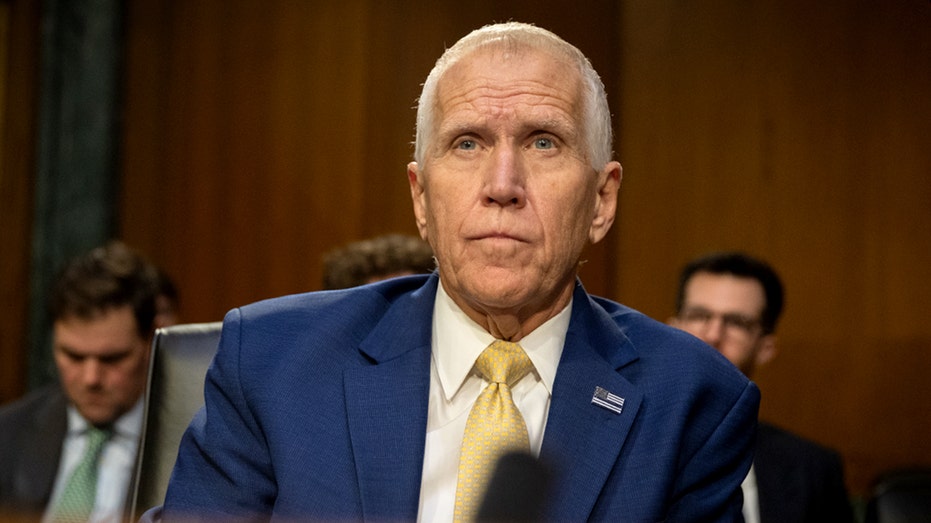
Sen. Thom Tillis, R-N.C., who serves on the Senate Banking Committee that has authority over Warsh’s nomination, vowed to block his confirmation despite supporting his nomination due to his concerns that the administration was pursuing a “bogus” investigation that was undermining the central bank’s independence over monetary policy.

U.S. Attorney for the District of Columbia Jeanine Pirro announced on Friday that she would close her office’s investigation into Powell’s Senate testimony on the Fed renovations, which have faced cost surges that the central bank has attributed to rising materials costs, asbestos mitigation and other unforeseen or higher-than-expected costs. Pirro said the Fed’s inspector general, Michael Horowitz, will take over the investigation.

Tillis said that the DOJ’s probe was a “serious threat to the Fed’s independence, and it needed to end before I could support Kevin Warsh’s confirmation,” adding that the inspector general probe is a “necessary and appropriate measure” that he’s confident will be “conducted thoroughly and professionally.”

WHO IS KEVIN WARSH, TRUMP’S PICK TO SUCCEED JEROME POWELL AS FED CHAIR?

Advertisement
Sen. Thom Tillis

Sen. Thom Tillis, R-N.C., said the DOJ probe’s conclusion will allow him to support Warsh’s nomination. (Nathan Posner/Anadolu via Getty Images)

With the path opened for Warsh to be confirmed as chairman by the Senate in the near future, attention will shift to whether Powell intends to continue to serve as a member of the Fed’s Board of Governors after the end of his chairmanship. 

Although most leaders of the central bank have departed the Fed at the conclusion of their terms as chair, Powell hasn’t confirmed that he will follow that path and may remain as a governor.

At his press conference following the March FOMC meeting that left rates unchanged, Powell said that he had “no intention of leaving the board until the investigation is well and truly over with transparency and finality.”

“On the question of whether I will then continue to serve as governor after my term ends, and after the investigation is over, I have not made that decision yet, and I will make that decision based on what I think is best for the institution and for the people we serve,” Powell added. “I’m not going to have anymore to say on those issues, by the way.”

Advertisement

HOW DOES FED CHAIR NOMINEE KEVIN WARSH VIEW THE CENTRAL BANK’S INFLATION GOAL?

Kevin Warsh sworn in at confirmation hearing

Former Fed Governor Kevin Warsh, President Donald Trump’s nominee to be the next chair of the Federal Reserve, is sworn in before his confirmation hearing with the Senate Banking Committee on April 21, 2026. (Elizabeth Frantz/Reuters)

EY-Parthenon chief economist Gregory Daco said that while the DOJ dropped its investigation, he anticipates that Powell is “more likely than not to remain on the Board,” explaining that the “rationale is institutional continuity, not politics.”

Daco wrote that Warsh’s views of inflation outcomes and a potential productivity surge driven by artificial intelligence could be disinflationary, as well as his views about how the Federal Reserve system operates, could compel Powell to stay to “help preserve institutional continuity, anchor the existing communication approach, and provide a stabilizing counterweight during the transition.”

“Dropping the investigation reduces pressure but does not eliminate it. The Inspector General review keeps governance questions active, and Powell remaining on the Board would not preclude the possibility of the DOJ reopening its investigation if new information emerges,” Daco added. 

Advertisement

GET FOX BUSINESS ON THE GO BY CLICKING HERE

“For now, the combination of a cleared confirmation path, a likely June transition, and a high probability of Powell remaining in place points to continuity in the policy framework, even as leadership evolves.”

Continue Reading

Trending

Copyright © 2025