
Crypto World
Here’s everything to expect when the Fed issues its latest interest rate decision Wednesday

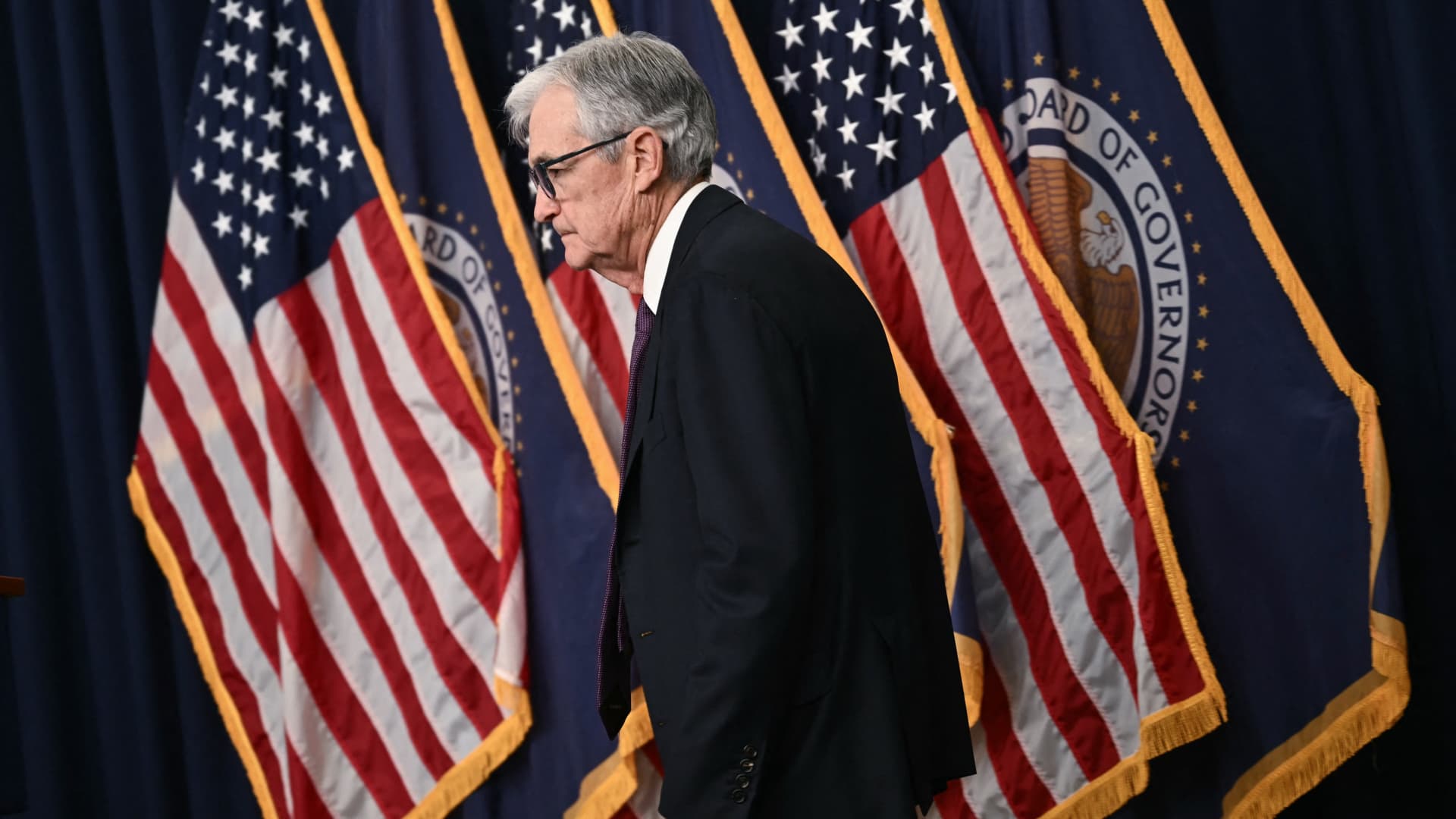
US Federal Reserve Chair Jerome Powell arrives for a press conference following the Federal Open Market Committee meeting at the Federal Reserve Board Building in Washington, DC, on March 18, 2026.
Brendan Smialowski | Afp | Getty Images
In what could be Jerome Powell’s final meeting as Federal Reserve chair, he is expected to lead his fellow policymakers toward another cautious pause, with stubborn inflation and a resilient labor market leaving little room yet for interest rate cuts.
The decision Wednesday will come against a backdrop of elevated energy prices and a central bank that has been above its 2% inflation target for five years at the same time that the labor market has been weak but not in distress. That’s not a recipe for easing, at least not yet.
“On the dual mandate, they’d say we’re roughly at a stable labor market,” Roger Ferguson, an economist and former vice chair at the Fed, told CNBC. “On the inflation side of the mandate, [there’s] a lot more work to be done with a sticky 3% [inflation rate], and I hope they argue, ‘we’re going to sit tight for a little while to see how this all plays out.’”
Similarly, Goldman Sachs economist David Mericle expects the post-meeting statement “is likely to acknowledge the better labor market news and higher inflation numbers but to leave the standing policy guidance unchanged. We expect a strong consensus to stay on hold for now, with only one dissent, as in March.”
So with little drama over the rate decision — markets are pricing in a 100% chance of the FOMC staying on hold — attention will turn squarely to Powell.
Unless something unexpected pops up, the chair’s designated successor, Kevin Warsh, appears on track to take over when Powell’s term ends in May.
The transition clouds the usual signaling value of Powell’s post-meeting news conference.
Inflation the key
Powell’s post-meeting news conference, normally a closely watched event for markets, could be viewed as less of a guide to future policy steps than it is a valedictory for a central bank leader who has had one of the most contentious relationships with a president in the institution’s history.
“If Powell were staying, I might be trying to read more in between the lines of what he says at the press conference,” said Jerry Tempelman, a former senior analyst at the New York Fed and now vice president of economic and fixed income research at Mutual of America Capital Management. “But given the fact that, in all likelihood, Kevin Warsh will soon be the Fed chair, all the surrounding language, etc., probably becomes less relevant.”
From a communications standpoint, Tempelman expects the Fed will put the focus on inflation, which most recently ran at 3% on an ex-food and energy basis using the central bank’s preferred gauge.
Crude oil prices are hovering around $100 a barrel and the average price nationwide for gasoline is surging again, now around $4.18 a gallon, further complicating the Fed’s path.
Though Fed officials often would look through such spikes as temporary, they also remain cautious about longer-term impacts should the fighting in the Middle East escalate.
“Inflation has continued to come in far above anyone’s expectations and far above the Fed’s target,” Tempelman said. “Everyone expects this to be Jay Powell’s final meeting. I think also there’s very little uncertainty as to what the decision will be, namely, that there will be no change to monetary policy in this meeting, and that from the June meeting on, it will be the Fed … chaired by Kevin Warsh.”
What does Powell do next?
That does not, however, mean that Powell’s future will be settled. The current chair has the option to stay on at the central bank for the final two years of his term as governor. So far, he has provided no indication of what he will do.
At the March meeting, he did say he wouldn’t be leaving until an investigation into the renovations at the Fed’s headquarters is completed. Jeanine Pirro, the U.S. attorney for the District of Columbia, passed the investigation off to the Fed’s office of inspector general, a move that politically cleared the way for Warsh’s confirmation.
However, it’s unknown whether that will satisfy the “well and truly over” bar that Powell set in March for his leaving.
“I’m not sure that the move of this investigation from the Justice Department to someplace else really fully checks the box of putting this behind us,” Ferguson said. “I’m not sure that if I were sitting in his seat or [was one of] his advisors, that I would say, let’s blow the all clear.”

Crypto World
XRP Price Outlook: How Bank Adoption and Token Scarcity Could Drive Long-Term Value Growth

TLDR:
- Banks integrating Ripple’s DLT are expected to grow XRP Ledger transaction volumes massively over time.
- Payment providers like Finastra and Volante are adding transaction volume through XRPL’s Cross-Currency RTGS functions.
- XRP cannot be mined and a portion is burned per transaction, meaning circulating supply will keep falling.
- XRP targets the $180 trillion international payments market, positioning it as a top bridging currency asset.
XRP is drawing renewed attention from the crypto community as Ripple’s distributed ledger technology gains traction among global banks.
Analysts and long-time observers point to a combination of rising network adoption, a shrinking token supply, and a massive addressable market.
Together, these factors are expected to push XRP toward higher and more stable valuations over time. The case being made is straightforward and grounded in market mechanics.
Banking Adoption and Payment Providers Fuel XRP Network Activity
As more banks integrate Ripple’s distributed ledger solution, transaction volumes across the network are expected to grow.
Each new institutional participant adds meaningful activity to the XRP Ledger. This growing participation directly increases the utility of XRP as a functional asset.
Payment service providers are also entering the picture. Companies like Finastra, Volante, and CGI are tapping into the XRPL’s Cross-Currency RTGS functions.
They are also using the Neutral Liquidity Marketplace that the XRP Ledger provides. This adds another significant layer of transaction volume on top of banking activity.
A recent post from crypto commentator SMQKE on X laid out the case clearly. The post stated that “the transaction volumes of the network will grow massively” as banks and payment providers deepen their integration with Ripple’s infrastructure. More network activity directly translates to greater XRP utility.
Greater utility, in turn, supports a stronger case for price appreciation. This is not speculative reasoning. It follows a basic supply-and-demand framework that has held across multiple asset classes over time.
Decreasing Supply and a $180 Trillion Market Position XRP for Long-Term Value
XRP cannot be mined, which makes its supply dynamics fundamentally different from Bitcoin and similar assets. A small amount of XRP is permanently burned with every transaction processed on the ledger. Over time, this means the circulating supply will only continue to fall.
As the SMQKE post noted, “everything that exists in a limited amount and is actively used is becoming more expensive.”
This principle applies directly to XRP as network usage climbs. A shrinking supply base against rising demand creates natural upward pressure on price.
The addressable market adds further weight to this outlook. XRP is positioned to serve international funds transfers, a market with an annual volume of $180 trillion.
Even a fraction of that volume flowing through the XRP Ledger would represent enormous demand for the token.
On the question of price volatility, Ripple has addressed this directly. The company expects volatility to ease as demand becomes more constant.
A steady flow of transactions using XRP as a bridging currency is expected to support price stability over time.

Crypto World
A crypto coalition releases technical proposal to save Aave users from a massive token exploit


A $300 million hole doesn’t usually come with a neat repair manual. This time, the group spearheading the Kelp DAO recovery effort is trying to write one.
DeFi United, a coalition of multiple blockchain projects and crypto ecosystem individuals, has laid out a detailed, step-by-step plan to restore the backing of rsETH after this month’s Kelp DAO hack sent shockwaves through DeFi lending markets, releasing more than 116,000 tokens that weren’t properly accounted for.
The proposal, circulated on Aave’s official X account, reads like a coordinated cleanup operation, one that leans heavily on Aave’s infrastructure to unwind the damage and get markets back on a stable footing.
The incident traces back to April 18, when an attacker exploited a vulnerability in rsETH’s bridge. By forging a message that appeared legitimate, the attacker tricked the Ethereum side of the system into releasing 116,500 rsETH, making the system believe the funds had moved when they hadn’t, allowing a large batch of rsETH to be created without backing.
Those tokens didn’t just sit idle. They were spread across multiple wallets and deployed across DeFi, with a significant portion used as collateral on Aave and other lending platforms.
That’s where the problem became systemic: protocols like Aave suddenly found themselves holding collateral that, at least temporarily, wasn’t fully backed.
According to the proposal, most of the exploited funds are still in play. Roughly 107,000 of the original 116,500 rsETH remain tied up in active positions across Aave and Compound.
That leaves two problems to solve at once: restoring the actual backing of rsETH itself, and unwinding the loans created using those extra tokens.
DeFi United’s proposal aims to tackle both sides of that equation simultaneously.
On the backing side, the group says it has already lined up enough ETH commitments to fully re-collateralize rsETH. The plan is to feed that ETH back into the system in stages, converting it to rsETH and depositing it back into the system so the token is once again fully backed.
At the same time, attention shifts to the lending markets where the damage is most visible.
Instead of letting things play out chaotically, the plan is to step in and carefully unwind the mess.
A big part of that involves dealing with the positions the attacker opened on Aave. These are essentially loans backed by rsETH that shouldn’t have existed in the first place. Rather than waiting for those loans to collapse on their own — which could cause more market disruption — the proposal suggests nudging the system so they can be closed out in a more controlled way.
In practice, temporarily adjusting how rsETH is valued inside the system will enable those bad positions to be liquidated or closed more smoothly. As those positions are unwound, the underlying assets (like ETH) can be recovered. The proposal estimates this could free up around 13,000 ETH from Aave alone.
Once that collateral is back in hand, it gets converted into ETH and used to cover the shortfall created by the exploit — essentially filling the hole left behind.
The process isn’t risk-free. It hinges on governance approvals across multiple chains, the successful deployment of committed funds and a smooth execution of the unwind.
Still, the plan reflects a more coordinated response than DeFi has often managed previously. If executed as intended, the end goal is straightforward: “rsETH backing is fully restored, and all affected markets are stabilized,” as the proposal says.


The CFTC filed suit against Wisconsin to establish its exclusive regulatory authority over prediction markets, a sector closely tied to crypto and blockchain-based derivatives.
The U.S. Commodity Futures Trading Commission (CFTC) sued Wisconsin on April 28, 2026, to reassert its exclusive jurisdiction over prediction markets. The action challenges state-level regulatory interference in a sector increasingly built on blockchain technology and crypto assets. The lawsuit underscores ongoing federal-state jurisdictional disputes over decentralized and tokenized derivatives platforms.
The CFTC’s enforcement action signals the regulator’s intent to maintain control over derivatives-adjacent products in the crypto space, potentially affecting platforms that tokenize prediction market shares or operate on decentralized protocols.
The CFTC said that its lawsuit is in response to Wisconsin filing civil suits against multiple CFTC-regulated prediction market companies — Kalshi, Polymarket, Crypto.com, Robinhood, and Coinbase — alleging violations of state law.
Sources: CFTC
This article was generated automatically by The Defiant’s AI news system from publicly available sources.
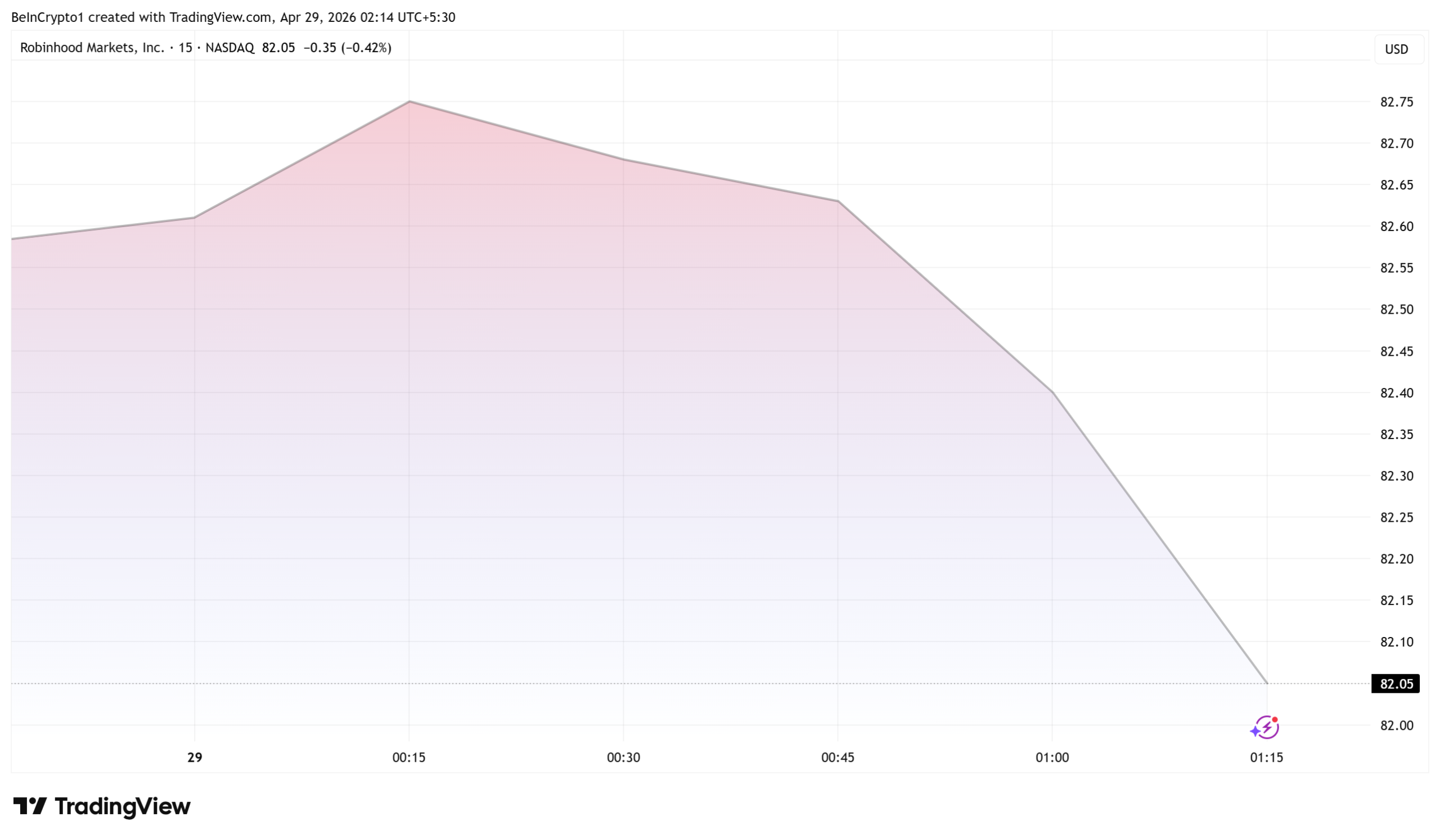
Robinhood Markets shares slipped about 6% in after-hours trading Tuesday after the retail brokerage reported a 47% year-over-year drop in cryptocurrency revenue, dragging overall first-quarter results below Wall Street expectations.
The Menlo Park firm posted $346 million in first-quarter profit, or $0.38 per diluted share, narrowly missing analyst estimates of $0.39 even as net income rose 3% from a year earlier.
Crypto Revenue Slides as Bitcoin Cools
Crypto transactions generated $134 million in revenue during the quarter, down 47% year-over-year as digital asset trading activity cooled across the platform.
Total revenue reached $1.07 billion, up 15% year-over-year but short of the $1.14 billion analysts had projected. The miss arrived even as equities, options, futures, and prediction markets posted double-digit growth or record volumes, the company said.
Trading fees drove much of the platform’s gains last year, when HOOD stock peaked at $153.86 in October alongside crypto’s broader run.
Robinhood stock dipped on this report, and was trading for $82.05 as of this writing.
Prediction Markets and Tokenization Cushion the Slide
Chairman and CEO Vlad Tenev pointed to the firm’s expanding role across customer finances in a statement.
“Robinhood is increasingly positioned at the center of our customers’ financial lives,” he stated in the broadcast.
Wagers routed through Kalshi-powered prediction markets logged record volumes, supported by a one-cent transaction fee.
Robinhood also launched the public testnet for Robinhood Chain, an Ethereum (ETH) layer-2 network built around tokenized assets.
Total platform assets stood at $307 billion, up 39% year-over-year on the back of net deposits and higher equity valuations.
The firm’s European tokenized stocks product continues to offer customers exposure to private companies including OpenAI and SpaceX.
The after-hours sell-off pushed HOOD to roughly $82, well off the October peak. The path forward depends on whether prediction markets and tokenization can offset the cooling in digital asset trading.
The post HOOD Stock Topples After Robinhood Earnings Reveals 47% Decrease in Crypto Revenue appeared first on BeInCrypto.
Crypto World
LayerZero Pledges 10,000 ETH to DeFi United as Industry Rallies Behind Kelp DAO Recovery
TLDR:
- LayerZero Labs is donating 5,000 ETH and depositing another 5,000 ETH into Aave to strengthen market liquidity.
- The $292M Kelp DAO exploit involved an RPC-poisoning attack that forged cross-chain messages via LayerZero’s DVN.
- DeFi United has raised over $300M in ETH and stablecoins, with major contributors including Consensys and Arbitrum DAO.
- Total value locked across DeFi fell from $95B to $80B following the Kelp DAO hack, reflecting broad market disruption.
LayerZero Labs has committed over 10,000 ETH to the DeFi United recovery initiative, led by Aave, following the $292 million Kelp DAO exploit.
The crypto infrastructure provider will donate 5,000 ETH directly and deposit another 5,000 ETH into Aave markets.
This contribution, valued at roughly $23 million, places LayerZero among the largest participants in the industry-wide effort to restore rsETH backing after the April 18 attack.
LayerZero’s Contribution to DeFi United
LayerZero’s pledge comes approximately five days after the company first announced its intent to join a recovery effort.
The firm will also work to deepen liquidity for GHO, the native stablecoin on Aave. This move signals a broader commitment beyond a simple financial donation.
LayerZero confirmed the details in an official post on X, stating it is “donating 5,000 ETH to DeFi United, depositing an additional 5,000 ETH to strengthen Aave markets liquidity, and strategically deepening GHO liquidity.”
LayerZero also confirmed plans to continue working with Aave and other DeFi participants. The focus will be on how Omnichain Fungible Tokens (OFTs) should be designed and configured for use in lending markets. This collaboration could shape future standards across the ecosystem.
The exploit on April 18 involved a sophisticated RPC-poisoning attack on LayerZero’s Decentralized Verifier Network.
Attackers forged a cross-chain message, releasing unbacked rsETH from Kelp’s LayerZero-powered bridge adapter on Ethereum. Around 107,000 rsETH then entered lending positions on Aave, creating substantial bad debt.
Industry Response and Recovery Progress
DeFi United has now raised over $300 million in ETH and stablecoins from dozens of protocols and individuals. Arbitrum DAO has a pending vote to release 30,765 ETH toward the effort.
Consensys and Joseph Lubin together are contributing 30,000 ETH, matched by a low-interest loan from Mantle.
Aave DAO also has a pending proposal to approve a 25,000 ETH contribution. This adds to Aave founder Stani Kulechov’s personal pledge of 5,000 ETH. Kelp DAO contributed 2,000 ETH, while Circle is buying AAVE tokens to support the protocol’s stability.
There remains a dispute over responsibility for the attack. LayerZero states it “recommended multi-DVN redundancy” to protect against single points of failure. Kelp, however, says it “used the default configuration” provided, which relied on a 1-of-1 DVN setup with only LayerZero Labs as the verifier.
Meanwhile, the total value locked across DeFi has dropped to $80 billion, down from roughly $95 billion just before the hack.
Aave has released a detailed technical recovery plan, and the broader effort to restore rsETH backing continues to move forward.


A federal judge rejected Sam Bankman-Fried’s request for a new trial on Tuesday, April 28, 2026, denying the former FTX chief’s attempt to reopen his criminal case based on claims of newly discovered evidence.
US District Judge Lewis Kaplan issued the ruling in New York, where he oversaw Bankman-Fried’s 2023 trial. Bankman-Fried was convicted over the collapse of FTX and later sentenced to 25 years in prison.
The motion was filed under Rule 33, a procedure that allows defendants to seek a new trial if new evidence emerges. Bankman-Fried argued that the jury did not hear the full picture of FTX’s finances, including claims that the exchange had assets that could repay customers.
He also argued that evidence about lawyers’ involvement in FTX decisions could have supported his claim that he acted in good faith rather than with criminal intent.
However, Kaplan denied the motion even after Bankman-Fried tried to withdraw it. Bankman-Fried had claimed the judge would not be fair in deciding the request.
The ruling leaves Bankman-Fried’s broader appeal before the Second Circuit as his main path to challenge the conviction.
The post Judge Rejects Sam Bankman-Fried’s Retrial Bid in FTX Case appeared first on BeInCrypto.
Crypto World
RailsX Goes Live: Amboss Brings Self-Custodial Bitcoin and Stablecoin Trading to the Lightning Network
TLDR:
- RailsX enables peer-to-peer bitcoin and stablecoin trading natively on the Lightning Network with no intermediary..
- The platform launches with two stablecoin pairs, USDT-L and USDC-L, both issued by Speed Wallet on Lightning.
- All trades settle atomically through Lightning channels in seconds, removing the need for centralized exchanges.
- RailsX combines Amboss’s Magma liquidity marketplace with Taproot Assets to power decentralized BTC trading.
RailsX, a new peer-to-peer exchange built on the Lightning Network, is now live for early users. Amboss Technologies developed the platform to allow self-custodial trading between bitcoin and stablecoins.
The launch introduces two stablecoin-bitcoin pairs: USDT-L and USDC-L, both issued by Speed Wallet. Users retain full control of their private keys throughout all transactions, removing the need for centralized custody.
Trading Bitcoin Against Stablecoins Without Giving Up Custody
RailsX routes all trades through existing Lightning payment channels. This means settlement happens in seconds, with minimal fees and no third-party intermediary holding assets.
There is no centralized order book managing trades on the platform. Instead, transactions execute atomically, giving users a fully decentralized trading experience.
The platform is accessible through open-source node manager Thunderhub, with no additional setup required. Amboss is also coordinating liquidity formation across BTC/stablecoin pairs to support growing trading volume.
RailsX combines Amboss’s liquidity marketplace, Magma, with Taproot Assets to enable this decentralized structure. The company says this approach aligns with its reading of U.S. draft Clarity Act legislation.
Speed Wallet handles the issuance and underlying custody for both USDT-L and USDC-L. All assets remain fully backed and transparent under Speed Wallet’s framework.
Before RailsX launched, Speed Wallet had already been operating wrapped stablecoins for its own users. Now, that infrastructure is available to the entire Lightning Network through RailsX.
Amboss CEO and co-founder Jesse Shrader addressed what the platform means for everyday users. “RailsX lets users trade, hold, and move value on Lightning without ever giving up control of their money,” Shrader said.
He added that the platform is designed to unlock Bitcoin’s potential as a medium of exchange. According to Shrader, RailsX serves global stablecoin demand without exposing users to cross-chain decentralized finance risks.
Stablecoins Return to Bitcoin via Taproot Assets
RailsX builds on Amboss’s existing Rails product, which lets users supply liquidity to Lightning channels and earn yield. The new platform extends that foundation into fully self-custodial stablecoin trading.
Industry leaders have recently discussed bringing stablecoins back to Bitcoin using Taproot Assets. These include Tether CEO Paolo Ardoino and Lightning Labs CEO Elizabeth Stark.
Speed Wallet CEO Raj Patel spoke directly about the platform’s role in expanding access. “Speed Wallet built this technology with one goal: to make stablecoins on Lightning accessible to everyone,” Patel said.
He described RailsX as the kind of distribution platform Speed Wallet had always envisioned. Patel also noted that the launch takes self-custody stablecoin trading into the mainstream for the broader Lightning Network.
The Lightning Network saw a sharp drop in capacity earlier this year amid bear market conditions. However, capacity has largely stabilized over the past two months.
According to The Block’s data dashboard, total U.S. dollar capacity on the network stands at roughly $380 million. Bitcoin capacity hovers at approximately 4,870 BTC. RailsX was first unveiled in January and is now entering its early-user phase.
The platform represents a growing push to make Bitcoin a practical medium of exchange at scale. As stablecoin demand rises globally, Lightning-native solutions like RailsX are drawing increasing attention from users seeking alternatives to centralized exchanges.
TLDR:
- TON Tech’s Agentic Wallets let AI agents execute on-chain transactions without needing per-action user approval.
- Users retain full ownership and can withdraw funds or revoke agent access at any point during operation.
- The framework needs no wallet upgrades and supports leading AI models, MCP, and CLI developer tools.
- Telegram bots using Agentic Wallets can now handle both autonomous communication and on-chain payments.
Agentic Wallets on TON represent a new standard for AI-driven blockchain activity. TON Tech has introduced a self-custodial framework that allows AI agents to manage funds and execute transactions independently.
Users retain full control over their assets at all times. The system requires no third-party involvement and works with existing TON wallets without requiring upgrades.
This development connects blockchain payments directly to the Telegram ecosystem, where autonomous bots are already active.
How Agentic Wallets Operate Within the TON Ecosystem
The setup process for Agentic Wallets is straightforward for any user. A user asks their AI agent to create a wallet, funds it, and confirms the setup.
After that, the agent can transact within clearly defined spending limits. No per-transaction approval from the user is needed during normal operation.
Control over funds stays with the user throughout the entire process. The agent operates a dedicated on-chain wallet funded directly by the user.
Ownership, however, remains tied to the user’s main wallet at all times. Funds can be withdrawn at any point, and agent access can be revoked on demand.
TON Tech shared details about the framework publicly, noting the open and self-custodial nature of the standard. The role separation between agent and user reduces the risk of unauthorized activity.
This separation is built directly into the architecture of each wallet setup. Users therefore do not need to rely on any intermediary to manage agent transactions.
The system is also designed to protect developers from vendor lock-in. No upgrades to existing wallets are required to implement the framework.
Developers can build and manage their own setups independently from the start. Compatibility with leading AI models and agent frameworks further adds to that flexibility.
Telegram Integration and the Developer Stack Behind Agentic Wallets
The developer tooling packaged with Agentic Wallets supports multiple integration paths. It includes MCP and CLI tools specifically built for managing agent workflows.
These tools allow developers to work inside their existing environments without major changes. The framework’s broad compatibility makes adoption practical for teams of various sizes.
Telegram adds an immediate use case for this release. Bot API and recent bot-to-bot communication already allow agents to interact autonomously on the platform.
Agentic Wallets extend that foundation to include on-chain payments within the same chat interface. As TON Tech noted in its post, agents on Telegram can now both communicate and make financial transactions in one environment.
That combination makes the framework immediately actionable within Telegram. The existing bot infrastructure provides a ready-built environment for agent-based payments.
Developers can therefore build financial workflows directly into their Telegram bots without external tools. This bridges the gap between AI communication and real on-chain transactions.
The framework is open and available for any developer to adopt without restrictions. TON Tech has published resources to help teams launch AI agents with Agentic Wallets.
The standard is built to grow alongside the broader AI agent and blockchain ecosystem.


President Trump told hundreds of top $TRUMP memecoin holders at a private April 25 event at Mar-a-Lago that the White House will not allow banks to block the CLARITY Act, pledging to sign the bill immediately and framing crypto market structure legislation as a national priority.
Summary
- Trump delivered a direct warning to bankers at a private Mar-a-Lago gala on April 25, telling attendees he would not allow traditional financial institutions to derail the CLARITY Act.
- The event drew Tether CEO Paolo Ardoino, ARK Invest’s Cathie Wood, Anchorage Digital CEO Nathan McCauley, billionaire Tim Draper, and boxer Mike Tyson, among the top 297 $TRUMP token holders.
- The Trump intervention comes as the CLARITY Act missed its April Senate Banking Committee markup deadline and faces a final end-of-May window with approximately four working weeks remaining before the Memorial Day recess.
CLARITY Act legislation received the most direct public presidential backing it has seen yet on April 25 when Trump addressed top $TRUMP memecoin holders at a private gala at his Mar-a-Lago estate in Florida. TheStreet reported that Trump told the gathering he would not allow banks to hinder the progress of the bill and said he would sign the bill immediately if Congress sent it to his desk. Trump described crypto as having “become mainstream” and backed the CLARITY Act as essential for keeping the industry onshore.
CLARITY Act Gets a Presidential Warning Directed at Banking Industry Resistance
The April 25 event was organized by Fight Fight Fight LLC, the issuer behind the $TRUMP token, and billed as the most exclusive conference in the world. The top 297 $TRUMP holders by time-weighted average received access to a conference and gala luncheon. The top 29 holders received a private reception with the president. As crypto.news reported, attendees included Tether CEO Paolo Ardoino, ARK Investment Management’s Cathie Wood, Anchorage Digital CEO Nathan McCauley, billionaire Tim Draper, and boxer Mike Tyson. Trump’s remarks directly targeted banking industry groups that have spent months lobbying senators to reopen the settled stablecoin yield provisions, warning that the White House would not allow those efforts to succeed. The event also carried a political subplot: Democratic senators Warren, Schiff, and Blumenthal sent a formal letter calling the gathering a direct sale of presidential access to crypto industry participants with financial interests in legislation Trump controls.
Why Trump’s Intervention Matters for the May Markup Window
The CLARITY Act missed its April Senate Banking Committee markup deadline after the Kevin Warsh confirmation hearing consumed most of the committee’s April calendar. As crypto.news documented, a coalition of 120-plus organizations including Coinbase, Ripple, Kraken, and Andreessen Horowitz had sent a joint letter on April 23 demanding an immediate markup, but no notice came from Chairman Tim Scott before the informal April cutoff. As crypto.news tracked, the committee’s most pressing competing obligation has now been removed following Tillis’s decision to end his Warsh block on April 27, potentially opening a direct path for a first-week-of-May markup. Trump’s April 25 statement now gives the Senate Banking Committee explicit White House pressure to move, with Senate Banking Committee Republicans aware that publicly resisting a Trump-backed bill carries its own political cost.
What Still Stands Between the CLARITY Act and Trump’s Signature
Presidential backing alone does not resolve the bill’s remaining structural obstacles. As crypto.news noted, the bill must still pass a Banking Committee markup, clear a 60-vote Senate floor threshold, be reconciled between the Banking and Agriculture Committee versions, reconciled with the July 2025 House text, and then signed by Trump. Congress breaks for Memorial Day recess on May 21, leaving fewer than four working weeks. Polymarket prices passage at approximately 46% and Galaxy Research puts odds at 50-50 or lower. The core dispute that banking groups are lobbying on, whether stablecoin activity rewards function as illegal yield, remains formally unresolved in the final bill text, and Democratic senators continue to insist on ethics language barring senior government officials from profiting from crypto holdings, language the White House has refused to accept.
Justin Sun, the Tron founder who emerged as the top $TRUMP holder at a previous May 2025 gala, held a notable position at the April 25 event, a development that drew renewed congressional scrutiny about the role of foreign investors in $TRUMP token purchases given Sun’s nationality.
TLDR:
- Peter Brandt publicly rejected $250,000 Bitcoin forecasts for 2026, calling them unrealistic based on current chart conditions.
- Bitcoin’s ascending channel allows gradual gains but does not confirm a bullish reversal or support a parabolic price advance.
- Brandt identified double bottoms and inverse head-and-shoulders as true reversal signals, none of which appear on Bitcoin’s chart.
- A legitimate breakout above the channel’s upper boundary with strong volume remains the only path toward extreme Bitcoin price targets.
Veteran trader Peter Brandt has publicly shut down projections of $250,000 Bitcoin in 2026. He pointed to a defined ascending channel on the chart as evidence against such forecasts.
Brandt argued that the current structure does not support a parabolic advance or a confirmed bullish reversal. His remarks came as Bitcoin traded between $76,000 and $78,000 in recent sessions. The response has drawn significant attention from traders and analysts across the market.
Brandt Calls Out Unrealistic Bitcoin Forecasts
Brandt took to X to confront what he sees as dangerous market optimism. He wrote directly, “Bitcoiners, those of you predicting $250,000 in 2026 need to stop with the mushrooms.”
He accompanied that remark with a chart showing a clear ascending channel pattern. His message was pointed and left little room for misinterpretation.
He identified the formation as a rising parallel channel, not a bullish reversal structure. Brandt stated plainly that the pattern “is NOT a bullish bottoming pattern.”
That distinction carries weight for traders who rely on technical analysis to guide decisions. An ascending channel and a bullish bottom are two very different market signals.
He then outlined what a genuine bullish reversal actually looks like. Double bottoms and inverse head-and-shoulders patterns are structures that historically confirm new uptrends.
These formations signal a definitive shift in market momentum from sellers to buyers. None of those signals is present on Bitcoin’s current chart, according to Brandt.
He also made clear that an ascending channel does allow for gradual price gains. However, he stressed it does not guarantee acceleration toward extreme price targets.
Without a confirmed breakout above the upper boundary, the channel simply defines a range. That range, in Brandt’s view, makes $250,000 an unsupported projection for 2026.
Chart Structure Tells a Different Story for Bitcoin
Bitcoin dropped sharply in late January 2026 and tested the $60,000 support zone in early February. Sellers dominated that move before buyers regained footing and pushed price higher.
The recovery established the current ascending channel that has contained price action since. That structure has held firm through multiple trading sessions without a confirmed break.
Within the channel, Bitcoin has posted higher highs and higher lows in an orderly fashion. The upper resistance boundary has continued to reject rally attempts near $77,000 to $78,000.
Meanwhile, the lower support boundary has absorbed each dip without a decisive breakdown. Price remains technically constructive but structurally capped.
Brandt stated that a move toward extreme price targets would require a clear breakout above channel resistance. He added that such a breakout must be accompanied by strong trading volume to carry validity.
That confirmation has not materialized as of the latest available market data. Until it does, the channel remains the dominant structure on the chart.
Bitcoin was near $77,000 at the time of reporting, with the channel still intact. Brandt offered no revised price target alongside his critique of the $250,000 forecasts.
His focus remained on chart interpretation and structural discipline rather than speculation. Traders continue to watch both channel boundaries closely for any sign of a directional shift.

Sky’s Prisoner actor details being ‘handcuffed to co-star for 4 months’

Stride, Inc. (LRN) Q3 2026 Earnings Call Transcript
XRP Price Outlook: How Bank Adoption and Token Scarcity Could Drive Long-Term Value Growth

Manchester United reach agreement with Casemiro over contract clause amid transfer speculation

US brings back mandatory military draft registration

Steven Gerrard disagrees with Gary Neville over ‘shock’ Chelsea and Arsenal claim | Football


-

 Tech1 day ago
Register Renaming | Hackaday
-

 Fashion4 days ago
Weekend Open Thread – Corporette.com
-
Crypto World3 days ago
Hyperliquid $HYPE Rally Builds Momentum as AI Sector Enters Prove-It Phase
-

 Politics6 days ago
Making troops accountable for war crimes threatens US alliance, ex-SAS colonel warns
-

 Politics6 days ago
Disabled people challenge government SEND proposals over segregation concerns
-
 Business5 days ago
Patterson-UTI Energy, Inc. (PTEN) Q1 2026 Earnings Call Transcript
-

 Business7 days ago
Rolls-Royce Voted UK’s Most Iconic Trade Mark as IPO Register Hits 150
-
 Sports2 days ago
IPL 2026: Ruturaj Gaikwad registers slowest fifty of the season, enters all-time unwanted list | Cricket News
-

 Politics1 day ago
Drax board avoid their own AGM, accused of greenwashing & environmental racism
-

 Politics6 days ago
Starmer handler McSweeney to be dragged from shadows by Foreign Affairs Committee
-

 Politics6 days ago
Zack Polanski responds to home secretary’s taser threat
-
Politics6 days ago
Wings Over Scotland | How To Get Away With Crimes
-

 Politics6 days ago
‘Iran is still a nuclear threat’
-
 Business7 days ago
HCL Tech share price tank over 9% after weak Q4. JPMorgan, HSBC & 3 others cut target price
-

 NewsBeat3 days ago
LK Bennett closes all stores after entering administration
-
 Sports6 days ago
Tim Bradley names the current best in the world: “Better than Inoue and Usyk”
-

 Crypto World5 days ago
Michael Saylor says BTC winter is over. Market analyst disagrees, says bitcoin was in a pullback
-
 Crypto World7 days ago
Ethereum Price News: ETH Flashes a Bullish Setup No Holder Should Miss While Pepeto Nears Its Binance Listing
-

 Business7 days ago
The Job Benefits Most Men Don’t Know to Negotiate
-

 Sports7 days ago
Manny Pacquiao buys shuttered Floyd Mayweather gym, will use it as base of operations for upcoming rematch
You must be logged in to post a comment Login