
Crypto World
Bitwise CIO Reveals the Hidden Force Behind Bitcoin’s 20% Rebound



Bitcoin (BTC) has remained relatively resilient amid ongoing geopolitical tensions, with its price broadly trending higher since late February.
According to Bitwise CIO Matt Hougan, MicroStrategy has emerged as a standout contributor to the recent rally due to its continued large-scale Bitcoin purchases.
MicroStrategy’s STRC Shares Are the Real Engine Behind Bitcoin’s Rally
In a memo published Tuesday, Hougan acknowledged that several forces have contributed to Bitcoin’s recent climb. He pointed to strong ETF inflows of $3.8 billion since March 1 and a wave of fresh accumulation from long-term holders.
Still, he argued that Strategy has “been the single biggest factor.” The firm snapped up $7.2 billion in Bitcoin over the last eight weeks.
“Bitcoin is up roughly 20% from its February lows, trading around $76,000. Everyone is wondering if the rally can continue. To a large degree, the answer lies with Strategy,” the executive wrote.
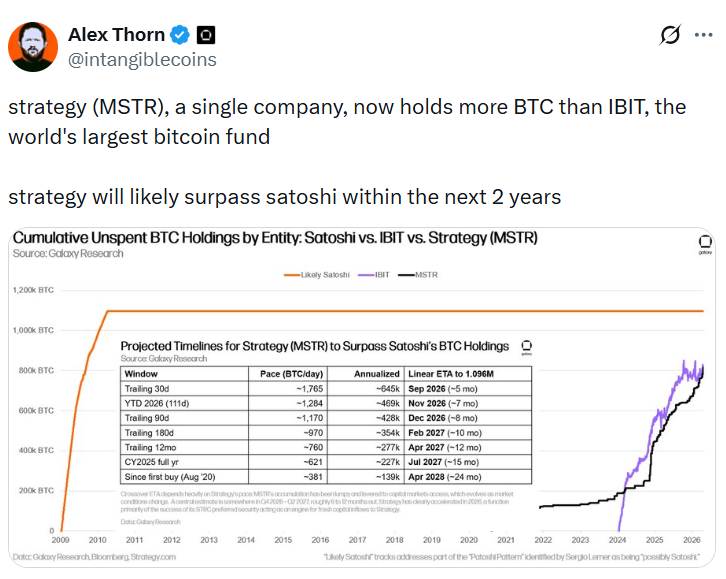
The firm now holds 818,334 BTC, sitting 181,666 coins short of 1 million. Galaxy Research head Alex Thorn projects that MicroStrategy could overtake Satoshi Nakamoto’s estimated 1.1 million BTC stash within two years if the current pace continues.
Follow us on X to get the latest news as it happens
Why Bitwise CIO Thinks Strategy’s STRC Buying Is Far From Over
Hougan pointed out that MicroStrategy has bankrolled this buying spree by selling STRC. BeInCrypto also highlighted in a recent report that, so far in 2026, Strategy’s STRC has financed 10x more BTC buying than the entire US spot ETF market combined.
Hougan expects Strategy to keep leaning on STRC as a funding vehicle. He argued that STRC’s 11.5% payout looks compelling in a market where junk bonds offer under 7%, and capital is rotating out of private credit. With a Bitcoin cushion exceeding $40 billion, he sees plenty of appetite for more.
“The number I’d watch is Strategy’s total obligations (debt + preferred equity) as a percentage of its bitcoin holdings. Today, that sits at 33%: $21 billion in obligations against $63 billion in bitcoin. If that number pushes toward 50%, I think investors will start asking questions. But at today’s bitcoin prices, that still gives room for another $10-$15 billion in STRC issuance. And more if bitcoin rallies,” Hougan added. “I don’t think we’re done STRC-ing at all.”
That said, STRC hasn’t escaped scrutiny. Economist Peter Schiff has been among the critics, warning that Strategy’s Bitcoin-backed yield model is on a path toward a death spiral.
Subscribe to our YouTube channel to watch leaders and journalists provide expert insights
The post Bitwise CIO Reveals the Hidden Force Behind Bitcoin’s 20% Rebound appeared first on BeInCrypto.



Canada has proposed banning crypto ATMs nationwide as part of measures unveiled in the federal Spring Economic Update 2026.
The government described the machines as a key tool used by scammers to defraud victims and launder illicit cash proceeds.
“To protect Canadians by shutting down a primary method for scammers to defraud victims and for criminals to place their cash proceeds of crime, the Spring Economic Update 2026 proposes to ban crypto ATMs,” the text reads.
There are nearly 4,000 cryptocurrency ATMs operating in Canada, according to figures cited in CBC. That gives the country the highest concentration of crypto ATMs per capita worldwide.
The proposed ATM ban is positioned as a public safety measure. Canadians would still be able to access services through money services businesses (MSBs), including purchasing digital assets at physical locations, while reducing the sector’s exposure to illicit activity.
Meanwhile, Canadian lawmakers are separately advancing legislation to bar political campaigns from accepting cryptocurrency donations
Follow us on X to get the latest news as it happens
Canada Joins a Broader Crypto ATM Crackdown
Canada is not the first country to clamp down on cryptocurrency ATMs. The UK’s Financial Conduct Authority ordered crypto ATMs to shut down in 2022.
The regulator ruled that none had registered to operate legally. Australia also intensified oversight in 2025.
Meanwhile, the United States is grappling with similar fraud patterns. Americans lost more than $333 million through scams routed via Bitcoin ATM machines in 2025.
It marked a sharp jump from roughly $250 million the year before. Older Americans accounted for the majority of reported victims.
Subscribe to our YouTube channel to watch leaders and journalists provide expert insights
The post Canada Eyes Crypto ATM Ban in Anti-Fraud Crackdown appeared first on BeInCrypto.


Veteran trader Peter Brandt has pushed back against claims that Bitcoin could reach $250,000 in 2026.
Summary
- Peter Brandt said Bitcoin’s rising channel does not confirm a strong bullish bottoming pattern.
- Bitcoin traded near $76,000 to $78,000 after rebounding from February’s $60,000 support zone.
- On-chain data showed fresh capital inflows, but retail Bitcoin participation remained weak.
His latest chart review warned traders against treating recent price action as the start of a strong breakout. Brandt said Bitcoin has formed an ascending parallel channel over recent weeks. He said the structure can allow more gains, but it does not confirm a major bottom.
“This is called a channel,” Brandt said. “While it does not preclude further price gains, it is NOT a bullish bottoming pattern.”
Bitcoin remains inside rising channel
Bitcoin has been trading near the $76,000 to $78,000 range after recovering from a sharp decline earlier this year. The asset dropped toward the $60,000 support area in February before staging a slow rebound.
Brandt’s chart showed BTC moving higher inside a controlled channel. Such a pattern can show short-term strength, but it can also limit momentum if buyers fail to push price above resistance.
A stronger breakout would require Bitcoin to move above the channel with rising volume. Without that move, traders may continue watching the current range for direction.
Market data shows mixed signals
On-chain analyst Ali Martinez pointed to low short-term Bitcoin participation. He said the share of Bitcoin held by buyers from the past month has fallen below 7%.
According to Ali, this shows weak retail activity and a quieter market. He said past cycles have seen similar readings near areas where selling pressure started to fade.
Ali also said about $3 billion has entered the crypto market over the past 30 days. He described it as the first positive net capital inflow since December.
Additionally, the new inflows suggest market liquidity has started to improve after months of weaker activity. However, Bitcoin still needs stronger buying pressure to confirm a larger move.
For now, Brandt’s view places caution over the $250,000 Bitcoin price target. His analysis suggests the current structure does not yet support such an aggressive 2026 forecast.
Disclosure: This article does not represent investment advice. The content and materials featured on this page are for educational purposes only.


A class action lawsuit has accused Believe founder Ben Pasternak of extracting $54 million in fees through token migrations tied to Launchcoin while leaving investors with losses.
Summary
- Plaintiffs allege Ben Pasternak and associated entities generated about $54M in fees across Believe platform tokens, according to the complaint.
- Court filings state a token migration increased supply by about 33.3% and erased holdings that were not converted within the set deadline.
- Separate New York court records show Pasternak has pleaded not guilty to assault related charges linked to a March 31 incident and is due back in court on June 11.
According to a complaint filed in the U.S. District Court for the Southern District of New York, plaintiffs Joshua Lee and Pierre Montmeas alleged that Pasternak and associated entities, including B24, Inc. and the Believe Foundation, carried out a series of token launches and migrations that generated significant revenue while reducing the value of investor holdings.
Court filings state that the Believe platform processed nearly $6 billion in trading volume and collected an estimated $54 million in fees across tokens such as $PASTERNAK, $LAUNCHCOIN, and $BELIEVE.
Migration terms and dilution claims
Details in the complaint identify an October 2025 migration from $LAUNCHCOIN to $BELIEVE as the central point of dispute. Plaintiffs claim the total token supply increased from 1 billion to over 1.33 billion during the process, introducing roughly 333 million new tokens and diluting existing holders by about 33.3%.
A two-week migration window required users to convert their holdings within a set deadline, after which any remaining tokens were permanently burned, according to the filing.
Further allegations state that newly created tokens were allocated to insider-linked wallets, while a portion of the foundation’s allocation, estimated at around 40 million tokens, was unlocked immediately.
In one of the cited claims, the complaint states, “Pasternak ran the same play three times, under three different token names: generate excitement, bring consumers in, collect fees, and let the token collapse.”
Criminal case unfolds alongside civil claims
Separately, court records from the New York State Unified Court System show that Pasternak was arrested on April 22 on one count of second-degree strangulation and two counts of third-degree assault linked to a March 31 incident at the Baccarat Hotel in New York.
Authorities allege the incident involved physical harm to a 27-year-old YouTube creator, Evelyn Ha, including neck injuries and bruising, while Pasternak has pleaded not guilty and is scheduled to appear in court on June 11.
Statements from Pasternak’s legal team, reported in the filing, say he acted in self-defense, while a spokesperson close to him described the complainant as the aggressor during the altercation.
The civil complaint also claims that Pasternak failed to fulfill at least 12 publicly stated buyback commitments and continued to collect transaction-related fees despite earlier statements indicating “zero ownership” in the tokens.
Plaintiffs have asked the court to freeze on-chain assets tied to the project, including wallets and token reserves, while seeking recovery of what they describe as unlawfully obtained revenues.
Bitcoin treasury company Strategy and its perpetual preferred stock, STRC, have been the “single biggest factor” in the recent rally of Bitcoin, which has jumped 20% from its February low, according to Bitwise chief investment officer Matt Hougan.
Over the past eight weeks, Strategy has added $7.2 billion in Bitcoin, Hougan said in a report published Tuesday.
“Yes, there have been multiple drivers of the recent rally, including strong buying from ETFs, $3.8 billion since March 1, and renewed purchases by long-term holders. But Strategy has been the single biggest factor,” he said.
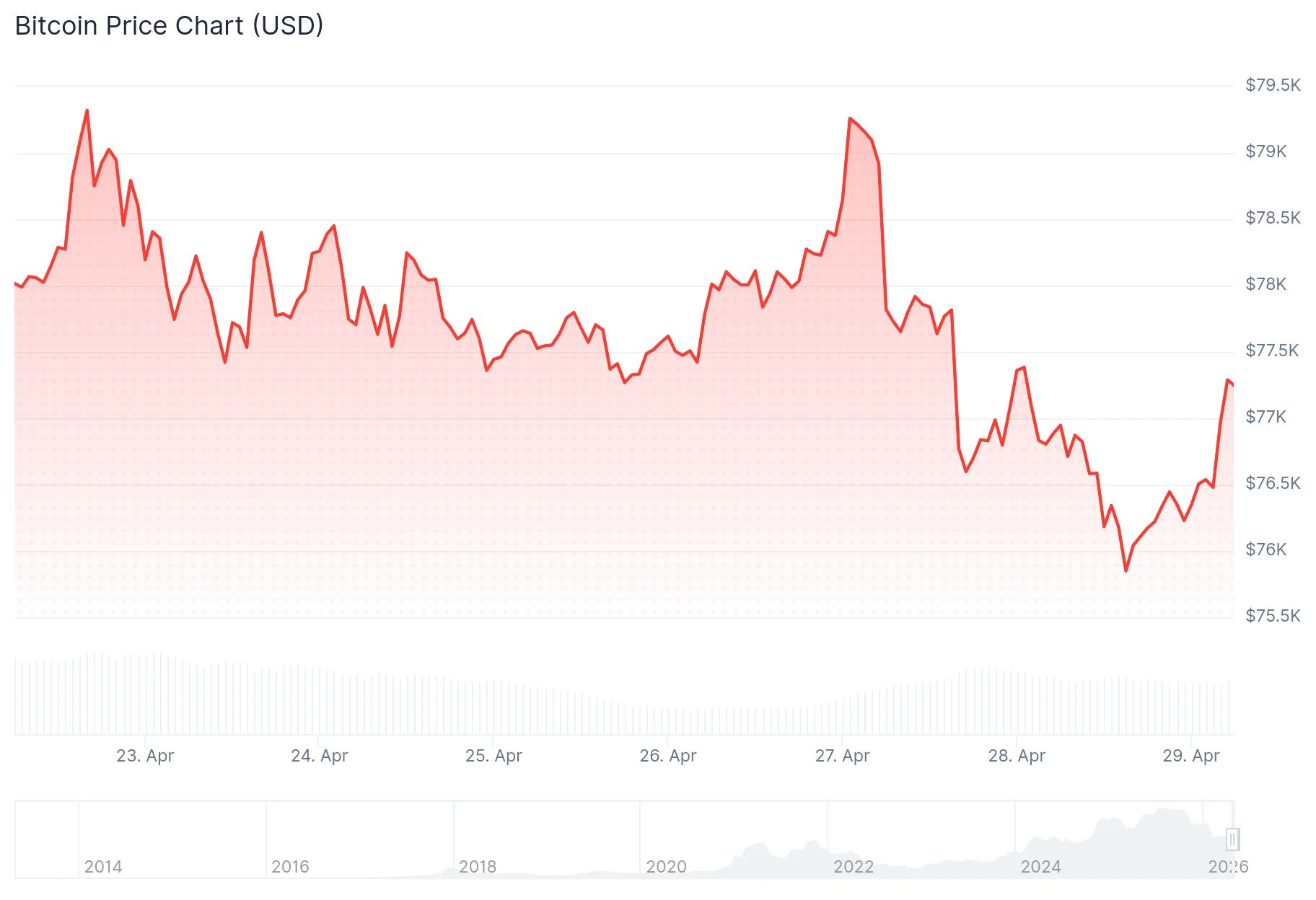
Bitcoin has traded between $75,849 and $79,321 over the past seven days, according to CoinGecko. It was trading at about $76,486 as of Wednesday, up 21% from its Feb. 6 low of $62,822.
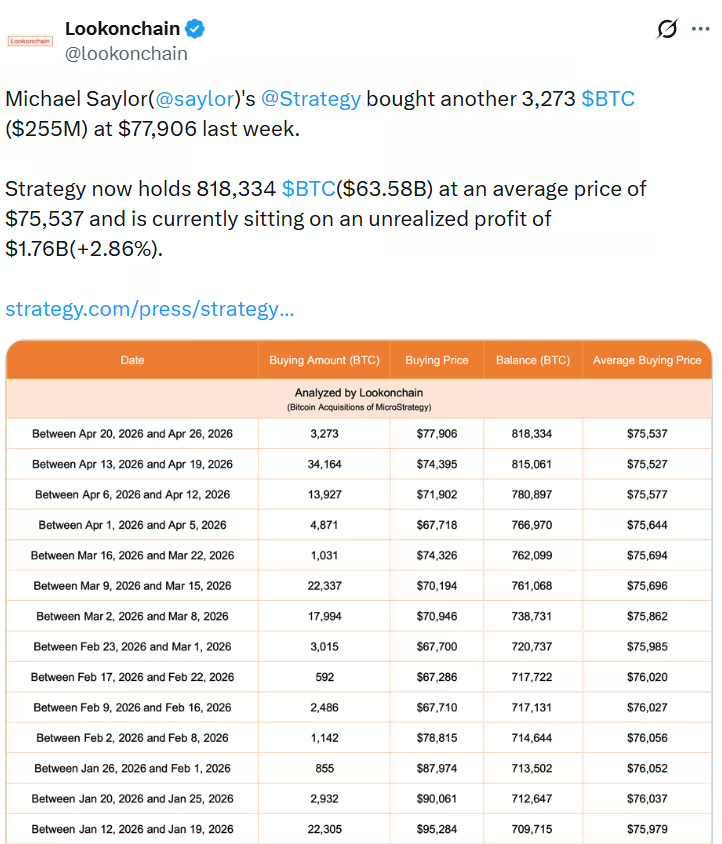
Strategy is the largest publicly listed corporate Bitcoin holder. It bought 3,273 Bitcoin for $255 million between April 20 and April 26, bringing total holdings to 818,334 BTC.
Source: Lookonchain
Bitcoin buys are set to continue, analyst says
Strategy typically makes weekly Bitcoin purchases. Its latest buying spree pushed its total holdings past those of global asset manager BlackRock, which holds about 812,300 coins on behalf of its clients.
Hougan speculates that Strategy’s purchases will “continue for some time to come,” driven by the issuance of STRC, the company’s perpetual preferred stock, which pays a fixed dividend to investors for as long as the company operates.
“Strategy issues STRC because it wants to buy more Bitcoin. Most of the capital raised by issuing STRC is used to purchase BTC on the open market,” he said.
Related: 80% of Strategy’s ‘Stretch’ buyers are mom-and-pop investors
“With junk bonds yielding less than 7% and investors fleeing private credit, STRC’s 11.5% yield — backed by a more than $40 billion bitcoin cushion — looks particularly attractive. I suspect Strategy will raise billions more through STRC,” Hougan added.
Saylor has previously claimed that the company can sustain dividend payments indefinitely if Bitcoin continues to grow.
Hougan said that at current prices, Strategy could “hypothetically pay existing dividends for 42 years.” However, if Bitcoin rises by 20% a year, it could “pay the dividends forever.”
Strategy could surpass Satoshi soon
If Strategy continues at its current pace, its holdings may surpass those of Bitcoin creator Satoshi Nakamoto within the next two years, according to Alex Thorn, head of research at crypto-focused financial services firm Galaxy Digital.
Source: Alex Thorn
Wallets believed to be owned by Nakamoto hold 1.1 million Bitcoin, representing about 5.5% of the total supply. Strategy would need to buy another 277,666 coins to match Nakamoto.
However, Strategy’s Bitcoin purchases have varied significantly. The smallest buy in 2026 was 855 Bitcoin in February, while the largest so far this year was on April 20 with 34,164 coins.
Magazine: Should users be allowed to bet on war and death in prediction markets?
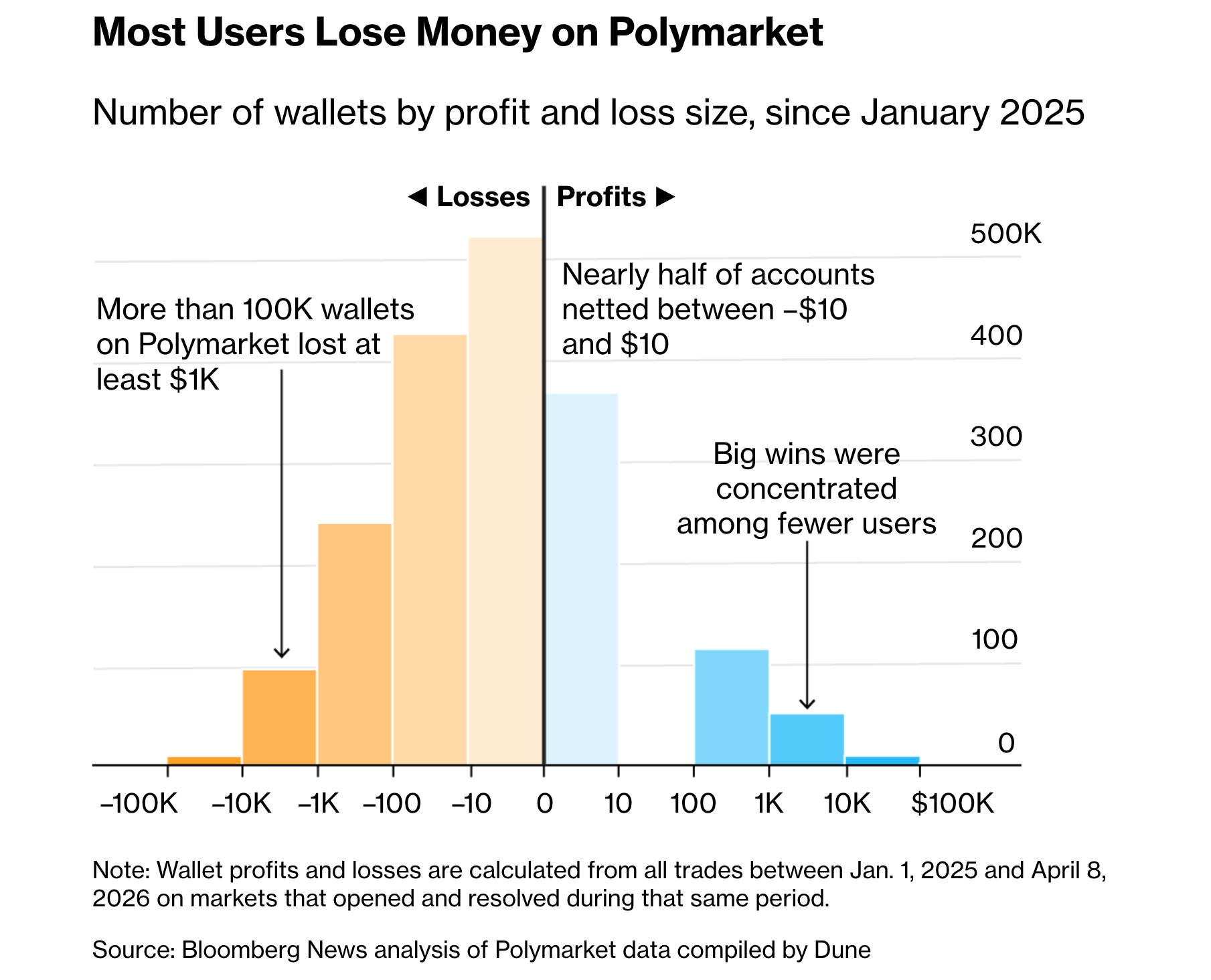
A Bloomberg analysis found that most traders on prediction markets are losing money, often by significant margins.
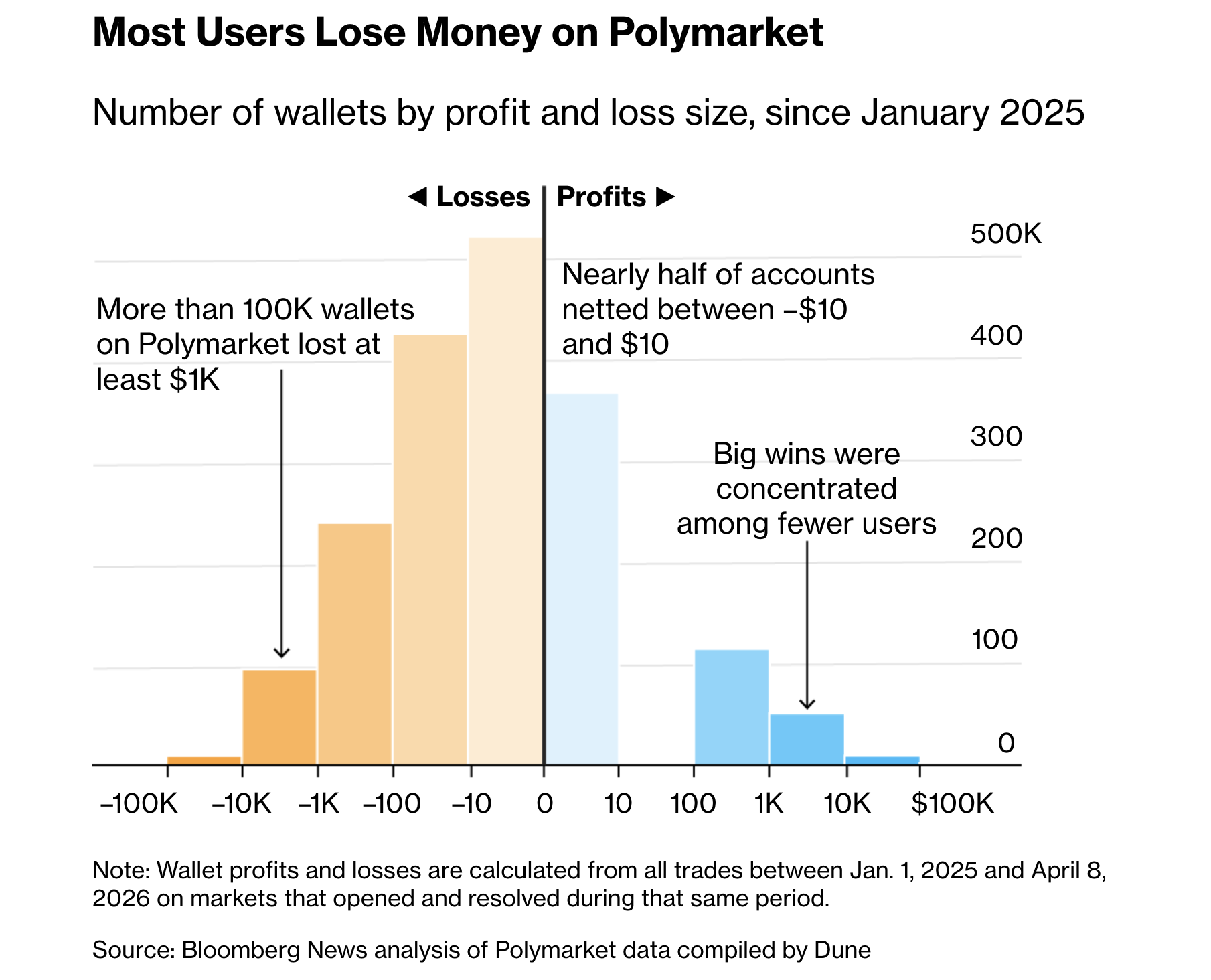
Since January 2025, more than 100,000 Polymarket accounts have recorded losses of at least $1,000, nearly double the number of wallets posting comparable gains.
Polymarket Side Hustle Dream Dies in Bloomberg Investigation
According to the report, the bulk of winnings flowed to a small group of accounts that appear to be automated trading bots. Of the roughly two million wallets that have been active on the platform since the start of 2025, nearly half saw gains or losses of under $10.
This suggested that many users were simply testing out this form of wagering. Yet even within that casual cohort, the majority finished underwater.
Follow us on X to get the latest news as it happens
Separately, researchers from the University of Toronto, HEC Montréal, and ESSEC Business School examined Polymarket data. Their paper covered 2.4 million users and $67 billion in trading volume.
The study found 68.8% of users lost money since 2022. Meanwhile, the top 1% of traders captured 76.5% of all gains. The top 0.1% alone accounted for more than half of the platform’s total profits.
“Users who lose money trade considerably more often at extreme prices (below 10¢ or above 90¢) than users who gain: the bottom 95% of users place 56% of their trades at these prices, against 28% for the top 0.1% of earners,” the paper read. “We urge caution in interpreting this finding as representing skill (or information) since we lack the tools typically used to assess performance in financial markets.”
Bloomberg also noted that roughly 5% of bot-like wallets generated 75% of trading volume on Polymarket. Among those high-volume accounts, 823 netted more than $100,000 in profit each.
“These high-volume accounts collectively turned a profit of $131 million, mostly concentrated among 823 users that netted more than $100,000 each. The less active traders, meanwhile, lost the equivalent amount when all their wins and losses were added up,” the report read.
However, Joshua Della Vedova, a University of San Diego professor, found that retail traders actually picked the winning outcome more often than bots. They lost anyway because they entered positions later, at bad prices.
BeInCrypto has contacted Polymarket for comment on the findings and will update this story if it receives a response.
Subscribe to our YouTube channel to watch leaders and journalists provide expert insights
The post 100,000 Polymarket Accounts Booked Four-Figure Losses Since 2025, Bloomberg Finds appeared first on BeInCrypto.
Key Takeaways
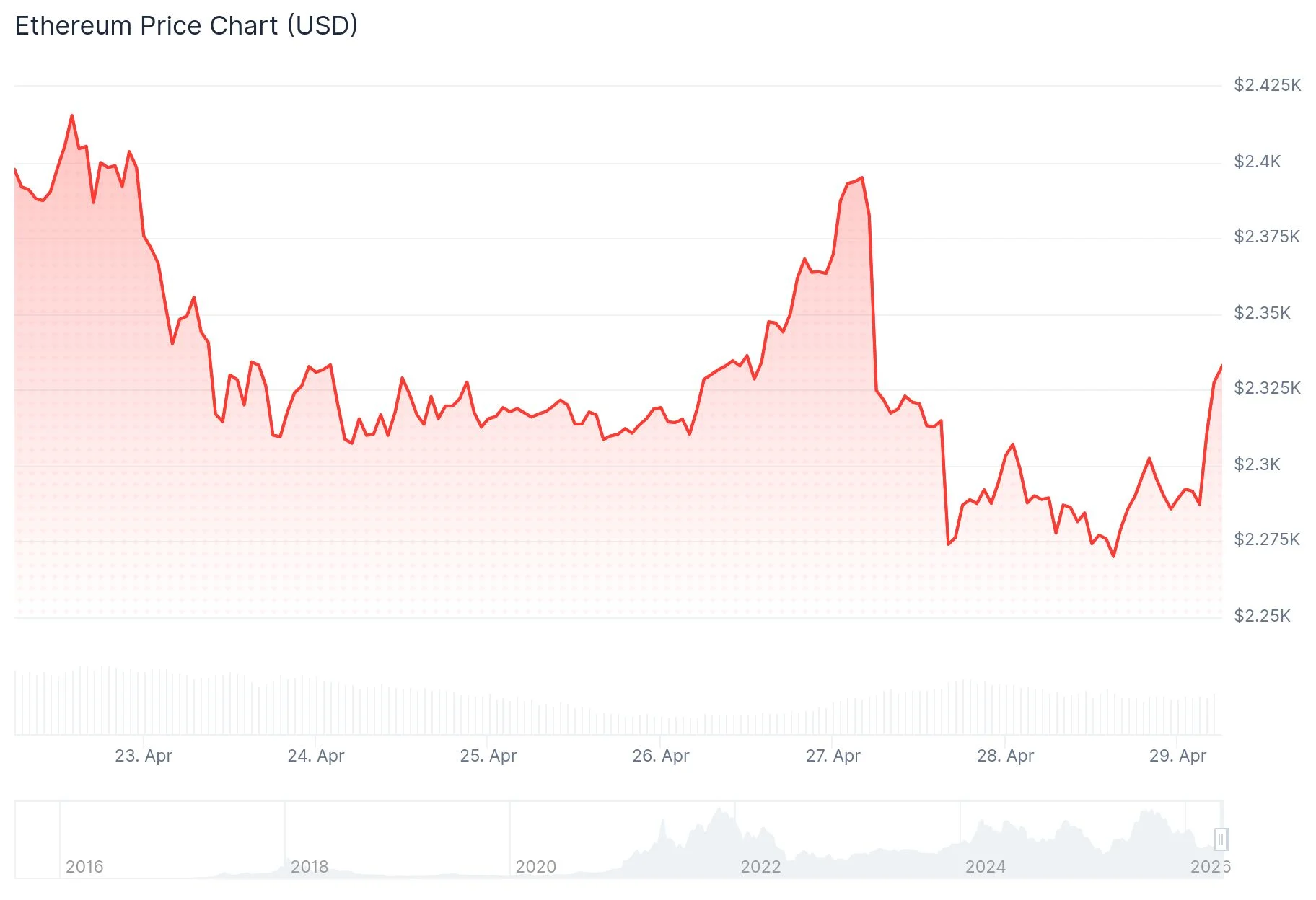
- Ethereum currently trades near $2,300 following a 5% decline across the last two sessions, reversing weekend momentum
- Critical support sits at $2,200 where the 50-day and 100-day simple moving averages align
- Bulls must recapture $2,400 to shift momentum and trigger potential short squeezes
- Smaller wallets offloaded 756,000 ETH in the past seven days while whale addresses accumulated 60,000 ETH
- Crossing above $2,400 could spark over $1.94 billion in leveraged short liquidations
Ethereum is currently hovering around the $2,290–$2,300 range following a two-day pullback that erased approximately 5% of its value and eliminated weekend price gains. The asset now finds itself compressed between the 100-day exponential moving average (EMA) positioned at $2,350 on the upside and the 100-day simple moving average (SMA) at $2,220 on the downside.
Market observers suggest this consolidation pattern may persist for several additional sessions before a definitive directional move materializes.
Telegram-based Technical Crypto Analyst highlighted that Ethereum has surrendered its $2,300 support trendline. “We can probably expect Ethereum to drop, and it might even hit the lower support level in the next few days,” the analyst stated. “A solid breakdown with good volume would confirm this.”
Market commentator Ted Pillows reinforced this assessment on X, stating: “ETH has dropped below the $2,300 level. The next crucial support zone is $2,200, which could be a level for a short-term bounceback.”
Trader Daan Crypto Trades identified $2,100 as a significant support floor and $2,800 as a major resistance ceiling that Ethereum has honored across multiple years. Should price action slip beneath $2,200, technical watchers are monitoring the $2,000 psychological barrier and the $1,800–$1,750 range, which corresponds with the multi-year bottom established on February 6.
Retail Distribution Creates Selling Pressure
Blockchain analytics reveal that the Accumulation Addresses Realized Price (AARP) positioned at $2,400 has functioned as a formidable ceiling since Ethereum dropped below this threshold in February. Each subsequent attempt to test this level has encountered renewed distribution activity.
Smaller wallet holders — addresses containing between 100 and 10,000 ETH — offloaded approximately 756,000 ETH throughout the previous week. The majority of these transactions occurred at a loss, indicating either capitulation behavior or strategic risk reduction.

Conversely, whale entities demonstrated opposing market behavior, accumulating roughly 60,000 ETH during the same timeframe. While their acquisition pace moderated somewhat, these large holders refrained from selling pressure.
Within the derivatives landscape, perpetual funding rates for ETH have maintained consistently negative territory, signaling that short positioning has dominated trader sentiment. Open interest has similarly contracted over recent sessions.
The Significance of $2,400 and Potential Breakout Implications
CryptoQuant contributor CW8900 identified $2,400 as a crucial psychological threshold. “Breaking through that line signifies that whales are transitioning to a profitable position,” the analyst explained on X, noting that this development would “provide grounds for their buying power to become stronger.”
Liquidation heatmap data from CoinGlass indicates that a rally beyond $2,400 would catalyze more than $1.94 billion in forced short position closures across major exchanges.
Market analyst Ali Charts observed on X that Ethereum is attempting to recapture its Realized Price situated at $2,335. “Successfully turning this level into a floor is a standard technical prerequisite for a sustained rally,” Ali Charts noted.
On-chain intelligence from Lookonchain revealed that Bitmine, an entity associated with Fundstrat’s Tom Lee, acquired an additional 45,000 ETH valued at approximately $103.5 million through FalconX and BitGo transactions.
The Relative Strength Index currently registers near 52, reflecting neutral momentum conditions. Meanwhile, the Stochastic Oscillator has retreated toward oversold readings, which technical analysts suggest could provide a buffer against additional downside provided Ethereum maintains its current EMA support structure.



Ondo Finance has partnered with Broadridge Financial Solutions to bring voting tools to holders of tokenized stocks and ETFs.
Summary
- Ondo holders can submit voting preferences across more than 250 tokenized stocks and ETFs.
- Broadridge will provide governance documents, filings, prospectuses, and investor communications to token holders.
- Ondo also seeks SEC clarity for recording securities interests as Ethereum-based tokens.
The integration will allow holders of more than 250 Ondo tokenized assets to submit voting preferences for the underlying securities.
Broadridge will provide access to investor communications, prospectuses, regulatory filings, and other governance materials.
The company settles more than $15 trillion in securities daily and serves over 10,000 public companies.
Voting preferences will reflect token ownership
Ondo said voting recommendations will be weighted based on each holder’s token ownership.
With Ondo Global Markets’ consent, Broadridge may aggregate tokenholder voting preferences with votes from traditional market investors.
Meanwhile, the partnership comes as Ondo asks the U.S. SEC to support its model for recording securities interests as Ethereum tokens.
Ondo says the tokens act as an operational overlay on existing broker-dealer custody, not as a change to investor protections.
“This is about expanding what it means to hold a tokenized stock,” said Matthieu de Vergnes, global head of institutional at Ondo Finance.
“Today’s announcement represents a major milestone in the evolution of tokenized equities and ETFs,” said Doug DeSchutter, president of investor communication solutions at Broadridge.

Key Takeaways
- Q1 earnings per share landed at $0.38, missing analyst expectations of $0.39, while revenue reached $1.07B versus $1.14B forecasted
- Cryptocurrency revenue plummeted 47% compared to the prior year, declining to $134 million, while crypto trading volume decreased 48% to $24 billion
- Shares of HOOD declined approximately 9.4% during after-hours trading session
- The prediction markets segment showed exceptional growth with 8.8 billion event contracts executed, representing a 780% increase from Q2 2025
- Bottom-line profits increased 3% year-over-year, reaching $346 million, even as topline revenue disappointed
Robinhood experienced a challenging Tuesday evening following its first-quarter earnings release. The trading platform delivered financial results that fell short of expectations across key metrics, triggering an immediate reaction from investors — shares plummeted roughly 9.4% after the closing bell.
The company’s adjusted earnings per share for the first quarter registered at $0.38, narrowly missing the Street consensus of $0.39. Overall revenue climbed to $1.07 billion, representing a 15% increase from the same period last year, yet significantly trailing the analyst forecast of $1.14 billion. The revenue shortfall amounted to approximately 6%, while the EPS miss reached 11.6%.
The primary driver behind the disappointment? Cryptocurrency.
Transaction-based revenue from crypto assets collapsed 47% compared to last year’s quarter, tumbling from $252 million down to $134 million. Meanwhile, cryptocurrency trading volumes contracted 48% to reach $24 billion. This marked the third consecutive quarter where the platform witnessed declining crypto transaction revenues.
Chief Executive Vlad Tenev tackled the issue directly during the company’s earnings conference call. “I want to get away from talking about the price of bitcoin,” he stated, indicating a strategic shift away from dependency on cryptocurrency price fluctuations for revenue generation.
Tenev positioned crypto as a long-term infrastructure opportunity instead. “We’re at the very beginning of what’s going to be a tokenization supercycle,” he explained, highlighting the firm’s broader blockchain strategy.
While crypto represented a significant headwind, other segments delivered positive results. Overall transaction-based revenue climbed to $623 million from $583 million in the year-ago period. The company maintained profitability with net income advancing 3% year-over-year to $346 million.
Prediction Markets Emerge as Growth Driver
The quarter’s most impressive performance came from Robinhood Predictions. The platform’s users executed an unprecedented 8.8 billion event contracts throughout Q1 — representing a staggering 780% surge compared to Q2 2025, when the feature first launched for a complete quarter.
This robust activity propelled “other transaction revenue” upward by 320% year-over-year to $147 million, providing a crucial counterbalance to cryptocurrency losses. According to Tenev, Robinhood Predictions is on pace to generate approximately $3 billion in trading volume for April alone.
The prediction market functionality operates through an integration with Kalshi and has experienced rapid adoption since its March 2025 introduction.
Additional revenue streams including net interest income and Gold subscription fees also delivered positive contributions as Robinhood expands its comprehensive financial services ecosystem.
Bitstamp Results Reported Separately
An important detail: Bitstamp, the cryptocurrency exchange that Robinhood acquired in June 2025, was excluded from the consolidated crypto metrics mentioned above. The standalone exchange processed $42 billion in trading volume throughout Q1, representing a 13% decline from Q4 2025.
This represents substantial volume that isn’t reflected in Robinhood’s primary crypto reporting, meaning the complete scope of cryptocurrency activity across the combined platform exceeds what the reported decline might suggest.
Coinbase (COIN), scheduled to announce earnings on May 7, also experienced a roughly 1% decline on Tuesday — the two companies frequently exhibit correlated movements given their mutual exposure to retail cryptocurrency trading activity.
Robinhood’s first-quarter performance illustrates a platform undergoing strategic transformation, pivoting toward prediction markets and diversified financial services while its historically strong cryptocurrency segment experiences headwinds.
Quick Overview
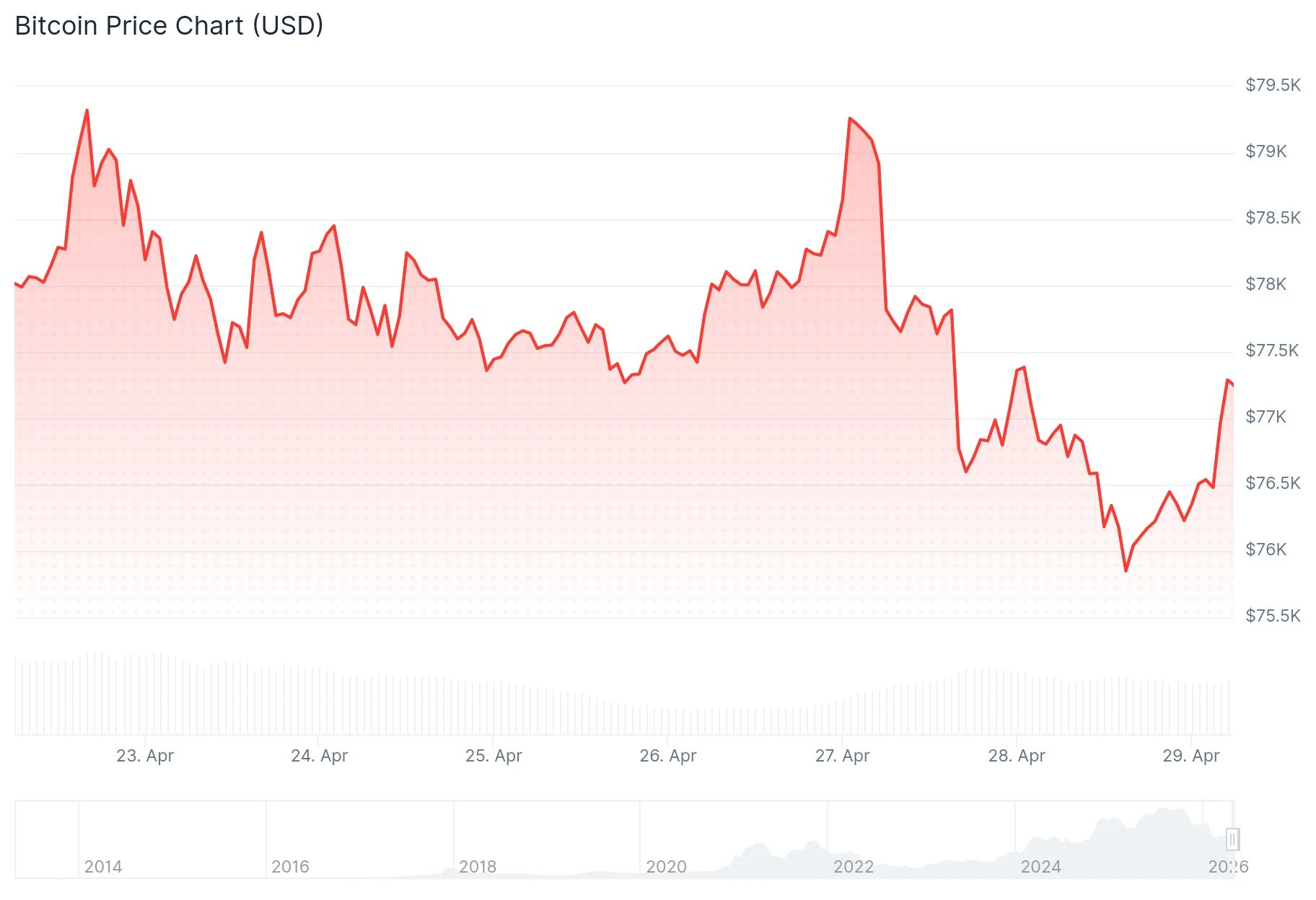
- Bitcoin maintains position just under $77,000 with a modest 0.1% increase over 24 hours
- Crude oil prices jumped above $111 per barrel following news of potential U.S. naval blockade in the Strait of Hormuz
- Leading altcoins including ETH, XRP, SOL and BNB post weekly losses; Dogecoin stands as sole gainer
- Market expert Zaheer Ebtikar suggests seller exhaustion has reduced BTC’s reaction to macroeconomic developments
- Critical price zones: $75,000 represents crucial support level, $80,000 breakout needed to sustain bullish momentum
Bitcoin continues to demonstrate remarkable stability around the $77,000 mark despite turbulence in energy markets and a broader cryptocurrency selloff. The flagship digital asset shows a minimal 0.1% gain over the last day while posting a 0.8% weekly decline.
Brent crude oil prices surged beyond $111 per barrel after the Wall Street Journal revealed that President Donald Trump instructed advisors to prepare for a prolonged U.S. naval blockade in the Strait of Hormuz. WTI crude simultaneously crossed back above the $100 threshold on Tuesday.
In a Truth Social post, Trump claimed Iran communicated it was experiencing a “State of Collapse” and sought the reopening of the Strait. Iranian officials have suggested openness to an interim agreement contingent on Washington removing its blockade of Iranian ports.
[[LINK_START_0]]https://twitter.com/wallstengine/status/2049119139370045712?s=20[[LINK_END_0]]
The energy market turmoil sent shockwaves through risk-sensitive assets. U.S. equity markets opened in negative territory Tuesday, though Nasdaq 100 futures managed to recover 0.4% during Asian trading sessions.
BTC/USD experienced a brief drop below $76,000 during Tuesday’s Wall Street opening before staging a modest recovery. This marked a seven-day low and reversed much of the earlier weekly gains.
Alternative Cryptocurrencies Struggle as Bitcoin Dominance Expands
While Bitcoin demonstrated relative strength, the broader top 10 cryptocurrencies surrendered recent gains. Ethereum declined 2.6% weekly to reach $2,310. XRP tumbled 3.8% to $1.39. Solana decreased 3.2% to $84.57. BNB retreated 2.3% to $625.
Dogecoin emerged as the notable outlier, climbing 5.5% over the week to $0.1016. It remained the only top-10 non-stablecoin asset posting positive seven-day returns.
Consequently, Bitcoin’s market dominance metric has been gradually increasing. This pattern typically emerges during periods of macroeconomic uncertainty when capital flows toward the most established cryptocurrency.
Zaheer Ebtikar, founder of Split Research, explained to CoinDesk that this market behavior signals a fundamental transformation.
“The supply overhang has finally dried up,” he said. “Bitcoin is far less sensitive to regulatory noise or central bank policy than people think. Its sensitivity is purely a function of wider volatility.”
Critical Price Thresholds Under Trader Scrutiny
Bitget analysts highlighted $75,000 as the essential support threshold. A decisive breach below this level could trigger additional downward pressure. Conversely, a push back toward $80,000 from current levels would preserve the bullish structure.
Glassnode, an on-chain analytics provider, observed that ongoing disruptions in the Strait of Hormuz continue constricting supply and generating widespread market anxiety.
https://twitter.com/glassnode/status/2049116949343342999?s=20
Material Indicators, a trading analytics service, noted that BTC bulls lack strong conviction for a robust double-bottom recovery and cautioned about increasing volatility approaching the month’s end.
Analyst Ali Charts (@alicharts) highlighted that [[LINK_START_2]]Bitcoin[[LINK_END_2]] is penetrating a significant trendline, suggesting a possible momentum shift.
[[LINK_START_3]]https://twitter.com/alicharts/status/2049171282650906678?s=20[[LINK_END_3]]
Analyst Ted (@TedPillows) indicated that a monthly close above present levels could ignite a rally toward $80,000, whereas closing below would likely validate $79,500 as the local peak.
[[LINK_START_4]]https://twitter.com/TedPillows/status/2049193775122223420?s=20[[LINK_END_4]]
The Federal Reserve’s upcoming rate decision announcement is scheduled for Wednesday. The European Central Bank follows Thursday. These monetary policy events could inject fresh volatility into both cryptocurrency and conventional financial markets.
BTC currently trades just beneath $77,000, maintaining its consolidation range as market participants await the next macroeconomic catalyst.

The U.S. Commodity Futures Trading Commission has filed a federal lawsuit against the state of Wisconsin, alleging that federal law governs prediction-market contracts and that Wisconsin’s actions to curb or criminalize these markets interfere with that framework. The complaint follows Wisconsin’s own litigation against five platforms—Kalshi, Polymarket, Crypto.com, Robinhood, and Coinbase—each of which the state contends operates prediction-market activity subject to state gaming licensing requirements.
The CFTC said in a statement that the lawsuit against Wisconsin was brought “in response to the state’s lawsuits against Kalshi, Polymarket, Crypto.com, Robinhood, and Coinbase, five CFTC-regulated prediction markets.” CFTC Chairman Michael Selig emphasized that states cannot contravene Congress’s clear directive on financial market regulation. “States cannot circumvent the clear directive of Congress,” he stated. “Our message to Wisconsin is the same as to New York, Arizona, and others: if you interfere with the operation of federal law in regulating financial markets, we will sue you.”
According to the agency, the action is its fifth affair with a state seeking to halt prediction-market activity. The CFTC previously pursued complaints against New York and, earlier this month, filed suits against Arizona, Connecticut, and Illinois after those states moved to regulate or shut down platforms operating event contracts. The Wisconsin filing underscores the ongoing, broader legal clash over whether state action may constrain federally regulated markets or whether such markets remain exclusively within federal oversight.
Michael Selig speaking on stage at Bitcoin 2026 in Las Vegas. Source: YouTube
Wisconsin’s lawsuit, filed in federal court, mirrors the state’s broader position that prediction markets that offer sports-related event contracts constitute illegal gambling requiring state gaming licenses. The CFTC and the platforms have consistently rejected that view, arguing that such contracts fall under federal regulation as designated contract markets. The agency contends that Wisconsin’s gambit to criminalize or block these markets would undermine the federal framework established to regulate national swaps markets.
In its complaint, the CFTC argued that Wisconsin’s attempts to criminalize federally regulated markets intrude on the exclusive federal scheme Congress designed to oversee national swaps markets. The agency sought a declaration that state gambling laws do not apply to CFTC-regulated designated contract markets and a permanent injunction preventing Wisconsin from enforcing state actions against prediction markets. The complaint named Wisconsin Governor Anthony Evers, Wisconsin Attorney General Josh Kaul, and the Wisconsin Gaming Division and its administrator, John Dillett, as defendants alongside the state’s actions.
State officials were contacted for comment, but no additional statements were provided in the initial disclosures. The legal maneuver comes amid a broader policy dispute about the proper locus of regulation for prediction markets, a class of financial infrastructure that has evolved rapidly alongside crypto-enabled platforms and traditional financial market mechanisms.
Key takeaways
- The CFTC asserts exclusive federal jurisdiction over prediction-market event contracts, arguing that state gaming laws cannot override the federally regulated framework for designated contract markets.
- The Wisconsin action targets five platforms—Kalshi, Polymarket, Crypto.com, Robinhood, and Coinbase—in the context of Wisconsin’s broader claim that prediction markets operate as illegal gambling without proper licensing.
- This case marks the fifth time the CFTC has sued a state to block state-level actions against prediction markets, following recent suits against New York, Arizona, Connecticut, and Illinois.
- The complaint explicitly links the federal regulatory regime to the operation of designated contract markets, seeking injunctive relief to prevent Wisconsin from taking enforcement actions against these markets.
- For market participants, the proceedings underscore ongoing regulatory contention around jurisdiction, licensing, and compliance requirements for prediction-market platforms in the United States, with implications for AML/KYC frameworks and licensing regimes.
Federal framework versus state enforcement: legal framing and implications
The core legal question in Wisconsin’s dispute centers on the proper locus of regulation for prediction-market contracts, which are traded on designated contract markets under federal law. The CFTC’s position rests on the argument that the contracts—designed to settle on the outcome of real-world events such as sports results or other occurrences—are financial instruments that fall within the federal regime administered by the CFTC, and that designated contract markets operate under federal preemption. In this view, state gambling statutes and licensing schemes cannot legitimately compel or criminalize activity that the federal government has already cleared for operation under the designated contract market framework.
Observers note that the CFTC’s ongoing strategy is to defend a narrow yet potentially far-reaching jurisdictional principle: that federal preemption governs the operation of national markets that rely on centralized, federally supervised trading venues. By layering state gaming or gambling statutes atop or alongside this regime, Wisconsin argues a traditional state authority to license or prohibit activities within its borders. The dispute thus embodies a fundamental tension in U.S. financial regulation: the balance between state-level enforcement prerogatives and the reach of federal market governance, particularly as new market mechanisms emerge at the intersection of traditional finance and digital platforms.
From a policy and enforcement perspective, the case contributes to the broader debate about how to regulate fast-evolving, technology-enabled markets. If federal courts affirm the CFTC’s exclusive-oversight position, platforms operating prediction markets could gain greater regulatory clarity and uniform compliance expectations, potentially reducing the cost and complexity of navigating multiple state regimes. Conversely, if states succeed in asserting licensing or prohibitory authority, a patchwork regulatory environment could emerge, complicating cross-state operations and raising questions about the enforceability of federal prerogatives in the face of diverse state laws.
Implications for platforms, compliance, and market structure
The Wisconsin action explicitly centers on five platforms that the state contends operate in a regulated space that requires state gaming licenses. Kalshi, Polymarket, Crypto.com, Robinhood, and Coinbase are named in the litigation, with the CFTC asserting that their activities fall under the federal designation of contract markets and are therefore subject to federal oversight rather than state gambling statutes. The dual-layered enforcement posture—state lawsuits paired with federal action—highlights the complex compliance implications for platforms that bridge traditional financial markets, crypto assets, and prediction markets.
For regulated venues, the case underscores the importance of robust, federally compliant gatekeeping measures, including registration as a designated contract market and adherence to the range of obligations that accompany such status. It also emphasizes the need for clear customer due diligence and transaction monitoring to remain aligned with AML/KYC frameworks prominent in federal oversight. While the platforms named have operated with varying degrees of federal recognition, this litigation signals that regulators are prepared to assert that federal permission is a prerequisite to offering prediction-market contracts on U.S. soil.
Beyond platform-level implications, the proceedings have bearings on licensing, cross-border access, and the interface with other regulatory bodies, including the SEC, DOJ, and financial-market authorities. The broader policy environment—characterized by heightened scrutiny of crypto-enabled financial services—may prompt exchanges and institutions to reassess product catalogs, risk controls, and interagency coordination to meet evolving compliance expectations. The case also intersects with ongoing debates about market integrity, insider trading risk, and transparent governance of event-driven instruments in a rapidly changing market ecosystem.
Closing perspective
The Wisconsin litigation reinforces a continuing crosswinds between state authority and federal market regulation in the United States, particularly as prediction markets evolve alongside traditional finance and crypto-native platforms. The outcome will shape how states calibrate their enforcement actions and how platforms structure compliance programs to align with a federal preemption narrative. As courts adjudicate these questions, observers should watch for rulings that clarify the boundaries of state licensing power and the resilience of the CFTC’s designated contract market framework in a rapidly changing regulatory landscape.
What We Would Have Done with Every Vikings Draft Pick

Reach the Money, Win $10,000

ASX continues slide as inflation points to rate hike

Manchester United reach agreement with Casemiro over contract clause amid transfer speculation

US brings back mandatory military draft registration

Steven Gerrard disagrees with Gary Neville over ‘shock’ Chelsea and Arsenal claim | Football


-

 Tech2 days ago
Register Renaming | Hackaday
-

 Fashion5 days ago
Weekend Open Thread – Corporette.com
-
 Crypto World4 days ago
Hyperliquid $HYPE Rally Builds Momentum as AI Sector Enters Prove-It Phase
-

 Politics7 days ago
Making troops accountable for war crimes threatens US alliance, ex-SAS colonel warns
-

 Politics7 days ago
Disabled people challenge government SEND proposals over segregation concerns
-

 Business5 days ago
Patterson-UTI Energy, Inc. (PTEN) Q1 2026 Earnings Call Transcript
-

 Business7 days ago
Rolls-Royce Voted UK’s Most Iconic Trade Mark as IPO Register Hits 150
-
 Sports3 days ago
IPL 2026: Ruturaj Gaikwad registers slowest fifty of the season, enters all-time unwanted list | Cricket News
-

 Politics1 day ago
Drax board avoid their own AGM, accused of greenwashing & environmental racism
-

 Politics7 days ago
Zack Polanski responds to home secretary’s taser threat
-
Politics7 days ago
Wings Over Scotland | How To Get Away With Crimes
-

 Politics7 days ago
Starmer handler McSweeney to be dragged from shadows by Foreign Affairs Committee
-

 Politics6 days ago
‘Iran is still a nuclear threat’
-

 NewsBeat3 days ago
LK Bennett closes all stores after entering administration
-
 Sports6 days ago
Tim Bradley names the current best in the world: “Better than Inoue and Usyk”
-

 Crypto World5 days ago
Michael Saylor says BTC winter is over. Market analyst disagrees, says bitcoin was in a pullback
-
 Entertainment4 days ago
Mariah Carey Slams Deposition Claims In Brother’s Lawsuit
-
Business6 days ago
Altimmune prices $225 million public offering at $3 per share
-
Entertainment6 days ago
Michael B. Jordan and Austin Butler's “Miami Vice” movie will bring the action back to the '80s
-
Crypto World5 days ago
Is Algorand One of the Few Quantum-Resistant Blockchains? Here’s What the Data Shows
You must be logged in to post a comment Login