Bitcoin treasury company Strategy and its perpetual preferred stock, STRC, have been the “single biggest factor” in the recent rally of Bitcoin, which has jumped 20% from its February low, according to Bitwise chief investment officer Matt Hougan.
Over the past eight weeks, Strategy has added $7.2 billion in Bitcoin, Hougan said in a report published Tuesday.
“Yes, there have been multiple drivers of the recent rally, including strong buying from ETFs, $3.8 billion since March 1, and renewed purchases by long-term holders. But Strategy has been the single biggest factor,” he said.
Bitcoin has traded between $75,849 and $79,321 over the past seven days, according to CoinGecko. It was trading at about $76,486 as of Wednesday, up 21% from its Feb. 6 low of $62,822.
Advertisement
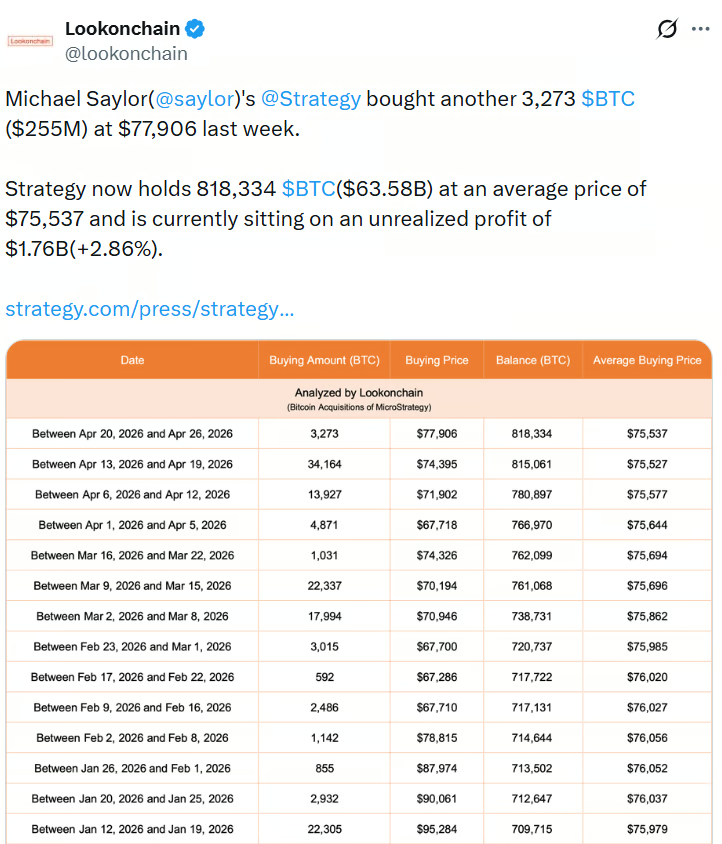
Strategy is the largest publicly listed corporate Bitcoin holder. It bought 3,273 Bitcoin for $255 million between April 20 and April 26, bringing total holdings to 818,334 BTC.
Strategy typically makes weekly Bitcoin purchases. Its latest buying spree pushed its total holdings past those of global asset manager BlackRock, which holds about 812,300 coins on behalf of its clients.
Hougan speculates that Strategy’s purchases will “continue for some time to come,” driven by the issuance of STRC, the company’s perpetual preferred stock, which pays a fixed dividend to investors for as long as the company operates.
Advertisement
“Strategy issues STRC because it wants to buy more Bitcoin. Most of the capital raised by issuing STRC is used to purchase BTC on the open market,” he said.
“With junk bonds yielding less than 7% and investors fleeing private credit, STRC’s 11.5% yield — backed by a more than $40 billion bitcoin cushion — looks particularly attractive. I suspect Strategy will raise billions more through STRC,” Hougan added.
Saylor has previously claimed that the company can sustain dividend payments indefinitely if Bitcoin continues to grow.
Advertisement
Hougan said that at current prices, Strategy could “hypothetically pay existing dividends for 42 years.” However, if Bitcoin rises by 20% a year, it could “pay the dividends forever.”
Strategy could surpass Satoshi soon
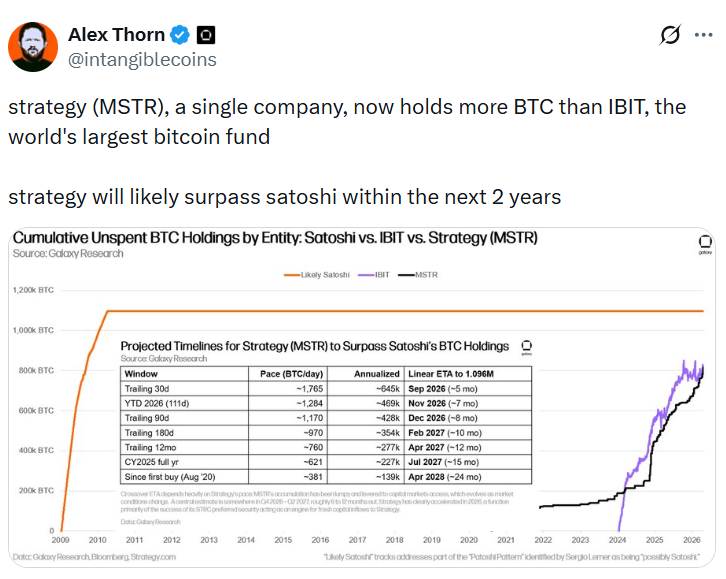
If Strategy continues at its current pace, its holdings may surpass those of Bitcoin creator Satoshi Nakamoto within the next two years, according to Alex Thorn, head of research at crypto-focused financial services firm Galaxy Digital.
Wallets believed to be owned by Nakamoto hold 1.1 million Bitcoin, representing about 5.5% of the total supply. Strategy would need to buy another 277,666 coins to match Nakamoto.
Advertisement
However, Strategy’s Bitcoin purchases have varied significantly. The smallest buy in 2026 was 855 Bitcoin in February, while the largest so far this year was on April 20 with 34,164 coins.
Cointelegraph is committed to independent, transparent journalism. This news article is produced in accordance with Cointelegraph’s Editorial Policy and aims to provide accurate and timely information. Readers are encouraged to verify information independently.
Tether has introduced a Bitcoin faucet inside its self-custody wallet, offering small BTC payouts through the Lightning Network to bring new users into its ecosystem.
Summary
Tether has launched a Bitcoin faucet within its self-custody wallet, distributing small BTC amounts through the Lightning Network.
Users must link their tether.me usernames and interact with official posts to receive instant payouts.
According to Paolo Ardoino, who announced the feature at Bitcoin 2026 in Lugano, the faucet forms part of the newly launched tether.wallet application, where users can claim Bitcoin by interacting with the firm’s official social channels and linking their tether.me usernames.
A verified response tagged with @btc triggers an instant Lightning Network transfer to the user’s wallet, delivering funds without on-chain delays.
Advertisement
Lightning payouts positioned as entry point
Using the Lightning Network for distribution, Tether has tied the faucet directly to low-cost, near-instant transactions, allowing users to test Bitcoin transfers without handling traditional network fees or wait times.
The company has framed this approach as a practical introduction for users already familiar with stablecoin transactions but new to Bitcoin’s scaling layers.
Details shared at the event indicate that the faucet also highlights the wallet’s use of human-readable identifiers, where funds are sent to usernames instead of long wallet addresses, reducing friction during onboarding.
Advertisement
Tether has connected the rollout to its push for self-custody adoption, placing Bitcoin, USDT, and XAUT within a single wallet interface. The faucet serves as an initial incentive, giving users a small balance that can be managed alongside other assets without relying on third-party custodians.
Revival of an early Bitcoin distribution model
Earlier industry developments show similar attempts to revive faucet-based onboarding. On April 19, 2026, Jack Dorsey said Block planned to relaunch a Bitcoin faucet through btc.day, revisiting a concept first introduced in 2010 by Gavin Andresen, who distributed 5 BTC to users completing simple verification steps.
While Block has not yet disclosed how its new faucet will operate or how much BTC it will distribute, both initiatives draw from the same early model that helped users test wallets and understand Bitcoin transactions when the network was still in its early stages.
Canada has moved to tighten oversight of cryptocurrency use by proposing a nationwide ban on crypto ATMs while advancing legislation to block digital asset donations in federal elections.
Summary
Canada has proposed a nationwide ban on crypto ATMs, with CBC News reporting they are widely used in fraud schemes.
FINTRAC has identified crypto ATMs as a recurring channel in suspicious transaction reports linked to scams.
Lawmakers have advanced Bill C-25 to prohibit crypto donations in elections, citing challenges in verifying donor identities.
According to CBC News, the federal government has outlined plans in its Spring Economic Update 2026 to ban crypto ATMs, describing them as a key tool used by scammers to extract funds from victims and process illicit cash.
The report notes that officials have linked the machines to fraud activity across the country, with investigations identifying them as a primary channel through which victims are instructed to transfer money.
Advertisement
A months-long investigation by CBC News, which included input from law enforcement agencies, financial regulators, industry participants, and fraud victims, found that crypto ATMs have become a central mechanism in scam operations. Financial Transactions and Reports Analysis Centre of Canada reached a similar conclusion in a February 2023 analysis of suspicious transaction reports, identifying these machines as a recurring route used in fraud schemes.
Across Canada, nearly 4,000 crypto ATMs are currently in operation, the highest number per capita globally, according to CBC News.
These machines allow users to deposit cash and convert it into cryptocurrencies such as Bitcoin, which can then be sent to digital wallets with limited identity verification.
Advertisement
Transactions under $1,000 often require only a phone number, while the absence of in-person oversight removes the chance for intervention during suspected fraud attempts.
Although crypto ATMs are regulated as money services businesses, CBC News reports that Canada does not yet have industry-specific rules governing their operation. Officials have pointed to this gap while outlining the proposed ban as part of a wider effort to address fraud risks tied to digital asset access points.
Lawmakers push ahead with crypto donation ban
Separately, lawmakers have continued to advance restrictions on the use of cryptocurrency in political financing through Bill C-25, known as the Strong and Free Elections Act. The proposed legislation has passed second reading in the House of Commons and would prohibit political parties, candidates, and associated entities from accepting crypto donations.
The bill extends the restriction to leadership campaigns, nomination contests, riding associations, and third-party advertisers, requiring any prohibited contributions to be returned or transferred to the Receiver General within 30 days. According to statements from government officials, the proposal addresses concerns over verifying donor identities and tracing the origin of funds when digital assets are used.
Jan3 CEO Samson Mow has declared that the Bitcoin price prediction for the four-year halving cycle is dead. Mow is replacing it with something far more explosive: an “Omega candle” targeting $1 million.
In a recent interview, Mow argued that available BTC supply is dramatically lower than the market recognizes, making any price below $120,000 structurally undervalued.
“Everything is up in the air now,” he said. “An Omega candle and $1 million Bitcoin is just around the corner, especially with all the buy pressure that is flooding the market now with Saylor through STRC and other Bitcoin treasury company players all coming in.”
JUST IN: SAMSON MOW JUST SAID THE 4-YEAR CYCLE IS DEAD AND #BITCOIN IS HEADING TO $1,000,000 SAYLOR IS FLOODING THE MARKET WITH BUY PRESSURE "THERE IS NOT ENOUGH SUPPLY" BREAKOUT SOON pic.twitter.com/a93eJcmFHI
Bitwise CIO Matt Hougan independently models a $1 million base case within a decade, requiring only 17% share of a projected $121 trillion global store-of-value market. Hougan also added that the Fed’s impact on the Bitcoin price is also fading. Ark Invest’s Cathie Wood and MicroStrategy’s Michael Saylor echo seven-figure targets across separate frameworks.
Advertisement
Bitwise CIO Matt Hougan says the Fed's impact on $BTC is fading. Hougan adds, "We're in an environment where we're feathering rates 25, 50 basis points…The Fed will matter, but on the edges and less than it has in #Bitcoin's history." pic.twitter.com/tglexpGBZa
In the short to mid-term, ETF inflows and evolving regulatory clarity around Bitcoin ETF structures remain macro catalysts to monitor as institutional accumulation accelerates.
Bitcoin Price Prediction: The 1 Million Dollar Question
Advertisement
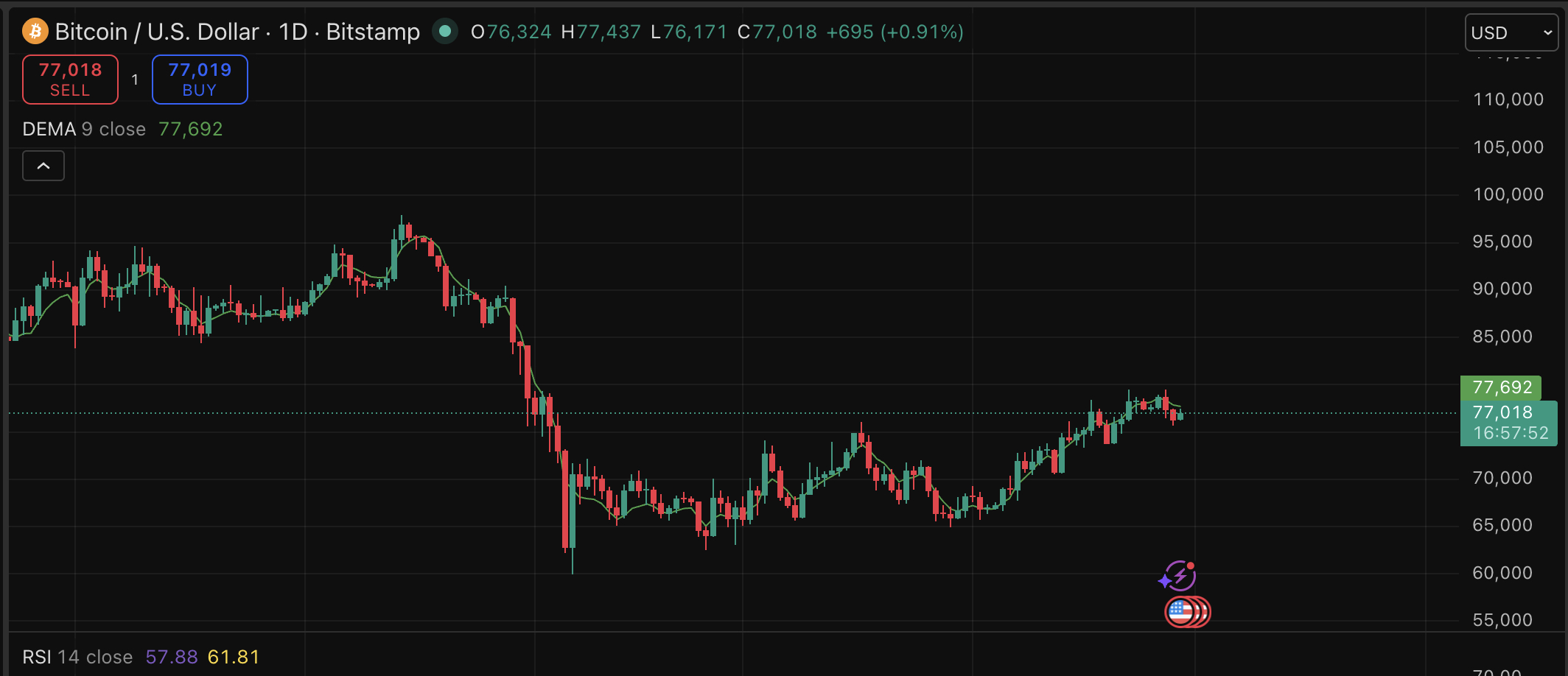
At today’s price of $77,000, Bitcoin sits 40% below its October 2025 record high, a gap that frames two very different narratives simultaneously. The Mow thesis demands ignoring that gap entirely. The counter-thesis reads it as a classic post-euphoria distribution phase.
BTC USD, TradingView
Technically, momentum favors the bulls in the near term. Bitcoin has pushed steadily higher on a store-of-value narrative, with price action showing consolidation.
Hougan’s math is worth internalizing, especially from what we saw with gold. The precious metal’s addressable market grew from $2.5 trillion in 2004 to $40 trillion today in a 16x expansion that no one predicted. If the store-of-value market reaches $121 trillion on a similar trajectory, Bitcoin’s 21 million coin hard cap does the rest of the arithmetic.
With the supply shock driven by treasury accumulation. Saylor’s STRC vehicle alone represents sustained institutional bid pressure that could trigger the Omega candle. A near-vertical price surge compresses months of price discovery into days, targeting $1 million.
The critical variable is timing. Mow offered none. That ambiguity may actually be the honest answer.
Bitcoin Hyper Targets Early-Mover Upside as BTC Eyes Historic Levels
Bitcoin is a good investment, but $1 million might be too far-fetched. For us who missed the early BTC entry, that math stings. The question becomes where comparable asymmetry still exists in the Bitcoin ecosystem.
Bitcoin Hyper ($HYPER) is one answer drawing significant presale capital. The project is positioning itself as the first-ever Bitcoin Layer 2 with Solana Virtual Machine (SVM) integration that delivers faster performance than Solana, while inheriting Bitcoin’s security and trust layer.
Advertisement
Hyper directly addresses Bitcoin’s three structural constraints: slow transactions, high fees, and the absence of programmable smart contracts.
The presale has raised more than $32.5 million at a current token price of $0.0136793, with 36% APY staking rewards available only to early participants.
Aptos Labs founding engineer Sherry Xiao said Aptos’ newly introduced privacy coin could fix a long-standing trade-off between protecting user privacy and preserving transparency for compliance.
“Confidential APT” launched on the Aptos mainnet on Friday after a governance proposal to integrate the privacy feature passed in a near-unanimous vote. It uses zero-knowledge proofs to conceal token balances and transfer amounts while still enabling transactions to be verified.
While blockchains offer a level of transparency that most traditional ledgers do not, the lack of privacy has slowed individual and enterprise adoption due to the risk of exposing financially sensitive information.
In an interview with Cointelegraph, Xiao said Confidential APT — which is pegged 1:1 to Aptos (APT) — reduces the risks of users being subjected to wallet profiling or targeted scams:
Advertisement
“Portfolio sniping, social pressure from visible holdings, personal safety — these are pain points people feel today.”
Confidential APT can conceal salaries, business strategies
Xiao said the Confidential APT token solves an active problem in the workplace, too.
“If a company runs payroll on-chain with visible amounts, every employee’s salary is permanently public — to coworkers, competitors, recruiters, everyone,” she said.
“Same with treasury moves, settlement flows, trading strategies,” Xiao said, noting that blockchain’s lack of privacy is an “operational dealbreaker” for many businesses.
Auditor keys may only be authorized following a successful onchain governance vote, she noted:
“This approach allows relevant parties to access information like transfer amounts for investigations, while preserving privacy as the default for users.”
While Confidential APT conceals token balances and transfer amounts, the wallet addresses involved and transaction verification remain visible, distinguishing it from other privacy-focused cryptocurrencies like Monero (XMR).
Advertisement
Xiao said she expects individuals to adopt Confidential APT faster than businesses, noting that integrating the privacy coin into the tax reporting pipeline and compliance will take some time.
That said, “If Confidential APT runs on mainnet for six months with solid volume and no issues, that’s the proof point that shortens the enterprise sales cycle,” Xiao added.
Cointelegraph is committed to independent, transparent journalism. This news article is produced in accordance with Cointelegraph’s Editorial Policy and aims to provide accurate and timely information. Readers are encouraged to verify information independently.
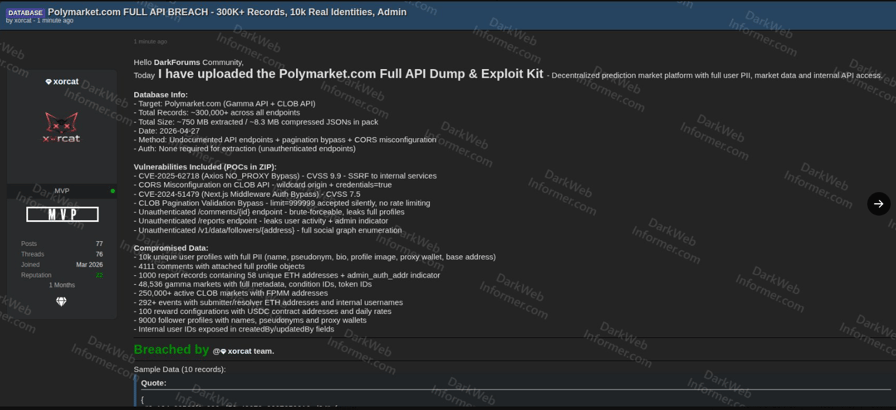
Prediction markets platform Polymarket has denied recent reports that its customer data was breached after a hacker on the dark web posted what the person claimed was a trove of private user details.
Cybersecurity company Vecert Analyzer and several other X accounts that track dark web activity shared screenshots from DarkForums on Tuesday showing a hacker using the pseudonym “xorcat” claiming to have breached Polymarket.
In the post, xorcat said they had stolen over 300,000 records, including 10,000 unique user profiles with full names, profile images, proxy wallets and base addresses.
Polymarket called the claims of a data breach “complete and utter nonsense” and said the information the hacker posted is already available online.
Advertisement
The crypto industry saw a sudden surge in crypto-related hacks and exploits in April, putting many in the space on high alert. Blockchain security company Hacken reported earlier this month that Web3 projects lost $482 million to hacks and scams in the first quarter of 2026 across 44 incidents.
“You compromised our platform by accessing publicly accessible API endpoints & on-chain data and *checks notes* are trying to sell the data we offer developers for free? Which VC paid you to post this?” Polymarket said.
In another post, the prediction market said: “Part of the beauty of being on chain is all our data is publicly auditable, this is a feature, not a bug. No data was leaked, it’s accessible via our public endpoints & on-chain data. Instead of paying for the data, you can access it for free via our APIs.”
Xorcat also said data was pulled via undocumented API endpoints, pagination bypass and CORS misconfiguration on Polymarket’s Gamma and CLOB APIs. The hacker claimed to have breached other prediction markets and planned to release the data over the next few days.
Several security experts have expressed doubt. Vladimir S, a threat researcher and chief security officer at Legalblock, said it appears “someone parsed data and is trying to present it as a [DB] leak. It does not seem probable to me.”
Cointelegraph is committed to independent, transparent journalism. This news article is produced in accordance with Cointelegraph’s Editorial Policy and aims to provide accurate and timely information. Readers are encouraged to verify information independently.
Canada has proposed banning crypto ATMs nationwide as part of measures unveiled in the federal Spring Economic Update 2026.
The government described the machines as a key tool used by scammers to defraud victims and launder illicit cash proceeds.
“To protect Canadians by shutting down a primary method for scammers to defraud victims and for criminals to place their cash proceeds of crime, the Spring Economic Update 2026 proposes to ban crypto ATMs,” the text reads.
There are nearly 4,000 cryptocurrency ATMs operating in Canada, according to figures cited in CBC. That gives the country the highest concentration of crypto ATMs per capita worldwide.
The proposed ATM ban is positioned as a public safety measure. Canadians would still be able to access services through money services businesses (MSBs), including purchasing digital assets at physical locations, while reducing the sector’s exposure to illicit activity.
Canada’s parliament advanced Bill C-25, which would ban crypto donations to federal political campaigns. The bill passed second reading with cross-party support and heads to committee review.
Meanwhile, the United States is grappling with similar fraud patterns. Americans lost more than $333 million through scams routed via Bitcoin ATM machines in 2025.
It marked a sharp jump from roughly $250 million the year before. Older Americans accounted for the majority of reported victims.
Veteran trader Peter Brandt has pushed back against claims that Bitcoin could reach $250,000 in 2026.
Summary
Peter Brandt said Bitcoin’s rising channel does not confirm a strong bullish bottoming pattern.
Bitcoin traded near $76,000 to $78,000 after rebounding from February’s $60,000 support zone.
On-chain data showed fresh capital inflows, but retail Bitcoin participation remained weak.
His latest chart review warned traders against treating recent price action as the start of a strong breakout. Brandt said Bitcoin has formed an ascending parallel channel over recent weeks. He said the structure can allow more gains, but it does not confirm a major bottom.
Advertisement
“This is called a channel,” Brandt said. “While it does not preclude further price gains, it is NOT a bullish bottoming pattern.”
Bitcoin remains inside rising channel
Bitcoin has been trading near the $76,000 to $78,000 range after recovering from a sharp decline earlier this year. The asset dropped toward the $60,000 support area in February before staging a slow rebound.
Brandt’s chart showed BTC moving higher inside a controlled channel. Such a pattern can show short-term strength, but it can also limit momentum if buyers fail to push price above resistance.
A stronger breakout would require Bitcoin to move above the channel with rising volume. Without that move, traders may continue watching the current range for direction.
Market data shows mixed signals
On-chain analyst Ali Martinez pointed to low short-term Bitcoin participation. He said the share of Bitcoin held by buyers from the past month has fallen below 7%.
Advertisement
According to Ali, this shows weak retail activity and a quieter market. He said past cycles have seen similar readings near areas where selling pressure started to fade.
Ali also said about $3 billion has entered the crypto market over the past 30 days. He described it as the first positive net capital inflow since December.
Additionally, the new inflows suggest market liquidity has started to improve after months of weaker activity. However, Bitcoin still needs stronger buying pressure to confirm a larger move.
For now, Brandt’s view places caution over the $250,000 Bitcoin price target. His analysis suggests the current structure does not yet support such an aggressive 2026 forecast.
Advertisement
Disclosure: This article does not represent investment advice. The content and materials featured on this page are for educational purposes only.
A class action lawsuit has accused Believe founder Ben Pasternak of extracting $54 million in fees through token migrations tied to Launchcoin while leaving investors with losses.
Summary
Plaintiffs allege Ben Pasternak and associated entities generated about $54M in fees across Believe platform tokens, according to the complaint.
Court filings state a token migration increased supply by about 33.3% and erased holdings that were not converted within the set deadline.
Separate New York court records show Pasternak has pleaded not guilty to assault related charges linked to a March 31 incident and is due back in court on June 11.
According to a complaint filed in the U.S. District Court for the Southern District of New York, plaintiffs Joshua Lee and Pierre Montmeas alleged that Pasternak and associated entities, including B24, Inc. and the Believe Foundation, carried out a series of token launches and migrations that generated significant revenue while reducing the value of investor holdings.
Court filings state that the Believe platform processed nearly $6 billion in trading volume and collected an estimated $54 million in fees across tokens such as $PASTERNAK, $LAUNCHCOIN, and $BELIEVE.
Advertisement
Migration terms and dilution claims
Details in the complaint identify an October 2025 migration from $LAUNCHCOIN to $BELIEVE as the central point of dispute. Plaintiffs claim the total token supply increased from 1 billion to over 1.33 billion during the process, introducing roughly 333 million new tokens and diluting existing holders by about 33.3%.
A two-week migration window required users to convert their holdings within a set deadline, after which any remaining tokens were permanently burned, according to the filing.
Further allegations state that newly created tokens were allocated to insider-linked wallets, while a portion of the foundation’s allocation, estimated at around 40 million tokens, was unlocked immediately.
Advertisement
In one of the cited claims, the complaint states, “Pasternak ran the same play three times, under three different token names: generate excitement, bring consumers in, collect fees, and let the token collapse.”
Criminal case unfolds alongside civil claims
Separately, court records from the New York State Unified Court System show that Pasternak was arrested on April 22 on one count of second-degree strangulation and two counts of third-degree assault linked to a March 31 incident at the Baccarat Hotel in New York.
Authorities allege the incident involved physical harm to a 27-year-old YouTube creator, Evelyn Ha, including neck injuries and bruising, while Pasternak has pleaded not guilty and is scheduled to appear in court on June 11.
Statements from Pasternak’s legal team, reported in the filing, say he acted in self-defense, while a spokesperson close to him described the complainant as the aggressor during the altercation.
Advertisement
The civil complaint also claims that Pasternak failed to fulfill at least 12 publicly stated buyback commitments and continued to collect transaction-related fees despite earlier statements indicating “zero ownership” in the tokens.
Plaintiffs have asked the court to freeze on-chain assets tied to the project, including wallets and token reserves, while seeking recovery of what they describe as unlawfully obtained revenues.
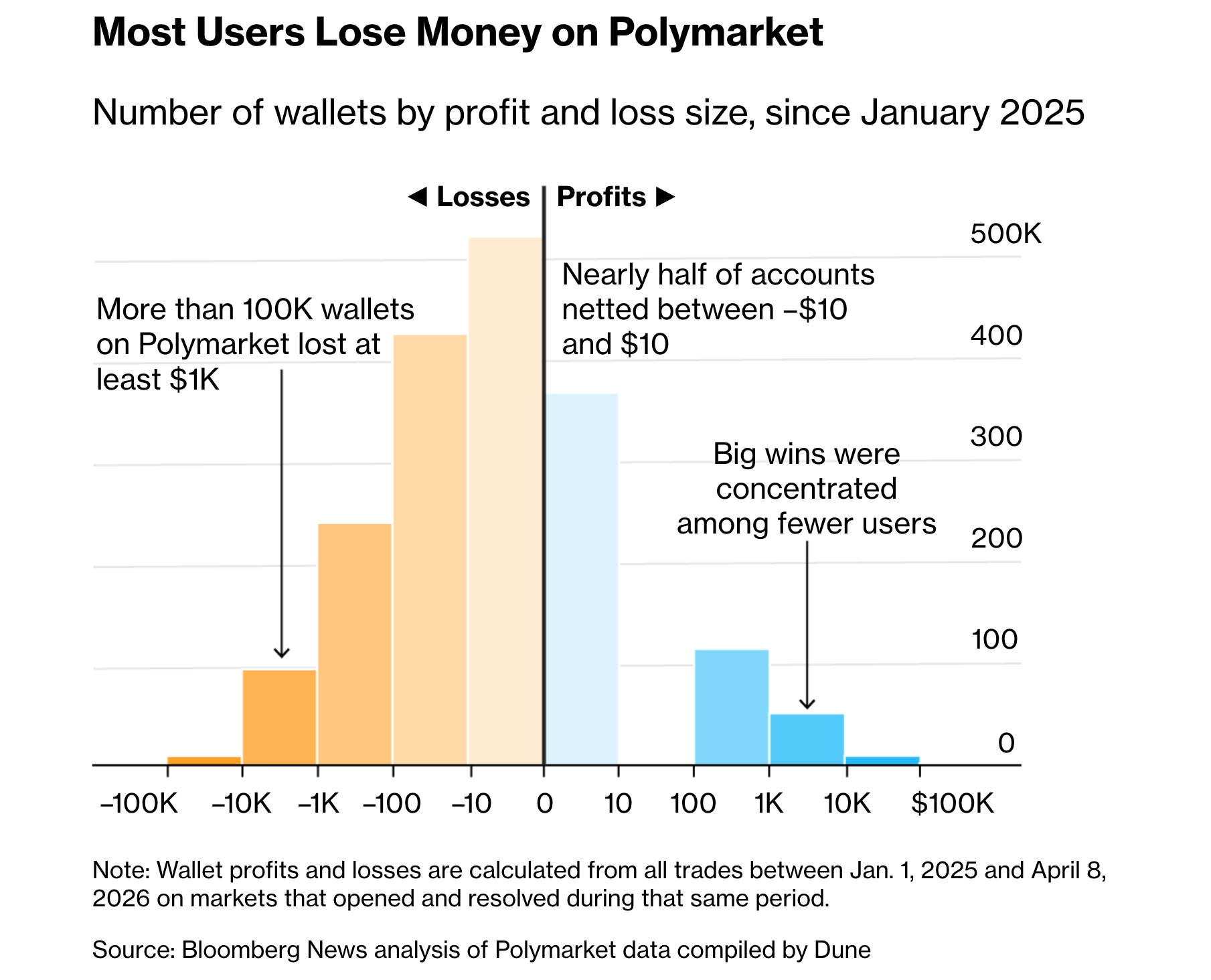
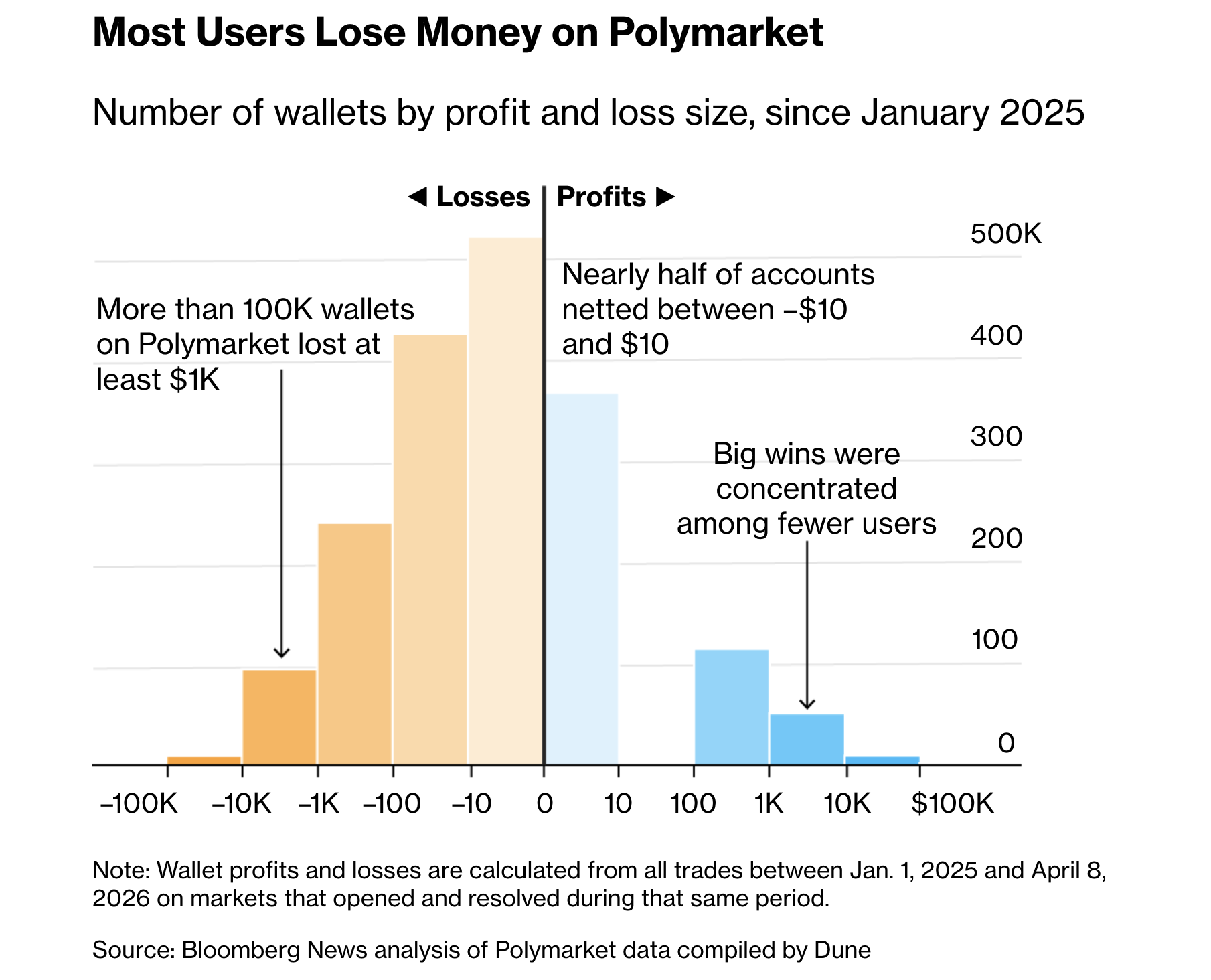
A Bloomberg analysis found that most traders on prediction markets are losing money, often by significant margins.
Since January 2025, more than 100,000 Polymarket accounts have recorded losses of at least $1,000, nearly double the number of wallets posting comparable gains.
Polymarket Side Hustle Dream Dies in Bloomberg Investigation
According to the report, the bulk of winnings flowed to a small group of accounts that appear to be automated trading bots. Of the roughly two million wallets that have been active on the platform since the start of 2025, nearly half saw gains or losses of under $10.
This suggested that many users were simply testing out this form of wagering. Yet even within that casual cohort, the majority finished underwater.
Advertisement
Follow us on X to get the latest news as it happensPolymarket Users’ Profit and Loss. Source: Bloomberg
Separately, researchers from the University of Toronto, HEC Montréal, and ESSEC Business School examined Polymarket data. Their paper covered 2.4 million users and $67 billion in trading volume.
The study found 68.8% of users lost money since 2022. Meanwhile, the top 1% of traders captured 76.5% of all gains. The top 0.1% alone accounted for more than half of the platform’s total profits.
“Users who lose money trade considerably more often at extreme prices (below 10¢ or above 90¢) than users who gain: the bottom 95% of users place 56% of their trades at these prices, against 28% for the top 0.1% of earners,” the paper read. “We urge caution in interpreting this finding as representing skill (or information) since we lack the tools typically used to assess performance in financial markets.”
Bloomberg also noted that roughly 5% of bot-like wallets generated 75% of trading volume on Polymarket. Among those high-volume accounts, 823 netted more than $100,000 in profit each.
“These high-volume accounts collectively turned a profit of $131 million, mostly concentrated among 823 users that netted more than $100,000 each. The less active traders, meanwhile, lost the equivalent amount when all their wins and losses were added up,” the report read.
However, Joshua Della Vedova, a University of San Diego professor, found that retail traders actually picked the winning outcome more often than bots. They lost anyway because they entered positions later, at bad prices.
Advertisement
BeInCrypto has contacted Polymarket for comment on the findings and will update this story if it receives a response.
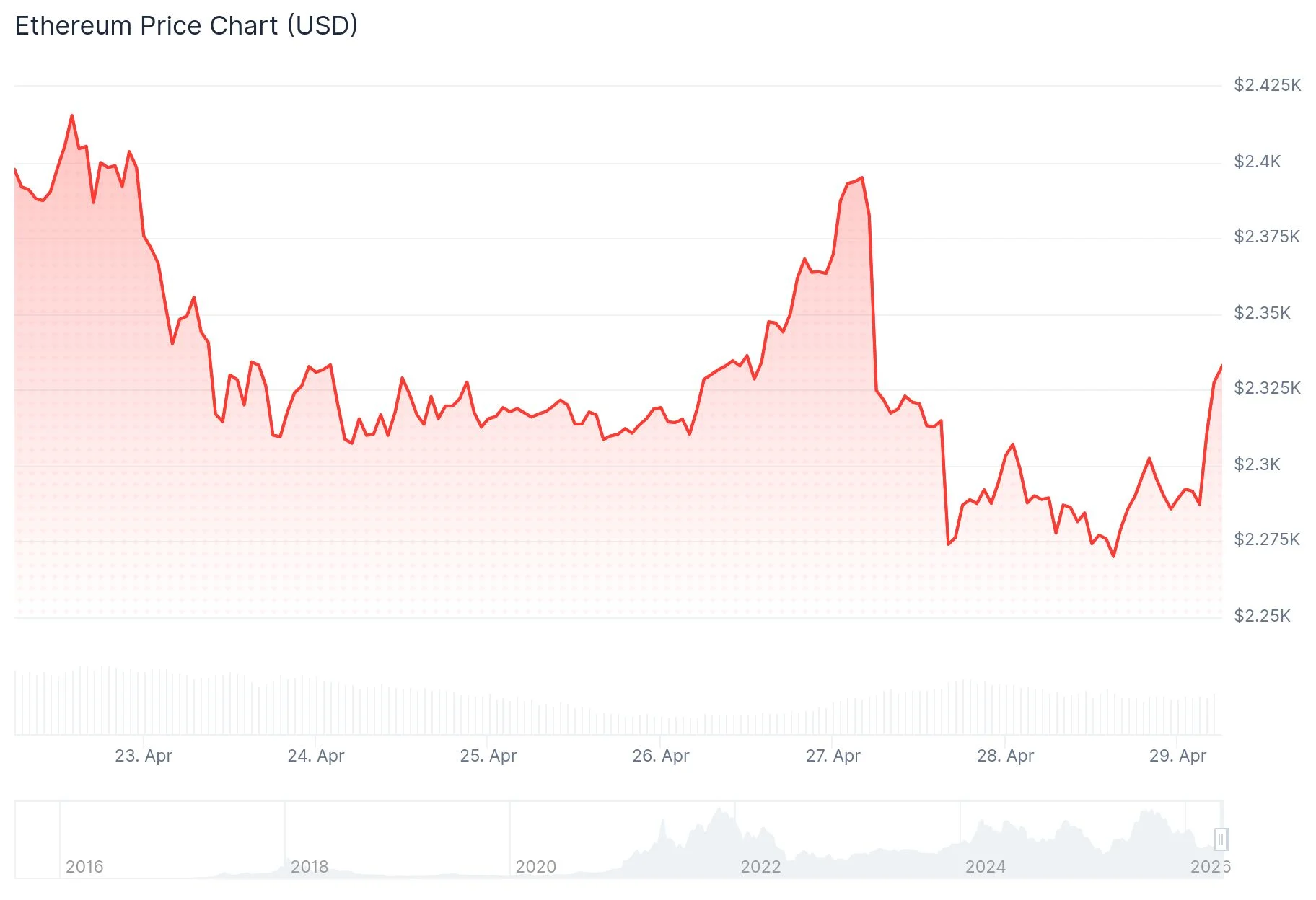
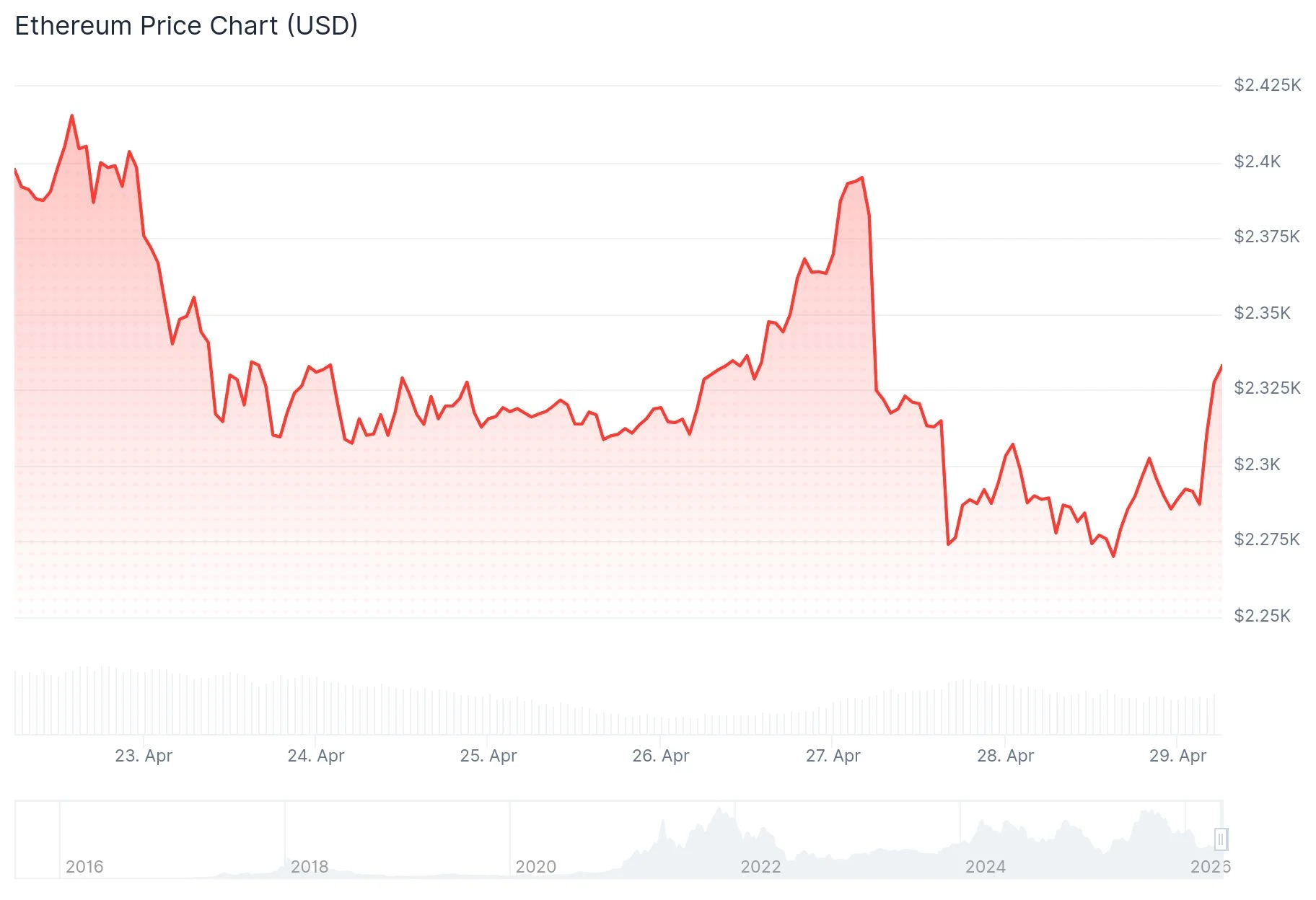
Ethereum currently trades near $2,300 following a 5% decline across the last two sessions, reversing weekend momentum
Critical support sits at $2,200 where the 50-day and 100-day simple moving averages align
Bulls must recapture $2,400 to shift momentum and trigger potential short squeezes
Smaller wallets offloaded 756,000 ETH in the past seven days while whale addresses accumulated 60,000 ETH
Crossing above $2,400 could spark over $1.94 billion in leveraged short liquidations
Ethereum is currently hovering around the $2,290–$2,300 range following a two-day pullback that erased approximately 5% of its value and eliminated weekend price gains. The asset now finds itself compressed between the 100-day exponential moving average (EMA) positioned at $2,350 on the upside and the 100-day simple moving average (SMA) at $2,220 on the downside.
Ethereum (ETH) Price
Market observers suggest this consolidation pattern may persist for several additional sessions before a definitive directional move materializes.
Telegram-based Technical Crypto Analyst highlighted that Ethereum has surrendered its $2,300 support trendline. “We can probably expect Ethereum to drop, and it might even hit the lower support level in the next few days,” the analyst stated. “A solid breakdown with good volume would confirm this.”
Market commentator Ted Pillows reinforced this assessment on X, stating: “ETH has dropped below the $2,300 level. The next crucial support zone is $2,200, which could be a level for a short-term bounceback.”
Trader Daan Crypto Trades identified $2,100 as a significant support floor and $2,800 as a major resistance ceiling that Ethereum has honored across multiple years. Should price action slip beneath $2,200, technical watchers are monitoring the $2,000 psychological barrier and the $1,800–$1,750 range, which corresponds with the multi-year bottom established on February 6.
Retail Distribution Creates Selling Pressure
Blockchain analytics reveal that the Accumulation Addresses Realized Price (AARP) positioned at $2,400 has functioned as a formidable ceiling since Ethereum dropped below this threshold in February. Each subsequent attempt to test this level has encountered renewed distribution activity.
Smaller wallet holders — addresses containing between 100 and 10,000 ETH — offloaded approximately 756,000 ETH throughout the previous week. The majority of these transactions occurred at a loss, indicating either capitulation behavior or strategic risk reduction.
Advertisement
Source: CryptoQuant
Conversely, whale entities demonstrated opposing market behavior, accumulating roughly 60,000 ETH during the same timeframe. While their acquisition pace moderated somewhat, these large holders refrained from selling pressure.
Within the derivatives landscape, perpetual funding rates for ETH have maintained consistently negative territory, signaling that short positioning has dominated trader sentiment. Open interest has similarly contracted over recent sessions.
The Significance of $2,400 and Potential Breakout Implications
CryptoQuant contributor CW8900 identified $2,400 as a crucial psychological threshold. “Breaking through that line signifies that whales are transitioning to a profitable position,” the analyst explained on X, noting that this development would “provide grounds for their buying power to become stronger.”
Liquidation heatmap data from CoinGlass indicates that a rally beyond $2,400 would catalyze more than $1.94 billion in forced short position closures across major exchanges.
Market analyst Ali Charts observed on X that Ethereum is attempting to recapture its Realized Price situated at $2,335. “Successfully turning this level into a floor is a standard technical prerequisite for a sustained rally,” Ali Charts noted.
Ethereum $ETH is attempting to reclaim its Realized Price as support, which is currently at $2,335.
When we look at the MVRV pricing bands, we can see that successfully turning this level into a floor is a standard technical prerequisite for a sustained rally. Historically,… https://t.co/93y0hrX297pic.twitter.com/5oBzCy5npw
On-chain intelligence from Lookonchain revealed that Bitmine, an entity associated with Fundstrat’s Tom Lee, acquired an additional 45,000 ETH valued at approximately $103.5 million through FalconX and BitGo transactions.
The Relative Strength Index currently registers near 52, reflecting neutral momentum conditions. Meanwhile, the Stochastic Oscillator has retreated toward oversold readings, which technical analysts suggest could provide a buffer against additional downside provided Ethereum maintains its current EMA support structure.








pic.twitter.com/a93eJcmFHI
Bitwise CIO Matt Hougan says the Fed's impact on $BTC is fading.


















 Tech2 days ago
 Fashion5 days ago

 Politics7 days ago
 Politics7 days ago
 Business5 days ago
 Business7 days ago

 Politics1 day ago
 Politics7 days ago
 Politics7 days ago
 Politics7 days ago
 NewsBeat3 days ago

 Crypto World5 days ago
You must be logged in to post a comment Login