
Crypto World
TotalEnergies (TTEF) Shares Surge as Q1 Earnings Soar 29% Above Forecasts


Key Highlights
- Q1 adjusted earnings reached $5.4 billion for TotalEnergies, representing a 29% year-over-year increase and surpassing the $5 billion Wall Street estimate
- Quarterly dividend increased 5.9% to €0.90 per share
- Share repurchase program doubled to $1.5 billion for the second quarter from the previous $750 million announced in February
- Refining and chemicals division saw earnings multiply more than five times to reach $1.6 billion
- Shares gained 1.1% to 79.16 euros during morning trading in Paris, with year-to-date performance showing a 42.33% increase
The French energy powerhouse delivered impressive first-quarter results on Wednesday, surpassing Wall Street forecasts across virtually all business divisions. TotalEnergies recorded adjusted earnings of $5.4 billion, marking a 29% surge from the $4.2 billion reported during the corresponding quarter last year.
Wall Street analysts had projected approximately $5 billion in earnings, based on LSEG consensus figures. The impressive performance came even as regional tensions forced the company to temporarily halt roughly 15% of its upstream operations.
What fueled the outperformance? Elevated oil prices combined with robust trading operations linked to Middle Eastern geopolitical tensions.
Brent crude approached multi-year peaks near $120 per barrel following U.S.-Israeli military operations against Iran that commenced in late February. Iran’s retaliatory closure of the Strait of Hormuz and subsequent attacks on neighboring Gulf states — including a Saudi Arabian refinery partially owned by TotalEnergies — triggered significant energy market volatility.
While this turmoil hampered production volumes, it generated substantial profits for the company’s trading desks.
Refining and Chemicals Division Shines Brightest
The refining and chemicals business unit emerged as the quarterly champion. This segment saw earnings explode to $1.6 billion, up more than fivefold, primarily propelled by exceptional trading performance in oil and petroleum products.
The upstream exploration and production division recorded a 5% earnings increase to $2.58 billion. The liquefied natural gas business unit saw a modest 2% uptick to $1.3 billion, despite damage to Qatari LNG infrastructure from Iranian strikes that directly impacts TotalEnergies’ supply chains.
The marketing and services division posted 9% earnings growth to $262 million. Meanwhile, the integrated power segment — encompassing gas-fired generation, renewable energy, and battery storage — increased 8% to $545 million.
Notably, every significant business division delivered positive growth despite widespread disruption across global energy markets.
Enhanced Capital Return Strategy
TotalEnergies leveraged the earnings release to announce a more substantial cash distribution to investors. The quarterly dividend received a 5.9% boost to €0.90 per share.
The share buyback program was doubled to $1.5 billion for the upcoming quarter. This marks a dramatic pivot from February’s announcement, when TotalEnergies reduced buybacks to $750 million amid concerns about declining oil prices affecting future performance.
RBC Capital Markets analyst Biraj Borkhataria characterized the results as encouraging, emphasizing both the dividend enhancement and the expanded buyback initiative. Jefferies analyst Mark Wilson categorized the quarterly report as a “small positive” development.
TTEF shares advanced 1.1% to 79.16 euros during early Paris trading sessions by 07:02 GMT, reaching the highest intraday level observed in over two weeks.
Year-to-date, the stock has appreciated 42.33%.
British competitor BP similarly announced robust Q1 performance on Tuesday, with net earnings more than doubling thanks to identical war-driven trading advantages.


Crypto World
SanDisk (SNDK) Shares Dip Despite Strong Q3 as Seagate (STX) and Western Digital (WDC) Ride AI Storage Wave

Key Takeaways
- SanDisk exceeded Q3 projections with $5.95 billion in revenue, representing a 97% year-over-year increase, yet shares declined over 6% after market close
- The company’s Datacenter division revenue soared more than 300% to reach $1.47 billion during Q3
- Over the past year, Seagate and Western Digital shares have climbed approximately 600% and 850% respectively
- Bank of America characterizes the hard disk drive industry as an “oligopoly,” providing Seagate and Western Digital substantial pricing leverage
- Artificial intelligence-powered data storage requirements continue exceeding available supply, enabling pricing increases across the sector
SanDisk delivered impressive third-quarter results, yet investors responded with skepticism rather than enthusiasm. The company generated $5.95 billion in quarterly revenue, representing a 97% jump from the prior year and substantially exceeding the $4.70 billion analyst projection. On an adjusted basis, earnings reached $23.41 per share, significantly outperforming the $14.54 Wall Street forecast.
Despite previously climbing approximately 350% throughout the current year, shares tumbled more than 6% during Thursday’s extended trading session.
Management’s Q4 revenue outlook of $7.75 billion to $8.25 billion substantially surpassed the $6.49 billion analyst consensus estimate. Similarly, adjusted earnings guidance ranging from $30 to $33 per share exceeded the $22.70 Wall Street expectation by a considerable margin.
What triggered the selloff? Cerity Partners analyst Michael Ashley Schulman offered a straightforward explanation — the forward guidance lacked the compelling “wow factor” necessary to sustain the stock’s upward trajectory. Western Digital experienced a similar fate, declining nearly 8% during the same trading session despite also exceeding estimates and issuing above-consensus guidance.
Chief Executive David Goeckeler characterized the period as transformational. “This quarter marks a fundamental inflection point for Sandisk — where our technology leadership is enabling a deliberate shift in our mix toward the highest-value end markets, led by Datacenter,” he stated.
The Datacenter division emerged as the clear performance leader, generating revenue that increased more than threefold during Q3 to $1.47 billion. Artificial intelligence applications require massive volumes of flash storage capacity, and current demand significantly outstrips available supply — allowing SanDisk to implement premium pricing strategies.
Artificial Intelligence Sparks Storage Infrastructure Race
The storage industry has emerged as one of the most obvious beneficiaries of the artificial intelligence infrastructure expansion. Data centers require high-capacity storage solutions to archive, train, and manage extensive AI datasets. While graphics processing units provide computational power, hard disk drives and flash memory handle data management — and this requirement shows no signs of moderating.
Seagate announced fiscal 2025 annual revenue totaling $9.10 billion, reflecting a 39% year-over-year expansion. The company’s most recent quarterly performance reached $3.11 billion, up 44% and surpassing the $2.95 billion analyst estimate. Adjusted earnings per share of $4.10 exceeded the $3.50 consensus projection.
Western Digital reported fiscal 2025 revenue of $9.52 billion, representing a 51% year-over-year increase. Second-quarter revenue of $3.02 billion topped the $2.98 billion Wall Street forecast. Adjusted earnings per share of $2.13 surpassed the $1.95 expectation.
Bank of America analyst Wamsi Mohan characterized the hard disk drive sector as an “oligopoly,” featuring minimal competition and virtually no threat from new market entrants. This market structure provides Seagate and Western Digital considerable pricing authority as major technology companies compete for storage capacity.
Strategic Contracts and Innovative Technologies
Mohan also highlighted long-term supply contracts as representing a transition toward more stable, predictable revenue streams. Both Seagate and Western Digital are progressively securing customer commitments rather than depending exclusively on transactional hardware sales.
Heat-assisted magnetic recording (HAMR) technology represents another positive development. This innovation enables manufacturers to increase data density on existing drive platforms, reducing material expenses while expanding storage capacity.
Mohan’s optimistic scenario projects Seagate earnings approaching $45 per share by 2028, supporting a $700 price objective. For Western Digital, his analysis suggests potential earnings of $33 per share with a corresponding $495 price target.
SanDisk shares had appreciated roughly 350% during 2025 prior to Thursday’s after-hours decline.


A Nordic Bitcoin education group has released an open-source AI database designed to generate evidence-backed responses to common criticisms about Bitcoin’s environmental impact and energy use.
Summary
- Bitcoin Beyond 66 has launched an AI database that generates evidence-based responses to claims about Bitcoin’s environmental impact and energy use.
- The tool draws on more than 22 peer-reviewed studies and cites Cambridge research showing over 52% of Bitcoin mining uses renewable energy.
- Users can input criticism and receive structured replies, with response tones ranging from direct to balanced or soft depending on context.
According to Bitcoin Beyond 66, the tool, called “The Bitcoin Evidence Base,” has been built in response to what it describes as a growing volume of peer-reviewed research on Bitcoin mining, while public narratives continue to rely on outdated or incomplete data.
The group said misinformation often spreads faster than research, leaving users without quick access to credible counterpoints during online discussions.
Developed as a searchable response engine, the database allows users to input claims or links and receive structured replies grounded in published research, industry reports, and energy data. Bitcoin Beyond 66 said the system regularly references studies, such as an April 2025 report from the University of Cambridge, which found that more than 52% of Bitcoin mining is powered by renewable energy sources.
Data cited within the platform also compares Bitcoin’s energy mix with other sectors, stating that its renewable share exceeds that of the traditional banking system. The group added that over 22 peer-reviewed studies have documented potential environmental benefits tied to Bitcoin mining, including its role in utilising stranded or excess energy.
Explaining the motivation behind the project, Bitcoin Beyond 66 said most users do not have the time to review dozens of academic papers or datasets before responding to claims online.
“The problem is that most people don’t have time to read 22+ peer-reviewed papers, Cambridge reports and ERCOT data. When someone posts criticism on social media, you need a credible response — fast,” the group stated.
How the tool approaches Bitcoin criticism
The database incorporates a communication framework attributed to Bitcoin environmental advocate Daniel Batten, which combines factual rebuttals with a tone designed to avoid confrontation. Bitcoin Beyond 66 said the system encourages users to acknowledge earlier concerns about Bitcoin’s energy use before addressing newer data that may challenge those views.
Users can choose between direct, balanced, or softer response styles, depending on the context of the discussion. Bitcoin Beyond 66 said this approach is intended to keep conversations constructive, noting that attempts to win arguments often lead to defensive reactions rather than engagement.
“If you’re trying to ‘own’ someone, you’ll trigger their defenses and accomplish nothing,” the group said.
Ongoing debate around Bitcoin’s environmental footprint has drawn scrutiny from institutions including the United Nations and several governments, which have raised concerns over energy consumption and its link to climate change.
Daniel Batten has argued in separate research that a growing share of Bitcoin mining now relies on lower-carbon and renewable sources, challenging earlier assumptions about its environmental cost.
To expand its dataset, Bitcoin Beyond 66 said contributors can submit research papers and verified sources for review before inclusion, allowing the database to evolve alongside new findings and industry data.
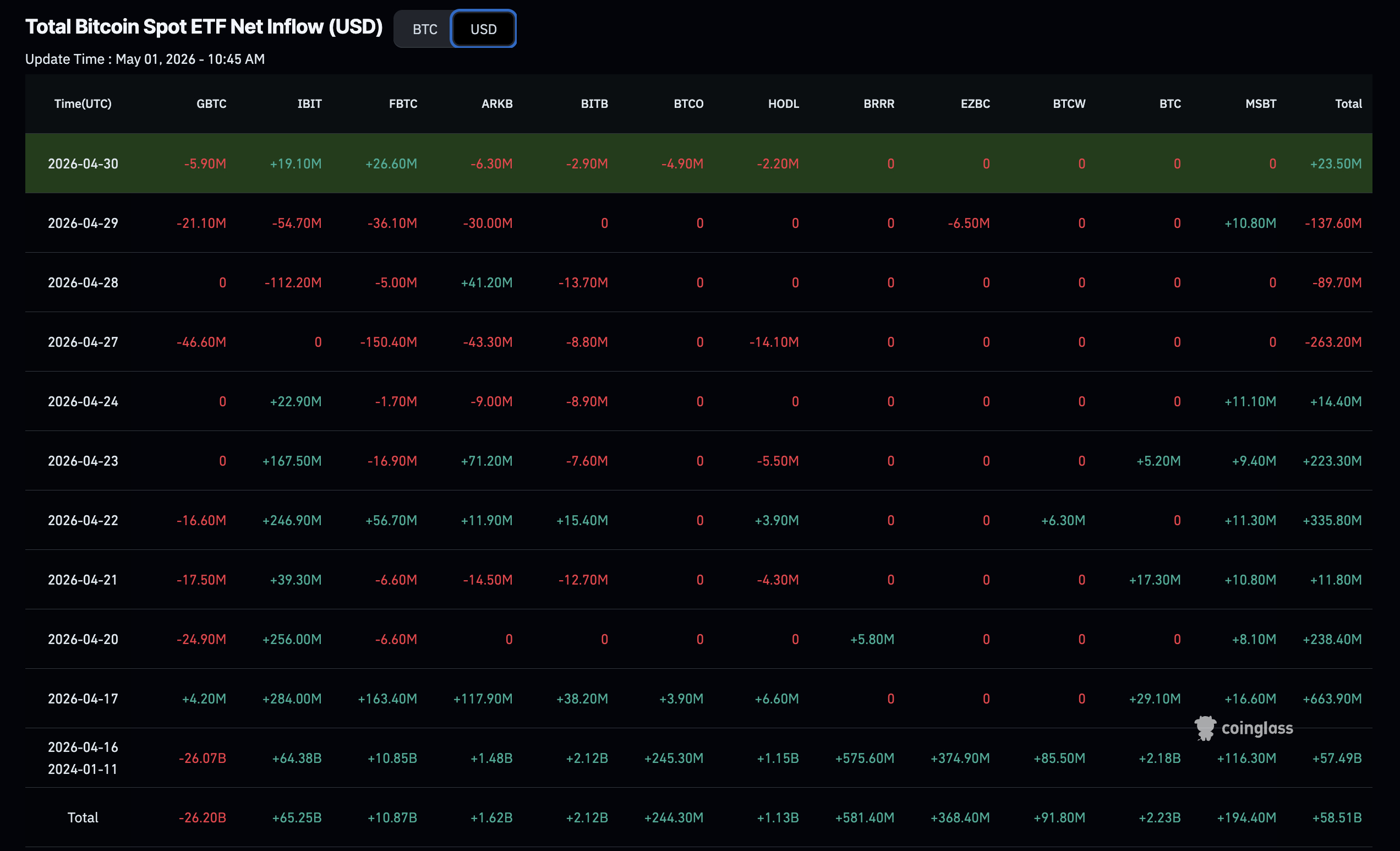
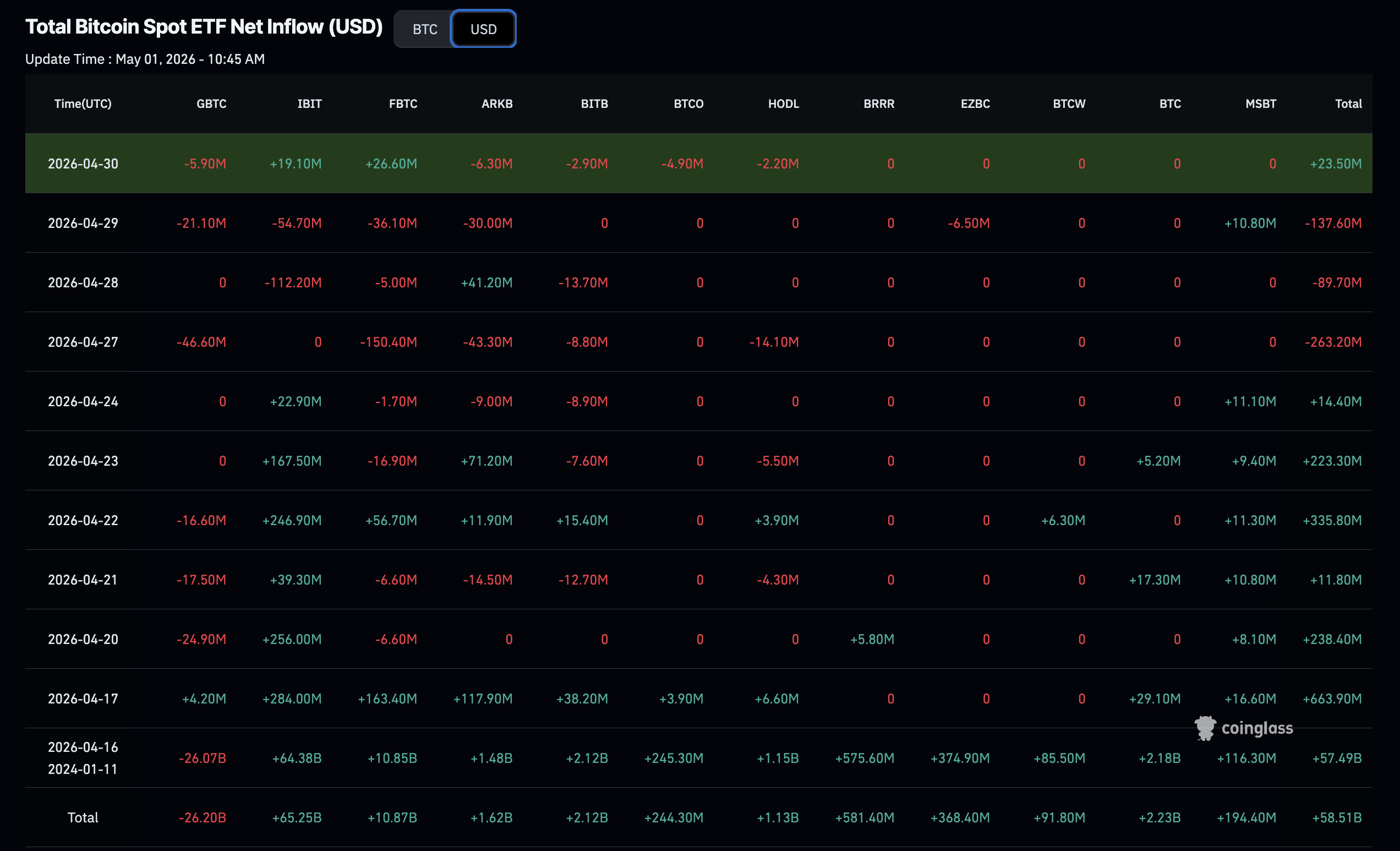
Bitcoin BTC Spot CVD, or Cumulative Volume Delta, exploded 199.1% over the prior week, climbing from $18.3 million to $54.8 million, a signal of aggressive spot-market buying. Parallel perpetual CVD rose 174.7% to $315.1 million, confirming the same directional pressure across both markets. ETF inflows are re-accelerating again after weeks of stagnation, providing the absorption layer and holding Bitcoin above $78,000.
BlackRock’s IBIT gained 1.33% in yesterday’s session as institutional crypto demand showed renewed aggression following a 3-day period of net outflow pressure. The re-acceleration follows a stretch in which ETF outflows had weighed on spot liquidity.
Open interest recovered to $25 billion, which Bernstein analysts flagged as a sign of returning leverage. Spot-led nature of this move, confirmed by CVD composition, shows that the rally has a different foundation than January’s futures-driven spike.
Explore: Bitcoin price prediction – key support and resistance levels to watch
Can Bitcoin Finally Breach $80K This May?
Bitcoin is sitting at $77,000 intraday after reclaiming the same support level. CVD lines are holding above their moving averages, which is the minimum confirmation for bullish conviction. RSI is elevated but not yet at overbought extremes, leaving room for continuation.
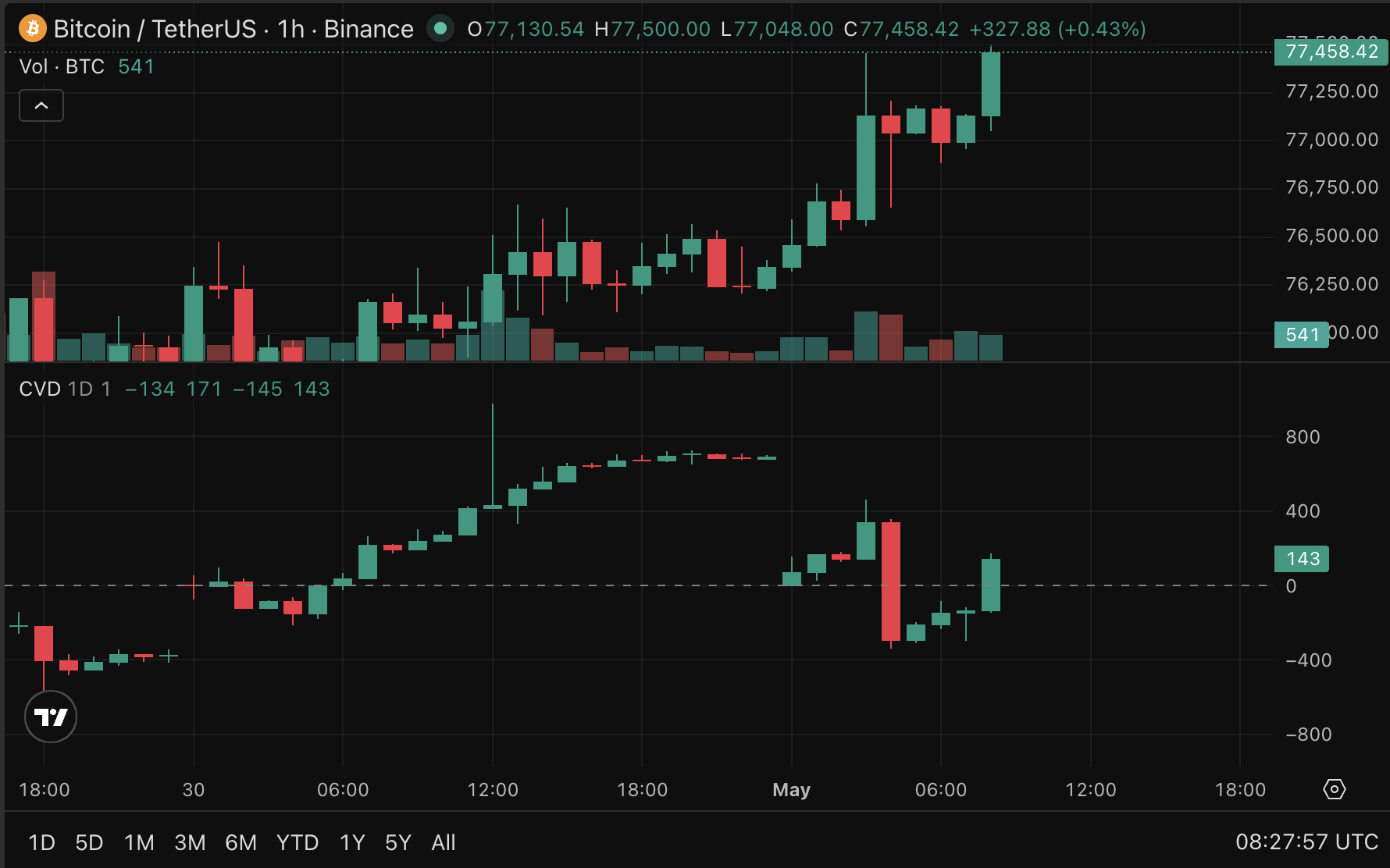
If $75,000 holds on a weekly close, the structure opens a move toward $80,000 and, beyond that, the $82,000 zone identified by on-chain resistance clustering. If $75,000 breaks, the real floor is closer to $72,000. The risk case is an open interest flush, $25 billion in OI with rising leverage could create a liquidation cascade.
The honest read: structure is bullish as long as spot CVD stays positive and ETF inflows don’t reverse. Watch the weekly close.
Discover: The best pre-launch token sales
Wall Street Backdrop: Market Structure Flips Bullish
The macro context is supportive. The Wall Street rally, driven by strong Alphabet and Caterpillar earnings, sent U.S. equities into April’s close with positive momentum, and Bitcoin followed, rising 1.17% in direct correlation with NASDAQ risk-on sentiment.
As we know, traditional fund managers are increasingly treating BTC as a high-velocity proxy for high-beta tech exposure, tightening its correlation with equities in trending macro environments.
BREAKING: — Bull Theory (@BullTheoryio) April 30, 2026
 Nasdaq and S&P 500 just hit a NEW ALL TIME HIGH.
US stocks have now added over $10 trillion in market cap in the last 30 days. pic.twitter.com/ipimnCw4S5
Bitcoin is now printing higher lows, has reclaimed $77,000 as support, and is holding a bullish market structure. If equities sustain their recovery through the next FOMC decision, BTC’s macro tailwind stays intact and amplifies the spot demand signal.
The combined read from CVD, ETF inflows, and on-chain transfer volume points to one conclusion: this is a structurally supported move, not a leverage blip.
Discover: The best crypto to diversify your portfolio with
The post Bitcoin Spot CVD Surges 199% as Institutional Inflows Re-Accelerate appeared first on Cryptonews.

Key Takeaways
- Polymarket has formed a strategic alliance with Chainalysis for insider trading detection and prevention
- Federal authorities arrested a US military member for allegedly using secret intelligence to place bets on the platform
- The Senate approved new regulations prohibiting lawmakers from participating in prediction market trading
- The platform aims to secure $400 million in funding at a $15 billion company valuation while pursuing CFTC authorization for US operations
- Prediction market trading activity reached $25.7 billion in monthly volume during March 2026
The decentralized prediction market platform Polymarket has formed a strategic collaboration with Chainalysis, a leading blockchain intelligence company, to strengthen its defenses against insider trading and fraudulent market activities. The partnership was officially revealed on Thursday.
Through this collaboration, Chainalysis will deliver advanced analytical capabilities to identify abnormal trading behaviors and generate blockchain-backed documentation for governmental and regulatory investigations.
“Polymarket has zero tolerance for insider trading, fraud, and market manipulation in any form. We are committed to identifying and removing bad actors from our platform,” the company declared in its official statement.
This strategic move follows multiple incidents where traders allegedly leveraged confidential information related to real-world developments to generate profits.
Recently, federal prosecutors charged an on-duty US Army servicemember with exploiting classified military intelligence to make profitable wagers on Polymarket prior to the apprehension of Venezuela’s former leader Nicolás Maduro.
The partnership announcement coincides with Polymarket’s efforts to obtain $400 million in investment capital at a proposed $15 billion company valuation, as reported by The Information.
Intensifying Regulatory Environment
Simultaneously, the company is actively seeking regulatory clearance from the Commodity Futures Trading Commission to restore full operations within the United States. Polymarket reached a settlement agreement with the CFTC in 2022 over accusations of providing unauthorized binary options trading products.
Subsequently, the platform purchased QCEX, a derivatives trading venue with CFTC registration, and introduced an American version of its marketplace last year.
This Thursday, the US Senate approved a modification to its Standing Rules that establishes an immediate prohibition on senators engaging in prediction market transactions.
Meanwhile, New York state authorities have initiated legal proceedings against Coinbase Financial Markets and Gemini Titan, alleging their prediction market offerings constitute illegal gambling activities under state legislation.
Trading Activity Continues Upward Trajectory
Despite mounting regulatory challenges, prediction market platforms have experienced explosive growth in user activity. Trading volumes climbed to $25.7 billion for the month of March 2026, according to joint research from Bitget Wallet and Polymarket.
Individual retail participants represent the primary force behind this expansion, with behavioral patterns shifting from sporadic wagering to sustained engagement.
A comprehensive academic investigation examining all Polymarket transactions spanning 2023 to 2025 revealed that merely 3.14% of user accounts demonstrated consistent profitability.
This elite segment, combined with professional market makers, accumulated over 30% of total platform profits despite representing less than 3.5% of all registered accounts.
Shayne Coplan, CEO of Polymarket, emphasized that the Chainalysis collaboration enhances the platform’s inherent blockchain transparency. “This alliance combines our transparent infrastructure with sophisticated monitoring and enforcement capabilities,” he stated.
Competing platform Kalshi has similarly implemented measures to prevent insider trading as both organizations compete for multi-billion dollar market valuations.

Senate Banking Committee Chairman Tim Scott is pushing the Coinbase backed Clarity Act toward a presidential signature by summer 2026. The committee markup is locked in this month, with over 100 industry groups now publicly demanding action.
NEWS — Mintern (@MinswapIntern) April 30, 2026
LAWMAKERS FAST-TRACK CLARITY ACT
The U.S. Senator Tom Tillis says the CLARITY Act could hit committee markup in May, with a potential Senate floor push by June or July. pic.twitter.com/sIAszLVK1v
The Digital Asset Market Clarity Act cleared the House in July 2025 with a 294-134 bipartisan vote, but Senate delays over stablecoin regulation, DeFi provisions, and ethics language burned nearly a year of momentum as the window to recover it is narrowing fast.
— Real World Asset Watchlist (@RWAwatchlist_) April 29, 2026
 The Clarity Act is still in limbo.
Sen. Cynthia Lummis says the bill is “ready” for a hearing… but delays over stablecoin yield rules are still holding it back.
Months of “coming soon.”
Still no clarity. pic.twitter.com/39hlYd6Ig1
The bill resolves the SEC vs CFTC jurisdictional overlap that has functioned as a de facto block on institutional adoption of US-domiciled crypto products. Until that boundary is drawn cleanly, banks and corporate treasuries cannot size positions with confidence.
Discover: The best pre-launch token sales
SEC/CFTC Line Matters
The Clarity Act draws a hard line between SEC and CFTC authority over digital assets, with digital commodities falling under CFTC jurisdiction. This single division is the core unlock that the bill delivers. It also provides regulatory clarity for spot trading, custody operations, DeFi protocols, and developers who do not hold customer assets.
On stablecoin regulation specifically, the bill requires 1:1 backing with high-quality liquid assets and establishes a federal floor that state-regulated issuers must meet. Most of the negotiating friction around stablecoin yields has now been resolved, according to Senator Cynthia Lummis, who confirmed the May committee review.
Treasury Secretary Scott Bessent, SEC Chair Paul Atkins, and White House crypto adviser Patrick Witt are all actively backing passage. That alignment across the executive branch is unusual and gives the bill institutional cover that earlier versions lacked. The White House’s broader legislative posture on crypto signals this is a coordinated policy, not a standalone Senate push.
Discover: Why stablecoin regulatory scrutiny is intensifying beyond the Clarity Act
Coinbase Clarity Act Passage Unlocks Institutional Flows
If the Clarity Act clears the Senate this summer, the direct market effect is a compression of the regulatory risk premium currently embedded in US-exposed crypto assets.
On-chain data from previous periods of legislative progress showed USDC minting accelerating 5–10% in anticipation of cleaner on-and-off ramps. That, by itself, is a signal that institutional positioning begins before the ink is dry.
If the bill stalls past the May markup window, the calculus flips. Senator Bernie Moreno warned directly that missing May could freeze progress for years, not months. Midterm election dynamics would take over, and any bill touching DeFi or stablecoin yields becomes politically radioactive heading into the 2026 campaign season.
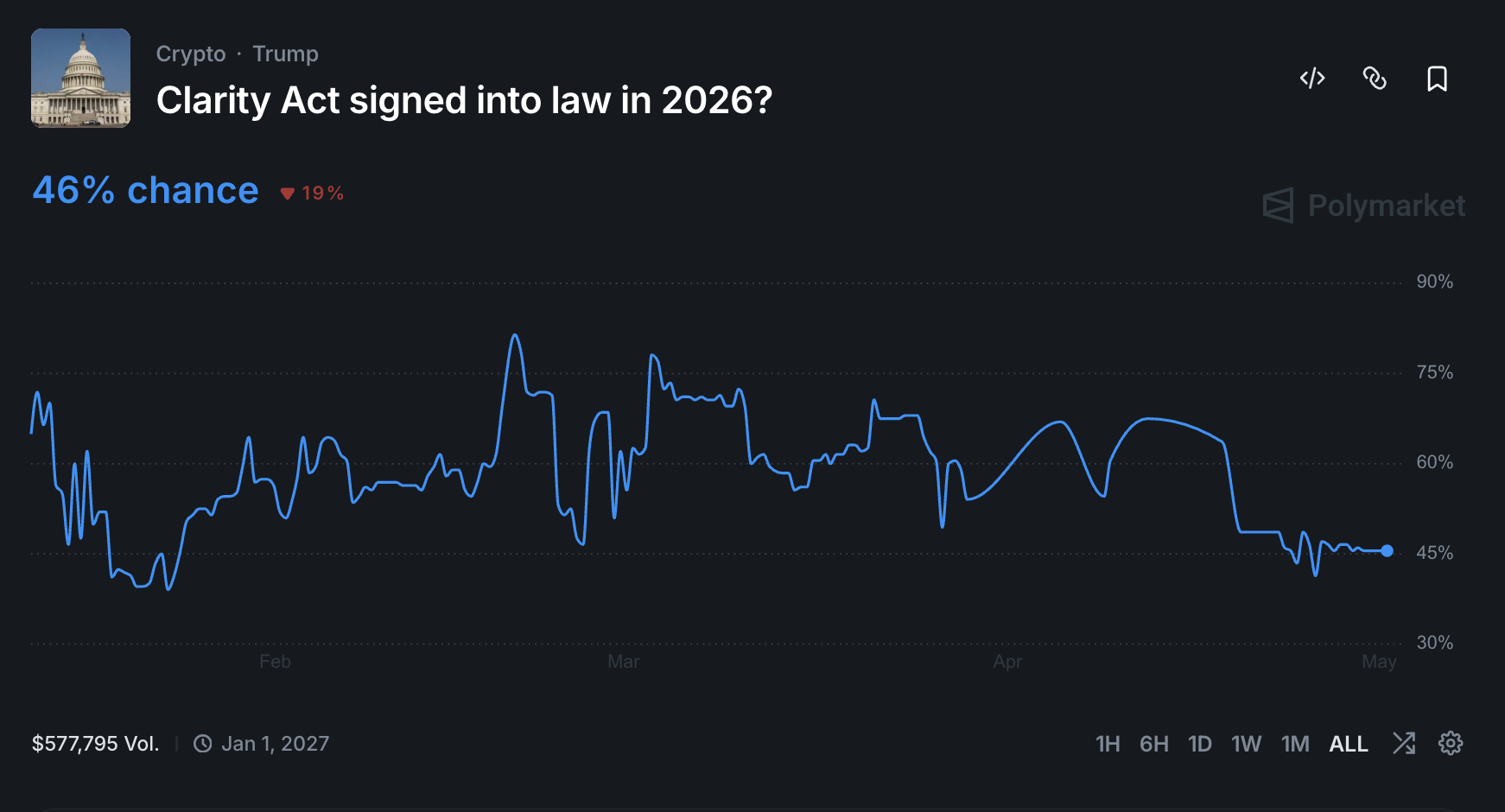
Polymarket odds for 2026 passage have already slipped from 65% to 46% since January, reflecting the accumulated frustration of missed deadlines.
Discover: The best crypto to diversify your portfolio with
The post Coinbase Backed Clarity Act Advances: Tim Scott Eyeing Summer appeared first on Cryptonews.


Crypto wallet startup Oobit has introduced a Visa-backed virtual card that allows AI agents to execute payments in USDT without human input.
Summary
- Oobit has launched Visa-backed Agent Cards that allow AI agents to make payments in USDT directly from Tether’s treasury without fiat conversion.
- The cards are limited to approved businesses, with spend controls and merchant restrictions set at the transaction level after compliance checks.
- Support for AI frameworks such as OpenAI, Claude, AutoGen, and LangChain enables agents to automate tasks like subscriptions, ad spend, and cloud services.
According to Oobit, the new “Agent Cards” draw funds directly from Tether’s treasury, removing the need for fiat conversion or on-ramps when AI systems initiate transactions.
The company said these cards enable automated spending across online services, including subscription renewals, advertising budgets, and cloud infrastructure provisioning triggered by pre-set workflows.
Oobit stated that each card is assigned to a single AI agent, ensuring a traceable identity and a clear audit trail across transactions.
Spend limits and merchant-level restrictions are enforced within the transaction layer, which the company said keeps activity confined to approved parameters after businesses complete know-your-business compliance checks.
Integration with major AI frameworks allows the system to operate across commonly used tools. Oobit confirmed compatibility with solutions from OpenAI, Claude, AutoGen, and LangChain, enabling businesses to deploy agents that can act on operational instructions without manual oversight.
Oobit advisor Alex Obchakevich said in a post on X that these agents could also extend beyond payments to trading crypto and equities.
Oobit said the Agent Cards have been issued to a founding group of businesses, with onboarding set to expand gradually through June 30. Access remains restricted as the company evaluates usage and compliance requirements before a wider release.
Industry leaders have increasingly pointed to AI agents as future participants in digital payments.
“There will be more AI agents transacting online than humans very soon,” said Brian Armstrong, while Jeremy Allaire added in January that “literally billions of AI agents” could be transacting on-chain within three to five years.
Oobit said the next trillion internet users would be AI-driven systems.
Earlier developments show how the company has been linking crypto wallets to traditional payment networks.
In January, Oobit added support for Phantom, connecting Solana-based assets to Visa’s infrastructure and allowing users to spend digital assets across more than 80 million merchants. The integration used its DePay system to settle payments directly from non-custodial wallets, converting crypto into fiat at checkout while merchants received local currency.
Key Highlights
- Real-world asset tokenization expanded by more than 420% between January 2025 and April 2026, reaching $30.2 billion
- US Treasury tokens dominated the sector, soaring from $3.9 billion to beyond $15 billion
- Gold-backed tokens generated $90.7 billion in spot trading volume during Q1 2026
- Europe’s MiCA regulation provided the clarity needed to attract traditional finance institutions
- Equity tokenization exploded from $2 million to approximately $487 million in market capitalization
The market for tokenized real-world assets has experienced explosive expansion, climbing from $5.8 billion in early January 2025 to surpass $30.2 billion by late April 2026, data from analytics provider RWA.xyz reveals. This represents an increase exceeding 420% across approximately 16 months.
The primary catalyst behind this remarkable expansion was tokenized US Treasury securities. This asset category surged from $3.9 billion to more than $15 billion, establishing itself as the dominant force within the tokenized asset ecosystem. Treasury tokens now represent over half of the sector’s entire market capitalization growth during this timeframe.
BlackRock’s USD Institutional Digital Liquidity Fund, commonly referred to as BUIDL, debuted in March 2024. The product provides institutional participants with blockchain-based exposure to short-duration US government securities. Fidelity entered the market in September 2025, introducing the Fidelity Digital Interest Token as its competing tokenized offering.
According to Dominick John, a research analyst at Zeus Research, tokenized Treasury products essentially transform blockchain infrastructure into a distribution mechanism for institutional money. He noted that capital flows have pivoted away from speculative positions toward yield-generating strategies.
Legislative developments have contributed significantly to this momentum. The European Union’s Markets in Crypto-Assets Regulation has facilitated the entry of conventional financial institutions into blockchain-based products. Zhong Yang Chan, head of research at CoinGecko, observed that tokenization activity has “noticeably accelerated” as pilot programs evolved into mainstream operational standards.
Gold Tokens Experience Dramatic Growth Amid Global Uncertainty
Tokenized commodity products have emerged as another high-performing segment. Their combined market capitalization reached $5.55 billion by the conclusion of Q1 2026, representing a 289% increase from $1.43 billion. Tether and Paxos gold-backed token products comprise 89.1% of this category.
Spot trading activity for tokenized Gold products hit $90.7 billion throughout Q1 2026 alone. This quarterly figure exceeded the entire 2025 annual volume of $84.64 billion. Market observers attribute the dramatic increase to climbing Gold valuations sparked by international conflicts and expanded listing availability on major platforms including Binance.
Trading activity demonstrates significant variability. Volumes peaked above $21 billion during October 2025 when physical Gold prices reached all-time highs, before declining to approximately $14 billion in the subsequent month.
Equity and Fund Tokenization Shows Promise Despite Limited Scale
The tokenized stock market expanded from a modest $2 million valuation in mid-2025 to approach $487 million by the end of Q1 2026. Circle leads this category with $173 million, while Tesla holds $61.7 million, Nvidia commands $42.6 million, and Alphabet represents $36.9 million.
Notwithstanding this substantial percentage growth, tokenized equity trading activity continues to represent under 1% of conventional financial market volumes.
Tokenized exchange-traded fund products climbed to nearly $300 million by Q1 2026’s close, up sharply from merely $620,000 in July 2025.
John from Zeus Research indicated that continued expansion will hinge on whether tokenized equity products, investment funds, and private credit instruments can achieve meaningful scale. ARK Invest forecasts that the broader digital asset market could expand to $28 trillion by 2030.
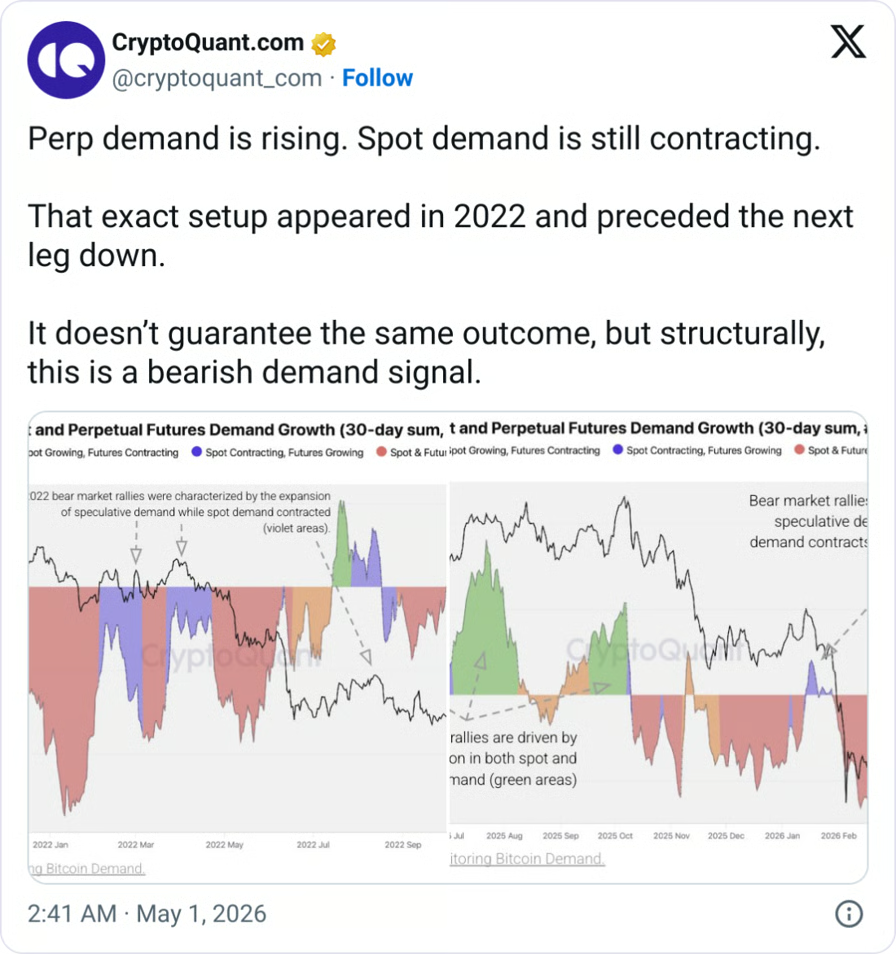
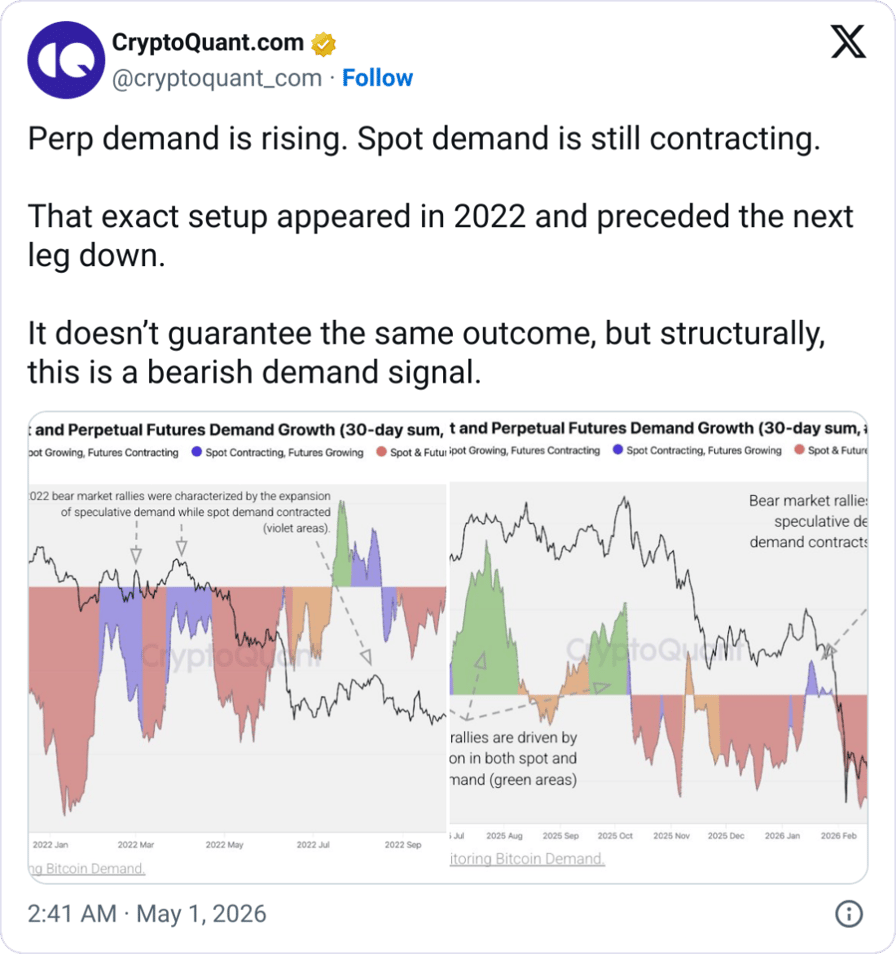
Bitcoin could be setting up for a multimonth price decline, after a rally in April driven mainly by futures traders while spot demand declined, according to the crypto analytics firm CryptoQuant.
Bitcoin gained around 20% in April, rising from $66,000 to a peak of $79,000 in a rally “driven entirely by growth in perpetual futures demand,” CryptoQuant said in a report on Thursday.
Meanwhile, spot demand for Bitcoin contracted throughout the rally, “indicating that the market’s marginal buyer was speculative, not fundamental,” it said.
“The divergence between rising price and contracting spot demand is one of the clearest on-chain signals that price gains are speculative rather than structural,” CryptoQuant added.
Bitcoin is trading around $77,000 at the time of writing, rising 2.1% over the past 24 hours. CryptoQuant said Bitcoin’s correction from $79,000 last month is consistent with rallies led only by strong futures demand.
Current demand for Bitcoin mirrors a pattern at the start of the 2022 bear market, when futures demand surged while spot demand dropped, a setup that “ultimately preceded a sustained price decline.”
Source: CryptoQuant
Related: Bitcoin price hits one-week low as $100 oil sparks fresh Asia crisis fears
“History suggests this setup carries meaningful downside risk as Bitcoin remains in a bear market regime,” CryptoQuant said.
The report is in contrast with a note on Tuesday from Bitwise chief investment officer Matt Hougan, which said the Bitcoin treasury company Strategy has been the “single biggest factor” in Bitcoin’s recent rally.
“There have been multiple drivers of the recent rally, including strong buying from ETFs [exchange-traded funds], $3.8 billion since March 1, and renewed purchases by long-term holders. But Strategy has been the single biggest factor,” Hougan argued.
CryptoQuant added that its Bull Score Index, which analyzes market and network activity to gauge market sentiment on a scale of 100, fell from 50 to 40 in April despite the price increase.
“The Bull Score returning back to 40 indicates conditions are ‘getting bearish’ and places the market in the same range that historically preceded continued price weakness,” CryptoQuant said.
Magazine: Bitcoin will not hit $1M by 2030, says veteran trader Peter Brandt
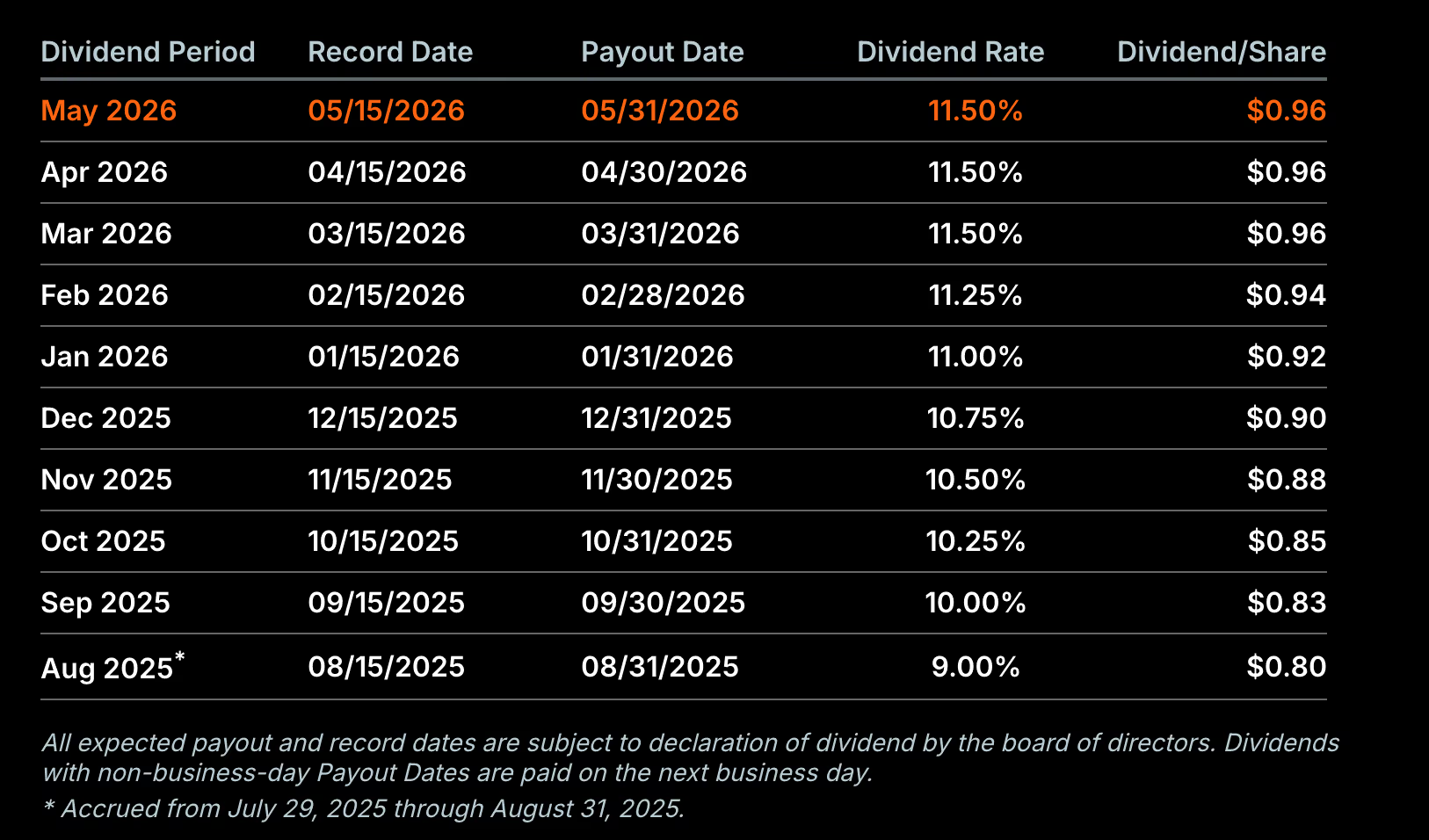
Strategy (MSTR), the largest publicly traded bitcoin holder, has maintained an 11.5% dividend rate for May on its perpetual preferred stock, Stretch (STRC), marking a third consecutive month at that dividend rate.
The volume weighted average price (VWAP) during April came in at $99.76, which was close enough to its $100 par value to justify holding the rate unchanged.

STRC has seen a series of increases since listing in July 2025 with a 9% dividend as the company aims to reduce volatility and keep the price anchored near its $100 par value.
Strategy markets STRC as a short-duration, high-yield savings alternative, paying monthly cash distributions.
STRC is currently trading at $99.75 and has remained below par since April 15. Based on historical patterns, a return to $100 for STRC is expected next week.
MSTR common stock has also shown signs of recovery, closing April at $165, up 33%, its first positive month in nine.
The stock fell fell 75% across eight consecutive losing months from August 2025 to March 2026, according to TradingView data.
Bitcoin also rose 12% in April, its best monthly performance since April 2025.
In addition, Strategy is considering a shift to semi-monthly dividend payments for STRC, moving away from its current monthly distribution structure to further reduce volatility.
Read More: Why Michael Saylor’s Strategy decided to make STRC’s dividend bi-monthly
Artificial intelligence (AI) tools now exploit smart contracts roughly twice as effectively as they detect vulnerabilities, according to Binance Research.
AI has become a central talking point in the conversation around crypto hacks. Many analysts are increasingly suspecting that attackers are leveraging these tools to pull off DeFi exploits.
Why the AI Offense-Defense Gap Is Widening
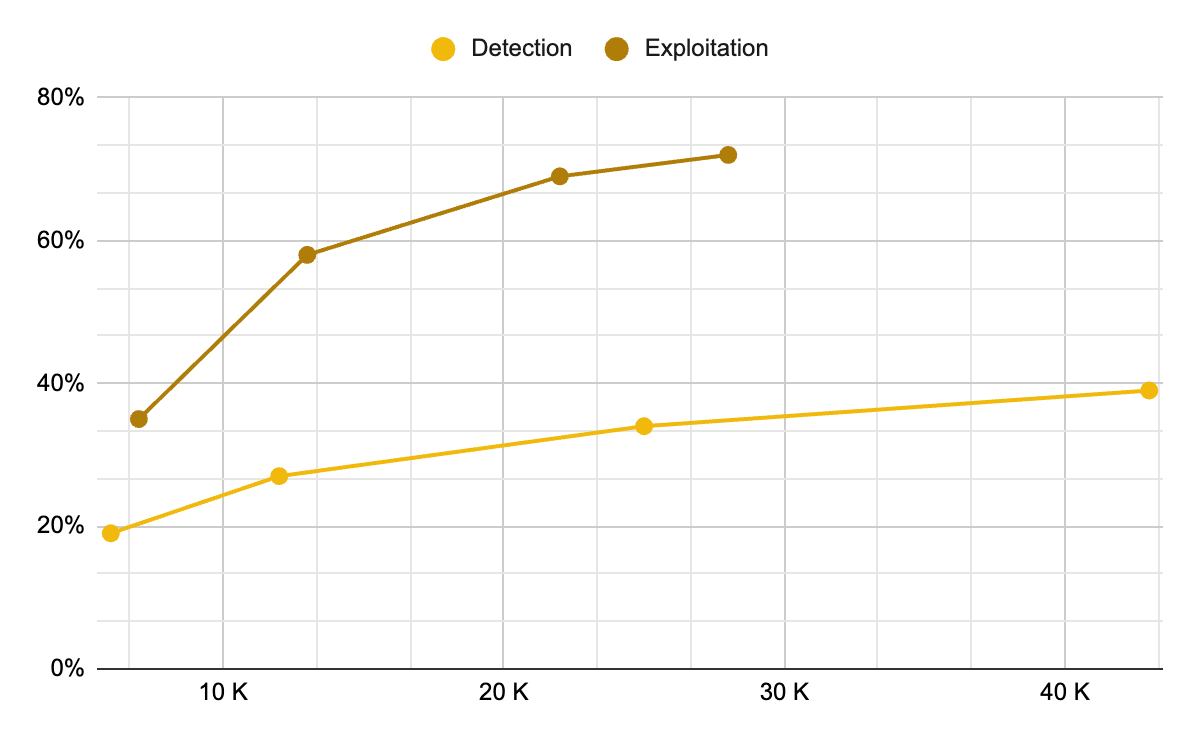
In a recent report, Binance Research noted that GPT-5.3-Codex hits a 72.2% success rate in “exploit” mode on the EVMbench. Meanwhile, its success rate in “detect” mode is roughly half that.
“Whether we welcome it or not, AI is currently 2x better at exploitation than at detection,” the report read. “The economics now favor attackers.”
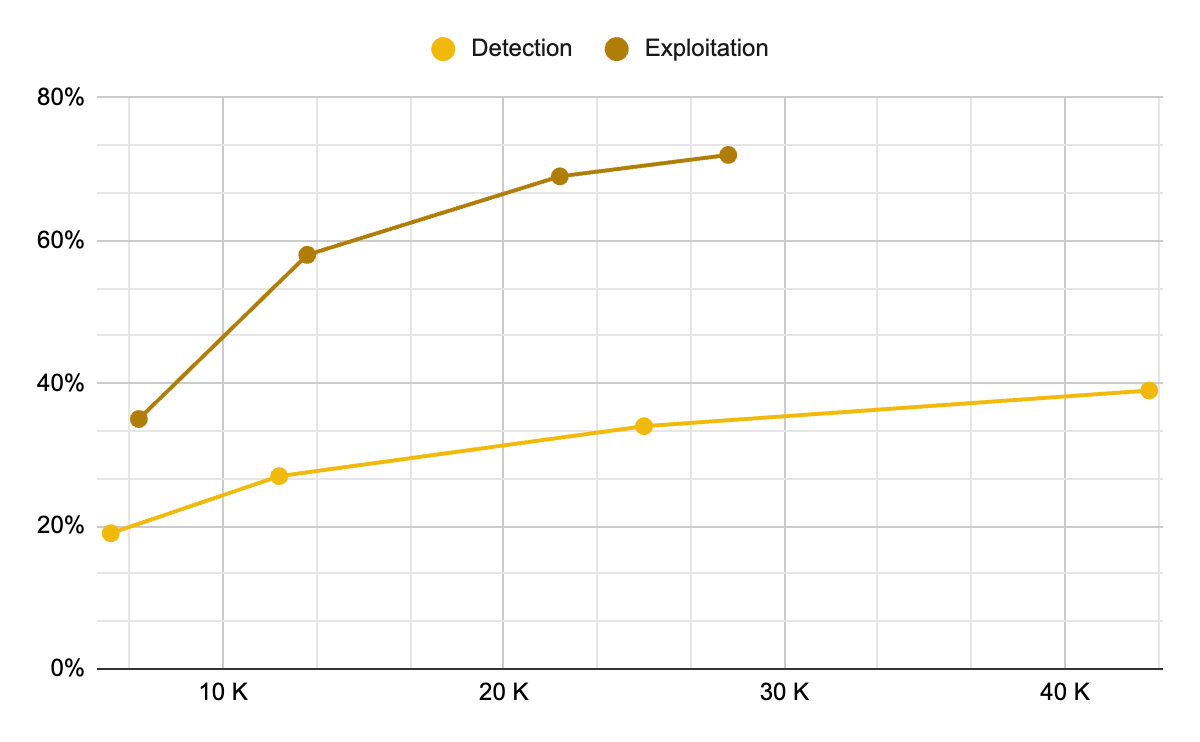
For context, EVMbench is a benchmark that measures how well AI agents can detect, patch, and exploit high-severity smart contract vulnerabilities. It draws on 117 curated vulnerabilities from 40 audits
Smart contracts hold billions in user funds across decentralized finance (DeFi). Their open-source code makes them ideal targets for automated probing. AI systems can scan thousands of contracts in minutes at marginal cost.
The asymmetry is widening because attack costs are collapsing. Binance Research data shows AI-powered exploits average roughly $1.22 per contract, with that figure projected to fall another 22% every two months.
“Hacken’s SSDLC Maturity Survey shows over 80% of developers now use AI in development, but fewer than 40% use AI for advanced testing — leaving the offense-defense gap structurally lopsided,” Binance Research added.
The threat extends beyond static code. Analysts at TRM Labs have begun speculating that North Korean hackers are integrating AI into their reconnaissance and social engineering operations.
The shift would help explain attacks like Drift, which involved weeks of targeted manipulation of sophisticated blockchain systems, a marked departure from North Korea’s traditional reliance on basic private key compromises.
Follow us on X to get the latest news as it happens
AI Is Reshaping the Economics of Crypto Fraud
The economics of online fraud have also shifted just as dramatically. Chainalysis found that AI-powered scams pull in 4.5 times more money per case than conventional ones and generate nine times the transaction activity.
The firm noted that the spike in transaction volume points to AI helping scammers reach and juggle far more victims at once, a hallmark of fraud being run at an industrial scale.
Scammers are turning to deepfake technology and AI-generated content to craft convincing impersonations for romance and investment cons. Notably, in 2025, impersonation-based attacks alone exploded by 1,400% year-on-year.
Roughly 60% of industry respondents flag rising AI use by criminals as the leading driver of risk exposure in 2025. Crypto, in particular, is bearing the brunt. The sector accounts for 88% of all detected deepfake fraud cases worldwide.
Subscribe to our YouTube channel to watch leaders and journalists provide expert insights
The post AI Is 2x Better at Exploiting Smart Contract Flaws Than Catching Them, Binance Finds appeared first on BeInCrypto.

Update on large building fire in Cambridgeshire village

Adamas Trust, Inc. 2026 Q1 – Results – Earnings Call Presentation (NASDAQ:ADAM) 2026-05-01
SanDisk (SNDK) Shares Dip Despite Strong Q3 as Seagate (STX) and Western Digital (WDC) Ride AI Storage Wave

Manchester United reach agreement with Casemiro over contract clause amid transfer speculation

US brings back mandatory military draft registration

Steven Gerrard disagrees with Gary Neville over ‘shock’ Chelsea and Arsenal claim | Football

SEC CHAIR PAUL ATKINS JUST WENT NUCLEAR ON XRP & CRYPTO (BULLISH!)

Saylor Just DESTROYED The Bitcoin Bear Market | Why is the US Treasury PANICKING?

6 Money Mistakes You Must Avoid in Your 20s | Tamil Motivation | Financial Tips#motivation #shorts
-

 Tech4 days ago
Register Renaming | Hackaday
-

 Fashion7 days ago
Weekend Open Thread – Corporette.com
-
Crypto World6 days ago
Hyperliquid $HYPE Rally Builds Momentum as AI Sector Enters Prove-It Phase
-

 Politics3 days ago
Drax board avoid their own AGM, accused of greenwashing & environmental racism
-

 Tech4 days ago
Images of Samsung’s rumored smart glasses have leaked
-
 Sports5 days ago
IPL 2026: Ruturaj Gaikwad registers slowest fifty of the season, enters all-time unwanted list | Cricket News
-

 Tech4 days ago
Why Blue Badges Disappeared From Toyota Hybrids
-

 NewsBeat5 days ago
LK Bennett closes all stores after entering administration
-

 Fashion2 days ago
Kylie Jenner’s KHY Enters a New Era with ‘Born in LA’
-

 Crypto World7 days ago
Michael Saylor says BTC winter is over. Market analyst disagrees, says bitcoin was in a pullback
-
 Entertainment6 days ago
Mariah Carey Slams Deposition Claims In Brother’s Lawsuit
-

 Business2 days ago
Most Commercial Energy Audits Miss the Real Losses
-

 Business4 days ago
(VIDEO) Charlize Theron Climbs Times Square Billboard to Promote New Netflix Thriller ‘Apex’
-

 Business7 days ago
Jeanine Pirro announces closure of Federal Reserve building cost probe
-
 Crypto World6 days ago
Nvidia (NVDA) Stock Jumps 5% as Intel Earnings Ignite Semiconductor Rally
-

 Tech5 days ago
Microsoft to roll out Entra passkeys on Windows in late April
-

 Tech5 days ago
OpenAI’s Sam Altman apologizes for not reporting ChatGPT account of Tumbler Ridge suspect to police
-

 Crypto World3 days ago
CFTC’s AI will review U.S. crypto registration applications, chairman tells CoinDesk
-

 Tech7 days ago
Apple’s Next CEO Has a Different Battle Ahead
-

 Tech5 days ago
OpenAI CEO apologizes to Tumbler Ridge community
You must be logged in to post a comment Login