Forty years after poems first appeared on London’s Underground, the project that placed verse beside adverts and Tube maps continues
to shape the daily journeys of millions
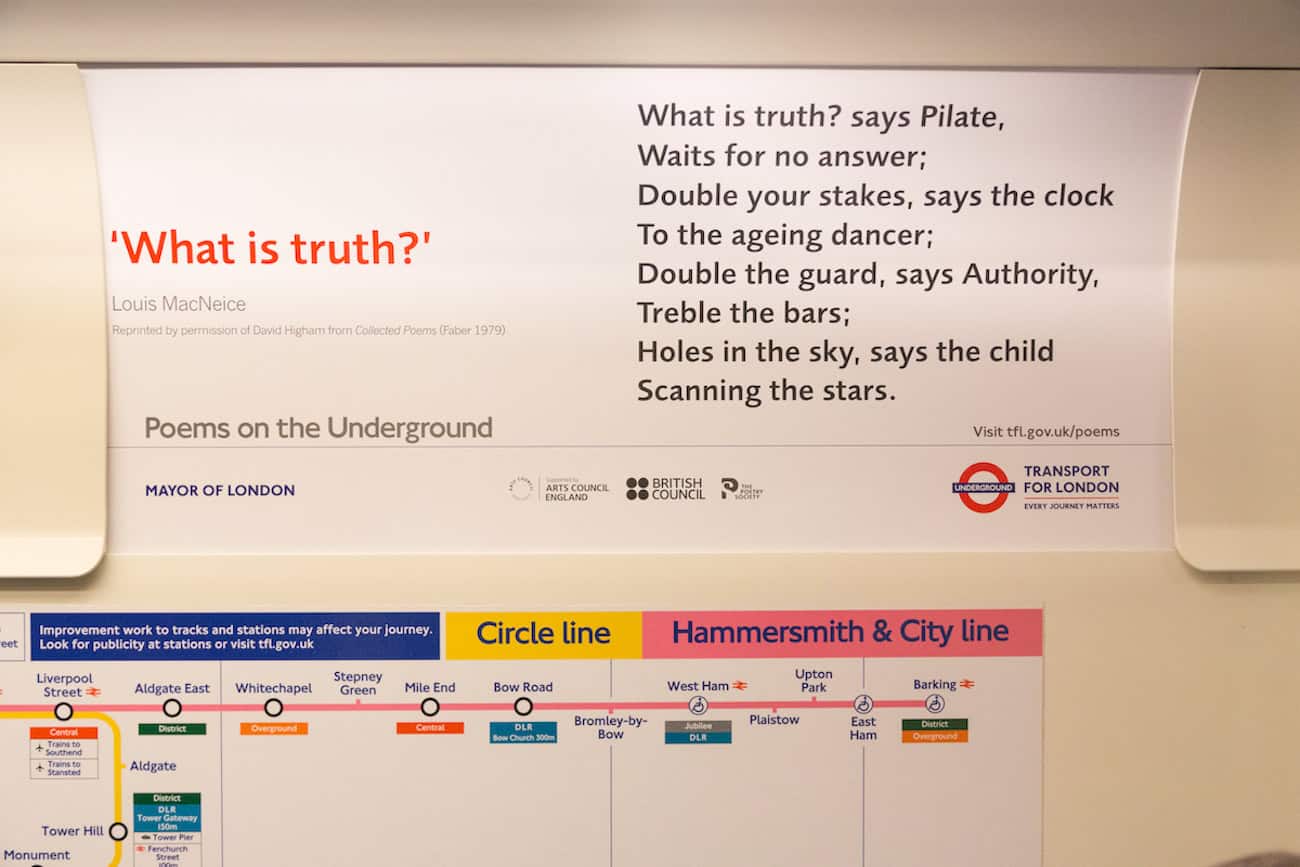
On a Tuesday morning in January, packed into a Victoria Line train between Oxford Circus and Green Park, most commuters keep their eyes firmly on their phones or gaze dreamily into the middle distance. Then something appears in their sightline: a poem, tucked alongside the usual ads for apps and health supplements, grabs their attention. A few heads lift. A few eyes linger. A moment later, the doors open and they are whisked back into the bustle of London’s streets.
This is Poems on the Underground in action. It’s been like this for 40 years, and the scheme marks its anniversary this year by reminding the 3 million people that make journeys on the Tube everyday that public transport need not be only about deadlines and screens.
Advertisement
Founded in 1986 by the American writer Judith Chernaik, the project now displays six poems, refreshed three times a year across London Underground trains, deliberately mixing classic and contemporary voices so riders encounter a range of styles and subjects during their commute. Over the decades, hundreds of poems by hundreds of poets have appeared in carriages and stations– from Shakespeare and Sappho to Wole Soyinka and Blake Morrison – collected now in a 40th-anniversary anthology of 100 Poems on the Underground.
Advertisement
Wrapped in a cosy scarf, Chernaik greets me into her north London kitchen on a crisp January morning, walls adorned with framed Tube posters from years past. Around the table, pamphlets and old leaflets lie like artefacts of a cultural project that has become invisible precisely because it works. As she flips through selections from earlier years, it’s clear each poem carries its own life on the move, inseparable from the daily rhythm of millions underground.
The poem has to “strike them” in that time. That’s the criterion. They aren’t chosen to be relentlessly upbeat, because “life is very complicated, and grief and struggle and despair are part of it.”
Chernaik’s voice is clear and playful. She recounts early letters from literary figures like Seamus Heaney and Philip Larkin, who championed the idea, and she shows me the archive of correspondence – now held at Cambridge University – that helped convince Transport for London to give poetry a home next to Tube maps and schedules. Larkin, writing to Chernaik in 1985, compared the project to pulpit posters outside churches, a reminder that “the world of the imagination existed.”
Advertisement
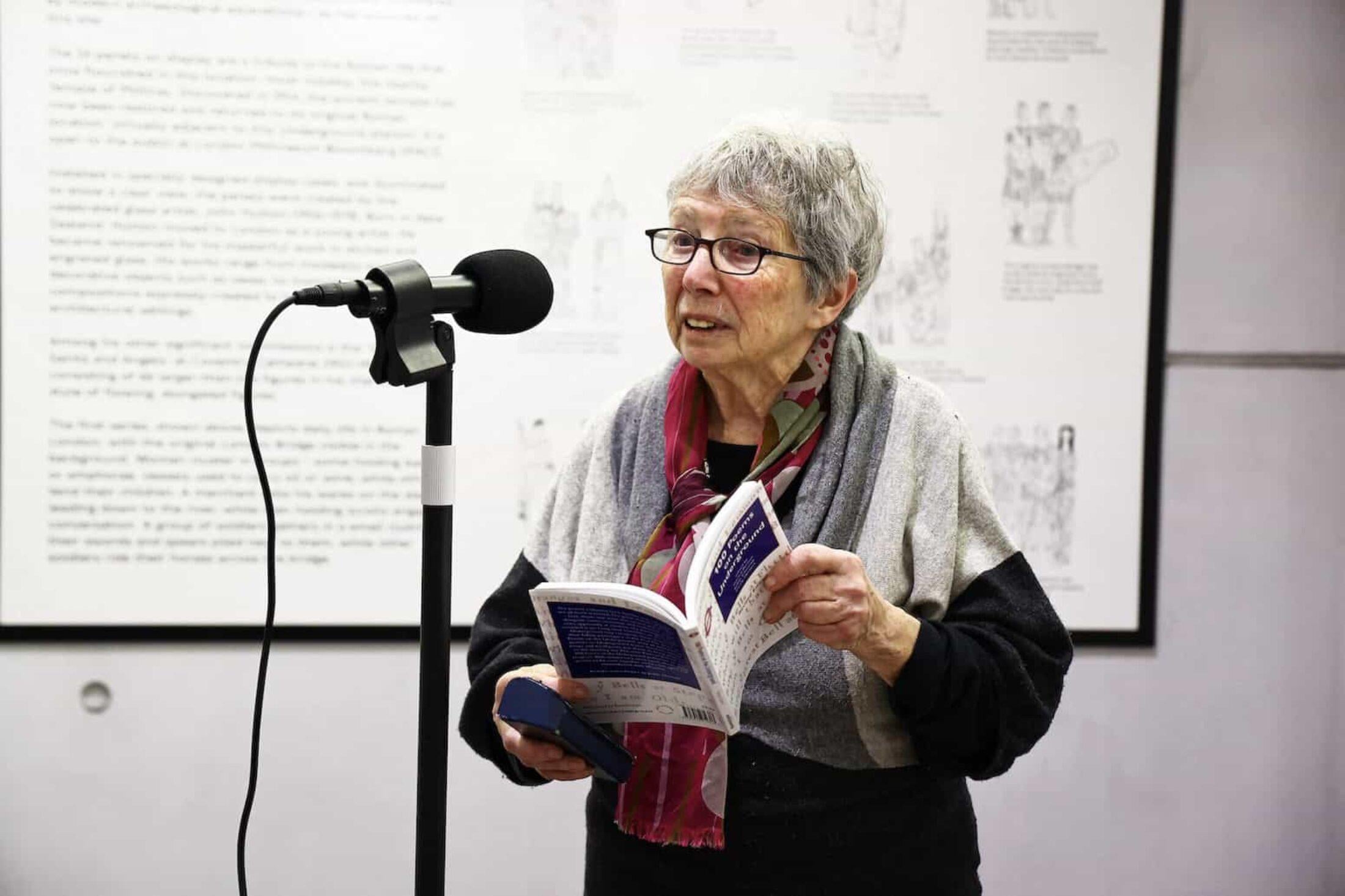
American writer Judith Chernaik founded Poems on the Underground in 1986. Here, she reads a poem at Bank Underground station to celebrate the project’s 40th anniversary
The structure is simple: every few months, Chernaik and her co-editors – now poets Imtiaz Dharker and George Szirtes – gather to pick a fresh set of six poems that will run across Tube carriages for about three months. In recent years they have also placed selections at key stations such as Heathrow, Westminster and Aldgate East, extending the reach of the project beyond the carriages into the spaces where journeys begin and end.
Advertisement
In a space dominated by screens and consumer messaging, these poems demand nothing and allow for reflection, empathy, puzzlement or humour.
“People like the idea of something artistic in public space, because there’s so much advertising, which is telling you, buy this, buy it now…” Chernaik puts it. The poems “offer you something. It’s free.”
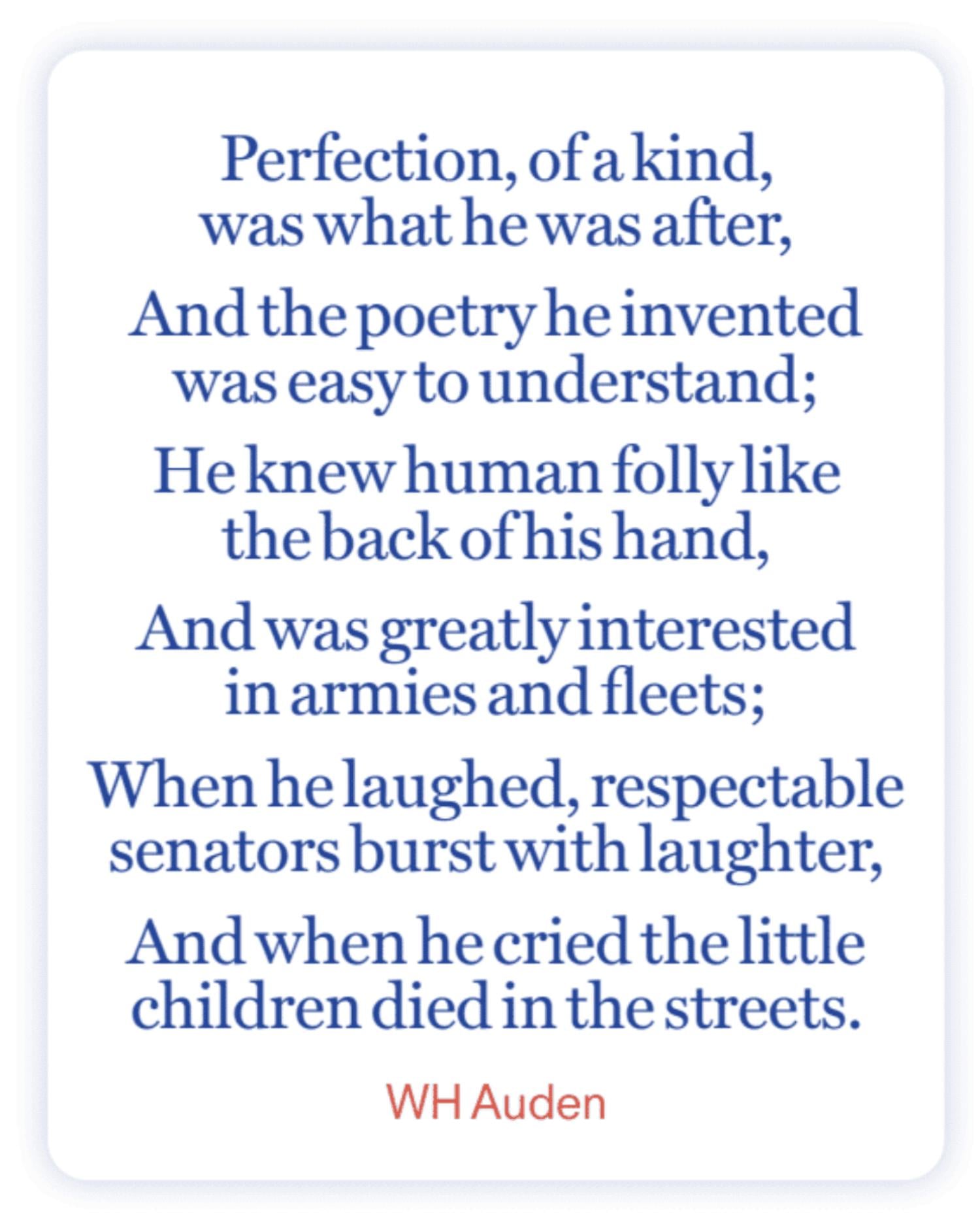
The inclusion of WH Auden’s Epitaph on a Tyrant carried its own resonance recently – and Chernaik makes a point of dating the posters so casual readers might connect the poem to its time
Advertisement
Selections have also been sensitive to context and meaning. Some have quietly acknowledged broader cultural moments – such as Black History Month, marked with expanded leaflets featuring voices from the African diaspora – while others have nodded to collective memory and geopolitics without overt partisanship. The inclusion of WH Auden’s Epitaph on a Tyrant, for example, carried its own resonance recently – and Chernaik makes a point of dating the posters so casual readers might connect the poem to its time.
The approach isn’t without challenge. Very occasionally there have been complaints – one over accusations of blasphemy, another over a medieval poem titled I Have A Gentil Cock.
“This is a very sophisticated city with a very sophisticated population,” Chernaik says. “People don’t take offence that easily..”
Advertisement
When I finished reading it I looked up to see a woman with her teenage daughter also reading it, with tears in her eyes
Chernaik remembers them with a lightness belying the project’s seriousness. Nearly all responses, she says, are positive: letters telling of consolation found in lines read en route to a difficult day, or debates sparked among strangers who paused mid-commute to exchange interpretations.
Ask Tube users what they make of the project and the answers are as diverse as the poems themselves. For Glen, 44, the poetry “removes me from my commute. I’m reading and re-reading it, trying to make sense of it. If I see certain publishers, it sparks off London memories from when I was a kid and exploring poetry books in libraries and having my mind blown. Having poetry in a public space transports us, even if we don’t understand it.”
Katie, 27, says the presence of poems feels like a reminder “that not everything is AI and marketing”.
Malaika, 25, says she once saw a poem about a woman’s love for her newborn on her morning journey. “I’m not even a mother but it was so beautiful it was making me tear up,” she says. “When I finished reading it I looked up to see a woman with her teenage daughter also reading it, with tears in her eyes.”
Advertisement
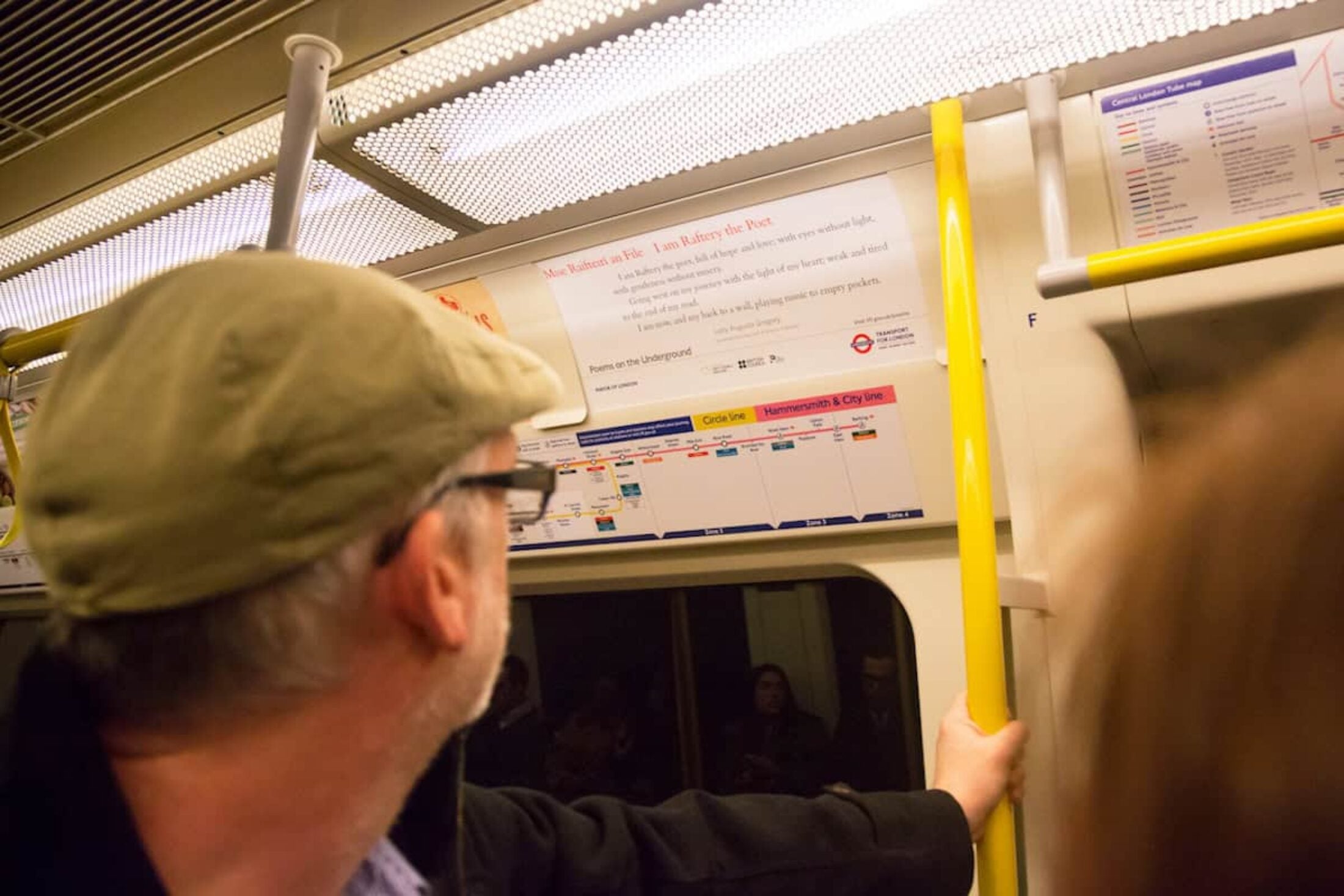
I am Raftery the Poet, part of the Poems on the Underground campaign, April 2015
Today the project has inspired similar public art initiatives around the world – from Dublin to New York to Shanghai – but its greatest impact is felt in the everyday journeys of Londoners. Though the Underground is still beset by delays, overcrowding and daily grind, a few lines of poetry can prompt riders to look up, think, feel and connect.
Advertisement
This January the scheme marked its 40th year with a special anthology and event at Bank Station. For Chernaik, who never imagined this idea would “take over her life” in the way it has, the future of these poems still feels open. She hopes another will take up the mantle and keep the poems alive long after her own tenure.
Late last year, the scheme did receive some criticism from Reform UK and Conservative members of the London Assembly, who were quoted as calling the £72,000 TfL spend on the project “a waste of money”. But the project, which is currently funded by a combination of support from the Arts Council, TfL and the British Council, will remain available to all those travelling on the Underground. They are, as one supporter wrote to Chernaik, “a shaft of light in the darkness. They must continue.
Images: TFL
Advertisement
Be part of the solution
At Positive News, we’re not chasing clicks or profits for media moguls – we’re here to serve you and have a positive social impact. We can’t do this unless enough people like you choose to support our journalism.
Give once from just £1, or join 1,800+ others who contribute an average of £3 or more per month. Together, we can build a healthier form of media – one that focuses on solutions, progress and possibilities, and empowers people to create positive change.
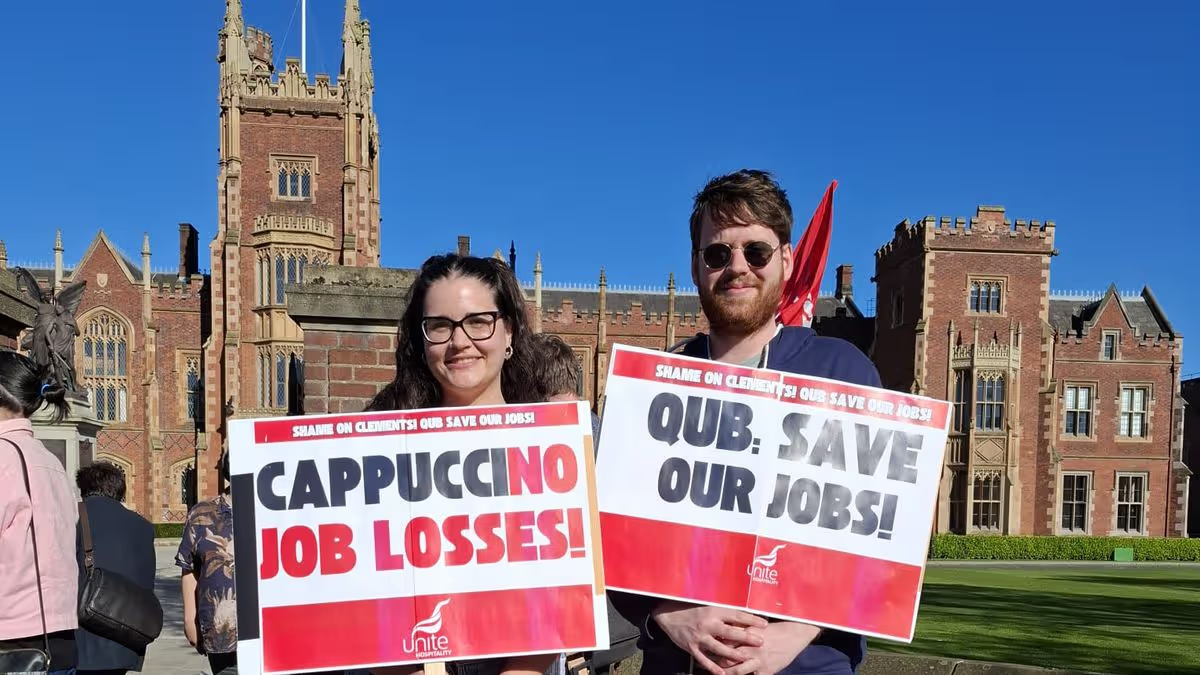
Neil Moore from Unite the Union, said: “I’m an officer who represents both workers in Queens, but also workers across the hospitality sector.
“I want to thank everybody for coming down to this emergency protest on quite short notice. I think from talking to people here, the outrage from customers, from Clement’s staff, from staff and students at Queens is quite palpable that a situation like this can be allowed to happen, that a rogue employer such as John Elliott from Clements can simply say so long, say anara to his workers and expect the taxpayer to pick up the bill.
“In the letters that workers got, and workers, obviously nothing turns without workers. They understood where the business was at, seemingly a dispute between their employer and Queens, and their employer has decided to throw the baby out with the bathwater, and workers are collateral damage for that.
Advertisement
“That is a shame.
“I think, We really want to hear from Clement’s workers, so I’m gonna invite Sophie from Clement’s up to speak first, just about Clement’s workers’ experience and of course anybody else from Clements who wants to speak as well.”
While Atletico are well off the pace in LaLiga and lost the Copa del Rey final on penalties 11 days ago, they did overcome Barcelona in the quarter-final to keep their trophy hopes alive and, perhaps crucially, have previously knocked Arsenal out of a European competition at the semi-final stage. Follow the game LIVE below with our dedicated match blog, featuring expert insight and analysis from Matt Verri.
Jane McCarry, best known for playing Isa in the hit BBC comedy, will bring Whit’s Yer Chat? to the venue on Friday, May 8.
Still Game star Jane McCarry will appear at Rutherglen Town Hall next month with a new live show.
Advertisement
McCarry, best known for playing Isa in the hit BBC comedy, will bring Whit’s Yer Chat? to the venue on Friday, May 8.
She will be joined by Britain’s Got Talent stars Edward Reid and Vinnie McKee, radio presenter Ali Wright and TV Presenter Liam Dolan.
The show will feature a mix of humour, stories, and audience interaction in an informal setting.
Jane McCarry said: “We’re really looking forward to coming to Rutherglen. It’s bound to be a great night of laughs and chat, and the audience are a big part of it.
Advertisement
“Whit’s Yer Chat? is the ultimate night out with pals – an exuberant mix of laughs, stories, and chat, brimming with madness, music, and mayhem.”
Tickets are available now from South Lanarkshire Leisure and Culture’s online box office, at SLLC cultural venues, or by calling 0141 613 5700.
*Don’t miss the latest headlines from around Lanarkshire. Sign up to our newsletters here.
And did you know Lanarkshire Live had its own app? Download yours for free here.
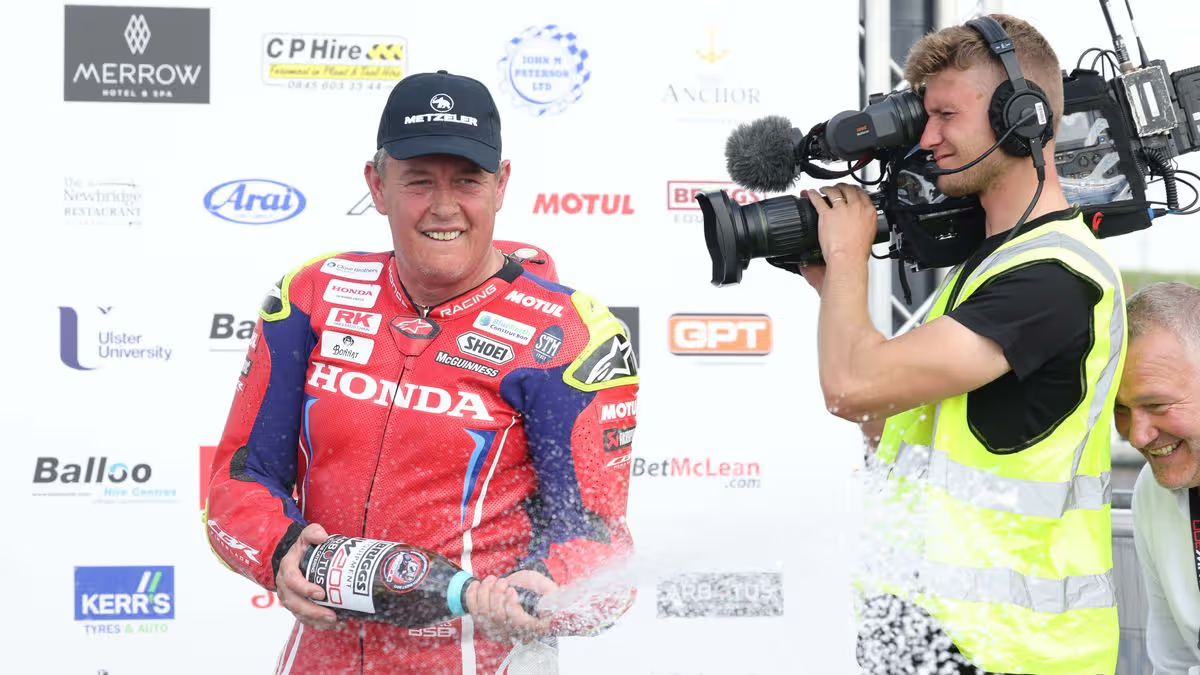
Twelve months ago a slight miscalculation left John McGuinness confused about the precise number of North West 200 races he had competed in as he planned to celebrate his 100th race start at the north coast event.
“It was embarrassing when we got it wrong.’ McGuinness smiles. “I had a helmet and all painted for the occasion and we had to leave it at home on the shelf.”
According to the official records, McGuinness has now made 96 race starts at the north coast event. With the special anniversary helmet in tow, he now hopes to celebrate the landmark centenary during this year’s Briggs Equipment NW200 race week on May 4-9.
The 54 year old Honda Racing star reminisced about his long and checkered North West career during the official opening of the revamped Ballymena Honda showroom last week.
Advertisement
“I rolled up to Portrush with Becky-his then girlfriend, now wife- in 1994 in an old Iveco van,” the Morecambe man recalled.
“It was a different track back then with no Mill Road roundabout and no chicanes at Mathers or Magherabouy. I’ve ridden different variations of the track and millions of variations of bikes over the last three decades – two strokes, four strokes, carburretors, fuel injection, fly by wire, traction control- you name it!’”
“It is an event that keeps on giving for me, one I still look forward to coming to, bang on top of the calendar.’ the six time North West winner smiled.
“The teammates I’ve had, the laughs we’ve had, the tears and the pain too. I’ve been in tons of ding dong races where I could have won but I’ve ended up sixth. I’ve won a few and arguably been in the hunt to win a few more that we didn’t. But to win six around here is hard work.
Advertisement
“And then there are the people and manufacturers I’ve ridden for. A lot with Honda and a bit with Yamaha. Paul Bird played a big part in my journey and I wish he was here to see the 100 th start.’
“I always get asked what makes the North West so special and why have I come back each year?” McGuinness smiled as he launched into a eulogy that would gladden the hearts of the Tourism Ireland people.
“It has some sort of grip that gets a hold of you and won’t let go. You are treated like a hero for a week. I’ve seen people coming here in pushchairs and now they’ve grown up and are in the sport. They are on the tools or racing themselves now. Families and friends who have come right through it and still love coming here.
‘”That is a very rare thing but then you are riding along the sea front. It is like riding down the prom at Morecambe or Blackpool. The location is off the charts, the craic is great and the food is mega.
Advertisement
“There are still a few things that need sorting like the water supply in the paddock – you need about 10 hoses and you could pee faster than the water that comes out! But it’s an organisation of volunteers isn’t it? So it has its own character.”
McGuinness laments the reduction in both time and fun the current, tighter qualifying and race schedule imposes.
“The whole paddock used to be in the Anchor Bar or Kelly’s night club back in the day,” he says.
“It was fantastic, but obviously it is a shorter event now. Even though things have changed in many ways, walking through the tunnel from the paddock, pulling on the helmet and going out on to the coast road is exactly the same as it has always been.”
Advertisement
The Honda star enjoys the peculiarities that persist around the event.
“The corporate side of the North West is epic now and we need all the sponsors onboard but when you go to sign on you still get a shop mug, a bag of apples, a programme and a Bible,” he smiles.
Advertisement
“It is still the same craic, same old-fashioned rituals, and that is nice in a way.”
Road racing can also be a bittersweet sport and McGuinness felt the full weight of its downside when he crashed at Primrose corner during practice for the 2017 North West after the ECU on his Honda Racing Fireblade developed a fault.
“I thought I was going to meet my maker that day,” the Morecambe racer, who suffered a compound fracture to his right tibia and fibula plus four broken vertebrae and three smashed ribs, says.
“I’d never been in that position before but the whole lead up in 2017 wasn’t great,” he recalls.
Advertisement
“Guy (Guy Martin, his Honda teammate) and me were worried about a lot of things that year and in hindsight we should not have been on the grid. But you go there, you have all that pressure on your shoulders, and you feel that you are cheating people out of something if you’re not riding.”
McGuinness was fired through the fence in the crash at Primrose, ending up on a golf course.
“I’m not a golf fan.’ he says with a rueful grin. “It took a long time to recover, not just physically but mentally too. I’m a bit old school in thinking you have to grow a set of balls and toughen up but I wasn’t in a good place. Addicted to Tramadol and morphine, I was driving around at 2am, thinking. ‘What am I doing? I want all this to end’.”
After splitting with Honda following the crash, McGuinness rejoined the team in 2022.
Advertisement
Two years later the Morecambe veteran enjoyed a fairytale comeback in his North West 200 story as he is finished third in the CP Hire Superstock race behind race winner, Davey Todd and runner-up, Peter Hickman.
“I rolled up my sleeves and got stuck back in and in 2024 I was back on the North West podium,” McGuinness smiles.
“That was the sweetest podium and now, looking back, I wish I had milked it more! I should have done a Glenn Irwin and gone up on to the grandstand to do some crowd surfing! To be honest I rode straight into the winner’s enclosure with a bit of disbelief, thinking, have I done this? I didn’t really know what to do because it had been a long time since I had been on the podium.’
“It was a hot day with great racing and there is nothing better than being up there on that podium when the sun is shining.’ he smiles, recalling the moment.
Advertisement
“The North West is a big event and in that atmosphere, and when everyone is back safe in the paddock, it is very hard to replicate that feeling.”
During over three decades of North West 200 racing, the Morecambe veteran has been in the mix at the north coast meeting with so many of road racing’s greats.
“I’ve been Joey Dunlop’s teammate there and Michael Dunlop’s teammate too. I’ve been on track with Robert Dunlop and all the greats of the Nineties. Riders like Ryan Farquhar, Phelim Owens and Woolsey Coulter.
“There have been endless amounts of talented Irish road racers, just so many good hands everywhere. The grids were stacked full. We would come across and the Irish boys would just want to beat us and we wanted to beat them. It always got real competitive on the 250s.
Advertisement
“I’ve been on the North West grid on a 125cc, 250cc, 400cc, 600cc and on Superbike machinery. I’ve been through all the classes and every single emotion that racing can put you through. And I am still coming back.”
Has he any thoughts of retirement?
“I sort of think I should stop but then I think, why?” he smiles. “I’m riding a factory Honda with Dean Harrison and sometimes I think that maybe that bike should go to someone else. In last year’s Superbike race at the North West I finished sixth and was holding my own in the field. I think I was warranting the ride and then I thought, come and get it from me.”
A “chilling” crime thriller set for Netflix adaptation has left book lovers’ ‘skin crawling’.
Hayley Anderson Screen Time TV Reporter
17:50, 29 Apr 2026
This Morning: Severance’s Ben Stiller quizzed on season 3 release date
Severance and The Godfather stars are joining forces for a Netflix thriller that promises to leave your “heart pounding”.
Advertisement
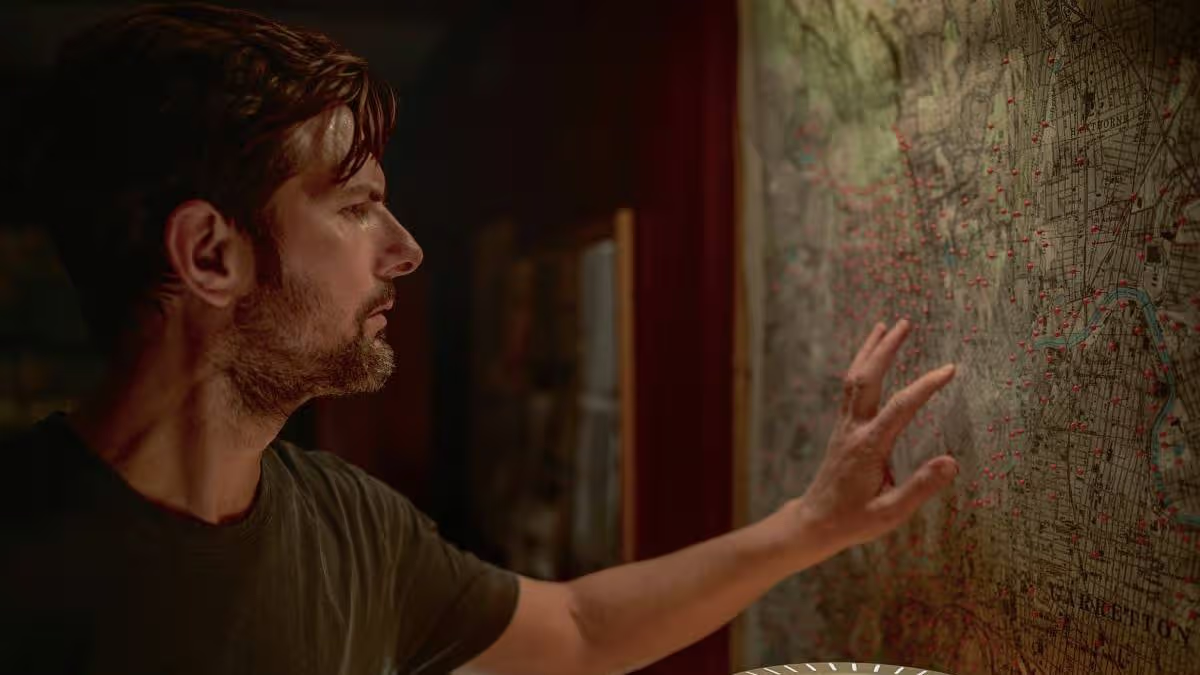
Adapted from Alex North’s New York Times best-selling novel of the same name, The Whisper Man arrives on Netflix on Friday, August 28.
The official synopsis for the forthcoming “disturbing” film states: “When his eight-year-old son is abducted, a widowed crime writer looks to his estranged father, a retired former police detective, for help, only to discover a connection with the decades-old case of a convicted serial killer known as ‘The Whisper Man.’”
Adding to the anticipation surrounding The Whisper Man is its remarkable ensemble cast.
Ahead of the film’s release, The Whisper Man already commands a devoted following amongst readers eager to see the adaptation brought to life.
Taking to Amazon Prime to heap praise on the novel, one reader enthused: “This is one of the most gripping and mind-blowing books I have read this year, and it takes suspense and terror to a whole new thrilling level.”
Advertisement
A second described it as “gripping and flawless”, while another wrote: “This book genuinely makes your heart pound.”
One further reviewer noted: “Creepy and chilling? Yes! Addictive and clever? Totally!
“It made my skin crawl, it’s sometimes heartbreaking, it’s dark and twisty and just mind-blowingly fabulous!
Advertisement
“The Whisper Man is one of the best thrillers I have read in years. It is in equal parts gripping and truly terrifying”, one reader remarked.
Another enthusiastic viewer added: “I will undoubtedly be keeping my window shut for a little while, and will be obsessively checking on my sleeping children!”
Behind the camera, the producing duties fall to brothers Joe and Anthony Russo, renowned for their directorial work on the Marvel blockbusters Avengers: Infinity War and Avengers: Endgame.
The Whisper Man premieres on Friday, August 28, on Netflix.
Less than two years after her six-year-old son was killed at Sandy Hook Elementary School in 2012, Nicole Hockley found herself in an Ohio church basement, teaching the inaugural class of a program she hoped would prevent future school shootings.
Born from the profound grief of one of the nation’s worst mass shootings, the initiative, known as “Say Something,” teaches students to identify warning signs among their peers and urges them to report any red flags to an anonymous tip system or a trusted adult, aiming to avert violence.
Since that first class in a Columbus church, the program has been presented to thousands of students nationwide. It has generated nearly 395,000 tips, covering concerns from threats of school shootings and suicides to drug use and bullying. Its effectiveness was starkly demonstrated last year when a tip led to the arrest of an Indiana student who had threatened a shooting at her school.
Hockley, whose son Dylan was among the 20 first graders and six educators who died at Sandy Hook in Newtown, Connecticut, in December 2012, articulated her profound motivation.
Advertisement
“It’s been very successful,” she said. “Having had direct experience of both of my children being in a school shooting and my youngest one dying, I feel very compelled to honor that legacy by doing all that I can to prevent future acts of violence and school shootings.”
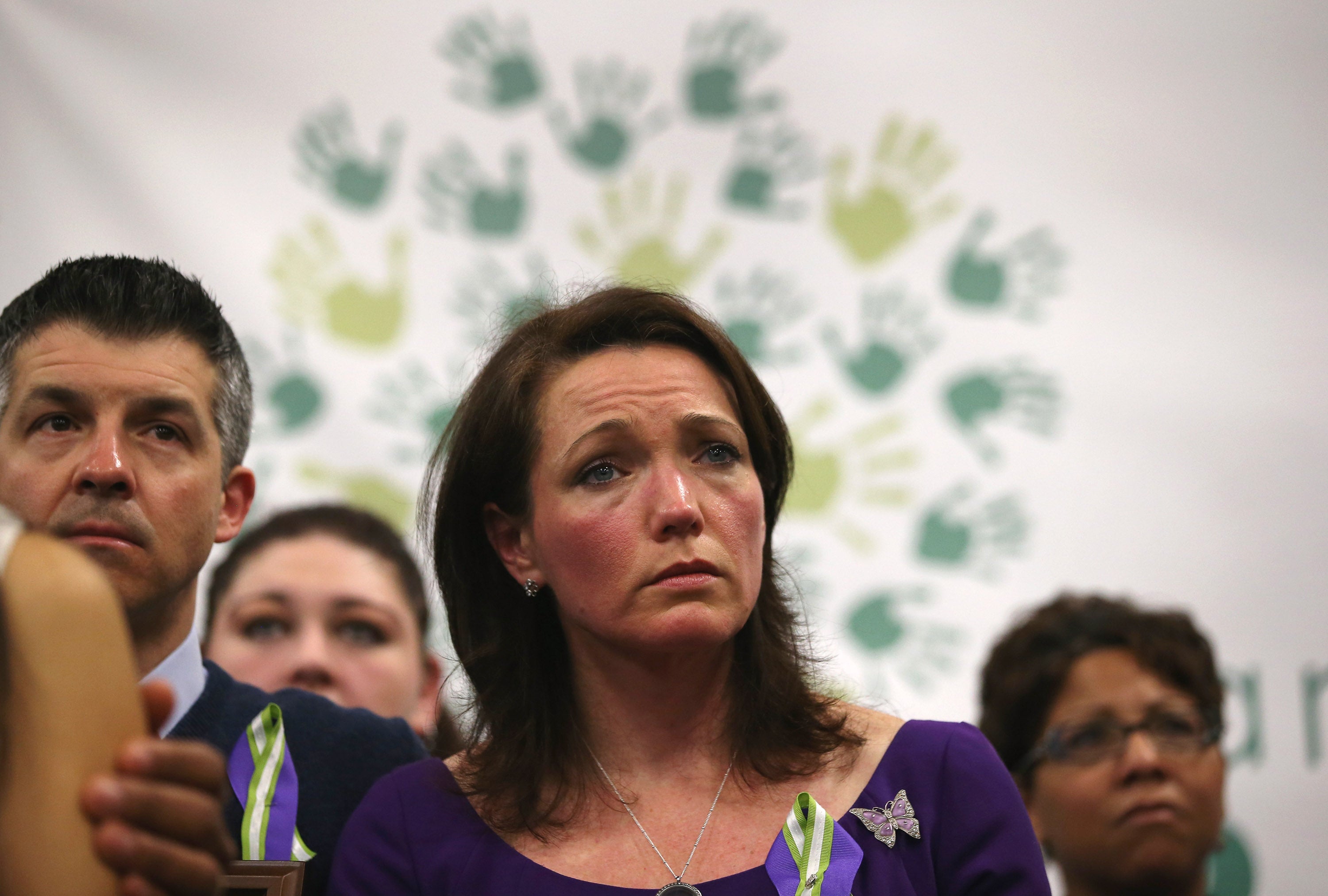
Nicole and Ian Hockley, parents of Sandy Hook massacre victim Dylan Hockley, listen during a press conference with fellow parents of victims on the one month anniversary of the Newtown elementary school massacre on January 14, 2013 in Newtown, Connecticut (Getty Images)
Trainers with Sandy Hook Promise, a non-profit founded in early 2013 by Hockley and other relatives of the Newtown victims, have travelled to all 50 states. They show students how to spot signs of potential violence or self-harm – which can include threats on social media, an obsession with weapons, or behavioral changes – as well as the importance of speaking up before something bad happens.
For a generation of students accustomed to news of mass killings and regular lockdown drills, the “Say Something” program offers a tangible way to take action.
Addison Hunt, a 17-year-old junior at Hanover High School in Massachusetts, reflected on this sentiment: “School shootings are definitely very scary, and they do run through your head as a high school student. But I think being able to have these outlets where you can report things definitely makes me feel a lot safer.”
During a recent session at Hanover High, instructor Keely Rogers, a 28-year-old former high school music educator, highlighted the critical role students play. Research indicates that nearly all school attackers exhibit warning signs beforehand, most commonly on social media.
Advertisement
“You are going to become the eyes and ears of your school through social media, right?” she told the students. “Your teachers and staff don’t follow the same people as you. They can’t keep an eye out. They can’t keep everyone safe.”
She cited an Instagram post, pulled from a real tip, that read: “Don’t come 2 school tomorrow if you wanna live.” Rogers noted someone reported the post within three minutes, leading to swift action.
Ava Khouri, Hanover’s senior class president, noted a key takeaway: overcoming the fear of being perceived as a “tattletale.”
“I think that definitely students are wary to bring these issues up to adults and administration in the school, because they’re worried they’re either going to be made fun of for tattling or getting someone else in trouble,” she said. “So I think that this program definitely gave light to the fact that you’re not a tattletale if you’re helping someone and you’re helping others.”
Advertisement
Both Hunt and Khouri confirmed they had reported troubling behavior to parents and educators prior to learning about the program.
The “Say Something” anonymous reporting system is staffed 24 hours a day, 365 days a year, by trained crisis counsellors, who refer serious situations to police and school officials. While common tips include concerns about bullying, drug use, harassment, and self-harm, the system also receives alarming reports that are immediately escalated to law enforcement.
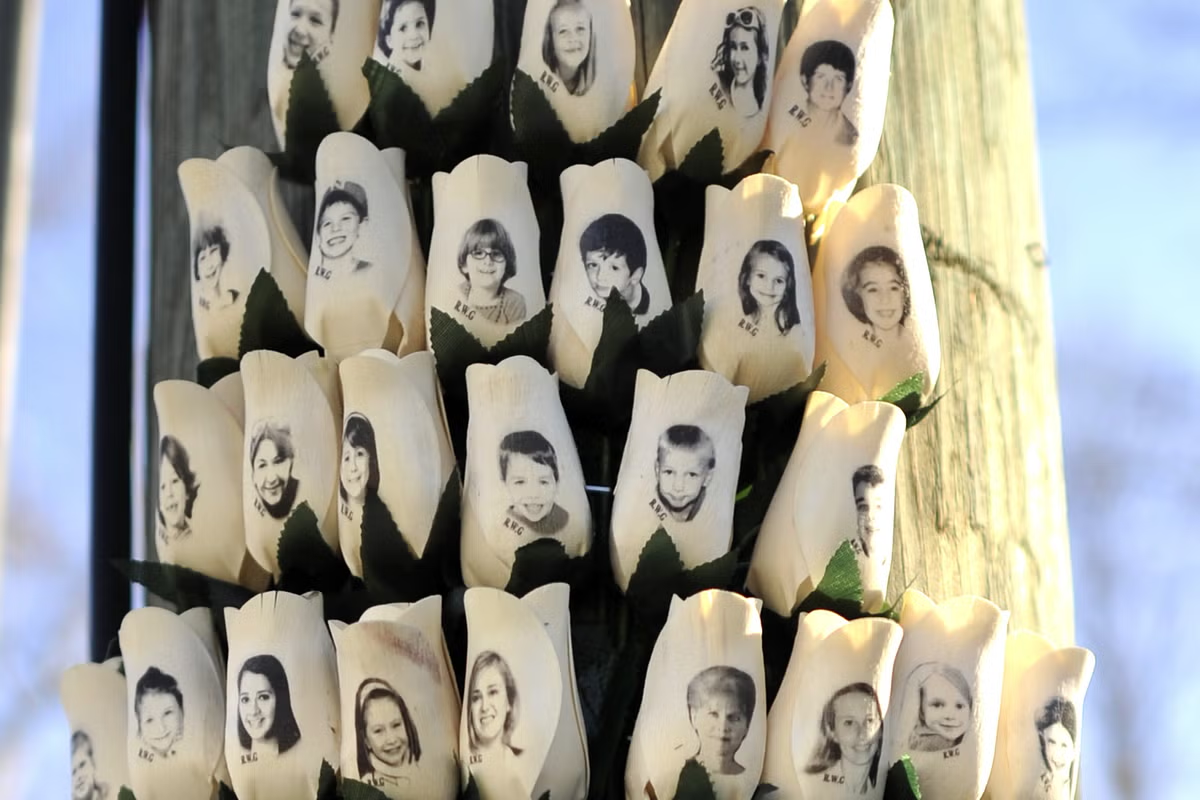
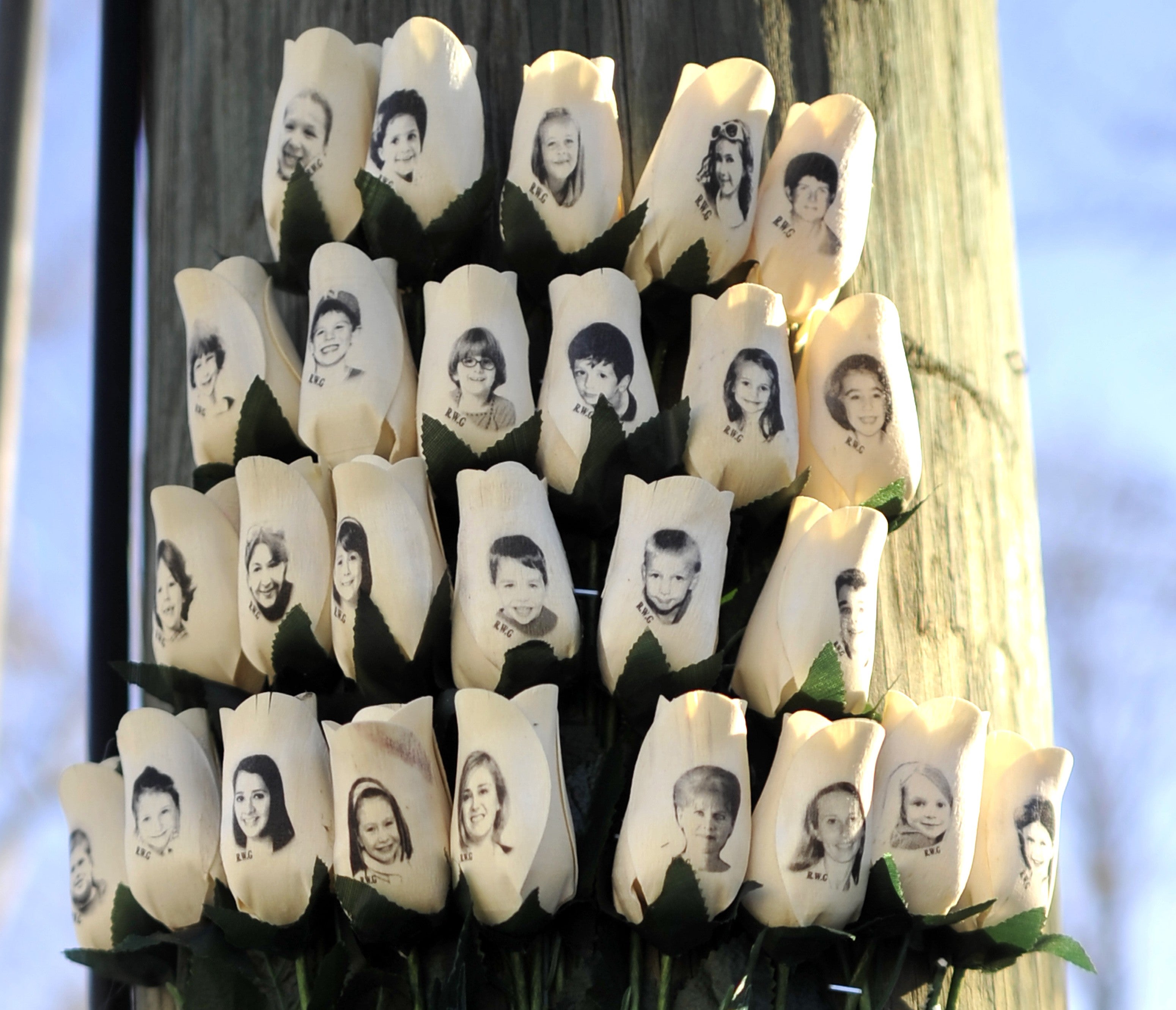
Roses with the faces of the Sandy Hook Elementry students and adults killed are seen on a pole in Newtown, Connecticut on January 3, 2013 (AFP via Getty Images)
One such instance occurred last year in Indiana, where a tip reported a student planning a shooting at Mooresville High School, near Indianapolis, on 14 February – the anniversary of the 2018 Marjory Stoneman Douglas High School massacre in Parkland, Florida.
Trinity Shockley, 18, was arrested on February 12. According to a police report, the tipster, a friend, revealed Shockley’s obsession with the Parkland shooter and access to an AR-15 rifle.
Shockley’s social media postings included a chilling message: “Parkland part two. Of course. I’ve been planning this for a YEAR.”
Advertisement
She later pleaded guilty to conspiracy to commit murder and received a 12-year prison sentence, despite her lawyer’s assertion that she would not have carried out the plan.
Sandy Hook Promise asserts that its program and reporting system have prevented shootings in communities like Mooresville, and have also intervened in potential suicides.
Hockley concluded with a poignant reflection on the program’s necessity: “So it’s bittersweet, because I wish this had existed before Sandy Hook.”
If you are experiencing feelings of distress, or are struggling to cope, you can speak to the Samaritans, in confidence, on 116 123 (UK and ROI), email jo@samaritans.org, or visit the Samaritans website to find details of your nearest branch
Advertisement
If you are based in the USA, and you or someone you know needs mental health assistance right now, call or text 988, or visit 988lifeline.org to access online chat from the 988 Suicide and Crisis Lifeline. This is a free, confidential crisis hotline that is available to everyone 24 hours a day, seven days a week. If you are in another country, you can go to www.befrienders.org to find a helpline near you
Private Eye mocked Donald Trump with its biting new cover, riffing on two big headlines.
The satirical magazine’s latest front page referenced both the shooting at the White House Correspondents’ Dinner and King Charles III’s ongoing visit to the United States.
Its headline read: “Royal Visit Goes Ahead Despite Shooting.”
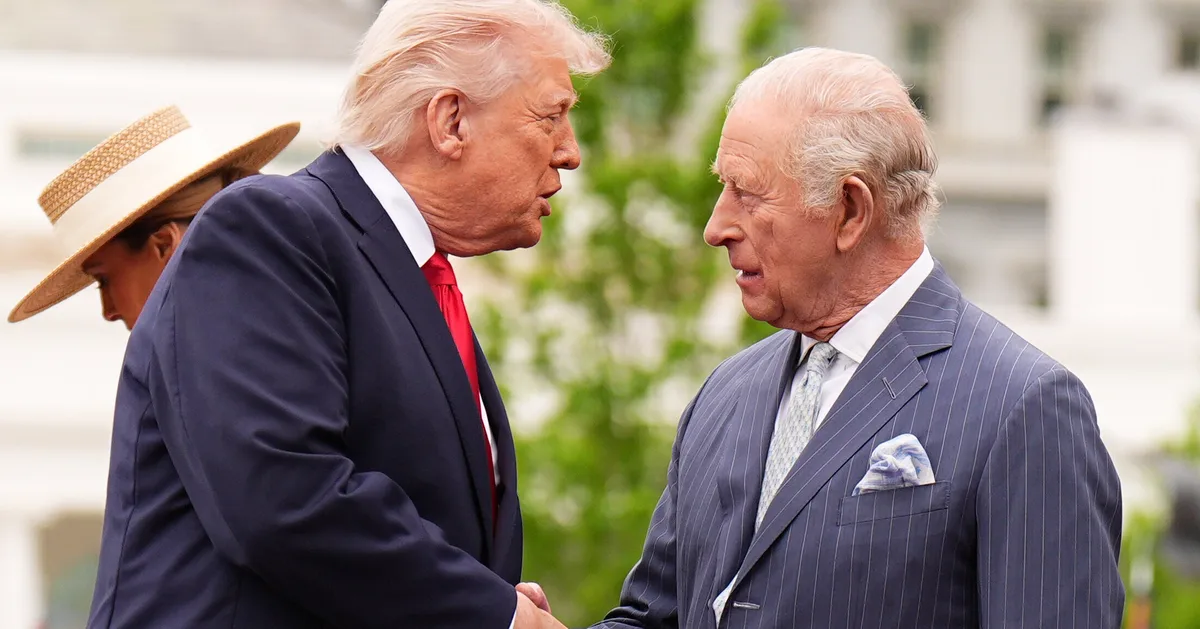
Beneath it, an image of Trump shaking hands with the British monarch featured a speech bubble from the president saying: “I had a narrow escape from a madman.”
Donald Trump, left, shakes the hand of King Charles III after speaking during the ceremonial welcome on the South Lawn of the White House on day two of the State Visit of King Charles III and Queen Camilla.
The magazine has, for years, used its cover to mock and criticise Trump and his administration. Most recently, it has noted Vice President JD Vance’s failure to sway the Hungarian election and slammed the president’s war on Iran.
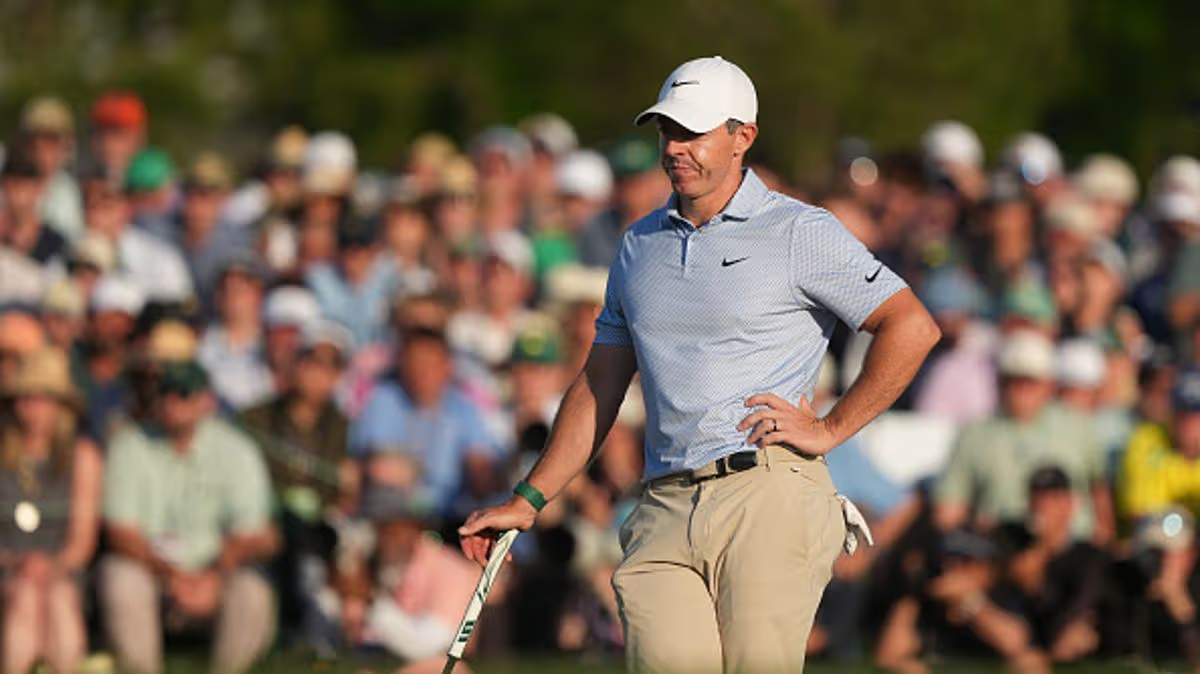
The 36-year-old has taken three weeks off after sensationally defending his Masters title at Augusta National earlier this month
17:10, 29 Apr 2026Updated 17:14, 29 Apr 2026
Rory McIlroy will make his long-awaited return to competitive golf at next week’s Truist Championship at Quail Hollow.
The 36-year-old has taken three weeks off after sensationally defending his Masters title at Augusta National earlier this month.
There had been growing speculation that he might not tee it up again until next month’s PGA Championship – the season’s second major – following his decision to give this week’s Cadillac Championship a miss.
Advertisement
But it has been confirmed that the Holywood man will tee it up at Quail Hollow in North Carolina, a course McIlroy has won on four times previously, including his first ever PGA Tour title in 2010.
It will be a chance for McIlroy to shake off any rust before the PGA Championship which will get under way the following week at Aronimink Golf Club in Philadelphia.
It comes as US President Donald Trump paused his address during a White House state banquet to single out McIlroy, commending the golfer for his “unconquerable courage”.
The president was delivering remarks during a state visit by the King and Queen when he stopped mid-speech to acknowledge McIlroy, who was amongst the guests at the dinner.
Advertisement
Trump declared: “The entire world has been uplifted by this distinct and special character we share. This unstoppable daring, this unconquerable courage. It really is, it’s unconquerable.
“Speaking of that, where’s Rory McIlroy? Can you stand up Rory, will you, please?”, reports Belfast Live.
“That was unconquerable courage. That was very good Rory. I don’t know if that helps him talking about how wonderful the speech… but I had to interrupt my speech because I watched that man win a tournament that was a tough one.
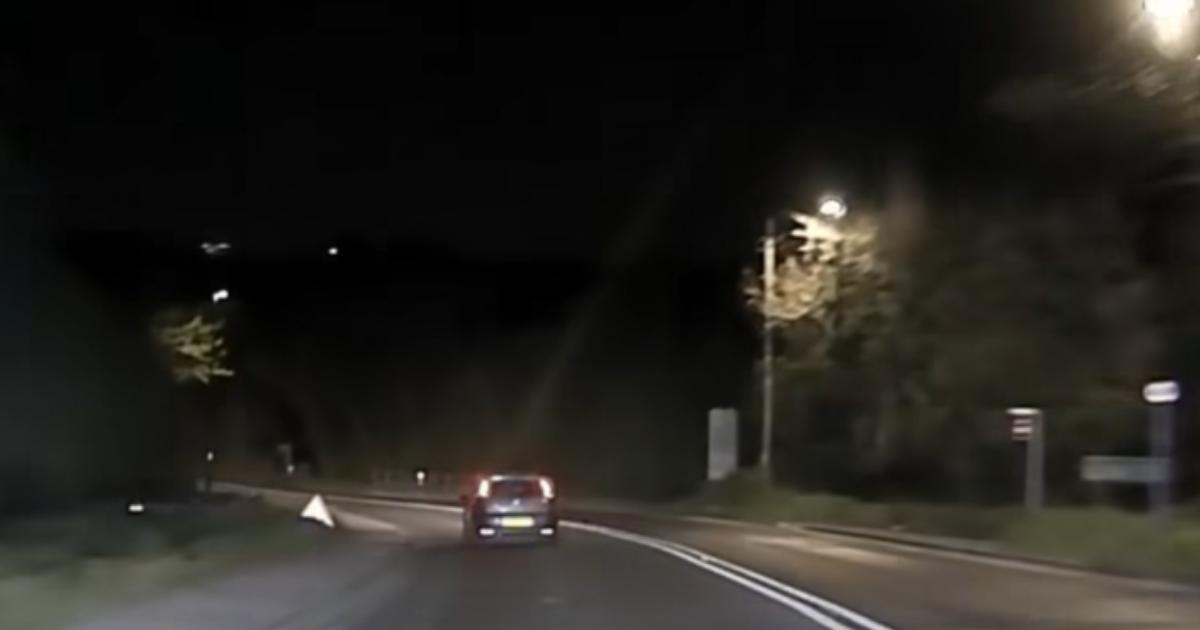
It came after a high-speed pursuit, which started in Harrogate and continued into Ripon, shortly after 9.15pm on Tuesday (April 28).
A 37-year-old man was arrested on suspicion of theft of a motor vehicle, failing to stop, driving whilst disqualified and without insurance, dangerous driving, theft and driving under the influence of drugs.
Recommended reading:
Advertisement
He remains in custody for questioning.
A spokesperson for North Yorkshire Police said: “We received information that a suspected stolen vehicle from Harrogate had been spotted in the area, and officers were quickly deployed.
“The car was swiftly sighted by one of our Roads Policing Units, but failed to stop, leading to a pursuit.
“With support from our “eyes in the sky” at the National Police Air Service (NPAS), officers maintained the pursuit despite the driver’s attempts to get away.
Advertisement
“It continued into Ripon, where a stinger was successfully deployed, bringing the vehicle to a stop.
“The driver made off on foot, but a 37-year-old man was detained a short time later.”
The decision by the United Arab Emirates to leave the oil producers’ cartel Opec after 59 years is more than a symbolic break. It highlights a growing divide among major oil producers over how to respond to a changing energy landscape, and will weaken the group’s ability to manage global supply.
In the short term, the impact of the UAE’s exit will be limited. The world still needs every available barrel of oil, and the UAE accounts for some 3-4% of global production. But the forces behind the decision are more significant than the move itself. They are both economic and political – and the war in Iran helped the two align.
For years, the UAE has been investing heavily to expand its oil production capacity, spending around US$150 billion (£111 billion) to push its potential daily output close to 5 million barrels. But Opec quotas have prevented it from fully exploiting that capacity. Actual production has remained well below its potential at about 3.5 million barrels a day (mbd), with some 5 mbd capacity, constrained by the Opec quota system designed to restrict supply and support prices, generally shaped by the de facto leader, Saudi Arabia.
This has created a tension. Why invest to produce more oil if you are not allowed to sell it?
Abu Dhabi’s answer reflects a different economic model. The UAE can balance its budget at much lower oil prices than Saudi Arabia (just below $50 v Saudi $90 a barrel or more), giving it less incentive to restrict output. Instead, it has prioritised maximising its oil exports.
That strategy is also shaped by expectations about the future. As countries such as China accelerate the electrification of transport, the hitherto steady and reliable demand for oil is slowing and becoming less reliable. Over time, it is likely to plateau. UAE is also well ahead of the Saudis in energy transition – and maintain their net zero target as 2050, compared to the Saudi 2060.
From the UAE’s perspective, the bigger risk is not falling prices, but leaving oil in the ground that may never be sold.
Advertisement
Shifting geopolitics
The timing of the exit is not just about economics. It also reflects shifting political and security calculations, particularly after the UAE came under heavy, sustained attack during the war in Iran.
In Abu Dhabi, there is a growing sense that regional institutions and partnerships, such as the Gulf Cooperation Council (GCC) offered limited support during that period. Anwar Gargash, a senior presidential adviser, told reporters that: “The GCC’s stance was the weakest historically, considering the nature of the attack and the threat it posed to everyone,” adding that he “expected such a weak stance from the Arab League … But I don’t expect it from the GCC, and I am surprised by it.”
That experience has reinforced a more independent foreign policy. The UAE has strengthened ties with the US and Israel, building on the agreement it signed as part of the 2020 Abraham accords. The relationship with Israel is seen not just an economic and security partnership, but as a channel for influence inside the White House.
At the same time, relations with Saudi Arabia have become more strained, with differences over regional conflicts in Somalia and Yemen and economic strategy increasingly visible. Leaving Opec is both an economic decision and a geopolitical signal.
Advertisement
The UAE’s departure also raises questions about the future of Opec itself. The group once controlled more than half of global oil production. Today, its share is much smaller (no more than 35%), and internal divisions over production quotas are more pronounced. Quotas, long the core of its strategy, are increasingly seen as uneven constraints rather than shared commitments.
UAE energy minister, Suhail Al Mazrouei, explains the decision to leave Opec.
Saudi Arabia remains the only member with significant spare capacity, giving it outsized influence. The result is an organisation that still matters, but is less cohesive than it once was.
Not necessarily a win for the US
Some have hailed the UAE’s exit as a victory for Donald Trump, who has repeatedly criticised Opec for keeping oil prices high. A weaker OPEC would indeed lead to higher output and lower prices at the pump.
Advertisement
But sustained lower prices would also put pressure on higher-cost producers, including the US oil patch, which has been one of Opec’s main competitors in recent years. It benefited from the cartel’s restraint when it came to capping oil production. So what now looks like a geopolitical win could, over time, become an economic challenge.
For now, I believe that the UAE’s exit will not dramatically reshape oil markets. Demand remains strong enough to absorb additional supply, particularly as countries rebuild their inventories when Iran reopens the Strait of Hormuz. But the deeper significance lies in what the decision reveals.
Oil producers are no longer aligned around a single strategy. Some are trying to manage scarcity and keep prices high. Others are racing to monetise their resources before demand peaks and they end up with stranded assets. That divergence is likely to grow – and may ultimately prove more consequential than any single country leaving the cartel.
We may be entering a new age where oil is going to play a much lesser role in our lives.






































You must be logged in to post a comment Login