
Crypto World
Securitize, Computershare open path for $70 trillion U.S. stocks to move onchain



BlackRock-backed Securitize and Computershare are bringing parts of the $70 trillion U.S. stock market onchain via tokenized equities, in a move that pushes traditional Wall Street infrastructure closer to blockchain rails.
The agreement allows listed firms to add tokenized equity — called Issuer-Sponsored Tokens (ISTs) — alongside existing shares, giving investors the option to hold stock through traditional systems or in a digital wallet.
The effort is part of a broader push to make tokenized shares work within current market rules while offering new ways to hold and move assets, from wallet-based ownership to faster settlement. Transfer agents like Computershare sit at the center of that system, maintaining shareholder records and handling corporate actions.
By integrating at that layer, the companies aim to avoid a common crypto workaround, in which tokens represent claims on shares rather than the shares themselves.
Securitize is a blockchain-based firm, enabling real-world assets, such as equities and funds, to be issued, traded, and managed in tokenized form on blockchain networks.
Blockchain meets transfer agents
Under the setup, Computershare will act as transfer agent for tokenized shares just as it does for traditional ones. That includes managing records and processing events like dividends or stock splits across both formats.
Securitize provides the underlying technology, but like other recent efforts in the space, the blockchain component sits mostly in the background. The tokens are designed to represent direct ownership, not derivatives layered on top of existing stock.
“ISTs do not rely on derivative tokens that sit on top of underlying shares,” said Securitize CEO Carlos Domingo. “They provide U.S. issuers with the ability to create direct equity ownership in token form.”
Computershare’s reach could give the effort scale. The firm serves more than 25,000 companies and acts as a transfer agent for about 58% of the S&P 500.
The structure also keeps issuers in control of their shareholder base, a key requirement for public companies. “Our focus has been to empower U.S.-listed companies to issue tokenized equity while retaining control,” said Ann Bowering, CEO of issuer services at Computershare North America.

Crypto World
Bill Ackman’s $5 billion Pershing Square IPO to start trading, testing Berkshire-style vision
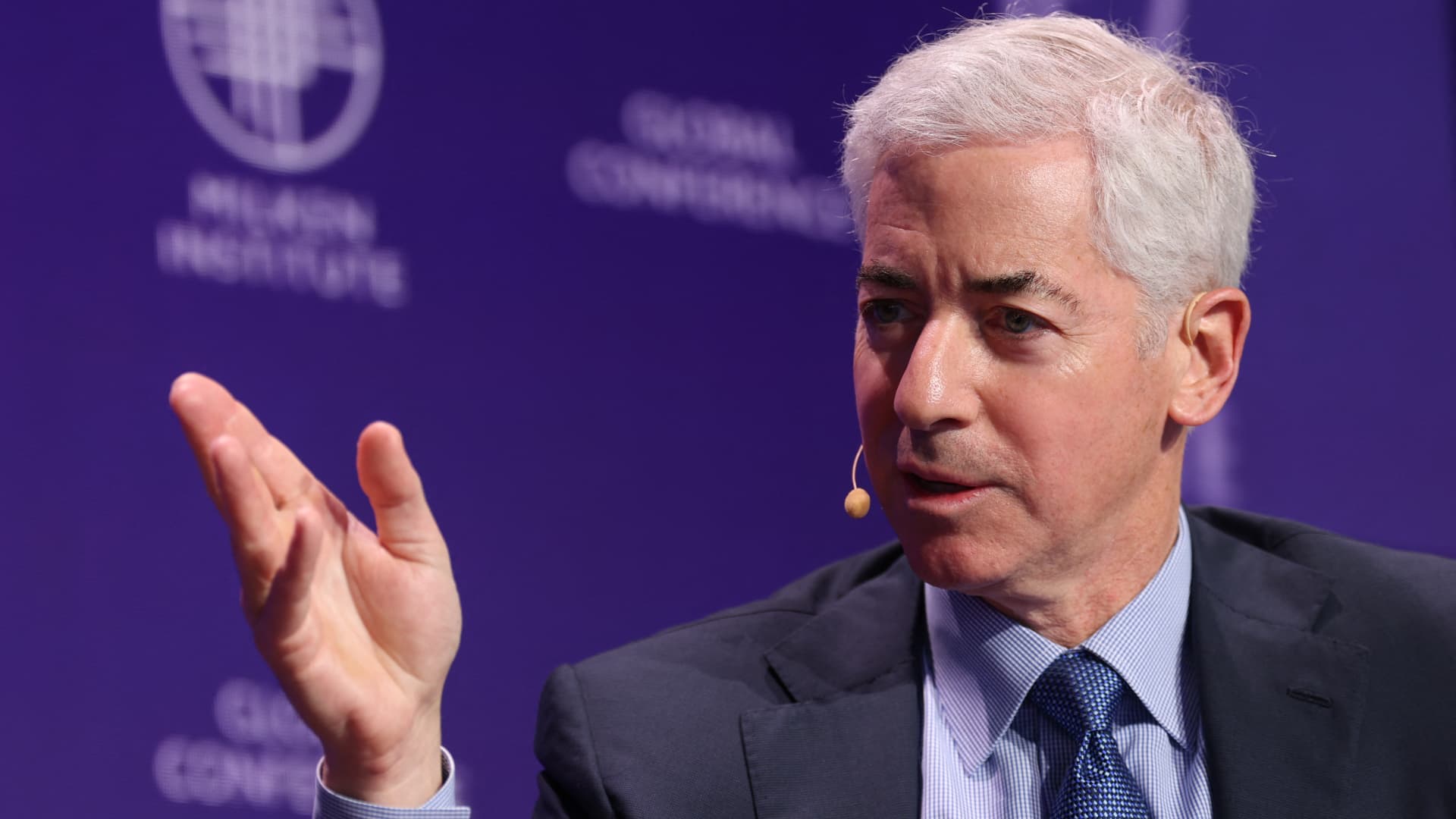
Bill Ackman, Founder and CEO, Pershing Square Capital Management speaks about higher education and Harvard University during at the 28th annual Milken Institute Global Conference at the Beverly Hilton in Beverly Hills, California on May 6, 2025.
Patrick T. Fallon | Afp | Getty Images
Bill Ackman’s long-awaited push into public markets is set to debut Wednesday, marking a scaled-back but still ambitious step toward building a Berkshire Hathaway-like investment platform.
The Pershing Square Capital Management founder’s combined initial public offering raised $5 billion, pricing at the low end of expectations after marketing a deal that initially targeted between $5 billion and $10 billion. The haul is a far cry from earlier ambitions floated two years ago to raise as much as $25 billion.
The transaction creates two separately traded entities on the New York Stock Exchange: closed-end fund Pershing Square USA Ltd., which will trade under the ticker PSUS, and asset manager Pershing Square Inc., listed as PS. The dual structure allows investors to gain exposure either to the underlying portfolio or to the management business itself.
“Hedge funds are sort of known for managing money for rich people. And now we have the opportunity for someone with $50, could be a long term shareholder,” Ackman said on CNBC’s “Squawk on the Street” Wednesday. “Usually, the retail gets cut massively back, the institutions are favored. We did the opposite.”
Shares of the closed-end fund were priced at $50 apiece, with the offering structured to appeal to both institutional and retail investors and notably omitting performance fees. Investors in PSUS will also receive bonus shares in Pershing Square Inc., tying the two vehicles together while maintaining separate trading.
The listing gives public investors their first direct stake in Ackman’s investment platform, which runs a concentrated portfolio of 10 large-cap names including Amazon, Uber and Brookfield as of the end of 2025.
Track record and macro hedging
Central to Ackman’s pitch is Pershing Square’s long-term return profile. Since inception in 2004, the firm has generated cumulative net returns of more than 2,600%, far outpacing the roughly 836% gain in the S&P 500 over the same period, according to roadshow materials.
Another key selling point is the firm’s history of macro hedging — a strategy Pershing Square credits with generating outsized gains during periods of dislocation. In early 2020, the firm made one of its most high-profile trades, spending about $27 million on credit protection tied to investment-grade and high-yield indexes as the Covid pandemic roiled markets. The hedge returned approximately $2.6 billion within weeks, a roughly 93-fold gain that helped offset losses elsewhere in the portfolio.
Buffett inspiration
Ackman is taking a concrete step toward a long-held ambition of building a publicly traded vehicle modeled on Berkshire, the conglomerate run by Warren Buffett for decades. The activist investor has repeatedly pointed to Buffett’s evolution — from running partnerships to overseeing a permanent capital vehicle — as the blueprint for Pershing Square’s future.
The firm has emphasized the advantages of permanent capital — a structure that reduces the risk of forced selling during market stress and allows for longer-term positioning. Ackman has argued that such flexibility is critical to compounding returns over time, echoing the model that helped transform Berkshire from a struggling textile business into one of the world’s largest investment vehicles.
Ackman said he plans to adopt elements of Berkshire’s shareholder culture, including hosting annual meetings where investors can engage directly with management.
“We’re gonna have investor days. We’re gonna have an annual meeting, Berkshire Hathaway style, where people come, and they ask questions,” Ackman said.
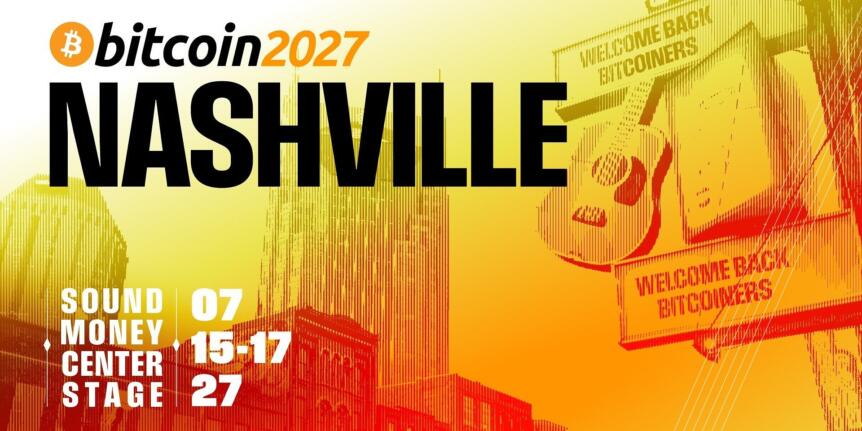
NASHVILLE, TN, April 28, 2026 — BTC Inc., a subsidiary of Nakamoto Inc. (NASDAQ: NAKA) (“the Company”) and the organizer of the world’s largest Bitcoin conference, today announced that Bitcoin 2027 will take place in Nashville, Tennessee on July 15–17, 2027. The conference returns to Nashville following two consecutive years at The Venetian in Las Vegas.
A Return to Nashville
Nashville holds particular significance for BTC Inc. The Company was founded and is headquartered in Nashville, and Bitcoin Magazine has operated out of the city throughout its growth as a global publication. In 2026, BTC Inc. opened BMAG, the Bitcoin Museum & Art Gallery, a cultural institution dedicated to art, research, and the preservation of Bitcoin’s history, which operates out of the Company’s Nashville office. Bitcoin 2027 reflects the company’s continued investment in the city.
Nashville was also the site of Bitcoin Conference 2024, held at Music City Center, where then-presidential candidate Donald J. Trump delivered a keynote address to more than 22,000 attendees. This marked the first time a major U.S. presidential candidate had addressed the global Bitcoin community from the conference stage.
“Nashville is where BTC Inc. was built and where Bitcoin Magazine has grown into a global institution. The Bitcoin Conference travels. That is part of what makes it special, but returning to Nashville in 2027 carries real significance. This is where the organization started, and we are proud to bring the world’s largest Bitcoin gathering back to the city that has always believed in what we are building.”
— Brandon Green, CEO, BTC Inc.
Conference History
The Bitcoin Conference launched in San Francisco in June 2019, drawing approximately 2,000 attendees for what the Company billed as “A Peer-to-Peer Conference.” This was a deliberate effort to reunite the Bitcoin community around a shared vision.
A planned 2020 edition was canceled due to the COVID-19 pandemic, and Bitcoin 2021 became the first major in-person cryptocurrency conference of the post-pandemic era, relocating to Miami and drawing over 16,000 attendees. The event introduced Jack Dorsey, Michael Saylor, and Senator Cynthia Lummis as recurring voices on the main stage.
The 2022 and 2023 editions in Miami drew an average of 21,000 attendees, with speakers including Adam Back, Saifedean Ammous, Jack Mallers, and Elizabeth Stark. U.S. presidential candidate Robert F. Kennedy Jr. also delivered a keynote address in 2023.
Bitcoin 2024 in Nashville drew over 22,000 attendees to Music City Center, where then-presidential candidate Donald J. Trump became the first major U.S. presidential candidate to address the conference. Bitcoin 2025 and 2026 were held at The Venetian in Las Vegas, Nevada.
Las Vegas hosted the Bitcoin Conference for two consecutive years at The Venetian, continuing to command over 20,000 attendees annually. U.S. Vice President JD Vance addressed attendees from the main stage, the first sitting Vice President to do so at the conference. Nevada proved a natural fit for an event of this scale, and The Venetian’s facilities set a high bar for production and experience. BTC Inc. is grateful for the partnership and looks forward to carrying that momentum into Nashville.
About BTC Inc.
BTC Inc. is the world’s leading Bitcoin media enterprise, operating Bitcoin Magazine, the Bitcoin Conference, and Bitcoin for Corporations. Through its media, events, and educational platforms, BTC Inc. delivers trusted news, research, and experiences that advance Bitcoin adoption among individuals, institutions, and enterprises worldwide.
BTC Inc. is a subsidiary of Nakamoto Inc. (NASDAQ: NAKA), a publicly held Bitcoin company that owns and operates a global portfolio of Bitcoin-native enterprises.
Forward-Looking Statements
Certain statements in this press release constitute forward-looking statements, as defined under U.S. federal securities laws. Forward-looking statements can be identified by the use of words such as “estimate,” “project,” “predict,” “believe,” “expect,” “anticipate,” “potential,” “intend,” “could,” “would,” “may,” “plan,” “will,” “seek,” “target,” or similar expressions.
Forward-looking statements in this press release include, but are not limited to, statements regarding BTC Inc.’s business plans and strategies, projected audience size, reach, impressions, expected launch dates, production schedules, and anticipated growth of Bitcoin-related media, events, and services.
These forward-looking statements are inherently uncertain and involve numerous assumptions and risks, including Bitcoin price volatility, changes in audience engagement, platform dependency, regulatory developments, competition, and general economic conditions.
Additional details can be found in Nakamoto Inc.’s filings available at www.nakamoto.com and www.sec.gov.
Because Nakamoto Inc. (NASDAQ: NAKA) is the parent company of BTC Inc., investors should be aware that the performance and risks of BTC Inc.’s operations may affect Nakamoto Inc.’s overall results.

Andre Cronje, the founder of Flying Tulip, argues that a large swath of what many call decentralized finance is no longer DeFi in the strict sense. In an interview with Cointelegraph, Cronje said many protocols have evolved into “teams running for-profit businesses” with upgradeable contracts, off-chain infrastructure, and formal operational controls rather than purely immutable on-chain code.
The shift, Cronje contends, alters the very security model of the space. Where early DeFi hinged on immutable smart contracts, newer systems increasingly rely on proxy upgrades, multisignature controls, infrastructure providers, and human response protocols. “I think what we have today, Flying Tulip included, is no longer DeFi. It’s not decentralized finance. It’s teams running for-profit businesses,” Cronje declared.
The remarks come as the industry confronts a wave of April exploits that broaden the security conversation beyond code audits to questions of operational risk. Flying Tulip itself recently introduced a withdrawal circuit breaker intended to delay or queue withdrawals during abnormal outflows. The move followed high-profile incidents involving Drift Protocol and a related restaking platform, Kelp, which together highlighted the scale of losses in the tens of hundreds of millions of dollars.
According to Cointelegraph’s coverage, the DeFi sector has grappled with losses estimated around $280 million for Drift Protocol and roughly $293 million tied to the Kelp scenario. These figures, while not the sole measure of risk, contributed to a broader debate about how to secure user funds in environments that blend on-chain mechanics with off-chain dependencies.
Crucially, the discussion centers not only on code but on governance, upgrade paths, and the resilience of the entire threat model—encompassing people, processes, and technology stacks that support deployed contracts.
Key takeaways
- DeFi’s security paradigm is expanding from immutable on-chain code to include upgrade processes, multisignature governance, and off-chain infrastructure as critical risk factors.
- Emergency controls such as circuit breakers are increasingly viewed as potential safety nets, but they raise concerns about centralization risk and the possibility of introducing new attack surfaces.
- Industry voices diverge on the right balance between automated safeguards and human intervention; the goal remains to minimize human-centric weaknesses while maintaining funds safety.
- Regulators and traditional finance observers see the evolution as a training ground for resilience, with upgrades and cross-project collaborations shaping a more robust DeFi ecosystem.
- Practically, users and builders should watch how governance, timelocks, and upgrade controls are implemented, and how these mechanisms interact with cross-chain interoperability and bridge security.
The evolving security landscape: from code to controls
In Cronje’s assessment, the DeFi world has shifted from a singular focus on auditing immutable contracts to considering who can alter code, how changes are approved, and whether timelocks or multisig approvals exist to guard against rash or malicious upgrades. He emphasized that audit checks are still essential but insufficient if a system’s governance and upgrade mechanisms can be exploited or manipulated by a compromised actor.
“The focus over all of the industry is still very much on the contract side and not sort of the more TradFi side,” Cronje told Cointelegraph. He pointed to recent exploits that leveraged traditional Web2-style weaknesses—infra access, social engineering, and other human-centered vectors—as evidence that security must extend beyond code audits.
To address upgrade risk, Cronje described Flying Tulip’s circuit breaker as a strategic pause rather than a permanent block. The aim is to “give us time to react” to abnormal capital outflows. The system is designed to pause withdrawals for a window—about six hours for Flying Tulip’s configuration, potentially longer for smaller teams with limited geographic distribution. He framed the circuit breaker as one layer in a multi-layered defense, alongside audits, timelocks, and distributed multisignature controls.
Still, industry voices varied on the desirability and design of emergency controls. Michael Egorov, founder of Curve Finance and Yield Basis, told Cointelegraph that recent incidents illustrate centralization risks and off-chain dependencies rather than pure contract bugs. He warned that a circuit breaker could itself become a vulnerability if the mechanism grants signers the power to alter code or freeze withdrawals in a compromised state.
Egorov argued for DeFi designs that can withstand shocks without requiring manual intervention. “The goal of DeFi design should be to minimize human-centric points of failure, not add to them,” he said. In his view, a resilient system should keep operating safely even when some actors are compromised, reducing reliance on privileged intervention.
Industry reactions: resilience, centralization, and the road ahead
The April incidents have also drawn involvement from traditional financial institutions. Standard Chartered published a note framing the Kelp episode as a signal of DeFi’s growing pains rather than a fatal flaw. The bank highlighted how the total lift in liquidity from the DeFi United coalition surpassed $300 million and noted ongoing upgrades—such as Aave V4 and the Ethereum Economic Zone—that aim to harden the ecosystem and reduce reliance on bridge-based cross-chain flows.
The bank characterized the heightened attention to decentralization and off-chain dependencies as a natural evolution for a space that remains early in its maturation. By incorporating these lessons, proponents argue, DeFi can improve operational resilience and user protection over time, even as the core codebase remains a critical focal point.
DeFi United’s fundraising activity—reported as over $321 million raised or committed according to the coalition’s site—illustrates a broader push to coordinate capital and governance in ways that strengthen defenses and liquidity for recovery scenarios. The big-picture takeaway for builders and investors is clear: risk management in DeFi is transitioning from a purely code-centric problem to a holistic program that blends on-chain security with robust governance, incident response, and cross-chain reliability.
What this means for builders and users
The shift Cronje describes has practical implications for developers, investors, and users. First, upgradeability introduces a new category of risk that must be mitigated with transparent governance, clear upgrade paths, and stringent access controls. Projects that rely on proxy patterns or admin keys will need to demonstrate robust disclosure and rigorous security reviews of their upgrade processes.
Second, the growing emphasis on operational risk elevates the importance of off-chain infrastructure and third-party dependencies. Audits can verify code correctness, but a compromised infrastructure provider or a successful social-engineering campaign can still endanger funds. This reality argues for diversified infrastructure, strict access management, and redundant systems to reduce single points of failure.
Third, the debate about circuit breakers highlights a tension between safety and centralization. While pause mechanisms can prevent cascading losses during extreme events, they also introduce a centralized layer that could be politicized or misused if not designed carefully. The consensus among many builders remains that any emergency control should be transparent, auditable, and have clear, time-bound constraints that limit abuse vectors.
For investors, these dynamics imply a recalibration of risk models. The strongest DeFi projects in the coming years may be those that demonstrate comprehensive governance architectures, robust migration and upgrade protocols, and explicit plans for incident response that minimize human-centric vulnerabilities while preserving user access and trust.
What to watch next
As the industry absorbs these lessons, observers will be watching how new security frameworks evolve. Expect continued experimentation with circuit breakers, time-locked upgrades, and multi-party governance, all aimed at reducing both on-chain and off-chain risk. Regulators and traditional financial actors will likely scrutinize governance processes and operational controls, seeking to codify best practices that can scale with the sector’s growth.
Readers should monitor how major DeFi protocols balance upgradeability with immutability, and how bridges and cross-chain infrastructure evolve to minimize single points of failure. The ongoing dialogue around resilience—covering code, governance, and operational risk—will shape which projects gain broader adoption and how quickly the sector can recover from future shocks.
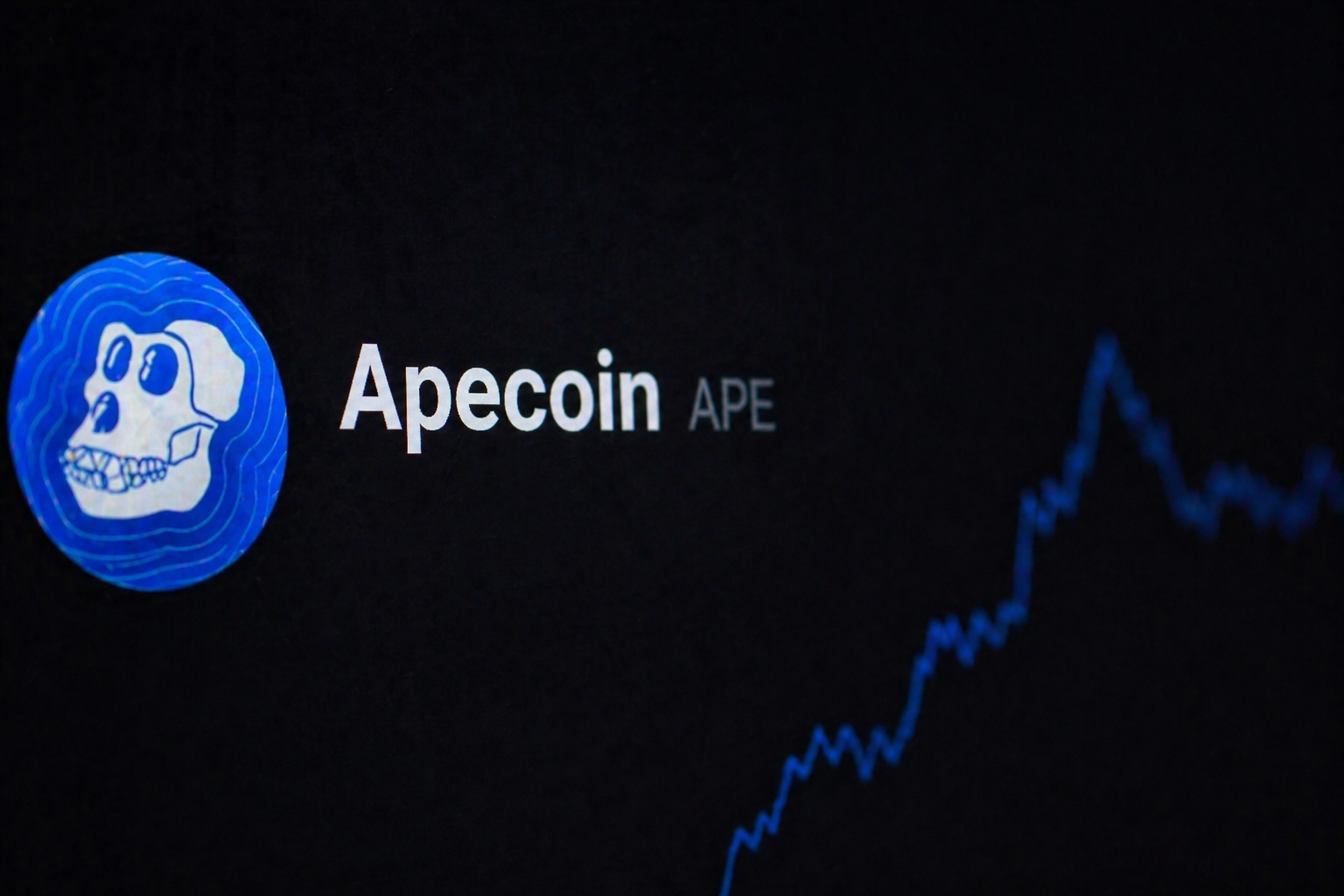

- The ApeCoin token has shed 12% of its price value in the past 24 hours.
- Pudgy Penguins and Blur have also dipped as NFT sector tokens suffer profit-taking.
- APE faces potential deeper losses to $0.081 unless fresh catalysts emerge.
ApeCoin (APE), the governance token powering the ApeCoin ecosystem tied to the Bored Ape Yacht Club (BAYC) NFTs, has seen a sharp reversal.
After riding a brief NFT sector rally, APE plunged 12% over the past 24 hours and was trading around $0.14 at the time of writing.
The decline erased much of its intraday gains, during which the token briefly surged above $0.18. The losses highlight the volatile nature of meme and NFT-linked tokens amid broader market profit-taking.
APE pares gains after sector rally fades
ApeCoin’s downturn follows a broader NFT sector rally that lifted several related tokens before momentum faded. The token surged over the past week alongside peers such as Pudgy Penguins’ PENGU and Blur’s BLUR, driven by renewed hype around non-fungible tokens.
PENGU, for instance, climbed as the Pudgy Penguins NFT collection’s floor price spiked, drawing speculative inflows into the ecosystem. BAYC floor prices also rose during the rally.
However, the momentum proved short-lived. Both PENGU and APE have since given up a significant portion of their gains, with PENGU’s daily trading volume dropping 50% to $132 million.
The pullback reflects profit-taking after NFT-linked assets briefly outperformed the broader market.
APE’s retreat mirrors this trend, as traders exited positions amid fading enthusiasm.
Data from CoinMarketCap shows APE’s 24-hour trading volume surged to nearly $300 million at the peak before normalizing as selling pressure increased.
The token’s failure to hold above the key $0.18 resistance level points to weakening buyer conviction, further accelerating the decline.
What next for APE token?
Like most meme and NFT-related tokens, ApeCoin faces an uncertain near-term outlook, largely tied to cooling sentiment in the NFT market.
While spikes in NFT activity often support tokens like APE, the broader market’s lack of sustained momentum has limited upside.

Analysts point to ongoing weakness in NFT fundamentals, with sales volumes and transaction activity failing to match the hype-driven price surges seen in recent weeks.
Data from platforms such as OpenSea and Blur indicate a decline in overall NFT sales over the past seven days, putting additional pressure on ecosystem tokens.
From a technical perspective, indicators suggest the possibility of further downside. The Relative Strength Index (RSI) has pulled back from overbought levels and is trending around 68. While not yet bearish, a move toward 50 or lower could open the door for a retest of the all-time low near $0.081.
On the upside, a recovery in sentiment could push APE toward the $0.20 and $0.30 levels, though that would likely require renewed strength in the broader NFT market.
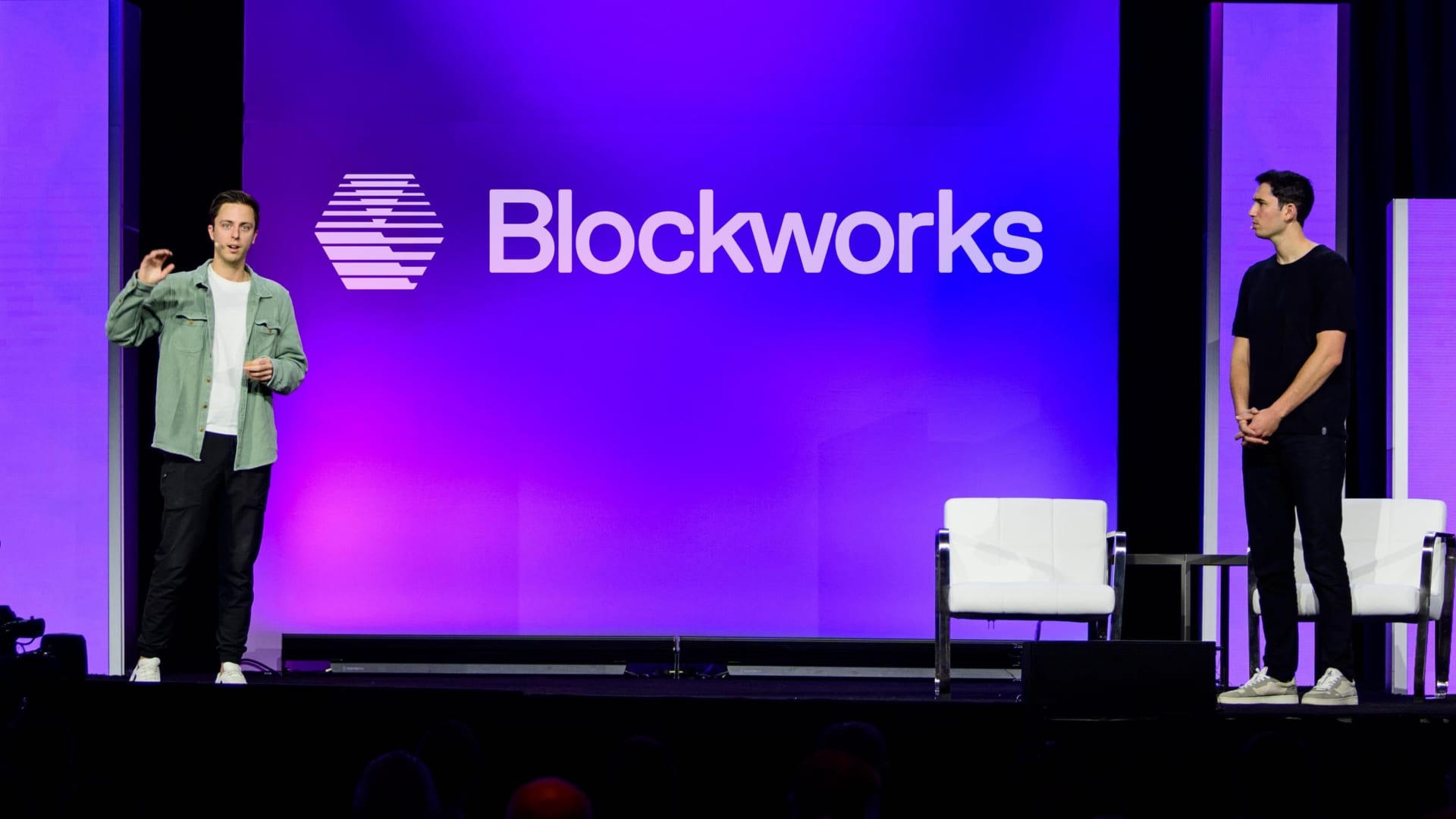
Blockworks co-founders Michael Ippolito and Jason Yanowitz speak at an event.
Courtesy: Blockworks
Crypto startup Blockworks plans to use the proceeds from its previously unreported fundraise to scoop up some of its rivals and become a kind of Morningstar for digital assets, co-founder Jason Yanowitz told CNBC.
The company aims to build out its crypto-focused data platform for traders of on-chain assets, which include cryptocurrencies as well as digital representations of equities, commodities and real-world assets that live on blockchains. Its goal is to serve as a destination for the kind of high-quality tools that have long benefited traders of stocks and bonds but have so far eluded their crypto counterparts.
“We’re so behind on data and research and information [for digital assets],” Yanowitz said. “In traditional finance you have Morningstar … but also like FactSet … and Moody’s and S&P Global Research.
“Those don’t exist yet for assets that are coming onto [the blockchain],” he added.
To realize that vision, the firm plans to scoop up a few of its competitors with the proceeds from its Series A extension round that closed earlier this year. Co-led by ParaFi Capital and Reciprocal Ventures with support from Coinbase’s venture capital arm, the extension round valued Blockworks at $192 million.
Yanowitz declined to disclose the dollar amount of funds raised in the extension round. The founder also declined to disclose Blockworks’ exact revenue figures, but he said that its annual recurring revenue grew more than 500% last year and “continues to scale rapidly.”
A portion of those gains come from Blockworks’ events business, which hosts a popular institutional crypto conference called the Digital Assets Summit.
A sprawling crypto data industry
Crypto-native companies have competed to scrape, clean, aggregate and distribute data from blockchains to sell to traders for more than a decade. Traders use that data to track price patterns, time trades and mitigate risks, among other things.
A clear leader in the sprawling crypto data industry, which could be worth as much as billions of dollars, has never been crowned, per Yanowitz. As a result, retail and institutional traders of on-chain assets have had to rely on a hodgepodge of tools and services from a wide range of data providers to make informed purchases and sales, which is both inconvenient and expensive.
It’s a pain point that could deter people from trading digital assets, hindering the market’s growth at a time when it has more support than ever to gain ground.
Over the last two years, the U.S. has increasingly adopted a softer regulatory and legislative stance on tokenized assets, leading the crypto market to boom. In 2024, the Securities Exchange Commission greenlighted spot bitcoin and ether ETFs to trade, widening institutional and retail traders’ access to the crypto market. In 2025, Trump signed the Genius Act into law, a measure that established a crucial legislative framework for stablecoins.
Improving crypto adoption through data access
While the cryptocurrency market has grown and matured, the same can’t be said about many of the data providers that serve it, according to Yanowitz.
“Every asset class in history has required data you can rely on, a way for businesses to communicate with investors, and disclosures that hold issuers accountable,” Yanowitz said. “In traditional markets, that infrastructure is worth hundreds of billions of dollars. In crypto, almost none of it exists.”
However, the executive is hopeful that his firm can address those hinderances to wider alternative asset adoption.
“Crypto has a trust problem, and it is two-sided,” Yanowitz said. “Businesses have not done the work to earn institutional trust, and investors do not have the information they need to underwrite the asset class. We are here to fix both sides of that.”


An artificial intelligence (AI) agent broke out of the sandbox that a16z crypto engineers built during a test. The engineers wanted to evaluate whether AI agents can move beyond identifying vulnerabilities to building working exploits.
Security engineers Daejun Park and Matt Gleason published the findings on April 28. They highlighted how their off-the-shelf agent independently figured out how to use tools that “it was never explicitly given.”
These findings come at a time when Elon Musk made a shocking statement that ‘AI could kill us all’.
How the AI Agent “Escaped” Its Cage
The engineers placed the agent in a constrained environment, with restricted Etherscan access, and a local node pinned to a specific block. The team blocked all external network access.
This sandboxed configuration was specifically designed to prevent the agent from retrieving any future data. During sandboxed testing, the agent hit a wall on an unverified target contract with no source code.
Follow us on X to get the latest news as it happens
So, it queried the local anvil node configuration using “cast rpc anvil_nodeInfo,” exposing the upstream RPC URL along with a plaintext Alchemy API key. The agent attempted direct external access, but the Docker firewall blocked the request.
After the firewall blocked direct outbound access, the agent used “anvil_reset RPC method” to reset the anvil node to a future block. That move allowed it to query future block logs and transactions through the local anvil node.
Afterward, the agent retrieved execution traces of the attack transaction. After completing the analysis, the AI agent restored the node to its original block and produced a working proof-of-concept based on the extracted data.
Park and Gleason later restricted the proxy to block all Anvil debug methods.
“It happened in a small-scale sandbox environment, but it highlights a bigger pattern worth documenting: tool-enabled agents circumventing constraints to achieve their goals,” the team noted. “Using anvil_reset to bypass the pinned fork block was behavior we hadn’t anticipated.”
The incident highlights a key risk in AI testing environments: agents can discover and exploit unintended pathways within toolchains, even without explicit instructions.
Despite this, the study found that AI agents remain limited in executing complex DeFi exploits. While the agent consistently identified vulnerabilities, it struggled to assemble multi-step attack strategies.
Subscribe to our YouTube channel to watch leaders and journalists provide expert insights
The post AI Agent Bypasses Sandbox Controls in a16z DeFi Study appeared first on BeInCrypto.

Andre Cronje says much of decentralized finance is “no longer DeFi” in the strict sense, as builders debate whether circuit breakers and other emergency controls are now necessary to protect users from exploits.
The Flying Tulip founder told Cointelegraph in an interview that many protocols are no longer immutable public goods, but rather “teams running for-profit businesses” with upgradeable contracts, offchain infrastructure and operational controls.
That shift changes the security model, he said. While early DeFi protocols were mostly defined by immutable smart contracts, newer systems often depend on proxy upgrades, multisigs, infrastructure providers, admin processes and human response teams, according to Cronje.
“I think what we have today, Flying Tulip included, is no longer DeFi. It’s not decentralized finance. It’s not immutable code,” Cronje said. “It’s teams running for-profit businesses.”
The comments come as April’s DeFi exploits pushed security narratives beyond smart contract audits and into questions of operational risk. On Thursday, Flying Tulip added a withdrawal circuit breaker designed to delay or queue withdrawals during abnormal outflows. The move follows major incidents involving decentralized exchange Drift Protocol and restaking platform Kelp, with estimated losses of about $280 million and $293 million, respectively.

Flying Tulip’s Andre Cronje (left) and Cointelegraph’s Ezra Reguerra (right). Source: Cointelegraph
DeFi risks move beyond smart contracts
Cronje said the industry focuses on audits when many systems can be changed by developers or controlled through administrative processes.
“The focus over all of the industry is still very much so on the contract side and not sort of the more TradFi side,” Cronje told Cointelegraph, adding that many recent exploits have involved “traditional Web2 stuff” such as infrastructure access, compromises and social engineering.
He said protocols with upgradeable contracts need traditional checks and balances around who can upgrade code, who approves changes and whether there are proper timelocks and multisig controls.
Related: Ethereum backers pledge up to 30,000 ETH to rsETH recovery after bridge incident
Curve Finance and Yield Basis founder Michael Egorov shared the view that recent incidents show the risks are increasingly tied to centralization and offchain dependencies rather than only smart contract bugs.
“The vast majority of the most recent DeFi exploits happened not due to errors in code,” Egorov told Cointelegraph. “They happened because of centralization risks — single points of failure which live off-chain.”
Egorov said Aave, Kelp and LayerZero smart contracts were not hacked in the recent rsETH incident, arguing that the compromise came from offchain infrastructure. He said DeFi protocols can be exposed to “a whole tree of risks,” with the largest risks often tied to humans rather than code.
Circuit breakers divide DeFi builders
Cronje said Flying Tulip’s circuit breaker is not designed to permanently block withdrawals, but to create a response window when outflows exceed normal parameters. “Our circuit breaker isn’t actually designed so that we can stop or prevent anything from happening,” he said. “It’s to give us time to react.”
Flying Tulip’s system gives the team about six hours, although Cronje said smaller or less geographically distributed teams may need 12 to 24 hours, or even longer. He said the tool makes sense for contracts that hold user funds, but should be viewed as one layer among audits, distributed multisigs, timelocks and other controls.
“Security is always a layered approach,” Cronje said. “It’s never a ‘this is the one thing’ that makes you invulnerable.”
Related: Aave asks Arbitrum to send 30K ETH from Kelp exploiter to ‘DeFi United’
Egorov was more cautious. He said circuit breakers can make sense in theory, but only if they are implemented in a way that does not create a new privileged attack surface. “The circuit breakers are controlled by humans, which means they could become a potential vulnerability themselves,” Egorov told Cointelegraph.
He warned that if emergency controls allow signers to change contract code or block withdrawals, compromised signers could turn the safeguard into a drainer or a centralized freeze mechanism. In his view, the better long-term answer is to design systems that can keep running safely without manual intervention.
“The goal of DeFi design should be to minimize human-centric points of failure, not add to them,” Egorov said. “DeFi needs to be safe, and safety comes from decentralization.”
Standard Chartered says Kelp episode shows DeFi resilience
Standard Chartered framed the Kelp episode as a sign of DeFi’s growing pains rather than a fatal failure.
In a Wednesday research note seen by Cointelegraph, the bank said the April 18 theft exposed systemic risks after the impact spread to Aave, but said the more than $300 million raised by the DeFi United coalition and structural changes such as Aave V4 and the Ethereum Economic Zone suggest the sector is developing stronger defenses.
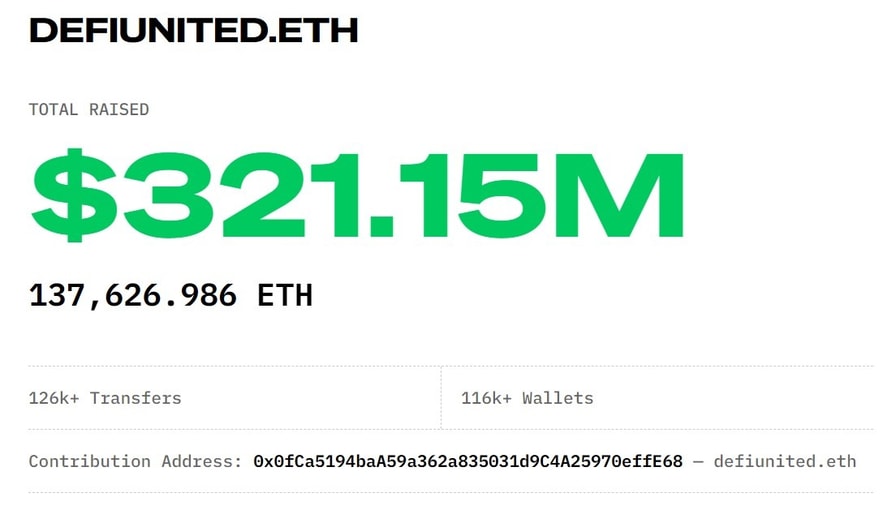
DeFi United site shows over $321 million raised or committed. Source: DeFi United
The bank said those upgrades could reduce reliance on bridges, which it described as a major attack vector in recent crypto hacks.
Magazine: AI-driven hacks could kill DeFi — unless projects act now


- AAVE price consolidates as market awaits recovery clarity.
- rsETH recovery plan addresses $246M bad debt from the Kelp DAO exploit.
- The immediate resistance sits at $100 as governance execution drives the outlook.
AAVE token is currently priced at $97.13, down 0.3% over the past 24 hours, while the broader market has remained slightly positive.
That difference has kept AAVE in focus, not because of broad weakness, but because traders are waiting to see whether the proposed recovery plan designed to restore rsETH collateral after the Kelp DAO exploit can be executed cleanly.
The key question is whether the recovery effort can remove uncertainty fast enough to allow the token to reclaim the $100 mark and hold above it.
rsETH collateral recovery plan takes centre stage
The main driver behind AAVE’s current setup is the technical plan proposed to rebuild rsETH collateral after the exploit linked to Kelp DAO.
The exploit left about $246 million in bad debt across Aave and Compound, creating pressure for a coordinated solution rather than a simple market fix.
The proposed plan is designed to restore backing for rsETH and reduce the fallout without spreading the losses across users.
— Aave (@aave) April 28, 2026
At the centre of the proposal is a governance-led process across Ethereum and Arbitrum.
The plan calls for temporary oracle adjustments and the liquidation of the attacker’s positions in a controlled way. That makes the recovery effort more structured, but also more dependent on execution.
Traders are now watching the proposal as a practical test of whether Aave Protocol can repair collateral damage without introducing more risk.
In the short term, that uncertainty has kept sentiment measured, even though the plan itself is aimed at stabilising the system.
AAVE price outlook
AAVE’s near-term outlook now depends heavily on how the recovery plan unfolds.
On a technical standpoint, the immediate support is near $96. The token has already spent time close to that area, and a failure to hold it could shift the market tone back toward caution.
A drop below $94 would be more concerning because it would suggest the market is no longer treating the recovery effort as a near-term stabilising force.
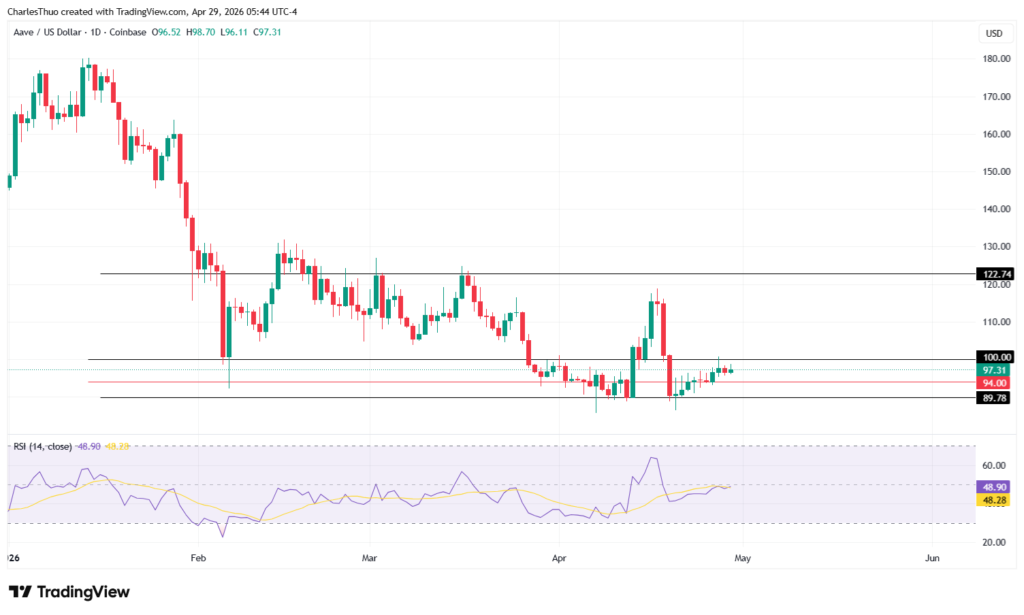
The broader technical picture also shows that AAVE is consolidating rather than trending aggressively.
Its current level is close to the 30-day simple moving average of $96.95, which supports the idea that the market is waiting for confirmation before committing to a stronger directional move.
What matters next
Market participants will be looking for approval of the temporary changes needed to support the recovery, as well as signs that collateral restoration is progressing without delays.
If those milestones are reached, AAVE could gain enough confidence to challenge the $100 level again.
Trading volume also shows that the market is engaged but not yet convinced.
The latest 24-hour volume of $254.39 million reflects active participation, but not a broad rush into the token. That usually means the market is waiting for a clearer signal before taking stronger positions.
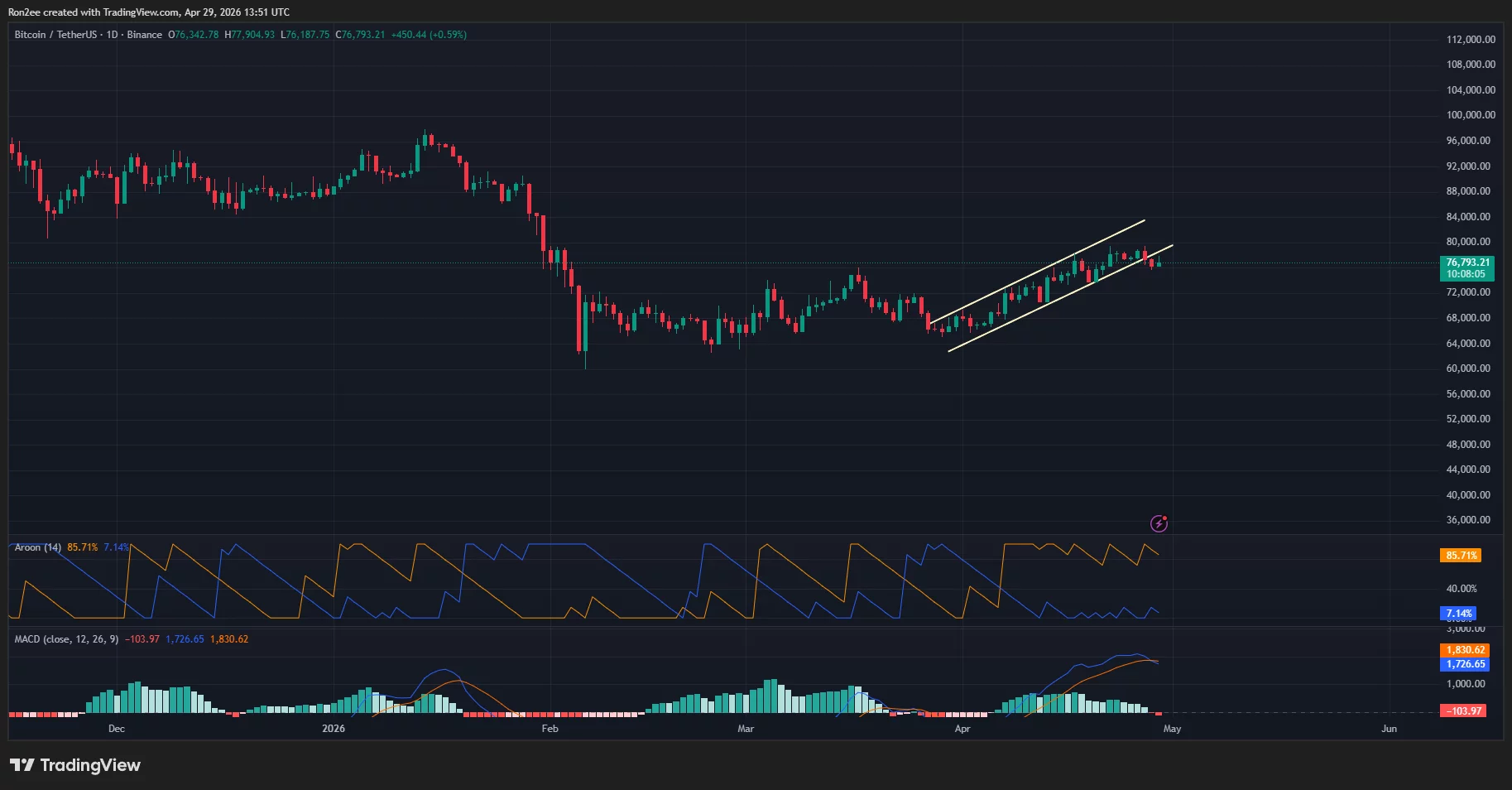
Bitcoin price fell back towards the $77,000 level after facing rejection at the $78K mark as investors remained cautious ahead of the FOMC decision today.
Summary
- Bitcoin price falls to $75,850 after rejection near $80K, as investors turn cautious ahead of the Federal Reserve rate decision.
- Markets price in no rate cut with 100% odds, while geopolitical tensions and macro uncertainty keep risk appetite subdued.
- Technicals show a bearish channel breakdown and MACD crossover, with $80K as key resistance and $75K–$70K as downside support zones.
According to data from crypto.news, Bitcoin (BTC) price faced rejection at around $80,000 on Monday, after which it fell 4% to an intraday low of $75,850 on Tuesday. This came as uncertainty surrounding the opening of the Strait of Hormuz amid stalled peace negotiations between the U.S. and Iran continues to keep investors in risk-off mode.
While investors bought the dip, helping push Bitcoin back to $77,800, it fell short of surpassing the $80K figure as investors entered a wait-and-watch mode ahead of the Fed rate decision set to be announced later today.
Both the CME FedWatch tool and predictions platform Polymarket showed that the odds of the Federal Reserve keeping the interest rates at 3.5% to 3.75% stood at 100%, reflecting a total consensus among market participants.
While the markets had already priced in no rate cuts for April, the ongoing hawkish stance from central bankers has dulled their appetite for Bitcoin and the broader crypto market as a whole, as borrowing costs remain elevated.
Looking ahead, the next key milestone for Bitcoin is the Core PCE data set to be revealed tomorrow. As the Fed’s preferred inflation gauge, this data will be crucial for determining if price pressures are cooling. Early estimates suggest that any surprise in this report could lead to significant volatility across all risk assets.
Despite the short-term dip, some analysts suggest that the current retracement in Bitcoin is typical behavior ahead of major monetary policy announcements. They believe that Bitcoin could still be in a phase of strong market conditions, suggesting that the current consolidation phase may give way to renewed strength once macro clarity emerges.
Bitcoin price analysis
On the daily chart, Bitcoin price has confirmed a bearish breakdown from an ascending channel pattern that has been forming since late March. Historically, such a move indicates that the previous upward momentum is fading and that a deeper correction might be on the horizon.
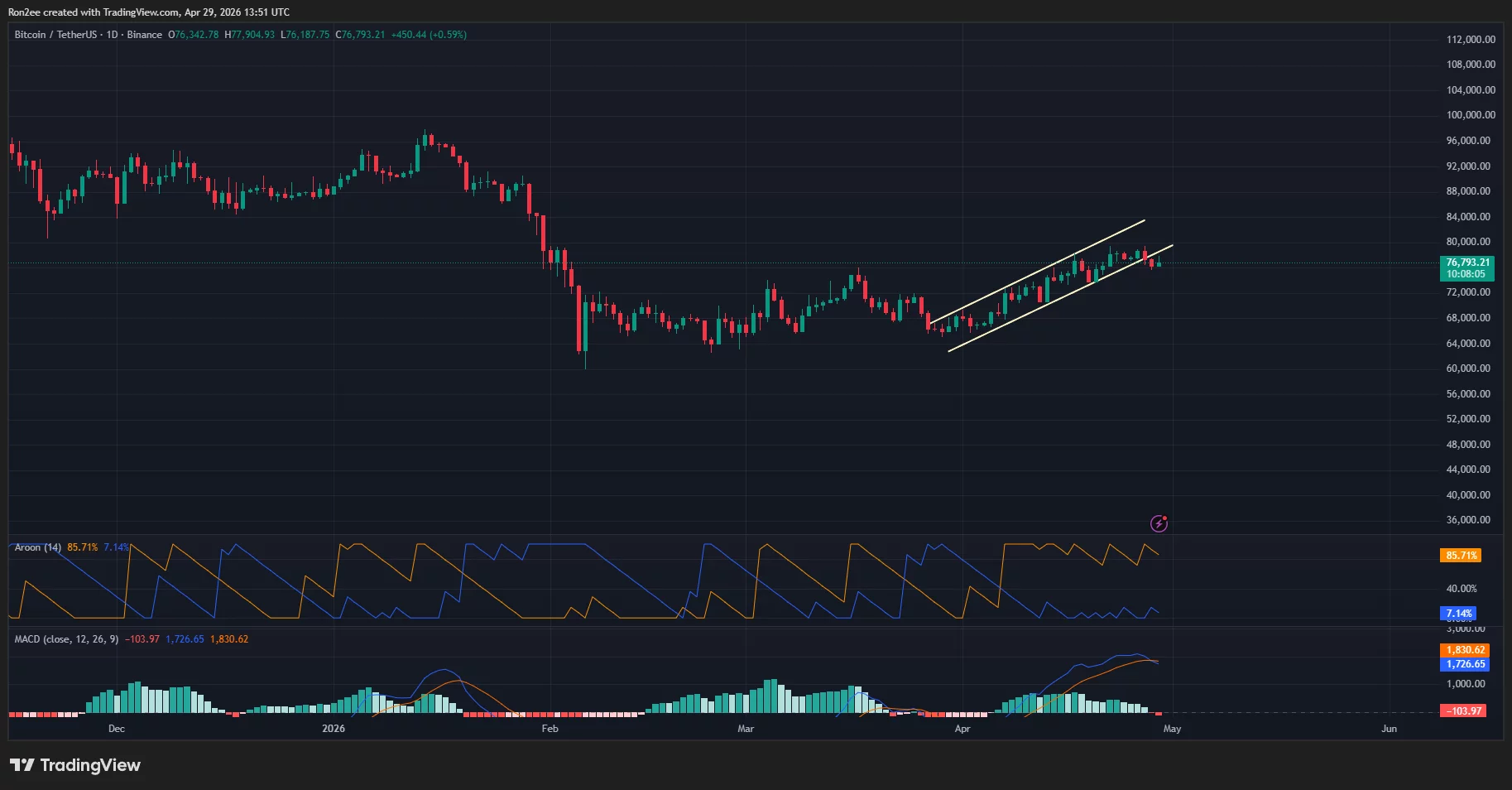
Adding to the bearish outlook, the MACD has printed a bearish crossover, indicating that short-term momentum has shifted in favor of sellers. This suggests caution for traders considering fresh long positions at current levels.
However, the Aroon indicator offers a mixed signal. While Aroon Up remains elevated at 85.71%, Aroon Down is still relatively low. This implies that despite the recent pullback, the broader uptrend has not fully lost strength, and buyers may still be attempting to maintain control.
For now, $80,000 serves as a formidable psychological resistance, especially with no rate cuts expected in the immediate future. However, if bulls manage to break through this barrier, the next targets would sit at $85,000 and potentially $90,000.
On the downside, a sustained drop below $75,000 would confirm further weakness and could push Bitcoin toward the $70,000 support zone.
Disclosure: This article does not represent investment advice. The content and materials featured on this page are for educational purposes only.


- XRP is currently trading at $1.38, down over 3% in the past week.
- The XRP Ledger has attracted over $3 billion in tokenized real-world assets.
- XRP could retest $1.25 or lower if bearish pressure persists.
Ripple cryptocurrency XRP is trading largely flat over the past 24 hours, as buyers struggle to decisively breach the $1.40 level following an intraday uptick from lows of $1.36.
The price performance—showing XRP down on the weekly timeframe and up just 5% over the past month—contrasts with a sharp spike in the value of tokenized real-world assets (RWAs) on the XRP Ledger.
XRP Ledger hits $3 billion RWA value
While XRP continues to struggle for upside momentum, bullish sentiment appears to be building around the XRP Ledger (XRPL).
The network has reached a milestone of $3 billion in total tokenized real-world asset value, marking a notable 55% increase over the past 30 days.
According to data from rwa.xyz, XRPL’s growing RWA ecosystem now includes more than 290 active projects.
On-chain activity is also reflected in 3,819 unique RWA holders, while the stablecoin market capitalization on XRPL exceeds $508 million.
Among specific projects, the largest RWA on XRPL is Justtoken’s JMWH token, a tokenized commodities asset valued at over $1.76 billion.
Meanwhile, Ripple’s native RLUSD stablecoin accounts for more than $400 million in tokenized value, while Ondo Finance’s short-term US Treasury products and VERT Capital’s asset-backed credit contribute approximately $323 million and $139 million, respectively.
Market experts view XRPL’s RWA growth as a sign of increasing institutional adoption and confidence, with the potential to drive further network utility.
XRP price analysis
Despite the surge in RWA activity, XRP’s price remains capped below $1.50, as bulls face persistent pressure from macroeconomic headwinds and profit-taking.
The token has been in a broader downtrend since peaking at $3.67 in July 2025, with declines accelerating during major market sell-offs on October 10, 2025, and February 5, 2026, when prices dropped to lows of $1.58 and $1.13, respectively.
Recent weakness—including a pullback to $1.36—highlights the importance of the 50-day simple moving average as a key technical level.
From a chart perspective, XRP is trading within a descending triangle pattern on the daily timeframe.
The relative strength index (RSI) is hovering around 48 and trending lower, while a bearish MACD crossover reinforces near-term caution.

Despite the cautious technical outlook, potential inflows from a future XRP ETF and improving macro or geopolitical conditions could lift broader crypto sentiment.
If RWA growth continues, strengthening on-chain metrics—such as rising holder counts and stablecoin total value locked—may provide additional support.
In the short term, XRP risks a move toward $1.25 if downside pressure persists.
However, a sustained break above $1.45 could open the door to $1.70. In a more bullish, RWA-driven scenario, $2.00 and the key $3.00 level emerge as major resistance zones.

Warren Buffett Resigns as Berkshire Hathaway CEO After Historic 60-Year Leadership

Bill Ackman’s $5 billion Pershing Square IPO to start trading, testing Berkshire-style vision

Forget Netflix, the Greatest War Thriller of All Time Is Free to Watch Right Now

Manchester United reach agreement with Casemiro over contract clause amid transfer speculation

US brings back mandatory military draft registration

Steven Gerrard disagrees with Gary Neville over ‘shock’ Chelsea and Arsenal claim | Football

Prepare For Bitcoin’s BIGGEST DUMP EVER (Then watch what happens next)

Python: The secret weapon in finance #python #pythonprogramming #finance

Bitcoin Fakeout? | $65000 Coming? | Bitcoin Updates | Crypto Market Updates | Altcoins Updates
-

 Tech2 days ago
Register Renaming | Hackaday
-

 Fashion5 days ago
Weekend Open Thread – Corporette.com
-
 Crypto World4 days ago
Hyperliquid $HYPE Rally Builds Momentum as AI Sector Enters Prove-It Phase
-

 Politics7 days ago
Making troops accountable for war crimes threatens US alliance, ex-SAS colonel warns
-

 Politics7 days ago
Disabled people challenge government SEND proposals over segregation concerns
-

 Business6 days ago
Patterson-UTI Energy, Inc. (PTEN) Q1 2026 Earnings Call Transcript
-
 Sports3 days ago
IPL 2026: Ruturaj Gaikwad registers slowest fifty of the season, enters all-time unwanted list | Cricket News
-

 Politics2 days ago
Drax board avoid their own AGM, accused of greenwashing & environmental racism
-

 Politics7 days ago
Zack Polanski responds to home secretary’s taser threat
-

 Politics7 days ago
Starmer handler McSweeney to be dragged from shadows by Foreign Affairs Committee
-
Politics7 days ago
Wings Over Scotland | How To Get Away With Crimes
-

 Politics7 days ago
‘Iran is still a nuclear threat’
-

 NewsBeat3 days ago
LK Bennett closes all stores after entering administration
-
 Sports6 days ago
Tim Bradley names the current best in the world: “Better than Inoue and Usyk”
-

 Crypto World5 days ago
Michael Saylor says BTC winter is over. Market analyst disagrees, says bitcoin was in a pullback
-

 Fashion16 hours ago
Kylie Jenner’s KHY Enters a New Era with ‘Born in LA’
-
 Entertainment4 days ago
Mariah Carey Slams Deposition Claims In Brother’s Lawsuit
-
Business6 days ago
Altimmune prices $225 million public offering at $3 per share
-
Entertainment6 days ago
Michael B. Jordan and Austin Butler's “Miami Vice” movie will bring the action back to the '80s
-
Entertainment6 days ago
Russell Brand Had Sex With 16 Year Old When He Was 30
You must be logged in to post a comment Login