Connect with us
DAPA Banner

NewsBeat

Coronation Street Carl Webster’s future if he survives in Debbie admission

Published

on

Manchester Evening News

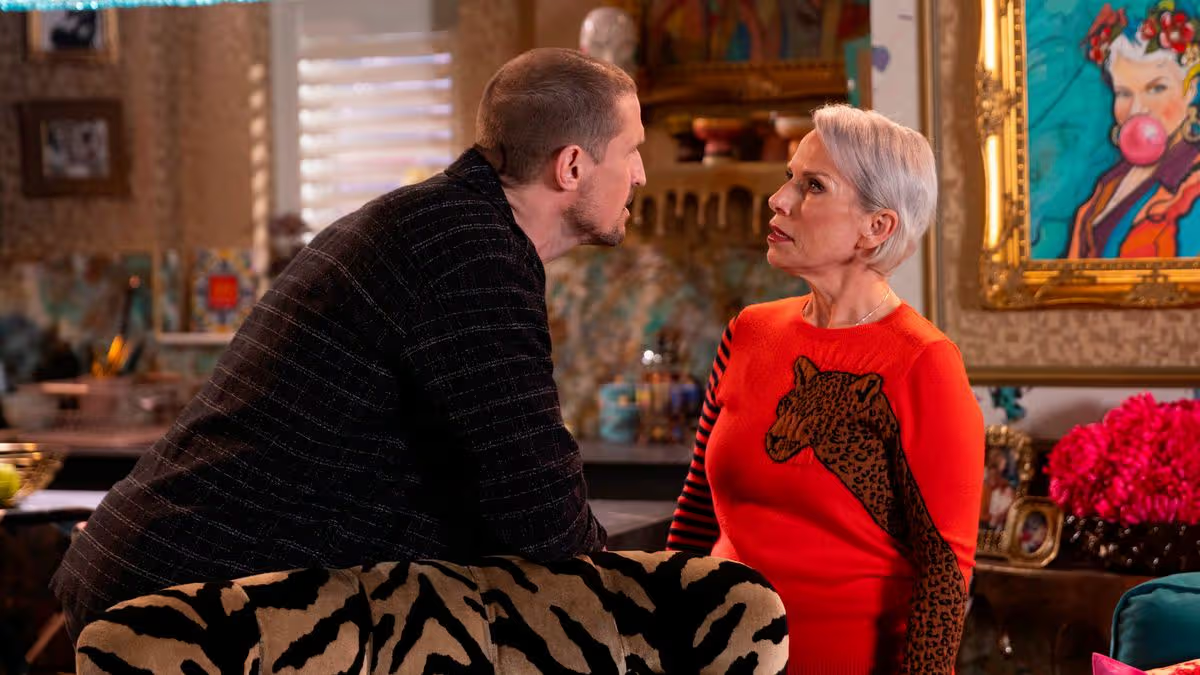
Actor Jonathan Howard has discussed what the future could look like for Carl Webster if he survives the upcoming murder

Coronation Street star Jonathan Howard has discussed what the future could look like for Carl Webster if he survives the upcoming murder.

Advertisement

As fans of the ITV soap already know, Carl is among the possible victims of a murder set to rock the cobbles, with the victim, which could also be Theo Silverton, Jodie Ramsey, Megan Walsh or Maggie Driscoll, set to be revealed following a week of dramatic episodes.

Following his first-ever appearance in Weatherfield last year, the character hasn’t made his life, or the lives of his loved ones, very easy. But none more so than Debbie, after he recently discovered that the fabulous hotel owner isn’t his half-sister, like he has spent his whole life believing, but his biological mother.

Click here to sign up for more Coronation Street updates in our newsletter

The truth came out as Debbie took the blame for him following a horror multi-vehicle crash in January that caused the death of Weatherfield vicar, Billy Mayhew, during which a drunk Carl coldly pulled her from the passenger side into the driver’s seat to make it seem like she was behind the wheel.

Advertisement

After thinking Debbie, who was diagnosed with dementia last year, was taking the blame because she had forgotten what had happened, Carl didn’t take the news of his parentage very well and took pleasure in seeing Debbie take the wrap for the crash, before she was sentenced to time behind bars.

Eventually, with her health suffering, Debbie was freed following a successful appeal, and while she was led to believe that Carl wanted to make amends and work on a relationship, he soon showed his true colours and has repeatedly tried to get money out of her since.

However, in scenes aired during last week’s Corrie, the hotel owner was seen sending her son on his way for the last time, having given him some cash to leave Weatherfield once and for all. But Debbie’s goodbye could end up being permanent because, as Corrie fans also know, Carl is among the five possible victims of a murder which is set to rock the cobbles this week, after a flashforward episode back in February confirmed who could be killed, and that it’s Betsy Swain who finds the dead body.

Advertisement

Speaking about Carl’s motives, Jonathan told the Manchester Evening News and other press: “With Carl, everything that drives him is he feels like he’s owed something. Before he found out Debbie was his mum, he felt like he had this family in England that never visited him and he’d been neglected, so he’s always had a chip on his shoulder.

” Now he’s got the news Debbie’s his mum, and then to be attacked by Ronnie, he uses that to his advantage. Wherever he is in life, he’s going to try to take advantage of the situation. He knows his mum loves him unconditionally, and he’s going to take advantage of that because he doesn’t quite know how to accept that love at the moment.”

When it was suggested that it was quite a sad place for the character to be in, the soap star replied: “It’s very sad. I feel for him. Obviously, I play him, so I feel something for him.” He added: “I’ve got to have empathy and compassion and find the humanity in him. Especially if I’m being paid to play this guy, I’ve got to find the empathy and compassion there.

“If I’d grown up my whole life not really knowing who my family was and feeling like I was left on the side, how would that impact me? How would I react? I’ve got to play what’s on the page, but I’ve got to try and find the humanity in that and the reason behind it.

Advertisement

Asked whether Carl does have love for his mother, and has a heart when it comes to their situation, the actor shared: “Absolutely he’s got feelings for his mum, yes. Does he know how to express them? No. I don’t really think so. Does he know how to love? I don’t really think so. I think it’s sex and what can I get from life, from this situation? [Carl’s] a bit of a chancer like that.

But if Carl were to survive this week’s murder, Jonathan admits he’d quite like to see more dodgy antics from his character. “I’m really intrigued to see, if he survives, if he’s going to have a redemptive arc because I’ve had a wonderful, fun time for the 12 months I’ve been here, you know, being a mosquito and annoying the hell out of people, doing the dodgy dealings, the hit and runs, the car stealing, the teenage robberies, the blackmailing – I’ve really enjoyed all that.

“If Carl survives, how far are we going to push the envelope? And I love playing the mosquito and I really hope he continues to have some of that in him if he survives. But, yeah, I try and find moments of kindness in him and moments of wanting to be loved.”

Source link

Advertisement
Continue Reading
Click to comment

You must be logged in to post a comment Login

Leave a Reply

NewsBeat

Warehouses to be replaced with new homes in Cambridgeshire city

Published

on

Cambridgeshire Live

The site will have 11 new flats

Plans have been granted by Peterborough City Council that will see commercial buildings in New England demolished to make way for 11 new residential flats.

Advertisement

Surjit Singh Developments Ltd’s planning application request to remove the warehouses which currently occupy much of the site at 74-80 Crown Street and replace them with six one-bedroom flats to the rear of the land. Permission was granted on April 22.

The development will also see No. 80 Crown Street, which is a Non Designated Heritage Asset, internally renovated to accommodate three one-bedroom flats.

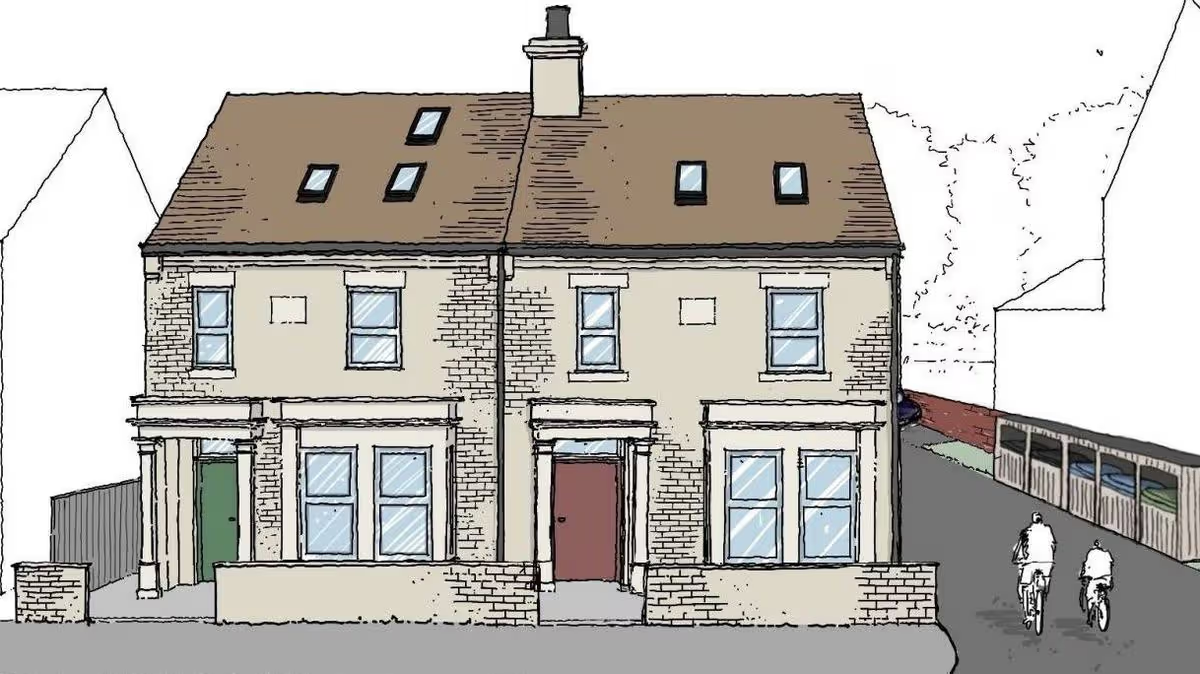
At the front of the site will be a new building, designed in keeping with the architectural character of No. 80, which will provide an additional two flats.

PiP Architects, who presented a design and access statement on behalf of the applicant, said: “The new proposal respects the existing, whilst enhancing the local architecture by providing new high-quality, safe and sustainable homes to the neighbourhood.”

Advertisement

Along with presenting an “opportunity to establish a more harmonious relationship with the surrounding dwellings,” they suggested the development would also aid in “minimising the likelihood of noise, disruption, and environmental impact.”

The exterior of the property will be landscaped and offer 11 on-site parking bays for residents and three additional bays for visitors. Existing hard-paved areas will be transformed into communal green spaces to “enhance the urban environment and promote sustainable living.”

Green roofs will also feature to further support biodiversity and help manage rainwater sustainably.

Source link

Advertisement
Continue Reading

NewsBeat

Here’s What The Non-Fluffy Stripes On Towels Are Really For

Published

on

Here's What The Non-Fluffy Stripes On Towels Are Really For

Every once in a while, I see a post on social media that makes me realise I know nothing about the world.

Last week, that question came from a Redditor who wanted to know why new builds sometimes have bricked-up windows (turns out it’s a mixture of manufactured charm and, sometimes, council rules).

And now, another, equally mind-melting X post has come to my attention: “What is the purpose of this part of a towel?” software engineer Nate McGrady asked, sharing a circled photo of the non-fluffy stripes on the bathroom textile.

This, I thought, is what my press privileges exist for. So, I reached out to Courtney Cole, an interior designer at TileCloud, about what’s really going on here.

Advertisement

They’re called “dobby borders”

“This part of the towel is actually called a ‘dobby border’ – which so many people don’t know,” Cole explained (I certainly didn’t).

King Towel describes a “dobby border” as a strip or band on the towel which has no loops or pile on it – in other words, the non-fluffy bit.

“Because it’s woven more closely than the rest of the towel, it will help with fraying and will keep the edges from curling over time,” Cole continued.

Advertisement

“This means that the towel with the dobby border will likely last longer than those that don’t have it.”

There’s also a branding-friendly reason for the addition, the interior designer told HuffPost UK.

“It also gives manufacturers a structured area for branding and embroidery, which is why you’ll see logos and monograms there with hotels and other places like spas,” she said.

And lastly, there’s the matter of storing them to consider. The interior designer suggested towels without this border don’t stack as well, “which anyone who’s ever tried to make their linen closet look perfect knows all too well”.

Advertisement

So basically, it’s down to structural integrity, branding, and better stacking.

X users had other theories…

Responding to the original post, X users shared their – erm – questionable theories.

One joked the bands are “racing stripes. It makes them dry faster.”

Advertisement

“The purpose of it is to annoy me and to make me feel grateful for the other side of the towel that actually dries your hands all the way,” another commenter wrote.

Yet another simply said: “Grip.”

To be fair, I don’t think I would have been able to give a better answer without Coles’ help…

Advertisement

Source link

Continue Reading

NewsBeat

the government’s plans for Send reform in England hinge on these overworked school staff

Published

on

the government’s plans for Send reform in England hinge on these overworked school staff

Sencos – special educational needs coordinators – play a vital role in maintained mainstream English schools, nursery schools and sixth forms. If you are a parent, you may encounter them if you have concerns about your child’s progress or the support available, or during review meetings. Children may meet them through assessments, pupil interviews or informal check-ins.

They are teachers who take on additional leadership responsibility for special educational needs and disabilities across the school. In many cases, they continue to teach classes, but in larger schools the role is increasingly non-class based due to its scale and demands.

Despite its importance, the Senco role is often hampered by excessive workload, inconsistent status – many Sencos are still not part of school leadership teams as this is not a requirement in legislation – and a limited understanding of its scope. These factors affect both effectiveness and retention.

The government’s recent policy proposals for special educational needs and disabilities support make frequent mention of Sencos and the role they play in schools. As a former Senco, and as someone who has worked in Senco professional development for almost twenty years, I have scoured the proposals to understand what they mean for the profession.

Advertisement

Statutory support

The reforms – still under consultation and not yet law – formalise much of what Sencos already do. However, they also signal a profound shift. The role is set to become more data-driven and more central to whole-school development than before.

Sencos oversee Sen Support – internal school provision for learners with special educational needs. They also oversee support for children with education, health and care plans (EHCPs). EHCPs are legal documents issued and funded by local authorities for children with more complex needs. They outline a child’s needs, required provision and targeted outcomes across education, health and care.

Sencos often are not part of a school’s senior leadership team.
fizkes/Shutterstock

The recent policy proposal sets out a system of school-based individual support plans for every child and young person identified with special educational needs. These digital plans would be statutory, monitored and reviewed annually at minimum.

Sencos would therefore be responsible for ensuring that each individual support plan accurately identifies any barriers to learning (such as sensory needs or a specific learning difference), and records support and reasonable adjustments (such as adapted materials or additional processing time). While the terminology may be new, this practice is not. Individual support plans largely formalise what Sencos already do for learners at Sen Support.

Advertisement

However, the statutory nature of individual support plans represents an expansion of legal accountability, borrowing from policy implemented in recent years in Wales. Whereas EHCPs apply to a small proportion of pupils in schools, statutory individual support plans could apply to a greater percentage of the school population.

This risks creating a compliance-heavy model of inclusion. Sencos may spend increasing amounts of time on producing evidence rather than working directly with teachers and families.

EHCPs will remain for a smaller number of children – those with the most complex needs – who will receive specialist support packages. The definition of complex needs has not yet been defined in the policy proposals, which may be an area for contention.

By tightening access to EHCPs while expanding individual support plans, the reforms shift the pressure point from local authorities to schools. Sencos may become the public face of a rationed system. They will need to mediate between school resources, parental expectations and local authorities, as well as colleagues working in health and care.

Advertisement

There is the risk that trust in Sencos may decline unless schools are given the capacity to deliver the promised support. At the same time, Sencos will have to navigate families’ worries about tighter access to EHCPs.

Overseeing mainstream support

A central message of the policy proposals is that mainstream education must be strengthened in terms of its ability to include pupils with special educational needs and disabilities. This is a laudable aim, but it requires significant investment in teacher expertise, curriculum flexibility and environmental adaptation.

For Sencos, it will mean leading whole-school early identification and targeted support. They will need to build teacher confidence in adaptive and inclusive education and provide more robust evidence when specialist placements are requested. They will lead in helping families school provision. This shift may increase contested decisions and appeals, with Sencos becoming the key point of contact for families navigating changing legal boundaries.

One of the government’s most ambitious proposals is the Experts at Hand service. This is designed to give schools quicker access to educational psychologists, speech and language therapists and other specialists. It’s likely to place the Senco at the centre of multi-agency work, coordinating referrals, implementing specialist advice and contributing to wider planning.

Advertisement

What’s more, every member of school staff will complete a national special educational needs training programme. It’s likely that Sencos will take a lead in delivering much of this professional development. This will elevate the Senco as a driver of whole-school pedagogy.

The proposals amount to a significant widening of the Senco remit. Their success hinges on whether the Senco role is finally given the leadership status, time and support it requires. Without structural changes such as protected leadership time, a place on leadership teams, administrative support and clear career pathways, the reforms risk accelerating burnout. However, with the right support and sufficient resourcing, Sencos can be leaders shaping the cultures, systems and partnerships that help every child to learn and flourish.

Source link

Advertisement
Continue Reading

NewsBeat

Investigation into suspended Addenbrooke’s surgeon extended

Published

on

Cambridgeshire Live

90 trauma cases and 700 planned surgical procedures that happened during the time Ms Stohr was employed by the Trust have been examined

An investigation into a suspended Addenbrooke’s surgeon has been extended. Kuldeep Stohr, an orthopaedic surgeon, was suspended by Cambridge University Hospitals Foundation Trust (CUH) after a review identified the “outcomes of treatment provided to a small number of patients were below the standard” the Trust said it would expect.

Advertisement

The independent review of surgical operations carried out on children by Ms Stohr was commissioned last year and has been extended to cover additional emergency procedures. This follows after the review team was asked to examine an initial 90 trauma cases to assess the standard of treatment, alongside 700 planned surgical procedures during the time Ms Stohr had been employed by the Trust.

In letters to patients, signed by Chief Medical Officer Sue Broster, the Trust says the decision to extend the review was taken “following careful consideration by the independent clinical experts.”

It reassures parents that cases are being selected for review “to understand whether the treatment provided met the outcomes we could expect”. According to Hudgell Solicitors, the letter says that each case will be considered individually, and that some patients may need to undergo a clinical review.

A number of families affected by the ongoing investigations are being represented including some who have reportedly now had confirmation from the Trust that their child was harmed.

Advertisement

Solicitors Elizabeth Maliakal said: “This is a significant development, given it comes 14 months after the initial review was commissioned by the Trust into the surgeries Ms Stohr had conducted in her time there.”

The focus will now be on the final independent report findings, which the Trust has said will be shared publicly on conclusion in the Autumn.

In a report last year, CUH Trust was found to have failed to act appropriately after an initial investigation into Ms Stohr’s practice in 2015. That investigation found “a series of shortcomings” in her surgeries and proposed remedial steps to address them.

However, an external review of the Trust’s response last year said it had done “nothing substantial” to address concerns over her practice, meaning “any deficiencies in Ms Stohr’s practice were allowed to persist for the next seven to eight years”, missing 32 opportunities to act.

Advertisement

Mrs Stohr went on a period of leave in March 2024 which led to colleagues raising concerns about patient outcomes and aspects of her decision-making. This resulted in an initial review of 55 cases which found nine where treatment provided was below the standard expected and Ms Stohr’s was consequently suspended.

Source link

Continue Reading

NewsBeat

Gogglebox star details filming ‘traumatic’ scene with family member ‘I’ve had to escape’

Published

on

Daily Mirror

One Gogglebox fan-favourite detailed an awkward experience they had while filming the Channel 4 show this week.

Gogglebox star Lara Fawcett joined the Channel 4 show last year.

She has quickly became a fan favourite with viewers for her hilarious and sweet relationship with her mother-in-law, Sara.

However, it seems as though watching certain shows with her in-laws has provided some awkward moments, especially this week.

Advertisement

Taking to Instagram, Lara shared a video of herself on holiday as she could be seen in front of snowy mountains.

She said: “Oh my god, Gogglebox this week is a corker! But I’ve had to escape the trauma of watching Virgin Island with my mother-in-law, Sara.

“Her talking about sex and virginity. Oh my god, it’s traumatic. I’ve had to escape to the mountains for a few days on my own. Enjoy Gogglebox, it’s cool.”

Although Gogglebox fans will have to wait until Friday night to watch Lara squirm next to her mother-in-law.

Lara was one of the many new faces that joined the Channel 4 show last September, alongside Sarah, Chee and Andre, Andrew and Alfie, Jake and Calum and Susie and Rosie.

This comes after Scottish favourites on the show Roisin Kelly and Joe Kyle were axed after three years on the sofa, much to viewers dismay.

Mike Cotton, Creative Director for Studio Lambert, spoke about the latest additions as he said: “It’s a delight to welcome some new households to the Gogglebox family.

Advertisement

“Along with our much-loved returning cast, we can’t wait to join them in their living rooms and hear their candid thoughts on this week’s most talked-about TV!”

Gogglebox fans were left stunned when they recently discovered Lara has a very famous younger brother, survival expert and TV star Bear Grylls.

Bear is well-known for his survival shows such as Running Wild, Celebrity Island, Man Vs Wild and Netflix’s Celebrity Bear Hunt with former This Morning star Holly Willoughby.

Advertisement

However, it seems that not everyone is thrilled that Lara is on the programme with a famous brother, as some think it helped to get onto the show.

One fan wrote on TikTok: “Controversial opinion, but it does help to get chosen to go on Gogglebox if your brother is Bear Grylls.”

In response, someone else wrote: “Only the same way being related to the chuckle brothers helped Sophie and Pete get on the show.”

Advertisement

Although some defended their appearance as one person replied: “I think Gogglebox is a rare example of where it works, they need one family from all walks of life and you’d struggle to find someone that posh and aristocratic who aren’t related to someone famous.”

The siblings are no strangers to the world of showbiz, as their father, late Conservative politician Michael Grylls, was knighted by the late Queen Elizabeth in 1992.

Gogglebox is available to watch Fridays at 9pm on Channel 4

Source link

Advertisement
Continue Reading

NewsBeat

How Cambridgeshire is forecast to vote in May local elections

Published

on

Cambridgeshire Live

Labour is projected to lose seats across Cambridgeshire in next week’s election

Labour may lose control of Cambridge City Council as the governing party is expected to face sweeping defeats in next week’s election, according to polling aggregator PollCheck. The party will be facing an attack from both the right and left with the rise of smaller parties like the Greens and Reform in recent polls.

Advertisement

This year’s local elections on Thursday, May 7, will see seats up for re-election in four Cambridgeshire councils. These are Cambridge City Council, South Cambridgeshire District Council, Huntingdonshire District Council, and Peterborough City Council.

You need to be registered in order to vote in the elections. The deadline to register for this year has already passed.

If registered, you should receive a polling card from your local council. You can check if you’re registered by visiting the government website and entering your postcode to check your local registration office (usually your council). This will give you the email address or phone number to call to check.

You will need photo ID to vote. Your polling card will tell you where your local polling station is. Polls will be open from 7am to 10pm to allow you to cast your vote.

Advertisement

In South Cambridgeshire and Huntingdonshire all seats will be up for election, with Labour expected to lose their remaining seats in Huntingdonshire after winning four in 2022. Reform, who won 10 seats in last year’s Cambridgeshire County Council election, are predicted to win nine in Huntingdonshire.

The Conservatives are also expected to also benefit, with the party gaining three seats if the forecast is correct. They are forecast to lose six seats in South Cambridgeshire however, to the benefit of the Liberal Democrats who are expected set to gain the same number. The Greens predicted to win two.

Neither council is expected to see a change in control with no party having an overall majority in Huntingdonshire and the Lib Dems still firmly in charge of South Cambridgeshire.

Cambridge City could see Labour lose power for the first time in more than a decade with the party predicted to lose seven seats. Labour has been in control of the council since 2014 but no party will have a majority of the seats following next Thursday’s election if the prediction is correct.

Advertisement

The Conservatives are predicted to gain one seat, the Lib Dems two, the Greens three, and independents one.

PollCheck warns that local elections “have lower and more variable turnout than generals, patchy candidacy, and wards dominated by local factors”. They said: “Seat-level projections are noisier than for Westminster.”

Their predictions take into account national polling data, past local election results, and demographic modelling rather than ward-level surveys. You can check their predictions for each ward by visiting the PollCheck website.

Source link

Advertisement
Continue Reading

NewsBeat

Arsenal’s dream transfer target sends clear message to Mikel Arteta

Published

on

Daily Mirror

Arsenal are on the lookout for a new left winger in the upcoming summer transfer window.

Paris Saint-Germain star Khvicha Kvaratskhelia has given Arsenal every reason to make him a top transfer priority this summer. Mikel Arteta‘s side are in the market for a new left winger, with Kvaratskhelia emerging as the best option available.

Advertisement

The 25-year-old lit up the Champions League semi-final stage for PSG on Tuesday evening, proving instrumental in his side’s thrilling 5-4 victory over Bayern Munich. It was a match that captivated football supporters throughout — with Kvaratskhelia among the night’s finest performers.

The winger netted twice as he steered PSG to a slender advantage ahead of next week’s second leg at the Allianz Arena.

READ MORE: Arsenal beware…Atletico Madrid will be riding a wave of emotion at the end of an eraREAD MORE: Arsenal hero Jack Wilshere roped into cheeky ‘managing against Tottenham’ discussion

His opener saw him curl the ball into the bottom right corner to make it 1-1 after Harry Kane’s penalty. He then made it 4-2 in the second half, latching onto the ball and driving it past blasting it past Manuel Neuer.

Advertisement

Arsenal will have been keeping a close eye on proceedings ahead of their own semi-final first leg against Atletico Madrid on Wednesday evening. The victors of both ties will clash in the final on May 30 at the Puskas Arena.

FOLLOW OUR ARSENAL FB PAGE! Latest Gunners news and more on our dedicated Facebook page

One criticism levelled at Arsenal under Arteta has been their cautious, defensive approach. The Gunners are renowned for their solidity but are not always the most fluid attacking outfit.

That stood in stark contrast to both PSG and Bayern on Tuesday. While the approach has helped Arsenal re-establish themselves as title contenders, greater balance may be required to reach the next level.

Advertisement

One way to achieve that is by making bold moves in the transfer market. Arsenal have been linked with Kvaratskhelia, who has established himself as one of the finest attacking talents in Europe.

The Gunners’ pursuit of another left-wing option should now have the Georgian international firmly at the top of their wishlist, off the back of his stunning display against Bayern.

While they could push hard for a deal, Arsenal may face resistance from both PSG and the player himself. The French giants reportedly shelled out £59 million plus add-ons to Napoli for the winger last January and would almost certainly demand considerably more than that figure should they consider selling.

Advertisement

Both the winger and his father have spoken openly about his contentment in the French capital, suggesting he has little desire to move on during the transfer window.

This means Arsenal could face a tough battle should they decide to pursue their interest. However, if there is any indication of a change of heart from either Kvaratskhelia or PSG, the Gunners should ensure they are first in line.

Sky Sports, HBO Max, Netflix and Disney+ with Ultimate TV package

This article contains affiliate links, we will receive a commission on any sales we generate from it. Learn more
Content Image

Sky has upgraded its Ultimate TV and Sky Sports bundle to now include HBO Max, Netflix, Disney+, discovery+ and Hayu, as well as 135 channels and full Sky coverage of the Premier League and EFL.

Sky broadcasts more than 1,400 live matches across the Premier League, EFL and more with at least 215 live from the top flight alongside Formula 1, darts and golf.

Advertisement

Source link

Continue Reading

NewsBeat

Nine-part crime thriller from High Potential maker looks like ‘live action GTA’

Published

on

Manchester Evening News

Fans excited to stream the series say it looks like The Punisher meets Cross

Content cannot be displayed without consent

Some fans reckon the forthcoming crime drama bears a striking resemblance to a live-action Grand Theft Auto.

Advertisement

A release date has been announced for a highly anticipated series from the creators of several hit shows. The team behind the upcoming production includes talent that has previously worked on Netflix’s Ozark and High Potential.

It has now been confirmed that the title M.I.A. will begin streaming in the UK from May 7, exclusively on Paramount+.

The service is accessible either through a standalone subscription via its own dedicated app, or as an add-on through the Prime Video platform.

M.I.A. is created and written by Bill Dubuque, one of the co-creators of the gritty and widely acclaimed Netflix crime thriller Ozark. That series concluded with an impressive overall rating of 86% on review site Rotten Tomatoes, meaning expectations are understandably high for this new venture, reports the Mirror.

Advertisement

According to its synopsis, the nine-part series centres on a young woman, Etta Tiger Jonze, who is restless in the Florida Keys. But when her family’s drug-running business shatters in tragedy, Etta embarks on a dangerous journey through Miami’s neon-lit underbelly that will define who she is and what she’s ultimately capable of.

Shannon Gisela leads the cast as Etta, alongside Cary Elwes, who portrayed Mayor Larry in Stranger Things, as well as Fear The Walking Dead star Danay Garcia. The ensemble is further bolstered by Grand Army’s Brittany Adebumola, Godfather of Harlem’s Dylan Jackson, Alberto Guerra from Griselda, and Narcos’ Maurice Compte.

Advertisement

The cast also features Gerardo Celasco, who has appeared in The Waterfront, and Marta Milans from White Lines. Karen Campbell, who has also penned episodes of Dexter and Outlander, serves as showrunner.

It has additionally been confirmed that Alethea Jones is credited as executive producer and director for the first two episodes, having previously helmed three episodes of High Potential. Gwyneth Horder-Payton, Mairzee Almas, Ben Semanoff, and John Dahl are the remaining directors for the rest of the season.

Viewers have already been voicing their excitement for the series since the trailer dropped recently. Some remarked that the Miami setting and appearance of the female-led cast reminded them of what has been revealed about the highly anticipated title Grand Theft Auto VI, which is expected to launch later that year.

Advertisement

The eagerly awaited game is set in Vice City, which is modelled on Miami and is expected to include a playable female character.

One person shared on social media: “We got live action Lucia from GTA 6 before GTA 6. Can’t wait.” Others drew comparisons to similar programmes, with one person commenting: “So it’s like The Punisher meets Cross.”

M.I.A. is streaming on Paramount+ from May 7.

Source link

Advertisement
Continue Reading

NewsBeat

Atherton – Plans submitted to alter Bolton Road bus shelter

Published

on

Atherton - Plans submitted to alter Bolton Road bus shelter

The planning application details the relocation of the shelter on Bolton Road due to required roadworks.

The project includes moving one shelter equipped with an internally illuminated double-sided paper advertisement unit.

The shelter, located on a section of public highway, and the relocation has been requested by TfGM.

The new shelter will be designed using steel, aluminium, and toughened glass and will have an advertised space measuring 1065mm x 1895mm.

Advertisement

The proposed design of the bus shelter (Image: JCDecaux via planning documents)

The advertisement will be illuminated internally with a light level of 600 cd/m², and will remain static.

It will also project over a public highway.

The applicant is Stephen Herraghty, operating out of JCDecaux UK’s base on Great West Road in Brentford.

Consent for the repositioned bus shelter has been initially requested for a period from April 20, 2026, to April 20, 2031.

Advertisement

No prior consultation has been sought by JCDecaux UK with neighbours or the local community regarding the proposal.

If the planning authority needs to conduct a site visit, the applicant himself, Stephen Herraghty, is noted down as the point of contact.

No prior advice or assistance from the local authority has been sought concerning this application.

The planning application’s reference number is A/26/100476/ADV, should the public need to inquire specifically about it.

Advertisement

Residents and the local community can view the official proposal and plans on the authority’s website.

Source link

Advertisement
Continue Reading

NewsBeat

Do birds have accents? The fascinating regional differences in birdsong

Published

on

Do birds have accents? The fascinating regional differences in birdsong

Birds sing the most around an hour before dawn, when the air is at its stillest. Theoretically, this enables sounds to travel further, making song up to 20 times more effective than if sung at midday.

With International Dawn Chorus day approaching, it’s time to take a moment to soak in the spring birdsong and notice the individual harmonies blending together.


International Dawn Chorus Day brings casual bird appreciators, ornithological experts and dedicated twitchers together in a celebration of birdsong. In our series, experts give their insights on nature’s chorus.

Advertisement

The dawn chorus is beautiful anywhere, but your local birdsong may sound rather different to nearby areas. Even in the same neighbourhood, birds of the same species don’t always sound exactly alike. I was recently teaching undergraduates about bird song, and they recorded blue tits singing around campus. The students found plenty of differences between individual birds. Some blue tits sang their classic song, which sounds a bit like they are saying “he-llo, I’m a little blue tit”. Some sang a more elaborate “he-llo, I’m a little blue tit, blue tit”, and some only bothered with “he-llo”.

Alongside individual differences, birds have regional differences in song. For example, the birdsong that sounds a bit like “my toe bleeds Be-tty”, commonly sung by the woodpigeon is, in some parts of the UK, “my toe bleeds Ju-li-a”, with an extra syllable to the final section of the song. These sorts of regional dialects have been reported in several British bird species including blackbirds and great tits.

However, one of the most interesting accents comes from farmland bird the yellowhammer, who typically sings birdsong that sounds like “a little bit of bread and no cheese please”. In the UK, the yellowhammer largely has two distinct dialects, differing in the final “cheese please” part of the song. In the east of England, “cheese” has a lower pitch than “please”, and this is reversed in south and west England.

Advertisement


À lire aussi :
Why do birds sing?


The yellowhammer was introduced to New Zealand from the UK in the 1860s and 70s. But, unlike the UK, the New Zealand yellowhammers have around seven dialects, despite originating from the south of England. These five extra dialects have also been detected in birds across Europe, indicating that the New Zealand birds still sing the 19th century British dialects that have since disappeared in the UK. This is likely due to the large decline in the number of yellowhammers in the UK which caused some populations to go extinct. An ongoing project allows you to view a map of yellowhammer dialects or help with citizen science research on their song.

Most birds only sing one dialect, learned from parents or neighbours, resulting in a geographical mosaic of regional accents. Dialects often overlap but can dominate certain areas, essentially producing geordie, brummie, cockney and scouse birds.

Advertisement

Although some bird species have an innate ability to sing the song of their species (the cuckoo, for example), species with more elaborate song must learn to sing. Young birds inherit a template which they add to from listening to songs around them.

For example, chaffinches that have been hand-reared in isolation produce simple songs, whereas wild chaffinches learn complexities from their parents or immediate neighbours in their first weeks of life. Finer details of their song are acquired the following breeding season when they come into contact with neighbouring territory owners. Interestingly, corn buntings, a farmland bird, sing the same song as their nearest neighbour rather than their parents, seeming to learn most after dispersing from their nest.

Birds are also adapting to humans. In urban areas, wildlife is subjected to human-made noise such as cars and machinery. Consequently, urban birds now sing at a higher pitch than rural birds as higher-pitched songs carry better over low-pitch urban noise. And it’s not just the pitch of the song that has been altered.

Advertisement

Great tits sing shorter and faster songs in cities compared to forests, and blackbirds sing louder in urban areas. However, even when cities are quiet, like in the early hours, urban birds maintain these song features, which suggests that sounds echo off large buildings and don’t travel as far in urban areas.

Birds are singing earlier in response to traffic noise, with city blackbirds starting their dawn chorus up to five hours earlier than rural birds. The effect of artificial light also leads to an earlier start of dawn singing, with song thrushes starting ten minutes earlier, and robins and great tits 20 minutes earlier than in areas without street lighting. And, artificial light causes blackbirds to sing around an hour earlier than those exposed to natural light.

Scientists still have much to learn about the differences in birdsong within a species. When you hear birdsong, it’s easy to assume that it’s a male. And it is more usually males that sing. Females choose males with the best song so that his high quality genes will be inherited by her offspring. But female birds have been massively under-represented in archives and scientific studies. A 2016 analysis found that for 3,500 out of 4,814 species we don’t even have enough data to know whether or not the females of the species sing. As researchers take a closer look at female birdsong, we may learn of even more differences.

Next time you listen to a bird singing, see if you can hear the nuances in the dialect, or spot the difference between urban and rural birds.

Advertisement

Source link

Continue Reading

Trending

Copyright © 2025