
Crypto World
RealOpen and TRON Verify $9.4M in USDT Across Crypto-Enabled U.S. Real Estate Transactions


TLDR:
- RealOpen and TRON’s Holiday Campaign verified approximately $9.4M in USDT from 27 KYC-verified users.
- A total of 69 real estate agents were onboarded through the 2025 TRON Real Estate Challenge program.
- TRON processes over $22B in daily transfer volume, supporting 376 million self-custodial accounts globally.
- TRON handles roughly 65% of global USDT retail transfers under $1,000, making it a leading stablecoin network.
RealOpen and TRON have wrapped up their “Fast Moves, Fast Payments” Holiday Campaign, verifying approximately $9.4 million in USDT.
The campaign ran from November 17, 2025, through February 28, 2026. It offered eligible U.S. homebuyers up to 50,000 USDT in rewards.
Buyers had to purchase property through RealOpen using USDT on the TRON blockchain. The campaign showed how blockchain can support both everyday and high-value transactions.
Campaign Results Show Growing Crypto Adoption in Real Estate
The campaign recorded 343 user sign-ups on the RealOpen platform overall. Out of those, 27 users completed KYC verification successfully.
Those verified users accounted for the $9.4 million in USDT on TRON. Additionally, 69 real estate agents joined through the 2025 TRON Real Estate Challenge. This shows a rise in industry participation in crypto-enabled property deals.
RealOpen allows buyers to purchase any property currently on the market. Buyers can fund purchases directly using digital assets without complication.
The platform combines traditional real estate reliability with crypto speed and efficiency. This approach makes blockchain-powered homebuying accessible to a wider audience.
Johnny Schiro, Executive Vice President at RealOpen, spoke on the campaign’s outcome. “The Fast Moves, Fast Payments campaign showed why TRON is such a strong settlement layer for real-world assets,” Schiro said.
He noted that hundreds of new users engaged and dozens of agents came on board. He added that “modern capital needs modern payment rails – and TRON is well-positioned to power that shift.”
According to TRON DAO, the collaboration showed TRON’s real-world use across different payment types.
It covered everything from small retail transfers to large real estate closings. This range further supports TRON’s standing as a versatile settlement layer.
TRON’s Infrastructure Backs Large-Scale Stablecoin Transactions
TRON processes more than $22 billion in daily transfer volume across its network. The network has a circulating USDT supply of $86 billion currently active.
Over 376 million self-custodial accounts use the TRON network globally. It also handles around 65% of global USDT retail transfers under $1,000.
The network’s near-instant finality makes it suitable for time-sensitive transactions. Low transaction costs further support its use in real estate closings.
These features position TRON as a practical settlement layer for high-value deals. Earlier in 2025, RealOpen already closed multiple real estate deals funded in USDT on TRON.
Pearl Homes’ Hunter’s Point development in Florida also promoted crypto acceptance via RealOpen. The net-zero master-planned community on Florida’s Gulf Coast accepted blockchain-based payments.
This expanded crypto settlement into broader residential real estate markets. It reflected a shift toward stablecoin use in mainstream U.S. housing transactions.
As demand for faster and more transparent capital movement grows, stablecoins are gaining traction. The RealOpen and TRON campaign demonstrated this trend in the U.S. housing market. USDT on TRON is proving to be a workable settlement option at scale.


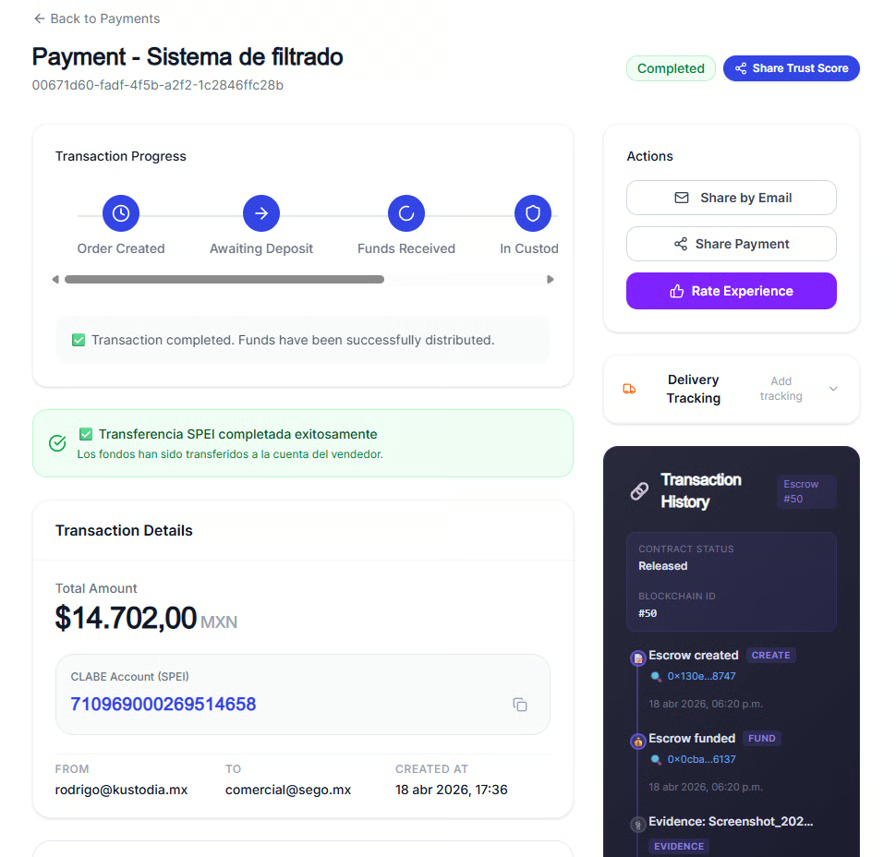
Mexico’s first peso-denominated blockchain escrow goes live on SPEI for high-value P2P transactions.
Mexico City, April 29, 2026 — Kustodia, a programmable escrow platform for Latin America’s high-value economy, today announced the public launch of its smart contract escrow service in Mexico. Buyers and sellers can now protect any transaction — from used vehicles to real estate deposits to B2B contracts — using SPEI, Mexico’s instant payment rail. Funds are held in audited smart contracts until both parties confirm delivery, with no human intermediary involved.
Payment fraud stripped $44.3 billion from the global economy in 2024, according to Juniper Research. Latin America has the world’s highest fraud rate, with 20 percent of merchant revenue lost annually. In Mexico, every dollar of fraud costs $4.08 in total economic damage — representing approximately $600 million USD in annual losses, according to data from Cloudflare and Mexico Business News.
‘I lost money to fraud in a peer-to-peer transaction in 2021,’ said Rodrigo Jimenez, Founder and CEO of Kustodia. ‘I spent three years building the infrastructure that should have existed. Mexico’s $60 billion used vehicle market runs almost entirely on stranger-to-stranger transactions with no protection for either side. We changed that.’
How it works — no app, no crypto knowledge needed
Kustodia works entirely through SPEI and WhatsApp. The buyer deposits pesos to a unique account number generated by Kustodia. Those pesos are immediately locked in a smart contract on the Arbitrum blockchain — neither party can access them. The seller delivers. Both parties confirm. The funds are released to the seller’s bank account in pesos. The blockchain operates invisibly; users interact only through WhatsApp.
The platform uses MXNB, a 1:1 Mexican peso-backed stablecoin issued by Juno and audited by a Big Four accounting firm, as its escrow settlement layer. This means users never experience cryptocurrency price volatility — they send pesos and receive pesos. Every completed transaction is publicly verifiable on Arbitrum’s blockchain explorer at no cost to anyone.
Users never pay blockchain fees. Kustodia absorbs and bundles these costs automatically, so the only fee a user sees is the escrow commission — 3 percent for standard transactions, lower for volume partners. Compared to traditional escrow agents that charge 3 to 6 percent and take 5 to 7 days to settle, Kustodia settles near-instantly.
From used cars to real estate to AI agents
Kustodia’s initial focus is the Mexican used vehicle market, where the average transaction is $15,000 USD and fraud risk is highest. The platform includes integrated vehicle history verification powered by Truora, KYC identity checks, and webhook-based notifications for marketplace integrations.
The platform also supports AI agents through its dedicated agent infrastructure at kustodia.app/ai-agents, enabling autonomous systems to create and manage escrow contracts programmatically. Web3 native escrow is available at kustodia.app/web3, supporting USDC and MXNB on Arbitrum and Injective.
Real estate rental deposits, crowdfunding, and marketplace integrations are live as additional verticals. USD Wire is supported for cross-border US-to-Mexico transactions. Brazilian real (BRL) via Pix is in development for the company’s planned 2027 Brazil expansion.
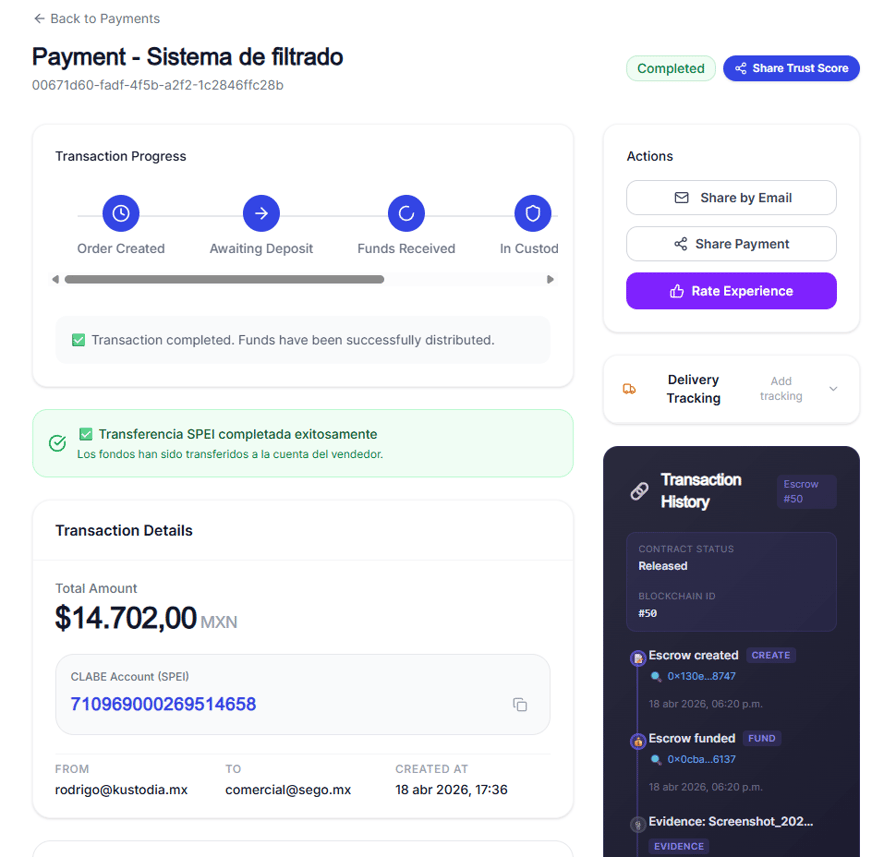
Source: Kustodia
Built for developers and platforms
Kustodia offers a full API and webhook system for marketplace integration. Developers can explore documentation and test the platform at kustodia.app/demo/marketplace. The platform currently works alongside SPEI, USD Wire, and USDC — and compares favourably to MercadoPago and Stripe Mexico, neither of which offers true escrow, blockchain verification, or integrated vehicle checks.
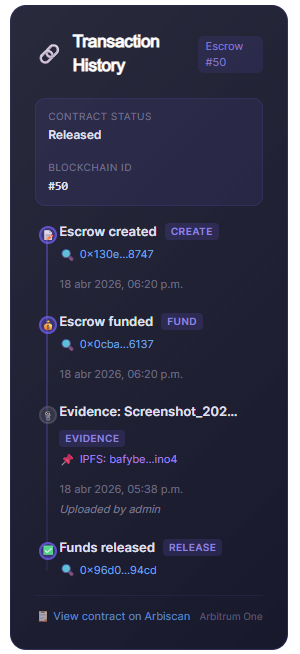
Source: Kustodia
About Kustodia
Kustodia is programmable escrow infrastructure for Latin America and emerging markets. The platform protects high-value transactions across vehicles, real estate, services, and crowdfunding using smart contracts on Arbitrum and Injective, with SPEI and USD Wire as fiat rails. Available at kustodia.app.
Media contact:
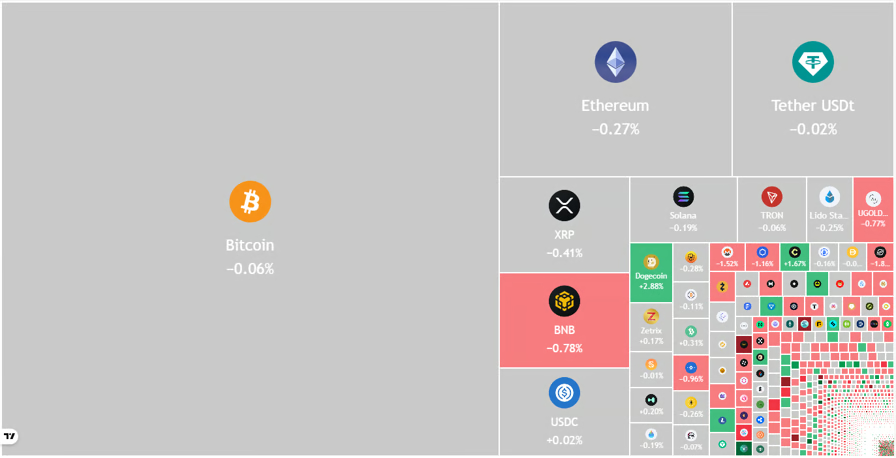
Key points:
- Buyers are struggling to sustain the BTC rebound, suggesting bears are attempting a comeback.
- Several major altcoins risk breaking below their support levels, signaling a deeper short-term pullback.
Bitcoin (BTC) rallied above $77,900 on Wednesday, but the long wick on the candlestick shows selling on rallies. On-chain analyst Willy Woo said in a post on X that BTC needs to close above the $79,000 cost basis of recent investors to strengthen the recovery. Woo gave BTC only 30% odds of rising above $79,000 in this attempt.
Another cautious view came from crypto trading account CRYPTOWZRD, who highlighted the risks of downside in June. CRYPTOWZRD said in a post on X that historically BTC has corrected for a few months after a new Federal Reserve chair takes over. With Kevin Warsh slated to take over as the Fed chair in May, could BTC “break the curse,” or will it see a final dip?
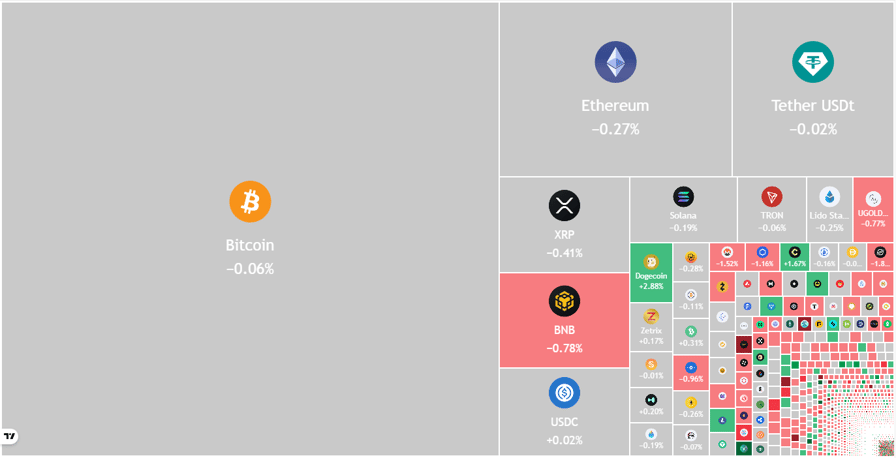
Crypto market data daily view. Source: TradingView
Analysts remain divided about BTC’s prospects in the near term. Some analysts believe BTC will breakout to a new all-time high and rally to as high as $250,000 in 2026, while others anticipate a drop below $50,000 to as low as $30,000. Although anything is possible in the cryptocurrency markets, traders should watch crucial support and resistance levels closely rather than becoming overly optimistic or pessimistic based on target projections.
Could BTC and the major altcoins stay above their immediate support levels? Let’s analyze the charts of the top 10 cryptocurrencies to find out.
Bitcoin price prediction
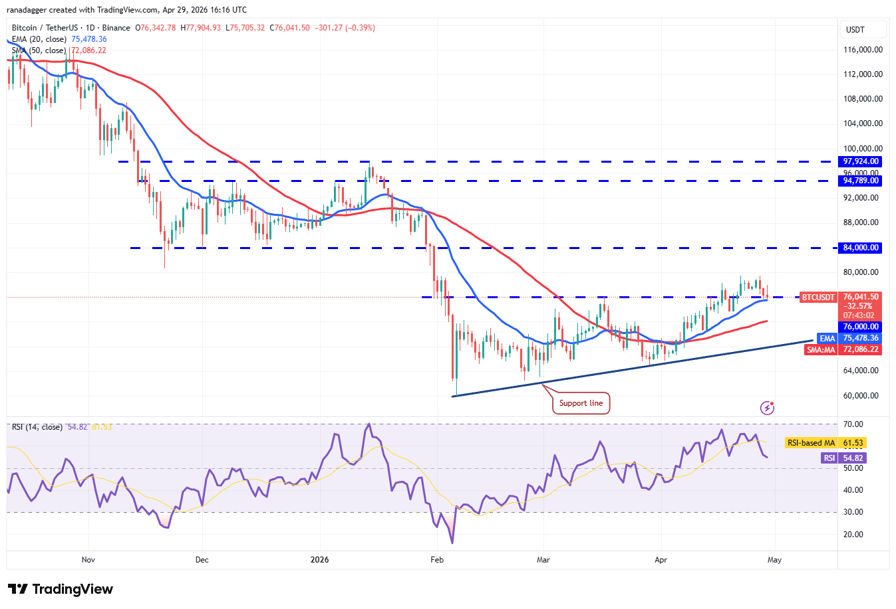
BTC bounced off the 20-day exponential moving average ($75,478) on Wednesday, but the bulls could not sustain the higher levels.
BTC/USDT daily chart. Source: Cointelegraph/TradingView
The 20-day EMA is the critical near-term support to watch out for. If the BTC price rebounds off the 20-day EMA with force and breaks above $80,000, it signals that the bulls have flipped the $76,000 level into support. The BTC/USDT pair may then rally to $84,000.
This positive view will be negated in the near term if the price continues lower and breaks below the 20-day EMA. That suggests the bears are active at higher levels. The pair may then tumble to the 50-day simple moving average ($72,086) and later to the support line.
Ether price prediction
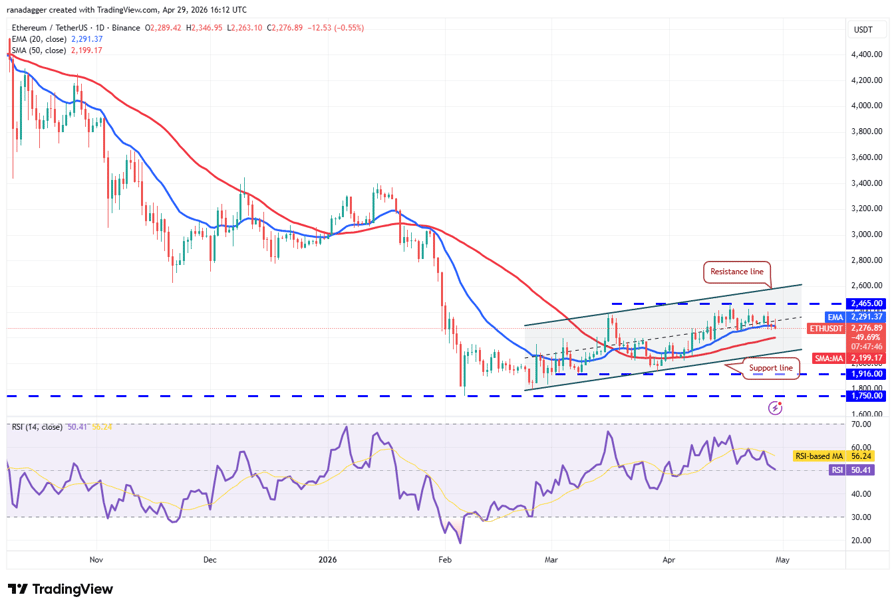
Buyers are attempting to sustain Ether (ETH) above the 20-day EMA ($2,291), but the bears continue to exert pressure.
ETH/USDT daily chart. Source: Cointelegraph/TradingView
If the ETH price continues lower and breaks below the moving averages, it suggests that the bears are on a comeback. The ETH/USDT pair may then slump to the support line, where the buyers are expected to step in.
Conversely, if the price turns up from the moving averages, it suggests that the lower levels are attracting buyers. The pair may rise to $2,465 and then to the resistance line of the ascending channel pattern.
XRP price prediction
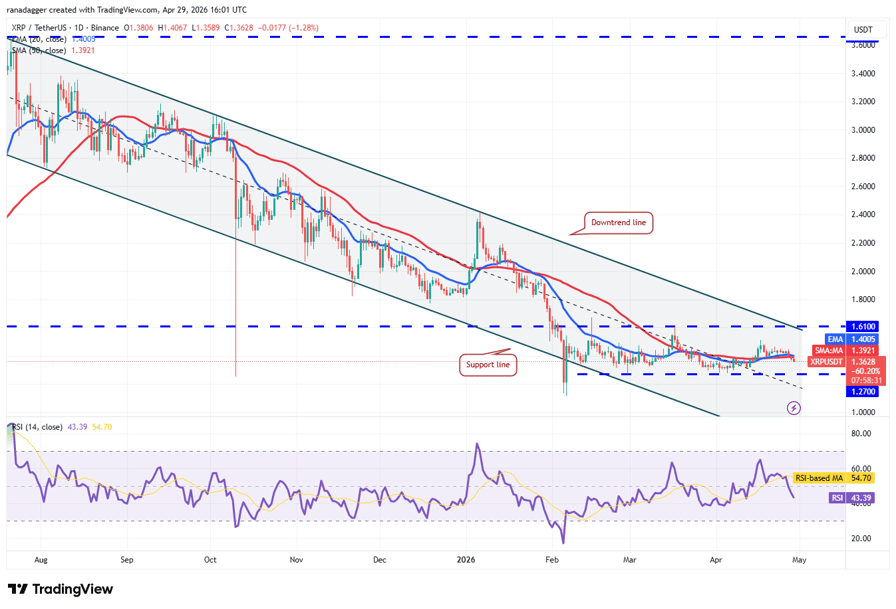
XRP (XRP) fell below the moving averages on Tuesday, indicating that the bears are attempting to take charge.
XRP/USDT daily chart. Source: Cointelegraph/TradingView
XRP price may slide to $1.27, where buyers are expected to mount a strong defense. If the price rebounds off the $1.27 support and rises above the moving averages, the recovery may reach the downtrend line. A close above the downtrend line signals a potential trend change.
Conversely, a break below the $1.27 level puts the Feb. 6 low of $1.11 at risk of a breakdown. The pair may then plummet to $1 and then to the support line.
BNB price prediction
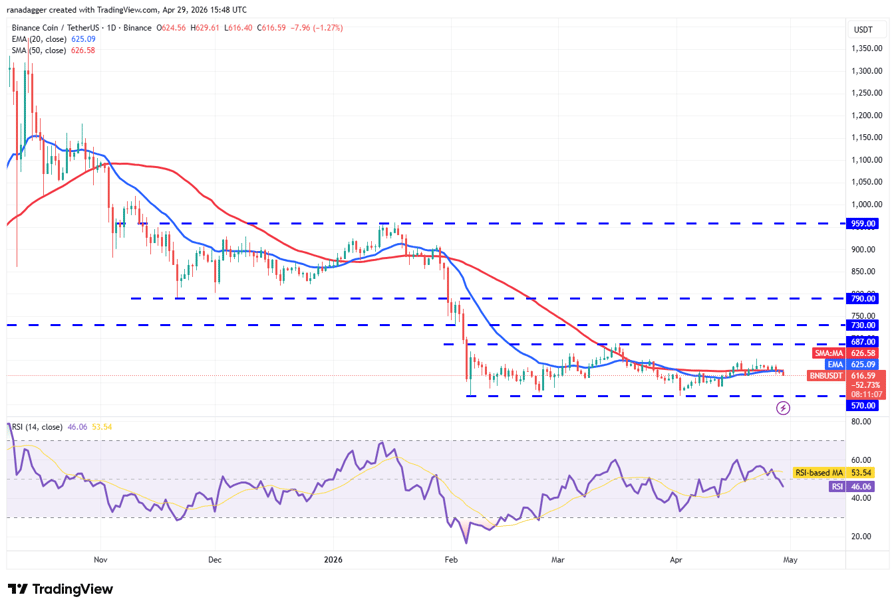
BNB (BNB) remains stuck inside the large range between $570 and $687, signaling buying on dips and selling on rallies.
BNB/USDT daily chart. Source: Cointelegraph/TradingView
The flattish moving averages and the RSI just below the midpoint suggest that the BNB/USDT pair may continue consolidating for some time.
Buyers will gain the upper hand if they push the BNB price above $687. If they manage to do that, the pair may surge to $730, then to $790. On the other hand, a break below the $570 support signals the resumption of the downtrend. The pair may then collapse to $500.
Solana price prediction
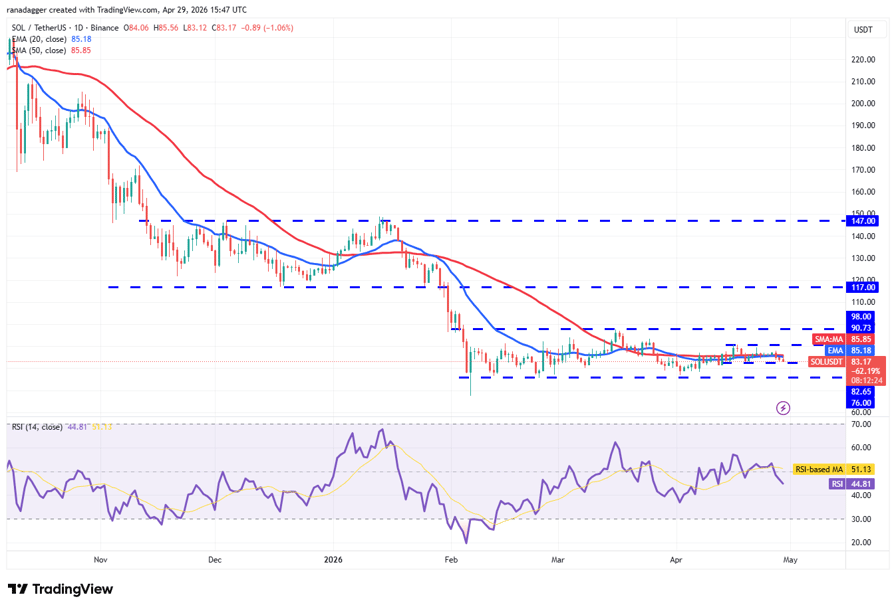
Solana (SOL) has been trading inside a tight range between $82.65 and $90.73, indicating a balance between supply and demand.
SOL/USDT daily chart. Source: Cointelegraph/TradingView
If the price breaks below $82.65, the SOL/USDT pair may decline toward the $76 support. Buyers are expected to fiercely defend the $76 level, as a close below it may sink the pair to $67.
On the upside, a break and close above the $90.73 level would indicate a slight advantage for the bulls. The SOL price may then reach the overhead resistance at $98. This is a critical level to watch out for as a break above $98 opens the doors for a rally to $117.
Dogecoin price prediction
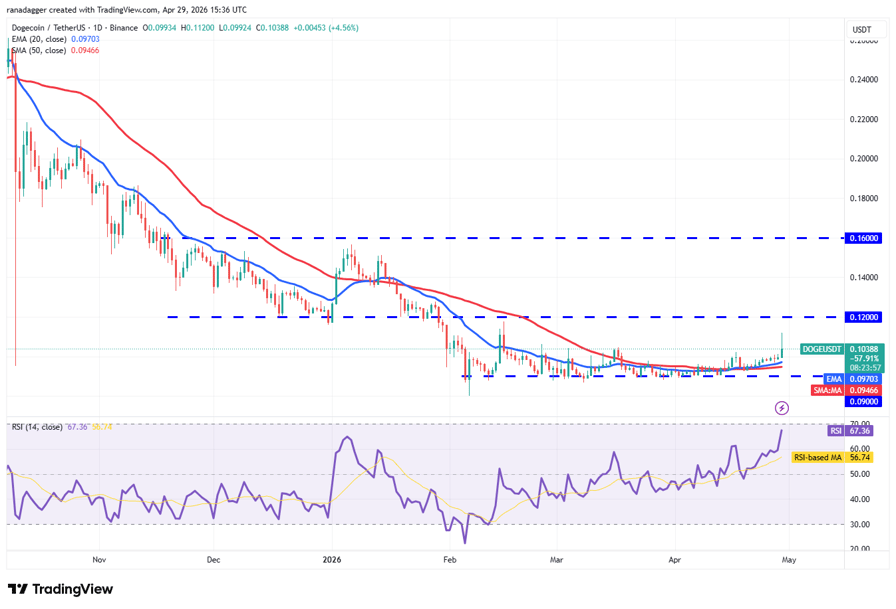
Dogecoin (DOGE) bounced off the 20-day EMA ($0.10) on Monday, indicating buying on dips.
DOGE/USDT daily chart. Source: Cointelegraph/TradingView
The bulls pushed the DOGE price above $0.11 on Wednesday, but the long wick on the candlestick indicates that bears remain active at higher levels. A break below the 20-day EMA signals that the DOGE/USDT pair may remain range-bound between $0.09 and $0.12 for a few more days.
On the other hand, if the price rebounds off the $0.10 level, it increases the possibility of a rally to $0.12. A close above the $0.12 resistance suggests that the pair may have bottomed out in the short term.
Hyperliquid price prediction
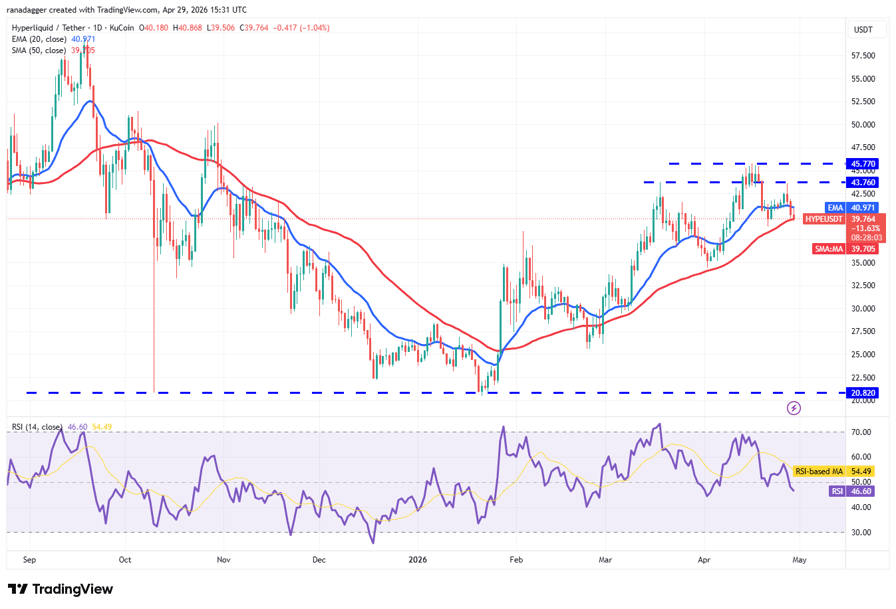
Hyperliquid (HYPE) turned down from the $43.76 overhead resistance on Monday and fell to the 50-day SMA ($39.70) on Tuesday.
HYPE/USDT daily chart. Source: Cointelegraph/TradingView
Sellers will attempt to strengthen their position by pulling the HYPE price below the 50-day SMA. If they manage to do that, the HYPE/USDT pair may initiate a deeper pullback to $37.77, then to $34.45.
On the upside, the bears will continue to pose a substantial challenge in the $43.76-$45.77 zone. However, if buyers break above the overhead zone, the pair may rally to $50 and then to $51.43.
Related: XRP set for ‘strongest’ 2026 monthly ETF inflows as bulls target $2
Cardano price prediction
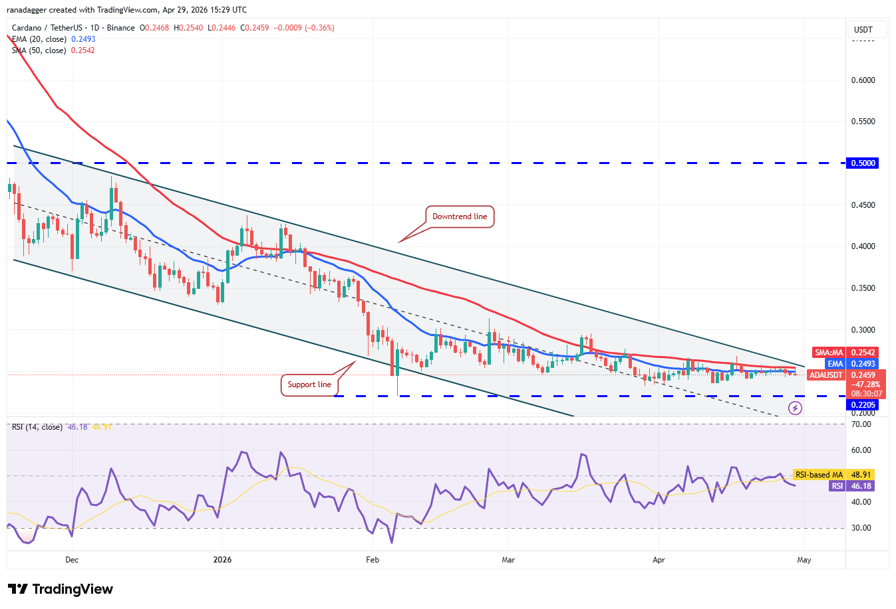
Cardano (ADA) is facing selling near the downtrend line, but a minor positive is that the bulls have not given up much ground to the bears.
ADA/USDT daily chart. Source: Cointelegraph/TradingView
That suggests the bulls will again attempt to drive the ADA price above the downtrend line. If they succeed, the ADA/USDT pair may rally to $0.32 and then to $0.37. Such a move signals a potential trend change.
Sellers are likely to have other plans. They will attempt to defend the downtrend line and pull the price to the solid support at $0.22. A close below the $0.22 level indicates the resumption of the downtrend.
Bitcoin Cash price prediction
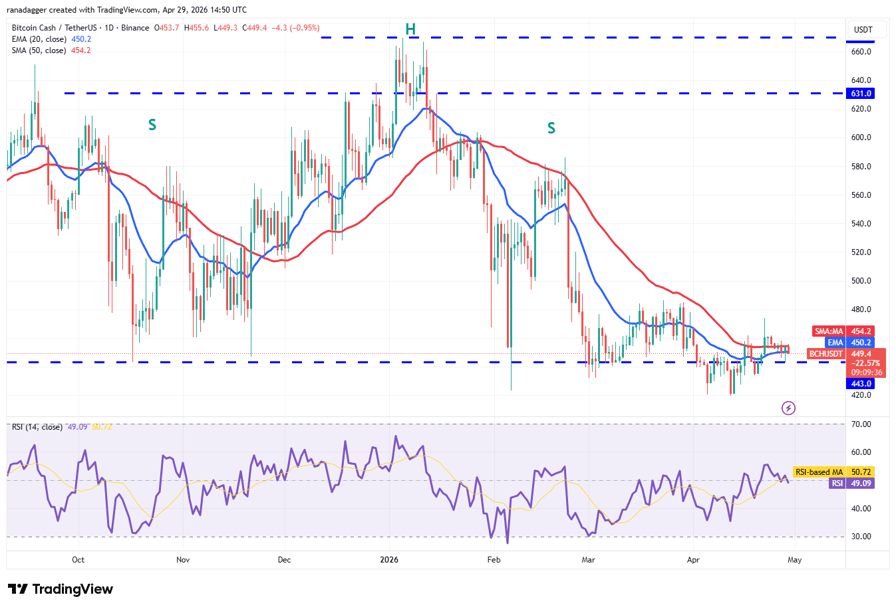
Bitcoin Cash (BCH) bounced off the $443 support on Tuesday, but bulls are struggling to push the price above the moving averages.
BCH/USDT daily chart. Source: Cointelegraph/TradingView
The flattish moving averages and the RSI near the midpoint do not give either bulls or bears a clear advantage. If the BCH price maintains above the moving averages, the possibility of a rise to the $486 level increases. Sellers are expected to aggressively defend the $486 level, as a close above it opens the door to a rally to $520.
On the downside, a close below the $443 level may sink the BCH/USDT pair to the solid support at $419.
Monero price prediction
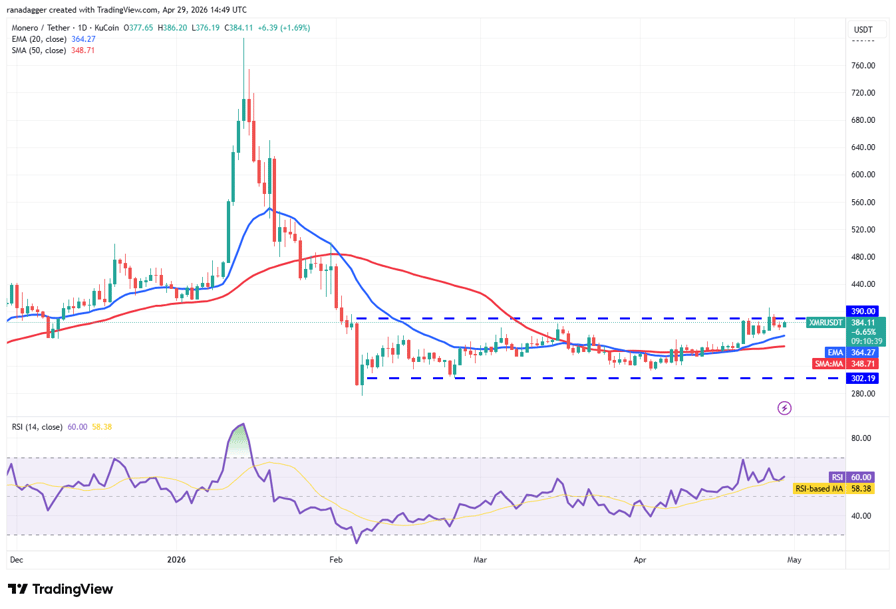
Monero (XMR) surged above the $390 resistance on Sunday, but the bulls could not sustain the breakout.
XMR/USDT daily chart. Source: Cointelegraph/TradingView
The XMR price pulled back to the 20-day EMA ($364), where the buyers stepped in. If the XMR/USDT pair continues higher and breaks above the $406 level, it signals the start of a new up move toward $500.
Contrary to this assumption, if the price turns sharply lower and breaks below the moving averages, it suggests the pair may remain within the $302 to $390 range for some time.
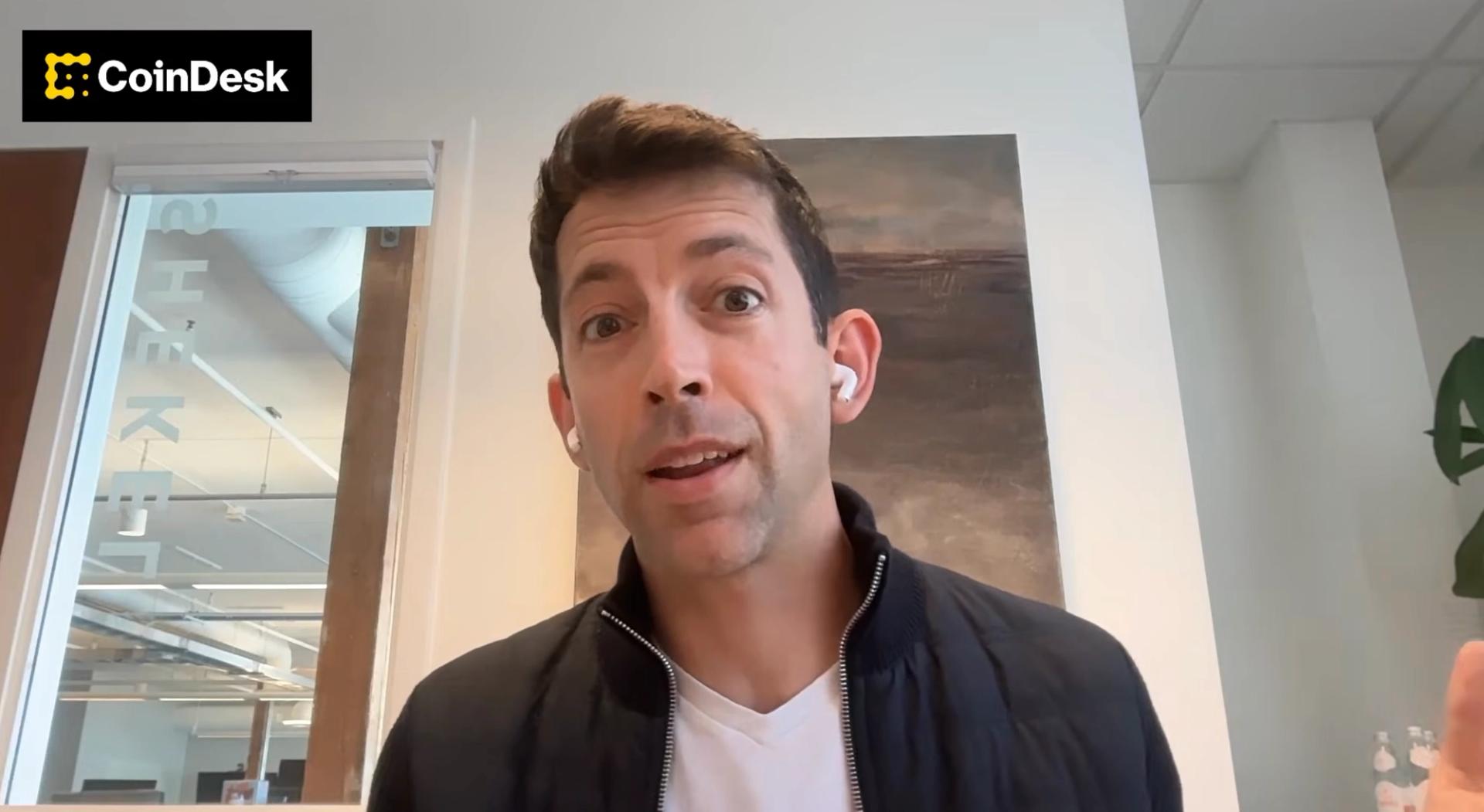
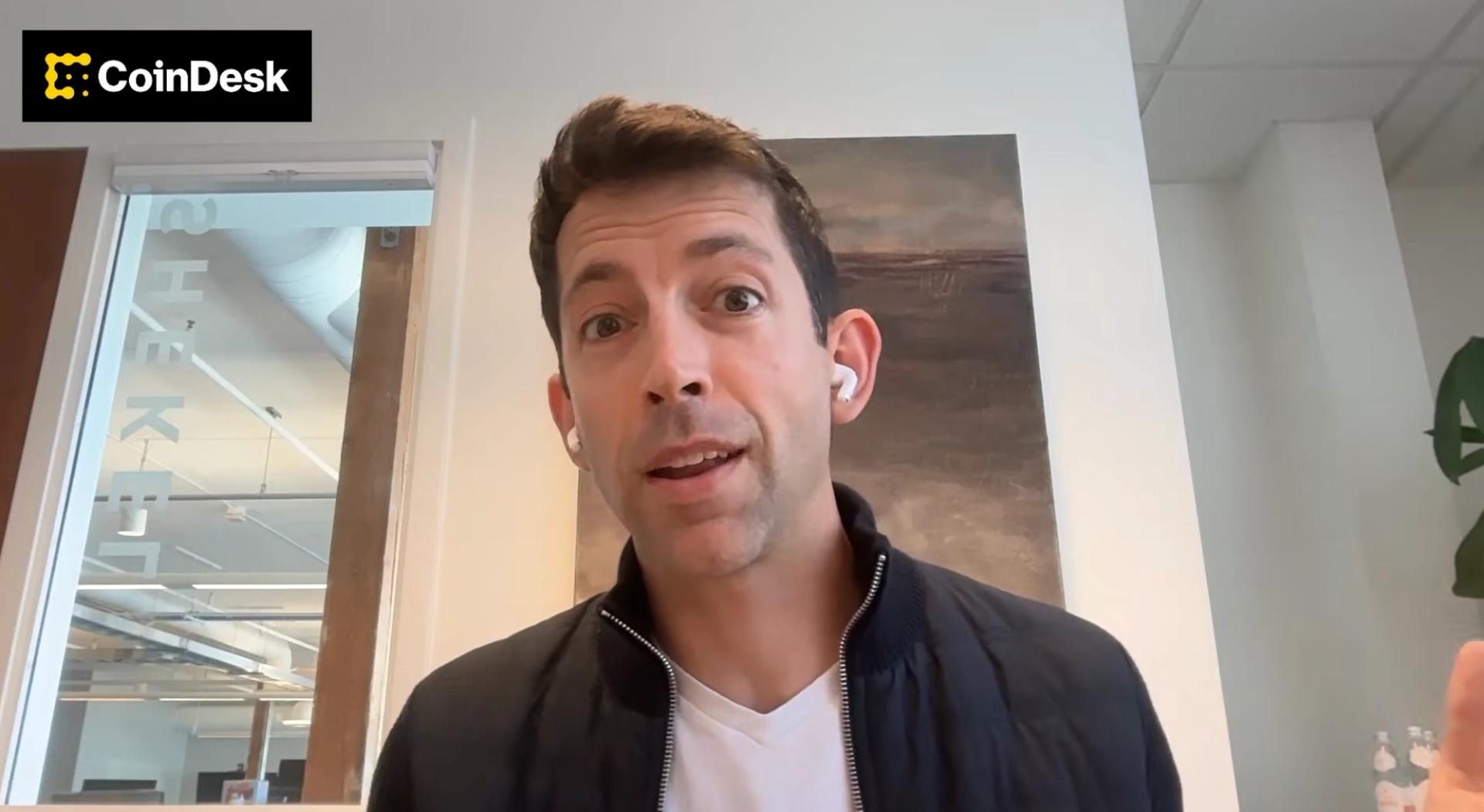
Why it matters: Crypto still suffers from a branding gap despite growing institutional adoption, according to Stellar CMO Jason Karsh.
- Karsh said the industry leans too heavily on “esoteric words and verbiage” that alienate everyday users.
- He argued crypto “peaked in public” too early due to speculative mania, distorting its real potential.
- The bigger opportunity: rebuilding global financial rails to move and store value more efficiently.
The big picture: Stellar is positioning itself at the center of tokenization and cross-border payments as institutions enter crypto.
- The network has focused on payments and real-world financial use cases since launching in 2014.
- That long-term approach is now paying off as regulators warm to stablecoins and tokenized assets.
- Karsh said the goal is to eventually move “trillions” of dollars on-chain, beyond early pilot programs.
Between the lines: Stablecoins are emerging as crypto’s gateway product, but messaging remains a hurdle.
- Karsh called stablecoins “the killer first use case” because they mirror familiar fiat currencies.
- Still, broader audiences remain skeptical or confused about how they work.
- He suggested reframing them as programmable dollars that earn yield and move instantly.
What they’re saying: Karsh is pushing a sharp break from short-term, hype-driven crypto marketing.
- “You need to try to get rich slow… create value every day,” he said.
- He criticized projects that prioritize token launches over sustainable products.
- Strong brands, he added, come from consistent execution and aligning product with messaging.
What’s next: The next wave of adoption may come from infrastructure, not speculation.
- Karsh expects growth to come from replacing legacy financial systems with blockchain rails.
- He predicts both humans and AI agents will drive transaction growth, with agents eventually dominating volume.
- But near-term success depends on onboarding “100 million humans” first.

Hong Kong’s nascent stablecoin regime faced a fresh test as scammers impersonated the two newly licensed issuers ahead of their official product launches. Warnings issued by the Hong Kong Monetary Authority (HKMA), HSBC, and Anchorpoint Financial stated that tokens bearing the tickers HKDAP and HSBC have appeared on the market but are not connected to the licensed issuers.
Hong Kong began its stablecoin licensing regime in August 2025. Last month, the HKMA granted its first stablecoin issuer licenses, approving Anchorpoint Financial and HSBC under the new framework. The episode underscores the growing pains that accompany a regulated rollout of fiat-backed digital currencies in a major financial hub.
The HKMA emphasized that, at present, neither licensed issuer has published any regulated stablecoins. The authority’s warning was echoed by HSBC and Anchorpoint, who stressed that no stablecoins have been issued by either institution under the HKMA framework.
HSBC said in a statement that it “has not yet issued any stablecoins in Hong Kong,” adding that its planned Hong Kong dollar stablecoin will be available only through PayMe and the HSBC HK Mobile App when it launches in the second half of 2026. Anchorpoint likewise clarified that since receiving its license from the HKMA on April 10, it has not issued any tokens or products under the HKDAP name, and urged the public to verify information through official channels and to use regulated avenues when acquiring or using stablecoins.
The guidelines governing fiat-backed stablecoins in Hong Kong require issuers to obtain an HKMA license and adhere to rules around reserve backing, redemption rights, governance, and anti-money-laundering controls. The HKMA maintains enforcement powers that include fines, suspensions, and license revocations to ensure compliance with the regime.
The episode arrives as banks and other traditional financial players increasingly pivot toward stablecoins. In a notable move last week, Morgan Stanley’s investment management arm launched a “Stablecoin Reserves Portfolio,” allowing stablecoin issuers to park reserve funds in one of the bank’s money market funds and earn interest. Separately, Western Union has signaled a May rollout for its USD-backed stablecoin, USDPT, which will be built on Solana and issued by Anchorage Digital Bank. These developments illustrate growing institutional interest in reserve management and settlement rails for fiat-backed digital currencies.
Key takeaways
- Fake tokens with tickers HKDAP and HSBC appeared in the market, but neither is issued by the HKMA-licensed stablecoin issuers Anchorpoint Financial or HSBC.
- The HKMA, HSBC, and Anchorpoint Financial confirm that no regulated stablecoins have been issued to date; real launches are expected later, including HSBC’s HKD stablecoin planned for H2 2026.
- Hong Kong’s licensing regime requires reserve backing, redemption rights, governance, and AML controls, with the HKMA empowered to fine, suspend, or revoke licenses for non-compliance.
- Traditional banks are increasingly engaging with stablecoins, exemplified by Morgan Stanley’s reserve portfolio product and Western Union’s USDPT rollout plans with Anchorage Digital Bank.
Regulatory framework and the road ahead
The HKMA’s stance reflects a balancing act between fostering innovation and maintaining stringent oversight. The newly licensed issuers must meet a set of governance and reserve standards designed to ensure that each stablecoin is fully backed and redeemable under orderly conditions. The enforcement toolkit—ranging from fines to license revocation—signals that regulators intend to act decisively against misrepresentation or mismanagement in the stablecoin space.
For market participants, the latest warnings serve as a reminder to rely on official channels for information and to verify any claims about regulated products. Investors and users should monitor both issuers’ adherence to the HKMA framework and the public rollouts of the actual stablecoins when they become available via licensed channels.
Beyond Hong Kong, the momentum around stablecoins continues to attract traditional finance players. Morgan Stanley’s new reserve portfolio approach provides a pathway for issuers to optimize cash management, while Western Union’s USDPT project points to a broader trend of fiat-backed digital currencies integrating with existing payment rails. As the regulatory regime matures and real products begin to surface, observers will watch how reserve strategies, custody arrangements, and redemption mechanics evolve in practice.
Readers should stay tuned for updates on when the HKD stablecoin will actually launch in Hong Kong, how the public markets will verify legitimacy, and what additional licensing actions the HKMA may take as the regime scales.
Note: This reporting reflects information available from official statements and linked industry reports. Readers are encouraged to consult the cited sources for the most current developments.
Related coverage and sources: Hong Kong’s first stablecoin licenses issued, HSBC warns against fraudulent stablecoins, Anchorpoint alert on HKDAP, Morgan Stanley launches money-market fund for stablecoin issuers, Western Union targets May for USDPT rollout.
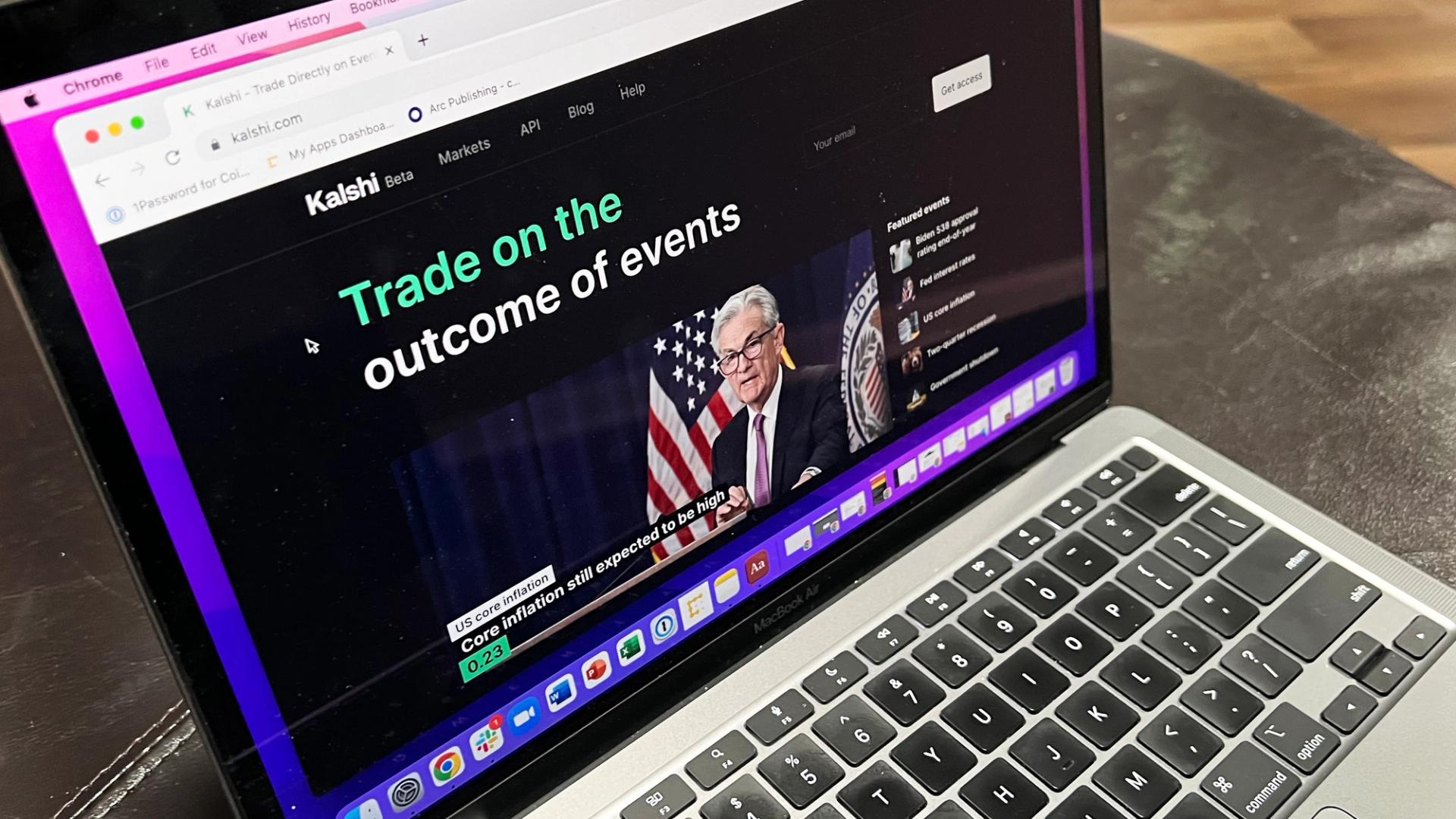
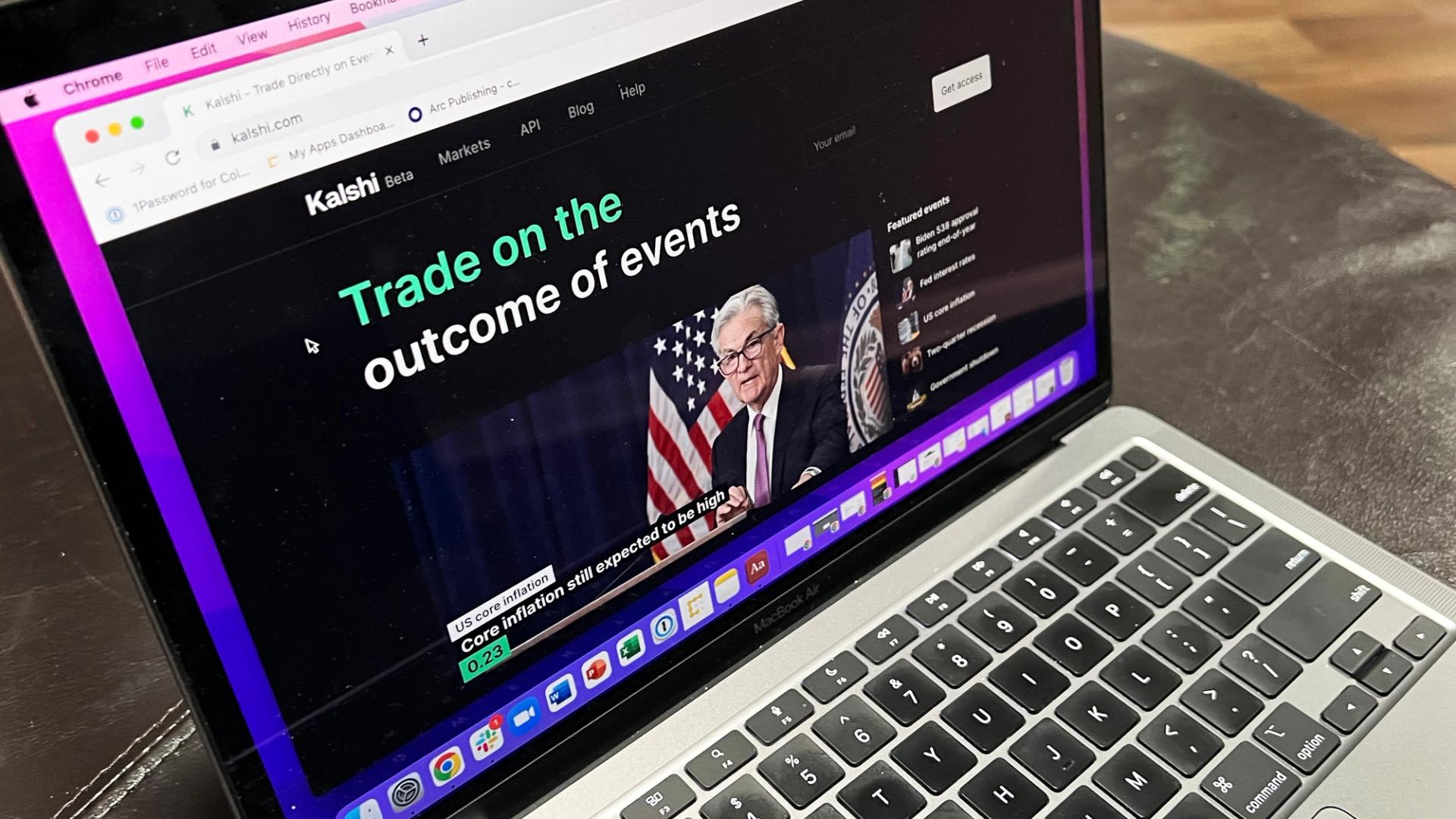
Roundhill Investments is set to launch the first U.S. exchange-traded funds (ETFs) tied to prediction markets next week, with two other asset managers preparing similar products.
According to a filing with the U.S. Securities and Exchange Commission (SEC), Roundhill will list six funds tied to whether Democrats or Republicans control the White House, Senate and House.
The launch is set for May 5, according to Bloomberg ETF analyst James Seyffart.
The funds are the Roundhill Democratic President ETF (BLUP), Republican President ETF (REDP), Democratic Senate ETF (BLUS), Republican Senate ETF (REDS), Democratic House ETF (BLUH) and Republican House ETF (REDH).
The House and Senate products are tied to who controls them after the Nov. 3, 2026, elections, while the presidential products point to the Nov. 7, 2028, race.
The funds gain exposure through swap agreements referencing binary event contracts traded on CFTC-regulated markets. These contracts settle at $1 if an outcome occurs and $0 if it does not.
The prospectus warns in capitalized text that if the targeted party does not win, “the fund will lose substantially all of its value.”
Roundhill won’t terminate the funds after settlement. Once the market prices a winner at above $0.995 or below $0.005 for five consecutive trading days, the fund treats the outcome as decided and rolls into the next cycle, the 2028 House and Senate exposure for the midterm funds, and the 2032 presidential race for BLUP and REDP.
The prospectus notes that if the market is later proved wrong, “there will be no recourse” for shareholders.
Bitwise and GraniteShares filed identical six-fund slates in February, with Bitwise using a “PredictionShares” brand. Their structures differ as Bitwise’s funds terminate shortly after each outcome is determined, while GraniteShares, like Roundhill, rolls into the next election.
Political event contracts are already traded on prediction markets such as Polymarket and Kalshi, but wrapping them in ETFs could expand access by allowing them to be held in ordinary brokerage accounts and some retirement accounts.
The push comes after the CFTC withdrew a Biden-era proposal in February that would have banned political event contracts, though state regulators in Massachusetts, New York, Nevada and elsewhere continue to challenge the underlying contracts in court.
Roundhill has also filed to list non-political prediction market ETFs tied to whether the U.S. will enter a recession, according to a filing flagged by Bloomberg ETF analyst Eric Balchunas.
Treasury management startup Stable Sea has integrated WisdomTree’s tokenized US Treasury money market fund into its platform, in a move aimed at helping businesses generate yield on idle cash.
On Wednesday, Stable Sea said the WisdomTree Government Money Market Digital Fund (WTGXX) is now available on its platform, allowing corporate clients to allocate excess cash to a government-backed fund rather than leaving it in low-yield bank accounts.
Stable Sea provides software that automatically reallocates — or “sweeps” — corporate cash balances into yield-bearing instruments. By integrating WTGXX, the company is extending that functionality to a tokenized fund that settles on blockchain infrastructure.
The product is aimed at businesses and corporate treasury teams seeking more efficient ways to manage liquidity and earn returns on cash reserves.
Companies access the fund through Stable Sea’s platform, which connects to existing financial systems. Clients are still required to complete onboarding and standard compliance checks, reflecting the regulated nature of the underlying fund.
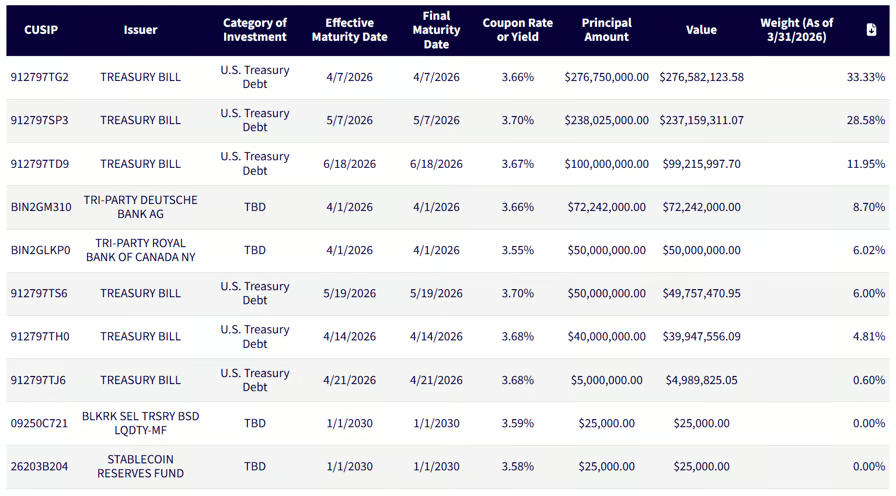
WTGXX invests primarily in short-term US government securities, such as Treasury bills, and is structured as a money market fund. Its “tokenized” format means ownership shares are recorded onchain, which can enable faster settlement and more automated transactions compared to traditional fund infrastructure.
The fund had total assets of $857.64 million, as of April 28, and offered a daily yield of 3.43%, according to WisdomTree.
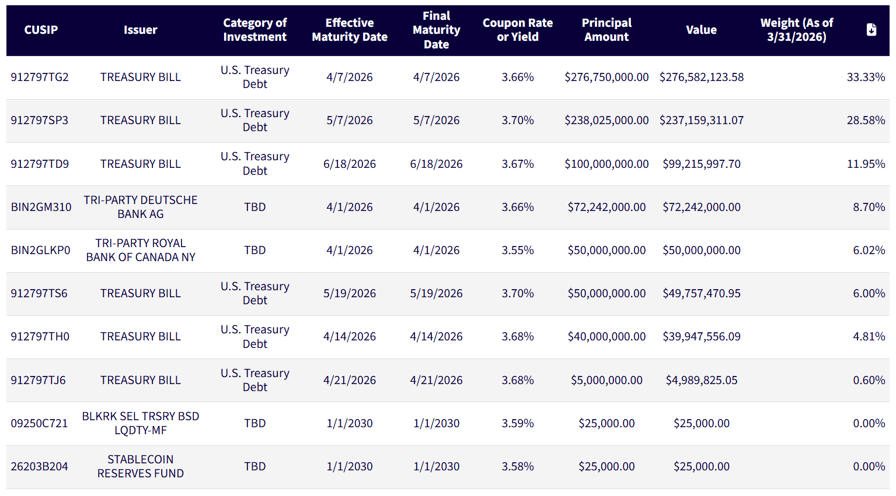
WGTXX’s primary holdings. Source: WisdomTree
Related: WisdomTree gets SEC approval for round-the-clock trading of tokenized MMF
Tokenized money market funds gain traction among institutions
Tokenized money market funds are seeing increased adoption as investors and institutions look for low-risk yield with greater operational flexibility. One of the key selling points is liquidity.
WisdomTree recently enabled 24/7 trading for its WTGXX fund after receiving approval from the US Securities and Exchange Commission, allowing investors to access and move funds outside traditional market hours.
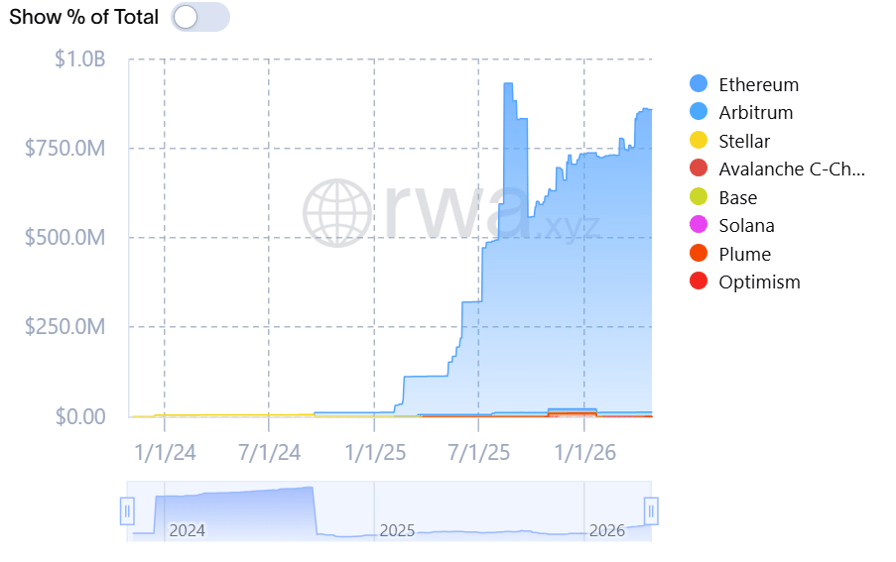
WGTXX has $857 million in total assets. Source: RWA.xyz
The use case is also expanding beyond cash management. Franklin Templeton and Binance have partnered to allow tokenized money market funds to be used as off-exchange collateral. Eligible institutions can pledge tokenized fund shares issued via Franklin Templeton’s Benji platform to support trading activity on Binance.
Standard Chartered this week launched a new framework that enables its institutional clients to use BlackRock’s tokenized short-term Treasurys fund as collateral for trading on crypto exchange OKX.
In an email to Cointelegraph following the launch, Richard Baker, CEO and founder of Tokenovate, said StanChart’s move “signals another instance of tokenization’s transition into the heart of core market infrastructure, elevating it from innovation to something structurally transformative.”
Other traditional finance players are entering the market as well. Northern Trust Asset Management recently launched a tokenized share class of its Treasury Instruments Portfolio, marking its entry into blockchain-based fund infrastructure.
Related: Visa adds Polygon, Base support as stablecoin settlement run rate hits $7B
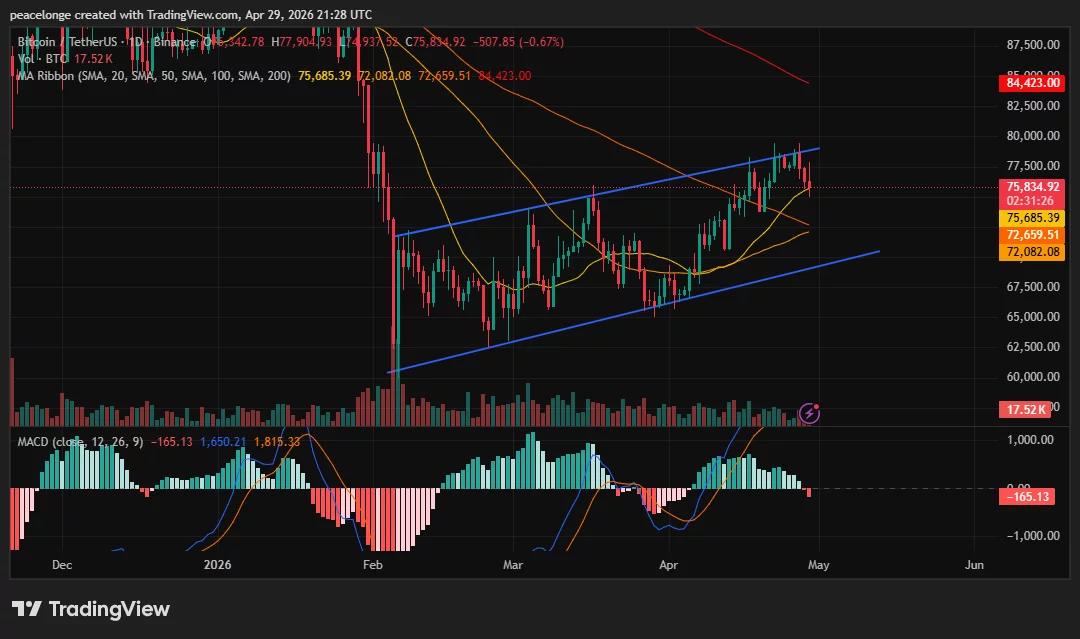
Bitcoin is pulling back from the upper boundary of its ascending channel on Powell’s final FOMC day, with a daily MACD bearish crossover now confirmed and price retreating toward key SMA support. This article breaks down what the daily chart signals, where price could head next, and why the Fed transition to incoming Chair Kevin Warsh adds a fresh layer of uncertainty.
Summary
- Bitcoin is trading at $75,834 on April 29, down 0.67% on the session, as a daily MACD bearish crossover confirms momentum is shifting.
- Price has pulled back from the ascending channel’s upper boundary and is now pressing the SMA 20 at $75,685 as immediate support.
- If the SMA 20 fails, the next floor sits at the SMA 50 near $72,082; a confirmed close above $80,000 invalidates the bearish setup.
Bitcoin (BTC) is trading at $75,834 on April 29, down 0.67% on the day, after touching a high of $77,904 before sellers reasserted control heading into the Federal Reserve’s rate decision. The pullback comes as Jerome Powell delivers his final FOMC press conference before his term ends on May 15, and as the daily MACD histogram flips negative for the first time in several weeks, signaling that the momentum driving April’s 21% recovery is beginning to wane.
Daily MACD bearish crossover at descending channel resistance
The daily chart shows Bitcoin navigating two overlapping structures. The ascending channel from the February lows near $59,000, defined by two parallel blue trendlines, remains intact and has framed the entire recovery through April. However, a broader descending channel formed by two red trendlines running from the February highs near $85,000 is capping the macro recovery, with the SMA 200 at $84,423 sitting inside that upper boundary as major overhead resistance.
Price tested the upper region of the ascending channel near $78,000 on April 28, then retreated sharply, producing the current session’s high of $77,904 before sliding to $75,834 at the time of writing. The critical technical development on today’s daily chart is the MACD. The MACD line reads at 1,650.21, the signal line at 1,815.33, and the histogram at -165.13, confirming a bearish crossover on the daily timeframe. Crypto analyst Michael van de Poppe said on X that Bitcoin pullbacks ahead of and during FOMC events are typical, but cautioned that a close below $73,000 would signal a deeper correction rather than a routine reset.
Key levels: support, resistance, and price targets
The immediate support is the SMA 20 at $75,685, which price is currently pressing. A daily close below it removes the first dynamic buffer and brings the SMA 50 at $72,082 and the SMA 100 at $72,659 into focus, both of which converge in a tight cluster near the $72,000 to $73,000 zone that analysts identify as the lower boundary of the ascending channel. A confirmed close below $72,000 would break the ascending channel structure and open a retest of the $65,000 to $68,000 range, where heavy on-chain accumulation occurred throughout the Iran-driven correction in Q1 2026.
On the upside, $80,000 remains the primary resistance and the bull-case target that would invalidate the current bearish MACD reading. Above it, the SMA 200 at $84,423 and the upper boundary of the descending red channel represent the macro level bulls must clear for a confirmed structural trend reversal. A confirmed daily close above $80,000 on volume would shift the near-term bias back toward neutral.
ETF flows and derivatives context
According to data tracked by crypto.news, spot Bitcoin ETFs recorded $89.68 million in net outflows on April 28, breaking an eight-day inflow streak that had totalled $2.43 billion. Bitcoin fell after eight of the last nine FOMC meetings within 48 hours of the decision, per data published by Phemex, with the pattern driven by traders unwinding pre-event long positioning rather than by the rate decision itself. The current setup, where BTC entered the FOMC on a 21% April rally with the Fear and Greed Index near 40, closely mirrors prior setups that produced the sharpest post-meeting declines.
Powell’s exit and the Warsh uncertainty
This meeting carries an additional layer of uncertainty beyond the rate decision. Powell’s tenure ends May 15, with incoming Chair Kevin Warsh expected to preside over the June 16 to 17 FOMC meeting as his first. As crypto.news reported, institutional flows have proven sensitive to shifts in Fed communication tone throughout 2026, with oil prices near $105 per barrel adding further pressure on rate-cut expectations. Warsh’s hawkish reputation relative to Powell could shift the June dot plot in a direction that tightens the liquidity outlook for risk assets, making the 48-hour post-FOMC window on April 30 and May 1 the critical test for whether this pullback stabilises or extends toward $72,000.
If Bitcoin holds the SMA 20 at $75,685 and reclaims $77,500 on a daily close, the ascending channel remains intact and the bearish MACD crossover may prove to be a temporary signal. A close below $72,082 confirms a deeper correction is underway.


The Federal Trade Commission settlement decision also ordered Mashinsky to pay the commission $10 million.
U.S. District Judge Denise Cote on April 28 signed off on a $10 million settlement between the Federal Trade Commission and Alex Mashinsky, the founder of collapsed crypto lender Celsius Network, according to court documents.
The settlement permanently bans Mashinsky from promoting or operating any product or service involving the deposit, exchange, investment, or withdrawal of “assets” broadly, which could bar him from financial services beyond crypto.
The stipulated order enters a $4.72 billion monetary judgment against Mashinsky, though his actual cash payment to the FTC is capped at $10 million. That obligation will be considered satisfied if Mashinsky pays an equivalent amount to the Department of Justice under a separate forfeiture order tied to his criminal case, the court filing notes.
The order also permanently enjoins Mashinsky from misrepresenting any product or service he promotes.
The civil settlement follows Mashinsky’s sentencing last May, when a federal judge ordered him to serve 12 years in prison for fraud and market manipulation — specifically for artificially inflating the price of Celsius’s CEL token while secretly selling his own holdings.
Celsius froze customer withdrawals in June 2022, cratering crypto markets and trapping funds belonging to 1.7 million users before the platform filed for bankruptcy the following month, as The Defiant reported. A former partner had already alleged in 2022 that Celsius was operating a Ponzi scheme, with customer funds used to manipulate CEL’s price — accusations that ultimately proved accurate.
The $4.72 billion judgment reflects the full scope of harm to consumers, even if most of it remains uncollectable.
This article was written with the assistance of AI workflows. All our stories are curated, edited and fact-checked by a human.
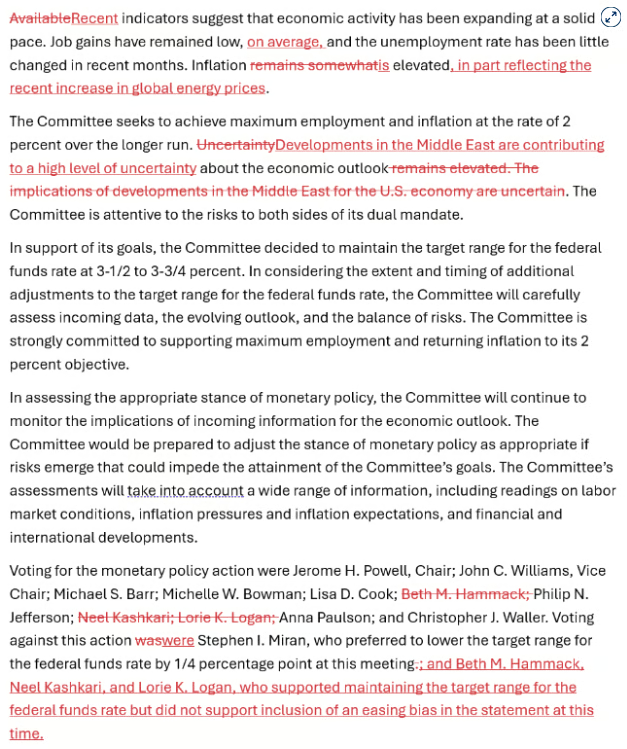
Bitcoin (BTC) extended its two-day decline on Wednesday after the Federal Open Market Committee (FOMC) minutes confirmed the Fed’s decision to hold “the target range for the federal funds rate at 3-½ to 3-¾ percent.”
While the Fed maintains its goal of achieving “maximum employment and inflation at the rate of 2 percent over the longer run,” the FOMC minutes cited the “developments in the Middle East” as factors fueling an environment of “uncertainty” and the Fed stressed its desire to maintain optionality as it evaluates the “risks to both sides of its dual mandate.”
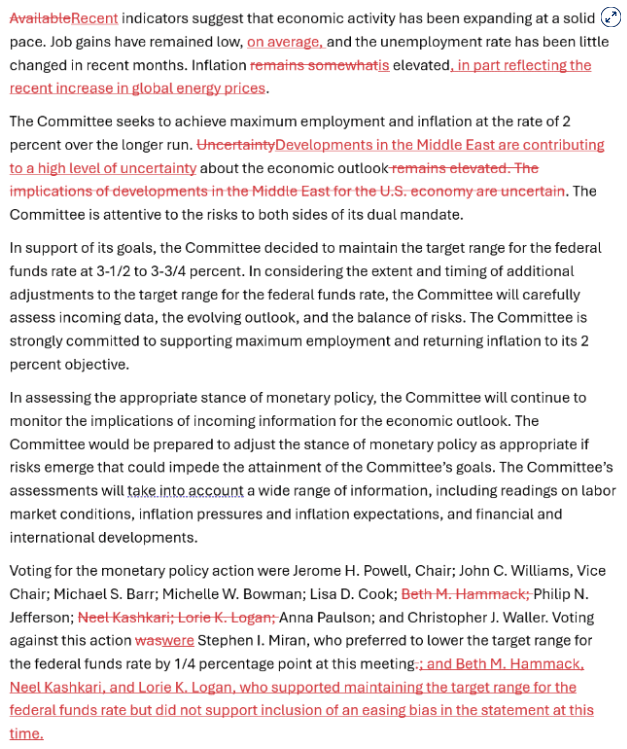
FOMC minutes with new statements in red. Source: CNBC
The Fed’s hold on rates aligned with market expectations, but Bitcoin remained fragile throughout Chairman Powell’s presser.
Hyblock CEO Shubh Varma described the price action as “the usual sell the news reaction after the FOMC,” but also noted that BTC “quickly recovered to pre-announcement levels within hours, showing strong underlying conviction.”
Adding data to back his market view, Varma said,
“The global bid ask ratio spiked to 0.3 (one of the highest readings), while open interest fell on the price drop. This is classic post-FOMC position squaring and stop-hunt behavior rather than conviction selling.”
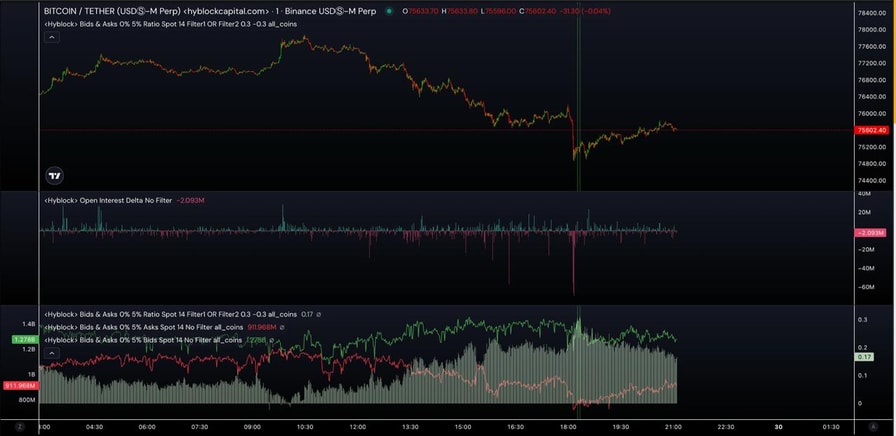
BTC/USDT global bid ask ratio. Source: Hyblock
Will support turn back into resistance?
After the FOMC minutes were published, BTC dropped to an intra-day low of $74,937, slightly below the 20-day simple moving average ($75,664) that some traders identified as critical to confirming BTC’s support-resistance flip.
As reported on Monday by Cointelegraph, following the break above the channel resistance on the daily chart, BTC required consecutive daily candle closes above the trendline, followed by a lower support restest in the $76,500 to $75,500 range.
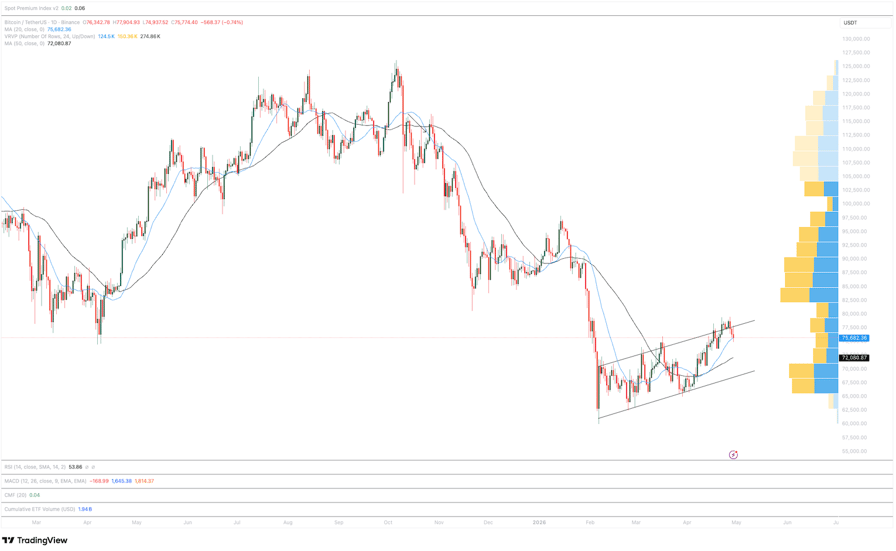
BTC/USDT 1-day chart. Source: TradingView
While all the above have happened, failure to recapture the 20-MA and close above the trendline resistance could be interpreted as a loss of momentum within the bull trend, opening the path for Bitcoin to test the downside boundary of the near-4-month-old channel.
Related: Bitcoin falls as traders cut risk ahead of FOMC: Will Tradfi, spot ETF volumes bolster $70K support?
Prior to the Chairman Powell’s presser, Glassnode analysts noticed that Bitcoin traders were adding bearish leverage, citing rising open interest after Tuesday’s rally to $79,000, funding remaining neutral and a divergence between the spot and futures market cumulative volume delta (CVD).
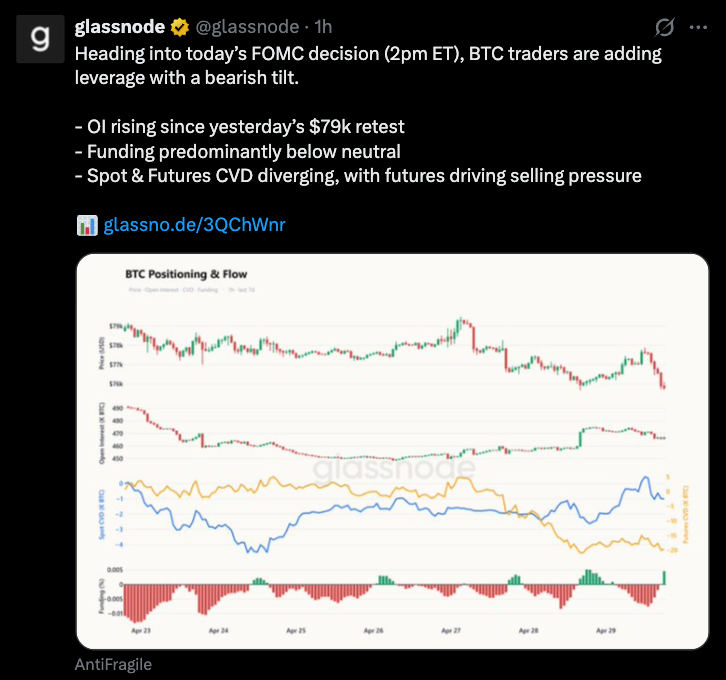
Bitcoin traders turn bearish ahead of FOMC minutes. Source: Glassnode / X
Additional analysis from Glassnode’s The Week Onchain report depicted Bitcoin’s price action as “trapped below market mean,” where $65,000 to $70,000 act as support, but weak demand prevents the formation of sustainable rallies.
According to the report, Bitcoin failed to overcome its True Market Mean at $79,000 and a surge in short-term holders’ profit taking, along with margin futures flipping net short, has sapped away Bitcoin’s shorter-term bullish momentum.
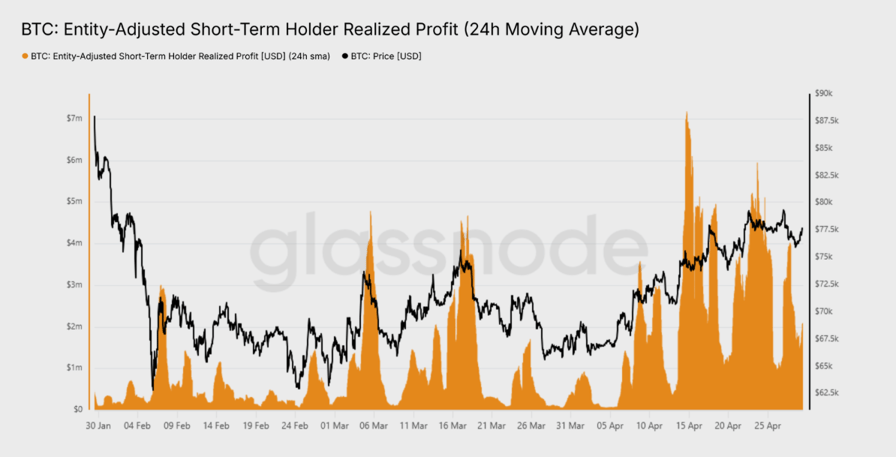
BTC entity-adjusted short-term holder realized profit. Source: Glassnode
While these factors increase Bitcoin’s sensitivity to a sharper downside move, the analysts said institutional flows into the spot BTC ETFs and rising CME open interest have helped to build a “dense accumulation cluster between $65K and $70K.”
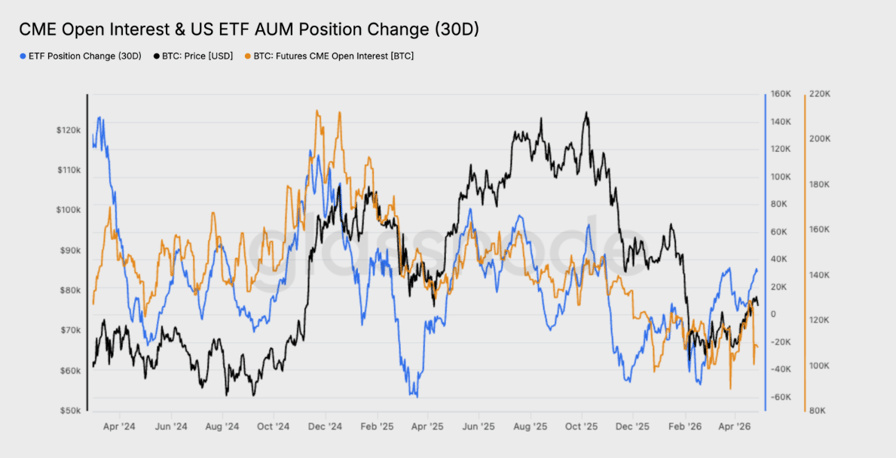
CME open interest, US spot ETF AUM position change. Source: Glassnode
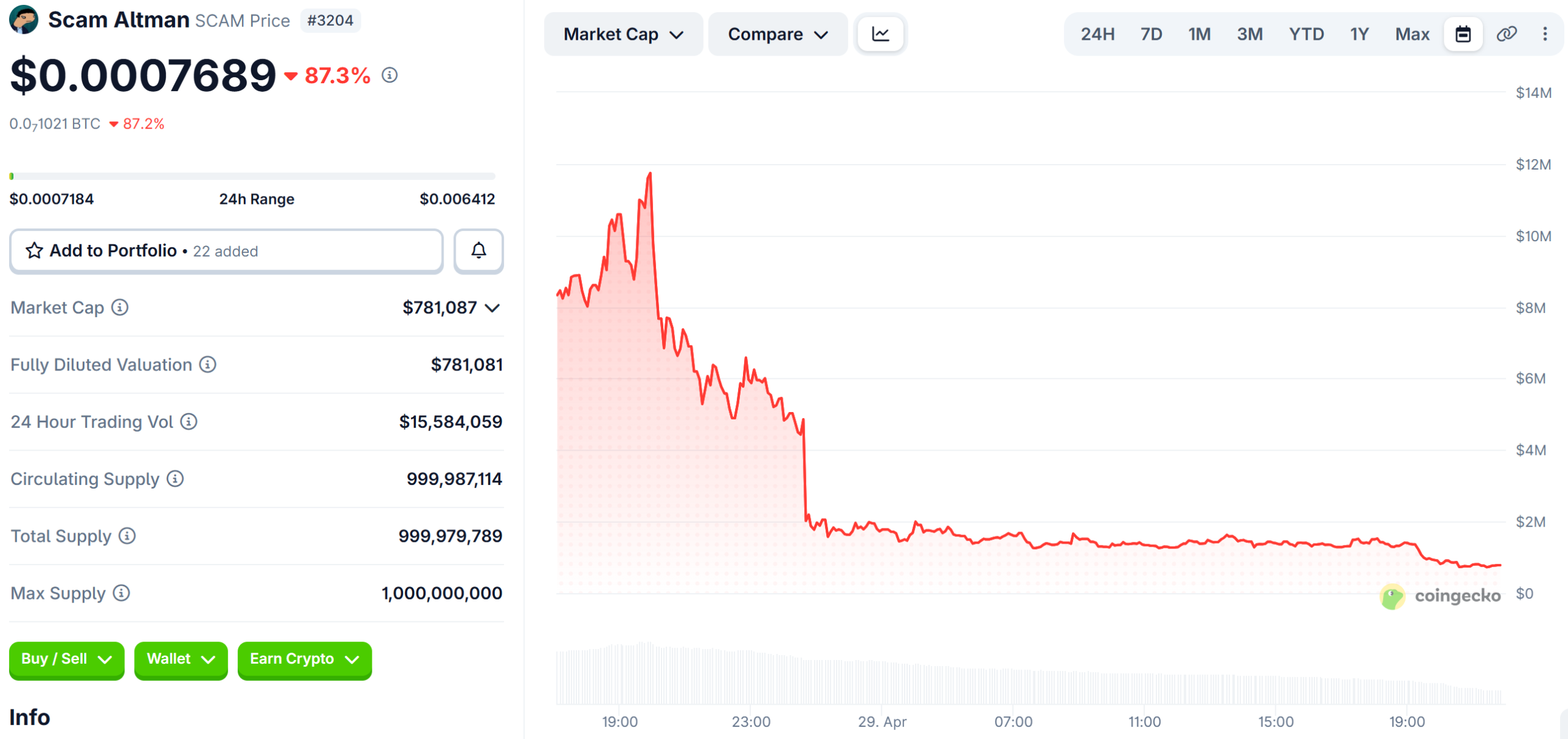
A single Solana wallet lost about $150,000 buying Scam Altman (SCAM) near the top of its launch. The trader sold close to the bottom after SCAM crashed 95% in 24 hours, on-chain analytics firm Bubblemaps reported.
The same address, tagged AuKRRB…L7sN, also dropped roughly $81,000 on UNC and $14,000 on ASTEROID in earlier trades. The three-token streak put combined realized losses at about $245,000 in a single week.
How the Scam Altman Trade Went Wrong
The Scam Altman token launched on Pump.fun this week as Elon Musk’s lawsuit against Sam Altman and OpenAI opened in federal court in Oakland.
Musk spent much of the morning calling the OpenAI chief “Scam” Altman across multiple X posts. Solana traders read the nickname as a tradable meme and raced to mint a token before competitors could.
Within eight hours, SCAM hit a market cap above $10 million on roughly $19.6 million of volume. The peak briefly approached $20 million before sellers stepped in.
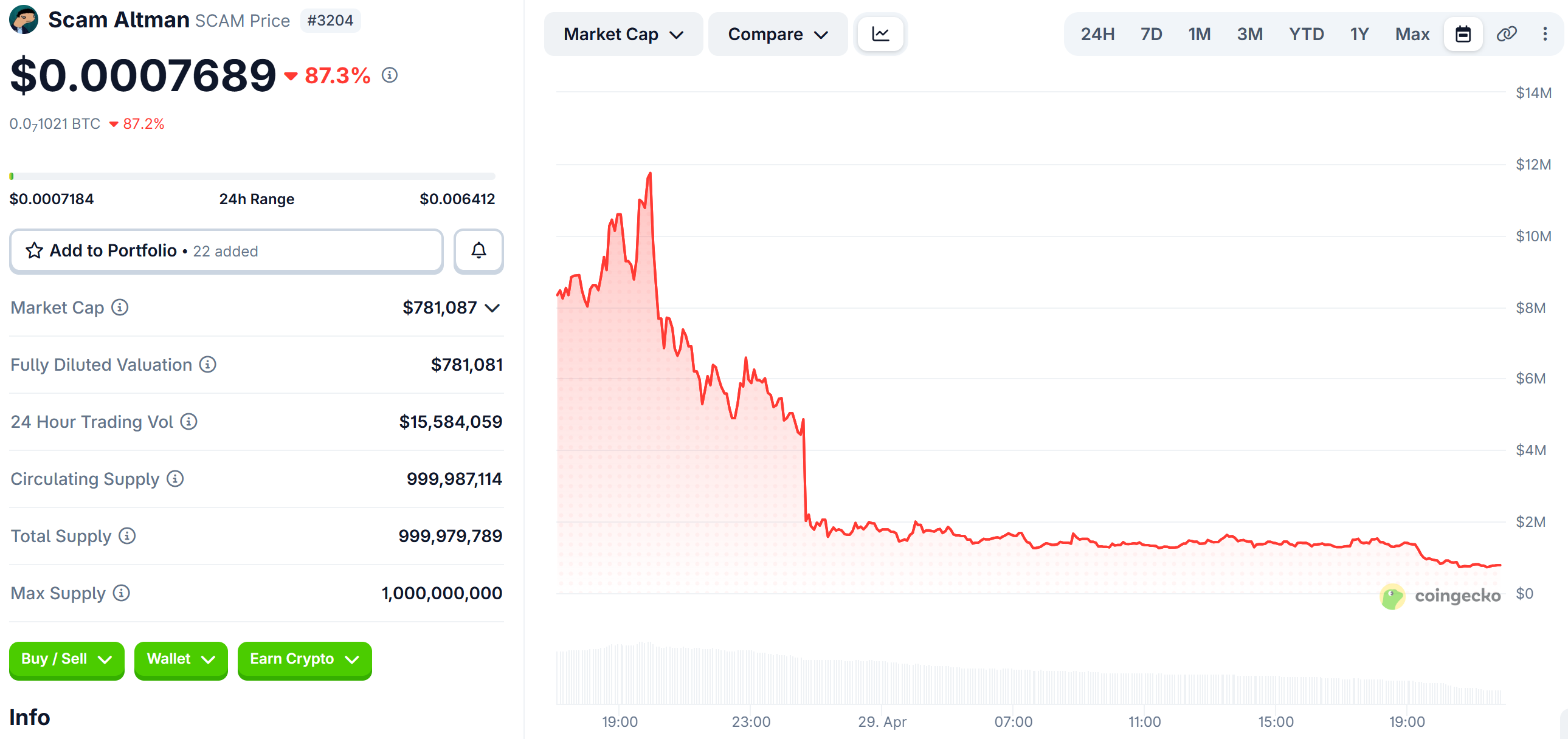
The reversal was equally fast. SCAM shed close to 88% of its value over the next 24 hours. The drop from the highlighted wallet’s entry to its exit reached about 95%.
What Bubblemaps Showed
Bubblemaps shared a post with a visualization of SCAM holders that flagged clusters of interconnected wallets. That pattern often signals insider distribution or coordinated buying on Solana meme coin launches.
The map placed wallet AuKRRB…L7sN inside an active buyer cluster near the top of the chart. Bubblemaps shared a direct map so traders could inspect the wallet relationships themselves.
The same trader’s earlier picks tell a similar story. Wallet AuKRRB…L7sN bought UNC and ASTEROID after each token had already pumped, suggesting late-entry timing on Solana tickers.
A Familiar Pump.fun Cycle
Tokens launched on Pump.fun rarely survive a full trading week. Galaxy Research has argued the meme coin economy rewards bots and snipers, while retail traders absorb most of the losses.
Industry compliance figures put Solana rug pull losses at roughly $500 million in 2024 alone.
SCAM followed the familiar template. A hype-driven launch attracted retail buyers, early holders distributed into the demand, and the chart collapsed within hours.
The token had no whitepaper, no team, and no product. Its only narrative was Musk’s recurring nickname for Sam Altman during the OpenAI trial.
Sam Altman’s existing crypto venture, Worldcoin (now rebranded as World), had no connection to SCAM. The meme coin was an unaffiliated joke trade riffing on the courtroom drama.
Whether SCAM stabilizes or fades will likely depend on how long the Musk and Altman feud dominates crypto X. For the trader behind AuKRRB…L7sN, the bill has already arrived.
The post Trader Loses $150,000 on Scam Altman Token After Elon Musk’s Tweet appeared first on BeInCrypto.
Kustodia launches smart contract escrow for LATAM’s $600m fraud crisis
Lorenzo Lamas gushes about Heather Locklear romance: 'She is the most amazing woman'

CAF and UEFA Sign New Partnership to Develop Football in Africa and Europe

Manchester United reach agreement with Casemiro over contract clause amid transfer speculation

US brings back mandatory military draft registration

Steven Gerrard disagrees with Gary Neville over ‘shock’ Chelsea and Arsenal claim | Football


-

 Tech2 days ago
Register Renaming | Hackaday
-

 Fashion5 days ago
Weekend Open Thread – Corporette.com
-
Crypto World4 days ago
Hyperliquid $HYPE Rally Builds Momentum as AI Sector Enters Prove-It Phase
-

 Business6 days ago
Patterson-UTI Energy, Inc. (PTEN) Q1 2026 Earnings Call Transcript
-
 Sports4 days ago
IPL 2026: Ruturaj Gaikwad registers slowest fifty of the season, enters all-time unwanted list | Cricket News
-

 Politics2 days ago
Drax board avoid their own AGM, accused of greenwashing & environmental racism
-

 NewsBeat4 days ago
LK Bennett closes all stores after entering administration
-

 Crypto World6 days ago
Michael Saylor says BTC winter is over. Market analyst disagrees, says bitcoin was in a pullback
-
 Sports7 days ago
Tim Bradley names the current best in the world: “Better than Inoue and Usyk”
-

 Fashion1 day ago
Kylie Jenner’s KHY Enters a New Era with ‘Born in LA’
-
Entertainment7 days ago
Michael B. Jordan and Austin Butler's “Miami Vice” movie will bring the action back to the '80s
-
 Entertainment4 days ago
Mariah Carey Slams Deposition Claims In Brother’s Lawsuit
-
Business7 days ago
Altimmune prices $225 million public offering at $3 per share
-
Entertainment7 days ago
Russell Brand Had Sex With 16 Year Old When He Was 30
-

 Tech2 days ago
Images of Samsung’s rumored smart glasses have leaked
-
Crypto World6 days ago
Is Algorand One of the Few Quantum-Resistant Blockchains? Here’s What the Data Shows
-

 Business1 day ago
Most Commercial Energy Audits Miss the Real Losses
-
 NewsBeat6 days ago
Trump threatens to review UK’s claim to Falkland Islands and punish Nato allies over Iran war disagreement
-

 Business7 days ago
SL Green Realty: Dividend Cut And Record Leasing Fuel Their Potential Recovery
-

 Sports7 days ago
2026 NFL Draft tonight: Time, TV channel, where to watch, order
You must be logged in to post a comment Login