DALLAS — A powerful tornado ripped through a small Texas town Wednesday afternoon, April 29, 2026, destroying homes, businesses and vehicles on the sixth straight day of severe weather that has battered the state with deadly storms, leaving at least five people dead and dozens injured across multiple communities.
Powerful Tornado Devastates Texas Town on Sixth Day of Deadly Severe Storms
The twister struck Valley Mills, a town of about 1,200 residents roughly 90 miles south of Dallas, around 3:45 p.m. local time. Emergency responders described scenes of widespread devastation, with entire neighborhoods leveled, power lines downed and debris scattered for miles. At least three fatalities were confirmed in Valley Mills, with two more deaths reported in nearby areas hit by separate storms earlier in the day.
Texas Governor Greg Abbott declared a state of disaster for 25 counties, activating the state’s emergency response network and requesting federal assistance. National Weather Service meteorologists confirmed multiple tornadoes touched down across central and north Texas, with the strongest rated EF3 on the Enhanced Fujita scale, packing winds estimated between 136 and 165 mph.
The storm system has been unrelenting. For six consecutive days, severe thunderstorms, large hail and tornadoes have hammered the state, killing at least 12 people so far and causing hundreds of millions of dollars in damage. Meteorologists attribute the prolonged outbreak to an unusually strong clash of warm, moist air from the Gulf of Mexico meeting cooler, drier air from the Rockies, creating perfect conditions for supercell thunderstorms.
Advertisement
In Valley Mills, the tornado carved a path of destruction nearly a mile wide. Video footage from residents showed homes reduced to rubble, vehicles flipped and tossed, and trees stripped of branches. First responders worked frantically into the evening, searching through debris for survivors. Local hospitals were overwhelmed with injured patients, many suffering from lacerations, broken bones and head trauma.
“I’ve never seen anything like it,” said Valley Mills Mayor Robert Hayes, who lost his own home in the storm. “Half the town is gone. We’re grateful for the quick response from emergency services, but we’re going to need a lot of help to rebuild.”
The National Weather Service issued multiple tornado warnings throughout the afternoon, urging residents to seek shelter immediately. Doppler radar showed a large, well-defined hook echo associated with the Valley Mills storm, a signature often linked to strong tornadoes.
This latest outbreak follows similar devastating storms earlier in the week. On Sunday, an EF4 tornado killed four people in Jarrell, about 50 miles south of Valley Mills. Monday and Tuesday brought additional tornadoes and large hail across the Dallas-Fort Worth metroplex, causing widespread power outages and property damage.
Advertisement
Climate scientists note that while individual storms cannot be directly attributed to climate change, the frequency and intensity of severe weather events in Texas have increased in recent decades. Warmer Gulf waters provide more energy for storms, while changing atmospheric patterns have led to more frequent multi-day severe weather outbreaks.
Texas Emergency Management officials have deployed hundreds of search-and-rescue teams, mobile medical units and disaster relief supplies to affected areas. The Federal Emergency Management Agency has pre-positioned resources and is ready to provide federal assistance once formal requests are made.
For residents in the path of the storms, the past week has been exhausting. Many have spent nights in shelters or basements, emerging each day to assess damage and prepare for the next round of warnings. Power outages have affected more than 200,000 customers at times, complicating recovery efforts.
The agricultural impact has also been severe. Large hail and high winds have destroyed crops across prime farmland in central Texas. Farmers are assessing losses that could reach tens of millions of dollars, further straining an industry already dealing with drought conditions in other parts of the state.
Advertisement
The human toll has been heartbreaking. Families have lost loved ones, homes and irreplaceable possessions. Community organizations have stepped up, with churches, schools and local businesses opening as shelters and donation centers. The American Red Cross and other relief groups have mobilized volunteers to provide food, water and temporary housing.
As night fell on Wednesday, search efforts continued under generator-powered lights. Officials warned residents to stay vigilant, as additional severe weather remains possible through Thursday. The Storm Prediction Center has issued a moderate risk for severe thunderstorms across parts of north and central Texas for the next 24 hours.
The repeated storms have tested the resilience of Texas communities. Emergency management directors say preparedness has improved since previous major outbreaks, but the back-to-back nature of this event has stretched resources thin. Coordination between local, state and federal agencies has been critical in responding to the crisis.
For meteorologists, the six-day outbreak is unusual but not unprecedented. Similar multi-day severe weather events have occurred in the past, particularly during active spring patterns. However, the human and economic cost of this particular stretch has been especially high.
Advertisement
As recovery efforts continue in Valley Mills and other affected towns, the focus will shift toward rebuilding. Insurance claims are expected to pour in, and federal disaster assistance will play a key role in helping communities recover. Long-term, questions about building codes, early warning systems and community resilience will likely be examined.
The tornado outbreak of late April 2026 will be remembered as one of the most destructive in recent Texas history. For the families who lost loved ones and homes, the road to recovery will be long and difficult. Yet the spirit of Texas communities — known for coming together in times of crisis — offers hope that healing and rebuilding will eventually follow.
The United Arab Emirates’ move to quit OPEC signals a desire to boost output and also raises questions about the future role of the oil cartel.
Analysts said the withdrawal marks a significant shift for OPEC. “Alongside Saudi Arabia, it is one of the few members with meaningful spare capacity—the mechanism through which the group exerts market influence,” said Jorge León, head of geopolitical analysis at Rystad Energy.
Once outside the group, the U.A.E. would have both the incentive and the ability to increase production, León added, raising concerns about the sustainability of Saudi Arabia’s role as the oil market central stabilizer.
NEW YORK — GameStop Corp. shares traded modestly lower at $24.50 in morning trading on Wednesday, April 29, 2026, down about 2.35% as the meme stock favorite consolidated following recent volatility and ahead of its next earnings report, reflecting a cooling of retail enthusiasm amid broader market caution.
GameStop Stock Slips 2% to $24.50 as Meme Momentum Cools in 2026
The slight decline came as the broader market showed mixed performance, with the Dow Jones Industrial Average hovering near record highs. GameStop’s trading volume remained elevated compared to traditional retail stocks, underscoring its enduring appeal among individual investors and short-term traders who continue to monitor the company for potential catalysts or short squeezes.
GameStop reported stronger-than-expected fiscal fourth-quarter 2025 results in late March, posting adjusted earnings per share of $0.49 that beat estimates. While revenue of $1.10 billion missed forecasts, the company highlighted a robust cash position approaching $9 billion, providing significant financial flexibility for potential investments, acquisitions or shareholder returns. The cash hoard has become a central talking point for investors, with speculation persisting about how Chairman Ryan Cohen might deploy capital.
Recent operational updates have also fueled interest. GameStop announced plans to roll out dedicated retro gaming sections in all U.S. stores by May, capitalizing on nostalgia for classic consoles and titles. The company also launched “Power Packs,” a digital trading card platform, generating buzz among collectors and younger gamers. These initiatives reflect efforts to evolve beyond traditional brick-and-mortar retail amid the ongoing shift to digital gaming.
Analysts remain divided on the company’s long-term prospects. Some view the cash balance as a safety net that provides optionality in a challenging retail environment. Others caution that core video game sales continue facing headwinds from digital downloads and subscription services. Consensus price targets generally hover near current levels, with limited analyst coverage compared to larger consumer stocks.
Advertisement
Meme stock dynamics continue influencing price action. GameStop remains a favorite on platforms like Reddit’s r/Superstonk and X, where communities track short interest, options activity and insider moves. Short interest has moderated from peaks seen in earlier years but remains notable relative to float. Volatility persists, with the stock capable of sharp intraday swings on news or social media sentiment.
Ryan Cohen’s involvement continues to draw attention. The activist investor and Chewy co-founder, who became chairman in 2021, has steadily increased his stake. His purchases in recent months signaled confidence, helping support the stock during periods of broader market weakness. Cohen has emphasized transforming GameStop into a technology-driven company rather than a traditional retailer.
The next earnings report, expected in early June for the first quarter of fiscal 2026, will be closely watched for progress on cost-cutting, e-commerce growth and any updates on capital allocation. Analysts forecast modest revenue pressure but potential margin improvement from efficiency initiatives.
GameStop’s balance sheet strength sets it apart from many distressed retailers. With billions in cash and minimal long-term debt, the company faces less immediate pressure than peers navigating post-pandemic shifts. However, turning that liquidity into sustainable growth remains the key challenge as the video game industry consolidates around a few major platforms.
Advertisement
Retail investors continue playing a prominent role in GME’s trading. High social media engagement and options activity often amplify moves. Wednesday’s modest decline followed a period of relative stability around the mid-$20s, with the stock showing resilience compared to some other consumer discretionary names. Year-to-date performance has been positive but far more muted than the dramatic swings of 2021.
Broader market context provides some support. Strong performance in major indices and optimism around artificial intelligence and economic resilience have helped lift risk assets. However, GameStop trades more on company-specific and sentiment-driven factors than macroeconomic trends.
For long-term shareholders, the focus remains on execution. Can GameStop successfully pivot toward higher-margin businesses while maintaining its physical footprint? Management has emphasized disciplined spending and customer-centric initiatives, but delivering consistent profitability in a digital-first world remains difficult.
As trading continued Wednesday morning, GameStop shares hovered near $24.50 with moderate volume. Technical levels show support around $23 and resistance near $26–$27. Options flow has been mixed, with some bullish bets on potential catalysts later in the year.
Advertisement
GameStop’s story continues captivating investors more than a decade after its initial meme surge. While the company has made strides in strengthening its balance sheet and exploring new revenue streams, questions persist about its ability to generate sustainable growth in an evolving industry. For now, the combination of cash reserves, retail enthusiasm and strategic moves by leadership keeps the stock on many watchlists.
The modest decline today fits a pattern of consolidation after periods of volatility. As the company prepares for its next earnings report, investors will be looking for signs of progress in its transformation efforts and any updates on how the substantial cash position will be deployed. Whether GameStop can reignite meme stock momentum or transition into a more traditional retail story remains one of the most watched narratives in the market.
NEW YORK — Shopify, the leading e-commerce platform for millions of online businesses worldwide, faced significant technical difficulties on Wednesday, April 29, 2026, with numerous merchants reporting problems accessing the admin dashboard, login failures and delayed processing of orders and payments.
Shopify
Downdetector and other outage tracking services recorded a sharp spike in user reports beginning around 9 a.m. EDT, with the majority of complaints centered on the Shopify admin panel. Many store owners were unable to log in, update products, process orders or access analytics, causing frustration during what is typically a busy midweek trading period for online retailers. Shopify’s official status page confirmed it was investigating an issue affecting merchant access to the admin interface.
The outage, while not a complete platform shutdown, disrupted operations for thousands of businesses that rely on Shopify for their day-to-day e-commerce activities. Small business owners, particularly those running fashion, home goods and specialty retail stores, expressed concern on social media about lost sales and customer service delays. Some reported being locked out of their accounts for over an hour, while others experienced slow loading times and error messages when trying to fulfill orders.
Shopify has not yet released a detailed explanation for the disruption, but the company’s status dashboard indicated it was actively working on a resolution. In previous similar incidents, outages were often linked to backend infrastructure updates, high traffic volumes or authentication system glitches. This latest event marks the second notable Shopify disruption in recent weeks, raising questions about the platform’s reliability as it scales to serve an increasingly global merchant base.
For many small businesses, Shopify is the backbone of their online presence. The platform powers everything from product listings and inventory management to payment processing and customer analytics. An outage of even a few hours can translate into significant lost revenue, especially for merchants in time-sensitive categories like fashion or event-related goods. Several users reported being unable to process payments during peak morning hours, forcing them to direct customers to alternative contact methods or temporarily close their online stores.
Advertisement
The timing of the outage added to the frustration. With many businesses still recovering from supply chain challenges and economic pressures, any interruption in e-commerce operations can have outsized impacts. Independent retailers who have built their entire business model around Shopify expressed particular anxiety, with some turning to social media to share workarounds and seek support from fellow merchants.
Shopify’s support team has been responding to individual reports through official channels, advising users to clear cache, try alternative browsers or wait for the issue to be resolved. However, the volume of complaints suggests a broader systemic problem rather than isolated user errors. The company’s status page has been updating periodically, but many merchants have criticized the lack of more detailed real-time communication during the incident.
This is not the first time Shopify has faced criticism for service reliability. In recent years, the platform has experienced several high-profile outages, particularly during peak shopping periods like Black Friday and holiday seasons. While Shopify has invested heavily in infrastructure and redundancy, the growing complexity of its platform — with thousands of third-party apps and custom integrations — has made maintaining 100% uptime increasingly challenging.
For merchants, today’s outage serves as a reminder of the risks of relying on a single platform for critical business operations. Many are now exploring backup solutions, multi-platform strategies or enhanced contingency plans to minimize future disruptions. Some have even begun migrating portions of their business to alternative e-commerce providers as a hedge against potential downtime.
Advertisement
The incident also highlights broader concerns about the concentration of e-commerce power in a few major platforms. Shopify’s dominance in the small-to-medium business segment means that when it experiences problems, the ripple effects are felt across thousands of independent retailers and their customers. Industry analysts estimate that even brief outages can cost the ecosystem millions in lost transactions.
Shopify has built its reputation on empowering entrepreneurs with easy-to-use tools and a robust app ecosystem. The company powers millions of online stores globally and has been a key driver of e-commerce growth, particularly for small businesses that might otherwise struggle with technical complexity. However, today’s events underscore that even market leaders are not immune to technical challenges.
As the outage continues into the afternoon, affected merchants are advised to monitor Shopify’s official status page and social channels for updates. In the meantime, many are turning to manual order processing methods or directing customers to alternative contact channels to maintain business continuity.
The situation remains fluid, with full resolution timelines not yet confirmed. Shopify has a strong track record of resolving issues relatively quickly once identified, but the current disruption has already caused significant inconvenience for many users.
Advertisement
For business owners relying on Shopify, today’s events serve as a timely reminder of the importance of diversification and preparedness. While the platform remains an invaluable tool for e-commerce, building redundancy into operations can help mitigate the impact of future outages.
As Shopify works to restore full functionality, the e-commerce community will be watching closely. The company’s response to this incident could influence merchant confidence and shape discussions about platform reliability in the broader online retail ecosystem.
US equity-index futures advanced, lifted by late-session gains in tech giants, as the artificial intelligence trade remained a key driver of markets, while oil prices surged on escalating uncertainty over the Iran war.
Contracts for the tech-heavy Nasdaq 100 rose 0.9% and those for the S&P 500 Index climbed 0.4% in early Asian trading after broadly positive earnings from megacap companies. Alphabet Inc. and Amazon.com Inc. shares climbed in after-market trading, while Meta Platforms Inc. slumped on spending concerns. Chipmaker Qualcomm Inc. rallied 13% after making headway in the data-center market. Samsung Electronics Co.’s profit also beat estimates.
Meanwhile, Brent crude climbed 1.9% at the open to $120.30 a barrel Thursday, after rallying to the highest level since June 2022 on Wednesday. Oil is climbing with no signs of progress toward a resolution to the Iran war that’s roiled global markets following the near-closure of the crucial Strait of Hormuz. Asian shares fell at the open.
The higher oil prices and a hawkish hold by the Federal Reserve weighed on Treasuries, with the yield on the 10-year rising more than eight basis points to 4.43% during the US session. Australian bonds tracked Treasuries lower early Thursday as expensive oil stoked inflation. Japanese 10-year bond yields rose to the highest since 1997.
Advertisement
“As the MAG7 profit results roll out, the money printing of their businesses and profitability stands in stark contrast to the ever climbing US debt and yield story,” said Martin Whetton, head of financial markets strategy at Westpac Banking Corp.
Live Events
From surging oil prices driven by the Iran war to a divided Federal Reserve holding rates steady and megacap tech earnings, traders are grappling with a barrage of whipsawing headlines. With oil climbing to four-year highs and 10-year Treasury yields at the highest since July, the backdrop presents a test for a global equity rally that has erased war-related losses and pushed US markets to new highs. There’s more for traders to parse Thursday with the European Central Bank and the Bank of England set to announce policy decisions. Then, Apple Inc. is scheduled to report earnings. Then there’ll be more US economic data release.In other corners of the market, the yen was slightly stronger early Thursday after the currency extended its slide beyond 160 per dollar to its weakest mark this year, fueling risk that officials may step into the market to offer support.
Gold edged up 0.3% to $4,560 an ounce, while Bitcoin advanced to about $75,790.
Amazon.com Inc. shares rose 5% in after-market trading after seeing the fastest sales growth for its cloud unit in more than three years. Alphabet Inc. also gained in late after reporting quarterly revenue and profit that beat projections. Meta plunged 6.5% on escalating concerns over the AI spending spree.
Also, Anthropic PBC has begun weighing a fresh funding round that would value the artificial intelligence developer at more than $900 billion, according to people familiar with the matter, potentially leapfrogging its longtime rival OpenAI as the world’s most valuable AI startup.
Advertisement
The moves in oil came as President Donald Trump told Axios he will not lift a naval blockade of Iran’s ports until he secures a deal with Tehran to address the country’s nuclear program, extending a standoff over the Strait of Hormuz that has caused a global energy crisis.
A market-wide shift toward expecting a longer conflict has sharpened focus on US supplies, now all-the-more critical to offset disruptions to Middle Eastern flows. Government data published Wednesday show that domestic oil stockpiles are declining as American exports surge to record highs.
“The longer the strait is closed, the higher prices go,” said Dennis Kissler, senior vice president for trading at BOK Financial Securities Inc. “A longer-term waiting game is a near-term bullish catalyst for crude prices, however it may be just the recipe needed to bring the conflict to an eventual end game.”
Earlier, the Fed left rates unchanged, but revealed a deepening division over the outlook for policy. Traders have all but abandoned wagers on a rate cut this year and began pricing in the chances of a hike in 2027.
Advertisement
Fed officials tweaked their statement, saying “developments in the Middle East are contributing to a high level of uncertainty about the economic outlook.” They repeated the phrase referring to “the extent and timing of additional adjustments” to rates.
Jerome Powell’s press conference was his last at the helm of the central bank after the Justice Department dropped a controversial criminal investigation into the Fed, clearing the way for the Senate confirmation of Kevin Warsh as the next chair. Powell said he’ll remain at the central bank as a governor.
The gathering revealed a deepening division. Cleveland Fed President Beth Hammack alongside Minneapolis’ Neel Kashkari and Dallas’ Lorie Logan “supported maintaining the target range for the federal funds rate but did not support inclusion of an easing bias in the statement at this time.” Governor Stephen Miran dissented in favor of a cut.
“The three dissents on the statement’s language point to a marginally more hawkish tilt, as some officials prepare for the possibility that inflation remains higher for longer,” said Angelo Kourkafas at Edward Jones. “We expect the Fed to remain firmly on hold in the months ahead.”
Q2 Holdings, Inc. (QTWO) Q1 2026 Earnings Call April 29, 2026 5:00 PM EDT
Company Participants
Josh Yankovich – Investor Contact Matthew Flake – President, CEO & Chairman of the Board Jonathan Price – CFO and Executive VP of Strategy & Emerging Businesses
Advertisement
Conference Call Participants
Andrew Schmidt – KeyBanc Capital Markets Inc., Research Division Eleanor Smith – JPMorgan Chase & Co, Research Division Terrell Tillman – Truist Securities, Inc., Research Division Matthew VanVliet – Cantor Fitzgerald & Co., Research Division Alexander Sklar – Raymond James & Associates, Inc., Research Division J. Lane – Stifel, Nicolaus & Company, Incorporated, Research Division Michael Infante – Morgan Stanley, Research Division Adam Hotchkiss – Goldman Sachs Group, Inc., Research Division Joseph Vruwink – Robert W. Baird & Co. Incorporated, Research Division Cristopher Kennedy – William Blair & Company L.L.C., Research Division Daniel Perlin – RBC Capital Markets, Research Division
Presentation
Advertisement
Operator
Good afternoon. My name is Kevin, and I will be your conference operator today. At this time, I would like to welcome everyone to the Q2 Holdings First Quarter 2026 Financial Results Conference Call. [Operator Instructions]
I will now hand the conference over to Josh Yankovich, Investor Relations. Sir, please begin.
Advertisement
Josh Yankovich Investor Contact
Thank you, operator. Good afternoon, everyone, and thank you for joining us today. With me on the call are Matt Flake, our CEO; and Jonathan Price, our CFO.
This call contains forward-looking statements that are subject to significant risks and uncertainties, including, among other things, with respect to our expectations for the future operating and financial performance of Q2 Holdings and for the financial services industry. Actual results may differ materially from those contemplated by these forward-looking statements, and we can give no assurance that such expectations or any of our forward-looking statements will prove to be correct. Important factors that could cause actual results to differ materially from those reflected in the
Mumbai: Overseas investors have dumped Indian equities worth over ₹1.8 lakh crore so far in 2026, surpassing the total for all of 2025, as a weaker rupee, elevated oil prices and limited AI investment opportunities in the country fuelled risk-off sentiment.
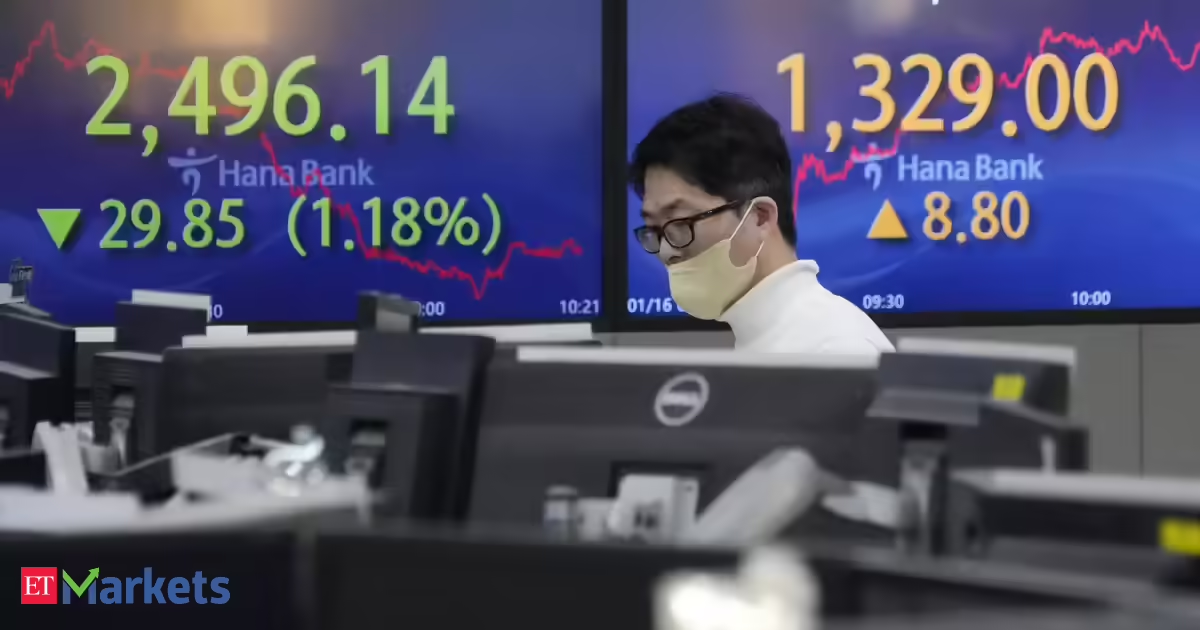
Selling in local equities – the second highest across Asia and emerging markets after South Korea – is the most by overseas investors in the first four months of any calendar year, show data from ETIG and Bloomberg.
The unabated outflows are an extension of selling by foreign portfolio investors (FPIs) since September 2024, when sentiment on India turned sour after corporate earnings growth failed to match rich share valuations. In 2025, FPIs pulled ₹1.6 lakh crore out of stocks, the highest in a year until then.
“Foreign outflows were driven by a host of factors like weak rupee and deceleration in earnings momentum,” said Sriram Velayudhan, senior vice president, IIFL Capital Services. “South Korea and Taiwan saw increased foreign interest as these offered bets on the AI and semiconductor theme at cheaper valuations.”
Advertisement
Just as it looked like withdrawals were tapering off this year, the West Asia conflict that began February 28 revived the flight to safety, with foreign investors stepping up their selling amid the record fall in the rupee and worries about the impact of higher oil prices on the currency.
Live Events
Agencies
Risk-off Sentiment in Asia “At the end of 2025, the valuations in India were relatively less expensive and in the first two months of 2026, the flows were largely neutral, but the thesis changed quickly in March as global investors sold shares worth around $12 billion in India,” said Hari Shyamsunder, VP and senior client portfolio manager, Franklin Templeton. The renewed selloff in March struck not just India but also global AI favourites such as Taiwan and South Korea. The intensity of the selling across Asian markets led to South Korea displacing India as the most sold market in the region in 2026 with outflows at $35.3 billion. India was next at $19.75 billion followed by Taiwan at $8.50 billion, according to Bloomberg data. Russia has received the most foreign capital investment at $20.6 billion, followed by Brazil at $11.8 billion. “The foreign selling was sharper in these markets at about $21-26 billion, which clearly marked the risk-off sentiment as Asia emerged vulnerable due to the West Asia war,” said Shyamsunder.
Selling abated in Taiwan and South Korea in April but India is yet to see renewed inflows in the absence of the AI theme, he said.
















































You must be logged in to post a comment Login