
Crypto World
Kustodia launches smart contract escrow for LATAM’s $600m fraud crisis

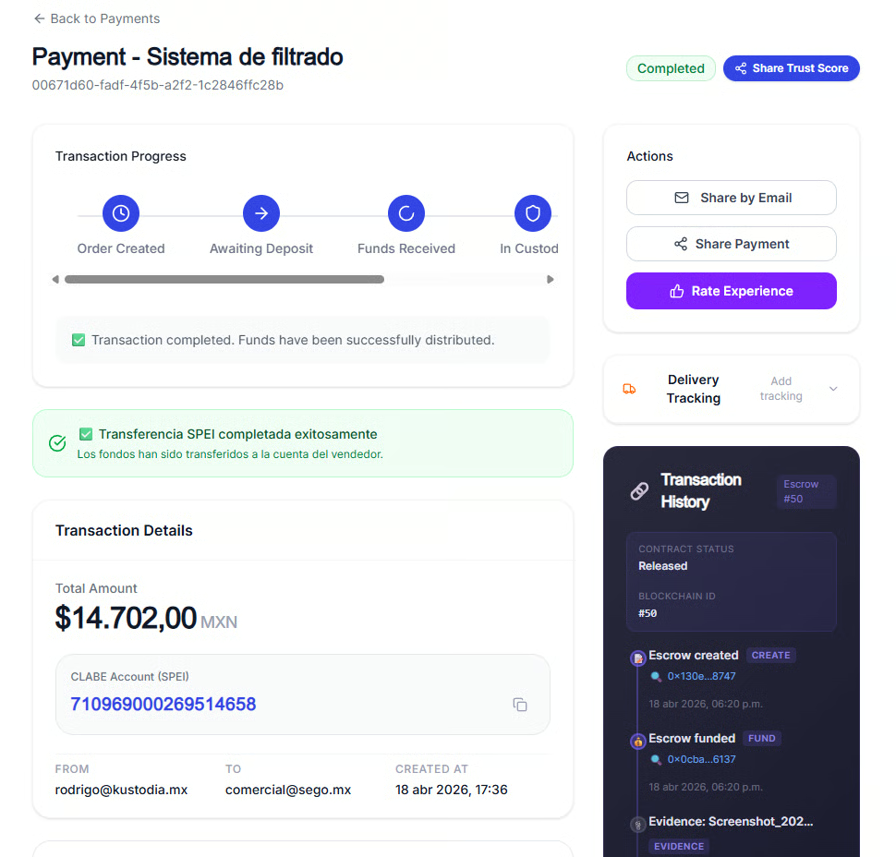
Mexico’s first peso-denominated blockchain escrow goes live on SPEI for high-value P2P transactions.
Mexico City, April 29, 2026 — Kustodia, a programmable escrow platform for Latin America’s high-value economy, today announced the public launch of its smart contract escrow service in Mexico. Buyers and sellers can now protect any transaction — from used vehicles to real estate deposits to B2B contracts — using SPEI, Mexico’s instant payment rail. Funds are held in audited smart contracts until both parties confirm delivery, with no human intermediary involved.
Payment fraud stripped $44.3 billion from the global economy in 2024, according to Juniper Research. Latin America has the world’s highest fraud rate, with 20 percent of merchant revenue lost annually. In Mexico, every dollar of fraud costs $4.08 in total economic damage — representing approximately $600 million USD in annual losses, according to data from Cloudflare and Mexico Business News.
‘I lost money to fraud in a peer-to-peer transaction in 2021,’ said Rodrigo Jimenez, Founder and CEO of Kustodia. ‘I spent three years building the infrastructure that should have existed. Mexico’s $60 billion used vehicle market runs almost entirely on stranger-to-stranger transactions with no protection for either side. We changed that.’
How it works — no app, no crypto knowledge needed
Kustodia works entirely through SPEI and WhatsApp. The buyer deposits pesos to a unique account number generated by Kustodia. Those pesos are immediately locked in a smart contract on the Arbitrum blockchain — neither party can access them. The seller delivers. Both parties confirm. The funds are released to the seller’s bank account in pesos. The blockchain operates invisibly; users interact only through WhatsApp.
The platform uses MXNB, a 1:1 Mexican peso-backed stablecoin issued by Juno and audited by a Big Four accounting firm, as its escrow settlement layer. This means users never experience cryptocurrency price volatility — they send pesos and receive pesos. Every completed transaction is publicly verifiable on Arbitrum’s blockchain explorer at no cost to anyone.
Users never pay blockchain fees. Kustodia absorbs and bundles these costs automatically, so the only fee a user sees is the escrow commission — 3 percent for standard transactions, lower for volume partners. Compared to traditional escrow agents that charge 3 to 6 percent and take 5 to 7 days to settle, Kustodia settles near-instantly.
From used cars to real estate to AI agents
Kustodia’s initial focus is the Mexican used vehicle market, where the average transaction is $15,000 USD and fraud risk is highest. The platform includes integrated vehicle history verification powered by Truora, KYC identity checks, and webhook-based notifications for marketplace integrations.
The platform also supports AI agents through its dedicated agent infrastructure at kustodia.app/ai-agents, enabling autonomous systems to create and manage escrow contracts programmatically. Web3 native escrow is available at kustodia.app/web3, supporting USDC and MXNB on Arbitrum and Injective.
Real estate rental deposits, crowdfunding, and marketplace integrations are live as additional verticals. USD Wire is supported for cross-border US-to-Mexico transactions. Brazilian real (BRL) via Pix is in development for the company’s planned 2027 Brazil expansion.
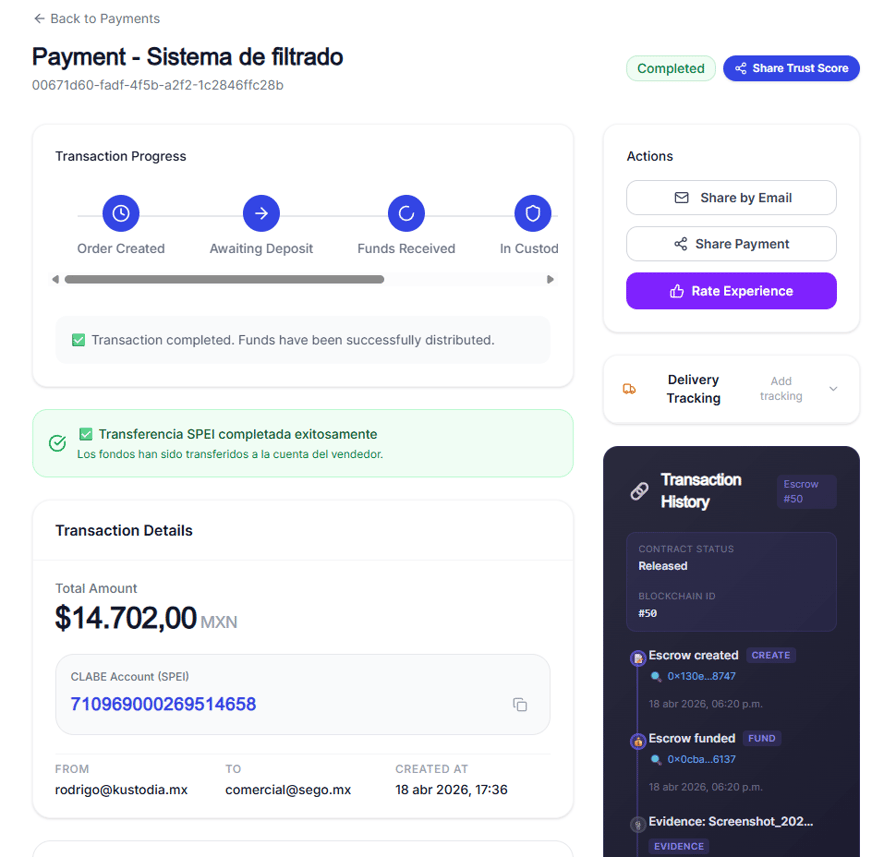
Source: Kustodia
Built for developers and platforms
Kustodia offers a full API and webhook system for marketplace integration. Developers can explore documentation and test the platform at kustodia.app/demo/marketplace. The platform currently works alongside SPEI, USD Wire, and USDC — and compares favourably to MercadoPago and Stripe Mexico, neither of which offers true escrow, blockchain verification, or integrated vehicle checks.
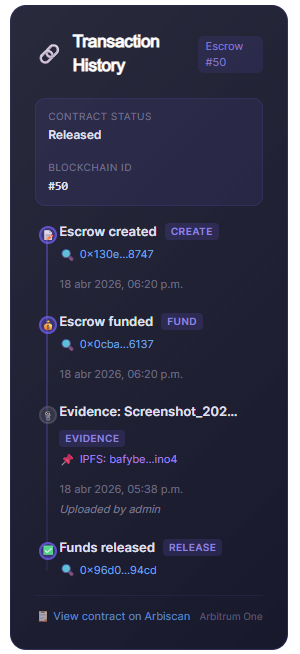
Source: Kustodia
About Kustodia
Kustodia is programmable escrow infrastructure for Latin America and emerging markets. The platform protects high-value transactions across vehicles, real estate, services, and crowdfunding using smart contracts on Arbitrum and Injective, with SPEI and USD Wire as fiat rails. Available at kustodia.app.
Media contact:

Crypto World
BeInCrypto 100 Institutional Awards Nomination: Citi for Leader in Digital Asset Adoption


Digital asset adoption inside global banks has moved past the pilot stage. The real question now is which institutions can connect blockchain infrastructure to the systems that already move money, settle trades, and support global commerce.
Citi is one of the banks doing that at scale. The firm is nominated for Leader in Digital Asset Adoption at the BeInCrypto Institutional 100 Awards 2026.
Founded
Total Assets
Global Reach
Core Platform
Core Product
Regulatory Context
1812
$2.6T+
Nearly 160 countries
CIDAP
Citi Token Services
OCC, Fed, FCA, MAS
Citi Digital Asset Adoption Snapshot
The nomination centers on the Citi Integrated Digital Assets Platform, or CIDAP, and the continued rollout of Citi Token Services across cash management, liquidity, trade finance, and tokenized asset workflows.
CIDAP is Citi’s internal bridge between traditional banking systems and blockchain networks. Citi describes it as a core pillar of its digital asset strategy, supporting use cases across payment services, capital markets, securities, custody, trade, and FX.
That matters because most institutional clients do not want a separate crypto operating model. They want blockchain-based settlement, tokenized deposits, and digital asset services to connect with the same systems they already use.
Moving Tokenized Deposits Into Global Banking
Citi Token Services is the clearest example of its digital asset adoption moving into production infrastructure.
The product uses blockchain and smart contracts to support tokenized deposits inside Citi’s global network. Citi first announced the creation and piloting of the service in 2023, saying it would upgrade core cash management and trade finance capabilities for institutional clients.
Citi Token Services for Cash enables clients to transfer liquidity between participating Citi branches on a 24/7 basis. Citi Token Services for Trade supports programmable transfers of tokenized deposits, with instant payments to service providers through smart contracts.
“Leveraging our digital proprietary global network, we’re enabling 24/7, near instant cross-border payments across the Citi network and our financial institution clients – helping corporates and financial institutions move millions of dollars in a matter of seconds,” said Debopama Sen, Head of Payments, Services
The cash product is especially important because it tackles one of the oldest problems in global banking: liquidity still gets trapped by cut-off times, settlement windows, and market hours.
Citi’s 24/7 USD Clearing integration with Citi Token Services supports near-instant liquidity movement across Citi and non-Citi accounts in select markets.
Trade Finance Moves On-Chain
Citi’s adoption story also extends into trade finance.
In its original Citi Token Services pilot, Citi worked with Maersk and a canal authority on a digitized solution similar to bank guarantees and letters of credit. The pilot used tokenized deposits and smart contracts to provide instant payments to service providers. Citi said the process could reduce transaction processing times from days to minutes.
In 2026, Citi pushed that work further by testing tokenized Bills of Exchange.
Working with PwC and Solana, Citi completed an internal proof of concept that represented a bill of exchange as a token on blockchain. The test covered issuance, financing, distribution, and settlement in a simulated environment. Citi said the proof of concept used synthetic data and fictitious clients, but showed how a full trade finance lifecycle could be replicated on blockchain.
That is a practical development. Bills of exchange are still tied to paper-heavy and manual workflows. Tokenizing them could make ownership, financing, and repayment easier to track and settle. Citi’s own report says tokenization can reduce friction, improve real-time visibility, and support better risk management across the supply chain.
Tokenization Beyond Payments
Citi has also tested tokenization in private markets.
In 2024, Citi worked with Wellington Management and WisdomTree on a proof of concept for tokenized private funds. The test ran on the Avalanche Spruce institutional test subnet and explored how smart contracts could support new functions and operational efficiencies that are difficult to achieve with traditional private market infrastructure.
The test tokenized a Wellington-issued private equity fund and encoded distribution rules into the smart contract.
Citi also tested smart-contract-based transfers, simulated identity credentials, and the use of a private fund token as collateral in an automated lending contract with DTCC Digital Assets.
A Bank-Scale Adoption Story
Citi’s nomination is not based on a single blockchain experiment. It reflects the bank’s effort to connect digital assets with core institutional banking.
The company has more than 200 years of operating history and does business in nearly 160 countries and jurisdictions. Its 2025 annual filing reported total assets of $2.657 trillion at year-end.
That scale is why Citi’s digital asset work matters. Tokenized deposits, programmable payments, tokenized trade finance, private market tokenization, and future digital asset custody are not isolated products. They are pieces of a wider infrastructure strategy.
Citi is also reportedly investing in digital asset custody and post-trade infrastructure so clients can safekeep and mobilize assets with the same confidence they expect in traditional markets. The bank says clients are increasingly expecting deposits, payments, investment assets, and collateral to move across traditional and tokenized forms with less friction.
The BeInCrypto Institutional 100 Awards recognize firms building the systems that could define the next phase of finance. Citi’s nomination reflects its role in moving digital assets from lab experiments into the operating infrastructure of global banking.
The post BeInCrypto 100 Institutional Awards Nomination: Citi for Leader in Digital Asset Adoption appeared first on BeInCrypto.


Ripple Prime will route clients into Bullish’s regulated BTC options while Ripple and OKX push RLUSD into compliant markets, extending Ripple’s $1.25b prime‑broker bet.
Summary
- Ripple is expanding its partnership with Bullish to give Ripple Prime clients direct access to Bullish’s regulated Bitcoin options market.
- Bullish says its Bitcoin options venue is the world’s second-largest crypto‑settled BTC options market by open interest.
- Ripple and OKX are also partnering to bring RLUSD to compliant markets, as Ripple Prime scales institutional brokerage after a $1.25 billion prime‑broker acquisition.
Ripple has expanded its institutional derivatives push, announcing that Ripple Prime will connect directly to Bullish’s Bitcoin (BTC) options market, opening regulated BTC options access to its institutional client base.
According to the announcement from both parties, this integration will allow Ripple Prime users to directly access Bullish’s regulated BTC options market, which Bullish describes as “the second largest cryptocurrency‑settlement Bitcoin options market in the world by open interest” and one that already supports spot, perpetual contracts and dated futures.
The move deepens a long‑running partnership between the two firms and comes as Bullish, listed on the NYSE under the ticker BLSH, continues to position itself as an institution‑first venue focused on Bitcoin and Ethereum liquidity after reporting $80.5 billion in monthly trading volume in October 2025.
Ripple Prime scales after $1.25b prime‑broker bet
In addition, both parties revealed that OKX has reached a strategic partnership with Ripple to introduce the stablecoin RLUSD (Ripple USD) in compliant markets, with RLUSD now live on OKX for spot trading across more than 280 pairs and usable as institutional‑grade margin collateral for derivatives.
Ripple Prime, as one of the largest non‑bank prime brokers globally, has exceeded a clearing scale of $30 trillion in 2025 and can provide multi‑asset brokerage, clearing, and financing services, building on Ripple’s $1.25 billion acquisition of multi‑asset prime broker Hidden Road that made it, in Ripple’s words, “the first crypto company to own and operate a global, multi‑asset prime broker.”
In an earlier Reuters report, Ripple said the Hidden Road deal would help create a “one‑stop‑shop” for institutional clients across foreign exchange, digital assets, derivatives, swaps and fixed income, while a follow‑up BusinessWire release emphasized that RLUSD is intended as “enterprise‑grade” collateral across that stack.
For crypto traders, the tie‑up between Ripple Prime and Bullish folds a large BTC options venue into a rapidly scaling prime‑broker platform just as macro uncertainty keeps demand high for hedging and basis trades, echoing themes raised in a recent crypto.news story on how rate‑cut delays are reshaping institutional risk‑taking.
The RLUSD expansion also builds on wider Middle East and Strait of Hormuz coverage from crypto.news, where prior stories have tracked how geopolitical chokepoints and energy costs feed back into liquidity conditions for assets such as Bitcoin and XRP (XRP), dynamics institutional desks on Ripple Prime and Bullish will now be able to express more precisely through BTC options and stablecoin‑collateralized derivatives.
Key takeaways:
- Negative Bitcoin funding rates indicate bearishness, yet whales maintain steady long-to-short ratios at major exchanges.
- Inflation concerns and tech corporate earnings remain the biggest drivers for Bitcoin traders’ sentiment.
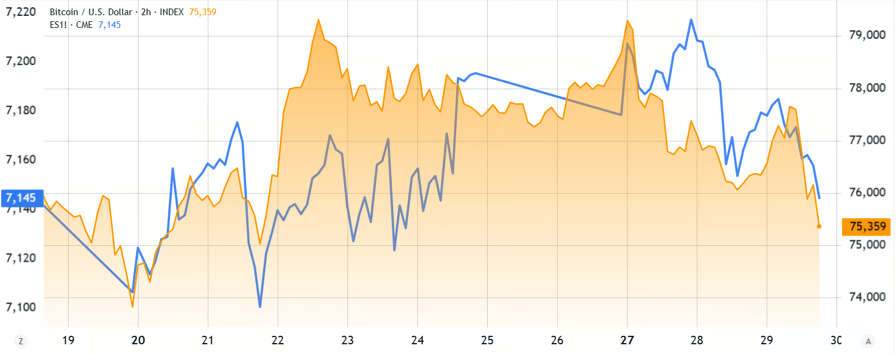
Bitcoin (BTC) faced rejection at $77,800 on Wednesday, then retested the $76,000 level. This movement followed a correction in the S&P 500 Index as the war in Iran reached its 60-day mark, driving crude oil prices toward $118. While demand for leveraged bearish Bitcoin futures positions increased, the long-to-short ratio of whales at major exchanges indicates a different trend.
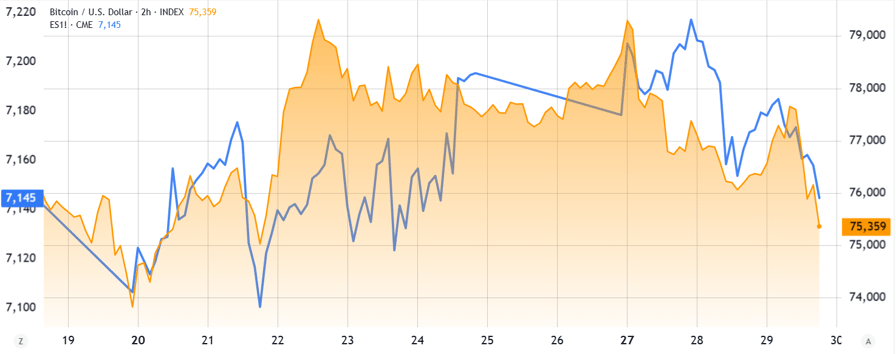
S&P 500 Index futures (left) vs. Bitcoin/USD (right). Source: TradingView
Bitcoin’s lack of bullish momentum above $78,000 mirrors the S&P 500 Index’s struggle near 7,200. Trader skepticism stems in part from the inflationary impact of high energy prices, which diminishes consumer spending and corporate earnings through higher logistics costs. Additionally, investors are questioning the profitability of technology companies’ investments in AI, according to Yahoo Finance.
Bitcoin futures show bulls lacking confidence
Setting aside the specific reasons for investor caution, the Bitcoin perpetual futures funding rate turned negative on Wednesday. This followed a brief neutral-to-bullish period on Tuesday. In a healthy market, this rate usually stays between 6% and 12% to cover capital costs, which means buyers typically pay a fee to maintain their positions. A negative rate suggests a shift toward sellers.
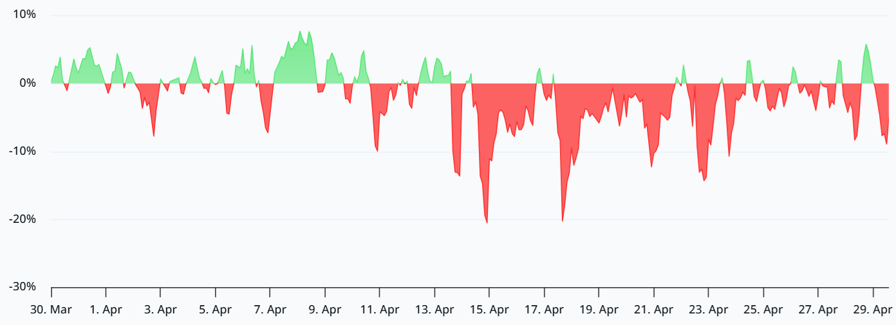
Bitcoin perpetual futures annualized funding rate. Source: Laevitas
The Bitcoin perpetual futures funding rate has remained mostly negative over the past two weeks, indicating increased demand for leveraged short positions. While this data initially suggests a lack of confidence among buyers, a closer examination of whale positioning is necessary. The top traders’ long-to-short ratio across exchanges includes spot, margin, and futures data, offering a more comprehensive perspective.
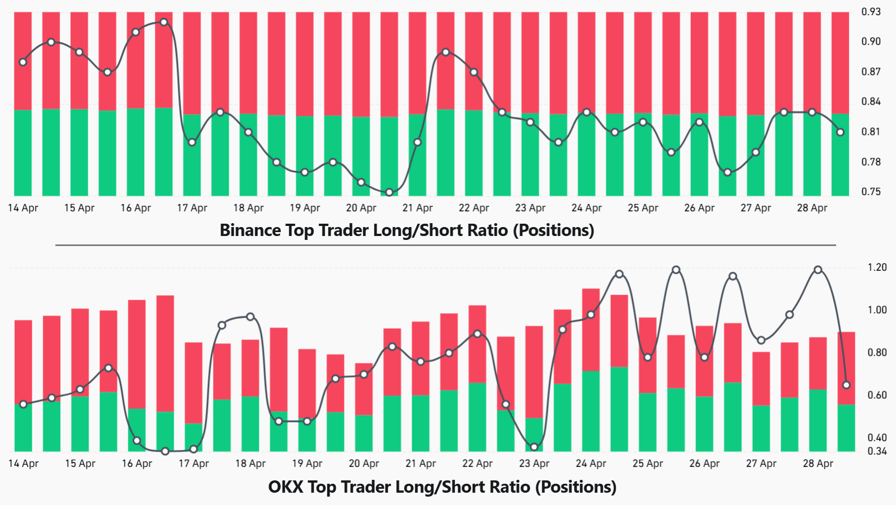
Top traders’ long-to-short ratio and Binance and OKX. Source: Coinglass
The long-to-short ratio for professional traders on Binance was 0.80, showing a minor improvement from the 0.75 level recorded on Tuesday, though it remains slightly bearish. At OKX, top traders have briefly signaled bullish sentiment several times since Friday, but these shifts have been temporary. Nevertheless, there is no evidence that whales are turning increasingly bearish, as the long-to-short ratio has held steady throughout the past week.
The latest US Federal Reserve statement after Wednesday’s meeting observed that “inflation is elevated, in part reflecting the recent increase in global energy prices.” The FOMC chose to keep interest rates at their late 2025 levels, even though four members supported a 0.25% cut. According to CNBC, this marks the first time four FOMC members have dissented since October 1992.
Related: Bitcoin’s recent rally is largely fueled by Strategy purchases: Bitwise’s Hougan
Bitcoin bulls’ lack of conviction should not be mistaken for bearishness, particularly as Strategy (MSTR US) continues its accumulation. Over the last four weeks, Strategy acquired 56,235 BTC, a move supported by the issuance of its perpetual preferred security, STRC. The company currently holds 818,334 BTC, exceeding the position of BlackRock’s IBIT exchange-traded fund (ETF).
Professional traders remained unmoved by Bitcoin’s decline to $75,000 on Wednesday, as indicated by exchange long-to-short ratios. However, the persistent negative funding rate in Bitcoin futures suggests that sentiment remains cautious. Macroeconomic and tech corporate earnings remain the biggest driver for Bitcoin traders’ sentiment.


Fence netted $20 million from Galaxy Digital to tokenize a $6 trillion asset‑backed finance market that still runs on manual, legacy rails.
Summary
- Blockchain finance startup Fence has raised $20 million in funding led by Galaxy Digital.
- Fence aims to modernize the $6 trillion U.S. asset‑backed finance market through tokenization and automated infrastructure.
- The company already manages around $1.5 billion in assets and works with institutions such as BlackRock.
Fence has secured a $20 million investment led by Mike Novogratz’s Galaxy Digital to bring blockchain infrastructure to the roughly $6 trillion U.S. asset‑backed finance market, in one of the clearest recent bets on tokenizing legacy credit plumbing.
According to Galaxy Digital’s investment disclosure, Fence “leverages blockchain behind the scenes to automate and improve” asset‑backed lending workflows that today remain “labor‑intensive and highly manual,” positioning the firm as a back‑office rails provider rather than a consumer‑facing crypto platform.
Fence says its system can tokenize lenders’ positions in financing instruments and, in some cases, the underlying loans and invoices themselves, effectively turning traditionally illiquid receivables into programmable, tradable claims.
Galaxy’s RWA push meets credit market automation
Fence reports that it currently manages approximately $1.5 billion in assets on its platform, working with marquee institutions including BlackRock, where it helps streamline the administration of complex structured‑credit deals.
The company said in a statement that the fresh $20 million will support “growth and product development” as it looks to deepen integrations with banks, asset managers and specialty finance shops searching for operational efficiency and faster settlement in private credit.
Galaxy Digital framed the deal as part of its broader push into tokenized real‑world assets, following moves such as its planned multi‑chain tokenized money market fund, designed to sit alongside products like BlackRock’s roughly $2.2 billion BUIDL fund and Franklin Templeton’s BENJI in the emerging on‑chain yield stack.
The Fence funding also lands as tokenization narratives accelerate across private markets that total more than $270 trillion globally, with research cited by RWA tracking platform RWA.xyz projecting over $16 trillion in assets could be tokenized by 2030 if adoption continues to compound.
For crypto‑native investors, Galaxy’s role as lead backer signals that large digital asset firms continue to see value not only in tokenized funds and treasuries but also in the infrastructure that quietly turns real‑world exposures—leases, invoices, auto loans—into on‑chain primitives, a thesis echoed in a recent crypto.news story on how institutional flows are gravitating toward yield‑bearing, real‑world‑linked instruments.
In previous crypto.news coverage, stories on Middle East‑driven energy shocks and stories on risk sentiment have highlighted how macro and credit conditions are bleeding into digital asset markets, a backdrop that makes Galaxy’s bet on tokenized asset‑backed finance—quiet, regulated and yield‑focused—look less like hype and more like infrastructure for the next cycle of on‑chain credit.
BNB Chain has surpassed 150,000 on-chain AI agent deployments as of April 2026, a 43,750% increase since January, while Binance simultaneously launched its Agentic Wallet, a keyless wallet allowing AI bots to trade and transfer tokens on behalf of its 250 million users without accessing their primary accounts.
Summary
- BNB Chain’s AI agent count grew from a minimal base in January 2026 to over 150,000 deployments by April, driven by the network’s low fees, high throughput, and developer tooling for autonomous agent deployment.
- Binance’s Agentic Wallet is a keyless wallet architecture specifically designed for AI agents, allowing automated trading and transfers within defined parameters without the bot touching the user’s main account keys.
- BNB price held above $625 during the broader April 28 to 29 market decline, with analysts citing BNB Chain’s structural AI agent demand as a driver of relative price resilience compared to Ethereum and XRP.
BNB Chain became the leading blockchain for autonomous AI agent deployments by April 2026, with Bitget News confirming over 150,000 on-chain agents operating across the network, a 43,750% increase since January 2026. The same period saw Binance launch its Agentic Wallet, a keyless wallet infrastructure designed to let AI bots execute trades and token transfers on behalf of users without requiring access to the user’s primary account credentials.
BNB Chain AI Agent Growth Represents the Fastest Ecosystem Expansion on Any Layer-1
As crypto.news reported, BNB Chain surpassed all other blockchains in AI agent deployments earlier in April 2026, driven by three structural advantages: transaction fees averaging under one cent, a block time of 250 milliseconds following the Fermi hard fork in January, and a developer ecosystem that includes pre-built agent frameworks and access to BNB Chain’s AI hackathon programs. The 43,750% growth rate since January represents a jump from approximately 340 agents in late January to over 150,000 by April, a trajectory that reflects the broader acceleration of autonomous on-chain AI infrastructure across the industry. A recent pilot with OpenMind AGI confirmed that Pi Network’s distributed node network can support decentralized AI tasks, but BNB Chain’s AI agent deployments operate at a scale and transaction throughput that no competing network has matched.
The Agentic Wallet and What It Means for AI-Driven Trading at Scale
The Agentic Wallet launched by Binance represents a distinct infrastructure advancement from the AI agent deployment count alone. Where AI agents on BNB Chain typically execute on-chain actions within smart contract environments, the Agentic Wallet gives those agents access to Binance’s centralized exchange liquidity and 250 million user base without requiring the agent to hold the user’s primary account credentials. The keyless architecture uses a permissioned sub-wallet structure, allowing AI bots to trade within user-defined parameters and transfer tokens between wallets without exposing the main account to security risk. As crypto.news documented, BNB Chain’s 2026 roadmap targets 20,000 transactions per second and sub-second finality, a performance profile designed specifically to handle the high-frequency, low-latency execution that autonomous AI agents require to function at institutional scale rather than as retail curiosities.
BNB Price Performance in the Context of AI Agent Leadership
As crypto.news tracked, BNB demonstrated relative price resilience during the broader April 28 to 29 market decline, holding above $625 while Bitcoin fell 1.6% and Ethereum hit a week low. Analysts observing BNB’s outperformance during macro-driven selloffs have pointed to the structural demand from BNB Chain’s transaction fee burn mechanism and the growing utility base from AI agent deployments as factors that insulate BNB from pure macro risk-off selling pressure, since gas fee demand from 150,000 AI agents generates continuous real-time BNB demand that is independent of speculative sentiment.
The 35th quarterly BNB burn executed on April 15 removed 2.14 million BNB worth approximately $1.32 billion from circulation. With over 150,000 AI agents generating ongoing gas fee demand, each quarterly burn calculation now incorporates AI-driven transaction volume as a growing component of the supply destruction formula.
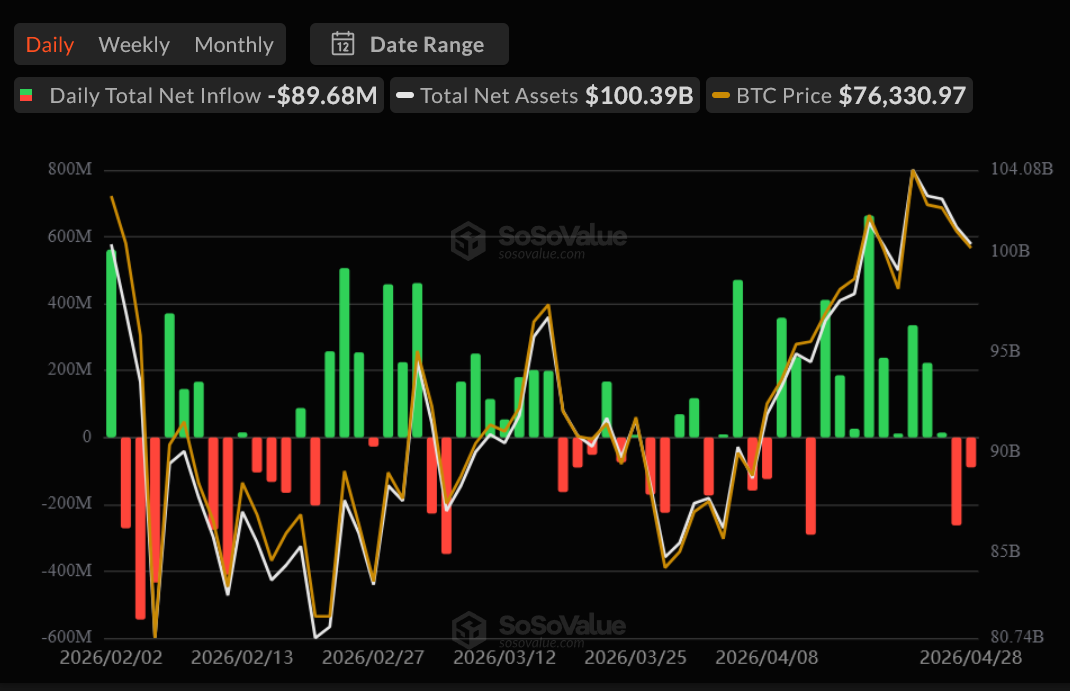
BlackRock’s iShares Bitcoin Trust (IBIT) recorded no fresh inflows on Monday, as US Bitcoin (BTC) spot ETFs together shed $263 million that day. The pullback ended a nine-day inflow streak.
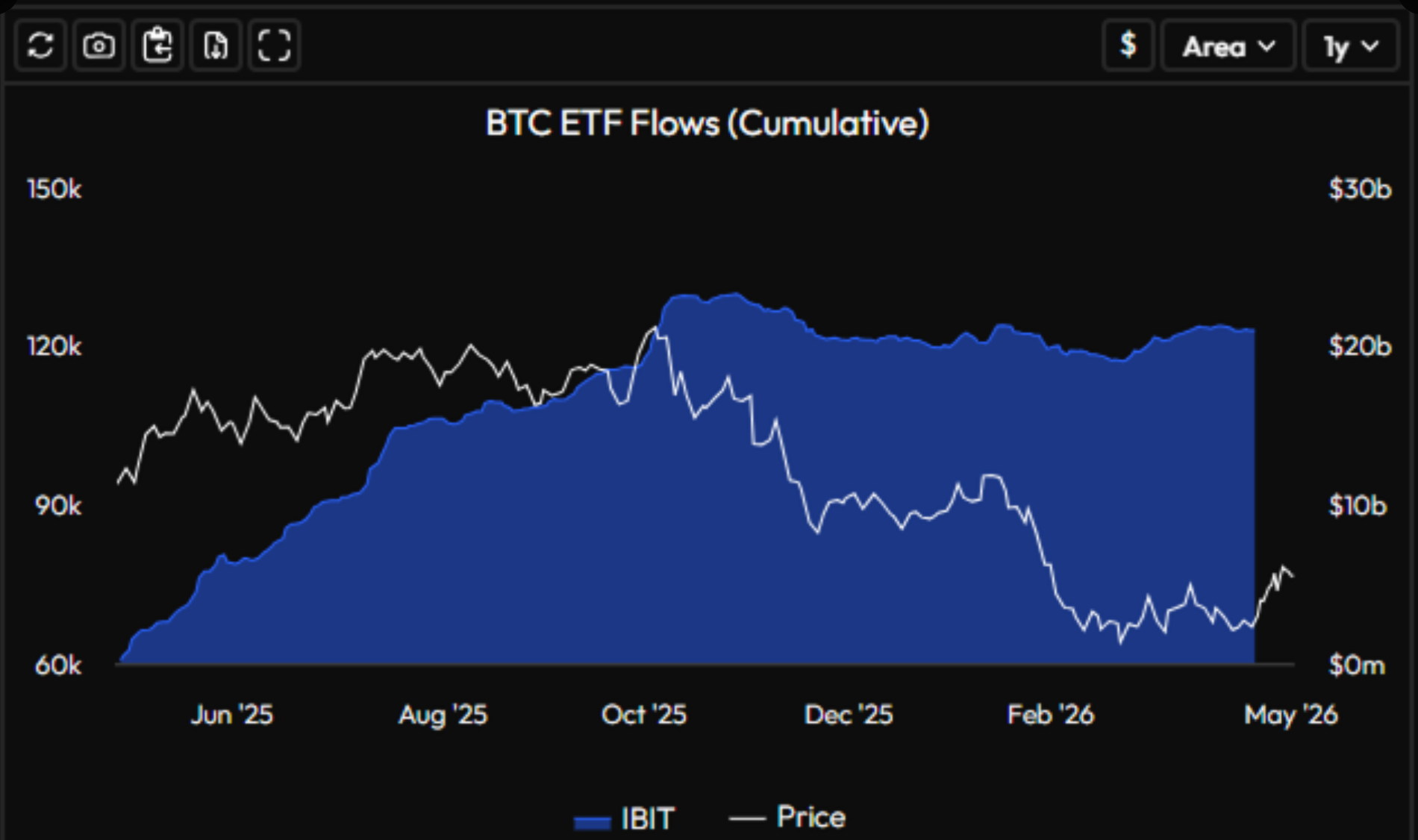
The reversal arrived at a tense moment for the largest spot Bitcoin product. IBIT flows have been roughly flat for six months. Fresh appetite for allocators appears to have cooled, even as BTC trades near recent highs.
Nine-Day Bitcoin ETF Streak Comes to an End
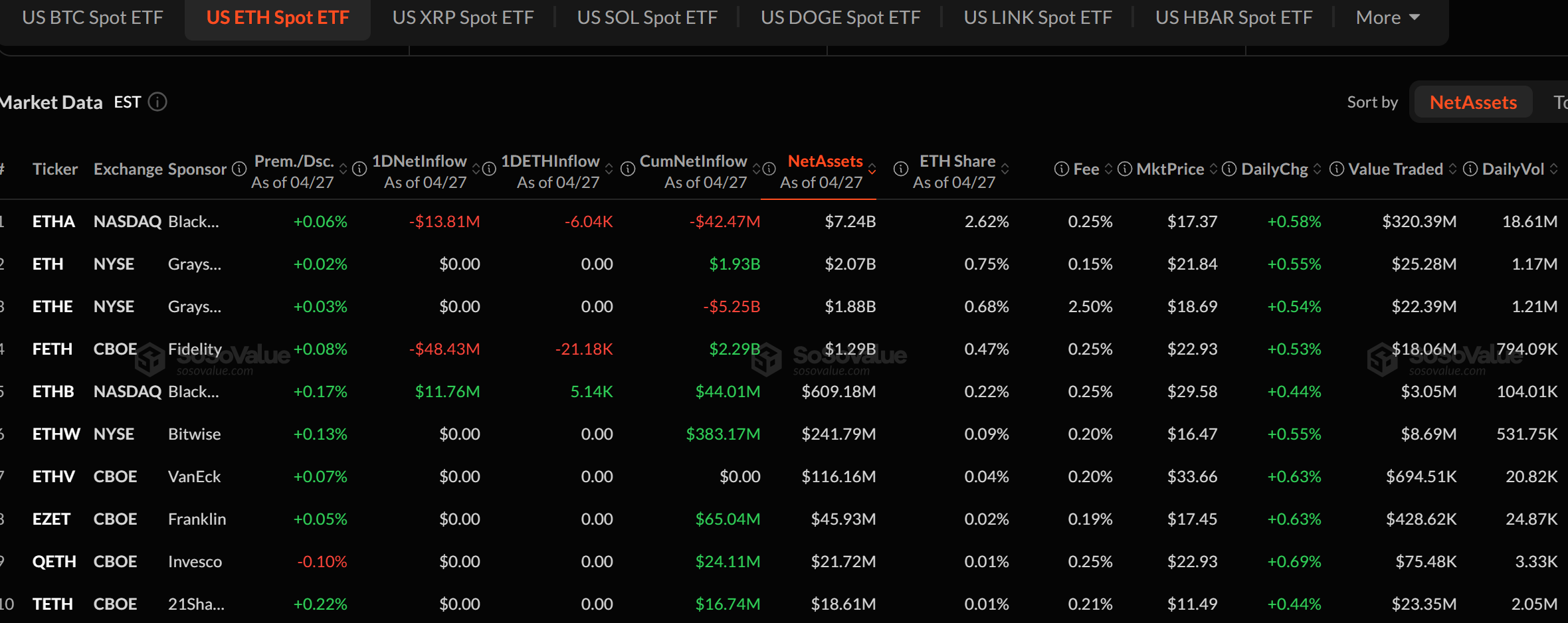
Data from SoSoValue shows US Bitcoin spot ETFs collectively shed $263 million on April 27. The move broke a nine-session run of inflows. The funds had absorbed roughly $767 million across the prior week.
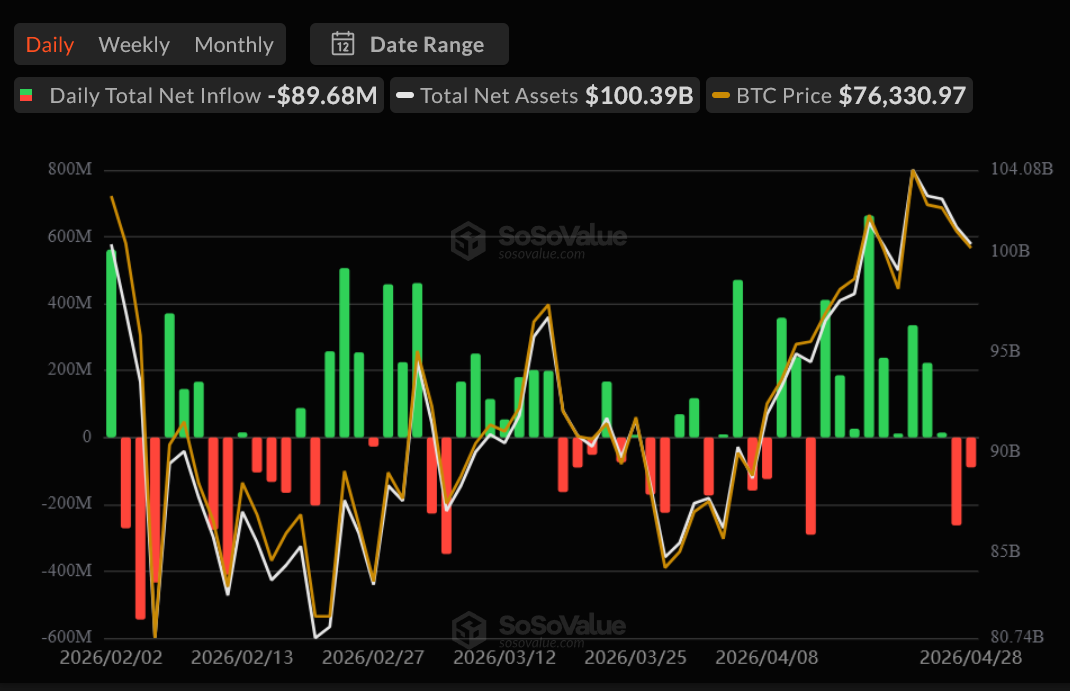
BlackRock’s IBIT avoided driving the selloff. However, the fund has shown flat net flows for roughly six months. That stagnation comes as Bitcoin continues to trade below the $80,000 psychological level.
ETHB Bucks the Ethereum ETF Trend
US Ethereum (ETH) spot ETFs together lost $50.48 million on the same day. Almost every fund in the category posted withdrawals.
BlackRock’s Staked ETH ETF, ticker ETHB, was the only product in the group to attract fresh capital. The flow split suggests allocators may prefer staked exposure over passive holdings as Ethereum yield rises.
What the Mixed Signals Mean for Spot Crypto Funds
Solana (SOL) ETFs also slipped, recording a small $1.21 million net outflow despite a strong weekly figure. Meanwhile, the seven-day BTC ETF window remains positive at $283 million.
For BlackRock, the contrast between IBIT inactivity and ETHB’s lone inflow points to where institutional risk appetite is rotating.
Investors appear to favor yield-bearing products over passive Bitcoin exposure as the second quarter winds down.
The post BlackRock Falls Flat as Bitcoin ETFs End April in Red appeared first on BeInCrypto.
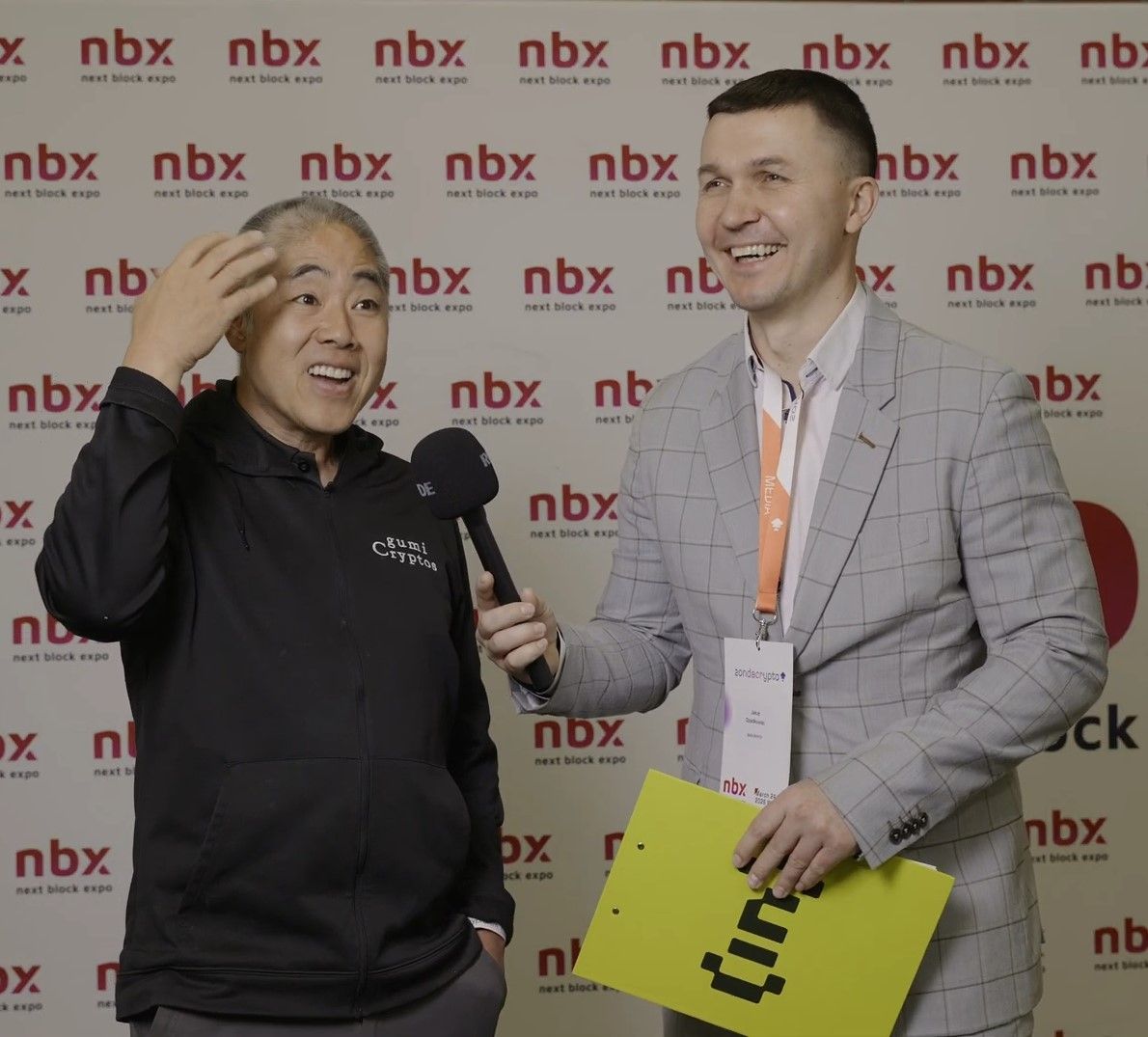
Crypto’s wild west era is over, according to Miko Matsumura, managing partner at Gumi Cryptos Capital. The industry has won its core battles as institutional rails fall into place.
Matsumura welcomed the current bear market but warned that it would reward different behavior than previous cycles. Builders who repeat the meme coin playbook will be left behind as fresh capital and tougher regulation arrive.
The Industry Has Won, Miko Matsumura Argues
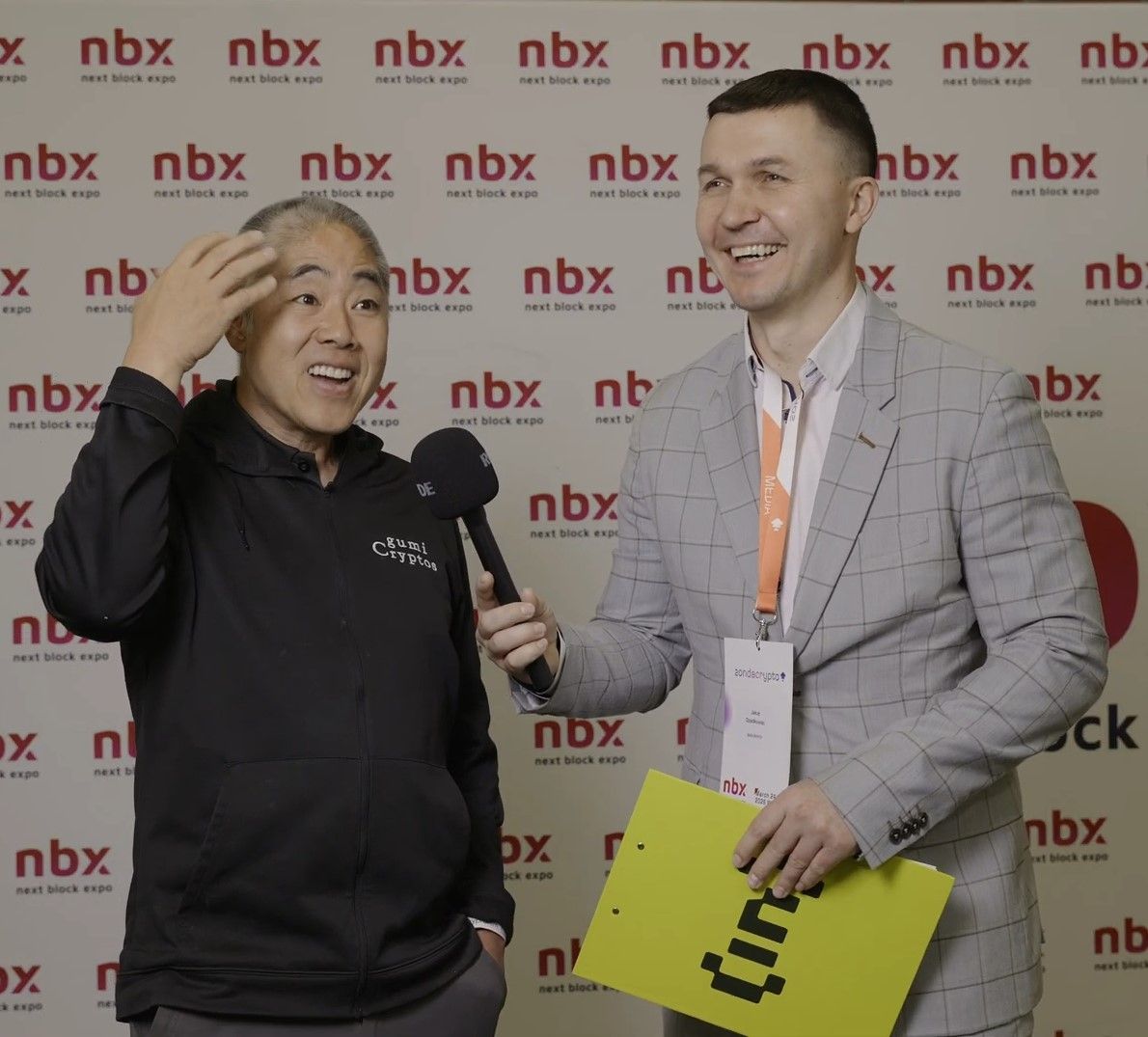
In an interview with BeInCrypto at the NBX Warsaw conference, Matsumura argued that crypto has already secured its structural wins.
“I think we’ve basically won. We’ve basically gotten everything that we wanted.”
He broke that victory into three pieces, mapping crypto sectors onto traditional finance roles.
“I think the reserve bank is solved which is Bitcoin. I think the investment bank is solved which is Ethereum. I think the retail bank is solved.”
Multiple chains will likely share retail banking duties, with Base and Solana competing for that layer.
Regulation arriving is, in his view, further proof that the industry has crossed the finish line. The next chapter is about scaling crypto a thousand times bigger, not redefining it.
This Bear Market Is Not Like the Last One
Miko Matsumura describes himself as a net accumulator and welcomes lower prices. However, he cautioned that the next leg up will not reward yesterday’s tactics.
“I don’t think this is like any other previous bear market because of the change of the phase from the frontier phase into the traditional phase. People won’t be rewarded for doing exactly the same thing they did last time.”
He was blunt about meme coin speculation as a path to riches.
“I don’t think it’s going to be like, oh, just go and build another meme coin and then, you know, you’ll be rich. Like, it’s not going to be like that.”
He emphasized that the deepest stretches of a bear market typically reward the highest-conviction builders. New entrants and tighter rules will reshape what counts as a winning strategy this cycle.
Where the Opportunity Goes Next
Meanwhile, Miko Matsumura pointed to high-growth economies in Latin America and Nigeria as the new frontier for crypto. Solo founders using AI tools to keep burn rates low also stand out, he added.
“You need to continue building in the bear market, but you really need to change things up… build different things and build real practical solutions that solve problems.”
Matsumura listed courage, curiosity, and conviction as the traits he wants in founders this cycle. Building at the application layer should outweigh rebuilding foundations, he added.
The post Miko Matsumura: No More Crypto Wild West, This Cycle Will Reward Different Behavior appeared first on BeInCrypto.

April 29, 2026 – Changelly, a leading instant cryptocurrency exchange and trusted blockchain API provider, is marking its 11th anniversary with a new company milestone. More than 12 million users worldwide now rely on the platform’s web and app alone for seamless digital asset swaps, purchases, and cash-outs—with API integrations driving an even greater volume of users beyond that count. After more than a decade on the market, the platform has grown to support 1,200 cryptocurrencies across 200 blockchains for instant crypto swaps.
To celebrate, the company is launching Changelly’s 11th Birthday Mystery Boxes—a limited-time in-app game available starting April 28, 2026, featuring prizes from Changelly and its partners, including Topper by Uphold, SafePal, OneKey, SecuX, and MyTonWallet.
“Congratulations to Changelly on 11 years of making crypto accessible to millions worldwide. At SecuX, we believe great security starts with great partners, and Changelly has always stood for ease, trust, and innovation. Here’s to many more years of building a more secure and open financial future together!” — Wendy Chen, Head of PR at SecuX.
1,200 coins, 1b+ assets on DeFi, 840 integrations, scaling user and business demand
Asset availability on Changelly has continued to expand. The platform now supports 1,200 cryptocurrencies, with 200 new coins added over the past year—a selection built around users’ preferences and market demand. Include Changelly DeFi, a recently launched cross-chain swap product accessible directly on the web platform and as a standalone app, and that figure grows to over 1 billion supported assets.
Meanwhile, Changelly significantly broadened its business collaborations and blockchain API reach. Its partner network has grown to 840 Web3 companies, with 240 new partnerships signed over the last 12 months. Through embedded instant exchange and fiat on/off-ramp APIs, Changelly’s infrastructure now powers a growing share of crypto purchase and swap flows across wallets, apps, and digital finance products. Additionally, Changelly expanded its blockchain API offering for crypto businesses with the launch of Changelly DeFi, which brings decentralized trading infrastructure to business partners.
“We’re proud of our long-term partnership with Changelly—a progressive team that shares our vision of making crypto simple, easy, and more accessible to people around the world. On behalf of MyTonWallet, we warmly congratulate Changelly on its 11th anniversary. This is an impressive milestone for the entire industry, and we’re excited to support this campaign together. Here’s to many more years of growth, innovation, and shared success.” — Irina Arons, CMO at MyTonWallet.
Where first-time users became long-term traders
Besides bringing in new users, Changelly has remained the preferred platform for its user base for years—and the anniversary data suggests the platform has managed to do both. Users who joined Changelly five or more years ago have returned to use the platform again and again, making thousands of crypto swaps and purchases. One customer alone completed more than 16,000 transactions across eight years—the kind of number that speaks volumes about habits, trust, and routine use.
“Reaching 12 million users is a milestone we’re proud of, but it’s the depth of engagement that tells the real story,” said John Adam Khandjian, Chief Growth Officer at Changelly. “Our longest-standing users have made millions of secure and fast crypto transactions. That’s a real relationship built over the years. It reflects what we’ve tried to build from the start: a service people can rely on regardless of what the market is doing.”
The 2 million new users added over the past year have largely followed market movements, with registration spikes consistent within weeks of significant price action. On the platform, the most-traded assets included BTC, ETH, SOL, XRP, and TRON, alongside altcoins like VIRTUAL, AIXBT, PENGU, GRASS, HYPE, and CC, indicating growing user interest in AI-adjacent and community-driven assets.
Security is another reason why users remain loyal to the veteran crypto platform:
“At OneKey, our mission is to make advanced security feel effortless, pairing certified hardware with an app anyone can use. Partnering with Changelly helps us share that mission and remind users that strong security doesn’t have to be scary.” — The OneKey Team.
The anniversary celebration moves in-app
Starting April 28, 2026, Changelly is bringing its 11th birthday celebration directly into the app—and users get to unwrap gifts from Changelly and ecosystem partners.
Prizes include a Crypto Terminal (Mac Mini & espressoDisplay Pro), SafePal x Changelly limited edition hardware wallets, Topper-branded exclusive hardware wallets, OneKey Classic 1S Pure BTC-only hardware wallets, OneKey Keytags, SecuX Neo wallets, MyTonWallet NFT cards, USDT prizes of up to 200 USDT, VIP status, 0% fees, and exclusive crypto guides.
“Changelly sets the bar for what a crypto partnership should look like—collaborative, high-performing, and always thinking about the user. Proud to be part of this campaign.” — Robin O’Connell, CEO Enterprise, Uphold.
How to get your birthday surprise
- Download the Changelly app or log in if you already have an account
- Navigate to the in-app stories to play the game
- Open your Mystery Box and discover your reward
- To unlock more boxes and more chances to win, complete any transaction and get one more try
The two-week anniversary campaign will run through May 11, with the final results and prize announcements scheduled for May 12. Read the Terms & Conditions and enter the game.
About Changelly
Changelly is an instant crypto exchange trusted by over 12 million users worldwide. Founded in 2015, the platform offers secure and fast crypto-to-crypto swaps for over 1,200 cryptocurrencies and 24/7 live customer support. Changelly also features a built-in smart fiat on-ramp aggregator, giving users access to 220+ competitive offers from verified providers, enabling seamless purchases of 350+ cryptocurrencies using 20+ global payment methods.
Changelly is available on desktop (website), iOS (App Store), and Android (Google Play).

MoonPay is establishing a dedicated institutional unit by acquiring Sodot, an Israeli provider of crypto security infrastructure, and plans to use Sodot’s key-management technology as the backbone for services tailored to banks, asset managers, trading firms, and exchanges entering digital asset markets.
In a press release, MoonPay said the move will extend its network beyond consumer crypto payments into enterprise-grade infrastructure. Bloomberg reported that the deal closed in April in an all-stock transaction valued at around $100 million, though MoonPay did not immediately respond to Cointelegraph for comment on the specifics.
“We built MoonPay to be the world’s leading crypto payments network,” MoonPay co-founder and CEO Ivan Soto-Wright said in a press release, adding that its institutional arm is the next stage for the company.
Key takeaways
- MoonPay is launching an institutional division by acquiring Sodot, leveraging its key-management technology to serve traditional finance players entering crypto markets.
- The deal, disclosed as an all-stock transaction valued at about $100 million, reportedly closed in April, according to Bloomberg.
- Caroline D. Pham will lead the new unit, bringing regulatory and capital markets acumen to shepherd institutional adoption.
- The move underscores a broader trend of custody and wallet infrastructure becoming central to crypto adoption by institutions.
MoonPay’s institutional push takes shape
The newly formed MoonPay Institutional unit is designed to cater to major traditional financial firms across several domains, including trading, tokenized securities, payments, wallet management, and stablecoin issuance. The strategy signals a shift from MoonPay’s established retail-payments footprint toward essential infrastructure that incumbents require to operate in digital asset markets at scale.
Caroline Pham will helm the division, having joined MoonPay as chief legal officer and chief administrative officer in December after serving as acting chair of the U.S. Commodity Futures Trading Commission. MoonPay’s leadership highlighted her regulatory experience and capital markets background as a critical asset for navigating complex crypto markets at an institutional level. “There is no one better suited to lead this business than Caroline, who brings decades of experience at the highest levels of financial regulation and capital markets,” Soto-Wright said.
Pham’s leadership appointment and the strategic focus on institutional clients come as the industry sees a growing appetite among banks, asset managers, and trading desks for robust custody, secure wallet technology, and compliant on-ramps into digital asset markets. The new unit will pursue relationships that require high assurance around key management, secure settlement rails, and scalable custody solutions—areas that have historically been the preserve of specialized custody providers, but are increasingly embedded in mainstream financial workflows.
Key technology: MPC and Sodot’s security framework
Sodot, founded in 2023, specializes in crypto key management infrastructure and is known for its self-hosted multi-party computation (MPC) approach. MPC is a cryptographic method that splits a private key into multiple shares distributed across independent parties, enabling signatures and access controls without exposing a single point of failure. This architecture is particularly attractive to institutions that demand stringent controls and resilience for large digital asset holdings.
By integrating Sodot’s MPC-based framework, MoonPay aims to offer enterprise-grade custody and wallet-management capabilities that can be deployed within traditional financial environments. The emphasis on secure key management aligns with a broader market push toward formalizing crypto custody as a core service for institutions, rather than a niche feature for crypto-native players.
Industry context and implications for institutional crypto adoption
The MoonPay-Sodot move sits within a broader industry trajectory in which custody and security infrastructure are increasingly essential to institutional participation. In recent weeks, major exchanges have accelerated their own institutional onboarding through partnerships and off-exchange settlement arrangements with custody providers. For example, OKX recently integrated off-exchange settlement via BitGo, a publicly traded digital asset custodian, underscoring demand for regulated, secure settlement rails as institutions enter crypto markets.
Cross-industry collaborations between trading venues and custody specialists have become a recurring theme. Earlier, BitMEX announced a partnership with Zodia Custody to enable institutional crypto derivatives trading with collateral held in segregated custody off-exchange. These developments illustrate how the market is maturing from consumer-focused payments to a suite of reliability-focused services that institutions require to operate confidently in digital assets.
The MoonPay–Sodot announcement also highlights the ongoing competition to deliver secure, scalable infrastructure that can support not just custody, but also tokenized securities, regulated wallet services, and compliant stablecoin ecosystems. As traditional finance players seek to extend their footprint in digital assets, the emphasis on robust key management, governance, and regulatory alignment will be a key differentiator among service providers.
Looking ahead, investors and market participants will want to watch several dimensions: how MoonPay’s institutional unit signs its first major clients and which product lines prove most compelling for different segments (trading desks vs. asset managers), how smoothly Carline Pham’s regulatory expertise translates into practical governance and compliance outcomes, and how the partnership with Sodot scales in real-world deployments across jurisdictions with varying regulatory regimes.
MoonPay’s latest move reflects a broader shift in the crypto ecosystem—from retail-focused payments to institutional-grade infrastructure that enables secure, regulated participation. As the market continues to evolve, the integration of advanced key-management tech and formalized custody offerings will likely become a baseline expectation for any platform seeking to attract and retain institutional users.
Readers should stay tuned for updates on client onboarding milestones, product rollouts, and any financial or strategic details the company elects to disclose as the institutional arm begins its first full operating cycle.

TLDR:
-
- Ondo Finance holds roughly 70% of the tokenized stock market share, with over $825M in total value locked.
- Holders of 250+ tokenized stocks and ETFs can now participate in proxy voting through Broadridge’s network.
- Voting recommendations are weighted proportionately based on each token holder’s onchain ownership stake.
- Ondo tokenized stocks are live on Solana, Ethereum, and BNB Chain, backed by Binance, MetaMask, and Ledger.
- Ondo Finance holds roughly 70% of the tokenized stock market share, with over $825M in total value locked.
Ondo Finance has announced a partnership with Broadridge to bring proxy voting to holders of tokenized stocks and ETFs.
Through this integration, holders of over 250 tokenized products can now access corporate governance tools. Broadridge serves more than 10,000 public companies and connects issuers with investors globally.
The collaboration adds a meaningful layer of functionality to Ondo’s growing platform for onchain securities. This development comes as tokenized asset markets continue to expand.
Connecting Onchain Holders to Corporate Governance
Ondo Finance will allow token holders to participate in proxy voting for underlying securities. Holders can also access prospectuses, regulatory filings, and issuer communications through Broadridge’s established infrastructure.
Voting recommendations will be weighted proportionately based on each holder’s token ownership. This structure ensures governance participation reflects actual onchain holdings accurately.
Broadridge will aggregate token holder preferences alongside votes from traditional market participants. This aggregation requires consent from Ondo Global Markets before any votes are consolidated.
As a result, onchain investors gain access to governance tools previously available only to conventional shareholders. The integration also preserves blockchain benefits such as 24/7 trading and free token transferability.
Ondo Finance announced the development through its official channels, writing: “Ondo is partnering with Broadridge to enable holders of tokenized stocks and ETFs to participate in proxy voting and access regulatory filings and issuer communications for underlying securities.”
Matthieu de Vergnes, MD and Global Head of Institutional at Ondo Finance, addressed the announcement directly.
He stated that the partnership enables onchain tokenized stock holders to access governance and voting capabilities.
He added that corporate governance participation is another step toward delivering institutional-quality products onchain. The firm views this as a natural extension of its core design goals.
Doug DeSchutter, President of Investor Communication Solutions at Broadridge, also commented on the collaboration.
He said the partnership helps define the next generation of market infrastructure. He described it as a bridge between investor protections in traditional finance and the programmability of public blockchains. Both parties anticipate further developments as the integration progresses.
Ondo’s Position in the Tokenized Stock Market
Ondo Finance currently holds roughly 70% of total tokenized stock market share. At its peak, the platform recorded over $825 million in total value locked.
This spans more than 250 tokenized stocks and ETFs across the platform. Tens of thousands of asset holders use Ondo’s onchain securities products today.
The platform operates across Solana, Ethereum, and BNB Chain. It is supported by leading wallets, exchanges, custodians, and protocols.
Binance, Bitget, MetaMask, Ledger, and Blockchain.com are among the key supporting partners. This broad ecosystem support reflects the platform’s reach across the broader crypto market.
The Broadridge partnership builds directly on this existing infrastructure. It adds governance access that was previously unavailable to onchain investors.
As tokenized assets gain wider adoption, proxy voting becomes an increasingly relevant feature. This collaboration reinforces Ondo’s ongoing goal of matching traditional market standards on the blockchain.


Rooftop restaurant blames ‘perfect storm’ of economic hits as it announces sudden closure

Can OnEMI Technology IPO offer value for long-term investors?

BeInCrypto 100 Institutional Awards Nomination: Citi for Leader in Digital Asset Adoption

Manchester United reach agreement with Casemiro over contract clause amid transfer speculation

US brings back mandatory military draft registration

Steven Gerrard disagrees with Gary Neville over ‘shock’ Chelsea and Arsenal claim | Football


-

 Tech2 days ago
Register Renaming | Hackaday
-

 Fashion5 days ago
Weekend Open Thread – Corporette.com
-
Crypto World4 days ago
Hyperliquid $HYPE Rally Builds Momentum as AI Sector Enters Prove-It Phase
-

 Business6 days ago
Patterson-UTI Energy, Inc. (PTEN) Q1 2026 Earnings Call Transcript
-
 Sports4 days ago
IPL 2026: Ruturaj Gaikwad registers slowest fifty of the season, enters all-time unwanted list | Cricket News
-

 Politics2 days ago
Drax board avoid their own AGM, accused of greenwashing & environmental racism
-

 NewsBeat4 days ago
LK Bennett closes all stores after entering administration
-

 Crypto World6 days ago
Michael Saylor says BTC winter is over. Market analyst disagrees, says bitcoin was in a pullback
-
 Sports7 days ago
Tim Bradley names the current best in the world: “Better than Inoue and Usyk”
-

 Fashion1 day ago
Kylie Jenner’s KHY Enters a New Era with ‘Born in LA’
-
Entertainment7 days ago
Michael B. Jordan and Austin Butler's “Miami Vice” movie will bring the action back to the '80s
-
 Entertainment4 days ago
Mariah Carey Slams Deposition Claims In Brother’s Lawsuit
-

 Tech2 days ago
Images of Samsung’s rumored smart glasses have leaked
-
Business7 days ago
Altimmune prices $225 million public offering at $3 per share
-
Entertainment7 days ago
Russell Brand Had Sex With 16 Year Old When He Was 30
-

 Business1 day ago
Most Commercial Energy Audits Miss the Real Losses
-
Crypto World6 days ago
Is Algorand One of the Few Quantum-Resistant Blockchains? Here’s What the Data Shows
-
 NewsBeat6 days ago
Trump threatens to review UK’s claim to Falkland Islands and punish Nato allies over Iran war disagreement
-

 Sports7 days ago
2026 NFL Draft tonight: Time, TV channel, where to watch, order
-

 Sports7 days ago
Bayern Munich on the brink of historic ‘double treble’
You must be logged in to post a comment Login