


Connect with us
DAPA Banner

Business

(VIDEO) Cristiano Ronaldo Scores 970th Goal as Al Nassr Surge Toward Saudi Title

Published

on

Cristiano Ronaldo

RIYADH, Saudi Arabia — Cristiano Ronaldo delivered another trademark moment Wednesday, netting his 970th career goal to propel Al Nassr to an eight-point lead atop the Saudi Pro League with four matches remaining, underscoring the Portuguese superstar’s enduring brilliance at age 41.

The five-time Ballon d’Or winner continues to defy expectations in his fourth season with Al Nassr, blending veteran savvy with relentless scoring form. His latest strike against rivals Al Ahli not only tightened the title race but fueled talk of a third consecutive Golden Boot in the Saudi league while keeping his sights set on the historic 1,000-goal milestone.

Ronaldo’s performance comes amid a strong campaign. He has tallied 24 league goals and 26 across all competitions in 2025-26, maintaining elite efficiency despite reduced minutes designed to preserve him for Portugal’s 2026 World Cup campaign. Al Nassr sits atop the table, two wins from potential silverware, with Ronaldo serving as both scorer and talisman.

Advertisement

The goal against Al Ahli sparked chaotic celebrations and highlighted Ronaldo’s enduring aura. Opposing player Merih Demiral’s provocative display with an Asian Champions League medal drew a swift social media retort from Ronaldo referencing his five UEFA Champions League titles, reminding critics of his unmatched pedigree.

Off the pitch, Ronaldo briefly made headlines in February when he reportedly went on strike over perceived lack of squad investment by Al Nassr’s backers compared to rivals. The situation resolved quickly, with Ronaldo affirming his commitment. “I belong to Saudi Arabia,” he told reporters, praising the country’s welcome for him and his family.

Injury concerns surfaced earlier in 2026 when a hamstring issue sidelined him for several weeks, prompting his omission from Portugal’s March friendlies against Mexico and the United States. Coach Roberto Martinez insisted the absence was precautionary and Ronaldo’s World Cup participation remains assured. Ronaldo returned with a brace in a 5-2 thrashing of Al Najma on April 3.

Advertisement

Data from recent matches shows a deliberate workload management strategy. Ronaldo has not completed a full 90 minutes since late February, often substituted around the 70- to 80-minute mark. The approach has preserved his sharpness without diminishing impact, a testament to modern sports science and Al Nassr’s focus on peak condition for the summer’s global showcase.

Ronaldo’s club form bolsters Portugal’s hopes ahead of the 2026 World Cup, where the Selecao landed in Group K alongside Colombia, Uzbekistan and Congo. At 41, Ronaldo will make history as the first player to appear in six World Cups. He confirmed to CNN in a November interview that the tournament will “definitely” be his last.

“I will be 41 years old and I think it will be the moment,” Ronaldo said during a video link from Portugal training to a Saudi tourism event. He acknowledged one or two years remain in his playing career but expressed optimism about his current sharpness and enjoyment of the game.

The World Cup represents unfinished business for Ronaldo, who has never lifted the trophy despite a record 143 international goals in 266 appearances. Portugal enters as favorites in their group, though questions linger about Ronaldo’s optimal role as younger talents emerge. Some analysts suggest his presence could both inspire and complicate tactical setups for coach Roberto Martinez.

Advertisement

Beyond club and country, Ronaldo’s influence extends into business and legacy-building. He recently acquired a stake in Spanish club Almeria, signaling growing off-field ambitions. Rumors of a post-Al Nassr move, including potential MLS interest alongside Lionel Messi, have surfaced, but Ronaldo has dismissed immediate exit talk.

Former players and pundits remain divided on his future. Some urge retirement after the World Cup to preserve his legacy, while others marvel at his consistency. Ronaldo has averaged goals at a rate that could see him reach 1,000 before year’s end or early 2027 if he sustains his current pace.

In the Saudi Pro League, Ronaldo’s presence has elevated the competition’s profile globally. Matches draw record audiences, and his professionalism sets standards. He recently voiced concerns about player complaints and referee criticism, urging focus on elevating the league to European levels.

Al Nassr’s continental ambitions remain alive. The club advanced deep into AFC Champions League competitions, with Ronaldo contributing key goals, including his 969th in a dominant win over Al Wasl.

Advertisement

At 41, Ronaldo’s physique and dedication continue to set him apart. Rigorous training, diet and recovery protocols enable performances that younger players struggle to match. His aerial ability, penalty prowess and leadership remain elite, even as his explosive pace has moderated.

The 2025-26 season has not been without challenges. Early-year results tested Al Nassr’s unbeaten run, and squad depth questions arose amid transfer market comparisons with rivals like Al Hilal. Yet Ronaldo’s scoring touch — including a double on his return from injury — has steadied the ship.

Portugal’s path to World Cup glory will test Ronaldo’s adaptability. With stars like Bruno Fernandes, Bernardo Silva and rising talents pushing for prominence, Martinez must balance Ronaldo’s experience with tactical fluidity. Ronaldo’s leadership, however, remains unquestioned; teammates view him as motivational bedrock.

As the Saudi league season hurtles toward its climax, Ronaldo stands on the cusp of more silverware and personal milestones. A league title would cap another dominant chapter, while the looming World Cup offers a final shot at football’s ultimate prize on American soil — a stage he last graced in a 2014 club friendly.

Advertisement

Fans worldwide continue to celebrate Ronaldo’s longevity. Social media erupts with each goal, debates rage over his place in the GOAT conversation alongside Messi, and young supporters discover his highlights for the first time. His journey from Madeira prodigy to global icon spans more than two decades of excellence.

Ronaldo has repeatedly credited mental strength and passion for his sustained success. “I see many bad things,” he noted recently about league culture, advocating professionalism as the path forward. That mindset has defined his career and continues to drive him as the curtain prepares to fall on one of sport’s greatest stories.

With Al Nassr pushing for domestic glory and Portugal eyeing World Cup contention, Ronaldo’s 2026 remains packed with purpose. Whether he reaches 1,000 goals this year or lifts major silverware, his impact transcends numbers. At an age when most players have long retired, the Portuguese phenomenon keeps rewriting what’s possible.

The football world watches with anticipation. For Ronaldo, every goal, every match and every headline adds another chapter to a legacy already etched in history — one that may culminate on the grandest stage one final time.

Advertisement
Continue Reading
Click to comment

You must be logged in to post a comment Login

Leave a Reply

Business

Meesho shares jump 10% as JP Morgan initiates coverage with Rs 215 target price

Published

on

Meesho shares jump 10% as JP Morgan initiates coverage with Rs 215 target price
Shares of Meesho surged nearly 10% to Rs 189.90 on BSE on Wednesday after JP Morgan initiated coverage on the value-focused e-commerce platform with an ‘Overweight’ rating and a price target of Rs 215.

The US-based brokerage stated that “Meesho is building India’s first discovery-led marketplace that acts as a long tail ad network with embedded logistics for a fragmented retail market”.

JP Morgan expects the company’s net merchandise value (NMV) to scale at a 23% compound annual growth rate (CAGR) over FY26-31 without “heroic” annual transacting user (ATU) targets, driven by rising frequency, falling return-to-origin (RTO) orders and stronger growth in Mall and Content Commerce.

Strong margin expansion ahead

The brokerage sees significant EBITDA margin expansion to 4% by FY31, up from negative 3% in FY26, driven by under-monetized advertising take-rates. “This should drive EBITDA/FCF CAGR of 170/52% over FY28-31 post break-even,” JP Morgan noted in its report.
JP Morgan valued Meesho at 35 times FY30 estimated EV/EBITDA, discounted back to FY28. The brokerage highlighted that this valuation reflects “EBITDA CAGR of 140% over FY28-30E vs internet peers’ average growth of 70% over FY26-28E and 30x EV/EBITDA”.

Advertisement

Three levers for advertising growth

Explaining the advertising monetization potential, JP Morgan analysts Ankur Rudra and Bhavik Mehta stated that “advertising take rates have several levers including: 1) the number of paying sellers (JPMe ~60%); 2) monetization per seller of paying sellers (current sellers’ spend <50% of ad budget); and, 3) growth in Mall and branded goods”.
The report emphasized that “Meesho is under-indexed on ad rates at 1.8% of GMV vs. global peers at ~3.7% of GMV”, suggesting substantial room for improvement.

Market leadership and growth trajectory

Meesho has emerged as India’s largest e-commerce player over the twelve months ended June 30, 2025, in terms of the number of placed orders and annual transacting users, according to Redseer data cited in the report.

The company’s annual transacting users increased from 199 million in FY25 to an estimated 265 million in FY26, representing a 33% year-on-year growth. JP Morgan projects ATU to reach 568 million by FY31.

“NMV growth can outperform user growth,” the brokerage noted, adding that “we are skeptical of annual transacting user growth being constrained in the late teens, we think NMV can be sustained at a 23% FY26-31 CAGR, thanks to a combination of rising platform frequency (to over 12x from FY30) and falling RTO”.

Advertisement

Logistics: temporary setback, not structural

Addressing concerns around logistics costs, JP Morgan stated: “We understand the key debate has been on logistics costs pullback, whether it has been a loss of economics or cyclical. We believe the 2Q-3Q drop in logistics monetization was a one-off as a result of 3PL consolidation and should recover in FY27 as Meesho is able to plan volumes better”.

The brokerage expects Valmo, Meesho’s proprietary logistics orchestration platform, to peak out at 65-70%, “which can balance economics with resilience”.

Free cash flow recovery expected

JP Morgan expects free cash flow (FCF) to recover faster than EBITDA due to a negative working capital cycle. “We expect FCF to recover to 1.5% of NMV by FY28 and 3.1% by FY30,” the analysts wrote.

The company has generated positive FCF historically in FY24 and FY25, though it turned negative in FY26 due to strategic investments in logistics and user acquisition.

Advertisement

Key risks to watch

JP Morgan flagged several risks including “slower than expected growth in NMV due to slower smartphone shipments, persistent logistics cost overruns, inability to expand ad take rates, competition from horizontal ecommerce, and labor code risks”.

The brokerage noted rising competition, with Amazon and a leading Indian e-commerce player picking up pace since mid-2025 and outpacing Meesho in monthly downloads growth rate.

For FY28, JP Morgan estimates revenue of Rs 216.36 billion, with adjusted EBITDA of Rs 2.11 billion and adjusted net income of Rs 6.27 billion. The company is expected to achieve adjusted EBITDA breakeven in FY28.

Advertisement
Continue Reading

Business

Expansion for community-owned west Wales seaweed and shellfish farming venture

Published

on

Business Live

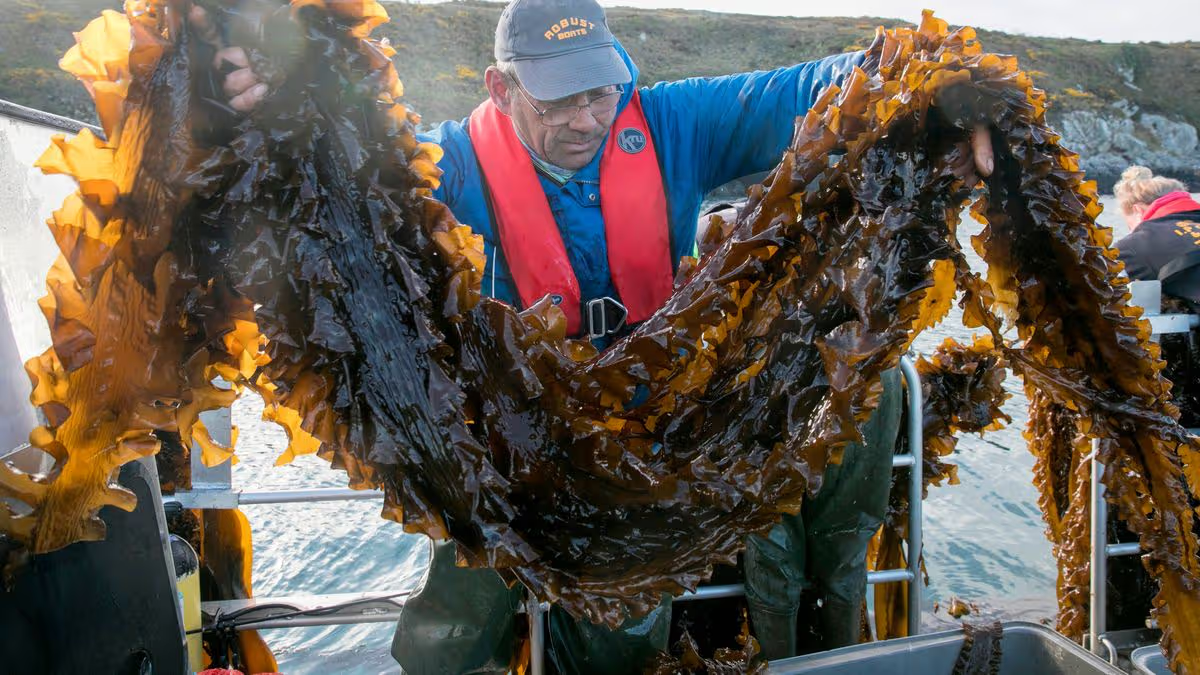
Câr-y-Môr is expanding following a marine licence extension from the Natural Resources Wales

Câr-y-Môr (Image: Angeles Rodenas)

A West Wales seaweed and shellfish farming venture have been given the go-ahead to expand two sea farms.

Câr-y-Môr hopes the growth of its community business will provide British land farmers with a homegrown and effective fertiliser substitute at a time when conflict in the Middle East is driving up costs. Câr-y-Môr is a growing community of 700 members and working partners, all committed to forging a sea farming industry for Wales and beyond.

Eight additional roles are planned for the next five years to join the 19 full-time, year-round working partners currently employed at the St Davids site. In its approval of the marine licence extension, NRW noted the project will contribute to the local economy, blue growth and job creation.

In March the community benefit society (CBS) published results of seaweed biostimulant trials funded by the Co-op Foundation’s Carbon Innovation Fund. They showed that when synthetic fertiliser was cut by 40% and the seaweed biostimulant applied on conventional grassland, the grass quality was maintained and the yield was up by 29%. The yield and quality on trialed cereal and potato fields were also maintained when fertiliser was reduced by 25% and 29% respectively.

Advertisement

This backed up earlier trials of a 24% yield increase on organic potatoes, and an 18% yield increase on silage (equivalent to £92 per hectare uplift) when the biostimulant was added to the existing fertiliser programme.

READ MORE: The knowhow built up in Wales’ contact centre sector is an asset worth redirectingREAD MORE: Wales doesn’t need grants but a new approach to IP and innovation that sustains business success

Now entering its third year of seaweed biostimulant trials, Câr-y-Môr has secured granted a marine licence o expand two existing integrated multi-trophic aquaculture (IMTA) sea farms in the Ramsey Sound off Pembrokeshire. This will allow it to increase production of Welsh seaweed, and meet the increasing demand for its high quality shellfish, which grew by 30% last year.

Beth Marshall, Câr-y-Môr’s marine biologist, who led the marine licence application, said “NRW’s approval is the result of years of feedback and collaboration between the team, volunteers and stakeholders, as well as strong advocacy from local people and businesses.

Advertisement

“It gives us the scope to scale our operations: to harvest more zero-input seaweed for use in biostimulant on the land; increase shellfish and seaweed production in A Grade waters for our 90+ restaurant partners; grow our community outreach and education programmes; and generate more year-round, full-time roles for rural Pembrokeshire.”

Câr-y-Môr’s sea farms will now total 8 hectares. The extended sea farms will be home to sugar kelp, oarweed, Atlantic wakame, furbelows, dulse, pepper dulse, sea lettuce, scallop, native oyster and mussels. The marine licence extension coinciding with the opening of the business’s Sied-y-Môr facility, home to the first dedicated seaweed biorefinery in Wales just a few miles inshore.

The community business has also taken part in a native oyster restoration programme, which last year saw it deploy 50,000 native oysters into Pembrokeshire’s Daugleddau Estuary.

Sophie Wood, programme manager at the UK Seaweed Network, said: “The UK Seaweed Network is delighted to hear of the successful granting of two sea farm extension licences for Câr-y-Môr.

Advertisement

“It is a well-deserved outcome, reflecting the strength of Câr-y-Môr’s efforts to date and its positive contribution to the marine environment and local economy. This decision is a vote of confidence in the future of regenerative sea farming, as well as reinforcing the importance and potential of long-term, responsible use of marine resources in Wales and around the UK.”

Jess Watton, education and engagement lead at Câr-y-Môr, grew up in Pembrokeshire. Part of her role sees her conducting seaweed workshops – which to date have reached more than 4,000 schoolchildren.

She said: “St Davids is tiny, famously the smallest city in the UK, sitting here on the edge of west Wales. Yet our humble community is paving the way for regenerative ocean farming, linking aquaculture with agriculture, and championing Welsh seafood.

“The fact we can do all that whilst cultivating seaweed and shellfish under the waves of what is notoriously one of the most dangerous stretches of water in the world, is just so inspiring.”


Advertisement
Continue Reading

Business

Council staff under attack from High Street gangs

Published

on

Council staff under attack from High Street gangs

For the first time, the CTSI has also logged where it believes High Street crime gangs are operating most. The data reveals criminality in big cities, but also in smaller towns – including Great Yarmouth in Norfolk, and Barry in South Wales – and even in villages.

Continue Reading

Business

Mondelez: Snacks holding their own amid consumer uncertainty

Published

on

Mondelez: Snacks holding their own amid consumer uncertainty

First-quarter profit bite from cocoa cost phasing expected to ease.

Continue Reading

Business

Vertu seals multimillion-pound payout in wake of Jaguar Land Rover cyber attack disruption

Published

on

Business Live

A £1m interim payment has already been paid to Gateshead based Vertu, the UK’s fourth biggest auto retailer

Mr Forrester says Government policies are distorting the car market.

Robert Forrester, chief executive of Vertu Motors(Image: supplied pic, free to use)

Gateshead motor retailer Vertu has sealed a multimillion-pound insurance payout in the wake of the cyber-attack at Jaguar Landrover.

The five-week shutdown at Jaguar Landrover (JLR) – believed to be the most damaging cyberattack in British history – triggered widespread disruption across the firm’s systems. As well as affecting production and supply of vehicles to dealers, it affected retail platforms used by franchised partners, including Team Valley’s Vertu Motors, the UK’s fourth-largest automotive retailer.

Advertisement

Now, however, Vertu has announced it has settled a successful claim for insurance following last September’s cyber attack. The total claim recovery has been agreed at £3.9m, against which a £500,000 policy deductible applies, resulting in a total net insurance recovery to the group of £3.4m

In a stock market statement, the firm said: “Vertu Motors, a leading UK automotive retailer, announces that it has been notified by its insurers of a successful settlement of the group’s business interruption insurance claim relating to the cyber-attack on Jaguar Land Rover Limited in September 2025, which temporarily disrupted JLR vehicle supply, parts availability and connected systems used by JLR franchised retailers, including those operated by the Group. The business impact was resolved by early 2026.”

In a trading update last month, Vertu said the group’s JLR business has returned to normal operations, and that the anticipated financial impact was expected to be less than the £5.5m previously estimated. A £1m interim payment has already been paid to Vertu, and the full recovery will be recognised as underlying income in the group’s results for the year ended February 2026.

General view of the Jaguar Land Rover Halewood Operations Plant

Jaguar Land Rover has a major site in Halewood(Image: Dave Thompson/PA Wire)

As a result, Vertu added that adjusted pre-tax profit is likely to be ahead of the current market consensus of £21.6m, with its full year results set to be announced on May 13.

Advertisement

Jaguar Land Rover revealed last November that it lost around £500m during the second quarter of its financial year, as a result of the impact of the most expensive cyber attack in British history.

Earlier this month, however, the car manufacturing giant announced a bounce back in sales over the last quarter, after production resumed. JLR, which is owned by India’s Tata, was forced to suspend production across its UK plants for five weeks from September 1 last year.

By September 22 it had led to work halting on all of its production lines for three weeks, with staff told to stay at home. All of its facilities – including plants in Solihull, West Midlands, and Halewood, Merseyside – halted output before starting up once more in October.

At the time, the Society of Motor Manufacturers and Traders (SMMT) and Department for Business and Trade and issued a statement outlining the significant impact on Jaguar Land Rover and the broader supply chain for car manufacturers. With an estimated eventual total damage to the British economy of £1.9bn, the Bank of England also said that the cyberattack was one reason for slower GDP growth.

Advertisement

Like this story? For more news from the retail sector, visit our dedicated page for the latest news and analysis here .

Continue Reading

Business

LIV Golf: Saudi Arabia to withdraw funding at end of season

Published

on

Jon Rahm

This week LIV postponed its June event in New Orleans, meaning it will not have any tournaments in the US between 10 May until 6 August, when it goes to Trump Bedminster in New Jersey.

However, LIV tournaments are due to take place in South Korea, Spain and Britain during this period.

BBC Sport has been told LIV remains hopeful of remaining an international tour with a team model, and that it is in “constructive” talks with potential investors. The series is said to be “totally up for sale”.

Davis said: “LIV Golf has built something truly differentiated – a global league with passionate fans, world-class talent, and demonstrated commercial momentum.

Advertisement

“The executive leadership team, along with Jon and I, see a clear opportunity to help the league formalise its structure, attract and secure long-term capital, and position the business for growth while continuing to promote the game across the world. We look forward to positioning LIV Golf for future success.”

LIV described Davis as a “leading corporate governance and strategic advisory professional”, while Zinman is said to have “expertise in driving financial and operational transformation for companies navigating complex reorganisations”.

Its statement did not mention PIF or Al-Rumayyan.

Sources indicated that executives are exploring a number of opportunities to “reposition” the business. They said LIV Golf was on course to earn $100m (£86m) more in 2026 than last season, and are telling potential investors that ten of the LIV teams will be profitable this year.

Advertisement

However, officials accept it is almost certain that the series will have to be significantly scaled back, with far fewer than the current 14 events.

Team captains and staff have been told of LIV’s plan to find new funding.

This month LIV Golf chief executive Scott O’Neil told players the 2026 season would continue “as planned and uninterrupted” amid rumours the tour was on the verge of collapse, although he did not address what might lie ahead.

It came as PIF – which also owns Premier League club Newcastle United – announced a new strategy, with a focus on more sustainable investments.

Advertisement

Major winners Jon Rahm, Bryson DeChambeau, Phil Mickelson and Cameron Smith are among the players who compete on the LIV tour.

The project, which pivoted to a more traditional 72-hole format this year, has been bankrolled by an eye-watering amount of money from PIF.

The overall investment surpassed $5bn (£3.8bn) when fresh capital of $267m (£229m) was injected this year.

The tour’s net losses in markets outside the US increased to $462m (£340m) in 2024, meaning it had lost more than $1.1bn (£810m) since it was established in 2021.

Advertisement

But with vast amounts of money pumped into the US arm of the operation, overall losses look likely to run to several billion dollars.

In February, Rahm, Smith and DeChambeau turned down a one-time opportunity to apply for reinstatement to the PGA Tour under its ‘Returning Member Programme’, which was facilitated for those who had won a major – or The Players Championship – since 2022.

Five-time major winner Koepka was the only player to take up the offer and smoothed his return by paying fines said to be worth about £63m.

Amid reports that some LIV golfers have approached the PGA Tour and DP World Tour to explore possible returns, it remains unclear if the series’ potential demise would see such a path reopened, and what terms might be issued.

Advertisement

Speaking after the most recent event in Mexico City, DeChambeau said, “As of right now, my job is to help make the league work after this year. I just feel like I have a responsibility. I’ve put a lot of effort into it. So that’s what I’m going to do, we’re going to make this work.

“As long as LIV is here, I would figure out a way for it to make sense.”

LIV Golf Virginia at Trump National Golf Club just outside of Washington DC is scheduled to begin on 7 May.

PIF has been approached for comment.

Advertisement

Saudi Arabia hosts and invests in a number of sports, including football, boxing, Formula 1 and tennis, and is due to host the 2034 World Cup. Earlier this month, PIF announced it had sold a 70% stake in Saudi Pro League club Al-Hilal.

The Saudi Arabia Snooker Masters, one of the richest events on the sport’s calendar, was cancelled just two years into a 10-year deal.

Continue Reading

Business

HUL shares drop over 4% despite Q4 topping Street estimates; profit jumps 21% YoY to Rs 2,464 crore

Published

on

HUL shares drop over 4% despite Q4 topping Street estimates; profit jumps 21% YoY to Rs 2,464 crore
Shares of Hindustan Unilever Ltd (HUL) slipped as much as 4.4% to an intraday low of Rs 2,211 on the BSE on Thursday, despite the FMCG major reporting a consolidated profit of Rs 2,992 crore for the March quarter of FY26, up 21.4% from Rs 2,464 crore in the year-ago period.

Revenue from operations rose 7.6% YoY to Rs 16,351 crore, compared with Rs 15,190 crore in Q4FY25.

EBITDA increased 3.2% to Rs 3,877 crore versus Rs 3,754 crore in the corresponding quarter last year. EBITDA margins stood at 23.7%, improving by 70 basis points YoY. Segment-wise, Home Care grew 9%, marking its strongest performance in 11 quarters, led by double-digit growth in Fabric Wash and high single-digit growth in Household Care.

Beauty & Wellbeing delivered 8% USG with mid single-digit UVG, supported by strong double-digit growth in Hair Care, which continued to strengthen its leadership position. Personal Care grew 5%, with Skin Cleansing posting high single-digit growth, driven by Dove and Lux. Market development initiatives also supported double-digit competitive growth in premium soaps and bodywash.

Advertisement

The Foods segment recorded 5% USG, led by high single-digit UVG. Tea reported low single-digit UVG, while Coffee continued its strong double-digit growth, supported by both volume and pricing.


Priya Nair, CEO and Managing Director, said FY26 saw an improved demand environment backed by supportive macroeconomic policies. She noted that the company undertook several actions to accelerate growth, including portfolio sharpening, higher investments, stronger frontline demand generation and organisational simplification.
She added that the company remains well placed to navigate a volatile environment, supported by strong brands, a robust financial position and operational agility, with a focus on delivering sustainable and competitive growth.The board proposed a final dividend of Rs 22 per share, subject to shareholder approval at the AGM. This is in addition to the interim dividend of Rs 19 per share declared in October 2025, taking the total dividend payout for FY26 to Rs 9,633 crore.

(Disclaimer: Recommendations, suggestions, views, and opinions given by the experts are their own. These do not represent the views of The Economic Times)

Continue Reading

Business

Why are UK prices rising more quickly?

Published

on

Why are UK prices still rising?

The war in Iran has pushed UK Inflation further above the Bank of England’s 2% target.

Continue Reading

Business

800,000 Used EVs Set to Flood Market, Threatening Carmakers With Billions in Losses

Published

on

Electric vehicles are subject to much lower import duties, and the government expects them to help Nepal reach its ambitious aim of becoming a net-zero greenhouse gas emitter by 2045

DETROIT — A massive wave of off-lease electric vehicles is poised to crash into the U.S. used-car market, creating fresh headaches for automakers already struggling with slowing new EV sales and plunging resale values.

Electric vehicles are subject to much lower import duties, and the government expects them to help Nepal reach its ambitious aim of becoming a net-zero greenhouse gas emitter by 2045
Electric Vehicles
AFP

Industry analysts estimate roughly 800,000 EVs could hit the secondary market by 2028 as three-year leases signed during the height of federal tax credit incentives begin expiring. The influx — peaking around 2027 and 2028 — threatens to drive down prices further, saddling manufacturers and their finance arms with potential losses of up to $8 billion.

The numbers are staggering. EV lease returns are projected to climb from about 123,000 in 2025 to 300,000 in 2026 and double to 600,000 in 2027, according to recent forecasts. That cumulative surge of more than 1 million vehicles over several years will dramatically reshape the used-car landscape.

Many of these returning EVs were leased when new models qualified for the $7,500 federal tax credit, spurring aggressive manufacturer leasing programs. Tesla, General Motors, Hyundai-Kia, Ford and others pushed leases to move inventory. Now those vehicles are returning with residual values far below what captive finance arms projected just a few years ago.

A three-year-old EV today retains roughly 40% of its original value, down sharply from near 90% in earlier periods, according to data cited by Automotive News. The gap between lease-end expectations and actual market prices could average $5,000 to $20,000 per vehicle, with analysts pegging the industry hit at around $10,000 on average.

Advertisement

Tesla faces the greatest exposure, having leased nearly 229,000 EVs in 2025 alone. GM follows with about 102,000. Combined losses for major players could exceed $1 billion each in the peak year depending on how aggressively they adjust residuals going forward.

The threat comes at a precarious time for the EV transition. New EV sales dropped 28% in the first quarter of 2026 after the expiration of federal tax credits, falling to roughly 212,600 units. Yet the used market tells a different story: Americans bought a record 42,924 used EVs in March alone, up nearly 28% from a year earlier. First-quarter used EV sales reached 93,500 units, up 12% year-over-year.

Used EV prices have fallen dramatically, now sitting within about $1,300 of comparable gasoline vehicles — the narrowest gap in years. That affordability is drawing in buyers deterred by high new-car sticker prices and range anxiety.

“These off-lease vehicles will increase consideration for EVs for a lot of used-car shoppers,” Stephanie Valdez Streaty, Cox Automotive’s director of insights, told reporters. Higher gasoline prices above $4 a gallon in many markets are accelerating the shift.

Advertisement

For consumers, the flood represents opportunity. Late-model EVs with low mileage, remaining factory warranties and advanced features are appearing at dealerships and online marketplaces at steep discounts. Popular models like the Tesla Model 3 and Model Y, Chevrolet Bolt, Ford Mustang Mach-E and Hyundai Ioniq 5 are expected to dominate the wave.

Dealers are bracing for the inventory surge. Off-lease EVs could make up nearly 15% of used-vehicle supply by the end of 2026, up from much lower levels. While this boosts selection and potentially foot traffic, it also compresses profit margins on both new and used lots as buyers compare options.

Automakers worry the cheap used supply will cannibalize new EV demand. Why pay full price for a new model when a two- or three-year-old version costs tens of thousands less? This dynamic already forced some brands to slash new EV prices or pull models entirely in 2026.

The depreciation curve for EVs has proven steeper than anticipated. Rapid technological improvements — longer ranges, faster charging, cheaper batteries — make even recent models feel outdated quickly. Battery health concerns, though often overstated with proper data from services like Recurrent, still give some buyers pause.

Advertisement

Yet real-world data shows many off-lease EVs retain strong battery capacity. Most come with 70% to 90% state of health after typical use, well within warranty coverage that often extends eight years or 100,000 miles.

The flood also highlights shifting manufacturer strategies. Several automakers have dialed back EV ambitions, prioritizing hybrids and extending gasoline vehicle production as consumer demand cooled. Lease penetration for EVs, once double the industry average, is expected to decline.

Still, the used boom could ultimately benefit the broader EV ecosystem. First-time electric drivers often become repeat buyers. Affordable entry points via the used market may accelerate mainstream adoption, especially as charging infrastructure expands and electricity prices remain favorable compared to volatile gasoline.

Cox Automotive and other forecasters see used EVs as a bridge. With total used-vehicle sales dwarfing new-car volume, even modest market share gains for electrics in the secondary market can move the needle on overall electrification.

Advertisement

Challenges remain for the industry. Dealers must invest in EV-specific training, charging infrastructure and battery certification programs to build buyer confidence. Wholesale auctions are already seeing increased EV volume, pressuring prices downward.

Some automakers are responding by adjusting lease terms, lowering new-vehicle prices or offering incentives to prop up residuals. Others are exploring certified pre-owned programs with extended warranties to differentiate their off-lease inventory.

The situation echoes past automotive disruptions, such as the flood of off-lease vehicles after the 2008 financial crisis or the rapid shift to SUVs. This time, the technology transition adds complexity.

Environmental benefits could be significant. More used EVs on the road means fewer gasoline vehicles and reduced emissions, even if new sales slow. Battery recycling and second-life applications for retired packs offer additional upside.

Advertisement

For now, the immediate pressure falls on balance sheets. Finance executives at automakers are scrambling to model scenarios and mitigate losses through remarketing strategies and earlier residual adjustments on new leases.

Analysts caution that not every manufacturer will feel equal pain. Those with stronger brand loyalty and better residual performance, particularly in premium segments, may fare better. Mass-market players with heavier exposure could face tougher choices.

As the first major wave of lease returns builds through late 2026, the industry watches closely. Will demand absorb the supply without a price collapse? Or will the market require deeper discounts and manufacturer subsidies?

One thing is clear: The used EV market has arrived as a major force. For buyers hunting deals, 2026 and beyond look like a buyer’s paradise. For carmakers, it’s a costly reminder that the road to electrification includes sharp turns and unexpected bumps.

Advertisement

The coming deluge of nearly 800,000 used EVs will test the resilience of the auto industry’s EV strategy. How manufacturers navigate the resale reckoning could shape the pace of electric adoption for years to come.

Continue Reading

Business

Aussie shares slip as brent crude hits new wartime high

Published

on

Aussie shares slip as brent crude hits new wartime high

The Australian bourse has continued its losing streak into its eighth-straight day as oil prices rocketed and the realities of a prolonged energy shock hit home for Woolworths and other exposed businesses.

Continue Reading

Trending

Copyright © 2025