
Crypto World
How to sell Counter-Strike 2 skins for crypto


Disclosure: This article does not represent investment advice. The content and materials featured on this page are for educational purposes only.
CS2 skin trading trends rise as gamers convert in-game items into crypto assets for liquidity and control.
Summary
- CS2 skins can now be converted into crypto, giving players faster, global, and more flexible access to their value.
- Selling CS2 skins for crypto lets gamers cash out quickly, avoid delays, and take full control of their digital assets.
- Turning CS2 skins into crypto aligns gaming with digital finance, offering speed, ownership, and borderless transactions.

Counter-Strike 2 is the reality for many players, beyond an ordinary shooting game, a skillful merging of tactics and personality. Skins contribute significantly to this character’s total, as they give a chance not only to stand out but also to make a statement in every round. However, skins represent more than just a pretty sight; they carry tangible value that can be converted into a far more versatile form: crypto.
Converting CS2 skins into crypto by selling is rapidly becoming a favorite among gamers seeking full control over their assets. Be it replenishing a collection, withdrawing money, or delving into the world of digital finance, this manual aims to simplify the entire process.
Reasons for selling CS2 Skins to obtain crypto
It’s quite normal for a person to react to the idea of converting in game items to cryptocurrency with bewilderment, as it is a rather intricate matter on the surface. However, it already aligns quite well with the perspective many gamers have on value.
Currently, many gamers resort to methods that let them sell CS2 skins instantly, without lengthy wait times or complicated steps. For that reason, skin trading venues like Tradeit have already begun implementing faster marketplace transactions and smoother player interactions, aligning their operations perfectly with player expectations.
Below are some reasons why crypto is still a fashionable alternative:
- Speed and flexibility: First, don’t wait for a withdrawal to be approved. Most crypto transactions take just a few minutes, so money will be at hand almost at all times.
- Global accessibility: Because crypto is built on a decentralized system, it can be used across borders without many issues. There is just a need for a device capable of operating on the Internet.
- Control over funds: Holding funds at a single exchange platform is a real risk, and users are also vulnerable to the platform’s policies. Whereas, if assets are kept in the user’s own wallet, they have complete control over their financial matters.
- Future potential: From a macroeconomic perspective, players recognize that cryptocurrency is on its way to becoming an integral component of the digital economy; hence, they consider it more than merely a method of receiving payments.
This is an additional means by which players who want to get the most out of all their CS2 facets can stay one step ahead of the competition.
Understanding the value of the skins
It goes without saying that the first step in selling skins is to know their value. Because of the different features, skin prices vary a lot.
Some of the main factors determining price are:
- Rarity: Usually, skins from special collections or rare drops are the ones that carry a higher price tag
- Condition: Typically, factory-new skins fetch a higher price than the worn ones
- Demand: Skins for popular weapons often see more sales
- Visual appeal: Unique patterns or clean finishes greatly add to the attractiveness
Use this as a starting point and compare skins with those on sale across various marketplaces. This way, the seller will gain a good grasp of pricing and steer clear of underselling their products.
A wise gamer always treats their inventory as an investment and is constantly mindful of its value.
Choosing the right marketplace

A platform can significantly impact the selling process. Not all marketplaces have the same crypto payout features, for example.
To decide on where to sell, first check out:
- Nice and simple UI: It should be easy and even fun to make a trade
- Quick login: Also, waiting times for the heartbeat of the market closing should be minimized
- Fanatical multiple crypto support: This is a sweet feature to have
- Almost rock-solid reputation: Nobody would want to risk a lot in a shady hypothetical location
In principle, a quality marketplace should be quite similar to an amusement park in that it is fun, fun, and more fun!
Step by step guide to selling skins
After deciding on the platform, implementation will be pretty simple. Here’s how anyone can start:
1. Connect an Account
In general, marketplaces ask to link a Steam account. Through this account, they can see a user’s inventory.
2. Select the Skins to Sell
Look through the stash and pick out skins to sell. In line with the selling goals, choose, for example, skins for liquidation or highly valuable skins.
3. Set or Accept a Price
Listing a price or accepting an instant offer will vary by platform.
- Instant offers are faster
- Custom listings may yield higher returns
4. Confirm the Trade
A trade offer will be obtained via Steam. Make sure everything matches up before hitting the confirm button.
5. Receive Crypto
After the trade is finalized, the crypto will be sent to the wallet right away. Then it’s up to the user wants to do: hold, trade, or convert it.
How to get as much as possible out of one’s sale
Flipping skins could be a lot more profitable than just hitting a “sell” button. Users can significantly improve their outcomes with the right strategy.
Think of these pieces of advice:
- See what’s happening on the market: Prices may go up or down depending on changes, tournaments, and the players interested.
- Make a sale at the right moment: People’s desire for a product tends to increase during major events or when new items are released.
- Don’t do it in a hurry: While quick selling is a comfortable approach, waiting and being patient can eventually yield better results.
- Be orderly: Keep a record of what to purchase and sell to measure progress.
- Go for well known things: Most of the time, commonly used skins are seen as “hot items” and therefore change hands more quickly.
This can be seen as a training aim in CS2. The more someone focuses on small details, the more their output will improve.
Upgrading the experience of CS2
The main purpose of selling skins for crypto should not be solely for earnings. It may also be the way to get to know the game part that is most even a part of a personality.
By having a clever management of items, users will be able to:
- Stay topical with the weapons by rotating skins
- Buy things that are in line with a style of playing
- Remain updated on the ever changing CS2 business
That way, they get more than a game; they’re making a connection to what they are doing. Users don’t only get the satisfaction of winning a match, but also feel like they are going in a direction and achieving the goals set for themselves.
In Conclusion
Counter-Strike 2 is an ever changing world where opportunities keep shifting. One way to update gaming is by mixing it with crypto, and in particular, by selling skins for crypto.
By having the correct attitude and hardly ever putting in the amount of effort, the exchange of the virtual items, in this case, skins, can be converted into more than a casual hobby. Whether the seller intends to get better equipment, step into the crypto world, or just get their hands on a new experience, it is really quite easy and worthwhile.
Keep eyes peeled, get the most recent information, but above all, have fun the rest of the way.
Disclosure: This content is provided by a third party. Neither crypto.news nor the author of this article endorses any product mentioned on this page. Users should conduct their own research before taking any action related to the company.


Bitcoin has failed to sustain a move above $78,000 in the 24 hours following Wednesday’s FOMC decision, with three straight sessions of Bitcoin ETF outflows totalling over $490 million signalling that institutional allocators are pausing rather than adding exposure as uncertainty over the Fed’s direction deepens.
Summary
- Bitcoin ETF products logged $137.77 million in net outflows on April 29, ending a nine-day inflow streak worth $2.1 billion, with every active issuer printing negative for the first time in the streak — including IBIT at $54.73 million and FBTC at $36.13 million.
- Glassnode data show Bitcoin is “trapped” below its True Market Mean at approximately $78,000 to $79,000, with perpetual futures at their most negative level on record — a positioning setup that contains both downside risk from continued selling and upside potential from a short squeeze if spot demand returns.
- April closed with $2.44 billion in total Bitcoin ETF net inflows, a strong monthly reversal despite the late-month outflow pressure, with XRP ETFs the only product category to print positive flows on April 29 at $3.59 million.
Bitcoin ETF data from SoSoValue confirmed $137.77 million in net outflows on April 29, the third consecutive outflow session and the one that ended a nine-day inflow run. As crypto.news reported, April 29 was the first session in the streak where zero issuers printed positive — every active fund was in net redemption territory, led by BlackRock’s IBIT at $54.73 million and Fidelity’s FBTC at $36.13 million.
“Bitcoin staying below the $78,000 mark isn’t really about crypto right now, it’s about what’s happening in the broader market,” said Daniel Reis-Faria, CEO of ZeroStack. “The Fed holding rates wasn’t a surprise, but there is no clear direction on what comes next, and that’s keeping investors from stepping in.”
Why the FOMC hold matters more than the rate
As crypto.news documented, Bitcoin has fallen after 8 of the last 9 FOMC meetings. The pattern is driven not by the decision itself but by the unwinding of pre-event positioning once the meeting passes. What made Wednesday’s outcome distinctly more negative than a standard sell-the-news event was the four-way dissent — the first such split since October 1992 — and Powell’s announcement that he will stay on the Federal Reserve Board past May 15, introducing leadership uncertainty on top of policy ambiguity. Kraken chief economist Thomas Perfumo said the market is now “more concerned about the policy uncertainties brought about by the division within the Federal Reserve rather than the inaction itself,” pointing to a leadership overhang that has no clear resolution timeline.
“You’re seeing that directly in ETF outflows and weaker demand,” Reis-Faria added. “The buying just isn’t strong enough to push Bitcoin higher. It doesn’t mean institutions are leaving the market, it just means they’re not increasing their exposure right now.”
That distinction — pause versus exit — is supported by the April data. Despite three consecutive outflow sessions, April closed with $2.44 billion in total Bitcoin ETF net inflows, a sharp positive reversal from a quarter that began with negative year-to-date flows. As crypto.news tracked, the ETF outflow and Bitcoin price relationship is not mechanically linear: concentrated outflows from large funds can compress price without indicating a structural exit from the asset class.
What brings Bitcoin back above $78,000
Glassnode data show Bitcoin currently below its True Market Mean and short-term holder cost basis clustered between $78,000 and $79,000, with the $65,000 to $70,000 range as the key downside support if selling accelerates. Perpetual futures have flipped to their most negative positioning level on record, a setup that historically precedes sharp short squeezes when spot demand returns. The 48-hour window from April 30 to May 1 is the critical observation zone: stable ETF flows, BTC holding above $74,500, and normalizing funding rates would collectively signal that the post-FOMC selling has exhausted itself.
“If money starts coming back in, especially from institutions or through ETFs, Bitcoin can move higher pretty quickly,” Reis-Faria said. “But until that happens, it’s likely to stay in this range.”
The catalysts that could shift that equation are concentrated in May: the CLARITY Act markup window, the Warsh Senate confirmation vote, Big Tech earnings outcomes from the prior session, and whether the Iran military briefing reported by Axios this morning produces a further risk-off escalation or opens a path toward diplomatic resolution.


XRP Las Vegas 2026 opened today, April 30, as Ripple covered the Las Vegas Strip with “Raise the Standard” billboards and Steven Zeiler of Yellow Network posted live from the floor calling XRP “only a step on the trajectory to becoming a global reserve currency.
Summary
- XRP Las Vegas 2026 runs April 30 to May 1 and draws Ripple executives, regulators, and institutional investors, coinciding with the listing of Ripple’s RLUSD stablecoin on OKX and a formal Ripple-OKX partnership announced April 29.
- White House advisor Patrick Witt hinted at major new developments for the national Bitcoin strategic reserve in the coming weeks, while speakers at XRP Las Vegas separately argued XRP occupies a different and complementary role as a bridge asset rather than a store of value.
- XRP is trading near $1.37 as the conference opens, down approximately 62% from its all-time high of $3.65 set in July 2025, as the broader community debates whether institutional adoption can convert conference momentum into price recovery.
XRP Las Vegas 2026 kicked off today at Las Vegas with Ripple’s most aggressive public marketing push in the event’s history. CoinGape reported that “Raise the Standard” XRP billboards blanketed the Strip across Resorts World, the Wynn, and beyond, setting the visual stage for an event that runs through May 1. Steven Zeiler of Yellow Network posted from the conference floor: “Live from Vegas. Impressed by seeing XRP promoted like this. But then again it’s only a step on the trajectory to becoming a global reserve currency.”
Crypto analyst Versan Aljarrah added broader context, saying: “The conversation around XRP is usually clouded by speculation and price predictions. The true potential for XRP isn’t just as a payments token or bridge asset.”
Why XRP supporters and Bitcoin advocates are not competing for the same reserve role
As crypto.news reported, XRP’s regulatory status shifted materially in March 2026 when the SEC and CFTC jointly classified it as a digital commodity, placing it on the same legal footing as Bitcoin and Ethereum for purposes of exchange-traded product approvals. That classification underpinned a record $81.63 million in April ETF inflows. The XRP Las Vegas argument, however, is structurally different from the Bitcoin strategic reserve conversation that Patrick Witt teased at the adjacent Bitcoin Conference. Bitcoin advocates frame the strategic reserve case around scarcity and store of value. XRP supporters argue the asset’s purpose is operational: a bridge currency that moves value between fiat rails in seconds at near-zero cost, a function that does not compete with Bitcoin’s role but sits alongside it. Ripple’s $190 billion processing partnership with Convera and integrations with Deutsche Bank and Société Générale reflect that operational framing, though those deals settle in RLUSD rather than XRP directly, meaning XRP’s utility depends on RLUSD volume growing through the XRP Ledger rather than on the partnerships themselves.
As crypto.news documented, a $59 million RLUSD settlement completed on April 29 for a fee of $0.000188 is precisely the kind of real-world infrastructure proof the XRP Las Vegas stage is highlighting — but approximately 82% of RLUSD currently resides on the Ethereum blockchain, not the XRP Ledger, meaning the network utility case for XRP specifically remains structurally dependent on RLUSD migrating to its native chain. As crypto.news tracked, Standard Chartered lowered its 2026 XRP price target from $8 to $2.80 in February amid macro headwinds, leaving the $1.37 conference open price well below even the revised institutional target heading into the CLARITY Act’s May markup window.

Key Highlights
- On April 27, 2026, CoreWeave’s Chief Development Officer McBee Brannin offloaded approximately $5 million in Class A shares via a pre-established Rule 10b5-1 plan.
- Executive Brian Venturo sold 375,000 shares worth around $40.9 million on the same date, also through a pre-arranged trading program.
- Shares of CRWV climbed approximately 8.2% to reach $114.19 amid robust trading activity, with the stock posting a 59% gain year-to-date.
- Wall Street maintains an optimistic outlook with 20 Buy recommendations and a consensus price target of $125.78.
- The company recently announced a $6 billion computing partnership with Jane Street, with quarterly results set for release on May 7.
Shares of CoreWeave have surged 59% since the start of the year, hovering near $114, yet two top executives just liquidated substantial positions — and investors didn’t seem to care.
CoreWeave, Inc. Class A Common Stock, CRWV
McBee Brannin, who serves as Chief Development Officer, disposed of Class A Common Stock valued at approximately $5 million on April 27, 2026. The transaction involved 45,850 shares executed at prices between $105.02 and $112.76 each.
Brannin’s sales occurred through a Rule 10b5-1 trading arrangement established in November 2025. Such plans allow executives to schedule stock sales ahead of time, shielding them from insider trading allegations.
The stock holdings were structured through two grantor retained annuity trusts — specifically the Canis Major 2025 GRAT and Canis Minor 2025 GRAT — a typical wealth management technique.
Concurrently, Brian Venturo, another company insider, divested 375,000 shares at approximately $109.03 apiece, generating proceeds of about $40.9 million. This sale also followed a predetermined 10b5-1 arrangement.
In total, both executives liquidated north of $45 million in holdings within 24 hours.
Market Response and Stock Trajectory
Notwithstanding the substantial insider transactions, CRWV shares climbed 8.2% to close at $114.19, with trading volume approaching the typical 27.8 million share daily average. The equity has traded within a 52-week band of $39.50 to $187.00, positioning current levels near the middle of that spectrum.
Since January, CRWV has appreciated 59%. On a trailing twelve-month basis, shares have rocketed 176%, although they dipped 2.8% during the previous week.
The enterprise commands a market capitalization fluctuating between $50 billion and $57 billion based on daily valuations. The balance sheet shows a debt-to-equity ratio of 4.46, while the company continues operating at a loss, posting a $0.89 per share deficit in its latest quarter — missing the analyst consensus estimate of a $0.61 loss.
Quarterly revenue registered at $1.57 billion, reflecting a robust 110.4% year-over-year expansion.
Wall Street Maintains Optimistic Stance
The financial community remains largely unfazed by the red ink or executive share sales. Among 33 analysts tracking the company, 20 recommend buying, 11 suggest holding, and only 2 advise selling. The mean price objective sits at $125.78.
Wells Fargo elevated its price forecast to $135 while maintaining an Overweight designation. DA Davidson pushed even higher, boosting its target to $175 with a Buy rating. Cantor Fitzgerald increased projections from $149 to $156 following CoreWeave‘s announcement of a $6 billion computing arrangement with Jane Street.
This agreement grants Jane Street access to CoreWeave’s computational infrastructure spanning multiple data centers. Jane Street also committed $1 billion in capital at $109 per share.
Oppenheimer analysts anticipate that CoreWeave will deliver first-quarter revenue toward the upper boundary of guidance and may potentially elevate its full-year 2026 projections.
Taking a more reserved position, Sanford C. Bernstein bumped its target from $56 to $67 while retaining an Underperform classification.
CoreWeave has additionally structured a $1 billion private placement of senior notes maturing in 2031 carrying a 9.75% coupon, with closing anticipated on April 21, 2026.
The company is slated to announce quarterly earnings on May 7, 2026.


Ripple Expands Its UAE Base
Ripple has opened a new Middle East and Africa regional headquarters in Dubai’s DIFC, expanding its footprint in the UAE. The move reflects rising demand for regulated blockchain payment solutions across the region. It also supports Ripple’s plan to grow its local team and strengthen partnerships with financial institutions operating in the Middle East and Africa markets.
New Headquarters Supports Regional Growth
Ripple said the new DIFC office can support a larger team. The company now has capacity to double its regional operations.
The expansion comes as more firms seek regulated blockchain payment services. Banks and financial companies are also testing digital asset tools.
Reece Merrick, Managing Director for Middle East and Africa at Ripple, said, “In recent years the Middle East has become an increasingly vital driver of Ripple’s global growth.”
He added, “A larger team, based here in Dubai, will enable us to go further in supporting our clients and partners across the region and beyond.”
Ripple Builds on Dubai Regulation
Ripple has also secured key regulatory approvals in Dubai. In March 2025, it became the first blockchain payments provider licensed by the DFSA.
The license allows Ripple to offer regulated cross-border digital payment services from the DIFC. It also supports its work with banks and payment firms.
The DFSA also approved RLUSD as a recognized crypto token in the DIFC. Regulated firms in the financial centre can use the dollar-backed stablecoin.
Arif Amiri, CEO of DIFC Authority, said, “Ripple’s expansion within DIFC is a strong signal of the confidence that world-leading digital asset firms have in Dubai.”
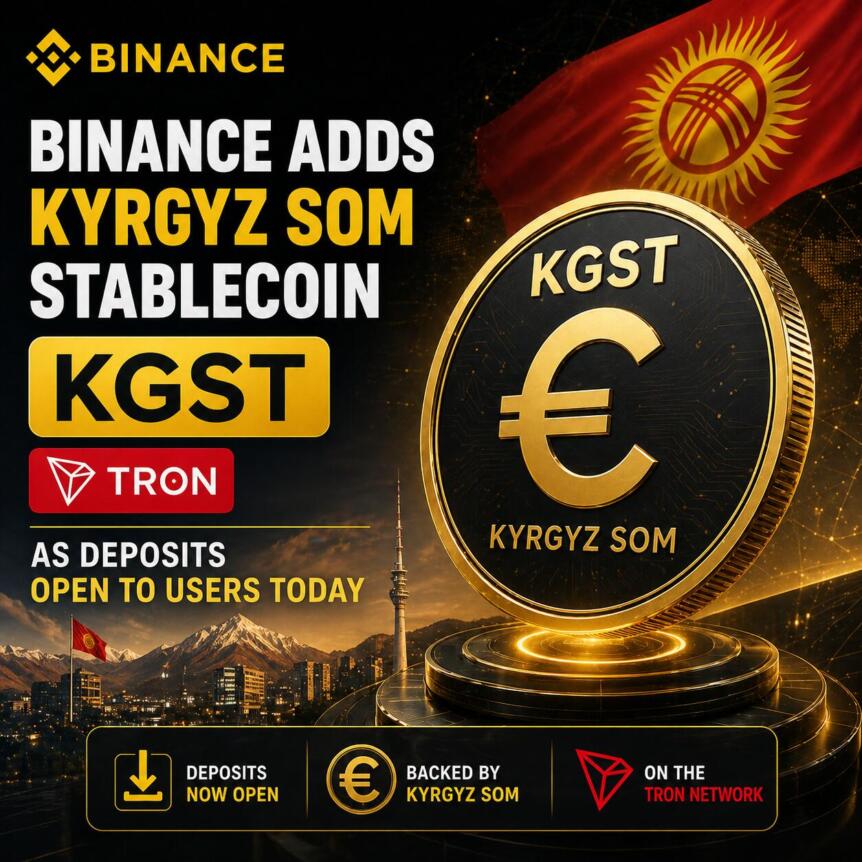
Binance has opened KGST deposits after completing the stablecoin’s integration on the TRON TRC20 network. The update gives users a new supported route for moving the Kyrgyz Som Stablecoin on Binance. Withdrawals are not yet live, as the exchange said they will open after enough liquidity is available.
Binance Adds KGST Support on TRON
Binance announced that KGST deposits are now available through the TRC20 network. Users can send the stablecoin to Binance by choosing the supported network on the deposit page.
The exchange asked users to check all transfer details before sending funds. It also advised users to avoid using unsupported networks for KGST transfers.
KGST is a stablecoin linked to the Kyrgyz som, the national currency of Kyrgyzstan. Its support on TRON may help users move the token with lower fees.
Meanwhile, the listing adds another fiat-linked asset to Binance’s supported crypto options. It also gives KGST access to a wider trading and transfer base.
Withdrawals Will Open After Liquidity Is Ready
Binance said KGST withdrawals are not yet available. However, the exchange plans to open withdrawals after enough liquidity is in place.
This process is common when exchanges add support for new tokens. Deposits often open first so liquidity can build before withdrawals begin.
Users can deposit KGST now, but they must wait for a later notice about withdrawals. Binance has not shared a fixed date for that step.
Therefore, users are expected to follow official Binance updates. They should also check the withdrawal page before planning any KGST transfer.
Wider Crypto Market Records More Activity
The KGST update came as several exchanges reported fresh market activity. OKX is also set to add MEGA, linked to MegaETH, for spot trading.
The listing is expected to begin today, according to the market update. It adds another token to OKX’s spot market during active trading hours.
At the same time, CoinW shared data on a large trader shorting altcoins and meme tokens. The trader reportedly gained more than $10 million in 90 days.
CoinW said the strategy is now available through copy trading. The platform also stated that the model has no profit share.
In another market move, a whale returned 220 BTC to Binance after about three years. Reports estimated the trader’s profit at around $28 million.
The transfer drew attention because the coins had stayed inactive for a long period. Together, these updates show continued activity across exchanges, traders, and large holders.
CFTC Chairman Michael Selig confirmed the agency is deploying AI tools to review crypto registration applications and monitor trading data, the first major US financial regulator to use artificial intelligence to compensate for a workforce cut of more than 20% under the Trump administration’s federal staffing reductions.
Summary
- CFTC AI tools will flag incomplete applications, reject blank filings, and send inadequate submissions to the back of the queue without human review, with staff trained on Microsoft Copilot and in-house surveillance tools under development.
- The CFTC’s Chicago enforcement office has no active lawyers left following a string of departures and retirements, raising bipartisan concerns in Congress about whether a 20% workforce cut is compatible with overseeing crypto and prediction markets simultaneously.
- Critics warn that AI-reviewed applications could create new compliance blind spots, since the agency has not disclosed how algorithmic errors will be identified, appealed, or corrected.
CFTC AI deployment was confirmed by Chairman Michael Selig in an April 28 interview, when he told reporters the agency is building systems to automate registration reviews and flag applications containing blank spaces, inadequate descriptions, or clearly incorrect information. Crypto Integrated reported that Selig described AI as essential to the agency’s ability to function given the workforce reductions, saying it would allow staff to “focus on more complex cases” while automated systems handle routine filtering.
As crypto.news reported, the CFTC has also launched an Innovation Task Force covering three themes: crypto assets and blockchain, AI and autonomous systems, and prediction markets and event contracts. Selig described AI market surveillance tools the agency already has in place as capable of helping staff “reach conclusions about certain trades,” and said Microsoft 365 Copilot is now being trained across all CFTC staff. The context for this deployment is stark: staff levels have fallen by roughly 25% since the start of 2025, and Barron’s reported the Chicago regional office has no enforcement attorneys left. As crypto.news documented, the CFTC is simultaneously suing New York, Illinois, Arizona, and Connecticut over prediction market jurisdiction, adding new caseload at precisely the moment its enforcement capacity is at a 15-year low. Representative Angie Craig, the top Democrat on the House Agriculture Committee, told Selig directly that “the agency’s workforce is stretched too thin.” Selig responded that the agency is “running more efficiently and effectively than ever before.”
As crypto.news tracked, the CFTC’s expanding jurisdiction over crypto and prediction markets under the CLARITY Act framework would make it the primary federal regulator for non-securities crypto trading, dramatically increasing its oversight mandate even as headcount falls. Whether AI tools can fill the gap left by experienced enforcement attorneys remains the central unresolved question.
Bitcoin (BTC) is trading at $76,350, which is above several key investors’ cost-basis levels. The one-to-three-month holder average sits at $75,620, placing a large share of recent buyers near breakeven, while the price sits just below the US spot exchange-traded fund (ETF) cost basis of $76,700.
The short-term holder (STH) cost basis and the adjusted realized price extend on either side of this range, increasing the importance of the $75,000 level as a near-term support pivot.
BTC cost basis cluster tightens near $75,000
The one-to three-month holder cohorts share an average cost basis of $75,620. That level capped the price earlier in March when BTC fell to $62,000 from $75,600 in two weeks, but now it aligns as a potential support pivot.
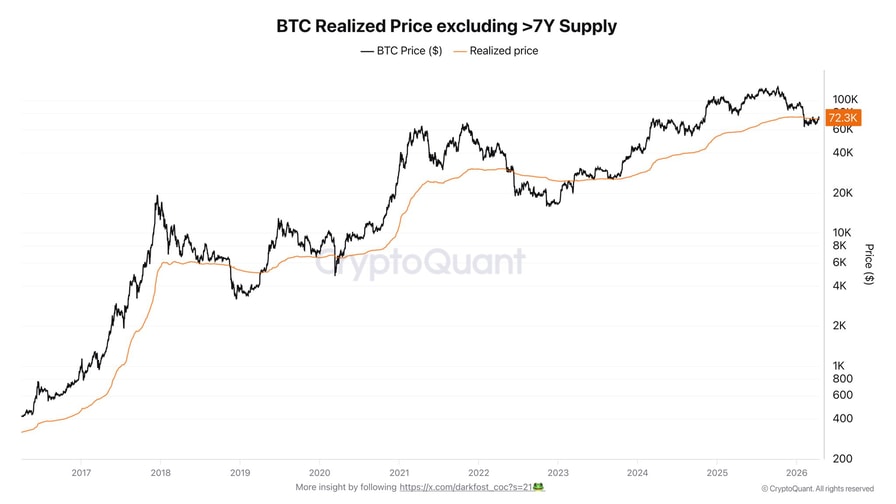
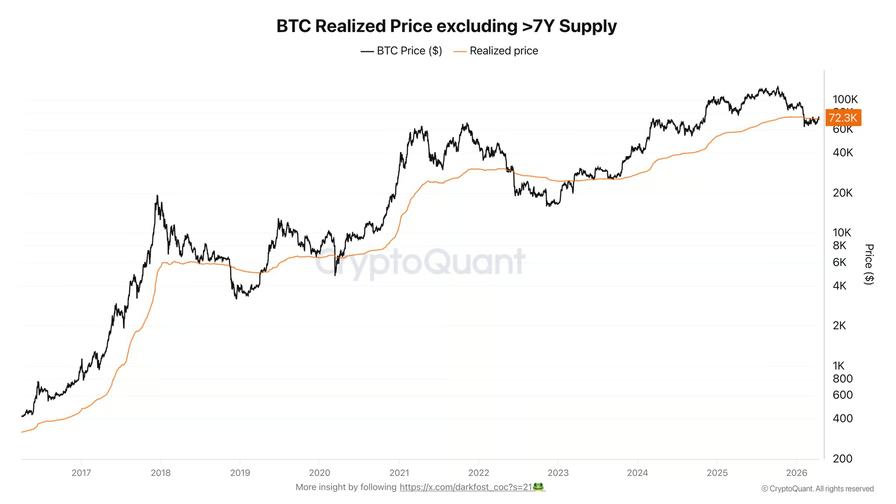
BTC realized price excluding more than a seven-year supply. Source: CryptoQuant
Bitcoin has also closed above the adjusted realized price at $72,300. This metric tracks the average acquisition cost of circulating supply, excluding coins held for more than seven years. A move above it places a large share of investors above the break-even level.
Crypto analyst Darkfost noted that a weekly close above the adjusted realized price on April 19 signaled stronger long-term investor conviction in Bitcoin. The analyst added,
“A truly bullish signal would be for Bitcoin to start building a standard deviation above this average cost basis, pushing more investors into profit and encouraging them to hold due to increased conviction.”
US spot ETF positioning adds an institutional cost basis level. The weighted average cost basis of US spot Bitcoin ETFs sits near $76,700, placing the price close to a key area of recent institutional accumulation. The short-term holder’s cost basis is near $81,800, a level at which investors could build more conviction if the price holds above it.
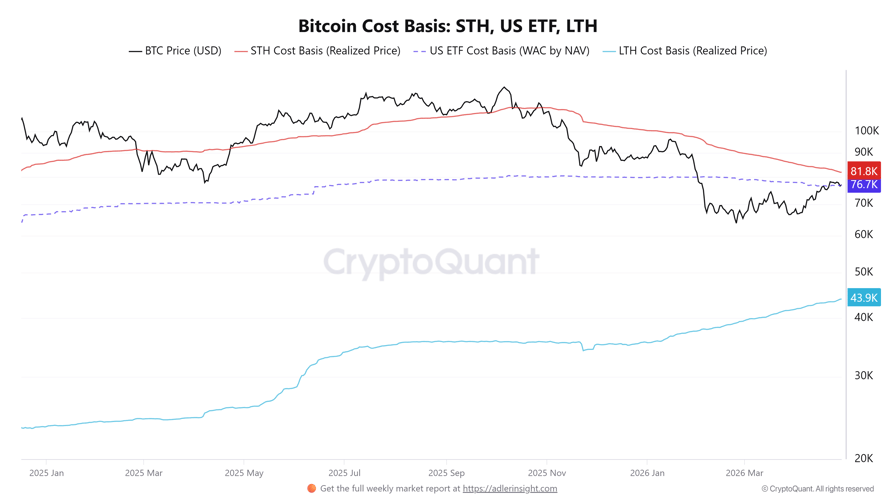
Bitcoin cost basis for STH, US ETF, and LTH. Source: CryptoQuant
Together, these overlapping cost bases compress around $75,000, concentrating both realized and unrealized positioning in a narrow price range. This clustering increases price sensitivity to flows near this level, making it a key support zone.
Related: Bitcoin eyes $75K after ‘most hawkish’ FOMC as oil hits highest since 2022
BTC liquidity bands outline the near-term range
With the support level established at $75,000, the derivatives data outlines a tight liquidity corridor. Cumulative long liquidation risk nears $74,000, with roughly $2.69 billion at risk, while short liquidations near $80,000 total about $4.48 billion.
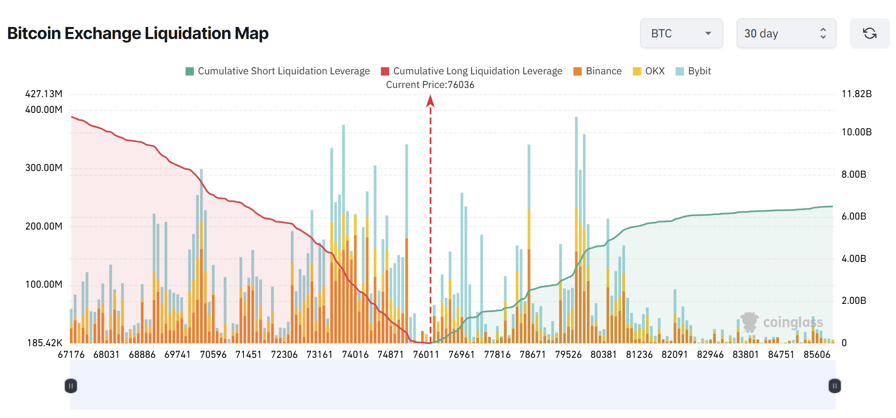
Bitcoin exchange liquidation map. Source: CoinGlass
A recent swing between $77,873 and $74,868 on Wednesday cleared $494 million in positions, including $347 million in longs.
Crypto analyst CW said the high-leverage longs have been reduced, while a larger pool of short liquidations sits above $80,000. The $74,000 to $80,000 band continues to anchor positioning, with both sides clustering around key cost-basis levels.
Related: Most crypto investors believe Bitcoin is undervalued: Coinbase survey


Best Multi-Asset Broker is a category within the BeInCrypto Institutional 100, covering platforms that bring crypto into broader brokerage accounts alongside equities, FX, futures, ETFs, and other asset classes.
This Category sits under Pillar 1: Retail to Crypto Bridge, with the 2026 long list drawn from multi-asset brokers and bank-brokerage platforms active between April 2025 and March 2026.
A shortlist will be named in May 2026, with the winner announced at Proof of Talk in Paris on June 2–3, 2026.
- Longlist: 15 firms, covering Nasdaq- and LSE-listed multi-asset brokers, FINMA-supervised Swiss banks with integrated crypto exchanges, German banking-licensed pan-European platforms, US wealth managers entering spot crypto, and CFD-led FX brokers building dedicated spot venues.
- Candidates screened: Starting pool of 32 multi-asset brokers and bank-brokerage hybrids with live crypto offerings; 15 advanced to this longlist, with 5 additional firms held in the outreach pool.
- Scoring (Track B): 30% quantitative data · 50% Expert Council · 20% disclosed company data.
- Criteria assessed: Crypto coverage, execution quality, cross-asset integration, volume and adoption, regulatory standing, innovation, and industry standing.
- Sources: Regulator registers (FCA, FINMA, BaFin, ASIC, CFTC, MAS), audited filings, firm disclosures, partner integrations, and private-market platforms.
| # | Firm | HQ | In Crypto Since | Scale Signal | Crypto Product | Status | Representative Work |
|---|---|---|---|---|---|---|---|
| 1 | Interactive Brokers | Greenwich, CT | 2021 | Nasdaq: IBKR 2.5M+ accounts across 170+ markets |
11 spot cryptos via Paxos and Zero Hash Coinbase nano BTC/ETH futures added Feb 2026 |
Public · Nasdaq listed | Expanded crypto access inside a global brokerage account Added crypto-to-account transfers in Mar 2026 |
| 2 | IG Group | London, UK | 2018 | LSE: IGG · FTSE 100 820,000 active clients in FY25 |
55+ tokens via FCA cryptoasset registration Crypto 10 Index and Independent Reserve exposure |
Public · LSE listed | First FCA-registered crypto offering from a UK-listed broker Acquired Independent Reserve in 2025–26 |
| 3 | Swissquote | Gland, Switzerland | 2017 | SIX: SQN 650,000+ accounts; FINMA and CSSF licences |
50+ cryptos through SQX exchange Staking on ETH, DOT, SOL, ADA, XTZ |
Public · SIX listed | Integrated crypto into a Swiss banking and brokerage model Offers native exchange, custody, and staking access |
| 4 | Saxo Bank | Copenhagen, Denmark | 2018 | 1M+ clients 200+ banks and 400+ intermediaries |
Crypto ETPs for all clients Crypto FX pairs for elective professional clients |
Private · Bank-licensed | White-label broker infrastructure with crypto-linked products J. Safra Sarasin 70% acquisition closed Mar 2026 |
| 5 | Charles Schwab | Westlake, TX | 2024 | NYSE: SCHW ~$12T client assets; 38.9M brokerage accounts |
Schwab Crypto launching Q2 2026 Spot BTC and ETH via Schwab Premier Bank |
Public · NYSE listed | Brings spot crypto to one of the largest US wealth platforms Announced 0.75% crypto trading fee in Apr 2026 |
| 6 | Fidelity Investments | Boston, MA | 2018 | Privately held Enterprise custody through Fidelity Digital Assets |
Fidelity Crypto retail trading FBTC, FETH, FSOL and IRA-eligible products |
Private · Trust company | Combines retail trading, custody, and crypto ETP access Uses institutional infrastructure built through Fidelity Digital Assets |
| 7 | flatexDEGIRO | Frankfurt, Germany | 2024 | FRA: FTK 3.35M+ customers across 16 European countries |
Spot crypto launched Dec 2024 0.6% all-in cost; 90%+ customer eligibility |
Public · Frankfurt SE | Reported first €500M crypto-volume quarter in Q1 2026 Grew crypto volume roughly 5x year-on-year |
| 8 | CMC Markets | London, UK | 2017 | LSE: CMCX 12,000+ instruments; 2M+ user logins |
Crypto CFDs across major tokens Bermuda digital asset licence |
Public · LSE listed | Offers crypto CFDs inside a broad multi-asset trading platform Developing broader DeFi “super app” strategy |
| 9 | Plus500 | Haifa, Israel | 2017 | LSE: PLUS $415.1M H1 2025 revenue; 179,931 active customers |
Crypto CFDs on major tokens Separate regional spot and CFD entities |
Public · LSE listed | Maintains crypto exposure across regulated CFD entities Plus500 US extends group into CFTC-regulated markets |
| 10 | XTB | Warsaw, Poland | 2018 | WSE: XTB 2.16M+ clients across 13+ jurisdictions |
50+ crypto CFDs in the EEA 5,400+ instruments through xStation 5 |
Public · WSE listed | Brings crypto CFDs into a large European brokerage platform Expanded regulatory footprint with UAE licence upgrade |
| 11 | Webull | St. Petersburg, FL | 2020 | Nasdaq: BULL 4.3M+ funded accounts across 13+ countries |
Webull Pay crypto app US crypto access via Bakkt |
Public · Nasdaq listed | Separates crypto access from core brokerage through Webull Pay Added prediction markets in 2026 |
| 12 | Pepperstone | Melbourne, Australia | 2019 | Privately held 160 countries; seven-regulator footprint |
Pepperstone Crypto spot exchange BTC, ETH, SOL, USDC, USDT at 0.1% flat fee |
Private · Multi-regulated | Launched dedicated Australian spot crypto exchange in Feb 2026 Also offers 21 crypto CFD pairs globally |
| 13 | OANDA | New York, NY | 2024 | Privately held NFA member with 25+ year operating history |
Spot crypto via Paxos itBit Eight tokens including BTC, ETH, LINK, UNI |
Private · NFA member | Added spot crypto to a long-standing FX brokerage platform Uses mobile and TradingView access for US crypto users |
| 14 | Capital.com | Limassol, Cyprus | 2018 | Privately held 845,000+ traders; $1T+ cumulative client volume |
450+ crypto CFDs MiCA CASP licence through CySEC |
Private · MiCA-licensed | Offers one of the broadest crypto CFD lineups in the sector Secured MiCA CASP licence in Jan 2026 |
| 15 | Exness | Limassol, Cyprus | 2018 | Privately held $1T+ monthly trading volume |
BTC, ETH, LTC, BCH, XRP CFDs BTC cross pairs across several fiat currencies |
Private · Multi-regulated | Brings crypto CFD access into a high-volume FX platform Moving selected BTC cross pairs to close-only in Apr 2026 |
About This List
The BeInCrypto Institutional 100 — Multi-Asset Brokers (2026 Long List) identifies brokers and bank-brokerage platforms bringing crypto into wider trading accounts. These firms offer crypto exposure alongside traditional assets, including equities, FX, ETFs, futures, bonds, and CFDs.
The long list covers brokers, Swiss- and European-bank-backed platforms, US wealth managers, and CFD-led operators building spot crypto venues or integrated crypto access. Firms focused only on digital asset trading are evaluated separately under dedicated broker, exchange, and trading infrastructure categories.
Methodology
This category evaluates multi-asset brokers under Track B of the BeInCrypto Institutional 100 methodology: 30% editorial quantitative metrics, 50% Expert Council scoring, and 20% disclosed data.
Assessment spans seven criteria: crypto coverage, execution quality, cross-asset integration, volume and adoption, regulatory standing, innovation, and industry standing.
Data was verified using regulator registers, audited filings, company disclosures, transparency pages, partner integrations, and private-market sources, including PitchBook, Tracxn, and Crunchbase. Figures reflect the most recent available data at the time of publication.
To submit a nomination or share feedback, contact awards@beincrypto.com.
The post BeInCrypto Institutional Research: 15 Multi-Asset Brokers Integrating Crypto Trading appeared first on BeInCrypto.
Digital asset adoption in Latin America is evolving, with more users now converting funds into stablecoins than into Bitcoin — a shift that reflects growing pressure from local economic conditions.
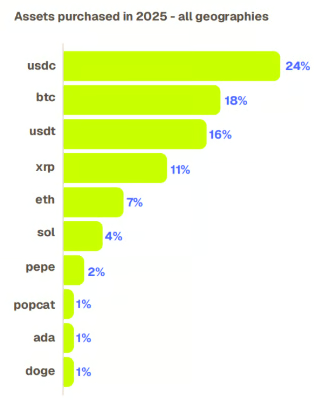
According to Bitso’s 2025 report on crypto adoption in Latin America, 40% of crypto purchases in 2025 were US dollar-linked stablecoins such as Tether’s USDt (USDT) and Circle’s USDC (USDC), while Bitcoin (BTC) accounted for 18%. The report marks the first time stablecoin purchases have surpassed Bitcoin in the region.
The findings are based on data from Bitso’s nearly 10 million retail users across its exchange platform.
The trend reflects a broader move toward what the Latin American crypto exchange described as “digital dollarization.” In countries facing persistent inflation, currency depreciation and limited access to traditional banking, stablecoins offer a relatively accessible way to store value and transact in US dollar equivalents.
While the US dollar itself is not immune to inflation, it tends to depreciate more slowly than many local currencies and remains the world’s dominant medium of exchange, making it an attractive benchmark for users seeking stability.
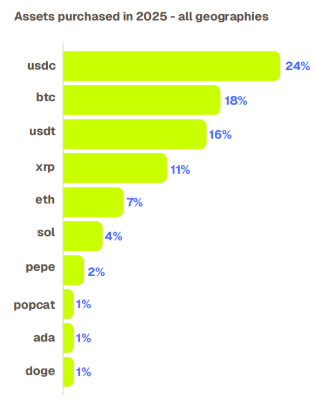
The most purchased assets in 2025 across Latin America. Source: Bitso
The global stablecoin market has grown to roughly $320 billion, with adoption expanding across both developed and emerging economies. Their Latin American regional appeal is particularly practical: users rely on stablecoins for preserving savings, making payments and sending cross-border remittances.
Use of home-grown stablecoins is benefiting from the expansion. Brazilian retail giant Mercado Libre in early April launched a cross-border remittance product using the Meli dollar stablecoin for users in Brazil, Mexico and Chile, Cointelegraph Brasil reported. That came after the retailer discontinued issuing its own stablecoin, Mercado Coin, earlier this year.
Related: Visa adds Polygon, Base support as stablecoin settlement run rate hits $7B
Bitcoin remains dominant as a store of value
While Bitcoin purchases have declined as a share of total activity, the Bitso report shows the asset still plays a central role as a long-term savings vehicle in Latin America.
“Bitcoin continues to function as Latin America’s primary long-term digital store of value,” the report said, noting that the cryptocurrency is held in 52% of crypto portfolios across the region in 2025. That’s down only slightly from 53% the previous year.
Bitcoin has long been viewed as a store of value, despite periods of volatility and uneven performance compared with previous market cycles. The asset rose above $126,000 in October before pulling back sharply, with prices later trading in the low $60,000 range.
Recent research by index maker MarketVector reframes the store-of-value narrative beyond price performance alone, arguing that Bitcoin and gold share core traits, including scarcity, decentralization and resistance to supply expansion, that underpin their long-term value.
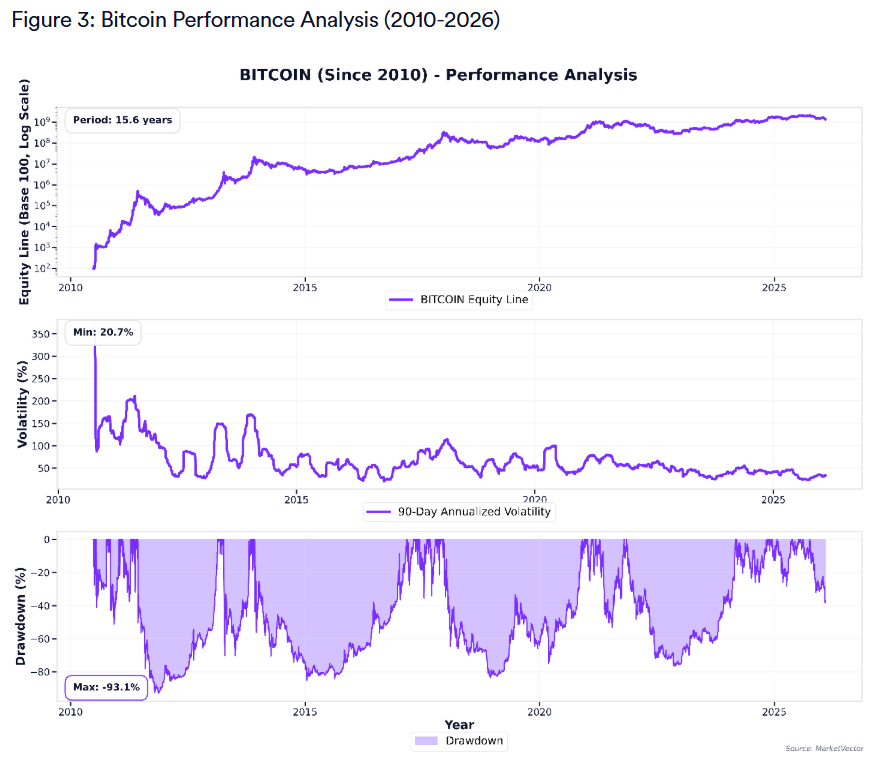
A comparison of Bitcoin’s price performance, volatility and drawdowns since inception. Source: MarketVector Indexes
Related: Did Bitcoin bottom versus gold? BTC price will reach $167K in 2027 if history repeats

Latin America’s crypto adoption path is pivoting toward stablecoins in 2025, reflecting how local conditions—high inflation, currency depreciation, and uneven access to traditional banking—shape user behavior. Bitso’s 2025 crypto adoption report, drawn from nearly 10 million retail users on its exchange, shows stablecoins accounted for 40% of crypto purchases that year, while Bitcoin represented 18%. The shift marks the first time stablecoins outpaced Bitcoin in the region’s purchase mix.
The findings illuminate what Bitso calls a movement toward “digital dollarization.” In economies where local currencies struggle to preserve value, stablecoins pegged to the U.S. dollar offer a comparatively accessible way to store value and transact in dollar equivalents. As global payment rails expand, stablecoins appear increasingly practical for everyday savings, payments, and cross-border remittances across Latin America.
Key takeaways
- Stablecoins dominated Latin American crypto purchases in 2025 at 40%, versus 18% for Bitcoin.
- Bitcoin remains a core long-term store of value, present in 52% of regional crypto portfolios in 2025, a slight dip from 53% the prior year.
- The region’s stablecoin momentum feeds into a broader global trend, with the sector near $320 billion in market capitalization and growing use as a financial tool beyond investing.
- Local use-cases are expanding, notably Mercado Libre’s cross-border remittance product using the Meli dollar stablecoin for Brazil, Mexico and Chile, following the earlier discontinuation of its Mercado Coin offering.
Stablecoins reshape Latin American on-ramps
Bitso’s data underscore a practical shift in how individuals interact with crypto: stablecoins are increasingly used as a first point of entry and a medium of daily value transfer. In economies facing persistent inflation and currency volatility, stablecoins provide a more predictable unit of account than many local currencies, alongside faster settlement and lower friction for cross-border payments.
Beyond on-ramps, stablecoins are gaining traction as a component of regional financial infrastructure. The Bitso study situates stablecoins not merely as speculative assets but as tools that empower savers and small businesses to navigate volatility, access dollar-denominated payment rails, and send remittances with lower costs than traditional channels.
Bitcoin endures as a regional store of value
While the share of crypto activity tied to Bitcoin has declined slightly as stablecoins gain ground, the asset continues to anchor Latin American portfolios. The Bitso report notes that Bitcoin remains the primary long-term digital store of value, held in 52% of crypto portfolios in 2025, down marginally from 53% in 2024.
Industry observers have long framed Bitcoin as a scarce, decentralized store of value akin to gold. New analyses, including research from MarketVector, broaden that lens by highlighting common traits—scarcity, decentralization, and resistance to supply expansion—that underpin Bitcoin’s narrative as a durable store of value, even amid price volatility.
Local innovations push adoption forward
Regional deployments illustrate how stablecoins are moving beyond speculation toward practical use cases. In early April, Mercado Libre reported the launch of a cross-border remittance product using its Meli dollar stablecoin for users in Brazil, Mexico and Chile. The rollout followed the company’s earlier decision to discontinue issuing its own stablecoin, Mercado Coin, earlier this year. The move signals a shift toward dollar-linked digital currencies as a backbone for cross-border commerce within Latin America.
These developments sit within a broader ecosystem trend: the global stablecoin market has grown to roughly $320 billion, with adoption expanding across both developed and emerging economies. The Latin American experience demonstrates how stablecoins can function as a bridging technology—supporting savings, domestic payments, and regional remittances in an increasingly interconnected digital economy.
Broader market backdrop and policy signals
The Latin American story unfolds against a global backdrop where stablecoins are increasingly integrated into payments and settlement rails. For example, larger payment networks have begun to explore or implement stablecoin settlements, a trend that could accelerate liquidity and adoption in regions with imperfect traditional banking access. In related Asia-Pacific and European developments, industry participants emphasize that stablecoins offer efficiency gains for merchants and users alike, while regulators weigh consumer protections and systemic risk considerations.
US dollar dynamics also matter in this narrative. While the dollar itself faces inflationary headwinds, it historically retains greater stability relative to many local currencies, reinforcing the appeal of dollar-pegged digital assets for regional users seeking to preserve purchasing power.
What comes next for Latin America’s crypto landscape
Looking ahead, readers should watch how LATAM regulators balance innovation with safeguards as stablecoins scale in everyday use. The region’s mix of high inflation in some economies, ongoing currency depreciation, and evolving fintech ecosystems creates both opportunity and risk for stablecoins, Bitcoin, and related services. Investor and user interest may hinge on liquidity, on-ramps for new users, and the development of compliant custody and payment rails that can support cross-border activity at scale.
As Bitso’s findings illustrate, stablecoins have moved from niche instruments to practical components of everyday financial life in Latin America. The coming year will reveal whether this digital dollarization trend broadens beyond pockets of inflationary stress to become a pervasive feature of the region’s financial infrastructure.
Why Bitcoin stays below $78K despite ETF demand

Timberwolves Game 4 hero Ayo Dosunmu out for Game 6 in latest blow for Minnesota

Can A Samsung Tablet Replace A Laptop?

Manchester United reach agreement with Casemiro over contract clause amid transfer speculation

US brings back mandatory military draft registration

Steven Gerrard disagrees with Gary Neville over ‘shock’ Chelsea and Arsenal claim | Football


-

 Tech3 days ago
Register Renaming | Hackaday
-

 Fashion6 days ago
Weekend Open Thread – Corporette.com
-
 Crypto World5 days ago
Hyperliquid $HYPE Rally Builds Momentum as AI Sector Enters Prove-It Phase
-

 Politics3 days ago
Drax board avoid their own AGM, accused of greenwashing & environmental racism
-

 Business7 days ago
Patterson-UTI Energy, Inc. (PTEN) Q1 2026 Earnings Call Transcript
-
 Sports4 days ago
IPL 2026: Ruturaj Gaikwad registers slowest fifty of the season, enters all-time unwanted list | Cricket News
-

 NewsBeat5 days ago
LK Bennett closes all stores after entering administration
-

 Tech3 days ago
Images of Samsung’s rumored smart glasses have leaked
-

 Tech4 days ago
Why Blue Badges Disappeared From Toyota Hybrids
-

 Crypto World7 days ago
Michael Saylor says BTC winter is over. Market analyst disagrees, says bitcoin was in a pullback
-

 Fashion2 days ago
Kylie Jenner’s KHY Enters a New Era with ‘Born in LA’
-
 Entertainment5 days ago
Mariah Carey Slams Deposition Claims In Brother’s Lawsuit
-

 Business2 days ago
Most Commercial Energy Audits Miss the Real Losses
-
 NewsBeat7 days ago
Trump threatens to review UK’s claim to Falkland Islands and punish Nato allies over Iran war disagreement
-

 Business6 days ago
Jeanine Pirro announces closure of Federal Reserve building cost probe
-

 Business3 days ago
(VIDEO) Charlize Theron Climbs Times Square Billboard to Promote New Netflix Thriller ‘Apex’
-

 Tech5 days ago
Microsoft to roll out Entra passkeys on Windows in late April
-

 Crypto World2 days ago
CFTC’s AI will review U.S. crypto registration applications, chairman tells CoinDesk
-
 Crypto World6 days ago
Nvidia (NVDA) Stock Jumps 5% as Intel Earnings Ignite Semiconductor Rally
-

 Tech5 days ago
OpenAI’s Sam Altman apologizes for not reporting ChatGPT account of Tumbler Ridge suspect to police
You must be logged in to post a comment Login