
Crypto World
BeInCrypto Institutional Research: 15 Multi-Asset Brokers Integrating Crypto Trading



Best Multi-Asset Broker is a category within the BeInCrypto Institutional 100, covering platforms that bring crypto into broader brokerage accounts alongside equities, FX, futures, ETFs, and other asset classes.
This Category sits under Pillar 1: Retail to Crypto Bridge, with the 2026 long list drawn from multi-asset brokers and bank-brokerage platforms active between April 2025 and March 2026.
A shortlist will be named in May 2026, with the winner announced at Proof of Talk in Paris on June 2–3, 2026.
- Longlist: 15 firms, covering Nasdaq- and LSE-listed multi-asset brokers, FINMA-supervised Swiss banks with integrated crypto exchanges, German banking-licensed pan-European platforms, US wealth managers entering spot crypto, and CFD-led FX brokers building dedicated spot venues.
- Candidates screened: Starting pool of 32 multi-asset brokers and bank-brokerage hybrids with live crypto offerings; 15 advanced to this longlist, with 5 additional firms held in the outreach pool.
- Scoring (Track B): 30% quantitative data · 50% Expert Council · 20% disclosed company data.
- Criteria assessed: Crypto coverage, execution quality, cross-asset integration, volume and adoption, regulatory standing, innovation, and industry standing.
- Sources: Regulator registers (FCA, FINMA, BaFin, ASIC, CFTC, MAS), audited filings, firm disclosures, partner integrations, and private-market platforms.
| # | Firm | HQ | In Crypto Since | Scale Signal | Crypto Product | Status | Representative Work |
|---|---|---|---|---|---|---|---|
| 1 | Interactive Brokers | Greenwich, CT | 2021 | Nasdaq: IBKR 2.5M+ accounts across 170+ markets |
11 spot cryptos via Paxos and Zero Hash Coinbase nano BTC/ETH futures added Feb 2026 |
Public · Nasdaq listed | Expanded crypto access inside a global brokerage account Added crypto-to-account transfers in Mar 2026 |
| 2 | IG Group | London, UK | 2018 | LSE: IGG · FTSE 100 820,000 active clients in FY25 |
55+ tokens via FCA cryptoasset registration Crypto 10 Index and Independent Reserve exposure |
Public · LSE listed | First FCA-registered crypto offering from a UK-listed broker Acquired Independent Reserve in 2025–26 |
| 3 | Swissquote | Gland, Switzerland | 2017 | SIX: SQN 650,000+ accounts; FINMA and CSSF licences |
50+ cryptos through SQX exchange Staking on ETH, DOT, SOL, ADA, XTZ |
Public · SIX listed | Integrated crypto into a Swiss banking and brokerage model Offers native exchange, custody, and staking access |
| 4 | Saxo Bank | Copenhagen, Denmark | 2018 | 1M+ clients 200+ banks and 400+ intermediaries |
Crypto ETPs for all clients Crypto FX pairs for elective professional clients |
Private · Bank-licensed | White-label broker infrastructure with crypto-linked products J. Safra Sarasin 70% acquisition closed Mar 2026 |
| 5 | Charles Schwab | Westlake, TX | 2024 | NYSE: SCHW ~$12T client assets; 38.9M brokerage accounts |
Schwab Crypto launching Q2 2026 Spot BTC and ETH via Schwab Premier Bank |
Public · NYSE listed | Brings spot crypto to one of the largest US wealth platforms Announced 0.75% crypto trading fee in Apr 2026 |
| 6 | Fidelity Investments | Boston, MA | 2018 | Privately held Enterprise custody through Fidelity Digital Assets |
Fidelity Crypto retail trading FBTC, FETH, FSOL and IRA-eligible products |
Private · Trust company | Combines retail trading, custody, and crypto ETP access Uses institutional infrastructure built through Fidelity Digital Assets |
| 7 | flatexDEGIRO | Frankfurt, Germany | 2024 | FRA: FTK 3.35M+ customers across 16 European countries |
Spot crypto launched Dec 2024 0.6% all-in cost; 90%+ customer eligibility |
Public · Frankfurt SE | Reported first €500M crypto-volume quarter in Q1 2026 Grew crypto volume roughly 5x year-on-year |
| 8 | CMC Markets | London, UK | 2017 | LSE: CMCX 12,000+ instruments; 2M+ user logins |
Crypto CFDs across major tokens Bermuda digital asset licence |
Public · LSE listed | Offers crypto CFDs inside a broad multi-asset trading platform Developing broader DeFi “super app” strategy |
| 9 | Plus500 | Haifa, Israel | 2017 | LSE: PLUS $415.1M H1 2025 revenue; 179,931 active customers |
Crypto CFDs on major tokens Separate regional spot and CFD entities |
Public · LSE listed | Maintains crypto exposure across regulated CFD entities Plus500 US extends group into CFTC-regulated markets |
| 10 | XTB | Warsaw, Poland | 2018 | WSE: XTB 2.16M+ clients across 13+ jurisdictions |
50+ crypto CFDs in the EEA 5,400+ instruments through xStation 5 |
Public · WSE listed | Brings crypto CFDs into a large European brokerage platform Expanded regulatory footprint with UAE licence upgrade |
| 11 | Webull | St. Petersburg, FL | 2020 | Nasdaq: BULL 4.3M+ funded accounts across 13+ countries |
Webull Pay crypto app US crypto access via Bakkt |
Public · Nasdaq listed | Separates crypto access from core brokerage through Webull Pay Added prediction markets in 2026 |
| 12 | Pepperstone | Melbourne, Australia | 2019 | Privately held 160 countries; seven-regulator footprint |
Pepperstone Crypto spot exchange BTC, ETH, SOL, USDC, USDT at 0.1% flat fee |
Private · Multi-regulated | Launched dedicated Australian spot crypto exchange in Feb 2026 Also offers 21 crypto CFD pairs globally |
| 13 | OANDA | New York, NY | 2024 | Privately held NFA member with 25+ year operating history |
Spot crypto via Paxos itBit Eight tokens including BTC, ETH, LINK, UNI |
Private · NFA member | Added spot crypto to a long-standing FX brokerage platform Uses mobile and TradingView access for US crypto users |
| 14 | Capital.com | Limassol, Cyprus | 2018 | Privately held 845,000+ traders; $1T+ cumulative client volume |
450+ crypto CFDs MiCA CASP licence through CySEC |
Private · MiCA-licensed | Offers one of the broadest crypto CFD lineups in the sector Secured MiCA CASP licence in Jan 2026 |
| 15 | Exness | Limassol, Cyprus | 2018 | Privately held $1T+ monthly trading volume |
BTC, ETH, LTC, BCH, XRP CFDs BTC cross pairs across several fiat currencies |
Private · Multi-regulated | Brings crypto CFD access into a high-volume FX platform Moving selected BTC cross pairs to close-only in Apr 2026 |
About This List
The BeInCrypto Institutional 100 — Multi-Asset Brokers (2026 Long List) identifies brokers and bank-brokerage platforms bringing crypto into wider trading accounts. These firms offer crypto exposure alongside traditional assets, including equities, FX, ETFs, futures, bonds, and CFDs.
The long list covers brokers, Swiss- and European-bank-backed platforms, US wealth managers, and CFD-led operators building spot crypto venues or integrated crypto access. Firms focused only on digital asset trading are evaluated separately under dedicated broker, exchange, and trading infrastructure categories.
Methodology
This category evaluates multi-asset brokers under Track B of the BeInCrypto Institutional 100 methodology: 30% editorial quantitative metrics, 50% Expert Council scoring, and 20% disclosed data.
Assessment spans seven criteria: crypto coverage, execution quality, cross-asset integration, volume and adoption, regulatory standing, innovation, and industry standing.
Data was verified using regulator registers, audited filings, company disclosures, transparency pages, partner integrations, and private-market sources, including PitchBook, Tracxn, and Crunchbase. Figures reflect the most recent available data at the time of publication.
To submit a nomination or share feedback, contact awards@beincrypto.com.
The post BeInCrypto Institutional Research: 15 Multi-Asset Brokers Integrating Crypto Trading appeared first on BeInCrypto.

Crypto World
Monero Price Prediction Gains Momentum as XMR Rallies 26% and Pepeto Presale Pulls Smart Capital
The monero price prediction carries real weight this cycle because XMR hit a new all-time high of $798 in January 2026 and now trades 52% below that peak at $376. Monero (XMR) climbed 26% in April on pure spot buying with zero retail participation according to Santiment data, and Strategy added another $255 million in Bitcoin on April 27 per Yahoo Finance, proving that institutional capital is positioning hard during fear.
While the XMR forecast plays out over months, Pepeto is pulling in the kind of capital that only appears before the biggest moves. More than $9.66 million raised, a Binance listing approaching, working tools already live, and a presale price of $0.0000001867 that disappears the second trading opens.
Monero Price Prediction Sharpens as Spot Buying Drives April Without Retail Participation
Monero (XMR) climbed from $320 to $405 between April 7 and April 26 while retail futures activity registered neutral every session according to Santiment data. Spot taker volume showed buy dominance in 24 consecutive sessions.
When a privacy coin gains 26% on spot accumulation alone with no retail crowd, the monero price prediction shifts from hope to pure timing.
XMR at $376 and Pepeto at $9.66M: Where the Timing Already Points
Pepeto: The Presale That Solved the One Problem XMR Holders Know Too Well
Monero (XMR) holders know the best entries happen when nobody is paying attention and the price has not caught up to the truth. That is where Pepeto sits right now, except the catalyst is not time and adoption. It is a single event, the Binance listing, and once it happens, the presale price is gone forever.
Every tool in the Pepeto network is already running. The exchange processes trades with no fee on either side, a bridge transfers tokens across Ethereum, BNB, and Solana and delivers the full amount with nothing removed, and a contract scanner reads every token’s code and rejects anything designed to take funds. SolidProof confirmed the full system with results on-chain.
The original Pepeto domain was targeted by attacks as the project grew in size and attention. The team secured a new address, and Pepeto is where the presale now operates.
The same person who created the original Pepe token and grew it to $11 billion shipped every tool before this presale started, and a former Binance executive handles the listing. At $0.0000001867 with staking at 177% APY compounding positions every single day, the distance between presale price and listing price is the kind of gap that even the best monero price prediction cannot produce from a $6.94 billion base.
Monero (XMR) Price at $376 as Spot Accumulation Drives the Strongest April Rally in Years
Monero (XMR) trades near $376 with a $6.94 billion cap, sitting 52% below its January 2026 all-time high of $798 per CoinMarketCap. Analyst Will Taylor targets $1,160 per NewsBTC, while Changelly projects a bull case of $555 by year end.
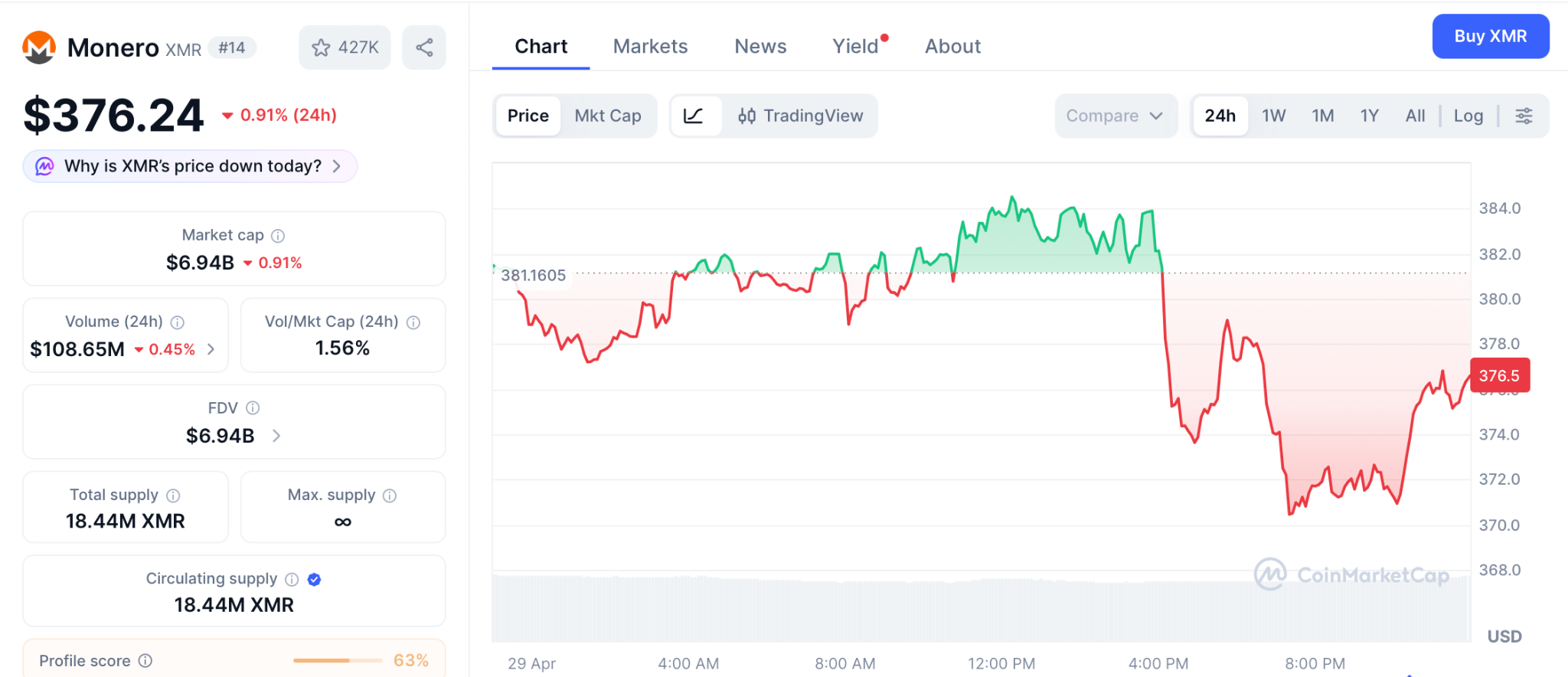
The $400 zone is key resistance, and a break above it confirms a fresh move higher. Even the bull case delivers 47% from current levels, strong for a privacy coin but months away.
Conclusion:
Monero (XMR) holds the privacy narrative and a 26% spot-driven April rally that proves serious capital is behind it, but even the bull case at $555 delivers 47% over months from a $6.94 billion base, and that is a trade, not the kind of event that changes how someone lives. The returns that change lives come from one decision made at the right time, before the listing opens and the entire market has to pay what early holders already locked in.
The person who built the $11 billion Pepe token shipped a full working exchange this time, a SolidProof audit sits on-chain for anyone to check, a former Binance executive runs the listing process, and $9.66 million came in from wallets that have seen presale-to-listing events turn small entries into life-altering returns and are placing themselves exactly where the biggest return sits.
The Binance listing is approaching, the presale price of $0.0000001867 disappears the moment trading opens, and every day closer to that date is one less day to enter at a price the open market will never offer again. Visit Pepeto right now, because when this listing hits, the difference between the people who acted and the people who waited will be the story of 2026.
Click To Visit Pepeto Website To Enter The Presale

Important Notice:
The Pepeto project is moving forward fast, and because of its growing impact, bad actors have hit the official website.
The backup domain is now « PepetoSwap DOT com » in place of « Pepeto DOT io » until further updates. Users must always check they are on the correct URL before connecting wallets or sharing personal information.
FAQs
How does the April spot rally affect the monero price prediction for 2026?
The monero price prediction improved because XMR gained 26% in April on pure spot buying without retail participation, and analyst targets now reach $1,160 per Cryptoinsightuk. Pepeto at presale pricing with an upcoming listing delivers returns XMR needs months to match.
What is Pepeto and why is it drawing more capital than privacy coins this cycle?
Pepeto is a working cross-chain trading hub where every trade costs nothing in fees, a verified bridge delivers the full token amount across chains, and a scanner rejects risky contracts before capital enters. More than $9.66 million raised and a Binance listing approaching make it the presale with the strongest capital flow during fear.
Disclaimer: This is a Press Release provided by a third party who is responsible for the content. Please conduct your own research before taking any action based on the content.


Polymarket, the prediction market platform, has enlisted Chainalysis to bolster on-chain oversight and curb insider-informed betting. The collaboration aims to provide an on-chain market integrity solution designed to monitor trading activity and surface patterns that may indicate non-public information being used to place bets. In a landscape where volatile real-world events increasingly feed digital markets, the move seeks to reinforce platform rules and restore user trust after a string of controversial bets tied to sensitive developments.
The initiative reflects a broader push within the crypto prediction ecosystem to adopt more rigorous surveillance measures as regulators scrutinize the space for manipulation and improper access to information. Polymarket described the model as one that can identify patterns consistent with insider knowledge and help flag transactions or trading behavior that warrant closer review.
Polymarket emphasized that it has already implemented stricter safeguards to address manipulation concerns, a trend highlighted by coverage from Cointelegraph. The latest partnership with Chainalysis adds an additional layer of on-chain analytics aimed at reinforcing market integrity and compliance with platform rules.
Key takeaways
- Polymarket is deploying an on-chain market integrity system with Chainalysis to detect patterns that may indicate insider information driving bets.
- The move comes amid heightened regulatory and public scrutiny of prediction markets, including legal action and proposed prohibitions on certain participants.
- Industry volumes in prediction markets continued to surge, with March trading activity estimated near $25.7 billion, underscoring retail-driven participation and a growing ecosystem.
- Regulators in the United States are pursuing a multi-front approach—from DOJ charges to state and federal enforcement—raising questions about the future of unregulated prediction markets.
Polymarket expands on-chain oversight with Chainalysis
Polymarket disclosed that it selected Chainalysis to provide an on-chain market integrity solution intended to monitor trading activity and enforce platform rules. The company said the detection model is designed to surface patterns that align with insider knowledge being used to place bets, with alerts routed to internal reviewers for potential action.
Chainalysis’ role centers on analyzing on-chain activity around Polymarket markets to identify anomalous sequences, clustering of trades, or other indicators that may signal non-public information is influencing market pricing. By integrating investigative analytics into its workflow, Polymarket seeks to deter exploitative behavior and improve response times to suspected misconduct.
Industry observers have stressed that such tools are increasingly necessary as prediction markets grow in size and complexity. While on-chain monitoring cannot eliminate all risks, it can provide a more proactive framework for safeguarding market integrity, aligning with broader moves across the ecosystem to implement governance and compliance controls.
Polymarket’s leadership has hinted that the collaboration with Chainalysis is part of a longer-term plan to elevate trust and transparency in prediction markets, a pillar of its value proposition for users who want to bet on real-world events with transparent settlement rules.
The company also noted that it had already introduced tighter trading safeguards to address concerns about manipulation—an evolution Cointelegraph covered in a prior report on Polymarket’s rule updates. The current partnership with Chainalysis complements those safeguards by adding a formal, on-chain analytics layer that can be scaled across markets.
Regulatory backdrop tightens around prediction markets
The policy environment for crypto-driven prediction markets has grown more complex in recent weeks. In a notable enforcement action, the U.S. Department of Justice charged a U.S. Army soldier with using classified information to place large winning bets on events linked to U.S. actions, illustrating how insider information can intersect with prediction-market activity. This case highlighted the potential legal exposure for participants who leverage confidential information to profit from outcomes in real time.
Separately, the U.S. Senate advanced an amendment to its Standing Rules that would immediately prohibit senators from trading on prediction markets. The move signals growing scrutiny at the highest levels of government over how elected officials interact with these platforms and the potential for conflicts of interest.
Against this backdrop, state authorities have also taken aim at unregulated markets. New York recently filed lawsuits against Coinbase Financial Markets and Gemini Titan, alleging that their prediction market offerings violate state gambling laws. The actions underscore a broader tension between innovation in digital markets and traditional regulatory frameworks.
For Polymarket and other platforms, the regulatory environment is a critical variable determining user adoption and long-term viability. While enhanced safeguards and monitoring can bolster compliance posture, ongoing legislative and judicial developments will shape how these markets evolve or retreat in certain jurisdictions.
Alongside these regulatory currents, market participants and observers have noted an expansion in engagement with prediction markets. Yet the regulatory appetite for tighter controls remains a significant counterweight to growth. Industry coverage has pointed to a mixed environment where investor curiosity and retail participation are rising, even as regulators pause to reassess governance, disclosure, and participant eligibility.
In this climate, observers are watching not only for headline enforcement actions but also for the practical effects of governance updates. How entities implement surveillance, how swiftly authorities respond to alleged misconduct, and how the market adapts to changing rules will determine whether prediction markets can scale while maintaining trust.
Markets rise, and scrutiny intensifies
A recent collaborative report from Bitget Wallet and Polymarket found that monthly trading volumes reached approximately $25.7 billion in March. The research indicates that retail participants are driving much of the activity and that trends are shifting toward more sustained engagement, particularly in sports-related markets. This level of activity demonstrates the demand for structured, event-based betting as a way to hedge opinions or speculate on outcomes beyond traditional financial instruments.
Nevertheless, the surge in volumes coexists with a tightening regulatory stance. The so-called “regulatory tug-of-war” between U.S. state authorities and federal regulators over how prediction markets should be governed continues. As enforcement actions and new restrictions unfold, platforms face a balancing act between innovation and compliance, with potential implications for liquidity, market depth, and user experience.
For market participants, the evolving landscape means heightened attention to risk management and governance frameworks. The introduction of Chainalysis’ on-chain integrity tools could help reduce the incidence of insider-informed betting and improve auditability, but questions remain about how these measures will influence user participation and market quality in the near term.
While the regulatory narrative remains unsettled, Polymarket’s emphasis on integrity and Chainalysis’ analytics points to a broader industry trend: prediction markets that blend open participation with robust oversight may become the norm, rather than the exception, if they can demonstrate resilience against manipulation and clear paths to compliance.
As policymakers and market operators navigate this terrain, investors and users should monitor ongoing enforcement actions, rule updates, and the outcomes of on-chain surveillance programs. The balance between innovation, inclusion, and protection will continue to shape the trajectory of crypto-based prediction markets in the months ahead.
What remains uncertain is how quickly regulators will formalize rules that can accommodate the unique characteristics of prediction markets while safeguarding against abuse. Readers should keep an eye on forthcoming policy developments, platform governance updates, and any measurable impact from enhanced on-chain oversight on trading behavior.


President Trump will receive a military briefing today from CENTCOM Commander Admiral Brad Cooper on new Iran options, including a “short and powerful” wave of infrastructure strikes, a Strait of Hormuz ground operation, and a special forces mission to secure Iran’s enriched uranium stockpile, as Bitcoin opened at its lowest level since April 13.
Summary
- The Iran briefing signals Trump is seriously considering resuming major combat operations to break the stalled nuclear negotiations, according to two sources who spoke to Axios.
- CENTCOM has also prepared an option for US forces to physically seize part of the Strait of Hormuz to reopen it for commercial shipping, a plan that could involve ground troops on Iranian-controlled territory.
- Bitcoin fell to its lowest morning open since April 13 as the Axios report circulated, with Ethereum hitting a multi-week low and oil prices pushing above $107 per barrel on escalation fears.
Iran briefing news broke this morning when Axios reported that CENTCOM Commander Admiral Brad Cooper is scheduled to brief Trump today on a range of new military options against Tehran. Joint Chiefs Chairman General Dan Caine is also expected to attend the session. The briefing comes as diplomatic talks between Washington and Tehran have stalled over Iran’s refusal to commit to abandoning its uranium enrichment program. Trump told Axios separately that he views the naval blockade as “somewhat more effective than bombing,” but made clear military action remains on the table.
As crypto.news reported, the US naval blockade has been in place since April 13 as leverage to force Iranian concessions on nuclear enrichment, with Tehran refusing to negotiate under what it describes as coercive pressure. Each confirmed escalation signal in this conflict has produced immediate Bitcoin selling, with BTC dropping from $79,000 to the mid-$74,000 range this week on the combined weight of the hawkish FOMC outcome and renewed Iran pressure. The April 30 Axios briefing report pushed crypto prices lower on the open, with Bitcoin opening at its weakest morning level since April 13 and Ethereum falling to a multi-week low. Oil prices, which directly shape Fed inflation expectations and therefore crypto liquidity conditions, rose above $107 per barrel on the news.
As crypto.news documented, Bitcoin’s sensitivity to every Iran diplomatic signal has been one of the defining market dynamics of 2026, with the asset tracking geopolitical headlines more closely than any on-chain metric. As crypto.news tracked, Iran has also been demanding stablecoin payments from ships seeking Strait of Hormuz transit, directly entangling crypto infrastructure in the conflict’s economic mechanics.
Ripple-backed XRP treasury company Evernorth has named OpenAI Foundation CFO Robert Kaiden and Antalpha COO Derar Islim as independent directors in its second SEC S-4 amendment, bringing AI and institutional finance expertise onto the board of the company aiming to list on Nasdaq under ticker XRPN.
Summary
- The Evernorth XRP board now includes Robert Kaiden (OpenAI Foundation CFO), Derar Islim (Antalpha COO), Ted Janus, and Ripple CLO Stuart Alderoty, creating a governance structure that bridges AI, crypto, and traditional finance.
- Evernorth has raised over $1 billion in gross proceeds from investors including Ripple, SBI Holdings, Pantera Capital, Kraken, and Arrington Capital, with Ripple Labs contributing 126.79 million XRP directly.
- The company currently holds over 473 million XRP in treasury, valued at approximately $656 million, and plans to become the largest publicly traded XRP treasury company on Nasdaq.
Evernorth XRP treasury company filed its second amendment to its Form S-4 registration statement with the SEC, naming OpenAI Foundation CFO Robert Kaiden and Nasdaq-listed Antalpha COO Derar Islim as independent directors under Nasdaq rules. CoinGape reported that the appointments bring deep expertise in audits, financial oversight, and institutional digital asset leadership to a company that will hold XRP as its core balance sheet asset, similar in structure to how Strategy holds Bitcoin.
As crypto.news reported, Evernorth filed its initial Form S-4 on March 18, 2026, formally disclosing its business plan, leadership team, and strategy for the first time. The company is merging with Armada Acquisition Corp II, a SPAC sponsored by Arrington Capital, to achieve its public listing under XRPN. Ripple CLO Stuart Alderoty is also named as a board member, maintaining Ripple’s direct governance presence in the company after Ripple Labs committed 126.79 million XRP to anchor the deal. CEO Asheesh Birla, a longtime Ripple executive, leads the combined entity. As crypto.news documented, the $1 billion raise included $200 million from SBI Holdings, making it one of the largest pre-listing XRP-focused raises in history. As crypto.news tracked, the broader XRP institutional momentum — including Goldman Sachs’ $153.8 million XRP ETF position and the NYSE Arca commodity trust filing — provides the regulatory and institutional backdrop that makes Evernorth’s public market timing strategically significant.
The bridge between AI and XRP ecosystems in Kaiden’s appointment is not incidental. Kaiden’s role at the OpenAI Foundation gives Evernorth a board member with direct visibility into how AI infrastructure is being governed and financed at the highest level, a signal that the company intends to position XRP settlement infrastructure as a relevant layer for AI-driven financial applications.
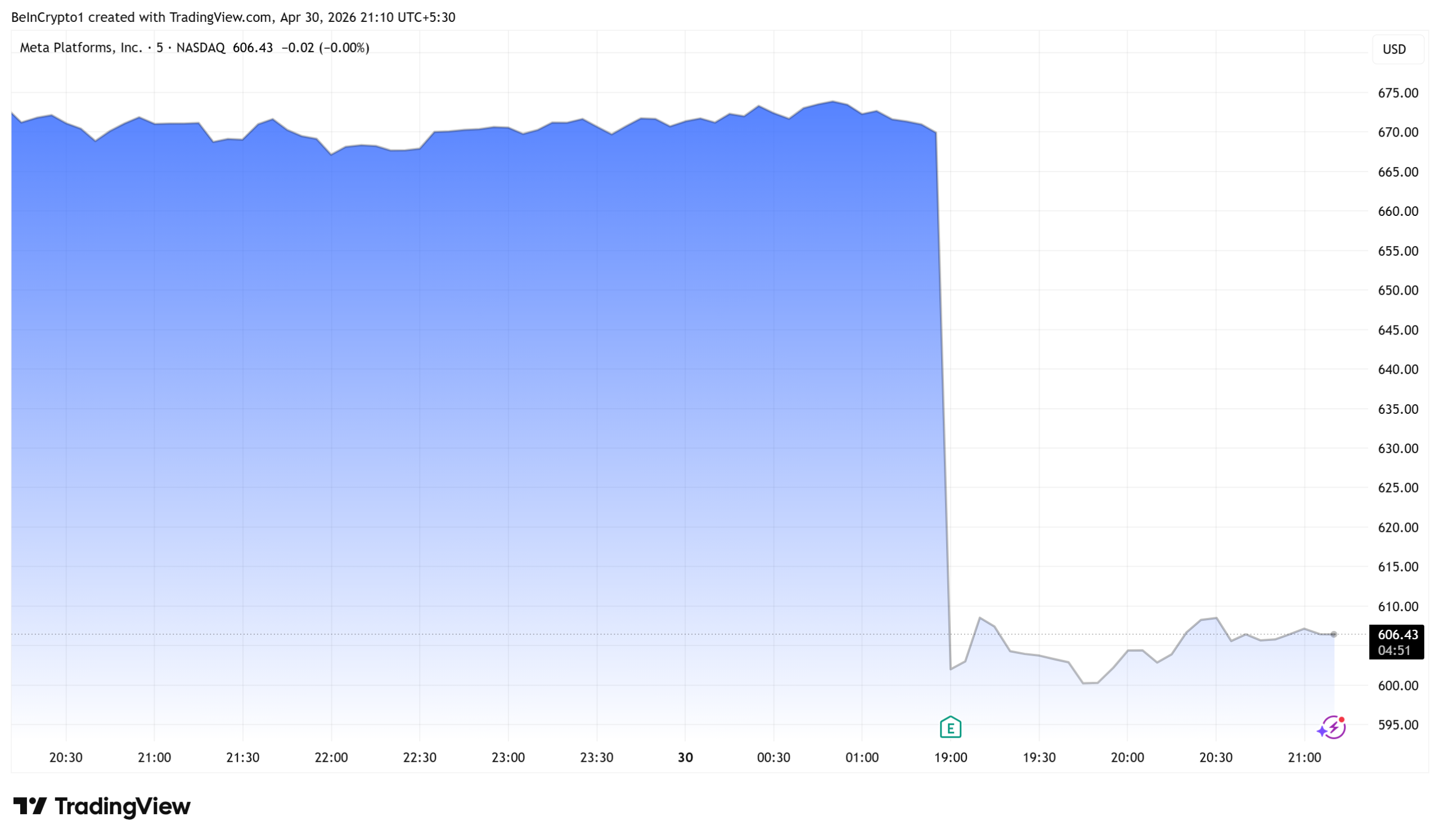
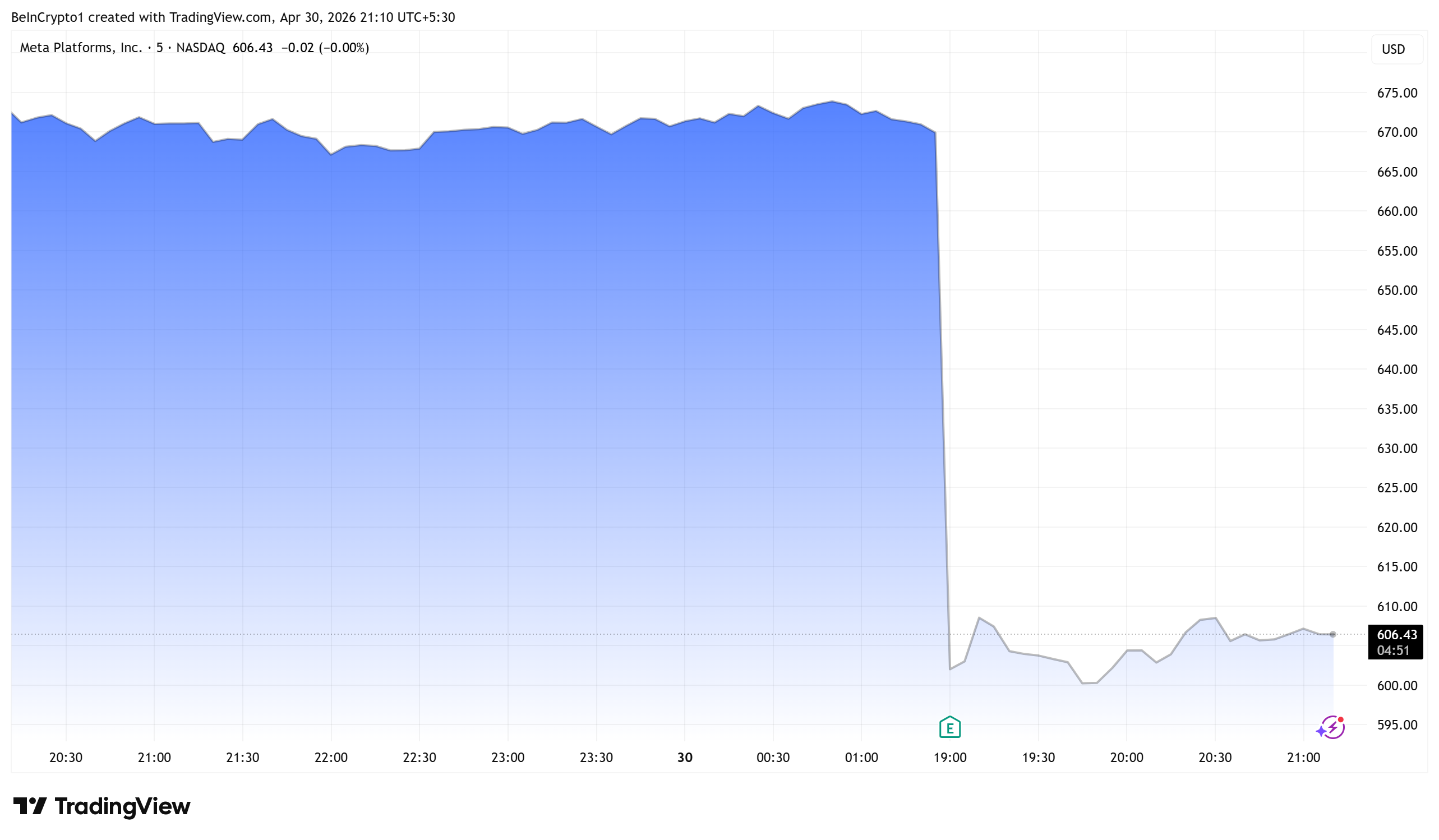
Meta Platforms (META) shares dropped roughly 10% on Thursday, erasing about $175 billion in market value. A higher 2026 capital expenditure forecast of $125 billion to $145 billion triggered the selloff.
The decline marked the stock’s largest single-day percentage drop in roughly six months. It came despite Q1 2026 earnings that exceeded Wall Street estimates on both revenue and profit.
Capex Hike Spooks META Investors
As of this writing, META stock was trading for $606.43, down by almost 10% in the last 24 hours, wiping out up top $175 billion from its market cap today alone.
The new spending range sits roughly 7% above the previous January guidance of $115 billion to $135 billion.
Chief Financial Officer Susan Li attributed the increase to higher memory-chip pricing. She also cited additional data center costs tied to artificial intelligence (AI) infrastructure.
JPMorgan analyst Doug Anmuth downgraded Meta to Neutral and cut the bank’s price target to $725 from $825. The note flagged intensifying full-stack AI competition and a more challenging path to returns.
Q1 capex alone reached $19.8 billion, in line with the broader Big Tech race in AI infrastructure.
Earnings Beat Overshadowed
Meta reported revenue of $56.31 billion, up 33% year over year, the strongest quarterly growth since 2021. Net income reached $26.8 billion, or $10.44 per diluted share. An $8 billion one-time tax benefit tied to U.S. Treasury R&D guidance lifted that figure.
Ad revenue stayed strong as AI-powered content recommendations boosted engagement on Reels and video.
Yet the reaction echoed earlier sell-offs after prior Meta capex hikes. The pattern repeatedly overshadows strong fundamentals with spending fears.
CEO Mark Zuckerberg defended the strategy on the call. He framed the higher outlay as a vote of confidence in Meta’s AI roadmap.
Subscribe to our YouTube channel to watch leaders and journalists provide expert insights
The post Meta Stock Loses $175 Billion After AI Expense Estimate Shakes Shareholders appeared first on BeInCrypto.


Eric Trump predicted BTC would reach $1 million per coin at the Bitcoin 2026 conference in Las Vegas.
The statement marks continued Trump family support for cryptocurrency. It signals strong federal backing for the industry at the highest levels.
The $1 Million Bitcoin Prediction
Speaking at Vegas, Eric Trump was direct about his conviction.
“Bitcoin is going to hit $1 million. I absolutely believe it will,” he said to the assembled conference audience.
This prediction represents roughly a 13x increase from Bitcoin’s current price of $76,000. While such predictions are common at industry conferences, Eric Trump’s statement carries significant political weight. His family’s influence shapes federal policy and public perception.
Bullish Voices Clash With Skeptics
Michael Saylor pushed even further with his prediction. He argues that digital credit should drive Bitcoin to $10 million per coin. Saylor believes Bitcoin will become the world’s primary reserve asset through this mechanism.
However, skeptics strongly disagree with this narrative. Peter Schiff has criticized Strategy’s Bitcoin accumulation strategy. He warns that the company faces mounting pressure on dividends.
Additionally, Schiff predicted Bitcoin could fall to $10,000 if macroeconomic conditions worsen significantly. This contrasts sharply with Trump’s bullish stance and optimistic timeline.
Trump Administration Shows Pro-Crypto Support
The Trump administration signals clear pro-crypto backing at the federal level. The White House recently indicated strong interest in a strategic BTC reserve. This marks a major policy shift from prior administrations that viewed crypto skeptically.
Furthermore, the administration appointed pro-crypto SEC Chair Paul Atkins. This demonstrates deliberate federal support for the cryptocurrency industry. Such policy alignment creates favorable conditions for BTC appreciation.
What Bitcoin Needs to Reach $1 Million
Reaching $1 million requires several critical conditions to align. First, institutional adoption must accelerate dramatically across financial systems.
Second, digital credit instruments must transition from experimental to mainstream adoption. Third, Bitcoin must overcome significant macroeconomic headwinds, including the risk of stagflation and ongoing geopolitical risks.
Federal regulatory clarity remains absolutely essential for sustained growth. Eric Trump’s prediction implicitly assumes that pro-crypto policy will continue indefinitely. This assumption remains uncertain beyond the current electoral cycle.
Eric Trump’s prediction reflects the Trump family’s strong commitment to Bitcoin. Whether this target proves accurate depends on the development of digital credit infrastructure. It also hinges on macro conditions supporting risk-on asset appreciation.
The statement signals federal backing for Bitcoin moving forward. This contrasts sharply with prior administrations’ skeptical approach. Federal support could reshape policy in ways that support higher valuations.
The post Eric Trump Gives His Unsurprising Bitcoin Prediction in Las Vegas appeared first on BeInCrypto.


Treasury Secretary Scott Bessent confirmed on April 29 that the United States has seized almost $500 million in Iranian crypto assets under Operation Economic Fury, including a $344 million Tether freeze on two Tron addresses, while saying Iran’s currency has fallen 60 to 70% against the dollar and the country is in the middle of a currency crisis.
Summary
- Bessent said Operation Economic Fury has seized roughly $350 million in crypto assets plus an additional $100 million seized separately, bringing the total close to $500 million as part of a broader campaign targeting Iranian bank accounts, retirement funds, and overseas real estate.
- Tether froze over $344 million in USDT across two Tron addresses on April 23 after receiving direction from OFAC, with Chainalysis confirming on-chain patterns consistent with IRGC-linked wallets and Central Bank of Iran intermediary addresses.
- Bessent warned that the pressure campaign would leave the Iranian regime unable to pay its soldiers or fund proxy networks including Hezbollah and Hamas, and said secondary sanctions are now being deployed against buyers of Iranian oil.
Bessent Iran remarks on Fox Business’s Kudlow on April 29 confirmed the scope of Operation Economic Fury. CryptoTimes reported that Bessent said: “We were able to grab about 350 million crypto assets, and then on top of another 100 that we had recently gotten, so we’re almost at half a billion there, and we are freezing bank accounts everywhere.” Operation Economic Fury was ordered by President Trump in March 2025 and has been systematically cutting off Tehran’s financial access across crypto wallets, banking channels, foreign real estate, and retirement funds.
As crypto.news reported, OFAC has sanctioned more than 1,000 Iran-related individuals, vessels, and aircraft under Operation Economic Fury since February 2025, with the campaign recently expanding to secondary sanctions against Chinese oil refineries and shipping firms that handle Iranian crude. The largest single crypto action within the campaign came on April 23, when as crypto.news documented, Tether froze $344 million in USDT across two Tron addresses at OFAC’s direction, with one wallet holding approximately $213 million and the other $131 million, both identified by Chainalysis as matching IRGC wallet patterns and Central Bank of Iran intermediary addresses. As crypto.news tracked, the freeze is the largest single crypto enforcement action directly linked to Iran since the current conflict began in February 2026. Bessent said the combined economic pressure from Operation Economic Fury and the naval blockade has produced a 60 to 70% crash in the Iranian rial against the dollar and the collapse of Iran’s largest bank in December, and warned that Tehran will soon be unable to fund its military or its proxy networks.


The stablecoin issuer’s new payment rail enables USDC transfers as small as $0.000001, targeting AI agents that pay per API call, per second, or per dataset read.


The payments giant will fold PYUSD, Braintree, and merchant processing into a new Payment Services & Crypto division, marking the first time digital assets have a dedicated home within the company.
Peter Schiff has intensified his assault on Michael Saylor and Strategy, calling both the MSTR stock and STRC preferred equity scheme scams and comparing them to Nakamoto Games (NAKA), a cryptocurrency that collapsed 99% in the past year.
Schiff’s barrage of critiques comes as the Bitcoin conference season kicks off with renewed enthusiasm for digital credit instruments backed by Bitcoin holdings.
The NAKA Collapse Precedent
Schiff attended last year’s Las Vegas Bitcoin conference, where Nakamoto token (NAKA) generated massive hype and investor enthusiasm. Since then, the token’s price has collapsed by more than 99%, leaving investors who bought near the peak with devastating losses.
This year, Schiff argues, attendees are repeating the same pattern with STRC.
“By next year’s conference, attendees who buy STRC now may face similar losses to those who bought NAKA then,” Schiff warned, suggesting the preferred equity structure will eventually implode just as NAKA did.
Schiff’s Call-Out of Industry Complicity
Schiff went further, stating that every investment professional, government regulator, and financial journalist who does not publicly call out MSTR and STRC as scams and name Saylor as a fraud “can’t be trusted.”
The critique extends to the broader crypto industry. Schiff argued that crypto, “where hype and exaggeration rule,” was tailor-made for the Trump family and their ability to shill overpriced stocks to what he called “delusional investors.”
He suggested that after the bubble fully deflates, crypto industry workers will face a reckoning over which career path to take next.
Bitcoin’s “Hope” Problem
Schiff also attacked Saylor’s central thesis that digital credit denominated in Bitcoin will deliver superior returns compared to alternatives such as gold or the S&P 500.
“Expected by whom?” Schiff asked, noting that Bitcoin’s expected return is “more hope than forecast.”
He argued that investing based on hope rather than empirical data or fundamental analysis will end poorly for retail investors.
Beyond his Strategy critique, Schiff issued a broader economic warning. He cited Federal Reserve Chair Powell’s own admission that inflation remained uncontrolled except during crisis periods, averaging 3.7% per year over 30 years before 2010 and only dropping to 1.7% during the 2008 financial crisis and subsequent recession.
“Inflation is breaking out, bonds are breaking down, and stocks will follow bonds lower,” Schiff warned.
He predicted stagflation would worsen into recession, sending federal budget deficits soaring while the Fed cuts rates despite policy mandates to hike.
His conclusion: “Buy gold and silver.”
The Bigger Picture
Schiff’s sustained attack on MicroStrategy reflects a fundamental disagreement about where value lies in uncertain economic times. While Saylor and crypto advocates argue that Bitcoin offers superior returns and store of value properties, Schiff contends that precious metals offer more reliable downside protection.
For STRC investors betting on digital credit and Bitcoin appreciation, Schiff’s comparison to NAKA’s collapse serves as a cautionary reminder that crypto hype cycles have ended badly before and will likely do so again.
The post Peter Schiff Calls MicroStrategy’s MSTR Stock a Scam and Saylor a Fraud appeared first on BeInCrypto.

Five-bed Scarborough house could become HMO for nine people

AI Agents Move from Boardroom Buzzword to Business Infrastructure

Monero Price Prediction Gains Momentum as XMR Rallies 26% and Pepeto Presale Pulls Smart Capital

Manchester United reach agreement with Casemiro over contract clause amid transfer speculation

US brings back mandatory military draft registration

Steven Gerrard disagrees with Gary Neville over ‘shock’ Chelsea and Arsenal claim | Football


-

 Tech3 days ago
Register Renaming | Hackaday
-

 Fashion6 days ago
Weekend Open Thread – Corporette.com
-
 Crypto World5 days ago
Hyperliquid $HYPE Rally Builds Momentum as AI Sector Enters Prove-It Phase
-

 Politics3 days ago
Drax board avoid their own AGM, accused of greenwashing & environmental racism
-
 Sports5 days ago
IPL 2026: Ruturaj Gaikwad registers slowest fifty of the season, enters all-time unwanted list | Cricket News
-

 Tech3 days ago
Images of Samsung’s rumored smart glasses have leaked
-

 NewsBeat5 days ago
LK Bennett closes all stores after entering administration
-

 Tech4 days ago
Why Blue Badges Disappeared From Toyota Hybrids
-

 Crypto World7 days ago
Michael Saylor says BTC winter is over. Market analyst disagrees, says bitcoin was in a pullback
-

 Fashion2 days ago
Kylie Jenner’s KHY Enters a New Era with ‘Born in LA’
-
 Entertainment5 days ago
Mariah Carey Slams Deposition Claims In Brother’s Lawsuit
-

 Business2 days ago
Most Commercial Energy Audits Miss the Real Losses
-
 NewsBeat7 days ago
Trump threatens to review UK’s claim to Falkland Islands and punish Nato allies over Iran war disagreement
-

 Business6 days ago
Jeanine Pirro announces closure of Federal Reserve building cost probe
-

 Business3 days ago
(VIDEO) Charlize Theron Climbs Times Square Billboard to Promote New Netflix Thriller ‘Apex’
-

 Tech5 days ago
OpenAI’s Sam Altman apologizes for not reporting ChatGPT account of Tumbler Ridge suspect to police
-

 Tech5 days ago
Microsoft to roll out Entra passkeys on Windows in late April
-

 Crypto World3 days ago
CFTC’s AI will review U.S. crypto registration applications, chairman tells CoinDesk
-
 Crypto World6 days ago
Nvidia (NVDA) Stock Jumps 5% as Intel Earnings Ignite Semiconductor Rally
-
Entertainment7 days ago
Snooki says “Jersey Shore” cast plans to film show 'until we're in a nursing home': 'It's not over for us'
You must be logged in to post a comment Login