



Connect with us
DAPA Banner

NewsBeat

Police warning ahead of Dante Festival at York Racecourse

Published

on

Police warning ahead of Dante Festival at York Racecourse

With visitors heading to York Racecourse for the first race meeting of the season later this month, North Yorkshire Police are urging the public to plan ahead and expect significant traffic and parking pressures on race days.


Recommended reading:


Officers are also encouraging racegoers to use official racecourse car parks and to be considerate of residents in nearby streets.

Advertisement

The Dante Festival is the fisrt race meeting of 2026 and takes place from Wednesday, May 13 to Friday, May 15 this year.

North Yorkshire Police said: “Avoid obstructive parking – please do not block driveways, junctions, or emergency access routes.

“Officers and traffic teams will be out on key dates to monitor parking and ensure road safety, and enforcement action may be taken where necessary.”

Visitors are advised that delays are likely before and after events, and alternative travel options should be considered where possible.

Advertisement

The force is reminding the public to plan their journeys in advance and to follow parking guidance to help keep race days safe and disruption to a minimum.

Source link

Advertisement
Continue Reading
Click to comment

You must be logged in to post a comment Login

Leave a Reply

NewsBeat

Second missing Florida doctoral student’s remains identified after roommate charged with murders

Published

on

Second missing Florida doctoral student’s remains identified after roommate charged with murders

Human remains found near a bridge in the Tampa Bay area on Sunday have been identified as Nahida Bristy, the second missing University of South Florida doctoral student, Hillsborough County Sheriff Chad Chronister said Friday, according to CNN.

Bristy and her friend Zamil Limon, both 27, vanished on April 16. Limon’s body was found on April 24 on the Howard Frankland Bridge.

Limon’s roommate, Hisham Abugharbieh, was arrested a few days later and charged with two counts of first-degree premeditated murder with a weapon in the deaths of Limon and Bristy.

Source link

Advertisement
Continue Reading

NewsBeat

Julia Cumming isn’t Debbie Harry, she’s Burt Bacharach

Published

on

Julia Cumming isn't Debbie Harry, she's Burt Bacharach

Blondie. The Ramones. Talking Heads. The Strokes. Geese. Trawl back through the history of New York bands and you’ll find a potted list of some of the coolest motherf***ers ever to grace a stage. It’s the city that birthed the CBGB club and an entire substrata of 1970s punk; the city that gave us Andy Warhol and the Pop Art movement. And so, when indie-rock trio Sunflower Bean burst on to the scene in the mid-2010s in a flurry of fuzzy riffs, bleached blonde hair and precocious youth (the group’s press-igniting debut EP Show Me Your Seven Secrets was released before its members turned 20), there seemed a natural lineage for the group and their frontwoman Julia Cumming to slide into. Cumming had also recently signed a modelling contract with Yves Saint Laurent; frequently referred to as “Hedi Slimane’s muse”, to the world she seemed like Debbie Harry 2.0. But internally, Cumming was trying to reconcile a new identity that felt like an ill fit.

“We internalise ideas of ourselves that others have and become them. Musicians are particularly prone, because we’re weirdos who need applause”

Julia Cumming

Source link

Advertisement
Continue Reading

NewsBeat

How Britain’s housing crisis contributes to its declining healthy life expectancy

Published

on

How Britain’s housing crisis contributes to its declining healthy life expectancy

People in the UK are now spending fewer years in good health than they did a decade ago, according to a new analysis by the Health Foundation. The UK now sits near the bottom of a 21-country comparison, ahead only of the US.

A drop in healthy life expectancy is explained through many causes: obesity, alcohol, drugs, suicide, chronic disease, poverty and widening inequality. But one of the most powerful causes sits atop them all: housing. Where and how people live is one of the main factors explaining how health risks are created and distributed across society.

The UK Housing Review is an annual independent review of housing policy and evidence, written by housing experts and published by the Chartered Institute of Housing. Its latest edition, which we contributed to, identifies several interrelated ways that housing affects health.

A key one is affordability – housing costs shape where people can live, whether they can heat their homes, whether they can afford food and transport, whether they can move for work, whether they can leave unsafe or unsuitable housing and whether they live with chronic financial stress.

Advertisement

In the UK, housing costs are high by historical standards and poor housing remains widespread. The review notes that private rents are now at their highest recorded share of earnings, while millions of homes in England still contain serious health and safety hazards.

When housing is unaffordable, people are forced to make tradeoffs. For example, trading affordability for damp or overcrowded homes. They cut back on heating, food, medication, transport and social participation. They move further from public services, work and support networks. Affordability problems also force many people into cheaper, less secure, tenancies.

Poor housing quality directly shapes health. Cold, damp, mould, disrepair, poor ventilation and unsafe homes are directly linked to respiratory illness, cardiovascular risk, mental health problems and reduced wellbeing.


À lire aussi :
Cold homes increase the risk of severe mental health problems – new study

Advertisement

The Building Research Establishment, an independent research organisation, has estimated that poor housing costs the NHS in England £1.4 billion each year. More than half of this is attributed to cold homes, which increase the risk of respiratory illness, cardiovascular problems and poor mental health. They are especially dangerous for older people, babies and people with existing health conditions.

But the wider costs are even greater. Poor sleep, stress, disrupted schooling, insecure work, social isolation and caring strain all affect mental and physical health. They increase pressure on families and, over time, on health, education and social care systems.

Cold homes can cause serious and widespread health problems.
Jelena Stanojkovic

Historically in the UK, social housing has provided some protection to people unable to access good quality affordable housing in the open market. But the stock of social rented housing in the UK has declined. This means that people are increasingly dependent on (often expensive) market rental, where the quality, size and location of housing depend much more directly on income.

The rise of the private rented sector this century has meant that more households are exposed, not just to higher housing costs, but also to shorter tenancies and fewer protections than social housing traditionally provided.

Advertisement

The Renters’ Rights Act increases security, but does not remove “no fault” evictions altogether and does little to protect tenants from economic pressures that can result in eviction. The cognitive burden of worrying about eviction, arrears, repairs or the next rent increase is a direct health risk.

Recent evidence also suggests that insecure housing can result in measurably faster biological ageing, equivalent to the effects of more traditional health concerns like smoking.

Additional weeks of biological ageing per year from different factors
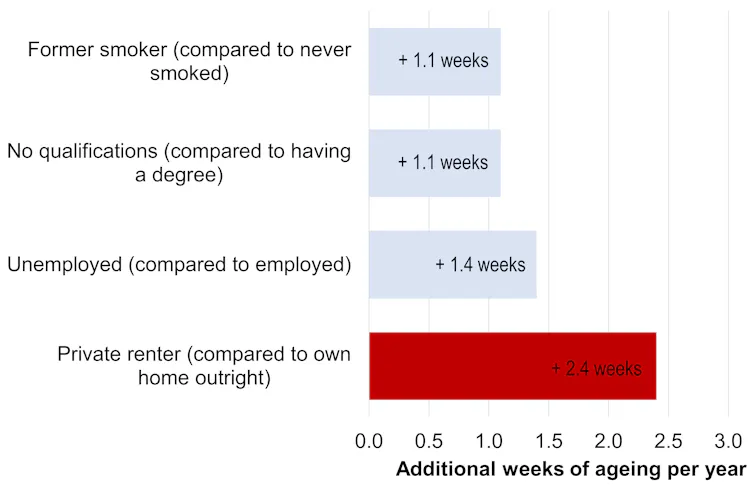
Bar chart showing additional weeks per year for private renting (2.4 weeks) compared to other social determinants of health including unemployment (1.4 weeks), having no qualifications (1.1 weeks) and being a former smoker (1.1 weeks)

Amy Clair

The number of people living in temporary accommodation has risen dramatically, reaching over 130,000 households at the beginning of 2025. This is a 156% increase compared with 2010, largely driven by the poor affordability and insecurity of the private rented sector and lack of social housing. Temporary accommodation is inadequate housing, particularly for children. Living in temporary accommodation was a contributing factor in the deaths of at least 104 children in England between 2019 and 2025, 76 of whom were under one year of age.

This is not about housing quality alone. Temporary accommodation reflects multiple risks brought together: poverty, overcrowding, poor conditions, instability, lack of space for safe infant sleep, poor access to services and wider racial and social inequality. The National Child Mortality Database identifies temporary accommodation as a contributing factor to vulnerability, ill health or death, not necessarily as the sole cause. Emerging evidence also links temporary accommodation with stillbirth and neonatal death.

Advertisement


À lire aussi :
Insecure renting ages you faster than owning a home, unemployment or obesity. Better housing policy can change this


Housing health inequality

ONS data shows a very large difference in healthy life expectancy between the most and least deprived areas. In 2022-24, healthy life expectancy in the most deprived areas of England was just 49.8 years for men and 48.2 years for women, compared with 69.2 and 68.5 years in the least deprived areas.

Housing contributes to this difference, determining whether people live in homes that support recovery or deepen stress, whether children grow up in stable and safe environments, and whether older people can remain warm and independent.

If the government is serious about its stated aim to “halve the gap in healthy life expectancy between the richest and poorest regions”, housing policy must become health policy.

Advertisement

That means investing in social housing, enforcing decent standards in the private rented sector, making homes warmer, safer and more accessible, and recognising temporary accommodation, overcrowding and insecurity as public health failures, not just housing management problems.

It also means changing the way that success is measured. Housing policy is too often judged by supply numbers, prices or tenure outcomes. These matter, but they are incomplete. A healthy housing system should also be judged by whether people can live in homes that are affordable, secure, decent, suitable and resilient to climate change.

The decline in healthy life expectancy is a warning light. It tells us that the UK is not only failing to keep people well for longer, it is failing to provide the foundations of health.

Advertisement

Source link

Continue Reading

NewsBeat

How To Remove A Tick And Symptoms To Watch For After A Bite

Published

on

How To Remove A Tick And Symptoms To Watch For After A Bite

Nothing pains me more than having to declare “it’s tick season” – but here we are, nonetheless.

Tick season usually runs from March to October, with a peak during the warmer, humid months from April to July.

For those who haven’t come across the biting bugs before, they are small spider-like creatures with oval-shaped bodies. They’re roughly the size of a sesame seed and can have six or eight legs (depending on whether they’re fully grown or not).

Unfortunately, ticks can spread Lyme disease, a bacterial infection which, if not caught early, can lead to serious health issues over time including joint pain, nerve damage, and memory problems.

Advertisement

Lyme disease cases in England and Wales have risen steadily since reporting began in 1986. In 2021, there were 1,156 lab-confirmed cases reported, however the UK government estimates there are probably 1,000-2,000 additional cases each year.

Where are ticks typically found?

Ticks are typically found in grassy areas like gardens, parks, fields and woodland. They climb onto animals or humans as you brush past them.

So, whether you’re hiking, walking the dog, or spending time in your back yard, it’s important to be aware of them and how to get rid of them, especially if they attach themselves to you or your child.

Advertisement

How to remove a tick

If you notice a tick on your child’s body, NHS Inform suggests you should remove them with a tick removal device or fine-toothed tweezers.

There is a technique to follow, however, to ensure the whole tick is removed.

The NHS advises to “gently grip the tick as close to the skin as possible” and to “pull steadily away from the skin without crushing the tick”. The bit about not squishing them is important, as if you do, it can release pathogens into the body.

Advertisement

Howard Carter, Bite prevention expert and CEO of incognito insect repellent, says special tick remover tools are your best bet. “Tweezers don’t work as well – you have to be careful taking a tick out as they can break, leaving parts still inside the body,” he explained.

“Remove gently and hold it so that it is vertically above your skin. The chance of contracting Lyme Disease is far less if you successfully remove the tick without squashing its innards into your body.”

Once the tick is removed, clean the area with soap and water, and then apply an antiseptic cream to the skin around the bite.

Parents are advised not to use alcohol or petroleum jelly on a tick.

Advertisement

I squished the tick by accident, now what?

NHS Inform says if the tick’s mouthparts break off in the skin and can’t be removed, “this may cause irritation but they should fall out naturally in time”.

In an Instagram post, Dr Rachael Barr, known on social media as The Kids Doctor, said: “Getting a tick bite doesn’t mean you will definitely get an infection – the majority of UK ticks do not carry infection.

“So, in the UK we don’t generally recommend antibiotics straight after a tick bite, but you do need to be on the look out for symptoms.”

Advertisement

Post-tick bite symptoms to look out for

Regardless of whether the tick’s been removed successfully or not, parents are advised to monitor for symptoms over the next few weeks.

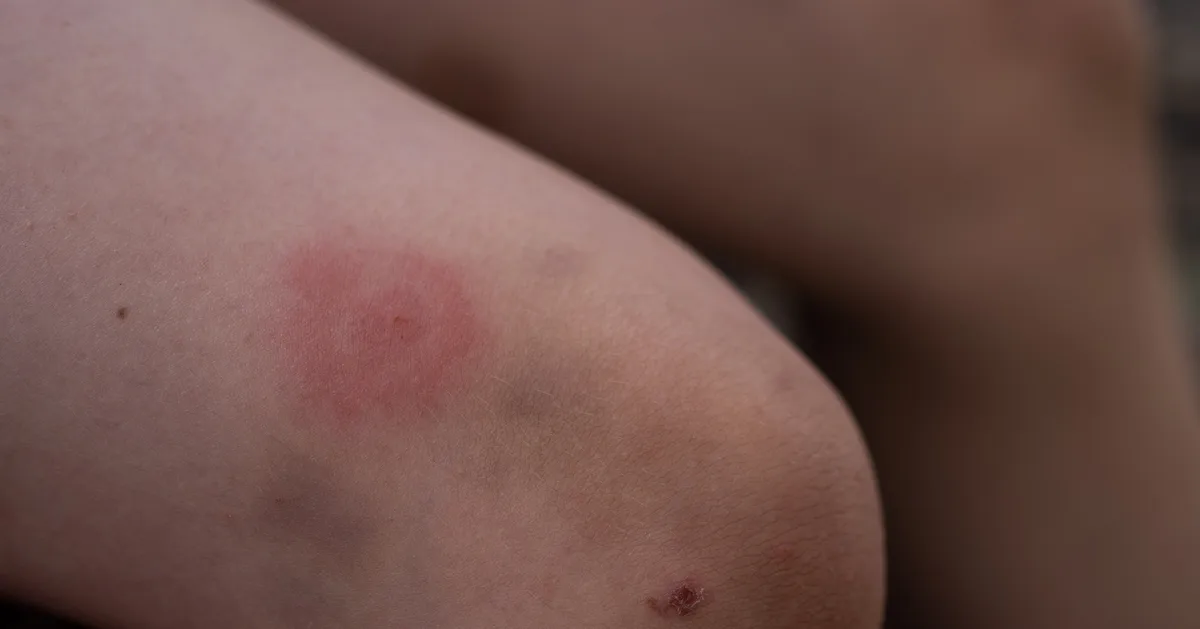
“Contact your GP if you feel unwell or notice a rash. Watch out for a bulls eye-shaped rash (but note, not everyone gets this) and flu-like symptoms – such as fatigue, fever and muscle aches,” says Carter.

Other notable symptoms include headache, joint pain or swollen lymph nodes.

Advertisement

Carter adds that if a rash appears, take a photo of it so you can show it to your GP.

If left untreated, Dr Barr noted symptoms can develop into: facial palsy (one side of the face not moving properly), heart rhythm problems; neck pain and/or stiffness; and pain, weakness or numbness in the hands or feet.

If you spot any of the above symptoms after a tick bite, book in to see your GP. If they suspect you or your child might have Lyme disease, they’ll prescribe a course of antibiotics – the sooner treatment begins, the more effective it is.

How to prevent tick bites in future

Advertisement
  • Cover arms and legs when in grassy or wooded areas.
  • Stick to paths and don’t brush against foliage. If you need to go in grassy areas, tuck trousers into socks.
  • Wear light-coloured clothing so ticks are easier to see and brush off.
  • Apply insect repellent.
  • Check children and pets after they’ve been out in grassy/wooded areas.

Source link

Continue Reading

NewsBeat

Commodore 64 and ZX Spectrum are getting Nintendo style handhelds this year

Published

on

Commodore 64 and ZX Spectrum are getting Nintendo style handhelds this year
Old school on the go (Retro Games Ltd/Evercade)

Handheld versions of the Commodore 64 and ZX Spectrum are being released later this year, loaded with 25 classic games in each.

Handheld systems are all the rage at the moment, between Valve’s Steam Deck, the ROG Xbox Ally, and the more specialist Analogue Pocket, but now systems from over 40 years ago are getting in on the action.

Retro Games, a company known for miniature and full-sized recreations of systems like the Commodore 64 and Atari 400, as well as the recently unveiled white ZX Spectrum, has joined forces with Evercade developer Blaze Entertainment for two brand new handhelds.

The C64 Handheld and The Spectrum Handheld are set to launch in October, priced at £109.99 each. You can also grab a collector’s edition for £129.99 from Funstock, which includes a hard shell carry case and a specially designed Crash or Zzap!64 magazine from the era, but these are limited to 2,000 units.

Advertisement

Each handheld sports a 4.3 inch IPS screen with 800×480 resolution, and comes complete with a 3.5mm headphone jack and a USB port for keyboard or joystick support. At 13.6cm wide it’s bigger than a Game Boy Advance SP but a little smaller than a Nintendo DS.

The two systems emulate their classic console counterparts via their buttons as well, with the C64 rocking plastic fuction keys while the Spectrum sports the trademark rubber.

Expert, exclusive gaming analysis

Sign up to the GameCentral newsletter for a unique take on the week in gaming, alongside the latest reviews and more. Delivered to your inbox every Saturday morning.

Advertisement

Like other devices from Retro Games, each system comes with 25 games built in. The C64 has the likes of Speedball 2: Brutal Deluxe and Nebulus, while the Spectrum has Manic Miner, Head Over Heels, and Skool Daze. You can find a full list of all the games below.

Speaking about the systems, Blaze Entertainment CEO Andrew Byatt said: ‘The C64 and the Spectrum are two of the most iconic names in gaming history, with generations of players who hold them close to their hearts.

Advertisement

‘Bringing these experiences into a brand-new handheld form feels like a natural next step, and we’re proud to bring these to both longtime fans and a new audience discovering them for the first time. We are delighted to be working with Retro Games Ltd to make this happen.’

While be conducting an interview with Retro Game shortly, about the white Spectrum and their work in general, so we’ll be sure to bring these up then.

Spectrum handheld games

  • Manic Miner
  • Skool Daze
  • Head Over Heels
  • Archon: The Light And The Dark
  • Tiny Dungeons
  • The Great Escape
  • Bounder
  • Switchblade
  • Nightmare Rally
  • M.O.V.I.E.
  • Avenger: The Way Of The Tiger 2
  • Bugaboo the Flea
  • Devwill Too ZX
  • Hammerfist
  • Hammer Knight
  • Penguin Attack
  • S1NCLA1R C1TY
  • Shovel Adventure
  • Snake Escape
  • Sorcerer Kid Adventure
  • Splat!
  • Tourmaline
  • Where Time Stood Still
  • Zynaps
  • Starquake

C64 handheld games

  • A Pig Quest
  • Sam’s Journey
  • Nebulus
  • Boulder Dash
  • Speedball 2: Brutal Deluxe
  • Paradroid
  • Hunter’s Moon Remastered
  • Knight ‘n’ Grail
  • Aztec Challenge
  • Krakout
  • Lee [possibly Bruce Lee, we’re not sure yet – GC]
  • Druid
  • Encounter!
  • Galencia
  • Ice Guys
  • Metal Warrior Ultra
  • Millie & Molly
  • Planet Golf
  • Shadow Switcher
  • Spherical
  • Squish ‘Em
  • Steel Ranger
  • X-Out
  • Yeti Mountain
  • It’s Magic 2

Email gamecentral@metro.co.uk, leave a comment below, follow us on Twitter.

To submit Inbox letters and Reader’s Features more easily, without the need to send an email, just use our Submit Stuff page here.

Advertisement

For more stories like this, check our Gaming page.

Advertisement
Advertisement

Source link

Continue Reading

NewsBeat

Newsquest’s Young Reporter Scheme returns with early bird price offer

Published

on

Newsquest's Young Reporter Scheme returns with early bird price offer

To mark the milestone, new schools have the chance to benefit from special early bird pricing until June 30.

The offer, available from May 1 until June 30, gives new schools the opportunity to secure reduced costs while allocating the expense with the current academic year’s budget.

Alison Cotton, Head of English at Croydon High, who has been involved with the scheme for a number of years, said: “The Young Reporter programme has become a key component of our extra-curricular offer for KS4 & 5 and we have been delighted to celebrate numerous award winners over the years.

Advertisement

“Our pupils have found it both exciting and challenging; an illuminating insight into a career in news journalism.

“Generating ideas, managing their time and producing work of a publishable quality, to monthly deadlines, is no mean feat!

“However, the balance of independence/support enables participants to flourish as writers on this dynamic work experience programme.”

Over the years, the programme has grown significantly, with tens of thousands of students taking part in what schools describe as a unique and engaging opportunity.

Advertisement

The scheme gives students first-hand experience of working in the media industry, with participants writing monthly articles that are published across Newsquest’s wide network of national online newspapers.

Each student will have their work published over an eight-month period, helping them to develop key skills such as meeting deadlines and producing content to a professional standard.

This helps them prepare for university and life beyond school.

If this sounds like it might be of interest to your school or someone you know, spread the word or visit the website youngreporter.co.uk and fill in an information request form.

Advertisement

The scheme is open to all students in Years 10 to 13, regardless of academic ability or future career plans, and continues to be a popular extra-curricular activity for schools across the country.

Organisers say the programme is beneficial even for those not considering a career in journalism, as it encourages students to broaden their horizons, step outside their comfort zones and improve their writing abilities.

Victoria Whitwam from Hampton School said: “We are great fans of the scheme at Hampton School.

“It is well organised whilst also being realistic and understanding the pressures pupils and staff are under.

Advertisement

“Best of all, it fosters independent thinking and organisational skills in the pupils that take part.”

Source link

Advertisement
Continue Reading

NewsBeat

Vacant homes in Scarborough to become homeless accommodation

Published

on

Vacant homes in Scarborough to become homeless accommodation

​Three Scarborough properties owned by North Yorkshire Council will be turned into temporary accommodation for homeless households.

​NYC said the properties identified for refurbishment were in a poor state of repair which resulted in them remaining empty.

​They are located within Scarborough, allowing easy access to services, the authority added.

Advertisement

​Eight flats are set to be created from the three properties, according to documents published by the council.

​A spokesperson told the Local Democracy Reporting Service (LDRS) that the authority anticipates that the refurbishment required to bring the properties back into residential use, including any necessary planning permissions, will be completed by the end of 2027.

​“Using council-owned homes for homeless households is one of our strategies to provide appropriate accommodation and reduce the use of B&B and hotels, which is more cost-effective and delivers better outcomes for families and individuals,” the spokesperson added.

​In recent years, Scarborough has faced some of the highest levels of homelessness in North Yorkshire.

Advertisement

​NYC was one of the first authorities in England to introduce a 100 per cent tax on second homes.

​The scheme has raised about £10 million so far, according to North Yorkshire Council, all of which has been ring-fenced for housing projects.

​The authority’s homelessness strategy for 2025-30 states that while North Yorkshire is among the least deprived local authority areas in England, there are “pockets of deprivation, particularly in Scarborough”.

​“Approaches are consistently highest in Scarborough and Harrogate. We are seeing more single homeless people and more people declaring support needs and multiple disadvantages, including mental health, substance use, domestic abuse, and contact with the criminal justice system,” the report states.

Advertisement

​The number of households in temporary accommodation is also increasing, with the council reporting particularly strong demand in Scarborough and Harrogate.

​NYC’s gross spend on emergency accommodation has grown rapidly in recent years, from just over £500,000 in 2019/20 to over £2.1 million in 2022/23 – an increase of 400 per cent. Particular pressures are within the Scarborough area, with more people staying longer in emergency accommodation, according to the report.

Source link

Advertisement
Continue Reading

NewsBeat

Sarah Michelle Gellar’s EMS workout trend explained

Published

on

Sarah Michelle Gellar’s EMS workout trend explained

Actor Sarah Michelle Gellar, best known for her role as teenage demon slayer Buffy Summers, recently shared in an interview that she uses an “EMS suit” during workouts to stay fit. And she’s not the only one who has made this form of exercising a trend – with celebrities from Tom Holland to Cindy Crawford all using EMS workouts to get fit.

EMS, short for electromyostimulation, uses electrical impulses to support muscle contraction. The idea is that the machine uses electricity to stimulate your muscles to work harder, to help you get more out of your workout without lifting heavy weights.

Some companies even claim that a 20-minute EMS session (roughly half an episode of Buffy the Vampire Slayer), can deliver the same benefits as hours in the gym. For people who are short on time, dislike traditional exercise or want a novel way to stay motivated, this sounds very tempting.

But while EMS does have some evidence-based benefits, particularly in rehabilitation settings, it’s far from a miracle shortcut to getting fit.

Advertisement

In clinical contexts, EMS works by sending small, electrical impulses through pads placed on the skin. Just like with regular workouts, these impulses stimulate nerves, triggering muscles to contract. Physiotherapists have used EMS for decades to help patients recovering from injury or surgery, especially when regular movement is difficult.

It has even been used in spaceflight simulations, in which participants have to lie in a bed tilted slightly downwards for extended periods to replicate the effects of being in space on the body. This can cause muscles to weaken, and research has explored EMS as a countermeasure loss during these conditions, particularly when combined with resistance exercise.

What is new is the rise of “whole body EMS” in the fitness industry. Instead of placing electrodes on a single muscle group, users wear the suit or vest. It contains multiple electrodes targeting the arms, legs, glutes, back and core. During a session, people perform squats, lunges, arm raises and more, while the suit pulses to intensify muscle activation.

In practice, the benefits depend heavily on who you are and how you train.

Advertisement

Does it work?

Research suggests EMS can help maintain strength and muscle mass after five to six weeks of treatment compared with doing a conventional exercise programme. A meta analysis in 2023 supports this, outlining how between one to three whole-body EMS sessions per week for six to 12 weeks can result in modest improvements in muscle mass, strength and power.

Another separate study also reported strength gains after a similar frequency of use in non-athletic, sedentary adults.

For people who are sedentary, or have joint pain, EMS may offer an alternative to stimulating muscles without the stress of exercise.

However, it is not a substitute for the broad, well established, whole-body health benefits of regular exercise, which extend beyond muscles to the cardiovascular and metabolic systems, among others.

Advertisement

This distinction becomes clearer when we look at regular exercisers. A recent study, which examined EMS use in athletes and trained sportspeople, found little to no benefit on performance measures such as jumping, sprinting or agility.

EMS suits may not be as beneficial for regular exercisers.
Chester-Alive/ Shutterstock

Furthermore, studies examining strength outcomes report inconsistent findings, with results varying widely depending on the EMS protocol used and how it’s combined with conventional training.

Taken together, these findings suggest that for people who are already active, EMS probably won’t provide a meaningful edge as conventional exercise is already very effective. Lifting weights, sprinting or doing bodyweight exercises all produce strong, natural muscle contractions without the need for electrical stimulation.

Should you try it?

Overall, the research on EMS is promising but far from definitive. Many studies are small, short term, or use differing protocols, making comparisons difficult.

Advertisement

Some combine EMS with exercise, while others compare it to doing nothing at all. This makes it challenging to determine whether improvements come from EMS alone, its combination with exercise or because participants are just being more active.

Because EMS can produce strong, involuntary muscle contractions, overuse can also lead to severe muscle soreness or, in rare cases, a condition called rhabdomyolysis. This occurs when muscle tissue breaks down rapidly and releases proteins into the bloodstream, harming the kidneys.


À lire aussi :
High-intensity workouts may put regular gym goers at risk of rhabdomyolysis, a rare but dangerous condition


Several cases of rhabdomyolysis have been reported after intense EMS sessions, even after a single workout. For this reason, it is recommended to start slowly, stay hydrated and use EMS under professional supervision.

Advertisement

Cost is another factor. Whole body EMS sessions can be expensive, and purchasing a suit for home use can be even more costly. For many people, that money might be better spent on evidence-based, personal training or structured exercise programmes.

For those that can afford it, EMS should be viewed as a supplement, not a substitute, for regular exercise. The strongest evidence for improving health, fitness and body composition still comes from simple, consistent habits: lifting weights a few times a week, walking more, cycling, swimming, jogging or following a gym programme.

There’s no shortcut around the basics. EMS may add a spark, but it can’t replace the benefits of real exercise.

Advertisement

Source link

Continue Reading

NewsBeat

Diego Simeone issues Julian Alvarez injury update ahead of Arsenal match | Football

Published

on

Diego Simeone issues Julian Alvarez injury update ahead of Arsenal match | Football
Julian Alvarez was forced off with an ankle injury in Atletico Madrid’s 1-1 draw with Arsenal (NurPhoto/Shutterstock)

Diego Simeone admits Julian Alvarez is still struggling with his ankle injury ahead of Atletico Madrid’s Champions League semi-final second leg against Arsenal next Tuesday.

Alvarez scored a penalty in the second half of Atletico’s 1-1 draw with Arsenal on Wednesday night but was forced off with 13 minutes remaining after injuring his ankle in a challenge from Eberechi Eze.

Atletico travel to Valencia for their game in La Liga on Saturday and Simeone has revealed that Alvarez will play no part in the fixture.

Simeone is also without his son Giuliano, Alexander Sorloth, Jose Gimenez and Pablo Barrios.

Advertisement

‘If there hadn’t been a match on Tuesday, Julian probably wouldn’t have made it to Saturday either, nor would Sorloth, Giuliano, Barrios or Gimenez,’ Simeone said on Friday.

‘It’s more than clear that we’re going to go with those who are in the best shape to compete tomorrow.

‘The players’ form dictates it [the squad rotation]. We’re going to field fresh legs so we can compete, which is what matters to us.

‘I expect a lot from them. They have the responsibility of being at Atletico Madrid and the opportunity to show why they’re at Atletico Madrid.’

Advertisement

Speaking after Atletico’s draw with Arsenal, Simeone said that he expected Alvarez, Giuliano Simeone and Sorloth to recover for the second leg against Mikel Arteta’s side next week.

Atletico currently sit fourth in La Liga, five points behind third-placed Villarreal with five games remaining.

For more stories like this, check our sport page.

Follow Metro Sport for the latest news on
FacebookTwitter and Instagram
.

Advertisement
Advertisement

Source link

Continue Reading

NewsBeat

Tottenham: Roberto de Zerbi wants Spurs to ‘silence voice inside of us’ in Premier League relegation fight

Published

on

Tottenham boss Roberto de Zerbi reacts on the touchline during a Premier League match against Wolves at Molineux

Netherlands attacking midfielder Simons has been ruled out for the rest of the season after rupturing his anterior cruciate ligament (ACL) against Wolves – and joined a lengthy Spurs injury list.

Striker Dominic Solanke also went off at Molineux with a hamstring injury, while goalkeeper Guglielmo Vicario will also be unavailable against Villa – with Ben Davies, Mohammed Kudus, Dejan Kulusevski, Wilson Odobert and Cristian Romero among long-term absentees.

“I want to keep the focus on ourselves and the quality of my players,” De Zerbi said.

“We go to play against one of the best teams in this moment Premier League, but if Tottenham win at Villa Park it’s not a miracle. Maybe we lose but we have the quality to win this game. It’s not a miracle. We have to be positive.

Advertisement

“If Xavi and Solanke are injured we can play with [Randal] Kolo Muani, [Mathys] Tel, Richarlison… they are different but very good players. All these things – I don’t have too much time to hear these things.

“We are good enough to win the games and to stay up and then we will see because it’s the unique way. The way I know is to work hard, give my best, to trust in my idea of the players, their confidence and to be realistic.”

However, one player close to returning from a long-term injury is James Maddison.

The England playmaker has not featured this season because of an ACL injury but was named on the bench against both Brighton and Wolves.

Advertisement

“I would like to play with Maddison because he is a special player but we have to consider physical condition, a lot of things. But I think he can be important in the next three games,” De Zerbi said.

Source link

Continue Reading

Trending

Copyright © 2025