
Crypto World
XRP Rally Signal: Low Leverage and Steady Price Point to a Powerful Breakout Ahead


TLDR:
- XRP leverage ratio is trending low while price remains elevated, creating a rare market divergence.
- CryptoQuant analyst PelinayPA warns the calm market is quietly building strong upward potential energy.
- Historically, low-leverage and high-price gaps in XRP resolve with fast, squeeze-driven price expansions.
- If the leverage ratio turns upward, new long positions could trigger a sharper-than-expected XRP rally.
XRP investors are watching a key on-chain metric closely. Data from CryptoQuant shows a widening gap between XRP’s leverage ratio and its price.
Analysts say this pattern has historically preceded sharp price moves. The current setup points to a market where speculative excess has cleared out.
Yet, the price has not collapsed. This combination is drawing attention from traders who track market structure signals.
Low Leverage and Steady Price Create an Unusual Setup
The leverage ratio for XRP is currently low and moving sideways. At the same time, the price is holding at relatively elevated levels.
This gap between the two metrics is what analysts call a divergence. It shows the market is no longer being driven by borrowed positions.
When leverage is flushed out of the market, it often means a cleaner base is forming. Traders are not piling in with excessive risk. So, the price is being supported by something other than speculation. That is a notable shift in market behavior.
CryptoQuant analyst @PelinayPA noted that such divergences rarely last long. Either the price pulls back to meet the ratio, or the ratio rises quickly.
When the ratio rises, it is usually tied to a strong price move higher. The current structure leans toward the latter scenario.
Historically, low-leverage environments like this one act as a reset. They reduce the chance of a cascade of liquidations on the way up.
As a result, any new rally tends to move faster and with more force. That is what the data is currently pointing toward.
Potential Energy Is Building in the XRP Market
According to PelinayPA, the market looks calm on the surface. However, beneath that calm, potential energy is accumulating.
This is a common setup before aggressive price expansions. The divergence between price and leverage is the clearest sign of this buildup.
If the leverage ratio starts trending upward, fresh long positions will enter the market. That new demand tends to push prices higher quickly.
The move is often sharper than what most traders expect. A squeeze-driven rally becomes more likely in this kind of environment.
The key point is that leverage has already been reduced. Speculative positions have been unwound without a major price collapse.
That means the market has absorbed selling pressure well. It also means there is room for new buying without immediate resistance from underwater longs.
Periods like this one have preceded some of the more sudden price expansions in XRP’s history. The setup is not a guarantee, but the structure is in place.
Traders watching the leverage ratio will be looking for the first signs of an upward trend. That shift could be the trigger for the next significant move.


TLDR:
- McLaren joins Hedera Council, expanding governance reach and fan-driven digital collectibles rollout
- Agent Lab enables no-code AI agents on Hedera, integrating LangChain and Stablecoin tools
- FRNT stablecoin and tokenized RWAs push enterprise adoption across regulated blockchain systems
- Hedera surpasses 70B transactions as institutional players expand usage across finance and AI stacks
The HBAR Hedera ecosystem has progressed notably across governance, AI development, and enterprise adoption during 2026.
The recent McLaren joining of the council, Agent Lab launches, and tokenization activity expand across regulated finance, stablecoins, and global enterprise infrastructure networks in the 2026 period
Governance Expansion and McLaren Entry
McLaren Racing joined the Hedera Governing Council in 2026, expanding governance participation across global enterprise members and reinforcing institutional coordination within the network.
McLaren introduced digital collectibles across Formula 1 and IndyCar race weekends during the 2026 season, linking fan engagement to on-chain interactions through simplified access systems.
Council membership includes firms such as Google, IBM, NVIDIA, Deutsche Telekom, and Standard Bank, expanding enterprise representation across governance decisions.
McLaren’s participation aligns with the network’s focus on consumer engagement, digital assets, and data integrity across enterprise-grade infrastructure.
HederaCon 2026 is scheduled in Miami Beach alongside major industry events, including the Formula 1 Miami Grand Prix and Consensus 2026 discussions.
Simplified onboarding through Web2 social sign-in systems allows users without blockchain wallets to interact with Hedera-based applications and collectibles.
Sustained council expansion supports protocol governance, enterprise adoption, and integration of real-world applications across multiple sectors.
Network coordination continues through enterprise validators and governance participants who contribute to system reliability.
McLaren-branded collectibles expand consumer-facing blockchain interaction across seasonal racing events and digital ecosystems supported by Hedera infrastructure.
Such sustained participation from global enterprises reinforces operational scalability across Hedera. This is as governance coordination maintains alignment between consumer applications, tokenization frameworks, and regulated digital asset infrastructure throughout the 2026 development network growth cycle
Agent Lab and Enterprise AI Stack
Agent Lab launched in March 2026 as a browser-based environment for building on-chain AI agents across simplified development modes.
It integrates frameworks such as LangChain and Vercel AI SDK, enabling developers to deploy AI agents with reduced technical complexity.
Agent Lab connects to Hedera Agent Kit, enabling streamlined deployment of AI-driven applications across blockchain infrastructure systems.
Planned updates introduce Stablecoin Studio plugins, supporting token swaps, lending operations, and automated financial workflows within enterprise systems.
Verifiable Compute collaboration with NVIDIA and Deloitte enhances AI auditability, providing structured logs for regulated enterprise environments requiring transparency.
These developments align enterprise infrastructure with automation, compliance, and real-world asset interaction across financial and industrial use cases.
Developer adoption increases through low-code interfaces that reduce complexity for blockchain application creation and integration workflows.
Enterprise participants use these tools to support scalable deployments across regulated environments and tokenized financial systems.
Hedera-based infrastructure continues supporting interoperability across enterprise networks, enabling coordinated data processing, digital asset settlement, and AI-driven automation across multiple industry sectors.
Integration between AI tooling and blockchain infrastructure strengthens enterprise workflows, while supporting verifiable computation, tokenized settlement processes, and scalable application deployment across regulated digital ecosystems within enterprise technology governance frameworks and systems
Crypto World
Riot’s stock rises after AMD boosts data center capacity to a potential 150 megawatts power
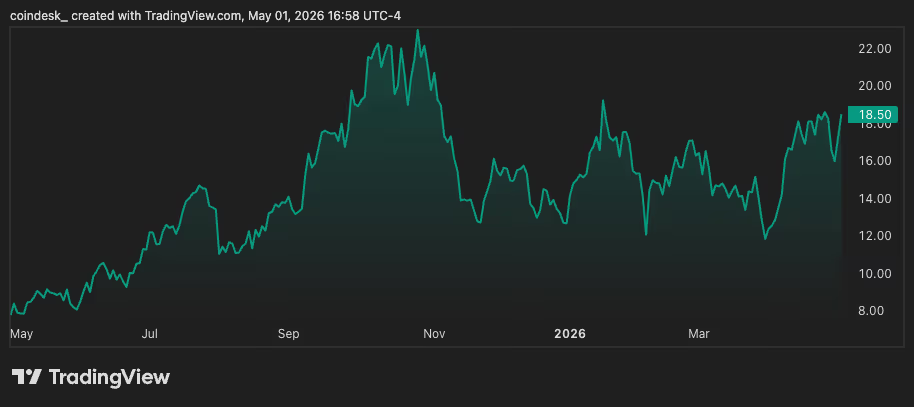
Riot Platforms (RIOT) shares jumped about 8% on Friday after Advanced Micro Devices (AMD) expanded its capacity at the company’s Rockdale, Texas campus, highlighting Riot’s continued pivot from bitcoin mining into AI and high-performance computing.
According to the Q1 financial results, AMD exercised an option to double its contracted capacity to 50 megawatts (MW), with the potential to upsize to 150MW. According to the earnings transcript, Riot said the agreement could generate roughly $636 million over a 10-year term.
Riot also secured improved terms on its $200 million bitcoin-backed credit facility with Coinbase, lowering the rate to a fixed 6.15% from 8.3% and releasing 1,544 of pledged collateral bitcoin, signaling growing lender confidence in its expanding data center business.
Together with the AMD deal and improved credit terms, investors are paying a premium for the stock. “Market pricing in lower cost of capital as the expanded AMD deal drives lender confidence,” said Matthew Sigel, head of digital assets research at VanEck.
Riot was one of the last few ‘pure play’ mining companies left that didn’t get into hosting AI computing, while others opened up their data centers to move away from mining. Until recently, activist investor Starboard started to urge the management to accelerate its transition from bitcoin mining to an AI infrastructure provider.

The move to expand its data center business to host AI computers appears to be paying off for the Castle Rock, Colorado-based company.
The firm reported total revenue of $167.2 million for the quarter ended March 31, up from $161.4 million a year earlier, supported by $33.2 million in initial data center revenue. However, bitcoin mining revenue fell to $111.9 million from $142.9 million, mainly due to lower bitcoin prices and increased mining competition. The mining company’s shares are up about 147% over the last 12 months, while bitcoin fell nearly 17%.
The company, which previously held onto all its mined bitcoin, is also accelerating its bitcoin sales. According to Bitcoin Treasuries data, the company sold 3,688 BTC during Q1. The company ended March with 15,679 BTC and $282.5 million in cash.
Read more: The bitcoin treasury boom is unwinding as some companies and governments sell holdings
TLDR:
- Bitcoin holds near $78.4K as ETF inflows return, signaling stabilizing institutional demand.
- BlackRock and Fidelity lead Bitcoin ETF inflows while smaller funds see mixed outflow pressure.
- Ethereum ETF outflows persist for four days, reflecting weaker institutional risk appetite.
- Bitcoin ETF inflow rebound follows prior outflows, reinforcing selective institutional accumulation.
Bitcoin trades at $78,423.77 as of writing with $38,674,613,465 in 24-hour volume, rising 2.75% daily and 1.05% weekly amid ETF flow shifts.
Spot Bitcoin ETF net inflow of $23.5M signals renewed institutional demand. In the meantime, Ethereum ETFs have extended outflows, reinforcing divergence and supporting cautious accumulation trends around Bitcoin.
Bitcoin ETF Flow Reversal After Outflow Streak
According to SosoValue, Bitcoin spot ETF flows reversed after three days of outflows, recording a $23.5 million net inflow across issuers on April 30.
BlackRock IBIT and Fidelity FBTC led inflows, offsetting weaker performance from smaller competing ETF products and alternative providers.
Grayscale continued outflows due to higher fees, while Bitcoin price remained stable near key trading support levels during the session today. Trading data also showed concentrated activity among large asset managers during the rebound session.
Institutional participation increased modestly as ETF trading volumes rose alongside improved sentiment following Bitcoin price stabilization near support.
Macro expectations around interest rates also influenced ETF allocation decisions across regulated crypto investment products globally.
Market analysts noted ETF flows remain sensitive to short-term volatility, especially during uncertain geopolitical and economic conditions. ETF inflow patterns continue correlating with broader crypto market stabilization signals across trading venues.
Recent ETF flow behavior suggests selective accumulation of Bitcoin during consolidation phases across the market cycle.
Investor positioning data shows sustained interest in Bitcoin ETFs despite short-term volatility and mixed macro signals.
This pattern reinforces Bitcoin’s role as the primary digital asset exposure within regulated ETF investment frameworks globally. Such allocation behavior reflects ongoing preference for established liquidity pools within crypto ETF structures.
Ethereum ETF Outflows Signal Diverging Sentiment
Ethereum spot ETFs recorded four consecutive days of net outflows across major issuers, reflecting weaker institutional demand.
Investor rotation toward Bitcoin continued as Ethereum faced reduced near-term catalysts and weaker risk appetite exposure.
This divergence between Bitcoin inflows and Ethereum outflows widened across ETF markets during recent trading sessions. Liquidity concentration remains highest across top-tier Bitcoin ETF issuers in current market conditions.
Data indicate Ethereum ETFs are experiencing sustained redemption pressure compared with Bitcoin, which shows stabilizing capital inflows. Fee structures and liquidity depth continue influencing investor allocation across competing spot ETF products in crypto markets.
Market participants remain cautious as Ethereum flows suggest reduced conviction relative to Bitcoin dominance trends. Market observers continue monitoring Ethereum ETF performance for signs of sustained capital recovery.
Ongoing Ethereum ETF outflows reflect cautious positioning among institutional investors awaiting stronger ecosystem catalysts. Reduced allocation may indicate rotation toward assets with deeper liquidity and stronger historical ETF demand profiles.
ETF data continues to show divergence between Ethereum and Bitcoin allocation trends across regulated markets. These patterns continue shaping short-term allocation strategies among institutional crypto investors.
TLDR:
- LINK trades at $9.20, gaining 1.13% daily despite a 1.75% weekly pullback in a weak market structure
- Whale activity shows phased redistribution of LINK holdings, signaling steady supply rotation
- 24-hour volume near $179M reflects active participation amid ongoing consolidation phase
- Market structure remains range-bound as liquidity shifts between exchanges and private wallets
Chainlink (LINK) trades at $9.20 with $179,867,749 in 24-hour volume, reflecting a 1.13% daily gain despite a -1.75% weekly decline.
Chainlink whale activity continues to shape market structure as large holders redistribute millions of tokens during consolidation.
This mix of price recovery and ongoing supply shifts keeps liquidity dynamics tightly watched across the market.
Staggered Redistribution Across Whale Wallets
On-chain data tracking Chainlink whale activity indicates a gradual reduction in large wallet balances as nearly 18.94 million LINK moved across addresses over recent weeks during a structured redistribution phase.
Unlike abrupt sell-offs, the movement appears phased, suggesting deliberate liquidity release rather than panic-driven exits from major holders. Market observers note that such patterns often emerge during consolidation cycles.
This is where price direction remains range-bound while liquidity deepens across exchanges and OTC desks. It allows whales to distribute holdings in stages without causing sharp volatility spikes across the broader market structure over time. It also helps maintain steady liquidity conditions across the overall structure.
Recent exchange flows reinforce the view of redistribution within Chainlink whale activity as wallets linked to Binance recorded significant LINK withdrawals.
These transfers reduce exchange supply and shift tokens into private custody or long-term storage, lowering immediate sell pressure in spot markets.
On-chain trackers show accumulation behavior despite muted price action, indicating positioning ahead of ecosystem expansion and broader adoption across decentralized financial networks within the current market cycle phase.
Consolidation Phase and Shifting Supply Structure
Chainlink price action remains confined within a narrow consolidation range, with LINK trading near $9 after extended sideways movement between $8 and $10.
Despite subdued volatility, on-chain metrics indicate steady network engagement. This includes rising total value locked across Chainlink-enabled protocols and growing infrastructure usage.
Market participants continue monitoring the divergence between flat price movement and sustained ecosystem activity.
The ongoing development across data feeds, interoperability tools, and real-world asset integrations is linked to Chainlink’s infrastructure role in decentralized markets.
These conditions are aligned with reduced exchange supply and continued whale repositioning across market cycles. This is without immediate directional price expansion signals emerging.
Large wallet behavior continues to show gradual accumulation and redistribution patterns, reflecting strategic positioning among Chainlink whale participants.
These movements often coincide with extended consolidation phases where liquidity conditions remain stable, and exchange order books absorb distributed supply over time.
Tracking data suggests ongoing wallet dispersion across multiple addresses among top holders, indicating a gradual redistribution within the broader Chainlink ecosystem structure phase.
Market structure has remained influenced by reduced exchange balances and continued off-exchange movement of LINK.
Participants are observing wallet-level shifts across both retail and institutional segments as consolidation persists across broader crypto markets.
Crypto World
AI and blockchain infrastructure company Gency AI today announced it has raised $20 million in a new funding round
San Francisco, U.S.A., March 17, 2026 — AI and blockchain infrastructure company Gency AI today announced it has raised $20 million in a new funding round. The round saw participation from several institutions, including Y&ZC Capital, MTmetaworld Holdings, Riverpark, ArkStream, MH Ventures, ViaBTC and Basics Capital.
The fresh capital is earmarked for scaling Gency AI’s decentralized advertising execution and settlement network, hardening its privacy-preserving computing stack, and accelerating product deployment and ecosystem partnerships across North America, Asia, and Europe.
Building verifiable infrastructure for the advertising economy
The global digital advertising market continues to grow rapidly, but many execution and settlement processes still rely on centralized platforms. Industry participants have highlighted ongoing challenges related to attribution transparency, data ownership, and reconciliation cycles between advertisers, publishers, and agencies.

Gency AI aims to shift the industry from a model of “platform trust” to “protocol trust” by introducing on-chain verifiable credentials and automated revenue distribution mechanisms. Leveraging smart contracts and privacy-preserving computing technologies, ad impressions, conversion outcomes, and revenue allocation can be independently verified and settled automatically.
According to the company, the system is designed to automate reconciliation processes through smart contracts, with the goal of reducing settlement times and improving transparency in cross-border advertising transactions.
AI and blockchain–integrated technical architecture
Gency AI’s network architecture is built around four core modules:
Policy identity
Creates on-chain permission identities and usage boundaries for data, enabling transparent and traceable data authorization management.
ESQ privacy computing layer
Integrates technologies such as TEE, PSI, and MPC to support encrypted computation and privacy-preserving processing of advertising data.
PSG clearing and settlement protocol
Converts advertising actions and conversion outcomes into on-chain verifiable credentials and automatically executes revenue distribution through smart contracts.
AI optimization engine
Operates in an anonymous and encrypted environment to power advertising strategy prediction, audience matching, and campaign optimization. It also enables model training and attribution analysis without exposing raw user data, balancing privacy protection with operational efficiency.
Investor perspectives
Investors participating in the round said the convergence of AI automation and verifiable computing has the potential to reshape the core infrastructure of digital advertising, gradually shifting the industry from a model driven by closed data platforms to one powered by open protocols.
They also noted that as global privacy regulations tighten and demand for AI-powered automated advertising continues to grow, building a trusted, verifiable, and autonomously operating advertising network is likely to become a key direction for the industry.
About Gency AI
Gency AI is a sovereign advertising network purpose-built for the agentic economy — an environment where data ownership, permissions, execution, and settlement are designed to be programmable, verifiable, and controlled by users by default.
Unlike traditional adtech systems that depend on opaque data aggregation and trust-based reporting, Gency AI reimagines advertising as a verifiable coordination system. By combining cryptographic guarantees, on-chain policy enforcement, and measurable outcomes, it enables coordinated interactions among advertisers, publishers, AI agents, and users.
Media contact:
Ethereum (ETH) is coiling under a $2,300 while Bitcoin Dominance approaches a monthly death cross seen only twice in history, the kind of pairing that historically sets up an altseason.
The two charts move as mirrors. Ether is the largest altcoin, so sustained strength in ETH against bitcoin pulls capital away from BTC and pushes the dominance index lower, the textbook setup that has previously marked the start of an altcoin rotation.
Ethereum Price Targets $3,430
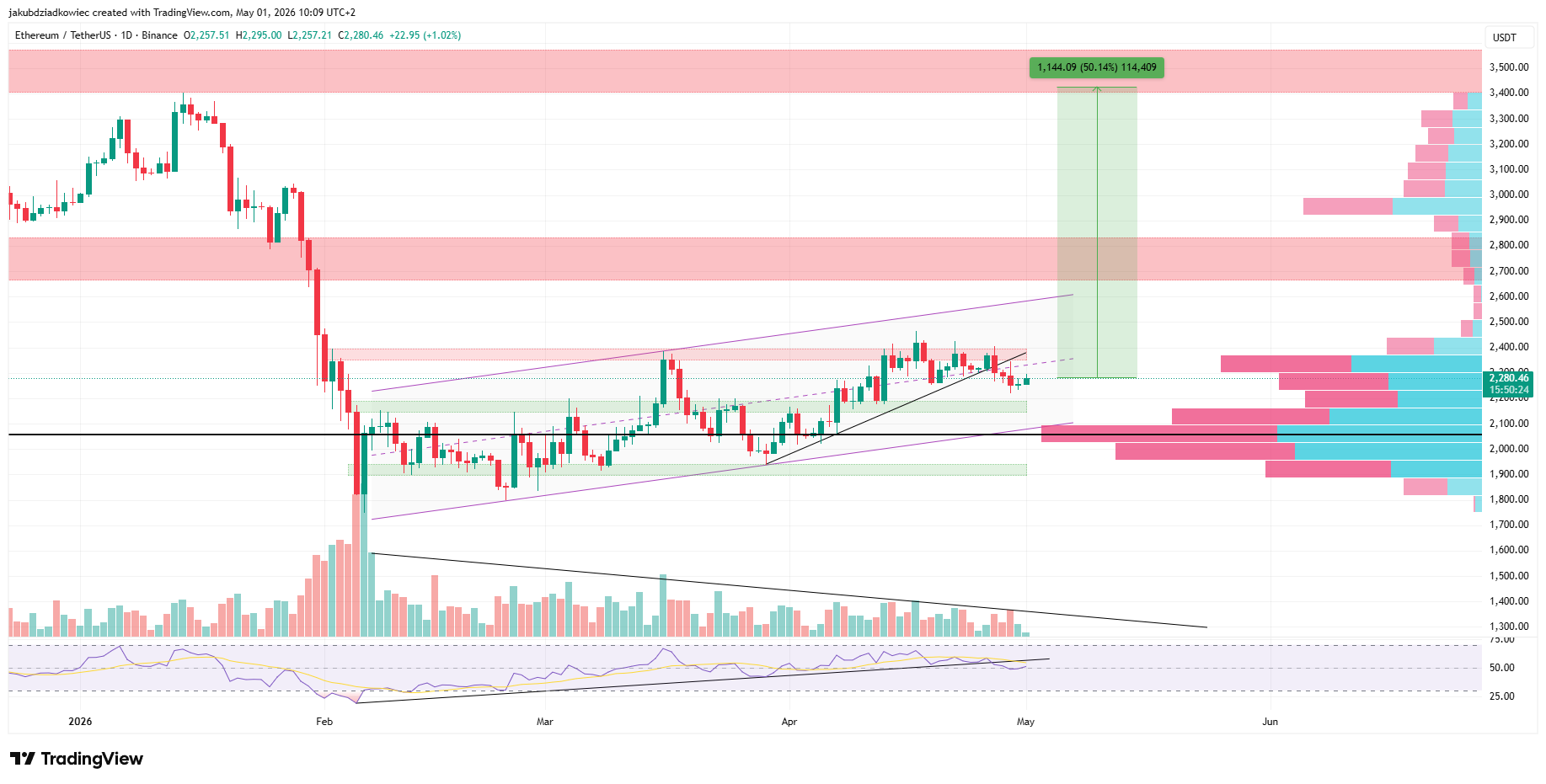
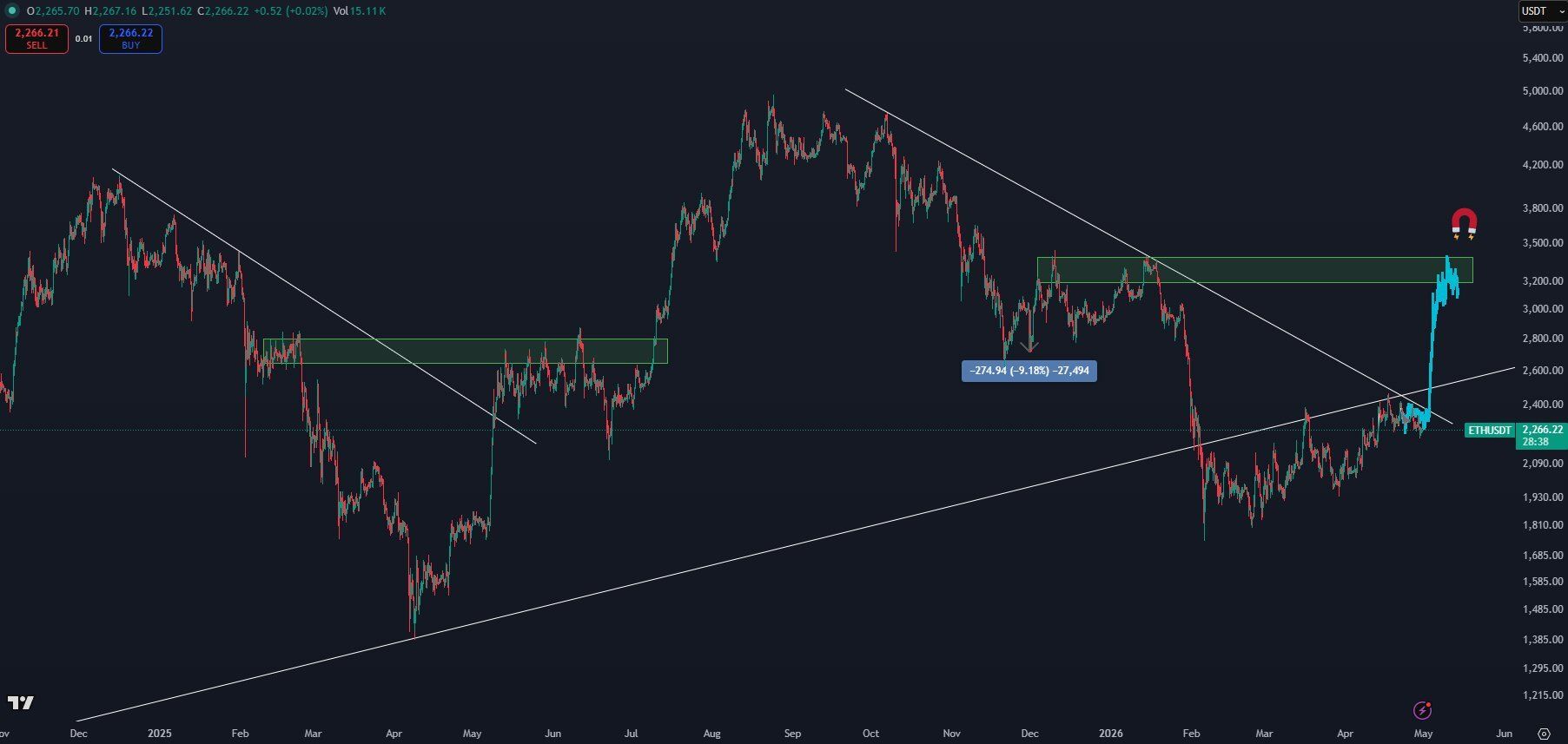
Ethereum trades at $2,280, inside an ascending parallel channel that has guided price action since February. The token broke below the channel midline on April 27, a structural shift that put bears in temporary control.
That breakdown coincided with the daily Relative Strength Index (RSI) breaking through its own ascending trendline. The double trendline failure is a bearish confluence that often precedes deeper retracements.
However, the breakdown volume contracted rather than expanded. The Visible Range Volume Profile (VRVP) on the right side of the chart shows heavy accumulation around $2,050, which now overlaps with the lower band of the rising channel and serves as the primary downside target if sellers press the move.
A clean reclaim of the channel midline opens the door to a 50% measured move toward $3,430. Closer overhead resistance sits at $2,750, the prior swing high that bulls would need to clear before the long-range target comes into view.
Trader Fractal Points to the Same $3,430 Magnet
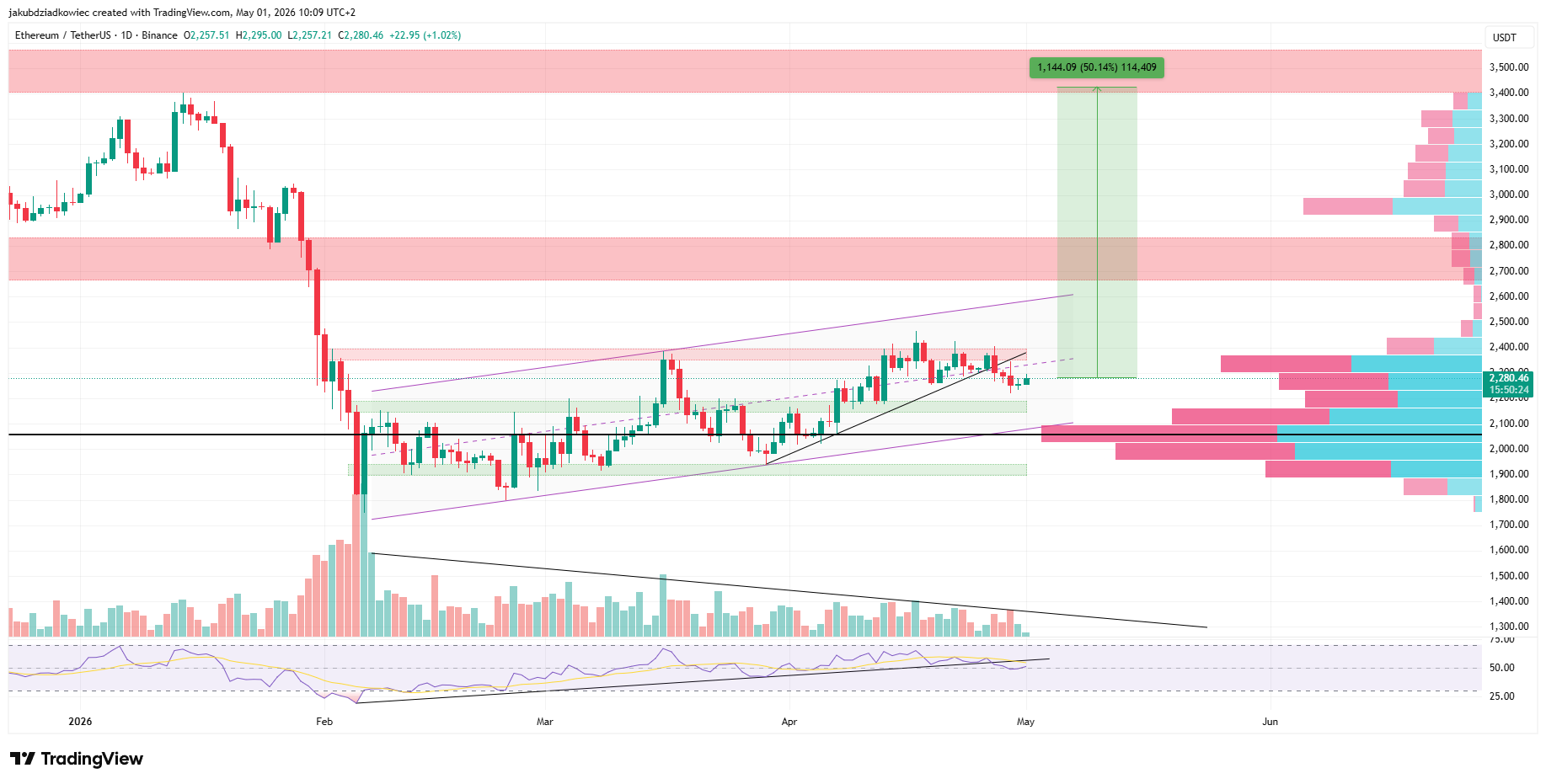
Trader CryptoKaleo published a daily Ether chart on X that arrives at the same $3,430 zone from a different angle. He marks two falling trendlines that the price has already started to break through, a pattern he says mirrors a similar fractal from earlier in 2025.
The earlier setup resolved with a fast move higher after consolidation under resistance. Kaleo treats the prior move as the template for what could follow this base.
His drawn target zone overlaps cleanly with the long-range resistance from the channel chart. Two independent technical reads landing on the same $3,430 area strengthen the case that ether bulls have a defined upside objective if the breakdown fails to extend.
Bitcoin Dominance Approaches Its Third Monthly Death Cross Ever
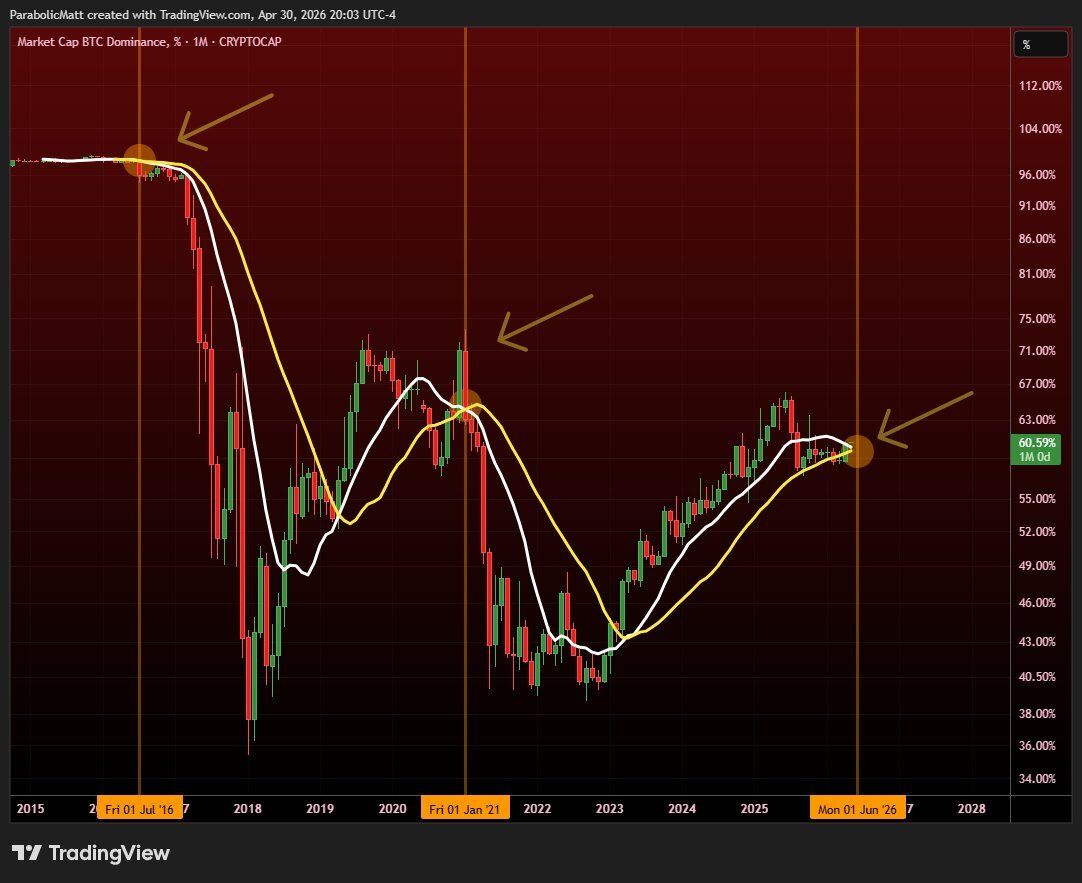
Analyst Matthew Hyland flagged a monthly death cross brewing on the Bitcoin dominance chart, with the slower yellow moving average set to cross below the faster white moving average around June 2026.
The signal has appeared only twice before in the asset’s history. The first cross arrived in July 2016, and the second in January 2021. Both events were followed by sharp drops in dominance and aggressive rotations into altcoins.
BTC.D currently prints a 60.59% monthly close. Even with dominance still elevated near multi-year highs, the structural setup behind the chart suggests the path of least resistance over the coming months may be lower, not higher.
BTC Dominance Tests 61% Resistance That Decides Altseason
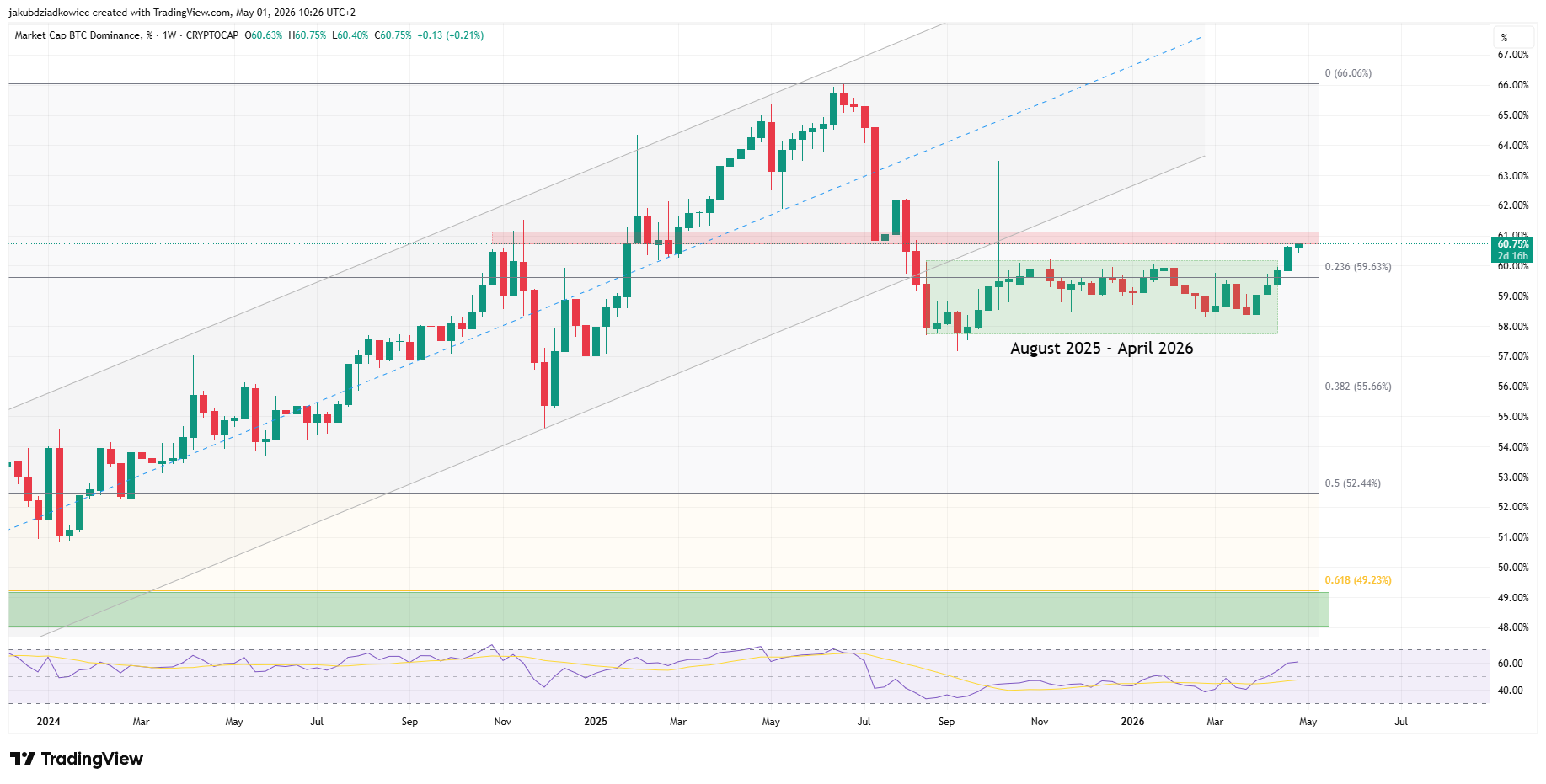
The weekly chart adds precision that the monthly view cannot. Bitcoin Dominance climbed inside an ascending channel for years before breaking down in August 2025, then traded sideways inside an accumulation box from August 2025 through April 2026.
Over the past two weeks, BTC.D pushed out of that range and is now stalling at 60.75%, just below resistance at 61%. That level is the line that decides the next macro move.
A clean break above 61% would open the door to 62% and the 66% June high. A rejection lines up with the monthly death cross thesis and points price action down toward the 0.618 Fibonacci retracement at 49.23%.
Ethereum’s $3,430 breakout and Bitcoin Dominance’s drop toward 49% are two sides of the same altcoin trade. The 61% level on dominance and the channel midline on ETH are the binary triggers to watch over the coming weeks.
The post Bitcoin Dominance Nears Death Cross, Ethereum Could Trigger Altcoin Season appeared first on BeInCrypto.
Key points:
- Bitcoin will have to flip the $80,000 level into support to continue its up move to $84,000.
- Several major altcoins are finding buyers at lower levels, but they will have to overcome the overhead resistance to start a new up move.
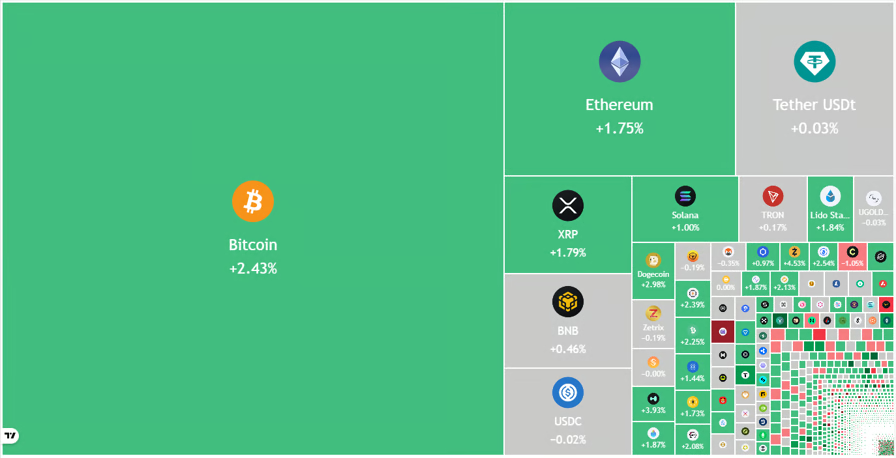
Bitcoin (BTC) has risen above $78,000, extending upon its 11.87% rally in April, per CoinGlass data. The recovery in April was supported by solid buying in the US spot BTC exchange-traded funds, which saw $1.97 billion in inflows, according to SoSoValue data.
The rally is expected to encounter selling in the zone between the True Market Mean at $78,000 and the Short-Term Holder (STH) cost basis at $79,000. Analysts are closely monitoring the $80,000 level, which needs to be flipped into support for confirmation that bulls remain in control.

Crypto market data daily view. Source: TradingView
CryptoQuant is not convinced that BTC’s rally could extend further. In a recent report, the crypto analytics firm said that BTC’s up move in April was fuelled mainly by futures traders, while spot demand contracted. That suggests “the market’s marginal buyer was speculative, not fundamental.” CryptoQuant warned in an X post that the exact setup had “preceded the next leg down” in 2022.
Could BTC and the major altcoins break above their overhead resistance levels? Let’s analyze the charts of the top 10 cryptocurrencies to find out.
Bitcoin price prediction
BTC turned up from the 20-day exponential moving average ($75,814) on Thursday, indicating buying on dips.

BTC/USDT daily chart. Source: Cointelegraph/TradingView
The relief rally is expected to face selling pressure at $79,500, but if buyers pierce the overhead resistance, the uptrend is expected to gain momentum, and the BTC/USDT pair may rally to $84,000.
The 20-day EMA is the crucial support to watch out for on the downside. If the BTC price turns down from the current level or the overhead resistance and breaks below the 20-day EMA, it may start a deeper correction to the 50-day simple moving average ($72,362) and then the support line.
Ether price prediction
Ether (ETH) is finding support near the 50-day SMA ($2,207), indicating that bulls are viewing the dips as a buying opportunity.

ETH/USDT daily chart. Source: Cointelegraph/TradingView
The flattening 20-day EMA and the relative strength index (RSI) just above the midpoint suggest weakening momentum. If the ETH price turns down and breaks below the 50-day SMA, the next stop is likely to be the support line.
Instead, if the price remains above the 20-day EMA, the bulls will attempt to drive the ETH/USDT pair to $2,465 and then to the ascending channel’s resistance. The next trending move is expected to begin on a close above the resistance line or below the support line. Until then, the pair may remain inside the channel.
XRP price prediction
XRP (XRP) remains stuck inside the $1.27 to $1.61 range, signaling buying on dips and selling on rallies.

XRP/USDT daily chart. Source: Cointelegraph/TradingView
The 20-day EMA ($1.39) has started to turn down gradually, and the RSI is near the midpoint, indicating a slight edge to the bears. If the XRP price remains below the moving averages, the likelihood of a drop to the $1.27 support increases.
Buyers are likely to have other plans. They will attempt to thrust the price above the moving averages. If they succeed, the XRP/USDT pair may rally to the downtrend line of the descending channel pattern, then to the $1.61 resistance. A trend change will be signaled on a close above the $1.61 level.
BNB price prediction
BNB (BNB) slipped below the moving averages on Tuesday, but the bears have failed to build upon their advantage. That suggests demand at lower levels.

BNB/USDT daily chart. Source: Cointelegraph/TradingView
The bulls are attempting to push the BNB price back above the moving averages. If they manage to do that, the BNB/USDT pair may rise to $654 and then to the $687 overhead resistance.
On the other hand, if the price turns down and breaks below $610, it signals that the sellers remain in control. The pair may then tumble toward the $570 support, where the buyers are expected to step in.
Solana price prediction
Buyers are attempting to sustain Solana (SOL) above the $82.65 level but the bears continue to exert pressure.

SOL/USDT daily chart. Source: Cointelegraph/TradingView
If the $82.65 level cracks, the SOL/USDT pair may decline to $76. Buyers are expected to defend the $76 level with all their might, as a close below it may start the next leg of the downward move to $67.
On the contrary, if the SOL price rises above the moving averages, it suggests that the pair may remain inside the $82.65 to $90.73 range for some time. A close above $90.73 opens the gates for a retest of the $98 overhead resistance.
Dogecoin price prediction
Dogecoin (DOGE) is showing strength, as bulls prevented the pullback from dipping below the $0.10 level on Thursday.

DOGE/USDT daily chart. Source: Cointelegraph/TradingView
That increases the likelihood of a rally to the $0.12 overhead resistance, where the bears are expected to mount a strong defense. If the price turns sharply lower and breaks below the moving averages, it suggests the DOGE/USDT pair may remain within the $0.09 to $0.12 range for a while longer.
Alternatively, if buyers overcome the $0.12 obstacle, it suggests that the pair may have bottomed out in the near term. The DOGE price may rise to $0.14 and later to $0.16.
Hyperliquid price prediction
Hyperliquid (HYPE) fell below the 50-day SMA ($39.84) on Thursday but the long tail on the candlestick shows buying at lower levels.

HYPE/USDT daily chart. Source: Cointelegraph/TradingView
The bulls are striving to push the HYPE price above the 20-day EMA ($40.85). If they manage to do that, the HYPE/USDT pair may rally toward the $43.76-$45.77 overhead resistance zone. A close above the zone clears the path for a rally to $50.
Contrary to this assumption, if the price turns down and breaks below $38.70, it signals that the bears are selling on rallies. That may start a deeper pullback to $37.77 and subsequently to $34.45.
Related: Did Dogecoin bottom first? DOGE price poised for 20% gains as whales return
Cardano price prediction
Cardano (ADA) has been clinging to the moving averages, indicating that the bulls have kept up the pressure.

ADA/USDT daily chart. Source: Cointelegraph/TradingView
That improves the prospects of a break above the downtrend line. If that happens, the ADA/USDT pair may surge to $0.32 and later to $0.37, signaling a potential short-term trend change.
This bullish view will be invalidated in the near term if the ADA price turns sharply lower and breaks below $0.22. Such a move suggests that the pair may remain inside the descending channel for a few more days.
Bitcoin Cash price prediction
Bitcoin Cash (BCH) bounced off $443 again, indicating that the bulls are aggressively defending the level.

BCH/USDT daily chart. Source: Cointelegraph/TradingView
There is minor resistance at the 50-day SMA ($453), but it is likely to be crossed. The BCH/USDT pair may then soar to $486, at which point bears are expected to sell aggressively. However, if buyers overcome the barrier, the pair may rally to $520.
Contrary to this assumption, if the BCH price turns sharply lower from $486 and breaks below the moving averages, it suggests that bears remain sellers on rallies. That may keep the pair range-bound between $419 and $486 for some time.
Monero price prediction
Monero (XMR) bounced off the 20-day EMA ($366) on Wednesday, indicating a positive sentiment.

XMR/USDT daily chart. Source: Cointelegraph/TradingView
The upsloping 20-day EMA and the RSI in positive territory indicate that the path of least resistance is upward. If buyers push and maintain the XMR price above the $406 resistance, the rally may reach the $500 level.
Conversely, if the price turns sharply lower from the overhead resistance and breaks below the moving averages, it suggests that the XMR/USDT pair may remain range-bound between $302 and $406 for some time.
XRP’s (XRP) sentiment on social media has risen sharply over the last few days, but overhead resistance at $1.40 kept the price in consolidation.
Key takeaways:
- XRP’s social media sentiment has risen 240% over the last 30 days to a two-year high.
- XRP price recovery may face resistance at $1.40, with a prolonged consolidation likely.
.
XRP sentiment jumps on integration with Rakuten Pay
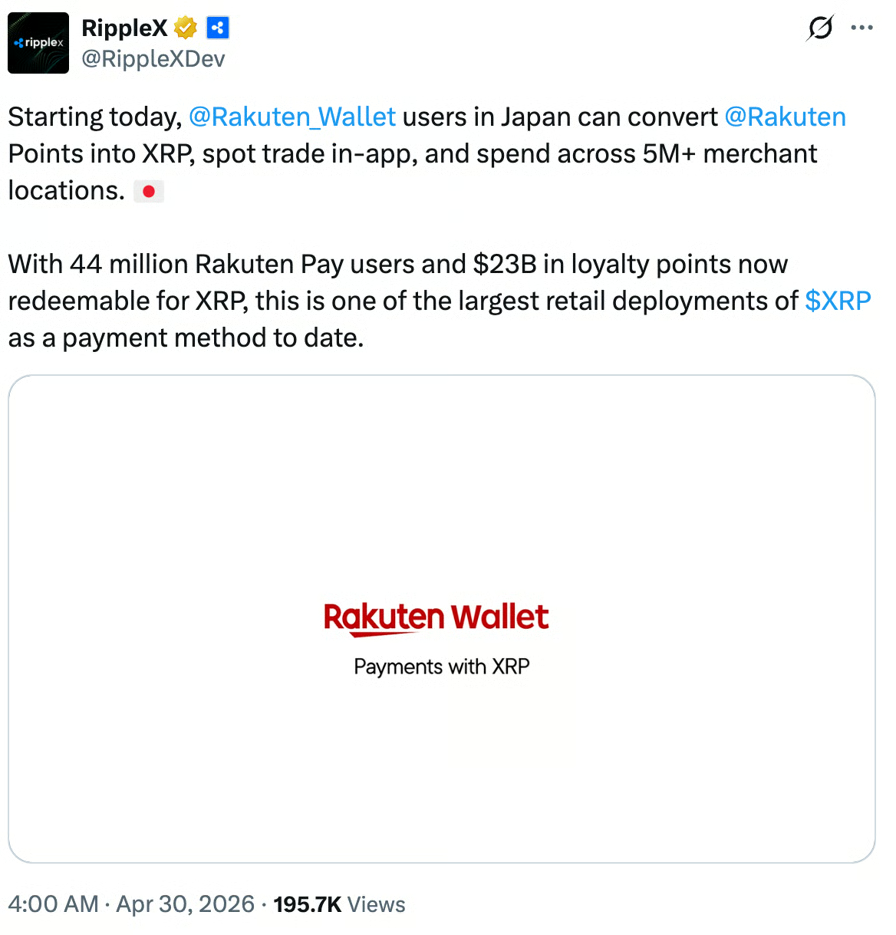
News of XRP’s integration with the Japanese payment platform, Rakuten Wallet, has sparked renewed optimism among investors.
Related: XRP set for ‘strongest’ 2026 monthly ETF inflows as bulls target $2
This integration allows Rakuten’s over 44 million users to convert their loyalty points (worth over $23 billion) directly into XRP, trade it in-app, and spend it at over 5 million merchant locations via the Rakuten Pay app.
This marks “one of the largest retail deployments of $XRP as a payment method to date,” bridging loyalty programs, payments, and crypto utility in a major world economy, Ripple said in an X post on Thursday.

XRP integrates with Rakuten Pay. Source: Ripple
As a result, XRP saw its “2nd highest bullish sentiment across social media in the past 2 years,” Santiment said in a Thursday post on X.
Santiment’s Positive/Negative sentiment indicator, which measures the ratio of positive to negative social media mentions for a cryptoasset, shows XRP has a score of 3.9, levels last seen in early 2024.
This was more than 240% higher than the 1.135 value recorded on March 29, following a 20% price drop over two weeks.
Traders are showing excitement over the fact that XRP is “seeing further adoption,” the onchain data provider said, adding:
“As far as price goes, these events don’t often instantly lead to major price outbreaks. It is usually after the initial wave of euphoria, after FOMO calms down, that the impact of this kind of news sees the bullish outcome.”

XRP’s Positive/Negative sentiment metric. source: Santiment
“Buy $XRP with points. Spend it across millions of merchants in Japan,” analyst John Squire said in reaction to the development, adding:
“This is what mass adoption looks like.”
Following this news, XRP/USD jumped 2% over the last 24 hours, but remains 62% below its $3.66 multi-year high reached in July 2025.
XRP faces stiff resistance above $1.40
XRP’s recent 18% rally from its local low at $1.27 reached on April 5 was stopped at $1.48, coinciding with the upper boundary of a symmetrical triangle.
This trend line has suppressed the price since early February, as shown in the chart below.
Bulls must push the price above the $1.40-$1.45 resistance zone to confirm a bullish breakout from the triangle. This area is also where the 50-day exponential moving average, the 100-day simple moving average and the upper trend line of the triangle sit, reinforcing the significance of this resistance zone.

XRP/USD daily chart. Source: Cointelegraph/TradingView
According to XRP’s cost-basis distribution data, investors hold approximately 2 billion XRP at an average cost of $1.40-$1.45, creating a potential resistance zone. This concentration suggests many investors may sell at break-even, potentially stalling XRP’s upward momentum.

XRP cost basis distribution chart. Source: Glassnode
A break above this supply area could open the way for a rally toward the measured target of the triangle at $2.10, about 50% above the current price.
In a Friday post on X, analyst ChartNerd said a big move was brewing for XRP price once resistance above $1.40 is “cleared.”

As Cointelegraph reported, the XRP/USD pair was required to hold the $1.27 support and rise above the moving averages around $1.40 to signal a trend change.
Crypto World
Consensys Challenges OCC’s Stablecoin Rules, Urges Treasury to Narrow Yield and DeFi Restrictions
TLDR:
- Consensys argues the OCC’s yield ban wrongly extends to third-party distributors beyond what Congress intended.
- The firm says DeFi lending on platforms like Aave is an active user choice, not issuer-paid yield on stablecoins.
- Consensys recommends disclosure and pool segregation over outright prohibition on multi-brand stablecoin issuance.
- The rules, if left unchanged, could favor large institutions and put OCC-supervised issuers at a competitive disadvantage.
Consensys submitted a formal comment letter to the U.S. Treasury Department regarding the Office of the Comptroller of the Currency’s proposed stablecoin rules.
The letter responds to the OCC’s framework implementing the GENIUS Act’s payment stablecoin provisions. While Consensys acknowledged the OCC’s effort, it identified three areas needing revision.
These areas relate to yield restrictions, DeFi access, and multi-brand stablecoin issuance. The outcome of these rules will shape how the U.S. stablecoin market develops.
Yield Restrictions and the Role of Distributors
The GENIUS Act prohibits stablecoin issuers from paying interest or yield to holders. Congress wanted to prevent stablecoins from competing with bank deposits through passive returns. Consensys confirmed it recognizes this concern and accepts Congress’s position on the matter.
However, the OCC extended the prohibition to cover “related third parties.” This broader category sweeps in independent distribution partners that co-brand or white-label a stablecoin product.
Consensys argued that a distributor using its own commercial fee to offer user incentives is not acting as an issuer.
Consensys explained in the letter that such a distributor is “a business competing for customers with its own money, as every business does.”
This is standard commercial practice and not the conduct Congress sought to restrict. Congress also rejected two separate amendments that would have extended the yield ban to non-issuers.
Therefore, the OCC’s proposed rule oversteps the statutory line Congress deliberately drew. Consensys called on the OCC to revise this provision to align with legislative intent and respect the boundaries Congress set.
DeFi Access and the Multi-Brand Stablecoin Issue
On the DeFi question, Consensys pointed to how MetaMask users interact with protocols like Aave or Morpho. When a user deposits stablecoins into such platforms, they make an active investment decision. They accept protocol risk and earn yield from borrowers in that specific market.
Consensys clarified that this activity is not “the issuer paying them to hold a stablecoin.” The GENIUS Act itself excludes non-custodial software interfaces from regulated intermediary status. Consensys argued the final rule should confirm that DeFi access falls under this same carve-out.
Regarding multi-brand stablecoins, the OCC is considering prohibiting a single licensed issuer from supporting multiple co-branded products.
Consensys stated that “disclosure is the right instrument here, not prohibition.” Requiring issuers to identify themselves and explain reserve structures would address transparency concerns directly.
If disclosure alone proves insufficient, Consensys suggested pool segregation as a proportionate remedy. A full prohibition “forecloses the distribution model entirely rather than managing the risk it presents.”
It also places OCC-supervised issuers at a disadvantage compared to FDIC-supervised issuers facing no equivalent restriction.


137 Ventures has raised over $700m across two new funds, lifting AUM above $15b as it doubles down on AI agents, robotics, advanced industry and a $10b‑plus SpaceX stake.
Summary
- SpaceX backer 137 Ventures has closed more than $700 million across two new funds, lifting its assets under management above $15 billion.
- The growth-stage firm says the fresh capital will target high‑impact technology bets in AI agents, robotics, advanced industrial systems, and aerospace propulsion.
- 137 Ventures now owns more than 1% of SpaceX, a stake its founder values at over $10 billion ahead of a potential IPO that could see the rocket company valued above $1 trillion.
San Francisco–based 137 Ventures has raised over $700 million for two new investment vehicles, according to TechFundingNews and a separate press release.
New funds push 137 Ventures past $15b AUM
The closings bring the firm’s total assets under management to more than $15 billion as of March 2026, cementing its status as one of the larger specialist growth funds backing late‑stage technology companies.
137 Ventures, founded in 2010 by Justin Fishner‑Wolfson and S. Alexander Jacobson after their time at Founders Fund, focuses on “generational technology companies” and often provides liquidity solutions to founders and early employees alongside primary capital.
Betting on AI agents, robotics, and propulsion
In its announcement, 137 Ventures said the new funds will back companies “operating at the frontier of AI, defense, and advanced industrial systems,” highlighting categories such as AI agents, robotics, and novel aerospace propulsion as key focus areas.
Recent disclosed portfolio additions include Cognition, Impulse Space, Hadrian, and Physical Intelligence—startups working on AI copilots, in‑space logistics, automated precision manufacturing, and embodied AI, respectively.
Over the past 12 months, the firm has deployed more than $1.7 billion, concentrating capital into a relatively small number of high‑conviction positions rather than spreading bets across hundreds of smaller seed deals.
That strategy fits with a broader venture shift toward fewer, larger rounds in companies seen as core infrastructure for AI and space, even as overall VC volumes in crypto and tech have cooled.
A $10b‑plus SpaceX stake ahead of a trillion‑dollar IPO
137 Ventures’ biggest swing remains its position in SpaceX, where it has invested across roughly two dozen rounds since 2010.
Firm founder Justin Fishner‑Wolfson told Bloomberg that “at this point we own well over I think $10 billion dollars” of SpaceX shares, adding that the stake represents “more than 1%” of the company.
That exposure could become one of the biggest single‑position wins in modern venture history if SpaceX proceeds with a long‑discussed IPO at a valuation north of $1 trillion, as some bankers and secondary‑market indications suggest.
Beyond SpaceX, 137 Ventures has backed names like Anduril, Gusto, and Ramp, reflecting a thesis that AI‑enabled defense, fintech, and enterprise infrastructure will generate outsized returns as automation and autonomy reshape both digital and physical industries.
For founders building AI agents, robotics platforms, or space‑adjacent businesses, the new funds mean 137 Ventures will be an even more active late‑stage counterparty—especially for teams looking for investors comfortable underwriting capital‑intensive, long‑duration bets.

How close reading took over the internet via The Devil Wears Prada’s cerulean monologue

Pentagon says US military to be an 'AI-first' fighting force

Leeds on verge of survival after comfortable win over Burnley

Manchester United reach agreement with Casemiro over contract clause amid transfer speculation

US brings back mandatory military draft registration

Steven Gerrard disagrees with Gary Neville over ‘shock’ Chelsea and Arsenal claim | Football


-

 Tech4 days ago
Register Renaming | Hackaday
-
Crypto World6 days ago
Hyperliquid $HYPE Rally Builds Momentum as AI Sector Enters Prove-It Phase
-

 Politics4 days ago
Drax board avoid their own AGM, accused of greenwashing & environmental racism
-

 Tech4 days ago
Images of Samsung’s rumored smart glasses have leaked
-

 Tech5 days ago
Why Blue Badges Disappeared From Toyota Hybrids
-
 Sports5 days ago
IPL 2026: Ruturaj Gaikwad registers slowest fifty of the season, enters all-time unwanted list | Cricket News
-
 Tech3 hours ago
Trump’s 25% EU auto tariff breaches Turnberry Agreement that also covers semiconductors and digital trade
-

 NewsBeat6 days ago
LK Bennett closes all stores after entering administration
-

 Fashion3 days ago
Kylie Jenner’s KHY Enters a New Era with ‘Born in LA’
-
 Entertainment6 days ago
Mariah Carey Slams Deposition Claims In Brother’s Lawsuit
-

 Business3 days ago
Most Commercial Energy Audits Miss the Real Losses
-

 Business4 days ago
(VIDEO) Charlize Theron Climbs Times Square Billboard to Promote New Netflix Thriller ‘Apex’
-

 Crypto World3 days ago
CFTC’s AI will review U.S. crypto registration applications, chairman tells CoinDesk
-

 Business2 days ago
Barclay Brothers Avoid Bankruptcy: HSBC Drops High Court Petitions After IVA Deal
-
 Sports2 hours ago
Paul Scholes issues Marcus Rashford reality check as agreement emerges over Man United star
-
 Crypto World7 days ago
Nvidia (NVDA) Stock Jumps 5% as Intel Earnings Ignite Semiconductor Rally
-

 Tech6 days ago
Microsoft to roll out Entra passkeys on Windows in late April
-

 Tech6 days ago
OpenAI’s Sam Altman apologizes for not reporting ChatGPT account of Tumbler Ridge suspect to police
-

 Tech6 days ago
OpenAI CEO apologizes to Tumbler Ridge community
-
 Business2 days ago
Tesla Officially Registers Elon Musk’s Stock: What Investors Need to Know
You must be logged in to post a comment Login