
Crypto World
Bitcoin, Altcoins Breakout With Strength: Are New Highs Next?

Key points:
- Bitcoin will have to flip the $80,000 level into support to continue its up move to $84,000.
- Several major altcoins are finding buyers at lower levels, but they will have to overcome the overhead resistance to start a new up move.
Bitcoin (BTC) has risen above $78,000, extending upon its 11.87% rally in April, per CoinGlass data. The recovery in April was supported by solid buying in the US spot BTC exchange-traded funds, which saw $1.97 billion in inflows, according to SoSoValue data.
The rally is expected to encounter selling in the zone between the True Market Mean at $78,000 and the Short-Term Holder (STH) cost basis at $79,000. Analysts are closely monitoring the $80,000 level, which needs to be flipped into support for confirmation that bulls remain in control.

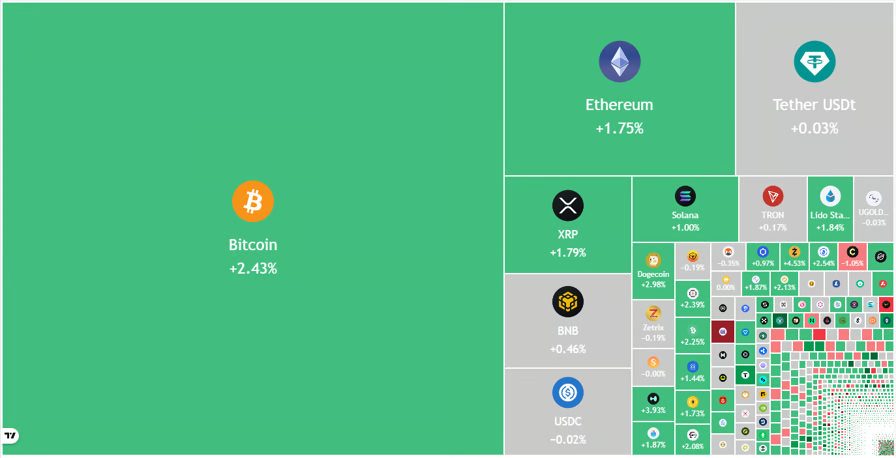
Crypto market data daily view. Source: TradingView
CryptoQuant is not convinced that BTC’s rally could extend further. In a recent report, the crypto analytics firm said that BTC’s up move in April was fuelled mainly by futures traders, while spot demand contracted. That suggests “the market’s marginal buyer was speculative, not fundamental.” CryptoQuant warned in an X post that the exact setup had “preceded the next leg down” in 2022.
Could BTC and the major altcoins break above their overhead resistance levels? Let’s analyze the charts of the top 10 cryptocurrencies to find out.
Bitcoin price prediction
BTC turned up from the 20-day exponential moving average ($75,814) on Thursday, indicating buying on dips.

BTC/USDT daily chart. Source: Cointelegraph/TradingView
The relief rally is expected to face selling pressure at $79,500, but if buyers pierce the overhead resistance, the uptrend is expected to gain momentum, and the BTC/USDT pair may rally to $84,000.
The 20-day EMA is the crucial support to watch out for on the downside. If the BTC price turns down from the current level or the overhead resistance and breaks below the 20-day EMA, it may start a deeper correction to the 50-day simple moving average ($72,362) and then the support line.
Ether price prediction
Ether (ETH) is finding support near the 50-day SMA ($2,207), indicating that bulls are viewing the dips as a buying opportunity.

ETH/USDT daily chart. Source: Cointelegraph/TradingView
The flattening 20-day EMA and the relative strength index (RSI) just above the midpoint suggest weakening momentum. If the ETH price turns down and breaks below the 50-day SMA, the next stop is likely to be the support line.
Instead, if the price remains above the 20-day EMA, the bulls will attempt to drive the ETH/USDT pair to $2,465 and then to the ascending channel’s resistance. The next trending move is expected to begin on a close above the resistance line or below the support line. Until then, the pair may remain inside the channel.
XRP price prediction
XRP (XRP) remains stuck inside the $1.27 to $1.61 range, signaling buying on dips and selling on rallies.

XRP/USDT daily chart. Source: Cointelegraph/TradingView
The 20-day EMA ($1.39) has started to turn down gradually, and the RSI is near the midpoint, indicating a slight edge to the bears. If the XRP price remains below the moving averages, the likelihood of a drop to the $1.27 support increases.
Buyers are likely to have other plans. They will attempt to thrust the price above the moving averages. If they succeed, the XRP/USDT pair may rally to the downtrend line of the descending channel pattern, then to the $1.61 resistance. A trend change will be signaled on a close above the $1.61 level.
BNB price prediction
BNB (BNB) slipped below the moving averages on Tuesday, but the bears have failed to build upon their advantage. That suggests demand at lower levels.

BNB/USDT daily chart. Source: Cointelegraph/TradingView
The bulls are attempting to push the BNB price back above the moving averages. If they manage to do that, the BNB/USDT pair may rise to $654 and then to the $687 overhead resistance.
On the other hand, if the price turns down and breaks below $610, it signals that the sellers remain in control. The pair may then tumble toward the $570 support, where the buyers are expected to step in.
Solana price prediction
Buyers are attempting to sustain Solana (SOL) above the $82.65 level but the bears continue to exert pressure.

SOL/USDT daily chart. Source: Cointelegraph/TradingView
If the $82.65 level cracks, the SOL/USDT pair may decline to $76. Buyers are expected to defend the $76 level with all their might, as a close below it may start the next leg of the downward move to $67.
On the contrary, if the SOL price rises above the moving averages, it suggests that the pair may remain inside the $82.65 to $90.73 range for some time. A close above $90.73 opens the gates for a retest of the $98 overhead resistance.
Dogecoin price prediction
Dogecoin (DOGE) is showing strength, as bulls prevented the pullback from dipping below the $0.10 level on Thursday.

DOGE/USDT daily chart. Source: Cointelegraph/TradingView
That increases the likelihood of a rally to the $0.12 overhead resistance, where the bears are expected to mount a strong defense. If the price turns sharply lower and breaks below the moving averages, it suggests the DOGE/USDT pair may remain within the $0.09 to $0.12 range for a while longer.
Alternatively, if buyers overcome the $0.12 obstacle, it suggests that the pair may have bottomed out in the near term. The DOGE price may rise to $0.14 and later to $0.16.
Hyperliquid price prediction
Hyperliquid (HYPE) fell below the 50-day SMA ($39.84) on Thursday but the long tail on the candlestick shows buying at lower levels.

HYPE/USDT daily chart. Source: Cointelegraph/TradingView
The bulls are striving to push the HYPE price above the 20-day EMA ($40.85). If they manage to do that, the HYPE/USDT pair may rally toward the $43.76-$45.77 overhead resistance zone. A close above the zone clears the path for a rally to $50.
Contrary to this assumption, if the price turns down and breaks below $38.70, it signals that the bears are selling on rallies. That may start a deeper pullback to $37.77 and subsequently to $34.45.
Related: Did Dogecoin bottom first? DOGE price poised for 20% gains as whales return
Cardano price prediction
Cardano (ADA) has been clinging to the moving averages, indicating that the bulls have kept up the pressure.

ADA/USDT daily chart. Source: Cointelegraph/TradingView
That improves the prospects of a break above the downtrend line. If that happens, the ADA/USDT pair may surge to $0.32 and later to $0.37, signaling a potential short-term trend change.
This bullish view will be invalidated in the near term if the ADA price turns sharply lower and breaks below $0.22. Such a move suggests that the pair may remain inside the descending channel for a few more days.
Bitcoin Cash price prediction
Bitcoin Cash (BCH) bounced off $443 again, indicating that the bulls are aggressively defending the level.

BCH/USDT daily chart. Source: Cointelegraph/TradingView
There is minor resistance at the 50-day SMA ($453), but it is likely to be crossed. The BCH/USDT pair may then soar to $486, at which point bears are expected to sell aggressively. However, if buyers overcome the barrier, the pair may rally to $520.
Contrary to this assumption, if the BCH price turns sharply lower from $486 and breaks below the moving averages, it suggests that bears remain sellers on rallies. That may keep the pair range-bound between $419 and $486 for some time.
Monero price prediction
Monero (XMR) bounced off the 20-day EMA ($366) on Wednesday, indicating a positive sentiment.

XMR/USDT daily chart. Source: Cointelegraph/TradingView
The upsloping 20-day EMA and the RSI in positive territory indicate that the path of least resistance is upward. If buyers push and maintain the XMR price above the $406 resistance, the rally may reach the $500 level.
Conversely, if the price turns sharply lower from the overhead resistance and breaks below the moving averages, it suggests that the XMR/USDT pair may remain range-bound between $302 and $406 for some time.

Historically, crypto markets have been driven by a dominant narrative. Not today.
In one corner, miners are trying to break free of four-year cycles. IREN is being recast as an AI infrastructure company, with analysts pointing to data centers and compute demand as the real growth engine. In another corner, BitMine is doing the exact opposite, pouring billions deeper into Ether (ETH) even as losses mount.
The disconnect doesn’t stop there. Stablecoin balances have ballooned to over $300 billion, yet activity has dropped sharply. It reflects capital waiting, with no clear consensus on what comes next.
Meanwhile, institutions are building a parallel track. Tokenized Treasurys are now being used as collateral on exchanges, linking traditional finance and crypto markets more tightly than ever.
This week’s Crypto Biz delves into a market pulling in different directions.
Bernstein sees IREN pivoting from Bitcoin mining to a $3.7B AI cloud business
Analysts at Bernstein are reframing the story around IREN, arguing the company’s future may depend less on Bitcoin (BTC) mining and more on building out AI-focused data center capacity.
In a new report, Bernstein highlights IREN’s access to large-scale energy infrastructure as a key advantage, positioning it to support high-performance computing workloads tied to artificial intelligence.
IREN’s AI cloud segment could grow into a multibillion-dollar business over time, with estimates pointing to a potential $3.7 billion valuation. The company has already begun expanding its data center footprint and securing financing to support this shift, signaling a longer-term strategy that extends beyond crypto mining.
The transition reflects a broader trend among miners seeking more stable and diversified revenue streams as economic conditions in the mining sector deteriorate.
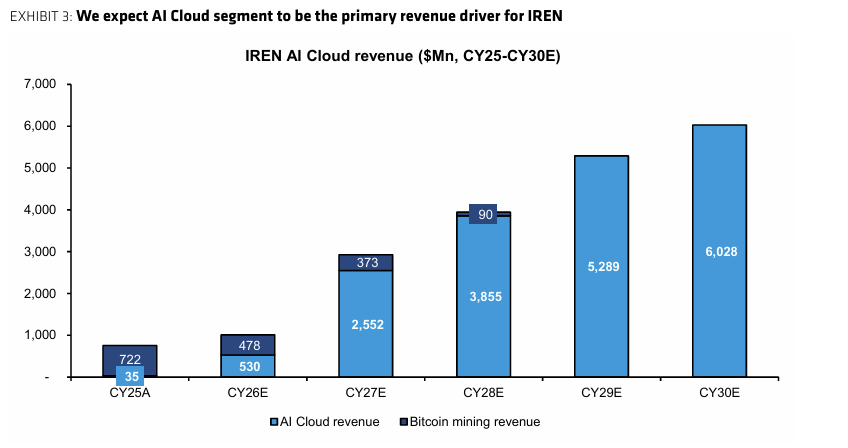
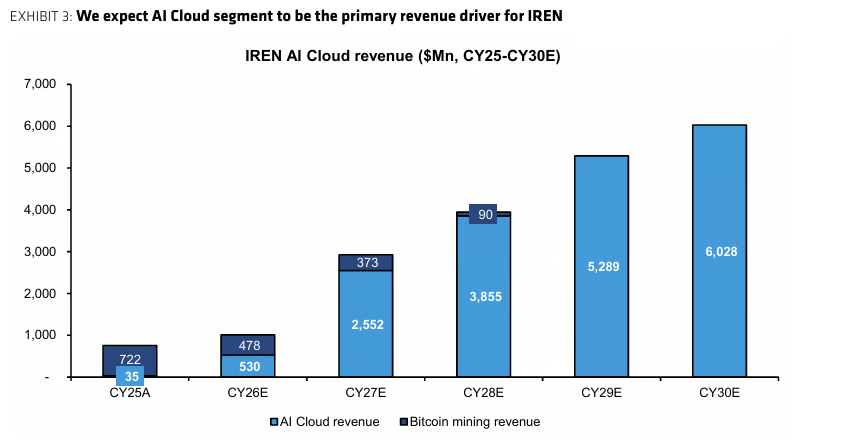
AI cloud is expected to become IREN’s dominant revenue stream very soon. Source: Bernstein
BitMine stacks another 101,000 ETH as unrealized losses grow
Tom Lee’s BitMine added another 101,000 ETH to its balance sheet, doubling down on its accumulation strategy even as its existing holdings remain deeply underwater. The latest purchase brings total investment to roughly $17.6 billion, reinforcing the company’s position as the largest corporate holder of Ether.
That aggressive buying streak comes amid more than $6.5 billion in unrealized losses, reflecting Ether trading well below BitMine’s average acquisition price, $2,248.55 at last look versus the average $3,621.34, according to DropsTab data.
The scale of the drawdown underscores the risk of concentrating corporate treasuries in a single volatile asset, especially when accumulation continues during price weakness.
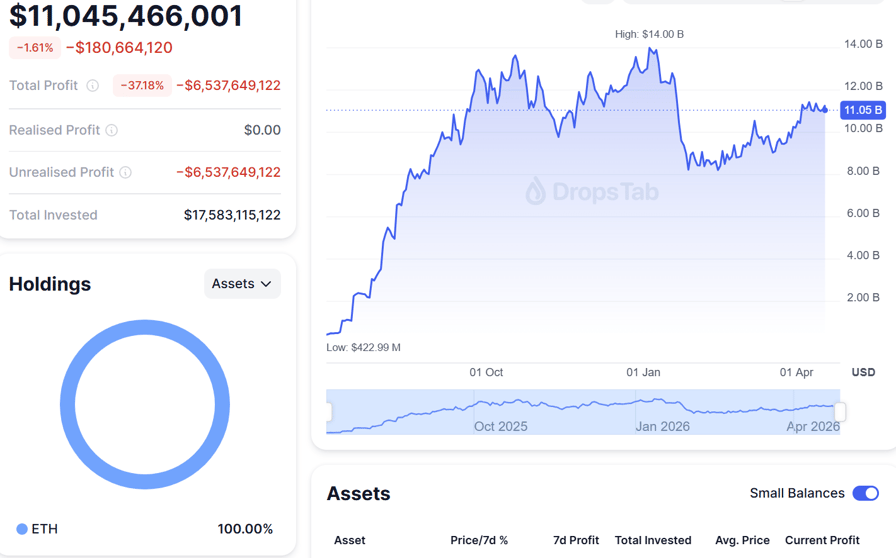
BitMine is deeply underwater on its ETH position. Source: DropsTab
Stablecoin supply rises as transfer volume drops nearly 20%
Stablecoin transfer activity fell sharply over the past month, with total volume dropping 19% to about $8.3 trillion, even as the overall market continued to expand, according to RWA.xyz data. At the same time, total supply climbed above $305 billion, while the number of holders and active addresses also edged higher.
The divergence points to a buildup of capital that isn’t moving. More dollars are entering or staying in stablecoins, but fewer are being used across blockchains. In practical terms, liquidity is rising, but activity is slowing, suggesting that users are holding rather than deploying funds.
Flows across individual assets tell a similar story. Tether’s USDt (USDT) led inflows with roughly $3.6 billion added, followed by USDC (USDC), while USDe (USDE) and PayPal USD (PYUSD) saw outflows.
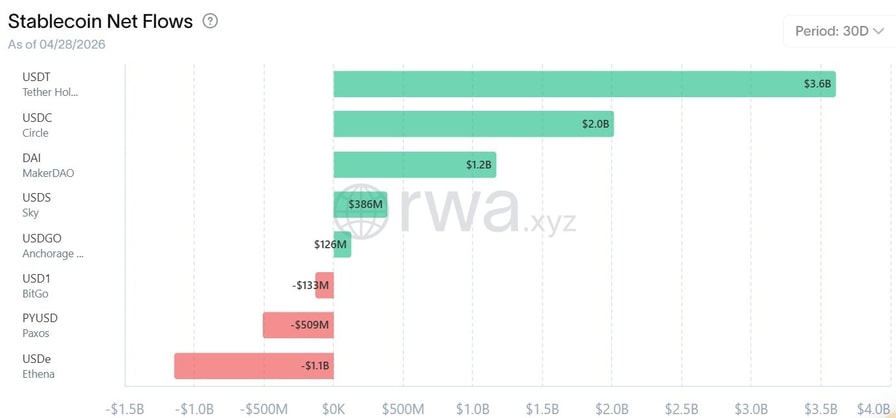
Net flows of stablecoins over the past 30 days. Source: RWA.xyz
OKX brings BlackRock’s tokenized Treasurys fund into trading collateral
OKX has added BlackRock’s tokenized US Treasurys fund, BUIDL, to its platform, allowing institutional clients to use the asset as trading collateral. The integration is part of a new framework developed with Standard Chartered, where the fund can be posted as margin while remaining in regulated custody with the bank.
The setup changes how collateral works on crypto exchanges. Instead of parking cash or stablecoins that sit idle, clients can hold a yield-bearing Treasury-backed asset and still use it to support trading activity.
In some cases, the collateral stays off-exchange under Standard Chartered’s custody, while OKX mirrors it for trading — a structure designed to reduce counterparty risk without interrupting execution.
Crypto Biz is your weekly pulse on the business behind blockchain and crypto, delivered directly to your inbox every Thursday.
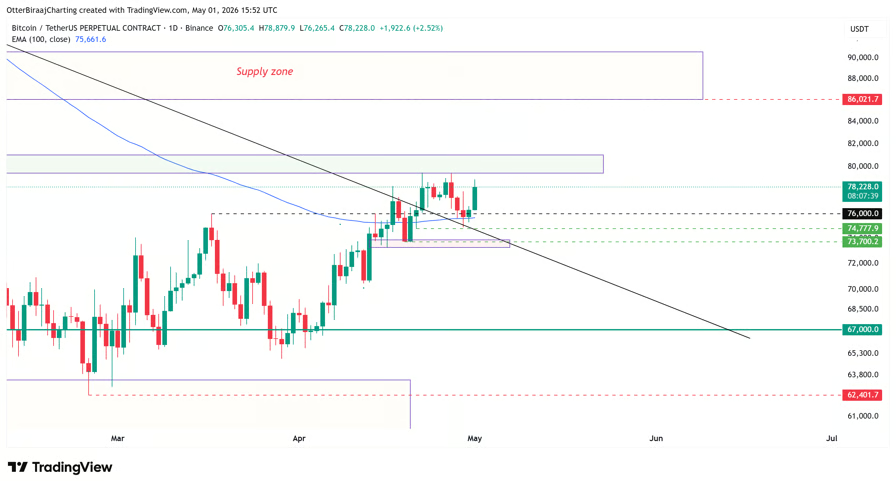
Several Bitcoin (BTC) data points suggest that $80,000 is the next destination for the cryptocurrency. Bitcoin gained 2.52% to trade above $78,800 on Friday after holding support at the 100-day exponential moving average. Spot market buy volumes also strengthened while the cumulative volume delta (CVD) reached 11,500 BTC, its highest level since Feb. 17.
BTC futures activity is picking up, with the open interest rising 6.64% to 257,000 BTC, indicating fresh positioning.
Bitcoin’s daily trend recovery shows fresh positioning
Bitcoin rebounded from its 100-day exponential moving average (100-EMA) after retesting the daily trend over the past two days. The move lifted the price by 2.52% to $78,800 on Friday, holding the short-term uptrend intact.
The 100-day EMA, currently acting as dynamic support on the daily chart, suggests that the higher time-frame chart remains bullish.

BTC/USDT on the one-day chart. Source: Cointelegraph/TradingView
The spot demand is strengthening at the same time. The spot cumulative volume delta (CVD), which tracks net buying versus selling, reached 11,500 BTC, a new high since Feb. 17. This indicates buyers are absorbing the supply during the recent dip.
Derivatives positioning is expanding in tandem with price, pointing to fresh participation. The aggregated open interest has risen 6.64% to 257,000 BTC over the past 24 hours, indicating new positions are being added as Bitcoin consolidates below $80,000.

BTC price, spot, and futures CVD. Source: Velo
This follows a recent leverage flush of roughly 9,000 BTC, suggesting that excess positioning has been cleared as the leveraged market rebuilds.
The futures CVD adds further context. Futures volume has recovered to 98,300 BTC, signaling a return of net buying pressure. However, it remains below the levels seen during the April 27 correction, suggesting trader positioning is still developing.
At the same time, liquidity continues to cluster in the $78,000–$80,000 range, with $2.1 billion in short positions at risk, which could lead to a short squeeze near the key level.

Bitcoin liquidation heatmap. Source: CoinGlass
Related: Bitcoin ETFs draw $2B in April for highest monthly inflows this year
BTC demand from institutions tightens the available supply
BTC institutional activity continues to lean supportive. The 30-day change in OTC desk balances has fallen to around -20,700 BTC, matching levels last seen in March 2025. The lower balances indicate BTC moving off desks, reducing the immediately available supply.

Bitcoin: Total OTC desk balance. Source: CryptoQuant
The exchange-traded fund (ETF) flows show a similar pattern. With ETF flows reaching $1.97 billion in April. Bitcoin research newsletter Ecoinometrics noted a nine-day streak of inflows, the longest in 2026.
Ecoinometrics explained that while the pace of inflows is moderate, the consistency has improved, adding,
“The last time flows showed this kind of persistence was right before the October 2025 peak. Not saying we’re there yet, but it tells you the direction is improving.”
The near-term focus is on how long flows sustain themselves and whether liquidity above $80,000 thins as spot, futures, and institutional participation increase.

ETF inflow streak improves for Bitcoin. Source: Ecoinometrics/X
Related: Bitcoin’s $75K cost basis emerges as key support zone for current bull trend


Pi Network has set May 11 as the activation date for Protocol 23, the upgrade that introduces full smart contract functionality to the Pi blockchain and transforms the network from a mobile mining project into a programmable platform capable of supporting DeFi applications and real-world asset tokenisation.
Summary
- Pi Network Protocol 23 lands on May 11, moved one week earlier from the previously announced May 18 date, four days after co-founders Dr. Chengdiao Fan and Nicolas Kokkalis speak at Consensus 2026 in Miami.
- Protocol 23 enables developers to build decentralised exchanges, lending protocols, automated tools, and tokenised asset products on Pi for the first time, completing the transformation Protocol 22 began on April 27.
- The network currently has 421,000 active Mainnet nodes, over 10 billion PI migrated to Mainnet, and a market cap of approximately $1.73 billion as of late April 2026.
Pi Network confirmed May 11 as the Protocol 23 activation date, following the completion of the mandatory Protocol 22 upgrade on April 27. CoinMarketCap confirmed that Protocol 23 was moved forward from May 18 to May 11 as part of Pi’s accelerated upgrade cycle, timed to land shortly after the Consensus 2026 conference in Miami where both co-founders are scheduled to speak on May 6 and May 7.
As crypto.news reported, Pi Network is an official sponsor of Consensus 2026, with co-founder Dr. Chengdiao Fan speaking May 6 on aligning Web3, AI, and blockchain for utility, and co-founder Nicolas Kokkalis joining a May 7 panel titled “How to Prove You’re Human in an AI World (Without Doxing Yourself).” Protocol 23’s May 11 date creates a tight strategic sequence: public stage appearance at Consensus on May 6 and 7, followed four days later by the most consequential technical upgrade in Pi’s seven-year history. Protocol 22 removed all non-compliant nodes that had failed to upgrade, enforcing network synchronisation and establishing the stable base required for smart contract execution. Protocol 23 builds on that foundation by enabling developers to write and deploy programmable contracts directly on Pi’s Mainnet, unlocking decentralised applications, token launches via the Pi Launchpad, a native decentralised exchange, and real-world asset tokenisation.
As crypto.news tracked, the Protocol 22 deadline on April 27 disconnected non-compliant nodes and moved the network to Stellar Core 22 under software version 0.5.4, the prerequisite for the smart contract infrastructure Protocol 23 introduces. Pi competes in the proof-of-personhood space with Worldcoin and Humanity Protocol, and the Consensus appearance positions Protocol 23 as part of a broader AI-era identity and programmable finance argument rather than a standalone technical release.

TLDR:
- Bitcoin futures open interest rises 5.92% to $57.621B as leverage builds faster than spot price moves
- Binance leads BTC derivatives with $10.55B, followed by Gate, Bybit, and OKX in rising exposure
- Stable Bitcoin price near $78K contrasts with surging leverage, showing compressed market structure forming
- Open interest near the $60B zone historically precedes sharp volatility shifts and liquidation-driven moves
Bitcoin futures open interest rises as derivatives exposure expands across major exchanges while Bitcoin trades near $78,000.
CoinGlass data shows leverage building rapidly to $57.621 billion, reflecting intensified positioning activity ahead of a potential volatility expansion across the market structure.
Leverage built into Bitcoin futures open interest across major exchanges
Bitcoin futures open interest increased 5.92 percent within 24 hours, reaching $57.621 billion across leading derivatives platforms. The rise reflects fresh leverage entering the market rather than position closure.
CoinGlass data shows Binance dominating Bitcoin futures open interest with $10.553 billion in BTC contracts. Gate follows with $5.323 billion, while Bybit and OKX maintain $4.725 billion and $3.349 billion, respectively.
The distribution shows concentration remains high among top exchanges, although participation is gradually broadening. This structure indicates that leveraged exposure is not isolated but spread across multiple trading venues.
Bitcoin futures open interest expansion aligns with relatively stable spot movement near $78,000. This divergence suggests traders are positioning aggressively without strong directional confirmation in price action.
Such behavior typically forms when derivative activity builds faster than underlying asset momentum. Market participants appear to be preparing for breakout conditions while maintaining leveraged exposure on both sides.
Market compression signals a potential volatility shift in Bitcoin futures open interest
Bitcoin futures open interest nearing $57.621 billion places the market close to historically sensitive zones around $60 billion. Previous cycles show similar levels preceding sharp directional moves.
Price action remains compressed despite rising leverage, creating conditions where volatility is temporarily suppressed. This structure often leads to sudden repricing once the imbalance in positioning resolves.
A breakout scenario in Bitcoin futures open interest could trigger short liquidations if resistance levels are breached. This would result in accelerated buy-side pressure across derivatives markets.
On the downside, a price drop could unwind leveraged long positions quickly, producing a fast liquidation cascade. Such moves typically occur when crowded positioning meets weak support levels.
Exchange-level data confirms that Bitcoin futures open interest growth is not isolated to a single platform but is distributed across major venues. This reinforces systemic leverage buildup rather than localized speculation.
Trading activity remains active but not euphoric, indicating structured participation instead of retail-driven spikes. This environment often precedes sharp volatility once directional bias is established.
Bitcoin futures open interest continues to act as a key indicator of market positioning intensity. With leverage rising faster than spot movement, the market structure remains sensitive to sudden shifts in sentiment and liquidity.



Crypto VC funding slid to $659m across 63 April deals, a 74% drop from March that drags monthly flows back to 2024 lows even as DeFi and AI still attract capital.
Summary
- Cointelegraph data show crypto venture funding fell to $659 million across 63 deals in April, down 74% from $2.6 billion and 84 rounds in March.
- Since peaking at $3.84 billion in October 2025, monthly crypto VC flows have trended lower even as 2026 year‑to‑date funding still totals about $5.64 billion.
- DeFi led sector activity with 12 deals, while blockchain services and AI‑linked crypto projects each saw 8 rounds; market maker GSR’s VC arm was the most active investor, with Tether, Animoca Brands, and Coinbase Ventures close behind.
The crypto venture market hit a fresh air pocket in April, with Cointelegraph reporting that startups in the sector raised just $659 million across 63 funding rounds.
April’s funding cliff takes crypto VC back to 2024 levels
That marks a 74% month‑on‑month drop from March’s roughly $2.6 billion and 84 deals, sending monthly volumes back to their lowest level since 2024 and underscoring how quickly risk appetite has cooled after a burst of early‑2026 optimism.
By Cointelegraph’s count, total crypto VC financing so far in 2026 stands at about $5.64 billion, still substantial but well below the run‑rate implied by October 2025’s local peak, when funding reached around $3.84 billion in a single month.
From October 2025 peak to slow‑motion reset
Since that October 2025 high, monthly funding volumes have been grinding lower in parallel with token prices.
Industry trackers cited by Cointelegraph say global crypto market capitalization has dropped roughly 37% over the same period, compressing valuations and leaving many late‑stage investors nursing mark‑downs.
February already offered a warning shot: Phemex tallied about $866 million raised across 62 deals that month, down 46% from January, with DeFi and AI projects still attracting capital but at smaller ticket sizes.
April’s $659 million figure suggests that slowdown has now deepened into a full‑blown reset, with fewer large growth‑stage rounds and a higher bar for new token launches after data showed roughly 85% of 2025 issuances trade below their issue price.
Where the money still goes—and who is writing checks
Even in a quieter month, some pockets of activity stood out.
DeFi protocols led with 12 deals, followed by 8 for blockchain infrastructure and services and another 8 for AI‑adjacent crypto projects, reflecting continued interest in both core financial primitives and tooling for the emerging “agent” economy.
On the investor side, Cointelegraph’s breakdown highlights the venture arm of market maker GSR as April’s most active backer, participating in four separate raises spanning trading infrastructure and liquidity tooling.
Heavyweights such as Tether, Animoca, and Coinbase Ventures also remained present, each joining three deals, often in smaller, earlier‑stage rounds rather than the nine‑figure growth checks that defined the last cycle’s peak.
For founders, the message is clear: capital is still available, but investors are more selective and more price‑sensitive, with an emphasis on products that can survive leaner market conditions and plug directly into real usage rather than trading purely on narrative.
For the broader market, a slower VC tape tends to mean fewer new tokens hitting exchanges—and more scrutiny on whether existing projects can deliver on their roadmaps without relying on another wave of easy money.

SBI Holdings has begun talks to acquire the Bitbank exchange, expanding its crypto footprint in Japan amid strategic sector consolidation. The move would strengthen Ripple-linked infrastructure as SBI deepens its digital asset strategy across institutional and retail channels. Regulatory changes in Japan are supporting broader institutional participation in crypto markets, contributing to financial modernization of the economy.
Ripple Affiliate SBI Holdings Advances Bitbank Acquisition Plans
SBI Holdings confirmed talks with Bitbank after signing a letter of intent to advance potential acquisition discussions in the Japanese market. The company aims to make Bitbank a consolidated subsidiary after completion of due diligence and regulatory approvals. Final structure and timing depend on approvals and ongoing assessments by relevant authorities in Japan.
SBI says it seeks greater control over Bitbank to strengthen group integration and operational efficiency across subsidiaries. The firm plans to leverage synergies across its crypto-related units to support expansion and market penetration, boosting scalability. It notes Bitbank’s strong security record as a key factor in its evaluation of the competitive exchange landscape.
By welcoming Bitbank into its group, SBI aims to build domestic dominance in the crypto sector over the coming years. SBI also notes potential regulatory shifts under the Financial Instruments and Exchange Act framework reform direction for risk management. The company expects greater market consolidation as rules evolve and compliance standards tighten across ecosystems.
Metaplanet Expands Bitcoin Strategy Through Bond Financing
Metaplanet continues expanding its Bitcoin holdings through capital-market fundraising strategies in response to growing institutional demand and momentum. The firm recently issued fifty million dollars in bonds to purchase more Bitcoin through a structured debt-financing process. This move reflects rising corporate interest in Bitcoin accumulation strategies in Japan amid global treasury diversification trends.
Metaplanet strengthens its position as institutional adoption of Bitcoin grows globally on corporate balance sheets. The company aligns its treasury strategy with digital-asset diversification trends in a competitive, efficiently managed financial environment. Market participants view this as part of a broader corporate crypto shift driven by macroeconomic uncertainty.
Bond issuance allows Metaplanet to expand Bitcoin exposure without immediate equity dilution for existing shareholders. The firm continues to build a long-term digital-asset reserve strategy with disciplined capital allocation. Japan’s corporate sector shows growing interest in Bitcoin-based financial structures and structured investment vehicles.
SBI Broadens Crypto Ecosystem Through Partnerships and Acquisitions
SBI has partnered with Visa to develop crypto-linked payment card services to expand digital payments adoption across Japan. The program lets users convert rewards into major digital assets through an integrated fintech infrastructure and rewards system. The initiative connects traditional payments with blockchain-based settlement systems, supporting faster transaction processing and cross-border payment efficiency.
SBI previously acquired BitPoint Japan to expand its domestic crypto footprint and strengthen its exchange-network presence. The group continues consolidating operations to improve efficiency across subsidiaries and reduce operational redundancy. It seeks a stronger position in regulated digital-asset markets under evolving compliance frameworks.
Japan’s evolving regulations create opportunities for large financial conglomerates in the digital finance sector. SBI positions itself for long-term growth in the crypto sector through strategic investment alignment. The company expects integration across exchanges and payment systems to accelerate as the ecosystem matures.
Crypto World
Berkshire Hathaway’s shopping extravaganza draws lighter crowds as spotlight shifts to Greg Abel

Squishmallow display the Berkshire Hathaway Annual Shareholders Meeting in Omaha, NE on May 1, 2026.
Sarah Min | CNBC
OMAHA, Nebraska — At the cavernous exhibit hall inside CHI Health Center Omaha, the annual “Berkshire Bazaar of Bargains” is still stocked with fan-favorite deals, just with a bit more breathing room this year.
The 20,000-square-foot shopping event tied to Berkshire Hathaway‘s annual meeting features its usual lineup: Warren Buffett-themed gear from Brooks Sports and chocolate coins from See’s Candies, alongside merchandise from dozens of subsidiaries. But unlike past years, lines were shorter and the crowds noticeably thinner.
The event came as Buffett, the 95-year-old chairman who has defined the gathering for decades, is no longer expected to headline the marquee Q&A session in the same way, ceding the spotlight to Greg Abel, who took over as CEO at the beginning of 2026.
Abel made a point of stopping by every booth in the hall, greeting employees and shaking hands with shareholders. Lines of shareholders formed as he made his way through the hall.
Greg Abel, CEO of Berkshire Hathaway, meets with shareholders at the Berkshire Hathaway Annual Shareholders Meeting in Omaha, NE on May 1, 2026.
David A. Grogan | CNBC
Squishmallows — the plush toy phenomenon owned by Jazwares that Berkshire gained through its 2022 acquisition of Alleghany Corporation — once again pulled in crowds, including for a new Abel-themed plush.
Adam Padawer, president of Jazwares, told CNBC that Abel was “engaged, interested and involved,” noting the CEO helped design his own Squishmallow. The company also partnered with other Berkshire brands including BNSF Railway, NetJets, GEICO and See’s Candies on special-edition versions.
Squishmallow display the Berkshire Hathaway Annual Shareholders Meeting in Omaha, NE on May 1, 2026.
Sarah Min | CNBC
Squishmallows on display at the Berkshire Hathaway Annual Shareholders Meeting in Omaha, NE on May 1, 2026.
Yun Li | CNBC
Squishmallows on display at the Berkshire Hathaway Annual Shareholders Meeting in Omaha, NE on May 1, 2026.
Yun Li | CNBC
Squishmallows on display at the Berkshire Hathaway Annual Shareholders Meeting in Omaha, NE on May 1, 2026.
Yun Li | CNBC
See’s Candies — one of Berkshire’s most iconic brands — leaned into the moment with shelves of themed chocolate treats and cardboard cutouts of Buffett and Abel playing hockey, a nod to Abel’s Canadian roots and well-known love of the sport.
See’s Candies display at the Berkshire Hathaway Annual Shareholders Meeting in Omaha, NE on May 1, 2026.
Yun Li | CNBC
See’s Candies display at the Berkshire Hathaway Annual Shareholders Meeting in Omaha, NE on May 1, 2026.
Yun Li | CNBC
Brooks Running was also leaning into the Berkshire fandom, selling a 2026 special edition of its running shoes featuring “Berkshire Hathaway” branding along the side and on the insoles.
Nearly 2,000 shareholders are expected to take part in the Brooks “Invest in Yourself” 5K fun run and walk on Sunday morning following the annual meeting, with participants set to tackle a new course this year.
A Brooks show on display at the Berkshire Hathaway Annual Shareholders Meeting in Omaha, NE on May 1, 2026.
Yun Li | CNBC
Justin Boots display at the Berkshire Hathaway Annual Shareholders Meeting in Omaha, NE on May 1, 2026.
Yun Li | CNBC
A Pilot display at the Berkshire Hathaway Annual Shareholders Meeting in Omaha, NE on May 1, 2026.
Yun Li | CNBC
Signage for Marmon Holdings on display at the Berkshire Hathaway Annual Shareholders Meeting in Omaha, NE on May 1, 2026.
Sarah Min | CNBC

XRP’s social sentiment has surged in recent days, even as the token remains largely consolidating below a key price barrier. Aggregated social data points to heightened optimism, while developers and traders parse how new real-world use could translate into price upside.
Key takeaways:
- XRP’s social sentiment has risen about 240% over the past 30 days, reaching a two-year high.
- Rocketing adoption signals emerged after Ripple announced XRP integration with Rakuten Pay, enabling loyalty points worth over $23 billion to be converted into XRP and used across millions of merchants.
- Technically, XRP faces immediate resistance around $1.40, with a potential breakout needing to clear the $1.40–$1.45 zone to target roughly $2.10.
- On-chain and cost-basis data point to near-term selling pressure near a cost area of roughly $1.40–$1.45, potentially creating a supply wall ahead of a bullish move.
- Market sentiment from Santiment notes XRP’s bullish discourse remains elevated, even as price actions show a measured, cautious tilt rather than an immediate breakout.
Rakuten Pay tie-up fuels XRP optimism
The latest wave of enthusiasm derives from XRP’s integration with Rakuten Wallet, a prominent Japanese payments ecosystem. Rakuten’s platform serves more than 44 million users, and the partnership allows loyalty points—valued at over $23 billion—to be converted directly into XRP, traded within Rakuten’s in-app environment, and spent at more than 5 million merchant locations via Rakuten Pay. Ripple described the rollout as “one of the largest retail deployments of XRP as a payment method to date,” highlighting a practical bridge between loyalty programs, payments, and crypto utility in a major economy.
Industry observers immediately flagged the potential ripple effects. Santiment noted XRP’s sentiment metrics spiked in response, citing that the Positive/Negative sentiment ratio now sits at about 3.9—levels not seen since early 2024. The data point aligns with the firm’s observation that the market is increasingly pricing in broader adoption rather than mere speculative chatter. In a separate note, Santiment explained that while news-driven hype doesn’t guarantee an instant price breakout, the accumulation of adoption signals often precedes more persistent bullish momentum once fear of missing out cools off.
Market participants also highlighted the broader narrative: as an established payments rails integration becomes visible in a major economy, XRP could transition from a speculative asset into a practical utility token for everyday spending. Traders who have watched the Ripple ecosystem emphasize that this is a different kind of catalyst—one tied to real-world spend and customer engagement rather than purely macro-driven flows.
Price action and the technical backdrop
Following a recent rally that lifted XRP about 18% from a local low near $1.27, the price stalled near $1.48, which sits at the upper boundary of a symmetrical triangle that has framed price action since February. To spark a sustained up-leg, bulls must push through the $1.40–$1.45 resistance corridor, an area that also encompasses the 50-day exponential moving average and the 100-day simple moving average. The alignment of these moving averages around that zone adds to its significance as a potential turning point.
From a supply-demand perspective, Glassnode’s cost-basis distribution heatmap points to roughly 2 billion XRP held at an average cost between $1.40 and $1.45. This concentration implies a sizable cluster of holders could place selling pressure near break-even, potentially tempering near-term upside unless fresh buyers step in to absorb that supply.
If the price can clear this supply zone, the measured target of the existing triangle lies near $2.10, about 50% above current levels. Several technicians have signaled that a move above $1.40 would not only invalidate the current consolidation but also set up a faster run toward the upper echelons of the recent trading range.
Market commentary from peers echoed a cautious anticipation. ChartNerd, in a Friday X post, suggested a substantial move could be brewing once resistance above $1.40 is cleared. This view dovetails with broader coverage that notes XRP would need to sustain a move beyond $1.40 to shift the trend from consolidation to a sustained uptrend.
Meanwhile, the price context remains clear: XRP has retraced a portion of its late-2024/early-2025 run, with a long-term high near $3.66 set in July 2025. The current price level sits well below that peak, underscoring the distance to the prior highs even as adoption stories intensify. This dynamic helps frame why the market is paying attention to the Rakuten Pay development—because it could alter the typical risk/reward calculus for XRP holders if real-world usage compounds over time.
What to watch next in XRP’s evolution
Investors should monitor whether the Rakuten Pay integration translates into measurable activity in XRP on-ramps and spend velocity across Japan’s ecosystems. If the price can push decisively through the $1.40–$1.45 zone, a path toward the $2.10 target could materialize, yielding a roughly 50% uplift from current quotes. Conversely, a failure to clear this resistance with robust volume may extend the current consolidation, especially if cost-basis holders defend that $1.40–$1.45 band.
Beyond pure price action, the broader adoption signal is crucial. A sustained uptick in XRP-use cases would shift the narrative from speculative sentiment to tangible utilization, potentially supporting a more durable uptrend should retail and merchant uptake continue to grow. Conversely, if the Rakuten integration encounters friction or a slower-than-expected uptake, the rally could be tempered, reinforcing the view that the early enthusiasm may fade into a longer, sideways phase before any decisive breakout.
Analysts caution that sentiment data, while informative, does not guarantee immediate price moves. As Santiment observers noted, the current bullish chatter often accompanies a wave that subsides after the initial euphoria. Still, the combination of a major payments ecosystem integration and a favorable technical setup could set the stage for a noteworthy shift in XRP’s trajectory if buyers sustain the bid above the critical resistance band.
Readers should keep an eye on how liquidity evolves around the $1.40–$1.45 range, whether further utility-driven catalysts emerge, and how the macro environment influences risk appetite in cross-asset crypto markets. The next few weeks will be telling for whether XRP can convert social and on-chain optimism into a durable price breakout or if the market lapses into a longer period of accumulation below the high-water marks seen in 2025.
TLDR:
- McLaren joins Hedera Council, expanding governance reach and fan-driven digital collectibles rollout
- Agent Lab enables no-code AI agents on Hedera, integrating LangChain and Stablecoin tools
- FRNT stablecoin and tokenized RWAs push enterprise adoption across regulated blockchain systems
- Hedera surpasses 70B transactions as institutional players expand usage across finance and AI stacks
The HBAR Hedera ecosystem has progressed notably across governance, AI development, and enterprise adoption during 2026.
The recent McLaren joining of the council, Agent Lab launches, and tokenization activity expand across regulated finance, stablecoins, and global enterprise infrastructure networks in the 2026 period
Governance Expansion and McLaren Entry
McLaren Racing joined the Hedera Governing Council in 2026, expanding governance participation across global enterprise members and reinforcing institutional coordination within the network.
McLaren introduced digital collectibles across Formula 1 and IndyCar race weekends during the 2026 season, linking fan engagement to on-chain interactions through simplified access systems.
Council membership includes firms such as Google, IBM, NVIDIA, Deutsche Telekom, and Standard Bank, expanding enterprise representation across governance decisions.
McLaren’s participation aligns with the network’s focus on consumer engagement, digital assets, and data integrity across enterprise-grade infrastructure.
HederaCon 2026 is scheduled in Miami Beach alongside major industry events, including the Formula 1 Miami Grand Prix and Consensus 2026 discussions.
Simplified onboarding through Web2 social sign-in systems allows users without blockchain wallets to interact with Hedera-based applications and collectibles.
Sustained council expansion supports protocol governance, enterprise adoption, and integration of real-world applications across multiple sectors.
Network coordination continues through enterprise validators and governance participants who contribute to system reliability.
McLaren-branded collectibles expand consumer-facing blockchain interaction across seasonal racing events and digital ecosystems supported by Hedera infrastructure.
Such sustained participation from global enterprises reinforces operational scalability across Hedera. This is as governance coordination maintains alignment between consumer applications, tokenization frameworks, and regulated digital asset infrastructure throughout the 2026 development network growth cycle
Agent Lab and Enterprise AI Stack
Agent Lab launched in March 2026 as a browser-based environment for building on-chain AI agents across simplified development modes.
It integrates frameworks such as LangChain and Vercel AI SDK, enabling developers to deploy AI agents with reduced technical complexity.
Agent Lab connects to Hedera Agent Kit, enabling streamlined deployment of AI-driven applications across blockchain infrastructure systems.
Planned updates introduce Stablecoin Studio plugins, supporting token swaps, lending operations, and automated financial workflows within enterprise systems.
Verifiable Compute collaboration with NVIDIA and Deloitte enhances AI auditability, providing structured logs for regulated enterprise environments requiring transparency.
These developments align enterprise infrastructure with automation, compliance, and real-world asset interaction across financial and industrial use cases.
Developer adoption increases through low-code interfaces that reduce complexity for blockchain application creation and integration workflows.
Enterprise participants use these tools to support scalable deployments across regulated environments and tokenized financial systems.
Hedera-based infrastructure continues supporting interoperability across enterprise networks, enabling coordinated data processing, digital asset settlement, and AI-driven automation across multiple industry sectors.
Integration between AI tooling and blockchain infrastructure strengthens enterprise workflows, while supporting verifiable computation, tokenized settlement processes, and scalable application deployment across regulated digital ecosystems within enterprise technology governance frameworks and systems
Crypto World
Riot’s stock rises after AMD boosts data center capacity to a potential 150 megawatts power
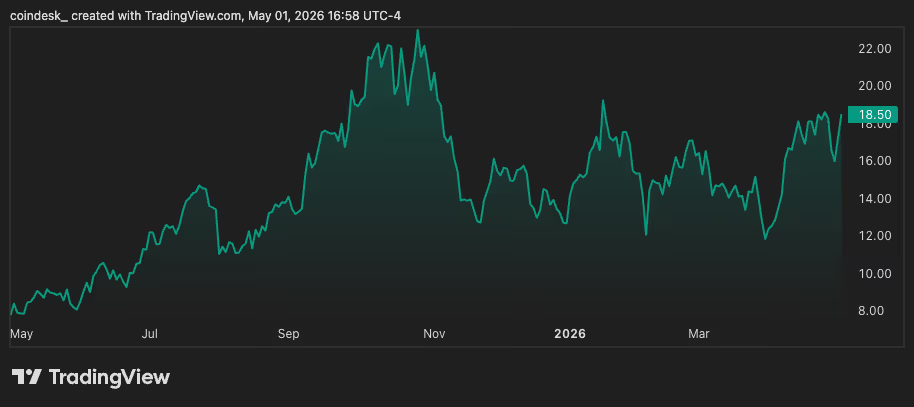
Riot Platforms (RIOT) shares jumped about 8% on Friday after Advanced Micro Devices (AMD) expanded its capacity at the company’s Rockdale, Texas campus, highlighting Riot’s continued pivot from bitcoin mining into AI and high-performance computing.
According to the Q1 financial results, AMD exercised an option to double its contracted capacity to 50 megawatts (MW), with the potential to upsize to 150MW. According to the earnings transcript, Riot said the agreement could generate roughly $636 million over a 10-year term.
Riot also secured improved terms on its $200 million bitcoin-backed credit facility with Coinbase, lowering the rate to a fixed 6.15% from 8.3% and releasing 1,544 of pledged collateral bitcoin, signaling growing lender confidence in its expanding data center business.
Together with the AMD deal and improved credit terms, investors are paying a premium for the stock. “Market pricing in lower cost of capital as the expanded AMD deal drives lender confidence,” said Matthew Sigel, head of digital assets research at VanEck.
Riot was one of the last few ‘pure play’ mining companies left that didn’t get into hosting AI computing, while others opened up their data centers to move away from mining. Until recently, activist investor Starboard started to urge the management to accelerate its transition from bitcoin mining to an AI infrastructure provider.

The move to expand its data center business to host AI computers appears to be paying off for the Castle Rock, Colorado-based company.
The firm reported total revenue of $167.2 million for the quarter ended March 31, up from $161.4 million a year earlier, supported by $33.2 million in initial data center revenue. However, bitcoin mining revenue fell to $111.9 million from $142.9 million, mainly due to lower bitcoin prices and increased mining competition. The mining company’s shares are up about 147% over the last 12 months, while bitcoin fell nearly 17%.
The company, which previously held onto all its mined bitcoin, is also accelerating its bitcoin sales. According to Bitcoin Treasuries data, the company sold 3,688 BTC during Q1. The company ended March with 15,679 BTC and $282.5 million in cash.
Read more: The bitcoin treasury boom is unwinding as some companies and governments sell holdings
Polanski unveils radical workers’ charter to protect people before profit

UFC Fight Night predictions, odds, fight card for Jack Della Maddalena vs. Carlos Prates

Adapting A 100-Year-Old Lens To A Modern Camera

Manchester United reach agreement with Casemiro over contract clause amid transfer speculation

US brings back mandatory military draft registration

Steven Gerrard disagrees with Gary Neville over ‘shock’ Chelsea and Arsenal claim | Football


-

 Tech4 days ago
Register Renaming | Hackaday
-
Crypto World6 days ago
Hyperliquid $HYPE Rally Builds Momentum as AI Sector Enters Prove-It Phase
-

 Politics4 days ago
Drax board avoid their own AGM, accused of greenwashing & environmental racism
-

 Tech4 days ago
Images of Samsung’s rumored smart glasses have leaked
-

 Tech5 days ago
Why Blue Badges Disappeared From Toyota Hybrids
-
 Sports5 days ago
IPL 2026: Ruturaj Gaikwad registers slowest fifty of the season, enters all-time unwanted list | Cricket News
-
 Tech4 hours ago
Trump’s 25% EU auto tariff breaches Turnberry Agreement that also covers semiconductors and digital trade
-

 NewsBeat6 days ago
LK Bennett closes all stores after entering administration
-

 Fashion3 days ago
Kylie Jenner’s KHY Enters a New Era with ‘Born in LA’
-
 Entertainment6 days ago
Mariah Carey Slams Deposition Claims In Brother’s Lawsuit
-

 Business3 days ago
Most Commercial Energy Audits Miss the Real Losses
-

 Business4 days ago
(VIDEO) Charlize Theron Climbs Times Square Billboard to Promote New Netflix Thriller ‘Apex’
-

 Crypto World3 days ago
CFTC’s AI will review U.S. crypto registration applications, chairman tells CoinDesk
-
 Sports3 hours ago
Paul Scholes issues Marcus Rashford reality check as agreement emerges over Man United star
-

 Business3 days ago
Barclay Brothers Avoid Bankruptcy: HSBC Drops High Court Petitions After IVA Deal
-

 Tech6 days ago
Microsoft to roll out Entra passkeys on Windows in late April
-

 Tech6 days ago
OpenAI’s Sam Altman apologizes for not reporting ChatGPT account of Tumbler Ridge suspect to police
-

 Tech6 days ago
OpenAI CEO apologizes to Tumbler Ridge community
-
 Business2 days ago
Tesla Officially Registers Elon Musk’s Stock: What Investors Need to Know
-

 Tech3 days ago
Get Ready for More Brain-Scanning Consumer Gadgets
You must be logged in to post a comment Login