
Crypto World
XRP Price Prediction: Rakuten Integration Sends Sentiment to 2-Year High


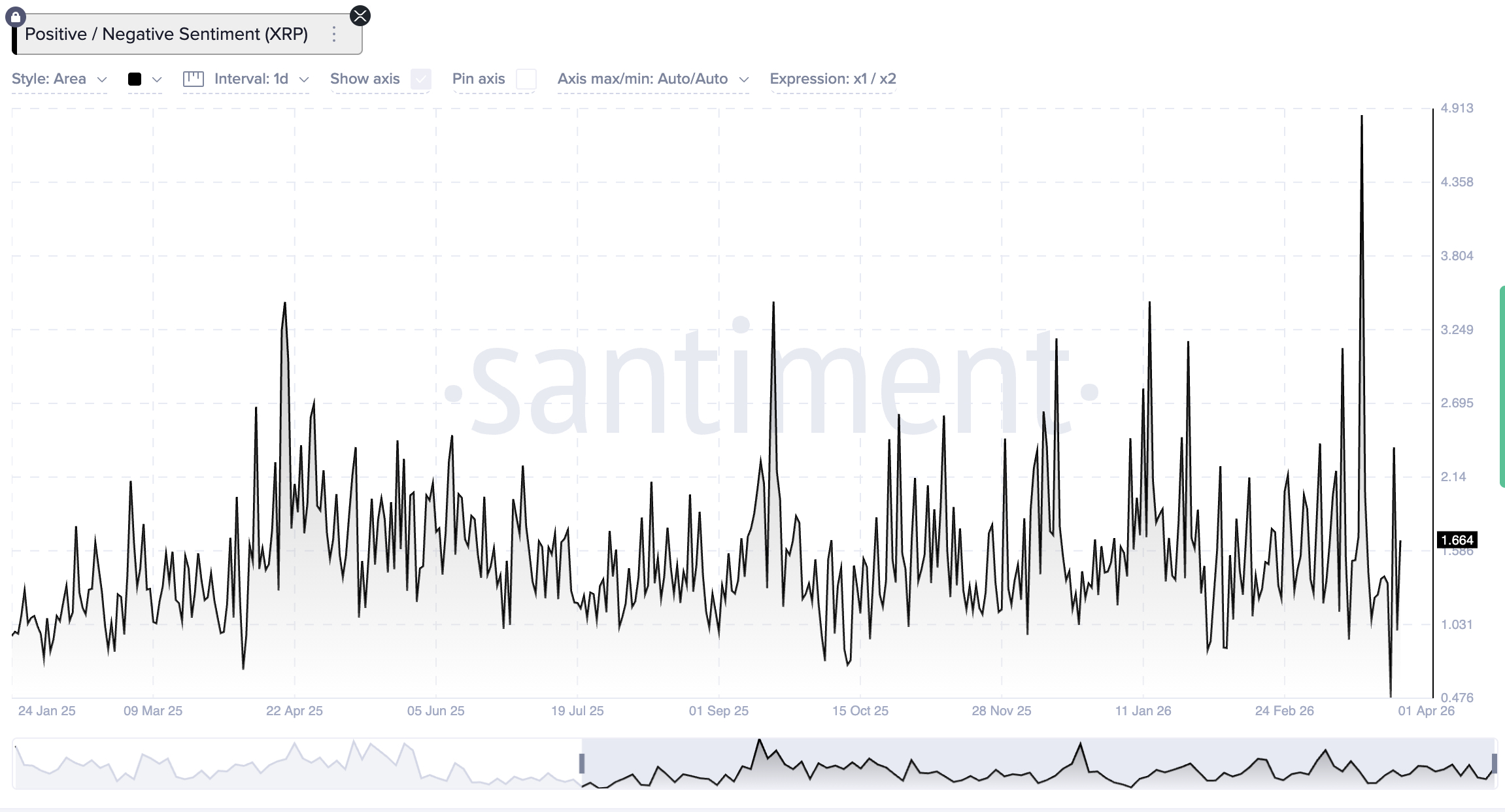
XRP is trading at the $1.40 level again after failing to break the $1.50 ceiling last month, and somehow, that’s the bullish part of the story. Social sentiment just hit its second-highest reading in two years, driven by Rakuten Wallet’s full-scale XRP integration. So what is our XRP price prediction for next week?
Starting today, @Rakuten_Wallet users in Japan can convert @Rakuten Points into XRP, spot trade in-app, and spend across 5M+ merchant locations. — RippleX (@RippleXDev) April 30, 2026

With 44 million Rakuten Pay users and $23B in loyalty points now redeemable for XRP, this is one of the largest retail deployments… pic.twitter.com/P7I52bGjVL
Santiment data clocked a positive-to-negative comment ratio of 4.8, near historic highs for the token. Rakuten Wallet’s deployment also enables 44 million users to convert loyalty points into XRP and spend at more than 5 million merchants.
Rakuten also launched a tiered reward campaign with bonuses on purchases of 30,000 yen or more, a lottery for 100,000-yen-plus buyers, and a pending iOS rollout. It’s a $23 billion loyalty ecosystem deploying XRP at a consumer scale.
Discover: The best pre-launch token sales
XRP Price Prediction: Break $1.50 Resistance and Target $5?
XRP recently tapped a local high of $1.44 before stalling, and that level now represents the immediate ceiling. A leverage flush followed the rejection, a signal that speculative positioning outpaced organic demand.
The price itself is now consolidating below both its 60-day and 200-day moving averages, a structurally bearish configuration that complicates the bullish narrative.
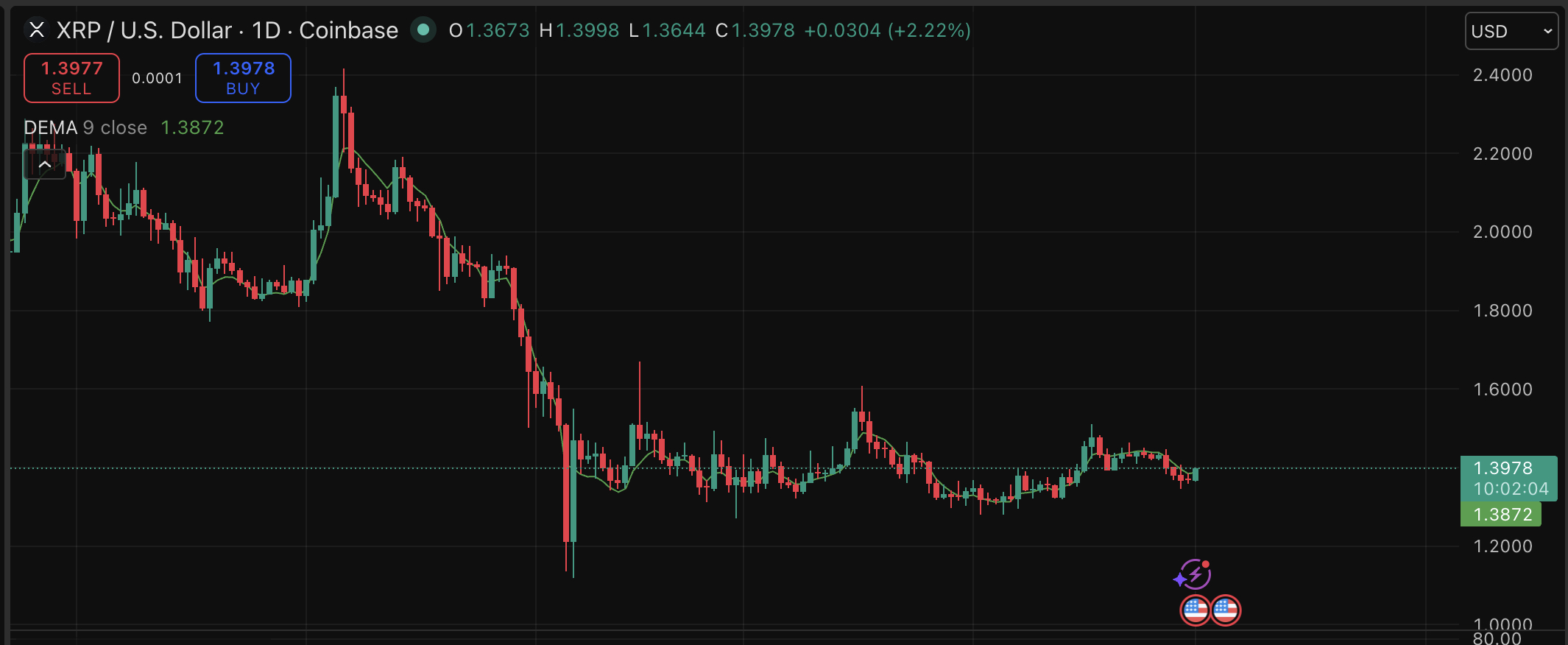
The technical picture is, frankly, a contradiction. Aggregate signals show a “Strong Buy” reading across 6 indicators (5 buy, 1 sell), yet the price has declined nearly 55% over the past nine months. Sentiment spikes historically precede short-term stabilization rather than immediate rallies as the FOMO builds before conviction does.
Ripple’s adoption narrative remains intact, but price discovery requires a sentiment ratio. Volume confirmation is the missing ingredient.
Discover: The best crypto to diversify your portfolio with
LiquidChain Targets Early Mover Upside as XRP Tests Key Levels
XRP’s current setup of strong narrative, muted price response, and overhead resistance is the kind of environment that pushes capital toward earlier-stage opportunities with higher asymmetric potential. When the blue-chip thesis stalls, the search for the next leg of upside moves down the risk curve. That’s where LiquidChain enters the picture.
LiquidChain ($LIQUID) is a Layer 3 infrastructure project that fuses Bitcoin, Ethereum, and Solana liquidity into a single execution environment, a cross-chain liquidity layer targeting the fragmentation problem that plagues DeFi.
The Order and the LiquidChain L3 have one thing in common.
They're both ready for anything.⟁https://t.co/vqvBcdSQYC pic.twitter.com/eHoGD2wtG0
— LiquidChain (@getliquidchain) May 1, 2026
With Liquid, developers can deploy once and access all three ecosystems simultaneously. The presale is currently priced at $0.01455, with more than $700K raised to date.
Key features include a Unified Liquidity Layer, Single-Step Execution, Verifiable Settlement, and Deploy-Once Architecture.
For those tracking the cross-chain narrative, research LiquidChain here.
The post XRP Price Prediction: Rakuten Integration Sends Sentiment to 2-Year High appeared first on Cryptonews.

Crypto World
Stablecoins Cross $300B Supply as B2B Payments Become the Fastest-Growing Real-World Use Case

TLDR:
- Stablecoin supply has surpassed $300B as banks and payment firms begin direct integration into financial systems.
- B2B transfers account for $226B of real usage, making it the largest and fastest-growing stablecoin category today.
- Real-economy usage sits at just $390B of $35T in annual volume, showing how early adoption still is globally.
- Asia, led by Singapore, Hong Kong, and Japan, is outpacing the West in practical, real-world stablecoin deployment.
Stablecoins are gradually moving beyond crypto-native activity into mainstream financial infrastructure worldwide.
Supply has already exceeded $300 billion, while banks and payment companies pursue direct integration. Regulatory frameworks are becoming clearer across major markets at the same time.
Annual transaction volume sits around $35 trillion, yet real-economy usage remains roughly $390 billion. That figure represents barely over 1% of total activity. The infrastructure is being built well before broader adoption fully arrives.
B2B Payments Emerge as the Clearest Use Case for Stablecoins
Stablecoins are finding their strongest real-world application in business-to-business payments today. Cross-border transfers remain slow, expensive, and full of friction for many companies.
Settlement often takes days, while liquidity regularly gets locked in transit. Smaller businesses tend to face far worse banking conditions than large institutions.
Around $226 billion of real usage comes from company-to-company transfers today. This makes B2B the largest real-economy stablecoin category by a clear margin.
That figure is growing quickly because the problem it addresses is well understood. Fewer intermediaries and 24/7 settlement rails deliver measurable savings for businesses.
As analyst @WorldOfMercek noted, traditional finance and blockchain rails are “no longer moving in completely separate worlds.” Banks are actively adopting crypto infrastructure because the operational benefits are hard to dismiss.
The old “crypto versus banks” narrative has given way to steady convergence. Financial institutions are integrating stablecoin rails for practical, well-documented economic reasons.
Most of the $35 trillion in annual volume still comes from trading, DeFi, and exchange settlement. Real-economy usage at $390 billion remains just over 1% of that total. Rails are always built before populations fully transition to using them.
Asia Leads Real Usage While Integration Remains the Biggest Barrier
Geographic data shows that Asia is ahead of the West in practical stablecoin use. Singapore, Hong Kong, and Japan account for a large share of real-world transactions.
Western markets spend more time discussing potential than actively deploying stablecoins at scale. Asia is already applying them where they directly solve payment and business problems.
Retail usage is growing, though it remains a smaller portion of the overall market. Consumer payments and daily card spending are not the leading story just yet.
That category will likely expand once rails integrate more deeply into existing payment systems. Most users care about speed, cost, and reliability — not which infrastructure moves their money.
The actual bottleneck today is not the technology — it already works. Bank connectivity, payment network access, regulatory clarity, and institutional trust are the real gaps remaining. Those barriers are narrowing as more traditional players enter the space.
Stablecoins are not displacing the financial system on any rapid timeline. Instead, they are being absorbed into it consistently and quietly over time.
That process tends to look slow until it suddenly feels inevitable to outside observers. The most consequential chapter of the stablecoin story is likely still ahead.



Bitcoin traded at $77,250 at press time, with 24-hour volume at $30.89 billion, per crypto.news data.
Summary
- Bitcoin must break $79,000 to target the next resistance zone between $86,000 and $88,000.
- More than 10,000 BTC moved to exchanges last week, raising short-term selling pressure concerns.
- Analysts remain split as Bitcoin holds an uptrend while May seasonality shows no clear bearish pattern.
The asset gained 2% in the past day but remained down slightly over seven days.
The price has recovered from earlier weakness and now trades in a short-term uptrend. The chart shows higher lows since mid-March, pointing to steady demand from buyers.
Analyst says $79K remains key
Crypto analyst Michaël van de Poppe said Bitcoin tends to behave positively at the start of a new month. He also expects spot Bitcoin ETF flows to improve in the coming week.
He said, “If $79K breaks, the next resistance zone is at $86-88K.” A move into that range could improve market confidence and support stronger altcoin performance.
Notably, Bitcoin is consolidating below the $79,000 resistance area. A clean move above this level would confirm stronger short-term momentum.
The moving average on the chart is rising, while the price remains above it. This supports the current bullish setup, although volume has not shown a major breakout signal.
Support sits near $73,000 to $74,000. A drop below this zone could weaken the current structure. Deeper support appears near $65,000 and $60,000.
Analysts remain split on May trend
Ali Martinez said Bitcoin shows similarities to its 2022 bottoming structure. He stated that this could allow another push higher before a final move lower.
He also noted that more than 10,000 BTC, worth about $760 million, moved to exchanges over the past week. Exchange inflows can signal possible selling pressure.
Daan Crypto Trades noted that May does not clearly support the “sell in May and go away” idea for Bitcoin. He noted that May ranks as Bitcoin’s sixth-best month by average return and third-best by median return.
Doctor Profit said Bitcoin has moved in a sideways box since February. He placed the local top around the $83,000 to $85,000 region.
Disclosure: This article does not represent investment advice. The content and materials featured on this page are for educational purposes only.
The US CLARITY Act, which aims to provide the US crypto industry with more regulatory clarity, could now move closer to becoming law after new stablecoin yield provisions were published, according to Coinbase chief legal officer Faryar Shirzad.
“It’s time to get CLARITY done,” Shirzad said in an X post on Friday, after US Senator Thom Tillis and US Senator Angela Alsobrooks published the final text aimed at settling the stablecoin yield dispute between the banking and crypto industries, which has centered on whether such yields would harm the banking system’s competitiveness.
“In the end, the banks were able to get more restrictions on rewards, but we protected what matters – the ability for Americans to earn rewards, based on real usage of crypto platforms and networks,” Shirzad said.

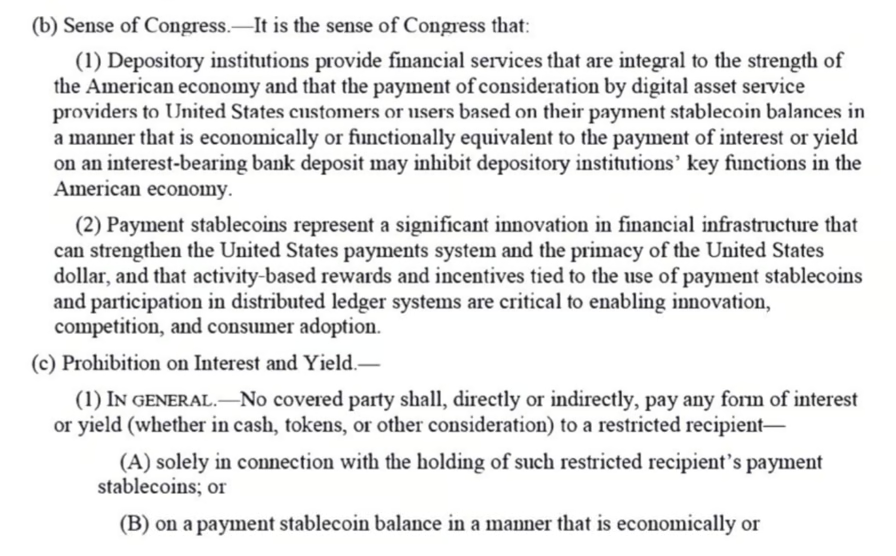
Extract of the “SEC 404. Prohibiting interest and yield on payment stablecoins” document. Source: Alex Thorn
The text titled “SEC 404. Prohibiting interest and yield on payment stablecoins” states that no crypto firm may pay “any form of interest or yield” to customers solely for holding stablecoins, akin to a bank deposit or any similar interest-bearing product.

Source: Patrick Witt
However, it allows firms to offer rewards tied to “bona fide activities.” Some industry executives voiced frustration with the ruling. Helius Labs CEO Mert Mumtaz said, “The clarity of not getting risk-free yield on your dollars without using a bank.”
Polymarket traders anticipate 55% odds of CLARITY passing in 2026
It marks a significant step forward for both the legislation and the broader crypto industry, as the stablecoin yield debate had been one of the main roadblocks delaying its passage, despite expectations earlier this year that it would move through Congress.

Source: Toly Yakovenko
“Now that this issue is behind us, it’s time to focus on the broader bill,” Shirzad said.
Traders on the Polymarket crypto prediction market now see a 55% chance of the CLARITY Act being signed into law in 2026, up 9% over the past 24 hours.
Many in the industry are now calling for the bill to be marked up. Coinbase CEO Brian Armstrong said shortly after the announcement, “Mark it up.”
Senate Banking Committee could schedule markup “imminently”
Galaxy Digital head of firmwide research Alex Thorn said the “release of text suggests that Senate Banking will schedule markup imminently, as soon as the week of May 11.”
Related: Spot Bitcoin ETF outflows top $490M: Is BTC’s rally losing momentum?
However, Thorn warned that he expects “the banks to increase their opposition efforts.”
US Senator Bernie Moreno recently said that he anticipates the CLARITY Act to “get done” by the end of May. On April 11, US Senator Cynthia Lummis said, “It’s now or never.”
Magazine: Why is Ethereum Foundation selling? BTC futures warning signs: Market Moves
TLDR:
- Bitcoin and Ethereum gained over 20% while gold and silver posted sharp losses during the conflict
- ETF inflows and 24/7 crypto trading supported faster price discovery during market uncertainty
- Gold faced selling pressure as crowded defensive positions unwound across traditional markets
- Liquidity expectations replaced fear-driven trading, boosting digital assets over safe-haven metals
Crypto markets and traditional metals have moved in opposite directions during recent geopolitical tension, as digital assets outperformed while gold and silver weakened.
Liquidity conditions, ETF inflows, and positioning shifts have reshaped how investors allocate capital across defensive and risk assets.
Liquidity-driven rotation reshapes haven dynamics
The relationship between Bitcoin and gold has shifted as capital flows respond more to liquidity expectations than fear-based positioning. Digital assets, led by Bitcoin and Ethereum, recorded gains above 20 percent during the period under review.
At the same time, precious metals faced sustained pressure, with gold and silver posting notable declines. This divergence reflects a broader reassessment of where investors seek protection during geopolitical uncertainty.
Market behavior suggests that modern safe havens are increasingly influenced by policy expectations. Traders appear to anticipate monetary easing rather than prolonged disruption, encouraging allocation toward higher-beta assets.
Crypto markets benefit from continuous trading cycles, allowing immediate reaction to global developments. This 24/7 structure creates faster price discovery compared to metals, which rely on fixed trading hours and slower adjustment periods.
Institutional flows further reinforced this divergence. Bitcoin ETF inflows exceeding $1.1 billion supported demand during volatility windows, reducing downside pressure and strengthening momentum across crypto markets.
Gold entered the period with elevated positioning, limiting fresh inflows when geopolitical catalysts emerged. Instead of new accumulation, profit-taking dominated, adding to downward pressure on prices.
Positioning shifts and macro signals redefine asset hierarchy
The evolving contrast between digital assets and metals highlights a shift in how markets interpret risk. Instead of relying solely on traditional hedges, investors increasingly favor instruments tied to liquidity cycles and growth expectations.
A widely circulated market note captured this sentiment, stating that crypto rallied while metals declined as liquidity replaced fear-based trading. This reflects a broader structural change in cross-asset behavior.
Macroeconomic conditions also contributed to the divergence. A stronger dollar and elevated interest rate expectations reduced demand for non-yielding assets such as gold and silver.
Bitcoin and Ethereum benefited from leveraged positioning in derivatives markets, amplifying price movement during periods of increased inflows. This structural leverage allowed faster repricing compared to commodity markets.
Equity indices, including the Nasdaq Composite and S&P 500, also recorded gains during the same period. This supported a broader risk-on environment aligned with expectations of policy stability rather than crisis escalation.
Copper prices remained relatively stable, signaling limited expectations of severe industrial disruption. This reinforced the view that markets were pricing contained geopolitical risk rather than systemic shock.
The evolving contrast between crypto and metals reflects a broader redefinition of safe-haven behavior, where liquidity responsiveness now plays a central role in determining asset preference.


Tether posts $1.04B Q1 profit on a $191.8B reserve stack, leaning on US Treasuries while expanding into gold and bitcoin as stablecoin scrutiny rises.
Summary
- Tether International posted more than $1.04 billion in Q1 2026 operating profit, with total assets reaching $191.8 billion and USDT circulation near $183 billion.
- The company said its reserve mix includes about $141 billion in U.S. Treasury exposure, $20 billion in gold, and $7 billion in bitcoin.
- The figures show Tether’s balance sheet getting larger and more diversified as stablecoin scrutiny intensifies across crypto markets.
Tether International said in its Q1 2026 attestation that it generated more than $1.04 billion in operating profit during the quarter, while total assets climbed to $191.8 billion against roughly $183 billion of USDT in circulation, extending the stablecoin issuer’s already massive footprint in global dollar liquidity.
The reserve composition remains heavily concentrated in U.S. government debt, with Treasury exposure at about $141 billion, alongside $20 billion in gold and $7 billion in bitcoin, giving Tether one of the largest balance sheets in the digital asset sector.
The numbers also reinforce how much of Tether’s earnings power still comes from high-yielding sovereign paper, a model that helped the company report more than $10 billion in profit in 2025 and build a multi-billion-dollar excess reserve cushion in prior disclosures.
Treasury scale drives earnings
Tether’s latest attestation shows the company continuing to lean on short-duration U.S. government securities and cash-equivalent instruments to back USDT, a structure it has repeatedly described as centered on “highly liquid, low-risk assets.”
That matters because interest income on Treasuries remains the engine of profitability: when rates stay elevated, Tether collects yield on a reserve base that now sits near $192 billion, turning scale into earnings faster than most crypto-native businesses can match.
The diversification into gold and bitcoin adds a second layer to the story. Gold holdings have risen from more than $17 billion earlier this year to about $20 billion now, while bitcoin reserves stand at $7 billion, giving Tether more exposure to non-dollar assets even as USDT itself stays pegged to the dollar.
Context across crypto markets
The update lands as stablecoins become more deeply embedded in trading, payments, and DeFi settlement, and as Tether’s role keeps expanding beyond issuance into capital allocation, infrastructure, and strategic investments.
And earlier reporting also showed the company’s surge in profits and Treasury holdings, which showed the same core pattern now visible in Q1 2026: more reserves, more Treasuries, more profit.
Previously, Tether said it was pursuing its first full audit with a Big Four accounting firm, a step meant to answer long-running transparency criticism as reserves keep growing.
And in related news, Tether’s gold position was already highlighted as a major contributor to the firm’s expanding reserve diversification strategy.
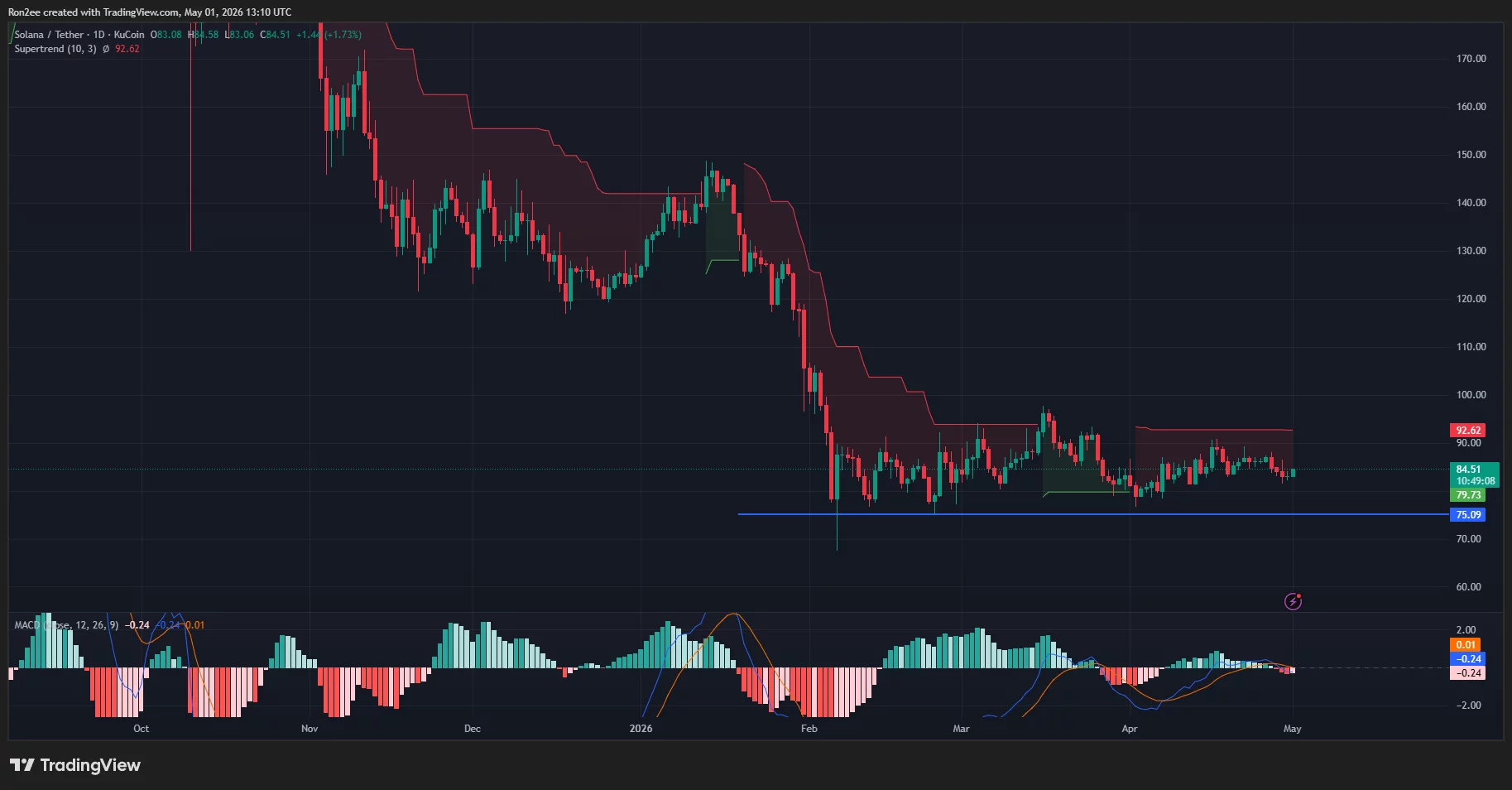
Solana price is showing signs of weakness as the MACD forms a bearish crossover, with price hovering just above a key support zone that could determine the next move.
Summary
- Solana price trades near $84.5 as MACD forms a bearish crossover, signaling weakening short-term momentum.
- Key support lies at $78–$75, with repeated tests raising the risk of a breakdown toward the $75 level.
- Declining ETF inflows, falling DEX volume, and exchange inflows point to weakening demand and rising sell pressure.
According to data from crypto.news, Solana (SOL) price was trading around $84.51 at press time on May 1, up roughly 1.7% over the past 24 hours. Over the past week, the token has moved within a relatively tight range between $79 and $92, reflecting a period of consolidation after a sharp decline earlier this year.
The asset remains under heavy pressure on higher timeframes, still down significantly from levels above $170 seen in late 2025. Price action has flattened in recent weeks, with lower volatility and limited directional follow-through.
When consolidation forms near key support after a downtrend, it often signals a continuation move if buyers fail to regain control.
Market structure suggests that buying pressure is gradually weakening. Institutional demand, which previously helped stabilize Solana, has started to fade. Data from SoSoValue shows monthly inflows into Solana-linked investment products have declined for six consecutive months, falling to around $38.69 million in April 2026, their lowest level since their launch.
On-chain data also shows persistent net inflows into exchanges throughout April, indicating that larger holders may be positioning to sell rather than accumulate.
At the same time, network activity has cooled. Total decentralized exchange volume on Solana has dropped sharply, falling more than 60% from $118 billion in early February to around $44 billion. Network fee generation has also declined by roughly 21%, reducing organic demand for SOL as gas.
Liquidity is also rotating elsewhere. Speculative capital that once flowed into Solana-based memecoins is increasingly shifting toward newer narratives such as AI-focused tokens on competing chains.
Solana price analysis
The daily chart shows Solana holding above a key horizontal support zone near $75, which aligns closely with a major Fibonacci level at $78.03.
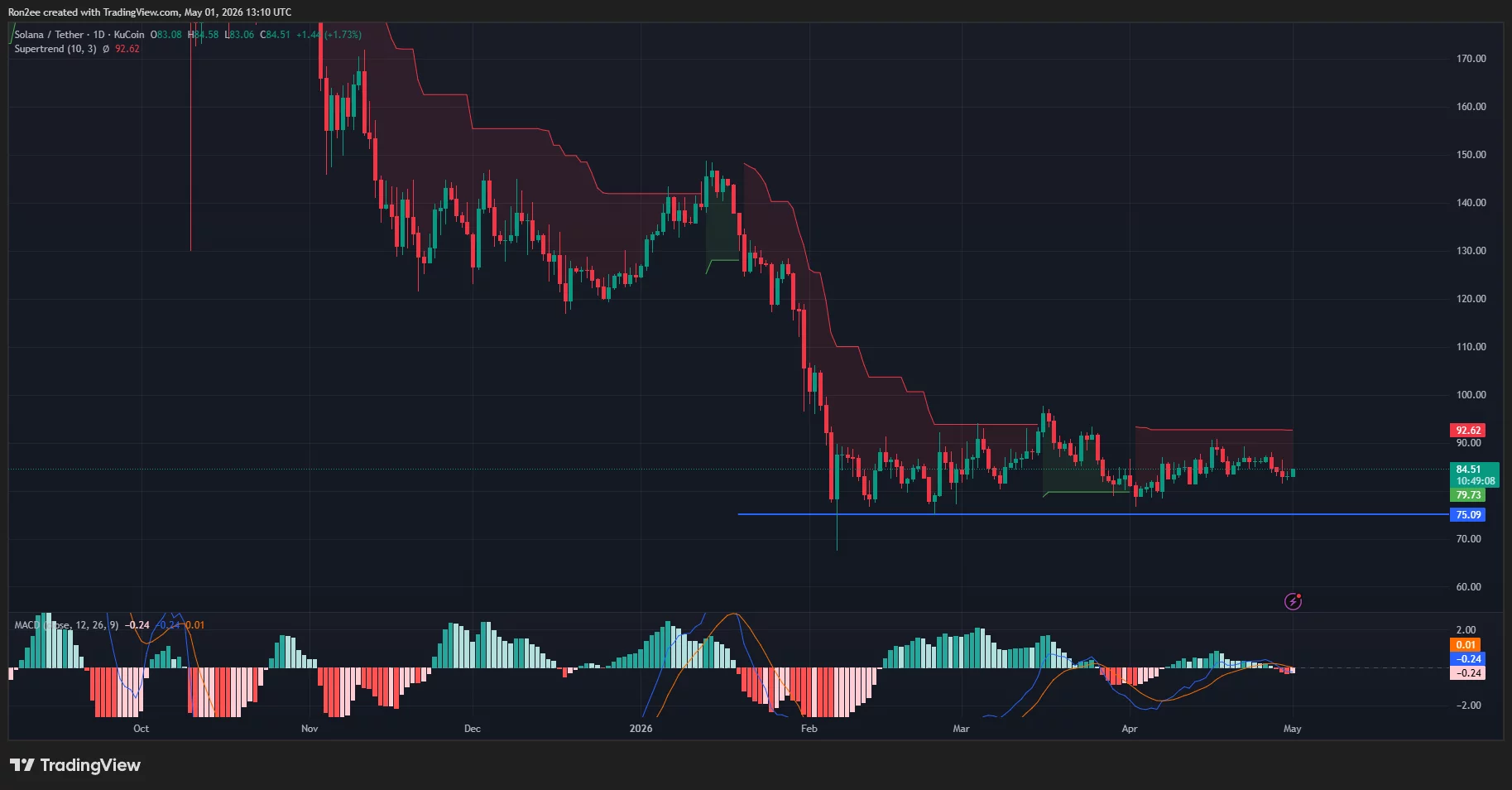
Solana price has repeatedly tested this region over the past several weeks, forming a base. However, rebounds have remained shallow, with resistance capping upside near $86, a level that coincides with the 20-day exponential moving average.
Momentum indicators are now turning negative. The MACD has formed a bearish crossover on the daily timeframe, with the histogram slipping back into negative territory. This suggests that short-term upward momentum is fading.
In addition, price remains below key trend indicators, with the Supertrend line positioned above current levels near $92, reinforcing the broader bearish bias.
A breakdown below the $78 support zone could trigger a sharper move lower, with $75 emerging as the next key downside level.
On the other hand, a sustained move above $86 would be needed to ease immediate pressure and shift momentum, though current indicators suggest that sellers still have the upper hand in the short term.
Disclosure: This article does not represent investment advice. The content and materials featured on this page are for educational purposes only.
Crypto World
MoonPay’s AI-native debit card gives agents a live stablecoin railMoonPay’s AI-native debit card gives agents a live stablecoin rail


MoonPay has launched the MoonAgents Card, a Mastercard-enabled debit product that lets AI agents spend stablecoins directly at the point of sale with onchain settlement behind the scenes.
Summary
- MoonPay has launched the MoonAgents Card, a Mastercard-network debit card that lets AI agents spend stablecoins in real time with on-chain settlement.
- The card integrates directly with the Exodus wallet and is initially rolling out in the UK and Latin America, targeting users who already hold and manage stablecoins onchain.
- The offering builds on MoonPay Agents, a non‑custodial software layer that gives AI agents wallets, funding rails, and 50+ crypto tools, positioning MoonPay at the center of the “agentic payments” stack.
MoonPay has unveiled the MoonAgents Card, a Mastercard-network debit card designed so AI agents can spend stablecoins directly at the point of sale, with every transaction settling onchain behind the scenes.
MoonPay turns AI agents into card-paying customers
According to MoonPay’s agents page, the product sits on top of MoonPay Agents, a non‑custodial infrastructure layer that gives AI systems “a wallet, virtual account, zero‑fee stablecoin onramps, and 20+ skills” with a single CLI install.
The new card effectively grafts those agent wallets onto the existing Mastercard network.
In an earlier announcement about its wider crypto cards, MoonPay said its partnership with Mastercard allows stablecoins to be spent at “more than 150 million merchant locations worldwide,” with fiat conversion handled in the background so merchants see a standard card payment.
Exodus integration and regional rollout
MoonPay has been building toward this moment through a series of wallet integrations. Back in 2024, the company announced a partnership with Exodus, calling the popular self‑custody app a “beginner‑friendly Bitcoin and crypto wallet” and allowing users to buy assets like Bitcoin and Ethereum directly via MoonPay’s on‑ramp.
Exodus support is critical for the MoonAgents Card because it gives AI agents an immediate user base and a familiar interface. As Exodus explains in its own support materials, MoonPay is available across mobile, desktop, and Web3, with 160+ countries supported and payments via cards, Apple Pay, Google Pay, and bank transfers, making it easier to top up the stablecoin balance that ultimately funds agent‑driven card spending.
For now, the MoonAgents Card is live in the UK and parts of Latin America, two regions where card penetration is high but access to dollar‑linked stablecoins and advanced onchain tools has been fragmented. By giving AI agents a way to spend stablecoins “like cash” over existing card rails, MoonPay is betting that consumers will tolerate crypto complexity on the back end as long as the front‑end looks like a normal tap‑to‑pay experience.
Building an “agentic payments” stack
MoonPay’s AI ambitions go beyond a single card. When it introduced MoonPay Agents, the company described the platform as a way to give AI systems “access to wallets, funds, and the ability to transact autonomously using MoonPay CLI,” enabling “the full financial life cycle for AI agents: fiat‑to‑crypto funding, wallet management, token discovery, risk analysis, trading, portfolio tracking, and off‑ramping back to fiat.”
A follow‑up support article says MoonPay Agents now exposes “54 crypto‑specific tools across 17 key skills,” including multi‑chain deposits, automatic stablecoin conversion, and compatibility with x402-style machine‑to‑machine payments that require “no human input.” In other words, the MoonAgents Card is one more endpoint in a system where software can receive funds, manage portfolios, and now pay merchants with stablecoins over a global card network.
For crypto markets, that matters because it hints at a future where demand for stablecoins is driven not only by human remitters and traders but also by fleets of autonomous agents transacting continuously. As MoonPay itself puts it in its agents materials, the goal is to let AI “enter the economy” with minimal friction—something the MoonAgents Card is now attempting to turn into an everyday payments reality.


The crypto market opened May with a stronger tone as traders reacted to short liquidations, Bitcoin ETF demand, and wider risk appetite.
Summary
- Bitcoin traded near $77,000 as short liquidations helped lift the broader crypto market.
- Bitcoin funding rates stayed negative for 46 days before a major short squeeze.
- Strategy’s STRC offers an 11.5% variable dividend, but payouts are not guaranteed.
Crypto.news reported several market-moving stories today, led by Bitcoin’s move near $77,000, pressure on short sellers, and fresh debate around Strategy’s STRC stock.
The latest updates show a market still driven by leverage and institutional flows. However, risk remains visible across derivatives, geopolitics, and dividend-linked crypto equities.
Crypto market rises as shorts get squeezed
The total crypto market cap rose about 1.2% on Friday as forced short liquidations helped lift prices. Bitcoin traded near $77,000, while Ethereum held around $2,200. Major altcoins, including XRP, BNB, and Solana, also moved higher by about 1% to 2%.
More than $150 million in crypto positions were liquidated within 24 hours. About 70% of those positions were shorts. This means many traders betting on lower prices had to close positions as prices moved higher.
Moreover, U.S. spot Bitcoin ETFs continued to record inflows above $200 million per day. These inflows supported Bitcoin even as geopolitical risk remained high due to U.S.–Iran tensions.
Tech stocks also helped improve market sentiment. Alphabet shares jumped about 10% after strong earnings from its cloud and AI businesses. Crypto-linked stocks, including Coinbase and MicroStrategy, also moved higher with Bitcoin.
Bitcoin funding drain sets up squeeze
Bitcoin funding rates stayed negative for 46 straight days, marking the longest such period since 2023. In perpetual futures markets, negative funding means short traders pay long traders to keep positions open.
The extended funding pressure may have eroded 30% to 40% of short margin before the final squeeze. More than $427 million in short positions were later liquidated as Bitcoin pushed toward the $80,000 breakout level.
The report also linked the squeeze to fresh catalysts, including Strategy’s $2.54 billion Bitcoin purchase. The move added pressure on already weak short positions.
Strategy STRC income pitch draws risk debate
Strategy CEO Phong Le promoted STRC as an income product, citing its 11.5% variable dividend. He also said he personally bought $250,000 worth of STRC.
However, Strategy’s disclosures state that dividends are not guaranteed. The company’s board can suspend payments or adjust the rate at any time. The disclosures also state there is no assurance of principal repayment.
Crypto World
Ripple investors turn to new profit opportunities, with SHRMiner offering returns of up to $57,000 per month

Disclosure: This article does not represent investment advice. The content and materials featured on this page are for educational purposes only.
XRP holders explore yield strategies as SHRMiner gains attention for cloud mining and passive income.
Summary
- XRP holders are shifting from passive holding to strategies like SHRMiner to boost efficiency and earn potential income.
- SHRMiner enables XRP investors to turn idle assets into automated, yield-generating opportunities with minimal effort.
- As crypto evolves, platforms like SHRMiner are helping XRP holders move from static holding to dynamic, income-focused strategies.
As the cryptocurrency market evolves, many long-term XRP holders are re-evaluating their investment strategies. Instead of simply waiting for prices to rise, they are exploring how to maintain market participation while improving asset efficiency and potentially generating additional cash flow.
The cryptocurrency market continues to evolve, and more and more investors are reassessing their holding strategies. For many long-term XRP holders, simply waiting for the price to rise is no longer the only option. How to maintain market exposure while further improving asset efficiency and generating potential cash flow is becoming an increasingly important focus.
Against this backdrop, SHRMiner’s cloud mining and smart yield programs are gradually attracting more attention from cryptocurrency investors. As a DeFi solution that emphasizes automation, ease of use, and visible returns, SHRMiner provides XRP holders with a new path that differs from traditional holding strategies, establishing a more direct link between “holding digital assets” and “earning potential passive income.”

XRP investors are looking for new revenue opportunities
XRP has long been one of the most-watched major digital assets in the cryptocurrency market. As market cycles continue to change, more and more investors are beginning to ask a practical question: if they simply hold the asset during periods of market volatility, can those funds be used more effectively?
For these investors, the goal is no longer simply to wait for prices to rise, but to explore more flexible strategies that enable digital assets to generate potential returns during the holding period. As a result, platforms combining decentralized finance (DeFi) yield models, cloud mining, and smart contract-based profit schemes are increasingly becoming the focus of market attention. Some market observers believe that the future of cryptocurrency investment will no longer be limited to a single “buy, hold, sell” model, but will gradually shift towards a more diversified path of “holding high-quality assets + allocating yield-generating tools.” This shift is particularly noteworthy for XRP holders.
SHRMiner’s plans are now attracting market attention
SHRMiner stands out among numerous yield-generating platforms primarily because it simplifies the complex logic of mining and yield generation. Leveraging cloud computing capabilities and smart contract technology, the platform provides users with a relatively intuitive entry point, making digital asset mining easier to understand and participate in.
Compared to traditional mining, SHRMiner’s model eliminates the need for users to purchase mining rigs or handle equipment maintenance, electricity costs, or server management. This significantly lowers the barrier to entry for ordinary investors without a technical background or mining farm experience.
The platform supports a variety of digital assets, including BTC, XRP, ETH, and USDT. After users deposit these assets, the system automatically converts them into computing power to participate in the platform’s revenue-generating program. This not only simplifies the process but also increases the flexibility of asset allocation.
For many XRP investors, SHRMiner’s appeal lies in its attempt to transform “static holding” into “dynamic returns,” giving digital assets stored in a wallet the opportunity to participate in generating returns.
Join SHRMiner now and turn cryptocurrency into daily passive income
SHRMiner is designed to be simple and easy to use, allowing even users with no mining experience to quickly understand and participate in its profit model. The entire process mainly includes the following steps:
1. Create an account
Users can register by visiting the official website or using the mobile platform. According to the platform, new users receive a $15 reward and can claim a daily check-in reward of $0.60, providing an introductory experience for cloud mining beginners.
2. Select a mining plan
After registration, users can choose different mining plans based on their capital allocation and profit goals. The platform offers a variety of contract options, each with different investment scales, contract terms, and profit structures, thus catering to investors with different preferences.
3. Deposit digital assets
The platform supports major cryptocurrencies, including BTC, XRP, ETH, and USDT. After users deposit these assets, the system automatically converts them into computing power, which is used to participate in the platform’s revenue program.
4. Claim your daily earnings
Once the contract is activated, users can begin receiving daily mining rewards. These rewards can be withdrawn or reinvested in new contract plans to expand future mining capabilities.
This process requires no knowledge of mining hardware, electricity costs, or server infrastructure, significantly lowering the barrier to entry for participating in digital asset mining.
Why is SHRMiner’s new mining plan only now attracting attention?
In financial media and cryptocurrency discussions, a clear return structure is often the most attractive feature for investors. SHRMiner’s new mining program has garnered significant attention precisely because it presents its return structure in a simple and clear way, making it easier for investors to understand the potential returns at different investment levels.
According to the platform’s example scheme, different contract levels correspond to different revenue structures:
Introductory Plan
Investment Amount: $100
Contract Duration: 2 days
Estimated Daily Return: Approximately $4
Medium-Term Plan
Investment Amount: US$10,000
Estimated Daily Return: Approximately US$150
Estimated Monthly Return: Approximately US$5,250
Premium Plan
Investment Amount: US$50,000
Estimated Daily Return: Approximately US$900
For more details on contract plans and portfolio return schemes, please visit the official website. According to the platform example, under the contract portfolio model, the estimated maximum daily return is approximately $8,577.
Cryptocurrency investment strategies are changing
As the centralized finance (DeFi) ecosystem continues to develop, more and more investors are focusing on the earning potential of digital assets, rather than solely relying on price increases. In the past, many XRP holders chose to hold long-term, waiting for market opportunities. Today, more and more users are exploring ways to earn additional income while holding their assets.
Therefore, cloud mining and automated yield models are gaining increasing attention. By linking digital assets with computing power plans, investors can maintain market exposure while pursuing daily returns and potential cash flow. As the market matures, strategies combining holding and yield are becoming a new focus for cryptocurrency investors.
Conclusion
As the cryptocurrency market continues to evolve, investors are seeking more efficient asset management methods that go beyond traditional holding models. The logic behind cryptocurrency investment is rapidly evolving, moving from simply waiting for prices to rise to utilizing decentralized finance (DeFi) yield tools and cloud mining solutions to generate potential cash flow.
For long-term investors holding XRP, BTC, or ETH, finding new profit opportunities in ever-changing market cycles has become an increasingly important priority. Platforms like SHRMiner simplify the participation process, offer diverse contract options, and emphasize clearly visible reward structures, providing investors with a new perspective.
Interested investors can visit the SHRMiner website for more information, contact the team by emailing [email protected], or download the SHRMiner application to manage their mining plans and track earnings.
Disclosure: This content is provided by a third party. Neither crypto.news nor the author of this article endorses any product mentioned on this page. Users should conduct their own research before taking any action related to the company.

Bitcoin has resumed its ascent, trading above the $78,000 level and extending its April rally, supported in part by notable inflows into U.S. spot BTC exchange-traded funds. According to CoinGlass data, BTC climbed higher as April delivered an 11.87% gain, a move that was underpinned by SoSoValue data showing about $1.97 billion in spot BTC ETF inflows for the month. Despite the move, market skeptics point to a potential test around the $80,000 mark, a level that many traders say must flip into support to confirm that bulls are in control. CryptoQuant, meanwhile, cautions that the April rebound appears to have been driven largely by futures traders, with spot demand softer, suggesting the marginal buyer may have been speculative rather than fundamental.
The mounting tension around key levels adds up to a simple reality for traders: a sustained move above $80,000 could unlock a path toward the mid-$80,000s, but failure to hold could invite a deeper correction toward recent moving-average support. The 20-day exponential moving average sits around $75,814, acting as a nearer-term barometer, with the 50-day simple moving average near $72,362 offering a more substantial cushion if prices retreat. In the background, traders are watching the “True Market Mean” near the $78,000 zone and the Short-Term Holder cost basis around $79,000 as markers of potential supply pressure.
Key takeaways
- Bitcoin’s heavy lift remains the $80,000 ceiling: a confirmed flip to support could catalyze a move toward $84,000, while a break below the 20-day EMA risks a deeper pullback toward $72,362.
- April ETF inflows underpin the recent rally: SoSoValue data show about $1.97 billion flowing into U.S. spot BTC ETFs in April, reinforcing upside momentum for BTC near the current zone.
- CryptoQuant flags a futures-driven spark in April: the firm notes that spot demand faded as futures trading led the rally, signaling that the market’s marginal buyer may have been speculative rather than fundamental.
- Ether eyes the 50-day and a higher target: ETH sits near the 50-day SMA at $2,207, with a potential push toward $2,465 if buying interest persists and price remains above the 20-day EMA.
- Altcoins poised, but overhead resistance remains: most top coins are trading within defined ranges, with breakouts dependent on clearing local resistance levels and chart patterns.
Bitcoin price dynamics
BTC’s recent uptick began as it rebounded from the 20-day exponential moving average around $75,814, reflecting renewed dip-buying. The immediate challenge appears near $79,500–$80,000, where sellers could reassert pressure. A sustained rally beyond $80,000 would likely embolden bulls and open the door to a test of the $84,000 zone. Conversely, a break below the 20-day EMA could invite a more meaningful correction toward the 50-day simple moving average near $72,362 and possibly below that if a broader trend turns decisively bearish. In this scenario, a failure to hold could embolden sellers toward the longer-term support line.
Ether and the broader Ethereum ecosystem
Ether has found support near the 50-day SMA at about $2,207, a sign that buyers are viewing declines as opportunities. The trend momentum, however, shows signs of cooling as the 20-day EMA flattens and the RSI hovers near the midpoint. If ETH holds above the 50-day SMA, bulls could push toward $2,465, with the price potentially tracing a path up to the ascending channel’s resistance. A close above the channel’s resistance or a sustained hold above the 20-day EMA could trigger the next leg higher; otherwise, prices may remain range-bound within the channel until a decisive breakout occurs.
Altcoin snapshots
XRP price outlook
XRP remains confined in a range between $1.27 and $1.61, suggesting a tug-of-war between buyers and sellers. The 20-day EMA sits around $1.39 and has begun to edge down, with the RSI near midpoint signaling balanced momentum. A sustained move below the moving averages increases the odds of a test toward the $1.27 support, while a breakout above the moving averages could push XRP toward the downtrend line and then the $1.61 resistance. A close above $1.61 would be a genuine trend shift toward a new ceiling.
BNB price trajectory
BNB has dipped below major averages but has not seen a decisive deterioration in demand. The bulls are attempting to reclaim the moving averages, with a break back above them potentially opening a path to $654 and then $687 as overhead resistance. If price action turns down and breaks below $610, sellers could push toward the $570 support, where buyers are expected to re-emerge.
Solana in the spotlight
Solana is attempting to hold above $82.65, but bears continue to press. A breakdown below this level could send SOL toward $76, with a further slip to $67 if selling intensifies. Conversely, a move above the moving averages could keep SOL within the $82.65–$90.73 range for now, with a close above $90.73 potentially re-opening a path to the $98 overhead resistance.
Dogecoin’s rally potential
Dogecoin has shown resilience as buyers defended the $0.10 floor, increasing the probability of a rally toward the $0.12 hurdle. A decisive move above $0.12 could carry DOGE toward $0.14 and potentially $0.16, while a drop below the moving averages might keep the price confined to a $0.09–$0.12 corridor for some time.
Hyperliquid price path
Hyperliquid turned lower and dipped below the 50-day SMA, though a long lower wick signals buying interest at lower levels. The bulls will need to push above the 20-day EMA to target the $43.76–$45.77 zone, with a decisive close beyond that zone opening a route to $50. A breakdown below $38.70 could invite a deeper pullback toward $37.77 and eventually $34.45.
Cardano price trajectory
ADA has clung to the moving averages, signaling ongoing bullish pressure. A break above the downtrend line could lift ADA toward $0.32 and then $0.37, signaling a potential short-term trend shift. If ADA weakens and slides below $0.22, the setup could keep the pair within the descending channel for several more days.
Bitcoin Cash price dynamics
BCH bounced off the $443 level as bulls defended the line, with minor resistance near the 50-day SMA around $453. A clear break above that level could push BCH toward $486, where bears are expected to defend, and if buyers surpass that hurdle, toward $520. If prices fail to clear the resistance, BCH could remain range-bound between roughly $419 and $486.
Monero price outlook
XMR showed a constructive bounce from the 20-day EMA around $366, with the moving average’s uptrend and a positive RSI pointing to upside momentum. If buyers sustain a move above $406, a rally toward $500 could unfold. Conversely, a sharp reversal from overhead resistance could see XMR drift back toward the $302–$406 range as volatility settles.
Market signals and what comes next
On balance, investors are weighing a split between technical momentum and macro-driven risk appetites. The CryptoQuant note that April’s rally was heavily fuelled by futures positioning serves as a cautionary reminder that spot demand remains a critical piece of the puzzle. The ETF inflows point to continued institutional interest, but the durability of the rally will hinge on whether spot demand strengthens in tandem with price action. As BTC and major altcoins approach pivotal thresholds, traders will be looking for clear confirmations—above or below key levels—to gauge whether this cycle shifts toward a fresh leg higher or retests lower supports.
What to watch next: a sustained break above $80,000 paired with a decisive hold above the 20-day EMA would bolster the case for a continued ascent, while a rejection at that level could re-ignite selling pressure into the mid-to-late spring. For Ethereum, the crucial test remains holding the $2,207 region and achieving a close above $2,465 to confirm new upside momentum. Beyond these, the market will be watching whether the breadth of gains across top altcoins broadens or remains contained within established ranges, with the CryptoQuant perspective serving as a reminder that sentiment and liquidity will continue to shape the near-term trajectory.
Stablecoins Cross $300B Supply as B2B Payments Become the Fastest-Growing Real-World Use Case
Barbie Ferreira Reveals Cosmetic Procedures She’s Done

The Unexpected Laws of Personal Finance – Morgan Housel

Manchester United reach agreement with Casemiro over contract clause amid transfer speculation

US brings back mandatory military draft registration

Steven Gerrard disagrees with Gary Neville over ‘shock’ Chelsea and Arsenal claim | Football


-

 Tech4 days ago
Register Renaming | Hackaday
-
Crypto World6 days ago
Hyperliquid $HYPE Rally Builds Momentum as AI Sector Enters Prove-It Phase
-

 Politics4 days ago
Drax board avoid their own AGM, accused of greenwashing & environmental racism
-

 Tech4 days ago
Images of Samsung’s rumored smart glasses have leaked
-

 Tech5 days ago
Why Blue Badges Disappeared From Toyota Hybrids
-
 Sports6 days ago
IPL 2026: Ruturaj Gaikwad registers slowest fifty of the season, enters all-time unwanted list | Cricket News
-
 Tech7 hours ago
Trump’s 25% EU auto tariff breaches Turnberry Agreement that also covers semiconductors and digital trade
-

 NewsBeat6 days ago
LK Bennett closes all stores after entering administration
-

 Fashion3 days ago
Kylie Jenner’s KHY Enters a New Era with ‘Born in LA’
-
 Entertainment6 days ago
Mariah Carey Slams Deposition Claims In Brother’s Lawsuit
-

 Business3 days ago
Most Commercial Energy Audits Miss the Real Losses
-

 Business5 days ago
(VIDEO) Charlize Theron Climbs Times Square Billboard to Promote New Netflix Thriller ‘Apex’
-

 Crypto World4 days ago
CFTC’s AI will review U.S. crypto registration applications, chairman tells CoinDesk
-
 Sports7 hours ago
Paul Scholes issues Marcus Rashford reality check as agreement emerges over Man United star
-

 Business3 days ago
Barclay Brothers Avoid Bankruptcy: HSBC Drops High Court Petitions After IVA Deal
-

 Tech6 days ago
Microsoft to roll out Entra passkeys on Windows in late April
-

 Tech6 days ago
OpenAI’s Sam Altman apologizes for not reporting ChatGPT account of Tumbler Ridge suspect to police
-

 Tech6 days ago
OpenAI CEO apologizes to Tumbler Ridge community
-
 Business2 days ago
Tesla Officially Registers Elon Musk’s Stock: What Investors Need to Know
-

 Tech3 days ago
Get Ready for More Brain-Scanning Consumer Gadgets
You must be logged in to post a comment Login