
Crypto World
MoonPay’s AI-native debit card gives agents a live stablecoin railMoonPay’s AI-native debit card gives agents a live stablecoin rail



MoonPay has launched the MoonAgents Card, a Mastercard-enabled debit product that lets AI agents spend stablecoins directly at the point of sale with onchain settlement behind the scenes.
Summary
- MoonPay has launched the MoonAgents Card, a Mastercard-network debit card that lets AI agents spend stablecoins in real time with on-chain settlement.
- The card integrates directly with the Exodus wallet and is initially rolling out in the UK and Latin America, targeting users who already hold and manage stablecoins onchain.
- The offering builds on MoonPay Agents, a non‑custodial software layer that gives AI agents wallets, funding rails, and 50+ crypto tools, positioning MoonPay at the center of the “agentic payments” stack.
MoonPay has unveiled the MoonAgents Card, a Mastercard-network debit card designed so AI agents can spend stablecoins directly at the point of sale, with every transaction settling onchain behind the scenes.
MoonPay turns AI agents into card-paying customers
According to MoonPay’s agents page, the product sits on top of MoonPay Agents, a non‑custodial infrastructure layer that gives AI systems “a wallet, virtual account, zero‑fee stablecoin onramps, and 20+ skills” with a single CLI install.
The new card effectively grafts those agent wallets onto the existing Mastercard network.
In an earlier announcement about its wider crypto cards, MoonPay said its partnership with Mastercard allows stablecoins to be spent at “more than 150 million merchant locations worldwide,” with fiat conversion handled in the background so merchants see a standard card payment.
Exodus integration and regional rollout
MoonPay has been building toward this moment through a series of wallet integrations. Back in 2024, the company announced a partnership with Exodus, calling the popular self‑custody app a “beginner‑friendly Bitcoin and crypto wallet” and allowing users to buy assets like Bitcoin and Ethereum directly via MoonPay’s on‑ramp.
Exodus support is critical for the MoonAgents Card because it gives AI agents an immediate user base and a familiar interface. As Exodus explains in its own support materials, MoonPay is available across mobile, desktop, and Web3, with 160+ countries supported and payments via cards, Apple Pay, Google Pay, and bank transfers, making it easier to top up the stablecoin balance that ultimately funds agent‑driven card spending.
For now, the MoonAgents Card is live in the UK and parts of Latin America, two regions where card penetration is high but access to dollar‑linked stablecoins and advanced onchain tools has been fragmented. By giving AI agents a way to spend stablecoins “like cash” over existing card rails, MoonPay is betting that consumers will tolerate crypto complexity on the back end as long as the front‑end looks like a normal tap‑to‑pay experience.
Building an “agentic payments” stack
MoonPay’s AI ambitions go beyond a single card. When it introduced MoonPay Agents, the company described the platform as a way to give AI systems “access to wallets, funds, and the ability to transact autonomously using MoonPay CLI,” enabling “the full financial life cycle for AI agents: fiat‑to‑crypto funding, wallet management, token discovery, risk analysis, trading, portfolio tracking, and off‑ramping back to fiat.”
A follow‑up support article says MoonPay Agents now exposes “54 crypto‑specific tools across 17 key skills,” including multi‑chain deposits, automatic stablecoin conversion, and compatibility with x402-style machine‑to‑machine payments that require “no human input.” In other words, the MoonAgents Card is one more endpoint in a system where software can receive funds, manage portfolios, and now pay merchants with stablecoins over a global card network.
For crypto markets, that matters because it hints at a future where demand for stablecoins is driven not only by human remitters and traders but also by fleets of autonomous agents transacting continuously. As MoonPay itself puts it in its agents materials, the goal is to let AI “enter the economy” with minimal friction—something the MoonAgents Card is now attempting to turn into an everyday payments reality.



Strategy’s CEO has promoted its high-yield STRC stock as a way to cover personal expenses, drawing attention to the risks tied to its dividend structure.
Summary
- Phong Le has promoted STRC as an income source for everyday expenses, citing its 11.5% variable dividend while acknowledging he invested $250,000 personally.
- Company disclosures from Strategy state dividends are not guaranteed and can be suspended, with no assurance of principal repayment.
- Le said about 80% of STRC holders are retail investors, identifying them as individuals managing mortgages, utility bills, and other financial obligations.
According to comments made by Phong Le on Natalie Brunell’s show, the executive described STRC as an income-generating asset that could help investors manage recurring costs such as mortgages, utility bills, and car payments. He said the stock’s variable dividends “almost looks like a paycheck,” while noting that payments arrive regularly.
Le disclosed that he had personally purchased $250,000 worth of STRC, explaining the decision through his own financial setup. He said he holds a 1.75% 30-year mortgage and viewed STRC’s current 11.5% annualized dividend as a way to earn a higher return instead of paying down that debt. He described the approach as earning income from the spread between the dividend yield and his borrowing cost.
Details published by Strategy on its STRC information page state that cash dividends are not guaranteed, while the company’s board retains the authority to suspend payments and adjust the dividend rate at any time. The same disclosures also note that the stock carries no assurance of principal repayment.
During the same appearance, Le compared the consistency of STRC payouts to a salary, although the company’s own documentation outlines conditions under which those payments can be reduced or halted.
Le also addressed the composition of STRC’s investor base, stating that roughly 80% of holders are retail participants. His remarks framed these investors as individuals managing everyday financial obligations, including mortgages and bills, placing them among the primary users of the product he described.
The discussion has drawn parallels to earlier remarks by Michael Saylor, who in March 2021 encouraged the use of leverage, including mortgages, to acquire Bitcoin. Unlike those comments, Le’s remarks focused on STRC rather than bitcoin, positioning the company’s own stock as a yield-based alternative.
In the same interview, Le also said STRC “grew faster than the iPhone,” referring to the pace of stock sales. Standard accounting definitions, however, distinguish capital raised through stock issuance from revenue generated through the sale of goods or services.
Compensation disclosures cited in public filings show that Le’s annual pay has exceeded $15 million, placing his personal investment example in a different financial context than the retail investors he described.


The crypto market rose around 1.2% on Friday, with total market capitalization ticking higher as a wave of short liquidations and stronger tech-led risk sentiment lifted prices despite persistent geopolitical tensions.
Summary
- Crypto market ticks higher as over $140M in liquidations, around 70% shorts, trigger a short squeeze, while Bitcoin holds near $77K.
- U.S. spot Bitcoin ETFs log continued inflows exceeding $200M daily, supporting prices despite ongoing U.S.–Iran tensions and elevated oil near $110.
- Alphabet Inc. shares jump ~10%, lifting global tech stocks and boosting crypto-linked equities, including Coinbase and MicroStrategy.
Bitcoin (BTC) climbed roughly 1.5% to trade near the $77,000 level after rebounding from recent lows, while Ethereum (ETH) gained about 1% to hover around $2,200. Major altcoins such as XRP (XRP), BNB (BNB), and Solana (SOL) also moved higher by 1–2%, reflecting a broader recovery across the market.
The move higher was largely driven by a short squeeze in derivatives markets. More than $150 million in crypto positions were liquidated over the past 24 hours, with roughly 70% of those tied to short positions. The forced unwinding of bearish bets added upward pressure as traders rushed to cover positions.
The rebound comes even as geopolitical risks remain elevated, particularly around the U.S.–Iran standoff.
Iran’s President Masoud Pezeshkian said the U.S. naval presence near Iranian ports amounts to an “extension of military operations,” calling it “intolerable.” U.S. President Donald Trump added that Washington “might need” to restart military action, while offering limited transparency on the status of negotiations.
Despite these developments, markets showed signs of resilience, suggesting that much of the geopolitical risk may already be priced in for now. Oil prices remained elevated but steadied after recent volatility linked to the Strait of Hormuz tensions. Brent crude held near the $110–$111 per barrel range, while WTI crude traded just below that level, easing slightly from recent spikes that had raised fears of supply disruptions.
At the same time, safe-haven assets softened. Gold slipped over 1% during the session, while silver also declined, indicating a partial rotation back into risk assets. This shift provided additional support to crypto markets.
Alphabet Inc. rally lifts tech and crypto-linked equities
Broader market sentiment improved sharply after Alphabet Inc. shares surged roughly 10% following stronger-than-expected earnings driven by its cloud and AI segments. The move added hundreds of billions of dollars in market value and lifted global tech stocks.
The rally extended into Asian markets, where tech-heavy indices such as the Nikkei 225 moved higher, reinforcing a risk-on tone across asset classes.
Crypto-linked equities also tracked the move. Shares of Coinbase and MicroStrategy rose alongside Bitcoin’s recovery, reflecting renewed investor appetite for digital asset exposure. Mining stocks also saw gains as improving prices and sentiment supported the sector.
While the latest move points to improving near-term sentiment, analysts note that crypto markets remain highly sensitive to further developments in U.S.–Iran tensions, oil price movements, and shifts in global liquidity conditions.


Tom Lee’s Bitmine has staked about $508 million worth of Ethereum in a recent move tracked by Arkham.
Summary
- Bitmine recently staked about $508 million worth of ETH, according to Arkham on-chain data.
- Bitmine’s Ethereum holdings crossed 5 million ETH, placing it among the largest institutional holders.
- More than 4 million Bitmine ETH is staked, equal to about 10.5% of total staked supply.
The transfers were routed through institutional channels, adding to the firm’s ongoing staking strategy.
The latest activity comes as Bitmine continues to increase its exposure to Ethereum. On-chain data shows the firm has now staked more than 4 million ETH, valued at about $9.3 billion, representing around 10.5% of total staked supply.
ETH holdings cross 5 million milestone
Recent disclosures show Bitmine’s total Ethereum holdings have crossed 5 million ETH. The company reported holdings of about 5.07 million ETH, marking a key milestone in its accumulation strategy.
Chairman Tom Lee said, “Bitmine ETH holdings crossed 5 million this past week,” noting the pace of accumulation has been rapid.
The firm now holds more than 4% of the total ETH supply. This places Bitmine among the largest institutional holders of Ethereum in the market.
Strategy focuses on staking and supply control
Bitmine has focused on staking a large share of its ETH holdings. More than 4 million ETH is already deployed in staking programs, generating yield while reducing liquid supply.
The company’s broader plan targets holding a larger share of Ethereum supply. Reports indicate a strategy aimed at securing up to 5% of total ETH over time through continued purchases and staking.
This approach combines accumulation with yield generation. Staked ETH contributes to validator activity while producing ongoing rewards tied to network participation.
Market watches concentration and institutional activity
Bitmine’s growing position has drawn attention to staking concentration. Large allocations of ETH in staking reduce available supply on the open market and increase the role of institutional participants.
The company has expanded its holdings steadily in recent months. Earlier filings showed ETH holdings around 4.5 million tokens before the recent increase past 5 million.


Strategy announced it maintained STRC’s 11.5% dividend rate for May 2026, signaling confidence in its Bitcoin strategy despite lingering market skepticism.
The announcement comes as the preferred equity instrument attracts growing institutional interest and daily trading volume surpasses $380 million.
Dividend Sustained Amid Volatility
Michael Saylor emphasized STRC’s resilience in his latest post. He highlighted three key metrics: approximately 3% volatility, 11.5% yield, and roughly $380 million in daily trading liquidity.
These figures paint a picture of stability. The low volatility suggests STRC trades predictably. The high yield attracts income-focused investors. The substantial liquidity ensures shareholders can easily enter or exit positions without moving markets.
The dividend maintenance reflects management’s confidence that Strategy can sustain payouts through ongoing Bitcoin appreciation and continued capital raises.
Shareholders Vote on Twice-Monthly Payments
Beyond the dividend announcement, Strategy is asking shareholders to make a structural change. Brokerages have begun sending voting notices to both MSTR and STRC holders.
The proposal shifts dividend payments from monthly to twice-monthly beginning mid-May 2026. This change improves cash flow timing for investors receiving semi-monthly income streams instead of lump-sum monthly payments.
Both share classes must approve the amendment. The shift suggests MicroStrategy management expects continued strong fundraising capabilities to support more frequent payouts.
Strategy Market Context and Criticism
However, not all observers view STRC positively. Peter Schiff has called Strategy’s structure a scam, arguing that rising dividend obligations will eventually force liquidations if Bitcoin prices stall.
Bitcoin price predictions for May 2026 remain mixed. Some analysts expect continued strength. Others warn of consolidation or pullback risks given macro headwinds.
Meanwhile, Saylor’s endgame thesis projects Bitcoin reaching $10 million per coin through the adoption of digital credit. Eric Trump recently predicted $1 million Bitcoin, signaling continued Trump family bullishness on crypto assets.
Liquidity Milestone Signals Acceptance
The $380 million daily liquidity milestone matters. It demonstrates that institutional and retail investors view STRC as a viable income vehicle, warranting meaningful trading volumes. Compare this to less liquid preferred securities that struggle to attract daily volume. STRC’s liquidity suggests growing acceptance despite skeptical voices like Schiff.
The combination of stable low volatility, high yield, and substantial liquidity creates an appealing risk-reward profile for income investors. This explains growing institutional participation in STRC trading.
Strategy’s dividend maintenance and twice-monthly payment proposal signal management confidence. However, the structure remains controversial.
Skeptics argue that the dividend model eventually breaks down. Believers argue that Bitcoin appreciation and digital credit adoption will sustain it indefinitely.
The $380 million liquidity milestone shows investors are willing to bet on Saylor’s vision. Whether that bet pays off depends on Bitcoin’s path forward and Strategy’s ability to raise capital sustainably.
The post MicroStrategy’s STRC Trading Volume Hits $380 Million as Payment Vote Nears appeared first on BeInCrypto.
Crypto World
Stablecoins Cross $300B Supply as B2B Payments Become the Fastest-Growing Real-World Use Case

TLDR:
- Stablecoin supply has surpassed $300B as banks and payment firms begin direct integration into financial systems.
- B2B transfers account for $226B of real usage, making it the largest and fastest-growing stablecoin category today.
- Real-economy usage sits at just $390B of $35T in annual volume, showing how early adoption still is globally.
- Asia, led by Singapore, Hong Kong, and Japan, is outpacing the West in practical, real-world stablecoin deployment.
Stablecoins are gradually moving beyond crypto-native activity into mainstream financial infrastructure worldwide.
Supply has already exceeded $300 billion, while banks and payment companies pursue direct integration. Regulatory frameworks are becoming clearer across major markets at the same time.
Annual transaction volume sits around $35 trillion, yet real-economy usage remains roughly $390 billion. That figure represents barely over 1% of total activity. The infrastructure is being built well before broader adoption fully arrives.
B2B Payments Emerge as the Clearest Use Case for Stablecoins
Stablecoins are finding their strongest real-world application in business-to-business payments today. Cross-border transfers remain slow, expensive, and full of friction for many companies.
Settlement often takes days, while liquidity regularly gets locked in transit. Smaller businesses tend to face far worse banking conditions than large institutions.
Around $226 billion of real usage comes from company-to-company transfers today. This makes B2B the largest real-economy stablecoin category by a clear margin.
That figure is growing quickly because the problem it addresses is well understood. Fewer intermediaries and 24/7 settlement rails deliver measurable savings for businesses.
As analyst @WorldOfMercek noted, traditional finance and blockchain rails are “no longer moving in completely separate worlds.” Banks are actively adopting crypto infrastructure because the operational benefits are hard to dismiss.
The old “crypto versus banks” narrative has given way to steady convergence. Financial institutions are integrating stablecoin rails for practical, well-documented economic reasons.
Most of the $35 trillion in annual volume still comes from trading, DeFi, and exchange settlement. Real-economy usage at $390 billion remains just over 1% of that total. Rails are always built before populations fully transition to using them.
Asia Leads Real Usage While Integration Remains the Biggest Barrier
Geographic data shows that Asia is ahead of the West in practical stablecoin use. Singapore, Hong Kong, and Japan account for a large share of real-world transactions.
Western markets spend more time discussing potential than actively deploying stablecoins at scale. Asia is already applying them where they directly solve payment and business problems.
Retail usage is growing, though it remains a smaller portion of the overall market. Consumer payments and daily card spending are not the leading story just yet.
That category will likely expand once rails integrate more deeply into existing payment systems. Most users care about speed, cost, and reliability — not which infrastructure moves their money.
The actual bottleneck today is not the technology — it already works. Bank connectivity, payment network access, regulatory clarity, and institutional trust are the real gaps remaining. Those barriers are narrowing as more traditional players enter the space.
Stablecoins are not displacing the financial system on any rapid timeline. Instead, they are being absorbed into it consistently and quietly over time.
That process tends to look slow until it suddenly feels inevitable to outside observers. The most consequential chapter of the stablecoin story is likely still ahead.



Bitcoin traded at $77,250 at press time, with 24-hour volume at $30.89 billion, per crypto.news data.
Summary
- Bitcoin must break $79,000 to target the next resistance zone between $86,000 and $88,000.
- More than 10,000 BTC moved to exchanges last week, raising short-term selling pressure concerns.
- Analysts remain split as Bitcoin holds an uptrend while May seasonality shows no clear bearish pattern.
The asset gained 2% in the past day but remained down slightly over seven days.
The price has recovered from earlier weakness and now trades in a short-term uptrend. The chart shows higher lows since mid-March, pointing to steady demand from buyers.
Analyst says $79K remains key
Crypto analyst Michaël van de Poppe said Bitcoin tends to behave positively at the start of a new month. He also expects spot Bitcoin ETF flows to improve in the coming week.
He said, “If $79K breaks, the next resistance zone is at $86-88K.” A move into that range could improve market confidence and support stronger altcoin performance.
Notably, Bitcoin is consolidating below the $79,000 resistance area. A clean move above this level would confirm stronger short-term momentum.
The moving average on the chart is rising, while the price remains above it. This supports the current bullish setup, although volume has not shown a major breakout signal.
Support sits near $73,000 to $74,000. A drop below this zone could weaken the current structure. Deeper support appears near $65,000 and $60,000.
Analysts remain split on May trend
Ali Martinez said Bitcoin shows similarities to its 2022 bottoming structure. He stated that this could allow another push higher before a final move lower.
He also noted that more than 10,000 BTC, worth about $760 million, moved to exchanges over the past week. Exchange inflows can signal possible selling pressure.
Daan Crypto Trades noted that May does not clearly support the “sell in May and go away” idea for Bitcoin. He noted that May ranks as Bitcoin’s sixth-best month by average return and third-best by median return.
Doctor Profit said Bitcoin has moved in a sideways box since February. He placed the local top around the $83,000 to $85,000 region.
Disclosure: This article does not represent investment advice. The content and materials featured on this page are for educational purposes only.
The US CLARITY Act, which aims to provide the US crypto industry with more regulatory clarity, could now move closer to becoming law after new stablecoin yield provisions were published, according to Coinbase chief legal officer Faryar Shirzad.
“It’s time to get CLARITY done,” Shirzad said in an X post on Friday, after US Senator Thom Tillis and US Senator Angela Alsobrooks published the final text aimed at settling the stablecoin yield dispute between the banking and crypto industries, which has centered on whether such yields would harm the banking system’s competitiveness.
“In the end, the banks were able to get more restrictions on rewards, but we protected what matters – the ability for Americans to earn rewards, based on real usage of crypto platforms and networks,” Shirzad said.

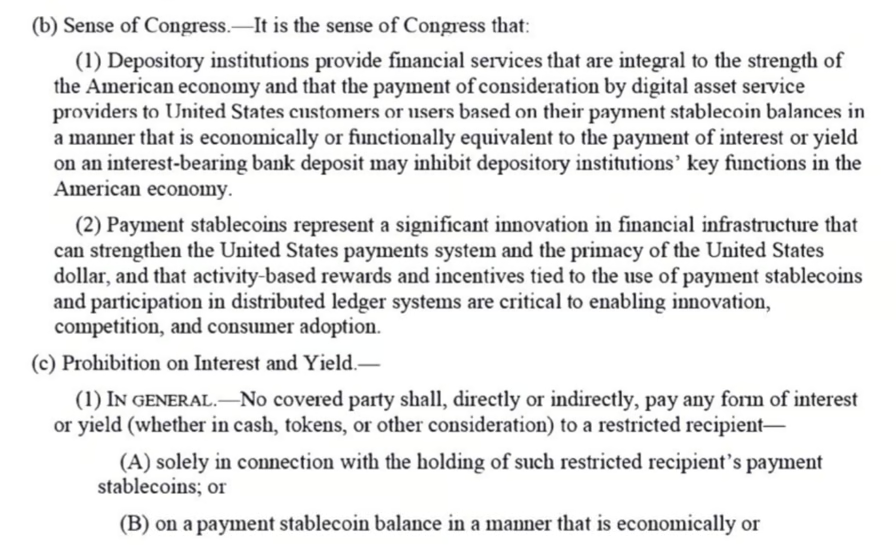
Extract of the “SEC 404. Prohibiting interest and yield on payment stablecoins” document. Source: Alex Thorn
The text titled “SEC 404. Prohibiting interest and yield on payment stablecoins” states that no crypto firm may pay “any form of interest or yield” to customers solely for holding stablecoins, akin to a bank deposit or any similar interest-bearing product.

Source: Patrick Witt
However, it allows firms to offer rewards tied to “bona fide activities.” Some industry executives voiced frustration with the ruling. Helius Labs CEO Mert Mumtaz said, “The clarity of not getting risk-free yield on your dollars without using a bank.”
Polymarket traders anticipate 55% odds of CLARITY passing in 2026
It marks a significant step forward for both the legislation and the broader crypto industry, as the stablecoin yield debate had been one of the main roadblocks delaying its passage, despite expectations earlier this year that it would move through Congress.

Source: Toly Yakovenko
“Now that this issue is behind us, it’s time to focus on the broader bill,” Shirzad said.
Traders on the Polymarket crypto prediction market now see a 55% chance of the CLARITY Act being signed into law in 2026, up 9% over the past 24 hours.
Many in the industry are now calling for the bill to be marked up. Coinbase CEO Brian Armstrong said shortly after the announcement, “Mark it up.”
Senate Banking Committee could schedule markup “imminently”
Galaxy Digital head of firmwide research Alex Thorn said the “release of text suggests that Senate Banking will schedule markup imminently, as soon as the week of May 11.”
Related: Spot Bitcoin ETF outflows top $490M: Is BTC’s rally losing momentum?
However, Thorn warned that he expects “the banks to increase their opposition efforts.”
US Senator Bernie Moreno recently said that he anticipates the CLARITY Act to “get done” by the end of May. On April 11, US Senator Cynthia Lummis said, “It’s now or never.”
Magazine: Why is Ethereum Foundation selling? BTC futures warning signs: Market Moves
TLDR:
- Bitcoin and Ethereum gained over 20% while gold and silver posted sharp losses during the conflict
- ETF inflows and 24/7 crypto trading supported faster price discovery during market uncertainty
- Gold faced selling pressure as crowded defensive positions unwound across traditional markets
- Liquidity expectations replaced fear-driven trading, boosting digital assets over safe-haven metals
Crypto markets and traditional metals have moved in opposite directions during recent geopolitical tension, as digital assets outperformed while gold and silver weakened.
Liquidity conditions, ETF inflows, and positioning shifts have reshaped how investors allocate capital across defensive and risk assets.
Liquidity-driven rotation reshapes haven dynamics
The relationship between Bitcoin and gold has shifted as capital flows respond more to liquidity expectations than fear-based positioning. Digital assets, led by Bitcoin and Ethereum, recorded gains above 20 percent during the period under review.
At the same time, precious metals faced sustained pressure, with gold and silver posting notable declines. This divergence reflects a broader reassessment of where investors seek protection during geopolitical uncertainty.
Market behavior suggests that modern safe havens are increasingly influenced by policy expectations. Traders appear to anticipate monetary easing rather than prolonged disruption, encouraging allocation toward higher-beta assets.
Crypto markets benefit from continuous trading cycles, allowing immediate reaction to global developments. This 24/7 structure creates faster price discovery compared to metals, which rely on fixed trading hours and slower adjustment periods.
Institutional flows further reinforced this divergence. Bitcoin ETF inflows exceeding $1.1 billion supported demand during volatility windows, reducing downside pressure and strengthening momentum across crypto markets.
Gold entered the period with elevated positioning, limiting fresh inflows when geopolitical catalysts emerged. Instead of new accumulation, profit-taking dominated, adding to downward pressure on prices.
Positioning shifts and macro signals redefine asset hierarchy
The evolving contrast between digital assets and metals highlights a shift in how markets interpret risk. Instead of relying solely on traditional hedges, investors increasingly favor instruments tied to liquidity cycles and growth expectations.
A widely circulated market note captured this sentiment, stating that crypto rallied while metals declined as liquidity replaced fear-based trading. This reflects a broader structural change in cross-asset behavior.
Macroeconomic conditions also contributed to the divergence. A stronger dollar and elevated interest rate expectations reduced demand for non-yielding assets such as gold and silver.
Bitcoin and Ethereum benefited from leveraged positioning in derivatives markets, amplifying price movement during periods of increased inflows. This structural leverage allowed faster repricing compared to commodity markets.
Equity indices, including the Nasdaq Composite and S&P 500, also recorded gains during the same period. This supported a broader risk-on environment aligned with expectations of policy stability rather than crisis escalation.
Copper prices remained relatively stable, signaling limited expectations of severe industrial disruption. This reinforced the view that markets were pricing contained geopolitical risk rather than systemic shock.
The evolving contrast between crypto and metals reflects a broader redefinition of safe-haven behavior, where liquidity responsiveness now plays a central role in determining asset preference.


Tether posts $1.04B Q1 profit on a $191.8B reserve stack, leaning on US Treasuries while expanding into gold and bitcoin as stablecoin scrutiny rises.
Summary
- Tether International posted more than $1.04 billion in Q1 2026 operating profit, with total assets reaching $191.8 billion and USDT circulation near $183 billion.
- The company said its reserve mix includes about $141 billion in U.S. Treasury exposure, $20 billion in gold, and $7 billion in bitcoin.
- The figures show Tether’s balance sheet getting larger and more diversified as stablecoin scrutiny intensifies across crypto markets.
Tether International said in its Q1 2026 attestation that it generated more than $1.04 billion in operating profit during the quarter, while total assets climbed to $191.8 billion against roughly $183 billion of USDT in circulation, extending the stablecoin issuer’s already massive footprint in global dollar liquidity.
The reserve composition remains heavily concentrated in U.S. government debt, with Treasury exposure at about $141 billion, alongside $20 billion in gold and $7 billion in bitcoin, giving Tether one of the largest balance sheets in the digital asset sector.
The numbers also reinforce how much of Tether’s earnings power still comes from high-yielding sovereign paper, a model that helped the company report more than $10 billion in profit in 2025 and build a multi-billion-dollar excess reserve cushion in prior disclosures.
Treasury scale drives earnings
Tether’s latest attestation shows the company continuing to lean on short-duration U.S. government securities and cash-equivalent instruments to back USDT, a structure it has repeatedly described as centered on “highly liquid, low-risk assets.”
That matters because interest income on Treasuries remains the engine of profitability: when rates stay elevated, Tether collects yield on a reserve base that now sits near $192 billion, turning scale into earnings faster than most crypto-native businesses can match.
The diversification into gold and bitcoin adds a second layer to the story. Gold holdings have risen from more than $17 billion earlier this year to about $20 billion now, while bitcoin reserves stand at $7 billion, giving Tether more exposure to non-dollar assets even as USDT itself stays pegged to the dollar.
Context across crypto markets
The update lands as stablecoins become more deeply embedded in trading, payments, and DeFi settlement, and as Tether’s role keeps expanding beyond issuance into capital allocation, infrastructure, and strategic investments.
And earlier reporting also showed the company’s surge in profits and Treasury holdings, which showed the same core pattern now visible in Q1 2026: more reserves, more Treasuries, more profit.
Previously, Tether said it was pursuing its first full audit with a Big Four accounting firm, a step meant to answer long-running transparency criticism as reserves keep growing.
And in related news, Tether’s gold position was already highlighted as a major contributor to the firm’s expanding reserve diversification strategy.
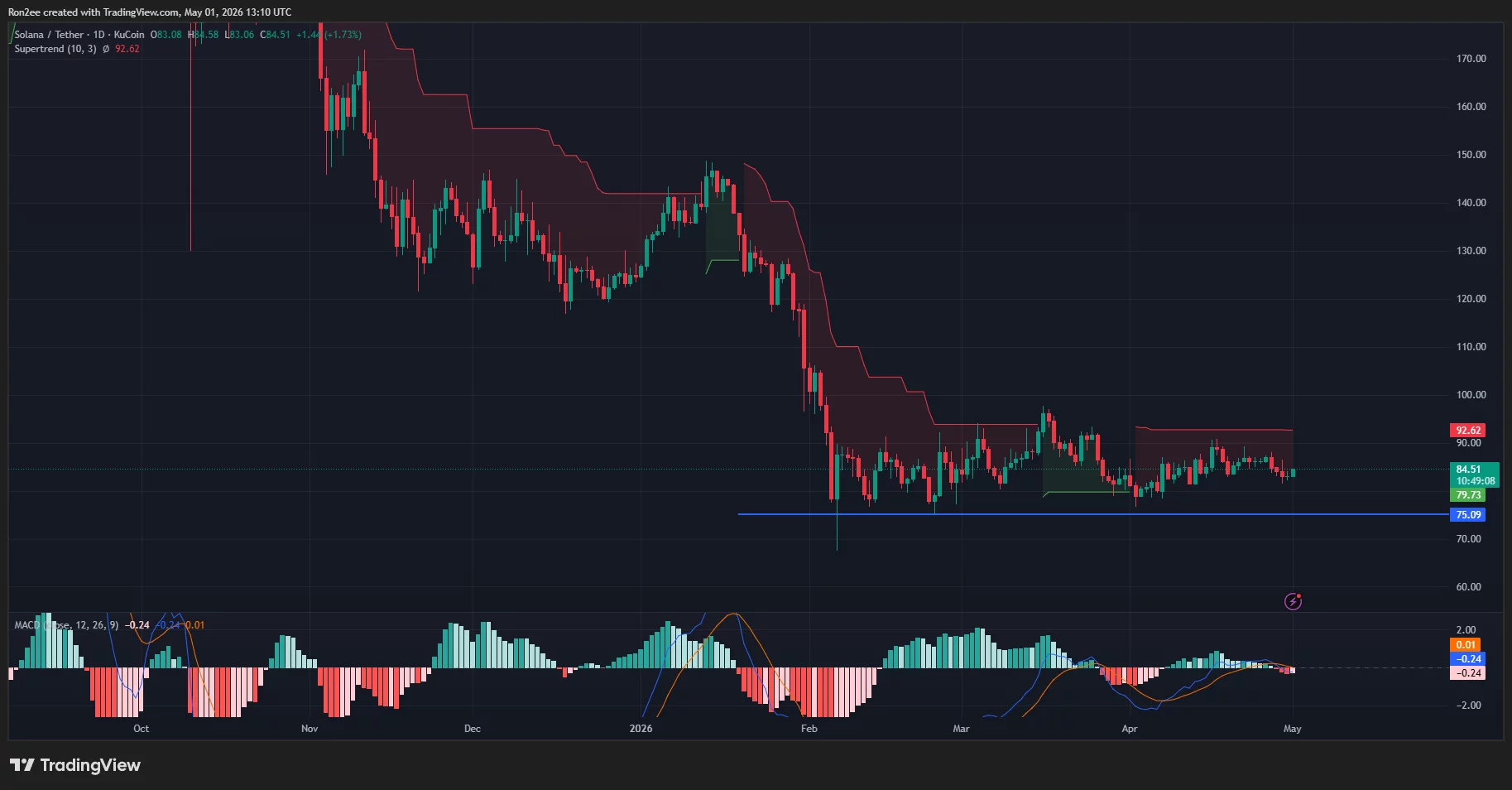
Solana price is showing signs of weakness as the MACD forms a bearish crossover, with price hovering just above a key support zone that could determine the next move.
Summary
- Solana price trades near $84.5 as MACD forms a bearish crossover, signaling weakening short-term momentum.
- Key support lies at $78–$75, with repeated tests raising the risk of a breakdown toward the $75 level.
- Declining ETF inflows, falling DEX volume, and exchange inflows point to weakening demand and rising sell pressure.
According to data from crypto.news, Solana (SOL) price was trading around $84.51 at press time on May 1, up roughly 1.7% over the past 24 hours. Over the past week, the token has moved within a relatively tight range between $79 and $92, reflecting a period of consolidation after a sharp decline earlier this year.
The asset remains under heavy pressure on higher timeframes, still down significantly from levels above $170 seen in late 2025. Price action has flattened in recent weeks, with lower volatility and limited directional follow-through.
When consolidation forms near key support after a downtrend, it often signals a continuation move if buyers fail to regain control.
Market structure suggests that buying pressure is gradually weakening. Institutional demand, which previously helped stabilize Solana, has started to fade. Data from SoSoValue shows monthly inflows into Solana-linked investment products have declined for six consecutive months, falling to around $38.69 million in April 2026, their lowest level since their launch.
On-chain data also shows persistent net inflows into exchanges throughout April, indicating that larger holders may be positioning to sell rather than accumulate.
At the same time, network activity has cooled. Total decentralized exchange volume on Solana has dropped sharply, falling more than 60% from $118 billion in early February to around $44 billion. Network fee generation has also declined by roughly 21%, reducing organic demand for SOL as gas.
Liquidity is also rotating elsewhere. Speculative capital that once flowed into Solana-based memecoins is increasingly shifting toward newer narratives such as AI-focused tokens on competing chains.
Solana price analysis
The daily chart shows Solana holding above a key horizontal support zone near $75, which aligns closely with a major Fibonacci level at $78.03.
Solana price has repeatedly tested this region over the past several weeks, forming a base. However, rebounds have remained shallow, with resistance capping upside near $86, a level that coincides with the 20-day exponential moving average.
Momentum indicators are now turning negative. The MACD has formed a bearish crossover on the daily timeframe, with the histogram slipping back into negative territory. This suggests that short-term upward momentum is fading.
In addition, price remains below key trend indicators, with the Supertrend line positioned above current levels near $92, reinforcing the broader bearish bias.
A breakdown below the $78 support zone could trigger a sharper move lower, with $75 emerging as the next key downside level.
On the other hand, a sustained move above $86 would be needed to ease immediate pressure and shift momentum, though current indicators suggest that sellers still have the upper hand in the short term.
Disclosure: This article does not represent investment advice. The content and materials featured on this page are for educational purposes only.

Here’s what a touchscreen Mac may be like

Strategy CEO Phong Le frames STRC as income despite payout risks

Jessi Draper Dragged Over Voice Note About Taylor Frankie Paul

Manchester United reach agreement with Casemiro over contract clause amid transfer speculation

US brings back mandatory military draft registration

Steven Gerrard disagrees with Gary Neville over ‘shock’ Chelsea and Arsenal claim | Football


-

 Tech4 days ago
Register Renaming | Hackaday
-
Crypto World6 days ago
Hyperliquid $HYPE Rally Builds Momentum as AI Sector Enters Prove-It Phase
-

 Politics4 days ago
Drax board avoid their own AGM, accused of greenwashing & environmental racism
-

 Tech4 days ago
Images of Samsung’s rumored smart glasses have leaked
-

 Tech5 days ago
Why Blue Badges Disappeared From Toyota Hybrids
-
 Sports6 days ago
IPL 2026: Ruturaj Gaikwad registers slowest fifty of the season, enters all-time unwanted list | Cricket News
-
 Tech8 hours ago
Trump’s 25% EU auto tariff breaches Turnberry Agreement that also covers semiconductors and digital trade
-

 NewsBeat6 days ago
LK Bennett closes all stores after entering administration
-

 Fashion3 days ago
Kylie Jenner’s KHY Enters a New Era with ‘Born in LA’
-
 Entertainment6 days ago
Mariah Carey Slams Deposition Claims In Brother’s Lawsuit
-

 Business3 days ago
Most Commercial Energy Audits Miss the Real Losses
-

 Business5 days ago
(VIDEO) Charlize Theron Climbs Times Square Billboard to Promote New Netflix Thriller ‘Apex’
-

 Crypto World4 days ago
CFTC’s AI will review U.S. crypto registration applications, chairman tells CoinDesk
-
 Sports7 hours ago
Paul Scholes issues Marcus Rashford reality check as agreement emerges over Man United star
-

 Business3 days ago
Barclay Brothers Avoid Bankruptcy: HSBC Drops High Court Petitions After IVA Deal
-

 Tech6 days ago
Microsoft to roll out Entra passkeys on Windows in late April
-

 Tech6 days ago
OpenAI’s Sam Altman apologizes for not reporting ChatGPT account of Tumbler Ridge suspect to police
-

 Tech6 days ago
OpenAI CEO apologizes to Tumbler Ridge community
-
 Business2 days ago
Tesla Officially Registers Elon Musk’s Stock: What Investors Need to Know
-

 Tech4 days ago
Get Ready for More Brain-Scanning Consumer Gadgets
You must be logged in to post a comment Login