
Crypto World
Gency AI lands $20M for sovereign ads network via blockchain consensus


Gency AI, a San Francisco-based AI and blockchain infrastructure company, announced a $20 million funding round on March 17, 2026. The round includes participation from YZC Capital, MTmetaworld Holdings, Riverpark, ArkStream, MH Ventures, ViaBTC, and Basics Capital. The capital will be used to scale Gency AI’s decentralized advertising execution and settlement network, strengthen its privacy-preserving computing stack, and accelerate product deployment and ecosystem partnerships across North America, Asia, and Europe.
Key takeaways
- Gency AI raises $20 million to build and scale a decentralized advertising network anchored in verifiable on-chain data and privacy-preserving computing.
- Investors include YZC Capital, MTmetaworld Holdings, Riverpark, ArkStream, MH Ventures, ViaBTC, and Basics Capital, signaling appetite for verifiable, cross-border ad tech infrastructure.
- The project aims to shift ad tech from centralized platform trust to protocol trust through on-chain credentials and automated revenue distribution.
- The architecture centers on four core modules: policy identity, ESQ privacy computing, PSG clearing and settlement, and an AI optimization engine designed for encrypted operation.
- Industry implications point to faster settlements, clearer attribution, and increased regulatory alignment as privacy rules tighten and demand for AI-driven automated advertising grows.
Building verifiable infrastructure for the advertising economy
The digital advertising market has expanded rapidly, yet a substantial portion of its execution and settlement remains brokered on centralized platforms. Industry participants have long flagged concerns around attribution transparency, data ownership, and the friction-filled reconciliation cycles that connect advertisers, publishers, and agencies. Gency AI positions its platform as a step toward a new paradigm—a shift from “platform trust” to “protocol trust.”
By introducing on-chain verifiable credentials and automated revenue distribution mechanisms, the company envisions a workflow where ad impressions, conversion outcomes, and payments can be independently verified and settled using smart contracts. In practical terms, this could mean reduced settlement times and greater transparency for cross-border campaigns, with a built-in privacy layer that preserves user data while enabling auditable outcomes.
AI and blockchain–integrated technical architecture
Gency AI describes its network as a four-module stack designed to coordinate advertising actions in a privacy-conscious, verifiable manner:
Policy identity
On-chain policy identities create permissioned data usage boundaries, enabling transparent and traceable authorization management for data assets used in advertising campaigns.
ESQ privacy computing layer
The ESQ layer integrates technologies such as trusted execution environments (TEEs), private set intersection (PSI), and secure multi-party computation (MPC) to facilitate encrypted data processing. This enables advertisers and platforms to run analytics and optimizations without exposing raw data.
PSG clearing and settlement protocol
This component converts advertising actions and conversion outcomes into on-chain verifiable credentials and automatically triggers revenue distribution through smart contracts, delivering end-to-end verifiability of the ad economy’s financial flows.
AI optimization engine
Operating within an encrypted environment, the AI module powers campaign forecasting, audience targeting, and optimization, while supporting model training and attribution analysis without revealing underlying user data. The approach aims to balance rigorous privacy protection with practical operational efficiency.
Investor perspectives
Investors in the round argue that uniting AI automation with verifiable computing could fundamentally remodel the core infrastructure of digital advertising. By moving away from opaque, closed data platforms toward open, verifiable protocols, they see an opportunity to improve transparency, efficiency, and compliance in a space where regulatory expectations are tightening and data privacy rules are evolving globally.
As demand for AI-powered automated advertising grows, backers note that a trusted, verifiable, and autonomous ad network could become a defining trend for the industry. The funding round signals confidence that a protocol-first approach—rooted in cryptographic guarantees and on-chain governance—could become attractive to advertisers, publishers, and technology partners seeking greater interoperability and accountability.
About Gency AI
Gency AI frames itself as a sovereign advertising network designed for the agentic economy—an ecosystem where data ownership, permissions, execution, and settlement are programmable, verifiable, and user-controlled by default. Rather than relying on traditional adtech models built on opaque data aggregation and trust-based reporting, Gency AI envisions advertising as a verifiable coordination system. By combining cryptographic guarantees, on-chain policy enforcement, and measurable outcomes, the network aims to enable coordinated interactions among advertisers, publishers, AI agents, and users.



The S&P 500 just closed at another record high while bitcoin made another run to the $80,000 level earlier Saturday.
The largest crypto traded at $78,180 in Asian hours Saturday, up 0.8% on the week and recovering from a Wednesday low near $75,500 that came on the back of fresh Iran military escalation reports. The bounce arrived alongside Friday’s reports that Tehran had relayed a new ceasefire proposal to Washington through Pakistan, which sent WTI crude falling nearly 3% to around $102 a barrel.
Equities had a much better week. The S&P 500 closed 0.3% higher Friday at an all-time high, marking a fifth straight weekly gain on the back of strong tech mega-cap earnings.
The Nasdaq 100 advanced 0.9% to its own record. Apple gained 3.2% after a better-than-expected revenue outlook. Oracle climbed 6.5% on news it had joined the list of AI firms working with the Pentagon’s classified networks.
A big crypto development was on the policy side.
The Senate released the long-negotiated Clarity Act compromise text Friday, ending months of negotiations between crypto firms and bank lobbyists. The agreement, hashed out by Senators Thom Tillis and Angela Alsobrooks, would ban stablecoin issuers from offering yield based purely on holding reserves but preserves activity-based reward programs that crypto firms structure as incentives for using their platforms.
Coinbase, which had been at the center of the talks, signaled support immediately, with Chief Legal Officer Paul Grewal stating the language “preserves activity-based rewards tied to real participation on crypto platforms and networks, which is what the bank lobby said they wanted.”
A markup, the Senate Banking Committee hearing where the bill gets formally debated and amended, can now proceed and clears the way for the legislation to advance further in the Senate. Treasury and the CFTC would have a year after the bill becomes law to write the detailed rules around what crypto firms can and cannot do with yield products.
Meanwhile, Daniel Reis-Faria, CEO of ZeroStack, said in a note that bitcoin’s range-bound trading reflects broader macro indecision rather than crypto-specific weakness.
“Bitcoin staying below the $78,000 mark isn’t really about crypto right now, it’s about what’s happening in the broader market. The Fed holding rates wasn’t a surprise, but there is no clear direction on what comes next, and that’s keeping investors from stepping in.”
Reis-Faria pointed to ETF outflows and softer demand as the symptoms. “It doesn’t mean institutions are leaving the market, it just means they’re not increasing their exposure right now. If money starts coming back in, especially from institutions or through ETFs, Bitcoin can move higher pretty quickly.”
Other majors were mixed. Ether held $2,310, XRP at $1.39, solana at $84.57, all close to flat on the week. Dogecoin was the standout, up nearly 10% on the week to $0.105 with futures open interest hitting a year-high earlier in the week.
The setup heading into next week is the same one that has held all month. Bitcoin needs a fresh catalyst to break decisively above $78,000, and the most likely sources, Fed clarity, ETF re-acceleration, or a Hormuz reopening, are all sitting outside the market’s control.
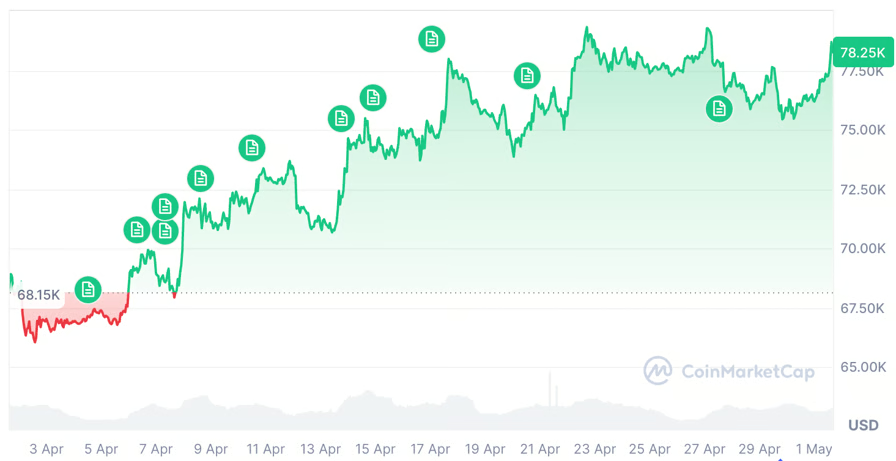
Bitcoin may not need a new story or catalyst to push back above the psychological $100,000 level, which it has not traded above in nearly five months, according to MN Trading Capital founder Michael van de Poppe.
‘“There doesn’t need to be a narrative that pushes the price upwards,” van de Poppe said in an X post on Friday, after asking, “What narrative will bring Bitcoin to $100K?”
“Price moves upwards, and the narrative will create itself,” van de Poppe said, adding:
“That’s why simply using math, statistics, and logic is required in order to succeed, and that’s why these regions on Bitcoin are still good for accumulation.”
Van de Poppe pointed out that attention has rotated elsewhere in the technology industry, with AI and other sectors “taking the spotlight” away from Bitcoin in recent months. At the time of market close on Friday, the stock price of Nvidia (NVDA), the largest AI stock by market capitalization, is up 5.08% since Jan. 1, while Bitcoin (BTC) is down around 10% over the same period.
Bitcoin hasn’t traded above $100,000 in almost five months
The last time Bitcoin traded at $100,000 was Nov. 13, just a month after the Oct. 10 $19 billion crypto market liquidation event, which many market participants attributed to the recent five-month downtrend. Bitcoin fell to a yearly low of $60,000 in February and has since recovered to $78,250 at the time of publication, according to CoinMarketCap.

Bitcoin is up 14.49% over the past 30 days. Source: CoinMarketCap
Many crypto market participants still believe that Bitcoin needs a strong narrative to drive its price higher. In recent times, attention has centered on US Federal Reserve interest rate decisions, regulatory developments in the US, and spot Bitcoin exchange-traded fund (ETF) inflows as potential catalysts.
Some also point to the potential passage of the US CLARITY Act, which aims to provide clearer rules for the industry, as a possible driver of Bitcoin’s upside.
Some say the CLARITY Act will not boost Bitcoin’s price
Others are not so sure. Veteran trader Peter Brandt told Cointelegraph in December that the CLARITY Act would be a positive step for the industry, but is unlikely to act as a major catalyst for upward movement in Bitcoin’s price.
Related: Repeated Bitcoin profit taking near $77K suggests rally is losing steam
“Is it a world-shaking macro development? Nope. Needed for sure, but not something that should redefine value,” Brandt said.
Coinbase chief legal officer Faryar Shirzad said on Friday that “It’s time” for the CLARITY Act to be finalized after new stablecoin yield provisions were published on Friday.
Meanwhile, White House crypto advisor Patrick Witt said at the Bitcoin Conference in Las Vegas this week that a “big announcement” on US President Donald Trump’s Bitcoin reserve is coming within weeks.
Magazine: AI-driven hacks could kill DeFi — unless projects act now

Key Highlights
- Compromise language for the CLARITY Act prohibits stablecoin issuers from distributing yield based purely on passive holdings
- Platforms can continue providing rewards connected to genuine user engagement and network participation
- The agreement between Senators Thom Tillis and Angela Alsobrooks emerged after extensive negotiations
- Coinbase praised the outcome, with CEO Brian Armstrong urging immediate markup proceedings
- Prediction market participants on Polymarket now estimate a 55% probability of 2026 passage, jumping 9 points in one day
A contentious disagreement between traditional financial institutions and cryptocurrency companies regarding stablecoin yield programs has reached resolution, removing a significant obstacle from the Digital Asset Market Clarity Act’s legislative path.
Senators Thom Tillis and Angela Alsobrooks unveiled compromise legislative language Friday that explicitly prohibits cryptocurrency platforms from distributing interest or yield to users based solely on stablecoin ownership.
Traditional banking institutions expressed worry that yield-generating stablecoin products would function similarly to deposit accounts, diverting capital from conventional lenders and constraining their lending capacity.
The negotiated framework prevents crypto platforms from offering returns that are “economically or functionally equivalent” to deposit account interest.
Nevertheless, the agreement permits rewards linked to what legislators define as “bona fide activities.” This provision enables platform users to generate returns through active engagement with cryptocurrency platforms and blockchain networks, rather than through passive asset retention.
[[LINK_START_0]]Coinbase[[LINK_END_0]] participated extensively in the negotiation process and faced the greatest business implications. Chief Policy Officer Faryar Shirzad acknowledged that banking interests secured more limitations than crypto advocates preferred, though the fundamental capacity to provide activity-driven rewards remained intact.
[[LINK_START_0]]Coinbase[[LINK_END_0]] CEO Brian Armstrong responded concisely on X: “Mark it up.” Chief Legal Officer Paul Grewal emphasized that the framework “preserves activity-based rewards tied to real participation on crypto platforms and networks.”
Operational Implications for Cryptocurrency Platforms
An industry insider indicated that companies must transition from a “buy and hold” approach to a “buy and use” framework to meet the requirements for permissible rewards under the revised regulations.
The legislative text mandates that the Treasury Department and the Commodity Futures Trading Commission initiate rulemaking procedures within twelve months of enactment. These proceedings will establish precise definitions for qualifying activities.
Regulatory agencies will have authority to evaluate elements including account balance, holding duration, and activity characteristics when formulating these guidelines. The text incorporates anti-circumvention provisions as well.
Legislative Calendar and Senate Proceedings
Galaxy Digital head of research Alex Thorn indicated that publication of the compromise text signals the Senate Banking Committee may schedule markup proceedings “as soon as the week of May 11.”
Thorn cautioned that banking sector opposition efforts are anticipated to intensify following disclosure of the finalized legislative language.
Senator Bernie Moreno recently projected the legislation would reach completion by late May. Senator Cynthia Lummis declared on April 11, “It’s now or never.”
The Clarity Act encountered delays earlier this year when a scheduled January markup was abruptly postponed.
Polymarket prediction market participants currently assess a 55% likelihood that the CLARITY Act receives presidential approval in 2026.
President Donald Trump has elevated cryptocurrency regulatory reform among his second-term priorities. Cryptocurrency enterprises have historically functioned within ambiguous regulatory frameworks, which industry leaders contend has restricted business expansion opportunities.

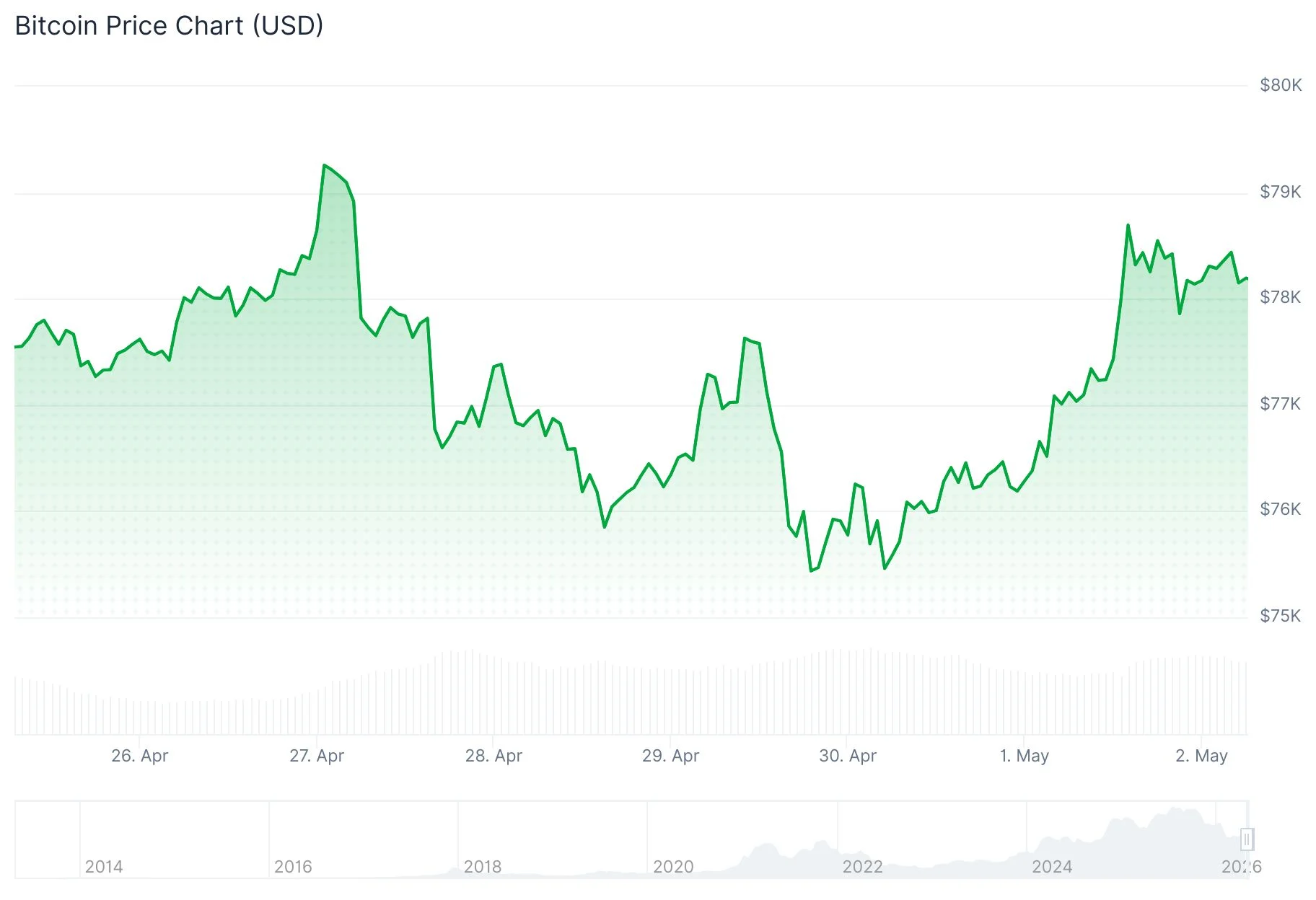
Key Highlights
- BTC surged past $78,000 following Iran’s submission of a revised peace proposal via Pakistani diplomatic channels
- Bitcoin reached approximately $78,800, registering over 3% gains during Saturday’s trading session
- Active diplomatic negotiations continue as Washington delivered updated conditions to Tehran
- Spot Bitcoin ETFs recorded $1.97 billion in April inflows, marking 2026’s strongest monthly performance
- Technical analyst Ali Charts identifies critical support zones at $54,145 and $43,316 that remain untested this cycle
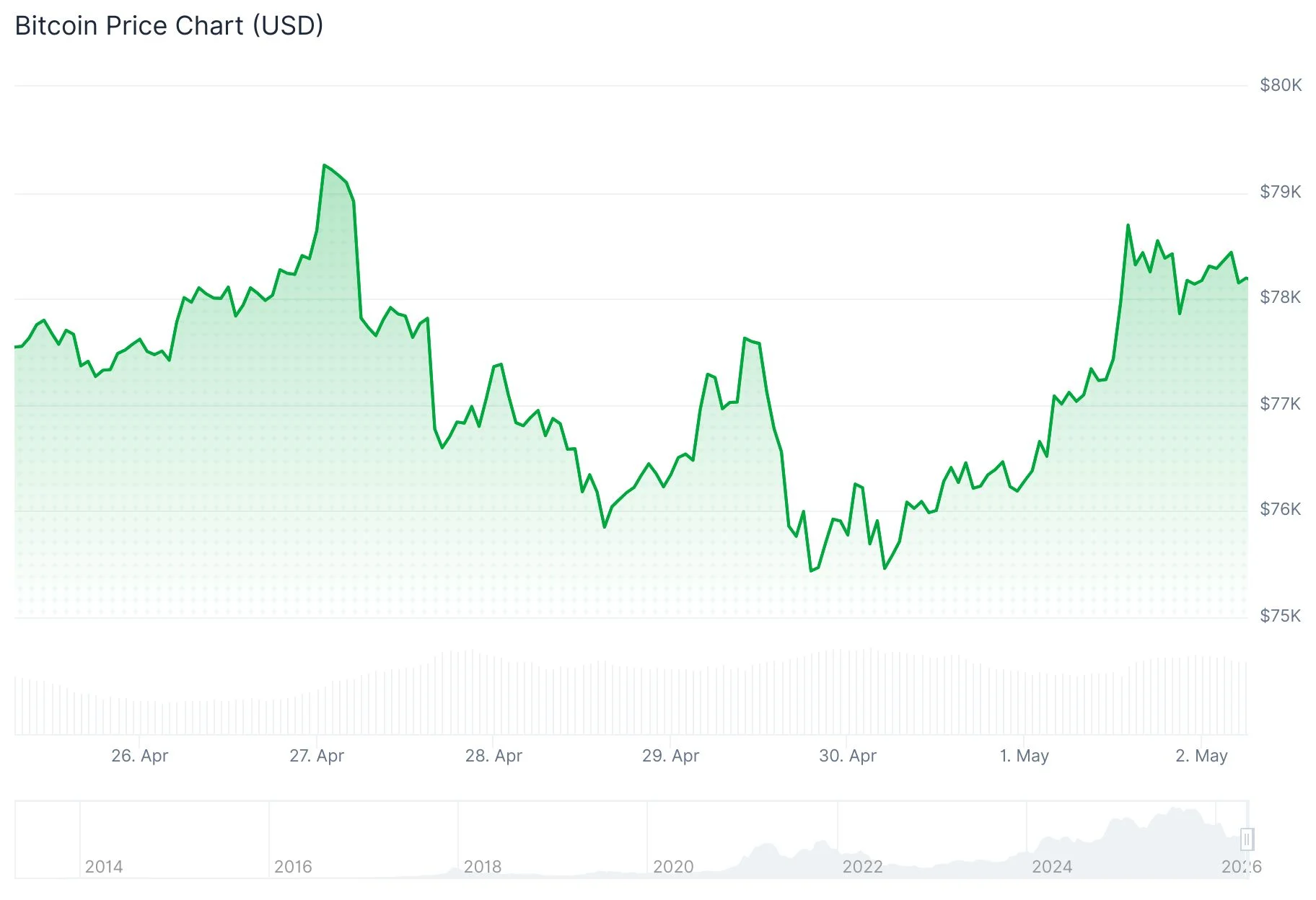
Bitcoin pushed above the $78,000 threshold on Saturday following reports that Tehran had delivered an updated peace proposal to United States mediators via Pakistan.
This diplomatic development followed President Donald Trump’s rejection of Iran’s previous offer, which proposed reopening the Strait of Hormuz in return for ending the American blockade at the critical oil passage. Speaking to the press, Trump remarked that Iran “wants to reach a deal badly.”
Per Axios reporting, Tehran responded to Washington’s most recent modifications to a preliminary agreement framework. White House special envoy Steve Witkoff transmitted a series of requirements to Iranian officials, primarily centered on reintegrating nuclear concerns into the agreement’s language.
At press time, BTC was exchanging hands near $78,800, representing a greater than 3% increase from its intraday bottom around $76,000, per TradingView market data.
Commodity markets reacted simultaneously to the diplomatic progress. Brent crude futures declined to approximately $106, shedding more than 4% during the session, as market participants factored in reduced geopolitical risk.
The wider cryptocurrency sector experienced parallel upward momentum. Approximately $2.1 billion worth of Bitcoin and Ethereum options contracts reached expiration on the same trading day, contributing to heightened market fluctuations.
Bitcoin ETF Products Post Strongest 2026 Monthly Flows
The price appreciation aligned with exceptional institutional demand for Bitcoin investment vehicles. U.S. spot Bitcoin ETF products accumulated $1.97 billion during April, surpassing March’s $1.37 billion and establishing the year’s peak monthly intake, based on SoSoValue analytics.
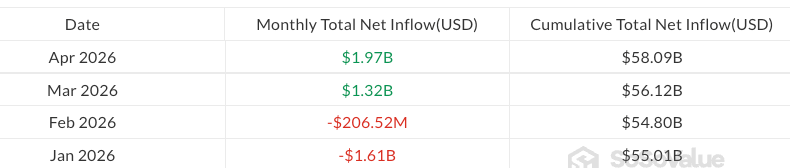
BlackRock’s iShares Bitcoin Trust (IBIT) dominated inflows with approximately $2 billion in net contributions. Conversely, Grayscale’s GBTC experienced the most significant withdrawals at roughly $280 million.
The Morgan Stanley Bitcoin Trust ETF (MSBT), which debuted April 8, attracted $194 million without recording any outflow sessions throughout the month.
Aggregate net contributions across all Bitcoin ETF products since their inception have now exceeded $58 billion. For 2026 year-to-date, Bitcoin ETFs maintain approximately $1.47 billion in net positive flows following withdrawal periods during January and February.
Critical Support Zones Remain Untouched in Current Cycle
Cryptocurrency market analyst Ali Charts highlighted Bitcoin’s MVRV Pricing Bands as an essential framework for determining cyclical bottom formations. According to Ali Charts’ analysis, Bitcoin has traditionally established its price floor within the 1.0 to 0.8 MVRV band range—representing the territory where market valuation trades at or beneath its collective acquisition cost.
As of late April 2026, these technical thresholds are positioned at $54,145 for the 1.0 marker and $43,316 for the 0.8 marker. Ali Charts emphasized that Bitcoin has yet to approach these price territories during the present market cycle.
Bitcoin delivered a 12% appreciation during April, representing its most robust monthly showing since April 2025, when it climbed over 14%.
Crypto World
Bitcoin quantum proposal offers Satoshi Nakamoto a way to prove control without moving BTC
Bitcoin’s quantum computing concerns have always had a Satoshi problem inside it.
Millions of bitcoin sitting in old wallets with exposed public keys could be vulnerable to theft if powerful enough quantum computers arrive. That includes the roughly 1.1 million bitcoin attributed to pseudonymous creator Satoshi Nakamoto, currently worth around $84 billion.
The obvious defense is a soft fork (or an upgrade to existing network rules) that eventually stops allowing spends from those legacy address types, forcing holders to move into quantum-safe formats before attackers can derive their private keys.
Prominent developer Jameson Lopp and five other developers proposed exactly that in mid-April through BIP-361, which would phase out quantum-vulnerable addresses on a five-year timeline and freeze any coins that fail to migrate.
That proposal created a different problem, however. Satoshi, and every other long-dormant holder, would have to wake up publicly or risk losing access to their assets.
Dan Robinson, a general partner at Paradigm, published a proposal Friday for a way around that trade-off that revolves around the concept of Provable Address-Control Timestamps, or PACTs.
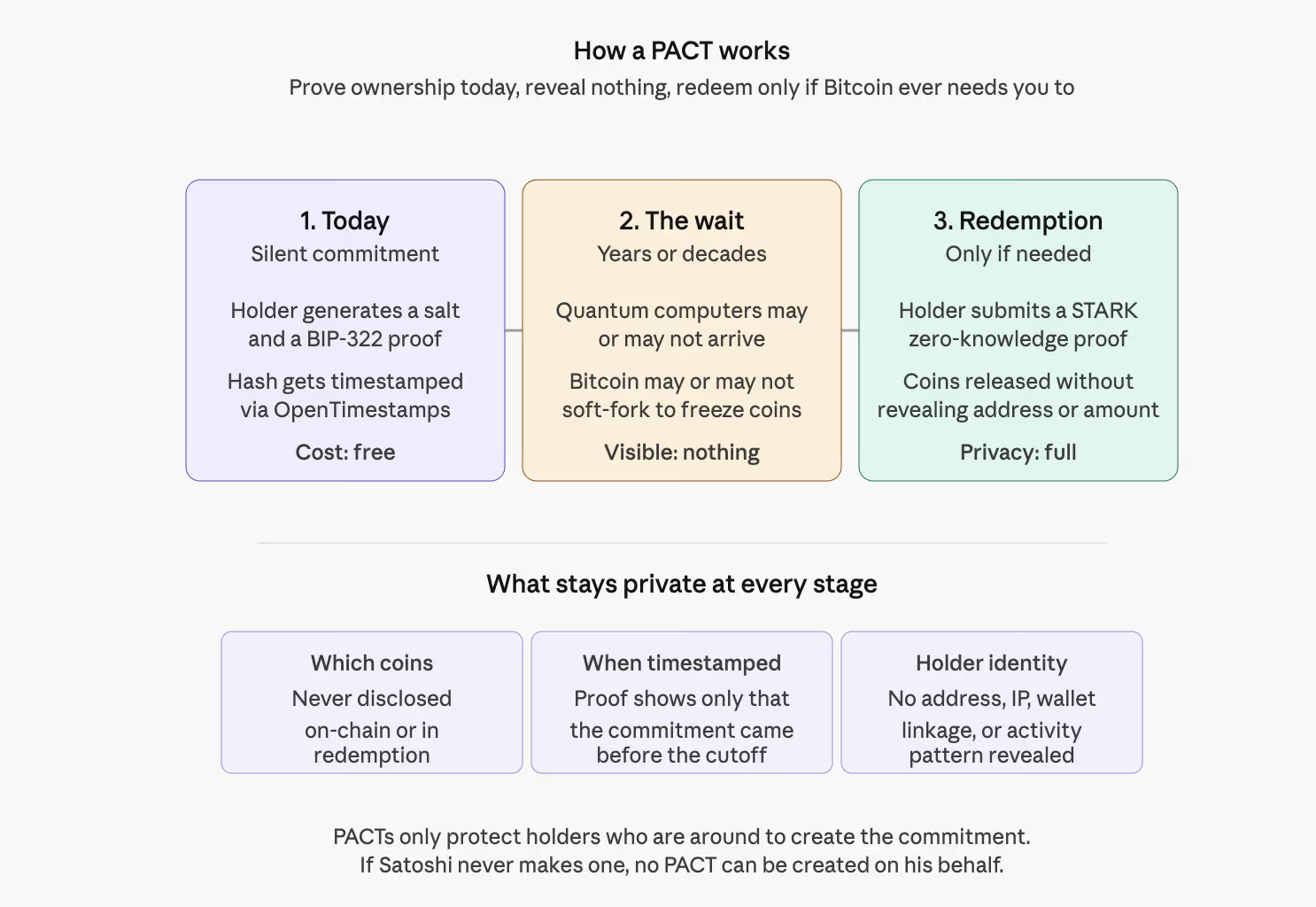
The core idea is not to move coins but timestamp proof of ownership at a specific date and reveal nothing to the public until the owners of those wallets actually need to spend.
A holder generates a random salt, which is a piece of secret data used to make a cryptographic commitment unique and unguessable, and uses BIP-322, a standard for signing messages from a Bitcoin address without spending from it, to produce a proof of ownership.
The salt and proof are bundled together into an onchain commitment and timestamp it through OpenTimestamps, a free service that anchors data onto the Bitcoin blockchain through a single batched transaction. The salt, proof, and timestamp files stay private.
If Bitcoin later activates a soft fork that freezes quantum-vulnerable coins, the protocol could include a rescue path that accepts a STARK proof, a type of zero-knowledge proof that remains secure against quantum computers, showing the holder created their commitment before quantum hardware existed.
The holder submits that proof when they want to spend, and the network releases the coins. The redemption reveals nothing about which address, which amount, or even when the original timestamp was created.
These PACTs also address a specific gap in BIP-361 by including a rescue path for wallets derived through BIP-32, the deterministic key generation standard introduced in 2012. Pre-2012 wallets, including most of Satoshi’s known addresses, do not use BIP-32 and cannot be rescued through that path.

As such, Robinson stated that the PACTs require Bitcoin to eventually adopt a STARK verification protocol, which would itself need a separate soft fork with broad community consensus.
The verification infrastructure does not exist in Bitcoin currently and would need what Robinson calls “substantial new plumbing,” such as multisig wallets, complex scripts, and hardware wallet support that would all need careful standardization.
That last constraint is the one PACTs cannot work around.
The protocol only protects Satoshi if Satoshi himself, or whoever currently controls those keys, makes the commitment. If Satoshi is genuinely gone, no PACT can be retroactively created. The coins remain exposed to whichever scenario plays out first, quantum theft or community freeze.
What PACTs do offer is a way to make the BIP-361 debate less binary. The current freeze proposal forces a choice between protecting against quantum theft and respecting dormant property rights.
Whether Satoshi will use it is the question PACTs cannot answer.
Key takeaways:
- Bitcoin options markets price in low odds of BTC reaching $84,000 in May, while the monthly futures basis rate reflects weakness.
- Significant Bitcoin accumulation by listed companies and rising spot Bitcoin ETF inflows absorb mining supply, reducing the impact of potential selling.
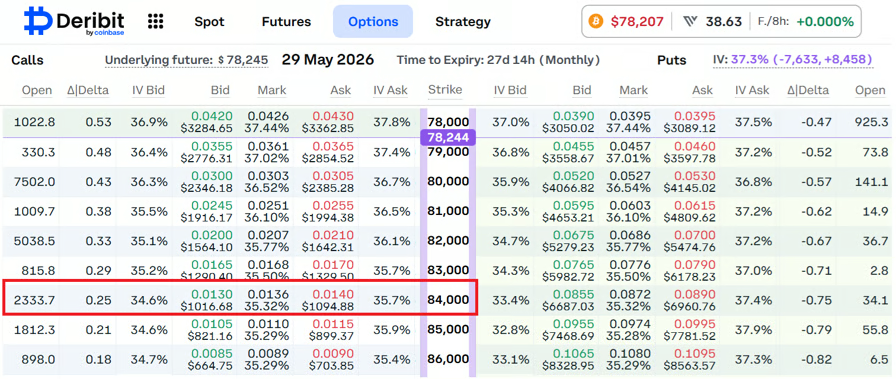
Bitcoin (BTC) reclaimed the $78,000 level amid broader risk-on sentiment, as the S&P 500 Index jumped to an all-time high on Friday. Despite 15% gains over the past 30 days, options markets are pricing in 25% odds that Bitcoin will trade above $84,000 by the end of May.
Derivatives markets remain skeptical of further gains, although institutional spot demand remains solid.

Bitcoin monthly options at Deribit. Source: Deribit
Bitcoin call (buy) options with a May 29 expiry and an $84,000 strike price traded at 0.0136 BTC, or $1,063. Considering there are 27 days left until expiry, the implied probability for Bitcoin price gaining 8% in May stood at 25%. Bitcoin put (sell) options have consistently traded at a premium over the past month, indicating heightened demand for downside price protection.

Bitcoin options 30-day delta skew (put-call) at Deribit. Source: Laevitas
The delta skew measures the gap between put and call options, which usually ranges between -6% to +6% in balanced markets. When professional traders are unwilling to take downside price exposure, the indicator jumps above the 6% neutral threshold, a level that has been the norm for the past month. A similar trend has also been prevalent in BTC futures markets.

Bitcoin 2-month futures basis rate. Source: Laevitas
The Bitcoin monthly futures basis rate usually trades at a 4% to 8% premium relative to regular spot markets to account for the cost of capital. However, this metric has displayed weakness over the past 30 days. The lack of demand for bullish leveraged positions can be partially explained by Bitcoin’s 12% decline year-to-date in 2026.
Bitcoin accumulation by spot ETFs and listed companies
While derivatives traders show little confidence that Bitcoin will reach $84,000, US-listed spot Bitcoin exchange-traded funds (ETFs) tell a different story. These instruments accumulated $1.3 billion in net inflows during March and another $2 billion in April, driving total net assets above $100 billion. This metric is commonly used as a proxy for institutional investor demand.
Related: Bitcoin’s surge to $77K pressures shorts, but absent spot and long leverage caps rallies

US-listed spot Bitcoin ETFs monthly net flows, USD. Source: SoSoValue
Similarly, listed companies have added massive Bitcoin positions to their reserves over the last 30 days. These include 56,235 BTC from Strategy (MSTR US), 5,075 BTC from Metaplanet (3350 JP), and 929 BTC from Strive (ASST US). By acquiring more than the equivalent of five months of future Bitcoin mining supply, these companies greatly reduce potential sell pressure.
The lack of demand for bullish Bitcoin derivative exposure does not invalidate the odds that the BTC price will reach $84,000 or higher by the end of May. As long as institutional appetite remains solid, the bullish momentum should continue.
Crypto World
What Is Harness Engineering? The AI Development Shift Every Tech Leader Needs to Understand


Something fundamental shifted in software development in late 2025 — and most organisations haven’t caught up yet. In February 2026, OpenAI published a landmark engineering blog revealing that a small team of three engineers had shipped one million lines of production code over five months without writing a single line manually. Every line was generated by an AI coding agent called Codex. The methodology behind that achievement has a name: harness engineering. For CTOs, product owners, and founders commissioning software today, understanding this shift is no longer optional — it is becoming the lens through which modern software quality and delivery speed must be evaluated.
From Prompt Engineering to Harness Engineering: A Brief History
The way engineers have worked with AI models has evolved rapidly through three distinct phases — and each phase reflects a deeper understanding of how AI actually produces reliable output.
Between 2022 and 2024, the dominant paradigm was prompt engineering: crafting the right instruction to get the best possible single response from a model. In 2025, context engineering emerged as the more sophisticated approach, focusing on what information surrounds a model’s context window at any given moment.
Harness engineering goes further still. Rather than optimising a single instruction or a single session, it asks: how do you design the entire environment in which an AI agent operates — across multiple sessions, multiple agents, and days or weeks of autonomous work?
As OpenAI’s Ryan Lopopolo summarised the lesson from their internal experiment: the hardest challenges in agentic software development now centre on designing environments, feedback loops, and control systems — not on writing code.
What Is a Harness, Exactly?
A harness is everything surrounding an AI agent except the model itself. It includes the structured documentation the agent reads, the architectural rules it must follow, the feedback loops that flag errors, and the tooling that lets it verify its own work. Without a well-designed harness, even the most capable AI model produces unreliable, inconsistent results.
The term borrows from horse tack — the equipment that both constrains and enables a horse to pull a load effectively. The metaphor is deliberate. An AI model is powerful but undirected; the harness channels that power towards a coherent, verifiable outcome.
In practice, a harness typically comprises three interconnected layers:
-
Context engineering: ensuring the agent has access to the right information at the right moment — architecture documents, design decisions, product specifications, and progress logs — all versioned and stored inside the repository itself.
-
Architectural constraints: mechanically enforced rules that prevent the agent from drifting outside the intended code structure, regardless of how many tasks it completes autonomously.
-
Entropy management: a recurring process that scans for outdated documentation, replicated anti-patterns, and accumulated technical debt, and opens corrective actions before problems compound.
What the OpenAI Experiment Actually Proved
The OpenAI internal experiment is the most concrete evidence to date that harness engineering works at production scale. Starting from an empty repository in August 2025, a team of just three engineers used Codex to build a fully functional internal product. By the time they published their findings, the repository contained approximately one million lines of code across application logic, CI configuration, observability tooling, tests, and documentation.
Roughly 1,500 pull requests were opened and merged. The team reported delivering at approximately ten times the speed of conventional manual development.
Crucially, early progress was slow — not because the model was incapable, but because the harness was not yet ready. Performance only accelerated as the environment was progressively improved.
Three engineering practices proved decisive:
-
A legible repository environment — rather than a single oversized instruction file, the team built a structured documentation directory with architecture maps, design documents, execution plans, and product specifications. The AGENTS.md file became an index, not an encyclopaedia.
-
Programmatic enforcement of architecture — a layered domain structure was enforced mechanically through custom linters and structural tests. If generated code violated these boundaries, the linter blocked it automatically.
-
End-to-end verification tooling — the application was made bootable per git worktree, and browser developer tools were wired into the agent’s runtime, allowing Codex to reproduce bugs, validate fixes, and reason about UI behaviour without human intervention.
Why Generic Tooling Outperforms Specialised Tooling
One of the more counterintuitive findings from harness engineering research involves the tools given to agents. The natural instinct when building a domain-specific AI agent is to create bespoke, highly specialised tools for every task. Vercel’s engineering team discovered the opposite.
Their sophisticated internal text-to-SQL agent — built over months with complex specialised tooling — was outperformed by a dramatically simpler architecture. When they stripped it down to a single batch command tool, performance improved by 3.5 times, token usage dropped by 37 per cent, and the success rate rose from 80 per cent to 100 per cent.
The reason is straightforward: large language models have been trained on billions of tokens of standard developer tooling — bash commands, grep, npm, git. They understand these tools natively. Bespoke schemas, by contrast, introduce friction the model must work around.
This has direct implications for any organisation building or commissioning AI-powered software systems. A well-structured harness with generic, familiar tooling will consistently outperform a more complex one built around proprietary abstractions.
What This Means If You Are Commissioning Software in 2026
Harness engineering is not merely an internal concern for AI research teams. It is already reshaping what it means to build production software at speed and at scale — and it changes the questions that technical decision-makers should be asking of any development partner.
The role of the software engineer is evolving from writing code to designing the systems that make AI write reliable code. For CTOs and founders, the practical implications are significant:
-
Delivery speed is no longer constrained by headcount in the same way — a well-harnessed agent system can scale output dramatically with a small team.
-
Code quality depends increasingly on environmental design, not just on individual developer skill.
-
Technical debt now accumulates differently and requires active management processes, not just periodic refactors.
-
Choosing a development partner who understands agentic workflows is becoming a meaningful competitive differentiator.
At Codescrum, we have been working at the intersection of software engineering and emerging AI methodologies for over 13 years. As harness engineering matures from experimental practice to industry standard, we are actively integrating these principles into how we architect and deliver software for clients across sectors — from government and finance to education and retail.
Conclusion
Harness engineering represents the clearest articulation yet of where software development is heading: away from code as the primary output of engineering effort, and towards environment design, feedback architecture, and structured knowledge management as the real drivers of quality and velocity.
OpenAI’s experiment proved it is possible. The broader industry — from Anthropic to Vercel — is now formalising the practices. The question for any organisation building digital products in 2026 is not whether to engage with this shift, but how quickly.
If you are evaluating how AI-assisted development methodologies could accelerate your next project — or if you want to work with a team that understands both the opportunity and the discipline required to implement it responsibly —
get a free consultation and estimate for your project and let’s talk about what we can build together.
Bakkt has completed its acquisition of Distributed Technologies Research, a stablecoin payments infrastructure firm.
Summary
- Bakkt issued over 11.3 million shares to complete its acquisition of DTR.
- DTR brings stablecoin payments technology and compliance tools into Bakkt’s institutional platform.
- Bakkt shares recovered after the deal closed, rising from Wednesday’s earlier decline.
The deal brings DTR’s agentic payments technology and compliance tools into Bakkt’s regulated institutional platform.
The company said the combined platform will support institutions and fintechs seeking faster digital payments. Bakkt aims to build a 24/7 digital settlement layer using stablecoin technology.
Stablecoin settlement becomes core focus
Bakkt said DTR’s AI-native engine will be added to its existing infrastructure. The company expects the integration to reduce reliance on traditional correspondent banking systems.
Bakkt CEO Akshay Naheta said, “The architecture of money movement rarely evolves at this level.” He added that the deal introduces stablecoin functionality as a bridge between legacy finance and digital assets.
At closing, Bakkt issued 11,316,775 Class A common shares to DTR’s beneficial holders. The company may issue up to 725,592 more shares tied to outstanding warrants.
The transaction was first announced in January. At that time, the deal involved 9.3 million shares. Bakkt also announced a corporate name change to Bakkt Inc. during the same period.
Bakkt stock recovers after earlier drop
Bakkt shares fell about 8% to $7.86 before the deal closed. The stock later recovered to $8.62 by Thursday’s market close.
The company has faced pressure in recent years. In 2024, the NYSE warned Bakkt over a possible delisting after its share price stayed below $1 for 30 days.
Bakkt was founded in 2018 and is majority-owned by Intercontinental Exchange. The firm has worked with major brands, including Starbucks and Mastercard. The DTR deal now places stablecoin payments at the center of its next growth plan.


SBI Holdings has started formal talks with Bitbank over a capital and business alliance. The planned transaction would make Bitbank a consolidated subsidiary of SBI.
Summary
- SBI Holdings has begun talks to make Bitbank a consolidated subsidiary through a share acquisition.
- The move follows SBI VC Trade’s merger with Bitpoint Japan in April 2026.
- Bitbank’s EPOS Crypto Card lets users settle monthly bills with bitcoin balances.
The company said it plans to acquire shares after due diligence and internal approval. Details on timing, structure, and acquisition method will be discussed later.
The move comes soon after SBI Group absorbed Bitpoint Japan through a merger with SBI VC Trade in April 2026. The latest talks show SBI is moving quickly to expand its crypto exchange business.
Japan is also reviewing how crypto assets fit under the Financial Instruments and Exchange Act. That process may bring tighter rules for exchanges and crypto investment products.
Bitbank’s IPO path comes into focus
Bitbank had previously prepared for a possible Tokyo Stock Exchange listing by mid-2025. The company had also raised about 7 billion yen through a capital and business alliance with Mixi in 2021.
Mixi became a major shareholder with a 26.2% stake. SBI’s proposal may now draw attention to Bitbank’s listing plans and future ownership structure.
Bitbank expands crypto payment services
Bitbank has also moved further into crypto-linked payments. The exchange launched the “EPOS Crypto Card for Bitbank” with EPOS Card, the fintech arm of Marui Group.
The card allows users to settle monthly credit card bills using bitcoin held on Bitbank. It also offers 0.5% cashback in bitcoin, ether, or Aster.
Bitbank said the card is the first in Japan to allow credit card bills to be settled directly from crypto exchange balances. The service may later add more crypto payment options.
The possible SBI deal would combine Bitbank’s exchange brand and payments push with SBI’s wider financial network. Bitbank has also reported zero hacking incidents since launch, which may support its appeal to a larger financial group.

The US CLARITY Act has advanced toward enactment as the final text addressing stablecoin yields has been published, signaling a potential turning point in a long-running regulatory dispute between the banking sector and the crypto industry. The provisions are designed to deliver regulatory clarity while balancing competitive concerns with consumer incentives. According to Cointelegraph, Coinbase chief legal officer Faryar Shirzad urged lawmakers to “get CLARITY done” after Senators Thom Tillis and Angela Alsobrooks released the final language outlining how stablecoins may or may not accrue rewards.
Shirzad said the framework preserves the core ability for Americans to earn rewards that reflect real usage of crypto platforms and networks, while the negotiations secured tighter restrictions on yield-bearing features that could undermine traditional banking models.
The draft text, titled “SEC 404. Prohibiting interest and yield on payment stablecoins,” would bar crypto firms from paying any form of interest or yield solely for holding stablecoins, aligning stablecoin economics with the treatment of deposits in conventional banking. It explicitly limits such rewards to bona fide activities, aiming to prevent the sort of risk-free earnings that critics argue could distort competition with banks. Industry observers cited the provision as a central point of contention in the broader debate over whether stablecoin yields should be subject to stricter oversight or outright prohibition.
Industry participants have voiced mixed reactions. Mert Mumtaz, chief executive of Helius Labs, argued that the approach clarifies that “you don’t get risk-free yield on your dollars without using a bank,” underscoring concerns about market structure and consumer protection. The policy, while restrictive on yields, leaves room for incentive schemes tied to legitimate platform activity, a nuance that proponents say preserves user engagement without eroding banking stability.
Key takeaways
- The SEC 404 provision would bar paying interest or yield on stablecoins solely for holding them, with exceptions limited to rewards tied to bona fide activities on a platform.
- The final text represents a compromise intended to address competitiveness concerns raised by banks while preserving incentives for users who engage with crypto platforms.
- Market and industry reaction centers on whether the bill can proceed to markup and eventual enactment, with predictions about timing and likelihood continually shifting.
- Policymakers and industry insiders expect a formal markup by the Senate Banking Committee, potentially as soon as the week of May 11, signaling a path toward a full chamber vote.
- Public commentary from industry leaders emphasizes the transition from debate on yields to broader considerations of licensing, oversight, and cross-border regulatory alignment.
Context and regulatory framing: stablecoins, yields, and governance
The central issue in the CLARITY Act discussions has been the interaction between stablecoin economics and the banking system’s capital and liquidity requirements. By placing a clear line on yields tied to stablecoins, the legislation seeks to deter yield-bearing mechanisms that could emulate deposits or credit-like products outside traditional bank channels, while permitting rewards that reflect genuine platform usage. This distinction is intended to reduce regulatory ambiguity for crypto firms while preserving consumer protections and preserving fair competition with regulated financial institutions.
Legislative momentum and process implications
Industry observers view the publication of the final text as a significant milestone, potentially clearing the way for a markup and a formal vote. Cointelegraph notes that Senate Banking Committee proceedings could be scheduled imminently, with some commentators indicating the possibility of markup in the week of May 11. Among lawmakers, optimism is tempered by the likelihood of continued negotiations with banking interests, who have historically pressed for tighter restrictions on crypto yields and product features.
Traders on prediction platforms have begun pricing in the probability of legislative movement. Polymarket participants currently assign a roughly 55% chance of the CLARITY Act being signed into law in 2026, reflecting optimism about congressional action while acknowledging potential hurdles ahead. Commentators also point to ongoing advocacy from industry leaders who are urging timely markup and consideration of the broader bill’s provisions beyond the yield issue.
Regulatory and institutional implications for firms and markets
The stablecoin yield provisions are part of a broader governance framework that could influence licensing, oversight, and constitutional concerns around crypto markets. For exchanges, custodians, and banks, the draft text raises practical questions about how rewards programs will be structured, how to demonstrate bona fide activity, and how to ensure compliance with the prohibition on yield that is not tied to legitimate usage.
From a compliance perspective, the final text frames the boundary conditions for reward schemes and may necessitate changes to product design, disclosures, and customer communications. It also shapes the risk calculus for banks weighing crypto-related partnerships or onboarding stablecoin-linked products, given the perceived impact on competitive dynamics and liquidity management. The broader policy environment—encompassing licensure, anti-money laundering (AML) controls, know-your-customer (KYC) standards, and cross-border considerations—could be influenced by how the CLARITY Act ultimately is crafted and enacted.
Industry leadership has underscored the importance of clarifying the regulatory regime to support strategic planning, risk management, and compliance programs across banks, crypto platforms, and financial counterparties. As the debate shifts from whether yields should be allowed to how they should be governed, institutions are likely to adjust their internal controls, policy documentation, and external disclosures to reflect the evolving framework.
Looking ahead, the ultimate fate of the CLARITY Act will hinge on the timing and outcome of the markup process and the willingness of lawmakers to broker a final agreement that satisfies both financial stability concerns and the desire for market clarity. While the published text narrows the scope of permissible yields, it also consolidates a path toward definitive regulation, which could reshape how crypto-native finance interacts with traditional banking systems.
As discussions progress, market participants and compliance teams should monitor committee calendars, stakeholder testimonies, and potential amendments that could alter the bill’s trajectory or scope. The next steps will be critical in determining whether the promised clarity translates into a durable regulatory framework for the U.S. crypto sector.

USL, players’ union reach tentative CBA deal

Planning a 15-year mutual fund investment? Here’s a simple 4-scheme portfolio approach

Bitcoin above $78K, ETH, SOL, DOGE higher as Senate clears Clarity Act yield hurdle

Manchester United reach agreement with Casemiro over contract clause amid transfer speculation

US brings back mandatory military draft registration

Steven Gerrard disagrees with Gary Neville over ‘shock’ Chelsea and Arsenal claim | Football

Live Trading – Crypto , Gold and US OIL with Trump | 1 May 2026 | Crypto Trading Live

Best financial management tip in telugu | Save money by 50 30 20 rule | Money saving idea | #viral

“money money green green” Kaytoven – MONEY! (Lyrics) Good Loyal Thots Remix
-

 Tech5 days ago
Register Renaming | Hackaday
-
Crypto World6 days ago
Hyperliquid $HYPE Rally Builds Momentum as AI Sector Enters Prove-It Phase
-

 Politics4 days ago
Drax board avoid their own AGM, accused of greenwashing & environmental racism
-

 Tech5 days ago
Why Blue Badges Disappeared From Toyota Hybrids
-

 Tech4 days ago
Images of Samsung’s rumored smart glasses have leaked
-
 Sports6 days ago
IPL 2026: Ruturaj Gaikwad registers slowest fifty of the season, enters all-time unwanted list | Cricket News
-
 Tech12 hours ago
Trump’s 25% EU auto tariff breaches Turnberry Agreement that also covers semiconductors and digital trade
-

 NewsBeat6 days ago
LK Bennett closes all stores after entering administration
-

 Fashion3 days ago
Kylie Jenner’s KHY Enters a New Era with ‘Born in LA’
-
 Entertainment7 days ago
Mariah Carey Slams Deposition Claims In Brother’s Lawsuit
-

 Business3 days ago
Most Commercial Energy Audits Miss the Real Losses
-

 Crypto World4 days ago
CFTC’s AI will review U.S. crypto registration applications, chairman tells CoinDesk
-

 Business5 days ago
(VIDEO) Charlize Theron Climbs Times Square Billboard to Promote New Netflix Thriller ‘Apex’
-
 Sports12 hours ago
Paul Scholes issues Marcus Rashford reality check as agreement emerges over Man United star
-

 Tech6 days ago
Microsoft to roll out Entra passkeys on Windows in late April
-

 Business3 days ago
Barclay Brothers Avoid Bankruptcy: HSBC Drops High Court Petitions After IVA Deal
-

 Tech6 days ago
OpenAI’s Sam Altman apologizes for not reporting ChatGPT account of Tumbler Ridge suspect to police
-
 Business2 days ago
Tesla Officially Registers Elon Musk’s Stock: What Investors Need to Know
-

 Tech6 days ago
OpenAI CEO apologizes to Tumbler Ridge community
-

 Tech4 days ago
Get Ready for More Brain-Scanning Consumer Gadgets
You must be logged in to post a comment Login