
Both programmes are filmed in one of the most isolated parts of the Yorkshire Dales National Park, where Amanda Owen, known as the Yorkshire Shepherdess, has raised her family and worked the land for decades.
Where is Our Yorkshire Farm filmed?
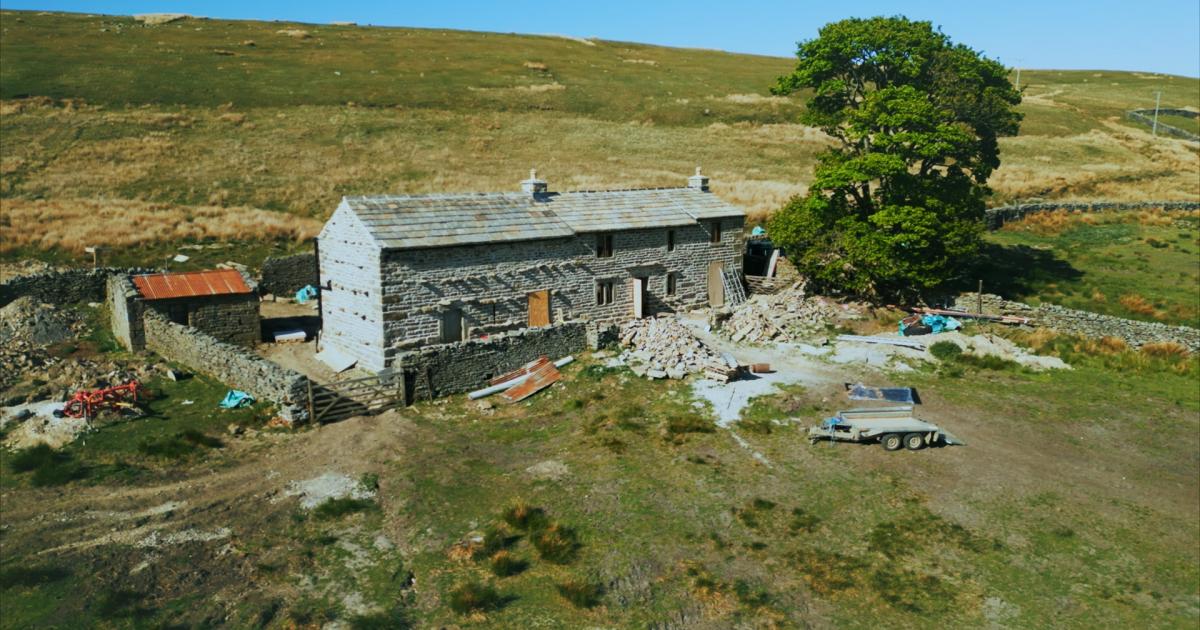
Our Yorkshire Farm is filmed at Ravenseat Farm, located in Upper Swaledale, North Yorkshire, at the head of Whitsun Dale.
Amanda, Clive and Kids altogether outside Anty John’s. (Image: CHANNEL4)
The hill farm covers around 2,000 acres of upland terrain and has been in the Owen family for generations. It operates primarily as a sheep farm and sits several miles from the nearest village.
The closest settlement is Keld, approximately three and a half miles away, a small hamlet with no shop and only a handful of buildings catering mainly to walkers.
Advertisement
Ravenseat previously welcomed visitors for cream teas and overnight stays, but public access was closed in 2022, and it now operates solely as a private family farm.
Where is Our Farm Next Door filmed?
The More4 series Our Farm Next Door is filmed nearby at Anty John’s, a historic farmhouse located close to Ravenseat in Swaledale.
The programme follows Amanda and Clive Owen as they renovate the long-derelict building, while continuing to run Ravenseat and care for their livestock with help from their nine children.
Amanda with crook and sheep at Ravenseat. (Image: CHANNEL4)
Series three of Our Farm Next Door: Amanda, Clive and Kids was filmed between spring and winter 2025 and documents the renovation entering its second year, with work shifting from making the building weatherproof to interior restoration.
Advertisement
How remote is the Owen family farm?
Ravenseat is widely regarded as one of the most remote farms featured on British television.
The surrounding villages are sparsely populated, with limited amenities and long distances between services.
The area is best known for walking routes, including the Coast-to-Coast Walk, which passes through nearby Keld.
Further east lies Muker, one of Swaledale’s larger villages, known for its traditional stone buildings and village pub.
Advertisement
Anyone visiting the area is advised to plan carefully, as shops, petrol stations and mobile signal can be limited in the upper Dales.
Why the location matters
The remote setting is central to both programmes, shaping daily life for the Owen family and presenting challenges ranging from extreme weather to long journeys for basic supplies.
Despite changes in family circumstances, Our Farm Next Door continues the themes that made Our Yorkshire Farm popular: rural resilience, family life and the realities of farming in one of England’s toughest landscapes.
Our Farm Next Door: Amanda, Clive and Kids is currently on More4, with a fourth series already confirmed.
Charlotte Foster and Ambarish Awale Trainee Trends, Showbiz and Lifestyle Writer
21:18, 06 Feb 2026
Just days after Andrew Mountbatten-Windsor moved into Sandringham, the former prince’s arrival has sparked controversy, with “public safety announcements” appearing around the area highlighting his connection to convicted sex offender Jeffrey Epstein.
Andrew, 63, was evicted from the Royal Lodge in Windsor earlier this week and relocated to the King’s Norfolk estate under cover of night to avoid attention. Sources say he is currently staying at Wood Farm Cottage while Marsh Farm, believed to be his intended permanent residence, undergoes renovations.
Within days of his arrival, locals expressed their disapproval of the disgraced royal moving into the otherwise quiet village.
Advertisement
In a video shared on social media, an unidentified resident can be seen attaching a notice over the ‘Welcome to Sandringham’ sign, described as a “public safety announcement.”
Content cannot be displayed without consent
The poster, which featured a photograph of Andrew, read: “Sweaty n*nce in the area. Andrew Mountbatten-Windsor (previously: Prince Andrew).”
The message further referenced the former royal’s link to Epstein, stating: “Close friend of notorious paedophile Jeffrey Epstein. Enthusiastic participant in his sex trafficking network. Paid millions to try and silence survivors.”
Andrew has consistently denied the allegations, and police investigations have not resulted in any charges.
The Epstein files reportedly contain claims that a woman in her mid-20s travelled to Windsor to have sex with Andrew. Additionally, his payment to Virginia Giuffre was made without any admission of guilt or liability.
The footage was circulated on social media by campaign group Everyone Hates Elon, who wrote: “Former Prince Andrew has been forced to move to a smaller home in Sandringham after the latest Epstein files release. Don’t worry, he’s getting the welcome he deserves. A national disgrace.”
Residents in the area have also voiced frustration about the disruption caused by the royal’s presence. The previously tranquil lane has been swamped with cars and journalists, with helicopters circling overhead.
Advertisement
One local said: “I think if he has to come and live here, it should be somewhere that’s quite secluded. There are houses that belong to the King that he could go to that wouldn’t cause anybody any bother. The press are all down there. The villagers don’t like that. It’s a quiet village.”
She suggested a more suitable location would be “out in the woods” surrounded by trees and away from roads, adding: “If he needs to come, he needs to come, but I think there’s better places he could have actually gone.”
Comments from visitors to the nearby Sandringham Visitor Centre highlighted similar sentiments. Abraham Bruin, 83, said: “I’m a little bit flabbergasted myself. If he’s an outcast and living on the estate, he’s not an outcast is he?”
Another woman added: “Really, he’s going back to luxury, isn’t he? He’s being waited on hand and foot.” Additional locals expressed discomfort with the former prince’s relocation, with one noting she was “not particularly keen on him.”
After major disasters, public debate often treats them as unexpected or unprecedented. This reaction is not necessarily about the absence of warnings. It reflects how societies process shock – and how authorities often explain disruption as unavoidable, rather than the result of earlier choices.
Extreme weather is rarely unpredictable. Days, sometimes weeks, in advance, scientists are able to warn of an increased risk of storms, floods, droughts or other hazards. Yet the cycle repeats.
To understand why this is, colleagues and I reconstructed the scientific warnings and the official responses to major floods in Luxembourg in July 2021 – my home country’s most damaging disaster on record. Those floods caused far more damage than they would have done if early action was taken, but Luxembourg isn’t an outlier: many other countries suffer from the same problems we identify.
As the UN targets “early warning for all” by 2027, it’s worth noting the issue is not that warnings were missing. It is that warning systems are often designed to act on certainty rather than probability – and that’s not how forecasting works. By the time warnings become visible to the public, it is often too late.
Advertisement
Liege, Belgium, July 2021: several days of intense rainfall caused many rivers to burst their banks. Abaca Press / Alamy
Weather forecasts may look definitive on your phone, but they are probabilistic by nature. They are created by running a series of computer simulations of the future weather. The level to which the outcomes of different simulations agree with each other provides the likelihood of hazardous conditions, not guaranteed outcomes. These allow forecasters to identify elevated risk well before impacts occur, even if the precise location of an event and their size remain uncertain.
Crucially, uncertainty is usually greatest further ahead, when preventative action would be most effective. Acting early therefore almost always means acting without certainty. This is not a weakness of science, but an inherent feature of anticipating complex systems under changing conditions. The real challenge lies in how institutions are organised to interpret, trust and act on those probabilities.
Acting on certainty
Most warning systems rely on predefined procedural thresholds: alert levels, activation protocols and emergency plans that kick in once specific criteria are met. Forecasting may indicate that flooding is increasingly likely, for example, but measures such as evacuations or road closures can only be triggered after formal thresholds are crossed.
Advertisement
Before that point, risk information passes through many layers of interpretation and judgment, where early signals are often noted but not acted upon.
Historic precipitation in one flood-affected region on the border of Belgium and Germany. The size of the dots directly represents the amount of precipitation each day; the circled orange dot is for 13 July 2021 and the circled red dot is for 14 July 2021. C3S/ECMWF (Data: ERA5), CC BY-SA
Thresholds serve important purposes. They help coordinate response, clarify chains of command and reduce unnecessary disruption. But they also embed a structural preference for certainty. Action is authorised only once risk is framed as imminent, even when credible evidence already points to escalating danger.
This attitude was apparent in the days leading up to the July 2021 floods. Our study shows that multiple forecasts at European and national levels indicated a high probability of extreme rainfall and flooding, in some cases up to a week in advance. This information was available across different parts of the warning system. At that stage, uncertainty about precise impacts remained, as would be expected. What mattered was how the system was designed to handle that uncertainty.
Too early for warning
Because Luxembourg’s response measures were tied to procedural thresholds, early signals could not translate into anticipatory action. The country’s water administration and its national weather service had access to relevant information, but they operated within a framework that did not authorise a collective interpretation of what was happening or encourage action before thresholds were crossed.
Advertisement
This was not a scientific miscalculation, nor was it necessarily an operational mistake by individual agencies. Meteorological and hydrological services most likely did as much as their mandates allowed. The decision to wait for formal triggers was human and institutional rather than technical,
reflecting a system designed to prioritise procedural certainty over sound decision-making.
Across affected areas of Germany, Belgium and Luxembourg, many rivers (in purple) reached their highest levels since records began in 1991. Copernicus EMS/ECMWF, CC BY-SA
By the time action was authorised, for many people it was too late. Evacuations or installing flood gates became far more difficult, particularly for communities with limited experience of such severe floods. From the perspective of those affected, warnings appeared late or did not arrive at all – even though the risks had been identified earlier throughout the system.
Luxembourg is a particularly instructive illustration of what can go wrong, because it is a small, wealthy and well-connected country. The issue was not necessarily a lack of resources or scientific capacity, but of institutional design and societal readiness to act on risk.
Learning and resilience
The effectiveness of early warning systems over time depends on their ability to learn from extreme events. This requires open, independent analysis of what worked, what did not work and why. In several neighbouring countries affected in 2021, such as Germany and Belgium, formal inquiries and external reviews were carried out. In Luxembourg, they were not.
Advertisement
When expert critique is discouraged or avoided, learning slows. Questions about system performance remain unresolved and the same structural vulnerabilities are likely to persist. This creates a systemic risk in its own right: societies become less able to adapt warning systems, interpret uncertainty and act earlier on emerging threats.
As someone who has worked within these systems and continues to research disaster risk governance, I have seen how asking difficult questions can be treated as destabilising rather than constructive. Resilience depends on confronting uncomfortable truths, not avoiding them.
The risk of extreme weather is increasing across Europe and beyond. Early warning systems are rightly central to disaster risk reduction. But their effectiveness depends on how societies authorise action under uncertainty. This is a choice, not an inevitability.
Uncertainty cannot be eliminated. The challenge is to decide how much uncertainty is acceptable when lives and livelihoods are at stake. Systems designed to wait for certainty – for procedural, organisational, financial or reputational reasons – are more likely to deliver warnings that arrive too late to feel like warnings at all.
Advertisement
If resilience to future climate risks is to be sustainable, warning systems must be designed to learn, adapt and act earlier on credible risk.
Every Olympic organising committee has to think about what they stand for. How do they want their Opening Ceremony, and by association their Olympics, to be remembered? How to best represent those most nebulous of things, the Olympic values? How to set the tone for the sporting extravaganza that is the next fortnight?
The most recent Opening Ceremony, in Paris 18 months ago, seemed to deliberately court controversy and want to split opinion – remember Marie-Antoinette being decapitated and the row over the ceremony being ‘ungodly’?
Milano-Cortina, by contrast, appears to have gone for a classy, prettily choreographed if perhaps not very memorable opener. An opening segment featured a beautiful balletic dance sequence with lifts that wouldn’t be out of place in an ice dance programme. Mariah Carey’s two minutes on stage were over blissfully quickly and replaced by Grammy-nominated singer Laura Pausini’s stunning rendition of the Italian anthem. Andrea Bocelli closed the show with another flawless performance, the whole stadium falling silent in awe.
And aside from an inexplicable – in true Olympic style – section featuring three enormous tubes of paint descending from the roof of the stadium, and hordes of people dressed as block colour coffee machines, the ceremony was largely tasteful. Pretty. All light and sparkle. Nothing, really, to see here.
Advertisement
And maybe that was intentional, with this Games dogged by political controversy despite the IOC doing its desperate best to avoid any sign of it. Old issues are still raging, like the thorny question of how to deal with Russia, which seems to be inexorably heading towards it being welcomed back, despite widespread opposition and the vast scale of death and destruction in Ukraine; equally there are questions over the continued participation of Israel. There’s the ongoing debate over the protection of the female category, with no verdict imminent on that front either, and age-old concerns over the environmental and economic impacts of hosting the Games.
Dancers take the stage at San Siro in Milan (AP)
But there are fresher concerns too, most obviously the backlash against the US Immigrations and Customs Enforcement agency (ICE) and wider anger at the Trump administration’s remarkable efforts at destabilising world peace, from kidnapping the Venezuelan president to threatening to take over Greenland.
American athletes have headed to Milano-Cortina acutely conscious of their shifting place in the world as Europe begins to fear the US rather than shelter behind it. The brutality of ICE in places like Minneapolis has only intensified that feeling. The US ice sports even renamed their hospitality venue from the ‘Ice House’ to the ‘Winter House’ to avoid being associated with the agency.
Advertisement
Performers during the Opening Ceremony (AP)
Athletes like cross-country legend Jessie Diggins have sought to distance themselves, however subtly, from the administration: she said she would race for “an American people who stand for: love, for acceptance, for compassion, honesty and respect for others… For everyone out there caring for others, protecting their neighbours and meeting people with love – every single step is for you.” US-based British freestyle skier Gus Kenworthy, who competed for the US at two previous Olympics, went a step further, appearing to urinate the words ‘F*** ICE’ on snow in a social media post.
Protests have broken out across Milan this and last week over ICE’s presence in Milan; there are no agents physically on the streets, but them having a role in the policing operation at all has been met with fury. Hundreds of protesters gathered in the hours leading up to the Opening Ceremony to chant anti-ICE slogans and set off flares; other demonstrators marched in support of Palestinians, or argued against the Olympics being held here at all amid a cost of living crisis.
Advertisement
Britain arrive for the parade of nations (Getty Images)
Italian interior minister Matteo Piantedosi dismissed the anti-ICE protests as politically motivated. But if it hasn’t occurred to him, everything about Olympic sport is political, starting with the official names of each country in the athletes’ parade. And there was a political message sent from the crowd, whether the IOC, or Trump’s administration, wanted to hear it or not.
US vice president JD Vance led an American delegation in Milan this week and was present at the Opening Ceremony. An enormous motorcade was seen ferrying dignitaries outside the stadium shortly before the ceremony began; he may have opted for the same understated entrance as he did at the ice hockey on Thursday night, slipping quietly into the posh seats alongside his security.
US vice-president JD Vance was booed after appearing on stadium screens (Getty Images)
The thumping, interminable house music inside the San Siro turned up another couple of notches when Iran was announced, presumably to drown out any potential booing. But no volume increase could block out the definite booing and whistling that accompanied Israel walking out into the stadium, accompanied by a security detail. The loudest cheer of the night, by contrast, was a sustained roar of support for the Ukrainian delegation.
Advertisement
And when Vance and his wife, second lady Usha Vance, were pictured briefly on screen gamely waving American flags as the US contingent walked in, there it was: the unmistakable sound of booing and jeering.
The five Olympic rings are raised inside San Siro (Getty Images)
The pair kept their beatific smiles on for the brief few seconds the cameras remained on them, but the message was loud and clear. It was notable that no other visiting dignitary, save for Princess Anne, had the same acknowledgement by the broadcasters. Perhaps that acknowledgement, pandering to this US administration’s sense of self-importance ahead of LA 2028, was unwise.
Having overrun by about 40 minutes the Ceremony finally got to the suits, and IOC president Kirsty Coventry thanked everyone present and watching at home “for believing in the magic of the Olympic Games”.
Advertisement
Team USA enter the stadium (Getty Images)
“The spirit of the Olympic Games is about so much more than sport. It is about us – and what makes us human,” she continued. “Here, athletes from every corner of the world compete fiercely — but they also respect, support, and inspire one another. They remind us that we are all connected, that our strength comes from how we treat each other, and that the best of humanity is found in courage, compassion, and kindness.”
Wise words. It would be nice if the likes of Vance could heed them, too.
The incident happened during TaylorMania, a Taylor Swift tribute show, which had begun at 7.30pm.
At around 8.10pm, the performance was suddenly stopped after a fire alarm sounded throughout the venue.
For several minutes, it was unclear whether guests needed to evacuate, with some members of staff initially advising people to remain inside while others began directing them towards exits.
House lights were later turned on and an announcement was made confirming that the building should be evacuated.
Advertisement
Some children were seen visibly distressed during the confusion.
Concertgoers were escorted outside the venue and asked to wait in the rain across the road from the Albert Halls while the incident was investigated.
A member of staff at Bolton Albert Halls later confirmed the alarm had been triggered by a haze smoke machine used during the performance.
Once the issue was resolved, guests were allowed back inside and the show resumed.
Advertisement
Taylormania continued despite disruptions (Image: NQ)
Although tribute singer Katy Ellis missed a small number of songs due to the disruption, the incident did little to dampen the spirits of the crowd, with Swifties quickly returning to singing and dancing for the rest of the night.
The award-winning tribute act performed hits from across Taylor Swift’s different musical “eras”, recreating the record-breaking Eras Tour from 2023 and 2024.
The show featured a live band and dancers, two of whom were from Bolton.
Samie Elishi dramatically stormed off during the Love Island All Stars movie night on Friday
One Love Island star stormed off in an explosive movie night that “will never be forgotten”.
Advertisement
The third series of the popular spin-off returned to ITV2 last month, bringing back a group of former contestants to the villa for another opportunity at finding romance.
Over recent weeks, audiences have witnessed numerous heated exchanges, surprising eliminations and several bombshell entries. The latest arrivals included six American contestants, alongside the launch of villa USA.
Tensions flared when the two villas were brought together earlier this week, with disagreements breaking out between Belle Hassan and Sean Stone, as well as Lucinda Strafford and Samie Elishi.
Tonight’s episode featured the much-anticipated return of movie night, with contestants preparing for an evening of cinema-themed entertainment. The All Star selection included Free Millie, How to Lose Leanne in Ten Days, Some like it Scott, The Sean Identity, There’s Something About Samie, Tommy Dearest and Lucinda’s Web, reports OK!.
Advertisement
There’s Something About Samie showcased footage of the dispute between Samie and Lucinda, which started after Lucinda decided to pair up with Samie’s partner Ciaran Davies.
Matters intensified when Lucinda pied Samie during Thursday’s task, as she believed Samie doubted the authenticity of her new relationship with Sean. When the two attempted to resolve their differences, Lucinda started laughing, prompting Samie to storm off furiously.
Upon reviewing the footage, Lucinda remarked: “You weren’t there for me and Sean,” prompting Samie to immediately retort: “Are you alright? I warned you… I was actually trying to warn you… There’s me trying to have your f****** back and then you throw that pie in my face.”
Advertisement
The heated exchange escalated when Lucinda playfully told Whitney Adebayo not to laugh in front of Samie. An irate Samie responded: “Are you taking the p*** out of me again?”
The star continued: “I might need five minutes. This bird keeps laughing in my face, you’re p****** me off,” before storming off with Belle.
Whilst Belle attempted to calm Samie down, Whitney and Leanne Amaning became embroiled in their own dispute, just hours after Leanne had taken Whitney’s partner Yemen Sanders into the secret garden.
Advertisement
The movie night screening pressed on, as did the tension, moments before presenter Maya Jama made her surprise appearance in the villa. “Everyone enjoying movie night? Well, it’s time for a plot twist,” she announced, before the credits began to roll.
ITV audiences were left stunned following tonight’s turbulent episode, with one viewer posting on X (formerly Twitter): “Don’t know about anyone else but I’ve got a headache now from all the shouting. That movie night was absolute carnage!”
Another commented: “And this, is what I call a messy MOVIE NIGHT,” whilst a third remarked: “Love island all starts 2026 movie night gone but will NEVER be forgotten.”
Love Island All Stars airs Sunday to Friday on ITV2 and ITVX at 9pm
Advertisement
For the latest showbiz, TV, movie and streaming news, go to the newEverything Gossipwebsite
NEW YORK (AP) — There are stages, and then there is the Super Bowl halftime show.
On Sunday, fresh off his historic win at the Grammys for his love letter to Puerto Rico, “Debí Tirar Más Fotos,” Bad Bunny will once again surprise audiences with a performance that is gearing up to be a landmark moment for Latino culture.

But what can you expect from his set?
What we know
Apple Music’s Zane Lowe mentioned that Bad Bunny’s Super Bowl halftime performance is 13 minutes long during an interview with the superstar on Thursday. Historically, they run 12 to 15 minutes.
Advertisement
In the same conversation, Bad Bunny offered few specifics about what viewers will see Sunday.
“It’s going to be a huge party,” he said, playfully dodging questions about surprise guests and other details. “What people can expect from me … I want to bring to the stage, of course, a lot of my culture. But I really don’t, I don’t want to give any spoilers. It’s going to be fun.”


Beyond that: A minute-and-a-half long trailer for the halftime show posted last month set a jovial tone for his performance. In it, Bad Bunny approaches a Flamboyan tree — more on that below — and presses play on his single “Baile Inolvidable” (“Unforgettable Dance”).
The song is modern salsa, performed with students from the Escuela Libre de Música San Juan. It is a featured single from “Debí Tirar Más Fotos,” an album that marries folkloric tradition in local Borinquen genres like bomba, plena, salsa and música jíbara with contemporary styles like reggaeton, trap and pop.
Advertisement
In the clip, Bad Bunny sways as he’s joined by different dancers across genders, races and ages: Those include a traditional salsa dancer in a red dress, a firefighter, a cowboy and a viejito wearing a pava (“viejito” is an affectionate term for an older man and a “pava” is a kind of straw hat). It’s representative of the superstar’s international appeal; he is currently the most-streamed artist globally on Spotify.
Will Bad Bunny perform entirely in Spanish?
All of Bad Bunny’s music is recorded in Spanish, so it seems like a safe bet. Were he to include English into his set, it would likely appear in a spoken interjection — or it would be featured in text.
In October, Bad Bunny hosted “Saturday Night Live” and said a few sentences in Spanish during his opening monologue. When he concluded, he joked in English, “If you didn’t understand what I just said, you have four months to learn,” a reference to the Super Bowl and his critics.
On Thursday, he joked that fans didn’t actually need to learn Spanish to enjoy his set — but they should be prepared to dance.
Advertisement
What symbols can we expect?
(AP Photo/Alejandro Granadillo, File)
Advertisement
(AP Photo/Alejandro Granadillo, File)
Advertisement
Advertisement
Advertisement
Advertisement
There’s no way to know for sure, but here are a few educated guesses.
Puerto Rican flags: In his song “La Mudanza,” Bad Bunny sings, “Aquí mataron gente por sacar la bandera / Por eso es que ahora yo la llevo donde quiera.” In English: “Here they killed people for showing the flag / That’s why I bring it everywhere I want now.” It appears to be a reference to Law 53 of 1948, better known as the Gag Law, a ruling by the Puerto Rican Legislative Assembly which attempted to suppress the independence movement on the island and criminalized displaying the Puerto Rican flag. It was repealed in 1952. It is also one of many reasons Puerto Ricans are known for waving their flag with pride for their island.
It is almost certain the flag of Puerto Rico will appear in some form on the Super Bowl stage. But its colors are worth noting. If it is shown in red, white and blue, that is the current flag of Puerto Rico and has been since 1952. If there are flags that feature light blue, that is reflective of the Puerto Rican independence movement. A black and white version of the flag has become synonymous with Puerto Rican struggle and resiliency. And if there is a flag that more closely resembles the Dominican Republic’s flag, that is the flag of the Puerto Rican mountain town Lares. It was used in the Grito de Lares, the first short revolt against Spanish rule in Puerto Rico in the 19th century.
Puerto Rican expressions: There may be a few Puerto Rican expressions uttered on stage, beyond just those found in Bad Bunny’s music. That could be anything from “Wepa!” which is used in moments of excitement, not unlike exclaiming “Wow!.” It grew in popularity after the release of Alfonso Vélez’s 1974 salsa song “El Jolgorio (Wepa Wepa Wepa).” Or “Acho, PR es otra cosa,” a phrase that became a fan chant during Bad Bunny’s performance of “Voy a llevarte pa’ PR” during his residency. It translates to “Damn, PR is something else.”
Advertisement
Casita: At Bad Bunny’s residency in Puerto Rico last summer, he performed across two stages. One was built to resemble a casita (“little house”), for the pari de marquesina, a house party. These structures are synonymous with Puerto Rico and the Caribbean at large.
Pavas: A symbol that is likely familiar to Bad Bunny fans everywhere, a pava is a straw hat traditionally worn by jíbaros, or Puerto Rican rural farmers. It has become a symbol of pride for the island. The singer even wore a leather version of the hat on the red carpet at the 2025 Met Gala.
Flamboyan tree: The second of the two stages at Bad Bunny’s residency focused on showcasing the island’s natural beauty with its flamboyan and plantain trees. The former are a common feature in Puerto Rican art for its flowers, most commonly seen in brilliant red, orange and yellow hues. The image of the tree evokes Puerto Rico almost as immediately as the sound of its national nocturnal residents, el coquí (a frog with a distinctive sing-song-y call heard only at night.)
El Sapo Concho: Not to be mistaken with el coquí, el sapo concho is the endangered Puerto Rican crested toad that Bad Bunny has used an animated version of in his visuals for “Debí Tirar Más Fotos.”
Advertisement
Traditional Puerto Rican instruments: Because much of Bad Bunny’s music pulls from bomba and plena, it is likely that a few of those traditional instruments will be on stage. Look out for a cuatro (a small, four-stringed guitar), güiro/güira (a percussive instrument made of a hollow gourd), palitos (also a percussive instrument resembling two long, wood sticks), cencerro (cow bell) and maracas. For the bomba songs, specifically, there may be a barriel (a barrel) and for plena, a pandereta (tambourine.)
Will there be special guests during the halftime show?
It is impossible to predict, but it would be surprising if Bad Bunny wasn’t joined by other performers — particularly other giants of Latin music, and probably, other Puerto Rican performers. The band Chuwi joined Benito for every night of his San Juan residency; it wouldn’t be out of the question to see them on stage for their collaboration, “Weltita.”
Other potential guests, if the residency is a framework to follow, could include Marc Anthony, Ricky Martin, Jennifer Lopez, Young Miko, Wisin y Yandel, Gilberto Santa Rosa and Alfonso Vélez. But the list goes on and on.
Will it be a political performance?
That is in the eye of the beholder. But there is historical precedent for it at the Super Bowl. In 2020, the NFL asked Jennifer Lopez to cut a segment featuring children in cages during her halftime performance, a critique of U.S. immigration policies. She refused. (Bad Bunny was actually a guest performer during that halftime show, which was headlined by Lopez and Shakira.)
Advertisement
Last year, Kendrick Lamar’s set was an artful confrontation of American history and racial dynamics through metaphor, as the actor Samuel L. Jackson, dressed as Uncle Sam, complained of a performance that was “too loud, too reckless, too ghetto” and reminded Lamar to “play the game.”
Bad Bunny has never steered clear of political messaging. He has criticized President Donald Trump on everything from his hurricane response in his native Puerto Rico to his treatment of immigrants. At the Grammys Sunday, he said “ICE out” while accepting his first televised award of the night. His latest tour skipped the continental U.S.; in an interview he said it was at least partially inspired by concerns that his fans could be targeted by immigration agents.
Trump, a Republican, has said he doesn’t plan to attend this year’s game, unlike last year, and he has derided Bad Bunny as a “terrible choice.”
Following the conclusion of Series 6 on Channel 5, the stars of the hit period drama have been appearing in a new set of videos for MASTERPIECE | PBS during the show’s US broadcast.
In the latest clip, attention turns to the real-life family behind the stories, as viewers are invited to learn more about Jim and Rosie Herriot, the children of author and veterinarian James Herriot.
All Creatures Great and Small (Image: CHANNEL 5)
The video explores their memories of growing up in Skeldale House, the real Yorkshire home that inspired much of the series, and the lasting impact their father’s work has had on generations of readers and viewers.
Fans are told how Jim and Rosie’s experiences have helped shape the tone and authenticity of All Creatures Great and Small, with the production team keen to honour the warmth, humour and humanity of Herriot’s original stories.
Advertisement
The cast also reflects on how important it has been to stay true to the spirit of the books, particularly as the series moves further into a post-war world following the events of Series 6.
The filming of All Creatures Great and Small (Image: CHANNEL 5)
The message struck an emotional chord with viewers, many of whom have followed the show since its debut and feel a deep connection to its characters and setting.
The MASTERPIECE | PBS post accompanying the video read: “Now that you’ve all met the Herriot children on All Creatures Great and Small, learn a little about the real Jim and Rosie.
Advertisement
“Hear about their impact on the series, memories of growing up in Skeldale House, and all the stories they have to share.”
Fans quickly responded, praising the series for staying faithful to Herriot’s legacy and celebrating the personal touches that continue to set the show apart.
All Creatures Great and Small has enjoyed huge success both in the UK and overseas, with its depiction of rural Yorkshire life winning international acclaim.
Series 7 and 8 have already been confirmed, with filming details expected to be announced in due course.
With standing water currently on areas of the Craven Park pitch, an inspection will take place at 11am ahead of the third-round tie, which is scheduled to kick-off at 6pm.
Should the tie be unable to go ahead tomorrow, Sunday is set aside as a contingency day, when it is hoped that the weather in Cumbria will improve.
A statement from Barrow Raiders on X read: “Please be aware that there will be a pitch inspection at 11am tomorrow to determine whether our Betfred Challenge Cup third round tie against York RLFC can go ahead as planned.
Advertisement
“Both sides and the RFL are keen for the game to go ahead, to avoid congestion in the fixture calendar.
“Should the pitch be deemed unplayable on Saturday, Sunday has been set aside as a contingency day, with the forecast set to improve slightly.”
ℹ️ Please be aware that there will be a pitch inspection at 11am tomorrow, to determine whether our Betfred Challenge Cup third round tie against @YorkRLFC can go ahead as planned.
The match marks a first competitive outing of 2026 for Mark Applegarth’s side as they prepare for their first-ever Super League season, and their final run out ahead of next Thursday’s mouth-watering clash at home to reigning champions Hull KR.
York’s only hit out so far this year saw them fall to a 22-4 defeat at Huddersfield Giants in Matty English’s testimonial last month, with 2025 top-scorer Ben Jones-Bishop scoring the visitors’ only try.
The Knights won both their Championship fixtures against Barrow last year, earning a 36-12 victory in Cumbria in March before a 26-12 triumph at the LNER Community Stadium in July.
The sides last met in the Challenge Cup in 2019, with York running out 32-16 victors.
Nick Ball faces off against Brandon Figueroa in defence of his WBA featherweight title on Saturday night in his home city Liverpool – with hopes of landing a showdown with Japanese superstar Naoya Inoue
I’ve been where Nick Ball is now, on top of the world with every fight a massive challenge.
Advertisement
Ball defends my old WBA featherweight crown against Brandon Figueroa on home turf in Liverpool. That’s a huge advantage against a tough opponent from the United States. Liverpool in February is a world away from his Texas home and Figueroa will feel cold in more ways than one.
Against a partisan Scouse crowd the M&S Bank Arena will arguably be the most hostile venue Figueroa has boxed. But at 5ft 9ins tall he has some things in his favour. Ball is giving away seven inches in height.
Figueroa was a world champion at super bantamweight and has lost only to Stephen Fulton, albeit twice, first a majority loss in their super bantamweight unification bout then for the WBC featherweight crown 12 months ago.
Advertisement
Figueroa has 19 KOs in 26 fights so it’s going to be a tough assignment for Ball, who has to give this guy serious respect.
Ball calls himself the wrecking ball. He has to be just that because at his height, you can’t stand off your opponent.
I gave five inches to Colombian banger Felipe Orozco in 1984 and won. Although I was only 5ft 6ins I had a relatively long reach. Ball does not have that advantage.
If he’s not punching, he has to keep his head moving, and when he is not doing that he has to be moving his feet, be mobile at all times, relentlessly coming forward.
The big target for Ball is Japanese superstar Naoya Inoue, who would represent his biggest pay day. But in order to get that fight he has to keep winning and in spectacular fashion.
But that won’t be easy against a world class opponent who is just as desperate to be crowned champion of the world for a second time.
This is a genuine 50/50 fight. I wasn’t expected to beat either Juan Laporte or Eusebio Pedroza back in the day but I fought just like Ball and took it to them.
Advertisement
My objective was to step on them early without getting nailed. If you do get caught, fire back with three shots of your own and at a pace your opponent struggles to match.
You have to be prepared to go to the ends of the earth at this stage of your career to keep winning.
Hopefully, with a febrile crowd at his back, Ball will find what he needs to retain his crown. But fasten those seat belts because it is sure to be a rollercoaster night.
Advertisement
Follow Barry on X at @ClonesCyclone @McGuigan’s_Gym
A flaw was discovered by Google’s Project Zero team which allowed people to send malicious files directly to phones (Picture: Getty Images)
Although WhatAspp had pushed out a fix to block new infections, it is unclear how many people were affected by the hack.
But turning off automatic downloads will prevent it happening in the future, Malwarebytes said.
Advertisement
This means no pictures, files, video or any other type of media will be automatically downloaded.
To turn it off, open WhatApp and tap the three-dot menu in the top-right corner.
Click settings, head to storage and data and click media auto-download.
Uncheck all media types, and then press OK.
Advertisement
What is the bug?
The bug makes people’s computers vulnerable to ‘spoofing’, which involves cyber crooks disguising their malware as an attached image file.
The documents allow the malware slip into the device, letting hackers to execute code – a script tells gadgets what to do.
The attack, called arbitrary code execution, uses a dodgy program to rip open a device’s backdoor so scammers can steal passwords, turn off security protections and even seize control of the device.