
Crypto World
The WSJ Just Linked Trump Crypto Venture to a Billion-Dollar Pig Butchering Scam Network: How Deep Does It Go?


A Wall Street Journal investigation has found that World Liberty Financial, the Trump crypto venture, partnered with a virtual-currency company called AB whose key figures were sanctioned by the U.S. Treasury for alleged ties to a transnational pig butchering scam network that stole billions from Americans.
The partnership, which enabled WLF’s USD1 stablecoin to operate on AB’s network, was announced less than a month after the October 14 sanctions. Chase Herro and Zachary Folkman, identified as central to WLF’s operational strategy, are now facing a DOJ Investigation into prior entities linked to the same fraud infrastructure.
The question this story forces is direct: how does a presidentially branded crypto project partner with a company whose controlling shareholder and general manager were simultaneously being sanctioned by the U.S. government for running violent scam compounds?
- Scam scale: Prince Group allegedly stole billions through pig butchering operations across at least 10 compounds in Cambodia
- Sanctions sweep: U.S. Treasury sanctioned more than 140 people and companies on October 14 for alleged Prince Group involvement
- WLF connection: World Liberty Financial enabled its USD1 stablecoin on AB’s network less than one month after the sanctions announcement
- Sanctioned individuals: Yang Jian (controlling shareholder) and Yang Yanming (general manager) of AB’s East Timor resort were both named in the Treasury action
- DOJ scrutiny: Federal investigators are examining Chase Herro and Zachary Folkman’s prior ventures – including Yield Game and Dough Finance – for infrastructure overlap with the scam network
Discover: The best pre-launch token sales
Who Are Chase Herro and Zachary Folkman – and Why Is the DOJ Looking?
Chase Herro and Zachary Folkman are identified in the WSJ investigation as the driving forces behind WLF’s technical and operational direction.

Federal investigators from the DOJ and SEC are scrutinizing their previous projects, specifically Yield Game and Dough Finance, for alleged infrastructure overlap with a pig butchering syndicate that defrauded investors of more than $100 million globally.
Blockchain forensics cited in the investigation show transactions flowing from wallets tied to early WLF development to addresses linked to the scam ring’s money-laundering operations. WLF also reportedly hired developers and consultants who had previously worked for those entities while they were already under federal scrutiny.
Neither Herro nor Folkman has been charged. WLF’s lawyers told the WSJ the company only learned of AB’s connection to the sanctioned East Timor resort project in January 2026 – roughly two months after the partnership was announced.
What Is Pig Butchering, and How Does This Network Connect to WLF’s Infrastructure?
Pig butchering is a long-con fraud scheme in which operators, often using enslaved workers in offshore compounds, build fake online relationships with victims before steering them into fraudulent crypto investments.
The U.S. Justice Department described Prince Group, the organization at the center of this case, as running at least 10 violent scam compounds in Cambodia using exactly this method.
The connection to WLF runs through AB, which was developing a blockchain-themed resort in East Timor.
Two of the men sanctioned on October 14, Yang Jian, the resort’s controlling shareholder, and Yang Yanming, its general manager, were sanctioned specifically for their alleged work for Prince Group.

AB removed all three sanctioned individuals from the company shortly after the Treasury action, but the partnership with WLF was announced weeks later, regardless.
The legal exposure here is not guilt by association alone. If blockchain forensics confirm wallet-level links between WLF’s early development infrastructure and the scam ring’s laundering operations, as the investigation alleges, that moves the story from reputational damage into potential sanctions evasion and crypto-enabled fraud territory that federal prosecutors have pursued aggressively.
Trump Crypto Exposure: What the WLF Brand Makes Worse
World Liberty Financial launched in 2024 as a DeFi lending and governance protocol backed by the Trump family, whose involvement gave the project immediate institutional visibility.
The USD1 stablecoin, the specific product enabled on AB’s network, is WLF’s primary financial infrastructure product, designed to function across partner chains.
There is no evidence Donald Trump or his family had knowledge of the alleged illicit histories of WLF’s technical partners. But the KYP failures described in the investigation are not minor. Sanctioning 140-plus entities on the same day your future partner’s two senior officials appear on that list is the kind of due diligence failure that regulators treat as a structural problem, not an oversight.
The political dimension compounds every legal question. Crypto companies facing regulatory scrutiny for politically connected financial activities operate under a different standard of press and congressional attention – and WLF, carrying the Trump name into every headline, has no buffer against that scrutiny.
Discover: The best crypto to diversify your portfolio with
The post The WSJ Just Linked Trump Crypto Venture to a Billion-Dollar Pig Butchering Scam Network: How Deep Does It Go? appeared first on Cryptonews.



Paul Sztorc’s proposed eCash fork has been framed as a battle over Bitcoin’s principles. But among developers and infrastructure builders, a different interpretation is taking hold.
This isn’t really a Bitcoin fork, they argue. It’s an airdrop — and a potentially hazardous one.
“I’m firmly against Paul’s fork, but not because it represents a ‘hostile Bitcoin hard fork,’ as some claim,” said Sergio Lerner, co-founder of Rootstock Labs, told CoinDesk in an email. “eCash is a new blockchain…It is not directly taking anything away from bitcoin holders.”
That distinction cuts through much of the early backlash. Unlike past splits that attempted to carry the Bitcoin name or compete for hashpower, eCash is structurally closer to a new token being airdropped to existing bitcoin holders.
But for Lerner and others, that framing shifts the concern rather than resolves it.
Airdrops are common across crypto. In Bitcoin, they are rare — and often messy.
Lerner argues that distributing eCash based on Bitcoin’s UTXO set — the collection of “unspent transaction outputs,” essentially the chunks of bitcoin that make up user balances — exposes users to avoidable operational risk, particularly if they try to claim the tokens.
“Airdropping to UTXO owners does not help bitcoiners and instead exposes them to significant risk,” he said, pointing to the need for users to move funds out of cold storage and interact with unfamiliar software.
That risk is compounded by the lack of full replay protection between the two chains. Without a clean separation, transactions intended for Bitcoin could inadvertently affect funds on the eCash network, or vice versa.
Dan Held, a Bitcoin entrepreneur, framed it more bluntly: “Reallocating Satoshi’s coins is shock value marketing, and the no-replay protection makes it quite hazardous to redeem.”
No-replay protection could allows a valid, signed transaction from the hard fork to be maliciously broadcast and accepted on another chain. This causes identical, unwanted transactions on both networks, leading to accidental loss of funds. It occurs when two chains share the same transaction format.
Distribution questions
Beyond security concerns, the distribution itself is being questioned.
Because Bitcoin ownership is often intermediated by exchanges, custodians and institutional platforms, the entity controlling private keys is not always the economic owner of the coins.
“The custodians controlling UTXO keys are often not the rightful economic owners,” Lerner said. “This places users who hold bitcoin through custodians at a disadvantage.”
In practice, that means some users may never receive eCash at all, while others may take on new risks to access it. For systems built on top of Bitcoin — including sidechains, like Rootstock, and federated custody networks — the situation becomes even more complex, potentially requiring coordination or upgrades to safely split coins across chains.
Lerner also criticized the project’s funding model, which allocates a portion of Satoshi-linked coins on the new chain to early investors, calling it “morally objectionable and unnecessary.”
Philosophical fault line
For others, the objection goes beyond mechanics.
Jay Polack, head of strategy at Bitcoin sidechain VerifiedX, sees the proposal as part of a broader category of attempts to reinterpret Bitcoin’s core properties through derivative systems.
“It’s mind boggling to think that anybody would think that’s a really good idea,” Polack said, referring to the combination of forking and reassigning dormant coins.
Polack argues that even indirect changes to how Bitcoin ownership is represented risk undermining the system’s core guarantee.
“You can’t break the native ownership of Bitcoin. It’s totally contradictory to what Bitcoin is,” he said.
In that framing, eCash is less about whether Bitcoin itself changes — it doesn’t — and more about whether the ecosystem should tolerate structures that reinterpret its ledger.
Most Bitcoin forks fail to gain meaningful traction. eCash may follow the same path.
But the reaction to it is already clarifying something else: Bitcoin’s resistance to change is not just about code or consensus rules. It extends to how users are expected to behave, how risk is introduced, and what kinds of experiments are considered acceptable at the edges.
Framed as an airdrop, eCash looks less like a challenge to Bitcoin — and more like a test of how far its social boundaries actually reach.


Crypto trade groups called for a markup of key market structure legislation within hours of U.S. Senators Thom Tillis (R-N.C.) and Angela Alsobrooks (D-Md.) releasing a compromise text Friday on stablecoin yield in the Digital Asset Market Clarity Act, the final major sticking point in the bill.
The text bars crypto firms from paying interest or yield on stablecoin balances in a manner economically or functionally equivalent to a bank deposit.
It carves out rewards programs tied to “bona fide activities or bona fide transactions,” and directs Treasury and the CFTC to write rules within a year of enactment.
Blockchain Association CEO Summer Mersinger called the deal a step in the right direction.
“We commend Senators Tillis and Alsobrooks for their leadership in reaching this agreement,” Mersinger said. “Every day without a clear legal framework is an invitation for top-tier talent, capital, and innovative companies to locate elsewhere.”
The Crypto Council for Innovation endorsed the bill while flagging concerns. Its CEO Ji Hun Kim said the new language extends the prohibition framework well beyond last year’s GENIUS Act, which barred only issuers from paying rewards.
“CCI has been clear that we disagree with assertions about deposit flight concerns from stablecoin adoption,” Kim wrote on X. The text, he said, “goes VERY FAR beyond” the GENIUS Act by applying to all digital asset market participants.
Kim urged the committee to advance the bill anyway. “The north star is to ensure that the U.S. can lead on crypto–this is the future. We respectfully ask Senate Banking to move to mark up. The time is now,” he wrote.
Circle Chief Strategy Officer Dante Disparte, whose firm issues the USDC and EURC stablecoins, endorsed the deal without qualification.
“Today’s compromise on stablecoin yield marks meaningful progress in the CLARITY Act negotiations,” Disparte said. He pointed to USDC’s growth in cross-border payments, capital markets collateral and agentic commerce.
“The United States faces a clear choice in digital assets: lead or be led,” he said. “Today’s progress is an encouraging signal that the U.S. is choosing to lead.”
Coinbase had the most at stake in the negotiations. CEO Brian Armstrong posted “Mark it up” after the text dropped. Chief legal officer Paul Grewal said the language preserves activity-based rewards tied to real participation on crypto platforms, which is what the bank lobby had asked for.
The Senate Banking Committee postponed an earlier CLARITY Act markup in January. Other negotiation points remain unresolved, but the yield language has largely been the greatest obstacle.
Firms will need to restructure rewards programs from a “buy and hold” model to a “buy and use” one to comply with the transaction caveats.


Arbitrum’s Security Council seized 30,766 ETH from the KelpDAO hacker, but a US court order now blocks the DAO from touching the $71 million stash. Lawyers for North Korean kidnapping victims aim to claim the money under a 2015 judgment against Pyongyang.
The legal action stalls Aave and Kelp DAO’s plans to compensate users hit by the April 18 hack. The freeze shows how a centralized governance move pulled assets straight into US courts.
Centralized Action, Centralized Consequences
The Council froze the ETH last month after a bridge exploit drained $290 million from KelpDAO. It coordinated with law enforcement and routed the funds to governance control.
Han Kim and Yong Seok Kim are US nationals whose relative was killed by North Korea. They won more than $300 million in damages from Pyongyang in a 2015 ruling.
Their lawyers obtained an order on May 1 from the Southern District of New York. The order bars Arbitrum from transferring the seized assets.
LayerZero attributed the hack to the Lazarus Group, tying the ETH directly to Pyongyang.
Aave Recovery Hits a Legal Wall
Attorney Gabriel Shapiro reviewed the filing and said the freeze is real, not theoretical. Plaintiffs secured court approval under specific garnishment statutes, leaving the DAO without unilateral authority to redirect the assets.
“Arbitrum DAO is not allowed to do anything with the KelpDAO funds for now, until a divestiture hearing… they are supposed to actually litigate that not just decide on their own what to do with it,” Gabriel Shapiro stated in post on X.
The freeze stalls Aave’s coalition, which pooled ETH from Lido, Mantle, and EtherFi to backstop rsETH holders. Those plans relied on the seized stash flowing back through Arbitrum governance.
According to one of the economics leads at MegaETH, the seizure exposes the DAO to claims it never anticipated.
Identifiable DPRK assets carry legal weight regardless of which protocol holds them.
Once a DAO seizes assets through centralized rails, those assets sit inside the same legal regime as bank accounts.
The divestiture hearing will decide final control. Separate ETH from the heist still moves through laundering channels.
The post Arbitrum’s KelpDAO Freeze Backfires as US Court Blocks $71 Million Recovery appeared first on BeInCrypto.

TLDR:
- Senators Tillis and Alsobrooks finalized a bipartisan deal that unblocks the Crypto Market Structure Bill.
- Crypto platforms are now banned from offering passive stablecoin yield equivalent to bank deposit interest.
- Activity-based rewards like trading and staking remain permitted under the new stablecoin regulatory framework.
- Prediction markets place a 62% chance the Digital Asset Market Clarity Act becomes law in 2026.
The Crypto Market Structure Bill has moved closer to becoming law following a bipartisan Senate agreement. Senators Thom Tillis and Angela Alsobrooks finalized a deal on stablecoin yield this week.
Their agreement resolves the single issue that had blocked the Digital Asset Market Clarity Act for months. The deal also ended the Senate Banking Committee markup collapse from January.
Washington is now ready to give digital assets a comprehensive legal framework for the first time.
Stablecoin Yield Restrictions Draw a Firm Regulatory Line
Under the new agreement, crypto platforms are broadly prohibited from offering passive stablecoin rewards. Paying users a return simply for holding a stablecoin is no longer permitted.
Regulators determined these payments are too similar to interest on a traditional bank deposit. Banks had lobbied firmly against the practice, fearing customers would pull funds from checking accounts.
The deal does not eliminate all reward types, however. Activity-based compensation remains fully permitted under the new framework.
Users can still earn rewards through trading, staking, or using platform services. The regulatory dividing line now sits between passive holding rewards and active participation rewards.
Coinbase had been among the platforms pushing hardest to offer stablecoin yield. The company viewed it as a direct competitor to traditional savings accounts.
That approach is now off the table in the U.S. market. Banks secured this outcome after arguing passive yield would trigger widespread deposit flight.
Bull Theory flagged the outcome on X, noting the deal bars platforms from paying rewards that function like bank deposit interest.
The trade-off is straightforward: crypto platforms lose a key user acquisition tool. Banks retain their edge on passive yield over digital asset providers. Neither outcome was accidental—both sides negotiated with clear objectives.
Regulatory Clarity Opens a New Chapter for Digital Assets
The Crypto Market Structure Bill now has a clear path toward a full Senate vote. Removing the stablecoin yield dispute eliminates the legislation’s single biggest obstacle.
The digital asset industry now has a credible shot at comprehensive federal regulation. Every exchange, stablecoin issuer, and platform in the U.S. has long been waiting for this moment.
Treasury Secretary Scott Bessent has publicly targeted spring 2026 for the bill’s passage. The Senate Banking Committee markup is now expected in May.
Prediction markets currently price the odds of the Clarity Act becoming law in 2026 at 62%. That figure reflects real momentum building in Washington around digital asset legislation.
Bull Theory noted that banks secured their demand on yield while crypto gained the regulatory clarity it had long been seeking.
The deal represents a genuine compromise between two powerful financial interests. Both sides entered negotiations with clear priorities and left with partial wins.
The Crypto Market Structure Bill’s forward movement is the most consequential development for digital assets in years.
A formal legal framework for the industry in America now appears genuinely within reach. Regulatory certainty has long been the most requested outcome from the digital asset sector.

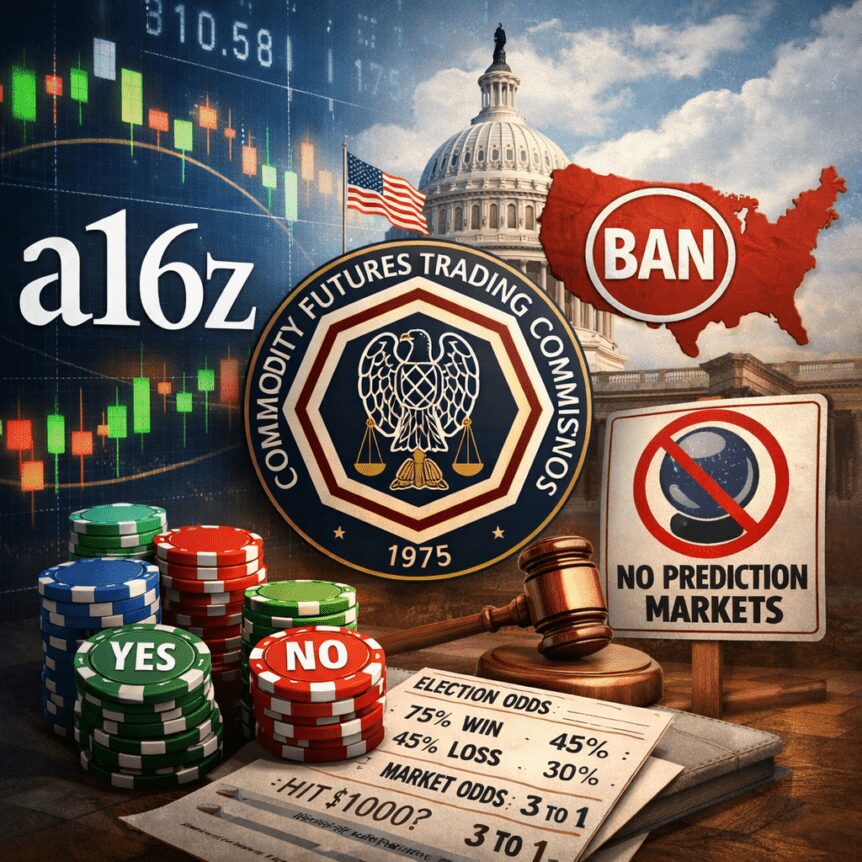
A16z has stepped into the federal-state clash over prediction markets by submitting a letter to the Commodity Futures Trading Commission (CFTC) that argues state-level crackdowns undercut the agency’s mandate to provide impartial access to its markets. The move comes as the CFTC advances its own rulemaking on how event contracts should be regulated and as enforcement actions against several states raise the stakes for platforms like Kalshi and Polymarket.
The venture-capital firm’s letter, filed on Thursday in response to the CFTC’s advance notice of proposed rulemaking, contends that a patchwork of state measures—ranging from cease-and-desist orders to criminal charges—creates barriers that hinder the federal framework designed to ensure open, unbiased access to prediction-market venues. A16z argues that such state interventions undermine the federal regulator’s ability to provide equal treatment for participants, liquidity, and predictable rules of engagement for operators and users alike.
Key takeaways
- A16z formally opposes state-level actions that restrict access to prediction-market platforms, urging the CFTC to preserve impartial access to markets and services.
- The CFTC has recently filed lawsuits against Illinois, Arizona, Connecticut, New York, and Wisconsin, accusing state authorities of overstepping by attempting to regulate markets that arguably fall under federal jurisdiction.
- A16z warns that forcing exchanges to block users based on state residency could severely limit liquidity, undermining the functionality and appeal of prediction markets.
- The letter argues that the CFTC—not state legislatures—should define what constitutes “gaming” under federal commodities law, citing decades of federal oversight over event contracts and market structures.
- Polymarket is seeking to regain access for U.S. users via discussions with the CFTC, following a 2022 settlement that barred the platform from serving U.S. customers for unregistered event contracts.
A16z’s intervention reframes the debate on access, liquidity, and regulatory authority
In its filing, A16z emphasizes a core tension in the current regulatory landscape: state authorities instinctively push back against online platforms that offer event-based contracts, while the CFTC contends it should oversee and harmonize these markets to protect consumers and preserve market integrity. The firm frames the issue as not merely a procedural mismatch but a question of market design and user access. “Being forced to deny impartial access to users in states that seek to license or prohibit certain event contracts will likely severely circumscribe available liquidity,” the letter states, underscoring a practical consequence of divergent regulatory approaches.
Beyond the legal arguments, A16z advances a broader case for prediction markets as legitimate price-discovery mechanisms. The firm argues that these platforms reveal crowd intelligence on uncertain outcomes and that their pricing processes contribute real-time information about how events are perceived to unfold. It also touts the potential for blockchain-based platforms to enhance regulatory oversight through on-chain auditability, which, in the firm’s view, can improve transparency and compliance without sacrificing access.
The stance aligns with a growing push from the crypto and digital-asset ecosystem to safeguard access to innovation even as regulators scrutinize risk. In the weeks surrounding the filing, enforcement activity has intensified on the state level, with governments pursuing action against platforms that operate in gray areas of state gambling or licensing regimes. The industry has watched closely for how federal authorities will balance consumer protection with the need for scalable, liquid markets that retail participants—often the majority in this niche—depend on for meaningful participation.
Regulatory framing and the ongoing jurisdictional contest
At the heart of the dispute is a question of jurisdiction: who gets to define what counts as “gaming” under federal commodities law—the CFTC or state attorneys general? State officials have argued that platforms offering bets on sports outcomes or political events are operating unlicensed gambling operations and should be regulated accordingly. A16z counters that only federal regulators have the authority to delineate the boundaries of gaming within the commodity-derivative regime, given the CFTC’s decades of oversight over event contracts and related markets.
The letter also foregrounds a social-value argument: prediction markets can surface price signals about uncertain futures, delivering a form of collective intelligence that complements traditional markets. A16z suggests that, when properly regulated, these markets can function as useful tools for information discovery and risk management. The firm highlights the potential benefits of on-chain transparency, arguing that blockchain-based platforms can render all transactions auditable in a way that may simplify regulatory oversight and reduce opportunity for malpractice.
As Cointelegraph has reported, prediction-market volumes have surged in recent months, underscoring the appeal of these venues to a broad spectrum of retail traders. March data showed roughly $25.7 billion in monthly trading volume, with more than four-fifths of participants categorized as retail traders by volume—an important signal of the democratization of access that regulators and policymakers are weighing in their own ways.
Polymarket’s US return and the broader market implications
Polymarket has become a focal point in the discussion about how US users might again participate in prediction markets. The platform is actively engaging with the CFTC to lift the ban that has barred American users from its main site since a 2022 settlement, in which Polymarket paid a $1.4 million penalty and agreed to block U.S. customers over unregistered event contracts. A successful return would require a formal vote by the commission, though the process could move more quickly if vacancies in four CFTC commissioner seats remain unfilled in the near term.
The potential re-entry of Polymarket would be a tangible test of whether the CFTC’s updated framework can accommodate a broader set of event contracts without compromising market safeguards. If the federal regulator clarifies or updates its stance on prediction-market governance, it could reduce the legal ambiguity that has spurred a patchwork of state actions. For investors and traders, such a shift would likely impact liquidity dynamics, geographic access, and the comparative attractiveness of multiple platforms that compete for user activity and capital flows.
What comes next for the prediction-market regime
The ongoing dialogue between A16z, the CFTC, and state regulators signals a broader trend: regulators are increasingly forced to reconcile a rapidly evolving technological landscape with established legal frameworks. While the current letter emphasizes preserving impartial access and clarifying regulatory authority, the outcome of the CFTC’s rulemaking will ultimately shape the architecture of prediction markets for years to come. Investors, traders, and builders should monitor how the agency weighs comments from major players, how it defines gaming and event contracts, and what safeguards—if any—will be codified to prevent abuses while preserving liquidity and access.
The fate of Polymarket’s U.S. participation remains a crucial live test. A federal path toward a clear, uniform regime could unlock a more robust, retail-friendly market structure, while a continued state-by-state approach might perpetuate fragmentation and liquidity fragmentation. In the near term, the next set of regulatory filings, court actions, and potentially new commission votes will help determine whether prediction markets can mature into a stable, compliant segment of the broader crypto-asset ecosystem.
Readers should stay attuned to updates from the CFTC’s rulemaking process and any new statements from A16z, Kalshi, and Polymarket as the regulatory framework for prediction markets continues to evolve—shaping both the opportunities and the risks for participants in this dynamic corner of the crypto economy.

Key Takeaways
- Q1 2026 earnings announcement scheduled for Monday, May 4, following market hours
- Analyst consensus points to $0.28 earnings per share, representing a 115% annual increase
- Anticipated revenue of $1.54 billion marks a 74% surge compared to last year
- Options market indicates approximately 10% volatility expected after earnings disclosure
- Shares have declined more than 20% year-to-date approaching the earnings release
Palantir is set to unveil its Q1 2026 financial performance on Monday, May 4, following the market close. Despite experiencing a decline exceeding 20% since the beginning of January, Wall Street analysts maintain optimistic projections for the data analytics company.
Palantir Technologies Inc., PLTR
Financial experts anticipate earnings per share of $0.28 for the three-month period, representing a substantial 115% increase compared to the corresponding quarter in 2025. Total revenue is forecast to reach an unprecedented $1.54 billion, marking a 74% year-over-year expansion.
Shares of PLTR concluded Thursday’s session trading around $138, while derivatives markets suggest potential price movement of approximately 9-10% in either trajectory by week’s end. This volatility estimate positions potential gains near $152 or potential losses approaching $126.
The year-to-date decline in PLTR stock has been attributed to widespread apprehension surrounding artificial intelligence software company valuations and concerns that the previous year’s extraordinary performance left shares trading at unsustainable levels.
Notwithstanding the recent downturn, the majority of equity analysts following the company maintain positive outlooks. Among nine analysts monitored by Visible Alpha, six recommend purchasing shares, with a consensus price objective approaching $201 — suggesting potential appreciation exceeding 40% from current trading levels.
Baird analyst William Power maintained his Outperform recommendation with a $200 price objective prior to the earnings announcement. He anticipates revenue expansion to continue for an 11th straight quarter, powered by robust performance across both U.S. Commercial operations and Government divisions.
Power additionally highlighted the recent price decline as a compelling opportunity for investors seeking exposure to high-growth technology companies.
Critical Metrics Under Scrutiny
Market participants will concentrate on commercial client expansion, uptake of Palantir’s Artificial Intelligence Platform (AIP), and traction within government procurement contracts.
Management’s forward-looking statements will receive significant attention, especially any insights regarding the trajectory of U.S. federal government technology spending patterns.
Wedbush analysts communicated to investors their conviction that Palantir possesses “a golden path to become the next stalwart software company over the coming years.” Both Wedbush and Baird indicated they anticipate Palantir will surpass revenue projections.
Extended Time Horizon Projections
Baird’s Power forecasts sustained expansion extending through 2026 and into 2027. His financial models suggest free cash flow could climb to $7.5 billion by 2027 assuming consistent operational performance.
The aggregate Wall Street rating consensus stands at Hold, derived from 15 Hold recommendations, five Buy ratings, and two Sell assessments. The mean price target of $191.74 implies approximately 37.8% appreciation potential.
Palantir’s AIP platform has served as a fundamental catalyst for commercial business growth, and the Q1 financial results will provide fresh insights into whether this expansion trajectory has persisted throughout early 2026.

Key Takeaways
- Zscaler (ZS) surged up to 6.99% on May 1, propelled by impressive earnings reports and upward forecast revisions from SaaS companies like Atlassian and Twilio.
- Citizens Financial reduced ZS price target from $290 down to $210 while maintaining an Outperform rating.
- ZS shares were changing hands at $139.58, representing a 36.7% decline year-to-date and sitting 58.5% beneath the 52-week peak of $336.27.
- A recent KeyBanc CIO survey identified increasing cybersecurity budgets driven by AI deployment as a favorable catalyst for security platforms.
- The shares have experienced 18 price swings exceeding 5% in the past year, underscoring persistent volatility.
Zscaler (ZS) rallied by as much as 6.99% on May 1, benefiting from a broader surge of optimism across the software industry following robust quarterly reports from multiple industry counterparts.
Shares were valued at $139.58 entering the trading session — a valuation representing a 58.5% discount from the 52-week peak of $336.27, achieved in November 2025.
The primary driver wasn’t company-specific news. Atlassian upgraded its full-year guidance, triggering gains in its own shares while simultaneously boosting software names including Salesforce and ServiceNow.
Twilio contributed to the optimistic atmosphere after delivering first-quarter revenue exceeding analyst expectations and elevating its forward outlook, with leadership highlighting AI as a significant growth engine.
This type of industry momentum typically elevates related stocks across the board, and ZS benefited accordingly.
Citizens Lowers Price Target While Maintaining Positive Stance
May 1 wasn’t entirely favorable for Zscaler. Citizens Financial reduced its price objective on the shares to $210 from a previous $290.
The revision stemmed from apprehensions that advanced AI technologies could amplify cybersecurity risks and necessitate a reassessment of how the market values cybersecurity companies sector-wide.
Nevertheless, Citizens preserved its Outperform designation — indicating the firm continues to anticipate appreciation from present levels, despite evolving valuation complexities.
Demand for zero-trust architecture and SASE (Secure Access Service Edge) solutions, which form the foundation of Zscaler’s offerings, remains robust according to analysts.
AI Adoption and Security Spending Come Into View
Approximately ten days prior to the May 1 rally, ZS advanced 4.1% following a KeyBanc CIO survey revealing expanding cybersecurity budgets connected to AI implementation.
The research emphasized Anthropic’s Mythos AI framework as a component likely to stimulate heightened enterprise investment in security infrastructure throughout the coming year.
The rationale is clear: expanded AI deployment creates additional vulnerability points, and organizations are anticipated to allocate more resources toward protection.
This favorable trend has partially counterbalanced the headwinds Zscaler has encountered in 2026.
ZS ranks among the more significantly impacted cybersecurity stocks this year, declining 36.7% since the beginning of January.
The equity has registered 18 daily movements surpassing 5% over the trailing twelve months, demonstrating exceptional sensitivity to both sector developments and broader market fluctuations.
An investor who allocated $1,000 to Zscaler five years ago would currently hold approximately $772.93 in value.
The stock’s typical daily volume hovers just above 3 million shares, with a present market capitalization of $21.01 billion.
Citizens’ updated price objective of $210 continues to suggest substantial upside potential from the $139.58 trading level observed on May 1.

Key Takeaways
- WOLF shares reached a fresh 52-week peak at $36.60, climbing approximately 24.6% from Thursday’s closing price of $29.53
- Year-to-date gains total 70%, with shares up 34% over the trailing 12-month period
- The semiconductor manufacturer finalized a debt restructuring transaction, securing roughly $475.9 million in total gross funding
- Wall Street maintains a bearish “Reduce” consensus view, with analyst price targets averaging just $14.33
- Financial metrics show continued struggles, including a -14% gross margin and quarterly loss of ($6.11) per share
Shares of Wolfspeed surged to a new 52-week peak of $36.60 during Friday’s trading session, ultimately settling at $36.49 — representing an impressive single-day jump of approximately 24.6% compared to Thursday’s $29.53 close. Trading activity was robust, with more than 4.7 million shares exchanging hands throughout the session.
This latest surge pushes WOLF’s year-to-date performance to an impressive 70% gain, while the stock has appreciated 34% when measured over a full year. The dramatic appreciation marks a significant reversal for shares that had previously hovered near their 50-day and 200-day moving average levels of approximately $20.60.
The explosive price action follows news of a significant balance sheet restructuring. Wolfspeed successfully completed a private placement transaction involving both convertible debt instruments and equity securities, generating total gross proceeds of approximately $475.9 million.
Those funds were immediately deployed to retire around $475.9 million worth of the company’s existing Senior Secured Notes scheduled to mature in 2030. The capital raise consisted of $379 million in new 3.5% Convertible 1.5 Lien Senior Secured Notes maturing in 2031, supplemented by roughly $96.9 million raised through common stock issuance and pre-funded warrant sales.
The transaction essentially provides the company with extended runway — and investors appear willing to reward management’s financial engineering, at least in the immediate term.
Wall Street Maintains Skeptical Stance
Despite the market euphoria, equity research analysts remain distinctly cautious on WOLF’s prospects. The Street’s consensus recommendation stands at “Reduce,” accompanied by an average 12-month price objective of $14.33 — representing substantial downside from current trading levels.
Among the six analysts actively covering Wolfspeed, just one maintains a Buy recommendation, two rate the stock at Hold, and three have assigned Sell ratings. Piper Sandler holds the most constructive view, maintaining its “Overweight” rating alongside a $20 price target. Susquehanna sits at “Neutral” with a matching $20 objective, while Weiss Ratings has issued a “Sell” recommendation.
The substantial disconnect between current market pricing and analyst expectations is striking.
Operating Performance Remains Challenged
The company’s operational results haven’t justified the market’s enthusiasm. Wolfspeed’s latest quarterly earnings report, released on January 28, revealed a loss of ($6.11) per share, dramatically missing the Street’s consensus forecast of ($0.74) by a margin of $5.37.
Quarterly revenues declined 6.6% on a year-over-year basis. The business continues to generate a negative gross profit margin of -14%, while sporting a price-to-earnings multiple of -5.23.
The company’s current market capitalization stands at approximately $1.66 billion.
InvestingPro data suggests potential undervaluation at present price levels, though the platform simultaneously highlights the firm’s ongoing profitability challenges.
Executive Restructuring Underway
Concurrent with the financial maneuvering, Wolfspeed unveiled several significant leadership transitions. Yasuhisa Harita has been tapped to assume the role of regional president for the Asia Pacific region, with responsibilities beginning June 1, 2026. Daihui Yu received appointment as regional president overseeing Greater China operations.
Brad Kohn will rejoin the organization in the capacity of Executive Vice President, Chief Legal and Global Affairs Officer.
Meanwhile, institutional ownership patterns show increasing interest. Renesas Electronics America established a fresh position valued at approximately $293.4 million during Q4. Goldman Sachs expanded its holdings by 176.7% in Q1, while UBS Group dramatically increased its stake by over 3,400% in the fourth quarter.
TLDR:
- Kalshi prediction markets show Bitcoin leaning toward the $59K level amid rising risk sentiment.
- Geopolitical tensions and macro uncertainty continue shaping Bitcoin downside probability pricing.
- Solana and Dogecoin contracts mirror Bitcoin’s defensive bias across prediction markets data.
- Traders assign stronger odds to sub-$75K levels than upside breakout scenarios in the current cycle.
Bitcoin forecasted to drop to $59,000 amid geopolitical tensions: Kalshi signals renewed pressure on crypto markets as prediction traders price higher downside risk.
Sentiment across derivatives reflects cautious positioning while macro uncertainty and geopolitical developments continue shaping Bitcoin expectations globally.
Kalshi pricing signals rising downside pressure
Prediction markets on Kalshi show Bitcoin traders increasing odds of a move toward lower price zones. Recent pricing data places stronger weight on sub-$60,000 outcomes as sentiment turns defensive. Liquidity across contracts remains moderate, with positioning shifting toward hedging strategies.
Bitcoin is forecasted to drop to $59,000 amid geopolitical tensions: Kalshi’s narrative reflects broader risk aversion across digital assets. Solana and Dogecoin contracts mirror similar downside bias, with traders pricing weaker near-term momentum.
Market participants continue adjusting exposure as macro uncertainty drives uneven liquidity across crypto markets. Geopolitical tensions continue shaping Bitcoin expectations as traders reassess risk exposure across global markets.
Strait of Hormuz concerns and broader macro uncertainty have strengthened demand for defensive positioning in prediction markets. Bitcoin price behavior remains sensitive to liquidity shocks and external policy signals from major economies.
Prediction market data suggests traders are prioritizing downside protection over aggressive upside positioning in Bitcoin contracts. Safe haven flows into gold, and other assets continue to reduce speculative appetite in crypto markets overall recently.
Technical analysis points toward key support clustering near the fifty-nine thousand dollar price region. Traders continue monitoring macro signals for directional clarity as volatility expectations remain elevated across market conditions.
Macro forces and range-bound Bitcoin expectations
Kalshi pricing shows Bitcoin expectations clustering within a defined trading range for near-term contracts. Upside probabilities remain present but weaken as price targets move above eighty-five thousand dollars.
Market participants assign a higher likelihood to moderate moves rather than sustained breakout scenarios in Bitcoin.
Downside probabilities remain structurally stronger, reflecting cautious positioning across derivatives and prediction market instruments currently priced in.
Liquidity conditions continue shaping probability distributions, especially in lower volume trading environments across crypto derivatives markets.
Short-term positioning reflects hedging activity rather than directional conviction among most market participants at current levels.
Overall price action remains contained within a narrow band as traders await clearer macro signals and emerging catalysts.
Solana and Dogecoin markets continue reflecting similar sentiment trends aligned with Bitcoin positioning. Prediction markets show synchronized downside pricing across multiple major crypto assets.
Trading volumes remain moderate, with participants maintaining cautious exposure across derivatives. Macro uncertainty continues to influence positioning, with traders responding to geopolitical developments and interest rate expectations shifts globally presently.
Market participants adjust exposure dynamically as prediction markets recalibrate probabilities across Bitcoin-related contracts within the current cycle phase range.
Liquidity remains sufficient for orderly pricing, though sentiment tilts toward cautious engagement across crypto derivatives markets, as currently observed trends. Bitcoin forecasted to drop to $59,000 amid geopolitical tensions: Kalshi remains a central reference for trader sentiment analysis signals.
TLDR:
- PACTs allow Bitcoin holders to timestamp private key ownership off-chain, requiring no transaction or on-chain activity.
- Satoshi Nakamoto holds over $75 billion in quantum-vulnerable Bitcoin addresses that a CRQC could potentially drain.
- A STARK proof would let holders reclaim sunsetted funds by proving key knowledge existed before quantum computers arrived.
- Multisig wallets, custodial setups, and complex scripts still require further standardization before PACTs can cover them.
Provable Address-Control Timestamps (PACTs) are a new scheme proposed by Paradigm researcher Dan Robinson.
The proposal offers Bitcoin holders a way to protect their assets from quantum computing threats. Robinson outlined the concept in a detailed post published on May 1, 2026.
The method allows holders to timestamp proof of key ownership without moving funds on-chain. It addresses a long-standing tension between privacy and security in any future quantum upgrade.
What the PACT Proposal Actually Does
PACTs work by letting holders create a silent, off-chain commitment tied to their private keys. The holder generates a random salt and uses BIP-322 to sign a standardized message proving address control.
That signed message is then hashed into a commitment and timestamped using OpenTimestamps, a free and open-source service.
No Bitcoin transaction is required for this process. OpenTimestamps batches many commitments into a single transaction on the Bitcoin blockchain. This makes the cost of participating effectively zero for individual holders.
Robinson described the Bitcoin network itself as the foundation for this approach, noting that Satoshi Nakamoto had already built the tool needed.
As Robinson wrote, the Bitcoin whitepaper described the network as a “distributed timestamp server,” a function that goes beyond recording transactions.
The commitment reveals nothing about the holder’s address, public key, or wallet balance. Only an opaque hash is published, keeping the entire process private.
Holders must store the salt, the BIP-322 proof, and the OTS file securely, as these become the foundation for any future rescue claim.
The Quantum Sunset Problem and Why It Matters
Bitcoin addresses with exposed public keys are vulnerable to cryptographically relevant quantum computers (CRQCs).
Addresses that have previously sent transactions, thereby revealing their public key, face the greatest risk. Robinson estimates that Satoshi Nakamoto alone holds around 1.1 million BTC in such addresses, worth over $75 billion today.
A “quantum sunset” refers to a potential soft fork that would freeze spending from quantum-vulnerable addresses.
Robinson warned of what inaction could mean, writing that without a sunset, “those holders will be forced to move those coins or let them be stolen.”
The problem is that a sunset forces dormant holders into a difficult position. They must either move their coins publicly, revealing identity and activity, or risk losing access entirely.
Robinson pointed out that “for an early holder like Satoshi, this would be a massive revelation — they would have to tell the world that they are alive and still in possession of their keys.”
PACTs offer a third path. Holders can record their ownership secretly now, then use a zero-knowledge proof later to claim coins under a rescue protocol, if Bitcoin ever adopts one. This separates the act of proving ownership from the act of moving funds publicly.
Rescue Process and Protocol Limitations
If Bitcoin adopts a sunset and a PACT-based rescue path, spending would require a STARK proof. This proof would confirm the holder knew the private key before a defined cutoff date. It would also bind to a specific rescue transaction to prevent replay attacks.
Robinson framed this in practical terms, describing a hypothetical scenario in which Satoshi returns in 2040. He wrote that if Satoshi “had the foresight back in 2026, he could have used a cryptographic timestamping service to timestamp a signature, establishing that he knew the private key before CRQCs existed.”
The salt and BIP-322 proof would never be revealed during a rescue claim. Only the cryptographic proof of their existence would be submitted to the network, maintaining privacy even through the redemption process.
There are real limitations to this approach. Robinson acknowledged that “multisig, complex scripts, custodial wallets, and hardware-wallet support would need careful standardization.”
There is also no guarantee Bitcoin will ever adopt this rescue mechanism, meaning holders should not treat PACTs as a substitute for migrating to quantum-safe addresses once those become available.

MAZI VS CASHING OUT $600,000 FROM MLB ! THEN BUYS $271,000 MAYBACH CASH #sportsbetting #money

Cambridgeshire village pub with ‘out of this world’ food and one of county’s biggest beer gardens

10 Things You Must Know About 2026 Kentucky Derby as Renegade Leads Star-Studded Field

Manchester United reach agreement with Casemiro over contract clause amid transfer speculation

US brings back mandatory military draft registration

Steven Gerrard disagrees with Gary Neville over ‘shock’ Chelsea and Arsenal claim | Football


-

 Tech5 days ago
Register Renaming | Hackaday
-
Crypto World7 days ago
Hyperliquid $HYPE Rally Builds Momentum as AI Sector Enters Prove-It Phase
-

 Politics5 days ago
Drax board avoid their own AGM, accused of greenwashing & environmental racism
-

 Tech5 days ago
Why Blue Badges Disappeared From Toyota Hybrids
-

 Tech5 days ago
Images of Samsung’s rumored smart glasses have leaked
-
 Sports6 days ago
IPL 2026: Ruturaj Gaikwad registers slowest fifty of the season, enters all-time unwanted list | Cricket News
-
 Tech22 hours ago
Trump’s 25% EU auto tariff breaches Turnberry Agreement that also covers semiconductors and digital trade
-

 NewsBeat6 days ago
LK Bennett closes all stores after entering administration
-

 Fashion4 days ago
Kylie Jenner’s KHY Enters a New Era with ‘Born in LA’
-
 Entertainment7 days ago
Mariah Carey Slams Deposition Claims In Brother’s Lawsuit
-

 Business4 days ago
Most Commercial Energy Audits Miss the Real Losses
-

 Crypto World4 days ago
CFTC’s AI will review U.S. crypto registration applications, chairman tells CoinDesk
-

 Business5 days ago
(VIDEO) Charlize Theron Climbs Times Square Billboard to Promote New Netflix Thriller ‘Apex’
-

 Business3 days ago
Barclay Brothers Avoid Bankruptcy: HSBC Drops High Court Petitions After IVA Deal
-
 Sports22 hours ago
Paul Scholes issues Marcus Rashford reality check as agreement emerges over Man United star
-

 Tech7 days ago
Microsoft to roll out Entra passkeys on Windows in late April
-

 Tech6 days ago
OpenAI’s Sam Altman apologizes for not reporting ChatGPT account of Tumbler Ridge suspect to police
-
 Business3 days ago
Tesla Officially Registers Elon Musk’s Stock: What Investors Need to Know
-

 Tech7 days ago
OpenAI CEO apologizes to Tumbler Ridge community
-

 Tech4 days ago
Get Ready for More Brain-Scanning Consumer Gadgets
You must be logged in to post a comment Login