Connect with us

NewsBeat

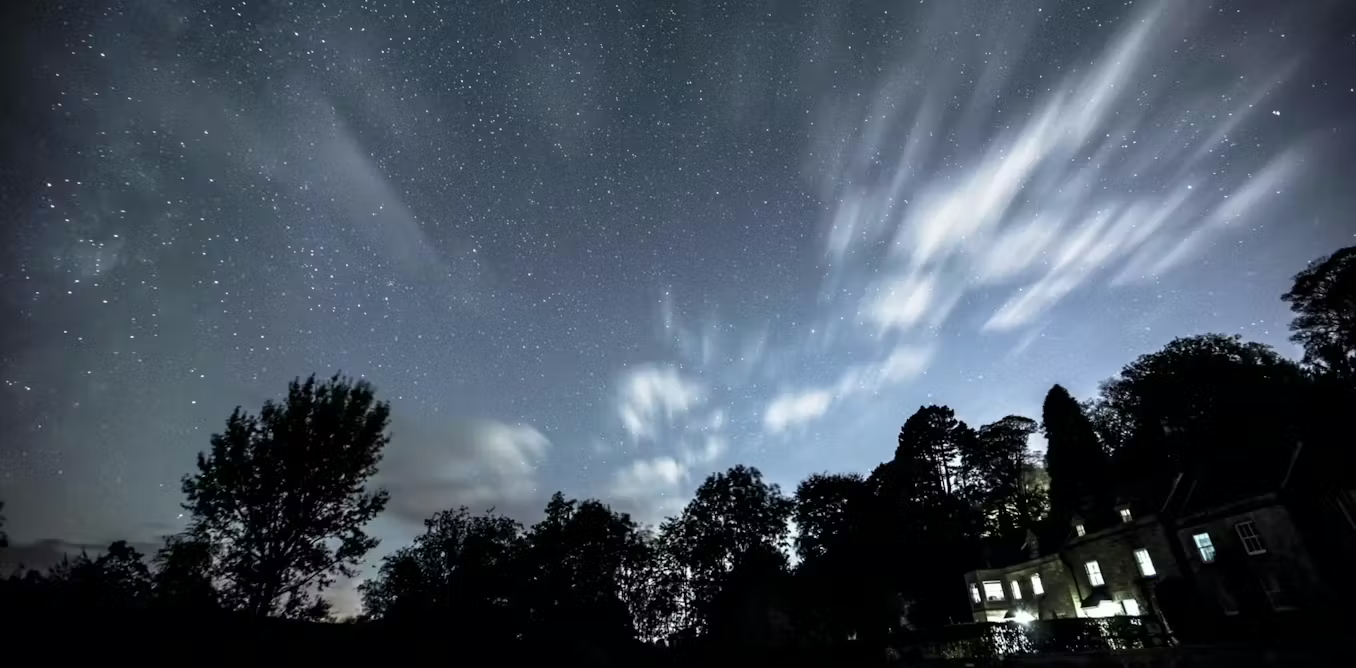
Why walking in a national park in the dark prompts people to turn off lights at home

Published

on

Why walking in a national park in the dark prompts people to turn off lights at home

As soon as you drive over the top of the Peak District and down into Sheffield you can see the light pollution – and it’s horrible, said a participant in a research project into darkness and light pollution.

In the last 100 years, the places where people can experience darkness have reduced dramatically. Now only 10% of the people living in the western hemisphere experience places with dark skies, where there is no artificial light. And the starry skies they can see are limited by artificial light. The number of stars that people can see from most of the western hemisphere is getting fewer and fewer.

Researchers trying to find out about public attitudes to darkness attended events over three days in the North York Moors National Park. Here, in one of the UK’s seven dark sky reserves (where light pollution is limited), the researchers explored how immersive and fun experiences, such as guided night walks and stargazing and silent discos, reshaped public perceptions of natural darkness and sparked ideas of what they might change in their lives.

Working with a professional film-maker, the research team recorded how people responded to taking part in events in darkness. Participants in the research included five tourism businesses, two representatives from the park and 94 visitors.

Advertisement
People walking with head torches in a dark sky event in North Yorkshire.
Andy Burns.

Darkness disappears

Light pollution is increasing globally by approximately 10% per year (estimated by measuring how many stars can be seen in the sky at night), diminishing night skies and disrupting ecosystems.

But increasing awareness of light pollution has led to an increase in national parks hosting events to explore this issue, according to my recent study.
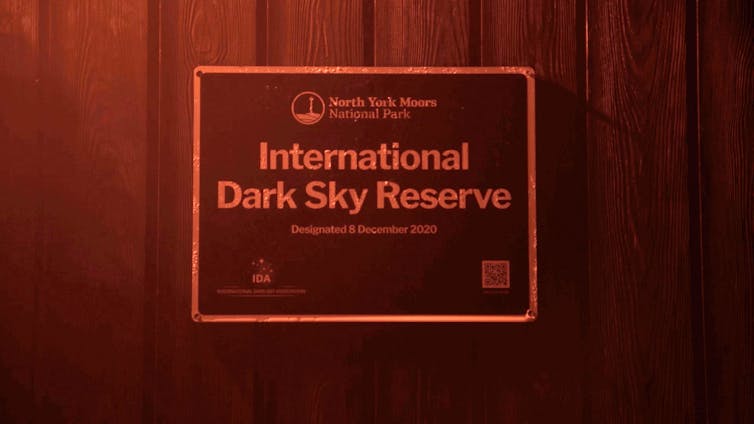
A sign saying international dark sky reserve.

Andy Burns., CC BY-SA

The study’s findings indicated that participants in the North York Moors Dark Sky Festival events not only started to feel more comfortable in natural darkness but also talked about changing their own lifestyle, including using low-impact lighting in their homes, asking neighbours to switch off lights in their gardens at night, and monitoring neighbourhood light levels.

The research team used filming and walking with visitors to capture not just what people said, but what they did in darkness. During guided walks, participants experimented with moving without head‑torches, cultivating night vision, and tuning into sound, smell and learning how to find their way around without artificial light.

Walking in silence helped visitors build a deeper connection with the nocturnal environment. One visitor said that being in the dark just for that moment of peace, and just to listen and tune in to the environment was a privilege and something to conserve.

Advertisement

One said: “I remember as a child I’d see similar stuff from a city [and that] sort of thing, and now we’re doing whatever we can do to save things like this.”

Visitors reported leaving with new skills, greater awareness and commitment, such as putting their lights at home on timers, and working on bat protection projects. These actions demonstrate that this kind of experience in nocturnal environments can change behaviour far beyond festivals.

Dark Sky activists, such as those in the North York Moors National Park, have learned that the public connect with the issues around light pollution and become more engaged if the activities are fun.

Shared experiences help people understand complex messages about climate, biodiversity, and responsible lighting, and help people feel more confident about walking in the dark. Several participants commented that walking without light was good and wasn’t as bad as they thought. Another said: “I find walking at night with a full moon is really quite a magical experience.”

Advertisement

By the end of the walk, some visitors (when on relatively easy ground) were happy to switch head torches off and enjoy feeling immersed within the nocturnal landscape.

Dark‑sky festivals show how joy and fun can build public awareness and an understanding of why darkness matters.

However, limited public transport to rural night events as well as safety concerns about walking in darkness, and the cost of festivals all restrict participation.

Why light is a problem

Research shows that artificial light at night disrupts circadian rhythms, impairs some species ability to find their way around and is a cause of declining populations of insects, bats and other nocturnal fauna.

Advertisement

There is also evidence that outdoor lighting generates needless emissions and ecological harm that is intensifying at an alarming rate.

North Yorks dark skies discussed.

To rethink this shift, the study argues that darkness could be considered a shared environmental “good”, requiring collective care to prevent overuse, damage and pollution.

Small changes in lighting shielding (which controls the spread of light), warmer coloured lights, and half lighting (switching street lighting off at midnight) can be significant and less damaging to animal life.

Advertisement

The national park’s next major step has been to establish a Northern England Dark-Sky Alliance to halt the growth of light pollution outside the park boundaries, particularly along the A1 road in northern England, which would help restore natural darkness for nocturnal migratory species, such as birds like Nightjars.

If we can make living with more darkness in our streets, and in our leisure time, feel more normal and more comfortable, then nighttime becomes not something that needs to be fixed, but a shared commons to be restored.

Jenny Hall is a speaker at an upcoming discussion on Cities Under Stars: Tackling Light Pollution in Cities, in conjunction with The Conversation, as part of this year’s Dark Skies Festival. Find out more, and come along.


Advertisement

Source link

Continue Reading
Click to comment

Leave a Reply

Your email address will not be published. Required fields are marked *

NewsBeat

Pentagon says it’s cutting ties with ‘woke’ Harvard, discontinuing military training, fellowships

Published

on

Pentagon says it's cutting ties with 'woke' Harvard, discontinuing military training, fellowships

The Pentagon said Friday it is cutting ties with Harvard University, ending all military training, fellowships and certificate programs with the Ivy League institution.

The announcement marks the latest development in the Trump administration’s prolonged standoff with Harvard over the White House’s demands for reforms at the Ivy League school.

Defense Secretary Pete Hegseth said in a statement Friday that Harvard “no longer meets the needs of the War Department or the military services.”

“For too long, this department has sent our best and brightest officers to Harvard, hoping the university would better understand and appreciate our warrior class,” Hegseth said. “Instead, too many of our officers came back looking too much like Harvard — heads full of globalist and radical ideologies that do not improve our fighting ranks.”

Advertisement

In a separate post on X, Hegseth wrote, “Harvard is woke; The War Department is not.”

Starting with the 2026-27 academic year, the Pentagon will discontinue graduate-level professional military education, fellowships and certificate programs, the statement said. Personnel currently attending classes at Harvard will be able to finish those courses.

The military offers its officers a variety of opportunities to get graduate-level education both at war colleges run by the military as well as civilian institutions like Harvard.

Broadly, while opportunities to attend prestigious civilian schools offer less direct benefit to a servicemember’s military career than their civilian counterparts, they help make troops more attractive employees once they leave the military.

Advertisement

Harvard has long been Trump’s top target in his administration’s campaign to bring the nation’s most prestigious universities to heel. His officials have cut billions of dollars in Harvard’s federal research funding and attempted to block it from enrolling foreign students after the campus rebuffed a series of government demands last April.

The White House has said it’s punishing Harvard for tolerating anti-Jewish bias on campus.

___

The Associated Press’ education coverage receives financial support from multiple private foundations. AP is solely responsible for all content. Find AP’s standards for working with philanthropies, a list of supporters and funded coverage areas at AP.org.

Advertisement

Source link

Continue Reading

NewsBeat

Mega Clearance Outlet opens in Hartlepool to huge crowds

Published

on

Mega Clearance Outlet opens in Hartlepool to huge crowds

Mega Clearance Outlet, described as “the North East’s largest discount clearance centre”, opened its doors on Friday, February 6, at Tofts Farm Industrial Estate in Hartlepool.

The new store, run by STW Clearence, will offer huge savings and discounts on a wide variety of items, from everyday essentials such as toilet rolls to sofas.

It opened the doors at 10am, welcoming shoppers keen to snap up goods at discounted prices.

Advertisement

Posting on social media following the launch, the STW Clearance team said they were “blown away” by the response.

The Facebook post said: “What an incredible opening day at Mega Clearance Outlet.

“We were blown away by the amazing turnout and are so thrilled to welcome so many of you into our warehouse.

Advertisement

“Thank you for the support, the smiles, and the buzz – you made our opening one to remember.”

Videos from the opening day show a huge turnout of shoppers snaking around the store.

The clearance centre offers a wide range of products, including furniture, homeware and everyday essentials such as toilet roll, with the company operating on a “once it’s gone, it’s gone” basis.

Bargain hunters who missed the opening day can also visit this weekend, with the outlet open on Saturday and Sunday from 10am until 4pm.

Advertisement

The post added: “If you missed out, don’t worry, we’re open all weekend, Saturday and Sunday from 10am until 4pm.

“Come down and grab a bargain, with everything from furniture and homeware right through to everyday essentials like toilet roll. There really is something for everyone.”

In the run-up to the opening, the owners teased various pictures and videos on social media, stirring up a lot of excitement from customers eager for a discount.

Since the launch, customers have already been posting on social media about how happy they are with their purchases.

Advertisement

One person said: “Over the moon with our purchases this morning. Had a great time and very friendly staff.”

While another commented: “This looks amazing, can’t wait to have look this weekend.”

The outlet is located at Tofts Farm Industrial Estate, next to Hartlepool Borough Council offices, and joins a growing number of businesses operating on the site.

Advertisement

Source link

Continue Reading

NewsBeat

Trump refuses to apologize for post depicting Obamas as apes and claims he’s the ‘least racist’ president

Published

on

Trump refuses to apologize for post depicting Obamas as apes and claims he’s the ‘least racist’ president

President Donald Trump refused to apologize for a video he shared on Truth Social — and later deleted — on Friday that included a racist image depicting former President Barack Obama and former First Lady Michelle Obama as apes.

During a press gaggle on Friday night outside Air Force One, reporters asked Trump about the post. He insisted that he was the “least racist president you’ve had in a long time,” and placed the responsibility for the post on his staff.

“I looked at it. I saw it, and I just looked at the first part. It was about voter fraud,” Trump said. “I guess during the end of it, there was some kind of a people don’t like, I wouldn’t like it either, but I didn’t see it. I just I looked at the first part, and it was really about voter fraud in the machines, how crooked it is, how disgusting it is.”

He said that after someone in his staff watched the entire video, it was taken down. When a reporter asked him about calls from other Republicans to apologize for the video, Trump refused to take responsibility.

Advertisement

“No, I didn’t make a mistake. I mean, if I look at a lot of thousands of things, I looked at the beginning of it. It was fine,” Trump said.

He was later asked directly if he condemns the racist parts of the video, to which Trump replied: “Of course I do.”

This is a breaking news story.

Source link

Advertisement
Continue Reading

NewsBeat

Tiny food items randomly posted to pubs and cafes in Welsh city mystery

Published

on

Wales Online

Various food and drink establishments across Swansea have been receiving single biscuits and even little individual potatoes in the post

Advertisement

Pubs and coffee shops in one part of Wales have found themselves receiving rather unexpected packages from an unknown source. In the last week, various establishments in the Swansea area have reported getting individual items in the post, and no-one quite knows why.

The random objects were not accompanied with a note or a return address, leaving the owners wondering who is sending them food in the post.

The Plough and Harrow pub in Llangyfelach has received two separate parcels in the last week, each containing a singular biscuit.

The first arrived on Saturday, January 31, with a rich tea biscuit inside and the second on Monday, February 2, came with a digestive. Never miss a Swansea story by signing up to our newsletter here.

Advertisement

Stephanie Hally, the owner of the pub, described the packaged as “bizarre”, saying she’d never received anything like it before. She said: “They’ve gone to the lengths of getting them packaged but by the time it comes through to our letterbox and we receive it it’s broken biscuits anyway.

“When the first one arrived a member of my staff sent it to me and I thought it was very strange.

“I thought it might have been a supplier wanting us to supply biscuits from them but there was no return address or sender on the back of the package so it’s quite bizarre.

Advertisement

“The first one I sort of just thought ‘ah right ok’ but now we’ve had another one. There was nothing inside other than the biscuit!”

Stephanie was even more stumped by the fact both packages had been sent using Royal Mail tracked delivery.

She explained: “The first package was a brown envelope which had a sticker saying it was tracked by Royal Mail, and then the second one was a white package which said it was tracked by Royal Mail as well.

Advertisement

“Someone’s spent money and gone to the trouble of having it tracked and paying for it.”

The Marquis Arms pub in Swansea received an almost identical package. The pub posted on Facebook: “Thank you to whoever sent us a McVities digestive biscuit in the post, much appreciated.”

This was accompanied by two pictures of a white envelope containing a digestive biscuit broken into a number of small pieces.

The pubs haven’t been the only two places to acquire something strange through the post in recent weeks. Smashed Raspberry, a café in Neath, received a small potato in yet another identical tracked Royal Mail white parcel.

Advertisement

Samantha Paul, the owner of Smashed Raspberry, said: “When I opened it I was completely and utterly baffled. I tried to figure out then whether I’d ordered it by mistake, had I ordered it late at night or had I slept walked? Then I asked everybody else and I realised it must just be a joke.”

Samantha has turned detective trying to figure out where the potato came from, but as of yet she’s had no luck.

She said: “We’ve had suspicions about who it might be – we thought it might be a company that’s sending them out to businesses knowing they’re going to post about such a bizarre thing.

Advertisement

That’s the only thing I can think of because there is nothing really that links us all. “The first thing I did was google ‘why have I received a potato in the post’ and that’s how I found out that this is an actual website where you can send a potato and things like that.”

She added: “We’ve asked loads of people that we thought it could be but nobody has come forward. We asked friends and customers who like a joke but no-one has said it was them.”

Despite the confusion, Samantha’s team have welcomed the potato in with welcome arms, drawing a face on him and naming him ‘PotaTony’.

Advertisement

Source link

Continue Reading

NewsBeat

Gogglebox shares moving tribute during new series after heartbreaking death

Published

on

Manchester Evening News

Gogglebox paid tribute to TV producer Jonathan Clough as it returned for series 27

Gogglebox has honoured a television producer who passed away following a battle with a brain tumour, as the show kicked off its latest series. The Channel 4 favourite made its comeback on Friday evening (February 6) with its 27th run.

At the programme’s conclusion, viewers saw an image of Jonathan Clough accompanied by the tribute: “In memory of Jonathan Clough” alongside the years 1989 to 2025. The producer had received a diagnosis of Grade 4 Glioblastoma in 2024, when he was just 35 years old.

A fundraising initiative had been set up to help Jonathan – whose television work also encompassed Strictly Come Dancing and The Apprentice – gain access to specialist care. Following a family appeal, actor Sam Swainsbury launched the GoFundMe effort, reports the Mirror.

Advertisement

READ MORE: Gogglebox fans all have same response minutes into new seriesREAD MORE: Inside Pete and Sophie Sandiford’s lives including early TV role before Gogglebox

Both Jonathan and his partner, Tracy Martin, were forced to step away from their professional lives and move with their two young children from London to Wigan, where they stayed with her parents after receiving the devastating news.

On the GoFundMe page, Tracy detailed how their existence was transformed after Jonathan unexpectedly collapsed from a seizure in March 2024.

Advertisement

She explained: “Two months after that, the results of an MRI brought our world crashing down. Our brilliant Jonathan, at only 35 years old, was diagnosed with a Grade 4 Glioblastoma – an extremely aggressive and incurable brain cancer.”

Jonathan went through surgery, chemotherapy and radiotherapy, with a post on the GoFundMe page saying: “For a while, we had hope. His scans showed the treatment was working, keeping the tumour stable. We dared to dream we’d fight this for a while.”

However, later scans revealed a tumour regrowth that medical professionals considered inoperable. In January, Sam shared the heartbreaking news on Instagram that Jonathan had passed away on Boxing Day.

“He saw his daughter’s first day at school,” he recalled. “He then made it to her first play. He then made it to Christmas. He then sadly passed on Boxing Day.

Advertisement

“He fought for every last second. He exceeded all expectations. He was extraordinary.” “I don’t have many more words than that,” he added. “I still can’t believe it.”

Ex-Strictly professional Kevin Clifton was amongst those honouring Jonathan’s memory, who worked as a producer on the BBC dancing programme between 2017 and 2019.

Posting photographs of Jonathan online, he expressed: “An amazing friend, an amazing man, an amazing father and a heck of a fighter for his amazing family. I will miss you forever [heartbroken emoji].”

Advertisement

Gogglebox airs on Channel 4

Source link

Continue Reading

NewsBeat

A charismatic straight talker, Japan’s Takaichi is poised to expand her power in Sunday’s vote

Published

on

A charismatic straight talker, Japan's Takaichi is poised to expand her power in Sunday's vote

Japan‘s prime minister is a heavy metal music fan. She loves motorcycles and playing the drums, including with visiting dignitaries. She thrilled a nation that often fetishizes company loyalty by declaring that her secret for success as leader would be “ work, work, work, work, work. ”

This charismatic combination, along with an image that is both tough and playful, has made Sanae Takaichi very popular, something exceedingly unusual for recent prime ministers in Japan, where her political party, which has led Japan for most of the last seven decades, has struggled mightily.

In stark contrast to the long line of often elderly men who’ve run Japan over the decades, Takaichi’s popularity is rooted in her support by younger people. They affectionately use her nickname, “Sana,” closely follow her fashion, her choice of stationery and her favorite food — steamed pork buns. Polls show her Liberal Democratic Party, despite deep-rooted problems, is now poised to make big gains in Sunday’s vote in the lower house of Parliament, thanks to Takaichi.

This would allow her to take the country in the direction of her hawkish, deeply conservative mentor, the late Prime Minister Shinzo Abe, and beyond.

Advertisement

The Associated Press takes a look at the first woman to lead Japan as prime minister.

She worked her way up from the middle class

Born in Nara, Japan’s ancient capital, Takaichi was raised by conservative parents who taught her prewar moral values. Her mother was a police officer and her father worked at a machinery maker.

As a child, she enjoyed listening to her parents recite an 1890 imperial document that praises paternalistic family values and loyalty to the government, Takaichi said in 2012.

Advertisement

Though she was admitted to prestigious Tokyo schools, her parents made her attend Kobe University while living at home, something that was normal then for unmarried daughters of conservative families.

She was briefly an intern for a U.S. Democratic lawmaker in Denver in the late 1980s and, after returning to Japan, worked as a television personality, an author and a critic.

She’s known for her straight talk

Takaichi is unique because she both speaks her mind and is seen as easygoing, said Izuru Makihara, a University of Tokyo politics expert.

Advertisement

“Takaichi is highly regarded, especially by women and younger generations who strongly feel stuck and hopeless,” he said.

She was elected prime minister by Parliament in October, and her first weeks were marked by a hawkish comment on a possible Chinese military action against Taiwan, the self-governing island that Beijing claims as its own territory, that angered China by deviating from past strategic ambiguity.

She struggled in male-dominated politics, but is not a feminist

She was first elected to Parliament in 1993 after defying her parents’ opposition. Some voters insulted her as “a little girl,” she said in 2023, recalling that first campaign as a 32-year-old.

Advertisement

“In those days, women who were not considered old enough were unwelcome,” she said. She also faced groundless allegations of being a mistress of a senior politician, and criticism — often from women — for wearing heels, flashy jewelry and short skirts.

“I am who I am,” Takaichi said. “The only way to prove myself is with the work I do.”

She supports the imperial family’s male-only succession and opposes same-sex marriage as well as amending the 19th-century law requiring married couples to have the same surname, under which most women are pressured into abandoning theirs.

Feminists are not happy and say Takaichi’s leadership is a setback for Japanese gender equality.

Advertisement

But Riho Shimogomi, a 43-year-old office worker, said that when she looks at Takaichi’s policies, “her being a woman doesn’t matter. … I think she has strong leadership skills and charisma.”

Following Abe’s policies while pushing even further to the right

As Abe’s protégé, Takaichi has echoed his nationalistic views, defending Japanese wartime actions, pushing for greater military capability and spending, as well as more patriotic education, and the promotion of traditional family values.

She rose quickly through the ranks during Abe’s leadership and was given ministerial and party posts.

Advertisement

After Abe stepped down and backed her as “the star of the conservatives,” Takaichi ran for the LDP leadership race twice, in 2021 and 2024, both unsuccessfully, before finally winning the top job in October, replacing Abe’s rival — centrist Shigeru Ishiba.

Takaichi has reappointed some of Abe’s top advisers as lieutenants and is expected to push Japan even further to the right on security, gender and immigration if she makes gains in Sunday’s election.

A workaholic who’d rather be in the office than socializing

Takaichi has admitted she doesn’t like drinking parties and would much rather study at home, though she tried to socialize more to build connections with colleagues after her two unsuccessful leadership bids.

Advertisement

After being elected as LDP leader, Takaichi asked her party members to “work like a horse” and said she would forget her “work-life balance” and “work, work, work, work and work.” These phrases became buzzwords, but some found them uncomfortable in a country known for long hours and overwork.

Analyzing her daily schedule during her first three months in office, the Kyodo News Agency reported last month that she was largely “holed up” in the official residence or her office. She had no dinner appointments with political or business leaders in the first month in office, the Mainichi newspaper said.

Strict but lighthearted

Her strictness can be linked to her mother. One time when Takaichi returned to Nara and complained about being tired because of her work, her mother slapped her in the face, she said, scolding her for griping about a path she’d chosen for herself.

Advertisement

At her mother’s funeral in 2018, Takaichi said her mother slapped her even after she was appointed a government minister, according to Nobumitsu Nagai, a local television executive who described Takaichi’s funeral speech as “not formal and filled with affection for her mother. … I felt she has inherited that strictness.”

But there’s also a playful side.

Years earlier when Takaichi found out that they attended the same elementary school in Nara, she asked Nagai if he remembered the school song, and they sang it together.

“While she gives out a strong impression of being right wing and a hawk, I realized she also has a (playful) side like that,” he said.

Advertisement

Source link

Continue Reading

NewsBeat

‘Public safety announcements’ posters for ‘disgrace’ Andrew as he moves in Sandringham home

Published

on

Daily Record

Just days after Andrew Mountbatten-Windsor moved into Sandringham, the former prince’s arrival has sparked controversy, with “public safety announcements” appearing around the area highlighting his connection to convicted sex offender Jeffrey Epstein.

Andrew, 63, was evicted from the Royal Lodge in Windsor earlier this week and relocated to the King’s Norfolk estate under cover of night to avoid attention. Sources say he is currently staying at Wood Farm Cottage while Marsh Farm, believed to be his intended permanent residence, undergoes renovations.

Within days of his arrival, locals expressed their disapproval of the disgraced royal moving into the otherwise quiet village.

Advertisement

In a video shared on social media, an unidentified resident can be seen attaching a notice over the ‘Welcome to Sandringham’ sign, described as a “public safety announcement.”

Content cannot be displayed without consent

The poster, which featured a photograph of Andrew, read: “Sweaty n*nce in the area. Andrew Mountbatten-Windsor (previously: Prince Andrew).”

The message further referenced the former royal’s link to Epstein, stating: “Close friend of notorious paedophile Jeffrey Epstein. Enthusiastic participant in his sex trafficking network. Paid millions to try and silence survivors.”

Andrew has consistently denied the allegations, and police investigations have not resulted in any charges.

The Epstein files reportedly contain claims that a woman in her mid-20s travelled to Windsor to have sex with Andrew. Additionally, his payment to Virginia Giuffre was made without any admission of guilt or liability.

The footage was circulated on social media by campaign group Everyone Hates Elon, who wrote: “Former Prince Andrew has been forced to move to a smaller home in Sandringham after the latest Epstein files release. Don’t worry, he’s getting the welcome he deserves. A national disgrace.”

Residents in the area have also voiced frustration about the disruption caused by the royal’s presence. The previously tranquil lane has been swamped with cars and journalists, with helicopters circling overhead.

Advertisement

One local said: “I think if he has to come and live here, it should be somewhere that’s quite secluded. There are houses that belong to the King that he could go to that wouldn’t cause anybody any bother. The press are all down there. The villagers don’t like that. It’s a quiet village.”

She suggested a more suitable location would be “out in the woods” surrounded by trees and away from roads, adding: “If he needs to come, he needs to come, but I think there’s better places he could have actually gone.”

Comments from visitors to the nearby Sandringham Visitor Centre highlighted similar sentiments. Abraham Bruin, 83, said: “I’m a little bit flabbergasted myself. If he’s an outcast and living on the estate, he’s not an outcast is he?”

Another woman added: “Really, he’s going back to luxury, isn’t he? He’s being waited on hand and foot.” Additional locals expressed discomfort with the former prince’s relocation, with one noting she was “not particularly keen on him.”

Advertisement

Source link

Continue Reading

NewsBeat

Why do disasters still happen, despite early warnings? Because systems are built to wait for certainty

Published

on

Why do disasters still happen, despite early warnings? Because systems are built to wait for certainty

After major disasters, public debate often treats them as unexpected or unprecedented. This reaction is not necessarily about the absence of warnings. It reflects how societies process shock – and how authorities often explain disruption as unavoidable, rather than the result of earlier choices.

Extreme weather is rarely unpredictable. Days, sometimes weeks, in advance, scientists are able to warn of an increased risk of storms, floods, droughts or other hazards. Yet the cycle repeats.

To understand why this is, colleagues and I reconstructed the scientific warnings and the official responses to major floods in Luxembourg in July 2021 – my home country’s most damaging disaster on record. Those floods caused far more damage than they would have done if early action was taken, but Luxembourg isn’t an outlier: many other countries suffer from the same problems we identify.

As the UN targets “early warning for all” by 2027, it’s worth noting the issue is not that warnings were missing. It is that warning systems are often designed to act on certainty rather than probability – and that’s not how forecasting works. By the time warnings become visible to the public, it is often too late.

Advertisement

Liege, Belgium, July 2021: several days of intense rainfall caused many rivers to burst their banks.
Abaca Press / Alamy

Weather forecasts may look definitive on your phone, but they are probabilistic by nature. They are created by running a series of computer simulations of the future weather. The level to which the outcomes of different simulations agree with each other provides the likelihood of hazardous conditions, not guaranteed outcomes. These allow forecasters to identify elevated risk well before impacts occur, even if the precise location of an event and their size remain uncertain.

Crucially, uncertainty is usually greatest further ahead, when preventative action would be most effective. Acting early therefore almost always means acting without certainty. This is not a weakness of science, but an inherent feature of anticipating complex systems under changing conditions. The real challenge lies in how institutions are organised to interpret, trust and act on those probabilities.

Acting on certainty

Most warning systems rely on predefined procedural thresholds: alert levels, activation protocols and emergency plans that kick in once specific criteria are met. Forecasting may indicate that flooding is increasingly likely, for example, but measures such as evacuations or road closures can only be triggered after formal thresholds are crossed.

Advertisement

Before that point, risk information passes through many layers of interpretation and judgment, where early signals are often noted but not acted upon.

Scatter graph of rainfall

Historic precipitation in one flood-affected region on the border of Belgium and Germany. The size of the dots directly represents the amount of precipitation each day; the circled orange dot is for 13 July 2021 and the circled red dot is for 14 July 2021.
C3S/ECMWF (Data: ERA5), CC BY-SA

Thresholds serve important purposes. They help coordinate response, clarify chains of command and reduce unnecessary disruption. But they also embed a structural preference for certainty. Action is authorised only once risk is framed as imminent, even when credible evidence already points to escalating danger.

This attitude was apparent in the days leading up to the July 2021 floods. Our study shows that multiple forecasts at European and national levels indicated a high probability of extreme rainfall and flooding, in some cases up to a week in advance. This information was available across different parts of the warning system. At that stage, uncertainty about precise impacts remained, as would be expected. What mattered was how the system was designed to handle that uncertainty.

Too early for warning

Because Luxembourg’s response measures were tied to procedural thresholds, early signals could not translate into anticipatory action. The country’s water administration and its national weather service had access to relevant information, but they operated within a framework that did not authorise a collective interpretation of what was happening or encourage action before thresholds were crossed.

Advertisement

This was not a scientific miscalculation, nor was it necessarily an operational mistake by individual agencies. Meteorological and hydrological services most likely did as much as their mandates allowed. The decision to wait for formal triggers was human and institutional rather than technical,
reflecting a system designed to prioritise procedural certainty over sound decision-making.

Annotated map

Across affected areas of Germany, Belgium and Luxembourg, many rivers (in purple) reached their highest levels since records began in 1991.
Copernicus EMS/ECMWF, CC BY-SA

By the time action was authorised, for many people it was too late. Evacuations or installing flood gates became far more difficult, particularly for communities with limited experience of such severe floods. From the perspective of those affected, warnings appeared late or did not arrive at all – even though the risks had been identified earlier throughout the system.

Luxembourg is a particularly instructive illustration of what can go wrong, because it is a small, wealthy and well-connected country. The issue was not necessarily a lack of resources or scientific capacity, but of institutional design and societal readiness to act on risk.

Learning and resilience

The effectiveness of early warning systems over time depends on their ability to learn from extreme events. This requires open, independent analysis of what worked, what did not work and why. In several neighbouring countries affected in 2021, such as Germany and Belgium, formal inquiries and external reviews were carried out. In Luxembourg, they were not.

Advertisement

When expert critique is discouraged or avoided, learning slows. Questions about system performance remain unresolved and the same structural vulnerabilities are likely to persist. This creates a systemic risk in its own right: societies become less able to adapt warning systems, interpret uncertainty and act earlier on emerging threats.

As someone who has worked within these systems and continues to research disaster risk governance, I have seen how asking difficult questions can be treated as destabilising rather than constructive. Resilience depends on confronting uncomfortable truths, not avoiding them.

The risk of extreme weather is increasing across Europe and beyond. Early warning systems are rightly central to disaster risk reduction. But their effectiveness depends on how societies authorise action under uncertainty. This is a choice, not an inevitability.

Uncertainty cannot be eliminated. The challenge is to decide how much uncertainty is acceptable when lives and livelihoods are at stake. Systems designed to wait for certainty – for procedural, organisational, financial or reputational reasons – are more likely to deliver warnings that arrive too late to feel like warnings at all.

Advertisement

If resilience to future climate risks is to be sustainable, warning systems must be designed to learn, adapt and act earlier on credible risk.

Source link

Advertisement
Continue Reading

NewsBeat

Olympic crowd’s boos for JD Vance show politics can’t be avoided at 2026 Winter Games

Published

on

Olympic crowd’s boos for JD Vance show politics can’t be avoided at 2026 Winter Games

Every Olympic organising committee has to think about what they stand for. How do they want their Opening Ceremony, and by association their Olympics, to be remembered? How to best represent those most nebulous of things, the Olympic values? How to set the tone for the sporting extravaganza that is the next fortnight?

The most recent Opening Ceremony, in Paris 18 months ago, seemed to deliberately court controversy and want to split opinion – remember Marie-Antoinette being decapitated and the row over the ceremony being ‘ungodly’?

Milano-Cortina, by contrast, appears to have gone for a classy, prettily choreographed if perhaps not very memorable opener. An opening segment featured a beautiful balletic dance sequence with lifts that wouldn’t be out of place in an ice dance programme. Mariah Carey’s two minutes on stage were over blissfully quickly and replaced by Grammy-nominated singer Laura Pausini’s stunning rendition of the Italian anthem. Andrea Bocelli closed the show with another flawless performance, the whole stadium falling silent in awe.

And aside from an inexplicable – in true Olympic style – section featuring three enormous tubes of paint descending from the roof of the stadium, and hordes of people dressed as block colour coffee machines, the ceremony was largely tasteful. Pretty. All light and sparkle. Nothing, really, to see here.

Advertisement

And maybe that was intentional, with this Games dogged by political controversy despite the IOC doing its desperate best to avoid any sign of it. Old issues are still raging, like the thorny question of how to deal with Russia, which seems to be inexorably heading towards it being welcomed back, despite widespread opposition and the vast scale of death and destruction in Ukraine; equally there are questions over the continued participation of Israel. There’s the ongoing debate over the protection of the female category, with no verdict imminent on that front either, and age-old concerns over the environmental and economic impacts of hosting the Games.

Dancers take the stage at San Siro in Milan

Dancers take the stage at San Siro in Milan (AP)

But there are fresher concerns too, most obviously the backlash against the US Immigrations and Customs Enforcement agency (ICE) and wider anger at the Trump administration’s remarkable efforts at destabilising world peace, from kidnapping the Venezuelan president to threatening to take over Greenland.

American athletes have headed to Milano-Cortina acutely conscious of their shifting place in the world as Europe begins to fear the US rather than shelter behind it. The brutality of ICE in places like Minneapolis has only intensified that feeling. The US ice sports even renamed their hospitality venue from the ‘Ice House’ to the ‘Winter House’ to avoid being associated with the agency.

Advertisement
Performers during the Opening Ceremony

Performers during the Opening Ceremony (AP)

Athletes like cross-country legend Jessie Diggins have sought to distance themselves, however subtly, from the administration: she said she would race for “an American people who stand for: love, for acceptance, for compassion, honesty and respect for others… For everyone out there caring for others, protecting their neighbours and meeting people with love – every single step is for you.” US-based British freestyle skier Gus Kenworthy, who competed for the US at two previous Olympics, went a step further, appearing to urinate the words ‘F*** ICE’ on snow in a social media post.

Protests have broken out across Milan this and last week over ICE’s presence in Milan; there are no agents physically on the streets, but them having a role in the policing operation at all has been met with fury. Hundreds of protesters gathered in the hours leading up to the Opening Ceremony to chant anti-ICE slogans and set off flares; other demonstrators marched in support of Palestinians, or argued against the Olympics being held here at all amid a cost of living crisis.

Britain arrive for the parade of nations

Advertisement
Britain arrive for the parade of nations (Getty Images)

Italian interior minister Matteo Piantedosi dismissed the anti-ICE protests as politically motivated. But if it hasn’t occurred to him, everything about Olympic sport is political, starting with the official names of each country in the athletes’ parade. And there was a political message sent from the crowd, whether the IOC, or Trump’s administration, wanted to hear it or not.

US vice president JD Vance led an American delegation in Milan this week and was present at the Opening Ceremony. An enormous motorcade was seen ferrying dignitaries outside the stadium shortly before the ceremony began; he may have opted for the same understated entrance as he did at the ice hockey on Thursday night, slipping quietly into the posh seats alongside his security.

Video Player Placeholder
US vice-president JD Vance was booed after appearing on stadium screens

US vice-president JD Vance was booed after appearing on stadium screens (Getty Images)

The thumping, interminable house music inside the San Siro turned up another couple of notches when Iran was announced, presumably to drown out any potential booing. But no volume increase could block out the definite booing and whistling that accompanied Israel walking out into the stadium, accompanied by a security detail. The loudest cheer of the night, by contrast, was a sustained roar of support for the Ukrainian delegation.

Advertisement

And when Vance and his wife, second lady Usha Vance, were pictured briefly on screen gamely waving American flags as the US contingent walked in, there it was: the unmistakable sound of booing and jeering.

The five Olympic rings are raised inside San Siro

The five Olympic rings are raised inside San Siro (Getty Images)

The pair kept their beatific smiles on for the brief few seconds the cameras remained on them, but the message was loud and clear. It was notable that no other visiting dignitary, save for Princess Anne, had the same acknowledgement by the broadcasters. Perhaps that acknowledgement, pandering to this US administration’s sense of self-importance ahead of LA 2028, was unwise.

Having overrun by about 40 minutes the Ceremony finally got to the suits, and IOC president Kirsty Coventry thanked everyone present and watching at home “for believing in the magic of the Olympic Games”.

Advertisement
Team USA enter the stadium

Team USA enter the stadium (Getty Images)

“The spirit of the Olympic Games is about so much more than sport. It is about us – and what makes us human,” she continued. “Here, athletes from every corner of the world compete fiercely — but they also respect, support, and inspire one another. They remind us that we are all connected, that our strength comes from how we treat each other, and that the best of humanity is found in courage, compassion, and kindness.”

Wise words. It would be nice if the likes of Vance could heed them, too.

Source link

Advertisement
Continue Reading

NewsBeat

Swifties evacuated from Bolton Albert Halls concert

Published

on

Swifties evacuated from Bolton Albert Halls concert

The incident happened during TaylorMania, a Taylor Swift tribute show, which had begun at 7.30pm.

At around 8.10pm, the performance was suddenly stopped after a fire alarm sounded throughout the venue.

For several minutes, it was unclear whether guests needed to evacuate, with some members of staff initially advising people to remain inside while others began directing them towards exits.

House lights were later turned on and an announcement was made confirming that the building should be evacuated.

Advertisement

Some children were seen visibly distressed during the confusion.

Concertgoers were escorted outside the venue and asked to wait in the rain across the road from the Albert Halls while the incident was investigated.

A member of staff at Bolton Albert Halls later confirmed the alarm had been triggered by a haze smoke machine used during the performance.

Once the issue was resolved, guests were allowed back inside and the show resumed.

Advertisement

Taylormania continued despite disruptions (Image: NQ)

Although tribute singer Katy Ellis missed a small number of songs due to the disruption, the incident did little to dampen the spirits of the crowd, with Swifties quickly returning to singing and dancing for the rest of the night.

The award-winning tribute act performed hits from across Taylor Swift’s different musical “eras”, recreating the record-breaking Eras Tour from 2023 and 2024.

The show featured a live band and dancers, two of whom were from Bolton.

Advertisement

Source link

Continue Reading

Trending

Copyright © 2025