
Crypto World
Bitcoin posts strongest April in 12 months


Bitcoin finished April with an 11.87% month, its strongest showing in a year and a potential signal that the market is rethinking the path higher. The gain follows a stretch of volatility and underpins a cautious but constructive mood among traders heading into May. While April’s bounce is notable, it still sits below the long-run average for the month, according to CoinGlass data.
As of writing, BTC hovered near $78,190, roughly 38% below its October all-time high near $125,100. The price backdrop keeps investors focused on whether the current momentum can translate into a sustained move toward former highs. The Crypto Fear & Greed Index lingered in the “Fear” territory at 39, indicating a still-cautious crowd weighing the near-term risk/reward.
Key takeaways
- Bitcoin logged an 11.87% rise in April, its best month since April 2025, when it gained 14.08%.
- April’s performance still underperformed the historical April average of about 12.98%, per CoinGlass.
- Bitcoin trades around $78,190, about 38% below the October all-time high of $125,100.
- Market sentiment remains cautious, with the Fear & Greed Index at 39, signaling persistent risk aversion among traders.
- Analysts are divided on May’s direction: CryptoQuant cautions that the April rally may foreshadow a multi-month decline, while bulls like Michael van de Poppe argue that fresh narrative catalysts aren’t strictly necessary to push BTC above $100,000.
April’s strength and what it implies for May
April delivered a robust monthly performance that traders saw as a potential turning point after a sequence of softer months. Nic Puckrin, founder of Coin Bureau, highlighted on X that while there is a long way to go to reclaim all-time highs, the green for April is welcome relief in an otherwise volatile cycle. The month’s strength did not occur in a vacuum; it followed a period where Bitcoin had struggled to maintain upward momentum despite headlines and macro shifts.
Still, the price action left many questions open. CoinMarketCap data place BTC around the $78k zone, underscoring that the rally still needs to clear a substantial psychological and technical hurdle to re-enter the $100k vicinity. The last time Bitcoin traded at or above $100,000 was in mid-November, a milestone that has since become a talking point for bulls and bears alike.
Contrasting views: risk signals vs. bullish catalysts
Not everyone is confident the rally will sustain into May. CryptoQuant analysts warned that the April move appeared to be driven largely by futures positioning, and there is concern the rally could give way to a multi-month downside if spot demand fails to follow futures-driven upside. The warning sits alongside a broader risk backdrop, with on-chain indicators and sentiment gauges painting a mixed picture for the near term.
In contrast, bullish voices argue that Bitcoin can reclaim higher levels without a fresh macro narrative. Michael van de Poppe, founder of MN Trading Capital, has suggested that BTC may not require a new catalyst to push back above the $100,000 level, urging readers to consider the potential for upside even without a dramatic fundamental trigger. His view contrasts with the question many traders are asking: what narrative would be needed to support a sustained move beyond the psychological barrier?
Meanwhile, market participants remain mindful of the broader risk environment. The fear gauge remains subdued but not out of reach of caution, a reminder that even with a supportive month, the market remains sensitive to macro shifts, liquidity conditions, and asset correlations that have defined crypto trading cycles in recent years.
What to watch next as May unfolds
Historical data shows that May has historically delivered modest but positive returns for Bitcoin, with an average around 7.78%. That baseline keeps analysts focused on a potential continuation of the April bounce, even as some warn that the path higher could be uneven. Traders will be watching for volume patterns, on-chain activity, and options market signals that could suggest whether the current momentum has legs beyond a single monthly rally.
Key indicators to monitor include the price action around the 100,000 level and the way market participants respond to potential catalysts, such as macro data releases, liquidity shifts, or notable developments in futures markets. The October 2023 to October 2024 cycle, which included notable market stress events, remains a reminder that big price moves can be followed by pullbacks even after periods of green performance.
What remains uncertain is how much of April’s strength will endure into May and whether a fresh narrative will emerge to sustain momentum. Investors should watch whether spot demand strengthens and whether risk appetite broadens from the current cautious footing. As always, a combination of price action, liquidity, and participant positioning will shape the near-term trajectory for Bitcoin.
Cointelegraph remains focused on transparent reporting and will monitor ongoing developments as markets digest April’s outcome and prepare for May’s unfolding narrative.



Ethereum whale activity has increased as large holders added more ETH over the past four days.
Summary
- Ethereum whales added 140,000 ETH in 96 hours as price remained near $2,300.
- ETH must hold $2,200 support to avoid renewed pressure toward the $1,900 zone.
- A clean move above $2,400 may open Ethereum’s path toward $2,800 resistance.
According to Ali Charts, whales accumulated over 140,000 Ethereum in 96 hours, worth about $322 million.
The buying comes as ETH trades near $2,305.11. The asset recorded a 0.1% gain in 24 hours, while it remained down 1.04% over the past seven days. Daily trading volume stood at $6.8 billion.
Whale holdings rise as ETH price stays flat
The chart shared by Ali Charts shows a steady increase in Ethereum held by whale wallets. Holdings rose from about 13.78 million ETH to nearly 13.98 million ETH between May 1 and May 3.
This points to steady buying by large holders, not a single large transfer. The move also suggests that major wallets are adding exposure while price action remains quiet.
However, traders are still waiting for stronger confirmation. ETH has remained close to $2,300, and market momentum has not yet followed the whale buying trend.
$2,200 remains key support for Ethereum
Ethereum is still trading above the $2,200 support area. Analysts view this level as important for the current market structure.
If ETH holds above $2,200, the price could continue its slow recovery toward the $2,800 resistance zone. A move above $2,400 may also give traders a stronger long setup.
However, the downside risk remains clear. A breakdown below $2,200 could weaken the structure and open the way toward $1,900.
The intraday outlook also remains mixed. The chart was described as “choppy and slow,” with traders waiting for a better structure before entering new positions.
$2,400 breakout may decide the next move
ETH has formed a base around the $1,800 to $2,000 area after a sharp decline earlier in the year. Since then, the price has printed higher lows, showing a gradual recovery.
Still, Ethereum remains below a major descending trendline. The $2,400 area is the nearest resistance. A clean breakout above it could support a move toward $2,600 and then $2,800.
The broader resistance near $3,700 remains far above current levels. That area still marks a major test for any wider recovery.

The U.S. crypto industry remains buoyant about its longer-term prospects, even as the fate of the CLARITY Act—an effort to codify regulatory clarity for tokens, stablecoins and crypto businesses—hangs in the balance in Congress. In a recent Chain Reaction episode, Chris Perkins, CEO of 250 Digital Asset Management, argued that the sector’s momentum would endure even if lawmakers don’t pass the bill this session.
Perkins pointed to ongoing policy work by the two main financial regulators as evidence the path to usable guidance is already being carved out. He cited the ongoing efforts of the US Securities and Exchange Commission (SEC) and the Commodity Futures Trading Commission (CFTC) under their chairs, following the agencies’ joint interpretation released in March on how federal securities laws apply to crypto assets.
“If not, we’re going to be just fine,” said Chris Perkins, CEO of 250 Digital Asset Management, on Cointelegraph’s Chain Reaction podcast, noting that the SEC and CFTC are already laying the groundwork for workable regulatory frameworks.
Key takeaways
- The crypto industry’s near-term momentum is not solely contingent on the CLARITY Act; regulators are actively shaping frameworks that could outlive any single piece of legislation.
- Regulatory policy work by the SEC and CFTC is creating a pathway that could bring much-needed certainty and a formal taxonomy for crypto assets, even absent a new law.
- Labeling tokens as securities is no longer an automatic death sentence; a clear, enduring framework could make the classification process more navigable for issuers, platforms, and investors.
- Passage of the CLARITY Act would entrench policy, making it harder for future administrations to roll back regulatory clarity and potentially reshaping the US crypto operating environment for years.
- A sense of urgency is growing around stablecoins and related yields, with lawmakers nudging toward a final text; several senators have offered optimistic timelines, signaling that energy around CLARITY is building.
Policy momentum in the making
The core premise of Perkins’s assessment is that policy isn’t waiting for a single bill to move forward. He highlighted that the SEC and CFTC have been actively developing frameworks and precedents that could guide token classifications, compliance pathways, and enforcement expectations regardless of CLARITY’s fate in Congress. The March joint interpretation, while not a CLARITY Act result, is cited by many industry observers as a signal that federal authorities are willing to articulate how securities laws apply to crypto assets in a concrete way.
Perkins emphasized that policy creation is a long-memory game: once a rule or taxonomy is established, it becomes a reference point that shapes future administration choices and regulatory posture. “There is a reason why we say it takes an act of Congress to do something,” he noted, but he also underscored that the current regulatory push is more than a momentary push for clarity—it’s the start of a framework that could endure beyond a single legislative cycle.
For investors and builders, the takeaway is that regulatory clarity may not depend entirely on a single bill. The ongoing work by the agencies could translate into a more predictable operating environment, with defined categories and compliance expectations that help reduce the mystery that has often surrounded crypto tokens and their regulatory status.
From “death sentence” to a regulated pathway
One recurring theme in Perkins’s discussion is the shift from the era when crypto assets labeled as securities faced existential risk to a landscape where a stable, enforceable framework could be leveraged by market participants. In the past, labeling a token as a security could trigger immediate enforcement action, delistings, and a lack of clear compliance pathways in the U.S. market. Perkins framed the current moment as a transition toward “certitude, stability, and ultimately, a taxonomy” that could harmonize regulatory expectations with practical business models.
That pivot matters because investors, exchanges, and developers often operate best when policy is predictable. If a robust taxonomy and enforcement approach emerge, projects may be better positioned to design compliant token structures, governance models, and disclosure norms that align with established regulatory expectations—reducing the risk of sudden policy shifts or unilateral enforcement actions that have in the past unsettled markets.
Still, Perkins cautioned that the absence of a final CLARITY Act passage would not automatically derail the industry’s long-run prospects. The momentum generated by regulator-led policy development could keep the ecosystem on a constructive trajectory, even as lawmakers deliberate on a more formal framework.
CLARITY Act: timing, prospects, and what to watch
The debate around CLARITY has intensified as lawmakers emerged from ongoing negotiations on stablecoin provisions and related regulatory questions. The timing remains a focal point, with several public signals feeding into the market’s expectations. After the publication of a final text aimed at resolving stablecoin yield disagreements between the banking and crypto industries, industry participants voiced renewed optimism that a broader CLARITY package could advance in short order.
“It’s time to get CLARITY done,” said Coinbase chief legal officer Faryar Shirzad in a post on X after US Senator Thom Tillis and US Senator Angela Alsobrooks released the final text addressing the stablecoin yield dispute between banking and crypto sectors.
Political voices from both sides of the aisle have weighed in with their own stipulations about when a vote might occur. Senator Bernie Moreno suggested a May deadline for completion of the act, signaling that momentum could converge around a concrete resolution in the near term. Separately, Senator Cynthia Lummis remarked on April 11 that the moment might be now or never, underscoring the sense of urgency among proponents who view CLARITY as a critical step toward market legitimacy.
Should the CLARITY Act pass, supporters argue it would create a durable framework that would be harder to unwind in future administrations, offering a stable baseline for crypto regulation. Critics, meanwhile, warn of potential overreach or rigidity that could hamper innovation. The interplay between these perspectives will help determine not only the act’s fate but also how the broader market calibrates risk and investment decisions in the months ahead.
In the broader context, the ongoing regulatory dialogue touches on several practical implications for the market. Stablecoins, which have been a particular flashpoint in policy discussions, could see clearer rules around reserve accounting, yield generation, and permissible cash-management practices. As reforms take shape, exchanges and custodians may gain clearer disclosure norms, while token issuers could adopt standardized compliance programs that align with a codified taxonomy—reducing ambiguity and softening the shock of enforcement actions that have characterized recent years.
Industry participants are watching closely for two things: a finalized CLARITY Act with a coherent taxonomy and a trusted enforcement pathway that reduces the risk of sudden regulatory reversals. The interplay between rulemaking activity by the SEC and CFTC and the legislative process around CLARITY will likely define the competitiveness of the U.S. crypto landscape for the foreseeable future.
Cointelegraph’s reporting and interviews remain focused on translating these regulatory developments into practical implications for investors, traders, and builders—highlighting where clarity exists, where it is still evolving, and what signals might guide decision-making as the regulatory regime continues to mature.
As the legal and regulatory narrative evolves, market participants should stay attuned to the next moves from Congress and from the agencies. Even in the absence of a final CLARITY Act, the trajectory of regulatory policy in this period could set the tone for how crypto projects raise funds, launch products, and engage with users in a compliant and sustainable manner.
Readers should monitor tightening timelines on stablecoin provisions, any further joint statements from the SEC and CFTC, and potential floor votes or committee actions related to CLARITY. The balance between legislative efforts and regulator-driven policy will shape the quality and predictability of the U.S. crypto market going into the second half of the year and beyond.
Cointelegraph is committed to independent, transparent journalism. This coverage reflects the ongoing synthesis of policy discussions, industry perspectives, and regulatory developments shaping the crypto landscape.

The US crypto industry’s momentum won’t be derailed in the long term even if the much-anticipated CLARITY Act, aimed at bringing more regulatory clarity to the crypto industry, doesn’t make it through Congress, according to 250 Digital Asset Management CEO Chris Perkins.
“If not, we’re going to be just fine,” Perkins said on Cointelegraph’s Chain Reaction podcast on Friday, emphasizing that the two major financial regulators are already building workable frameworks.
Perkins pointed to ongoing efforts by US Securities and Exchange Commission (SEC) Chair Paul Atkins and Commodities and Futures Trading Commission (CFTC) Chair Michael Selig, following the agencies’ joint interpretation released in March on how federal securities laws apply to crypto assets.
Being labeled a security was once a “death sentence” for crypto
“These guys are creating policy and precedent every single day, and they are giving us the one thing we’ve needed for a very long time, that certainty, that stability, and ultimately, a taxonomy,” Perkins said.
“In the past, being a security was a death sentence; there was nowhere to go with it, and it just didn’t reconcile…now it is awesome to be a security,” he said.
During the Joe Biden administration, under former SEC chair Gary Gensler, crypto tokens classified as securities typically faced enforcement action, delistings from major platforms, and had no clear pathway for compliance in the US market.

Chris Perkins spoke to Cointelegraph journalist Ciaran Lyons on Chain Reaction on Friday. Source: Cointelegraph
While Perkins said he’s not worried about the industry’s long-term outlook if the CLARITY Act doesn’t pass, he added that if it does become law, it would make it much harder for future administrations to roll back the regulatory clarity.
“What you’ve done is you’ve essentially enshrined policy for a very long time, as hard as it is to pass a law, it is even harder to unwind a law,” Perkins said. “There is a reason why we say it takes an act of Congress to do something,” he added.
CLARITY Act hopes rise
Many industry participants have raised expectations that the CLARITY Act could pass soon after the publication of new stablecoin yield provisions on Friday.
Related: Riot posts $167M in Q1 revenue as data center arm pulls in $33M in first quarter
“It’s time to get CLARITY done,” Coinbase chief legal officer Faryar Shirzad said in an X post on Friday, after US Senator Thom Tillis and US Senator Angela Alsobrooks published the final text aimed at settling the stablecoin yield dispute between the banking and crypto industries.
US Senator Bernie Moreno recently said that he anticipates the CLARITY Act to “get done” by the end of May. On April 11, US Senator Cynthia Lummis said, “It’s now or never.”
Magazine: AI-driven hacks could kill DeFi — unless projects act now
Crypto World
Ethereum Gas Limit to Triple After Glamsterdam Upgrade, Fees Could Stay Near Zero for Years

TLDR:
- Ethereum’s gas limit will increase from 60 million to 200 million following the Glamsterdam upgrade.
- L1 execution capacity will grow by more than 3x, with a further doubling expected shortly after.
- ETH mainnet gas fees could remain near zero for years if network demand does not rise equally.
- ePBS, BALs, and gas repricings work together to make the higher gas limit both safe and efficient.
Ethereum’s gas limit is heading for a dramatic increase following the upcoming Glamsterdam upgrade. The current limit of 60 million will rise to approximately 200 million, marking a major shift in the network’s execution capacity.
This change is expected to ease pressure on Ethereum’s mainnet significantly. As a result, gas fees could remain near zero for the foreseeable future, according to crypto researcher Hasu.
Glamsterdam Upgrade to Triple Ethereum’s Execution Capacity
The Glamsterdam upgrade will push Ethereum’s gas limit from 60 million to around 200 million. That represents a more than threefold increase in L1 execution capacity on the network. Beyond that, a further doubling is already being anticipated shortly after the initial raise.
Crypto researcher Hasu shared this development on X, noting it remains widely unknown. In his post, @hasufl wrote that “Ethereum’s gas limit will be increased to ~200M after Glamsterdam, a huge increase from the 60M we have today.” He further noted the expectation of a further doubling soon after that.
The upgrade brings together several technical innovations working in combination. Enhanced Proposer-Builder Separation (ePBS) gives payload processing more time during block production.
Meanwhile, Block-level Access Lists (BALs) allow clients to prefetch and parallelize execution work more efficiently.
Gas Fee Relief Expected as Network Supply Outpaces Demand
With execution capacity expanding this sharply, the supply side of Ethereum’s blockspace is set to grow considerably.
Assuming network demand does not rise at a similar pace, fees on Ethereum mainnet could stay near zero for years ahead.
Hasu pointed out that gas repricings also play a role in making higher limits technically safe. These repricings adjust the cost of certain operations, reducing the risk that a larger gas limit could be exploited or cause instability. Together, these changes form a coordinated technical foundation for scaling.
This combination of ePBS, BALs, and gas repricings arriving simultaneously is what makes the Glamsterdam upgrade particularly notable.
Each piece supports the others, allowing the gas limit increase to proceed without compromising network security.
The timing of these innovations coming together appears deliberate and well-coordinated within Ethereum’s development roadmap.



Greg Abel told Berkshire Hathaway shareholders Saturday that the conglomerate will adopt artificial intelligence (AI) only where it adds clear value, rejecting industry-wide hype in his first annual meeting as the designated successor to Warren Buffett.
His remarks, delivered in Omaha on May 2, set out a cautious deployment strategy across Berkshire’s insurance, rail, energy, and manufacturing units. Buffett, who recently retired from the chief executive role, did not weigh in on AI during the session.
Narrow AI, Not Hype
Abel told shareholders that AI must improve efficiency, safety, or decision-making before Berkshire deploys it. The vice chairman pointed to railroad subsidiary BNSF, where targeted AI tools are sharpening operations, and to insurance, where the company uses technology to flag fraud and deepfake threats.
Organizers opened the meeting with an AI-generated video of Buffett, which Abel called a serious risk Berkshire manages every day.
“It has to be additive to our businesses. We’re not going to do AI for the sake of AI,” he said.
The framing extends Buffett’s long-standing skepticism of unproven tech narratives, and stands in contrast to peers cutting jobs or rebranding around AI capabilities.
Energy Unit Positioned for Data-Center Boom
The clearest growth angle came from Berkshire Hathaway Energy. Data centers already account for roughly 8% of peak load in key service territories like Iowa, near the high end of industry benchmarks of 5% to 10%, Abel said.
He projected the unit could expand that footprint by 50% over the next five years, citing demand from hyperscalers racing to build AI infrastructure.
Abel insisted those operators “have to bear the full cost,” shielding residential and commercial ratepayers from absorbing the new load.
The stance offers Berkshire a tangible AI tailwind without forcing it to chase software valuations, a posture consistent with Abel’s succession at the conglomerate.
Whether that discipline holds as AI infrastructure spending accelerates across the utility sector will define Abel’s first full year at the helm.
The post Greg Abel Reveals Berkshire’s ‘Narrow AI’ Direction After Buffett Retirement appeared first on BeInCrypto.
Crypto World
Solana Co-Founder Anatoly Yakovenko Warns AI Could Break Post-Quantum Cryptography Securing Blockchain Networks
TLDR:
- Yakovenko warns that AI could crack post-quantum cryptography schemes securing blockchain networks today.
- Hidden mathematical and deployment vulnerabilities in PQC schemes remain poorly understood across the industry.
- Solana’s Anza team has published quantum readiness research exploring migration to quantum-resistant cryptography.
- Ethereum and Bitcoin face the same long-term cryptographic exposure, making this a cross-chain security concern.
Post-quantum cryptography risk has emerged as a pressing concern for blockchain networks, with Solana co-founder Anatoly Yakovenko raising alarms about the long-term security of cryptographic systems.
His warning covers wallets, transactions, and network integrity across the broader crypto industry. The concern is forward-looking but gaining urgency as quantum computing research advances steadily.
Yakovenko Warns of AI Breaking Quantum-Resistant Schemes
Yakovenko took to X to share his concerns about post-quantum cryptographic systems. He argued that the biggest risk is that AI could break post-quantum cryptography (PQC) signature schemes. His position as Solana’s co-founder gives his warning considerable weight among developers and researchers.
He pointed out that the industry lacks full understanding of the mathematical vulnerabilities in these schemes. Beyond that, hidden dangers in practical deployment remain unclear, adding another layer of concern.
These gaps make it harder for blockchain networks to confidently transition to quantum-resistant cryptography.
To address this, Yakovenko proposed practical solutions for securing networks during any transition period. He suggested providing 2/3 multi-signature wallet support for post-quantum schemes.
He also recommended native support through Program Derived Addresses (PDAs) within transaction processors as a stronger alternative.
In his post, Yakovenko tagged @fusewallet, indicating interest in collaboration on this issue. His comments reflect a broader push within the Solana ecosystem to treat quantum readiness as a technical priority. The call to action is aimed at developers building wallet infrastructure today.
Blockchain Networks Face a Shared Cryptographic Challenge
Solana’s engineering arm, Anza, has already published research on securing the network against powerful quantum adversaries.
The research explores how Solana could transition to quantum-resistant schemes while maintaining its performance standards. This groundwork shows that the concern is moving from theory into active planning.
The challenge extends well beyond Solana. Every blockchain relying on ECDSA or EdDSA signatures faces the same long-term exposure.
Bitcoin, Ethereum, and other major networks all use public-key cryptography that a sufficiently capable quantum computer could theoretically compromise.
Ethereum has also outlined a quantum resistance roadmap as part of its long-term strategy. The parallel efforts across major protocols suggest post-quantum preparedness is becoming a standard expectation. Projects that demonstrate a clear migration path may hold a credibility advantage with institutional investors.
The core difficulty lies in coordinating a cryptographic migration across millions of wallets and smart contracts. This must happen without disrupting active network operations, which makes the process technically complex.
Networks that begin preparing earliest will be in the strongest position when quantum computing capabilities mature further.
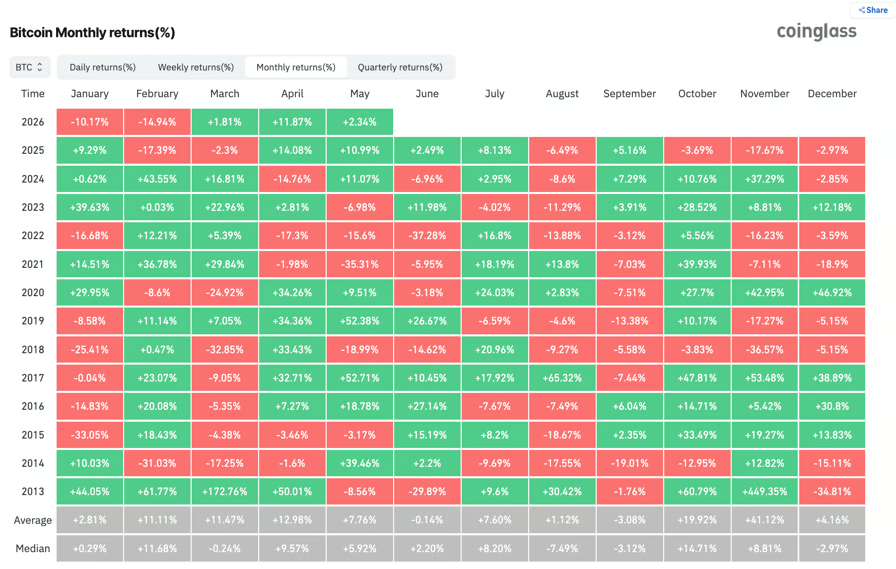
Bitcoin has posted its best-performing month in a year, prompting analysts to forecast what could lie ahead for May, which has historically delivered returns of about 8%.
“Long way to go back to ATHs, but good to see some green,” Coin Bureau founder Nic Puckrin said in an X post on Friday, referring to Bitcoin’s (BTC) performance during the month of April, which saw a monthly return of 11.87%.
It marked Bitcoin’s best-performing month since April 2025, when it returned 14.08%. However, it still came in slightly below its historical April average of 12.98%, according to CoinGlass.

Bitcoin has historically delivered an average return of 7.78% in May. Source: CoinGlass
“April is done. May is here. After 5 consecutive red monthly candles, Bitcoin has now closed 2 in the green, causing some relief in the market,” crypto trader Daan Crypto Trades said in an X post on Friday.
Market participants hold the belief that history repeats
Market participants often compare current monthly performance with previous months and look ahead, as many believe Bitcoin’s history tends to repeat itself.
Bitcoin is trading at $78,190, about 38% down from its October all-time high of $125,100, according to CoinMarketCap. Crypto analyst Jelle said, “We hit the ground running again next week.”

Bitcoin started April at around $66,000. Source: CoinMarketCap
Market participants appear uncertain about the crypto market, according to the Crypto Fear & Greed Index, which posted a “Fear” reading of 39 on Friday, suggesting investors are still cautious.
Bitcoin analysts are divided on what comes next
Analysts are divided on Bitcoin’s near-term outlook. Crypto analytics firm CryptoQuant warned that Bitcoin could be setting up for a multi-month price decline after a rally in April driven mainly by futures traders.
Related: Bitcoin rally extends, yet BTC options price only 25% chance of $84K in May
Others are more bullish. MN Trading Capital founder Michael van de Poppe recently said that Bitcoin may not need a new story or catalyst to push back above the psychological $100,000 level, which it has not traded above in nearly five months.
“There doesn’t need to be a narrative that pushes the price upwards,” van de Poppe said in an X post on Friday, after asking, “What narrative will bring Bitcoin to $100K?”
The last time Bitcoin traded at $100,000 was Nov. 13, just a month after the Oct. 10 $19 billion crypto market liquidation event.
Magazine: Why is Ethereum Foundation selling? BTC futures warning signs: Market Moves

Publicly traded Bitcoin miners have posted broad gains in 2026, with the sector’s 10 largest stocks all trading in positive territory year-to-date. The rally spans roughly 5% to more than 85% for the top names, according to data compiled by Bitcoinminingstock.io. Even as Bitcoin and the wider crypto market faced a cautious backdrop, these miners have benefited from improving fundamentals in data-center operations and a shift toward artificial intelligence and high-performance computing (HPC) workloads.
Among the leading performers, TeraWulf, Hut 8 Corp, and Riot Platforms have outpaced peers in 2026, delivering year-to-date gains around 85%, 67%, and 46%, respectively. Other significant movers include Core Scientific (~40%) and Applied Digital (~37%). By contrast, Bitdeer Technologies Group has trailed the pack with roughly a 5% rise, while American Bitcoin Corp.—the venture formed by Hut 8 and backed by Eric Trump and Donald Trump Jr.—has slid about 29% on the year. The data underscores a stock market narrative where miners are rewarding investors despite a stubborn price environment for Bitcoin itself.
Bitcoin’s price backdrop remains challenging. Bitcoin (BTC) is down about 20% year-to-date, even after having climbed roughly 17% over the previous 30 days. This divergence—rising stock performance in a downbeat crypto price regime—reflects a broader market dynamic where miners are leveraging on-chain profitability and expanding business lines to offset core mining economics. Data on BTC pricing and year-to-date performance are tracked by CoinGecko, while the stock performance snapshot comes from Bitcoinminingstock.io.
For readers tracking the breadth of publicly traded mining exposure, the data set emphasizes how individual companies have differentiated themselves: those with sizable data-center footprints, scalable AI workloads, or diversified revenue streams have tended to outperform peers with more traditional, pure-play mining exposure. The following developments illustrate where the sector is headed and why investors are watching closely.
Key takeaways
- All of the largest publicly traded Bitcoin miners are positive for the year, with gains ranging from roughly 5% to 85%+ as of this year’s mid-point.
- Top performers include TeraWulf (~85%), Hut 8 (~67%), and Riot Platforms (~46%), signaling a rotation toward operators expanding data-center capacity and AI infrastructure.
- Bitcoin’s price remains stressed, down about 20% YTD, highlighting how stock performance has outpaced spot-market momentum in the mining sector.
- Industry players are diversifying into AI and HPC, with Riot reporting strong Q1 data-center revenue and Core Scientific planning a major AI-focused campus expansion in Texas.
- Strategic moves—such as HIVE’s AI and GPU deployments and MARA’s stake in Exaion—signal a broader pivot toward GPU-based workloads and enterprise AI services, potentially reshaping mining economics and asset utilization.
Mining stocks rise as AI and HPC become core bets
The rally among the biggest miners comes as several industry leaders push deeper into artificial intelligence and high-performance computing. Riot Platforms, for example, disclosed a first-quarter 2026 revenue of $167.2 million, with its data-center segment contributing $33.2 million. Management described the quarter as an inflection point, framing the company as transitioning toward a revenue-generating data-center operator rather than solely a Bitcoin miner. This shift signals a broader ambition to monetize large-scale hardware deployments beyond the block reward cycle.
Core Scientific has outlined plans to transform part of its Texas site into an AI-focused data-center campus with a capacity of up to 1.5 gigawatts, including about 1 gigawatt available for leasing. The company indicated that roughly 300 megawatts currently used for Bitcoin mining at the site could be repurposed to support AI and other high-demand workloads. The strategy mirrors a wider industry trend toward repurposing existing mining capacity for non-mining workloads as energy and hardware supply dynamics evolve.
HIVE Digital Technologies also highlighted the AI/HPC pivot, reporting a 219% year-over-year jump in quarterly revenue as it expanded its AI and HPC offerings. The company stated a $30 million contract to deploy Nvidia GPUs for enterprise AI cloud customers, reinforcing the idea that miners can monetize their expansive data-center footprints by serving AI workloads beyond traditional mining.
In another strategic move, MARA Holdings acquired a 64% stake in Exaion, a French AI data-center company, signaling deployment of capital into AI-specific infrastructure. This aligns with the sector’s broader effort to diversify revenue streams through AI-focused data-center platforms rather than relying solely on Bitcoin mining as the primary cash-flow driver.
Industry observers also note a potential reallocation of long-term capital away from pure mining toward GPU-centric, AI-ready infrastructure. Bernstein’s recent note pointed to IREN Limited—the largest publicly traded miner by market capitalization—as potentially pivoting away from Bitcoin mining to a more expansive AI-cloud business. If realized, such a shift would reflect a structural reorientation of capital toward AI-centric workloads and could have meaningful implications for mining stock valuations and future capacity utilization.
These moves illustrate a clear editorial theme: as Bitcoin’s price remains under pressure, mining companies are seeking to optimize asset utilization by expanding into AI, HPC, and data-center services. The data-center angle offers potential resilience against Bitcoin price volatility, as enterprises pay for capacity on a pay-as-you-go basis, potentially smoothing cash flows for miners during cycles of lower block rewards.
What this means for investors and the sector
From an investor vantage point, the current pattern suggests a nuanced risk-reward in the mining space. Companies that can efficiently monetize their data-center assets through AI and HPC workloads may enjoy steadier revenue streams than those reliant on mining alone, particularly when Bitcoin’s price sinks or remains range-bound. The market is already rewarding those capabilities, as demonstrated by the outsized stock gains at the top of the list and the notable performances of Riot, Core Scientific, and HIVE.
However, the pivot toward AI and GPU-based workloads introduces its own set of uncertainties. Demand for enterprise AI compute can be cyclical, and success hinges on securing long-term GPU supply arrangements, managing power costs at scale, and navigating competitive pressure from established AI cloud providers. Investors should watch how effectively these miners monetize AI deployments, the terms of data-center leases, and the pace at which repurposed mining capacity meets enterprise demand.
On the regulatory front, the sector’s diversification into AI centers introduces new considerations around data-center siting, energy usage, and environmental impact—factors that could shape policy and permit timelines. In addition, the performance of AI-focused ventures may influence how capital allocators value traditional mining operations, especially if a sizable portion of cash flow is tied to non-mining services rather than block rewards.
Looking ahead, readers should monitor the progression of AI and HPC contracts across major miners, the extent of capacity reallocation from mining to AI workloads, and any notable partnerships or acquisitions that could broaden data-center ecosystems. The cryptocurrency market’s price trajectory will continue to interact with these dynamics, but the evolving business models suggest a longer horizon where the relevance of scale, power efficiency, and data-center utilization becomes central to miner profitability.
For readers seeking a concise map of the original reporting and data points, the sector’s performance data originates from Bitcoinminingstock.io’s stock-data dataset, with Bitcoin price context drawn from CoinGecko’s year-to-date metrics. Specific company updates and milestones are drawn from industry coverage and company disclosures, including Riot Platforms’ Q1 revenue report, Core Scientific’s Texas AI campus plan, HIVE Digital Technologies’ AI revenue growth and GPU contracts, MARA Holdings’ stake in Exaion, and Bernstein’s assessment of IREN’s potential pivot to AI/cloud services.
As the year unfolds, the critical question remains: can miners sustain a multiyear path toward AI-driven data centers while balancing the volatility inherent in crypto markets? What remains uncertain is how quickly AI-related workloads can scale across the sector, how supply chains for GPUs will respond, and whether these strategic pivots will translate into durable, diversified profit streams for investors.
Watch for further quarterly results and strategic updates from the biggest players as they refine their AI strategies, expand data-center footprints, and experiment with different revenue models beyond pure mining. The next few months could reveal whether the industry can translate AI-centric ambitions into steadier, long-term value creation.
Sources and related coverage: Bitcoinminingstock.io data on top mining stocks; Bitcoin pricing context from CoinGecko. Riot Platforms Q1 2026 revenue report; Core Scientific AI campus plans; HIVE Digital Technologies AI and GPU deployment contracts; MARA Holdings Exaion stake; Bernstein analysis on IREN pivot.
American Bitcoin Corp. is referenced in Hut 8’s materials as part of its strategic partnership, but broader commentary and market impact should be interpreted in light of the company’s performance and the evolving regulatory and operational landscape.
Crypto World
Bitcoin Community Reaches Early Consensus on Quantum Computing Threat, Says Galaxy Digital
TLDR:
- Galaxy Digital Alex Thorn says Bitcoin holders broadly agree Satoshi’s coins should remain untouched.
- Satoshi’s BTC spans roughly 22,000 addresses, making a full quantum attack far harder than many assume.
- Exchanges and active entities can upgrade to post-quantum addresses, reducing their realistic vulnerability.
- Developers broadly support building post-quantum cryptographic tools now and storing them for future use.
The Bitcoin community is gradually forming a shared view on the risks posed by quantum computing. Alex Thorn, Research Director at Galaxy Digital, shared observations from recent discussions held in Las Vegas.
He noted that both skeptics and advocates are beginning to align on key positions. The emerging agreement covers Satoshi Nakamoto’s holdings, post-quantum cryptography development, and how the broader ecosystem should respond.
Satoshi’s Coins and the Case for Non-Interference
A central point of agreement is that Satoshi Nakamoto’s Bitcoin should remain untouched. Thorn noted that interfering with those holdings could seriously damage Bitcoin’s core value proposition around property rights. This position appears to be widely shared across different camps within the community.
Thorn also pointed out that the actual risk may be lower than commonly believed. Nakamoto’s coins are spread across roughly 22,000 addresses, each holding 50 BTC.
As he noted in a post on X, “a long range attack would have to crack them all,” meaning it is not a single concentrated target.
The larger risks, Thorn explained, sit with exchanges and active entities holding large amounts of Bitcoin. However, those parties can upgrade to post-quantum addresses when needed, reducing their vulnerability. This makes them less of a realistic target compared to concerns raised in earlier discussions.
Additionally, Thorn referenced the “hourglass proposal” as a potential measure if a long-range quantum attack ever appeared imminent.
He also cited data showing that Bitcoin markets have routinely absorbed over one million BTC in sell pressure. Even a sharp drawdown from Satoshi’s coins being cracked would likely be manageable, and most Bitcoin holders would accept that trade-off to preserve property rights.
Developing Post-Quantum Cryptography as a Precaution
The second area of emerging agreement involves post-quantum cryptographic research. Most people Thorn spoke with agree that developing new cryptographic tools for Bitcoin is a worthwhile effort. The work includes testing, signature compression, and debating how it could eventually be implemented.
There are, however, recognized risks with moving too fast. Thorn outlined concerns such as diverting developer resources, introducing untested technology into the protocol, and creating consensus gridlock that could stall other upgrades. These risks make the timeline and approach important factors.
A broadly accepted middle ground appears to be developing a post-quantum solution and placing it “on the shelf” for when or if it becomes necessary.
This approach allows preparation without forcing premature changes to the protocol. Thorn described this as “unequivocally a good thing” based on his conversations.
Thorn closed by noting that even a one percent chance of quantum computing affecting Bitcoin justifies continued work on the issue.
He also acknowledged that urgent warnings about the threat have helped push these critical discussions forward within the developer community.
TLDR:
- Bitcoin has tested the $78,657 daily resistance seven consecutive times since April 22 without a confirmed breakout.
- Open Interest fell just 0.69% while price advanced, pointing to spot demand rather than leveraged futures driving the move.
- Funding Rates briefly hit -2.24% on May 1, reflecting extreme short pressure and a potential setup for a rapid squeeze.
- A dense liquidity zone from $79.5K to $81K on the heatmap makes $82K the next natural target if $78.6K breaks cleanly.
Bitcoin is testing a key daily resistance at $78,657 on May 2. Since April 22, the price has challenged this zone seven times without a confirmed breakout.
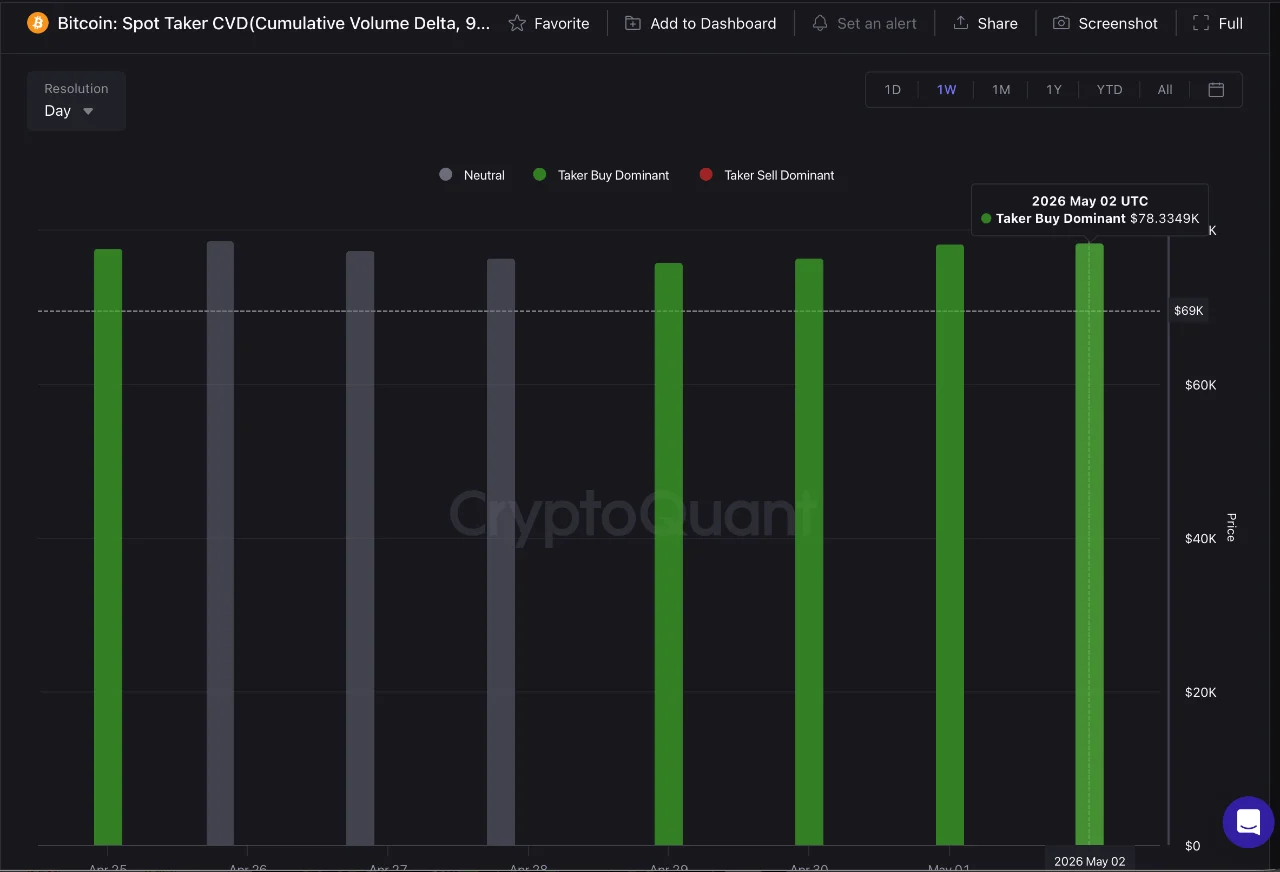
The Spot Taker CVD shows active buy-side demand, yet resistance keeps absorbing it. Derivative data adds tension to the picture.
A dense liquidity zone between $79.5K and $81K sits just above. This makes the current level critical for Bitcoin’s next major directional move.
Spot Demand Drives Price but Falls Short of a Breakout
The Spot Taker CVD is currently green, confirming buy-side dominance in spot markets. Even so, Bitcoin has not broken above $78,657 with clear conviction.
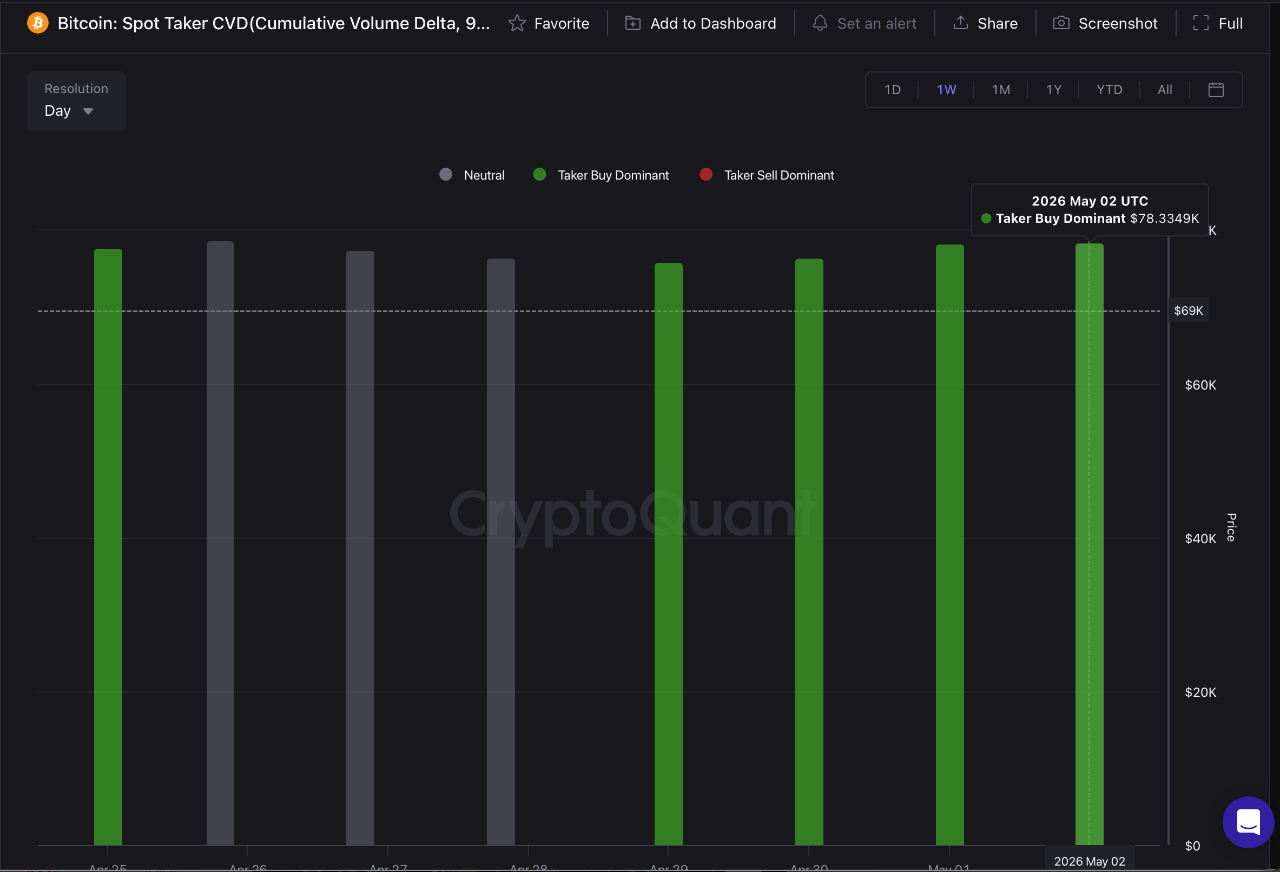
Source: Cryptoquant
The resistance zone continues absorbing incoming demand at a steady pace. Spot buyers remain active but not yet strong enough to force a clean breakout.
Meanwhile, Open Interest recorded only a minor decline during this period. It dropped from 26.737M to 26.552M, a fall of roughly 185M, or just 0.69%.
During that same window, the price moved from $78,480 up to $78,585. The recent advance was not driven by a fresh expansion in leveraged futures positions.
The pattern of rising prices alongside declining open interest points to spot-led action. When spot demand drives a move rather than futures, the resulting structure tends to be more stable.
A breakout could also occur through aggressive futures inflows. However, spot support would give any breakout a higher structural quality.
Crypto analyst Carmelo Alemán observed that buy-dominant spot activity aligned with minimal open interest change. This setup separates the current attempt from previous failed bids at $78,657.
It points to organic demand rather than speculative positioning. Buyers appear to be gradually building pressure at a firm resistance level.
Funding Rate Extremes and Liquidity Zones Define the Upside Risk
The 1-minute Funding Rates showed extreme negative readings on May 1, briefly touching near -2.24%. This means short traders were paying long traders at a highly unusual rate.
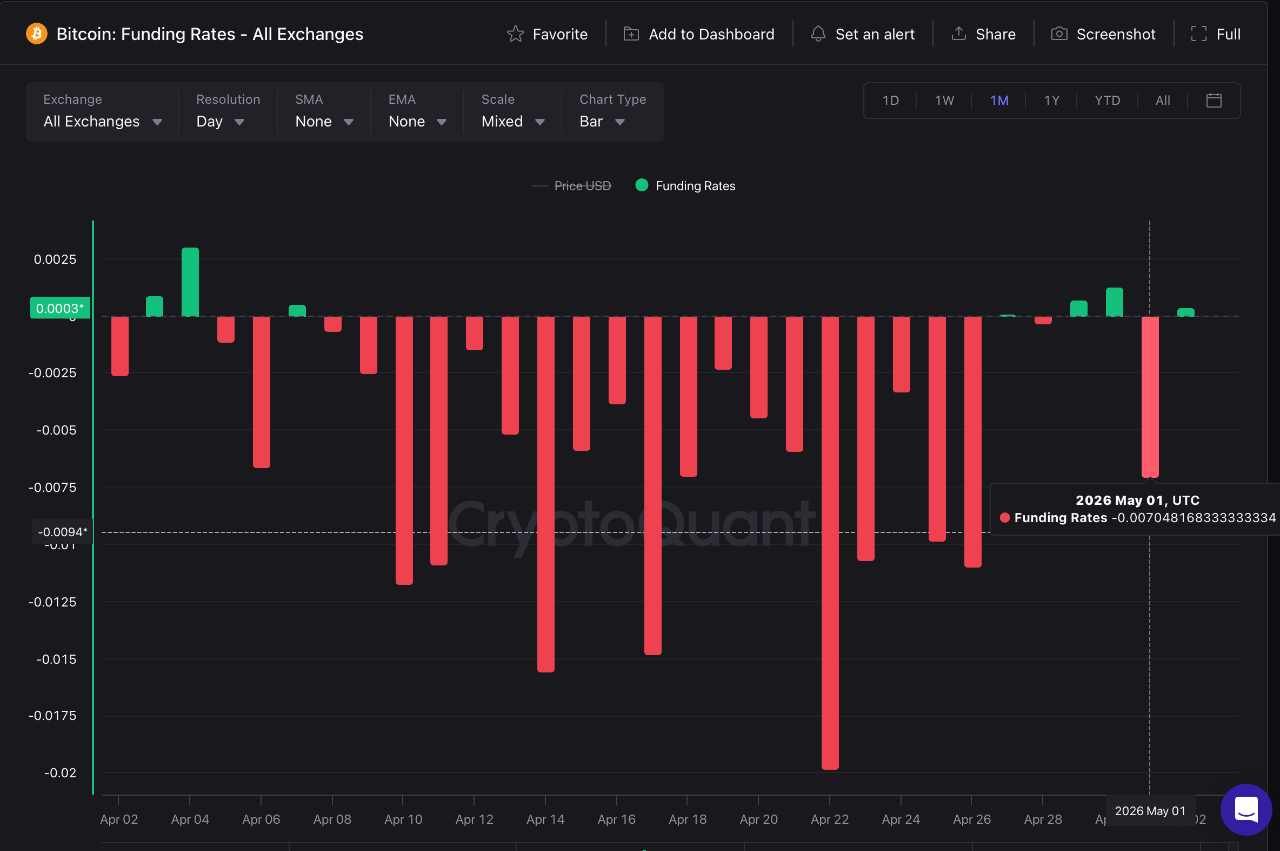
Source: Cryptoquant
Such sharp funding episodes often reflect short-term market stress. They can also set up rapid price moves when short positions get squeezed.
The Estimated Leverage Ratio currently sits near 0.245, moderate but elevated versus earlier weekly lows. The market is not overly stretched at this reading. That said, any sharp directional move could still trigger meaningful liquidations on either side of the market.
On the liquidity heatmap, the zone from $79.5K to $81K appears clearly loaded. Leveraged positions at 5x and 10x are concentrated throughout this range.
If Bitcoin breaks above $78.6K, this liquidity cluster becomes the immediate upside target. Price momentum could accelerate sharply once the breakout pulls in those positions.
Beyond the $79.5K–$81K zone, $82K emerges as the next natural target for Bitcoin. Yet a clear risk follows any sweep of that liquidity cluster.
As leveraged positions close within that range, upside momentum may begin to fade. A price correction remains possible once the market digests the liquidity sweep above $78.6K.

Smithills Hall in Bolton to host popular Fun Dog Show

Week Ahead: RBA Hike, U.K. Local Elections, And U.S. Employment Report

Princess Charlotte Looks Like Kate Middleton in New Video

Manchester United reach agreement with Casemiro over contract clause amid transfer speculation

US brings back mandatory military draft registration

Steven Gerrard disagrees with Gary Neville over ‘shock’ Chelsea and Arsenal claim | Football


-

 Tech6 days ago
Register Renaming | Hackaday
-

 Politics5 days ago
Drax board avoid their own AGM, accused of greenwashing & environmental racism
-

 Tech6 days ago
Why Blue Badges Disappeared From Toyota Hybrids
-

 Tech5 days ago
Images of Samsung’s rumored smart glasses have leaked
-
 Sports7 days ago
IPL 2026: Ruturaj Gaikwad registers slowest fifty of the season, enters all-time unwanted list | Cricket News
-

 NewsBeat7 days ago
LK Bennett closes all stores after entering administration
-
 Tech2 days ago
Trump’s 25% EU auto tariff breaches Turnberry Agreement that also covers semiconductors and digital trade
-

 Fashion4 days ago
Kylie Jenner’s KHY Enters a New Era with ‘Born in LA’
-

 Business4 days ago
Most Commercial Energy Audits Miss the Real Losses
-

 Tech7 days ago
OpenAI’s Sam Altman apologizes for not reporting ChatGPT account of Tumbler Ridge suspect to police
-

 Crypto World5 days ago
CFTC’s AI will review U.S. crypto registration applications, chairman tells CoinDesk
-

 Business6 days ago
(VIDEO) Charlize Theron Climbs Times Square Billboard to Promote New Netflix Thriller ‘Apex’
-

 Business4 days ago
Barclay Brothers Avoid Bankruptcy: HSBC Drops High Court Petitions After IVA Deal
-
 Sports2 days ago
Paul Scholes issues Marcus Rashford reality check as agreement emerges over Man United star
-
 Entertainment6 days ago
Alicia Keys Calls Out Music Industry ‘Boys Club’
-
 Business3 days ago
Tesla Officially Registers Elon Musk’s Stock: What Investors Need to Know
-

 Tech5 days ago
Get Ready for More Brain-Scanning Consumer Gadgets
-

 Tech7 days ago
Dyson Vacuums And The Curse Of Cooked Capacitors
-
Crypto World5 days ago
Robinhood Phishing Scam Exploits Gmail Dot Feature to Bypass Security
-

 Crypto World7 days ago
Only 3% of traders drive Polymarket’s accuracy, not the crowd, study finds
You must be logged in to post a comment Login