
Crypto World
Tangem Wallet launches new promo with BTC rewards and prize draw


Hardware wallets are back in focus as self-custody gains momentum
In today’s crypto market, one trend is quietly returning to the spotlight: self-custody.
After years dominated by centralized exchanges and DeFi platforms, more users are rethinking how they store their assets. Events over the past cycles have reinforced a simple idea: controlling your private keys matters.
Bitcoin and Ethereum continue to lead the market, but at the same time, awareness is growing. The phrase “Not your keys, not your coins” is becoming less of a slogan and more of a practical rule.
As a result, hardware wallets are seeing renewed interest.
Tangem’s approach: simplicity over complexity
Among the newer solutions in this space, Tangem has been gaining attention for taking a different approach.
Instead of relying on traditional seed phrases and complex setups, Tangem uses NFC-based cards that allow users to manage their crypto in a much simpler way.
This design removes a major barrier for many users, especially those who want security without dealing with technical friction.
It also reflects a broader shift in the industry, where usability is becoming just as important as security.
A new campaign introduces BTC rewards and over 100 prizes
To support adoption, Tangem has launched a new promotional campaign running from May 5 to June 5, 2026
During this period, users who purchase a wallet through an affiliate link are automatically entered into a prize draw.
The mechanism is straightforward:
- Each wallet purchased equals one entry
- Multiple wallets increase the number of entries
- No additional sign-up is required
The prize pool includes:
- $5,000 in Bitcoin (1 winner)
- 3 iPhone 17 devices
- Tangem Pro Kits and Tangem Rings
- Multiple BTC rewards ranging from $10 to $50
Winners will be announced on July 5, 2026, following a validation period to ensure only completed, non-refunded purchases are included.
Discount stacking adds another incentive
Alongside the prize draw, the campaign also introduces additional purchase incentives.
Users can combine:
- A 10% discount using a promo code
- A 50% discount on the second wallet when purchasing selected bundles
This creates a “stacking” effect:
- Lower overall cost per device
- Higher number of entries in the draw
- Increased value for users planning multiple wallets
It’s a structure designed to boost both engagement and average order size.
A more competitive hardware wallet landscape
The timing of this campaign reflects a broader shift in the hardware wallet sector.
Competition is no longer just about security. Today, it also includes:
- Ease of use
- Setup experience
- Accessibility for non-technical users
- Integration with mobile-first ecosystems
Tangem’s positioning leans heavily into simplicity, which could appeal to a wider audience beyond early adopters.
Affiliate incentives signal a push for growth
At the same time, Tangem has introduced a loyalty-based incentive model for partners and affiliates.
The program rewards cumulative sales with tiered bonuses, encouraging consistent performance over time
Milestones range from smaller entry levels to high-volume tiers, with total potential bonuses exceeding $6,000, paid in USDT
This type of structure suggests a strong focus on scaling distribution through long-term partnerships rather than one-off campaigns.
Why it matters
In a market where trust and security remain critical, campaigns like this combine several key drivers:
- Direct financial incentives
- Gamification through prize draws
- Discounted entry points for new users
For those already considering a hardware wallet, this period may offer additional upside.
How to participate
Users can access the campaign here:
https://www.cryptobreaking.com/go/tangem/
By using the promo code:
CRYPTO
they can unlock a 10% discount, which can be combined with other active offers during the campaign period.

Crypto World
Bitcoin (BTC) Surges Past $80,000 Amid Continued ETF Inflows and Geopolitical Uncertainty
Key Highlights
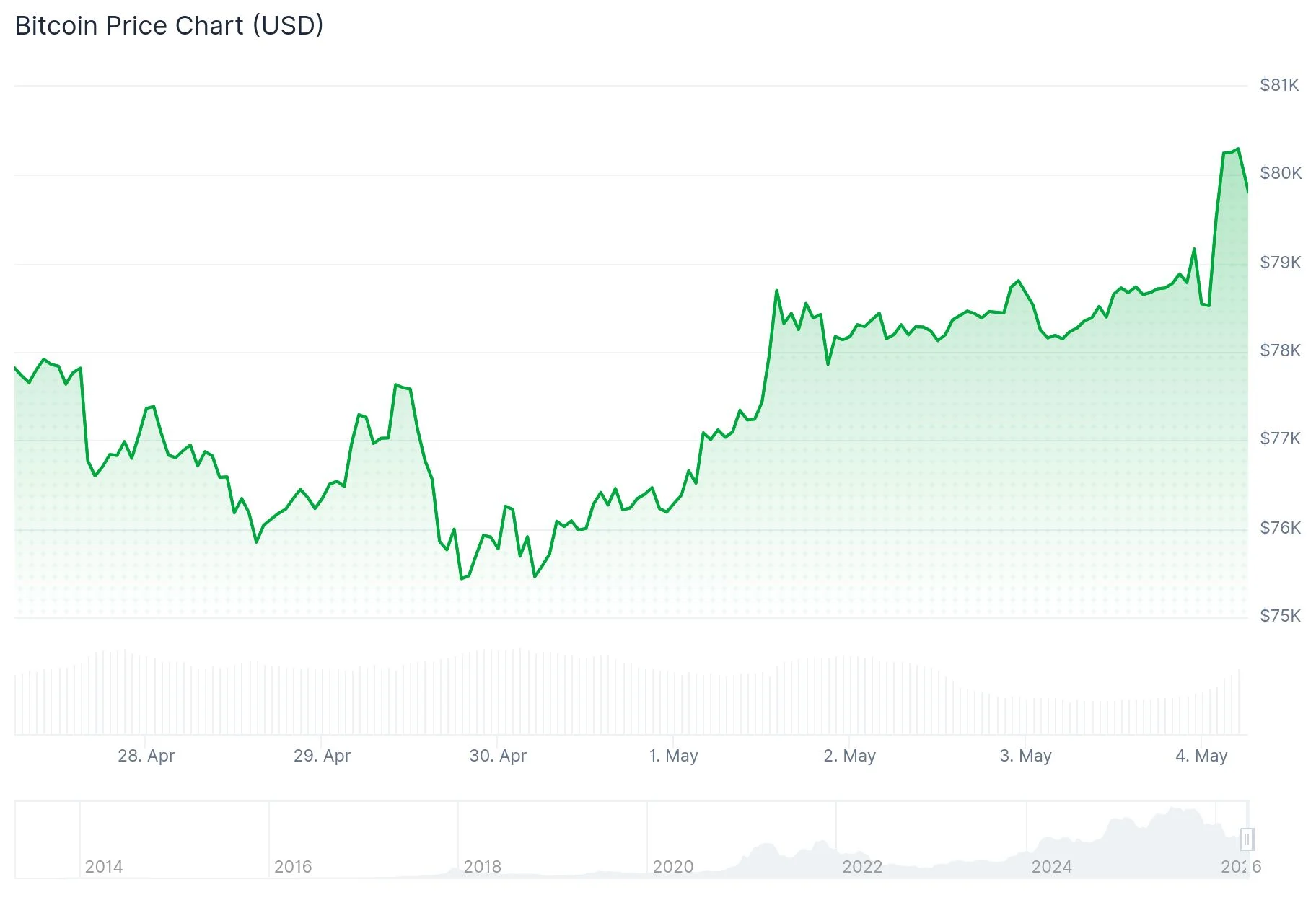
- BTC surged past $80,000 on Sunday evening with a 2.6% gain over 24 hours
- Institutional investors poured $153.87 million into US spot Bitcoin ETFs for the fifth consecutive week
- Geopolitical developments between the US and Iran continue influencing market risk appetite
- Technical analyst Michael van de Poppe identifies $86–88K and $92–94K as critical resistance zones
- Caution persists among some market participants citing potential liquidity traps
The leading cryptocurrency shattered the $80,000 barrier during Sunday’s late trading session, finally breaking through a ceiling that had contained upward movement throughout the weekend. The rally unfolded as market participants monitored developing diplomatic discussions between the United States and Iran alongside consistent institutional accumulation via exchange-traded funds.
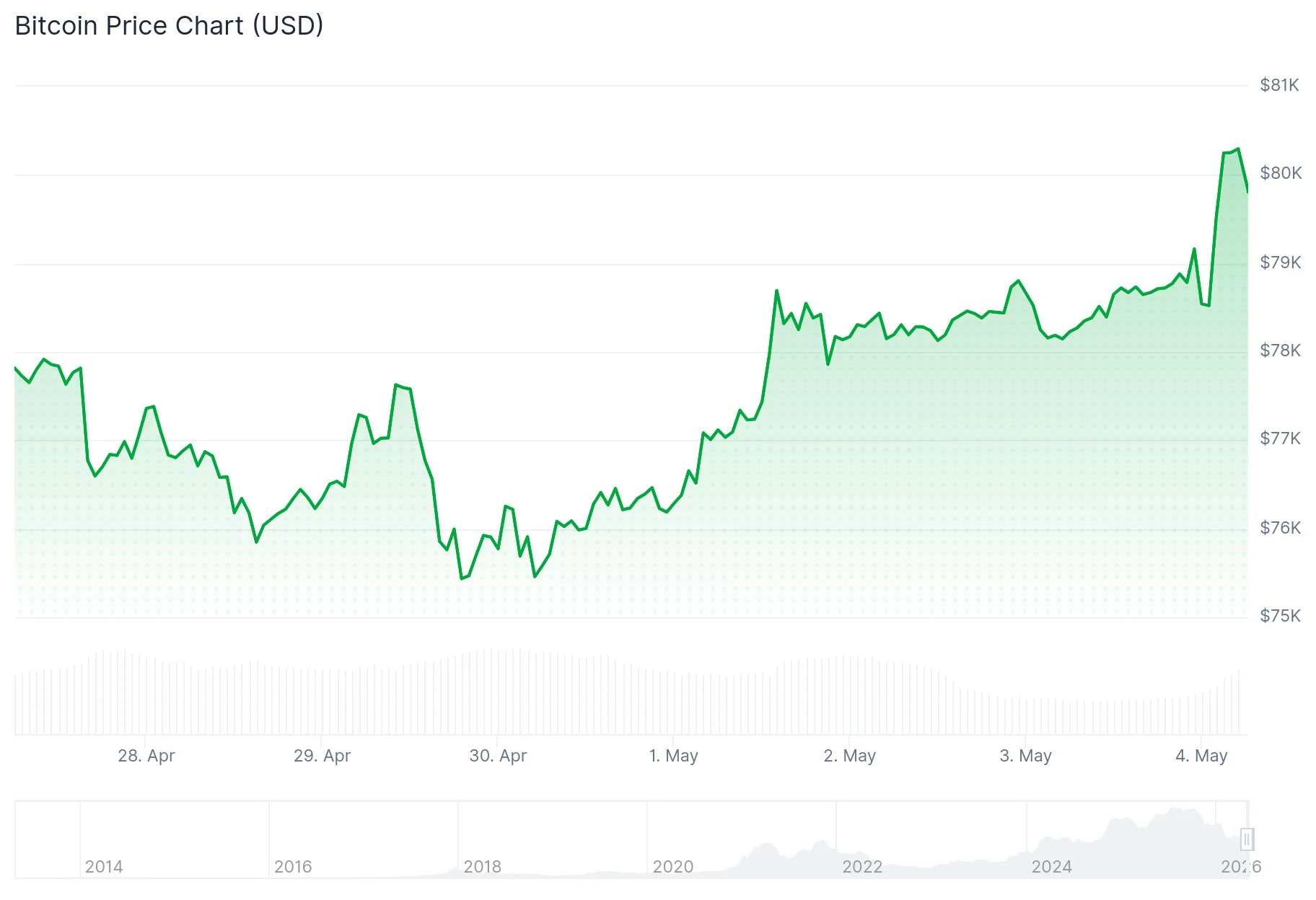
BTC, the flagship digital asset by market capitalization, registered a 2.6% increase across a 24-hour period, reaching $80,150 by 11:40 p.m. ET on Sunday. Meanwhile, Ether posted a stronger 3.6% advance to $2,382, while XRP recorded a modest 2% uptick to $1.41.
According to Nick Ruck, who directs research at LVRG Research, the breakthrough “places near-term momentum firmly as bullish and confirms buyer strength after the earlier pullback.” Dominick John from Zeus Research characterized the movement as a technical short squeeze penetrating what he termed a “major” psychological resistance threshold.
Data from Bitcoin Archive reveals that leveraged short positions exceeding $108 million were forcibly closed within a single hour as BTC maintained its position above $80,000.
Institutional Capital Continues Flowing Into Bitcoin Funds
According to data compiled by SoSoValue, US-based spot Bitcoin exchange-traded funds recorded their fifth straight week of positive net flows, accumulating $153.87 million in fresh capital during the most recent week. Friday’s session alone witnessed approximately $630 million entering these investment vehicles.
Ruck emphasized that the persistent inflows “highlight growing institutional support and confidence in bitcoin as a strategic asset in portfolios.”
Trading expert Michaël van de Poppe shared his perspective on X, highlighting Friday’s substantial ETF activity as a significant indicator. His analysis established $79K as a critical threshold to overcome, followed by initial resistance between $86–88K, with a subsequent target zone of $92–94K should bullish momentum persist.
Market analyst Ted Pillows observed on X that BTC initially breached $79,000 but encountered selling pressure before ultimately securing the level. He suggested that recapturing the $80,000 mark increases the probability of Bitcoin advancing to fill the unfilled CME futures gap positioned at $84,000.
Middle East Geopolitical Developments Under Close Watch
The upward price action coincided with President Trump’s announcement of “Project Freedom” via Truth Social—a program designed to facilitate the safe passage of stranded commercial vessels through the strategically vital Strait of Hormuz. Trump additionally indicated that US negotiators were engaged in “very positive discussions” with Iranian counterparts.
Nevertheless, Iranian representative Ebrahim Azizi issued a statement cautioning that any American intervention in the waterway would constitute a breach of the existing ceasefire agreement. Energy markets responded with Brent crude advancing to $108.49 per barrel.
A weekly close above $78,670 would have represented Bitcoin’s strongest weekly finish since the final days of January. The decisive break above $80,000 pushed that achievement even higher.
Despite the bullish price action, several traders maintained a circumspect outlook. Crypto Tony identified accumulating liquidity beneath current price levels. JDK Analysis characterized the current configuration as “typically bearish,” noting fresh long positions entering at elevated prices while observing potential signs of demand exhaustion.
Market participants are closely monitoring Thursday’s initial jobless claims release, ongoing diplomatic developments between Washington and Tehran, and continued ETF flow data as primary catalysts heading into the upcoming trading week.



Strategy has halted Bitcoin purchases for the week ahead of its first-quarter earnings release and rising scrutiny around its preferred stock dividend.
Summary
- Strategy has paused Bitcoin purchases for the week ahead of its first quarter earnings report, with Michael Saylor confirming no buys in a Sunday update.
- The company last acquired 3,273 BTC for $255 million, taking total holdings to 818,334 BTC valued at roughly $63.7 billion.
- Analysts expect a $18.98 per share loss, while criticism has intensified around STRC’s 11.5% dividend and its long-term sustainability.
According to a Sunday post on X by Michael Saylor, the company signaled “No buys this week,” breaking a pattern where he regularly flags upcoming accumulation.
The decision follows a recent stretch of steady buying. A Form 8-K filing with the U.S. Securities and Exchange Commission shows Strategy acquired 3,273 Bitcoin for about $255 million between April 20 and 26, funded through the sale of 1,451,601 MSTR Class A shares under its at-the-market equity program. Yahoo Finance reported the purchase price averaged $77,906 per coin.
Holdings have reached 818,334 BTC, which Saylor said were acquired for roughly $61.81 billion at an average of $75,537 per bitcoin. At current prices near $78,000, filings and market data place the position’s value at about $63.7 billion, implying an unrealised gain of roughly $1.9 billion.
As reported by crypto.news, Strategy added more than 34,000 BTC for $2.54 billion in a single week last month, which marked one of its largest purchases on record. Across April, four acquisitions totalled well over $3 billion, with earlier deals funded through a mix of MSTR stock sales and issuances of STRC, its perpetual preferred security.
Attention has turned to Strategy’s upcoming earnings report, where analysts expect pressure from accounting treatment tied to Bitcoin. Yahoo Finance data shows Wall Street forecasts a loss of $18.98 per share for the quarter, compared with a $16.49 loss a year earlier, largely due to mark-to-market adjustments on its holdings.
At the same time, scrutiny has intensified around STRC, which offers an 11.5% dividend yield. Peter Schiff repeated his criticism of the structure on Sunday, arguing in a post on X that relying on Bitcoin appreciation above that yield does not resolve what he described as a “ponzi like structure.”
Concerns over sustainability have also been raised by Joseph Parrish, who wrote on April 28 that current cash reserves may not cover two years of STRC dividend payments. Parrish warned that continued stock issuance could become necessary, increasing risk if Bitcoin fails to outperform expectations.
Despite the concerns, data from TipRanks shows a consensus “Strong Buy” rating on Strategy’s Nasdaq-listed shares, even as some investors weigh leverage, payout obligations, and dependence on equity funding.
Strategy still has $26.47 billion in MSTR shares available under its existing issuance program, according to its latest filing, leaving room to continue funding Bitcoin purchases without securing new capital sources.

Disclosure: This article does not represent investment advice. The content and materials featured on this page are for educational purposes only.
Mobile cloud mining expands in 2026 as BM Blockchain attracts beginner interest in BTC and DOGE mining.
Summary
- Mobile-first cloud mining platforms like BM Blockchain simplify Bitcoin mining without hardware or setup complexity.
- The platform offers beginner-friendly crypto mining with guided onboarding and mobile access to mining tools.
- As mining interest grows, BM Blockchain appeals with easy entry, no hardware needs, and streamlined participation.
As more people look up things like what Bitcoin mining is, how to mine Bitcoin, and whether any free cloud mining options still exist in 2026, the mobile-first crypto mining space keeps growing. On Android, iOS, and web dashboards, more users are choosing Bitcoin and Dogecoin cloud mining platforms instead of buying hardware, dealing with heat and power bills, or running dedicated mining rigs.
In real life, “free” usually doesn’t mean mining is forever at zero cost. In 2026, it more often points to free sign-ups, welcome bonuses, trial access, or mobile tools that let people get a feel for mining-related systems before paying for larger plans. That’s why comparison roundups still matter for anyone trying to understand how Bitcoin mining works, how BTC cloud mining platforms actually run, and which services might be easier for beginners.
Below is an original roundup of five platforms that people often mention when talking about the best cloud mining, the best crypto cloud mining options, and beginner-friendly ways to access Bitcoin and Dogecoin mining in 2026.
Top free cloud mining platforms (2026 comparison)
| Platform | Best For | Mobile Access | Entry-Level Feature |
| BM Blockchain | Beginner-friendly platform-based mining access | Mobile-friendly / browser access | Publicly referenced onboarding-related allocations valued at up to $108 |
| StormGain | Users looking for app-based mining activation | Android app | In-app mining activation cycle model |
| ECOS | Contract-style cloud mining access | Android / iOS app | Hosted infrastructure and integrated wallet tools |
| NiceHash | Users monitoring mining operations and hashrate markets | Android / iOS app | Mining marketplace and management interface |
| Binance Pool | Exchange ecosystem users seeking mining-related access | Mobile ecosystem support | Mining-related services integrated within a broader exchange environment |
1. BM Blockchain — Best for users looking for a low-barrier starting point
BM Blockchain can be seen as a beginner-friendly choice for people who want to try Bitcoin cloud mining or Dogecoin mining through a platform, instead of buying and running their own mining hardware. Based on publicly available industry information, BM Blockchain is described as focusing on letting users take part in infrastructure, access computing power, and get a more guided onboarding experience if they’d rather not deal with hardware setup themselves.
For those searching for things like how to mine Bitcoin or how to start mining Bitcoin without building a rig, this kind of platform setup may sound appealing because it removes a lot of the usual technical friction. Instead of setting up and tuning equipment, users can look through the platform’s tools, compare different ways to participate, and get started through a mobile-friendly experience.
Industry disclosures also mention welcome allocations during onboarding valued at up to $108, framed as participation incentives rather than any promised financial result. Interested investors who are comparing cloud mining apps or looking up the best cloud mining options, that kind of easier, low-effort onboarding could make BM Blockchain stand out as a place to begin.
BM Blockchain 2026 illustrative participation snapshot
| Model | Entry Amount | Term | Illustrative Daily Estimate | Illustrative End-of-Term Estimate |
| Starter Plan | $200 | 1 Day | $7.00 | $207.00 |
| A15 Compute | $1,200 | 2 Days | $43.20 | $1,286.40 |
| A2 Cluster | $3,600 | 3 Days | $136.80 | $4,010.40 |
| GPU Node | $8,000 | 2 Days | $344.00 | $8,688.00 |
| Hyd Compute | $16,800 | 3 Days | $924.00 | $19,572.00 |
Stable returns and a clear timeline: This is a truly hands-free way to earn Bitcoin daily.
BM Blockchain states that actual returns may vary depending on platform conditions, applicable terms, fees, operational assumptions, timelines, and broader market factors.
View the full contract and claim $108 worth of free hashrate!

2. StormGain — Best for a Bitcoin miner app experience
StormGain often comes up when people search for terms like best Bitcoin miner app, bitcoin miner app, or bitcoin mining apps, mainly because it offers a mobile-first way to access mining. Beginners in particular talk about it when they want an app that works through simple activation instead of dealing with a more technical contract-style dashboard.
A big reason StormGain shows up so much in beginner conversations is convenience. When someone is asking how to mine Bitcoin on a phone or is looking for a crypto mining experience on mobile, an app-based interface usually feels easier to approach than more traditional mining services.
3. ECOS — Best for structured contract-based cloud mining
ECOS often shows up in cloud mining roundups because it gives users a more structured setup, with hosted mining contracts and centralized tools to manage their accounts. Compared to lighter apps that focus more on quick activation, ECOS tends to suit people who want something more organized and a clearer, contract-style way of presenting the service.
For anyone looking into bitcoin cloud mining, BTC cloud mining, or how to start crypto mining, this approach can feel closer to getting longer-term access to mining infrastructure than just using a casual app.
4. NiceHash — Best for users interested in mining marketplace tools
NiceHash usually comes up less as a typical “free mining app” and more as a marketplace for mining power, along with a platform to manage day-to-day mining operations. That’s why it tends to appeal to people who want to see things like hashrate prices, use account tools, and track mining activity, instead of relying on a simple sign-up bonus approach.
For people looking up what miners are in blockchain, or trying to get a clearer picture of how mining marketplaces work, NiceHash is still one of the better-known names in this space.
5. Binance Pool — Best for exchange-integrated mining access
Binance Pool gets attention mainly because it links mining services with the wider Binance exchange ecosystem. For users who already use Binance regularly, this all-in-one setup can feel easier than running mining through a separate platform.
Looking at different cryptocurrency cloud mining services? People often see Binance Pool as a solid choice when it matters to have everything connected in one ecosystem, not just the mining access on its own.
Why Bitcoin and Dogecoin cloud mining continues to attract attention
Bitcoin is still the best-known digital asset by market value, and Dogecoin continues to get a lot of attention from everyday buyers. Put together, they show two very visible, but very different, corners of the digital asset market.
Many people who look up how to mine cryptocurrency, how to mine Dogecoin, or how long it takes to mine Dogecoin usually aren’t trying to run a large mining setup. More often, they’re looking for an easier way to get started so they can understand what it means to mine Bitcoin, how cloud-style options work, and whether a mobile-friendly service makes more sense for them than buying and managing their own hardware.
That’s part of why mobile crypto mining and browser-based tools are still getting more attention in 2026.
How to choose the right cloud mining platform
Every platform works a bit differently, and “free” doesn’t always mean the same thing everywhere. In real use, people should compare:
- Wwhat “free” actually means on the platform
- Whether the service is app-based, browser-based, or contract-based
- How clearly the participation model is explained
- Whether fees, estimates, and withdrawal rules are disclosed
- Whether the platform is designed for beginners or more advanced users
A practical way to do this is to begin on a platform with a lower entry barrier, get familiar with the participation rules, and try out the user experience first, then gradually increase the allocation.
Frequently asked questions
What is Bitcoin mining?
Bitcoin mining is basically how transactions get checked and then recorded on the blockchain, using computing power. In the past, that usually meant having dedicated mining machines, but a lot of people now start by looking into Bitcoin cloud mining platforms instead of buying and running hardware themselves.
How does Bitcoin mining work?
Bitcoin mining works by using computing power to confirm transactions on the network and help keep the blockchain secure. With cloud mining, people generally use remote services and rented infrastructure rather than owning and running the machines directly.
How can I mine Bitcoin as a beginner?
For those who are new, the easiest starting point is often an app or a platform that walks them through it. Many people who search for how to mine Bitcoin or how to start mining Bitcoin begin with cloud dashboards, instead of jumping straight into ASIC hardware.
What is cryptocurrency mining?
Cryptocurrency mining usually means using computing power to help process blockchain transactions and keep the network running safely. People searching for what cryptocurrency mining is or what cryptocurrency mining is are often trying to understand the difference between mining with their own hardware and joining through a cloud-based option.
What is the best Bitcoin miner app in 2026?
There isn’t one best choice that fits everyone. People looking for the best bitcoin miner app often compare things like how easy it is to use, how clear the terms are, how transparent it feels, and whether it’s mainly for activation, monitoring, or actually connecting users to a broader mining marketplace.
Can crypto be mined on a laptop or phone?
Most of the time, doing serious mining directly on a laptop or phone isn’t really practical anymore. That said, some people use cloud mining apps, crypto mining phone tools, or mobile-friendly dashboards that let them join or manage mining without making the device do the heavy work.
How to mine Dogecoin in 2026?
For those who are asking how to mine Dogecoin, it usually comes down to two routes: mine directly with the right hardware, or join through a cloud platform that offers access tied to Dogecoin. The cloud approach is often easier for beginners since they don’t have to deal with hardware setup.
How long does it take to mine Dogecoin?
That depends on how a person is mining, how much computing power is involved, and which platform or setup they’re using. So, searches like how long to mine Dogecoin and dogecoin cloud mining earnings can lead to very different expectations, depending on whether someone means solo mining, pooled mining, or a platform-based setup.
What does “cloud mining free” really mean?
Most of the time, it means free sign-up, a welcome bonus, a trial period, or limited-time activation — not endless mining with zero cost. It’s worth checking how each platform explains what “free” includes.
Conclusion
The mining scene in 2026 isn’t dominated by just one kind of product anymore. People can now choose from infrastructure-focused services, mobile-first onboarding platforms, mining marketplaces, and ecosystems tied to exchanges.
For those who are looking up things like what Bitcoin mining is, how to mine Bitcoin, the best cloud mining options, or how to mine Dogecoin, a good place to begin is usually a platform that clearly explains how someone can get access and makes it easier to start without having to own hardware. Publicly mentioned onboarding offers, like the $108 welcome incentive linked to BM Blockchain, also show how some platforms are trying to make it simpler for first-time users to get started.
As usual, it’s worth comparing the terms across platforms, understanding what each one actually means by “free,” and checking the participation rules before jumping in.
Disclosure: This content is provided by a third party. Neither crypto.news nor the author of this article endorses any product mentioned on this page. Users should conduct their own research before taking any action related to the company.

VANCOUVER, CANADA – APRIL 28: Gianni Infantino, FIFA President, presents Vittorio Montagliani, FIFA Vice-President and President of the Confederation of North, Central America and Caribbean Association Football (CONCACAF), with a gift during FIFA Council Meeting No. 36 at Fairmont Pacific Rim hotel on April 28, 2026 in Vancouver, Canada. (Photo by Verity Griffin – FIFA/FIFA via Getty Images)
Verity Griffin – Fifa | Fifa | Getty Images
FIFA has increased payments to teams competing in the 2026 World Cup, raising the total distribution to $871 million, making it the most lucrative edition on record.
But the increased financial distributions, announced last Wednesday at the 36th FIFA Council meeting in Vancouver, Canada, come as the governing body faces criticism over ticket pricing and its commercial partnerships.
Under the new financial distribution structure, participating associations at the 2026 World Cup — set to be held across the U.S., Mexico, and Canada from 11 June — will each receive an additional $2 million, across:
That brings the minimum payout for each team to at least $12.5 million upon qualification, with additional prize money tied to performance in the tournament.
These payments are meant to defray some of the costs associated with qualifying and preparing for the quadrennial sporting tournament, including travel, training facilities and staff remuneration and are expected to be particularly meaningful to teams outside of the sport’s traditional powerhouses, according to Ricardo Fort, founder of sport consultancy Fort Consulting.
“This incremental contribution to the national football associations reinforces FIFA’s role in redistributing the commercial success of the tournament back into the global football ecosystem,” Fort said.

The 2026 edition of the World Cup is set to be the largest-ever, expanding to 48 teams, up from 32 in 2022. Four national teams — Cape Verde, Curacao, Jordan, and Uzbekistan — are set to make their debuts at this year’s edition.
FIFA said more than $16 million has also been set aside to cover the costs of participating delegations and team ticketing allocations, bringing the total pool set aside for participating teams to $871 million.
Football’s governing body previously announced a more than 50% increase in the tournament’s prize pool in December.
In December, the FIFA Council approved a “record-breaking” prize pool of $727 million at the 2026 edition of the tournament, a 65% increase from the $440 million allocated to teams in the 2022 World Cup in Qatar.
Ticket pricing concerns
Despite the higher payouts at this year’s tournament, fans have expressed gripes over ticket pricing and the sources of FIFA’s revenue.
Under FIFA’s new “dynamic” pricing system, ticket prices fluctuate on demand. Some fans have reported that ticket prices have risen by more than tenfold from the 2022 tournament.
A CNBC review of ticket prices revealed prices ranging from $380 for a Category 2 ticket for a group stage match between Curaçao and Côte d’Ivoire in Philadelphia, to $4,105 for Category 1 tickets to a game between the U.S. and Paraguay at the Los Angeles Stadium.
On FIFA’s official ticket resale platform, some listings have reached extreme levels, with one such resale ticket for the final listed at $11.5 million. While FIFA does not control the prices of resale tickets, a 15% fee on the value of each transaction is collected.
A FIFA spokesperson told CNBC that the organization was “focused on ensuring fair access to our game for existing but also prospective fans, and offered group stage tickets starting at $60.”
These lower-cost tickets, however, were allocated “specifically to supporters of qualified teams, with the selection and distribution process managed individually by the Participating Member Associations .”
The spokesperson added that the variable pricing system “aligns with industry trends across various sports and entertainment sectors,” and ensures a “fair market value for events.”

Despite outrage over ticket prices, demand for tickets at this year’s World Cup ostensibly remains high.
FIFA President Gianni Infantino previously told CNBC that the organization has received around 508 million requests for the seven million tickets on offer across the tournament’s 104 matches.
If true, in-person viewership at this year’s World Cup would dwarf attendance at the 2022 tournament in Qatar, which drew more than 3.4 million spectators across all 64 matches.
“Ticket pricing is always a sensitive topic for mega-events of this scale,” Fort said. “There will always be segments of fans who feel priced out, especially for premium matches.”
Still, he said FIFA’s pricing strategy “has worked in the American market,” given the high demand.
Fans appear to have paid little attention to FIFA’s other controversies, including a sponsorship deal with Saudi Arabia’s Aramco and the awarding of the FIFA Peace Prize to U.S. President Donald Trump.
“Historically, what we’ve seen is that fan engagement with the tournament itself remains incredibly resilient. Once the competition starts, the focus shifts very quickly to the football,” said Fort.
FIFA’s finances have also grown alongside the tournament. In 2025, the governing body’s revenues totaled $2.66 billion, with television broadcasting rights accounting for a large portion, followed by marketing rights.
Its total assets rose to $9.48 billion, up 54% from the year before. Total reserves, however, fell to nearly $2.7 billion, down by 8% year over year as total liabilities more than doubled in 2025.
Officially a not-for-profit, FIFA’s investments are funneled to infrastructure across its 211 member nations, as well as the organization of tournaments such as the World Cup and Club World Cup, according to the Association’s 2027-2030 budget.
Stablecoins, the name given to cryptocurrencies pegged to the price of a stable asset such as the US dollar or gold, have outgrown their label as they become part of the global financial system, said Robert Hackett, head of special projects at a16z crypto.
Hackett said in a report on Friday that the term “stablecoins” was coined in crypto’s early years, when wild volatility defined the space and the tokens were created to maintain stable value and encourage their use for everyday financial activity.
“The name was straightforward, if slightly defensive: not a volatile coin, but a stable one. It described the problem it solved perfectly. But the technology has since outgrown the label,” he said.
“Stability is now table stakes. It’s a prerequisite, and not the point. The question is no longer ‘will it hold its value?’ But ‘what else can we build with it?’” Hackett added.
“That’s why the name stablecoin is outdated now: It still points to the original problem it was designed to solve, not the platform it has become. The term frames the category as a patch rather than a new primitive.”
Stablecoins have emerged as a key use case for crypto. The global market has grown to more than $321 billion, according to DefiLlama. Adoption is also expanding across economies as banks and institutions seek to use the technology for faster payments and other benefits.
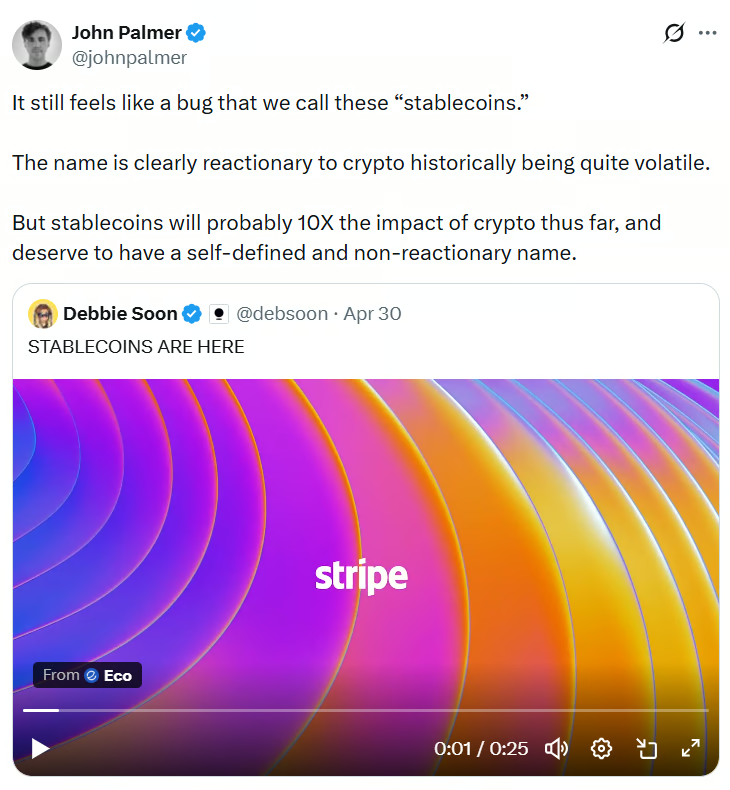
John Palmer, a developer and brand adviser, made a similar argument on Thursday and said it “feels like a bug” to call them stablecoins because “stablecoins will probably 10x the impact of crypto thus far and deserve to have a self-defined and non-reactionary name.”

Source: John Palmer
The stablecoin name will likely linger
Hackett said a rebrand to a term that better captures the essence of the technology, such as “digital cash” or “programmable money,” is too clunky to use.
Related: Stablecoins overtake Bitcoin in Latin America crypto purchases — Bitso
At the same time, he argued that the first term that gains traction with a new technology often sticks, such as email, which no longer operates like traditional mail, or horsepower when describing a car’s engine power.
“Stablecoins will probably follow the same quirky etymological path. The skeuomorphic name may linger long after it stops being descriptive. Or it may gradually fade as we simply speak of digital dollars, digital euros and other onchain assets,” Hackett said.
“Most likely though, the technology will disappear into the background entirely and become just how money works, the same way we stopped saying electric lighting once that newfangled gadgetry became the default. Now they’re just lights.”
Magazine: AI-driven hacks could kill DeFi — unless projects act now

The US Commodity Futures Trading Commission received more than 1,500 responses to a proposed rule tied to prediction markets, with some backing the regulator while others called for a tougher crackdown on the platforms.
The CFTC’s request for public comments on a rule it proposed in March that would allow it to amend or issue new regulations for event contracts on prediction markets ended on Thursday, drawing responses from prediction markets, crypto firms and consumer advocacy groups.
Kalshi co-founder and chief operating officer Luana Lopes Lara backed the CFTC in a letter on Thursday, saying its existing regulations were “well-designed and effective,” urging it to give guidance to ensure “that the universe of event contracts can continue to be listed, traded, and overseen by the Commission.”
The CFTC’s proposed rule comes as it looks to cement its authority over prediction markets, which have faced legal challenges from multiple US states that accuse the platforms of offering unlicensed sports gambling.
Kalshi, Polymarket and Coinbase are among the companies that have been sued over their sports prediction market offerings and have argued they are under the CFTC’s sole authority, a position the regulator has backed by suing at least five state governments that took legal action against prediction markets.
Polymarket US CEO Justin Hertzberg applauded CFTC Chair Mike Selig in his letter for “asserting the CFTC’s longstanding exclusive jurisdiction over prediction markets,” adding the company believes the regulator “should continue to exercise its exclusive jurisdiction over prediction markets.”

Mike Selig, pictured on a podcast in March, has threatened to sue any state that takes action against prediction markets. Source: YouTube
Venture capital firm Andreessen Horowitz also supported the CFTC, arguing in its letter that “state actions to regulate or ban prediction markets impose a serious barrier to impartial access,” a key rule for CFTC-regulated firms.
Meanwhile, gambling regulators in Tennessee, Missouri and Pennsylvania, among others, blasted the CFTC over its defense of sports event contracts, urging the regulator to drop its support.
Pennsylvania Gaming Control Board Executive Director Kevin O’Toole said the CFTC was allowing prediction markets “to masquerade as unregulated sportsbooks,” while Tennessee Sports Wagering Council Executive Director Mary Beth Thomas said the council disputes “that sports event contracts offered on prediction markets fall within the jurisdiction of the CFTC at all.”
Related: Polymarket pushes for broader US relaunch with CFTC talks: Report
Missouri Gaming Commission executive director Michael Leara said that Congress “did not intend futures markets to encompass gambling activities,” and urged the CFTC to “properly reserve jurisdiction over sports event contracts for the states.”
Prediction markets have also come under scrutiny from some federal lawmakers, who are concerned about the platforms’ offering markets tied to geopolitical events and their possible use by those with insider knowledge after well-timed bets on the Iran war.
Dennis Kelleher, the CEO and co-founder of the consumer advocacy group Better Markets, and 12 other consumer groups, told the CFTC in a joint letter that it should “prohibit event contracts that involve elections or geopolitical events,” arguing such contracts could influence government actions.
Kalshi and Polymarket said last week, after the US Senate passed a ban on its members and staff using prediction markets, that they have cracked down on insider trading and ban or prohibit some users, such as politicians, from using their platforms.
Magazine: Should users be allowed to bet on war and death in prediction markets?
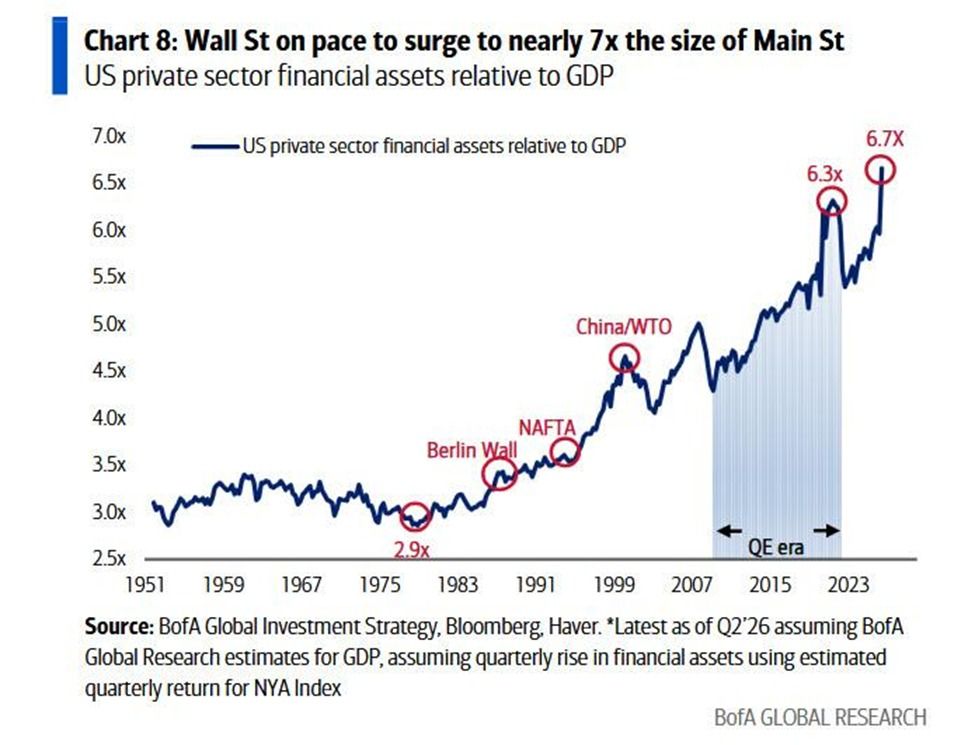
The total value of US private-sector financial assets has reached 6.7 times the US gross domestic product, marking a new record.
The ratio, which compares the combined value of stocks, bonds, deposits, and other financial instruments held outside the government to annual GDP, surpasses the previous peak of 6.3 times set in 2021.
The Gap Between Wall Street and Main Street Hits a Record
According to the Kobeissi Letter, the ratio has more than doubled since the 1970s. When asset values climb faster than wages, the gains flow to investors who own capital.
The 6.7x ratio shows that the private sector holds nearly 7 dollars in financial instruments for every dollar of US output.
“When financial assets outpace the real economy, the wealthy get richer, and workers get left behind,” the analysts wrote. “The wealth gap has never been wider.”

Follow us on X to get the latest news as it happens
Wealthy Investors Are Doubling Down on Stocks
At the same time, portfolio positioning among high-net-worth individuals signals a continued tilt toward risk assets. The Kobeissi Letter noted that equity allocations have risen to 65% of total portfolios, the highest level since December 2021.
This marks a 7-point increase since 2023 and places current positioning just below the 66% peak seen during the 2021 meme stock surge.
“By comparison, the 2020 pandemic low was 54% while the long-term average is ~57%,” the post added.
The analysts added that cash holdings have declined to 10%, the lowest level since September 2018, while bond exposure has dropped to 18%.
The shift suggests that affluent investors are increasingly concentrated in equities, reflecting elevated risk appetite and continued confidence in financial markets.
Subscribe to our YouTube channel to watch leaders and journalists provide expert insights
The post US Private Financial Assets Hit Record 6.7x GDP as Wealth Gap Widens appeared first on BeInCrypto.

The U.S. Commodity Futures Trading Commission (CFTC) is navigating a high-stakes regulatory discussion as it closes a public-comment window on a proposed rule designed to strengthen its authority over prediction markets. The rule, introduced in March, would allow the agency to amend or issue new regulations for event contracts traded on prediction platforms, with the comment period ending this week. The outreach drew more than 1,500 responses from a range of stakeholders, including prediction-market operators, crypto firms, and consumer-advocacy groups. According to Cointelegraph, the feedback underscored a broad debate about how the CFTC should supervise these markets and the proper balance between federal oversight and state authority.
Kalshi, a prominent player in the prediction-market space, publicly endorsed the CFTC’s approach. In a letter to the agency, Kalshi’s co-founder and chief operating officer, Luana Lopes Lara, argued that the CFTC’s current framework is “well-designed and effective” and urged the commission to provide guidance that would keep a broad universe of event contracts listed, traded, and overseen under federal supervision. The stance reflects a general expectation within the industry that clear, predictable federal rules help ensure safe operation and robust market integrity.
The regulatory moment comes amid persistent legal contestation surrounding prediction markets. Several platforms—including Kalshi, Polymarket, and Coinbase—face lawsuits brought by various U.S. states alleging unlicensed gambling activities tied to sports markets. The CFTC has signaled that it views prediction markets as falling under its exclusive federal authority, a position it has reinforced in litigation with at least five state governments. In this environment, the proposed rule seeks to codify the commission’s jurisdiction while inviting input on how to tailor oversight for event contracts, market listing rules, disclosure standards, and enforcement tools.
Polymarket’s U.S. chief executive, Justin Hertzberg, praised CFTC Chair Mike Selig for affirming the agency’s exclusive jurisdiction. In a separate comment letter, Hertzberg stated that the regulator should continue to exercise that jurisdiction over prediction markets, underscoring industry preference for federal clarity rather than state-by-state variability. The perspective is echoed by venture-capital firm Andreessen Horowitz, which argued in its submission that state actions to regulate or ban prediction markets create barriers to impartial access—an outcome at odds with the objectives of CFTC-regulated platforms.
Key takeaways
- More than 1,500 public comments circulated to the CFTC, reflecting broad engagement from industry players, platform operators, and advocates for consumers and market integrity.
- Industry participants generally welcomed the prospect of clearer federal guidance and continued CFTC oversight of event contracts used in prediction markets.
- State gambling regulators scrutinized the federal push, arguing that prediction-market contracts may fall outside the CFTC’s remit or should be constrained by state licensing regimes.
- The dispute illuminates ongoing tensions between federal and state regulators, with implications for licensing, enforcement, and cross-border operations in the U.S. market.
- Policy considerations extend to related areas such as AML/KYC compliance, licensing pathways for platforms, and how prediction markets intersect with sports betting and geopolitical-event markets.
According to Cointelegraph, the comments also reflect a wider concern among lawmakers and consumer groups about the appropriate scope of prediction markets. Some critics, including Dennis Kelleher, CEO of Better Markets, joined a coalition urging the CFTC to bar event contracts tied to elections or geopolitical events, citing potential influence on governance actions. The debate touches on fundamental questions about what kinds of markets are permissible, how consumer protection should be safeguarded, and whether federal rules can prevent corrosive or unlawful activity without stifling legitimate market-making and risk transfer functions.
Regulatory framework and jurisdiction under the lens
The CFTC’s rulemaking initiative arrives at a moment when the agency emphasizes its authorities over event contracts traded on prediction platforms. Proponents frame the move as a necessary step to reduce regulatory ambiguity, standardize listing and trading practices, and support robust compliance programs—particularly AML/KYC requirements and enforcement capabilities. Opponents, including several state gambling regulators, contend that certain prediction-market activities may be more appropriately addressed through state gaming and gambling statutes, or that the CFTC’s reach could inadvertently broaden into non-exempt gambling activities.
Beyond the dispute over jurisdiction, the conversation implicates broader policy themes important to institutional participants. A federal rulemaking pathway could shape licensing requirements, registration thresholds, and ongoing supervision for platforms offering predictive event contracts. For banks and payment rails seeking to serve such platforms, greater federal clarity could influence risk controls, customer due diligence, and cross-border considerations under a unified regulatory framework. The discussion also intersects with ongoing debates about stablecoins, custody solutions, and the potential for traditional financial institutions to participate in or support prediction-market ecosystems under compliant, licensed models.
Industry perspectives, compliance implications, and policy context
From the industry side, the push for federal guidance is seen as a path to safer, more interoperable markets. Kalshi’s support for the CFTC’s approach emphasizes continuity and orderly oversight, suggesting that operators should be able to list, trade, and supervise a broad array of event contracts under a stable regulatory regime. The stance aligns with a view that predictable regulation supports market integrity and reduces the risk of regulatory fragmentation that could complicate compliance programs for multinational platforms.
Industry voices also note that the regulatory framework should address insider trading concerns and ensure that platforms implement robust restrictions on participation for politically exposed figures or individuals with timely, non-public information. After the U.S. Senate banned its members and staff from using prediction markets, operators indicated they have tightened internal controls and restricted access for certain user groups. The broader policy implication is that federal guidance could standardize these guardrails across the market, contributing to a consistent baseline of governance for participants and counterparties.
Against this backdrop, the CFTC faces a converging set of expectations from industry, consumer advocates, and financial regulators. The agency’s rulemaking could prove pivotal in defining the permissible contours of event contracts, the treatment of geopolitical, political, and sports-related markets, and the boundaries of federal enforcement versus state licensing regimes. As Cointelegraph notes, the outcome will likely influence how prediction markets are designed, marketed, and integrated with institutional infrastructures, including banking partnerships and cross-border operations within a broader regulatory-compliance regime.
State regulators’ concerns and legal implications
Not all feedback lined up with federal oversight. Several state regulators responded by urging the CFTC to retract or limit its position. Districts such as Pennsylvania and Tennessee argued that certain sports-event contracts should remain within state regulatory purview or, at minimum, require careful examination of what constitutes a federally regulated financial instrument. Pennsylvania Gaming Control Board Executive Director Kevin O’Toole emphasized the concern that prediction markets could “masquerade as unregulated sportsbooks,” signaling a desire for clearer boundaries and more explicit licensing requirements. In Tennessee, the Sports Wagering Council criticized the notion that sports-event contracts offered on prediction markets fall under the CFTC’s jurisdiction, highlighting fundamental jurisdictional disagreements between federal and state authorities. Missouri’s Gaming Commission also urged Congress to preserve state control over sports-event contracts, arguing that Congress did not intend futures markets to encompass gambling activities.
These state-level objections underscore a broader policy tension: whether a federal rulemaking process can harmonize disparate regulatory approaches or if it risks blurring long-standing regulatory lines in favor of a more centralized framework. The comments reflect a sector-wide concern about the appropriate locus of oversight, licensing standards, and consumer protections—issues that will continue to shape enforcement priorities, collaboration between federal and state authorities, and the development of compliant business models for prediction-market operators and their financial partners.
Broader policy and market-structure implications
The unfolding debate sits at the intersection of market integrity, digital asset regulation, and the evolving architecture of gambling and financial services in the United States. If the CFTC’s proposed rule gains traction, it could set a precedent for how federal agencies delineate authority over digital-era forecasting markets that blend elements of finance, betting, and information markets. For market participants, the outcome may translate into clearer registration expectations, defined listing criteria, and standardized compliance practices—factors that contribute to institutional risk management and regulatory reporting. At the same time, the opposition’s concerns about overreach highlight the risk of regulatory fragmentation if federal guidance is narrow or ambiguous, potentially prompting divergent state actions that complicate cross-border or cross-state operations.
Looking ahead, the public comment period’s conclusions will inform whether the CFTC advances formal rulemaking, how it addresses stated concerns about elections and geopolitical markets, and how it reconciles jurisdictional alignments with state regulators. For researchers and compliance professionals, the dialogue offers a rich case study in how federal agencies adapt to rapidly evolving marketplaces while balancing investor protection, market integrity, and legal clarity. According to Cointelegraph, observers will be watching closely for any refinements that shape listing standards, the scope of permissible event contracts, and the mechanisms by which the agency enforces compliance across a growing ecosystem of prediction-market platforms.
Closing perspective: As the regulatory process proceeds, the most consequential developments will be the extent to which federal guidance reduces ambiguity for operators and mitigates governance risks, without curtailing legitimate market activity or stifling innovation. Monitoring the final rule’s language, along with any parallel state actions, will be essential for institutions seeking to align with evolving compliance expectations and to anticipate operational adjustments in a landscape where jurisdiction and enforcement are actively negotiated.
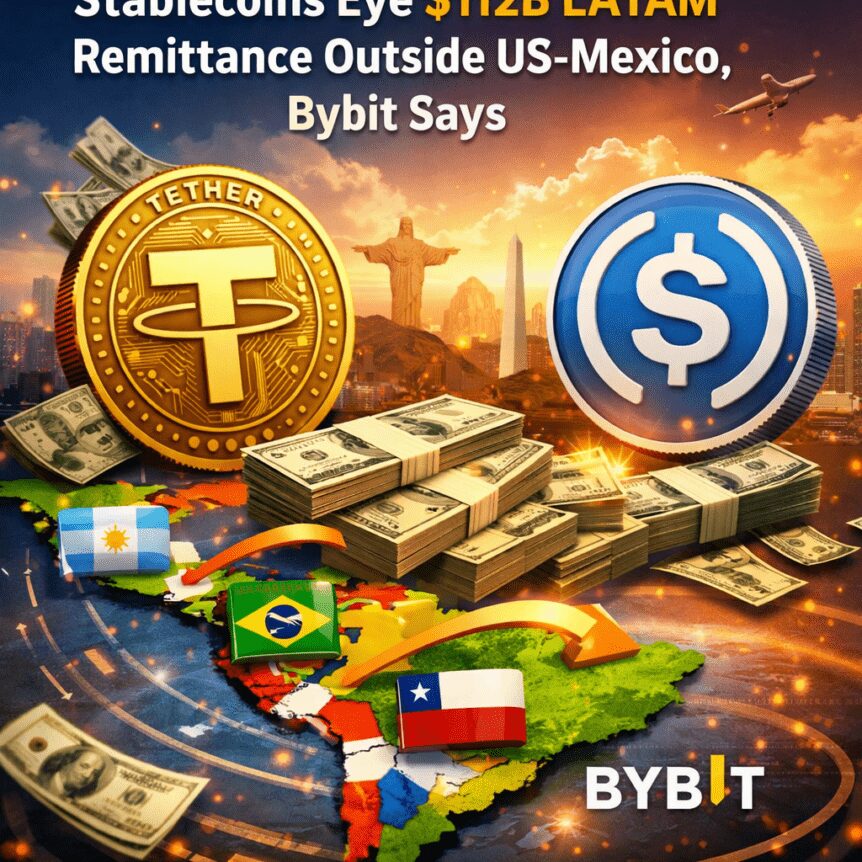
Bybit’s chief marketing officer, Claudia Wang, argues that the Latin American remittance opportunity extends far beyond the well-trodden US-to-Mexico corridor. In a recent post, she highlighted growing corridors within the region and emphasized that the “hot” routes are often not the ones fintechs have optimized for, urging a country-specific approach to capture the full LATAM remittance potential.
Key takeaways
- The non-US-to-Mexico remittance market in LATAM is about $112 billion, with corridors such as Venezuela-to-Colombia, Argentina-to-Bolivia, and Spain-to-Ecuador presenting notable growth.
- Overall remittances in the US-to-Mexico corridor fell to $61.8 billion in 2025, a 4.5% decline, while US-to-Central America flows showed stronger growth-year signals.
- US immigration policy is shaping behavior: Central American migrants are sending more money home—faster and in larger amounts—to hedge deportation risk, whereas the Mexican diaspora appears more established, dampening panic-send patterns.
- Fintechs must build country-specific stacks—different licenses, rails, stablecoins, and go-to-market models—rather than treating LATAM as a single market.
- In LATAM, the “killer app” may be holding stablecoins rather than simply moving value; users want to know the money lands and can be held as a store of value, not just spent immediately.
Expanding corridors reshape the Latin American remittance landscape
Wang’s assessment centers on a broader LATAM reality: large remittance corridors lie outside the US-to-Mexico frame, yet they remain under-served by traditional rails and even some crypto-enabled platforms. The non-US remittance market in LATAM is reported to be around $112 billion, a figure that underscores a wide field for cross-border financial flows beyond the familiar corridor.
Meanwhile, the region’s interior routes are also drawing attention. In 2025, remittance activity through the US-to-Central America corridor showed strong momentum, with Honduras, El Salvador, and Guatemala recording year-over-year increases of 19%, 18%, and 15%, respectively. By contrast, the US-to-Mexico corridor—historically the largest—contracted by about 4.5%, landing at roughly $61.8 billion for the year.
Wang attributes the divergence in behavior to shifts in US immigration policy. Central American migrants have been sending more money home—more frequently and in larger sums—partly as a hedge against deportation risk. Meanwhile, Mexico’s diaspora is comparatively more established and documented, reducing the urgency to “panic-send” funds home.
These dynamics imply that the next wave of remittance adoption in LATAM could hinge on corridors that previously received less attention from fintechs and crypto platforms. The region’s geographies—Venezuela to Colombia, Argentina to Bolivia, and Spain to Ecuador among them—are cited as examples where demand could grow rapidly if services align with local realities and regulatory requirements.
In terms of scale, the corridor between the United States and the rest of Latin America remains sizeable, but the opportunity set is widening as corridors within the region—often overlooked—develop their own momentum and infrastructure needs.
The race to serve LATAM: country-specific rails and stablecoins
Wang argues that LATAM’s remittance winners will be those who tailor solutions to the distinct regulatory and retail realities of each country. “Brazil, Mexico, Argentina, Colombia — each needs different licenses, different rails, different stablecoins, different marketing. The companies winning here run country-specific stacks, not regional ones,” she wrote in a post that has circulated across social channels.
“Stop treating LATAM as one market.”
The insight reflects a broader market truth: a one-size-fits-all approach is unlikely to gain traction where regulatory regimes differ, payment rails are fragmented, and user behavior diverges across populations and ages. The emphasis on local customization is consistent with the region’s reported demand for stablecoins that can be held as a store of value, rather than just used for on-chain transfers.
Indeed, Wang notes a critical user insight: many LATAM users want to hold stablecoins rather than merely move them. “Users don’t want to ‘use’ stablecoins for a transaction and convert back to local currency. They want to hold dollars. The transaction is the side effect,” she said. This points to a potential shift in product design—from cross-border remittance as a pure transfer service to a broader, closed-loop financial experience: remit → hold → spend → earn.
That stance aligns with a broader recognition in the region that real demand may center on stablecoin liquidity and multi-rail interoperability. Fintechs that can integrate local settlement rails, liquidity for stablecoins, and trusted, country-specific customer experiences stand a better chance of capturing a durable share of LATAM’s remittance market.
Wang also highlighted a gap: many fintech offerings have historically been designed with younger crypto traders in mind, not necessarily the older remittance sender. The typical remittance customer in LATAM tends to be older, often in the 40s to 60s range, and may require simpler, more transparent pathways to ensure that funds land reliably and can be accessed easily.
Competition, rails, and the evolving user landscape
The LATAM remittance arena is already crowded with a mix of traditional players and crypto-native firms. Western Union and MoneyGram, long-standing pillars of cross-border payments, are actively pursuing stablecoin-enabled rails following regulatory developments such as the GENIUS Act. Western Union has announced work toward its own USD-backed stablecoin, USDPT, which signals a significant shift in how the incumbent might participate in crypto-enabled settlements.
At the same time, crypto-native platforms—Binance, Bitso, Strike, and Felix Pago—are visible contenders in the LATAM remittance space, along with banks, retailers, and telecom players like Walmart and Tigo. The competitive landscape suggests a mixed ecosystem where on-ramps, local licensing, and reliable settlement are as important as technology itself.
For readers watching the policy and regulatory front, the evolving stance of authorities toward stablecoins and cross-border crypto payments will be critical. The market’s next phase depends on clear, workable frameworks that enable local players to operate with adequate consumer protections while preserving the efficiency gains that crypto rails can offer. The interplay between traditional rails and crypto-native approaches will shape which corridors gain momentum and which players set the pace.
The broader implication for investors and builders is clear: the LATAM remittance story is not a single, monolithic opportunity. It is a mosaic of country-specific needs, regulatory environments, and user behaviors. The corridors that appear attractive today may require fundamentally different product designs tomorrow, as regulatory clarity evolves and consumer preferences mature.
As the region’s regulatory and adoption landscape unfolds, observers should monitor how fintechs balance the dual goals of stability and accessibility. Stablecoins may become less about speculative trading and more about a practical store of value for everyday remittance users. In tandem, the race to build scalable, compliant, and user-friendly rails across Brazil, Mexico, Argentina, Colombia—and the broader LATAM network—will determine which players gain durable trust and position themselves as a backbone of regional financial inclusion.
Readers should keep an eye on updates from major remittance rails, central banks’ evolving stances on digital currencies, and the continued growth or repositioning of large incumbents like Western Union as they experiment with stablecoins and crypto-enabled settlement. The LATAM remittance arc is unlikely to settle soon, but its next chapter will be shaped by the region’s distinct markets and the ability of firms to tailor solutions that fit local realities.
The U.S. Commodity Futures Trading Commission has received more than 1,500 public responses on its proposed rule for prediction market event contracts.
Summary
- CFTC has received more than 1,500 public comments on its prediction markets rule, with firms backing its authority while state regulators push back.
- Kalshi, Polymarket, and Andreessen Horowitz supported the CFTC, urging it to retain exclusive control over event contracts.
- State gaming regulators from Pennsylvania, Tennessee, and Missouri said sports contracts resemble unregulated betting and should fall under state oversight.
According to the CFTC, the comment period for its March proposal closed Thursday after drawing submissions from prediction market operators, crypto firms, venture investors, and state-level gambling authorities, each weighing in on how event contracts should be regulated.
In a letter submitted Thursday, Kalshi co-founder and chief operating officer Luana Lopes Lara said the Commission’s current framework is “well-designed and effective,” urging regulators to provide clarity so that “the universe of event contracts can continue to be listed, traded, and overseen by the Commission.” Her comments framed the rulemaking as a chance to reinforce existing oversight rather than impose new restrictions.
Polymarket’s U.S. CEO Justin Hertzberg echoed that position in a separate letter addressed to CFTC Chair Mike Selig, writing that the agency should continue “asserting the CFTC’s longstanding exclusive jurisdiction over prediction markets.” Hertzberg added that the company believes the regulator must retain sole authority over the sector, a stance that aligns with ongoing legal disputes.
Andreessen Horowitz also backed the Commission, stating in its submission that state-level efforts to regulate or block prediction markets create “a serious barrier to impartial access,” which it argued conflicts with obligations placed on CFTC-regulated entities.
In the meantime, legal pressure from states has continued to build alongside the rulemaking. Kalshi, Polymarket, and Coinbase have each faced lawsuits tied to sports-based event contracts, while the CFTC has taken its own legal action against at least five state governments that challenged prediction platforms, defending its jurisdiction in court.
Pennsylvania Gaming Control Board Executive Director Kevin O’Toole wrote that prediction markets are being allowed “to masquerade as unregulated sportsbooks,” while Tennessee Sports Wagering Council Executive Director Mary Beth Thomas said her agency disputes “that sports event contracts offered on prediction markets fall within the jurisdiction of the CFTC at all.”
Rule builds on earlier compliance push
As previously reported by crypto.news, in its March 12 staff advisory, the CFTC instructed designated contract markets to apply full Part 38 oversight to event contracts, with particular scrutiny on sports-related products. In that notice, the agency said exchanges must remain bound by the Commodity Exchange Act and ensure compliance through product review, surveillance, and ongoing monitoring.
CFTC guidance tied that expectation to Section 5(d) of the Act and Core Principle 3 under Part 38, placing responsibility on exchanges to act as frontline regulators of listed contracts as trading activity grows.
Federal lawmakers and consumer groups have also raised concerns about how certain contracts could be used.
Dennis Kelleher, CEO and co-founder of Better Markets, joined 12 advocacy groups in a joint letter urging the CFTC to “prohibit event contracts that involve elections or geopolitical events,” arguing such markets could influence government decision-making.
Recent scrutiny has extended to geopolitical betting activity. Lawmakers have pointed to trading tied to the Iran war, where well-timed positions raised questions about potential use of non-public information.
Kalshi and Polymarket responded last week after the U.S. Senate passed a ban on its members and staff using prediction markets, stating that both platforms have strengthened controls around insider trading and restricted access for certain users, including politicians.

Bitcoin (BTC) Surges Past $80,000 Amid Continued ETF Inflows and Geopolitical Uncertainty

Kick Off May With Glowy Skin and Chic Accessories
Answering biggest questions about LIV Golf’s future

Manchester United reach agreement with Casemiro over contract clause amid transfer speculation

US brings back mandatory military draft registration

Steven Gerrard disagrees with Gary Neville over ‘shock’ Chelsea and Arsenal claim | Football


-

 Tech7 days ago
Register Renaming | Hackaday
-

 Politics6 days ago
Drax board avoid their own AGM, accused of greenwashing & environmental racism
-

 Fashion5 days ago
Kylie Jenner’s KHY Enters a New Era with ‘Born in LA’
-

 Tech7 days ago
Why Blue Badges Disappeared From Toyota Hybrids
-

 Tech6 days ago
Images of Samsung’s rumored smart glasses have leaked
-
 Tech2 days ago
Trump’s 25% EU auto tariff breaches Turnberry Agreement that also covers semiconductors and digital trade
-

 NewsBeat12 hours ago
Channel 5 – All Creatures Great and Small series 7 new post
-

 Business5 days ago
Most Commercial Energy Audits Miss the Real Losses
-

 Business7 days ago
(VIDEO) Charlize Theron Climbs Times Square Billboard to Promote New Netflix Thriller ‘Apex’
-

 Crypto World6 days ago
CFTC’s AI will review U.S. crypto registration applications, chairman tells CoinDesk
-
 Sports2 days ago
Paul Scholes issues Marcus Rashford reality check as agreement emerges over Man United star
-

 Business5 days ago
Barclay Brothers Avoid Bankruptcy: HSBC Drops High Court Petitions After IVA Deal
-
 Entertainment7 days ago
Alicia Keys Calls Out Music Industry ‘Boys Club’
-
 Business4 days ago
Tesla Officially Registers Elon Musk’s Stock: What Investors Need to Know
-

 Tech6 days ago
Get Ready for More Brain-Scanning Consumer Gadgets
-
 Crypto World6 days ago
Robinhood Phishing Scam Exploits Gmail Dot Feature to Bypass Security
-

 Crypto World6 days ago
Gmail Dot Trick Underpins Robinhood Phishing, Sending Real-Looking Emails
-

 Entertainment6 days ago
Sister Wives: Janelle Posts New Scary Warning
-

 Business3 days ago
Two Powerball Tickets Split $143 Million Jackpot in Indiana and Kansas
-

 Business6 days ago
Superdry co-founder accused of raping woman
You must be logged in to post a comment Login