
Crypto World
Five Key Takeaways This Week


Bitcoin started the week with renewed momentum, reclaiming the $80,000 level for the first time in three months and posting fresh intraday highs around $80,600 on Bitstamp. The weekly close also marked Bitcoin’s strongest close since January, and the price traded above the 21-week moving average for the second time since October 2025, according to TradingView data. The move adds a layer of optimism after a period of consolidation, and traders are weighing whether this is the start of a sustained up leg or a temporary reaccumulation before the next test of macro resistance.
Beyond the price action, market participants are watching a layered set of signals: ETF flows, on-chain momentum, and a domestic macro backdrop that continues to tilt in Bitcoin’s favor from a risk-on perspective, even as official policy remains unsettled. The blend of spot-market strength, fresh inflows into U.S. spot BTC ETFs, and a recovering on-chain metric set has some analysts arguing that the next leg could extend toward higher targets, while others warn that a failure to hold could invite a renewed pullback amid ongoing macro tensions.
Key takeaways
- Bitcoin reclaimed $80,000 and hit a local high of about $80,617 on Bitstamp, delivering a weekly close above the 21-week trend line for only the second time since October 2025.
- Analyst Michaël van de Poppe sees upside potential beyond $86-88k, with discussions of possible moves toward $92-95k if momentum persists, supported in part by about $630 million in net inflows to U.S. spot Bitcoin ETFs on Friday.
- Trading perspectives diverge on the near term: a persistent breakout above $80k could cement a bullish shift, while a failure to sustain gains risks a deeper pullback toward macro lows if the bear flag remains intact.
- On-chain momentum is improving, with Bitcoin’s MVRV ratio hovering around 1.45 — among multi-month highs — signaling a rebalancing of market valuation relative to realized value.
- The macro picture remains nuanced: dissent at the Fed meeting suggested a cautious stance on easing, while equities hit new highs on strong earnings, and oil-market dynamics continued to influence risk sentiment.
Back above the threshold: what the price action signals
The price thrust above $80,000 is more than a round-number milestone. It marks a key technical test of a bear-leaning pattern that had shadowed Bitcoin through much of 2026. The intraday peak near $80,617 and the weekly close above the 21-week moving average signal a potential shift in short- to medium-term momentum, according to traders monitoring price structure against the longer-term trend line first breached earlier in the week.
Market observers point to the 21-week line as a useful gauge for assessing macro-validity. Bitcoin’s ability to stay above this level and maintain a weekly close above it for the first time in several months is being interpreted as a potential foundation for a more durable move, contingent on continued demand and absence of a renewed macro shock.
Bear flag or breakout: a spectrum of trader opinions
As Bitcoin grapples with the $80,000 threshold, the community remains split on the trajectory ahead. On one flank, well-known trader Michaël van de Poppe argued that the market is primed for upside momentum. In posts circulated over the weekend, he suggested that surpassing $79,000 opens the path toward $86-88k in the near term, with the possibility of a stronger run toward $92-95k if the momentum persists. His commentary cited Friday’s robust ETF flows as a bullish tailwind, framing the move as part of a broader reacceleration in participation.
“Very keen to see how the markets will react when the US opens, especially given the positive ETF flows of last Friday. Breakout above $79K opens the opportunities all the way towards $86-88K for coming period.”
Meanwhile, other voices warn that the prevailing chart pattern could still deliver a deeper correction if the bear flag completes. A trader known as Crypto Storm cautioned that a break lower could trigger a 30–40% retreat and that only a decisive daily close above $80k would reestablish a bullish tilt. Several participants have emphasized the potential for a pullback if the current sequence fails to sustain higher highs and new resistance accelerates selling pressure.
On the more optimistic side, investors like Jeff Sun have noted that spot Bitcoin has reclaimed the $80,000 level for the first time since January and described the move as not necessarily a bear-flag scenario. Sun has been building a position via ETFs since March, arguing that the latest price action does not fit the classic bear-flag narrative, a view echoed by others who see the paint on the chart as a base-building phase rather than a terminal retreat.
Adding a layer of macro context, Jurrien Timmer, director of global macro at Fidelity Investments, has argued that the rebound from the February dip toward $60,000 could be part of a larger base formation designed to support the next significant up leg. While this framing is not a guaranteed forecast, it underscores the tendency to interpret Bitcoin’s late-winter resilience as more than a mere bounce within a bear market.
Fed policy, equities, and the risk-on backdrop
Beyond price action, the broader macro narrative continues to shape risk assets. The latest Federal Reserve meeting featured notable dissent among four FOMC members and highlighted a debate over easing bias. Market coverage from The Market Mosaic noted that the primary source of dissent was resistance to language signaling an easing bias, pointing to a more cautious stance on policy shifts in the near term.
Despite intra-meeting tensions, stock markets have held up well. The S&P 500 reached fresh highs in the week, aided by stronger-than-expected corporate earnings. Yet analysts caution that inflation and the path of policy will remain critical drivers for risk assets, with higher-for-longer or fluctuating inflation dynamics potentially altering valuations in coming months.
From a timing perspective, futures markets painted a picture in which significant easing in 2024 appears unlikely, according to CME Group’s FedWatch Tool. As policymakers evaluate inflation pressures and macro risks, the market’s interpretation of future rate moves remains a decisive variable for both equities and crypto assets.
Oil dynamics and risk sentiment
Oil markets have remained a central macro cross-check for risk appetite. Brent crude prices hovered around the $110s to $112 range, after peaking above $120 per barrel last week before cooling slightly. Analysts have stressed that the longer-term supply backdrop suggests a potential moderation in oil prices, even as short-term spikes reflect geopolitical risk and supply constraints. The view from some strategists is that the bullish oil narrative is largely priced in, with a potential for a downside drift should supply growth resume more robustly in 2026.
Market commentator Lukas Kuemmerle emphasized the pattern of price reactions around the highs as evidence that the current rally may be cooling into a consolidation phase, a scenario that could impact risk assets more broadly. Even as some banks have tilted toward a lower oil-price baseline than the immediate spike would imply, the overarching takeaway remains that the oil story—while supportive to some risk-on trades—may not sustain a continued surge without an accompanying shift in supply dynamics.
On-chain momentum: MVRV points to reaccumulation
On-chain metrics show a growing sense of confidence returning to Bitcoin investors. CryptoQuant’s data this week highlighted multimonth highs in Bitcoin’s market value to realized value (MVRV) ratio, a metric that compares Bitcoin’s market capitalization to the price at which the last supply moved. The MVRV ratio hovered around 1.45, a level not seen since early 2026, according to Arab Chain Now’s interpretation of CryptoQuant data.
“The Bitcoin MVRV Ratio is currently reading around 1.45, a significant level as it represents one of its highest readings since the beginning of 2026,”
CryptoQuant contributor Arab Chain Now noted, adding that such readings reflect improving profitability for holders and a rebalancing of market expectations after the early-year volatility. CryptoQuant.
Analysts say the trend in MVRV aligns with a broader narrative of investors regaining conviction and participating more actively in price discovery, a signal that could underpin additional upside if price action sustains above key levels. Still, observers emphasize that MVRV is only one piece of the puzzle, and it must be corroborated by continued demand across spot markets and continued resilience in macro catalysts.
In aggregate, the combination of on-chain momentum, ETF inflows, and the immediate price action around $80k constitutes a potential inflection point for Bitcoin. Yet as with any risk asset, the path forward will hinge on how macro factors—policy signals, inflation trends, and energy markets—evolve over the next few weeks.
What to watch next: a sustained move above $80k with a daily close above that level could shift the narrative toward a broader upside. Traders will be watching for continued ETF demand, the trajectory of the Fed’s policy path, and the oil-market dynamic, all of which could amplify or mute Bitcoin’s next leg up. As the week unfolds, the key question remains whether this rebound can sustain itself, or whether a new round of volatility will reassert itself as investors reassess risk in a rapidly shifting macro environment.


Hacks, exploits, rug pulls, and why “code is law” is not the moral upgrade people think it is
The digital economy promised something almost utopian: open markets without gatekeepers, financial systems run by transparent code, and trust replaced by mathematics. No bankers, no brokers, no middlemen—just smart contracts doing exactly what they’re told.
And that’s the problem.
Because in the real world, “exactly what you’re told” can still be a disaster if what you told the system was… wrong, malicious, or cleverly exploited.
The digital economy didn’t remove risk. It redistributed it. Sometimes into very sharp, very expensive corners.
1. Hacks, exploits, and the illusion of “secure by design.”
In traditional finance, security failures usually involve people: insider fraud, weak compliance, and bad auditing. In decentralized systems, the attack surface shifts from people to code, and code is brutally literal.
A smart contract doesn’t “interpret intent.” It executes logic. If that logic has a flaw, it doesn’t hesitate. It doesn’t raise a ticket. It just gets drained.
This is why DeFi history reads like a highlight reel of expensive mistakes:
- Flash loan exploits that drain liquidity pools in seconds
- Reentrancy bugs that turn “yield protocols” into ATMs—for attackers
- Oracle manipulation where prices are tricked into lying
- Governance attacks where voting power becomes a weapon instead of a democratic tool
And the most uncomfortable truth? Many of these weren’t obscure edge cases. They were known classes of problems. The kind of bugs you could explain in a security lecture… right before losing $50 million to them.
The digital economy runs on composability—protocols stacking on top of protocols like financial LEGO. That’s powerful. It’s also how a small crack in one brick can bring down a very expensive tower.
The myth is “code is secure because it’s transparent.”
The reality is “code is attackable because it’s transparent.”
2. Rug pulls vs legitimate experimentation
Not everything that collapses in crypto is a scam. But not everything is innocent either.
A rug pull is straightforward: creators build hype, attract liquidity, and disappear with the funds. It’s financial stage magic—now you see your money, now you don’t.
But the grey area is where things get interesting—and messy.
Many projects aren’t malicious in the cartoon-villain sense. They’re experiments running on live capital:
- Unproven tokenomics models
- Incentive systems that look good in theory but break under real behavior
- Early-stage teams learning in public, sometimes at users’ expense
- Governance systems that sound decentralized but are quietly controlled
So where’s the line?
If you’re honest, it’s often invisible until after the damage is done.
This is the uncomfortable duality of the digital economy:
- On one side: innovation happens faster than anywhere else in finance
- On the other: failure also happens faster, and more publicly
Traditional finance at least forces you to sit through paperwork before losing money. DeFi lets you lose money in real time, globally, in a single block confirmation.
The worst part? Some users prefer the chaos because it also moves faster. Risk becomes a feature, not a bug.
That’s not necessarily wrong—but it is dangerous when people confuse speed with safety.
3. Why “code is law” is powerful—and deeply incomplete
“Code is law” is one of the most iconic phrases in blockchain culture. It means smart contracts execute rules automatically, without subjective interference.
No corruption. No favoritism. No human discretion.
Sounds clean. Almost elegant.
But here’s the catch: law in human society isn’t just execution—it’s interpretation, correction, and context.
Code doesn’t do context.
Let’s say a traditional legal system sees:
- Fraud → intent matters
- Accident → intent matters
- Emergency → intent matters
Code sees:
- Conditions met → execute
- Conditions not met → do nothing
That rigidity is both its superpower and its weakness.
The power side:
- Predictable execution
- No arbitrary intervention
- Global accessibility
- Reduced reliance on centralized authorities
This is why decentralized finance became so attractive in the first place. It removed layers of permission and replaced them with deterministic rules.
The dangerous side:
- No mercy for edge cases
- No built-in ethical override
- No safety valve when assumptions break
- No distinction between exploit and legitimate use
In other words, code doesn’t care if you “meant well.” It only cares if you were allowed.
And attackers understand this better than anyone.
4. The real risk: systems that are correct but not safe
The most misunderstood idea in digital finance is this:
A system can be functioning exactly as designed—and still be catastrophically unsafe.
That’s where most people get blindsided.
In traditional systems, failure often comes from breaking rules.
In smart contract systems, failure often comes from following rules too perfectly.
This creates a strange inversion:
- In old finance, human discretion is the risk
- In DeFi, a lack of discretion is the risk
Neither is perfect. But only one of them can be exploited at machine speed with global liquidity.
5. So what actually protects users?
Spoiler: it’s not just audits.
Audits help, but they’re more like seatbelts than force fields. They reduce damage; they don’t prevent crashes.
Real protection comes from layered defenses:
- Conservative protocol design (boring is good)
- Gradual decentralization instead of instant governance handoffs
- Bug bounties that actually attract serious researchers
- Time delays on critical functions (the “pause button” nobody wants until they need it)
- Transparent risk disclosure that users can actually understand
And maybe the hardest one:
- Cultural maturity—knowing when not to chase yield that looks suspiciously like free money
Because in this space, “too good to be true” is not a warning—it’s a category.
6. The uncomfortable conclusion
The digital economy didn’t eliminate trust. It just moved it.
Instead of trusting institutions, we now trust:
- Developers writing contracts
- Auditors reviewing code
- Token designers modeling incentives
- Communities governing systems they barely understand
That’s not inherently worse. It’s just different—and faster, sharper, and less forgiving.
“Code is law” is a powerful idea. But law without interpretation becomes rigidity. And rigidity, at scale, becomes fragility.
The real future of digital finance probably isn’t pure decentralization or pure centralization.
It’s hybrid systems that admit something uncomfortable:
Code enforces rules.
Humans still understand consequences.
And until the ecosystem fully respects that difference, the dark side of the digital economy won’t be an exception.
It’ll be a recurring feature—just with better branding each cycle.
REQUEST AN ARTICLE
Crypto World
Anthropic Secures $1.5B Partnership with Blackstone (BX) and Goldman Sachs (GS) for AI Expansion

Key Highlights
- Anthropic has announced a joint venture worth approximately $1.5 billion with Blackstone, Goldman Sachs, Hellman & Friedman, and General Atlantic to distribute AI solutions to companies owned by private equity firms.
- Leading partners Anthropic, Blackstone, and Hellman & Friedman are each investing roughly $300 million, while Goldman Sachs is contributing approximately $150 million.
- The newly formed entity will integrate Claude AI technology into portfolio businesses spanning healthcare, logistics, financial services, and manufacturing sectors.
- Anthropic’s revenue run rate on an annualized basis jumped from approximately $9 billion at the close of 2025 to over $30 billion by the end of March 2026.
- This development coincides with Anthropic pursuing a funding round that could value the company above $900 billion and exploring a possible IPO as soon as October.
Anthropic announced on Monday the creation of a new enterprise-focused AI services company in collaboration with Blackstone (BX), Goldman Sachs (GS), Hellman & Friedman, and several other institutional investors, representing a total investment of approximately $1.5 billion.
This newly established entity operates as an independent company featuring dedicated Anthropic engineering teams and partnership capabilities integrated into its organizational structure. The venture’s primary objective is to integrate Claude AI into the operational workflows of mid-sized enterprises within the participating private equity firms’ investment portfolios.
Primary partners Anthropic, Blackstone, and Hellman & Friedman have each committed roughly $300 million to the initiative. Goldman Sachs joins as a founding investor with an investment of approximately $150 million. Additional backing comes from General Atlantic, Leonard Green, Apollo Global Management, GIC, and Sequoia Capital.
The strategic framework is purposeful. Private equity firms manage extensive portfolios of companies facing continuous pressure to optimize expenses and enhance operational efficiency — precisely the scenarios where AI implementation proposals gain traction.
Dedicated Applied AI engineers from Anthropic will work alongside the new firm’s personnel. Their responsibilities include pinpointing optimal use cases for Claude, developing tailored solutions, and providing ongoing client support, according to Anthropic’s official announcement.
Anthropic CFO Krishna Rao commented that enterprise appetite for Claude is “significantly outpacing any single delivery model,” noting that the new venture introduces “additional operating capability to the ecosystem.”
Blackstone COO Jon Gray stated the collaborators plan to establish “a scaled, world-class company” to implement Anthropic’s technology throughout portfolio companies and beyond.
Competing With OpenAI
This partnership places Anthropic in direct rivalry with OpenAI, which is developing a comparable initiative called DeployCo. That enterprise has secured support from TPG, Bain Capital, Advent International, Brookfield, and Goanna Capital. OpenAI has pledged $500 million to DeployCo, with provisions to contribute an additional $1 billion, while the five private equity supporters collectively invested approximately $4 billion. DeployCo is pursuing a $10 billion valuation.
Bloomberg reported separately on Monday that OpenAI is approaching completion of a deal for its own parallel venture, indicating that the competition for private equity-backed AI deployments is intensifying rapidly.
Anthropic has established a more robust presence in the enterprise market to date, although The Wall Street Journal observed that OpenAI is actively working to narrow that advantage.
Anthropic’s Revenue Surge
Anthropic’s annualized revenue run rate escalated from approximately $9 billion at the conclusion of 2025 to exceed $30 billion by late March 2026. The company attributes a substantial portion of this expansion to AI-powered coding solutions, particularly Claude Code.
The joint venture disclosure comes at a critical juncture for the organization. Anthropic is evaluating investor proposals for a new funding round that would establish its valuation above $900 billion — positioning it as the world’s most valuable AI startup, exceeding OpenAI’s most recent valuation of $852 billion.
The anticipated funding round is projected to range between $40 billion and $50 billion. A board meeting scheduled for May will likely decide whether Anthropic proceeds with the round and under what conditions.
Bloomberg has also reported that Anthropic is considering a public market debut that could materialize as early as October.



Western Union’s USDPT stablecoin has gone live on the Solana blockchain, marking the traditional remittance giant’s entry into on-chain digital assets.
Key Takeaways
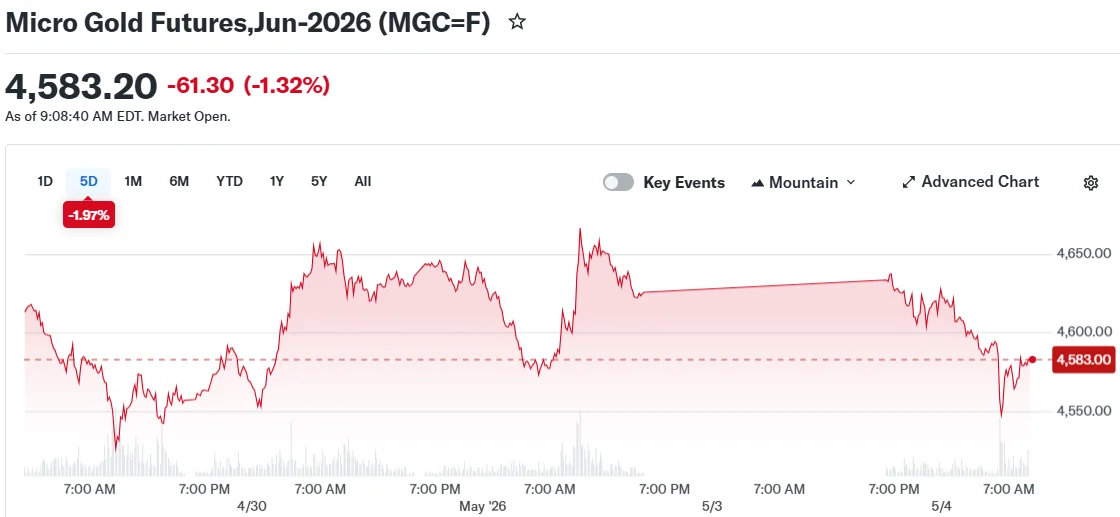
- Precious metal prices declined by up to 1.9%, hovering near $4,562–$4,571 per ounce during Monday’s session
- President Trump unveiled “Project Freedom” to facilitate maritime passage through the Strait of Hormuz
- Tehran’s naval forces reported repelling American warships and issued stern warnings against unapproved transit
- Dollar strength combined with petroleum-fueled inflation is driving monetary authorities toward tighter policy, creating headwinds for bullion
- Global monetary authorities purchased gold at the quickest rate in more than twelve months during the first quarter, signaling sustained appetite
Precious metal markets experienced significant selling pressure Monday as market participants monitored the deteriorating relationship between Washington and Tehran concerning the strategically vital Strait of Hormuz waterway.
Spot bullion plummeted as much as 1.9% during intraday trading before moderating to approximately 1.1% lower, settling within the $4,562–$4,571 range per ounce in London markets. Futures contracts similarly declined 1.5% to reach $4,573.94.
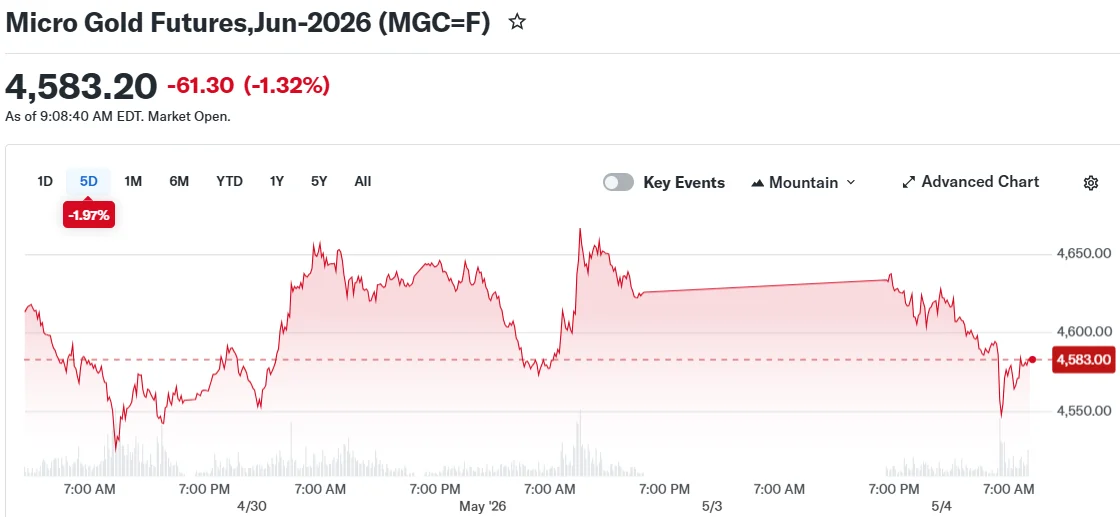
The selloff followed President Donald Trump’s weekend announcement of “Project Freedom,” an initiative designed to restore commercial shipping operations through the Strait of Hormuz, a critical chokepoint controlling approximately one-fifth of global petroleum flows.
The administration indicated it would commence escorting vessels uninvolved in the Iranian dispute through the waterway beginning Monday, though specific operational details remained scarce.
Iranian authorities responded forcefully. Tehran’s naval command asserted it had successfully repelled hostile vessels following what officials described as a “swift and decisive warning.” However, US Central Command maintained that no American naval assets sustained damage.
An unidentified Iranian official told government-affiliated media outlets that the Islamic Republic “will not be bullied” and maintained contingency plans ready for immediate deployment if circumstances warrant. Iran’s military apparatus additionally cautioned that commercial traffic attempting strait passage without Iranian armed forces authorization does so at significant risk.
The Associated Press documented that the American-led Joint Maritime Information Center established an “enhanced security area” positioned south of conventional shipping corridors. Officials characterized standard routes traversing the strait as “extremely hazardous” because of naval ordnance that remains incompletely removed.
Petroleum Surge and Inflation Concerns Weigh on Bullion
Brent crude benchmark contracts rebounded above $110 per barrel Monday. Petroleum valuations have maintained substantial premiums relative to pre-conflict levels since hostilities commenced in late February, amplifying worldwide inflation anxieties.
Elevated oil prices are compelling monetary authorities toward restrictive policy frameworks. Because gold generates no yield, it typically underperforms during periods of ascending interest rates.
The American dollar also appreciated Monday, compounding downward pressure on precious metals. Currency strength makes dollar-denominated gold costlier for international purchasers, potentially dampening acquisition activity.
Manav Modi, commodities specialist at Motilal Oswal Financial Services, indicated that dollar resilience coupled with petroleum-driven inflation concerns are eliciting hawkish rhetoric from principal central banking institutions.
Bullion has now surrendered approximately 12% since hostilities erupted at February’s conclusion.
Fundamental Demand Remains Robust
Notwithstanding recent price deterioration, certain market observers maintain constructive views regarding gold’s extended-horizon prospects.
The World Gold Council documented that monetary authorities expanded their bullion reserves at the most aggressive tempo in over twelve months throughout the initial quarter.
Tether Holdings has likewise continued accumulation activity that has positioned it as the world’s largest identified non-banking, non-sovereign gold repository.
Market participants this week will monitor the Treasury Department’s financing announcements, Federal Reserve official commentary, and the monthly employment data for indications regarding the trajectory of borrowing costs.
Crypto World
Trump-affiliated World Liberty sues Justin Sun for ‘defamation’ after Tron creator’s lawsuit


World Liberty Financial, the cryptocurrency company affiliated with U.S. President Donald Trump and his family, filed a defamation lawsuit against Tron creator Justin Sun in a Florida state court Monday, alleging “gross misconduct” from Sun over WLFI tokens he bought.
The lawsuit comes on the heels of Sun’s own lawsuit against World Liberty, which was filed in a federal California court, alleging World Liberty had unfairly frozen his ability to transfer his WLFI tokens. In Monday’s suit, World Liberty alleged that Sun-related entities bought WLFI tokens for other investors through straw purchases and may have “engaged in short selling” of the token.
World Liberty froze Sun’s WLFI tokens “to protect” itself “and the broader community as a result, the lawsuit said, adding that Sun’s tweets complaining about his tokens being frozen contain false or defamatory information.
Sun allegedly hired influencers and used bots to “amplify his lies,” World Liberty claimed, and as a result the company said it had “lost specific business opportunities.”
Many portions of the lawsuit were redacted, including portions describing Sun’s purchase of the tokens and sections about his alleged misconduct.
This alleged misconduct includes what World Liberty describes as “a large, deliberate, short-selling campaign designed to suppress $WLFI’s price at the moment of its public launch,” which the suit tied to Sun-affiliated wallets moving $300 million to Binance.
“Upon discovering these violations, World Liberty exercised its contractual rights to freeze Sun’s entities’ tokens to prevent further harm to World Liberty and the broader $WLFI community, an ability that Sun knew about well before this action was taken,” the lawsuit said.
One issue Sun knew about prior to his tweets was that World Liberty had the ability to freeze tokens, the suit said throughout the filing.
“Not only was Sun aware of the agreements’ terms, but Sun also knew through his personal experience that the defamatory statements were false because he (and the public) knew that World Liberty had the power to restrict the transferability of tokens,” the suit said.
The suit alleged defamation and calls for damages, expenses and retraction of Sun’s statements.


Bitget’s CFD platform has logged a record $8B day, with gold-linked contracts driving 95% of the jump as Chinese-speaking, European, and Southeast Asian traders pile into metals.
Summary
- Bitget says its contracts-for-difference (CFD) business has reached a new all-time high, with single-day trading volume surpassing $8 billion.
- Gold-related products drove roughly 95% of the incremental activity, making precious metals the core engine of Bitget’s cross-asset trading uptick.
- Chinese-speaking, European, and Southeast Asian markets together accounted for 85% of the growth, underscoring a broad regional expansion.
Bitget reported that daily trading volume on its CFD segment has broken through $8 billion, extending a run that saw the platform first pass $2 billion in early 2025 and then $6 billion in March 2026 as its multi-asset strategy gained traction.
Gold demand powers new CFD record
According to the exchange, the latest record has been “driven by the global macroeconomic environment and asset allocation needs,” with gold-linked contracts contributing about 95% of the increase in volume and emerging as the “core engine” behind the cross-asset spike.
Bitget pointed to heightened volatility in precious metals and commodities — influenced by geopolitical risk, inflation concerns, and shifting rate expectations — as key catalysts for traders rotating into XAU and other non-crypto products via its CFD offering.
On a regional basis, the platform said Chinese-speaking markets accounted for 42% of the incremental trading volume, the European market provided 27%, and Southeast Asia added 16%, meaning those three regions together generated 85% of the latest leg higher.
The remaining 15% of incremental volume came from other regions including Latin America and the Middle East, where Bitget has been rolling out localized campaigns to push its “Universal Exchange” positioning that combines crypto, CFDs, and copy trading.
UEX model links crypto capital to TradFi markets
Bitget’s CFD business is built on what it calls the UEX panoramic model, which lets users trade commodities, precious metals, foreign exchange, and stock indices using USDT as collateral, all from the same account they already use for spot and derivatives in crypto.
In practice, that means a trader can move from, say, BTC perpetual futures to XAUUSD gold CFDs, WTI oil, or major FX pairs without wiring fiat or opening a separate brokerage, using a single USDT margin pool to express macro views across asset classes.
Earlier milestones showed how quickly that model has scaled: Bitget’s TradFi platform hit $2 billion per-day volume on launch week, then reached a $6 billion daily CFD record in March as demand for gold, oil, and indices climbed on macro volatility.
A recent crypto.news recap described the CFD unit as “a key pillar” of Bitget’s push to become a universal exchange, noting that the platform aims to make it “as easy to trade gold, silver, indices, and forex as it is to trade crypto” using USDT margin.
Another crypto.news feature highlighted that the exchange is betting macro traders will increasingly “park capital in stablecoins and move between crypto and traditional markets without leaving the Bitget ecosystem.”
A separate crypto.news overview focused on how surging gold demand drove Bitget’s earlier $2 billion-per-day TradFi volumes, a dynamic now magnified at the $8 billion CFD level as metals again lead risk-off flows.

Key Takeaways
- Tyson Foods delivered adjusted EPS of $0.87, surpassing analyst expectations of $0.78
- Total revenue reached $13.65 billion, reflecting 4.4% year-over-year growth and exceeding projections
- Chicken division generated $523 million in operating income; Prepared Foods contributed $352 million
- Beef division recorded an adjusted operating loss of $202 million, with volumes declining 13%
- TSN shares climbed approximately 2% during premarket hours; the stock had already advanced 8.6% year-to-date before Monday
Tyson Foods (TSN) shares advanced Monday morning following the release of its fiscal second-quarter financial results that exceeded Wall Street’s projections.
The company’s adjusted earnings per share reached $0.87, comfortably beating analyst consensus of $0.78. While this figure represented a modest decline from $0.92 reported in the prior-year period, investors responded positively to the outperformance.
Quarterly revenue increased 4.4% year-over-year to $13.65 billion, surpassing Street expectations that ranged between $13.61 billion and $13.63 billion. TSN shares were up approximately 2% in premarket activity.
The stock had demonstrated solid momentum heading into the earnings announcement, posting an 8.6% gain year-to-date through Friday’s market close.
Chicken and Prepared Foods Segments Shine
Two business divisions stood out as clear performers during the quarter: Chicken and Prepared Foods. The Chicken segment produced adjusted operating income of $523 million, translating to a healthy 12.2% profit margin. The Prepared Foods unit contributed $352 million with an impressive 14.0% margin.
CEO Donnie King attributed the strong performance to “sustained market demand for protein.” Both divisions experienced growth in both volume and pricing metrics.
The Prepared Foods segment’s revenue performance also exceeded analyst projections, reinforcing the overall positive narrative surrounding the quarterly report.
Beef Division Continues to Struggle
The Beef segment remains a significant challenge for the company. This division registered an adjusted operating loss of $202 million during the reporting period.
Beef sales volume plummeted 13% compared to the same quarter last year. Elevated pricing continues to dampen consumer demand, creating visible strain on the segment’s financial performance.
Looking ahead to the complete fiscal year 2026, Tyson anticipates the Beef segment will generate an adjusted operating loss ranging from $350 million to $500 million.
The Pork division fared better, posting gains in both volume and pricing during the quarter.
The performance divergence across segments is striking. The strength in Chicken and Prepared Foods is effectively offsetting the weakness emanating from the Beef business.
Strong Financial Position and Future Outlook
Tyson achieved a $747 million reduction in total debt during the first half of fiscal 2026. The company’s liquidity position stood at $3.7 billion as of March 28, 2026.
Free cash flow generation for the initial six months totaled $432 million, representing a $50 million improvement compared to the corresponding period in the previous year.
For fiscal 2026, management targets free cash flow between $1.2 billion and $1.8 billion, while capital expenditures are projected to fall within a range of $0.7 billion to $1.0 billion.
The company anticipates full-year sales growth of 2% to 4% relative to fiscal 2025 performance.
Total adjusted operating income guidance for fiscal 2026 stands at $2.2 billion to $2.4 billion.
The Chicken segment by itself is expected to deliver adjusted operating income of $1.9 billion to $2.05 billion throughout the year.
Prepared Foods is forecast to generate between $1.25 billion and $1.35 billion for fiscal 2026.
Tyson’s balance sheet improvement efforts appear to be yielding results. The $747 million debt reduction achieved within a six-month timeframe represents meaningful progress.
The company’s substantial $3.7 billion liquidity cushion provides management with financial flexibility to navigate the persistent challenges in the Beef division.
Key Highlights
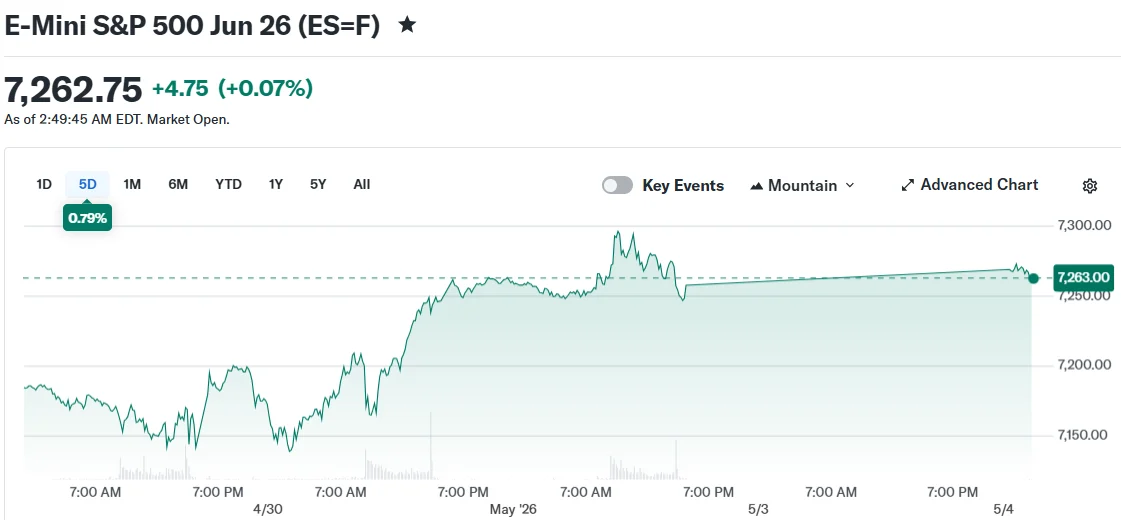
- U.S. equity futures declined Monday following Iranian media claims of missile attacks on an American naval vessel in the Strait of Hormuz region
- Pentagon officials refuted the Iranian state media claims, helping to stabilize early morning volatility
- Crude oil prices jumped more than 3%, with Brent crude approaching $112 per barrel
- President Trump unveiled “Project Freedom” to provide naval escorts through the strategic waterway; Tehran issued counter-threats
- Friday’s April employment report is anticipated to show only 60,000 jobs added
Equity futures in the United States tumbled Monday morning following claims by Iranian state-controlled media outlets that missiles had targeted an American warship operating near the Strait of Hormuz. The allegations sparked immediate market volatility before U.S. officials issued denials.
Contracts linked to the Dow Jones Industrial Average declined approximately 204 points, representing a 0.4% decrease. Futures on the S&P 500 dropped 0.2%, while Nasdaq 100 contracts shed 0.1%.
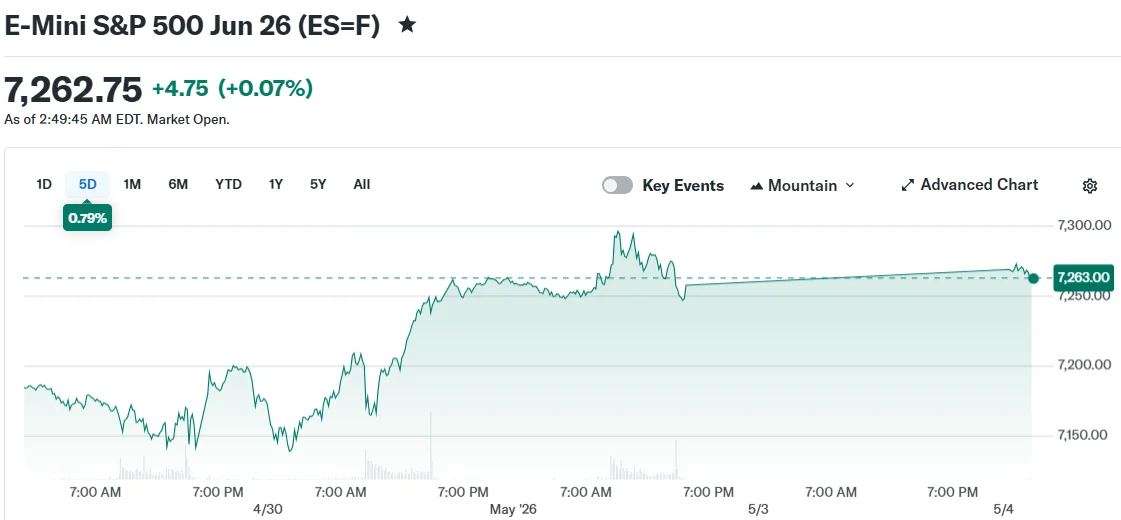
Both the S&P 500 and Nasdaq had achieved fresh all-time highs during Friday’s session, completing their strongest five-week stretch since May 2020. That bullish momentum faced headwinds Monday morning as geopolitical concerns took center stage.
Iran’s Fars News Agency reported that two missiles impacted a U.S. frigate after the vessel allegedly disregarded warnings against entering the Strait of Hormuz. U.S. Central Command responded via X, stating definitively that no naval vessels had sustained damage.
The official denial helped restore some market confidence, though lingering uncertainty persisted. Market participants rotated toward traditional safe-haven positions, driving the U.S. dollar index 0.3% higher against major global currencies.
Yields on 10-year Treasury notes advanced 4 basis points to reach 4.41%, reflecting investor appetite for lower-risk government securities.
Crude Oil Markets Rally on Transportation Concerns
Oil markets demonstrated significant sensitivity to the developing situation. Brent crude futures surged 3.4% to reach $111.80 per barrel. West Texas Intermediate increased 3.5% to $105.35 per barrel during morning trade.
The Strait of Hormuz represents one of the planet’s most critical maritime chokepoints. Approximately one-fifth of global petroleum supplies transit through this narrow passage, making any military escalation there an immediate concern for energy traders worldwide.
“Project Freedom” Initiative Heightens Regional Tensions
Over the weekend, President Trump announced the United States would commence naval escort operations for commercial vessels stranded in the contested waterway. The initiative was designated “Project Freedom.”
The President issued warnings via social media that any attempts to disrupt the operation would face “forceful” responses. Iranian officials countered with their own threats against American naval assets in regional waters.
The escalating rhetoric between Washington and Tehran elevated the probability of direct military engagement and maintained pressure on trading desks throughout the morning.
On the corporate earnings front, several notable companies are scheduled to release quarterly results this week. Technology sector reports will come from semiconductor firms Lattice Semiconductor, Advanced Micro Devices, and Arm Holdings.
Palantir and Paramount Skydance are also slated to announce earnings in the coming days.
Friday will bring the April employment situation report from the Bureau of Labor Statistics. Economic forecasters project merely 60,000 new positions were created during the month, representing a significant deceleration from March’s 178,000 additions. The unemployment rate is projected to remain unchanged at 4.3%.
The swift denial issued by U.S. Central Command regarding the Iranian strike allegations proved instrumental in preventing additional declines in futures contracts during early Monday trading activity.


Brush up on the basics, from agentic to generative, before Consensus Miami 2026.
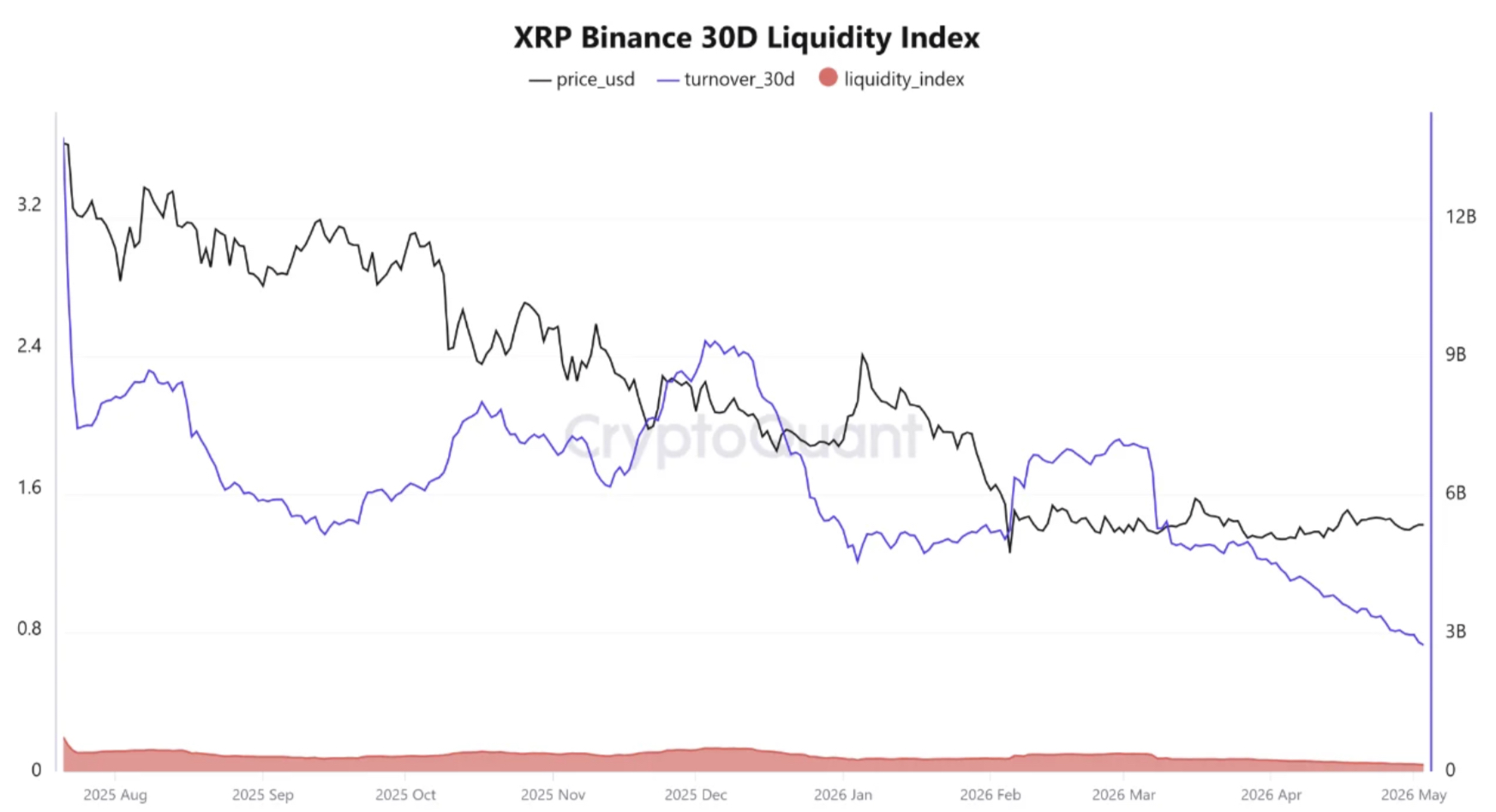
XRP price is sitting at a powder keg. The token is now trading at $1.41, and the conditions surrounding that price are anything but stable. Binance liquidity for XRP has collapsed to levels not seen since 2020, setting up a move that could break hard in either direction.
According to CryptoQuant data, the 30-day XRP liquidity index on Binance has dropped to 0.038, the lowest level since 2020.

Simultaneously, XRP spot ETFs posted their first weekly outflow in three weeks. This snaps a three-week inflow streak that pulled in almost $82 million, including a $55.39 million haul in the week ending April 17. Cumulative net inflows still hold at $1.29 billion, with weekly net assets at $1.06 billion.
Best month of the year so far for the XRP ETF's — Chad Steingraber (@ChadSteingraber) May 2, 2026

 https://t.co/xI9auH3rAv pic.twitter.com/x3FqX7fGcL
Thin order books amplify everything. A modest buy surge or a wave of redemptions can now move the price far more aggressively than under normal depth conditions.
Discover: The best pre-launch token sales
Can XRP Break Out of the $1.40 Price Range?
XRP has been range-bound at $1.40, but the liquidity collapse below that price changes the technical picture considerably. Data flagged a near-20% downside scenario if thin conditions persist and selling pressure builds, which could put the bear-case floor somewhere around $1.15.
With the leverage and liquidity setup on Binance already flashing warning signals, the key support level to watch is $1.35. A confirmed close below that level would likely accelerate selling, particularly with ETF outflows breaking the prior streak.

On the upside, $1.55 remains the immediate resistance where prior momentum stalled, and recent price prediction analysis has flagged that level as critical for any renewed bullish push.
Bitwise’s XRP fund led redemptions with $3.71 million pulled last week, while Canary’s XRPC absorbed $2.2 million in fresh capital. This split shows a fragmenting institutional capital.
Discover: The best crypto to diversify your portfolio with
Bitcoin Hyper Targets Early-Mover Upside as XRP Tests Key Levels
XRP at $1.41 still represents an $80+ billion market cap asset, which means the ceiling on percentage gains is structurally limited even in a bull scenario. Traders hunting asymmetric upside at this stage of the cycle are increasingly looking at early-stage infrastructure plays with uncapped growth potential.
Bitcoin Hyper ($HYPER) is one project drawing attention. It’s positioning itself as the first-ever Bitcoin Layer 2 with Solana Virtual Machine (SVM) integration. It’s a technical architecture that executes smart contracts faster than Solana while anchoring security to Bitcoin’s base layer.
The pitch is straightforward: bring programmability and speed to the world’s most trusted blockchain without sacrificing its trust model. The presale is live at $0.0136 per $HYPER and has raised $32.5 million to date. Staking is available with a high 36% APY for early participants.
Features include sub-second finality via an SVM-powered Layer 2, a Decentralized Canonical Bridge for BTC transfers, and low-cost smart contract execution. Hyper’s infrastructure targets both DeFi developers and BTC holders priced out of Ethereum-based yield.
Research Bitcoin Hyper and join the moving train.
The post XRP Price Movement Imminent: Binance Liquidity Hits Lowest Levels appeared first on Cryptonews.

The Dark Side of the Digital Economy

10 products that will save you strokes and money

How fraudsters target credit unions

Manchester United reach agreement with Casemiro over contract clause amid transfer speculation

US brings back mandatory military draft registration

Steven Gerrard disagrees with Gary Neville over ‘shock’ Chelsea and Arsenal claim | Football


-

 Tech7 days ago
Register Renaming | Hackaday
-

 Politics7 days ago
Drax board avoid their own AGM, accused of greenwashing & environmental racism
-

 Fashion6 days ago
Kylie Jenner’s KHY Enters a New Era with ‘Born in LA’
-

 NewsBeat20 hours ago
Channel 5 – All Creatures Great and Small series 7 new post
-

 Tech7 days ago
Images of Samsung’s rumored smart glasses have leaked
-
 Tech3 days ago
Trump’s 25% EU auto tariff breaches Turnberry Agreement that also covers semiconductors and digital trade
-

 Business6 days ago
Most Commercial Energy Audits Miss the Real Losses
-

 Crypto World6 days ago
CFTC’s AI will review U.S. crypto registration applications, chairman tells CoinDesk
-
 Sports3 days ago
Paul Scholes issues Marcus Rashford reality check as agreement emerges over Man United star
-

 Business5 days ago
Barclay Brothers Avoid Bankruptcy: HSBC Drops High Court Petitions After IVA Deal
-
 Business5 days ago
Tesla Officially Registers Elon Musk’s Stock: What Investors Need to Know
-

 Tech6 days ago
Get Ready for More Brain-Scanning Consumer Gadgets
-
Crypto World6 days ago
Robinhood Phishing Scam Exploits Gmail Dot Feature to Bypass Security
-

 Entertainment7 days ago
Sister Wives: Janelle Posts New Scary Warning
-

 Crypto World6 days ago
Gmail Dot Trick Underpins Robinhood Phishing, Sending Real-Looking Emails
-

 Entertainment7 days ago
Michael Jackson’s Biopic Excluded Abuse Allegations For $25M
-

 Business4 days ago
Two Powerball Tickets Split $143 Million Jackpot in Indiana and Kansas
-

 Business7 days ago
Superdry co-founder accused of raping woman
-
 Crypto World7 days ago
Meme Coin Based on White House Shooter Conspiracy Rallies 320%
-
Entertainment7 days ago
5 Movies Turning 20 That We’d Rather Forget About
You must be logged in to post a comment Login