

Crypto World
A beginner’s guide to AI



Brush up on the basics, from agentic to generative, before Consensus Miami 2026.



Kraken-affiliated Payward Services has unveiled a tokenized IPO program that would give retail investors access to U.S. public offerings.
Summary
- Kraken users and xStocks Alliance members will soon be able to access U.S. IPO shares at the offering price through a new tokenized equities program.
- Payward Services said allocated IPO shares will be backed 1:1 by the underlying stock and distributed as tokenized assets on listing day.
- Bernstein Research estimates the tokenized real-world asset market has reached $51 billion, while xStocks has processed more than $30 billion in volume.
According to Payward Services, customers of Kraken and selected members of its xStocks Alliance will soon be able to register interest in upcoming U.S.-listed IPOs before companies begin trading on public markets. Eligible investors who receive allocations will obtain tokenized shares on listing day at the IPO offering price.
The company said the shares will be backed 1:1 by the underlying stock, which will be held in custody by a regulated entity. Payward Services said the structure is designed to give retail investors access to allocations that have traditionally been available mainly to institutional clients and high-net-worth investors.
Coming months after Kraken expanded its presence in regulated financial markets through acquisitions and new product launches, the initiative adds another offering tied to tokenized versions of traditional assets.
In late 2025, Kraken acquired xStocks operator Backed Finance, while more recently the exchange outlined plans to introduce regulated Bitcoin perpetual futures in the United States through infrastructure obtained from its Bitnomial acquisition.
Retail investors to submit IPO interest before listings
Under the process outlined by Payward Services, participating exchanges will open an indication-of-interest period several weeks before a company’s public debut. During that period, customers can submit non-binding requests to purchase shares within the expected pricing range.
After collecting demand from participating platforms, Payward Services said it will coordinate with an underwriting syndicate before final allocations are determined on the day the company lists publicly.
Once allocations are finalized, the shares will be converted into tokenized assets and distributed through partner exchanges. According to Payward Services, investors will be able to gain exposure to newly listed companies without opening accounts with traditional brokerage firms.
Mark Greenberg, global head of Payward Services, said access to IPO pricing has historically depended on geography and wealth.
“Going public should mean public to everyone. Now a retail investor in Medellín, Madrid, or Malaysia can have similar access to a U.S.-listed IPO, and Payward Services’ xStocks infrastructure is finally making that possible for the masses.”
First offerings expected within weeks
In its announcement, Payward Services said the first tokenized IPO opportunities are expected to become available to Kraken users and other xStocks Alliance participants in the coming weeks. The company added that additional launch partners and markets are expected to join over time.
At a time when financial firms continue testing blockchain-based versions of traditional assets, Bernstein Research estimated that the tokenized real-world asset sector has reached $51 billion after growing 42% this year.
Payward Services also disclosed performance figures for its tokenized equities network. According to the company, xStocks processed more than $30 billion in transaction volume during its first year, including over $6 billion settled on-chain, while serving more than 125,000 holders worldwide.
Those figures arrive as exchanges and financial institutions continue competing to bring conventional market products onto blockchain infrastructure, with tokenized stocks, funds, and other regulated assets becoming an increasingly active area of development.
Crypto World
How to convert XRP, BTC into $1200 daily passive income during a crypto market downturn


Disclosure: This article does not represent investment advice. The content and materials featured on this page are for educational purposes only.
XRPPower unveils AI-driven digital asset platform focused on automation, transparency, and data traceability.
Summary
- XRPPower combines AI-driven analytics and automated management tools to offer a digital asset platform focused on transparency, traceability, and operational efficiency.
- The company says it follows international compliance practices, incorporates risk-management frameworks used by major consulting firms, and monitors evolving financial regulations.
- XRPPower highlights security measures including 2FA, encryption, DDoS protection, KYC verification, AML controls, and real-time risk monitoring to protect users and platform operations.
In the recent volatile cryptocurrency market, more and more investors are realizing that relying solely on price increases to generate profits is becoming increasingly difficult. The market’s sharp fluctuations not only test investors’ patience but also place immense psychological pressure on many long-term holders.
A Bitcoin investor from the United States shared his experience: he bought 10 BTC at nearly $100,000 during the market peak in 2025, expecting the price to continue rising. However, as the market corrected, the price of Bitcoin fell to around $70,000, resulting in a significant reduction in his account assets. This is not an isolated case; many cryptocurrency investors have experienced similar market volatility and are beginning to rethink how to achieve stable returns in bear markets and volatile market conditions.
Entering 2026, with the rapid development of fintech and artificial intelligence, the digital asset industry is undergoing a new transformation. XRPPower combines an AI intelligent analysis system with automated management technology to launch a brand-new digital asset service model. The platform prioritizes transparency, data traceability, and process verification. Through an intelligent system, it reduces human interference, providing users with a more convenient and efficient experience.
How to join XRPPower and experience its AI-powered intelligent profit model?
1. Register an Account
2. Choose a Contract Plan
The platform offers various contract plans with investment periods ranging from $100 to $100,000. Users can choose a suitable profit model based on their needs and financial plans.
3. Activate the Contract
Users can use XRP, BTC, and other mainstream cryptocurrencies to pay contract fees and activate the contract.
4. Earn Profits
Once the contract becomes active, profits will be automatically credited to the account balance according to platform rules. Users can choose to withdraw directly or continue participating in other contract plans for more profit opportunities.
5. Invite Friends
Invite friends to register and join XRPPower to earn up to 3% + 2% team rewards. As the team grows, users can continue to enjoy corresponding reward benefits.
XRPPower platform security and compliance guarantees
1. International compliance management
Headquartered in London, UK, XRPPower continuously monitors global digital financial regulatory developments and references international financial industry compliance standards to constantly improve its platform operation system, providing users with a safer and more transparent service environment.
2. International audit and risk control
The platform references the risk management concepts of internationally renowned institutions such as PwC, Deloitte, EY, and KPMG to continuously improve internal management, operational transparency, and risk control levels.
3. Multi-layered security protection system
XRPPower employs bank-grade data encryption technology, multi-factor authentication (2FA), an enterprise-grade DDoS protection system, and a real-time risk monitoring mechanism to comprehensively protect user accounts, data, and assets.
4. User security and privacy protection
The platform strictly implements KYC identity authentication and AML anti-money laundering management mechanisms and has established a comprehensive data security and privacy protection system, committed to creating a safe, stable, and reliable digital service platform for global users.
About XRPPower
To date, XRPPower has attracted users from numerous countries and regions worldwide. The platform consistently adheres to the core development principles of security, transparency, and innovation, providing users with a more stable and convenient digital service experience through a continuously improving security system, intelligent technical support, and a global service network. In the future, XRPPower will continue to focus on user needs, continuously driving technological innovation and ecosystem development to help more users seize the development opportunities of the digital economy era.
Join XRPPower now and embark on a new digital journey, letting action create value and opening up more possibilities for the future.
For more information, visit the official website and download the mobile app.
Disclosure: This content is provided by a third party. Neither crypto.news nor the author of this article endorses any product mentioned on this page. Users should conduct their own research before taking any action related to the company.
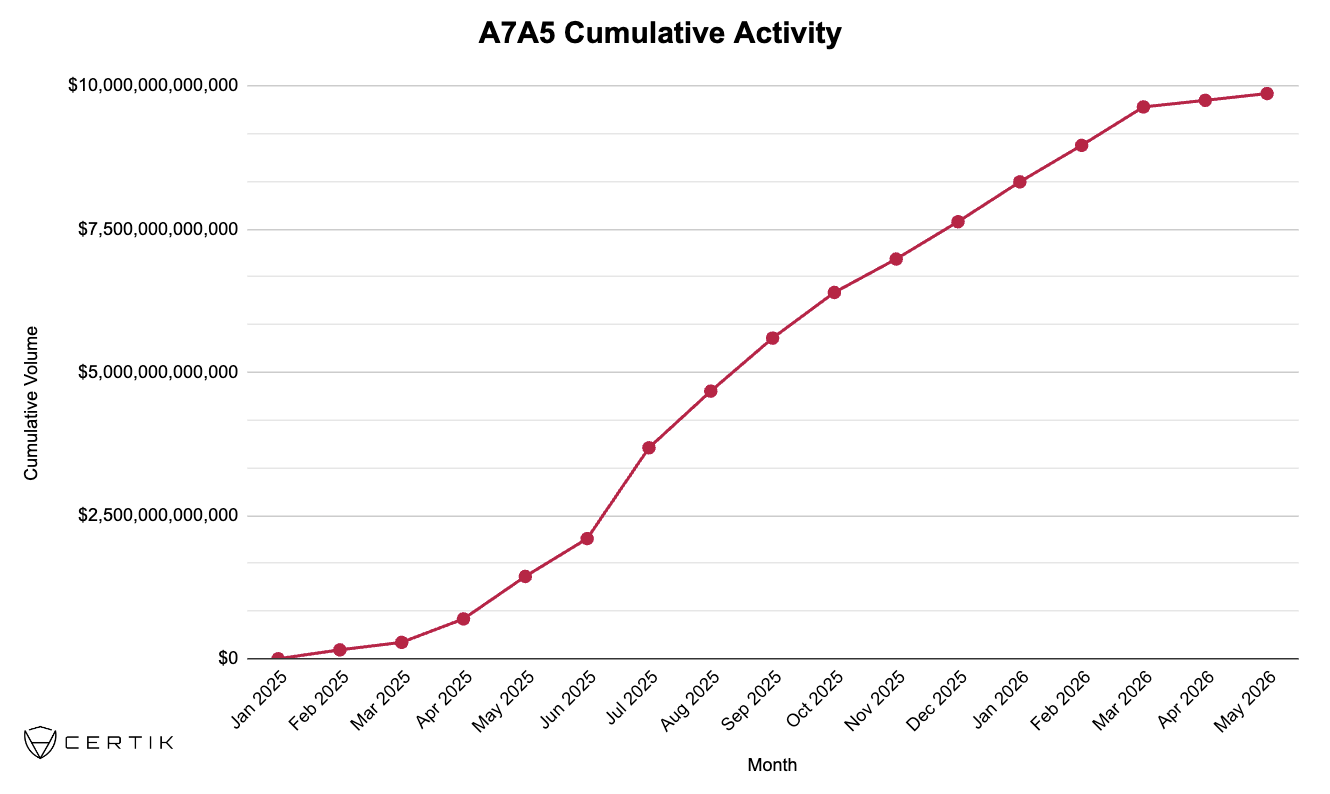
The Russian ruble-backed A7A5 stablecoin continued to grow despite Western sanctions, processing more than $110 billion in cumulative onchain transactions, according to CertiK.
CertiK said A7A5 processed over $110 billion in cumulative onchain transactions, captured about 43% of the global non-US dollar stablecoin market, and that its holder count rose from 13,000 to 29,000 wallets between February 2025 and May 2026.
The security company described A7A5 as one of the clearest examples of a sanctions-evasion stablecoin ecosystem, linking it to Russian cross-border settlement companies.
The growth highlights the limits of Western sanctions against blockchain-based payment systems, including the European Union’s 19th sanctions package, adopted on Oct. 23, 2025, which prohibited transactions involving A7A5 from Nov. 12. CertiK said the reserve structure places key assets outside direct Western enforcement reach.
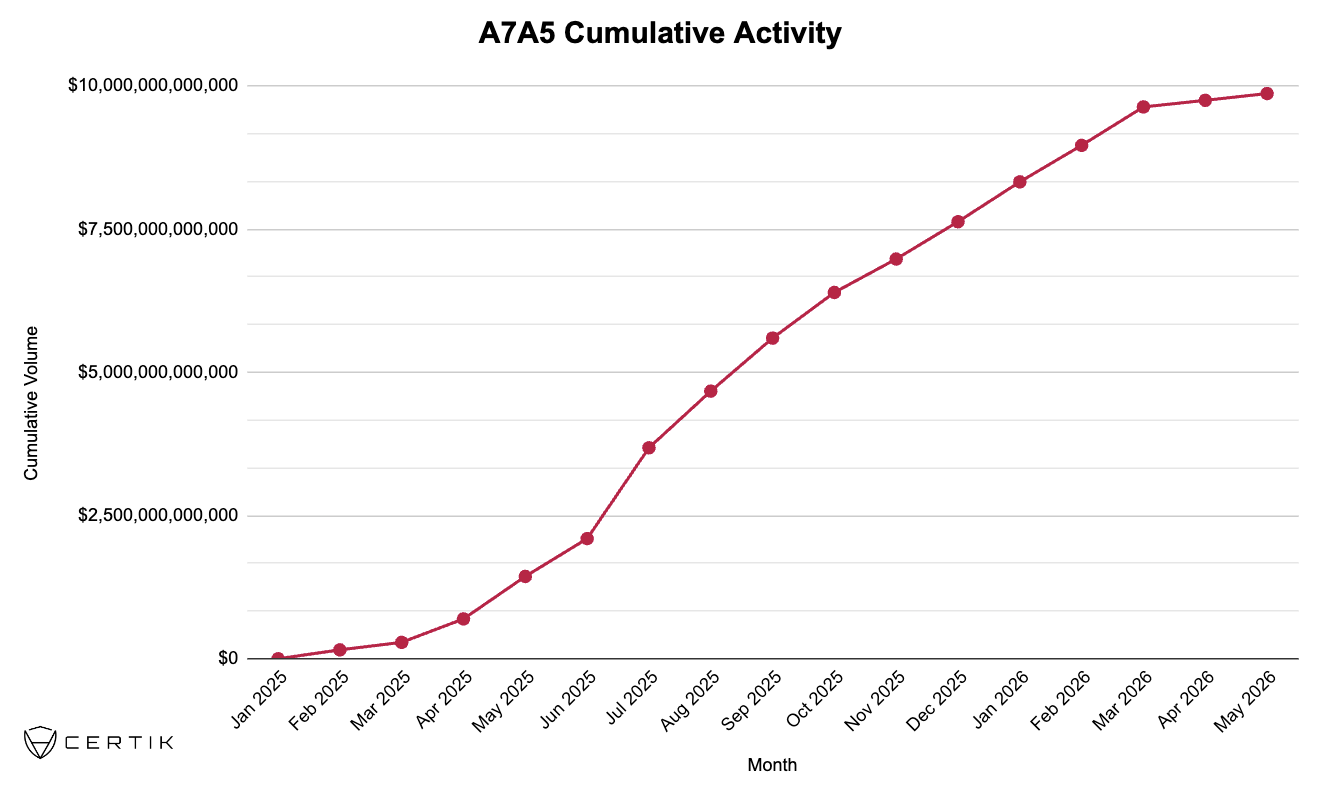
A7A5 cumulative activity, all-time chart. Source: CertiK
A7A5 was issued in January 2025 by Old Vector LLC, a Kyrgyz entity acting on behalf of the Russian cross-border-settlement firm A7 LLC, which is co-owned by Moldovan-Russian oligarch Ilan Shor and Russian state-owned defense sector lender Promsvyazbank.
Russian authorities later recognized A7A5 under the country’s digital financial asset framework.
The stablecoin recorded $11.2 billion in trading volume across A7A5/RUB and $6.1 billion in A7A5/USDT trades, primarily through Grinex, which is the successor to Garantex, the platform that previously functioned as a laundering venue for Conti, Black Basta, LockBit and some illicit funds attributed to North Korean-linked actors, including $30 million from the 2022 Horizon Bridge hack sent to Garantex in February 2023.
US Secret Service seized the Garantex domain in March 2025, while Tether froze approximately $28 million in USDt (USDT) held by Garantex-controlled wallets.
A7A5 was designed to replicate some of USDT’s stablecoin utility while keeping issuance, reserves and freezing authority outside Western-controlled infrastructure.
Related: Recovery hopes fade as Kelp DAO hacker launders nearly all $220M in stolen funds
Can Western sanctions curb A7A5’s circulation?
The creators of the ruble-backed stablecoin have designed it without a centralized kill switch, meaning that the smart contracts responsible for wallet and fund freezes are controlled entirely by its Russian and Kyrgyz developers, according to Jonathan Riss, OSINT and blockchain intelligence analyst at CertiK.
The stablecoin’s reserves also sit in Central Asian banking networks, predominantly in Kyrgyzstan and in the Russian banking system, meaning that the funds are outside the reach of Western sanctions.
A7A5 also relies on a distributed distribution model through decentralized finance (DeFi) liquidity pools such as Curve and Uniswap to prevent getting frozen by centralized exchanges, CertiK’s Riss told Cointelegraph, adding:
“While Western regulators cannot directly rewrite the Ethereum or Tron blockchain to erase A7A5, the EU’s 19th package and parallel US/UK actions target the physical and digital choke points.”
The stablecoin’s creators designed A7A5 with careful consideration of the above three “immunities” to evade sanctions that crippled their previous evasion methods, such as Tether’s USDT, Riss said.
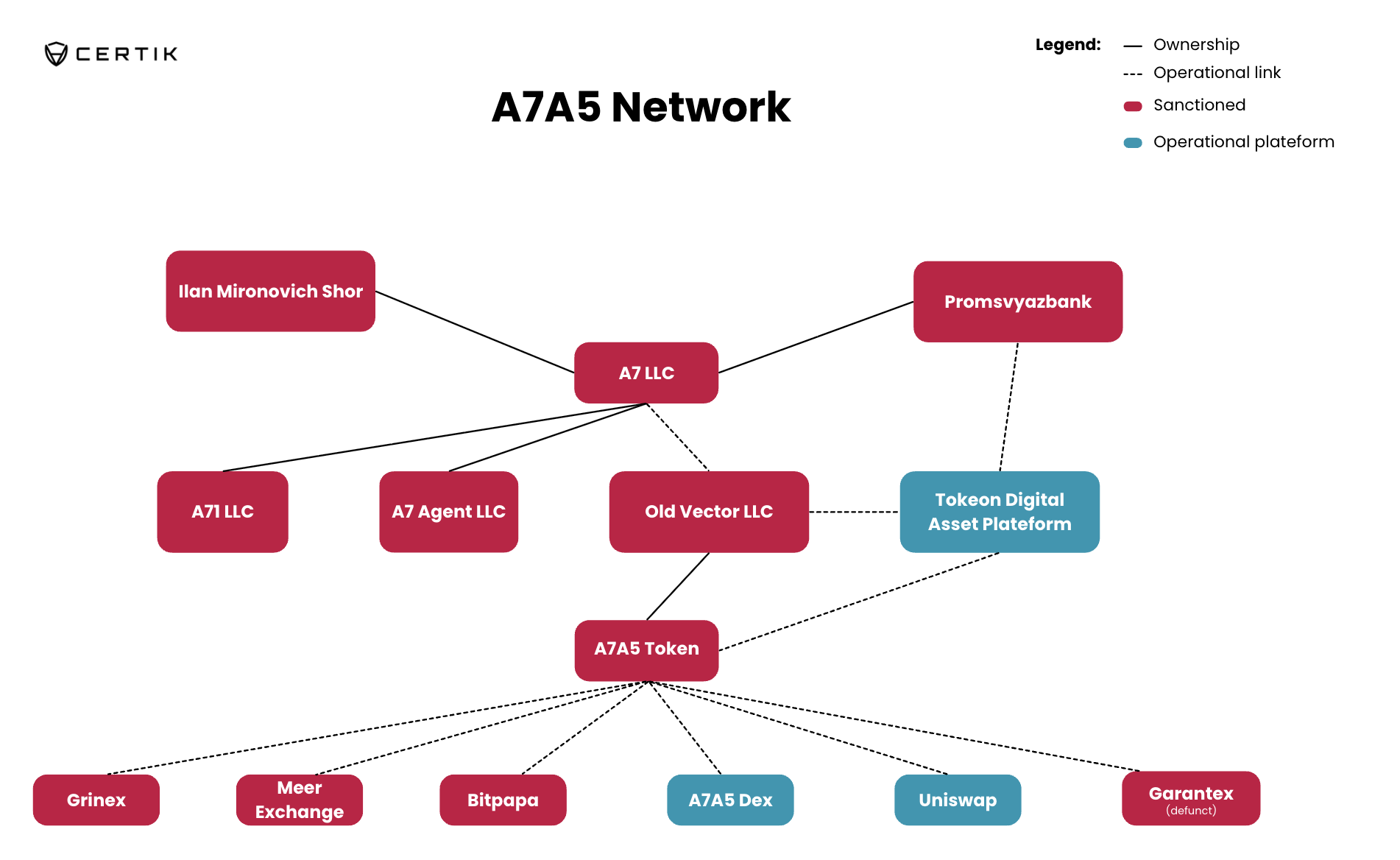
A7A5 network chart. Source: CertiK
Shor owns 51% of A7 LLC as the majority owner. He served as a former Moldovan parliament member until 2017, when he was convicted by a Moldovan court in connection with a 2014 theft of around $1 billion from three Moldovan Banks. He fled Moldova in 2019 and obtained Russian citizenship.
He was sentenced in absentia to 15 years in prison in 2023. He currently resides in Moscow.
Magazine: The legal battle over who can claim DeFi’s stolen millions


Strategy’s (MSTR) recent bitcoin sale has had an outsized impact on market sentiment, but Wall Street bank Citi says spot bitcoin exchange-traded fund (ETF) flows are the primary driver of BTC prices.
Markets were rattled after Strategy disclosed the sale of a small portion of its bitcoin holdings, marking a rare departure from Executive Chairman Michael Saylor’s long-standing “buy and hold” approach. The largest cryptocurrency has slumped 9% since Sunday and earlier Wednesday dropped to the lowest since March.
The sale should not have been a surprise, the bank said. Executive Chairman Michael Saylor mentioned plans to dispose of certain tax-disadvantaged bitcoin holdings as part of a portfolio optimization effort during its first-quarter earnings call. A bigger issue is the lack of investor demand.
“Recent flows have been negative, and the chances for the passage of a U.S. market structure bill (a potential catalyst for renewed investor interest in our view) are diminishing,” analyst Alex Saunders wrote in the Tuesday report.
Saunders said spot bitcoin exchange-traded fund (ETF) flows remain the primary driver of BTC prices, estimating they account for about 45% of weekly return variation. The ETFs have experienced a record 11 straight days of net outflows, which, he said, signals a broader lack of investor demand for the cryptocurrency.
The report also warned that the chances of a U.S. crypto market structure bill passing this year appeared to be declining, reducing the likelihood of a near-term catalyst for fresh investor inflows.
Combined with bitcoin’s underperformance relative to equities, the fading legislative outlook is likely to keep sentiment muted absent regulatory progress or renewed concerns about fiscal sustainability, the report added.
Read more: Bitcoin faces outsized quantum threat as computing breakthroughs accelerate, Citi says
UPDATE (June 3, 14:10 UTC): Adds BTC performance this week, ETF outflow streak record)

TLDR
- Evernorth stated that real banks are already using XRP through regulated stablecoin issuance.
- Société Générale launched its EURCV stablecoin on the XRP Ledger and other public blockchains.
- EURCV operates under the European Union’s MiCA regulatory framework.
- Evernorth said the next 18 months will determine scale, chain selection, and compliance models.
- The firm emphasized that adoption will occur through gradual product launches by regulated institutions.
Evernorth said established banks already use public blockchains for regulated products, including XRP. The firm pointed to Société Générale’s EURCV stablecoin launch across several networks. It stated the next 18 months will determine scale, chain selection, and regulatory alignment.
XRP Selected as Société Générale Expands EURCV Across Public Chains
Evernorth referenced Société Générale’s digital asset unit, SG-FORGE, which issued the euro-backed EUR CoinVertible stablecoin. The bank deployed EURCV on the XRP Ledger, Ethereum, Stellar, and Solana. Evernorth wrote on X that “real banks are already using XRP” through regulated stablecoin issuance.
The company said EURCV ranks among the largest euro-denominated stablecoins in circulation. It explained that U.S. dollar stablecoins still dominate the market share. However, it stated Europe continues building regulated digital money infrastructure under clear supervisory rules.
Evernorth said the blockchain choice signals institutional confidence in selected networks. It stated that major banks evaluate technical stability and compliance readiness before deployment. Therefore, it described XRP’s inclusion as part of a defined infrastructure selection process.
The firm added that SG-FORGE structured EURCV under European financial regulations. It confirmed that the stablecoin operates as a fully backed digital euro instrument. As a result, it emphasized that regulated entities already use public chains for financial settlement.
MiCA Rules Shape XRP Adoption and Network Competition
Evernorth linked the rollout to the European Union’s Markets in Crypto-Assets Regulation, known as MiCA. It stated that MiCA provides operational clarity for issuing and managing digital asset products. The framework became fully effective last year across EU member states.
The company said MiCA offers standardized licensing and disclosure requirements for stablecoin issuers. It explained that these rules give banks defined compliance pathways. Consequently, regulated institutions can deploy blockchain-based instruments within an established legal structure.
Evernorth compared MiCA with ongoing legislative efforts in the United States. It referenced proposals such as the CLARITY Act as examples of developing frameworks. However, it stated that Europe currently provides clearer operational guidance.
The firm wrote that the next 18 months will focus on measurable adoption outcomes. It said, “The next 18 months will be about how much, on which chains, and under which set of rules.” Therefore, it framed the period as a testing phase for network scalability and compliance capacity.
Evernorth said blockchain adoption will occur through incremental product launches rather than single announcements. It stated that banks will continue issuing regulated financial instruments on selected chains. The company identified the EURCV deployment as the latest confirmed step in that process.



On May 29, 2026, at 4:00 p.m. Central Time, CME Group flipped the switch. The world’s largest regulated derivatives exchange now trades Bitcoin and Ethereum futures and options around the clock, seven days a week, with only a short maintenance pause.
Summary
- CME Group now offers near-24/7 trading for crypto futures and options, with only short maintenance pauses.
- The shift covers nine assets, including Bitcoin, Ethereum, Solana, XRP, Cardano, Chainlink, Stellar, Avalanche, and Sui.
- Continuous trading effectively ends the recurring weekend CME gap that shaped years of Bitcoin technical analysis.
- The change is a major institutional milestone, but weekend liquidity may remain thin until volume builds.
The change covers nine crypto assets: Bitcoin, Ethereum, Solana, XRP, Cardano, Chainlink, Stellar, Avalanche, and Sui. The first weekend saw more than 7,200 contracts traded. It sounds like a dry piece of market plumbing, and in one sense it is.
But it quietly kills one of the most-watched quirks in all of crypto trading, the “CME gap,” and it marks a real milestone in how thoroughly traditional finance has absorbed digital assets. This piece explains what changed, why institutions pushed for it, what it does to the famous weekend gap, and the catch that most of the celebratory coverage is leaving out.
What actually changed
For years, CME’s crypto futures ran on traditional-market time. Trading opened Sunday evening and closed Friday afternoon, with the market shut for roughly 48 hours every weekend. That made sense for the exchange that has historically traded corn, oil, and interest-rate futures. It made much less sense for an asset class that never stops.
As of May 29, 2026, that closure is gone. CME crypto futures and options now trade nearly 24 hours a day, seven days a week, on its Globex electronic platform. The only interruptions are a two-minute maintenance window on weekdays between 4:00 and 4:02 p.m. Central Time, and a longer two-hour window on weekends. Continuous trading kicked off at 4:00 p.m. Central, which is 10:00 a.m. UTC. As close to always-on as a regulated exchange realistically gets.
The product roster is broad. Bitcoin futures, which CME first launched in December 2017, and Ether futures, added in 2021, anchor the lineup. Around them sit futures on Solana, XRP, Cardano, Chainlink, Stellar, Avalanche, and Sui. All of them now fall under the 24/7 umbrella, giving institutional traders continuous access to a diversified crypto derivatives portfolio on a single regulated venue. CME also rolled out Bitcoin Volatility futures, a product that lets traders position on Bitcoin’s volatility itself, available 24/7 from June 1.
The early demand was real. CME reported more than 7,200 contracts traded during the first weekend of continuous operation. Average daily volumes for crypto futures in early 2026 were already up 46 percent year-over-year, reaching around 407,200 contracts, with open interest near 335,400 contracts at launch. The weekend trading is not a token gesture. There is genuine appetite for it.
Why institutions pushed for this
The argument behind the change is simple and entirely about risk management.
A hedge fund, corporate treasury desk, or asset manager running a Bitcoin position has a problem if the main regulated futures venue closes for 48 hours every weekend. Bitcoin does not stop trading on Saturday. Spot markets and offshore venues keep moving, sometimes violently, on weekend news. But the institution holding a regulated hedge through CME could not adjust that hedge until Sunday evening. For two days every week, carefully managed exposure sat frozen while the underlying asset kept moving.
That gap between when risk happens and when you can hedge it is exactly what professional risk managers are paid to eliminate. Tim McCourt, CME’s Global Head of Equities, FX and Alternative Products, framed it directly, saying client demand for round-the-clock risk management had reached an all-time high and that always-on regulated markets let clients trade with confidence at any time. The institutional translation: we have clients with real money at risk who could not sleep on Friday night, and they asked us to fix it.
The ecosystem moved with CME. Robinhood’s futures chief called it the first time its users could trade regulated futures at any hour of any day. Ripple Prime, positioning itself as a futures commission merchant built for always-on markets, signed on. Wedbush, which had already been serving clients on a 24/7 basis, expanded its support. The point is that this was not CME acting alone. It was a coordinated move by the brokers and clearing firms that route institutional money into crypto derivatives, which tells you the demand was coming from their clients, not from the exchange looking for a headline.
The death of the CME gap
The most interesting casualty of this change is a piece of crypto trading folklore: the CME gap.
Here is how it worked. Because CME closed Friday afternoon and reopened Sunday evening, Bitcoin’s spot price would drift over the weekend while CME futures sat frozen at Friday’s closing level. When futures reopened Sunday night, the chart showed a “gap” between Friday’s close and Sunday’s open, wherever spot had wandered to in between. These gaps became a fixture of Bitcoin technical analysis. Traders watched them obsessively, because Bitcoin’s price had a well-documented tendency to later return and “fill” the gap, snapping back to that abandoned price level.
The gap became both a technical indicator and a speculative strategy. Traders would position around gap fills, betting the price would return to close them. Thin weekend liquidity made the whole thing worse, because low-volume weekend order books exaggerated moves that would frequently reverse once institutional participants logged back on late Sunday. The 11:00 p.m. UTC Sunday reopen was a recurring moment of volatility as futures recalibrated to wherever spot had gone, much of it low-volume noise rather than real price discovery.
With continuous trading, that structural quirk is, for practical purposes, extinct. There is no Friday close to gap away from and no Sunday reopen to snap back. One of the most reliably exploited inefficiencies in crypto markets just disappeared. For chart analysts who built strategies around gap fills, a tool they relied on for years is gone. For the market as a whole, it removes a recurring source of artificial weekend volatility that had little to do with fundamentals.
Why it matters beyond the gap
Strip away the trading folklore and the deeper significance is about market maturity.
Every step CME has taken in crypto, from the first Bitcoin futures in 2017 through the addition of Ether, Solana, and the rest, has been a marker of how seriously traditional finance takes the asset class. The 24/7 move is the next one. It signals that crypto derivatives have enough institutional volume and demand to justify the operational cost of running a regulated market around the clock, which is not trivial. Exchanges do not staff weekend operations and rebuild clearing schedules for an asset they consider a sideshow.
It also narrows the structural gap between regulated venues and crypto-native ones. For years, the knock on regulated crypto derivatives was that they operated on banker’s hours while the real action happened 24/7 on offshore perpetual-futures exchanges. That divide pushed a lot of volume to less-regulated venues simply because those were the only places open when the market moved. By going continuous, CME removes one of the main reasons institutional traders had to step outside the regulated system to manage weekend risk. It brings activity that had leaked offshore back toward a venue with US oversight and clearing guarantees.
There is a longer-arc reading too. The shift quietly admits that crypto’s always-on model won the argument. Traditional markets close because the institutions trading them are human and need the weekend. Crypto never adopted that convention, and rather than force crypto to conform, the largest traditional derivatives exchange reshaped itself around crypto’s clock. That is a small but telling reversal of who is adapting to whom.
The catch the press releases skip
Here is the part that the celebratory coverage tends to leave out: the structural gap is gone, but the liquidity is not evenly there yet.
Eliminating the weekend closure does not automatically create deep weekend markets. In the early going, liquidity on CME’s crypto products remains concentrated where it always was, during peak weekday hours and in the most-traded contracts. Weekend order books may stay thin for a while, which means volume and genuine price discovery will still cluster on weekdays even though the market is technically open all weekend. You can now trade Saturday, but you may not find a deep market to trade into.
The broader liquidity reality complicates the story further. Even with the change, the deepest pools of crypto derivatives liquidity sit elsewhere. IBIT options open interest, tied to BlackRock’s spot Bitcoin ETF, far exceeds CME’s crypto options markets, and offshore perpetual-futures venues still dominate raw volume. CME going 24/7 removes a structural inefficiency, but it does not instantly make CME the deepest place to trade crypto on a Saturday. That will depend on whether the weekend volume builds over time or stays a thin afterthought to the weekday session.
And the back office still runs on traditional time. Any trade executed over a weekend or holiday gets assigned the next business day’s date for clearing and settlement. You can trade on Saturday, but the paperwork pretends it happened Monday. It is a practical accommodation that lets CME extend trading hours without rebuilding its entire clearing infrastructure, but it is a reminder that the plumbing of traditional finance has not gone fully continuous even as the trading screen has.
None of this undercuts the significance of the change. It just means the honest version is “CME removed the weekend closure and the famous gap, and weekend liquidity will build from here,” not “CME weekends are now as deep as weekdays.” The structure changed instantly. The liquidity follows on its own schedule.
Where this leaves the market
CME going 24/7 is one of those changes that looks like plumbing and turns out to matter more than it first appears.
The immediate effects are concrete. The weekend closure is gone, the CME gap that shaped years of Bitcoin technical analysis is effectively extinct, and institutional traders can now hedge regulated crypto positions at any hour instead of sitting frozen through every weekend. The first-weekend volume and the 46 percent year-over-year growth in crypto futures activity show the demand was real, not theoretical.
The significance is mostly structural. This is another marker of crypto’s absorption into mainstream finance, a step that narrows the divide between regulated and crypto-native venues and pulls some weekend risk management back toward a US-overseen platform. It also quietly confirms that crypto’s always-on model reshaped the largest traditional derivatives exchange rather than the other way around.
The caveat is liquidity. A market being open is not the same as a market being deep. Weekend trading on CME will start thin and build only if the volume actually shows up, and the deepest crypto derivatives liquidity still sits in ETF options and offshore perpetuals rather than on CME. The structural change happened on May 29. Whether it becomes a genuinely active weekend market or stays a technically-open but lightly-used window is the thing to watch over the coming months. Either way, the era of the Bitcoin weekend gap is over, and that alone makes this a date worth remembering in the slow institutionalization of crypto.
This article is for informational purposes and does not constitute financial or investment advice. Cryptocurrency markets are highly volatile. The figures and analysis described reflect data available as of June 2, 2026. Always do your own research and consult with qualified financial professionals before making investment decisions.
TLDR
- Peter Schiff warned that Bitcoin could fall below $20,000 if it breaks the $50,000 level.
- He said excessive complacency suggests the market is not near a bottom.
- Schiff argued that a sharp drop could push long-term holders to exit positions.
- Strategy sold 32 BTC to fund preferred dividends while holding over 843,000 BTC.
- CryptoQuant reported that monthly Bitcoin demand has contracted by 232,000 BTC.
Bitcoin traded near $67,000 after a 4% daily drop and a 16% monthly decline. Peter Schiff warned that a break below $50,000 could trigger a slide under $20,000. He argued that complacency, not volatility, threatens market stability.
Bitcoin Price Outlook Faces $20K Breakdown Risk
Schiff posted on X that investor sentiment shows excessive calm despite recent losses. He wrote, “There’s way too much complacency in Bitcoin for the market to be anywhere near a bottom.” He added that once Bitcoin breaks $50K, it should fall quickly below $20K. He said that such a move would pressure long-term holders to exit positions. He claimed many investors would “finally throw in the towel” after a sharp breakdown.
Earlier, Schiff questioned whether a Bitcoin crash would drag broader risk assets lower. He suggested that either outcome could redirect capital toward “value and safety.” For years, he has supported gold as a hedge during market stress. He repeated that stance while discussing current price conditions.
Schiff also targeted Strategy’s STRC preferred stock during his commentary. STRC traded below $96, pushing its yield near 12% at the time. He argued that doubts about dividend payments could drive the price lower. He described a potential need to raise the coupon as a “death spiral.”
Strategy recently sold 32 BTC for $2.5 million to fund preferred dividends. The company still holds over 843,000 BTC on its balance sheet. Schiff suggested that the preferred structure remains fragile despite the large holdings.
Market Reaction Splits as Analysts Cite Demand Contraction
Crypto commentator Alex Marzell dismissed Schiff’s outlook on social media. He said that a move to $20K would only test his available cash. Meanwhile, Bitget CEO Gracey Chen said she plans to buy nearly $50,000. She stated that global money printing could support commodities, including Bitcoin and gold.
Chen also flagged short-term risks affecting the Bitcoin price. She cited CPI pressure, potential rate hikes, and selling by large holders. She mentioned possible sales from Strategy and Mt. Gox creditors. She also said heavy AI-related IPOs could drain market liquidity.
CryptoQuant research head Julio Moreno reported contracting Bitcoin demand. He said monthly demand has fallen by 232,000 BTC. He stated that weakening demand, not macro factors, drives the correction.
Bitfinex published a report describing a “slow bleed” phase. The report linked price weakness to distribution and fading conviction. Moreno’s assessment aligned with that view on demand contraction.


Federal investigators have opened a probe into former U.S. Representative George Santos after suspicious prediction market trades allegedly generated tens of thousands of dollars around President Donald Trump’s February State of the Union address.
Summary
- DOJ and CFTC have opened an investigation after Kalshi flagged suspicious trades linked to former Congressman George Santos.
- NPR reported that Santos allegedly made tens of thousands of dollars betting he would miss President Trump’s State of the Union address.
- The case adds to growing scrutiny of insider trading risks on prediction market platforms such as Kalshi and Polymarket.
NPR reported that the Department of Justice and the Commodity Futures Trading Commission are investigating Santos after prediction market platform Kalshi detected unusual trading activity linked to a contract on whether he would attend the speech. According to NPR, Kalshi froze Santos’ account and referred the matter to regulators after reviewing the trades.
Based on NPR’s reporting, Santos allegedly wagered that he would not attend the event despite posting a video on X indicating that he planned to be present in the gallery. As President Trump delivered his address, Santos posted from an airport, after which the market’s odds on his attendance dropped sharply, NPR said.
People familiar with the matter told NPR that Kalshi has sought to interview Santos as part of its internal investigation. The report added that Santos has not participated in those interview requests.
When contacted by the outlet, Santos responded, “Well, that’s news to me.”
Kalshi’s enforcement efforts face new test
Coming months after Kalshi disciplined political candidates for trading on their own races, the Santos case places renewed attention on how prediction markets police participants who may possess direct knowledge of an event’s outcome.
Back in April, Kalshi suspended three federal candidates after an internal review found they had placed bets on their own election contests. Kalshi’s head of enforcement, Robert DeNault, said at the time that candidates capable of influencing market outcomes violated exchange rules regardless of the size of their trades.
Those earlier cases resulted in exchange penalties but did not lead to referrals to the DOJ or the CFTC. NPR’s reporting suggests the Santos matter followed a different path, with Kalshi freezing the account and escalating the issue to regulators.
Kalshi has recently expanded measures intended to prevent market abuse. The company said it introduced screening tools designed to stop users from trading on events in which they are directly involved.
Prediction markets draw growing insider trading scrutiny
Attention from regulators has increased as several high-profile cases have raised questions about the use of nonpublic information in event-based contracts.
In April, federal prosecutors charged a U.S. Army Special Forces soldier with making roughly $409,881 from Polymarket bets tied to the capture of Venezuelan President Nicolás Maduro. Authorities alleged the trader possessed advance knowledge connected to the operation.
More recently, the DOJ and the CFTC charged Google software engineer Michele Spagnuolo with insider trading tied to prediction markets. Prosecutors alleged that Spagnuolo used confidential Google search ranking data to place $2.7 million in bets on Polymarket, generating approximately $1.2 million in profit before the information became public.
CFTC Enforcement Director David Miller said in May that insider trading laws apply to prediction markets and rejected arguments that event contracts exist outside existing market abuse rules.
Congress has also stepped up oversight. In May, House Oversight and Government Reform Committee Chairman James Comer launched an inquiry into insider trading safeguards at Kalshi and Polymarket, seeking information about monitoring systems and enforcement practices.
As scrutiny has intensified, both Kalshi and Polymarket have introduced additional compliance measures.
Kalshi has focused on identifying participants with direct involvement in market events, while Polymarket has revised its rules, expanded surveillance programs, and hired blockchain analytics firm Chainalysis to support investigations into insider trading and market manipulation.
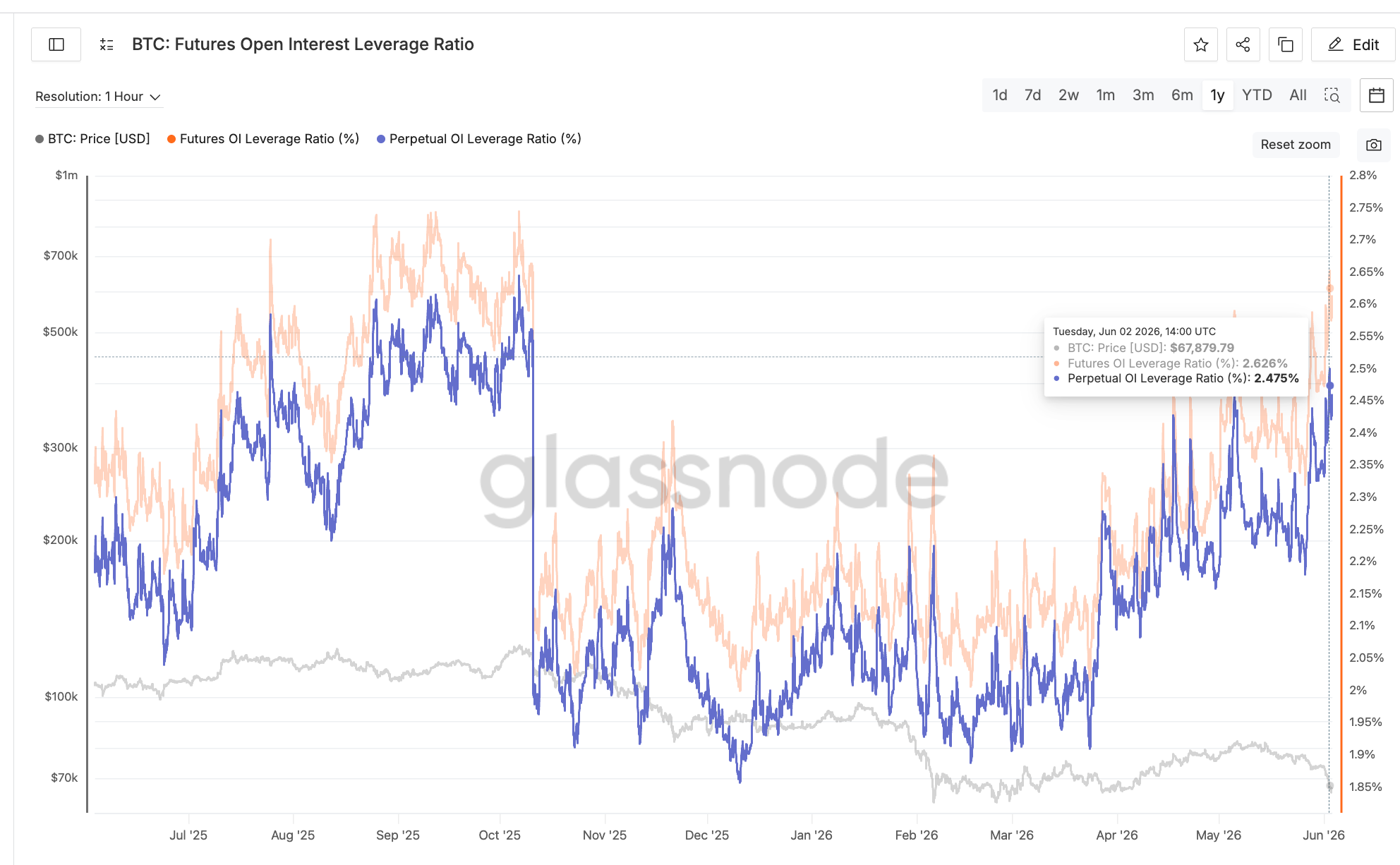
The crypto market fell nearly 7% in 24 hours into June 3, with Bitcoin briefly breaking below $66,000 and around $1.8 billion in positions wiped out.
The drop looked sudden, but the on-chain data had been flashing for days. Leverage sat at October-crash levels, funding ran hot, and a rare Strategy Bitcoin sale was the spark.
The Leverage Was Already at October-Crash Levels
Before the drop, the derivatives market was stretched. Bitcoin’s futures open interest leverage ratio, a gauge of how much borrowed money sits in the futures market relative to Bitcoin’s size, climbed to 2.63% on June 2. The perpetual version reached 2.48%. Both were the highest readings since October 6, 2025.

That date matters. It fell days before the October 10 Black Friday crash, when the same ratio peaked near 2.73%. A high reading means traders had piled into leveraged positions after a steady rally, leaving the market fragile.
Want more token insights like this? Sign up for Editor Harsh Notariya’s Daily Crypto Newsletter here.
Funding rates showed which side. The rate across all exchanges, the periodic fee that long traders pay shorts on perpetual futures, rose to about 0.018 on June 2, the most positive single-day reading since early September.

Because positive funding means longs pay to hold their bets, the spike confirms the leverage had crowded onto the long side. Notably, the funding bias was already high on June 1, at 0.017, the day when the market got its major bearish catalyst.
A Key BTC Sale Broke the Mood, Led to the Crypto Crash
The spark came on June 1. Strategy, the corporate Bitcoin holder led by Michael Saylor, disclosed a rare Bitcoin sale, its first in years. For a firm known only for buying, the reversal hit sentiment hard.
Analytics firm Santiment reported that social sentiment flipped into extreme fear, with traders blaming the Strategy sale as a main trigger.
With the market already leaning long and over-leveraged, that shock was enough to start the unwind.
BTC Spot Selling Ran Hotter Than October
The selling was not only in derivatives. Spot Bitcoin moving onto exchanges, often a precursor to selling, spiked on June 2. Total exchange inflows reached about 58,617 BTC, the highest since April 14. June 1 hit the sentiment hard and June 2 saw exchange-specific inflows as a result.

That figure carries weight against the October comparison. On October 7, 2025, just before the Black Friday crash, inflows peaked near 46,527 BTC. June 2 ran higher, so spot selling pressure was heavier this time than ahead of the October wipeout.
Crowded long leverage and real coins hitting exchanges together set off the crypto crash cascade.
Whales Sold, and It Was a Bitcoin Problem
The selling traced to large holders. Santiment data showed wallets holding between 10 and 10,000 BTC, the whales and sharks, offloaded 24,602 BTC over the past week, an 18% cut. The smallest traders, holding under 0.01 BTC, added just 61 coins, far too little to cushion the fall.
The cause sat with Bitcoin itself. CryptoQuant’s head of research, Julio Moreno, noted that Bitcoin demand was contracting at about 232,000 BTC a month, and argued the correction tied to demand rather than stocks, oil, or macro. US equities, by contrast, sat at record highs.
Because Bitcoin still commands about 58.4% of the total crypto market, its share of all crypto value, per CoinGecko, its slide dragged the rest of the market down with it, resulting in this sudden crypto crash.

For now, the data that flagged the drop is the data to watch. Whether leverage resets or builds back up, and whether Bitcoin demand steadies, will shape how the market moves over the next few days.
The post It Was All There: High Leverage and a Rare BTC Sale Behind the June Crypto Crash appeared first on BeInCrypto.

Global payments giant Mastercard has taken another major step toward integrating blockchain into traditional finance. It announced broader settlement capabilities that now include several stablecoins, such as Ripple’s RLUSD, Circle’s USDC, Paxos-issued PYUSD, USDG, and USDP, and SoFi’s SoFiUSD.
The crypto assets linked to the US dollar will be enabled across a wide range of supported networks, such as XRPL, Solana, Ethereum, Arbitrum, and Base.
To Settle Transactions in Stablecoins
The announcement from the TradFi behemoth reveals that the company is expanding its infrastructure to allow merchants and partners to settle transactions using the aforementioned assets. This is considered a significant evolution from pilot programs into more practical, real-world applications.
The firm has been building out its crypto strategy through its Multi-Token Network (MTN), designed to bridge traditional finance and digital assets. Most recently, it outlined a new collaboration that included some industry giants such as Binance, Ripple, and even PayPal.
Its stablecoin initiatives saw a major push in March when Mastercard announced the acquisition of such a payments firm called BVNK for $1.8 billion.
RLUSD has drawn particular attention due to Ripple’s strong presence in cross-border payments. However, Mastercard’s announcement encompasses a wider range of established stablecoins, including USDC and PYUSD.
Both are already gaining traction in institutional and payments use cases, and Mastercard is attempting to position itself as a neutral infrastructure layer rather than backing a single issuer.
Stablecoins’ Growth
The company’s latest move on the stablecoin scene comes as demand quickly grows for faster and cheaper cross-border transactions. These assets are increasingly viewed as a viable alternative to legacy correspondent-backing systems, offering near-instant settlement and lower costs.
Mastercard’s decision to expand support signals rising confidence in their long-term role within the global financial system. In addition, the firm emphasized its commitment to regulatory compliance, security, and interoperability, which are all key requirements for institutional adoption.
“The next phase of stablecoin adoption is about real-world utility, especially in settlement, where timing and liquidity matter most. By introducing intraday and weekend on settlement options across our global network, we’re expanding how partners manage liquidity and operate in an always-on digital economy while maintaining the trust, resilience and safeguards they expect from Mastercard,” commented Raj Dhamodharan, executive vice president, Blockchain & Digital Assets at Mastercard.
The post Ripple’s RLUSD in Focus as Mastercard Expands Stablecoin Strategy appeared first on CryptoPotato.
Rajesh Exports: Sebi finds 97-99% revenue inflation, bars promoter from trading

Kraken-linked Payward opens tokenized U.S. IPO access to retail investors

Israeli occupation’s aim is ethnic cleansing by any means possible



-

 Tech5 days ago
Waymo dominates autonomous vehicle registrations as Tesla trails behind
-

 News Videos5 days ago
This is BROKEN! INSANE 5x MONEY CAR WASH WEEK! The NEW GTA Online UPDATE Today! (GTA5 New Update)
-
 Tech4 days ago
SpaceX just won a second Golden Dome contract. This one is $4.16 billion.
-
 News Videos5 days ago
SHE IS KILLING XRP!!! WATCH URGENT AND ACT FAST
-

 Business2 days ago
Jade Biosciences, Inc. (JBIO) Discusses Positive Interim Results From JADE101 Phase I Healthy Volunteer Study and Development Plans Transcript
-
 NewsBeat5 days ago
FIRST NIGHT REVIEW: Take That bring the Circus back to life in spectacular sun-soaked style
-
Crypto World5 days ago
CFTC Has Approved the First Regulated Bitcoin Perpetual Contract in the U.S.
-

 Business4 days ago
Is the Spurs Phenom Already Better Than Prime Diesel?
-
 NewsBeat5 days ago
Novak Djokovic v Joao Fonseca LIVE: French Open latest scores and results after Jannik Sinner’s shocking collapse
-
 Crypto World5 days ago
Snowflake (SNOW) Stock Rallies on Strong Q1 Results and AI Product Growth
-
 Entertainment5 days ago
Weak ‘Supergirl’ Box Office Tracking Amid Milly Alcock Backlash
-

 Business4 days ago
Demand Conditions Improve In Chemicals Sector In April 2026
-
 Crypto World5 days ago
MicroStrategy Moves $30 Million in BTC to Coinbase Prime: Is the Bitcoin Sell-Off Already Here?
-

 Politics4 days ago
The House | Inside Andy Burnham’s Makerfield Campaign: “Nobody Thinks This Is In The Bag”
-
 Entertainment4 days ago
One of the Greatest Sitcoms of All Time Shoots Up Apple TV’s Charts 11 Years Later
-

 Tech5 days ago
This Week In Security: Ubiquiti Fixes, And FreeBSD Joins The Club You Don’t Want To Join
-

 Entertainment5 days ago
Maddox Jolie-Pitt Legally Requests to Drop Brad’s Surname
-
 Entertainment4 days ago
Britney Spears Shares Troubling Update After Hard Year
-
 Crypto World1 day ago
Seagate (STX) Stock Surges to Record High on AI Boom and Legal Settlement
-
 Entertainment5 days ago
Bruce Willis’ Generosity Resurfaces Amid His Dementia
You must be logged in to post a comment Login