
Crypto World
Bitmine (BMNR) Stock Surges 4.16% on Record 5.18M ETH Treasury Holdings


Key Highlights
-
BMNR shares surge 4.16% following disclosure of 5.18M ETH treasury position
-
Company’s total assets reach $13.1B including cryptocurrency and cash reserves
-
Staking operations now generate $297M in annualized revenue from 4.36M ETH
-
Weekly acquisition of 101,745 ETH marks fourth consecutive week of accelerated buying
-
Bitmine now controls approximately 4.29% of Ethereum’s circulating supply
Shares of Bitmine Immersion Technologies advanced during Monday’s trading session following the company’s announcement of expanded Ethereum treasury holdings and substantial staking revenue. BMNR stock closed at $22.79, reflecting a gain of $0.91, or 4.16%, after bouncing back from an early session low around $21.88. The equity climbed above the $23.00 threshold later in the day as investors responded positively to the strategic ETH accumulation.
Bitmine Immersion Technologies, Inc., BMNR
Company Accelerates Ethereum Accumulation Strategy
Bitmine disclosed that its Ethereum treasury position stood at 5,180,131 ETH as of May 3. Management calculated the position’s value using $2,336 per ETH. The firm confirmed this holding now accounts for roughly 4.29% of Ethereum’s entire circulating supply.
This disclosure brings the company significantly closer to its publicly announced goal of controlling 5% of all ETH in circulation. During the previous seven-day period, Bitmine added 101,745 ETH to its reserves. Leadership noted this purchase continued an accelerated acquisition pattern that has persisted for four consecutive weeks.
Management positioned this accumulation strategy within the context of Ethereum’s expanding role in asset tokenization and public blockchain infrastructure. The firm also highlighted ETH’s growing importance in AI-integrated commerce platforms. These strategic justifications provided additional support for BMNR stock’s positive price movement during the session.
Staking Operations Generate Substantial Revenue Stream
Bitmine reported that 4,362,757 ETH had been deployed in staking activities as of May 3. The company assessed this staked allocation at approximately $10.2 billion. This represents over 84% of the firm’s complete Ethereum holdings.
According to the announcement, current staking activities generate $297 million in annualized revenue. Furthermore, management indicated that full deployment through MAVAN and associated partner networks could increase annual rewards to $352 million. MAVAN refers to the Made in America Validator Network.
The company developed MAVAN primarily to facilitate its internal Ethereum treasury staking requirements. However, management revealed plans to extend MAVAN services to institutional investors, digital asset custodians, and blockchain ecosystem collaborators. This expansion positions the staking infrastructure as a revenue-generating service beyond internal operations.
Diversified Asset Base and Recent Transaction Activity
Bitmine disclosed combined holdings of approximately $13.1 billion across cryptocurrency, cash equivalents, and other publicly traded securities. This portfolio encompasses 5.18 million ETH, 200 BTC, and $700 million in cash reserves. Additionally, the company maintains a $200 million equity position in Beast Industries.
The firm also disclosed an $83 million investment in Eightco Holdings, which operates under the ticker symbol ORBS on the Nasdaq exchange. These diversified holdings demonstrate that Bitmine’s treasury management extends beyond exclusive Ethereum concentration. Nevertheless, ETH accumulation remains the central pillar of the company’s financial strategy.
The treasury update arrived shortly after another over-the-counter transaction between the Ethereum Foundation and Bitmine. The foundation transferred 10,000 ETH to the company at an average execution price of $2,292 per token. This represented the third documented OTC Ethereum sale from the foundation to Bitmine within the past two months.


ePBS, Block-Level Access Lists, and EIP-8037 repricings combine to unlock a 200M gas limit floor, a throughput jump that could keep network fees pinned for years.
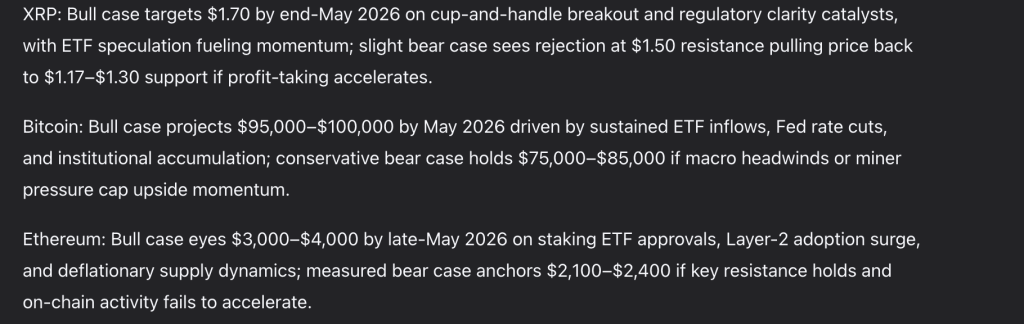
We prompted China’s Alibaba Qwen AI to predict near-term price predictions for XRP, Bitcoin, and Ethereum, and the result is a tightly structured outlook.
It leans on macro easing, ETF momentum, and asset-specific catalysts to justify another leg higher.
As per Qwen AI, Bitcoin is expected to push toward $95,000–$100,000 on sustained ETF inflows, potential Fed rate cuts, and continued institutional accumulation.
Which is interesting because Bitcoin just reclaimed $80,000 making the prediction realistic and possible.

Alibaba AI frame Ethereum for a move into the $3,000–$4,000 range, driven by staking ETF approval narratives, Layer-2 expansion, and deflationary supply mechanics.
XRP, meanwhile, is positioned around a technical breakout scenario, with a cup-and-handle structure and regulatory clarity acting as the core drivers behind a move toward $1.70.

What makes this set of predictions stand out is the balance between catalysts and structure. Qwen is not just projecting targets, it is tying each move to a specific trigger.
Bitcoin depends on liquidity and macro conditions. Ethereum relies on institutional product expansion and on-chain growth. XRP is driven by technical breakout confirmation and sentiment shifts tied to regulation and ETF speculation.
The question now is whether price action is actually confirming those triggers, or if the market is still lagging behind the narrative.
Price Prediction: Can Bitcoin, Ethereum, and XRP Validate These Alibaba Qwen AI Breakout Predicts?
Bitcoin is now trading around $78,996, still holding comfortably above the $75K pivot that Qwen’s entire bullish case depends on.
As long as this level holds, the structure supports continuation toward $95K–$100K, driven by ETF inflows and improving macro conditions.
The key shift here is stability. BTC is not just hovering at support anymore, it is maintaining strength above it.
That said, momentum is still not fully expanding. If the price slips back below $75K, the market is likely to rotate into the more conservative $75K–$85K range, delaying the breakout scenario.
Ethereum price is sitting near $2,339, still below the critical reclaim zone. The $2,400–$2,600 range remains the barrier that must be overcome for the $3,000–$4,000 projection to align with reality.
Right now, ETH is close, but not there yet. Holding above $2,300 keeps the structure intact, but without a push higher, it remains in a reactive phase.
Lose this level, and the downside toward $2,100–$2,200 comes back into focus. The narrative is strong, but price still needs to confirm it.
XRP is trading around $1.39, just below the key $1.50 resistance that defines the breakout scenario.
This keeps the setup very tight. If XRP can push through $1.50 and hold above it, the move toward $1.70 becomes a direct continuation play, aligning with the cup-and-handle breakout thesis.
Momentum can build quickly from there, especially with regulatory clarity and ETF speculation still in the background.
On the downside, rejection at $1.50 keeps XRP within its current range and brings the $1.17–$1.30 support zone back into play. That range now acts as the key defense level. Losing it would weaken the structure and shift the tone back toward consolidation rather than expansion.
Across all three, the structure remains intact and slightly stronger than before, but the breakout is still not confirmed.
Prices are holding in the right zones, but the market still needs that next push to turn positioning into momentum.
Discover: The best crypto to diversify your portfolio with
AI Predicts That Bitcoin Hyper Could Outperform Them All
Early-stage infrastructure plays offer a different risk/reward profile entirely, and some traders rotating between cycles are already looking there.
Bitcoin Hyper is positioning itself as infrastructure for the next leg: the first Bitcoin Layer 2 with Solana Virtual Machine (SVM) integration, claiming sub-Solana latency while inheriting Bitcoin’s security layer.
The project has raised $32M in its presale at a current token price of $0.013679, with staking available at high APY for early participants.
The core thesis, bringing fast, low-cost smart contracts to Bitcoin without abandoning its trust model, targets a gap that neither Ethereum nor Solana fills directly.
The post China’s Alibaba AI Predicts the Price of XRP, Bitcoin, Ethereum by the End of May 2026 appeared first on Cryptonews.
Crypto World
Pavel Durov Just Took Over TONCoin as Its Largest Validator and Cut Fees to Near Zero: Is This the Catalyst TON Has Been Waiting For?
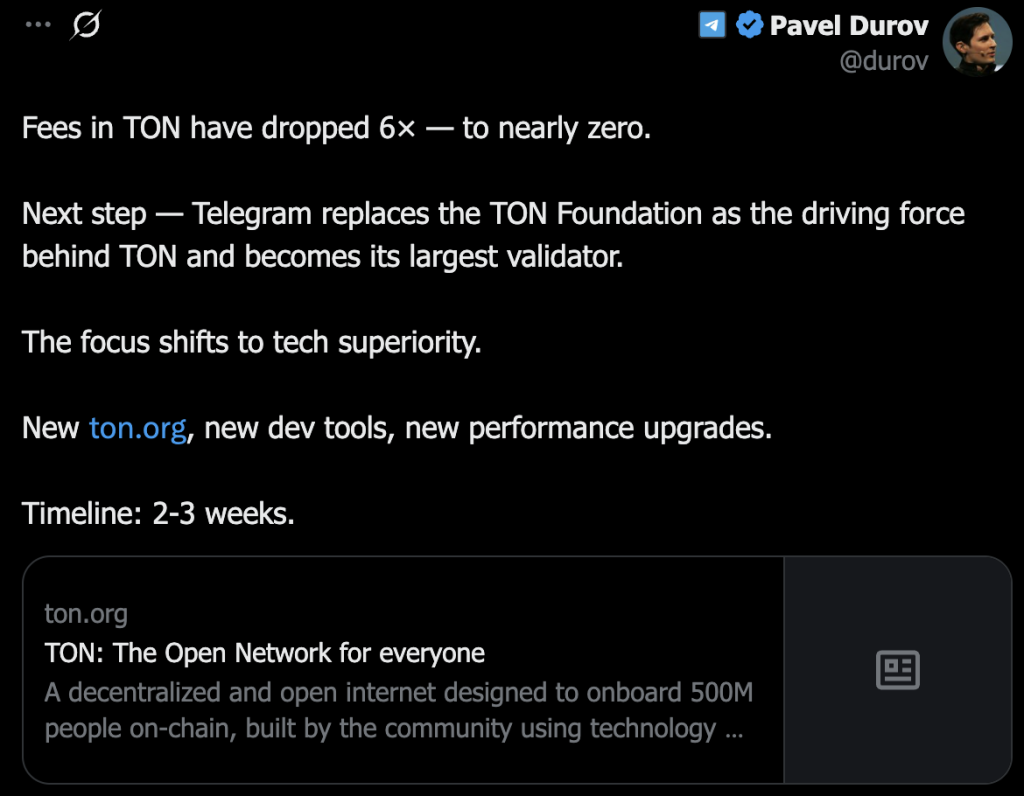
In a bold move that sent ripples through the crypto world, Telegram founder Pavel Durov announced today that fees on The Open Network (TONCoin) have already dropped 6x, plummeting to nearly zero.
But that’s just the beginning. Telegram is stepping up to replace the TON Foundation as the primary driving force behind the blockchain, becoming its largest validator.
This shift marks a major turning point for TON. After delivering a 10x speed upgrade in April (Step 1 of the “Make TON Great Again” plan), the network is now accelerating its transformation with Telegram’s direct involvement.

The focus is shifting squarely to technological superiority, backed by a refreshed ton.org website, new developer tools, and significant performance upgrades, all expected to roll out in the next 2–3 weeks.
Discover: The best crypto to diversify your portfolio with
Why This Matters For Telegram And Toncoin Foundation
Durov is making a direct bet on scale.
Telegram’s nearly 1 billion users combined with TONCoin ultra-low-cost infrastructure is the thesis. Near-zero fees and sub-second transactions open the door for seamless in-app payments, mini-apps, DeFi, and mass adoption at a scale most blockchains cannot touch.
Many transactions could soon become completely feeless.
For developers it means easier building and faster iteration. For the broader ecosystem it signals Telegram’s full commitment to turning TON into a high-performance backbone for real-world applications, not just another speculative asset.
Speculation is not the endgame here. Everyday utility is. With Telegram firmly in the driver’s seat, the Make TON Great Again roadmap is just getting started.
Discover: The best pre-launch token sales
The post Pavel Durov Just Took Over TONCoin as Its Largest Validator and Cut Fees to Near Zero: Is This the Catalyst TON Has Been Waiting For? appeared first on Cryptonews.


OpenAI has sealed a $10B joint venture dubbed DeployCo with major private equity firms, giving it capital, governance access, and a captive pipeline to roll AI across thousands of portfolio companies.
Summary
- OpenAI has finalized a $10 billion joint venture with a consortium of major private equity firms to accelerate deployment of its enterprise AI tools across portfolio companies.
- The vehicle, known internally as DeployCo, will see PE investors commit around $4 billion, while OpenAI is expected to contribute up to $1.5 billion and retain super‑voting control.
- The agreement underscores how AI labs and buyout firms are aligning to use foundation models to overhaul operations in thousands of traditional businesses.
Market reports indicate that OpenAI has now closed a $10 billion joint venture with a group of private equity backers, an entity that previous filings and leaks identified as “DeployCo,” formed in Delaware as a limited liability company.
DeployCo structure and capital commitments
According to details first outlined by the Financial Times and relayed by outlets such as Bloomberg, the structure assigns a pre‑money valuation of roughly $10 billion to the new venture and is designed to act as a dedicated distribution vehicle for OpenAI’s workplace and enterprise products.
The private equity syndicate is led by TPG, with Bain Capital, Advent International, Brookfield Asset Management, and Goanna Capital also named in reports as core investors, collectively expected to invest about $4 billion for equity stakes, board seats, and influence over deployment priorities.
OpenAI, for its part, is set to provide an initial equity commitment of around $500 million, with the option to increase that to as much as $1.5 billion over time, while maintaining super‑voting rights that give it effective control over the venture’s strategic direction.
In one LinkedIn summary of the term sheet, the company is described as offering investors a 17.5% annual return floor over a five‑year period, a structure one source quoted by the FT said was “a floor… but we expect it to be much higher.”
A distribution play for enterprise AI
The goal of DeployCo is not to build consumer apps but to “deploy OpenAI’s software across the portfolio companies” of the participating private equity firms, using capital and governance rights to push AI integration into manufacturing, retail, healthcare, finance, and other sectors those funds own.
Coverage from Reuters and Yahoo Finance frames the venture as a way for OpenAI to secure a pipeline of thousands of business customers in one stroke, while PE managers see it as a tool to cut costs, grow revenue, and defend legacy holdings from AI‑driven disruption.
Analysts quoted in market commentary argue the initiative marks a shift from AI labs selling generic API access toward tightly integrated, outcomes‑linked deployments, with OpenAI effectively tying its fortunes to the performance of buyout firms’ portfolios.
In a recent crypto.news analysis, the deal was described as “a whole new AI distribution war,” positioning OpenAI’s DeployCo against rival structures from Anthropic and other labs that are courting private equity and infrastructure investors with similar joint‑venture models.
Another crypto.news overview emphasized that the $10 billion vehicle could become a template for how foundation‑model companies raise capital and secure enterprise reach without going public.
A separate crypto.news briefing stressed that by committing its own capital and guaranteeing returns, OpenAI is blurring the line between software vendor and financial sponsor, taking on more balance‑sheet risk in exchange for deeper operational control.
Crypto World
XRP Price Prediction Eyes $1.50 as XRP ETFs Outperform Bitcoin While Pepeto Could Deliver Your First Million This Year
The XRP price prediction is gaining strength after XRP spot ETFs recorded $3.59 million in daily inflows on April 29 while Bitcoin ETFs posted $137 million in outflows and Ethereum funds lost $87 million the same day according to CoinEdition.
When XRP funds pull capital while the two largest crypto assets lose it, the market is telling you exactly where conviction is building. But the current XRP price prediction also faces resistance at $1.45, and that creates the right setup for smart capital to rotate into presale entries that capture the bull run from a far lower base.
Bitcoin spot ETFs attracted $630 million on May 1 while the S&P 500 hit a new record the same week. Futures open interest keeps climbing, and when institutional capital builds positions and risk appetite returns, presale tokens with real exchange infrastructure deliver the kind of returns that no XRP price prediction can match. Pepeto at $9.79M raised is exactly where that opportunity sits.
XRP Price Prediction Faces Resistance: Why Pepeto Is the Strongest Presale Entry of This Cycle
No other presale in the market right now ships a full working exchange. Pepeto does, and every crypto holder across every chain stands to gain from what it offers.
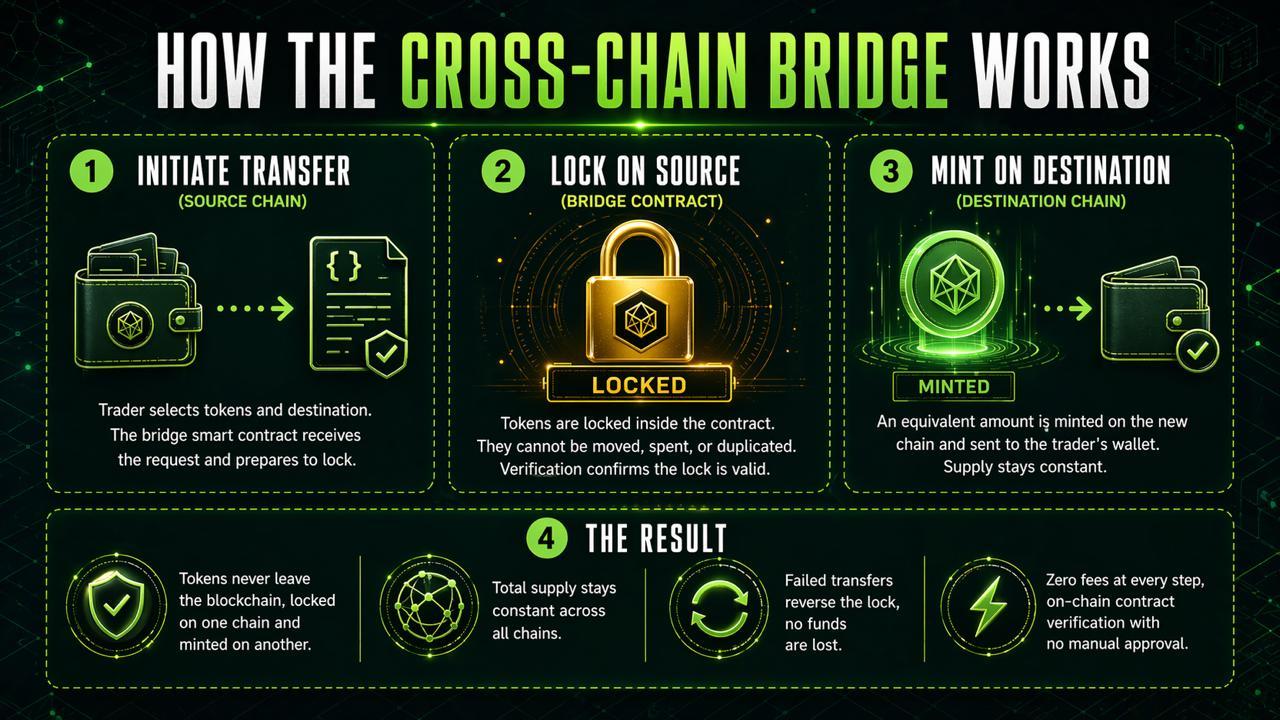
Three core systems power the platform. A bridge that lets you move assets between Ethereum, BNB Chain, and Solana without paying a cent. A trading engine that charges zero fees so your portfolio stops bleeding value on every swap. And a scoring tool that reads each token’s contract and warns you about risk before any of your money goes in.
All three work as one platform, not separate features. The exchange is not a concept on a whitepaper. It is live, it is growing, and SolidProof completed the full audit on every contract. The founder who launched the original Pepe token into a $7 billion market cap runs this project, with an ex-Binance developer shaping the listing timeline.
Due to the massive attention and growth the project is receiving, Pepeto’s original domain came under targeted attacks. The team secured a provisory domain immediately to keep access open for buyers. Click to visit Pepeto through the active link.
The numbers tell the story. Over $9.79M raised in rounds that close faster every time, and $0.0000001868 per token still leaves massive upside ahead. The moment the expected Binance listing opens, volume from every chain the bridge touches will flood in and reprice the token sharply.
Every day you hold a staked position at 175% APY, the compounding adds to your total. After the listing reprices, those stacked gains on top of gains produce the kind of outcome that makes any XRP price prediction look flat. Every major analyst covering this presale places the target above 100x. A $10,000 position at these numbers could be the path to your first million this year.
Acting now is the only way to capture it, because every day closer to the expected listing is one less day of compounding at this price.
XRP (XRP) Price at $1.38 as ETF Flows Outperform BTC and ETH
On April 29, XRP trades at $1.38 according to CoinMarketCap spot ETFs pulled in $3.59 million while both Bitcoin and Ethereum funds saw outflows according to CoinEdition.
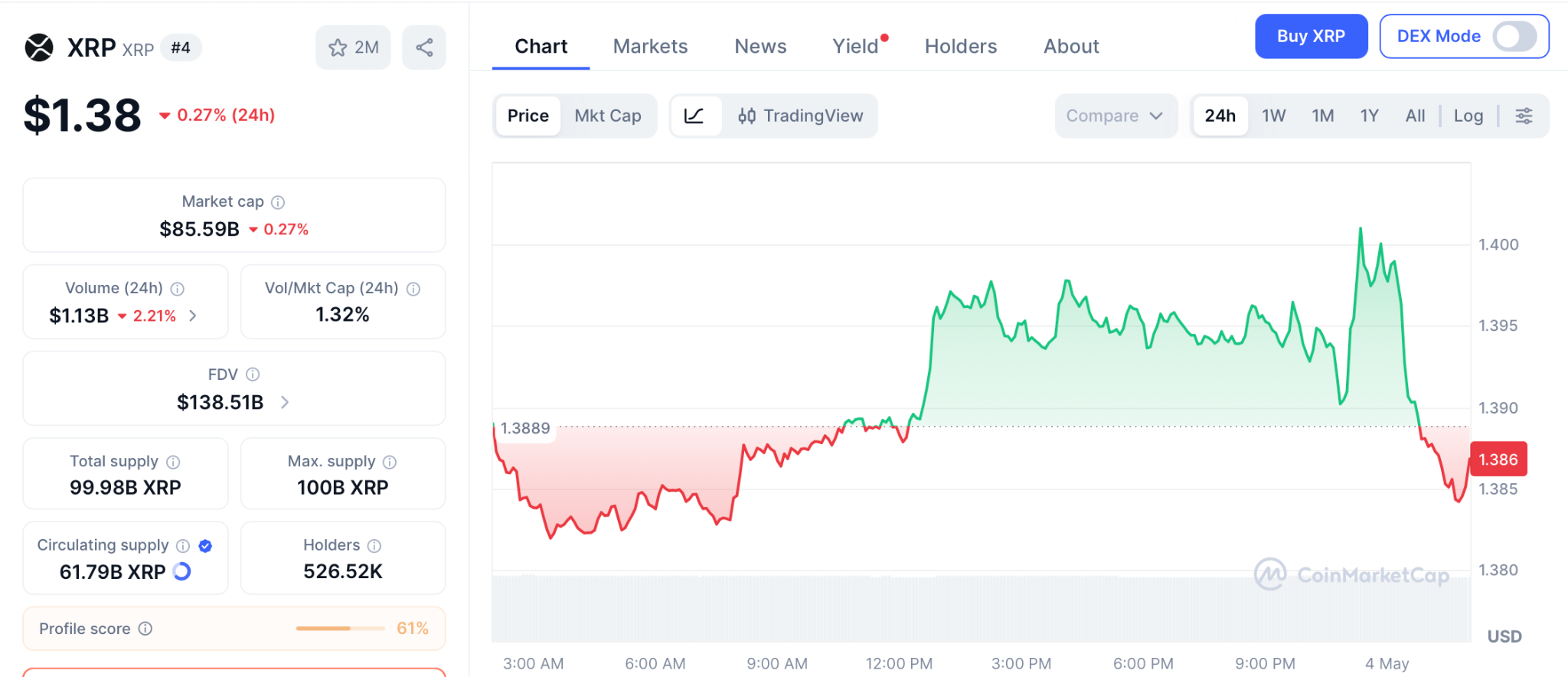
Total XRP ETF inflows crossed $1.30 billion since launch, with weekly inflows reaching $55 million in the week of April 17, the strongest single week on record. XRP trades at $1.38 according to CoinMarketCap, sitting 62% below its $3.65 all-time high reached in July 2025.
XRP sits in a symmetrical triangle between $1.35 support and $1.45 resistance. Even the aggressive $2.00 target is under a 45% gain from here, which is why the presale entry available right now in Pepeto at $0.0000001868 offers a level of return potential that XRP at this market cap will never deliver.
Conclusion:
The XRP price prediction across every credible analyst target is bullish, and the moment that breakout arrives the expected Binance listing closes the presale window on Pepeto for good so the $0.0000001868 entry simply stops existing.
This cycle will produce millionaires out of the wallets that got in position before the crowd showed up. Each round fills quicker than the last while 175% APY staking grows every position daily in real time, and the wider crypto media still has not begun covering what happens once the full exchange opens to live trading.
Click To Visit Pepeto Website To Enter The Presale

FAQs
What is the XRP price prediction for 2026?
The XRP price prediction for 2026 targets $1.50 to $2.00, but Pepeto at $0.0000001868 with a full exchange offers return potential that XRP at $1.38 cannot produce. Visit Pepeto.
Why are XRP ETFs outperforming Bitcoin and Ethereum funds?
XRP spot ETFs recorded positive inflows of $3.59 million on April 29 while Bitcoin and Ethereum ETFs posted outflows, showing that institutional capital is shifting toward XRP as cumulative inflows crossed $1.30 billion.
Disclaimer: This is a Press Release provided by a third party who is responsible for the content. Please conduct your own research before taking any action based on the content.
Crypto World
Kraken’s parent company Payward alleges $25 million crypto custody fraud in lawsuit against Etana and firm’s CEO


Payward, the parent company of crypto exchange Kraken, has accused former custody partner Etana and its CEO, Dion Brandon Russell, of misappropriating more than $25 million in client funds, according to a second amended complaint filed in the U.S. District Court in Colorado on Monday.
The crypto exchange alleges that Etana Custody, which is undergoing a court-supervised liquidation in Colorado, operated a “Ponzi-like” scheme in which custodial assets were commingled, spent on operating expenses and risky investments, and falsely reported as intact to clients.
The Wyoming-based firm said it entrusted Etana with hundreds of millions of dollars over several years as part of a fiat on-ramp partnership. But when it sought to withdraw roughly $25 million in reserve funds in April 2025, Kraken claims Etana stalled with what it alleges as fabricated reconciliation issues and misleading explanations.
According to the complaint, Etana lacked the funds to meet the withdrawal request and instead relied on new deposits to cover shortfalls.
“Kraken has millions of users and hundreds of billions of dollars in quarterly transaction volume. We did not get here by rolling over. If you take our money or deceive our customers, then know this: we will find you, we will sue you, and we will not stop until justice has been served,” Matt Turetzky, head of litigation at Kraken, said in emailed comments.
Etana didn’t respond to a request for comment by publication time.
Counterparty risk, the danger that a firm holding or facilitating users’ assets can’t return them, has become a defining issue in crypto markets, where users often rely on exchanges, lenders and custodians to safeguard funds.
Unlike traditional finance, where segregation, insurance and oversight are more standardized, crypto platforms have historically operated with looser controls, making it harder to verify whether assets are fully backed.
High-profile failures from FTX to smaller custodians have shown how quickly trust can evaporate when that assumption breaks. Cases like Kraken’s dispute with Etana underscore the same core concern, whether customer funds are truly ring-fenced or exposed to operational and liquidity risks behind the scenes.
Kraken is a U.S.-based crypto exchange operated by Payward Inc., offering spot and derivatives trading alongside custody and staking services. Founded in 2011, the platform serves both retail and institutional clients globally, supporting trading in assets like bitcoin and ether (ETH), as well as fiat on- and off-ramps. It is known for emphasizing security and regulatory compliance across multiple jurisdictions.
Etana is a crypto-focused custody firm that provided fiat on- and off-ramp services and held customer assets on behalf of exchanges like Kraken.
The lawsuit outlines several alleged instances of misuse. In one, Etana purportedly deployed at least $16 million of Kraken-related funds into promissory notes issued by Seabury Trade Capital, which later defaulted. Kraken claims those funds were never returned and may have been diverted to cover company expenses.
In another, Etana is accused of using customer assets to finance a foreign-exchange hedging strategy while retaining any investment income for itself.
Throughout this period, Kraken alleges that Etana continued issuing account statements and dashboard updates that showed customer balances as secure and fully accounted for, despite internal shortfalls.
Regulatory pressure mounted in 2025, when Colorado authorities issued a cease-and-desist order and increased capital requirements. Etana ultimately entered liquidation proceedings in November 2025 and is now under the control of a court-appointed receiver.
Kraken is seeking at least $25 million in damages, along with potential treble damages under civil theft claims, plus injunctive relief and attorneys’ fees.
The complaint also targets Russell personally, alleging he exercised near-total control over Etana’s operations and directed the misuse and concealment of funds.
The custodian isn’t the only crypto firm to run into liquidity trouble in recent months. Institutional lender Blockfills filed for bankruptcy in March after halting withdrawals, reporting roughly $75 million in losses and facing a lawsuit alleging misuse of customer funds.
UPDATE (MAY 4, 13:32 UTC): Clarifies details of Etana’s liquidation process.
Crypto World
Canada just got its first regulated digital dollar to take on the U.S. stablecoin’s crypto dominance


Tetra Trust Company, a Canadian digital technology and financial services provider, launched CADD, a Canadian-dollar stablecoin approved by Alberta Treasury Board and Finance.
The company said it’s the first CAD-pegged stablecoin issued by a regulated financial institution in Canada. Reserves are held in trust under Canadian law and dedicated to redemption, according to the firm. The token is live on major blockchains, including Base, Ethereum and Tempo, with Solana support planned.
The Calgary, Alberta-based Tetra raised $10 million for the project in September 2025, with backing from Shopify, Wealthsimple, Purpose Unlimited, Shakepay, ATB Financial, National Bank of Canada and Urbana Corporation, which holds a majority stake. The same consortium is also supporting the launch.
In December, Tetra ran testnet transactions between Wealthsimple and National Bank. The transfer was the first time a Canadian stablecoin moved between two financial institutions, the firm said.
Tetra positioned CADD for institutional use cases, including 24/7 cross-border settlement, real-time corporate treasury transfers, programmable marketplace payouts, and direct fintech-to-fintech settlement without the delays of correspondent banking.
A $320 billion market
The launch isn’t a surprise, as the stablecoin sector has grown exponentially in recent years but lacked a meaningful, regulated Canadian counterpart.
Canada clears roughly $424 billion per business day on legacy rails that are still dependent on batch infrastructure first deployed in the 1980s, the firm said. While the U.S. is pushing to grow the stablecoin sector through regulation, Canadian businesses have lacked a domestic option for moving CAD on blockchains, leaving USD-denominated stablecoins to dominate.
Global stablecoin transaction volume passed $27 trillion in 2025, exceeding Visa’s annual payment volume. The current stablecoin market cap is $320 billion, with the lion’s share accounted for by USD stablecoins, according to DeFiLlama.
Meanwhile, the competitive set in the country is small.
Stablecorp, backed by Coinbase Ventures, filed a preliminary prospectus for QCAD with the Ontario Securities Commission in June last year and received final approval in December. The token is not yet broadly available.
There is also Loon, a Calgary firm spun out of Paytrie in October, that is taking over CADC, a stablecoin launched in 2021 that has processed more than $200 million in volume. Loon raised $3 million pre-seed and pre-filed a prospectus with the Alberta Securities Commission.
Tetra Trust was Canada’s first regulated digital asset custodian and provides custody for the country’s first staking-enabled ether and solana ETFs.
From 1974-1986, the Golden State Killer committed 13 known murders, upwards of 67 sexual assaults and 120 burglaries in 11 different jurisdictions in California, but then he suddenly stopped. He simply disappeared, and his identity remained a secret for over 30 years, until we finally caught him using a new innovative technology. Utilizing Investigative Genetic Genealogy (IGG), which combines forensic DNA analysis and genealogical research, we cracked the case, and I led the prosecution team that brought the Golden State Killer to justice. Since we first used IGG to solve this case, law enforcement around the world has solved over a thousand cold cases using this innovative technology. But what would have happened if lawmakers suddenly overregulated, or worse yet, banned the use of IGG? We would see countless children, women and grieving families denied their due measure of justice.
We should promote innovation, not punish it. In areas such as cryptocurrency, ambiguous rules and enforcement lead to confusion and stifle growth, which drives industries underground and offshore. This creates an environment where real “bad actors” exploit the law and target the vulnerable – and get away with it.
As the District Attorney of Sacramento, I have spent more than 25 years holding people accountable. I prosecuted gang members, charged hate crime offenders and went after drug traffickers. I have also prosecuted fraud, financial crimes, corruption and high-tech crimes at the highest levels. As someone who has authored and helped pass legislation, I am mindful that both prosecutors and the public need clarity about the laws that govern them. I know what real crime looks like, and I know the difference between a genuine criminal and an industry caught in the crosshairs of a law that was never meant for them.
That distinction matters now more than ever, as federal prosecutors have been weaponizing a statute against software developers who have never touched a customer’s funds, never operated a business in the traditional sense, and never harbored criminal intent. As someone who has devoted his career to justice, I am here to say that is not justice, that is overreach.
Congress enacted 18 U.S.C. Section 1960 to target money-transmitting businesses, such as storefronts, wire services, and exchange houses that handle other people’s money and skirt the licensing requirements designed to prevent money laundering. It was designed as the enforcement mechanism for licensing requirements under the Bank Secrecy Act, aimed squarely at traditional money services businesses. It was a sensible tool for a sensible purpose. What it was never meant to do is criminalize the writing of software.
Yet that is precisely what has happened. Federal prosecutors have stretched Section 1960 to reach developers of noncustodial, peer-to-peer blockchain technology. These are people who built open-source tools that automate transactions between willing parties, but who never held a single dollar of user funds, never had “customers” in any real sense of the word, and never had any ability to intercept or redirect assets. Neither the developers nor the software itself controls other people’s funds or transfers funds on their behalf. Charging them under a statute built for traditional financial intermediaries is a mistake, because it is misinformed and misdirected. As prosecutors, justice requires that we charge people with what they actually did, under laws designed to cover it.
The “regulation-by-prosecution” approach to crypto development fails that test badly. This approach chills open-source innovation, pushing many U.S. developers offshore. This unfairly saddles some with a criminal conviction and erodes American technological leadership in an area of consequential financial innovation. The U.S. share of open-source developers fell from 25% in 2021 to 18% in 2025, driven by a lack of clear rules for software development. Every developer we chase overseas is a developer who now builds infrastructure beyond the reach of U.S. oversight and beyond the reach of U.S. law enforcement when something does go wrong.
That is not a win for public safety; that is a self-inflicted wound.
The good news is that some of this is beginning to change. In April of 2025, the United States Department of Justice (DOJ) issued a memorandum entitled “Ending
Regulation-by-Prosecution,” making clear that the DOJ will not enforce pure regulatory violations under Section 1960. Following the memo, the DOJ announced it would not approve new Section 1960 charges “where the evidence shows that software is truly decentralized and solely automates peer-to-peer transactions, and where a third party does not have custody and control over user assets.” That is what the law has always required.
But neither a memo nor a speech is a statute. Prosecutorial guidance can change with administrations and with U.S. Attorneys. The American innovation community and the public deserve clarity written into law. That is why the Promoting Innovation in Blockchain Development Act now before Congress deserves serious support. It restores the original intent of Section 1960: protecting the public from unlicensed financial intermediaries.
I am not naive about bad actors – there are genuine criminals who use digital assets to launder money and defraud victims. I have prosecuted them. I support robust enforcement against these criminals with the full weight of applicable law. The answer here is simply not to abandon the distinction between the tool and the criminal who wields it. We don’t charge email providers for wire fraud. We identify the actual bad actor, build the case and prosecute with evidence.
Section 1960 remains a powerful instrument against genuine money-transmitting criminals in the digital asset space. Custodial exchanges that knowingly process criminal proceeds, centralized mixers operated specifically to obscure illicit funds, platforms that flout FinCEN registration while holding customer assets – these are legitimate targets, and the law reaches them. It does not need to be stretched to reach a software developer in a Sacramento apartment who wrote a peer-to-peer protocol and never held a dime of someone else’s money.
I came to this country as a child refugee from Vietnam, with nothing but my family and the belief that America rewards hard work and respects the rule of law. The rule of law cuts both ways. It protects communities from violent crime, but it also protects innovators from overreach.
I run an office of nearly 500 employees that prosecutes nearly 30,000 cases a year. As the head of the second-largest District Attorney’s Office in Northern California, I have stood in courtrooms for 25 years and sworn to represent victims, the vulnerable and the voiceless. I believe that getting this distinction right should be a basic obligation of our Federal Government. Section 1960 is a good law that has been misused in relation to those involved in developing truly decentralized finance technology. Fix the application, target the actual criminals and let American innovation breathe. That is what justice demands, and that is what I will keep fighting for.


Applied Digital closed a Goldman-led $300M senior secured bridge loan to accelerate its next 150 MW AI data center, layering it on top of $2.15B in notes and a $7.5B hyperscaler lease.
Summary
- Applied Digital has completed a $300 million senior secured bridge loan, led by Goldman Sachs, to help fund construction of a new AI data center campus.
- The facility is secured by project assets, carries standard market terms, and can be repaid early without penalty as the company lines up longer-term capital.
- The bridge comes on top of a previously priced $2.15 billion senior secured notes offering to finance 200 MW of AI infrastructure already leased to Oracle.
Bitcoin mining hosting and cloud services provider Applied Digital said it has closed a $300 million senior secured bridge facility to advance construction of a new AI data center project, following through on plans it outlined in April when it secured a 15‑year, $7.5 billion lease with an unnamed U.S. investment‑grade hyperscaler.
Company disclosures indicate the bridge is designed to fund continued development of the 150 MW “Building 3” data center at its Polaris Forge 1 campus, part of a broader AI Factory platform that now includes a 430 MW campus at Delta Forge 1.
The loan is secured by project assets and, according to Applied Digital, can be prepaid “at any time without penalty,” giving the firm flexibility to refinance into longer‑duration structures once permanent capital is arranged.
Management has said it expects to add a matching $300 million senior secured revolving credit facility, taking total new credit lines to as much as $600 million to cover pre‑lease and post‑lease development, working capital, and transaction expenses across its AI and high‑performance computing footprint.
From Bitcoin hosting to AI infrastructure
Applied Digital, listed on Nasdaq as APLD, started as a builder and operator of data centers for Bitcoin and crypto mining customers, with 106 MW and 180 MW facilities in Jamestown and Ellendale, North Dakota, running at full capacity by late 2025.
In March, the company priced $2.15 billion of senior secured notes via its APLD Compute 2 subsidiary, telling investors it would use the proceeds “to fund the development and construction of 200 megawatts of critical IT load” at an AI data center in North Dakota leased to Oracle under a 15‑year, roughly $5 billion contract.
The new bridge facility extends that financing stack, effectively front‑loading capital for Polaris Forge 1’s 150 MW expansion while Applied Digital works with lenders on a longer‑term structure that matches the 15‑year profile of its hyperscaler leases.
A recent crypto.news briefing outlined how the $7.5 billion AI campus lease gives Applied Digital contracted revenue visibility through 2041, making it easier to layer on project‑finance style debt.
Another crypto.news overview noted that the company’s combined plan for a $300 million bridge and a $300 million revolver is intended to “smooth development risk” as it scales up from crypto hosting to full‑blown AI infrastructure.
A separate crypto.news analysis highlighted how a prior development loan facility with Macquarie helped fund early-stage AI factory campuses, a strategy now being repeated at larger scale with Goldman Sachs and a broader bank syndicate.

Vessels in the Strait of Hormuz near Bandar Abbas, Iran, May 4, 2026.
Amirhosein Khorgooi | ISNA | WANA | Via Reuters
Traders on prediction markets platform Kalshi don’t think the Strait of Hormuz will see normal traffic flows until late summer or September.
While the U.S. and Iran have maintained a ceasefire, Iran has yet to signal when it may open the strait nor has the U.S. indicated when it might end its naval blockade of the passageway.
Traders now give a 57% chance traffic in the strait will return to normal by September 1. Odds that will happen by August are hovering around 56%.
Kalshi defines normal traffic flows on the contract as the 7-day moving average of transit through the strait crossing 60 based on data from IMF PortWatch.
On Monday, the U.S. and Iran made conflicting claims about a ship near the strait. Iranian state media claimed that the country hit a U.S. warship with two missiles, forcing the vessel to retreat. U.S. Central Command denied that claim. Traders also digested news that the United Arab Emirates on Monday said it intercepted Iranian missiles for the first time since the ceasefire began.
It came after on Sunday President Donald Trump said the U.S. military will “guide” ships through the strait that have been stranded near it since the war began.
The latest headlines and lack of any breakthrough in negotiations between the two countries have made traders reassess when they think the Strait will open. Just a week ago, on April 27, traders thought the most likely scenario was the strait reopening by July 1.
Traders, though, see the passageway likely open by next year, giving 76% odds that normal traffic returns by January 1, 2027.
Disclosure: CNBC and Kalshi have a commercial relationship that includes a CNBC minority investment.
Markets shift and headlines fade, but the core principles of building long-term wealth remain constant. Join us for our third CNBC Pro LIVE, where investors of all backgrounds – from financial professionals to everyday individuals – come together to cut through the noise and gain actionable strategies for smarter, more disciplined investing. No matter where you’re starting from, you’ll leave with clearer thinking, stronger strategies. Enter your email here to get a discount code

Financial Audit Employees Get Free Food DAILY!

SPARK celebrates 8 years as a popular venue in Piccadilly
Stock Indexes Are Contorting Themselves to Include SpaceX and OpenAI

Manchester United reach agreement with Casemiro over contract clause amid transfer speculation

US brings back mandatory military draft registration

Steven Gerrard disagrees with Gary Neville over ‘shock’ Chelsea and Arsenal claim | Football


-

 Politics7 days ago
Drax board avoid their own AGM, accused of greenwashing & environmental racism
-

 Fashion6 days ago
Kylie Jenner’s KHY Enters a New Era with ‘Born in LA’
-

 NewsBeat24 hours ago
Channel 5 – All Creatures Great and Small series 7 new post
-

 Tech7 days ago
Images of Samsung’s rumored smart glasses have leaked
-
 Tech3 days ago
Trump’s 25% EU auto tariff breaches Turnberry Agreement that also covers semiconductors and digital trade
-

 Business6 days ago
Most Commercial Energy Audits Miss the Real Losses
-

 Crypto World6 days ago
CFTC’s AI will review U.S. crypto registration applications, chairman tells CoinDesk
-
 Sports3 days ago
Paul Scholes issues Marcus Rashford reality check as agreement emerges over Man United star
-

 Business5 days ago
Barclay Brothers Avoid Bankruptcy: HSBC Drops High Court Petitions After IVA Deal
-
 Business5 days ago
Tesla Officially Registers Elon Musk’s Stock: What Investors Need to Know
-

 Tech6 days ago
Get Ready for More Brain-Scanning Consumer Gadgets
-
Crypto World6 days ago
Robinhood Phishing Scam Exploits Gmail Dot Feature to Bypass Security
-

 Crypto World6 days ago
Gmail Dot Trick Underpins Robinhood Phishing, Sending Real-Looking Emails
-

 Entertainment7 days ago
Sister Wives: Janelle Posts New Scary Warning
-

 Entertainment7 days ago
Michael Jackson’s Biopic Excluded Abuse Allegations For $25M
-

 Business4 days ago
Two Powerball Tickets Split $143 Million Jackpot in Indiana and Kansas
-

 Business7 days ago
Superdry co-founder accused of raping woman
-
 Crypto World7 days ago
Meme Coin Based on White House Shooter Conspiracy Rallies 320%
-

 Tech7 days ago
YouTube TV’s Multiview Feature Just Got A Game-Changing Upgrade
-
Business7 days ago
Opus Genetics president Benjamin Yerxa sells $39,121 in stock
You must be logged in to post a comment Login