Connect with us
DAPA Banner

Sports

WNBA CBA negotiations: WNBPA’s Elizabeth Williams on need for ‘urgency’ and next steps after latest meeting

Published

on

At the beginning of this week, the WNBA and WNBA Players Association had an in-person meeting to discuss the new collective bargaining agreement. It was the first in-person meeting between the two sides in months.

Per reporting by ESPN and Front Office Sports, about 40 players and more than a half dozen team owners and executives were present at the meeting. On Friday, CBS Sports spoke exclusively to one of the players who attended the meeting via Zoom: Elizabeth Williams, the secretary of the WNBPA.

Williams is currently in Europe, where she is playing for Galatasaray of the Turkish Women’s Basketball Super League during the WNBA offseason. The 32-year-old center was the fourth overall pick in the 2015 draft and has been a longtime member of the WNBPA executive committee. She most recently played for the Chicago Sky, but like all but two veterans in the WNBA, is currently a free agent.

The WNBPA opted out of the current CBA at the end of the 2024 season. While the CBA originally expired on Oct. 31, 2025, the league and union agreed to two extensions. But on Jan. 9, when the second extension expired, the two sides entered a period of status quo, meaning the conditions of the current CBA remain in place, but either side can enact a work stoppage at any time. In December, the union voted to authorize a strike “if necessary.” 

Advertisement

Despite the ongoing stalemate, the WNBA released its 2026 schedule in late January. At the time, a WNBA spokesperson told CBS Sports that the schedule release was “a key step as we prepare for the WNBA’s 30th season and allows teams, partners, broadcasters and fans to begin the essential planning for the year ahead.” Training camps are supposed to open on April 19, and the first game is scheduled for May 8, just over three months away. The league still needs to hold free agency, the college draft and, perhaps most importantly, expansion drafts for the two newest WNBA franchises, the Portland Fire and Toronto Tempo.

The main point of contention between the league and players is the revenue-sharing model and salary structure. In the league’s most recent proposal, players would get about 70% of net revenue, which is the revenue remaining when league-specified operating expenses are removed from the pot. The union countered that offer with a proposal that would see the players get about 30% of gross revenue, which is all team and league revenue, before expenses.

The WNBPA sent its latest proposal to the league in late December. The league has yet to counter that proposal, and did not bring one to the meeting on Monday, which reportedly frustrated players. When the two sides left the meeting on Monday, the WNBA made it clear that the league understood it was its turn to respond and that a new proposal was coming soon. As of publication, the WNBPA has still not received a proposal from the league.

On Friday afternoon, Williams spoke to CBS Sports about what led to the meeting, how she felt the meeting went, reports of discord in the union’s executive committee, the possibility of a strike, her faith in leadership and whether she believes a deal will be done by the end of this month.

Advertisement

The following interview has been edited for length and clarity.

Gibbs: I know you were at the meeting on Monday via zoom. Some players have expressed frustration that the meeting didn’t start with a proposal from the league. Was that something that surprised you? And how did you feel the meeting went?

Williams: Yeah, I was a little surprised by that, especially knowing that players were going to be there in person. I think just having something would have been better than nothing. I do think as the conversation went on and the league side and ownership side could hear from people in person and hear the tone of why these issues matter, I think that helped the conversation, and I think it facilitated the level of urgency that’s needed. 

Gibbs: You use the word “urgency.” And I think from the public, it’s felt like there’s been a lack of urgency on both sides. You know, we’re now in February, and getting so close to the season. Have you felt the sense of urgency on the player’s side, and is that escalating as the clock continues to tick?

Advertisement

Williams: Yeah. I mean, I think the urgency is there on our side. I don’t think we would have had that meeting in person if the urgency wasn’t there. I think that was an explicit moment of, “OK. I think you really need to see us to understand where we’re coming from and why we need to come up with this deal ASAP.” I think the league has kind of operated from a place of comfort and complacency in the sense that they released the season schedule without our CBA being negotiated, like, they’re just very confident in what they’ve put out. And I think that’s where the disconnect was. After that, I think players really were like, “OK, the urgency is there from our end. And they just seem to think everything is fine without us agreeing.”

Gibbs: So you felt that the schedule release was a tipping point for the players, maybe that you all felt disrespected by that?

Williams: I think that’s fair to say, because I think it’s bold to put out a schedule without having anything agreed on. You have teams putting out schedules, and these teams don’t have players on them. That’s kind of mind-boggling to me. And so it said a lot about where they stood in the negotiations and feeling like they weren’t really going to budge. And I think after this meeting on Monday, that’s not the case at all. I think there is room for movement, and I think on both sides, I mean, I think players are willing to move on certain things that maybe the league wasn’t at an understanding of before. So maybe that’s just a reminder, like, we’re still negotiating in good faith. And that’s going to help us move forward.

Gibbs: Do you feel like they took you all more seriously after this meeting on Monday?

Advertisement

Williams: Yeah, I would say so.

Gibbs: What misconceptions do you feel like people have about what the players are asking for?

Williams: I think there’s a misconception about how much the league is losing moving forward. Because when you talk about the investment that has gone into the league, when you talk about the valuations of teams, when you talk about expansion fees, all of these things that the league might not consider, like, traditional revenue, it’s still dollars that are coming in. I don’t think you would see the pace of expansion if the league wasn’t growing. And so I think there’s just a misconception of our understanding of that and how that is going to impact our salaries and everything moving forward.

Gibbs: There’s a narrative that is coming out that the players are asking for so much that it’s going to handicap the league, that it’s going to shut down the growth, and that maybe the players don’t understand how much owners are spending and how much it is costing to run the WNBA. How do you respond to that?

Advertisement

Williams: I don’t think we’re being irresponsible. I think that’s what that translates to — that players are being irresponsible, they’re asking for this amount of money, blah blah. I don’t think it’s that at all. I think there are plenty of areas of revenue opportunities for the league and for the teams. I think at the end of the day, the product is most important, and I think the product is continuing to grow. There’s a lot of young talent, and that’s what brings in fans and excites fans. And there’s also still the fact that this league has existed for 30 years, there’s a fandom that’s here that is going to continue to be built on. And so I think all of those things, all the opportunities for revenue to come in, I really don’t think that we’re being irresponsible in how we are presenting what we think we should be getting.

Gibbs: Caitlin Clark was on NBC this week, and she talked about how this isn’t just a big moment for the WNBA, it’s a big moment for all of women’s sports. And I wondered how much you think about this as not just a movement for your league, but a movement for women’s sports and maybe women’s labor rights in general?

Williams: I agree. I mean, it’s kind of wild, especially considering how transformational the last CBA was right for us, and now this moment is that times 100, you know? I think there’s that understanding, and I think that’s why our leadership is being so intentional in how we communicate in the meetings that we have with the league and the meetings that we have with players. 

We’re just in this age where, like, you can see everything. And so there’s an understanding, if this labor is being put in, and you see these dollars coming from TV, see these dollars coming from investment, from expansion, everyone can see that. Why isn’t it reflected in salaries? I think this CBA is going to be that example for sports, of course, but just for women in general. If the work is being put in and the signs are there, then it needs to be reflected, period. And that’s the time that we’re that we’re living in.

Advertisement

Gibbs: You’ve been in the league for so long, you’ve played so many different roles – you’ve been the All-Star, you’ve been the veteran, you’ve been a starter, you’ve come off the bench, you’ve been on so many teams. How have you personally experienced the growth of the league, and what most surprises you about the growth you’ve seen in the past decade?

Williams: Oh, man, there’s so many changes. We joke about it in the locker room with [Maddy Westbeld and Hailey Van Lith] sometimes, sharing rooms on the road, right? Like, that’s something that a lot of people just seem to forget that you had to do that until you were in your sixth year. And then going from that to selling out 20,000 seats for arenas for a regular-season game. For the travel, obviously, the charters, and just overall, the growth from the fans, too. I think it’s just been huge. So all of those things are big. I think people just care more. People are watching more. They’re paying attention. People are inspired about 2020 and the impact that we had with Say Her Name, with Black Lives Matter and Senator Warnock. All of that comes from, yes, the product on the floor, but the type of impact that we have off the floor. And so I think all of that is kind-of reflected in how we’ve been approaching this negotiation, too. We do things together. We’re committed to doing things the right way and doing what we believe is right. So, yeah, it’s been nuts to see how much the league has grown, and deservedly so.

Gibbs: Caitlin Clark also said she thought that in the next few weeks there would be a deal done. I know [Breanna Stewart] had previously said she thought one could get done by Feb. 1. Obviously, that didn’t happen. It can be hard to answer, because it’s not in your control. But how, how confident are you that a deal will get done this month?

Williams: I mean, I would hope so, given that free agency was supposed to start on the first, but again, I think the fact that as of now another proposal hasn’t been sent, that’s not ideal. So I don’t know, I’ve been using the phrase “cautiously optimistic” for a very long time, but I still remain that way because I’m still confident that in in our staff and in our advisors, that we’re still in a position that a deal will get done. So as of now, yeah, I’ll continue to use “cautiously optimistic” as my phrase.

Advertisement

Gibbs: Are the players still ready to strike if necessary?

Williams: I’ll say we didn’t have the strike authorization vote for nothing. So we’re in a position, obviously, if we need to strike, we will. But as far as actually voting on it, we’re relying on our staff and our advisors. If they’re like, “Hey, I think this is time to have that, that vote or that conversation.” And as of now, they haven’t advised us to do so. So that’s where we stand as far as a strike is concerned. I think if the conversation changes with leadership and with legal counsel, and they say, “Hey, this is where I think the conversation should shift,” okay, then we can talk about the vote. But ultimately, we have the strike authorization vote in our back pocket if we need it, and then the [Executive Committee] can talk about striking if necessary.

Gibbs: But you know from talking with other players — the players want to play. You all know this is a big season, and you want to keep the momentum going. Is that fair to say?

Williams: Definitely fair to say. People want to play. There’s not a question. We just want to make sure we get it right. 

Advertisement

Gibbs: I’ll let you have the final word. If there’s anything I didn’t ask or anything you want to communicate?

Williams: I mean, to the fans, we see them. We see them supporting us, and we appreciate their patience with us and with this process, and their patience with the league, too. It matters to us, and they matter to us. As much as we all want to play, we also want to play for the fans. That’s a big part of the WNBA, the fandom and the people that have been with us from the beginning. So we’re doing what we can. We’re not sitting here resting. There are things that we can move on, and we’ve communicated that, just like the league has things that they can move on. We want to play, but we also want to put current players and future players in a position where they’ve gotten the best deal that they could possibly get.

Advertisement

Source link

Continue Reading
Click to comment

You must be logged in to post a comment Login

Leave a Reply

Sports

All-Time Final Four Appearances by Schools in West

Published

on


  By SuperWest Sports Staff


As Arizona prepares to play in its fifth all-time Final Four on Saturday, we’ve compiled a list of all such appearances by schools in the West.

The region boasts 19 Final Four teams, 12 of which have made two or more appearances, led by UCLA with 19, Arizona with five, and Utah and UNLV each with four.

But before we get to the list, for those who may be interested, a little history.

Advertisement

The NCAA recognizes Final Four appearances since the first tournament in 1939, even though only eight teams participated in the tournament from 1939 to 1950.

Between 1939 and 1950, there were only eight teams in the tournament, so half of the teams can claim a Final Four appearance.

However, since 1985, all have been required to play at least three games to make the Final Four.

Here is the list of participating schools from the region.

Advertisement
All-Time Final Four Appearances by Schools in the West
Appearances School Most Recent
19 UCLA 2021
5 Arizona 2026
4 Utah 1998
4 UNLV 1991
3 Cal 1960
3 San Francisco 1957
2 Gonzaga 2021
2 Oregon 2017
2 Stanford 1998
2 Oregon State 1963
2 Colorado 1955
2 USC 1954
1 SDSU 2023
1 New Mexico State 1970
1 Seattle 1958
1 Washington 1953
1 Santa Clara 1952
1 Wyoming 1943
1 WSU 1941

Source link

Continue Reading

Sports

‘Rohit 2.0 will worry all IPL teams’: Kumble hails MI star’s blazing return | Cricket News

Published

on

‘Rohit 2.0 will worry all IPL teams’: Kumble hails MI star’s blazing return

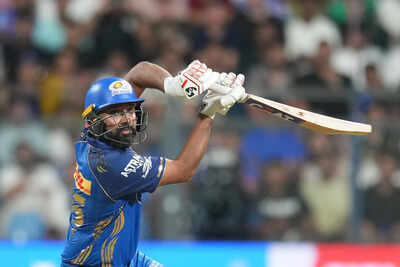
NEW DELHI: Former India captain Anil Kumble believes a resurgent Rohit Sharma could spell trouble for the rest of the IPL, after the Mumbai Indians opener announced his return in style with a match-winning knock against Kolkata Knight Riders.Rohit smashed a scintillating 78 off just 38 balls to power MI to a six-wicket win in their season opener at the Wankhede Stadium, ending their long-standing jinx of losing the first match of an IPL campaign.Go Beyond The Boundary with our YouTube channel. SUBSCRIBE NOW!Kumble was particularly struck by the authority and ease with which Rohit dominated quality bowling, calling it a sign of a dangerous new phase in his career.“Rohit Sharma seems to have arrived in his 2.0 avatar, and his innings showed he is ready to dominate again. The way he hit the ball all around the ground reminded me of his prime,” Kumble said on Star Sports.The former India coach highlighted how Rohit made light work of a potent spin attack featuring Sunil Narine and Varun Chakravarthy, along with pacer Blessing Muzarabani.“It is not easy to hit sixes against bowlers like Varun Chakravarthy, Sunil Narine and Blessing Muzarabani, but he made it look easy. He has worked a lot on his fitness… when you come back after a short break, it takes time to find rhythm,” Kumble noted.“This was a fantastic innings… the six-hitting looked easy, and even though the boundaries were small, those shots were going into the stands. This knock shows that Rohit means business and this version of him will worry all IPL teams,” he added.KKR’s spin strategy under scrutinyWhile praising Rohit, Kumble also pointed out tactical lapses from Kolkata Knight Riders, particularly their under-utilisation of key spinners.“KKR are relying too much on Sunil Narine and Varun Chakravarthy, and Narine did not even complete his quota, which was surprising. The disappointing part was that Ajinkya Rahane did not bring him on in the Powerplay,” he said.According to Kumble, the delay in introducing Narine proved costly as Mumbai’s openers had already taken control.“By the time Narine came on, the damage was already done… they need to use their resources better. When you have two world-class spinners, you need to use them well,” he added.

Source link

Continue Reading

Sports

Terence Crawford trainer ‘BoMac names’ the one fighter everyone should avoid: “Stay away from him”

Published

on

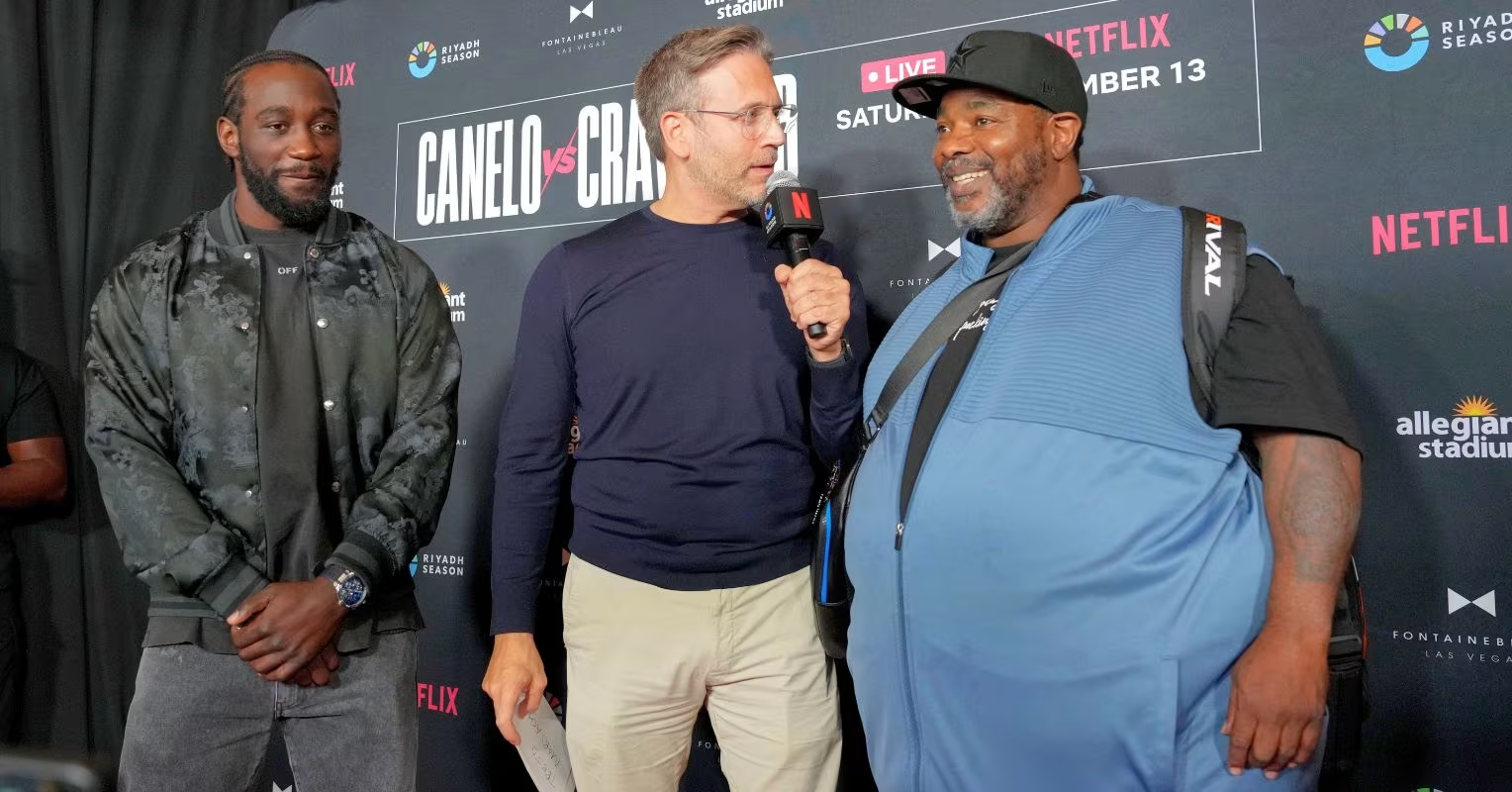
Terence Crawford‘s long-term trainer Brian ‘BoMac’ McIntyre believes there is one man that all other fighters would be wise to avoid sharing the ring with.

For many years Crawford was a fighter who appeared to be avoided himself, before finally landing the big fight he craved when he took on Errol Spence in an undisputed welterweight title showdown in July 2023.

Crawford dominated that bout and claimed a ninth round stoppage win, and that was seen as the biggest win of his career until he stepped up to 168lbs and dethroned Canelo Alvarez to become undisputed super-middleweight champion in September.

Advertisement

That looks set to be the final time ‘Bud’ will step into the ring as he hung up the gloves in December, paving the way for a new fighter to take Crawford’s place and emerge as a superstar of the sport.

Crawford’s well-respected coach BoMac appears to found someone who possesses the skills to do just that, as he told Fight Hub TV that other fighters should avoid Shakur Stevenson due to the skill level of the unbeaten star.

“Shakur has got a great boxing mind. That’s just it. Once he put his mind to it he gets the job done. You probably want to stay away from that kid man.”

BoMac also heaped praise on Stevenson for the performance he produced in his recent victory over Teofimo Lopez to become WBO super-lightweight champion.

“He looked so smooth, calm and relaxed. It was a boxing lesson. The future young guys in the amateurs just turning pro, watch that, it was beautiful.”

That win saw Stevenson become a four-weight world champion, and at just 28-years-old, it certainly appears he can go on to achieve plenty more within the sport.

Advertisement

Source link

Continue Reading

Sports

The 8 Best Draft Picks in Vikings History

Published

on

Advertisement

Vikings RB Adrian Peterson in 2027 against the Chargers
Nov 4, 2007; Minneapolis, Minnesota, USA: Minnesota Vikings running back (28) Adrian Peterson celebrates his third touchdown of the day against the San Diego Chargers in the fourth quarter at the Metrodome. Vikings win 35-17. Mandatory credit: Photo by Bruce Kluckhohn US PRESSWIRE Copyright © Bruce Kluckhohn.

The Minnesota Vikings set sail on the 2026 NFL Draft in 25 days, so let’s take a look at the past to size up the best selections in franchise history. Next week, we’ll profile the naughty list: the worst selections by Minnesota since 1961.

Ranking the Franchise Picks That Delivered the Biggest Payoff

The criteria are simple: the Vikings players who put the biggest thumbprint on the team.

Advertisement

Ranking the Franchise Picks That Delivered the Biggest Payoff

Counting down from Justin Jefferson to an obvious No. 1.

Justin Jefferson parties after a first-down catch against the Arizona Cardinals at U.S. Bank Stadium. best Vikings draft picks
Minnesota Vikings wide receiver Justin Jefferson (18) celebrates after converting a first down in the opening quarter, Oct. 30, 2022, at U.S. Bank Stadium in Minneapolis, Minnesota, against the Arizona Cardinals as he signals to the crowd and energizes the offense during an early-game scoring drive. Mandatory Credit: Brad Rempel-USA TODAY Sports.

8. Justin Jefferson | WR

Total Years as a Starter in NFL: 6
Drafted: Round 1 (2020)
1st-Team All-Pro: 2
Pro Bowls: 4

Here’s the stat to know about Jefferson:

Most Receiving Yards
thru First 6 Seasons of Career:

Advertisement

Justin Jefferson (8,480)
Randy Moss (8,375)
Torry Holt (8,156)
Jerry Rice (7,866)
Calvin Johnson (7,836)
Julio Jones (7,610)
DeAndre Hopkins (7,437)
CeeDee Lamb (7,416)
Mike Evans (7,260)
A.J. Green (7,135)
Antonio Brown (7,093)
Marvin Harrison (7,078)
Larry Fitzgerald (7,067)
A.J. Brown (7,026)
Sterling Sharpe (7,015)

Not bad.

7. Adrian Peterson | RB

Total Years as a Starter in NFL: 15
Drafted: Round 1 (2007)
1st-Team All-Pro: 4
Pro Bowls: 7

Peterson’s off-the-field antics have turned wacky as of late, but before that, he was the best running back of his era in the NFL. In fact, no one has quite replicated him stylistically since he left the sport in 2021. Derrick Henry came close, but he’s just not quite as fast.

Advertisement

The only player with more rushing yards and rushing touchdowns in NFL history than Peterson is Emmitt Smith, who was an obvious Hall of Famer.

Peterson will be up for Hall of Fame Consideration soon; he better get in right away without any voter shenanigans.

6. Chris Doleman | DE

Total Years as a Starter in NFL: 15
Drafted: Round 1 (1985)
1st-Team All-Pro: 3
Pro Bowls: 8

Doleman spent 10 years in Minnesota, appearing in 154 games and logging 96.5 sacks along the way. He navigated the rough stretch of mid-1980s Vikings football and helped get the Dennis Green era off the ground in style.

Advertisement

He ranks seventh all-time in sacks on the “unofficial” leaderboard and fifth on the official version. He would’ve ranked No. 5 on this list, but No. 5 fundamentally changed how the sport is played.

5. Randy Moss | WR

Total Years as a Starter in NFL: 12
Drafted: Round 1 (1998)
1st-Team All-Pro: 4
Pro Bowls: 6

Moss is widely known for revolutionizing the passing game in both the NFL and during his exciting 7.5 seasons with the Minnesota Vikings.

Jerry Rice is the only wide receiver in NFL history with more receiving yards and receiving touchdowns than Moss.

Advertisement

4. Randall McDaniel | G

Total Years as a Starter in NFL: 14
1st-Team All-Pro: 7
Drafted: Round 1 (1988)
Pro Bowls: 12

Though offensive guards rarely receive top billing, McDaniel’s accomplishments warrant consideration, as his resume speaks for itself.

Randall McDaniel gives his Hall of Fame induction speech in Canton, Ohio. best Vikings draft picks
Former Minnesota Vikings guard Randall McDaniel delivers his induction speech during the Pro Football Hall of Fame ceremony, Aug. 8, 2009, at Fawcett Stadium in Canton, Ohio, as he addresses the crowd and reflects on his career during enshrinement into the sport’s most prestigious honor. Mandatory Credit: Matthew Emmons-USA TODAY Sports.

From 1988 to 1999, McDaniel anchored Minnesota’s offensive line with remarkable consistency and versatility. After his departure to Tampa Bay, the Buccaneers won the Super Bowl the following season.

¯\_(ツ)_/¯

3. Carl Eller | DE

Total Years as a Starter in NFL: 15
Drafted: Round 1 (1964)
1st-Team All-Pro: 5
Pro Bowls: 6

Advertisement

Eller was a cornerstone of the Purple People Eaters and a Hall of Famer. Before joining the Vikings, Page starred at the University of Minnesota, further enhancing his already impressive credentials.

He ranks 19th all-time in sacks on the unofficial leaderboard, which includes numbers from before 1982, when official sack tracking began.

2. Alan Page | DT

Total Years as a Starter in NFL: 15
Drafted: Round 1 (1967)
All-Pro: 5
Pro Bowls: 9

Page’s 148.5 sacks rank eighth all-time, a remarkable achievement for a defensive tackle. While the choice between him and Eller for this spot was extremely close, Page’s statistics give him a slight edge, earning him the No. 2 spot.

Advertisement

He also served on the Minnesota Supreme Court from 1993 to 2015.

1. Fran Tarkenton | QB

Total Years as a Starter in NFL: 18
Drafted: Round 3 (1961)
All-Pro: 1
Pro Bowls: 9

Tarkenton’s No. 1 spot stems from three key factors: his position as quarterback, the most impactful on the field; his unexpected arrival to the Vikings as a 3rd-Round pick 65 years ago; and his remarkable longevity with the team.

Fran Tarkenton lines up with Ed White and Grady Alderman in archival Vikings photo. best Vikings draft picks
Minnesota Vikings quarterback Fran Tarkenton (10) lines up at the line of scrimmage alongside guard Ed White (62) and tackle Grady Alderman (67), date and location unknown, as the offense prepares for the snap during a classic era moment captured in this archival file photo. Mandatory Credit: Malcolm Emmons-USA TODAY Sports.

Tarkenton’s career spanned roughly the length of Harrison Smith’s current tenure, plus another rookie contract — all while playing quarterback. Imagine Smith playing until 2029; that’s Tarkenton’s career.

Upon his retirement in 1978, he held the league’s top records in major passing categories, marking the end of an era closely tied to Minnesota’s Super Bowl aspirations.

Advertisement

Honorable Mentions


avatar

Source link

Advertisement
Continue Reading

Sports

Michigan and Arizona have shown they’re the 2 best teams in college basketball. It’s just a shame they won’t play for the title

Published

on

CHICAGO — Even back in November, when the nascent college basketball season was barely a ripple on the national sports radar, Michigan and Arizona were eying each other like boxers in opposite corners, waiting for the bell to ring.

Though their paths did not cross, they were practically mirror images, their dominance made obvious by the wins they were racking up against quality teams — often by big margins. As far back as Thanksgiving week, when Michigan polished off the Players Era tournament with a 40-point win over Gonzaga while Arizona had already banked wins over Florida, UConn and UCLA, it would not have been a hot take to suggest they would be on a collision course for the Final Four.

Advertisement

“There were glimpses of this happening,” Michigan athletic director Warde Manuel said Sunday amid the net-cutting celebration at United Center, where the Wolverines had dominated Tennessee, 95-62. “But there was a long season.”

Advertisement

A long season that will end much as it began: With the two teams who flashed the earliest Final Four potential facing each other in the Final Four.

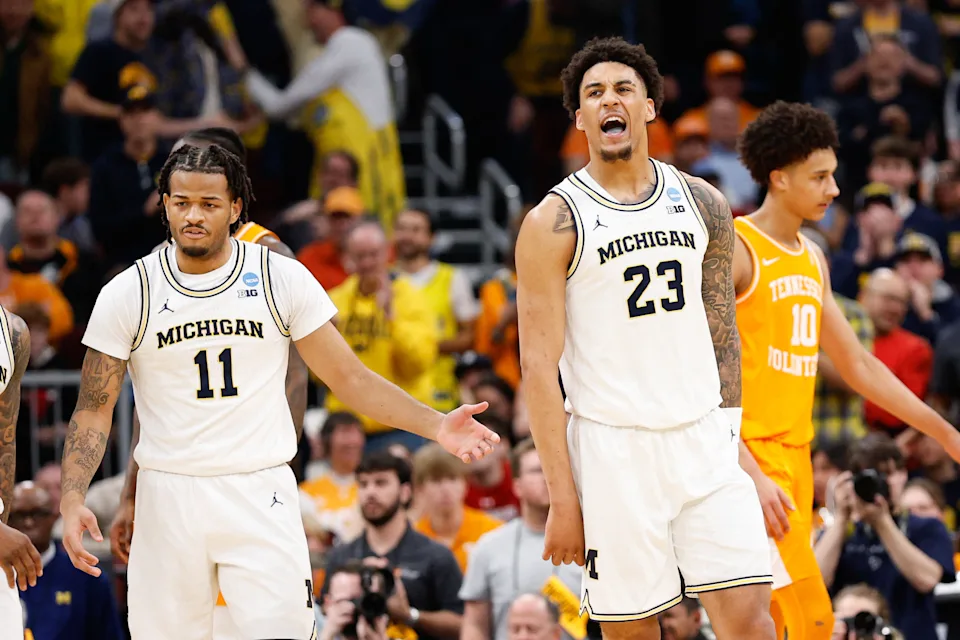
“We always wanted to play against that team,” Michigan forward Yaxel Lendeborg said. “That’s what everybody goes to college basketball for, to play those blockbuster-type games. They got a bunch of NBA guys. We got a bunch of NBA guys. It’s gonna be a fun matchup, man, and I hope everybody’s ready to play because I am.”

Mar 29, 2026; Chicago, IL, USA; Michigan Wolverines forward Yaxel Lendeborg (23) reacts in the first half against the Tennessee Volunteers during an Elite Eight game of the Midwest Regional of the men's 2026 NCAA Tournament at United Center. Mandatory Credit: Kamil Krzaczynski-Imagn Images

Yaxel Lendeborg and the Michigan Wolverines have won every game this NCAA tournament by more than 20 points. (Kamil Krzaczynski-Imagn Images)

(IMAGN IMAGES via Reuters Connect / REUTERS)

Is it the de facto national championship game? That’s probably unfair. UConn and Illinois, who will be paired in the other semifinal, are excellent teams.

Advertisement

Advertisement

Should the Final Four be reseeded? Now that’s a good debate topic because it certainly appears that the two best teams — and the two best teams all season long — are going to be playing Saturday night rather than Monday.

How hard is it to be as good as Michigan and Arizona from start to finish? Well, you saw it Sunday when Duke, the overall No. 1 seed, melted down in the second half against UConn.

College basketball deciding its champion with a single-elimination, six-round tournament has long been the sport’s blessing and curse. It makes the stakes of every game sky high and creates Cinderella storylines out of nowhere. It also means the national champion is sometimes not the best team but rather the team that got hot at the right time and avoided bad luck or injury. The uniqueness of March Madness has made that tradeoff worthwhile.

But thanks to Michigan and Arizona making it this far, there will be no such caveats this year.

Advertisement

Advertisement

Even before conference play began, you could have reasonably watched those two teams shred everyone in sight and conclude they were on a level above everyone else.

This wire-to-wire trend, however, goes against much of what we’ve learned over the decades about college basketball. Sure, there have been a handful of outlier teams that were locked and loaded from the beginning, but coaches have generally looked at the season as a way to prepare and peak for March.

When a team flashes national championship potential so early the way Michigan did — there was a 10-game stretch in November and December when the Wolverines were beating teams by an average of 34.5 points, including some true quality opponents — it’s almost problematic.

Advertisement

“The most difficult part is that everyone starts getting so much more attention, advice — literally everything they get more of,” Michigan coach Dusty May said. “And it’s difficult not to make it about you because the people you’re talking to are making it about you. There’s just a lot of distracting information, and if you’re not mature and you’re not connected to this group and not willing to be held accountable by the staff and each other, then it’s not going to work.

Advertisement

“And once it creeps in, it’s almost impossible to weed it out. So our guys never let it in. And trust me, they all had different fires that were ignited.”

Mar 28, 2026; San Jose, CA, USA; Arizona Wildcats guard Brayden Burries (5) celebrates in the second half against the Purdue Boilermakers during an Elite Eight game of the West Regional of the men's 2026 NCAA Tournament at SAP Center. Mandatory Credit: Eakin Howard-Imagn Images

Brayden Burries and the Arizona Wildcats haven’t lost since Feb. 14. (Eakin Howard-Imagn Images)

(IMAGN IMAGES via Reuters Connect / REUTERS)

If you lump this tournament in with last year, where all four No. 1 seeds made it to the Final Four, it seems like we may be moving away from an era of parity in college basketball and toward a cluster of superpowers. Michigan won its four tournament games by an average of 22.5 points, while Arizona’s margin was 20.5. Neither faced a true second-half challenge on their way to winning their regional.

Advertisement

Tennessee was a top-15 team in the predictive metrics and not some overachieving mid-major, but it was almost comical how overmatched the Vols looked trying to generate decent offense against this Michigan squad.

Advertisement

“Some teams have a little more room for error than others,” Tennessee coach Rick Barnes said.

In a way, college basketball and college football have switched roles in the NIL era. Whereas there used to be no parity at all in college football because of how stacked the superpowers like Alabama and Georgia used to be, conference commissioners are now talking about expanding the playoff beyond 12 because we might be leaving out viable teams.

Advertisement

Meanwhile, March Madness has played out pretty true-to-form for two straight years.

It’s hard to know exactly what to make of that. You can point to the transfer portal and the ability for a program like Michigan to go get an established star like the 23-year-old Lendeborg out of UAB, but here’s Arizona with three freshmen in its starting lineup. Perhaps there’s something to the idea that teams like Michigan and Arizona, which play big frontcourt lineups and don’t rely on making a bunch of 3-pointers to win, aren’t as susceptible to being upset.

Advertisement

Still, college basketball programs are judged by what happens in March. And we have decades of history telling us that it’s extremely hard, and rare, for two teams to be on a collision course all season and actually end up playing each other in the Final Four.

Advertisement

“This was obviously one of the goals because of the talent we had,” May said. “We have a sign in our locker room — “April Habits” — and from Day 1 we’ve challenged these guys to develop championship-level habits that would allow us to win a Big Ten championship and would also allow us to turn the calendar from March until April. Now we put ourselves in position to do that.”

Advertisement

Even though Michigan and Arizona showed four months ago that they were probably on a level above almost everyone else in college basketball, there was no guarantee they’d actually get to settle it on the floor. So many obstacles to overcome and landmines to avoid.

But they will finally touch gloves next Saturday in Indianapolis. Let’s get ready to rumble.

Advertisement

Source link

Continue Reading

Sports

FaZe Vegas bounces back from loss to capture CDL Stage 2 Major

Published

on

FaZe Vegas rebounded from a loss to OpTic Texas earlier in the day to win the rematch in the grand final 4-1 on Sunday of the Call of Duty League’s Stage 2 Major.

OpTic Texas took a 3-1 victory in the best-of-five upper-bracket final in Marston Green, England. That sent FaZe Vegas to the lower-bracket final, where they beat Toronto KOI 3-1 to earn a spot opposite OpTic Texas in the best-of-seven grand final.

Toronto KOI had eliminated the Los Angeles Thieves 3-0 in the lower-bracket semifinal on Sunday.

The Stage 2 Major, part of the DreamHack Birmingham event, awarded $150,000 and 100 Call of Duty League points to champion FaZe Vegas. OpTic Texas, as the first runner-up collected $90,000 and 75 CDL points.

Advertisement

Vegas’ Jovan “04” Rodriguez of the United States was selected the match MVP. He had a kill-death differential of 118-84 to lead all players. American teammate Chris “Simp” Lehr had 109 kills and a plus-20 differential.

Their team opened the grand final with a 250-184 win on Colossus Hardpoint. Texas drew even with a 6-2 victory on Raid Search and Destroy. But FaZe Vegas then reeled off wins on Scar Overload (4-3), Exposure Hardpoint (250-207) and Exposure Search and Destroy (6-5).

No OpTic Texas players had positive numbers.

The teams met in the upper-bracket final, which OpTic opened with a 250-192 win on Exposure Hardpoint. FaZe Vegas came back with a 6-4 win on Raid Search and Destroy, then Texas took it with wins on Den Overload (6-3) and Scar Hardpoint (250-112).

Advertisement

Cuyler “Huke” Garland of the United States was the match MVP with 101 kills and a plus-26 differential for Texas. All players for Vegas had negative differentials.

FaZe Vegas recovered in the double-elimination playoff format by defeating Toronto KOI 3-1 in the lower-bracket final. Vegas won on Den Hardpoint (250-240), then Toronto triumphed on Exposure Search and Destroy (6-3) before FaZe won on Exposure Overload (5-3) and Exposure Hardpoint (250-225).

Jordan “Abuzah” Francois of Belgium was match MVP with 89 kills and a plus-18 differential for FaZe Vegas.

Advertisement

In the lower-bracket semifinal, Toronto KOI swept the Los Angeles Thieves, winning 250-188 on Den Hardpoint, 6-3 on Colossus Search and Destroy and 4-3 on Exposure Overload.

Jamie “Insight” Craven of England was the match MVP for Toronto with 61 kills and a plus-12 differential.

Call of Duty League’s Stage 2 Major prize pool, with money winnings and CDL points

1. $150,000, 100 — FaZe Vegas

Advertisement

2. $90,000, 75 — OpTic Texas

3. $50,000, 60 — Toronto KOI

4. $30,000, 45 — Los Angeles Thieves

5-6. $15,000, 30 — Paris Gentle Mates, G2 Minnesota

Advertisement

7-8. $7,500, 15 — Riyadh Falcons, Miami Heretics

9-10. no money, no points — Vancouver Surge, Carolina Royal Ravens

–Field Level Media

Source link

Advertisement
Continue Reading

Sports

Bruno Fernandes’ release clause, £700k-a-week contract offer, Man United stance

Published

on

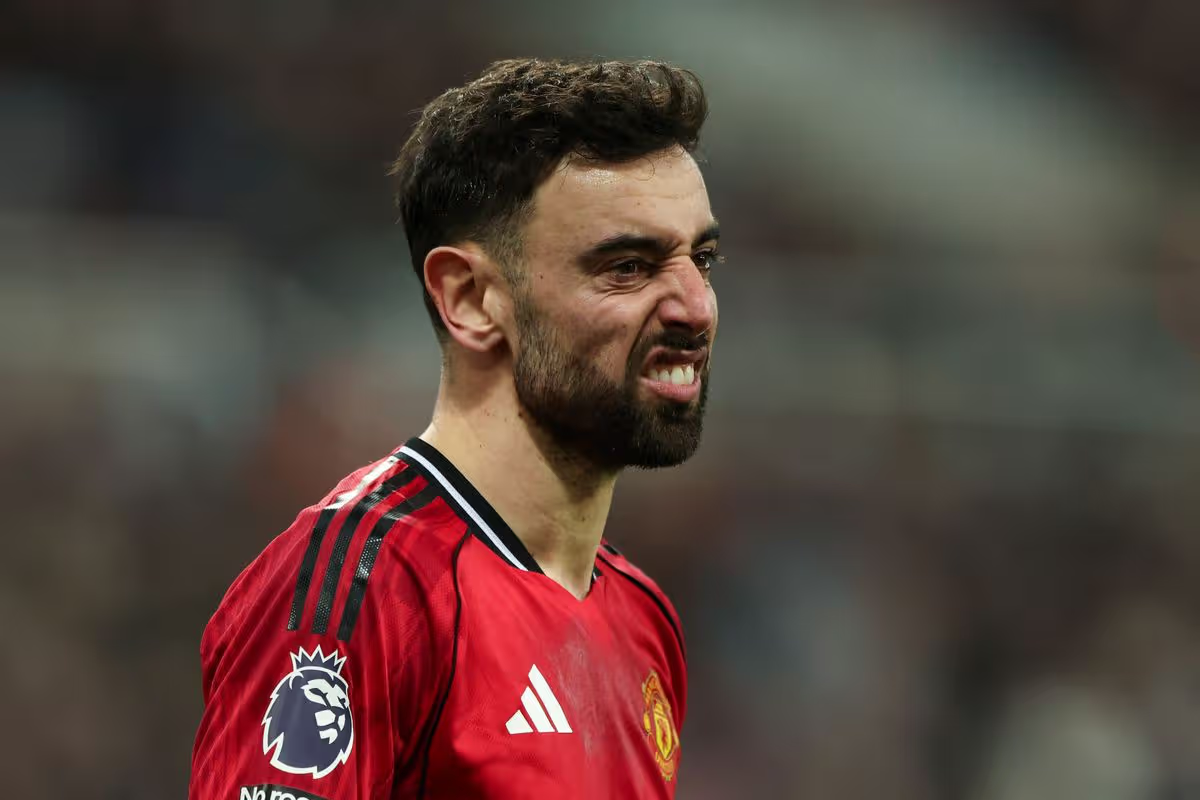
Bruno Fernandes’ Manchester United future is still up in the air despite the midfielder’s fine recent form

Despite being one of Manchester United’s most influential and consistent performers in recent years, Bruno Fernandes’ long-term future at Old Trafford has rarely felt entirely secure.

The 31-year-old, in excellent form once again this season, has registered eight goals and 17 assists in all competitions so far. But despite his output and his strong bond with both the club and its supporters, speculation over a potential departure has persisted.

Advertisement

That sense of uncertainty was heightened during Ruben Amorim’s time at United when reports emerged that the club were open to a lucrative sale to Saudi Arabia, temporarily straining the relationship between player and club.

Get MEN Premium now for just £1 HERE – or get involved in our United WhatsApp group by clicking HERE. You can also join our United Facebook page by clicking HERE and don’t miss out on our brilliant selection of newsletters HERE.

However, with the Portugal international now back to his best and firmly in the conversation for PFA Player of the Year, the situation appears to have stabilised – at least for the time being.

Here, MEN examines the wider picture surrounding Fernandes, including the details of a mammoth contract proposal and a little-known release clause in his deal at Old Trafford.

Advertisement

£700k-a-week offer

Last year, it was reported that Saudi Pro League side Al-Hilal were prepared to submit a £100m offer to sign Fernandes, alongside a staggering £700,000-per-week contract that would have placed him among the highest earners in world sport.

With the midfielder approaching the twilight of his career and United working to carefully balance their finances, the club were open to sanctioning a sale. However, the stance did not sit well with Fernandes, who was understood to be “hurt” that United were willing to cut ties with him.

Ultimately, the bid was never officially tabled, allowing United to keep their captain but simultaneously denying them what would have been a club-record sale.

Release clause

While Fernandes has made it clear that he wants to stay at United, the club are technically powerless to stop him from him leaving. That’s because of a new £56.68million release clause in his contract, one that can only be triggered by foreign clubs.

While that sum may deter some European teams from signing a player who turns 32 in September and has little resale value, it would not be a problem for the Saudis.

Al-Hilal were prepared to offer £100m because they were desperate to sign Fernandes ahead of last year’s Club World Cup, which began in June before the clause came into effect and there is expected to be renewed interest from the Middle East this summer.

Should Fernandes stay put, United are expected to open discussions over a new contract, with his current deal running out in 2027. They do, however, have the option to extend it by a further 12 months.

Advertisement

United want to keep Bruno

Despite previous links to a move away, the club’s stance has shifted firmly towards keeping Fernandes. While there is an ongoing push to reduce the wage bill – Fernandes is earning £300,000-a-week – United remain intent on retaining their captain’s influence on the pitch.

That position has reportedly been communicated directly to the player in an effort to ease any doubts over his future. He is also believed to be more settled since Michael Carrick took charge in January.

Source link

Advertisement
Continue Reading

Sports

Jermain Defoe named head coach of National League side Woking

Published

on

Jermain Defoe has been named as the new head coach of National League side Woking.

His appointment comes after the club dismissed former Wimbledon midfielder Neal Ardley earlier this month and is the 43-year-old’s first permanent role as a club manager.

The former Spurs striker has previous experience working in Tottenham’s academy as well as on the interim coaching staff at Rangers in 2021.

Woking’s own interim coach, Craig Ross, will lead the club for Tuesday’s match against Altrincham before Defoe takes over the full-time role. Ross has overseen four wins, three draws and one defeat in his eight matches in charge so Defoe will pick up a team in good form.

Woking’s club chairman Todd Johnson said: “Jermain’s achievements as a player speak for themselves, but what stood out to us during the process was how he sees the game, how he drives standards, and his approach to leadership and player development.

Advertisement

“We have a clear plan for where we want to go as a club, and we believe Jermain is the right person to build on the strong foundations already in place and help take us forward in the next phase of that journey.”

Defoe will be assisted by former Fulham and Halifax manager Paul Bracewell, with Ross and Jake Hyde remaining on the club’s coaching staff.

Defoe scored 305 goals in 763 senior appearances and won 57 England caps, representing his country at the 2010 World Cup and the 2012 European Championships. He retired from playing in 2022 and began to work on his coaching badges.

He earned his Uefa A-licence while working in the Spurs academy for two years but left his former club in the summer of 2024 to pursue a full-time managerial role.

Advertisement

“Woking is a historic club with huge potential, and I’m thrilled to be part of this exciting project,” said Defoe. “I can’t wait to get started.”

Source link

Continue Reading

Sports

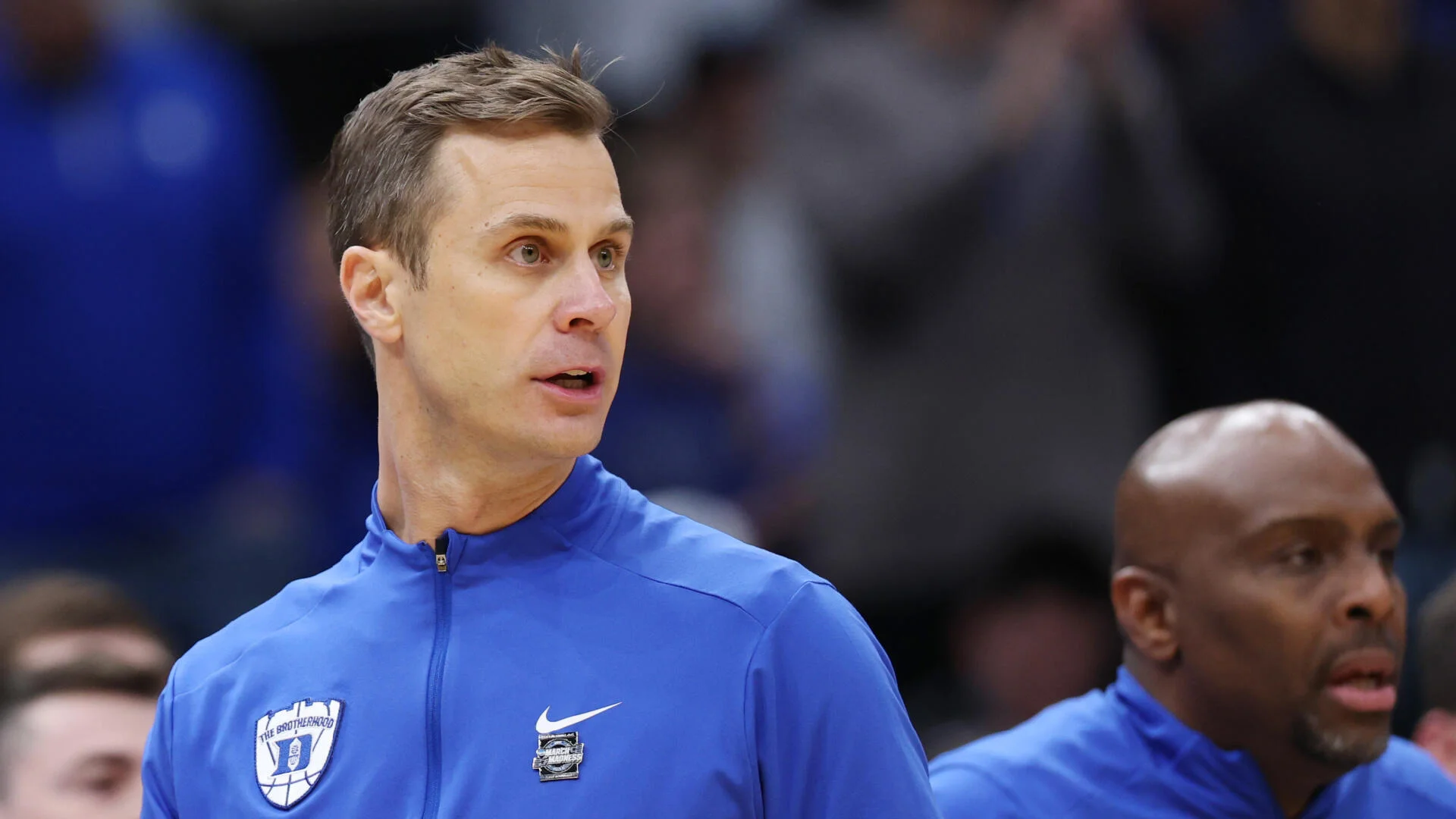
Duke’s March collapses under Jon Scheyer are no longer a fluke

Published

on

WASHINGTON, D.C. — Huddles are supposed to be the holiest of spaces, the one place where five basketball players can block out five opponents and tens of thousands of fans and regroup, in good times and bad, whether in need of a pump up or a calm down.

But UConn veteran Alex Karaban also recognized it as a sign of No. 1 overall seed Duke wilting under the pressure as the Blue Devils’ lead shrunk and shrunk and shrunk and then, on Braylon Mullinsgame-winner for the agesdisappeared altogether

“You feel the momentum swing, you feel them start to huddle up a lot more, really just get tight,” Karaban said. “You can just tell. When you’re a player, you can tell when the momentum’s swinging and when the other team is trying to regroup themselves.”

Karaban knows the magic of March well. He has two national titles and is now headed to another Final Four.

Advertisement

Duke coach Jon Scheyer knows the agony, the brutality, the suddenness of March even better.

Somehow, Duke — for all its talent, all its dominance, all its moments of pure basketball brilliance — has collapsed again. Scheyer bore the brunt of it last year, when the Blue Devils blew a seven-point lead with 1:15 left in the Final Four against Houston. Sunday’s was worse, on the wrong end of a 19-point UConn comeback that tied for sixth largest in NCAA Tournament history, with an all-time dagger to boot. 

One collapse can be credited to the madness of March, perhaps. A second? It’s a downright failure from everyone, and a failure from Scheyer. He cannot, in the exact moment, control whether a Cooper Flagg game-winning attempt goes down in 2025 (it did not). He cannot, in the exact moment, pull the plug on whatever idea Cayden Boozer had to even try and pass the baksetball with Huskies swarming and the clock ticking (Boozer of course put the ball in the air). But a coach can keep his players composed, keep them aggressive in the right spots, and keep them playing their game. Scheyer is failing to do that. 

“There’s not a person in this room, including me, that doesn’t replay everything that you could do and how you can help,” Scheyer said. “I mean, obviously. That’s part of being in this seat. That’s part of being in this spot. … End of the day, we’ve got to finish it off. We’ll reflect. We’ll learn, do all that. But yeah, of course.”

Advertisement

It simply isn’t good enough.

Mullins’ 35-foot prayer from the logo broke Duke’s heart. 
Getty Images

The anatomy of a titanic Duke collapse

Incredibly, UConn actually made a mistake on the play that led to Mullins’ three. Down 72-70, the Huskies were supposed to foul Dame Sarr, who received the ball after inbounding to Cameron Boozer. But they couldn’t get there in time — you can even see on replay Jayden Ross desperately reaching for Sarr — and Sarr zipped a pass to Cayden Boozer. With under seven seconds left, all he had to do was hold onto the ball and get fouled.

“I should have been strong with the ball,” Cayden Boozer said, tears in his eyes, emotions at once swelling and muting his voice. “I cost our team our season. We knew that they were gonna trap. [Scheyer said] ‘Be strong with the ball.’”

But one play did not blow a 19-point lead. One play did not blow a 15-point halftime lead; No. 1 seeds had been 134-0 in NCAA Tournament when leading by that margin at the break, by the way.

Advertisement

“There’s no heat on Cayden at all,” freshman Nik Khamenia said. “This game is not on him at all. He carried us for long, long, long portions of the game, making big play after big play. You can go through every single one of us at different points in the game we messed up. The game of basketball never relies on one possession, so, no, it’s not on him at all.”

This was a collapse from the moment the teams took the floor in the second half.

Duke could have surged. Duke should have surged. The Blue Devils had dominated UConn’s guards, picked apart UConn’s defense and generally gotten whatever it want offensively. Scheyer can’t go out and make the plays for his players, but he can instill them the small advantages to succeed in tough moments — the mental fortitude, the X’s and O’s, the calm nature required of a champion. Either he didn’t instill it Sunday, or his players were unable to instill it in themselves.

“I think as a whole we could have gave a lot more in the second half,” Cameron Boozer said. “We came out a little flat and gave them a little bit of life. When you’re playing a team as good as UConn, that’s all they really need.”

Advertisement

“We didn’t have our competitive edge,” Cayden Boozer said. “We were guarding them pretty well in the first half. We didn’t do the best job of it, but at the end of the day, I’m sticking with our guys no matter what. We had a chance to win no matter what in the second half.”

“In some moments we kind of let up a little bit, we let them off the hook,” Sarr said. “Just … I don’t know.”

Halftime adjustments are generally overrated as a concept. Every coach makes them — some more successfully than others — but it’s up to the players to fulfill them.

Duke’s didn’t, and the issues became apparent immediately. UConn star big man Tarris Reed Jr. had 12 points at halftime, and UConn, even down big, never stopped feeding him. He drew fouls in bunches and got the Huskies into the bonus before the second half was even six minutes old.

Advertisement

After four turnovers in the first half, Duke had eight in the second half. The offense got stagnant: Over the final eight minutes, Duke had as many field goals as turnovers (four), and only one of the makes was assisted. Prior to that, 16 of their 21 makes had been assisted.

“It’s easy to look at that play,” Scheyer said. “I look at every play that happened, especially in that second half, this is not about one play. It’s about every play that put us in that position, and that’s what you don’t want to do, where one play something could happen.”

Sophomore big man Patrick Ngongba II after Duke’s season-ending loss to UConn in the Elite Eight. 
Getty Images

Duke’s nightmarish déjà vu

Could Scheyer have saved the offense? It’s impossible to say. Could he have saved the defense, maybe putting Cameron Boozer on Reed, rather than have Boozer guard one of the ball handlers? Again, it’s hard to say. The game plan he had drawn up in the first half had worked, after all. It’s easy to praise players when things go well and fault coaches when things go poorly.

“I don’t have the words,” Scheyer said after the loss. “I don’t have the words.”

Advertisement

The problem? He needed to have the words during the game. If he had the words, he needed them to resonate more.

“I’m sure there’s a lot more that I could have done to help our guys at the end there,” Scheyer said after last year’s Final Four loss. “That’s the thing that kills me the most. The amount of game situations we’ve watched this year. We haven’t had the real-life experience all the time, but that’s something I really felt we prepared for. So I feel like I let our guys down in that regard.”

And this year?

“I’m incredibly sorry for these guys that they’ve got to go through this,” Scheyer said. “This is on us.”

Advertisement

Just like Scheyer can’t make the plays or avoid the mistakes on the court, he also can’t control some circumstances. Patrick Ngongba II missed five games — including the first round of the NCAA Tournament — earlier this month. Point guard Caleb Foster broke his foot just over three weeks ago and made a miraculous recovery to not only play but shine in the Sweet 16. However, Foster was ineffective in the Elite Eight. He hadn’t even practiced five-on-five with the team since the injury, and playing a second game in two days was always going to be an uphill battle.

These are not excuses. These are facts. Is a healthy Foster on the floor in Cayden Boozer’s spot in the final seconds? Does he avoid that turnover? In some aspects, Scheyer was correct when he told CBS sideline reporter Tracy Wolfson, “All I know is these guys don’t deserve that ending.”

The issue is that implies anyone deserves anything in the NCAA Tournament. No one does. Not Duke, not UConn, not any player or any team. You have to take it. You have to earn it. You have to be the aggressor. You can’t lose your way for a moment. Scheyer’s teams have now done it twice. His teams’ youth has been celebrated for months and then exposed in the crucial moments each of the last two seasons.

“We’re playing this 10-to-12, 10-to-11-point game, and we knew once we got under 10, once we cut it to single digits, it was going to be over,” Reed said. “You can really see it in their faces. The body language is a huge indicator.”

Advertisement

In an alternate universe, Boozer’s throw-ahead pass connects, and Duke gets an easy dunk and is onto the Final Four. In an alternate universe, Silas Demary Jr.’s high ankle sprain costs him an inch or two more on his jump, and he doesn’t tip the ball away.

“We’ve been telling the guys the whole year, there’s a very famous quote that says, ‘Victory is measured in inches, not miles,’” Dan Hurley explained.

But the inches have gone against Scheyer’s No. 1-seeded teams twice now, showing he has miles to go to get over the hump.

That doesn’t mean he can’t cover those miles. Roy Williams won 40 NCAA Tournament games before winning his first title. He ended up with three championships. Scheyer’s predecessor at Duke, Mike Krzyzewski won 26 NCAA Tournament games before winning his first title. He ended up with five.

Advertisement

But in order to cover those miles, Scheyer must get his teams to close consistently. He has to find a message that hits home, a strategy that works. He has to find a way to empower his players, and more importantly have players who empower each other in the biggest moments.

Duke’s NCAA Tournament finishes under Scheyer

Year Round Opponent (Seed) Largest Deficit
2026 Elite Eight UConn (2) 19
2025 Final Four Houston (1) 14
2024 Elite Eight NC State (11) 9
2023 Round of 32 Tennessee (4) 6

Scheyer, who is otherwise off to one of the best coaching starts in college basketball history, must eventually get lucky.

The 38-year-old said he had never seen a locker room like Sunday’s before, but that’s not true. There must have been a similar scene after the Houston loss. He was likely caught up in the moment, which is OK in the moment. But in the weeks and months and, yes, maybe even years to come, he’ll have to find away to avoid having more of those mistake-riddled, regret-filled locker rooms.

Advertisement

The locker room was a mess. Blood, sweat and tears. Lots and lots of tears, some body-shaking, some subdued. Answers barely above whispers. Handshakes and hugs. More tears. Ngongba covered his face with a towel and eventually excused himself. Cameron Boozer, sporting a black eye, and Cayden Boozer took questions with poise beyond their years. The bumps and bruises the team had prided itself on just days earlier after a hard-fought win over St. John’s now represented a team stunningly beaten down.

After the St. John’s win, as media members left the locker room, one Duke player joyously shouted out “No team can f**k with us!”

Perhaps not. But March Madness sure can.

Advertisement

Source link

Continue Reading

Sports

Canadiens’ Suzuki continues to prove he’s among world’s most complete player

Published

on

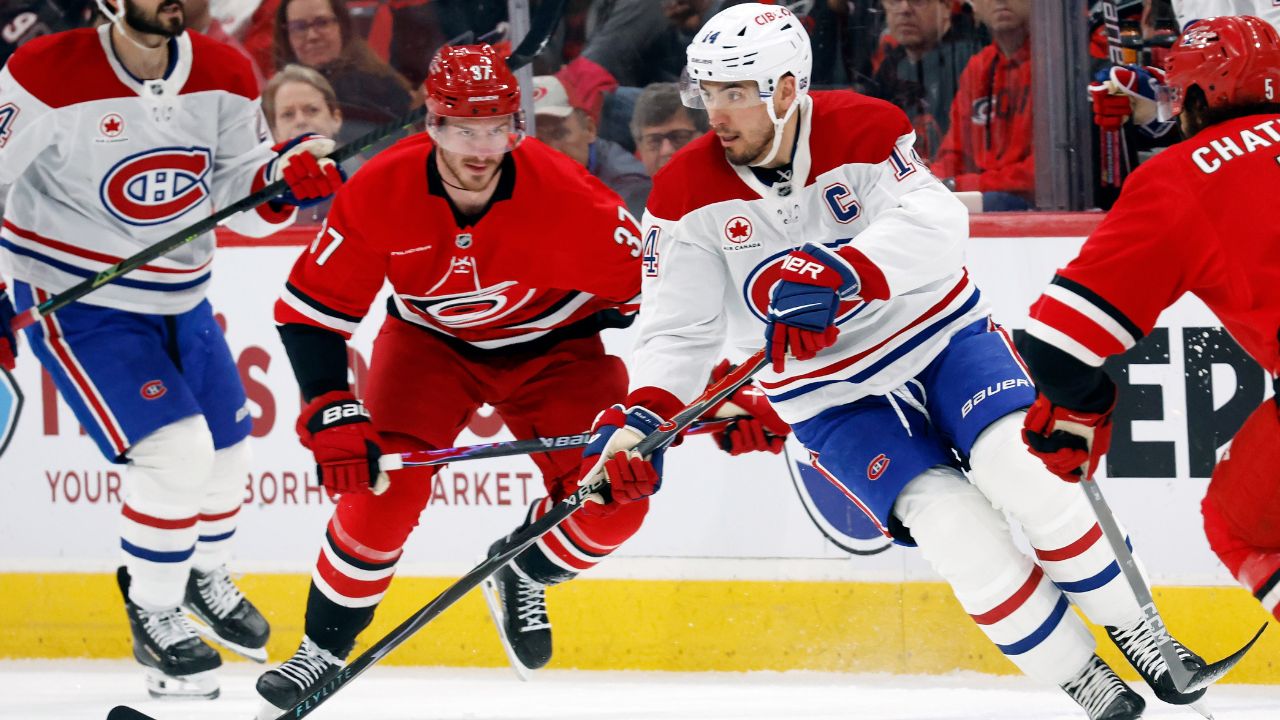
Nick Suzuki closed the gap on Sebastian Aho, dropped to one knee and put the finishing touches on one of his most desperate performances of the season with his strongest defensive play of the night.

Suzuki’s only block of Sunday’s game came with his Montreal Canadiens barely clinging to a 3-1 lead, with just under three minutes to play against a Carolina Hurricanes team that had put them in a spin cycle all night.

It came with the Hurricanes’ net empty, in a five-on-six situation, with the Canadiens burning every ounce of gas remaining in their reserve tank, and it was no coincidence it came from him. Because no Canadien has come up with bigger plays at either end of the ice this season than their captain, who’s in the process of simultaneously becoming the team’s first Selke Trophy winner since Guy Carbonneau in 1989 and its first 100-point player since Mats Naslund in 1986.

Naslund, who had 110 points for the Canadiens the year they won their second-to-last Stanley Cup, wasn’t exactly a defensive maven nor shot-blocker. He didn’t have to be, though, because Carbonneau left a lot of goals and points on the table on his way to finally being crowned the best defensive forward in the NHL three years later, when the Canadiens returned to the Stanley Cup Final.

Advertisement

In the decades that have passed since, no player for the Canadiens has blended Naslund and Carbonneau’s skills as well as Suzuki, who registered points 89, 90 and 91 on Sunday before making his 58th block of the season to keep himself at plus-2 on the night and plus-32 through 73 games.

“Those are the little plays you need to win,” assistant captain Mike Matheson told reporters at PNC Arena after the Canadiens closed out their fifth consecutive regulation win. “At this time of the season, going into the playoffs, that’s what you have to do.”

You must make small plays and big plays all the same, and Suzuki does that every single game.

He sets the standard, and the Canadiens follow, even if on this night they blocked 31 shots before Suzuki got his leg on Aho’s last attempt.

Advertisement

When they needed a rescue breath earlier, down 1-0, Suzuki provided it by skating the length of the ice to score his 25th goal of the season.

Lane Hutson stretched a three-zone pass up to Cole Caufield, and Caufield drew coverage in to lay the puck up for Suzuki to dunk it right as he arrived in front of Frederik Andersen.

Suzuki returned the favour when he set up Caufield’s 46th goal of the season a little over 11 minutes later.

And then, in the dying seconds of that middle frame, Suzuki drew a faceoff back to the point, drove to the net, took a shot, and then buried his own rebound to put the game out of reach.

Advertisement

They were two of a team-leading five shots on net the 26-year-old registered over his 20:17 spread over 22 shifts of this second game in 22 hours, which was played in a different time zone than the one the Canadiens were in the night prior.

Suzuki was desperate, and so were the tired Canadiens. Especially as the Hurricanes pressed and pulverized them early.

“Not an easy team to play against here on a back-to-back,” said Canadiens coach Martin St. Louis. “We had a tough time getting going, and not because we weren’t engaged. We just had trouble executing after their forecheck. We weren’t able to get forechecking ourselves. When you don’t have the puck, it’s hard to gain momentum…

“When you play Carolina, you expect a team that’ll surely have more shots than you, and you’re going to have to for sure weather a storm, and then you have to capitalize on chances when they’re over-aggressive.”

Advertisement

That’s what the Canadiens did.

When they bent, Jakub Dobes kept them from breaking.

The goaltender, who made a career-high 41 saves in a win over the Hurricanes at the Bell Centre to start the week, made another 34 against them Sunday. He stopped 33 consecutive shots after allowing the game’s first two goals Tuesday, and he stopped 26 straight after Andrei Svechnikov ripped one past him on the power play to start the scoring in the final game of the week.

In between, Dobes saved 25 shots in a 2-1 win over the red-hot Columbus Blue Jackets.

Advertisement

“He’s really finding himself as a goalie in this league,” said Suzuki, “and he’s been there for us every single time he’s been in the net.”

In front of Dobes, no player has been more consistent at both ends than Suzuki.

Playing every shift against either the best defensive players in the league or the most offensively potent ones, he’s dominated his matchups, never going more than two consecutive games without a point and rarely allowing anyone to get the over on him.

As a result, Suzuki is already two points up on the 89 he posted in 82 games last season. He ranks seventh in league scoring and is on pace to score 11 more points over the final nine games. And we know that Aho shot won’t be the last one he blocks this season.

Advertisement

It was Suzuki’s final play in a game that highlighted how he’s become one of the most complete players in the world.

Source link

Continue Reading

Trending

Copyright © 2025