
Crypto World
Control of Commerzbank ‘not the expected scenario’

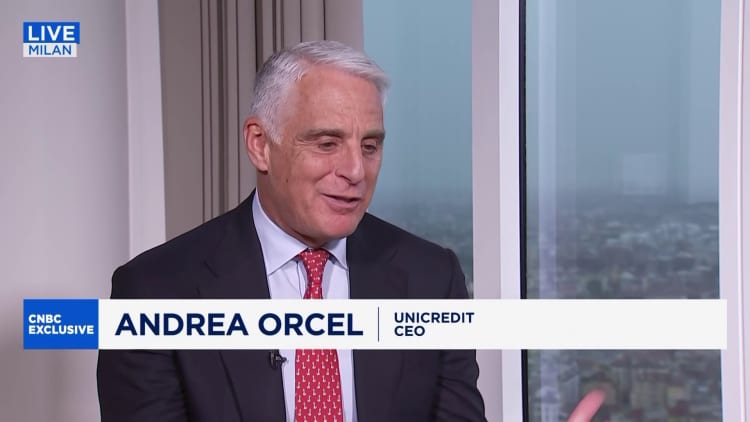
Andrea Orcel, chief executive officer of Unicredit, in London, UK, on Thursday, Nov. 23, 2023.
Bloomberg | Bloomberg | Getty Images
UniCredit CEO Andrea Orcel told CNBC Tuesday that he does not foresee a future where the Italian lender fully controls Commerzbank.
Orcel’s comments came as the Italian lender’s tender offer to raise its stake in the German bank kicks off.
“If we get to control, which is not the expected scenario at the moment, what we would do is very clear, and the returns on that would be … very positive for our shareholders, and also for the shareholders of Commerzbank, but it’s up to them,” he told CNBC’s Carolin Roth.
“We’re not really fretting it. We are just focusing on delivering, and we’ve done all we could to engage, and now we are just looking at what shareholders will do.”

Last month, UniCredit announced an offer to build more shares in Commerzbank, structured as a share exchange. The move aims to increase UniCredit’s holding in Commerzbank to more than 30%, a key regulatory threshold.
It already holds a 28% stake in Commerzbank, after steadily increasing its investment in the German lender since taking a minority stake in 2024.
The tender offer for Commerzbank begins on Tuesday.
On Monday, UniCredit shareholders voted to approve the issuance of 470 million new shares which could be exchanged for Commerzbank shares tendered in the offer.
Orcel’s interview with CNBC came after UniCredit published its first-quarter earnings, which were touted as the bank’s 21st quarter of profitable growth and its best quarter on record.
Quarterly net profit grew 16.1% year-on-year to 3.2 billion euros ($3.74 billion), well above the 2.8 billion euros expected by analysts polled by LSEG.
Shares of UniCredit were up by around 3% in early trade on Tuesday.
This is a developing story. Please refresh for updates.


- Kresus and Canton aim to accelerate institutional blockchain deployment.
- Focus shifts from pilot projects to full-scale production systems.
- Hanwha partnership targets tokenized private market assets.
Kresus and the Canton Network are joining forces to push institutional blockchain use beyond the pilot stage and into production, in a collaboration aimed at making deployment easier for enterprises and financial firms.
Announced Monday in San Francisco, the effort centers on a familiar challenge in digital assets: many institutions have explored blockchain through proofs of concept, but far fewer have moved live systems into full operation.
Kresus says the new collaboration will help organizations design, build and deploy blockchain applications “from first integration to full-scale launch,” combining its implementation capabilities with Canton’s institutional-grade infrastructure.
The companies said they are already working on several projects, with additional developments expected in the coming months.
Focus shifts from experimentation to execution
The collaboration is built around a practical problem that has slowed institutional blockchain adoption: implementation.
According to the companies, the aim is to reduce friction for enterprises and organizations that want to move from strategy to deployment.
That means helping clients navigate the technical and operational demands of production-grade blockchain systems rather than stopping at trials.
Kresus said the arrangement is designed to support institutions across industries, not just financial firms, as they look to deploy live blockchain solutions.
Canton’s infrastructure is positioned as the foundation for that effort, while Kresus brings delivery capabilities intended to bridge the gap between planning and production.
Hanwha partnership highlights real-world asset push
Kresus said it is already working with leading global financial institutions to bring next-generation blockchain applications into production on Canton.
One of those efforts is its partnership with Hanwha Investment & Securities, which is aimed at supporting the development of a tokenized digital asset platform focused on private market assets.
The platform is expected to enable the issuance, management and distribution of tokenized financial instruments aligned with real-world asset, or RWA, use cases.
That places the project squarely in one of the most closely watched areas in digital finance, where institutions are testing how traditional assets can be represented and managed on blockchain infrastructure.
Kresus also said it is bringing its core product stack to the Canton ecosystem. That includes enterprise-grade wallet infrastructure, tokenization systems and its secure middleware layer, KITE.
The company said these tools are designed to integrate into existing financial environments and support production deployments across payments, tokenized assets and digital asset management.
Institutional infrastructure remains the central pitch
The strategic message from both companies is clear: institutions need systems that are secure, reliable and scalable before blockchain can reach broader adoption.
“Financial institutions are moving beyond trials and toward actual blockchain applications,” Trevor Traina, founder and CEO of Kresus said.
The CEO added:
Success in regulated markets requires more than technology; it requires the ability to design, build, and deliver systems that meet real-world requirements. Kresus works directly with clients to bring these applications into production on Canton.
“Institutions need secure, reliable, and scalable systems to advance digital asset adoption,” Yuval Rooz, CEO of Digital Asset and co-founder of Canton said.
Through this collaboration, we are combining Canton’s institutional-grade blockchain with Kresus’ ability to implement production-ready applications that meet the needs of financial institutions.
According to Santiment, in early May large holders acquired more than 140,000 ETH within 96 hours. This demand is forming against a backdrop of growing corporate interest in Ethereum as a reserve asset: Bitmine Immersion Technologies holds over 5 million ETH. At the same time, an opposing trend is emerging: total assets under management in ETH-focused ETPs and ETFs amount to around $16 billion; however, at the beginning of 2026 the ETF segment experienced a period of subdued activity, with interest only starting to recover by April (source: CoinLaw).
Technical Picture
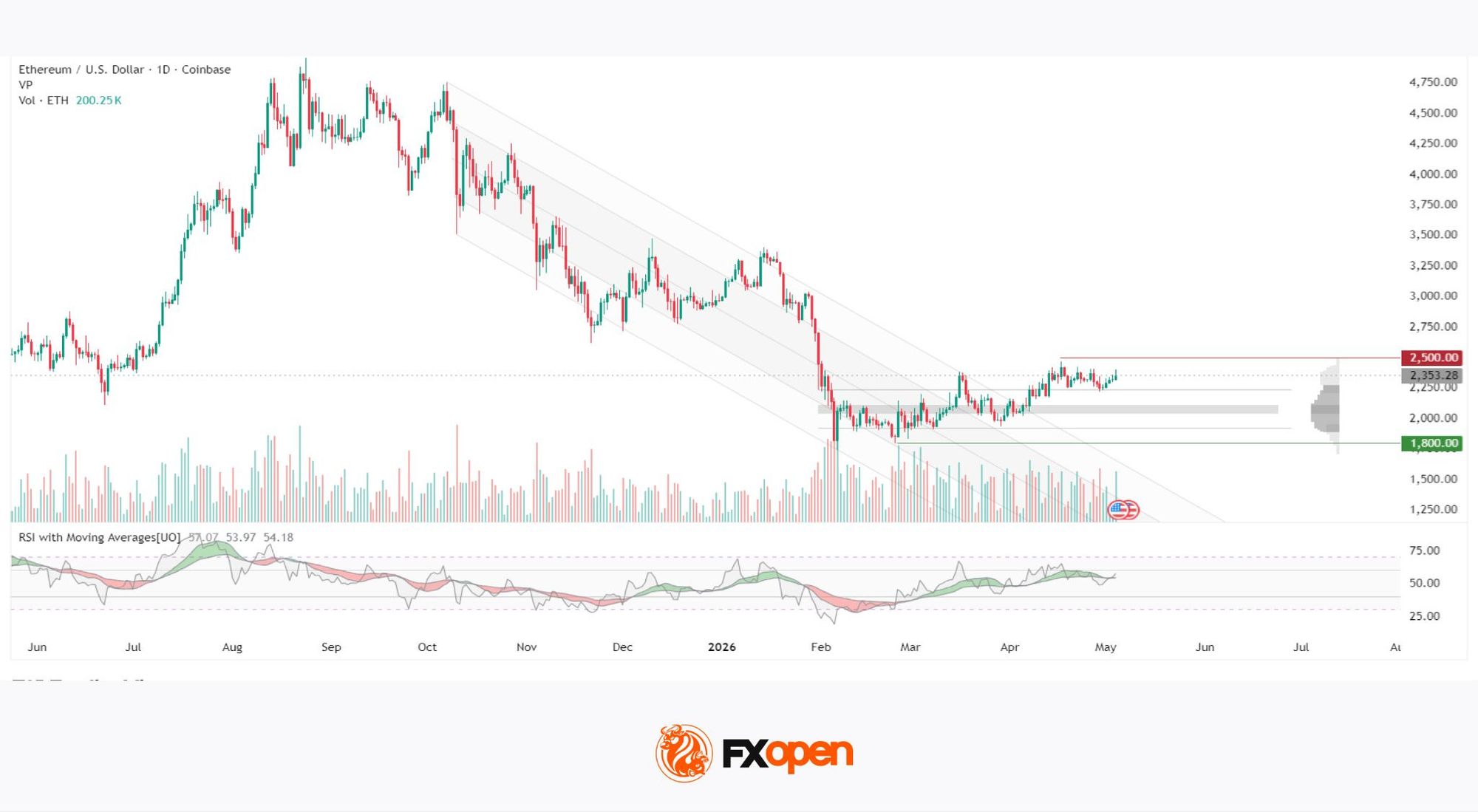
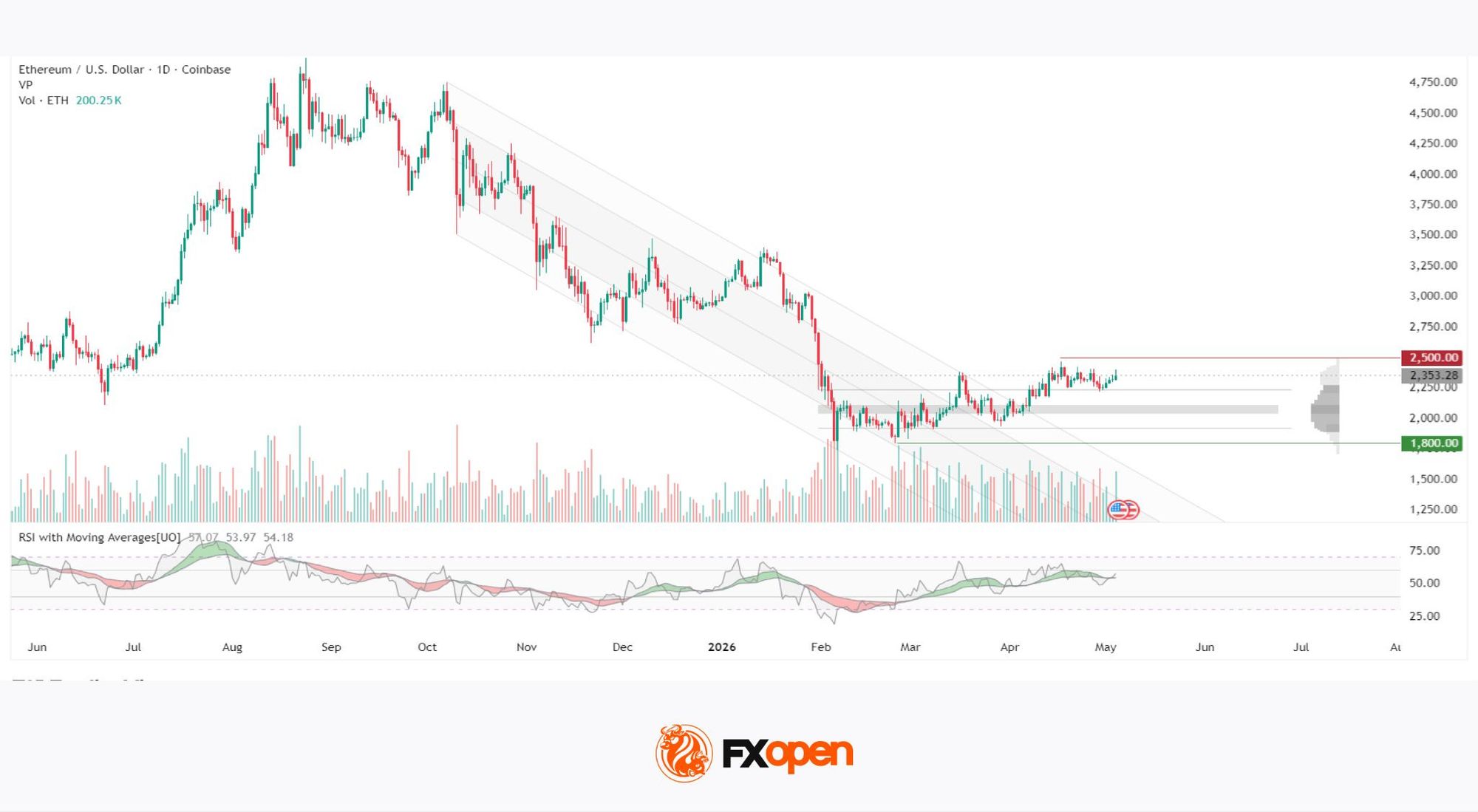
On the daily chart, an extended downward structure is evident: since early October 2025, the price has been declining within a descending channel, reaching a culmination in early February 2026 near the $1,750 level. Vertical volume during this period showed peak values, signalling the exhaustion of selling pressure. This was followed by a rebound: the price broke above the upper boundary of the channel and, during subsequent trading, formed a horizontal volume zone in the $1,920–$2,240 range, where the bulk of transactions over the period was concentrated. The point of control (POC) of this volume zone lies around $2,050–$2,100.
The price is currently trading above this zone, indicating a shift in favour of buyers. Support at $1,800 coincides with the February low from which the reversal began. Above current levels lies a resistance area near $2,500 — a zone the price approached in April but failed to consolidate above the round level. The RSI + MAs indicator shows readings of 57, 54 and 54: the oscillator is positioned above neutral, while the moving averages remain broadly neutral.
Key Takeaways
The technical profile reflects a transition from a prolonged downtrend to a consolidation phase above the volume zone. Further movement will depend on whether corporate demand for ETH can provide a sufficient basis to sustain a move towards the resistance area.
FXOpen offers the world’s most popular cryptocurrency CFDs*, including Bitcoin and Ethereum. Floating spreads, 1:2 leverage — at your service (additional fees may apply). Open your trading account now or learn more about crypto CFD trading with FXOpen.
*Important: At FXOpen UK, Cryptocurrency trading via CFDs is only available to our Professional clients. They are not available for trading by Retail clients. To find out more information about how this may affect you, please get in touch with our team.
This article represents the opinion of the Companies operating under the FXOpen brand only. It is not to be construed as an offer, solicitation, or recommendation with respect to products and services provided by the Companies operating under the FXOpen brand, nor is it to be considered financial advice.

Key Takeaways
- Apple is in preliminary discussions with Intel and Samsung regarding US-based manufacturing of core device processors
- No manufacturing contracts have been finalized; negotiations remain in exploratory phases
- CEO Tim Cook highlighted semiconductor supply limitations during the recent Q2 earnings presentation
- Partnering with Intel may enhance Apple’s standing with the Trump administration, which supports Intel’s domestic operations
- Apple presently sources semiconductors from TSMC in Taiwan, expecting 100 million units from TSMC’s Arizona facility by 2026
According to a Bloomberg report released Tuesday, Apple is investigating potential partnerships with Intel and Samsung to produce critical device processors domestically. These discussions remain exploratory, with no formal purchase agreements established.
Shares of Apple showed minimal movement during premarket hours Tuesday. Intel’s stock surged up to 4% following the report, while Samsung’s Seoul-traded shares climbed more than 5% before the close of Korean markets.
For over ten years, Apple has depended exclusively on TSMC for semiconductor fabrication. TSMC’s Taiwanese manufacturing plants produce cutting-edge 3-nanometer processors that drive current-generation iPhones and Mac computers.
The challenge? Capacity constraints are intensifying. AI data center requirements have consumed available production capacity, while demand for AI-enabled Mac systems exceeded Apple’s projections.
During last week’s Q2 FY26 earnings discussion, CEO Tim Cook acknowledged that semiconductor shortages were limiting revenue growth. “Our supply chain flexibility is more restricted than typical circumstances,” Cook stated.
Cook identified advanced processor capacity — rather than memory components — as the primary limitation. Mac mini and Mac Studio products have experienced the most significant impact. “Achieving supply-demand equilibrium will require multiple months,” he indicated.
Apple representatives have toured a Samsung manufacturing site currently under construction in Texas designed for advanced semiconductor production. Regarding Intel, preliminary discussions about utilizing its foundry capabilities have occurred.
The Strategic Value of Intel and Samsung
Securing Apple as a foundry client would represent a significant achievement for Intel. CEO Lip-Bu Tan is working to revitalize Intel’s manufacturing operations following prolonged challenges. Apple’s business could serve as validation to attract additional customers.
Samsung currently ranks as a distant competitor to TSMC in foundry services, but Apple’s endorsement would carry substantial industry influence. Samsung currently produces various iPhone components, including power management systems.
Political considerations also factor into these discussions. The Trump administration has positioned Intel as America’s domestic semiconductor manufacturing leader, and certain Apple leadership members believe collaboration could strengthen relations with Washington.
Nevertheless, Apple maintains legitimate concerns. Neither Intel nor Samsung currently matches TSMC’s manufacturing consistency or production volume. Apple may ultimately maintain its TSMC relationship without pursuing alternative suppliers.
Apple’s Component Sourcing Approach
Apple typically maintains relationships with at least two suppliers for critical components, providing negotiating power and protection against supply interruptions.
Taiwan presents particular geopolitical concerns. Cook has consistently identified Taiwan’s concentrated chip production as a strategic liability, considering China’s territorial assertions regarding the island.
TSMC is currently expanding operations in Phoenix, Arizona. Apple projects receiving 100 million processors from that location in 2026 — though this represents just a portion of its complete annual device requirements.
The iPhone 17 Pro series has also encountered supply chain difficulties. Apple has deployed operations personnel to prevent constraints from affecting AirPods and Apple Watch production lines.
Wall Street analysts rate TSMC a Strong Buy, Apple and Samsung a Moderate Buy, and Intel a Hold as they evaluate its recovery efforts.



Coinbase Australia has launched support for self-managed super funds, giving trustees a new way to add crypto exposure to retirement portfolios.
Summary
- Coinbase Australia now supports SMSFs, giving trustees a compliant route to add crypto exposure locally.
- Australian SMSFs held AU$1.06 trillion in assets, making retirement funds a key crypto target market.
- The launch follows Coinbase’s AFSL approval as OKX also builds SMSF crypto services locally nationwide.
The service focuses on self-directed investors who already manage their own superannuation funds.
According to the company, the offering includes downloadable data aligned with local accounting standards. It also added a verification process built for Australian fund structures. Coinbase APAC Managing Director John O’Loghlen said:
“With growing regulatory clarity in Australia and institutional adoption of digital assets, we see SMSFs as a core area of potential growth in Australia.”
Retirement funds hold large asset base
Self-managed super funds, or SMSFs, are private retirement funds regulated by the Australian Taxation Office. They give members direct control over investment choices, including shares, property and crypto assets.
Official data showed at least 664,000 SMSFs in Australia at the end of 2025. These funds held about AU$1.06 trillion, or $758.2 billion, in assets. That makes SMSFs a major target for crypto firms seeking long-term investors.
Crypto.news reported in September 2025 that Coinbase and OKX were moving into Australia’s pension market through SMSF-focused crypto products. The report said SMSFs form part of Australia’s wider retirement system and allow more flexible investment choices than traditional funds.
License backs Coinbase’s local push
Coinbase’s SMSF launch follows its Australian Financial Services License approval. Crypto.news reported in April 2026 that Coinbase secured the license and planned to expand into crypto and equity perpetuals, followed by futures, options and other financial products.
The license places Coinbase under conduct, disclosure, governance and consumer protection rules used by traditional financial firms in Australia. O’Loghlen said Coinbase planned to compete with traditional finance across stock trading, payments and other products.
Australia has also moved toward stricter rules for digital asset platforms. Crypto.news reported that draft laws would require many crypto platforms and custody providers to hold an Australian Financial Services License. The rules also cover conduct standards and possible penalties for breaches.
OKX adds pressure in SMSF market
Coinbase is not alone in targeting Australian retirement investors. As previously reported, OKX launched a regulated SMSF-focused crypto platform in Australia in September 2025. The product included compliance tools, custody features, portfolio dashboards and end-of-year reporting.
OKX Australia CEO Kate Cooper said trustees often rely on spreadsheets, generic portals or offshore support that does not understand SMSF rules. She said OKX wanted to make digital asset use through SMSFs more direct and easier to report.
Meanwhile, the launch also comes as the U.S. expands crypto’s role in retirement systems, after President Donald Trump signed an order in August allowing crypto in 401(k) plans and Indiana passed a law permitting crypto allocations in certain state retirement plans.


Five US banking lobbies issued a joint statement saying the proposed language on stablecoin yield in the Clarity Act falls short of its goal of protecting bank deposits.
The five trade groups backed the senators’ goal but demanded stronger text. It included the American Bankers Association, the Bank Policy Institute, the Consumer Bankers Association, the Financial Services Forum, and the Independent Community Bankers of America.
US Banks Want Tighter Stablecoin Yield Language in Clarity Act
Senators Thom Tillis and Angela Alsobrooks released the bipartisan compromise on stablecoin rewards. This came after months of talks with banks, the White House, and crypto firms.
The provision bars deposit-style yield but leaves room for rewards tied to genuine on-platform activity. The banking groups acknowledged the senators’ efforts to address deposit flight risks. They said their forthcoming feedback would aim to preserve community lending while accommodating innovation.
“Senators Tillis and Alsobrooks are seeking to achieve the correct policy goal – prohibiting the payment of yield and interest on stablecoins; however, the proposed language falls short of that goal. It is imperative that Congress get this right,” the statement read.
Follow us on X to get the latest news as it happens
The banking groups in particular pointed to Section 404. The text lets crypto exchanges pay yield through user membership programs, provided the payouts are not structured like bank interest. The lobbies called this a major loophole that lawmakers must close.
They also objected to rewards calculated on the basis of duration, balance, and tenure. Banks argue this setup directly rewards idle stablecoin holdings, defeating the prohibition’s purpose of preventing deposit flight.
“We will be sharing our detailed suggestions for strengthening the proposed language with lawmakers in the coming days, and we will continue to work in good faith to help Congress embrace innovation while protecting the deposits that drive local lending and economic activity in their communities,” they added.
Tillis Defends the Compromise
Tillis pushed back on Monday. He said on X that banks had a seat at the table for months of negotiations.
“Our compromise prohibits stablecoin rewards from resembling interest on bank deposits, our core concern over deposit flight… Some in the banking industry may not want either of these things to happen, and we respectfully agree to disagree,” he said.
Tillis warned against letting “the perfect become the enemy of the good.” The lobbies will submit detailed suggestions within days, ahead of an expected Senate Banking Committee markup later this month.
Subscribe to our YouTube channel to watch leaders and journalists provide expert insights
The post Banks Say Stablecoin Yield Language Falls Short, Senator Tillis Disagrees appeared first on BeInCrypto.


Bitmine chairman Tom Lee has said the crypto market may be entering an early recovery phase even as investor sentiment remains cautious.
Summary
- Tom Lee has said crypto may be entering an early recovery phase even as sentiment remains cautious.
- Bitmine has purchased over 101,745 ETH worth $242 million, taking its total holdings past 5.1 million ETH.
- More than 4 million ETH has been staked by the firm, accounting for about 10.5% of total staked supply.
According to Bitmine Immersion Technologies chairman Tom Lee, recent market trends resemble past cycle transitions where prices begin to recover while investor sentiment remains subdued.
In a note on Monday, Lee said “crypto spring…has commenced,” adding that sentiment has stayed cautious even as prices strengthen.
Lee tied that outlook to policy developments in the U.S., stating that the outcome of the CLARITY Act, whether it is passed or rejected, would confirm the return of favourable conditions for digital assets. His note came after more than six months of weak pricing following the October 2025 market downturn, a period that analysts have tracked closely for signs of reversal.
According to the company’s latest disclosure, Bitmine purchased over 101,745 Ether worth about $242 million in the past week, pushing total holdings beyond 5.1 million ETH. The firm said this represents roughly 4.29% of Ethereum’s circulating supply of about 120.7 million tokens.
Lee said the company is “continuing our aggressive accumulation,” pointing to a faster pace of purchases over the past four weeks.
Earlier updates from the company showed holdings around 5.07 million ETH, while on-chain data tracked by Arkham indicated that more than 4 million ETH has already been deployed into staking programmes.
Valued at roughly $9.3 billion, the stash accounts for roughly 10.5% of the total staked Ethereum supply, according to the same data.
Company disclosures show the strategy combines continued purchases with staking, allowing Bitmine to generate yield while reducing liquid supply in the market. Internal targets cited in reports indicate the firm is working toward securing up to 5% of Ethereum’s total supply over time.
Ethereum outlook tied to institutional and AI demand
Lee said Ethereum’s positioning remains supported by institutional adoption trends, noting that “Wall Street tokenizing on the blockchain” continues to drive demand. He added that emerging AI systems are increasingly relying on neutral public blockchains, which he said strengthens Ethereum’s role in the ecosystem.
Performance data cited by Lee shows ETH has outperformed the S&P 500 by 1,380 basis points since the start of the war referenced in his note, placing it among the strongest performing assets alongside crude oil.
On-chain data and company filings indicate Bitmine remains one of the largest holders of Ether, with its growing allocation placing it among the most active institutional participants shaping supply dynamics in the Ethereum market.


Moscow Exchange plans to publish four more crypto indexes from May 13, widening its benchmark list beyond Bitcoin and Ethereum.
Summary
- MOEX will add SOL, XRP, TRX and BNB indexes from May 13 for professional investors.
- Binance will supply 50% of pricing data, while Bybit, OKX and Bitget provide the rest.
- Existing Bitcoin and Ethereum indexes will update every 15 seconds during trading and weekend sessions.
The new indexes will track Solana, XRP, Tron and BNB under the tickers MOEXSOL, MOEXXRP, MOEXTRX and MOEXBNB.
The exchange plans to calculate prices with data from Binance, Bybit, OKX and Bitget. Binance will carry a 50% weight. Bybit will provide 20%, while OKX and Bitget will each provide 15%.
Crypto benchmarks move closer to live pricing
From May 13, Moscow Exchange also plans to update all digital currency indexes more often. Existing benchmarks, including MOEXBTC and MOEXETH, are expected to update every 15 seconds during trading hours and extra weekend sessions.
The shift may make the benchmarks more useful for products tied to digital asset prices. However, the exchange has not presented the new altcoin indexes as tradable products yet. It said they “could become” underlying assets for future instruments, leaving timing and terms open.
Meanwhile, the planned indexes fit Russia’s controlled route for crypto-linked market products. Crypto.news reported in June 2025 that Moscow Exchange listed a Bitcoin ETF futures contract tied to BlackRock’s IBIT product, but access stayed limited to qualified investors. The exchange said: “Trading in this new product will begin on June 4, 2025, and will be exclusively available to qualified investors.”
That model remains central to Russia’s approach. The country allows crypto exposure through selected financial products, but it has not opened broad spot crypto trading on local regulated venues. Crypto.news also reported that Russia had explored a trading pilot for top-tier investors, led by the Finance Ministry and the Bank of Russia.
Regulators target activity outside formal channels
The index launch comes as Russian officials try to move crypto activity into supervised channels. Crypto.news reported in February 2026 that Deputy Finance Minister Ivan Chebeskov estimated Russian crypto turnover at about 50 billion rubles per day, or more than 10 trillion rubles per year.
Moreover, Chebeskov said much of that activity remained “outside the regulated zone, outside our control.” The Bank of Russia has also called for penalties against transactions outside approved rules. Crypto.news cited Governor Elvira Nabiullina, who said: “Fraudsters are taking advantage of the gray market.”
More crypto indexes may follow
Moscow Exchange plans to expand its benchmark list to ten crypto assets. Possible additions include Dogecoin, Cardano, Hyperliquid and Chainlink, based on the current list under review.
The exchange has also discussed futures tied to crypto indexes, including possible perpetual futures on Bitcoin and Ethereum. Direct cryptocurrency trading remains a separate goal. The current roadmap points to early 2027 for that step.


Strive, Inc. has pushed its Bitcoin treasury past 15,000 BTC after its latest purchase added to a months-long accumulation run.
Summary
- Strive has crossed 15,000 BTC after buying 444 bitcoin for $33.9 million, according to its SEC filing.
- Company disclosures show the treasury has grown by over 2,200 BTC since its Semler Scientific acquisition in January 2026.
- Investor filings indicate Strive raised $225 million through its SATA preferred stock, with demand exceeding $600 million.
According to an 8-K filing with the U.S. Securities and Exchange Commission, the Dallas-based firm bought 444 BTC for $33.9 million at an average price of $76,307 per coin, taking its total holdings above the 15,000 BTC threshold. CEO Matt Cole disclosed the purchase on X alongside the filing, confirming the company’s continued pace of accumulation.
The new total builds on a prior disclosure from April 24, when Strive reported holding 14,557 BTC following a separate purchase of 789 BTC at $77,890 per coin. Company filings show that the latest addition lifts the treasury’s value to roughly $1.2 billion at current market prices.
Strive’s treasury expansion tied to structured capital strategy
SEC disclosures dated May 1 show Strive holding $97.9 million in cash and cash equivalents, alongside a $50.4 million position in Variable Rate Series A Perpetual Stretch Preferred Stock tied to Strategy, the firm led by Michael Saylor.
The filing also listed 63,129,587 Class A shares and 9,893,844 Class B shares outstanding, along with 4,959,536 shares of its own preferred stock trading under the SATA ticker.
Strive has framed its approach as a Bitcoin-first capital model. Company materials describe Bitcoin per share as the internal benchmark for capital allocation, with Cole steering the firm toward what he has called “digital credit” products built around Bitcoin exposure.
Investor filings show the SATA preferred stock at the center of this structure. In January 2026, Strive raised $225 million through an oversubscribed offering, with demand exceeding $600 million, while the instrument carried an annualized yield close to 13%. Company disclosures noted that the product held its peg even during a roughly 50% drawdown in Bitcoin prices.
As previously reported by crypto.news, Strive became a top 10 public corporate Bitcoin holder last month, with its balance rising to 14,557 BTC. In previous company statements, Strive reported it held 12,798 BTC following its January 2026 acquisition of Semler Scientific, a deal that brought the medical technology company under it as a subsidiary.
Statements from Strive and data referenced by BTCtreasuries indicate the company has added more than 2,200 BTC since that acquisition, a pace that has pushed it into direct competition with long-established treasury holders.
Positioning alongside Strategy’s treasury model
Public filings show Strategy remains the largest corporate Bitcoin holder, with 818,334 BTC acquired at a cumulative cost of about $61.8 billion and an average price of $75,537 per coin, accounting for nearly 4% of Bitcoin’s fixed supply.
Strive’s $50.4 million allocation to Strategy-linked preferred stock signals exposure to similar balance sheet structures across corporate treasury strategies.
Market data at the time of writing showed Strive’s shares trading at $16.23, down 0.05% on the day, while historical pricing data indicates the stock has declined about 88% over the past six months during a period that included a deep Bitcoin drawdown followed by a partial recovery.

Prime Minister Narendra Modi condemned the missile and drone attacks on the United Arab Emirates after three Indian nationals were injured in Fujairah.
Summary
- PM Modi called the Fujairah attack unacceptable after three Indian nationals were injured in the UAE.
- Pakistan and Canada condemned Iran’s missile and drone strikes, urging restraint and regional de-escalation.
- Hormuz tensions kept oil, shipping and Bitcoin volatility in focus after the UAE attack.
He said India stood with the UAE and called the targeting of civilians and infrastructure “unacceptable.”
India’s Ministry of External Affairs also criticised the strike and urged an end to attacks on civilians. Officials said the injured Indian nationals were receiving medical care, while the Indian Embassy in the UAE worked with local authorities.

Moreover, Pakistan’s Prime Minister Shehbaz Sharif also condemned the attacks on civilian infrastructure in the UAE. In a post on X, he said Pakistan “strongly condemns the missile and drone attacks on civilian infrastructure in the United Arab Emirates last night.”
Sharif said Pakistan stood with UAE President Mohamed bin Zayed and the Emirati people. He added that the ceasefire should be respected to allow space for dialogue and regional stability.
Canada’s Prime Minister Mark Carney also condemned Iran’s missile and drone attacks on the UAE. He said Canada stood in solidarity with Mohamed bin Zayed and the people of the UAE.
Carney also praised defensive steps taken to protect civilians and civilian infrastructure. He said Canada called for de-escalation and diplomacy in the region.
Fujairah attack raises concern over Hormuz
The UAE accused Iran of carrying out the strikes, including an attack linked to a fire at an oil facility in Fujairah. Reports said the attacks came as tensions around the Strait of Hormuz continued to pressure shipping and energy routes.
Modi also pointed to the need for safe navigation through the Strait of Hormuz. He said free movement through the waterway was vital for regional peace, stability and global energy security.
The UAE said its air defences intercepted ballistic missiles, cruise missiles and drones launched from Iran. Iran has not issued a full official response, while an Iranian military official told state media that Tehran had no plan to attack UAE oil facilities.
Bitcoin volatility stays in focus
Crypto.news reported that Bitcoin recently moved above $80,000 after U.S. President Donald Trump announced “Project Freedom” amid Strait of Hormuz tensions. The report said the move triggered more than $160 million in Bitcoin short liquidations.
Crypto.news also reported earlier that Iran denied claims it was collecting Strait of Hormuz tolls in Bitcoin or stablecoins. The outlet said maritime security firms had warned of scam emails asking stranded vessel operators for crypto payments.

TLDR
- Elon Musk has resolved an SEC enforcement action regarding delayed Twitter stock disclosure by agreeing to a $1.5 million settlement payment
- Federal regulators claimed Musk’s 11-day filing delay allowed him to acquire shares at reduced prices, resulting in approximately $150 million in avoided costs
- The settlement, paid through Musk’s trust, includes no acknowledgment of liability or wrongdoing
- This $1.5 million settlement represents the highest penalty ever imposed by the SEC for violations of this nature
- Tesla shares declined 0.16% in pre-market activity following the announcement, extending year-to-date losses to approximately 13%
Elon Musk has reached a settlement agreement with the U.S. Securities and Exchange Commission regarding allegations that he failed to timely disclose his accumulation of Twitter shares. Under the terms, a trust bearing Musk’s name will remit $1.5 million to resolve the matter. The settlement contains no acknowledgment of liability.
The regulatory agency initiated legal proceedings in January 2025, mere days before President Biden’s term concluded. The complaint centered on Musk’s alleged failure to file required disclosures for 11 days after surpassing the 5% ownership threshold in Twitter shares during late March and early April of 2022.
Federal securities regulations mandate that investors publicly report their holdings once they exceed 5% ownership in any publicly traded company. According to the SEC’s allegations, Musk’s delayed filing enabled him to continue accumulating shares at artificially suppressed prices before market participants could respond to the information.
Throughout this disclosure gap, Musk acquired more than $500 million in Twitter stock. His eventual disclosure revealed a 9.2% ownership position. The SEC calculated that the filing delay resulted in approximately $150 million in cost savings for Musk.
While the SEC initially sought disgorgement of the full $150 million, observers with knowledge of the proceedings indicated that establishing such damages in litigation would have presented significant evidentiary challenges. The negotiated resolution requires only the $1.5 million monetary penalty.
According to Alex Spiro, Musk’s legal counsel, his client has been “cleared of all issues related to the late filing of forms in the Twitter acquisition.” Musk previously characterized the filing delay as unintentional and contended that the SEC’s enforcement action violated his constitutional free speech protections.
A Long History With the SEC
This settlement marks another chapter in Musk’s ongoing relationship with the securities regulator. In 2018, he resolved separate charges by paying $20 million after publishing tweets claiming he had “funding secured” to take Tesla private. That earlier agreement also mandated his resignation as Tesla’s board chairman and implemented pre-approval requirements for certain social media communications.
The Twitter-related settlement was formally filed on May 4 in federal court in Washington, D.C. The resolution came approximately three months after a federal judge denied Musk’s motion seeking dismissal of the enforcement action.
The agreement emerged following the unexpected March departure of Margaret Ryan, the SEC’s enforcement division chief, who resigned after internal disagreements with agency leadership. Under current Chairman Paul Atkins, the SEC has been recalibrating its enforcement priorities and approach.
According to a source with direct knowledge of the matter, the $1.5 million penalty establishes a new record as the largest civil penalty ever assessed for this particular category of disclosure violation.
What It Means for Tesla
Tesla shares experienced a modest 0.16% decline in pre-market trading following news of the settlement. Year-to-date, the stock has fallen approximately 13%.
Current Wall Street consensus rates Tesla as a Moderate Buy, reflecting 13 Buy recommendations, 12 Hold ratings, and 5 Sell opinions. Analysts’ average price target of $410.21 suggests potential upside of roughly 4.5% from present trading levels.
For Musk personally, whose net worth Forbes estimates at $789.9 billion, the $1.5 million settlement payment represents an immaterial financial impact.

Who Invented Money? | The History of Money | Barter System of Exchange | The Dr Binocs Show

British Superbike star ready for ‘baptism of fire’ on North West 200 debut

The Bengal boom: 7 stocks that surged up to 22% after BJP win and should you still buy?

Manchester United reach agreement with Casemiro over contract clause amid transfer speculation

US brings back mandatory military draft registration

Steven Gerrard disagrees with Gary Neville over ‘shock’ Chelsea and Arsenal claim | Football
Who Invented Money? | The History of Money | Barter System of Exchange | The Dr Binocs Show

MONEY EXPERT Leila Hormozi: The Psychology of Making Money

Legacy starts with real protection cold wallet + LLC. #investing #xrp#cryptocurrency #wealth
-

 Business6 days ago
Most Commercial Energy Audits Miss the Real Losses
-

 Fashion6 days ago
Kylie Jenner’s KHY Enters a New Era with ‘Born in LA’
-

 NewsBeat2 days ago
Channel 5 – All Creatures Great and Small series 7 new post
-
 Tech4 days ago
Trump’s 25% EU auto tariff breaches Turnberry Agreement that also covers semiconductors and digital trade
-
 Sports4 days ago
Paul Scholes issues Marcus Rashford reality check as agreement emerges over Man United star
-

 Crypto World7 days ago
CFTC’s AI will review U.S. crypto registration applications, chairman tells CoinDesk
-

 Business6 days ago
Barclay Brothers Avoid Bankruptcy: HSBC Drops High Court Petitions After IVA Deal
-
 Business6 days ago
Tesla Officially Registers Elon Musk’s Stock: What Investors Need to Know
-

 Tech7 days ago
Get Ready for More Brain-Scanning Consumer Gadgets
-

 Tech6 days ago
Texas Instruments made a new flagship graphing calculator: the TI-84 Evo
-

 Business4 days ago
Two Powerball Tickets Split $143 Million Jackpot in Indiana and Kansas
-
 Crypto World4 days ago
CoreWeave (CRWV) Stock Climbs 8% Despite $45M Insider Share Dump
-
Business2 days ago
Winning Numbers Drawn as Jackpot Resets to $20 Million
-
Crypto World6 days ago
Securitize and Computershare Enable Tokenized Equity Issuance for Over 25,000 U.S.-Listed Stocks
-

 Crypto World5 days ago
Gibraltar Proposes Tokenized Funds Regulation to Bolster Compliance
-

 Fashion2 days ago
Mary J. Blige Vegas Residency Looks: Crystal-Embellished Fjolla Haxhismajli, Todd Fisher, and More!
-

 Business6 days ago
Alexandria Real Estate Equities, Inc. (ARE) Q1 2026 Earnings Call Transcript
-

 Tech5 days ago
Official SAP npm packages compromised to steal credentials
-

 Sports6 days ago
Antrim GAA: Hurlers cancel training as row with board deepens
-

 Entertainment5 days ago
Celebrities Who Are Attending the 2026 Met Gala Event
You must be logged in to post a comment Login