
Crypto World
PayPal (PYPL) Stock Climbs on Strong Q1 Earnings Despite Cautious Q2 Forecast


Quick Summary
- PayPal delivered Q1 adjusted EPS of $1.34, surpassing the analyst consensus of $1.27
- Quarterly revenue reached $8.35 billion, climbing 7% from last year and beating the $8.1 billion Street projection
- Newly appointed CEO Enrique Lores unveiled a reorganization into three distinct business divisions
- Q2 adjusted EPS is projected to fall 9%, significantly worse than the 4% decline Wall Street anticipated
- Management aims to achieve minimum gross run-rate savings of $1.5 billion within the next two to three years
PayPal (PYPL) shares climbed 0.9% during premarket hours on Tuesday following the digital payments giant’s first-quarter performance that exceeded Wall Street expectations, although cautious second-quarter projections limited the upward momentum. Prior to the earnings release, the stock had already declined 14% year-to-date.
The company’s adjusted earnings per share registered at $1.34, narrowly surpassing the FactSet consensus projection of $1.27. Quarterly revenue hit $8.35 billion, representing a 7% year-over-year increase and exceeding Wall Street’s $8.1 billion target.
Total payment volume expanded 11% to reach $464 billion. The number of payment transactions increased 7% to 6.5 billion. The active account base held steady at approximately 439 million, indicating that revenue growth stems from higher spending among current users rather than customer acquisition.
From a profitability perspective, GAAP net income dropped 14% to $1.11 billion. The GAAP operating margin compressed to 17.8%, declining roughly 182 basis points year-over-year.
Free cash flow totaled $903 million for the quarter. The company allocated $1.5 billion for shareholder returns via stock buybacks and announced a quarterly dividend of $0.14 per share, scheduled for distribution on June 25, 2026.
New CEO Drives Organizational Overhaul
The quarterly results coincided with a major restructuring initiative unveiled by newly installed CEO Enrique Lores. PayPal is reorganizing its operations into three core business segments: checkout, consumer financial services, and payment processing.
The digital payments provider also introduced a cost-reduction program focused on organizational simplification and accelerated artificial intelligence integration, with a target of securing at least $1.5 billion in gross run-rate savings across the next two to three years.
“We are taking deliberate steps to sharpen our strategy, simplify our organization, and improve both our growth trajectory and cost structure,” Lores stated.
Lores assumed the chief executive position earlier this year with a clear directive to revitalize the struggling payments platform.
Second Quarter Forecast Falls Short
While the first-quarter results impressed, the company’s forward-looking statements concerned market participants.
PayPal projected a 9% contraction in adjusted EPS for the second quarter. Wall Street had been modeling a decline around 4%. The variance represents a substantial miss relative to expectations.
Full-year 2026 projections remained unchanged. Management continues to anticipate a mid-single digit decline in GAAP EPS and non-GAAP EPS ranging from a low-single digit decrease to marginally positive growth.
Executives characterized the first quarter as a “solid start” while acknowledging what they termed a challenging operating landscape.
The board approved a $0.14 per-share cash dividend for payment on June 25, 2026.


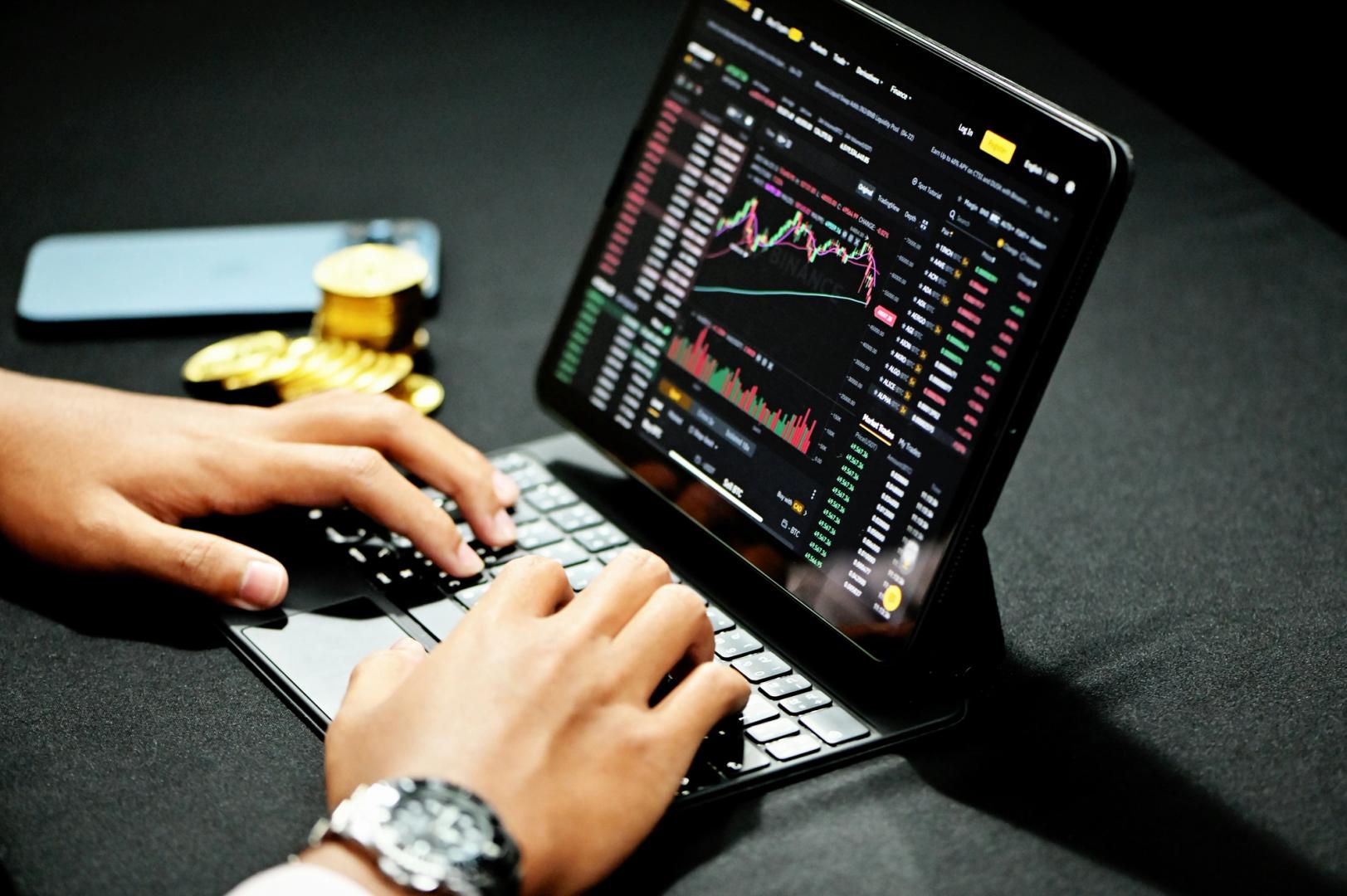
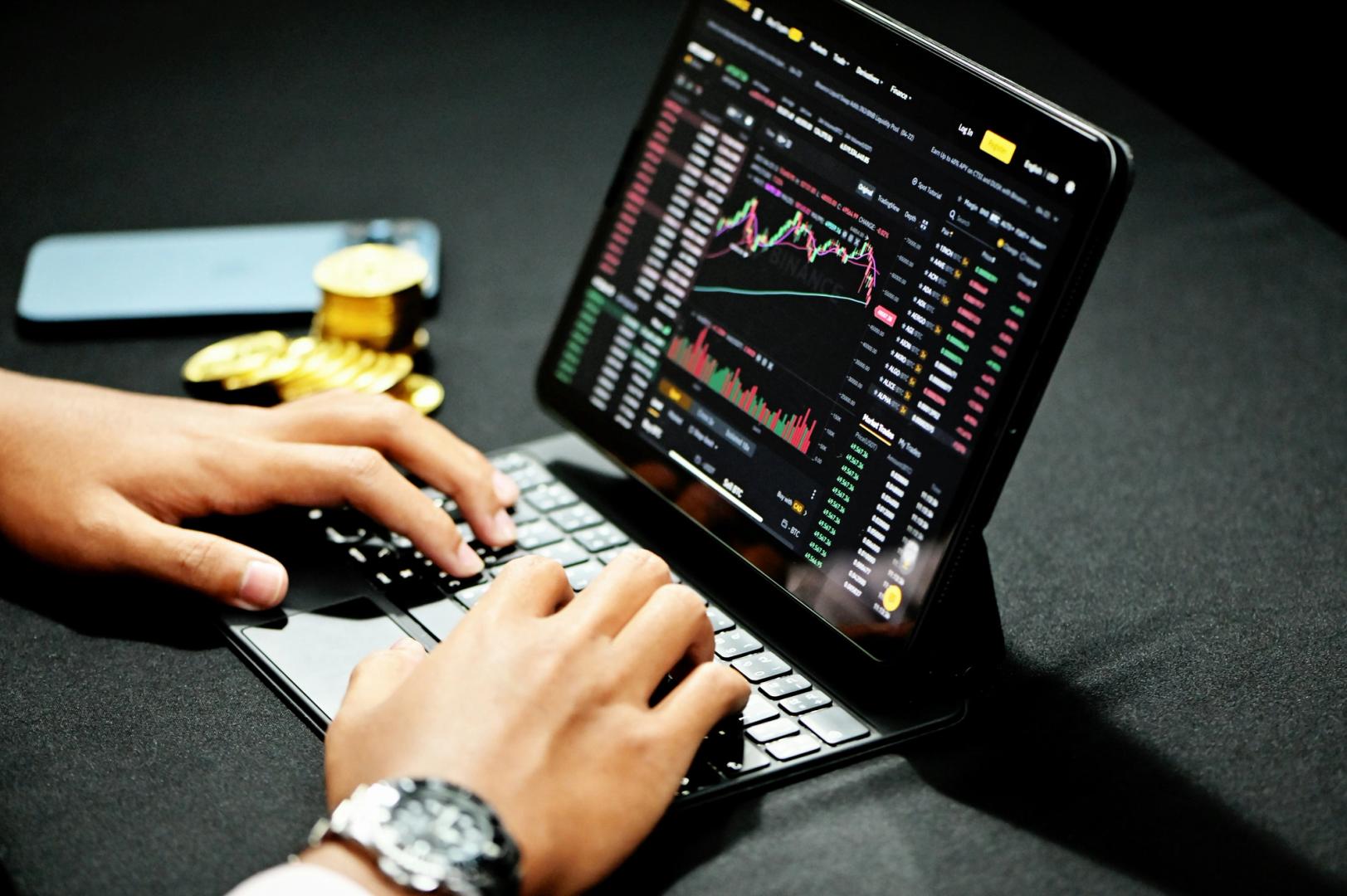
Jito Labs, a core infrastructure provider on Solana, has unveiled JTX, a new crypto trading platform aimed at bringing more advanced trading tools to the blockchain.
Announced at the Solana Accelerate conference in Miami, Florida, JTX is the company’s first product built specifically for traders. It allows users to trade tokens on Solana while maintaining self-custody, meaning they have full control of their funds unlike other set ups that have to hand assets over to a centralized exchange like Coinbase or Binance.
JTX is designed to feel more like those centralized platforms, the team shared in a press release with CoinDesk. It is supposed to offer faster trade execution and a range of tools typically used by professional traders, including stop-loss orders, preset trade strategies and detailed market charts powered by TradingView.
The launch comes as trading activity on Solana has surged, Jito Labs claimed, with decentralized exchanges on the network processing over $1 trillion in volume last year. Much of the more sophisticated trading still happens on centralized platforms or other blockchains.
Jito is betting that demand for more advanced, onchain trading will keep growing, with JTX expecting to come out with products like perpetual futures and prediction markets. In addition, a large portion of the revenue generated by JTX will go back to the protocol, benefiting holders of its JTO token.
JTX is currently open for sign-ups via a waitlist, with early access expected soon.
“Solana’s infrastructure is the best in the world, processing more daily transactions than every other blockchain combined,” said Lucas Bruder, the CTO at Jito Labs. “JTX is what happens when we point that at traders who’ve outgrown what’s currently being built for them. It beats a CEX on execution. It doesn’t take your keys. That’s the pitch.”
Read more: Jito Foundation acquires and revives SolanaFloor following shutdown over $27 million exploit
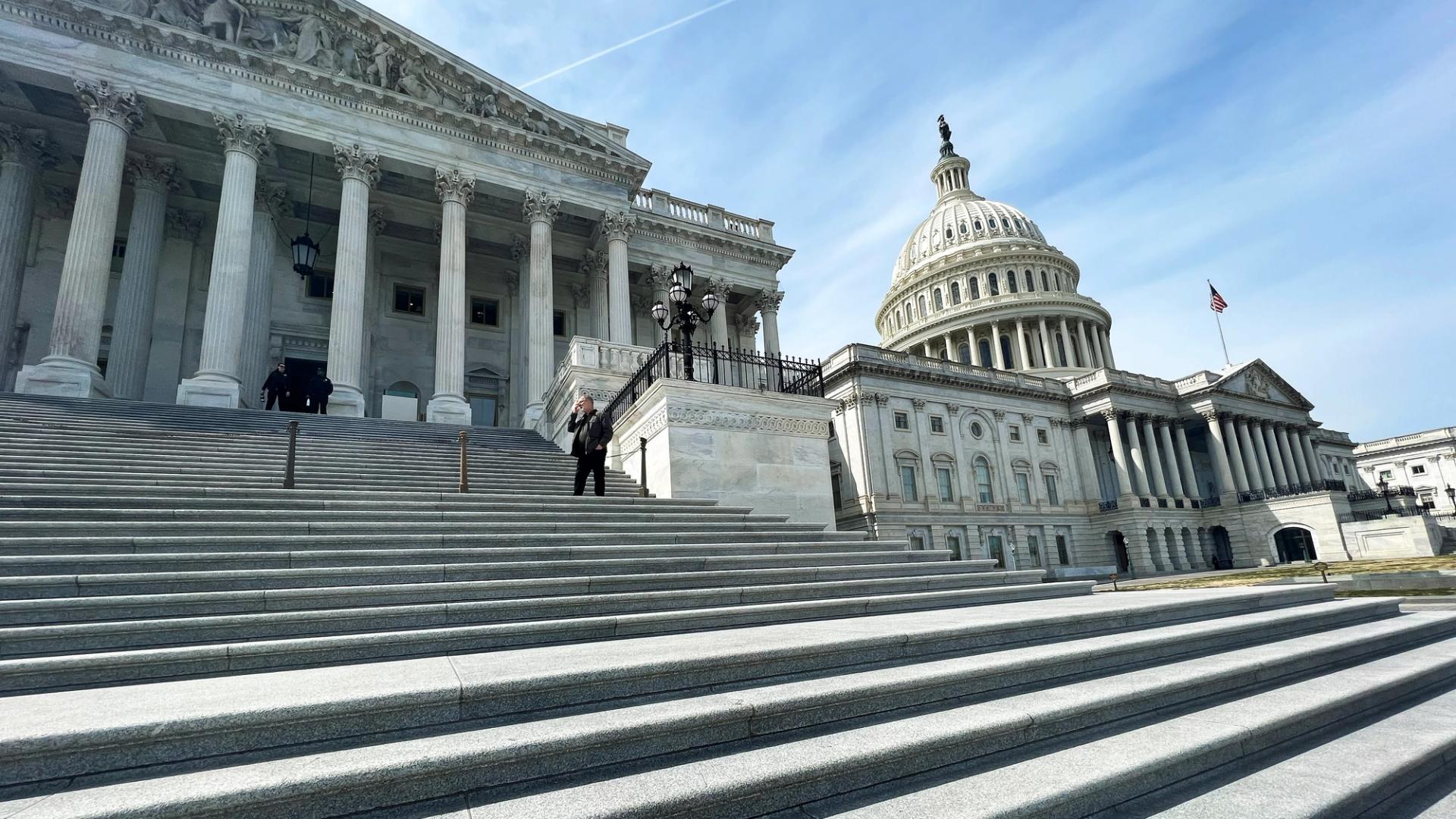
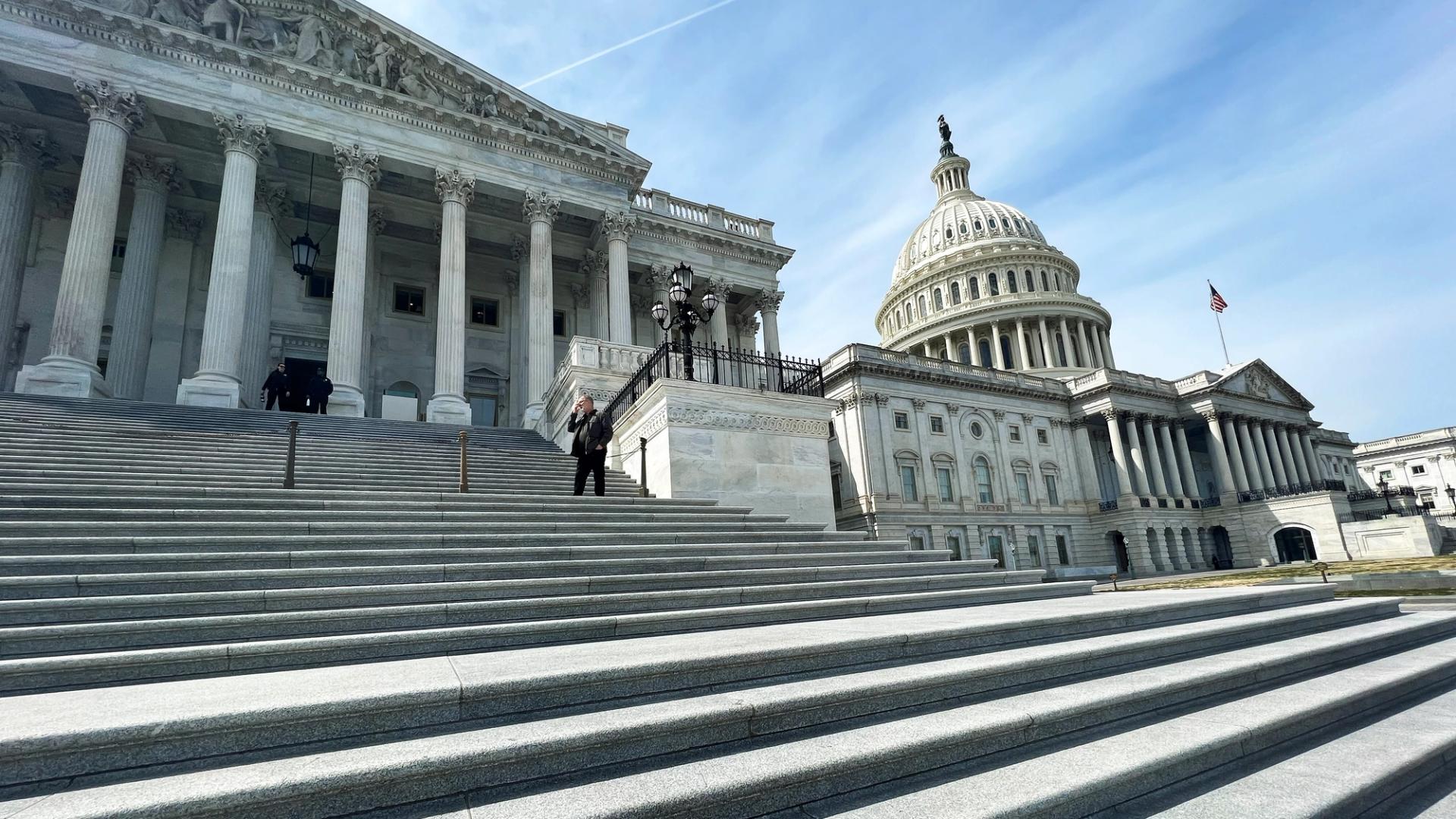
The American Innovation Project (AIP), a non-profit advocacy group, has added a crypto policy specialist to its ranks as it expands its work on digital asset legislation.
Jacob Smagula, a 2026 graduate of Claremont McKenna College, will join Democratic Representative Ritchie Torres’ (D-NY) team, AIP said. Smagula brings a background in crypto policy and industry affairs, having worked on the government relations team at publicly traded bitcoin miner MARA and currently serving on the policy team at the DeFi Education Fund.
He has also held roles on Capitol Hill, including internships with Representative Jake Auchincloss and Senator Angus King.
Smagula’s appointment comes as part of AIP’s Policy Innovation Fellowship, a two-part program designed to give congressional staff hands-on exposure to emerging technologies and direct experience in Congress.
AIP also named Hugo Swangstu, a 2025 graduate of the University of Washington, as a fellow. Swangstu previously interned for Representative Adam Smith and Representative Torres and will serve in the Washington office of Representative Shomari Figures (D-AL).
“The next generation of policymakers must understand the technologies reshaping our economy, national security, and daily lives,” Torres said.
Figures added that “as technology continues to advance at a rapid pace, it’s essential that Members of Congress are informed and prepared to craft sound tech policy.”
Allie Page, AIP’s executive director, said the organization is focused on bringing in talent with expertise in emerging technologies as lawmakers make decisions that will shape the U.S. role in AI, crypto and other sectors.
AIP was founded in August 2025 as a digital assets advocacy organization backed by crypto venture capital firm Digital Currency Group and the Cedar Innovation Foundation, a group whose funders are anonymous. Other supporters include Coinbase, Kraken, Andreessen Horowitz, the National Cryptocurrency Association, Paradigm, the Solana Policy Institute, Stand With Crypto and Uniswap Labs, according to the organization.

Quick Overview
- Walt Disney is set to unveil Q2 2026 financial results on Wednesday morning, May 6, with Wall Street projecting roughly $25 billion in revenue and earnings per share of $1.49
- The spotlight falls on streaming unit profitability — Disney+ and Hulu are working toward a 10% operating margin target by fiscal year-end, with approximately $500M in quarterly profit anticipated
- The Parks and Experiences segment confronts near-term headwinds including reduced international tourism and capital expenditures linked to expansion initiatives
- CEO Josh D’Amaro, who assumed leadership on March 18, prepares for his debut earnings conference call after succeeding Bob Iger
- Wall Street analysts maintain a Strong Buy rating on Disney shares with a consensus price target of $132.09, suggesting roughly 30% appreciation potential from present levels
The House of Mouse approaches Wednesday’s quarterly financial disclosure under fresh leadership, with a streaming operation now generating profits and its theme park empire navigating temporary challenges. Here’s what matters most.
Wall Street’s consensus calls for Disney to deliver Q2 2026 revenue near $25 billion alongside earnings per share of $1.49. Shares currently trade around $101.70, reflecting a 5.6% climb over the trailing 30-day period.
Market expectations point toward year-over-year revenue expansion of approximately 5.2% — matching the growth rate from the previous quarter, though trailing the 7% increase recorded during Q2 2025.
Streaming Profitability Commands Attention
The critical metric investors are monitoring isn’t top-line growth — it’s streaming operating margin. Disney’s direct-to-consumer platforms Disney+ and Hulu have established a 10% operating profit margin objective for fiscal year-end, making Wednesday’s figures a crucial progress indicator.
The Street anticipates the streaming segment will generate approximately $500 million in operating income this quarter. Should that materialize, it would represent roughly $200 million in year-over-year improvement.
This trajectory carries significance. Disney invested heavily in building its streaming infrastructure for years while absorbing substantial losses, and financial markets now demand evidence that these investments yield sustainable, recurring returns.
Theme Park Division Encounters Headwinds
The Experiences business unit — Disney’s most profitable segment — faces near-term obstacles. Analysts anticipate softer international visitor counts at U.S.-based parks combined with elevated expenses tied to development initiatives.
A particular pressure point: the forthcoming Disney Adventure cruise ship launch, which accelerates capital spending and compresses margins in the current period.
Despite these challenges, the parks division still generates nearly 68% of total operating earnings. Disney continues investing in new attractions including Toy Story and The Mandalorian-themed areas, and stakeholders await updates on whether these capital deployments are driving guest traffic.
Disney has fallen short of Wall Street’s revenue projections multiple times across the past 24 months. The broader consumer discretionary sector has demonstrated strength recently, with comparable stocks advancing 4.4% on average. Companies like Rush Street Interactive and Monarch exceeded estimates and posted double-digit gains following their reports.
New CEO Faces Inaugural Earnings Presentation
Wednesday also marks Josh D’Amaro’s first quarterly earnings discussion as Chief Executive Officer. He formally assumed the top position on March 18 following Bob Iger’s exit.
D’Amaro’s initial actions have encompassed workforce reduction of approximately 1,000 positions — roughly 1% of total headcount — alongside authorization of a $7 billion stock repurchase program.
The buyback initiative sends an unmistakable message to market participants that leadership views current share valuations as attractive.
Wall Street sentiment supports this perspective. Disney maintains a Strong Buy consensus rating derived from 11 Buy recommendations and one Hold rating. The mean 12-month price objective stands at $132.09, representing approximately 30% upside from today’s trading levels. Near-term focused analysts project a more conservative target of $128.25.
Disney releases results prior to Wednesday’s opening bell on May 6, 2026.


Miami Beach, FL — A growing group of Wall Street and crypto executives say the financial system is heading toward a breaking point, as markets shift from human-paced processes to machine-driven activity that runs around the clock.
“We’re moving to a world where transactions happen at a speed no human can track,” Sandy Kaul, head of digital assets and innovation at Franklin Templeton, said during a panel on the future of capital markets at Consensus in Miami on Tuesday. At the same time, “almost every process in capital markets today was built for humans, and none of them will stand up to what’s coming,” she added.
The tension between those two ideas — faster, automated markets and legacy systems designed for manual oversight — sat at the center of the conversation.
For decades, financial markets have relied on layered processes to handle trades. Systems batch transactions, reconcile records and settle trades hours or even days later. That structure dates back to a time when physical stock certificates moved across Wall Street by hand.
Now, blockchain infrastructure is starting to remove those constraints. Panelists pointed to tokenization — the process of turning assets like stocks or money market funds into digital tokens — as a key shift. These tokens can move instantly, settle in seconds and operate continuously.
“We are unwinding a system that’s been in place for 50 years and going back to settling one transaction at a time,” Kaul said, describing how real-time settlement could replace today’s batch-based model.
That shift has practical implications. In a tokenized system, an investor’s cash could remain fully invested until the exact moment it is spent. “Every penny of my earnings is fully invested from the moment I earn it to the moment that I spend it,” Christine Moy, partner at Apollo, said, outlining a future where idle cash largely disappears.
The same logic applies to large corporations. Instead of holding cash across multiple accounts worldwide, companies could pool funds into yield-generating assets and convert them only when payments are due.
Still, major hurdles remain. While blockchain networks can already process transactions quickly, some panelists argued that the industry lacks the rules and standards needed for institutions to operate at scale.
“We’ve solved the transaction problem. What’s missing is a standard for governance,” said Tom Zschach, former chief innovation officer at Swift, pointing to the need for clear rules around ownership, compliance and permissions.
That gap matters for large financial firms, where reliability often outweighs speed. “If there’s a chance it might not work, it’s a non-starter. What institutions need is certainty,” he said.
At the same time, competitive pressure is rising. As newer platforms offer faster and more flexible financial services, traditional firms risk losing clients if they fail to adapt.
Taken together, the discussion suggests the next phase of market evolution will not just be about faster trades. It will center on rebuilding the underlying systems so they can support continuous, automated flows of capital—without breaking the trust that global finance depends on.
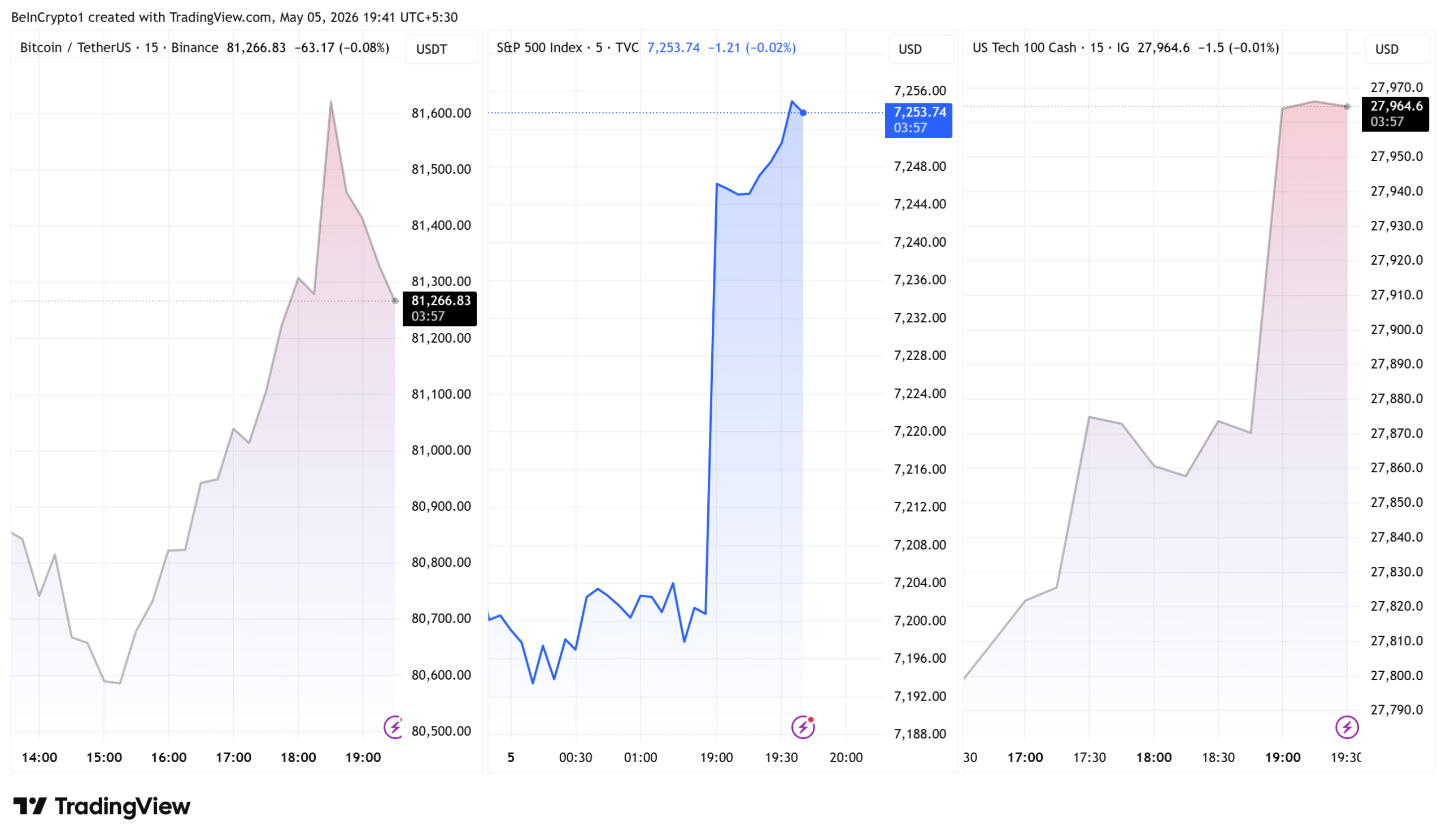
US risk assets rallied on May 5 after job openings, home sales, and services data beat estimates. Bitcoin (BTC) climbed toward $81,600, while the S&P 500 jumped to 7,253 and the Nasdaq 100 reached 27,964.
The figures pointed to resilient labor demand and a housing rebound without overheating. Markets read the prints as supportive of moderate growth. A patient Federal Reserve appeared to be the implied takeaway, easing fears of recession or renewed tightening.
Labor and Housing Data Beat Forecasts
JOLTS data showed March job openings at 6.866 million, slightly above the 6.84 million consensus. Hires rose by 655,000 to 5.6 million, a sign that employers continue to absorb workers.
New home sales surged 7.4% in March to a 682,000 annualized rate, well above the 650,000 forecast. Inventory tightened to 8.5 months of supply, while median prices eased to $387,400.
The April Institute for Supply Management Services PMI registered 53.6, just under the 53.7 estimate.
However, the reading kept services in expansion territory. The figure followed March’s 54.0 print, marking a modest deceleration but no contraction signal.

Bitcoin and Equities Track the Soft-Landing Narrative
Bitcoin price action mirrored equities, advancing roughly $1,000 from the intraday low before settling near $81,266. Meanwhile, the S&P 500 spiked from around 7,200 to 7,253, while the Nasdaq 100 climbed to 27,964.
Crypto traders treated the data as a continuation of risk-on conditions seen across stocks. Strong labor demand supports consumer spending and corporate earnings, two pillars of the current rally.
With services prices and oil-related pressures still elevated, however, the Fed appears unlikely to rush rate cuts.
Whether risk assets can extend gains likely hinges on how the next inflation print lands. Traders will watch for confirmation in upcoming labor and consumer data.
The post Risk Assets Climb as US Jobs, Housing Data Beat Estimates appeared first on BeInCrypto.
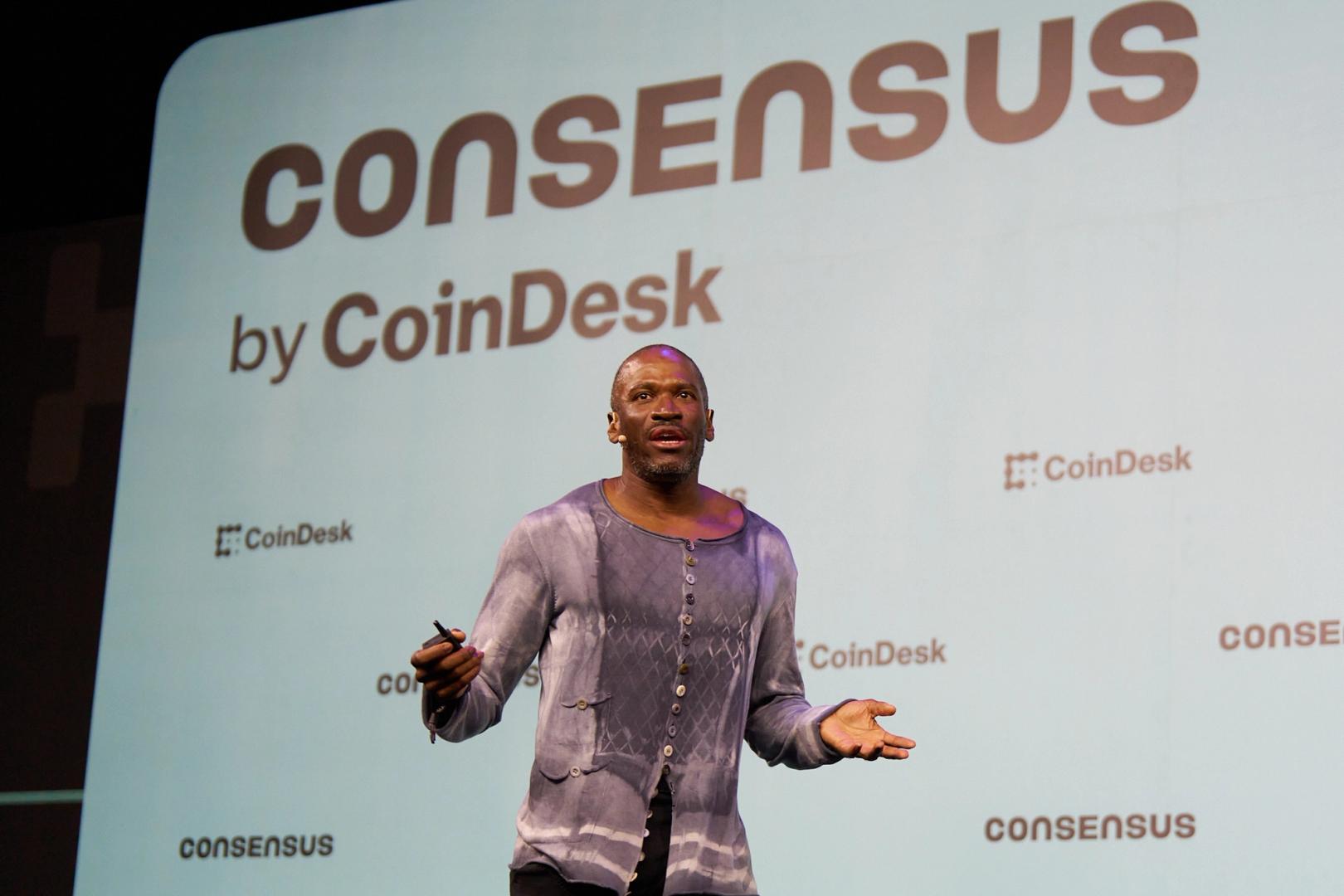
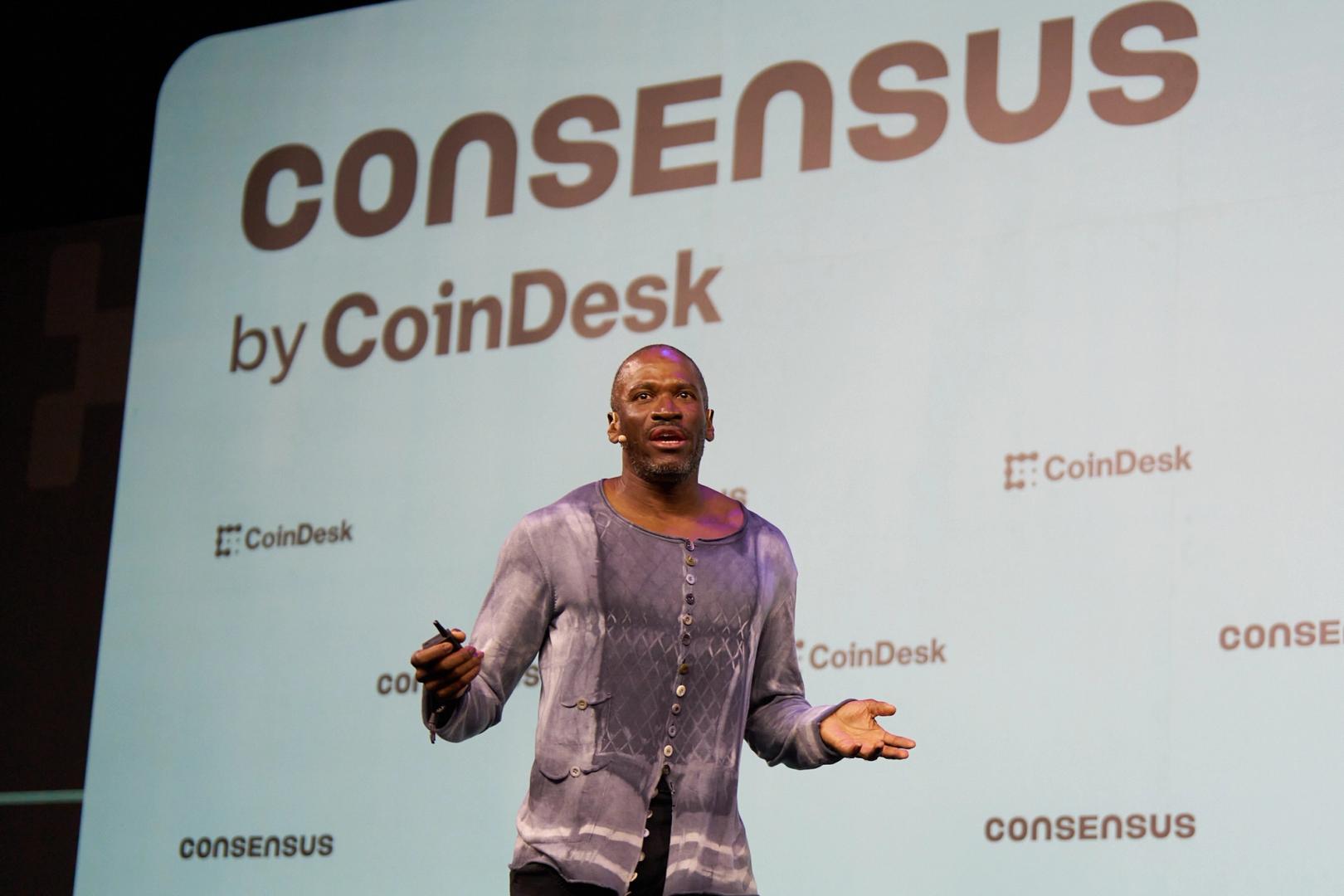
Miami, FL — Crypto doesn’t need regulation – something that charting the price of bitcoin over successive U.S. governments clearly shows, according to the provocative co-founder of BitMEX and CIO of Maelstrom, Arthur Hayes.
Hayes’ thesis is simple: fiat liquidity – precisely, the printing of more units of fiat money – is the only thing that affects bitcoin’s value proposition.
“I believe that if you want to talk about what is the price of Bitcoin and what’s the fair value, or what’s the future price, all that matters is how many units of fiat are there today,” Hayes told the audience at Consensus Miami 2026. “How many units of fiat will there be in the future, and what’s the pace of this fiat creation?”
While there’s a lot of talk about tradfi and regulators and crypto coming together and having this “bastard child,” the majority of people who attend conferences like Consensus want only to see the number go up, Hayes said. But they forget the price of Bitcoin has gone from zero to however many trillions of dollars that it’s worth today, he added, hammering his thesis home:
”The more money that is printed in the U.S. and around the world, the more value that bitcoin will have in fiat currencies,” said Hayes. “And it’s this liquidity part of the equation that really drives the price of bitcoin, and not anything to do with politics.”
Few executives in crypto maintain a social presence as lively, chaotic and strangely insightful as Hayes’. Behind the lapel-grabbing theatrics lies a track record that traders pay. For instance, Hayes was early to the rise of several AI-adjacent tokens, a sector that dominated speculative flows throughout 2024 and 2025. He also championed Zcash (ZEC), which rallied more than 450% over the past year.
Looking back over the last few U.S. administrations, key factors can be picked out that greatly bolstered the value of bitcoin, Hayes said. These included bailing out banks during the banking crisis and printing a lot more money, which sent bitcoin “off to the races.”
More recently, events like COVID, stimulus checks, Biden’s New Green Deal, and the Russian invasion of Ukraine have driven up the value of bearer assets like bitcoin and gold.
“This is the value that bitcoin provides outside of the regulatory apparatus,” Hayes said. “It’s precisely the reason that it does not adhere to the regulatory regime that some of you wish to put it under with bills like the clarity Act and other and other things.”


YLDS is an SEC-registered, USD-pegged stable asset from Figure.
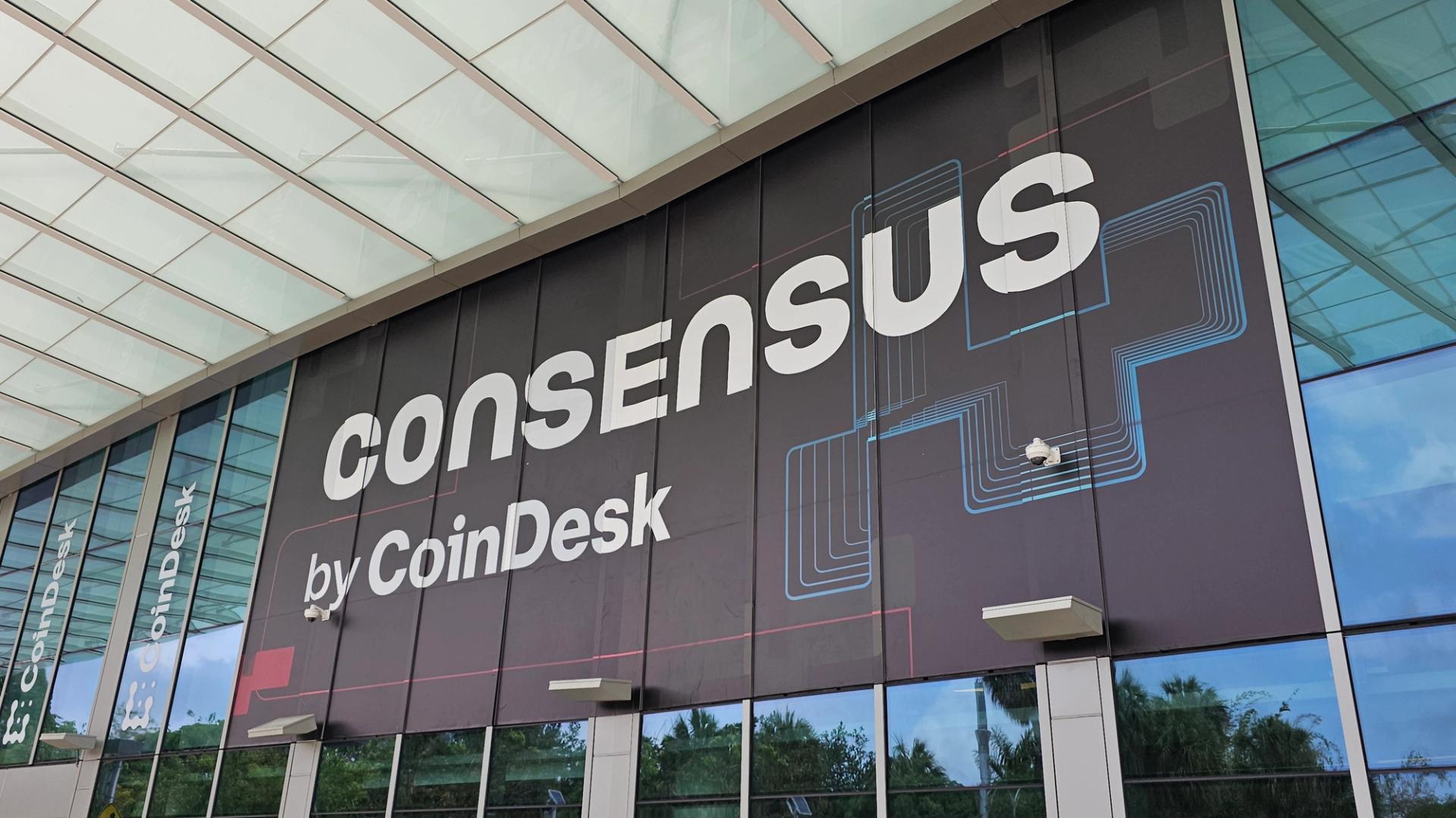
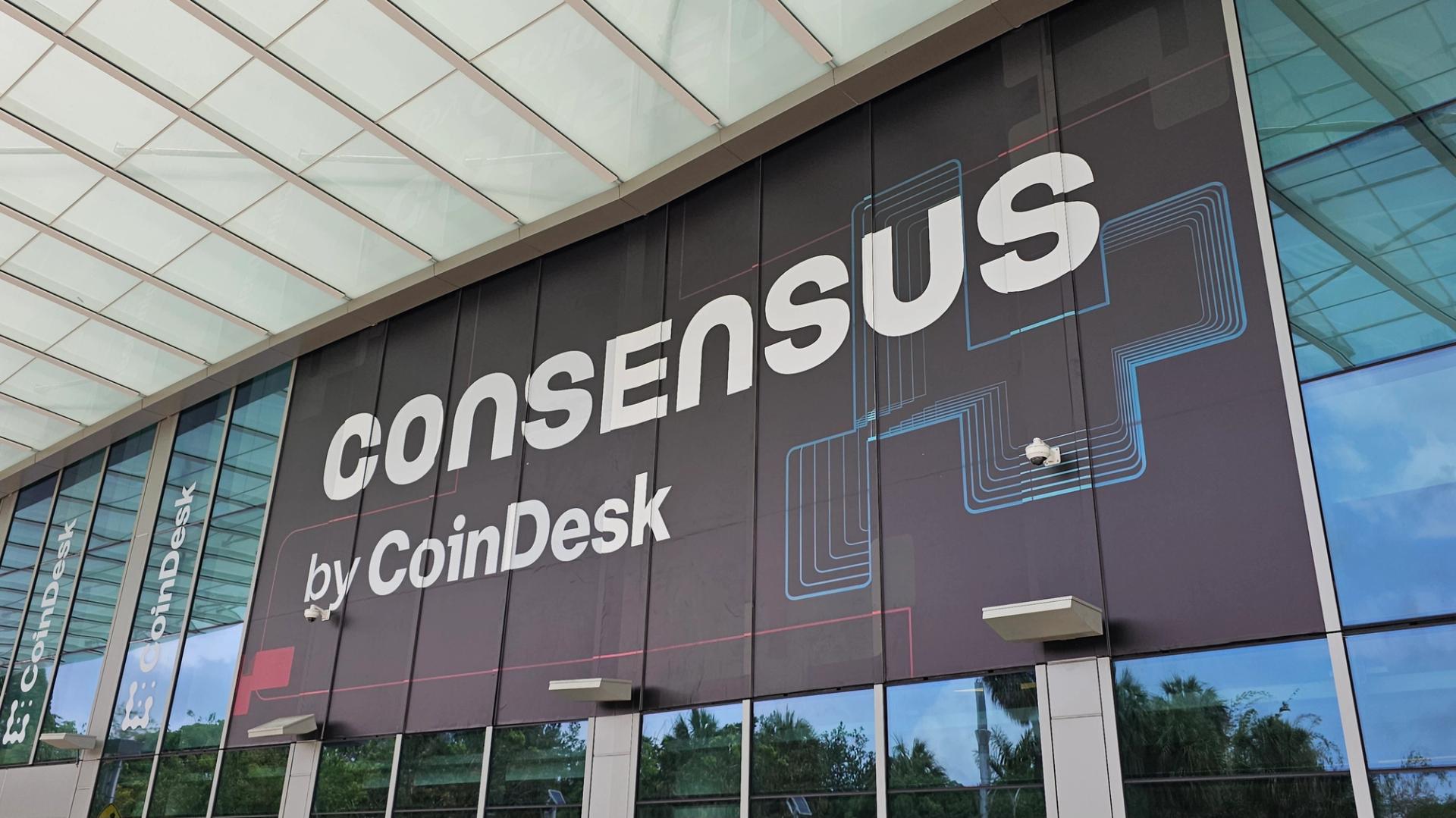
MIAMI BEACH, Fla. — CoinDesk’s flagship Consensus conference kicks off today at the Miami Beach Convention Center, bringing thousands of people together for the annual big-tent event to discuss the digital assets sector.
Day one of the conference will see local officials and startup executives lay out the state of the crypto world. Arthur Hayes, Lily Liu, Jesse Pollak, Anatoly Yakovenko, Mike Cagney, Brad Garlinghouse and more will present keynotes or take place in firesides to open the conference, weighing in on everything from the current macroeconomic environment to the future of AI tooling to the growth of decentralized finance. Keep an eye on this liveblog for updates throughout the day.
On the policy front, CoinDesk will see discussions about the U.S. Department of Justice’s fight against developers of mixers and hear from Congressional staffers about how exactly crypto-specific legislation is being written. Congressman Steven Horsford will discuss his effort to reform how the U.S. handles taxes around crypto transactions, while CFTC Chairman Michael Selig talks about his agency’s growing efforts to wrangle crypto and prediction markets.
Agentic payments, privacy tools and more familiar crypto tooling will — naturally — also see discussions throughout the day.
Tomorrow will also see CoinDesk host its Capital Markets Summit, bringing together traditional finance veterans with companies trying to bring these products onchain. A key theme at Consensus Hong Kong this past February was the growth of tokenization as a way for these long-established firms to build faster, more efficient tooling for their existing products. Is that trend real and will it continue? Come find out.
Tomorrow — and throughout the week — we’ll also have meetups for folks interested in different topics, like prediction markets or the midterm election, to connect with each other. Definitely take advantage of those; the Consensus Lobby has been one of the most-appreciated aspects of this event for the last decade, but now you can hang in a dedicated space for it instead of hoping for an empty corner in an actual lobby.
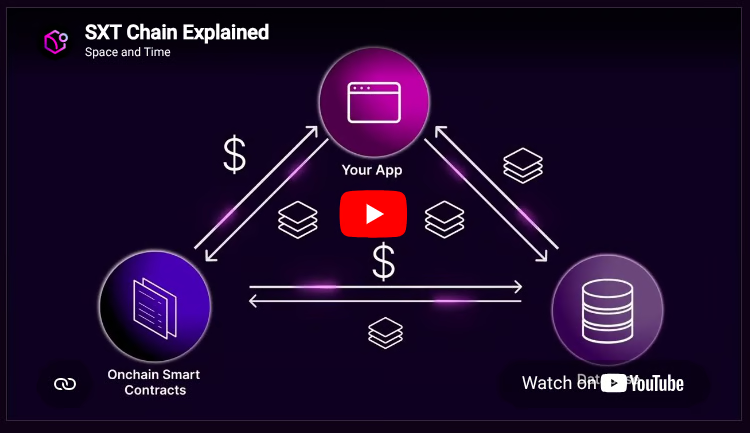
Space and Time (SXT), a level-1 data blockchain that secures onchain finance projects, has launched a virtual vault platform that it says is purpose-built for institutional lending.
The Microsoft-backed blockchain said on Tuesday that its new virtual vaults can be configured by institutional lenders and borrowers to their specific agreement, with cryptographically verified, continuously updated visibility into borrower collateral across the centralized exchanges and decentralized finance (DeFi) protocols where it actually sits.
Real-time verification of collateral has long vexed the institutional lending sector, with generic solvency metrics falling short of practical needs.
“We built Space and Time so both institutions and onchain protocols could verify the data they act on, and Virtual Vaults are the clearest expression of that yet. Institutional lenders need to see exactly what collateral backs a loan, exactly when they need to see it,” said Nate Holiday, co-founder of Space and Time and CEO of MakeInfinite Labs, in a statement shared with Cointelegraph.
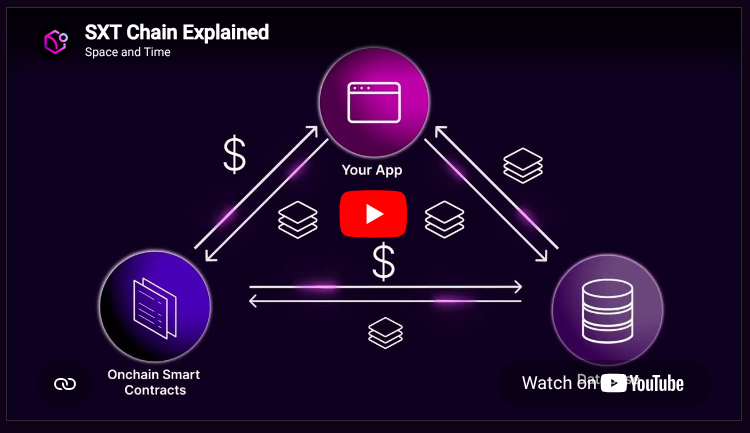
Screenshot of SXT Chain Explained. Source: YouTube
Each vault is configured to the specific terms of its lending agreement, that is, which venues to monitor, which assets qualify as eligible collateral and what thresholds trigger alerts, according to the statement.
Related: Fireblocks launches tool for institutions to earn yield on stablecoins
Virtual vaults extend the platform into onchain credit, bringing verifiable controls and reporting to the systems institutional lenders and borrowers actually need to operate at scale, the company said.
Microsoft made VC investment, then integrated SXT with Fabric intelligent data platform
M12, Microsoft’s venture capital arm, participated in Space and Time’s Series A funding round and led a 2022 strategic funding round, according to Token Terminal data.
SXT’s most recent round, in August 2024, raised $20 million from investors including Lightspeed Faction and Arrington Capital, brought the total to $50 million. A company spokesperson declined to comment on current financing plans.
Space and Time was integrated with Microsoft Fabric a year ago and was recently designated a Microsoft co-selling cloud solution. The software giant touts Fabric as an end-to-end “intelligent data platform” that its deployed across its cloud offerings.
Since then, the Space and Time Foundation has partnered with Southeast Asia’s Indomobil to onboard 50,000 students to the ecosystem. That program uses Space and Time to store proof of course completion and students pay for courses in SXT.
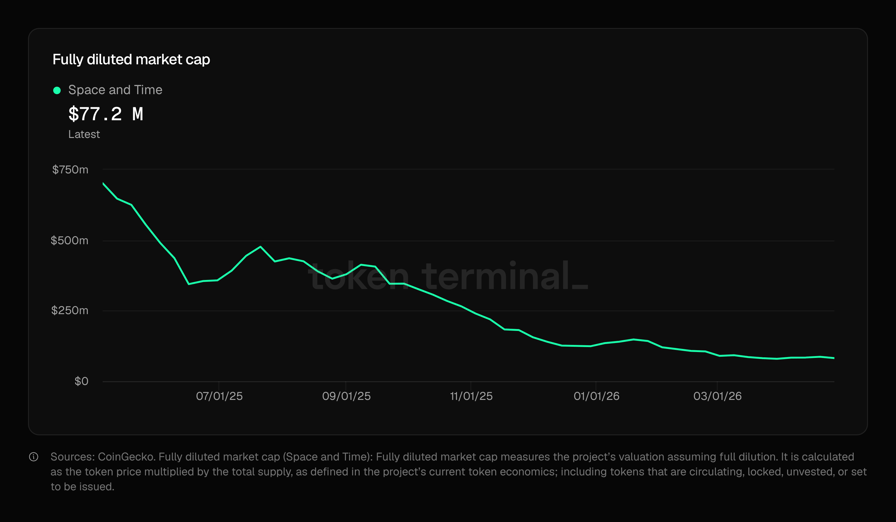
Space and Time (SXT) market cap over last 12 months. Source: Token Terminal
The blockchain’s native token, SXT, is deployed on multiple chains, including Ethereum and Base. At time of publication, CoinMarketCap data showed there were 368,350 token holders. SXT had a market cap of $21.92 million.
Magazine: Crypto wanted to overthrow banks, now it’s becoming them in stablecoin fight

Key Takeaways
- Shares of PayPal declined approximately 9% during premarket hours following first-quarter earnings results
- CEO Enrique Lores announced plans to achieve a minimum of $1.5 billion in gross run-rate cost reductions within 2-3 years
- Cost savings will be realized through artificial intelligence implementation, process automation, and organizational restructuring
- First-quarter adjusted earnings per share of $1.34 exceeded analyst expectations of $1.27; revenue of $8.35 billion also surpassed projections
- Second-quarter outlook disappointed investors, with adjusted earnings per share projected to decline approximately 9%
PayPal shares were changing hands at $45.77 during premarket trading on Tuesday, representing a decline of roughly 9.2%, following the release of first-quarter financial results and the announcement of an extensive cost-reduction initiative under new executive leadership.
CEO Enrique Lores, who assumed his position in March following the departure of Alex Chriss, acknowledged that PayPal has insufficiently invested in its technology infrastructure and is lagging behind competitors. His solution: streamline operations, accelerate AI implementation, and concentrate the company’s strategic focus.
“PayPal needs to focus,” Lores stated. “We need to recommit to the fundamentals.”
Lores brings experience from HP, where he established a reputation for operational efficiency and strategic pivots toward artificial intelligence and subscription-based models. He’s now implementing comparable strategies at PayPal.
The initiative targets a minimum of $1.5 billion in gross run-rate cost reductions over the coming two to three years. PayPal intends to reinvest these savings into growth initiatives and to mitigate operational challenges.
The company has not disclosed specific headcount reduction figures, but the transformation will include eliminating “duplication and layers” throughout the organizational structure. Enhanced deployment of AI and automation across business operations represents the other primary strategy.
During this year and next, the organization will restructure teams and implement new operational systems and procedures. This represents a comprehensive transformation rather than incremental adjustments.
First Quarter Performance Exceeds Expectations, But Forward Guidance Disappoints
Revenue for the first quarter reached $8.35 billion, increasing from $7.79 billion in the comparable period last year, and exceeding analyst consensus estimates of $8.05 billion.
Adjusted earnings per share reached $1.34, surpassing the consensus forecast of $1.27. However, GAAP net income decreased to $1.11 billion, or $1.21 per share, compared to $1.29 billion, or $1.29 per share, during the same quarter of the previous year.
Transaction margin dollars—a critical profitability indicator—increased 3% to $3.8 billion. Total payment volume expanded 11% to $464 billion.
The positive earnings and revenue performance proved insufficient to counterbalance subsequent guidance concerns.
Second Quarter Projections Pressured Share Price
For the second quarter, PayPal projected adjusted earnings per share to decline by approximately 9%, representing a high single-digit percentage decrease. Transaction margin dollars are anticipated to decrease roughly 3%.
For the complete fiscal year, the company maintained its forecast for adjusted earnings per share growth ranging from a low single-digit decline to marginally positive.
This conservative outlook prompted a negative market response, signaling that investors had anticipated stronger projections.
Organizational Transformation Into Three Operating Segments
Last week, PayPal announced a reorganization into three distinct business units: Checkout Solutions & PayPal, Consumer Financial Services & Venmo, and Payment Services & Crypto.
Lores identified checkout capabilities as his primary strategic focus. He also recognizes expansion opportunities in buy now, pay later services as consumers increasingly demand flexible payment alternatives.
The board of directors appointed Lores specifically due to dissatisfaction with “the pace of change” under previous leadership. PayPal’s checkout division had experienced decelerating growth following the post-pandemic period.
PayPal’s restructuring announcement coincided with Coinbase revealing approximately 14% workforce reductions, and followed Block’s February decision to implement similar cuts. All three companies cited artificial intelligence capabilities as a primary driver for the workforce adjustments.
Transaction margin dollars grew 3% to $3.8 billion during the first quarter, while total payment volume reached $464 billion, representing an 11% year-over-year increase.

McLaren Will Return to Le Mans with the Mighty MCL-HY

Congrats Everyone: U.S. Now Ranked 64th In Global Press Freedom

Marcus Rashford sends message to Man United after Champions League return confirmed

Manchester United reach agreement with Casemiro over contract clause amid transfer speculation

US brings back mandatory military draft registration

Steven Gerrard disagrees with Gary Neville over ‘shock’ Chelsea and Arsenal claim | Football


-

 Business7 days ago
Most Commercial Energy Audits Miss the Real Losses
-

 NewsBeat2 days ago
Channel 5 – All Creatures Great and Small series 7 new post
-

 Fashion7 days ago
Kylie Jenner’s KHY Enters a New Era with ‘Born in LA’
-
 Tech4 days ago
Trump’s 25% EU auto tariff breaches Turnberry Agreement that also covers semiconductors and digital trade
-
 Sports4 days ago
Paul Scholes issues Marcus Rashford reality check as agreement emerges over Man United star
-

 Business6 days ago
Barclay Brothers Avoid Bankruptcy: HSBC Drops High Court Petitions After IVA Deal
-
 Business6 days ago
Tesla Officially Registers Elon Musk’s Stock: What Investors Need to Know
-

 Tech6 days ago
Texas Instruments made a new flagship graphing calculator: the TI-84 Evo
-

 Business5 days ago
Two Powerball Tickets Split $143 Million Jackpot in Indiana and Kansas
-

 Entertainment5 days ago
Celebrities Who Are Attending the 2026 Met Gala Event
-
Business2 days ago
Winning Numbers Drawn as Jackpot Resets to $20 Million
-
 Crypto World6 days ago
Securitize and Computershare Enable Tokenized Equity Issuance for Over 25,000 U.S.-Listed Stocks
-

 Entertainment6 days ago
Insider Claims Reason Behind Key & Peele Split
-
 Crypto World5 days ago
CoreWeave (CRWV) Stock Climbs 8% Despite $45M Insider Share Dump
-

 Entertainment4 days ago
Met Gala 2026 Rumored Guest List Is Turning Heads
-

 Crypto World6 days ago
Gibraltar Proposes Tokenized Funds Regulation to Bolster Compliance
-

 Business7 days ago
Alexandria Real Estate Equities, Inc. (ARE) Q1 2026 Earnings Call Transcript
-

 Crypto World6 days ago
Meta (META) starts stablecoin payout to creators in Circle’s USDC on Polygon, Solana via Stripe
-

 Fashion3 days ago
Mary J. Blige Vegas Residency Looks: Crystal-Embellished Fjolla Haxhismajli, Todd Fisher, and More!
-

 Business6 days ago
Strait of Hormuz Remains Heavily Restricted on April 29 Amid Iran Conflict
You must be logged in to post a comment Login